




Abstract
In the context of women’s increased economic status coupled with declining divorce rates, the “gender revolution framework” suggests that greater gender equality in the division of labor has contributed to the stability of contemporary marriages. Yet recent research on this topic is not in consensus that this is the case. This study uses the Panel Study of Income Dynamics to test the hypothesis that progress toward gender egalitarianism, and associated changes in the relationship between the division of labor and divorce, is bifurcated across levels of education in the highly stratified United States. The results indicate modest support for the idea that the college educated have been vanguards of the progression of the gender revolution, but also that different forms of gender egalitarianism may have emerged across groups. Among college-educated couples, gender egalitarian and gender-specialized arrangements have similar risks of divorce in recent years, in line with an egalitarian essentialist perspective. Among less educated couples, results suggest that progress toward gender equality in paid labor may reflect economic need rather than shifting gender norms. Together, these findings illustrate how structural and cultural changes in the organization of work and family life have played out differently across levels of education.
This study draws upon the gender revolution framework, which links changes in women’s and men’s gendered dynamics to changes in marital stability over time (Esping-Andersen and Billari 2015; Goldscheider, Bernhardt, and Lappegård 2015), to shed light on an ongoing empirical debate regarding the changing relationship between a couple’s division of labor and marital dissolution. Although research is generally in consensus that traditional male-breadwinning arrangements lowered divorce risk in the mid- to late twentieth century (Bellani and Esping-Andersen 2020; Brines and Joyner 1999; Killewald 2016; Schwartz and Gonalons-Pons 2016), there is less consensus as to whether gender specialization or gender egalitarianism 1 is important for contemporary marital stability. Some studies find that economic equality between partners is no longer a risk factor for divorce (Schwartz and Gonalons-Pons 2016) and may even stabilize marriages (Bellani and Esping-Andersen 2020; Schwartz and Han 2014), in line with the predictions of the gender revolution framework (Esping-Andersen and Billari 2015; Goldscheider et al. 2015). However, others have found that women’s higher relative earnings (Brines and Joyner 1999; Eads, Tach, and Griffin 2023; Teachman 2010) or their full-time employment status increases the risk of divorce, while husbands’ full-time employment lowers it (Gonalons-Pons and Gangl 2021; Killewald 2016; Killewald, Lee, and England 2023), suggesting the durability of marriage as a “gendered institution.” To reconcile across these disparate findings, this study examines couples’ educational attainment as a crucial, but often overlooked, potential moderator of these associations, asking, “How is the division of paid and unpaid labor associated with divorce within and across levels of education over time?”
Educational attainment operates as both a cultural and structural influence on family life (Coontz 2016; Pampel 2011). As a cultural influence, higher education tends to have a liberalizing effect on attitudes (Campbell and Horowitz 2016). Indeed, the college educated led the adoption of more egalitarian attitudes regarding gender dynamics (Cunningham 2008; Pampel 2011), as well as gender egalitarian behaviors (Pessin 2024). As a result, some scholars suggest that the gender revolution has primarily been advanced by the college educated in the United States (e.g., Cherlin 2016; Esping-Andersen and Billari 2015; Pampel 2011). A cultural perspective would suggest that gender egalitarianism has become increasingly negatively associated with divorce over time, but that this shift occurred earlier and more rapidly among college-educated couples. Alternatively, the structural constraints associated with lower levels of education, such as employment precarity or financial instability, may require that less educated couples adopt dual-earning arrangements out of economic necessity (Edwards 2001; Oppenheimer 1997; Usdansky 2011). A structural perspective implies that dual-earning will primarily become negatively associated with divorce over time among less educated couples rather than college-educated couples. However, it is less clear if this trend would extend to housework, if dual earning is a function of economic need rather than changing preferences for gender egalitarianism.
Education has been underexplored as a moderator of the changing associations between the division of labor and divorce. The one study that did consider educational differences (Schwartz and Gonalons-Pons 2016) found more support for a structural influence of education: they observed a declining association between women’s higher relative earnings and divorce risk among couples with less educated wives (having some college or less), but not couples with college-educated wives. However, this study did not consider dual-earning couples as a separate group from those where the wife outearned the husband (and vice versa), 2 nor did they include indicators of unpaid labor, both necessary comparisons to fully test the gender revolution framework (Goldscheider et al. 2015). To add to our understanding of how educational attainment may have patterned the progression of the gender revolution in the highly stratified United States, this study considers how paid and unpaid labor, and their intersection, are associated with divorce risk within and across levels of education over three marital cohorts.
Background
The Two Halves of the Gender Revolution
Most Western countries have shifted away from a gender-specialized model of family organization to one that is more gender egalitarian as a result of a two-phased change in gendered dynamics, often referred to as the “gender revolution” (England 2010; Esping-Andersen and Billari 2015; Goldscheider et al. 2015). The first phase, which began around the 1960s and is largely complete in many developed countries, involves women’s greater participation in the public sphere. In the United States, women make up just under half of the labor force (Bureau of Labor Statistics 2021), attain college degrees at higher rates than men (DiPrete and Buchmann 2013), and have become increasingly likely to be equal or primary financial contributors to their households (Ruggles 2015). However, without accompanying changes in gender norms nor men’s increased contributions to domestic responsibilities, women’s increased economic independence is thought to initially destabilize family life. This destabilizing effect aligns with the declining marriage and fertility rates and rising divorce rates observed at the middle to the end of the twentieth century (Esping-Andersen and Billari 2015; Goldscheider et al. 2015), as well as historical evidence regarding men’s and women’s economic status and divorce (Brines and Joyner 1999; Nock 2001; Ruggles 1997).
The second half of the gender revolution involves men’s greater participation in housework and childcare. This should allow women to more easily balance work and family responsibilities, thus leading to a reversal of the previous destabilization of family life as well as a change in the association between the division of labor and divorce. The gender revolution framework predicts that, once egalitarian gender dynamics have become sufficiently prevalent, couples who equally divide economic and household labor should be more likely to marry and less likely to divorce (Esping-Andersen and Billari 2015:24; Goldscheider et al. 2015, 213). However, in the United States, this second half of the gender revolution has seemingly stalled. Men’s time spent on family care, especially housework, rose from 1965 until 1998, but their contributions have declined since (Sayer 2016), although recent research suggests a modest narrowing of the gender gap in unpaid labor (Milkie et al. 2025). Attitudes regarding gender dynamics also reflect a stall: although acceptance of working women has grown, norms around men solely as economic providers, rather than caretakers, have been slower to change and have possibly become more traditional since the mid-1990s (Dernberger and Pepin 2020; Pepin and Cotter 2018).
Findings regarding the associations between the division of paid labor and divorce reflect this stall. Although some studies show that women’s relative economic status no longer increases the risk of divorce (Bellani and Esping-Andersen 2020; Schwartz and Gonalons-Pons 2016; Schwartz and Han 2014), others still reveal a positive association (Eads et al. 2023; Killewald 2016; Killewald et al. 2023). This suggests that the norms underpinning marriage as a “gendered institution” have not fully eroded (Killewald 2016; Sayer et al. 2011). Research on the division of housework is sparse, but there is some evidence that women’s contributions to housework no longer decrease the risk of divorce (Killewald 2016) and that similarity in housework hours may instead increase marital stability (Bellani and Esping-Andersen 2020). However, the division of unpaid labor, and perhaps more importantly, the combined division of paid and unpaid labor, remains underexplored in its associations with marital dissolution. If men’s equitable participation in housework is a necessary condition for the completion of the gender revolution, this is an important oversight.
A Bifurcated Gender Revolution?
It is possible that the gender revolution has not occurred uniformly across the population in a highly stratified country like the United States; social stratification is a key moderator of the speed of the diffusion of the gender revolution (Esping-Andersen and Billari 2015). Social class could serve as a moderator because of its cultural connotations—if normative support for gender egalitarianism was reached earlier among certain groups—or because of its structural connotations, by shaping the costs, benefits, and other incentives associated with adopting a certain division of labor (Pampel 2011). Whether social class primarily works via its cultural or structural influence yields different predictions as to how a couple’s division of labor is associated with marital dissolution across groups and over time.
A cultural perspective suggests that the division of labor is associated with divorce because of the gendered cultural meanings attached to behaviors like paid work and housework (West and Zimmerman 1987). Adopting a division of labor that is misaligned to gendered behavioral expectations may lead to conflict, dissatisfaction, and/or social sanctions—what Gonalons-Pons and Gangl (2021:466) collectively termed “gender social stress”—that may culminate in divorce (Bellani and Esping-Andersen 2020; Killewald 2016; Sayer et al. 2011). The division of labor deemed most acceptable or desirable, and thus is most associated with marital stability, likely differs both over time and between levels of education. The college educated have consistently held more gender egalitarian preferences than those with less education, although these differences may have narrowed as a result of diffusion (Cunningham 2008; Meagher and Shu 2019; Pampel 2011). Gendered behaviors such as women’s labor market participation (Aaronson et al. 2014; England 2010) and men’s housework time (Sayer 2016) also suggest greater progress toward gender egalitarianism over time among those with higher education. More egalitarian gender dynamics coupled with increasing marital stability among the college educated have led to speculation that this population has led the gender revolution in the United States. For example, Cherlin (2016), commenting on Esping-Andersen and Billari’s (2015) and Goldscheider et al.’s (2015) theoretical work on the gender revolution, stated, “We did not foresee that young women and men with university educations would construct a new model of an egalitarian, dual-earner marriage in which the probability of divorce would be substantially lower. But that is what ensued” (p. 127). Yet we lack sufficient empirical evidence showing that the probability of divorce has become lower for egalitarian couples, especially among those with college degrees.
This is important, as education may operate on these associations in an alternative way. An economic or structural perspective on the gendered division of labor and divorce suggests that couples divorce if the costs (benefits) of remaining married are higher (lower) than the costs of being single (Becker 1981; Becker, Landes, and Michael 1977). The gendered division of labor that a couple adopts may directly influence these costs and benefits. In the mid-twentieth century, when women were less likely to be working for pay outside of the home (Ruggles 2015), a traditionally specialized arrangement—the husband focusing on paid work and the wife focusing on unpaid work—was thought to be most beneficial for marital stability (Becker et al. 1977). However, as women’s increased labor market participation was followed by labor market polarization (Autor, Katz, and Kearney 2006; Jacobs and Gerson 2004; Kalleberg 2011) and changing norms regarding involved parenting (Jacobs and Gerson 2004; Milkie, Robinson, and Bianchi 2006), the most efficient gendered division of labor may have diverged across levels of education and over time. Among highly educated couples, the increasingly long hours associated with professional jobs (Cha 2010) and expectations regarding “intensive parenting” (Blair-Loy 2009; Hays 1996; Lareau 2011) may have reduced the feasibility of a gender egalitarian division of labor. In an era of multiple competing demands on time, gender specialization may more effectively reduce work-family conflict—and divorce risk—among these couples (Daminger 2020; Stone 2007), especially if this is perceived to be an alternative to women taking on the “second shift” (Hochschild and Machung 1989). Highly educated men are better positioned than less educated men to financially sustain their households with just one income (Binder and Bound 2019; Winkler 1998), thus mitigating the financial risk of a gender specialized arrangement.
On the other hand, the polarization of the labor market and growth in wage inequality since the late 1970s has led to underemployment and declining wages among working- and middle-class men that may have necessitated that both partners be in the labor market (England 2010; Jacobs and Gerson 2004; Schwartz and Gonalons-Pons 2016). As a result, dual earning may have become more effective at reducing marital instability among these couples because this arrangement reduces financial strain (Killewald 2016; Schwartz and Gonalons-Pons 2016). However, it is possible that this negative association with divorce will not extend to the sharing of housework. Ideological attachment to the male-breadwinning norm remains higher among those with less education, particularly men, whose attachment may have even strengthened in direct response to their declining labor market opportunities (Demantas and Myers 2015; Legerski and Cornwall 2010; Sherman 2017). Therefore, working-class men who rely more on their partner financially may be even more resistant to sharing unpaid labor as a way of “doing gender” (Bittman et al. 2003; Brines 1994; Rao 2021). Women’s primary housework contributions, especially if they are also full participants in the labor market, might serve to neutralize “gender deviance” (Greenstein 2000), thus reducing gender social stress, and ultimately, the risk of divorce.
Despite the large body of research examining how the division of labor is associated with divorce, this author only knows of one study that has considered whether educational attainment moderates this association. Schwartz and Gonalons-Pons (2016) found that wives’ relative earnings (of at least 50 percent) have become less destabilizing for marriage over time, but only among wives without a college degree. Among couples with college-educated wives, divorce risk was higher when the wife outearned her husband, even in marriages formed after 1990. Schwartz and Gonalons-Pons interpreted these findings in the context of labor market polarization and increased economic precarity among working- and middle-class men, suggesting that wives’ earnings contributions are useful for marital stability out of greater economic necessity. This interpretation aligns better with a structural perspective on the division of labor and divorce. However, as this study did not include unpaid labor, we still lack an understanding as to how the division of unpaid labor, independently and in combination with paid labor, is associated with divorce risk within levels of education.
The aim of the present study is to expand upon the strengths of this and other relevant prior research (e.g., Bellani and Esping-Andersen 2020; Bellani, Esping Andersen, and Pessin 2018; Killewald 2016) to shed light on whether the progression of the gender revolution has been bifurcated in the United States. My first contribution is that I consider several measures of the division of labor, including paid labor, unpaid labor, and their combination. In the context of a two-part gender revolution, it is necessary to include measures of both to fully test the predictions of the gender revolution framework (Esping-Andersen and Billari 2015; Goldscheider et al. 2015). My second contribution is that I consider how the associations between the division of labor and divorce have changed over historical time within and across different levels of education. Although I cannot causally adjudicate whether education primarily operates culturally or structurally, these findings will provide crucial insight regarding how education has shaped progress toward gender equality in and out of the home in a highly stratified context such as the United States.
Data and Methods
Data and Sample
I use the Panel Study of Income Dynamics (PSID) through 2019, a commonly used dataset for examining the relationship between a couple’s division of labor and marital dissolution. The PSID is a longitudinal household survey that collects information on individuals and households related to economic factors, relationships, health, and more. In 1968, 5,000 families in the United States were selected to participate; since then, the study has collected information on those households and their descendants, following individuals even if they move to a different household. Respondents were interviewed annually until 1997, after which interviews became biennial. The PSID was nationally representative of the population as of 1968, not necessarily of the population today. “Refresher” populations have been added at various time points to reflect immigration, but they have not always been tracked for an extensive amount of time; I include only those samples followed continuously over time (added primarily in 1997 and 1999). Although my results mostly capture the experiences of those racialized as White or Black, adding a suitable set of control variables yields sufficient population-level estimates (Lillard and Panis 1998; Schwartz and Han 2014).
Because I am interested in the division of labor, following others, I restrict my sample to the working-age population: those aged 18 to 55 years (Bellani and Esping-Andersen 2020; Killewald 2016). I focus only on first marriages as remarriages tend to be less stable and may have different predictors of dissolution. I restrict to marriages started in 1970 and later. The PSID did not start collecting retrospective marital histories until 1985, so some couples who entered the PSID already married lack information about their date of marriage and union duration, making it difficult to reliably measure if and when a couple became newly married until after 1969. The 1970s are a useful starting marital cohort as this is shortly after the gender revolution is thought to have started (England 2010). To avoid truncating marriages at very short durations (following Schwartz and Gonalons-Pons 2016), I consider marriages formed through 2014, five years before the last survey wave. My analysis is dyadic, so couple-years are my units of analysis. I drop the record of the partner with the higher cross-wave PSID identifier, so I retain only one record per couple per year. I use listwise deletion to drop couples with missing values on any independent or control variables (<5 percent of couple-years) as well as the small number of couples who record no earnings or hours of housework in a given wave (~1 percent of couple-years). With these restrictions, my final sample consists of 6,576 couples with 55,169 couple-years of data.
Measures
My outcome variable is marital dissolution, including both separation and divorce. 3 I primarily constructed this variable using the marital history information collected by the PSID, which provides start and end dates for all of a respondent’s marriages. For individuals for whom no marital history was collected (primarily those who married before 1985; <2 percent of couples), I used change in their marital status between survey waves to indicate a dissolution. Couples are censored if they are still married by the latest survey year, attrit out of the survey, if one partner becomes widowed, or either partner turns 55.
My key independent variable is the couple’s division of labor. For paid labor, I categorize couples according to their annual earnings. For unpaid labor, I categorize couples on the basis of weekly housework hours, or “time spent cooking, cleaning, and doing other work around the house.” There are many ways to operationalize the division of labor, especially when it comes to a measure of egalitarianism—the arrangement of key theoretical interest—and prior research has taken a diversity of approaches. Many scholars suggest that a range of 40 to 60 percent of total work output best captures equal sharing, given that a true 50/50 split of labor is rarely achievable (Esping-Andersen et al. 2013; Grow and Van Bavel 2020; Nock 2001). Following Esping-Andersen et al. (2013), my primary variables are categorical so I can differentiate among (1) egalitarian arrangements, in which both partners contribute 40 to 60 percent of a given type of labor; (2) traditional arrangements, in which the husband is doing at least 60 percent of paid labor and/or the wife is doing at least 60 percent of unpaid labor; and (3) counter-traditional couples, in which the wife is doing at least 60 percent of paid labor and/or the husband is doing at least 60 percent of unpaid labor. These latter two categories capture two alternative theories associating the division of labor to divorce: the microeconomic theory of household specialization (Becker 1981), which is inherently gender neutral with regard to which partner specializes in which type of labor, and the gendered institutions perspective, which brings in gender culture to suggest that only a traditionally gendered form of specialization will increase marital stability given historical gender norms (Killewald 2016; Sayer et al. 2011). For comparability to relevant prior research (e.g., Killewald 2016; Schwartz and Gonalons-Pons 2016), I also include a continuous indicator of women’s percentage share of paid and unpaid labor. Supplementary Table S5 considers additional indicators of the division of labor that have been used by prior research.
I first consider paid and unpaid work separately to account for the differential rates of progress toward gender equality in these two domains. I then consider an indicator of the combined division of paid and unpaid labor to compare fully egalitarian couples to fully traditional couples as well as those only sharing paid labor; this allows me to better understand if the effects of women’s economic contributions are conditional on men’s participation in housework. Categories are adapted from prior research (DeRose et al. 2019; Pessin 2024), as well as guided by theory. Couples are considered (1) “egalitarian” if they both contribute 40 to 60 percent to earnings and housework (this is the arrangement predicted to be most stable by the gender revolution framework); (2) “her second shift” if they are equal contributors to paid labor, but she does the majority (≥60 percent) of the housework (this arrangement captures the stalled second half of the gender revolution [Hochschild and Machung 1989]); (3) “traditional” if he is the breadwinner, while she does the majority of the housework (Becker 1981; Killewald 2016); and (4) “counter-traditional” if she is the breadwinner and he does the majority of the housework. These categories are the most theoretically relevant. However, I also create several residual categories based primarily on paid work: couples are considered to be (5) “underworked” if neither partner works more than part-time (financial instability is a strong predictor of divorce [e.g., Killewald et al. 2023]; this also emerged as a unique work-family arrangement in Pessin [2024]); (6) “all other female breadwinning” if she is the primary provider and they either share housework or she does the majority; women outearning men is still seen as uniquely threatening for marital outcomes (Eads et al. 2023; Kowalewska and Vitali 2024; Schwartz and Gonalons-Pons 2016); and (7) a final “other” residual category for divisions of labor that do not fit into any of the aforementioned categories. These categories are largely derived from interactions between my categorical indicators of paid and unpaid labor, but Supplementary Table S5 includes results from a simple interaction of those variables.
I use a couple’s level of education as my key stratifying variable, based on the attainment of a bachelor’s degree, which is the clearest dividing line for both family trends and progress toward gender equality (Cherlin 2020; Furstenberg 2014). Couples can vary in their educational attainment, that is, one partner can have a bachelor’s degree while the other does not. I focus on a comparison between couples where neither partner has a bachelor’s degree and couples where at least one partner has a degree for two reasons. First, prior research has shown that just one partner having a college degree is sufficient to differentiate outcomes on the basis of education (McErlean 2024; Trimarchi and Van Bavel 2017). Second, the relatively uncommon nature of divorce coupled with the changing educational composition of couples, and associated divorce risks (Schwartz and Han 2014), over time prohibits a detailed comparative analysis based on which partner holds the college degree. Supplementary Table S6 provides preliminary findings based on more detailed couple-level education, but I urge caution in drawing strong conclusions from these data as the number of divorces in some combinations of marital cohort and couple-level education are quite small (e.g., <20).
Finally, I compare three marital cohorts: (1) those married between 1970 and 1979, a time period that corresponds to both women’s growing economic independence (England 2010) and rising divorce rates (Martin and Bumpass 1989); (2) those married between 1980 and 1989, the period in which the reversal of divorce rates began (Kennedy and Ruggles 2014); and (3) those married after 1990. I choose 1990 as the final cutoff for one theoretical reason and one practical reason. Theoretically, the 1990s align with the timing of the stalling of the “gender revolution” in terms of gender attitudes (Cotter, Hermsen, and Vanneman 2011; Pepin and Cotter 2018), women’s employment rates (England 2010), and men’s time spent on housework (Sayer 2016). Practically, although I control for marital duration, splitting the 1990s cohort even further shortens the time window in which couples can divorce, so the number of divorces in later marital cohorts is relatively small and captures those who divorce in the early years of marriage.
Analytical Approach
My analysis has two goals to comprehensively address the question of whether the gender revolution has been bifurcated in the United States: (1) examine how the division of labor is associated with divorce over time within levels of education and (2) examine differences in the associations between the division of labor and divorce across levels of education in each cohort. To accomplish these goals, I use discrete-time event-history analysis to predict a couple’s risk of marital dissolution on the basis of their division of paid and unpaid labor. These measures vary with time and predict marital dissolution by the subsequent survey year. Results are first presented for the total sample to provide a comparison point to prior research, then stratified by the couple’s level of education. Results are presented in terms of average marginal effects (AMEs) and predicted probabilities to facilitate the interpretation of interaction effects and the comparison of effects across models, which is not possible with odds ratios (Mize 2019; Mize, Doan, and Long 2019; Mustillo, Lizardo, and McVeigh 2018). Marginal effects capture the change in the predicted probability of marital dissolution given a change in the independent variable of interest, holding all other variables at their observed values. AMEs, then, represent the average of this change across all observations. 4 To estimate the changing association between the division of labor and divorce over time, the division of labor is interacted with marital cohort. Wald tests compare AMEs across marital cohorts within levels of education to test if the association between a given variable and divorce has significantly changed over time (goal 1). Wald tests also compare AMEs between levels of education within a given marital cohort to test if the association is significantly different across groups (goal 2).
Time is measured using a series of dummy variables designating couple’s marital duration in years, allowing maximum flexibility in the association between union duration and dissolution. 5 Data are in long format, so couples contribute one observation per survey wave (recoded as marital duration relative to relationship start date) until they are either censored or dissolve. All models include controls for factors that have been found to be associated with marital dissolution, including age at marriage and age at marriage squared of both partners, the race of the husband, whether their partner is the same race, the education composition of the couple, whether either partner is enrolled in school, whether the couple owns their home, region of residence, premarital cohabitation (separate indicators for cohabitation with current spouse and cohabitation with another partner), whether either partner’s first birth was premarital, and the couple’s total number of children. Because the PSID changed its interview cadence in 1997 from annual to biennial, I also include a dummy variable indicating the time between interviews to account for the fact that measurement timing between my independent variables and divorce may differ between earlier and later waves of the PSID. Finally, I include total couple earnings (logged) to isolate the effect of the division of labor on divorce from the effect of a couple’s total level of resources. Because the use of survey weights is debated in regression analysis as long as the key variables used to construct weights are controlled for (Winship and Radbill 1994), I present weighted descriptive statistics, but all regression analyses are unweighted.
Each indicator of the division of labor is estimated in its own model, but I consolidate all results into the same figure or table. Full model results with control variables are presented in odds ratios in Supplementary Tables S1 to S3, and the underlying predicted probabilities for the AMEs are in Supplementary Table S4.
Results
Descriptive Trends
Table 1 shows weighted descriptive statistics, comparing across time and levels of education. The division of labor has become more egalitarian over time in the total population: more couples share paid (29 percent in the 1990s vs. 19 percent in the 1970s) and unpaid labor (27 percent vs. 17 percent) today and traditional arrangements declined in prevalence from more than 50 percent of the population in the 1970s to 41 percent in the 1990s. There has also been an increase in the college-educated share of married couples; couples where one partner has a college degree now make up just over half of all married couples, up from just over one third in the 1970s.
Weighted Descriptive Statistics, Stratified by Marital Cohort and Level of Education.

There are also differences in the division of labor across levels of education; college-educated couples are more egalitarian, although differences are smaller for paid labor than for unpaid labor. In the most recent marital cohort, 31 percent of college-educated couples were in a dual-earning arrangement compared with 28 percent of less educated couples. Thirty-one percent of college-educated couples also shared housework in the 1990s, but that was the case for only 22 percent of less educated couples. The growth in fully egalitarian arrangements has also been modestly larger for the college educated: the number of egalitarian couples more than doubled over time for this group, while the rate of change was only 75 percent among less educated couples. Finally, to compare divorce rates over time between levels of education, I calculated annual predicted probabilities of divorce controlling for marital duration and all other control variables, which are displayed in Figure 1. Divorce rates rose much more rapidly between the 1970s and 1980s among less educated couples and have remained high, while divorce rates have declined since the 1980s among college-educated couples. These trends align with other findings regarding the widening gap in divorce risk across levels of education over time (McErlean 2021; Raley and Bumpass 2003).

Predicted probability of divorce by level of education interacted with marital cohort.
The Division of Labor and Divorce among the Total Sample
I first discuss the results for the total sample to more easily compare with prior research. Figure 2 shows AMEs and confidence intervals for the different measures of the division of labor across marital cohorts, while Table 2 shows results from Wald tests determining the significance of changes across cohorts. In the early cohorts, having a traditional division of paid labor lowered divorce risk: male-breadwinning couples had a lower risk of divorce relative to dual-earning couples in the 1970s (AME = −.0103, p = .007) and 1980s (AME = −.008, p = .06), while women’s higher relative earnings increased divorce risk in these same time periods. Although an AME of −.0103 may seem small, this translates into an approximately 25 percent lower probability of divorce in a male-breadwinning arrangement relative to a dual-earning arrangement in the 1970s. By the 1990s, the division of paid labor was not associated with risk of divorce, a cross-cohort change that was marginally significant (p = .08 for both male-breadwinning relative to dual-earning and for women’s share of earnings).

Average marginal effects and 95 percent confidence intervals by cohort across division of labor measures for total sample. BW = breadwinner; HW = housework.
Wald Tests Comparing Average Marginal Effects across Marital Cohorts, Total Sample.

Note: All models contain dummy variables for marital duration in years. All models control for age at marriage and age at marriage squared of both partners, the race of the husband, whether their partner is the same race, the education composition of the couple, whether either partner is enrolled in school, whether the couple owns their home, region of residence, premarital cohabitation (with current spouse or with another person), whether either partner’s first birth was premarital, the couple’s total number of children, total logged earnings, and survey interval (one or two years between survey wave). AME = average marginal effect.
*p<0.05, + p<0.10.
Women’s higher relative housework contributions also lowered the risk of divorce in the 1970s cohort (AME = −.0185, p < .001), but this effect became only marginally significant in the 1980s (AME = −.0153, p = .097) and disappeared by the 1990s. However, men’s majority contributions to housework increased the risk of divorce in all cohorts. Although traditional divisions of paid and unpaid labor were independently associated with divorce in early marital cohorts, differences between fully traditional (male-breadwinning with female-homemaking) and fully egalitarian couples (those sharing both paid and unpaid labor, the reference group) were not statistically significant in any cohort, although traditional couples had the lowest divorce risk in all cohorts (AMEs ranged from −.0051 to −.0111). The risk of divorce for traditional couples was, however, significantly lower than for “her second shift” and “all other female-breadwinning” couples in the 1970s and counter-traditional couples in the 1990s. Together, these results align with research that has found a weakening in the association between a traditional division of labor and divorce over time when individual indicators of paid and unpaid labor are considered (e.g., Bellani and Esping-Andersen 2020; Killewald 2016; Schwartz and Gonalons-Pons 2016). However, results also support the notion that the gender revolution has “stalled” (Cotter et al. 2011; England 2010). Despite this weakening over time, in no marital cohort is gender egalitarianism more beneficial for marital stability than gender specialization—the predicted end state of the gender revolution—regardless of which indicator is considered.
Is the Division of Labor Associated with Divorce Differentially across Levels of Education?
Figures 3 and 4 show AMEs on divorce for college-educated couples and non-college-educated couples, respectively. Table 3 shows results from Wald tests indicating the significance of within–education cohort change, while Figure 5 shows results from Wald tests for between-cohort differences in each cohort.
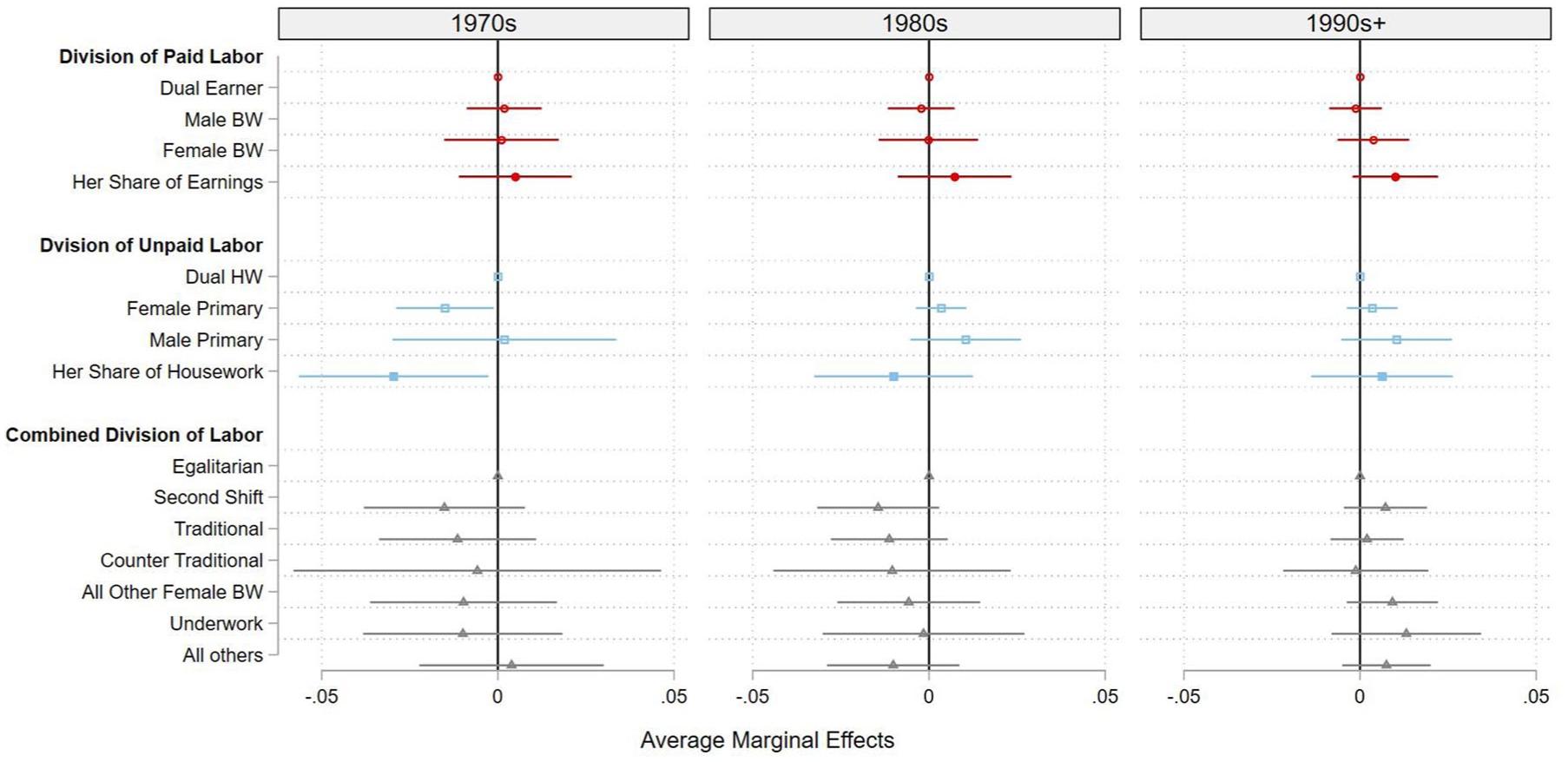
Average marginal effects and 95 percent confidence intervals by cohort across division of labor measures for couples where at least one partner has a college degree. BW = breadwinner; HW = housework.

Average marginal effects and 95 percent confidence intervals by cohort across division of labor measures for couples where neither partner has a college degree. BW = breadwinner; HW = housework.
Wald Tests Comparing Average Marginal Effects across Marital Cohorts, Split by Level of Education.

Note: All models contain dummy variables for marital duration in years. All models control for age at marriage and age at marriage squared of both partners, the race of the husband, whether their partner is the same race, the education composition of the couple, whether either partner is enrolled in school, whether the couple owns their home, region of residence, premarital cohabitation (with current spouse or with another person), whether either partner’s first birth was premarital, the couple’s total number of children, total logged earnings, and survey interval (one or two years between survey waves). AME = average marginal effect.
*p < 0.05, + p < 0.10.

Wald tests comparing average marginal effects (AMEs) across levels of education within marital cohorts. BW = breadwinner.
Starting with the division of paid labor, less educated couples were more likely than college-educated couples to divorce in nontraditional arrangements in the earliest marital cohort, but these differences have disappeared over time. For example, the difference in AMEs (AMEcollege − AMEnoncollege) for male-breadwinning relative to dual-earning was .0172 in the 1970s (p = .02) but only .0015 (p = .81) in the 1990s. This convergence was driven primarily by changing associations among less educated couples: those in male-breadwinning arrangements were least likely to divorce in the 1970s (AME = −.0154, p = .003) and 1980s (AME = −.0114, p = .07), but there were no longer differences across divisions of paid labor in the 1990s. The same is true for her share of earnings: her higher relative contributions to earnings increased divorce risk among non-college-educated couples in the 1970s (AME = .0277, p < .001) and 1980s (AME = .0242, p = .01), but not in the 1990s. For college-educated couples, the division of paid labor was not associated with the risk of divorce in any marital cohort. These findings on educational differences in the changing association between women’s contributions to paid labor and divorce are consistent with Schwartz and Gonalons-Pons (2016). My findings extend theirs to illustrate, first, that dual-earning specifically was never significantly or substantively associated with elevated divorce risk among the college educated in the marital cohorts observed here, and second, in the last marital cohort, the effect of dual-earning on divorce was (1) similar to that of male breadwinning and (2) similar across levels of education.
When it comes to unpaid labor, change over time was concentrated among college-educated couples. These couples were less likely to divorce when they adopted more traditional housework arrangements in the 1970s (according to both the continuous indicator of her relative contributions to housework [AME = −.0296, p = .03] and the categorical measure indicating that she does the majority of the housework [AME = −.0150, p = .03]). However, between the 1970s and the 1990s, a traditional division of housework became less negatively associated with divorce among the college educated, a cross-cohort change that was statistically significant (p = .02 for the categorical indicator and p = .04 for the continuous indicator). Among less educated couples, her relative housework contributions were negatively associated with divorce in all marital cohorts. Although these associations only ever approached marginal significance in the 1970s (p = .097) and the 1990s (p = .09), the effect size was consistent over time, ranging from −.0160 to −.0174. Additionally, couples where the man did the majority of the housework were more likely to divorce in every marital cohort. As a result, in the 1970s, the association between women’s majority housework contributions and divorce was more negative for the college educated (AMEcollege − AMEnoncollege = −.0174, p = .04), but in the 1990s, the association between women’s housework and divorce was more negative for the less educated (AMEcollege − AMEnoncollege = .0108, p = .09). Together, these findings regarding unpaid labor suggest that the observed population-level change in how housework is associated with divorce as documented above and by Killewald (2016) is driven primarily by college-educated couples.
Finally, I turn to my combined indicator of paid and unpaid labor. Among college-educated couples, there were no differences across divisions of labor in any cohort, but there were some changing associations over time and compared with less educated couples. In the earliest cohort, egalitarian couples had the highest risk of divorce relative to almost all arrangements, while “her second shift” couples had the lowest. However, over time, the association between “her second shift” and divorce changed from negative to positive (p = .042 between 1970 and 1980), highlighting the increasing importance of men’s sharing in housework if she is an equal participant in the labor market, in accordance with the second half of the gender revolution. For less educated couples, “her second shift” couples experienced a changing association in the opposite direction, from positive to negative (p = .01 between 1970 and 1990). This suggests some need for “gender deviance neutralization” (Evertsson and Nermo 2004; Greenstein 2000) among less educated couples; when she is a significant contributor to household earnings, perhaps she has to compensate for this violation of gender norms by shouldering more of the housework. By the 1990s, “her second shift” couples (AME = −.0184, p = .049) and traditional couples (AME = −.0178, p = .04) had significantly lower risks of divorce relative to gender egalitarian arrangements, a pattern that is opposite to what is predicted by the gender revolution framework. These differences in the associations between “traditional” and “her second shift” arrangements and divorce in the 1990s were also statistically and substantively significant across levels of education (AMEcollege-noncollege = .0256 [p = .02] and AMEcollege-noncollege = .0198 [p = .049], respectively).
Discussion
This study contributes to an ongoing debate: is gender egalitarianism or gender specialization more beneficial for marital stability and has this association changed over time? Although historical evidence suggests traditional couples were once less likely to divorce, research has mixed findings regarding the associations between the division of paid and, to a lesser extent, unpaid labor and divorce among contemporary marriages. I draw upon the gender revolution framework (Goldscheider et al. 2015)—and in particular assertions that this revolution has been “bifurcated” (Cherlin 2016; Esping-Andersen and Billari 2015; Pessin 2018:27)—to understand if the gendered predictors of divorce differ between levels of education and over time using the PSID.
First, results considering the separate indicators of paid and unpaid labor could support the cultural narrative that the gender revolution started earlier among those with college degrees (Cherlin 2016; Esping-Andersen and Billari 2015; Pampel 2011) and is occurring in two phases (Goldscheider et al. 2015). Among college-educated couples, male-breadwinning never had a protective effect; dual-earning and male-breadwinning couples had similar risks of divorce, even in the 1970s. This could indicate that the first half of the gender revolution occurred prior to the period under observation. We did, however, observe a changing association between housework and divorce, in line with the idea that men’s contributions to housework follow women’s participation in the labor market. Among less educated couples, there is evidence that the first half of the gender revolution, but not the second, occurred throughout the course of this study: male-breadwinning lowered the risk of divorce in early marital cohorts, but not in later ones, while women’s housework contributions reduced divorce risk across all marital cohorts.
However, a second key finding is that progress toward gender equality seems to have stalled among those with college degrees. Their association between paid labor and divorce risk remained unchanged across cohorts, even after the association between a traditional division of housework and divorce weakened. In the final cohort, gender egalitarian and traditional couples had similar risks of divorce across all measures. This outcome does not fully support the predictions of the gender revolution framework that gender egalitarianism will increase marital stability, particularly once men take on more housework. It does, however, align with other research showing that progress toward gender equality has stalled across an array of indicators, including men’s housework (Sayer 2016), women’s economic status (England 2010), and attitudes regarding gendered dynamics (Cotter et al. 2011; Dernberger and Pepin 2020).
This raises a third key finding, regarding the behavioral diffusion of the gender revolution more broadly—independently of the associations with divorce. As shown in Table 1, the division of labor is still quite traditional across levels of education. Even though college-educated couples are more egalitarian than those with less education—and all couples became more egalitarian across cohorts—still more than half of college-educated couples were in a male-breadwinning arrangement in the 1990s cohort, and more than two thirds were in arrangements in which the wife did the majority of the housework. Just 12 percent of college-educated couples married in the 1990s and later shared both forms of labor. According to theorists, one requirement for the completion of the gender revolution is that a sufficient proportion of couples both supports and adopts a gender egalitarian division of labor (Esping-Andersen and Billari 2015). Until fully egalitarian arrangements become the norm, further progress in the association between this arrangement and divorce may remain stalled.
Results from the combined indicator of paid and unpaid labor might help us understand the structural constraints prohibiting the greater adoption of gender egalitarian arrangements—and the ways in which structural constraints may operate differently across levels of education. Among college-educated couples, there was a large change in the association between “her second shift” arrangements, the second most prevalent arrangement, and divorce over time: this arrangement had the lowest risk of divorce in the 1970s (with an annual probability of divorce of just 1.8 percent) but became positively associated with divorce over time relative to being in a gender egalitarian (32 percent higher probability) or traditional arrangement (21 percent higher probability). This changing association aligns with changes in the labor market that intensified the work expectations of professional careers (Cha 2010; Jacobs and Gerson 2004) as well as the increasing time demands of involved parenting (Hays 1996; Lareau 2011), but with no accompanying change in work-family policy that facilitates the balance of both. Thus, a traditional arrangement may be preferrable and less conflictual than one where she works but is also expected to manage the home (Daminger 2020; Gerson 2011; Hochschild and Machung 1989; Pedulla and Thébaud 2015). Until men—and institutions such as the state and the labor market—do more to alleviate women’s dual burdens of work and family, the gender revolution may remain stalled.
An alternative cultural explanation that may explain these findings for college-educated couples suggests that there are a plurality of forms that “gender egalitarianism” may take in contemporary societies (Knight and Brinton 2017; Shu, Zhu, and Meagher 2025). The fact that gender egalitarian and traditionally specialized couples had similar risks of divorce among college-educated couples aligns with an “egalitarian essentialist” (Cotter et al. 2011; Grusky and Charles 2004) or “egalitarian familism” perspective (Knight and Brinton 2017). These perspectives emphasize support for women’s employment, but also for women’s primary roles as mothers and suggest that both working and caregiving should be equally valid and valued choices for women (Cotter et al. 2011; Shu et al. 2025). It is possible, then, that both egalitarian and traditional arrangements are deemed acceptable to college-educated couples, and thus both increase marital stability. Future research should continue to monitor changes in the division of labor and its association with divorce with new marital cohorts to understand if progress remains stalled—thus possibly suggesting the coexistence of multiple accepted forms of egalitarianism—or if progress toward a dual-earner/dual-caretaker model can continue.
Among less educated couples, it was an open question whether stability in dual-earning arrangements would translate to stability in dual-housework arrangements; results considering both together suggest not. Although there was a weakening of the negative association between male breadwinning and divorce, this finding seems driven more by economic necessity than increased preferences for gender egalitarianism, as others have speculated (Dernberger and Pepin 2020; Schwartz and Gonalons-Pons 2016). In the 1990s, “her second shift” and “traditional” couples had the lowest risk of divorce. These results suggest that women can contribute to household earnings, possibly out of economic necessity, but they must “neutralize” this “gender deviant” behavior (Bittman et al. 2003; Greenstein 2000) by also doing more of the housework; when she is an equal contributor to earnings but they are sharing housework, divorce risk is elevated. These results suggest that economic conditions might have increased the tolerance of women’s employment but that traditional gender culture still influences the marital outcomes of less educated couples; Shu et al. (2025) termed this ideology “flexible traditionalism.” Again, continuing to monitor these associations with new marital cohorts will help us understand if less educated couples will ever begin the second half of the gender revolution.
Several limitations of this study should be kept in mind. This study does not make causal claims regarding the associations between the division of labor and marital dissolution. Marriage has become more selective over time and entrance into marriage is facilitated by having a college degree (Torr 2011), as well as by division of labor preferences that differ across levels of education (McErlean 2024; Pessin 2018). Therefore, unobserved factors could influence selection into marriage and divorce across levels of education. Additionally, I use education as a proxy for both cultural and structural factors that may be related to the division of labor, such as normative preferences for gender egalitarianism, but many of these factors, including attitudes regarding gendered dynamics, are not directly measured in the PSID. Although I control for a wide array of variables that could be related to both the division of labor and divorce, such as earnings, a possible indicator of economic necessity, and home ownership status and number of children, indicators of couple-level investments and commitment (Becker et al. 1977; Gonalons-Pons and Gangl 2021), it is still possible that omitted variables may be biasing my coefficients. The PSID also lacks other measures that could shed light on the mechanisms through which the division of labor is associated with divorce, such as perceived fairness of the division of labor, work-family conflict, or relationship quality. Future research could explore other datasets with different measures of the division of labor and marital outcomes to complement the findings observed here. Finally, the PSID is the only longitudinal household survey in the United States that captures any measure of unpaid work, but it did not start asking about time spent on childcare until 2017. Using a measure of housework is preferred here because I include both parents and childfree couples, but once more data are accumulated on childcare time, it would be interesting to see how this dimension of unpaid labor is associated with the risk of marital dissolution in conjunction with other indicators.
In the context of changing gender dynamics in and out of the home, many scholars have examined how the associations between a couple’s division of labor and marital dissolution have changed over time, but research is mixed as to whether gender egalitarianism or gender specialization is key to contemporary marital stability. This study sought to understand if the progression of the gender revolution has been bifurcated in the United States by considering these changes over time within and across levels of education. Findings support the idea that the gender revolution started earlier among college-educated couples compared with less educated couples, but it is by no means complete among this former group. Instead, findings suggest that gender egalitarianism may be multifaceted, with different forms of egalitarianism and traditionalism emerging among different subgroups of the population in response to cultural and structural changes in gender organization over time.
Supplemental Material
sj-docx-1-srd-10.1177_23780231251372790 – Supplemental material for Gender Egalitarianism and Marital Dissolution: Understanding the Bifurcation of the “Gender Revolution” in the United States
Supplemental material, sj-docx-1-srd-10.1177_23780231251372790 for Gender Egalitarianism and Marital Dissolution: Understanding the Bifurcation of the “Gender Revolution” in the United States by Kimberly McErlean in Socius
Footnotes
Acknowledgements
I am grateful to Kelly Raley, Kara Joyner, and Léa Pessin for their valuable suggestions on previous versions of this article. An earlier version of this article was presented at the Population Association of America 2023 annual meeting in New Orleans; this article benefited from helpful comments from the discussant and attendees.
Data Availability Statement
The Panel Study of Income Dynamics data are publicly available from the Institute for Social Research at the University of Michigan (https://simba.isr.umich.edu/default.aspx) once users create an account. Stata code to replicate analyses can be found at  .
.
Funding
The author disclosed receipt of the following financial support for the research, authorship, and/or publication of this article: This research was supported by grants P2CHD042849 and T32HD007081 awarded to the Population Research Center at the University of Texas at Austin by the Eunice Kennedy Shriver National Institute of Child Health and Human Development. The content is solely the responsibility of the author and does not necessarily represent the official views of the National Institutes of Health. This work is also supported by European Research Council grant WeEqualize, grant agreement 101117327, funded by the European Union. The views and opinions expressed are however those of the author only and do not necessarily reflect those of the European Union or the European Research Council Executive Agency. Neither the European Union nor the granting authority can be held responsible for them.
Supplemental Material
Supplemental material for this article is available online.
1
I use gender egalitarian to describe couples who share paid and unpaid labor equally. I refer to these couples as dual-earning when talking about paid labor specifically. I use gender specialized or traditional to describe couples in a male-breadwinning and/or female-homemaking arrangement. I sometimes refer to these latter couples as male breadwinning when only referencing paid labor.
2
Dual-earning couples were considered in the population-level results for this study, but not for the analyses stratified by wives’ levels of education.
3
I use divorce and marital dissolution interchangeably throughout this text.
4
For categorical variables, AMEs represent the difference in the predicted probability of divorce for a given category relative to the reference group. For continuous variables, the AME roughly represents the average effect of a one-unit change in the independent variable on the probability of divorce.
5
Because of small sample sizes at longer marital durations, couples with a duration of 31 years or longer are grouped into one category for estimation purposes, to avoid the perfect prediction of divorce at individual durations.
Author Biography
References
Supplementary Material
Please find the following supplemental material available below.
For Open Access articles published under a Creative Commons License, all supplemental material carries the same license as the article it is associated with.
For non-Open Access articles published, all supplemental material carries a non-exclusive license, and permission requests for re-use of supplemental material or any part of supplemental material shall be sent directly to the copyright owner as specified in the copyright notice associated with the article.
