




Abstract
Scholars have theorized that as societies move toward gender equity, they move away from religious institutions. Research has relied on cohort turnover and unidirectional models to test these societal transformations; however, these approaches fail to recognize within-person change and mutually reinforcing dynamics between these two social processes. Religiosity may delay a person’s adoption of egalitarian gender attitudes, but gender egalitarianism may also accelerate their religious disengagement. To test these competing hypotheses, the authors use two nationally representative panel datasets (the National Study of Youth and Religion and the General Social Survey panels) and latent outcome cross-lagged panel models to compare the influence of gender attitudes and religiosity as individuals change over time. The authors find that a person’s gender attitudes strongly shape changes to later religiosity across all age groups, whereas religiosity is a far less reliable predictor of later gender attitudes. The key exception is among young women, for whom religiosity counteracts the trend toward gender egalitarian attitudes.
The second half of the twentieth century saw unprecedented changes toward more equitable conditions between men and women in the United States. Women’s educational attainment met and then surpassed that of men (DiPrete and Buchmann 2013), women’s participation in the paid labor force became the norm (Cotter, England, and Hermsen 2007), and women gained greater representation in government (Sanbonmatsu 2020). These seismic shifts in the hierarchical gender structure in the United States have often been called the “gender revolution” (Cotter, Hermsen, and Vanneman 2011; England 2010; England, Levine, and Mishel 2020; Shu and Meagher 2018). However, advances in gender equity that accumulated rapidly from the 1960s through the 1990s have slowed or “stalled” somewhat since that time (England 2010; England et al. 2020). In the public sphere, women still experience disadvantages in the labor market (Williams 2013), a significant pay gap relative to men (Glauber 2018; Hegewisch and Barsi 2020), and underrepresentation in government (Sanbonmatsu 2020; Teele, Kalla, and Rosenbluth 2018).
In private family life, progress toward gender equity has moved more slowly. Women continue to perform a greater portion of unpaid labor relative to men even if working full-time outside the home (Bianchi et al. 2012; Daminger 2019, 2020; Hochschild and Machung 2012; Sayer 2016), and attitudes that prioritize men’s position in marriage and family life remain common (Dernberger and Pepin 2020; Scarborough, Sin, and Risman 2019). The lack of movement toward gender equality in home life has led some scholars to argue that the nature of the gender revolution has been distinct and uneven between the public and private spheres (Pepin and Cotter 2018; Scarborough et al. 2019). The lack of recent progress in both domains calls for continued exploration of the causes and consequences of the stalled revolution, particularly as it pertains to the private realm, to identify what deters people from embracing more equitable opportunities for women.
Personal religious dynamics are a likely mechanism contributing to the stalled revolution, as previous studies have established that religious factors maintain a powerful relationship with gender attitudes 1 (Avishai 2008; Diefendorf 2019; Moore and Vanneman 2003; Perales and Bouma 2019; Stewart, Edgell, and Delehanty 2025; Tranby and Zulkowski 2012; Whitehead 2012) and that the United States has remained more religious on average than many Western societies (Voas and Chaves 2016). More specifically, numerous mainstream religious organizations in the United States commonly promote gender hierarchies that encourage men’s authority over women, especially in the home and family (Barr 2021; Perry 2020; Sharp Penya, Macaluso, and Bailey 2016). In this way, religious engagement in the United States may contribute to slowing a person’s adoption of gender equity in the private realm.
On the other hand, the powerful relationship between religious influences and gender attitudes must be juxtaposed against a recent decline in overall rates of religious affiliation, religious service attendance, and reported importance of religion in people’s lives in the United States (Brauer 2018; Burge 2021; Schwadel 2013; Twenge et al. 2016; Voas and Chaves 2016; Wood 2020). In exploring the mechanisms underlying religious decline, some scholars have theorized that movement toward ideals of gender equity leads to disengagement from traditional religious institutions that enforce strict gender hierarchies in their organizations or the personal lives of their members (Inglehart 2021). In this way, the gender revolution may accelerate the decline of traditional forms of personal religious engagement.
Studies linking gender attitudes with various religious factors abound (Edgell and Docka 2007; Gallagher and Smith 1999; Jeon 2023; Read 2003; Sandage et al. 2017; Stewart et al. 2025; Whitehead and Perry 2019). However, studies examining these forces tend to face three common limitations. First, many studies that chronicle trends in gender attitudes or religiosity over time rely on repeated cross-sectional data, which tracks changes within a society at the macro level but not within individuals. Second, studies tracking changes within individuals across time tend to focus primarily on the transition from adolescence to adulthood with less attention to potential processes of change among adults. Third, studies that examine the interplay between religiosity and gender attitudes are almost exclusively unidirectional, with studies alternating between which is the focal outcome versus a key predictor. These unidirectional approaches are, by definition, unable to identify which social force may play a stronger role in shaping the other during times of personal change.
Previous research has shown that aggregate levels of gender attitudes and religiosity in the United States are powerfully related and that both landscapes have been shifting over time. However, it has been unclear if one of these societal shifts is more consistently driving the other and how this might manifest within individual people. At the individual level, religiosity may delay the adoption of egalitarian gender attitudes, but embracing gender egalitarianism may also drive religious disengagement. To adjudicate between these competing hypotheses, we use latent outcome cross-lagged panel models (CLPMs) that allow mutually predictive effects of personal religiosity and gender attitudes. We model these reciprocal effects within individuals across time using two nationally representative panel datasets, the National Study of Youth and Religion (NSYR) and the General Social Survey rotating panels (GSS-P) for adults. These datasets allow us to examine both the transition to adulthood which is commonly marked by change and the full spectrum of adulthood which is presumed to be relatively stable.
Our findings reveal a dynamic relationship between gender attitudes and religiosity across time among all age groups. We find that, in general, private-realm gender attitudes are a far better predictor of a person’s later levels of religiosity than the other way around. Personal religiosity is a far smaller and less reliable predictor of a person’s changes in gender attitudes, except in the case of young women in their early-mid-20s. Among young women, religiosity has a negative relationship with adopting egalitarian attitudes about family matters.
Overall, we conclude that embracing gender egalitarianism in family life is associated with a decline in religious engagement, and thus, a microcosm of this societal shift is observable within the lifetime of an individual. Yet simultaneously, religiosity counters the overall trend toward more gender-equitable family arrangements primarily through shaping the ideals of young women during their transition to adulthood. Our findings suggest that the gender revolution has recently been the more defining of these two social forces through its strong association with religious decline when mapping within-individual changes. We conclude with a discussion of how these findings may facilitate theory and research moving forward, including advances in illuminating mechanisms of change, tipping points in cultural power, and possible futures of religion and gender equity within the broader social context.
Background
Gender Ideologies: What They Are and Why They Matter
Gender ideology refers to a person’s beliefs about the “appropriate rights, responsibilities, and roles for men and women in society” (Kroska 2007:1), operationalized here as “an individual’s level of support for a division of paid work and family responsibilities based on the notion of separate spheres” (Davis and Greenstein 2009:87). These spheres of paid work and family provide a conceptual framework to describe traditional views on gender that emphasize distinct responsibilities for men and women, such as fulfilling familial obligations through breadwinning for men and homemaking activities for women. Egalitarian gender ideologies, on the other hand, promote more equitable distributions of opportunities for both men and women across work and family domains (Davis and Greenstein 2009). Compartmentalized ideals for men and women permeate society, with far-reaching implications for other institutions including education (Cunningham et al. 2005; Patel et al. 2023), the labor force (Corrigall and Konrad 2007; Cunningham 2008; Zhou 2017), politics and public policies (Perry and McElroy 2022; Teele et al. 2018), families (Cunningham et al. 2005; Vespa 2009; Zhou 2017), and religion (Guhin 2020; Perry 2020; Schnabel et al. 2022; Whitehead 2012).
Gender attitudes have shifted considerably over the past 60 years amid extensive social-structural changes, with documented declines in average support for traditional gender ideologies in favor of egalitarianism (Brewster and Padavic 2000; Cotter et al. 2011; Donnelly et al. 2016; Scarborough et al. 2019; Thornton and Young-DeMarco 2001). Support for gender egalitarianism rose quickly in the United States throughout the 1970s and 1980s, although this trend has plateaued somewhat in recent decades (Cotter et al. 2011; England 2010; Pepin and Cotter 2018). At the individual level, as a person’s goals, needs, or interests become more dependent on gender equality, they are more likely to hold egalitarian attitudes (Bolzendahl and Myers 2004; Kroska and Elman 2009; Perales, Jarallah, and Baxter 2018). Personal shifts can also occur after encountering ideas and social situations that resonate with feminist ideals (Brooks and Bolzendahl 2004; Corrigall and Konrad 2007; Cunningham et al. 2005; Davis and Greenstein 2009; Kroska and Elman 2009). Increases in gender egalitarianism are often linked with the changes in personal interests and exposures that commonly occur during early adulthood (Cunningham et al. 2005; Davis 2007; Fan and Marini 2000; Zhou 2017). Overall, findings suggest that gender ideology is a dynamic concept that depends on experiences and social factors that may shift over the life course (Cunningham 2008; Vespa 2009).
Recent work reflects a multidimensional view of gender attitudes, particularly with varying configurations of attitudes that distinguish between the public and private realms (Brinton and Lee 2016; Grunow, Begall, and Buchler 2018; Knight and Brinton 2017; Pepin and Cotter 2018; Scarborough et al. 2019). Overall, the number of people in the United States who hold unambiguously traditional gender attitudes has been shrinking, replaced by a growing proportion of people who hold multifaceted views, such as supporting gender equality at work but not at home (Dernberger and Pepin 2020; Scarborough et al. 2019). Many scholars argue that this contrast in popular support for women’s equality in the public sphere coupled with the persistence of highly gendered divisions of labor and privileges in the private realm is a core mechanism underlying the slowed progress of the gender revolution (Charles and Bradley 2009; Cotter et al. 2011; Pepin and Cotter 2018; Scarborough et al. 2019). They suggest that changes to the gender system in the United States have been uneven and stalled because of a rise of a “separate-but-equal” ideology, called egalitarianism essentialism, that blends “feminist principles of gender equity with beliefs in innate gender dissimilarities” (Pepin and Cotter 2018:7). This ideology may serve as a salve for the dissonance produced by shifting social structures, allowing individuals to endorse gender equity while functionally dismissing patterns of persistent inequalities by framing them as individual preferences.
The Role of Religion in the Revolution
Religion is a complex and multidimensional construct with strong connections to a host of other social realms including education (Schleifer, Brauer, and Patel 2018; Schwadel 2016; Uecker, Regnerus, and Vaaler 2007), political attitudes and identities (Braunstein, Whitehead, and Burge 2022; Bruce 2020; Stewart et al. 2025; Whitehead and Perry 2019), sexuality (Adamczyk and Hayes 2012; Schnabel et al. 2022; Scroggs, Miller, and Stanfield 2018; Tranby and Zulkowski 2012), health (Homan and Burdette 2021; Walker et al. 2021), family processes (Denton and Uecker 2018; Gault-Sherman and Draper 2012; Perry and Schleifer 2019; Thornton, Axinn, and Hill 1992), and the work-family division of labor (Ammons and Edgell 2007; Ellison and Bartkowski 2002). Building on the work of Weber, Smith (2017) defined religion as
a complex of culturally prescribed practices, based on premises about the existence and nature of superhuman powers, whether personal or impersonal, which seek to help practitioners gain access to and communicate or align themselves with these powers, in hopes of realizing human goods and avoiding things bad. (p. 22).
More simply, religions “convey certain ideas that delineate good and bad, or acceptable or unacceptable, ways of being” (Pearce, Uecker, and Denton 2019:205). Of central interest for our analysis, religious factors have been shown to maintain a strong relationship with gender ideologies (Gallagher 2004; Moore and Vanneman 2003; Perales and Bouma 2019; Röder 2014; Ruiz et al. 2017; Scheible and Fleischmann 2013; Seguino 2011), particularly concerning the private realm.
In Berger’s (1967) conception, religions provide a framework for navigating the world and making sense of reality. They prescribe certain social arrangements, and experiencing social arrangements that match religious teachings serves to make the religious teachings appear self-evident in a kind of feedback loop. Many traditional religious institutions in the United States have incorporated a hierarchical interpretation of the ideal interactions between men and women in the home and family (Barr 2021; Perry 2020), and thus for many people, this type of gender ideology has been woven into the very fabric of their conception of religious life. Religious groups are by no means monolithic in their teachings, although broadly, people within the United States who report a higher frequency of religious service attendance and stronger religious affiliations espouse more traditional gender ideologies than their peers (Ammons and Edgell 2007; Bang et al. 2005; Bartkowski and Hempel 2009; Denton 2004; Hoffmann and Bartkowski 2008; Sharp Penya et al. 2016).
A religious version of a separate-but-equal egalitarian essentialism called “complementarianism” is commonly promoted among large and influential conservative and evangelical Protestant groups in the United States (Chan 2015; Gallagher and Smith 1999; Homan and Burdette 2021; Sharp Penya et al. 2016). This framework teaches that men and women are equally loved by God but are designed to fulfill distinct roles on earth, with men as the “head” over women, especially in family relations. Complementarian ideals have seen a crystallization and swell in popularity in recent decades as part of a political strategy to counter changes to gender hierarchies in the United States (Barr 2021; Du Mez 2020; Perry 2020). Furthermore, these ideals are likely to influence gender attitudes even among people who do not directly identify with one of these religious groups (Moore and Vanneman 2003). For these reasons, we expect that religious engagement in the United States is contributing to the stall in the gender revolution by discouraging the adoption of equitable private realm attitudes.
The Role of the Revolution in Religious Decline
Yet the religious landscape in the United States is changing, with numerous studies documenting substantial declines in average religious identification and participation in recent decades (Brauer 2018; Bruce and Voas 2023; Burge 2020, 2021; Hout and Fischer 2002, 2014; Twenge et al. 2016; Wilkins-Laflamme 2021; Wood 2020). 2 There are two pertinent large-scale mechanisms scholars have proposed to account for this kind of religious decline. First, scholars have linked religious decline to changes in a society’s fertility rates (Inglehart 2021; Jenkins 2020; Schnabel 2021). Inglehart (2021) argued that as people feel more existential security, they feel less need for the comfort, certitude, and stringent behavioral codes entwined with many religious systems. More specifically, he posited that as a society’s average life expectancy increases and the struggle for population replacement becomes less dire, people move away from strict “fertility norms” (i.e., the denunciation of any behavior thought to detract from procreation, including contraception, masturbation, divorce, LGBTQ acceptance, and women’s autonomy). As this argument goes, if reproduction becomes less urgent, people may disengage from more restrictive religious frameworks that espouse and enforce fertility norms that severely limit personal conduct. Consequently, demographic trends and religious decline are connected to women’s rights through their overlapping ties to the structuring of family life and reproduction. As Jenkins (2020) noted about the way demographic shifts are linked to religious decline, “the most obvious change involves the status of women in any given society and the life chances available to them. . . . The demographic revolution is above all a gender revolution” (pp. 9–10). These theories generally posit that greater population security is linked to greater rights for women, and in turn, the acceptance of women’s rights appears to precede disengagement from traditional religious institutions that champion strict gender hierarchies in the home and family. In short, proponents of these theories argue that the acceptance of women’s autonomy in family life precedes, and perhaps even precipitates, religious decline. 3 Another likely mechanism linking the gender revolution and religious decline is through political sorting (Egan 2020; Hout and Fischer 2002, 2014; Margolis 2018, 2022; Patrikios 2008; Perry 2020, 2022). In an era of salient political polarization, people’s religious engagement is increasingly a reflection of their political alliances, as both religion and politics have become amalgamated as part of an individual’s larger cultural identity. In the early 2000s, Hout and Fischer (2002) noted that the rise of “unchurched believers” was in part a rejection of the religious right. Later, they found that the relationship between one’s religious and political identity has strengthened over time (Hout and Fischer 2014), connected to backlash and disaffiliation from religion by Americans who reject conservative politics (Braunstein 2022; Burge 2021). Rather than religion and religiosity being “unmoved movers,” people in the United States are increasingly bringing their other identities in line with their politics (Egan 2020; Patrikios 2008). Attitudes about gender and the structuring of family dynamics play a key role in creating, refining, and reinforcing cultural boundaries in the religious and political identities that have become intertwined (Cassese and Holman 2017; Schnabel et al. 2022; Tranby and Zulkowski 2012). Considering both changing material conditions related to fertility as well as amplified identity sorting, we expect that shifts toward gender egalitarianism have fed religious decline.
Individual changes in religiosity, like gender ideology, can be a function of both interest- and exposure-based mechanisms (Schleifer and Chaves 2017; Schnabel et al. 2025; Schwadel 2016; Uecker et al. 2007; Woodell and Schwadel 2020). Although religiosity may shift across the life course (Dillon and Wink 2007; Hayward and Krause 2013), changes in religious engagement are most often documented during adolescence and young adulthood (Chan, Tsai, and Fuligni 2015; Denton and Culver 2015; Desmond, Morgan, and Kikuchi 2010; Mayrl and Uecker 2011; Pearce and Denton 2011; Uecker et al. 2007). Another possibility not directly addressed in previous research is that religiosity and gender ideology are mutually reinforcing frameworks that operate in a reciprocal fashion across individual lifespans. Theories specifically linking religious decline and the gender revolution remain largely untested on within-individual changes.
How and When Do Societal Shifts Occur? Cohort Replacement versus Changing Individuals
Previous studies have shown that cohort replacement is a significant contributor to the processes of both increasing gender egalitarianism (Brewster and Padavic 2000; Brooks and Bolzendahl 2004; Perales, Lersch, and Baxter 2019; Shu and Meagher 2018; Thijs et al. 2019) and religious decline (Hout and Fischer 2002, 2014; Idler 2022; Molteni and Biolcati 2018; Puga-Gonzalez et al. 2022; Schwadel 2011; Voas and Chaves 2018) as younger generations are socialized under new conditions. Generational replacement theories often assume individuals are relatively stable in their attitudes across their lifetime. Conversely, theories of intracohort change suggest individuals are flexible and malleable in response to new life experiences, interests, or historical periods (Bolzendahl and Myers 2004; Cha and Thébaud 2009; Mason and Lu 1988; Uecker et al. 2007).
Studies of the gender revolution and religious change typically rely on repeated cross-sectional data, which trains our empirical lens for understanding shifts in gender attitudes and religious landscapes toward macro-level processes. However, Inglehart (2021) argued that societies may reach a tipping point where the balance of societal pressures would “reverse polarity,” in which religiosity and personal freedom could switch places as the dominant socially acceptable stance. This switch could constitute a powerful external shock, causing a precipitous shift in both reported gender attitudes and religious engagement and with changes occurring faster than cohort replacement alone could produce. In other words, cultural tipping points could bring about more substantial changes within individual lifespans. As such, we argue that while cohort replacement remains a powerful mechanism for understanding societal transformations, within-person change is another important and understudied component for the relationship between the substantial shifts in gender attitudes and religiosity.
As discussed above, personal changes in gender attitudes and religiosity are commonly documented across the transition to adulthood, during the time many young people leave home to begin jobs, attend college, or form a family of their own (Chan et al. 2015; Cunningham et al. 2005; Davis 2007; Denton and Uecker 2018; Desmond et al. 2010; Uecker et al. 2007; Vespa 2009). This makes young adulthood a prime focal point for examining how these two forces relate during periods of personal change. Yet far less is known about shifts in “personal culture” across the adult years. Although this gap in our understanding is due in part to the limited availability of panel data among the adult population, there is also a presumption that personal culture ossifies during an individual’s 30s to 40s and stability is the norm outside of powerful external shocks. For example, Kiley and Vaisey (2020) recently demonstrated that persistent attitudinal change is uncommon among adults older than 30 years, although Lersch (2023) argued that using longer panels shows personal culture remains malleable throughout adulthood.
The Present Study
Previous research has shown religious factors are a meaningful contributor to the idealization of more hierarchical gender arrangements in the home and family but also suggests the movement toward gender equity is feeding religious decline. Both personal religiosity and gender attitudes have been shown to change within individuals across time, rather than strictly through cohort replacement. And, although these social forces are deeply connected, it remains unclear which exerts more influence on the other during times of personal change. This siloed effect in our knowledge is largely due to treating analyses of gender ideologies and religiosity as one sided, with each field shifting between what for one field is a key predictor and the other field a dynamic outcome. This unidirectional approach fails to capture the reciprocal, mutually reinforcing relationship suggested by previous research. Our approach bridges these two fields of study and aligns our empirical analyses with the existing theory and evidence in these areas by using latent outcome CLPMs that can account for reciprocal effects.
Ultimately, we wish to determine which social component is more influential on the other during times of individual-level change, net of other factors. Stated more formally, we test two competing hypotheses:
Hypothesis 1: A person’s level of religiosity will predict their later gender attitudes.
Hypothesis 2: A person’s gender attitudes will predict their later levels of religiosity.
In addition to the focal hypotheses, we test for differences in these relationships between men and women and between age cohorts. We use two nationally representative panel datasets to examine the relationship between gender attitudes and religiosity within individuals as they transition to adulthood in the NSYR as well as among the broader population of adults in the GSS-P. Our study highlights the importance of considering the mutually reinforcing dynamics between gender attitudes and religiosity within individuals across time, with implications for the persistent stall in the gender revolution as well as the nature of religious decline in the United States.
Method
Data
We use two nationally representative panel datasets from the United States covering the years 2006 to 2014. First, the NSYR follows participants through the transition from adolescence to adulthood. We also use the GSS-P to contextualize our NSYR findings alongside the general adult population. 4 The NSYR and GSS-P each provide observations following their participants across three time points, allowing us to examine how individual changes occurred during a period of meaningful religious decline and ongoing shifts in gender attitudes in the United States.
NSYR
The NSYR is a nationally representative, longitudinal survey collected over four waves from 2003 to 2013. Data collectors used a random-digit-dialing method to recruit households of English and Spanish-speaking youth aged 13 to 17 years. As is typical of studies using the NSYR, we exclude the oversample of Jewish households, leaving a total of 3,290 original participants. The NSYR collected three later waves among the English-speaking youth, with participants ultimately aged 22 to 28 years at the fourth wave. Of the original 3,290 participants, 77 percent (n = 2,530), 75 percent (n = 2,458), and 63 percent (n = 2,071) completed waves 2, 3, and 4 respectively. Wave 1 of the NSYR did not collect the measures capturing gender attitudes, and therefore we restrict our analyses to the three subsequent waves, which we refer to as Time 1 (T1), Time 2 (T2), and Time 3 (T3). After excluding cases entirely missing either of our latent outcomes (described below), we address the remaining missing data using full information maximum likelihood (FIML) estimators (Allison 2002; Enders 2010). This allows us to retain an analytical sample of 2,881 participants (88 percent of original).
GSS-P
Our adult sample comes from combining three of the GSS’s three-wave panels (GSS-P). The GSS is a national face-to-face survey of adults, and starting in 2006, it added a supplementary rotating panel design. Of the 4,510 respondents surveyed in 2006, the GSS selected 2,000 people to reinterview in 2008 and 2010. The response rate was 76.8 percent at T2 (n = 1,536) and 83.1 percent at T3 (n = 1,276). In 2008, the GSS empaneled 2,023 new respondents, with response rates of 78.2 percent at T2 (
Measures
For the sake of brevity, we describe the coding of our NSYR measures here and provide a description of the analogous GSS-P measures in section 1 in the Appendix. Table 1 shows summary statistics for the NSYR focal variables across all three waves (i.e., T3 minus T1).
Descriptive Statistics of Outcome Variables in the National Study of Youth and Religion as Means and Percentages.

Source: National Study of Youth and Religion (n = 2,881).
Latent scale marker variable.
Gender Ideology
Following Davis and Greenstein (2009), we operationalize gender ideology as an “underlying concept of an individual’s level of support for a division of paid work and family responsibilities that is based on the notion of separate spheres” (p. 87). We measure participants’ ideology with three commonly used questions about their attitudes toward gendered family roles. The NSYR asks participants to rate their agreement with the statements, “It is much better for everyone if the man earns the living and the woman takes care of the home and family,” “Most of the important decisions in the life of the family should be made by the man of the house,” and “A working mother can establish as warm and secure a relationship with her children as a mother who does not work.” Response options range from “strongly agree” to “strongly disagree.” We recode all items on a scale ranging from 0 to 3 such that higher scores indicate agreement with more gender egalitarian attitudes. As seen in Table 1, private sphere attitudes among young people lean toward egalitarianism and increase over the observation period. Average attitudes among the GSS-P’s broader sample of adults trend toward egalitarianism as well, though these scores are slightly lower than in the NSYR sample and the averages change little across the observation period (see Table A1 in the Appendix). 5
We use confirmatory factor analysis (CFA) (Bollen 1989; Brown 2015; Kline 2011; Loehlin 2004) to combine these three items into a continuous latent scale representing gender ideology (Davis 2007; Fan and Marini 2000; Patel et al. 2023). This approach to scaling provides increased precision in three ways: by allowing each observed variable to have a unique level of influence on the construct (factor weight), by partitioning each item’s measurement error away from the central construct (residuals), and by allowing covariances between the residuals of similar items. For longitudinal CFAs, we must test that these measures behave in a similar way at each data collection wave. We establish partial strong factorial invariance for our latent gender attitudes scale, meaning we constrain the factor loadings and the item intercepts to be the same across time to create a construct that is comparable across measurement occasions (Acock 2013; Allison 2009; Little 2013), with the exception that we free the intercepts on the working mothers item because of a sizable drop in its intercept in later waves. 6 After these constraints, a collection of indices suggest we have a well-fit time-varying latent measure of family life gender ideology (confirmatory fit index [CFI] = .98, Tucker-Lewis index [TLI] = .96, root mean square error of approximation [RMSEA] = .04, Schwarz-modified Bayesian information criterion [SBIC] = −56.30, χ2[df = 23] = 126.91, p < .001). 7
Religiosity
We operationalize religiosity as a latent scale of personal religious expression, consisting of an individual’s religious salience, practice, and belonging (Desmond et al. 2010; Lemos et al. 2019; Stark and Glock 1974).
8
The NSYR asks respondents, “How important or unimportant is religious faith in shaping your everyday life?” with answers ranging from “not important at all” (0) to “extremely important” (4). We combine two questions to capture their frequency of religious service attendance. First, “Do you attend religious services more than once or twice a year,
Demographic Controls
The NSYR collects information on a wide variety of other factors shown to predict gender attitudes and religiosity, and we use these variables to control for their portion of between-person variation. We include measures for gender, baseline age, race/ethnicity, region, religious affiliation, education, marriage, parenthood, mother’s education, and parent religiosity. 9 The demographic measures are treated as time-invariant controls, and they are included in all models. 10 We describe their descriptive tables, literature support, and detailed coding in section 1 in the Appendix.
Analytic Strategy
We use a latent outcome CLPM to examine the relationship between gender attitudes and religiosity. Using structural equation modeling (SEM), the CLPM approach allows us to model how these two latent constructs influence each other across time. It also allows us to determine if the effects are symmetrical over time or if one factor more strongly relates to the future of the other. A SEM framework provides several advantages, including the ability to explore reciprocal causation (counterintuitively called nonrecursive models), to incorporate latent factors, to account for correlated error variances between some measures, and to conduct multiple group analyses (Allison, Williams, and Moral-Benito 2017). Furthermore, although we do not make any causal claims in our analysis, some have argued that the CLPM moves us closer to parsing out causal effects compared with other models through its components described in detail below (see Zyphur, Allison et al. 2020; Zyphur, Voelkle et al. 2020 for a thorough treatment of the CLPM and its comparison to other models). We describe each component of our CLPM below.
Our model is specified as follows:


for individual i at time t, where
The occasion effects (
The AR terms (
Of central interest, the CL terms (
To better isolate our key effects of interest, we include several time-invariant demographic controls (
In the CLPM, the residuals (
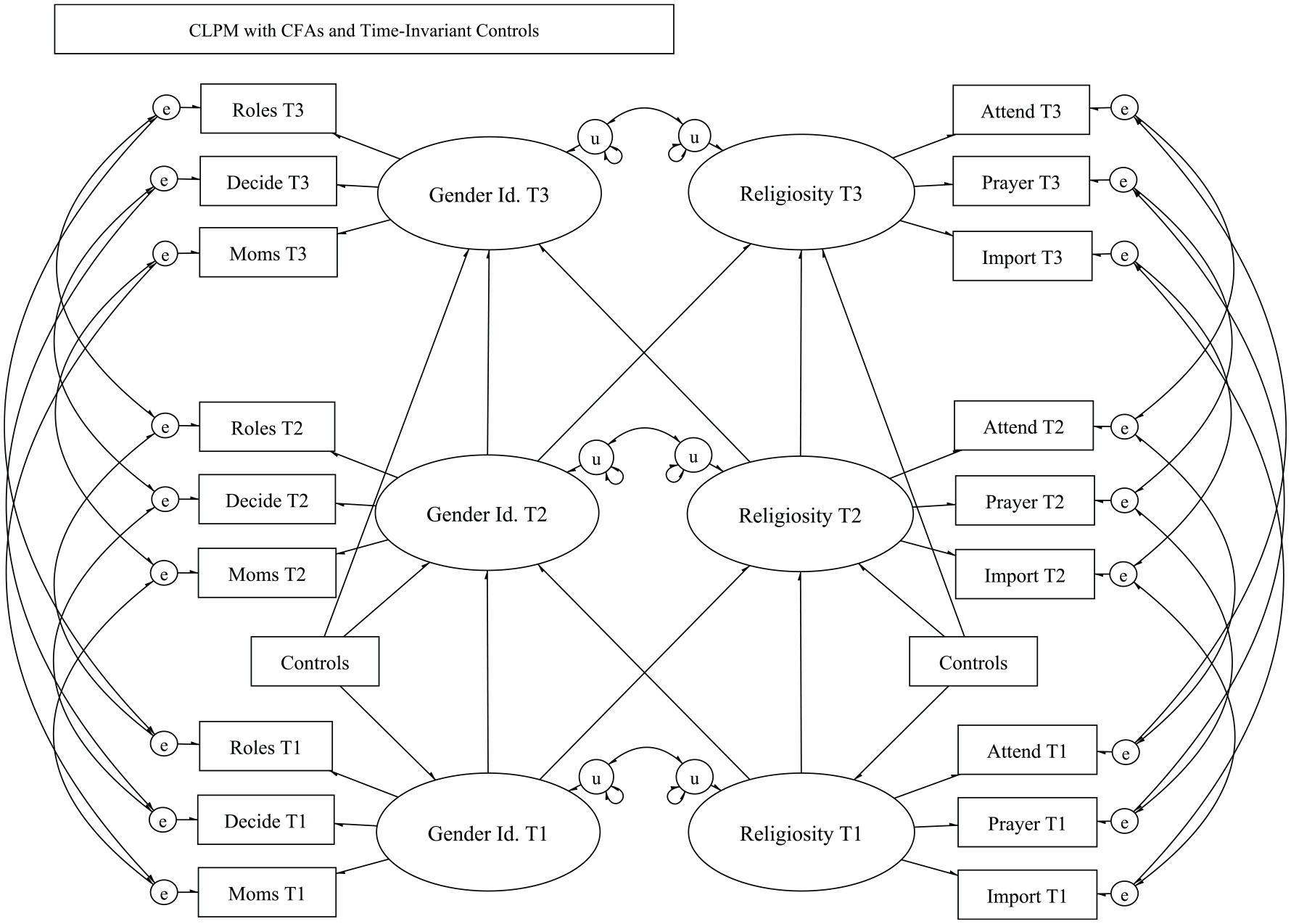
Cross-lagged panel model path model with latent outcomes and time-invariant controls in the National Study of Youth and Religion.
We conduct all analyses in Stata 18 using the sem suite of commands (StataCorp LP, College Station, TX). We first examine the general model in the NSYR total sample and then as grouped by gender. Multiple-group models help us test core assumptions, including whether our constructs for gender attitudes and religiosity behave in a similar fashion across subgroups (for a more thorough description, see section 2 in the Appendix). We establish measurement invariance in our longitudinal gender attitudes and religiosity factors across gender groups using conventional methods (Little 2013; Meredith 1993; Millsap 2007; Putnick and Bornstein 2016). In addition to the partial strong longitudinal invariance constraints discussed above, we further constrain all factor loadings and intercepts to be the same across gender categories in the multiple-group model. Taken together, a range of indices suggest that both the total and gender grouped models remain well fit to the data (total sample: CFI = 0.93, TLI = 0.92, RMSEA = 0.04, SBIC = −938.11, χ2[df = 346] = 1818.08, p < .001; grouped by gender: CFI = 0.92, TLI = 0.91, RMSEA = 0.04, SBIC = −3171.52, χ2[df = 674] = 2,197.50, p < .001). 13
We take further advantage of our SEM approach by using FIML estimators to adjust for missing data (Allison 2002; Arbuckle 1996; Enders 2010). Since the observed measures have different means and variances between men and women, it is inappropriate to compare standardized coefficients across groups (Acock 2013). Thus, we report unstandardized coefficients to maintain comparability across the coefficients from the total sample and grouped models. However, we use scaling variables in the latent factors with the most similar ranges to aid in comparing magnitudes of the CL terms. We also compare our models with a range of other configurations in section 4 of the Appendix.
Results
Persistence or Change: The AR Terms
Given the length and complexity of the model results tables, we focus here on the main findings and present them using SEM path diagrams. The model tables are presented in the Appendix. Figure 2 shows the results from the NSYR for the total sample and grouped by gender.

Cross-lagged panel model results in the National Study of Youth and Religion, in the total sample and grouped by gender.
First, we examine the AR terms. Recall that the AR terms parse out the “carryover” or “inertia” of a factor and that larger coefficients (closer to 1) indicate greater stability. These findings show that, unsurprisingly, previous gender ideology strongly shapes later ideology and religiosity strongly shapes later religiosity. The AR term for gender attitudes shows strong internal predictive power from T1 to T2 net of other factors (β = .61, p < .001) with a little less carryover from T2 to T3 (β = .48, p < .001). A formal test of the difference between these two coefficients is statistically significant using a Wald χ2 equality test (χ2 = 8.18, p < .01), meaning the carryover for gender ideology significantly decreases over time. For religiosity, we see large and similar AR terms from T1 to T2 (β = .68, p < .001) and from T2 to T3 (β = .72, p < .001), without a significant difference between the two lags (χ2 = 2.39, p = .12).
CL Gender Attitudes and Religiosity: A Test of Primacy
Of central interest, we use the CL terms to determine if one of these forces more strongly predicts the future of the other. From the late teens (T1) to early 20s (T2), gender attitudes have a reliably negative relationship with later religiosity (β = −.10, p = .02). This means that people who are more gender egalitarian in late adolescence are predicted to be less religious 2 years later or, similarly, that people who hold more traditional gender attitudes do not move away from religiosity as quickly as others. However, early religiosity does not predict gender ideology at T2, net of other factors (β = −.01, p = .72). A Wald equality test reveals that the two CL coefficients from T1 to T2 are statistically different (χ2 = 4.30, p = .04). Put simply, according to this model, gender attitudes play a more formative role on future religiosity during late adolescence.
When we look at the changes from the early 20s (T2) to the mid-20s (T3), the story shifts. Under these modeling conditions, a person’s gender attitudes are not a significant predictor of later religiosity net of other factors (β = −.05, p = .33), but religiosity does predict later gender attitudes (β = −.06, p < .001). 14 Although this is surprising, this model assumes that changes in both gendered attitudes and religiosity happen the same way and at the same periods for young men and women, an assumption that is tenuous at best. Our descriptive statistics show that young women are significantly more egalitarian on average (β = .21, p < .001) as well as significantly more religious (β = .18, p < .001) than young men. Disaggregating the model by gender group will allow a more detailed examination of these processes that we expect are deeply gendered.
The Gender Differences in Gender Attitudes and Religiosity Change
Figure 2 also shows the coefficients from a grouped model that provides separate results for young men and young women. As expected, we find several gender differences that were masked in the full model. In the AR terms, we see that early religiosity maintains a similar carryover strength for both young men and young women, and Wald equality tests reveal the differences between men’s and women’s coefficients are insignificant across both time lags (T1 to T2: χ2 = 0.54, p = .46; T2 to T3 χ2 = 2.62, p = .11). However, earlier gender attitudes have stronger carryover effects for young men than for young women. This is true both in the lag from T1 to T2 (χ2 = 13.84, p < .001) and from T2 to T3 (χ2 = 12.92, p < .001). In other words, the strength of religiosity’s persistence is very similar for young men and women net of other factors, but gender attitudes have much more inertia for young men than young women. This means young women are more prone to change their attitudes about gendered family life during the transition to adulthood than young men.
Returning to the CL terms, we find the effects of gender attitudes at T1 on religiosity at T2 maintain a similar magnitude to the total effect but slip outside of the standard significance threshold when the groups are considered separately (men: β = −.10, p = .13; women: β = −.09, p = .09). More strikingly, in this multigroup model we can see that women almost entirely drive the negative prediction from religiosity at T2 onto gender attitudes at T3 from the total cohort (men: β = −.01, p = .68; women: β = −.09, p < .001). There is a clear gender difference in the CL coefficient reliability as well as a significant difference in magnitude (χ2 = 7.28, p < .01). In other words, the effect of teenage gender attitudes on college-age religiosity is similar between young men and young women, but the effect of college-age religiosity on mid-20s gender attitudes is evident only for young women.
Taken together, our models show that within-person changes occurring over the 2-year lag from the mid- to late teens (T1) into the late teens to early 20s (T2) are best predicted by gender attitudes, but in the 5-year lag from the late teens to early 20s (T2) to the mid-20s (T3), young women’s changes in gender attitudes are predicted by earlier levels of religiosity. This would suggest that a person’s gender, social context, and developmental phase shape the interplay between gender ideology and religiosity. We conclude that the religiosity levels young women maintain during their late teens and early 20s will be a good predictor of changes that occur in their private-sphere gender attitudes into their mid- to late 20s. But for young men, religiosity does not meaningfully predict changes in later gender ideology net of other factors.
Changes in the General Adult Population
Although our previous analyses establish a complex relationship between gender attitudes and religiosity across the transition into adulthood, it is not yet clear how this relationship manifests during later adulthood. To capture this, we also conduct our models using data from the GSS-P. As above, we begin with model results from the total sample and then by gender category. We also disaggregate the model by age group to examine potential cohort differences, dividing the sample into three brackets for 18 to 35 years old, 36 to 55 years old, and 56 and older.
Figure 3 shows the results from the GSS-P for the total sample and grouped by gender. Unsurprisingly, we again find that previous gender attitudes strongly predict later gender attitudes and religiosity strongly predicts later religiosity. The AR terms for gender attitudes show similar high stability across both lags. Religiosity has a very high carryover rate from T1 to T2 but declines significantly in stability from T2 to T3 (χ2 = 38.11, p < .001).

Cross-lagged panel model results in the General Social Survey panels, in the total sample and grouped by gender.
Turning to the CL terms, we find that religiosity at T1 has a small, negative relationship with changes in gender attitudes at T2 (β = −0.02, p < .001). This can be interpreted that more religious individuals at T1 are predicted to hold slightly less egalitarian gender attitudes at T2, or similarly, that less religious individuals are predicted to become slightly more egalitarian. This relationship at T3 remains small and becomes insignificant. Conversely, the effect of gender attitudes on later religiosity remains large and statistically significant across both time lags (T1 to T2: β = −.16, p < .01; T2 to T3: β = −.26, p < .001). Additionally, a Wald χ2 equality-of-coefficients test shows the CL influence from religiosity and gender attitudes are significantly different in magnitude (χ2 = 5.46, p < .01). We conclude that among the adult population as a whole, gender attitudes are a far stronger predictor of changes in religiosity than the other way around.
Gender Differences among Adults
When we examine the results from the multiple-group models seen in Figure 3, we again find a few notable distinctions by gender. Contrary to the NSYR, adult women in the GSS-P show a bit more carryover than men in their gender attitudes across the first lag (χ2 = 5.79, p < .01), though the magnitude of this effect decreases slightly during the second time lag among women while it increases slightly among men, resulting in quite similar AR effects from T2 to T3. For religiosity, the AR terms significantly decrease in magnitude for both men and women across the second time lag.
Of more central interest, the CL terms for both men’s and women’s religiosity are associated with slightly lower gender egalitarianism from T1 to T2 (men: β = −0.03, p < .01; women: β = −0.02, p < .05), though the CL effects are not significant at T3 for either group. Conversely, we find that prior gender attitudes are negatively associated with later religiosity, but only significant for women. From T1 to T2, the effect of gender attitudes on later religiosity is large and reliable for women (β = −0.24, p < .001) but not for men (β = −0.07, p = .48). We find a similar pattern from T2 to T3, where the effect of gender attitudes on later religiosity is again large and reliable for women (β = −0.36, p < .001) but not for men (β = −0.09, p = .41). This echoes our findings that gender attitudes are a stronger cross-predictor than religiosity, an effect that holds true for the adult population and is driven primarily by women.
Adults by Age Group
Finally, the GSS-P sample allows us to test whether these patterns of within-person change hold among people in later phases of life (Figure 4 ). For our final set of analyses, we divide the GSS-P sample into three broad age groups: 18- to 35-year-olds (n = 1,758), 36- to 55-year-olds (n = 2,319), and those 56 to 89 years old (n = 1,990).
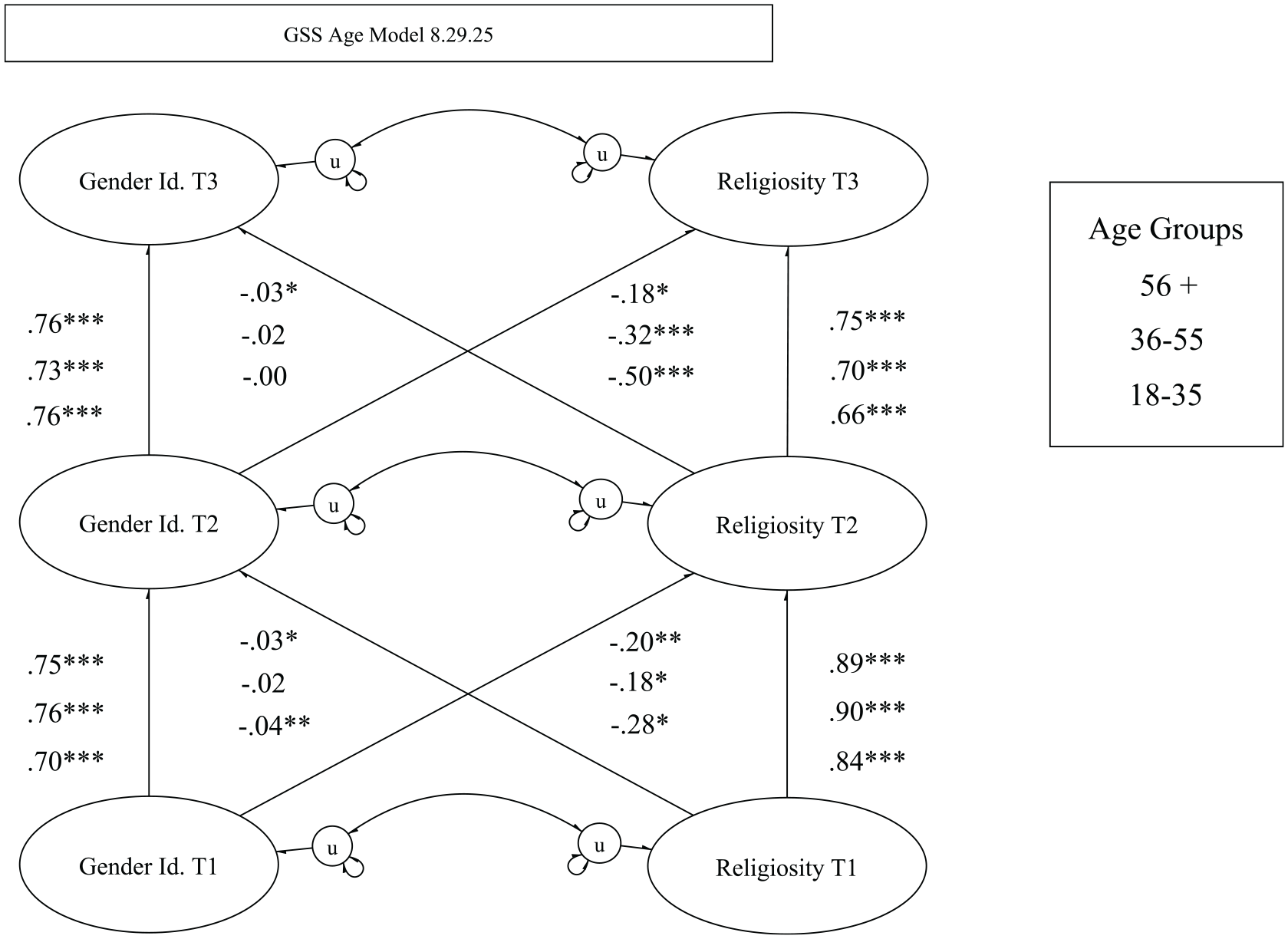
Cross-lagged panel model results in the General Social Survey panels, grouped by age.
Focusing on the CL terms, religiosity is largely unpredictive of changes in later gender attitudes, save for the fairly small effects from T1 to T2 for the youngest group (β = −0.04, p < .01) and across both lags for the oldest group (both β = −0.03, p < .05). Conversely, we find large and significant CL effects of gender attitudes on later religiosity across all time lags in all cohorts. Gender egalitarianism predicts lower religiosity from T1 to T2 for all age groups, with the largest effect among the youngest cohort. From T2 to T3, there is again a large, reliable effect from gender attitudes on changes in religiosity across all cohorts, with larger effects occurring among younger groups. In sum, we find again that gender attitudes are a stronger and more reliable cross-predictor of a person’s later religiosity than the other way around, and, strikingly, this pattern is visible across all age groups.
Discussion and Conclusions
Summary of Findings
Researchers across fields agree that societal dynamics related to gender ideologies and personal religiosity are interconnected. However, previous research has treated the relationship between these forces as unidirectional, failing to capture their reciprocal relationship across time. Macro-level approaches have struggled to determine which may be the more dominant force during times of personal change. We argue that trends in gender attitudes and religiosity are mutually reinforcing processes best considered in tandem, and to our knowledge, we are the first to directly model this relationship in a way that captures the co-occurrence of these shifts.
Our analyses show that religiosity and gender attitudes are reciprocally predictive across time, over and above their general correlation. However, they are not equally matched in their strength of influence when personal changes occur. Overall, a person’s level of (dis)agreement with statements about family gender hierarchies strongly relates to later levels of religiosity, and we find this effect across all age groups. Conversely, religious factors have a smaller and less reliable association with later gender attitudes. The key exception is among young women in their early to mid-20s, for whom religiosity counteracts the trend toward more gender egalitarian attitudes for family life.
Conclusions and Implications
On the basis of these findings, we conclude the societal shift toward gender equity is indeed associated with religious decline and that this is observable at the individual level. Yet simultaneously, religiosity counteracts the movement toward egalitarian gender attitudes concerning family life primarily through its influence on young women during their transition to adulthood. Our results highlight the importance of the relationship between gender attitudes and religion for interrogating the uneven nature of the gender revolution as well as the recent religious decline in the United States. More specifically, the differential pace of change toward gender equity in the public and private spheres presents a riddle with profound consequences, and our results suggest that understanding the dynamics of religious change is a fundamental piece of the puzzle. We believe our findings can inform the field in several important ways moving forward.
First, these findings contribute to identifying underlying mechanisms behind the uneven impact of the gender revolution on private family life relative to the public sphere as well as a recent period of religious decline in the United States. Modernist secularization theories such as the one described by Inglehart (2021) might explain our results through the mechanism of demographic stability leading to more freedoms for women in family life and reproduction, in turn leading to disengagement with institutions with strict reproductive expectations and gender hierarchies (see also Jenkins 2020). Another, and perhaps more salient, argument is that religious identities and behaviors are increasingly a product of social sorting driven by political affinities (Braunstein 2022; Egan 2020; Hout and Fischer 2002, 2014; Margolis 2018, 2022; Patrikios 2008; Perry 2022, 2024). However, these mechanisms need not be mutually exclusive, and our results could be interpreted to support both. Perhaps shifts in a society’s fertility profile and movement toward autonomy tend to foster aggregate attitude changes through cohort replacement, while more rapid personal shifts tend to occur through identity sorting nested within those larger trends.
Second, the general attitude trajectory in the United States has been toward increasing gender egalitarianism, and thus our finding that young women appear to need a “dose” of counter-socialization to offset this trend is striking. During the transition to adulthood, we found that young men are much more stable in their gender attitudes than young women, presumably because they have less personal incentive to alter their attitudes. During a time when many young women adopt more gender-equitable ideals, some religious young women may lean into a certain form of “doing religiosity” as a way to maintain agency and construct alternative forms of social status (Avishai 2008) in their given context. Similarly, this could be read as a component of the traditionalist movement among women (or “tradwives”) who view this identity as both a means to construct capital and a religiopolitical stance against some types of feminism (Proctor 2023; Sykes and Hopner 2024). Adopting religious justifications for family hierarchies may also serve as a useful, sacralized “family myth” (Hochschild and Machung 2012) that helps young women avoid cognitive dissonance and interpersonal conflict that could arise if they critiqued a subordinated position in family life. In any case, our results suggest that the recent promotion of religious complementarian messages buttressing familial gender hierarchies has had a double edge, playing a key role in stalling the gender revolution and also hastening religious decline in the United States. More specifically, they appear to suppress the adoption of more equitable private-sphere gender attitudes among religious young women as they transition to adulthood, and the promotion of gender hierarchies among these groups appears to push religious people with more equitable ideals to disengage.
Limitations and Recommendations for Future Research
Third, we hope this study sparks other important analyses into the complexities of the ongoing shifts in the relationship between gender ideology and religious factors. As discussed below, these include examining the critical distinctions between public and private religious orientations, the role of critical life events, intersectionality, and measurement timing.
Public vs. Personal Religious Orientations
An important caveat of this study is that we examined religiosity as the focal measure representing religion rather than other potential ways to measure religious beliefs and identities. We chose this focus because the personal religious dynamics examined here have decreased markedly in the United States in recent decades, a trend sparking alarm among religious adherents and debates among sociologists. Yet other important facets of religion are likely to interact with gender ideologies in ways that would differ meaningfully from these results. For example, Stewart et al. (2025) distinguish between multiple dimensions of religiosity (including public and personal religious commitments) and their relationship to multiple dimensions of gender attitudes (including gender identities, support for distinct gender roles, and gender bias). The authors found that wanting religion to play a prominent role in public life (rather than personal beliefs and practice) is the strongest predictor of holding traditional gender attitudes. This is in line with other research linking patriarchal gender attitudes with public religious orientations such as Christian nationalism (Whitehead and Perry 2019, 2020). The distinctions between specific religious identities, beliefs, and political entwinements are consequential for gender equity, and we hope future research will address these in turn.
Timing of Life Events
Another way future research could expand upon our results is to explore the impact of time-varying life events and exposures. We chose to treat the between-person control variables as time invariant partially because of data constraints and also because of ambiguity in whether events like early marriage, early parenthood, and higher education in the NSYR represent selection effects or intervention effects. Numerous studies have shown the importance of these factors in predicting changes in both gender attitudes (Cunningham et al. 2005; Fan and Marini 2000; Kroska and Elman 2009; Tallichet and Willits 1986; Vespa 2009; Zhou 2017) and religiosity (Denton and Uecker 2018; Desmond et al. 2010; Schwadel 2016; Uecker et al. 2007). Although the demographic factors were not a primary focus of the analysis here, much could be learned from examining the time-varying effects of events like higher education, marriage, and parenthood in mediating the reciprocal trends between these two forces.
Similarly, there may be critical periods or events for middle-aged or older adults not modeled here that could prove fruitful in future analyses. For example, Schleifer and Chaves (2017) showed that previously religious people tend to return to church when they become parents or when their kids reach school age. When older adults exhibit a meaningful shift in gender attitudes, alterations may relate to changes in their personal interests or exposures (such as having a [grand]daughter, learning that one of their [grand]children is LGBTQ, retirement, divorce, etc.). If a person’s gender attitudes change in response to their life circumstances, our results suggest this may also spur a shift in their engagement with religious frameworks that prioritize strict gender and fertility norms.
Additional Subgroup Distinctions
Some of the demographic variables used as controls in our analysis may represent subgroups with unique patterns of change. Although these were beyond the scope of this study, we hope future research will bring additional insights into key intersectional factors that may reveal distinct trajectories between, for example, religiously conservative or religiously liberal individuals (Bartkowski and Hempel 2009; Smith 2021), those with and without higher education (Mayrl and Uecker 2011; Meagher and Shu 2019; Uecker and Pearce 2017), between political identities (Cassese and Holman 2017; Margolis 2018, 2022; Perry 2022), 15 or between different racial/ethnic groups (Carter, Corra, and Carter 2009; Edgell and Docka 2007; Scarborough et al. 2021; Schnabel 2020; Wilde 2018).
Observation Occasions
A limitation inherent in longitudinal analyses is knowing if our measurement occasions reflect the optimal time lag to capture relevant changes (Allison 2022; Leszczensky and Wolbring 2022; Vaisey and Miles 2017). We expect changes in religiosity and/or gender attitudes occur across periods that justify the lags used here (i.e., years at a time rather than days or months), yet we were limited to three measurement occasions in this analysis. We expect the much longer span from T2 to T3 in the NSYR contributed to smaller AR effects (there is perhaps less carryover because of the delay) and larger CL effects (there is a greater opportunity to observe long-term changes with greater time accumulation). We argue this longer lag in the NSYR is a strength rather than a limitation in our study, though other observation frames may be beneficial for illuminating shifts or “regime changes” among adults.
Concluding Thoughts and Looking Ahead
Relatively rapid shifts in the United States in both gender equity and religious engagement in recent decades and their resulting social tensions could be ushering in a reorientation of personal decision-making processes. As people seek to minimize dissonance that arises from incongruence between their ideals and experiences, our results suggest that religiosity is not, on average, the prevailing force. For this reason, our results suggest the balance of cultural power in the United States may be shifting away from more traditional religious institutions aligned with patriarchy. In other words, the US may be approaching, or has already reached, a “tipping point” in the balance of cultural power held by traditional religious institutions (Inglehart 2021).
A diminishing social influence from religion would not imply an absence of sincere religious adherents whose lives are shaped by their personal beliefs and faith communities. Even among people who have disengaged from religious institutions, many retain a belief in God and identify themselves as spiritual (Marshall and Olson 2018; Steensland, Kucinskas, and Sun 2021; Wilkins-Laflamme 2021). Nor would a shift in cultural power imply that sociologists can comfortably marginalize the study of religion in the United States (Guhin 2014; Perry 2023). We may instead find that, as the number of traditional religious adherents shrinks, what remains are more “intense,” “strong,” “strict,” or identitarian forms of religion. 16 The perception of shrinking cultural power may spur some religious people, especially those who seek to prioritize Christianity in the public sphere, to strive to regain cultural power through political or violent means (Alberta 2024; Du Mez 2020; Gorski and Perry 2022; Whitehead and Perry 2020).
The gender attitudes of religious people are shifting alongside wider cultural trends to become more gender egalitarian, albeit at a pace behind the general public (Schnabel 2016). Religion may currently represent one of the last bastions of gender inequality in the United States, yet as the religious landscape shifts dramatically, so too may the relationship between religious expression and gender equity. In light of an apparent tipping point in the influence of traditional religious institutions, we may be able to anticipate another tipping point, one in which the United States experiences a new surge of more gender-equitable attitudes and practices. This is by no means the last chapter in how the relationship between these two forces will evolve, and we hope research will continue to explore the interplay between these foundational elements of society.
Supplemental Material
sj-docx-1-srd-10.1177_23780231251366719 – Supplemental material for The Stalled Revolution versus Secularization: The Dynamic Relationship between Gender Attitudes and Religiosity
Supplemental material, sj-docx-1-srd-10.1177_23780231251366719 for The Stalled Revolution versus Secularization: The Dynamic Relationship between Gender Attitudes and Religiosity by Elizabeth E. McElroy, S. Abby Young and Cyrus Schleifer in Socius
Footnotes
Acknowledgements
We wish to thank Sam Perry, Ann Beutel, Greg Hancock, and the University of Oklahoma’s Dialogue of Contemporary Sociology reading group for their feedback on various components of this project, although any deficiencies in the article are ours alone. This analysis was also presented at annual conferences of Sociologists for Women in Society, the Society for the Scientific Study of Religion, and the Religious Research Association, and we wish to thank panel attendees for their comments.
Data Availability
Data for all analyses are publicly available at https://www.thearda.com/Archive/NSYR.asp and  .
.
Supplemental Material
Supplemental material for this article is available online.
1
Researchers use a variety of phrases to describe beliefs about hierarchical gender ideals, including gender ideology, gender role attitudes, gender attitudes, and gender egalitarianism, among others (see Brooks and Bolzendahl 2004; Cotter et al. 2011; Kroska 2007; Pepin and Cotter 2018; ). For parsimony, we use the phrases “gender ideology” and “gender attitudes” somewhat interchangeably in this article, as we conceptualize and measure specific attitudes as manifestations of a person’s gender ideology.
2
Voas and Chaves (2016) described that, although the United States was once cited as a counterexample to the secularization thesis, as it was highly industrialized and yet maintained high rates of religious participation, recent decades in the United States have revealed a decline in religiosity mirroring trends seen earlier in much of Europe. Schnabel and Bock (2017, 2018) argued that, in the United States, it was moderate religious expressions on the decline while a relatively smaller group of people with more “intense” expressions (such as Biblical literalism and very frequent service attendance and prayer) remained stable from 1990 to 2015. Similarly, found that the percentage of “strong” believers had not decreased, but rather that the observed decline in religiosity is primarily among those who are moderately or weakly engaged in religious activity. Nevertheless, the United States has seen a recent decline in overall rates of religious affiliation, service attendance, and reported importance in people’s lives.
3
This is just one of many types of secularization theories that include exposure-based theories (Berger 1967), culturally and politically based theories (Asad 2003; Smith 2003), and modernization-based theories of religious decline (Bruce 2011). For an overview of typologies of secularization theories, see .
4
Data are publicly available at https://www.thearda.com/Archive/NSYR.asp and .
5
In both the NSYR and GSS-P samples, there appears to be relatively little change in the aggregate mean in some of the key indicators over time. However, a relatively stable group mean can be masking individuals’ variation around the mean, particularly if subgroups are changing in different directions (much like we see in our results).
7
8
Although some sociologists of religion prefer not to aggregate measures of religion, we argue that doing so here better aligns us with the macro-level theories of religious change. However, we include disaggregated models for religious service attendance, private prayer, and religious importance with additional discussion in section 4 in the Appendix.
9
The NSYR asks about parents’ political views in Wave 1 but does not ask about respondent politics until Wave 4. This limits our ability to meaningfully control for individual politics without violating causal assumptions or assuming alignment between parental and child political ideologies. We include a section in the appendix testing models with political identity as a control and a grouping variable, comparing the results to our main models while discussing their limitations and directions for future research.
10
See section 4 in the Appendix for a comparison of models with and without demographic controls, which support the same substantive conclusions in their CL effects as the main models.
11
One critique of the CLPM is that it conflates processes occurring within and between people (Usami, Todo, and Murayama 2019). Failing to account for trait-like person-to-person differences (also called unit effects or random intercepts) can bias the focal regression coefficients, and methodologists have stressed the need to use models that account for personal trait stability such as the random-intercept CLPM to avoid biased results (Hamaker, Kuiper, and Grasman 2015; Zyphur, Voelkle et al. 2020). For these models, an additional latent factor is used as a personal baseline score of the outcome variable with the measurement at each time point then representing a person’s deviation from their own average level of the outcome variable, here, gender ideology and religiosity. However, Andersen (2022) argued that such residual-level models are not appropriate if the process under observation is not at equilibrium. Theory suggests our factors are changing within individuals over time and are not at equilibrium. Nevertheless, we test multiple configurations of our model (Curran and Hancock 2021; ), including a latent trait model, in section 4 in the Appendix.
12
All path diagrams were constructed using https://semdiag.psychstat.org ().
13
For a more thorough description of how to interpret our SEM fit statistics, see section 2 in the Appendix.
14
In section 4 in the Appendix, we discuss disaggregated models that examine each religion variable separately. Under these conditions, gender ideology is a large and significant predictor of all three religious outcomes (attendance, prayer, and importance) across both time lags. The CL effects are particularly large for gender ideology’s relationship to later service attendance frequency (T2: β = −.37, p < .001; T3: β = −.34, p < .001).
15
We include models in the appendix with politics as a control and also as a grouping variable. However, as the NSYR only collected these political variables at the final wave and thus making them theoretically problematic for this application, we treat these models only as supplementary findings to aid future researchers.
16
Schnabel and Bock (2017, 2018) found that more “intense” expressions (such as Biblical literalism and very frequent service attendance and prayer) in the United States remained more stable from 1990 to 2015. Similarly, Schwadel (2013) found that the percentage of “strong” believers had not decreased, but rather those who were moderately or weakly engaged in religious activity. Iannaccone (1994) argued that “strict” churches are successful because they have fewer free riders. Scheitle, Corcoran, and Halligan (2018) showed that the rise of the “nones” has served to make measures of religious identification, belief, and behavior more congruent, perhaps because fewer nonbelievers feel the need to obscure their preferences because of social pressure.
Author Biographies
References
Supplementary Material
Please find the following supplemental material available below.
For Open Access articles published under a Creative Commons License, all supplemental material carries the same license as the article it is associated with.
For non-Open Access articles published, all supplemental material carries a non-exclusive license, and permission requests for re-use of supplemental material or any part of supplemental material shall be sent directly to the copyright owner as specified in the copyright notice associated with the article.
