




Abstract
Previous research has shown that gender role attitudes can predict changes in couples’ housework division over critical life events, but these studies might have suffered from endogeneity because such life events are anticipated and may be affected by gender role attitudes. In contrast, the coronavirus disease 2019 (COVID-19) pandemic was a truly exogenous shock that hit couples unexpectedly. Estimating fixed-effects regression models, the authors examine the role of gender ideologies in how couples adjusted their division of housework during the COVID-19 pandemic in 2020 compared with a prepandemic baseline observation. The data cover 3,219 couples from the UK Household Longitudinal Study. Both partners spent substantially more time on housework throughout the COVID-19 crisis than before, especially in the early stages. However, we found no evidence that individuals’ or couples’ precrisis gender role attitudes affected changes in men’s and women’s absolute or relative contributions to housework at any time during the lockdown.
The gendered division of labor is embedded in a broader system of gender inequalities and is thus more than just a family affair (e.g., Fuwa 2004). Importantly, despite some indication of convergence at older ages, the division of housework in couples remains highly gendered throughout the life course (e.g., Horne et al. 2018; Leopold, Skopek, and Schulz 2018). A growing body of research indicates, however, that critical life events are often accompanied by subsequent adaptations of couples’ division of domestic work. Principal examples are family-related events, such as the transition to marriage or parenthood (e.g., Baxter, Hewitt, and Haynes 2008; Kühhirt 2012; Schober 2013b), as well as employment-related events, such as transitions to full-time work (e.g., Gershuny, Bittman, and Brice 2005; Schober 2013a), unemployment (e.g., Fauser 2019; van der Lippe, Treas, and Norbutas 2018), or retirement (Leopold and Skopek 2018; Szinovacz 2000). Studies provide robust evidence that changes in partners’ relative resources and time availability cannot fully account for the observed adaptations in the division of household labor (for a review see Lachance-Grzela and Bouchard 2010). Rather, and in line with gender construction theories (e.g., Geist and Ruppaner 2018), it has been suggested that partners’ gender role attitudes are central to any explanation (e.g., Carriero and Todesco 2018). Gender role attitudes (or, synonymously, gender ideologies) are “beliefs about the appropriate role activities for women and men” in various life spheres, such as work, family, or politics (McHugh and Frieze 1997:4).
Gender ideologies are, however, to some extent endogenous to the previously studied events. Holding more traditional attitudes is, for example, likely to affect the risk for unemployment and the timing of retirement (through its effect on male and female partners’ labor force participation; e.g., Uunk and Lersch 2019), Jacob and Kleinert 2014 and (dis)similarities in gender role attitudes have been shown to affect couples’ fertility (e.g., Hudde and Engelhardt 2020). To avoid possible bias due to such endogeneity, assessments of gender ideologies’ role in adaptations of couples’ division of housework following critical life events should ideally draw on truly exogenous shocks, such as the coronavirus disease 2019 (COVID-19) pandemic.
The COVID-19 crisis of 2020 hit families unexpectedly. A key concern in debates about the consequences of the COVID-19 pandemic is its potential impact on gender inequalities (e.g., Alon et al. 2020; Oreffice and Quintana-Domeque 2020). Some commentators have suggested that the virological pandemic might have triggered a “patriarchal pandemic” (Chemaly 2020), disproportionally forcing women out of the labor market (e.g., Andrew et al. 2020; Reichelt, Makovi, and Sargsyan 2021) and back into traditional homemaker roles. This would not only bring to a halt recent macro-level trends of convergence in male and female partners’ time spent on housework (e.g., Leopold et al. 2018; Pailhé, Solaz, and Stanfors 2021) but can also be perceived as an unanticipated shock at the micro-level of couple relationships, forcing partners to renegotiate everyday routines, including their division of domestic labor.
The aim of the present study is to deepen our understanding of the effect of gender role attitudes on the sharing of housework. To do so, we investigate whether and how precrisis gender role attitudes affected couples’ reaction to the consequences of the pandemic and lockdowns. Our focus is on (1) housework tasks, such as cooking, cleaning, and doing the laundry, which should be studied as distinct from childcare (Sullivan 2013; note that our data do not allow a consistent measurement of couples’ division of childcare over time), and (2) attitudes toward the gendered organization of family life because these attitudes and the agreement on the division of partners’ tasks and responsibilities are directly related to the internal functioning of the relationship and family (Kalmijn 2005). We use unique data from the UK Household Longitudinal Study and four waves of its COVID-19 panel survey (see Burton, Lynn, and Benzeval 2020) to run fixed-effects regression models allowing us to monitor couples’ adaptation from April through September 2020.
COVID-19, Couples’ Division of Housework, and Gender Role Attitudes
Research on changes in couples’ division of labor early in the COVID-19 crisis indicates that the amount of unpaid domestic and care work has increased for both women and men, but the relevant studies provide ambiguous evidence regarding changes in the gender gap across a range of European countries (e.g., Del Boca et al. 2020; Fodor et al. 2021; Hank and Steinbach 2021; Hipp and Bünning 2021). Evidence from the United Kingdom consistently shows that on average, women have made substantially larger contributions to additional housework demands than men (see Andrew et al. 2020; Xue and McMunn 2020; Zamberlan, Gioachin, and Gritti 2021). Importantly, gender differences in the allocation of domestic work cannot be fully explained by gender differences in employment or earnings (Andrew et al. 2020; Zamberlan et al. 2021). 1
To explain these dynamics in couples’ division of domestic duties during the COVID-19 pandemic, two primary pathways related to changes in partners’ time availability and additional housework demands have been discussed so far (see, e.g., Hank and Steinbach 2021). First, during the COVID-19 crisis, changes in employment affected partners’ availability in the household. During the early phase of the pandemic, employment decreased considerably, and women were more likely than men to reduce their working hours or lose their jobs (e.g., Andrew et al. 2020; Reichelt et al. 2021; see, in contrast, Knize et al. 2021). Whereas unemployment or reductions in working hours have been shown to be associated with overall increases in housework time, there are important gender differences in couples’ adjustment to reduced or terminated employment (e.g., Fauser 2019; Pailhé, Solaz, and Souletie 2019; van der Lippe et al. 2018): task specialization by gender becomes more pronounced, and the extra domestic work is substantially greater for unemployed women than for unemployed men. This has been proposed as a likely driver of increases in women’s share of household labor during the COVID-19 pandemic (e.g., Zamberlan et al. 2021). In parallel, however, for many of those who remained in employment, working conditions changed substantially. Working from home, for example, has become more common (e.g., Felstead and Reuschke 2020). For men working from home, previously invisible housework may have become more noticeable, and they may have become more involved in these tasks if their work areas are shared with other family members and used for other purposes (e.g., as the dining table). Hence, for men in particular, this situation creates new opportunities and demands to increase their contribution to managing the household (e.g., Stenpaß and Kley 2020).
Second, under lockdown, the amount of housework may have changed. People not only spent more time at home but also spent more time doing housework (e.g., Oreffice and Quintana-Domeque 2020). At the same time, opportunities for domestic outsourcing, such as dining out or hiring household help, decreased. This is a likely driver of disproportionate increases in female partners’ time devoted to household labor, as women have been shown to be the main beneficiaries of domestic outsourcing (e.g., Craig et al. 2016; Raz-Yurovich and Marx 2019). Moreover, if mothers carry the main burden of new or resumed responsibilities resulting from closures of childcare facilities and schools (e.g., Benzeval et al. 2020; Zoch, Bächmann, and Vicari 2021), one may expect spillover effects on other tasks at home as well.
A third process of adaptation, which to the best of our knowledge has not yet been explicitly investigated in the context of the COVID-19 crisis, relates to gender role attitudes. This gap in previous research seems unfortunate because gender differences in the allocation of domestic work under lockdown cannot be fully explained by gender differences in employment rates or earnings (e.g., Andrew et al. 2020; Zamberlan et al. 2021). We argue that gender role attitudes may predict how couples adjusted to the COVID-19 shock and the associated increased demands in housework.
Individuals with less egalitarian attitudes favor “separate spheres,” in which women’s responsibilities revolve around the private realm, family, and homemaking, as opposed to men’s responsibilities, which are mainly in the labor market and public sphere. Individuals with more egalitarian attitudes ascribe to the idea of “joint spheres,” in which women and men are equally involved in tasks in all spheres, such as family, housework, and the labor market (see Davis and Greenstein 2009). Consequently, those with more egalitarian attitudes should favor equal involvement of women and men in housework, whereas those with less egalitarian attitudes should favor a setting in which women perform the lion’s share of housework.
According to cognitive dissonance theory, individuals aim to organize their family lives in accordance with their own attitudes (Festinger 1962), and Davis and Greenstein (2009) concluded from their review that most studies indeed show that men’s and women’s gender role attitudes are in line with the proportion of housework they actually perform. For example, husbands and/or wives exhibiting egalitarian gender role attitudes were found to be more likely to share housework equally (Aassve, Fuochi, and Mencarini 2014). Moreover, longitudinal studies investigating changes in the division of housework after, for example, childbirth showed that egalitarian gender attitudes before motherhood reduced the shift toward a more traditional division of paid and domestic work after the transition to parenthood (e.g., Nitsche and Grunow 2016; Schober 2013b). Even in these longitudinal studies, however, endogeneity cannot be ruled out completely if prebirth gender role attitudes, childbirth, and adaptation of the sharing of housework are interrelated. In contrast to the first COVID-19 lockdown, parenthood is an event in anticipation of which couples will usually develop expectations about their subsequent division of labor (e.g., Dechant and Rinklake 2016). The lockdown, however, hit individuals and couples unexpectedly, that is, without much time to develop new housework division arrangements consistent with their gender role attitudes. Hence, given the unforeseen nature of the COVID-19 crisis and the concomitant changes within households, it offers a unique opportunity to study gender role attitudes’ effect on changes in couples’ division of domestic work.
Our first set of hypotheses derived from the foregoing considerations refers to the expectation that gender role attitudes predict changes in housework from baseline to COVID-19; that is, we expect attitudes to moderate the effect of the COVID-19 pandemic on housework. At the individual level, men with egalitarian attitudes are expected to increase their housework more than men with traditional attitudes, whereas the opposite is expected for women. These changes in housework are expected to occur independent of the partner’s gender role attitudes. At the couple level, we expect an interaction between the partners: if both partners express egalitarian attitudes, the division of housework will be more equal than in traditional couples or in those with divergent attitudes.
Our second set of hypotheses refers to changes over time during our observation period, that is, from the early phase of the first lockdown in April through its later phase in September. Specifically, we expect further adaptations in the division of housework depending on partners’ gender role attitudes. In the unanticipated early phase of the lockdown, couples’ reaction to the new situation might have been driven by gender role attitudes as well as by immediate and pragmatic decisions related to the partner’s time availability and the additional demands of housework. During the summer, however, couples may have revised their initial “pragmatic” arrangements to (re)align with their precrisis gender role attitudes. Hence, we expect gender role attitudes to be a stronger predictor of couples’ division of housework in September than in April.
Data, Variables, and Methods
Data and Sample
Data
We analyze data from Understanding Society: The UK Household Longitudinal Study (Platt et al. 2020; also see Burton et al. 2020). Specifically, we use wave 10 of the Understanding Society’s main survey, conducted in 2018 and 2019 (University of Essex, Institute for Social and Economic Research 2021b), 2 as well as four COVID-19 study waves conducted in April, May, June, and September 2020 (University of Essex, Institute for Social and Economic Research 2021a). The latter study was initiated as a high-frequency panel on people’s experiences and reactions to the COVID-19 pandemic (Institute for Social and Economic Research 2021). Eligible were all Understanding Society respondents who had participated in at least one of the previous two waves of the main survey. The first wave of the COVID-19 study was carried out in April 2020, with monthly waves until July and bimonthly surveys from September 2020 onwards.
Survey Timing in the Pandemic Context
Figure 1 puts the timing of the survey interviews into the context of the first pandemic wave. It plots the fieldwork periods of the survey waves against two proxies for pandemic activity and lockdown intensity, namely, the number of patients with COVID-19 who were in hospitals and a measure of people’s mobility patterns. Any effective lockdown measure will reduce people’s mobility and increase their time spent at home. Therefore, we use aggregate information on the change in time spent in any residential area from the Google COVID-19 Community Mobility Reports as a proxy for the position on the lockdown-normality continuum (Google 2020; Hudde and Nitsche 2020). Both measures show that the country was most severely affected in early and mid-April, shortly before the interviews for the first COVID-19 survey wave were conducted. Toward the summer, hospitalizations neared zero, and the lockdown became moderately less intense. The fieldwork period for the September interviews roughly marks the end of the period with low hospitalizations and moderate to low lockdown intensity and the beginning of the second major infection wave. In summary, the April wave roughly captures the period of maximum pandemic impact; the May and June waves cover periods of relatively high but declining impact, and the September wave captures the temporary recovery to a relatively normal situation.
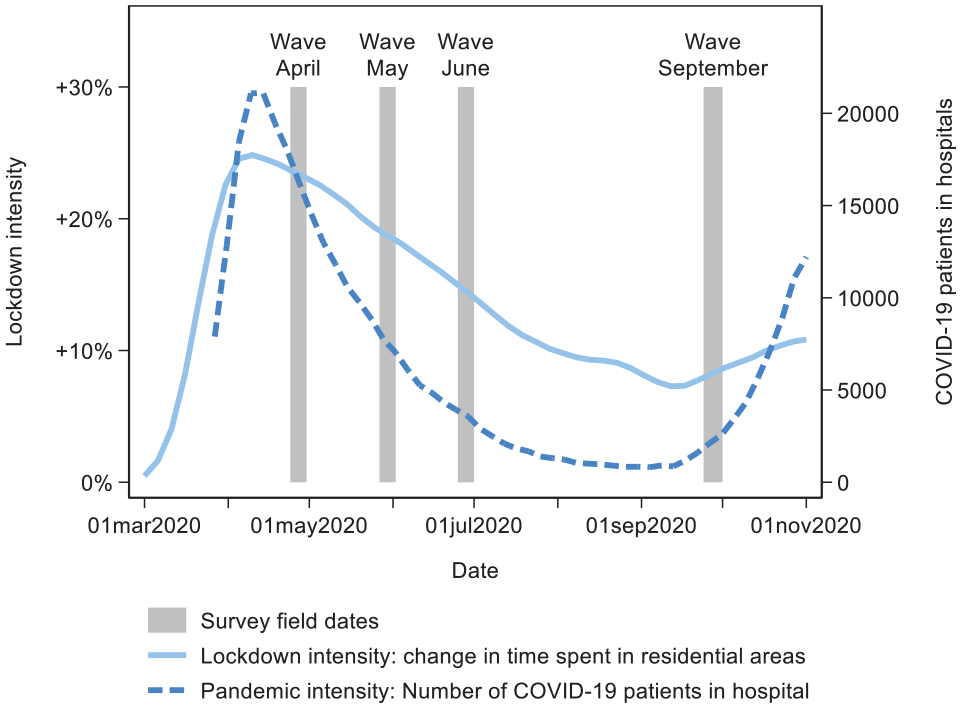
Timing of the coronavirus disease 2019 (COVID-19) survey periods in the context of pandemic impact. The proxy for lockdown intensity comes from the Google COVID-19 Community Mobility Reports and refers to the time spent in any residential area relative to a prepandemic baseline.
Survey Methods and Weights
Beginning in the Understanding Society study’s wave 8, face-to-face in-home interviewing was gradually replaced by Web interviews (Burton et al. 2020). In wave 10, 70 percent of respondents were invited to participate via the Web, and the other 30 percent were invited to participate face to face. These 30 percent consisted of a random sample (20 percent of the total) and households that were predicted to have the lowest probability of participating online (10 percent of the total). Telephone interviews were conducted with those who could not be reached via the Web or in person. Among the completed interviews in wave 10, 59 percent were realized via the Web, 41 percent face to face, and fewer than 1 percent via telephone. For the COVID-19 study, the interview mode shifted almost entirely to online (Burton et al. 2020). Understanding Society has a complex design, and the data providers strongly suggest using weights (Institute for Social and Economic Research 2021). In the Understanding Society sample, some groups, such as people from Northern Ireland and ethnic minorities, are overrepresented by design, and some groups are more likely to respond than others. Using weights assures that we average within-person changes over a representative population. We therefore apply the longitudinal weight provided for the most recently available wave to all analyses (Institute for Social and Economic Research 2021).
Sample Selection
Our sample consists of opposite-sex couples for which both partners participated in wave 10 of the Understanding Society study and in at least one of the four COVID-19 waves featuring the question on housework. Wave 10 (“baseline”) includes 9,243 opposite-sex couples, corresponding to 18,486 individuals. Of these, 10,833 individuals participated in at least one of the COVID-19 waves (58.6 percent); there were 4,097 couples for which both partners participated (8,194 individuals). On average, these couples participated in 4.1 of the 5 analyzed waves.
There are relatively few missing values for our key variables. Missing information on attitudes occurred for 4.4 percent of couples, missing information on housework for 4.2 percent, and missing work hours for 1.6 percent. In total, the attrition due to missing data is 9.9 percent and therefore relatively low. Furthermore, 31 couples were dropped because their wave 10 interviews were conducted after the onset of the COVID-19 pandemic, that is, in March or April 2020. After dropping those with survey weights of zero (14.4 percent), this leaves us with an analytical sample of 3,219 couples, observed for an average of 3.9 waves (12,702 couple observations, 25,404 person observations).
Measures
See Table 1 for a list of key variables. Partners’ engagement in housework is measured as weekly hours spent on housework, such as “cooking, cleaning and doing the laundry.” In the main study (wave 10), respondents were asked, “About how many hours do you spend on housework in an average week, such as time spent cooking, cleaning, and doing the laundry?” In the COVID-19 study, housework engagement was covered in waves 1, 2, 3, and 5, that is, in April, May, June, and September. In contrast to the main study, in the COVID-19 study, housework was measured with reference to the “last week” preceding the interview. The measure of the share of the couple’s housework is calculated as own housework hours divided by the sum of one’s own and one’s partner’s hours.
Descriptive Table: Key Variables.

We use Understanding Society’s wave 10 for pre-COVID-19 information on gender role attitudes as a “baseline” measure. For our analysis, accounting for precrisis attitudes is necessary to avoid endogeneity resulting from possible feedback of changes in couples’ division of labor on partners’ gender ideologies at the time of the COVID-19 interviews (Carlson and Lynch 2013; also see Nitsche and Grunow 2016). Our measure of gender role attitudes is derived from iterated principal factor analysis over four items that have also been used in previous studies on the division of housework (e.g., Fuwa 2004; Okun and Raz-Yurovich 2019; Schober 2013b; measured with five-point scales ranging from “strongly agree” to “strongly disagree”):
A husband’s job is to earn money, a wife’s job is to look after the home and family.
Both the husband and wife should contribute to the household income.
All in all, family life suffers when the woman has a full-time job.
A pre-school child is likely to suffer if his or her mother works.
All four items capture attitudes toward the gendered nexus between work and family/homemaking; that is, they all focus on a similar aspect or dimension of gender role attitudes (for discussions of different dimensions of gender role attitudes, see, e.g., Grunow, Begall, and Buchler 2018; Hudde 2018). In particular, these items focus on women’s roles as mothers, whether they should work for pay, and whether working mothers have a negative effect on family life. The first item explicitly mentions “to look after the home” (i.e., to perform housework). A Cronbach’s α of 0.72 gives statistical support to the idea that these four items capture one latent, underlying factor. To isolate this factor, we used iterated principal factor analysis with promax rotation. The factor variable is coded such that higher values represent more egalitarian gender role attitudes.
We control for changes in both partners’ working hours because they affect partners’ time availability and might thus confound the association between attitudes and the division of housework. Finally, we control for changes in the household composition, with two variables that each capture the number of children in the household aged 0 to 4 years and aged 5 to 11 years.
Methods
For the descriptive analysis, we split the total sample by gender and gender role attitudes. For this purpose, we dichotomize our continuous measure of gender role attitudes, labeling attitudes below the gender-specific median as “less egalitarian” and those above the median as “more egalitarian.” We then compute and plot the average hours of housework and the men’s average housework share by women’s and men’s attitudes. Confidence intervals are computed using pooled ordinary least squares regression with standard errors clustered at the individual or couple level. For the multivariate analysis and to study the effect of gender role attitudes on short-term changes in housework hours, we run linear panel regression models using fixed effects at the individual or couple level. This approach disregards differences in baseline levels between individuals and couples but assesses changes in housework within individuals and couples over time (i.e., each individual or couple is compared with itself at an earlier time as its control). Fixed-effects models thus eliminate all time-invariant factors by exploiting within-person and within-couple variability (i.e., intraindividual changes over time) only, thereby avoiding that potentially unobserved time-invariant confounders bias our estimates (e.g., Brüderl and Ludwig 2015).
Our hypotheses state that gender role attitudes predict how housework changes in response to the COVID-19 crisis; that is, attitudes moderate the effect of the pandemic on housework. To operationalize these hypotheses, the regression models include dummy variables for each monthly wave (i.e., the average change in housework between the baseline and each COVID-19 wave) and the interaction terms between these dummy variables and the respondents’ attitude (i.e., the test of whether the degree of change is a function of respondents’ precrisis attitude). The monthly dummies capture the degree to which the COVID-19 pandemic affected people’s lives: the April dummy, for example, captures the period of the pandemic with the most intense lockdown, whereas September captures the recovery to a near-normal situation (see Figure 1).
Results
First, we look at partners’ absolute hours of housework and then study the division of housework within couples. From both angles, we examine our hypotheses that gender role attitudes predict the change in housework from baseline to COVID-19.
Gender Role Attitudes and Housework Hours of Men and Women: The Individual Perspective
By comparing the housework hours of women and men (Figures 2A and 2B), we see that women, particularly those with less egalitarian attitudes, spent approximately twice as many hours on housework at any point in time. Men with less egalitarian attitudes engage least in domestic work. Hence, when looking at the overall level, we replicate the well-known associations between gender, gender role attitudes, and housework.

Descriptive findings on gender role attitudes and individuals’ housework at the individual level (women: nindividuals = 3,219, nobservations = 12,702; men: nindividuals = 3,219, nobservations = 12,702).
Figures 2C and 2D illustrate the change in housework hours for women and men during lockdown compared with the baseline measure. These results align with previous studies showing that men and women spent more hours doing housework during the crisis than in the precrisis period. This trend in housework roughly follows the course of the pandemic: housework is highest in April and May, when infection cases are also at their highest and the lockdown is at its most intense; in summer, when infection cases are low and the lockdown intensity is moderate, housework returns relatively close to baseline.
The pattern of change in housework from baseline to COVID-19 is similar between genders and attitude groups. Compared with the average number of hours they spent on housework before the COVID-19 crisis, women spent approximately 2.5 more hours and men almost 3 more hours on housework in April and May. In September, women still spent approximately 50 minutes more on housework than at baseline, and men devoted 75 minutes more to housework. In contrast to our expectations, these changes in housework hours do not differ by individuals’ precrisis gender role attitudes: whereas the respective time spent on housework in groups with “more” or “less” egalitarian attitudes differs at baseline, there is little difference in their response to the unforeseen COVID 19 crisis.
Figures 3A and 3B illustrate the effect of gender role attitudes on housework on the basis of fixed-effects regression models controlling for one’s own and one’s partner’s working hours (full results are presented in Table A1 in the Appendix). None of the effects reaches statistical significance. In tendency, however, women with more egalitarian attitudes reported smaller changes in housework hours, whereas men with more egalitarian attitudes increased their time spent on housework. The confidence intervals are not large, so the insignificance of the coefficients is unlikely to be due to our sample size or a lack of overall change in housework hours. What we observe instead is that, irrespective of their lack of statistical significance, the estimated “effects” are substantively small (on the order of a 20-minute, or even smaller, change in housework predicted by a 1 standard deviation change in gender role attitudes). Furthermore, our expectation was that attitudes matter more in the latter than in the first months of the pandemic, but there is no evidence that attitudes matter at any point in time.

Effect of egalitarian attitudes on individuals’ change in housework hours compared with baseline (results from fixed-effects regression models, see Table A1; women: nindividuals = 3,219, nobservations = 12,702; men: nindividuals = 3,219; nobservations = 12,702).
Gender Role Attitudes and Partners’ Share in Housework: The Couple Perspective
In the previous section, we discussed individuals’ absolute time spent doing housework. We now consider the couple’s division of housework, that is, men’s share of housework, by couples’ gender role attitude constellations, namely, both partners express less egalitarian gender role attitudes (“traditional” couples), both partners hold more egalitarian attitudes (“egalitarian” couples), and two combinations of mixed gender role attitudes.
Figure 4A shows that at baseline, men’s share of couples’ housework is highest in egalitarian couples (38 percent) and lowest in traditional couples (28 percent). Moreover, men’s attitudes seem to matter more than women’s, as partners’ shares of housework are more equally distributed in couples with egalitarian attitudes in men rather than women. Figure 4B highlights the change in men’s share of housework compared with the precrisis situation by the four different constellations of attitudes. In all couples, men’s share increased significantly in the intense early lockdown phase. Hence, in relative terms, the pandemic increased gender equality in housework in all couple constellations.
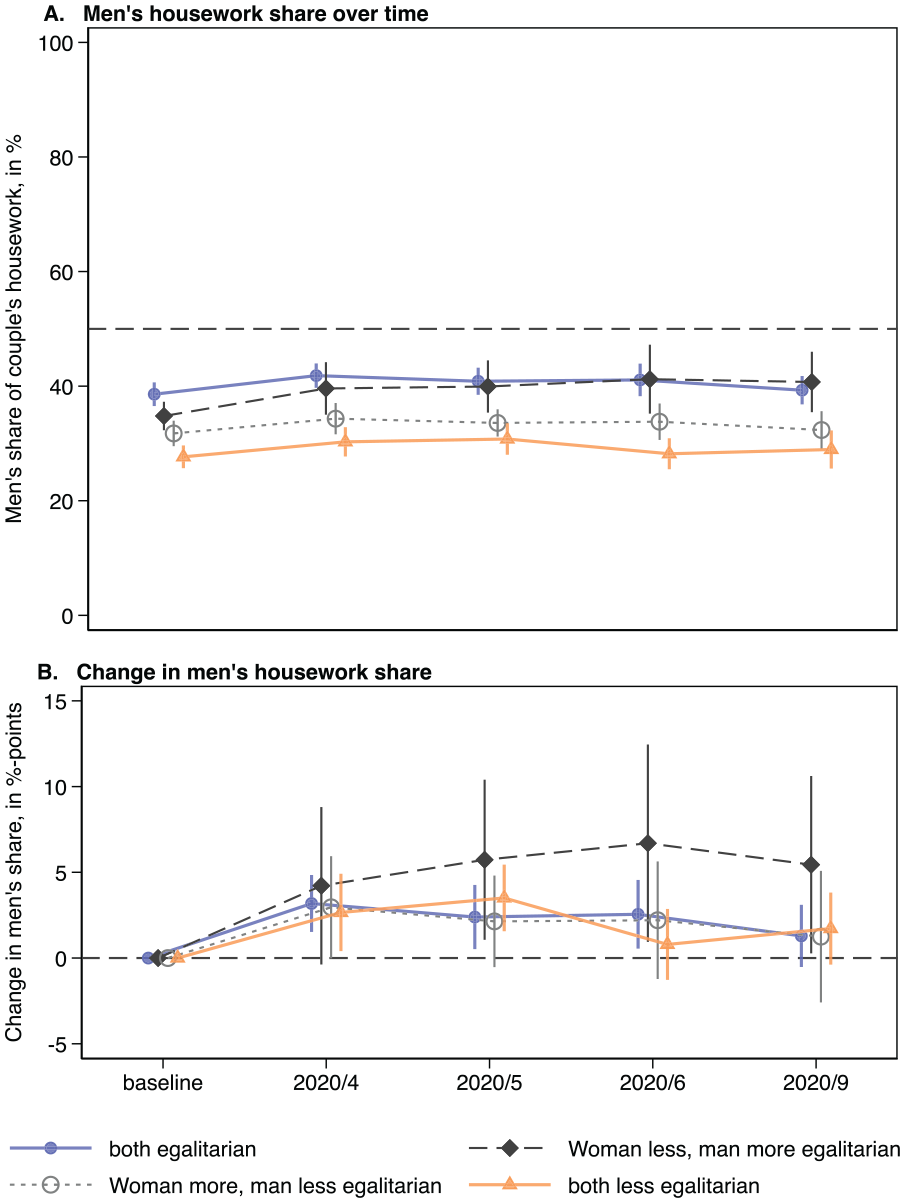
Descriptive findings on gender role attitudes and men’s share of the couple’s housework (ncouples = 3,219, nobservations = 12,702).
At the peak of the first lockdown phase, men increased their share of housework by approximately 3 percentage points. By September, men’s housework share had decreased to a level slightly above the precrisis baseline. Concerning our research question, there is no clear association between attitude constellation and change in the division of housework. Our theoretical expectation was that men’s share would increase most in couples in which both are more egalitarian and least in couples in which both are less egalitarian. However, this pattern does not materialize, and trajectories are almost identical in both types of homogamous couples and in couples in which the woman is egalitarian and the man is not. The couples in which the man is egalitarian and the woman is not seem to deviate: in these couples, men’s share remains substantially above baseline. However, the confidence interval is rather broad, so this finding should be interpreted with caution.
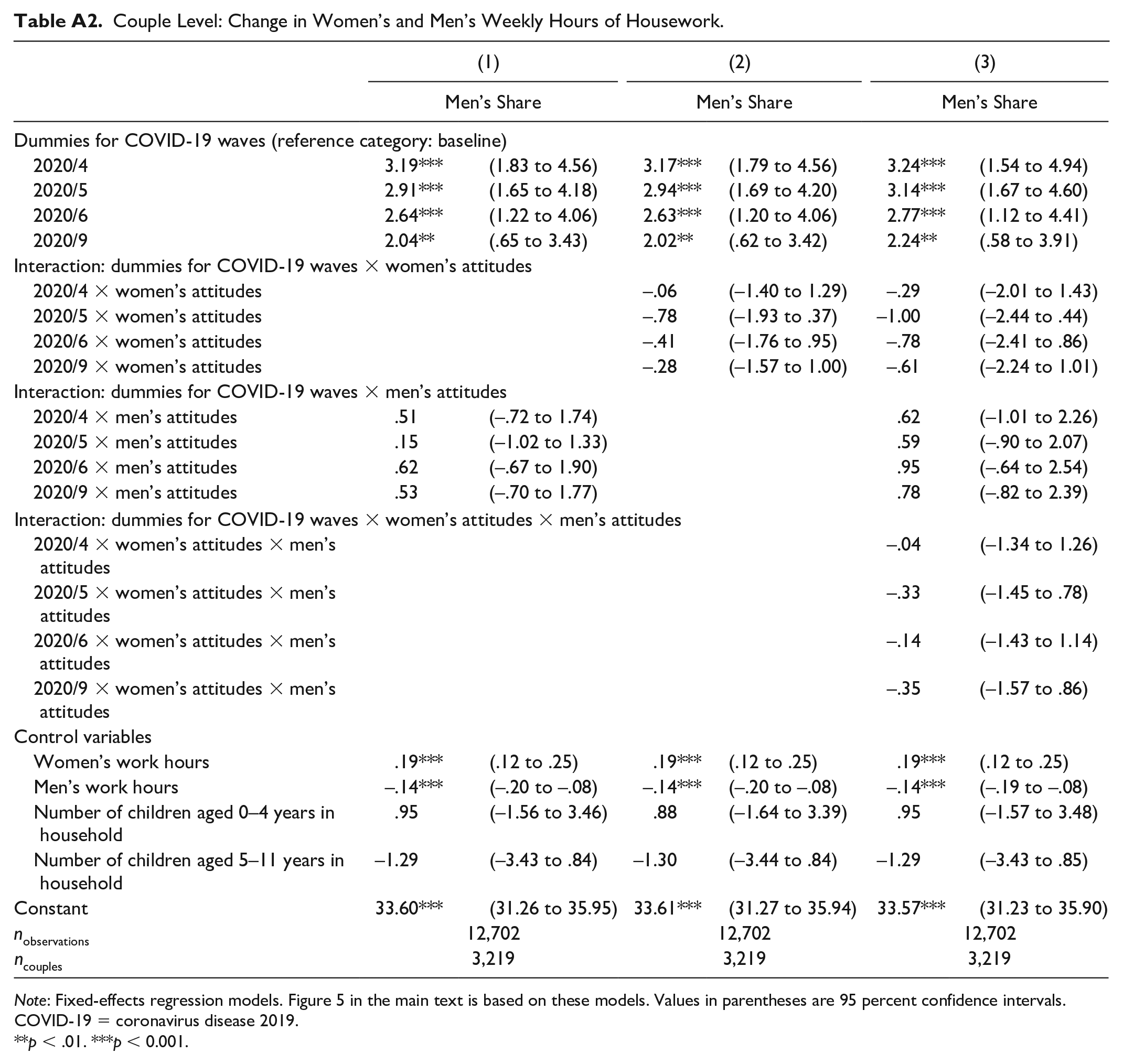
Figure 5 illustrates the effect of gender role attitudes on housework on the basis of fixed-effects regression models controlling for both partners’ working hours (full results are presented in Table A2 in the Appendix). The results show that there is no systematic effect of women’s or men’s attitudes at any month during the pandemic. The degree to which men change their share of the couples’ housework in response to the crisis is therefore independent of women’s attitudes (Figure 5A), men’s attitudes (Figure 5B), or their interaction (Table A2 in the Appendix).
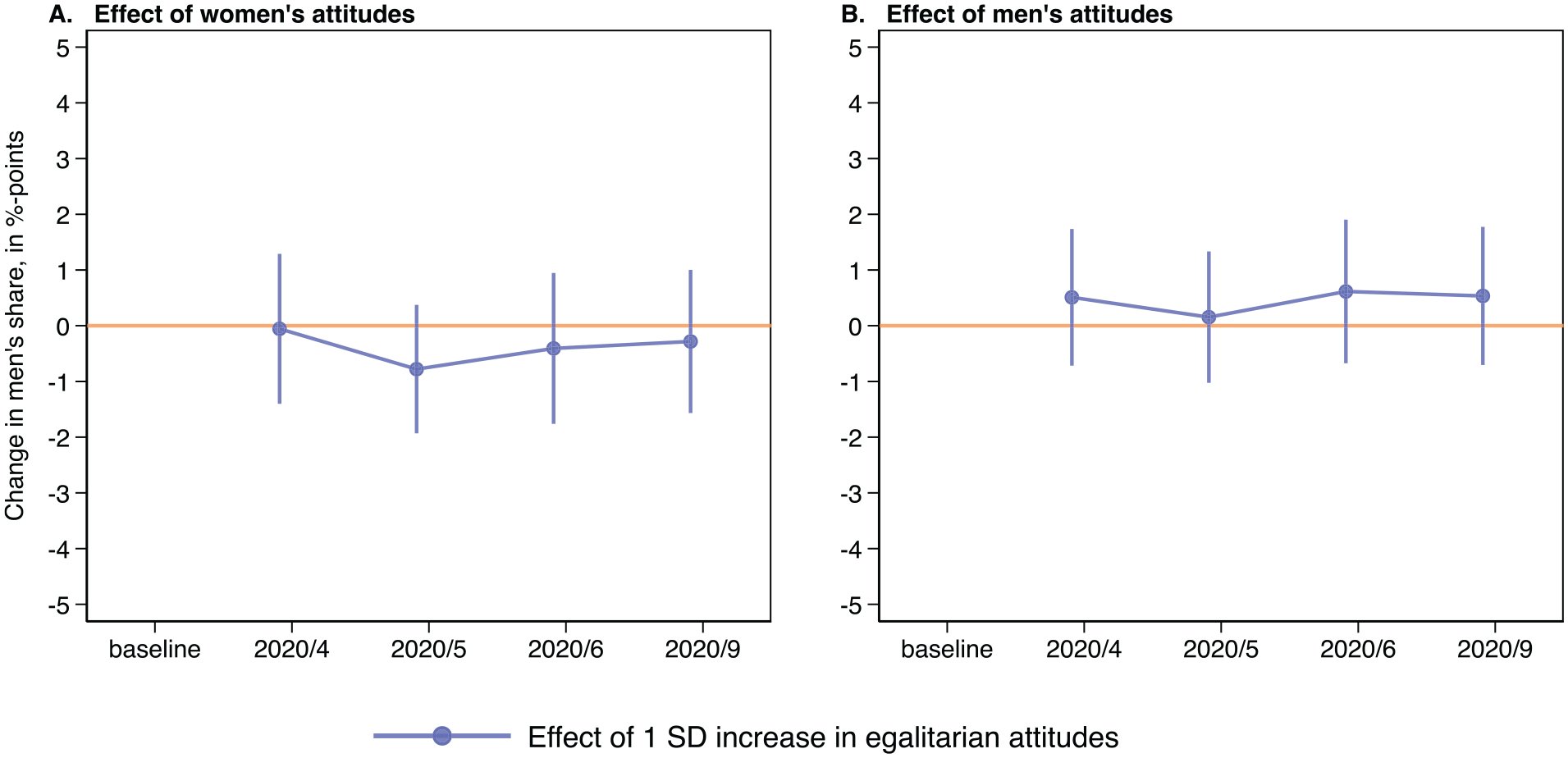
Effect of egalitarian attitudes on the change in men’s share of the couple’s housework compared with baseline (results from fixed-effects regression models, see Table A2; ncouples = 3,219, nobservations = 12,702).
Similar as for individual housework, irrespective of their lack of statistical significance, the point estimates are small in substantive terms (less than a 1 percentage point change in men’s housework share predicted by a 1 standard deviation change in their gender role attitudes). That is, even if we cannot be certain whether there is a small effect or no effect, there is certainly no large effect of gender role attitudes on the hours spent on and share of housework during the COVID-19 crisis. In sum, we find no support for our first or second hypotheses.
Robustness Checks and Further Analyses
To challenge these null findings, we conducted additional analyses. First, our main regression models included the attitudes as linear terms. This means that any nonlinear relationship in the data might be overlooked. We therefore examined the associations using local linear smoothing, which allows a flexible pattern of association (see Figures A1–A4 in the Appendix). This approach confirmed that there is no substantial association of any shape. Second, the dependent housework variables have a number of outliers, which might excessively influence the results. As a further test, we therefore recoded outliers. In these tests, the estimates remained almost identical (see Figures A5 and A6 in the Appendix). Finally, COVID-19 might have changed people’s incomes and thereby their bargaining positions within the couples (Sullivan and Gershuny 2016). The main models already control for working hours and changes therein. However, if people’s risk for wage loss is systematically associated with gender role attitudes, and if this is not fully captured by changes in working hours, this might potentially distort the estimated effect of attitudes on housework. Therefore, we run models that add control variables for both partners’ income. This does not change the estimated effect of gender role attitudes on housework (see Figures A7 and A8 in the Appendix). In sum, the results of these further analyses underscore the conclusion that gender role attitudes do not predict how people’s engagement in housework changed during the COVID-19 pandemic.
Summary and Conclusions
The present study set out to investigate the role of gender role attitudes in the dynamics of couples’ division of housework in a very peculiar historical context: the COVID-19 lockdown of 2020. Data from the UK Household Longitudinal Study and four waves of its COVID-19 panel survey provided us with the opportunity to investigate couples’ adaptation to changing circumstances following a truly exogenous shock, thereby avoiding issues of potential endogeneity common in related previous research. Our study thus contributes not only to the growing literature on gender inequalities during the pandemic (e.g., Alon et al. 2020; Oreffice and Quintana-Domeque 2020) but also, and more generally, to a better understanding of how couples negotiate their division of labor (e.g., Geist and Ruppaner 2018).
The main starting point for our research was observations indicating that changes in partners’ relative resources and time availability cannot fully account for adaptations in the division of household labor following critical life events more generally, ranging from childbirth to retirement (e.g., Leopold and Skopek 2018; Schober 2013b), and the “COVID-19 shock” in particular (e.g., Andrew et al. 2020; Zamberlan et al. 2021). We therefore hypothesized, first, that precrisis gender role attitudes predict changes in housework from our pre-COVID-19 baseline observation to lockdown (i.e., the period from April through September 2020). Second, we expected gender role attitudes to be stronger predictors of couples’ division of housework in September than in April 2020, as couples may then have revised their pragmatic adaptations to the early and more intense lockdown in spring by arrangements more in line with their precrisis attitudes.
Neither of these hypotheses could be supported by the results of our empirical analyses. We found no evidence indicating that individuals’ or couples’ precrisis gender role attitudes affected changes in men’s or women’s absolute or relative contributions to housework at any time during lockdown. These null findings were confirmed by a series of robustness checks. However, both partners spent substantially more absolute time on housework throughout the COVID-19 crisis than before, especially in its early phase, and in relative terms, the pandemic seems to have contributed to an at least temporary, modest increase in gender equality in housework.
Against the background of fears of a “patriarchal pandemic,” this latter finding is good news. One should be careful, however, about drawing premature general conclusions regarding gender inequalities during the COVID-19 pandemic in the United Kingdom. One particular reason warranting such caution is the lack of consideration of another important component in couples’ division of labor, childcare, which we were not able to assess in our analysis because its division between partners was not consistently measured in our data. Other U.K. studies suggest that mothers, on average, provided substantially more additional hours of childcare than fathers but that there is also an important fraction of fathers who became substantially more involved in childcare during the COVID-19 crisis (e.g., Hupkau and Petrolongo 2020; Sevilla and Smith 2020; see Kreyenfeld and Zinn 2021 for corresponding evidence from Germany). Overall, precrisis gender inequalities in couples’ division of labor within the household do thus not seem to have undergone major changes, in the United Kingdom or elsewhere in Europe (e.g., Hank and Steinbach 2021; Zamberlan et al. 2021). The survey question on housework in the data lists exemplary tasks, “cooking, cleaning and doing the laundry,” which are typical female-typed tasks (Noonan 2001). Gender-neutral or male-typed tasks, such as household repairs and improvements or shopping, are not listed. If a survey question also listed such tasks, this should increase the stated housework hours by men more than that of women, which would decrease the overall gender gap in housework hours. However, we are not aware of any argument suggesting that this would alter the effect of gender role attitudes on changes in housework hours during the pandemic.
An important question remains regarding why our expectation that gender role attitudes would matter for couples’ adaptation to the novel situation during the initial COVID-19 lockdown was not confirmed by our empirical findings. Although we cannot provide a definitive answer, we propose two possible explanations. First, previous research claiming an impact of gender role attitudes on changes in the division of housework after major life course events may have suffered from potential endogeneity issues. Attitudes and behavior are engaged in constant feedback: attitudes influence behavior, and behavior influences attitudes. In fact, there may also be a feedback loop between attitudes and anticipated behavior. For example, a woman planning to have a child may anticipate that motherhood will lead to reduced employment and increased housework, and she may adapt her attitudes to this anticipated change to avoid cognitive dissonance (Festinger 1962). The truly exogenous shock of the pandemic created a unique opportunity to rule out such potential issues of endogeneity. From this perspective, previous studies might have overestimated the actual role of gender ideologies.
Second, it could be that gender role attitudes matter under certain circumstances (e.g., Carriero and Todesco 2018) but not under the specific circumstances of the unanticipated COVID-19 shock. There are at least two plausible relevant ways in which the COVID-19 shock may differ from life events, for which gender role attitudes matter. First, unlike these life events, the pandemic was unanticipated, with the consequence that people were not able to mentally prepare and develop a behavioral script that was in accordance with their attitudes. What speaks against this idea is that attitudes should be readily available and guide behavior in a rapid and possibly subconscious way (Ajzen and Fishbein 2005). If gender role attitudes have little impact on behavior under unanticipated circumstances, this would weaken their relevance for family functioning, given that unexpected shocks are not rare; think, for example, of health crises in the family or unexpected job changes, such as a sudden increase or decrease in working hours. A second relevant way in which the pandemic differs from other changes in life circumstances is that COVID-19 is a temporary shock, one that changes couples’ lives for a few months before things return to normal (or at least, this is what most people expected to happen during the first pandemic wave in 2020). People might have expected that any change in housework and the gender balance would eventually return to the precrisis level. In practice, this means that, for example, a man with traditional gender role attitudes might be willing to increase his engagement during the pandemic because he is confident that the pandemic will have no long-lasting effect and he will be able to return to his practice of doing only a few hours of housework once the pandemic is over.
Whether gender ideologies translate into behaviors (and changes therein) appears to vary across situational contexts (see Carriero and Todesco 2018 for a related discussion). Despite its null findings, our study offers several promising avenues for future research. It will be important to investigate, for example, whether or how individuals’ gender role attitudes change in the further course and aftermath of the COVID-19 crisis (e.g., Reichelt et al. 2021), as has been previously observed after other critical life events (such as the transition to parenthood; Schober and Scott 2012). In particular, a distinction between anticipated and unforeseen life events accompanied by short-term and long-term adaptions of behavior might be a promising avenue for examining the relevance of gender role attitudes to couples’ behaviors and attitude-behavior feedback loops. Moreover, even though gender role attitudes did not predict how couples adapted their division of household labor during lockdown, they might well be relevant to couples’ adaptation to the COVID-19 crisis in other important domains, such as fertility (e.g., Okun and Raz-Yurovich 2019; Voicu and Bădoi 2021).
Footnotes
Appendix A
Couple Level: Change in Women’s and Men’s Weekly Hours of Housework.
| (1) | (2) | (3) | ||||
|---|---|---|---|---|---|---|
| Men’s Share | Men’s Share | Men’s Share | ||||
| Dummies for COVID-19 waves (reference category: baseline) | ||||||
| 2020/4 | 3.19*** | (1.83 to 4.56) | 3.17*** | (1.79 to 4.56) | 3.24*** | (1.54 to 4.94) |
| 2020/5 | 2.91*** | (1.65 to 4.18) | 2.94*** | (1.69 to 4.20) | 3.14*** | (1.67 to 4.60) |
| 2020/6 | 2.64*** | (1.22 to 4.06) | 2.63*** | (1.20 to 4.06) | 2.77*** | (1.12 to 4.41) |
| 2020/9 | 2.04** | (.65 to 3.43) | 2.02** | (.62 to 3.42) | 2.24** | (.58 to 3.91) |
| Interaction: dummies for COVID-19 waves × women’s attitudes | ||||||
| 2020/4 × women’s attitudes | −.06 | (−1.40 to 1.29) | −.29 | (−2.01 to 1.43) | ||
| 2020/5 × women’s attitudes | −.78 | (−1.93 to .37) | −1.00 | (−2.44 to .44) | ||
| 2020/6 × women’s attitudes | −.41 | (−1.76 to .95) | −.78 | (−2.41 to .86) | ||
| 2020/9 × women’s attitudes | −.28 | (−1.57 to 1.00) | −.61 | (−2.24 to 1.01) | ||
| Interaction: dummies for COVID-19 waves × men’s attitudes | ||||||
| 2020/4 × men’s attitudes | .51 | (–.72 to 1.74) | .62 | (−1.01 to 2.26) | ||
| 2020/5 × men’s attitudes | .15 | (−1.02 to 1.33) | .59 | (–.90 to 2.07) | ||
| 2020/6 × men’s attitudes | .62 | (–.67 to 1.90) | .95 | (–.64 to 2.54) | ||
| 2020/9 × men’s attitudes | .53 | (–.70 to 1.77) | .78 | (–.82 to 2.39) | ||
| Interaction: dummies for COVID-19 waves × women’s attitudes × men’s attitudes | ||||||
| 2020/4 × women’s attitudes × men’s attitudes | −.04 | (−1.34 to 1.26) | ||||
| 2020/5 × women’s attitudes × men’s attitudes | −.33 | (−1.45 to .78) | ||||
| 2020/6 × women’s attitudes × men’s attitudes | −.14 | (−1.43 to 1.14) | ||||
| 2020/9 × women’s attitudes × men’s attitudes | −.35 | (−1.57 to .86) | ||||
| Control variables | ||||||
| Women’s work hours | .19*** | (.12 to .25) | .19*** | (.12 to .25) | .19*** | (.12 to .25) |
| Men’s work hours | −.14*** | (–.20 to –.08) | −.14*** | (–.20 to –.08) | −.14*** | (–.19 to –.08) |
| Number of children aged 0–4 years in household | .95 | (−1.56 to 3.46) | .88 | (−1.64 to 3.39) | .95 | (−1.57 to 3.48) |
| Number of children aged 5–11 years in household | −1.29 | (−3.43 to .84) | −1.30 | (−3.44 to .84) | −1.29 | (−3.43 to .85) |
| Constant | 33.60*** | (31.26 to 35.95) | 33.61*** | (31.27 to 35.94) | 33.57*** | (31.23 to 35.90) |
| n observations | 12,702 | 12,702 | 12,702 | |||
| n couples | 3,219 | 3,219 | 3,219 | |||
Note: Fixed-effects regression models. Figure 5 in the main text is based on these models. Values in parentheses are 95 percent confidence intervals. COVID-19 = coronavirus disease 2019.
p < .01. ***p < 0.001.
