




Abstract
Research on neighborhood social organization and crime typically conceptualizes neighborhood change on the order of decades, even though the local social contexts that individuals experience change daily through mobility for work, errands and recreation. In this study, the authors analyze data from the Seattle Neighborhoods and Crime Survey linked to the Census Transportation Planning Products to investigate whether within-day changes in neighborhood diversity are associated with an individual’s social cohesion and fear of crime. The authors find that individuals living in neighborhoods where diversity increases during the daytime tend to report more social cohesion and relatively less fear of crime. Importantly, these relationships are observed only among white respondents, with implications for whether processes of racialization in diverse neighborhood contexts account for this tendency. Results from this study highlight how the “mobility turn” within theories about neighborhood effects would benefit from considering how the contexts themselves change throughout the day.
Spatial variation in the prevalence of crime and the ways in which people may respond differentially to crime and deviance are linked to neighborhoods’ racial/ethnic composition and racialized processes of social control (Sampson 2012; Sampson, Raudenbush, and Earls 1997; Shaw and McKay 1942). The significance of neighborhood diversity for structuring individuals’ behavior and interactions with others in a shared neighborhood fits within a broader discussion–, with competing perspectives–, about whether and how neighborhood diversity or homogeneity are linked to material differences in both meso- and micro-level social processes. In particular, considerable research has aimed to understand whether contextual diversity matters for neighborhood-level social cohesion as well as individual-level interpersonal relationships and perceptions of neighborhood safety. Some perspectives suggest that neighborhood diversity is associated with individuals’ withdrawal from community life (e.g., Browning, Dirlam, and Boettner 2016; Putnam 2007), while others suggest that individuals are likely to remain similarly engaged in their communities but segregated with respect to the types of social relationships and ties that constitute that engagement (e.g., Tran et al. 2013).
In addition to these divergent perspectives about how neighborhood diversity and homogeneity affect neighborhood social life, our understanding of the relationship between diversity, homogeneity, and community interaction has historically focused on definitions of the neighborhood, its boundaries, and its characteristics in somewhat narrow ways that are, in part, reflective of data limitations. For example, while the aforementioned discussions inform how residential neighborhood diversity has been conceptualized within theories about social organization and deviance, questions of how population heterogeneity and change matter for social organization are not limited only to individuals’ residential contexts. Indeed, these questions plausibly extend to the wide range of nonresidential social contexts that people experience, like their places of work (Browning and Soller 2014; Cagney et al. 2020; Jones and Pebley 2014). The myriad mobility pathways that individuals follow on a given day, in turn, raise questions about how neighborhoods themselves may change as their residents move about, and whether such changes matter for the social organization and perceptions of a neighborhood. Yet there has been relatively little investigation into how a neighborhood’s degree of diversity may be dynamic in the short-term, changing in important ways between day and night. Furthermore, prior scholarship on racial variation in likelihoods and implications of neighborhood population change and interpersonal interaction (e.g., Hwang and Sampson 2014; Tach 2014; Walton 2021a, 2021b; Walton and Hardebeck 2016) could be extended to suggest that the types of intraday population change experienced and the implications of these dynamics for local social organization may vary across racial/ethnic groups as well.
Combined, these insights point toward open questions about how these within-day dynamics may complicate our existing frameworks for understanding the relationship between neighborhood populations and community-level processes central to social organization and functioning, such as social cohesion and fear of victimization. These daily diversity fluctuations are important in their own right by creating more potential for cross-group interactions within neighborhoods than has previously been recognized (Ellis, Wright, and Parks 2004; Hess and Hall 2024). However, theories of social organization that, to date, have largely examined neighborhood contexts as static with respect to population characteristics, may be strengthened with a consideration of diversity and population heterogeneity as dynamic, allowing these theories to more fully capture the local contextual dynamics that shape social life in place and in communities.
In this study, we address both of these challenges to our analysis and understanding of the relationship between neighborhood population characteristics and social organization: that of divergent theoretical expectations and empirical perspectives on the direction of these associations and that of the limitations of conceptualization of neighborhoods as static in composition. To this end, we focus on the city of Seattle as a case, a city characterized by relatively high levels of racial/ethnic diversity and only moderate patterns of segregation between neighborhoods. We use the Seattle Neighborhoods and Crime Survey (SNCS) in tandem with estimates of daytime and nighttime population composition from Census Transportation Planning Products (CTPP) data to situate the role of within-day diversity changes in theories of neighborhood social organization. Using a combination of descriptive maps and regression models, we investigate the following research question: How do residents’ perceptions of social cohesion and crime vary with daily changes in local population diversity, and how do these associations vary with respect to race/ethnicity? Our results show that daytime diversity is associated with higher levels of social cohesion and reduced fear of crime, though importantly, only among white residents. Although these findings align with expectations stemming from classical theories of social contact and its consequences, we also situate our findings in relation to recent scholarship on the sociocultural factors contributing to white residents’ continued avoidance of cross-group interactions in the presence of diversity.
This intersection of residential population composition and intraday change in diversity is especially central to our understanding of neighborhood diversity and fear of crime. Our analysis shows that neighborhoods that become more diverse during the day tend to have residents who are less fearful of their surroundings compared with residents in neighborhoods that stay similarly diverse or become less diverse during the day, even among those that are diverse from the outset. Our multilevel analyses advance the perspective that intraday variations in population composition are salient to our understanding of social cohesion and fear of crime among neighborhood residents. Furthermore, they demonstrate that studies of neighborhood diversity must reckon with the socially dynamic, rather than static, nature of neighborhoods, much like scholars have begun to do with analyses that show how individuals’ activity spaces complicate “neighborhood effects.” Finally, the implications of intraday changes in local populations for social organization and crime outcomes highlight how daytime “activity space” mobility needs to also be studied with insight into the composition of daytime social contexts, rather than just the residential lenses through which researchers have historically viewed neighborhoods. Taken together, these findings offer important theoretical considerations for future research on neighborhoods, race/ethnicity, and spatial analyses of social life, including future directions for the analysis of activity space.
Background
Theoretical Perspectives on Composition, Change, and Community
The relationships between local population composition and change, social cohesion, and crime and safety have long been central to investigations of key processes that ground these concepts in place, particularly in the context of neighborhoods. The importance of examining neighborhood diversity to understand patterns of social organization has only increased in recent decades, too, with demographic research portending a “master” trend toward racial heterogeneity in residential communities, driven by rapid immigration to the United States from Latin America and Asia, the suburbanization of nonwhites, new regional patterns of internal migration, and growth in multiracial populations (Logan and Stults 2022; Logan and Zhang 2010; Sáenz and Morales 2016; Timberlake, Howell, and Staight 2011; Winkler and Johnson 2016; Zhang and Logan 2016). Theories of neighborhood change related to neighborhood or community-level processes and experiences provide a context in which to explore the impacts of intraday changes in racial/ethnic composition. Indeed, these theoretical perspectives offer competing theoretical expectations about how experiences of diversifying social contexts should matter for individuals’ perceptions of their neighborhoods and their experiences of local residential life (Portes and Vickstrom 2011), in part because of variation in levels of analysis and the ways in which neighborhoods and salient social and physical spaces are characterized and empirically described (e.g., Lichter, Parisi, and Taquino 2015, 2017). Each of these perspectives also points toward divergent hypotheses about the relationships between intraday change in local populations, the composition of the residential local population, and personal experiences of social integration, community, and safety in residential neighborhoods.
Analysis of community space and neighborhoods has explored the conditions of proximity under which openness, tolerance, and/or acceptance of dissimilar others may be encouraged, with some emphasis on exposure. For instance, public spaces that serve as “cosmopolitan canopies,” or spaces that mechanically expand opportunities for potential cross-group interaction and relationships, may under particular circumstances encourage prosocial behaviors, such as increased openness to others or a reconsideration of stereotypes, for instance (Anderson 2004, 2015). Relatedly, contact theory offers a “race-neutral” social psychological perspective on how increasing local diversity or exposure to others may counter a purported human tendency toward prejudice against the unfamiliar or dissimilar (Allport 1979). In the most optimistic of extensions, one might expect, then, that with patterns of intraday neighborhood diversification, probabilities of intergroup interaction may increase, setting the stage for potential social cohesion and shared expectations for the production of neighborhood life (Allport 1979).
These more meso-level theories of opportunities for interaction, cross-group exposures, and social contact are complemented by classic individual-level analyses of social relationships and cohesion that emphasize the significance of physical proximity, or propinquity, as a key driver of social interaction and cross-group relationship formation (e.g., Bossard 1932; Kalmijn 1998). In the context of friendships, for instance, residential and school segregation and integration have provided widely varying contexts for the formation of social ties. These analyses find that local availability of outgroup or dissimilar contacts increases likelihoods of friendships, for instance (e.g., Moody 2001), with potential for longer term impacts on entry into heterogamous friendships (e.g., Stearns, Buchmann, and Bonneau 2009).
On the other hand, theory also points toward a contrasting set of expectations for neighborhood population change and social dynamics. Social disorganization theory, for instance, offers a model relating racial/ethnic heterogeneity, residential turnover, socioeconomic context, and crime and delinquency (Sampson and Groves 1989; Shaw and McKay 1942). Of particular relevance to the present study, the initial model (Shaw and McKay 1942) and subsequent tests of this theory (Sampson and Groves 1989; Sampson, Morenoff, and Earls 1999) suggest that racial/ethnic heterogeneity and residential population change or mobility/migration increase crime and delinquency by way of local social disorganization. Somewhat complementary to this theoretical perspective, Putnam’s (2007) study examining social cohesion and change over time revealed that persons of all ethnoracial backgrounds tend to “hunker down” and have lower levels of social cohesion in neighborhoods with greater ethnic diversity. Other studies exploring how contextual diversity may shape individuals’ local social network ties and community participation observe that diversity itself does not predict lower levels of social engagement. Instead, the relevance of diversity to the density of neighborhood social ties or individuals’ overall community connection can depend on broader patterns of residential segregation, households’ socioeconomic status and residents’ level of involvement in organizations with reach beyond the neighborhood (Gibbons and Yang 2016; Tran et al. 2013).
Similarly, at the micro-level, explanations of social psychological processes provide some frameworks that would motivate a negative effect of diversification on social integration and perceptions of community safety (Dixon 2006; McKeown and Dixon 2017). Group threat processes provide a theoretical explanation for how we might expect local, short-term, or otherwise seemingly immediate or rapid changes in exposure to diversity, including intraday population change, to be negatively associated with experiences of neighborhood life. As originally formulated by Blumer (1958), perceptions of potential disruption to social organization and hierarchy and the privileges afforded by this structure may translate to hostility and prejudice toward dissimilar others (Quillian 1995), which may in turn negatively affect the possibility for local diversity, social cohesion, and other prosocial neighborhood-level processes to coincide. Analyses of social inclusion and exclusion, for instance, demonstrate how space can be racialized, with places perceived as more or less safe (e.g., Quillian and Pager 2001; Walton 2021a) or more or less inclusive (e.g., Anderson 2015; Walton 2021b) by individuals of different racial/ethnic groups occupying the same spaces.
Contextualizing Intraday Neighborhood Change
In short, theoretical frameworks related to social organization provide us with multiple ways to understand how local social contexts are related to key processes that shape individuals’ lives and interactions. However, neighborhoods are not static, but instead a social construction demarcating the start and end of individuals’ most local level of social context (Suttles 1972). Considerable research has investigated the construction of neighborhoods, including the role of neighborhood stratification in the demarcation of boundaries and identities of neighborhoods (Hwang 2016; Kramer 2017), or the salience that boundaries have to urban social processes like crime or social conflict (Legewie 2018; Legewie and Schaeffer 2016), and how neighborhoods are themselves dynamic and change in important ways over time (Schwirian 1983).
Another key component of the definition and description of neighborhoods is through analysis of their constitutive populations and change therein. Questions of whether and how neighborhoods change through normal processes of residential turnover have long been relevant to understanding social organization, with too much instability in the resident population expected to hinder their capacity to develop social cohesion and mutually shared expectations about how the neighborhood social context should operate (Kubrin 2009). Indeed, what appear to be isolated changes in residents—with the definition of “change” limited to turnover at particular addresses or in particular households—has the potential to translate into changes in neighborhood population structure if those who leave are systematically different than those who are arriving (Hipp and Chamberlain 2022).
Importantly, theories of neighborhood change suggest potential interaction between changing neighborhood populations, levels of social organization and residents’ fear of crime (Kirk and Laub 2010; Skogan 1986). Analyses of temporal change in population composition and diversity as they relate to social organization and crime have historically considered the relationship between these processes on the order of years, if not decades, observing cyclical dynamics such that changing neighborhoods can experience a shift in their social organization (Branic and Hipp 2018; Hipp and Chamberlain 2022), while neighborhoods that experience higher levels of crime tend to experience changes over time to their population structure as households with resources move away. Longitudinal evidence about how residential instability causes crime through impacts on social organization suggests the direction of effect may be through a process of decline brought on by crime to begin with.
However, another aspect of the definition and description of neighborhoods and their populations looks beyond the defined boundaries of a neighborhood and changes within. Specifically, an important recent direction within this literature is to engage with the concept of “activity spaces,” or egocentric mobility networks, in order to more faithfully represent the set of local social contexts that one experiences and thereby produce more reliable measures of “neighborhood effects” that persons in those social contexts are potentially exposed to (Browning et al. 2017; Wang et al. 2018; Xu 2022). Still, in large part because of data limitations, empirical research has tended to hold constant what these social contexts are like as individuals navigate them during the day, even if the limited evidence to date suggests that the social compositions and people’s perceptions about their neighborhood vary in important ways on the basis of the time of day (Boessen 2014; Boessen et al. 2017; Vallée 2018). The specifics of how to conceptualize and measure local social contexts or neighborhood populations as dynamic within the course of a day require articulation, as well, given that much of the relevant prior scholarship has analyzed neighborhoods as static, focusing specifically on the residential population in measuring racial/ethnic diversity (e.g., Gijsberts et al. 2012; Sampson et al. 1997).
Some areas that are relatively segregated on the basis of residential population or “nighttime” composition become more integrated through daily mobility patterns, while others that are multiethnic or more mixed in racial/ethnic composition become less diverse as people spend time outside of their residential contexts for work and other elements of their daily rounds (Hall, Iceland, and Yi 2019; Silm and Ahas 2014; Vallée 2017). Relatedly, other strategies that attempt to capture the characteristics of local contexts that extend beyond residents and workers use, for example, mobile phone or social media data to describe the composition of “ambient populations” as potential explanatory factors for spatial variation in crime and victimization (e.g., Andresen 2006; Gu et al. 2023; Tucker, O’Brien and Hangen 2024).
At the micro-level, these aggregate within-day flows in population composition have implications for individuals’ social interactions and their perceptions of their local social contexts. If they do not work outside their residential areas (e.g., work from home, caregiver, not working), the extent to which changes affect their daily exposures to different populations will be contingent on (1) the extent to which they leave their homes, both within and beyond their residential neighborhoods, and (2) the extent to which their neighborhood population shifts over the course of a day. If they do work outside their residential areas (i.e., they commute to work), individuals’ perceptions of change in their neighborhoods’ diversity while they are away from home may be relatively more salient than how much the neighborhood does in fact change.
Racial/Ethnic Variations in Neighborhood Change, Social Cohesion, and Fear of Crime
The theoretical perspectives discussed so far point to important open questions about linkages between local population dynamics and social cohesion. However, these theoretical frameworks on the experiences and implications of neighborhood change (i.e., social disorganization and group threat perspectives) leave the potential racialized contingencies of these linkages uninterrogated. More specifically, the integration of these classic theoretical perspectives with insights about racialized patterns of residential change and segregation allow us to expand upon the implicit race neutrality of the aforementioned perspectives by recognizing two types of racial/ethnic variation: patterns of neighborhood change and perceptions and experiences of neighborhood change.
First, neighborhoods have different potential for and types of neighborhood change (e.g., Hwang and Sampson 2014; Owens and Candipan 2019). For instance, analyses of neighborhood change have found that neighborhoods with populations that have higher proportions of Black and Latino residents are less likely to experience physical manifestations of gentrification and investment, such as new or updated construction and lower levels of disarray and deterioration (Hwang and Sampson 2014). Related analysis of neighborhood change demonstrates that those that have predominantly Black and Hispanic residents and experience socioeconomic growth or advancement are likely to experience concurrent “whitening” of the local population (Owens and Candipan 2019). In sum, the baseline racial/ethnic compositions of neighborhood populations are associated with different patterns of change over time, suggestive of differential likelihoods of change in local populations, though the extent to which this variation extends to shorter term and transitory periods (i.e., within day; Hall et al. 2019) and implications for social cohesion and perceptions of safety are unclear.
Second, residents of different racial/ethnic groups respond to and experience local social contexts differently. Prior scholarship on this heterogeneity has identified racial/ethnic variation in perceived levels of local population diversification and change (Craig, Rucker, and Richeson 2018; Wickes et al. 2013), perceptions of local safety and disorder (Hwang and Sampson 2014; Wickes et al. 2013), and experiences of inclusion and cohesion (Croff, Hedmann, and Barnes 2021; Hong et al. 2014). Much of this work has focused on the responses and perceptions of white persons in the United States to both objective and perceived changes in local population composition and suggest an array of potential implications of intraday changes in local racial/ethnic population composition. Some analyses find that white persons are likely to express a preference for local racial/ethnic homophily (Craig, Rucker and Richeson 2018), or less diversity, which may manifest as greater social distance from dissimilar others (Walton 2021b) when faced with observed or anticipated increases in racial/ethnic diversity, consistent with the group threat theoretical perspective discussed earlier. From the perspective of people living in previously predominantly white neighborhoods that are diversifying, this may be shaped by racialized conceptualizations of criminality and “otherness,” by which Black persons and residents are more likely to be stereotyped and racially typologized as criminal or threatening (Combs 2022; Muhammad 2019; Quillian and Pager 2001). Other scholarship focused on communities of color suggests that diversification via influx of new white residents, through gentrification, for instance, brings another meaning to diversification, with remaining residents sharing experiences of disempowerment and exclusion (Croff et al. 2021; Walton 2018).
Theoretical Expectations
Our study is situated at the intersection of these theoretical perspectives. Taken together, existing research about neighborhood diversity, social organization, fear of crime, and racialized variation in perceptions and experiences of neighborhood life leads to a number of important yet somewhat competing theoretical expectations about how short-run changes in a neighborhood’s social diversity might associate with important differences in residents’ experiences and expectations for local informal social control, interpersonal interactions, and local safety. Overall, research assessing the salience of changes in neighborhood diversity to community organization and cohesion has yielded somewhat mixed conclusions, contingent upon the study designs and populations being examined (Van der Meer and Tolsma 2014). We contend that one previously unappreciated reason for these mixed findings when considering the dynamics of neighborhood diversity and social organization may stem from the fact that relevant analyses of these processes have largely left within-day neighborhood change over the “day course” largely unobserved and unaccounted for (Vallée 2017). We build upon this work by conceptualizing the neighborhood as temporally dynamic, looking at diversity during the day and night, and socially dynamic, examining variation in these associations across racial/ethnic groups.
The concept of group threat offers one explanation for any observed linkages between intraday neighborhood change and variation in social organization or fear of crime, with implications for attitudes toward others in the community (e.g., King and Wheelock 2007). If we expect that theoretical perspectives on population change and social process translate from longer term periods to the intraday context, contact theory might suggest increased opportunities for between-group exposures (Allport 1979) and group threat theory (Blumer 1958) would suggest that neighborhoods with high levels of daily compositional change would present barriers to the development of social solidarity, community, and generalized trust. This in turn could contribute to decreases in the social cohesion that is essential to neighborhood social organization (Blau 1977; Schwartz 1997). Altogether, these theoretical frameworks contribute, in slightly different ways, to the development a first hypothesis about the relationship between racial/ethnic diversity and the neighborhood-level processes and experiences that we examine:
Hypothesis 1a: Neighborhoods with greater intraday change in racial/ethnic diversity will have lower levels of social cohesion and greater fear of crime.
However, some prior research on social organization in multiethnic communities affords another set of possible expectations for what might be observed amid intraday change. An extension of contact theory would suggest that individuals living in neighborhoods with high levels of daily compositional change would be more likely to have interactions with persons across racial/ethnic groups (Allport 1979). Furthermore, greater exposure to diversity may dampen processes of group threat, shaping perceptions of social distance from racially dissimilar others (e.g., Bai, Ramos, and Fiske 2020). One implication of this perspective is that social ties for a given neighborhood may include people who are residents, as has commonly been considered, but also potentially those who have activity spaces that intersect with the neighborhood, even if just during the day. Moreover, neighborhoods that are similarly diverse across night and day–whether consistently homogeneous or consistently diverse–may have increased cohesion and interaction compared with those whose diversity declines during the day. Therefore, a contrasting hypothesis suggests the following:
Hypothesis 1b: Neighborhoods with intraday increases in racial/ethnic diversity will have greater social cohesion and less fear of crime.
Importantly, there are systematic variations among persons of different racial and ethnic groups in terms of how much diversity is typical in their neighborhoods, because of prevailing patterns of residential segregation even amid more recent trends toward diversification. Furthermore, persons of different racial/ethnic groups may experience diversification, or homogenization, in their local populations, differently, with group threat theory leading us to expect that those of majority or dominant racial/ethnic groups to perceive increased diversity as negative (e.g., Lanfear et al. 2018), while those of minority or marginalized groups to experience diversification as a positive shift (e.g., Walton 2018). This leads to the following hypotheses on the basis of group threat theory as it pertains to racial/ethnic heterogeneity:
Hypothesis 2a: Among white respondents, intraday increase in racial/ethnic diversity will be associated with lower social cohesion and greater fear of crime.
Hypothesis 2b: Among nonwhite respondents, intraday increase in racial/ethnic diversity will be associated with greater social cohesion and less fear of crime.
On the other hand, we may expect that the same processes of group threat may produce inhospitable social climates for those in marginalized social positions. Relatedly, analyses of the racialization of space suggest that greater physical proximity may in fact expose individuals to “white space” (Anderson 2015) and “cultures of whiteness” (Walton 2021a), yielding experiences of seemingly color-blind yet racist exclusion for nonwhite persons. This offers the following competing hypothesis about the interaction between neighborhood racial/ethnic diversity and intraday change in that composition:
Hypothesis 2c: Among nonwhite respondents, intraday increase in racial/ethnic diversity will be associated with lower social cohesion and greater fear of crime.
Data and Methods
We draw on two sets of data for assessing whether intraday change in a neighborhoods’ racial and ethnic diversity is associated with differences in its social organization and neighbors’ fear of crime. First, we use tract-level estimates from the 2000 CTPP database to construct measures of the persons in a neighborhood at two stylized points of time, day and night. Second, we use the SNCS from 2002 to 2003 to assess residents’ perceptions of their neighborhoods’ social organization and whether crime is a salient source of fear (Matsueda 2010). The SNCS has been used in numerous studies of neighborhood social organization in Seattle because of its representativeness and full coverage of neighborhoods across the city (Drakulich 2013; Drakulich and Crutchfield 2013; Matsueda et al. 2006; Yuan and McNeeley 2017). After listwise deletion, our analytic sample consists of 3,793 responses, with all tracts of Seattle represented and a mean of 31 respondents residing within each tract. Summary statistics for the analytic sample are available in Appendix Table A1.
Neighborhood Composition and Intraday Diversity Change
Measures of the nighttime population for each neighborhood are drawn from the CTPP data on workers aged 16 years and older who reside in the neighborhood, while measures of the daytime population are based on the workers aged 16 years and older whose workplaces are located in the neighborhood. These measures report the shares of the neighborhood population that are non-Latino Black (Black), non-Latino Asian (Asian), non-Latino white (white), non-Latino other (other), and Latino when individuals are at work and when they are at their residence. 1 We use these composition measures to construct multiethnic entropy scores that characterize levels of daytime and nighttime racial/ethnic diversity in each neighborhood across five racial/ethnic categories; these multiethnic entropy scores range between 0 and about 1.61. We then rescale these measures to range from 0 to 1. The key explanatory variables for our analysis are then the level of nighttime diversity along with the intraday change in diversity, operationalized as the change score between night and day for each tract (i.e., daytime diversity − nighttime diversity).
Social Cohesion and Fear of Crime Victimization
Our analysis focuses on two key descriptors of neighborhood social organization and perceptions of local safety: social cohesion and fear of crime victimization. We generate these focal outcome measures through confirmatory factor analyses conducted using the lavaan package for R (Rosseel 2012). Both of the focal outcomes for our study (i.e., social cohesion and fear of crime) are strongly supported by reliability metrics (ω, Cronbach’s α) provided in Appendix Table A2. Table 1 presents the specific survey items used to construct each factor score (three for social cohesion and four for fear of crime victimization). The three SNCS items informing our social cohesion construct are drawn from prior analyses of neighborhood social organization in Chicago and Seattle (Gearhart 2019; Sampson et al. 1997). Second, our fear of crime measure draws upon a series of four SNCS items that are focused specifically on respondents’ opinions and perceptions of their risk for being a victim of a crime (Matsueda 2010).
Items from the Seattle Neighborhoods and Crime Survey Used for Constructing the Social Cohesion and Fear of Crime Measures.

Analytic Strategy
We begin by presenting choropleth maps for the focal variables of this study: nighttime diversity, intraday diversity change, social cohesion and fear of crime. We use these maps to situate the discussion of these neighborhood measures spatially across the city of Seattle. To describe these patterns as they are experienced by individual SNCS respondents, we then present boxplots of the distributions of contextual diversity experienced by respondents in their residential neighborhood tracts, disaggregated by race/ethnicity of the respondent. Following these initial descriptive analyses, we use linear mixed-effects regression models to estimate associations between intraday diversity change and levels of social cohesion and fear of crime. We first present models using our overall sample, after which we estimate race/ethnicity-stratified models and compare the coefficients for intraday diversity change across these models using Clogg tests (Clogg, Petkova, and Haritou 1995).
Across our models, we account for individual and household characteristics likely to be at least partly associated with variation in our outcomes by including covariates for respondents’ age, sex, race/ethnicity, education (college graduate), homeownership, residential tenure (number of years lived in neighborhood), marital/cohabitation status, the presence of children in the household, and the amount of time the respondent leaves their home empty each week. We also include covariates to adjust for neighborhood characteristics related to variations in our outcomes, with these measures covering the nighttime total population, the change in total population between night and day (relative to night), the share of persons who do not speak English at home, the median household income, the violent crime rate per 1,000 persons. Next, we use a set of spatial context covariates to adjust for the role of the built environment and presence of “third places,” that is, nonwork and nonhome points of interest that are central to informal public life (Oldenburg 1989), in structuring social organization, daily population flows for routine activities, as well as perceptions of crime and safety (Bjornstrom and Ralston 2014; Williams and Hipp 2019). Specifically, our models include covariates for proximity to different types of businesses and establishments (e.g., schools, hotels, retail centers), as well as the Manhattan distance from each tract centroid to Seattle’s central business district. 2 Finally, each of these models incorporates tract-level random intercepts to account for the nesting of multiple respondents within neighborhoods.
Results
Data Description
We start by providing insight into the spatial distribution of the focal variables of our analysis in Figure 1. First, Figure 1a provides district names to facilitate reference to different parts of Seattle within other panels. Next, the map in Figure 1b reflects the historic racial and spatial structure of Seattle neighborhoods such that white neighborhoods are most common in North Seattle. Districts such as Ballard, North Central Seattle, and Northeast Seattle are mostly census tracts with populations with at least 50 percent, if not 75 percent, non-Latino white persons when considering the nighttime residential population. All neighborhood contexts where whites are not the majority of the residential population (i.e., multiethnic and nonwhite-mixed neighborhoods) are located in Central and South Seattle, particularly among the areas of the Central Area, Beacon Hill and Rainier Valley. Finally, there is a swath of mostly white neighborhoods to the west of the diverse South Seattle region, with an industrial area and the Duwamish Waterway separating these areas from each other.
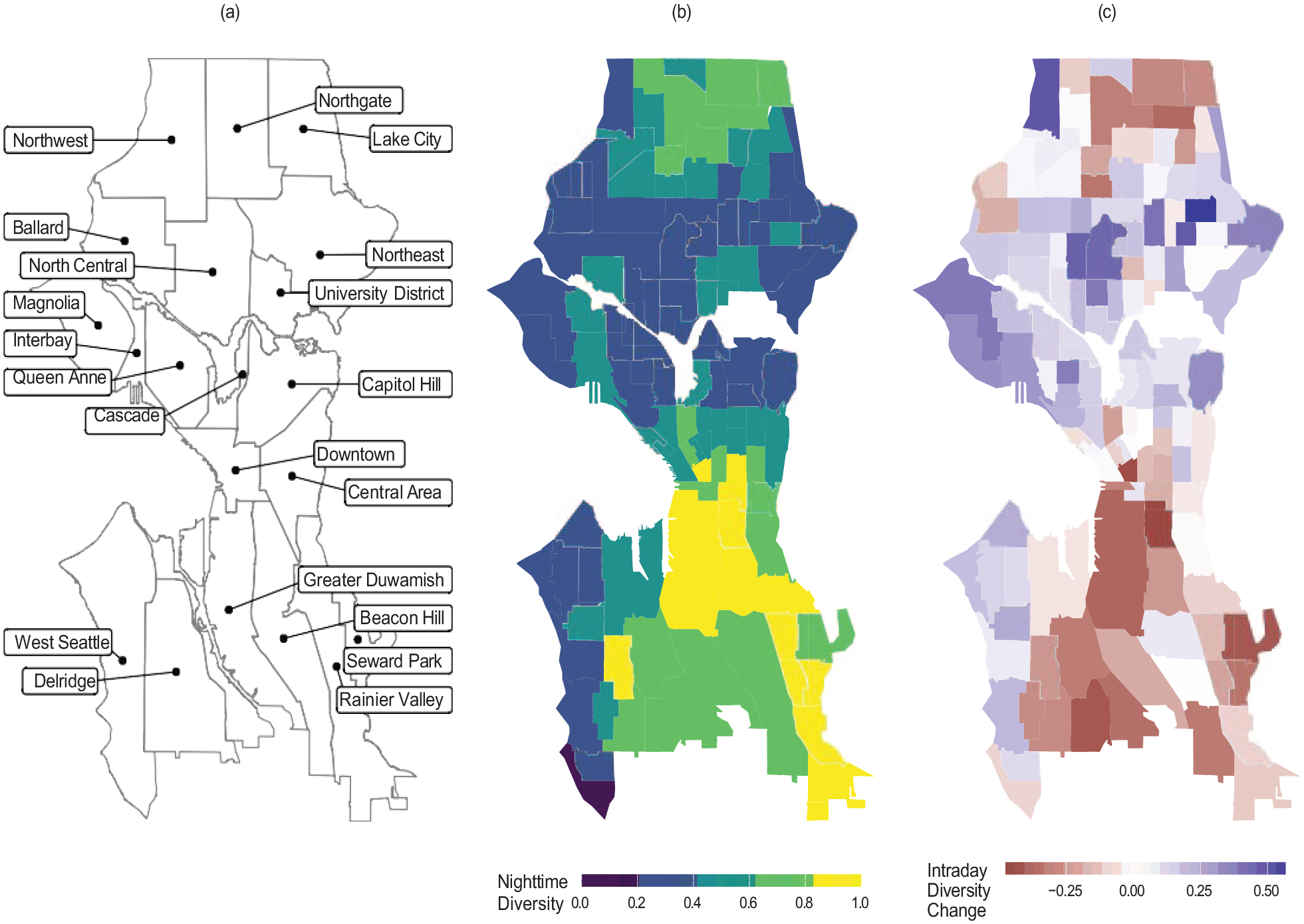
Maps of Seattle: (a) district names for reference, (b) neighborhood nighttime diversity, and (c) neighborhood daytime diversity.
Turning to Figure 1c, this map illustrates how diversity changes between night and daytime while people are at work. Areas such as Northeast Seattle, Ballard, and Magnolia that tend to be less diverse (e.g., dark blue) within Figure 1b tend to experience an increase in diversity within Figure 1c. In contrast, areas that tend to be more racially and ethnically diverse (e.g., Central Area, Beacon Hill, Rainier Valley), are where there are the largest declines in racial and ethnic diversity between night and day. At the neighborhood level, average diversity levels are higher in daytime than night, while exceptionally diverse neighborhoods (i.e., entropy greater than or equal to .8) are much fewer in number. Overall, these results highlight the existence of important differences in the trajectory of within-day change across the neighborhoods of Seattle, with many neighborhoods composed of substantially different populations at day and night.
Figure 2 formalizes some of these observations by investigating how these intraday differences in neighborhood diversity are experienced by individuals, including whether these dynamics differ with respect to individuals’ race/ethnicity. In line with expectations from the maps, this analysis shows that individuals of different racial/ethnic groups experience substantially different levels of neighborhood diversity. Specifically, Asian or Pacific Islander, Black, and Latino respondents tend to live in neighborhoods that become less diverse during the day (Asian or Pacific Islander median difference = −.11, Black median difference = −.08, Latino median difference = −.19). By comparison, white respondents tend to live in neighborhoods with less diversity at night that generally become more diverse during the day (white median difference = .12). In addition to descriptions of typical trajectories for intraday diversity change experienced by individuals, this analysis also shows that there is wide variation in the nighttime and daytime diversity levels experienced within each racial/ethnic group, with the tails of each boxplot tending to extend to about the same range (with the noted exception of some outlier white respondents who reside in exceptionally nondiverse neighborhoods).

Distributions of neighborhood diversity among Seattle Neighborhoods and Crime Survey respondents, by time of day and race/ethnicity. P.I. = Pacific Islander.
As the final component of our description of neighborhood contexts, we present mean levels of the focal outcomes of our analysis (i.e., social cohesion and fear of crime) across neighborhoods. As shown in Figure 3, both social cohesion and fear of crime have distinct spatial distributions across the city of Seattle, and the two outcomes are clearly inversely correlated. This is consistent with theories of social organization and the broader “neighborhood effects” literature on ecological variations in crime prevalence. Neighborhoods with high levels of social cohesion and low levels of fear of crime tend to be less diverse (on the basis of nighttime residential composition). Nevertheless, there is notable variation in the levels of these two outcomes even among low-diversity areas; as we report shortly, the substantial increases in diversity in daytime in these neighborhoods may be relevant to understanding this heterogeneity.

Maps of Seattle: neighborhood mean values for outcome measures of social cohesion and fear of crime.
By comparison, many neighborhoods with diverse nighttime residential populations are contexts within which there are lower typical levels for social cohesion and higher levels of fear of crime victimization. Still, there are important differences in both outcomes among these neighborhoods, with heterogeneity in degrees of racial/ethnic diversity decline over the course of the day constituting a potential factor for these variations in our outcomes. In many of these diverse contexts, mobility flows to work lead to rising white representation during the day, with this particular dynamic explored in supplementary analyses to follow. Overall, these analyses illustrate how mobility patterns for work radically reshape the geography of diversity within Seattle such that many neighborhoods where cross-racial and ethnic contact is unlikely during the evening became contexts of potential interaction during the day.
Neighborhood Social Cohesion, Fear of Crime, and Intraday Diversity Change
The coefficients from our linear mixed-effects regression models are presented in Table 2 to assess whether intraday changes in neighborhood diversity are associated with individuals’ social cohesion with their neighbors, net of the differences in these outcomes associated with other neighborhood characteristics (i.e., neighborhood nighttime diversity, individual and household characteristics, the broader neighborhood composition, the prevalence of crime and the spatial context of neighborhoods). Starting with the overall model based on our full analytic sample, there is a significant, positive association such that, ceteris paribus, residents of neighborhoods that become more diverse during the day tend to have more social cohesion compared with those that experience less change in diversity during the day, or while people are at work. Furthermore, net of intraday diversity change, greater nighttime neighborhood diversity is associated with lower average levels of social cohesion, in line with previous research that has observed an inverse relationship between local social diversity (measured using nighttime population) and this outcome. Together, these associations imply that a low-diversity neighborhood that becomes more diverse during the day would have some of the highest levels of social cohesion among residents.
Linear Mixed Models of Social Cohesion, Overall and Stratified by Race/Ethnicity.

Note: AIC = Akaike information criterion; BIC = Bayesian information criterion.
Significant difference from white respondents at p < .01.
p < .05. **p < .01. ***p < .001.
To investigate the extent to which these dynamics vary across racial/ethnic groups, the remaining results presented in Table 2 are from models stratified by respondent race/ethnicity. First, the only group-specific model that yields a statistically distinguishable association between within-day diversification and social cohesion is found for white respondents. For all other groups, Asian or Pacific Islander, Black, and Latino respondents, there is no consistent association, although the estimated coefficient for Black respondents differs measurably from that for white respondents according to the relevant Clogg test. There is also no independent association between nighttime diversity and social cohesion for Asian or Pacific Islander, Black, and Latino respondents across these stratified models. Instead, white respondents alone account for the significant positive association observed in our overall model.
The results from these models highlight how intraday diversity changes have particular salience for white respondents, with a respondent living in a neighborhood that is highly diverse throughout the day reporting significantly higher levels of local social cohesion compared with a respondent that lives in a similarly diverse context that experiences substantial declines in diversity over the course of the day. Moreover, these results indicate that a hypothetical white respondent living in a neighborhood with low diversity at night that becomes diverse during the day is expected to report the highest level of social cohesion.
Next, Table 3 presents coefficients from our second set of models investigating whether there are linkages between neighborhood diversity levels and fear of crime. Starting again with the model for the overall analytic sample, associations of fear of crime with nighttime diversity and intraday diversity change are statistically significant but in countervailing directions, as was the case in models of social cohesion. However, for this outcome, nighttime diversity is positively associated with fear of crime, whereas intraday diversity change has a negative association. The intraday diversity change association implies that residents are less afraid of crime victimization in contexts where the population stays diverse throughout the day when compared with neighborhoods that are highly diverse at night but become less so during the day. Taken together, these two associations suggest that neighborhoods that have lower diversity at night but increased diversity during the day are those where residents are expected to be the least afraid of crime victimization.
Linear Mixed Models of Fear of Crime, Overall and Stratified by Race/Ethnicity.

Note: AIC = Akaike information criterion; BIC = Bayesian information criterion.
Significant difference from white respondents at p < .01.
p < .05. **p < .01. ***p < .001.
The remaining columns in Table 3 report results from models stratified by race/ethnicity. Here, we observe estimated associations for intraday diversity change in the opposite direction as those estimated in the prior set of stratified models for social cohesion, though the implications are similar: that is, increased daytime diversity is associated with prosocial sentiments and reported behavior. These models suggest that neighborhoods with higher levels of nighttime diversity are contexts where Asian or Pacific Islander, Latino, and white respondents report higher levels of fear of crime victimization. However, there are no associations between intraday diversity change and fear of crime for Asian or Pacific Islander and Black respondents in these group-specific models (Table 3). Nevertheless, we do observe negative and statistically significant associations for Latino and white respondents such that positive intraday diversity change is related to lower levels for fear of crime (i.e., all else equal, compared with respondents from contexts where diversity does not change or declines while people are at work). Cumulatively, these associations between fear of crime and neighborhood diversity at different points of the day suggest that neighborhoods that are relatively less diverse at night but more diverse during the day are where fear of crime victimization is lowest.
Robustness Checks
Our results illustrate that there are clear associations between intraday neighborhood diversity change and social organization and fear of crime. In the following series of robustness checks, we affirm that these dynamics are not sensitive to reasonable alternative specifications and use supplementary analyses to better situate the interpretation of our focal results. Results from all of these analyses are presented in Appendix B.
First, we sought to assess whether particular dimensions of neighborhood racial and ethnic composition, whether at day or at night, accounted for the associations we observed rather than diversity overall. In the additional linear mixed models that we ran for this investigation (Appendix Table B1), we find that overall diversity at day and night remain statistically significantly associated with our key outcomes, both in models of the overall analytic sample and a race/ethnicity-specific model for white respondents, as in our main models. None of the estimated coefficients for a given group’s composition during the day or night were statistically significant. As such, we conclude that the presence of diversity on a multiethnic basis, rather than the representation of any particular racial/ethnic groups, is what is most salient to the patterns of social cohesion and fear of crime we observe in our main analyses.
Despite the fact that changes in specific racial/ethnic groups’ neighborhood representation did not account for the linkages we identified between neighborhood diversity and our outcomes, we nonetheless believed it fruitful to better understand how typical patterns of neighborhood composition change throughout the day vary with respect to neighborhoods’ overall levels of diversity. Accordingly, we estimated linear regressions of the intraday change in representation (i.e., nighttime composition − daytime composition) on the interaction of nighttime diversity with daytime diversity, measured by multiethnic entropy scores specific to the nighttime and daytime populations (Appendix Tables B2 and B3, Appendix Figures B1 and B2). Whereas low-diversity neighborhoods that become more diverse during the day tended to experience increases in their populations’ shares of Asian or Pacific Islander, Black, and Latino persons (and coinciding declines in proportions who were white), we find that diverse neighborhoods tend to experience an increase in their representation of white persons during the day in our focal case of the city of Seattle. Overall, these models provide important context for what intraday changes in diversity tend to look like in terms of the representation of different racial/ethnic groups.
Third, we considered whether measuring nighttime racial diversity among the total population, rather than just among all workers aged 16 years and older (as the CTPP captures), as the total population includes a more complete set of individuals in a person’s neighborhoods (i.e., those who are not working) and might have implications for the estimated level of diversity. We observed that the correlation in these nighttime diversity measurement approaches was .975 among SNCS respondents. Similarly, the correlation for their intraday diversity change scores was .95 between our primary measurement strategy and an alternative using the total population for nighttime diversity. As such, our supplementary models where nighttime diversity is measured using decennial estimates of the total population confirm the same patterns of association between intraday diversity change and our outcomes (Appendix Table B4).
Finally, we investigated whether there is any nonlinearity such that the associations of diversity change might depend on a neighborhoods’ level of nighttime diversity. In the additional linear mixed models where we include an interaction between nighttime diversity and intraday diversity change (Appendix Table B5), we observe a significant coefficient only for nighttime diversity but the model fit is also not measurably improved on the basis of goodness-of-fit criteria (Akaike information criterion and Bayesian information criterion) to justify the interaction’s inclusion. As such, we interpret such evidence as indicating that our approach without an interaction is more appropriate for testing our focal hypotheses.
Discussion
Although theories of neighborhood social organization and crime have long examined neighborhood change as part of the broader context shaping these key social processes, the results of our study highlight the importance of moving beyond neighborhood change over long stretches of time (e.g., decades) to examine how neighborhoods can change just over the course of a day. Specifically, for our first set of hypotheses we find evidence in support of our hypothesis that places with increased diversity during the day have higher levels of social cohesion and lower levels for residents’ fear of crime, in line with expectations from theories of social contact. We also find limited evidence in support of our second hypothesis about racial and ethnic differences in these dynamics, with a measurable difference between white and Black respondents in the association of intraday diversity change and our outcomes, but no evidence of a consistent between-group divergence in the direction of the coefficients. These findings provide suggestive evidence consistent with theories about racial variation in neighborhood change and quality of neighborhood social interactions, while highlighting avenues for future investigations that can more tightly link meso-level shifts in local contexts to the social psychological processes that shape community life. Overall, even though our call for assessing the short-run dynamics of social contexts is hardly new (Vallée 2017; Van Ham and Tammaru 2016), this study contributes novel evidence that within-day changes in the social composition of different locations map onto meaningful differences in neighborhood conditions and experiences central to our understanding of social organization and life, whether this is residents’ interactions with each other or the perception of safety that they have within their residential contexts.
Our findings have a number of important implications for research on neighborhood social organization and crime. First, we bring renewed attention to the positive role that social diversity could play in local communities, with the places that experience increased diversity during the day generally having higher levels of social cohesion and relatively less fear of crime. For neighborhoods where homogeneous populations become more diverse during the day, this could be supportive of contact theory (i.e., mobility for work leads some from outside of the neighborhood to diversify the social context and potentially interact with neighborhood residents). Moreover, for nonworking residents of such contexts, the increased diversity may facilitate cross-group contact and help reduce perceptions of social difference that might otherwise be reified amid isolation from persons of different racial/ethnic identities. That said, the observation that daytime diversity is salient for white respondents in particular highlights how an alternative interpretation may underpin this contingency, with whites’ anxiety and discomfort amid diversity fostering an increased interest in exertion of social control.
Second, our results illustrate how research on within-day changes in social context have bearing on prior work documenting variations in fear of crime across different points of the day (Boessen et al. 2017). Although fear of crime may tend to be greater during the evening, lower fear of crime associated with greater daytime diversity suggests that some variation in daytime fear of crime may be related to daytime exposures to residential diversity mitigating negative perceptions of outsiders in a neighborhood. To the extent that changing social contexts may be associated with changes in contributing factors for crime from a routine activity theory perspective (i.e., motivated offender, suitable target) but also differences in terms of social organization, there could be direct and indirect pathways linking short-term population dynamics with short-run variations in fear of crime (Cohen and Felson 1979).
This study advances our understanding of how within-day changes matter for local social dynamics. However, these findings also elicit important questions about within-day change, a framework advanced in this study. First, the present study’s focus on neighborhoods as defined by tracts raises questions about how social cohesion and population change may operate similarly or differently if examining individuals’ definitions of their most salient social environments, that is, by following them as they navigate their activity spaces (Golledge and Stimson 1997). Second, although the present study aimed to look at racial/ethnic variation in the key associations between intraday diversity change and our outcomes, there remain important and timely questions around how individuals directly shape the neighborhood experiences of others through their “doing” of sociospatial boundaries, including, for instance, through the use of new tools for residential and community surveillance and social organization, such as neighborhood community forums such as Nextdoor (Kurwa 2019; Lambright 2019), or through more conventional means of exerting social control like calling the police (Lanfear et al. 2018). These directions would facilitate understanding how short-run changes in diversity that occur in the areas where people reside may influence their perceptions about its organization or safety.
Furthermore, although our incorporation of both daytime and nighttime population exposures is a contribution, our data are limited in the “ambient populations” they capture, like many other types and sources of data leveraged to describe local populations and short-term local population change. For example, these data cannot capture the racial/ethnic composition of customers and clients in workplaces and the ways that may shape perceptions of diversity and social cohesion (e.g., Lee 2002) and casual visitors to residential neighborhoods (e.g., Gu et al. 2023). Taken together, continued methodological and data collection innovation in future research may yet more fully integrate concepts and methods from mobility-based literatures with the “day course” conceptualization of social contexts and be invaluable to our understanding of social contexts shape social process, and vice versa. This would lead to a more accurate representation of the contexts that different persons are exposed to, whether this is in terms of how diverse or homogeneous the local population is, or the extent to which changes in who else is present in the area matters for social dynamics like crime or social ties that happen within these spaces.
Next, the coronavirus disease 2019 (COVID-19) pandemic and associated changes to people’s day-to-day activities and mobility had both immediate and potentially longer term impacts on social isolation, interaction, and exposure to diversity (e.g., Müürisepp et al. 2023). The data used in our study do not reflect the massive changes to daily routines and social interaction tied to the spread of COVID-19 and societal and policy responses to that crisis. This shapes the larger generalizability of the findings presented here in that they are not able to speak to current patterns of day-to-night changes in local population composition and potential for interaction. However, given the linkages we identify between neighborhood racial/ethnic composition, intraday change in neighborhood composition, and core components of community process, the extension of this study to COVID-19-affected times will be essential to helping us understand how large-scale shocks may interact with both meso- and micro-level dimensions of social integration and segregation to shape the organization of social life moving forward. As societies move on from the pandemic into a “new normal” characterized by uneven prevalence of remote work arrangements and longer term changes to neighborhood social interactions based on lingering considerations about infection, the impacts of intraday changes in neighborhood contexts may look different and hold different implications for social organization than those demonstrated in the present study.
Beyond the specific empirical findings of this study and limitations therein, this work makes a larger theoretical and conceptual contribution to our understanding of neighborhood change by highlighting the need for considering short-run dynamics in our analyses of social context. Much like there are classical models for longer term dynamics (e.g., invasion-succession) involving changes in neighborhood diversity, future studies must reckon with how we define diversity, not only in terms of along what social boundaries and on what timeline, but also in terms of what “diversification” means across places with distinct population structures and compositions.
Supplemental Material
sj-docx-1-srd-10.1177_23780231241309224 – Supplemental material for Within-Day Diversity Change, Neighborhood Social Cohesion, and Fear of Crime
Supplemental material, sj-docx-1-srd-10.1177_23780231241309224 for Within-Day Diversity Change, Neighborhood Social Cohesion, and Fear of Crime by Chris Hess, Youngmin Yi, Gregory Sharp and Matt Hall in Socius
Footnotes

Supplemental Material
Supplemental material for this article is available online.
Notes
Author Biographies
References
Supplementary Material
Please find the following supplemental material available below.
For Open Access articles published under a Creative Commons License, all supplemental material carries the same license as the article it is associated with.
For non-Open Access articles published, all supplemental material carries a non-exclusive license, and permission requests for re-use of supplemental material or any part of supplemental material shall be sent directly to the copyright owner as specified in the copyright notice associated with the article.
