




Abstract
The #MeToo movement illustrated how higher-ups may abuse their power by engaging in sexual harassment and generated heightened concern about hierarchical workplace romantic relationships. In a survey experiment, the authors test whether sexual attention from a superordinate outside one’s reporting chain (desired or not) leads to stereotyping and resultant career penalties. A woman employee who reported sexual harassment was seen as less warm and more attention seeking and cutthroat but also more assertive and willing to speak truth to power, although some perceptions varied by the harassment type. A woman who declared a romantic relationship with a superordinate was viewed as less committed to the organization. This stereotyping did not translate to workplace penalties apart from a marginally significant raise penalty against the woman who reported unwanted sexual advances. However, the authors find that experiencing sexual attention from a superordinate, whether desired or not, is damaging to working women’s reputations.
The problem of sexual harassment has long been relegated to the shadows of American society. That changed with the popularization of the #MeToo movement. Although the activist Tarana Burke had already been using the phrase “me too” to illustrate the prevalence of sexual violence for a decade, it was in October 2017, when the actress Alyssa Milano urged survivors to use the hashtag #MeToo, that public attention turned broadly to the problem of sexual harassment and assault. One year later, #MeToo had been posted more than 19 million times on Twitter (Anderson and Toor 2018), and more than 200 powerful men had lost jobs or major roles because of public sexual harassment allegations (Carlsen et al. 2018).
Although some of the most infamous and heinous allegations, such as those against Harvey Weinstein and Bill Cosby, led to criminal sexual assault charges and convictions, it was much more likely for perpetrators to be ousted for making inappropriate sexual comments and unwanted advances (Rummler 2020). For example, Roy Price resigned from his position as head of Amazon Studios after producer Isa Hackett accused him of vulgar comments and repeated sexual advances. Although Price maintained that his “failed attempt at humor” was misunderstood, Hackett publicly commented that she “wasn’t laughing when he asked me in graphic detail about my sexual history with men, when he lauded his genitals or when he told me I would love having sex with him in explicit detail” (Perman 2020).
The allegations against Roy Price and many others during the global #MeToo movement have sparked widespread discussions about gender and workplace power. Organizational responses to interoffice dating, too, have come under closer scrutiny, particularly when romantic relationships are hierarchical and create opportunities for coercion. In 2019, McDonald’s abruptly fired CEO Steve Easterbrook for violating the company’s policy against fraternization by engaging in a sexual relationship with a subordinate. More recently, University of Michigan president Mark Schlissel was similarly removed from power after an anonymous complaint exposed his relationship with a subordinate that was “inconsistent with the dignity and reputation of the University” (Jaschik 2022).
The decisiveness of these organizations illustrates new societal recognition of the potential for abuse of power when higher-ups pursue subordinates, whether or not their advances amount to harassment. Following numerous accounts told throughout the #MeToo movement of men abusing their positions of power to attempt to coerce subordinates into sex, employers seem to be more cognizant of the potential for abuse of power in hierarchical workplace relationships. However, we hypothesize that there is even more at stake. A woman who is pursued by a superordinate may risk not only coercion but also subtler disadvantages, even if the advances are not experienced as harassment. Merely being in a romantic relationship with a superordinate may cause a woman to be negatively stereotyped and subsequently viewed as less worthy of career opportunities, we posit. Whether the subordinate enters a consensual workplace relationship with her superordinate or declines the advances, being the object of a superordinate’s sexual interest may put her in an impossible situation.
Extending Hart’s (2019) survey experiment on the negative stereotyping and subsequent employment penalties that can stem from self-reporting sexual harassment, we similarly field an original survey experiment on Amazon Mechanical Turk (MTurk) to test whether reporting sexual harassment from, or disclosing a romantic relationship with, a superordinate influences perceptions of an employee’s character and professional potential in the post-#MeToo era. We find evidence of the former but not the latter. Compared with an equivalent control condition employee, a woman who filed a sexual harassment complaint was perceived as less warm and more attention seeking and cutthroat but also more assertive and willing to speak truth to power, although some of these perceptions varied depending on the type of harassment reported. A woman who declared a romantic relationship with a superordinate was viewed as less committed to the organization, but not less competent, than the control. However, this stereotyping did not translate to workplace penalties for women who experienced sexual harassment or who dated a superordinate within the organization, apart from a marginally significant raise penalty against the woman who reported unwanted sexual advances from an organizational superordinate.
In what follows, we first review the literature on the prevalence and costs of sexual harassment. We then review literature illustrating how stereotyping and discrimination may create further costs (or benefits) to targets of sexual harassment, and outline hypotheses for how stereotypes about harassment targets may shape work outcomes deemed appropriate for a woman harassed by a superordinate at work. Finally, we review the literature on hierarchical workplace relationships and hypothesize how perceptions of a woman in a consensual workplace relationship with a superordinate may shape the work outcomes deemed appropriate for her.
Workplace Sexual Harassment
Workplace sexual harassment refers to sexual coercion, unwanted sexual attention, and verbal and nonverbal behaviors that convey objectification, hostility, exclusion, or second-class status toward members of a gender (NASEM 2018). Employers have a legal responsibility to protect workers from sexual harassment that is so frequent or severe that it creates a hostile work environment or causes the target to suffer negative employment outcomes such as termination or demotion.
Estimates of the prevalence of sexual harassment vary depending on measurement and sample characteristics, but some studies conclude that the majority of working women have experienced sexually harassing behaviors (Ilies et al. 2003). Women are more likely to be targeted than men, and men are most likely to be perpetrators (USMSPB 2018). These patterns have not been significantly affected by the #MeToo movement (Kearl 2018), although the movement has influenced how individuals understand and respond to sexual harassment (Palmer et al. 2021). Nationally representative studies have yet to systematically compare rates of harassment for transgender and nonbinary adult workers, but there is strong evidence to suggest that rates likely exceed those reported by cisgender women (Grant et al. 2011; Witcomb and Cooper 2024).
Incidence rates are also correlated with job characteristics such as occupation, industry, and the gender composition of the work. Raj, Johns, and Jose (2020), for example, found that working in women-dominated industries protected women—and working in men-dominated industries protected men—from sexual harassment compared with working in gender-balanced industries. Although they did not find similar patterns on the basis of gender ratios in occupations, women in men-dominated occupations were at increased risk for sexual harassment perpetrated by a supervisor. Evidence about the prevalence of sexual harassment by occupational role suggests that sexual harassment is particularly likely to be perpetrated by superordinates or peers (Folke et al. 2020). Evidence is mixed as to whether one’s organizational position shapes one’s likelihood of experiencing sexual harassment (Folke et al. 2020; Roscigno 2019; Tinkler and Zhao 2019).
Workplace sexual harassment has severe consequences for individuals and organizations (NASEM 2018). For targets, sexual harassment correlates to a host of adverse mental, physical, and behavioral health effects (Fitzgerald et al. 1997; Houle et al. 2011), reduces job satisfaction and productivity (Willness, Steel, and Lee 2007), and can derail individual careers (McLaughlin, Uggen, and Blackstone 2017). Moreover, these negative effects can extend to bystanders and colleagues (Glomb et al. 1997) and cost employers millions of dollars because of employee absenteeism and turnover, reduced morale, and reputational damage (Au, Dong, and Tremblay 2023; USMSPB 1988).
Despite these deleterious effects and increased exposure from the #MeToo movement, sexual harassment continues to be underreported to employers and the U.S. Equal Employment Opportunity Commission (Fitzgerald, Swan, and Fischer 1995; NASEM 2018). In lieu of reporting, it is more common for victims to ignore the behavior, avoid their harassers— e.g., by changing their work hours or routines—or attempt to stop the harassment on their own by confronting their harassers or seeking assistance from colleagues, though none of these responses are a surefire way to resolve the situation (Blackstone, Uggen, and McLaughlin 2009; Firestone and Harris 2003; McLaughlin et al. 2017). Reporting is a relatively unusual step: Cortina and Berdahl (2008) find that just one-fourth of harassed workers filed complaints with their employers, and Rosenfeld (2024) estimates that just one in 715 women who experiences sexual harassment in the United States reports it to the U.S. Equal Employment Opportunity Commission.
Reporting sexual harassment to one’s employer is no panacea. One study of the military showed that reporting to the organization improved the situation only about half the time (Firestone and Harris 2003). Reporting may not only be ineffective at addressing sexual harassment, but may lead to further problems. Among the sexual harassment complaints reported to the Equal Employment Opportunity Commission, two thirds of targets experienced employer retaliation (McCann, Tomaskovic-Devey, and Badgett 2018); a survey of federal workers revealed a similar rate of retaliation (Cortina and Magley 2003). Indeed, studies comparing the experiences of women who filed sexual harassment reports and those who experienced but did not report sexual harassment have shown worse health and career outcomes for the former (USMSPB 1995). Structurally, sexual harassment grievance procedures themselves can be detrimental to gender equality in the workplace: when instated in workplaces with few women managers, they are followed by declines in the representation of women of color in management (Dobbin and Kalev 2019).
The literature reviewed in this section provides important context for our study: workplace sexual harassment is ubiquitous, underreported, and consequential. Beyond the harms that stem from sexual harassment itself, targets of harassment often incur further, subtler consequences when they seek aid from their organizations in addressing it. Next, we review the social psychological literature on stereotyping and discrimination, along with interdisciplinary evidence indicating that this is a relevant pathway through which targets of sexual harassment may incur workplace penalties.
Biased Assessments of Sexual Harassment Targets
When people stereotype, they ascribe characteristics thought to typify particular groups to the individuals belonging to those groups (Fiske et al. 2002). Stereotyping allows people a means of predicting others’ behavior and shapes how they orient their own emotions and behaviors toward individuals on the basis of inferred traits (Fiske, Cuddy, and Glick 2007).
However, stereotyping processes often drive social inequalities, as negative views toward members of subordinated groups can produce discriminatory treatment (Ridgeway 2019). One form of discrimination, status discrimination, arises when individuals are deemed unsuitable for tasks because they are stereotyped as less capable (Benard and Correll 2010). For instance, in masculine-stereotyped fields, men are perceived as more competent than women and are thus favored for employment opportunities (Ridgeway 2011). Similarly, women who are not mothers tend to be viewed as more competent and committed to their work than women who are mothers, resulting in a hiring premium for nonmothers relative to mothers (Correll, Benard, and Paik 2007).
A second form of discrimination, normative discrimination, occurs when individuals fail to conform to stereotypical expectations of their group and as a result are viewed as deficient in interpersonal qualities (Benard and Correll 2010). For example, women who exhibit assertive leadership traits, defying the stereotype that women should be communally oriented, are seen as less likable and employable than men displaying the same qualities (Rudman et al. 2012). Similarly, when working mothers display competence and commitment to their work, violating societal expectations that mothers should prioritize childcare, they are perceived less favorably than equivalent working fathers, leading to adverse employment outcomes (Benard and Correll 2010).
There are a number of negative cultural tropes about women who report sexual harassment: for example, that they may be lying to ruin the alleged harasser’s reputation, that they ought to have been flattered by sexual attention, or that they should have been able to put an end to the unwanted sexual behavior when it occurred (Lonsway, Cortina, and Magley 2008). In line with this, Hart (2019) demonstrated in an experiment that participants were more likely to view a woman who reported sexual harassment as immoral and lacking in warmth and social skills, relative to a woman who experienced but did not report sexual harassment. In part because of these negative perceptions, participants were less likely to recommend the woman who reported sexual harassment for promotion. Thus, Hart’s results indicate that a woman who reports sexual harassment faces normative discrimination (but not status discrimination) because she is viewed as deficient in interpersonal qualities. This suggests that alongside explicit forms of retaliation that have previously been documented (e.g., Cortina and Magley 2003; McCann et al. 2018), targets of sexual harassment may face subtler biases resulting from negative stereotypes about people who report sexual harassment.
How would such bias affect the lives of sexual harassment targets, if it existed? If Americans carry a general bias against people who report sexual harassment, managers may view employees who are known to have reported sexual harassment as less worthy of forms of career advancement such as pay raises and promotion opportunities relative to employees who are not known to have reported harassment. Although we do not test this mechanism directly—we do not specifically survey the managers of employees who have reported sexual harassment—another study found that gendered biases held by hiring managers are also held broadly in the American population (Correll et al. 2007).
Although negative tropes about women who report sexual harassment are long-standing (Lonsway et al. 2008), the #MeToo movement may have shifted perceptions of women who speak out against sexual harassment. The abundance of women who shared experiences of sexual harassment during #MeToo may have challenged the idea that sexual harassment is a rare or inconsequential phenomenon. In fact, after #MeToo was popularized, Americans were more likely to consider sexual harassment a major problem than they were 20 years prior (Saad 2017), despite evidence that sexual harassment rates decreased during that period (Rosenfeld 2024). Likewise, women who experienced sexual harassment after the popularization of #MeToo were less prone to self-doubt or low self-esteem following harassment, suggesting less internalization of negative tropes about women who are sexually harassed (Keplinger et al. 2019). Indeed, people who shared experiences of sexual harassment during the #MeToo movement sometimes received adulatory attention. For example, in 2017, Time magazine named “the Silence Breakers”—those who had gone public with accounts of sexual harassment—the collective “Person of the Year” (Zacharek, Dockterman, and Edwards 2017).
Have these cultural shifts altered the negative stereotyping of, and subsequent discrimination toward, women who report sexual harassment? Hart’s (2019) data suggest that this may indeed be the case. Hart first ran the experiment discussed above on October 5, 2017, before the #MeToo hashtag was popularized, and then reran it monthly until February 2018. During this period, which coincided with the surge in media coverage of the #MeToo movement (Uggen et al. 2021), Hart found that the promotion penalty against the woman who reported sexual harassment disappeared.
The impact of the #MeToo movement leaves the possibility of normative discrimination toward sexual harassment targets uncertain. The #MeToo movement may have altered cultural views of sexual harassment targets in ways that reduce or even eliminate bias associated with reporting sexual harassment, consistent with Hart’s (2019) finding of fading bias.
Moreover, the #MeToo movement focused particularly on cases of sexual harassment that involved an abuse of power: typically, a superordinate man sexually harassing a subordinate woman. To examine how, several years after the popularization of the #MeToo movement, people perceive sexual harassment in which the possible abuse of power is salient, in this experiment we examine how participants perceive a woman who is sexually harassed by a superordinate (whereas Hart examined perceptions of a woman sexually harassed by a coworker). Given the potential for abuse of power, study participants might view unwanted attention from a superordinate as particularly concerning and therefore may view an employee who reports it as admirably assertive and heroic, as the Silence Breakers were framed in Time magazine. In light of this recent norm cascade, we propose the following hypothesis:
Hypothesis 1a: Reporting a superordinate for unwanted sexual attention leads to employment benefits because the employee is viewed as assertive and willing to speak truth to power.
Alternately, it may be the case that any positive effect the #MeToo movement may have had on perceptions of sexual harassment targets was marginal or transient. Indeed, Americans’ support for the idea that sexual harassment is a major problem declined from 2017 to 2019, particularly among men (Brenan 2019), suggesting that heightened awareness about the issue of sexual harassment—and, in turn, more favorable views of targets—may have faded quickly. If this were the case, following the normative discrimination mechanism (Hart 2019), women who report sexual harassment may continue to be negatively stereotyped and, as a result, viewed as less worthy of desirable employment outcomes. We formalize this competing hypothesis as follows:
Hypothesis 1b: Reporting a superordinate for unwanted sexual attention leads to employment penalties because the employee is viewed as lacking warmth, seeking attention, and cutthroat.
Our hypothesized mediators build on and extend the work of Hart (2019). Consistent with Hart’s formulation, we propose that an employee who reports unwanted advances will be perceived as less warm than an equivalent employee who does not experience such advances. Hart also found that general perceptions of the employee’s moral character mediated employment penalties toward a sexual harassment target. Here, we examine two components of moral character that are particularly salient in negative tropes about women who report sexual harassment: the idea that such women are merely seeking attention and the idea that their claims are rooted in a desire to advance their own careers or harm the careers of those they accuse.
Hierarchical Workplace Relationships
We hypothesize above that reporting unwanted sexual interest from a superordinate may result in employment penalties; however, we also posit that even sexual interest from a superordinate that is desired (i.e., that is not sexual harassment) may be detrimental to one’s career. Indeed, experimental studies indicate that an employee is viewed as less worthy of promotion when they are in a relationship with a direct superior, compared with an identical employee either in a relationship with an equal-status coworker or not in a workplace relationship (Barratt and Nordstrom 2011; Chan-Serafin et al. 2017).
Why might dating a superordinate negatively affect whether an employee is perceived as worthy of career advancement? Other employees tend to resent these relationships because of the potential for favoritism (Malachowski, Chory, and Claus 2012; Pierce and Aguinis 2009) and concerns that the relationship disrupts the workplace power balance (Mainiero 1986). The subordinate may be perceived as using the romantic relationship for professional gain, and therefore their career success may be attributed to an unfair advantage (Chan-Serafin et al. 2017; Chory and Gillen Hoke 2020). Put differently, an employee in a relationship with a superordinate may be seen as having gained their position at work through means other than merit.
Setting aside the potential of a subordinate to exploit a romantic relationship for career gains, dating a superordinate may activate tropes of “gold diggers” who exploit sexual relationships to acquire nonwork resources, particularly for women who date higher status men (Marks 2008). Beyond the context of hierarchical workplace relationships, a woman’s romantic life can jeopardize her career success when made salient: Bonnes (2022) found that women’s engagements and marriages serve as “femininity anchors” that lead others to question their commitment to military service and thereby lead to deleterious consequences for women’s military careers.
This body of research suggests that a woman in a relationship with a superordinate may be vulnerable to status discrimination: discrimination arising from the perception that she is less capable than an equivalent employee whose relationship status is not disclosed. Her relationship with a superordinate may be read as either a strategy for advancing at work through nonmeritocratic means (thus calling into question her competence) or a signal that she may seek financial security through the relationship rather than her job (thus calling into question her commitment to the organization).
Some prior experimental work has indeed demonstrated detrimental employment effects of dating a superordinate within one’s reporting chain, specifically, that such an employee may be perceived as less worthy of promotion or management training (Barratt and Nordstrom 2011; Chan-Serafin et al. 2017). We build on this work in two ways. First, we examine perceptions of a hierarchical workplace relationship in which the partners are not in the same reporting chain (i.e., a relationship between a director of accounting and a sales associate). Organizations have less cause to prohibit such relationships, particularly in the post-#MeToo era, relative to hierarchical workplace relationships between employees within a reporting chain (Boyd 2010). These relationships are also less stigmatized. According to a recent report by the Society for Human Resource Management (Gurchiek 2024), 42 percent of employees believe it is acceptable for workers at different levels who rarely or never work together to be in a romantic relationship, compared with only 27 percent approval for hierarchical workplace romances between individuals who often or always work together. Second, in contrast to prior work on this topic, we examine whether status discrimination may mediate any employment penalties we may find. Thus, we propose the following hypothesis:
Hypothesis 2: Dating a superordinate outside of one’s reporting chain leads to employment penalties because the employee is viewed as less competent and less committed to their work.
Data and Methods
We draw on an original survey experiment to investigate our hypotheses. The study uses data from a survey of 1,063 respondents conducted in July of 2020, fielded on Amazon MTurk. 1 Respondents were U.S. residents 18 years and older. As is typical of MTurk samples, participants tilted liberal, young, and white (see Table A1 in the supplemental materials for demographic characteristics). Our sample also had a preponderance of men (61 percent). Although our sample is not fully representative of the U.S. population, it allows us to evaluate cultural biases among a broad swath of Americans. 2
Each participant only viewed one employee file (a between-subjects design). Across conditions, the fictitious employee being evaluated is a woman (Sarah Carter), and the superordinate she is dating or being harassed by is a man (Michael Wilson). Given that most romantic relationships are heterosexual and that men occupy an outsize share of high-ranking positions, we reasoned that power-laden workplace relationships most commonly involve women subordinates dating men superordinates. Likewise, the most common configuration of workplace sexual harassment is a woman being sexually harassed by a man (McLaughlin, Uggen, and Blackstone 2012). Our experiment thus speaks best to these modal cases: women subordinates receiving romantic or sexual attention from men superordinates.
Experimental Design
We adapted our study procedure from Hart (2019). Study participants were first asked to imagine that they were a manager at a company making decisions about employees. Participants were randomly assigned to see one of four employee files, which represented the four experimental conditions. Then, participants were asked to select employment outcomes they deemed appropriate for the employee, and to rate the employee on qualities like warmth, competence, and assertiveness. The four employee files and our survey questions are presented in supplemental materials.
Participants all saw the same performance review on the first page. The employee, Sarah Carter, was a sales associate described as dedicated and enthusiastic but who struggled with tasks requiring flexibility. She was ranked in the middle category, “satisfactory,” across five metrics. We intentionally described her as a middling employee given that people make evaluations on the basis of stereotypes most readily when a person’s qualifications are ambiguous (Dovidio and Gaertner 2000).
The second page of each employee file contained our experimental manipulation. In the “unwanted advances” condition, Sarah reported to her employer that Michael Wilson (director of accounting) had repeatedly asked her to go on dates with him and begin a sexual relationship despite her expressed disinterest. In the “intrusive questions” sexual harassment condition, Sarah said that Michael had repeatedly asked her personal questions about her sex and dating life, despite her expressed disinterest. In both conditions, the form stated that an investigation had been initiated by Human Resources. In the hierarchical workplace relationship condition, an “Employee Romantic Relationship Disclosure Agreement” contained signatures from both Sarah Carter and Michael Wilson stating that they had entered into a consensual relationship. The role of each employee (Sarah as sales associate, Michael as director of accounting) was listed on the form. Both sexual harassment conditions contained an “Employee Sexual Harassment Complaint Form.” The control condition contained an acknowledgment of the performance review, signed by the employee and her supervisor. We created this page so that the control condition would match the two-page format of the other conditions without including meaningful new information.
Key Variables
After viewing the employee file, participants were asked to assign employment outcomes on three metrics presented in random order: the raise that they would recommend on a seven-point scale from 0 percent to 6 percent and their likelihood of recommending the employee for a promotion and for managerial training, both on seven-point scales from “extremely unlikely” to “extremely likely.” Participants then rated their perceptions of the employee along a series of traits: “committed to the organization,” “competent,” “warm,” “attention-seeking,” “assertive,” “speaks truth to power,” and “cutthroat.” Each perception measure was captured with a single seven-point scale (see the supplemental materials). After evaluating the employee, participants were then asked, “Which kind of document was included with the employee’s performance review?” to establish whether participants had read the study materials that contained the experimental manipulation.
Analytic Approach
Of the 1,063 participants who submitted the survey via MTurk, 786 (74 percent) correctly answered our manipulation check question. We limit the analytic sample to those 786 participants, but our results are similar when we run parallel models with the full sample (see the supplemental materials). There were no missing data for our dependent or mediator variables.
Each of our hypotheses posits a main effect in three employment penalty outcome variables between experimental conditions. We use ordinary least squares regression to test for differences across conditions for the raise item, which was captured on a numeric scale from 0 to 6. We use ordered logistic regression to test for differences across conditions for the promotion and managerial training items, and for the proposed mediator items (i.e., perceptions of the employee), all of which were captured on ordinal scales. For ease of interpretation, we present these results in odds ratios, obtained by exponentiating the regression coefficient. In these models, odds ratios can be interpreted as the odds of selecting higher value outcomes of an ordinal dependent variable relative to selecting lower value outcomes (Long and Freese 2014). We tested the proportional odds assumption underlying each of the ordered logistic regression models using the Brant test; the assumption is not violated except in one case (discussed below). We use the mediation framework proposed by Imai et al. (2011) to test for causal mediation.
Findings
We begin by examining how sexual attention from a superordinate, either unwanted or desired, may shape employment outcomes deemed appropriate for an employee. In Table 1, we first regress raise on the experimental conditions (model 1). The constant indicates that on average, respondents proposed a raise for the control employee at the midpoint of the scale (i.e., a 3 percent raise). Respondents did not recommend a raise to the employee in a workplace relationship that was significantly different from the control; the same is true for the employee who reported intrusive questions from a superordinate. Respondents offered a marginally significantly lower raise to the employee who reported she had been repeatedly asked out by a superordinate (p = .064).
Regressions of Employment Outcomes for Employees across Conditions.

Note: Values in parentheses are standard errors. Cut points are not shown for ordered logistic regression models. OLS = ordinary least squares; Ologit = ordered logistic regression.
p < .05. **p < .01. *** p < .001.
Although we urge caution in interpreting the raise penalty toward the employee who was repeatedly asked out by a superordinate, given its borderline statistical significance, to fully test hypothesis 1b we examine whether being viewed as lacking warmth, attention seeking, and cutthroat significantly mediate the raise penalty in the supplemental materials. In Table A6, we find the lack of perceived warmth for employees who reported sexual harassment indeed significantly mediated the raise penalty (average causal mediation effect = −0.07, 95 percent confidence interval = −0.14 to −0.01). Neither the attention-seeking nor cutthroat variable significantly mediated the raise penalty; interestingly, the effect of reporting sexual harassment increases in size and magnitude when cutthroat is added in model 3, contrary to hypothesis 1b. 3
We next examine respondents’ likelihood of offering the employee a promotion across conditions (model 2 of Table 1). The likelihood of promotion did not differ between any of the conditions and the control. Finally, we examine respondents’ likelihood of offering the employee managerial training for employees showing leadership potential (model 3 of Table 1). Here, too, we do not find that any conditions differ significantly from the control. Thus, we find an employment penalty in just one case—the employee who reported being repeatedly asked out was offered a lower raise than the control—and the effect is marginally significant. This provides only very limited evidence to support the employment penalties against people who report sexual harassment as proposed in hypothesis 1b. We do not find evidence to support employment penalties against an employee in a workplace relationship with a superordinate, as proposed in hypothesis 2, nor evidence to support an employment premium for employees who experience sexual harassment, as proposed in hypothesis 1a.
Perceptions of the Employee
We hypothesized that any employment benefits experienced by the employee who reported sexual harassment from a superordinate would be explained by the perception that she was more assertive and willing to speak truth to power than an equivalent employee who did not experience harassment (hypothesis 1a). Although we find no employment benefits for this employee, we next examine whether she is nonetheless rated more highly for these characteristics. In models 1 and 2 in Table 2, we find evidence that this is indeed the case, regardless of harassment type. Relative to the control, the employee who was repeatedly asked out by a superordinate is 160 percent more likely to be viewed as more assertive, and the employee who was asked intrusive questions is 128 percent more likely to be viewed as more assertive. In addition, the employee who reported being repeatedly asked out is 189 percent more likely to be viewed as someone who speaks truth to power, and the employee who reported being asked intrusive questions is 196 percent more likely to be viewed this way, relative to the control. 4
Ordered Logistic Regressions of Perceptions of the Employees, in Odds Ratios.
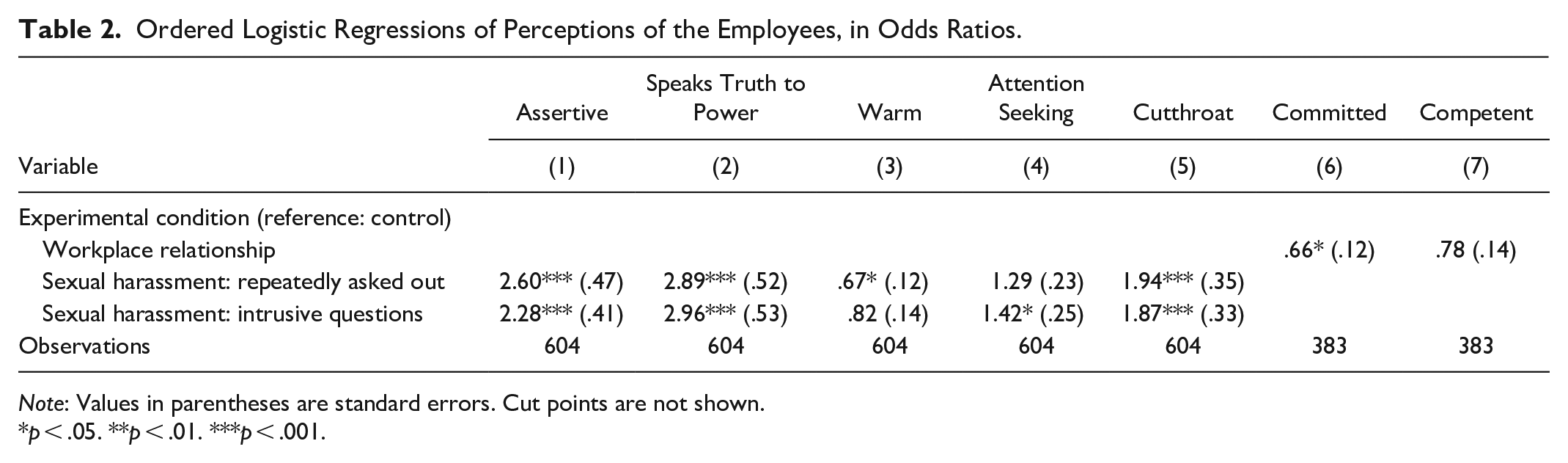
Note: Values in parentheses are standard errors. Cut points are not shown.
p < .05. **p < .01. ***p < .001.
As described above, we find marginally significant evidence of an employment penalty—a lower proposed raise—for one of the sexual harassment conditions: the employee who was repeatedly asked out by a superordinate. We hypothesized, however, that both employees who experienced unwanted sexual attention from a superordinate would be perceived as less warm, more attention seeking, and more cutthroat than the control employee (hypothesis 1b). Are the employees who reported sexual harassment indeed perceived through this negative lens?
We find partial evidence to support these predictions. The employee who reported being asked out repeatedly by a superordinate was 33 percent more likely to be seen as less warm relative to the control employee; conversely, the employee who reported being asked intrusive questions was not significantly more likely to be seen as less warm (model 3). Our findings were the opposite for attention seeking: the employee who reported intrusive questions was 42 percent more likely to be viewed as more attention seeking than the control, whereas the employee who reported being asked out repeatedly was not perceived as significantly more attention seeking (model 4).
The employee who reported being repeatedly asked out by a superordinate was 94 percent more likely to be seen as more cutthroat than the control (model 5). When we created a parallel ordered logistic regression model for the employee who reported being asked intrusive questions, a Brant test of the parallel regression assumption indicated that the assumption was violated for this condition. Therefore, in analyses presented in supplemental materials (Table A3, Figures A1 and A2) we relax the parallel regression assumption by using a generalized ordered logistic regression, examining the average marginal effects predicted by this model (see Fullerton and Xu 2016). We find that the employee who was asked invasive questions is less likely to be viewed at a 1 or 2 on the cutthroat scale (i.e., at the “not cutthroat” pole) and significantly more likely to be rated at the midpoint of the scale relative to the control. Put differently, these results indicate that participants appear far less likely to view the employee who reported intrusive questions at the not cutthroat extreme relative to the control.
Finally, we predicted that the employee in a workplace relationship with a superordinate would be perceived as less committed to the organization and less competent relative to the control (hypothesis 2). We find partial evidence that this is the case. Model 6 shows that relative to the control, the employee in the hierarchical workplace relationship condition is 34 percent less likely to be perceived as more committed to the organization. Model 7 illustrates that the employee in the hierarchical workplace relationship condition is not significantly less likely to be perceived as more competent relative to the control.
Although we did not hypothesize an effect of participant gender, in supplemental analyses we examine whether women and men participants perceived the experimental conditions differently. Across both the outcome and perception variables, we do not find substantially different responses between women and men participants (see the supplemental materials).
Discussion and Conclusion
The #MeToo movement has illustrated how higher-ups may abuse their power by engaging in sexual harassment, and increasingly, the ethics of hierarchical workplace romantic relationships have also been questioned. Yet the potential for subtler negative effects—stereotyping and bias—stemming from sexual attention from a superordinate outside of one’s reporting chain has gone largely unexamined. Our experiment sheds light on whether and how these workplace dynamics affect employment decisions.
The two women who filed sexual harassment complaints in our experiment were variably perceived as less warm and more attention seeking than an identical control employee who had not filed a sexual harassment complaint, and both were perceived as more cutthroat. Notably, both were also perceived as more assertive and willing to speak truth to power than the control employee. This suggests that the stereotypes attached to women who report sexual harassment have become something of a patchwork: persistent negative stereotypes now compete with positive attributions. Nonetheless, the enduring negative perceptions of women who report sexual harassment may stymy organizational reporting if targets are aware of, and concerned about activating, these tropes.
The negative stereotyping toward women who reported sexual harassment largely did not translate to employment penalties in our experiment, although it is worth noting that the employee who reported being repeatedly asked out by a superordinate did experience a marginally significant raise penalty relative to the control employee, which was mediated by the perception that she was less warm. Although the marginal significance of this coefficient necessitates caution, one interpretation of the finding is that targets of unwanted sexual attention from superordinates experience a double jeopardy, where expressing agency by filing a complaint can itself be detrimental.
Nonetheless, it is encouraging that we find less robust evidence of stereotype-driven career penalties than Hart (2019). It may be the case that the #MeToo movement has meaningfully reduced bias toward women who report workplace sexual harassment, a trend suggested in Hart’s own data. Alternately, it may be that people consider unwanted sexual behavior from a superordinate less acceptable than such behavior from a workplace peer (the scenario in Hart 2019) and are therefore less punitive toward employees who report it.
These findings are especially insightful when viewed in conjunction with our results regarding hierarchical workplace relationships. The woman who declared a romantic relationship with a superordinate was viewed as less committed to the organization relative to the control employee who declared no such relationship, but this stereotyping did not appear to translate to career penalties. Simply experiencing romantic advances from a higher-up does not, then, seem to indiscriminately harm women’s careers. On the other hand, it is notable that a woman may be negatively stereotyped even when the relationship is consensual.
The minimal discrimination toward women who experience sexual harassment that we document in this study should not be interpreted as evidence that targets no longer face career penalties as a result. The experience of sexual harassment itself is an assault on dignity (Roscigno, Yavorsky, and Quadlin 2021), and beyond this, a large body of research documents a range of negative career consequences for women who experience sexual harassment that occur independently of the negative stereotyping mechanism that we test here (e.g., Cortina and Magley 2003; McCann et al. 2018; McLaughlin et al. 2017; Saguy and Rees 2021; USMSPB 1995).
There are limitations in what can be learned from this study. First, our sample is not nationally representative, meaning that the effects (or lack thereof) that we capture here may not be indicative of the views of Americans as a whole. The data quality of Amazon MTurk has worsened substantially in recent years (Marshall et al. 2023). We are able to address this to some extent by limiting our analytic sample to those who passed the manipulation check, but it is possible that even these participants were not paying close attention. Second, we test perceptions of only narrow versions of a hierarchical workplace relationship and sexual harassment experiences among employees in specific occupational roles (a sales associate and director of accounting); it is possible that the perceptions that we capture here do not generalize to other types of hierarchical workplace relationships or sexual harassment.
There are also questions that our study leaves unanswered. First, how are men and nonbinary people who receive sexual attention from superordinates at work perceived? We know little about the stereotypic attributes that people attach to men and nonbinary people who report sexual harassment, and to what extent those attributes overlap with, or depart from, perceptions of men and nonbinary people in consensual relationships with superordinates. Second, how might racial stereotypes intersect with gender stereotypes in this context? The employee’s name, Sarah, is widely perceived as a white name (Gaddis 2017). It is possible that the employee may have been stereotyped differently if her name had carried different racial connotations, particularly given recent evidence showing that Black women are viewed as less believable than white women who say they have been sexually harassed (Hart 2023). Finally, how would our results differ if the superordinate in question was the focal employee’s direct supervisor? We might expect a strong backlash toward an employee in a relationship with a supervisor, given concerns about favoritism on the job; we might also expect less backlash toward an employee reporting sexual harassment from a boss, given heightened concerns about coercion; however, without testing this directly, these effects, too, remain uncertain.
The #MeToo movement created a new public sensitivity toward the power dynamics of powerful employees expressing sexual attention toward subordinates. But might such attention be damaging even beyond the potential for coercion? Our data suggest that for women, being exposed to sexual attention from a superordinate activates negative stereotypes. The recent norm cascade resulting from the #MeToo movement may have upped the stakes for those who abuse their power (e.g., Nodeland and Craig 2021), but reputational costs of sexual attention for women subordinates remain.
Supplemental Material
sj-docx-1-srd-10.1177_23780231241290545 – Supplemental material for Sexual Harassment and Hierarchical Workplace Relationships after #MeToo: Consequences for Women Subordinates
Supplemental material, sj-docx-1-srd-10.1177_23780231241290545 for Sexual Harassment and Hierarchical Workplace Relationships after #MeToo: Consequences for Women Subordinates by Chloe Grace Hart and Heather McLaughlin in Socius
Footnotes
Acknowledgements
We thank Eden Nay for research support.
Funding
The author(s) disclosed receipt of the following financial support for the research, authorship, and/or publication of this article: from the Stanford Diversity Dissertation Research Opportunity Grant and from the Wisconsin Alumni Research Foundation.
Supplemental Material
Supplemental material for this article is available online.
1
We aimed to have approximately 200 participants in each condition pass our manipulation check. In pretests, about 25 percent of respondents failed our manipulation check, so we sought approximately 267 participants per condition. We excluded duplicate entries from the same MTurk ID and entries submitted after the study had closed.
3
4
In Table 2, we present analyses specific to our hypotheses; for example, we only hypothesized about perceptions of the employee as cutthroat, assertive, and willing to speak truth to power in the sexual harassment conditions relative to the control, so we do not present results for the workplace relationship condition. All results omitted from Table 1 can be found in  . As shown, the employee in the hierarchical workplace romantic relationship was perceived as more cutthroat and more assertive relative to the control; however, for these and several other conditions in those models, as we indicate, the parallel regression assumption is violated.
Author Biographies
References
Supplementary Material
Please find the following supplemental material available below.
For Open Access articles published under a Creative Commons License, all supplemental material carries the same license as the article it is associated with.
For non-Open Access articles published, all supplemental material carries a non-exclusive license, and permission requests for re-use of supplemental material or any part of supplemental material shall be sent directly to the copyright owner as specified in the copyright notice associated with the article.
