




Abstract
In Australia, the #MeToo movement triggered a comprehensive inquiry into workplace sexual harassment lead by the Australian Human Rights Commission. This article explores the dynamic relationship between voice and listening in the Commission's National Inquiry into Sexual Harassment in Australian Workplaces and the resulting Respect@Work Report (2020). Drawing on a range of methodologies including thematic coding, citation analysis and discourse analysis, I explore what it means to victim-survivors to have a voice in the National Inquiry, narratives of law and justice that emerge in victim-survivor submissions and how the Commission responds in its role as institutional listener. These methodologies enable analysis of the politics and practices of listening within a law reform process, revealing hierarchies of attention that influence who is heard and how they are heard by the Commission. The Commission's listening practices, and its capacity to listen to victim-survivors with openness, attentiveness, receptivity and responsiveness, are shown to limit its engagement in transformative change to address workplace sexual harassment.
Introduction: Voice and Listening in Law Reform Addressing Violence Against Women
Eliciting the voices of victim-survivors has become commonplace in institutional processes designed to address gender-based violence through policy development and law reform. Individuals with lived experience of gender-based violence routinely contribute their voices to institutions tasked with investigating, analysing and making recommendations regarding law and policy to address this endemic problem. Victim-survivors of gender-based violence write submissions, both individually and collectively, offer verbal testimony at roundtables, workshops and other forums and lend their expertise to investigations and inquiries. Yet how the voices of victim-survivors are listened to, heard and responded to, their status within hierarchies of attention operating within institutions consulting a range of stakeholders on law reform and policy development, and the degree to which they influence recommendations for change, is an aspect of the law reform process that is largely obscured and, consequently, under-researched.
In this article, I seek to address that gap by advancing methodologies to identify and analyse the politics and practices of listening to victim-survivors in an institutional law reform process, the Australian Human Rights Commission's National Inquiry into Sexual Harassment in Australian Workplaces (National Inquiry) and subsequent Respect@Work: Sexual Harassment in Australian Workplaces Report (2020) (Respect@Work Report). Drawing on publicly available submissions to the National Inquiry from victim-survivors of workplace sexual harassment, I use thematic coding analysis to investigate what it means to victim-survivors to have a voice within a law reform process addressing gender-based violence, how victim-survivors frame the Commission as a listener or audience within the process, and narratives of law and justice that victim-survivors produce within their submissions. I argue that victim-survivors of workplace sexual harassment produce deeply affective forms of legal and textual subjectivity in their submissions, hopeful that their voices will reach a responsive audience in the Commission, who they view as empowered to effect transformative change. I then use discourse and citation analysis to explore the Commission's listening practices in the National Inquiry and Respect@Work Report: how victim-survivor voices and storytelling are represented by the Commission, how submissions from victim-survivors are used in the Report and how the Commission has responded to narratives of law and justice produced by victim-survivors in recommendations.
As I have argued elsewhere, a victim-survivor-centred approach to listening, characterised by openness, attentiveness, receptivity and response, is critical to improving the experiences of victim-survivors participating in institutional law reform processes, to improving the scope and quality of the voices they can bring to the process and to developing policy measures and law reform recommendations that can effect transformative change (Ailwood et al., 2023). Applying this theoretical approach to the Commission's listening practices with respect to victim-survivors, I argue that the Commission has demonstrated limited openness, attentiveness, receptivity and responsiveness to the voices of victim-survivors. The Commission has approached victim-survivors of workplace sexual harassment as experts only in the lived experience of being sexually harassed in the workplace, and not in other areas critical to the success of law and policy initiatives to address the problem, including reporting and complaint processes and changes required to the broader legal and regulatory framework. The Commission's limited listening and responsiveness to victim-survivors has arguably also limited the nature and extent of law reform recommendations within the Respect@Work Report. Transformative listening demands that victim-survivors of gender-based violence be treated as experts not only in their experiences of that violence but also in their experiences of legal frameworks and processes within justice systems.
Listening in Institutional Law Reform
Listening – who is listening, how they are listening, who they are listening to and how they are responding – is a key though as-yet unexplored and under-theorised influence within institutional law reform processes. The centrality of listening was highlighted in 2018 by Professor Rosalind Croucher, then President of the Australian Law Reform Commission (ALRC) and President of the Australian Human Rights Commission from 2017 to 2024, when she emphasised the critical interdependence between openness, listening and independence for the integrity of law reform processes: By always starting our inquiries with questions, never answers, it gives a message of openness and amenability to listening – of independence of mind – not being seen to be aligned with, or an advocate for, any particular viewpoint. For a law reform agency, the outcome should never be known until the process has been worked through. This openness facilitates securing stakeholder engagement. This is so important when extensive public involvement in law reform is crucial to the integrity of the process – it is the sine qua non accepted among institutional law reform bodies internationally – because it is a demonstration of independence of mind (2018: 80). You have to have the confidence of stakeholders that their opinions carry weight, that they will be listened to and evaluated respectfully – with outcomes not determined in advance. Respectful relationships with government and stakeholders across the spectrum of interests in any inquiry enables the impact of an inquiry to continue over the years (2018: 91, emphasis added).
Yet despite a wide consensus among agencies tasked with law reform of the importance of receiving voices from stakeholders and the wider community via consultation, and the necessity that the agency must listen to those voices, outwardly agencies offer limited and varying degrees of insight into the politics and practices of listening within these processes: how they listen, to whom they listen and relationships between voice, listening, the agency's internal deliberations and law reform recommendations. It is possible, at times, to determine who an agency has listened to where the agency cites identified submissions in its reports and other publications or publishes submissions on its website. Beyond this, however, there is little discussion of or transparency regarding what Croucher describes as ‘how we go about our work … the way of ‘doing’ law reform’ (2018: 80).
This limited attention to listening within law reform processes reflects a general dearth of information regarding how institutions tasked with reforming the law undertake the work that they do. As Tranter notes, ‘there has been little external research that looks at what law reform commissions actually do’ (2015: 329). 1 Although there has been investigation of individual law reform processes, their outcomes, implementation and impact (examples in the field of gender-based violence include Fitz-Gibbon and Stubbs, 2012; McLoughlin and O’Brien, 2019; Morgan, 2012; Wangmann, 2022), there have been few scholarly attempts to identify and analyse the methodologies by which institutions undertake law reform processes and formulate recommendations. This dearth of research may itself be a product of the general opacity regarding institutional law reform processes. Yet the few studies that have investigated the ‘work’ of law reform have yielded significant insights. Graycar and Morgan (2005) stress the influence of terms of reference, the framing of questions and issues, consultation processes and engagement with research, on law reform processes and recommendations. Tranter's analysis of citation practices in ALRC final reports identified ‘Submissions’, a category he defined to include ‘all the material that the ALRC had received that specifically responded to the reference’ (2015: 341), as ‘the most frequently cited source’ (2015: 323), reflecting the sector-wide consensus on the primacy of consultation within ALRC practices. Although Tranter deconstructs the category of ‘Submissions’ to identify the frequency with which submissions from organisations, professionals, advocates and private individuals were cited (2015: 350–53), his analysis does not extend to how those submissions were represented, applied or otherwise used in the reports, or their relationship to recommendations. Building on Tranter's analysis, Hutchinson questions ‘whether the evidence, gathered from the consultations and submissions sent to the law commission in their enquiries, is being infused into the recommendations?’ (2015: 137) and concludes: ‘The likelihood is that the recommendations are being based primarily on case law and the arguments provided by the judges and the weight of commission opinion favouring a particular line of action, rather than emanating from, the views of those providing submissions’ (2015: 137). Further investigation is needed to understand the hierarchies of attention operating within law reform processes; specifically, how the voices of victim-survivors, among other members of the broader public, are listened and responded to in the context of institutional consultation with a range of stakeholder groups.
Such an analysis is possible in relation to the National Inquiry and the Respect@Work Report because of measures taken by the Commission to increase the transparency of the process; namely, the publication of submissions to the National Inquiry on the Commission's website (where possible), 2 and the extensive citation of sources that the Commission used throughout the Respect@Work Report. Further, the National Inquiry and the Respect@Work Report are an illuminating case study for the examination of the politics and practices of listening in institutional law reform to address violence against women for two reasons. First, the law reform process was extensive, and the report and recommendations were substantial; the Commission received over 400 written submissions, conducted numerous workshops and consultations and made 55 recommendations. Although the Commission is not established as a ‘law reform commission’ or ‘law commission’, it is tasked with reporting to the Minister ‘as to the laws that should be made by the Parliament, or action that should be taken by the Commonwealth, on matters relating to human rights’ among its legislated functions, 3 and it regularly offers such reporting and advice across a range of areas of discrimination law, as well as in relation to the protection of human rights more generally. 4 In addition to being a broad inquiry into sexual harassment in Australian workplaces, the Terms of Reference of the National Inquiry specifically tasked the Commission with reviewing and reporting on ‘the current legal framework with respect to sexual harassment’ and to offer ‘recommendations to address sexual harassment in Australian workplaces’ (AHRC, 2020, 52). Second, the National Inquiry and the Respect@Work Report are inextricably intertwined with public, social media–driven campaigns for change to address violence against women, specifically #MeToo and #March4Justice; as Smith notes, this law reform process ‘played a pivotal role in developing the momentum and shape of the country's response to sexual harassment’ (2023: 146). Within this context there was a high degree of expectation placed on the Commission to answer the call for transformative change, and the Respect@Work Report and its recommendations enjoyed widespread public and eventually political support across many sectors of Australian society. The Commission's recommendations have been implemented in legislation and became enforceable in December 2023. 5 The phrase ‘Respect@Work’ has now effectively entered the zeitgeist and become the yardstick by which responses to workplace sexual harassment are measured. On that basis, the National Inquiry and the Respect@Work Report would seem to be an example of effective listening within an institutional law reform process: a moment when change was called for loudly, publicly and repeatedly; when that call was heard and responded to by political agents; and when the public were actively engaged not only in the process but also in championing the implementation of its recommendations. It is pertinent, then, to investigate the relationships between voice and listening – and specifically to analyse how the Commission listened – in what appears, at face value, to have been a highly effective law reform process.
‘I Need to Tell This in My Own Words in My Own Way’: Voice and Listening in Survivor Submissions 6
A Methodology for Identifying and Interpreting Voice and Listening in Law Reform Submissions
The Commission received 460 submissions to the National Inquiry (AHRC, 2020: 56); of these, 198 were published on the Commission's website, and of these 198, 59 were made by people writing in their personal capacity as private individuals (rather than, for example, in a professional capacity as an academic, legal practitioner or representative of an advocacy or support service). Throughout this study, I refer to these 59 published submissions as ‘survivor submissions’: 50 were written by people who self-identified as having experienced workplace sexual harassment, and 4 were written by people who had witnessed workplace sexual harassment. It is important to note that this data set includes only submissions by individuals who elected (or were able) to have their submission published. Appendix 2 to the Respect@Work Report lists a total of 303 submissions made by ‘individuals’ or ‘group of individuals’; the total of 303 includes the 59 published submissions as well as 244 other submissions by individuals who chose to keep their submission confidential or who were unable to elect for it to be published, including because of the terms of a non-disclosure agreement.
The Commission's publication of the 59 survivor submissions on its website enables analysis of how individuals approached engagement with a law reform process designed to address gender-based violence. The survivor submissions are without exception written in the first person and represent the voices of individuals, the vast majority of whom are victim-survivors of workplace sexual harassment, enabling analysis of individual voices within a law reform process. I analysed these submissions using thematic coding with some additional NVivo analysis. Following Braun and Clarke (2006), I downloaded, printed, read and re-read the submissions to establish familiarity with the data. I then conducted a line-by-line analysis and manually coded the data using coloured pens and sticky notes. Submissions to law reform processes are a recognised data set that have been analysed using these methods to evaluate the substantive content of the submissions, to gauge community sentiment and decision-making processes, on a range of issues (Erku et al., 2019; Jollymore et al., 2018; Kypri et al., 2014; Rigg et al., 2015). In each of these studies, the researchers deployed an inductive thematic analysis as they sought to uncover community attitudes to the law reform or policy questions at stake. By contrast, I employed a theoretical thematic analysis (Braun and Clarke, 2006: 84), because the data I sought to identify was less focused on mapping experiences of workplace sexual harassment and more focused on tracing voice and listening within the institutional law reform process itself. My thematic analysis did, however, also produce data revealing the main areas of concern within the survivor submissions.
My approach to the thematic analysis of survivor submissions is drawn from theoretical approaches to legal storytelling and the interpretation of life narratives. Written submissions to law reform processes that are grounded in a person's lived experience are both a form of legal storytelling and a form of life writing. To apply Smith and Watson's terminology, personal law reform submissions are ‘autobiographical acts’ (2010: 61) that are influenced by a range of factors. These include the subjectivity of the person writing the submission (the ‘autobiographical narrator’), the site of storytelling and its broader temporal, spatial and cultural contexts, the parameters of genre and the addressee. The explicitly legal context of the National Inquiry makes it a site of legal storytelling, influencing the autobiographical narrator's representation of self and experience within their submission. The Commission's requirement that the submission be provided in written form means that these submissions are located at a crossroads of textual and legal subjectivity: the Commission, as an instrument of the State, invites the autobiographical narrator to share their experience of law and its effects in textual form; the Commission is empowered to address the autobiographical narrator's concerns; and in responding to that invitation in writing, the autobiographical narrator constructs a subjectivity that is at once both textual and legal. The subjectivities contained within the submission are both legal, being formed and framed through the individual's engagement in a law reform process, and textual, being inscribed in a written form that is attendant to life experience, genre and audience. The autobiographical narrator – or writer of the written submission – has both agency and control over the narrative.
My thematic analysis, then, is focused on identifying and analysing how individuals writing submissions to the National Inquiry deploy their agency over self-narrative within this institutional process, the kinds of voices they produce and how they use them to interrogate law and justice, and how they expect their voice to be listened and responded to by the Commission. I supplemented this thematic analysis with data produced by NVivo, a text analysis software program, to trace the frequency of particular words and phrases in the submissions. I used these methods to answer three questions framed to trace voice and listening in survivor submissions:
What does it mean to survivors to have a voice in the National Inquiry process? How is the Commission constructed as a listener in survivor submissions? What narratives of law and justice are produced by these voices?
I designed these questions to identify how individuals view themselves as participants within the law reform process, what their expectations are of the Commission as the audience of their submission, and how they use their voices to interrogate law and justice in the context of their experiences of workplace sexual harassment and the law reform process.
What Does it Mean to Survivors to Have a Voice in the National Inquiry Process?
Fifty-four of the 59 survivor submissions are written in the first person, and from a place of having personally experienced and/or witnessed workplace sexual harassment. They recount the nature of the harassment that the writers have experienced and/or witnessed, their decisions whether and how to report the harassment, the consequences of reporting and not reporting and the emotional, mental, financial and social impacts of the harassment and/or the reporting of the harassment for the survivor, their colleagues, their families and their wider networks. The submissions reveal that survivors view writing a submission to the National Inquiry as an opportunity to reconstruct their experience in a textual form and relay it to an institution that is empowered to address it. The way that many survivors approached this task, however, reveals that they view having a voice in this process as more than a monologic transmission of raw data about their experience of workplace sexual harassment to the Commission.
In writing submissions, many individuals are explicitly and self-consciously aware of the textual process in which they are engaged. To have a voice in the National Inquiry is, for many survivors, to engage reflexively with the textuality of the submission and the process by which self and experience are translated into and transformed by the narrative form. My thematic analysis of the submissions revealed the repeated use of the ‘story’, reflecting the writer's self-conscious engagement with textuality, self-representation and narrative: I wrote a long sad, sad story about what happened to me, but I am unable to submit it. I still want my voice heard as one of my cases was very significant, so I will approach my submission from a different perspective (submission 160). This is a story of control and power (submission 405). This is my story… (submission 378). I have a nightmare of a story (submission 101). I believe another factor in my story is… (submission 246). I met with an HR staff member…and relayed my story (submission 341). My story is almost identical to so many others (submission 241). I have had discussions with several groups of colleagues and girlfriends over the years and stories such as these are not at all uncommon (submission 58). This story is complex (as they all are) (submission 60). This isn’t just my story. It is the story of far, far too many female scientists in Australia (submission 40).
The writers thus claim both individual ownership of their story and representation of a common, shared experience. One writer also viewed her submission as contributing explicitly to a form of collective storytelling: ‘I’m adding my voice to this story and I want to know that my story will be heard, validated, investigated and resolved’ (submission 125). The distinction between ‘my story’ and ‘this story’, together with references to representative storytelling, reveal that individuals see the storytelling in which they are engaged via the submission as at once both personal and collective.
The relationship between self, narrative and experience in the submissions, revealed through the explicit use of the words ‘story’ and ‘stories’, reflects Jerome Bruner's contention that ‘it is through narrative that we create and re-create selfhood, that self is a product of our telling’ (2002: 85). The creation and recreation of selfhood through storytelling in the submissions is elevated by the repeated use of the words ‘told’, ‘report’, ‘reported’ and ‘reporting’, which NVivo analysis reveals appear collectively 259 times in the submissions. The collective prominence of these words reflects the extent to which the submissions are dominated by survivors explaining and accounting for decisions they made about whether and how to report experiences of workplace sexual harassment to employers, colleagues, family and friends, and the consequences of their decision whether to report or not. Survivors who chose to report dwell at length in their submissions on internal and external complaint-handling and other processes that resulted from the report, and the consequences of the report for themselves and alleged perpetrators. For several survivors, the storytelling within their submissions about their experience of telling their story via complaints and other processes almost eclipses their storytelling regarding the harassment itself (e.g., submissions 7, 14, 27, 59, 60, 122, 136, 149, 247, 258, 341, 377 and 378). The emphasis on telling and reporting, or not telling and not reporting, therefore represents a doubling of legal storytelling, as the submission forms not only the survivor's story of their experience but also the story of how they did or did not tell the story of the harassment and the consequences of that decision. Thus, following Bruner, the storytelling both within the submission, and pre-dating the submission, is an inextricable part of the individual's experience of the harassment; the submission becomes another iteration of an ongoing storytelling process that continually reproduces self and experience. As one survivor commented, ‘the victim has to repeat and relive the nightmare over and over’ (submission 101).
Through this process of inscribing the self via legal storytelling, survivors construct deeply affective forms of legal and textual subjectivity in their submissions. To have a voice in the National Inquiry process is not only to convey to the Commission the survivor's experience of harassment and reporting but also to convey the survivor's emotional and affective responses. Of the 59 submissions, 42 detail affective and/or emotional responses to experiencing workplace sexual harassment. NVivo analysis revealed that the words ‘felt’, ‘feel’ and their derivatives appear 126 times in the submissions. Just as the telling and re-telling of the story of the harassment is an inextricable part of the experience of workplace sexual harassment, so too are survivors’ affective and emotional responses to the harassment and the experience of telling and re-telling their story. The types of response expressed in the submissions are typical of survivors of gender-based violence and particularly workplace sexual harassment: fear, shame and embarassment, as well as anger, anxiety and depression (Cook et al., 2001; Saunders and Easteal, 2013; Thornton, 2023; Young, 2004).
The National Inquiry provided many survivors with an opportunity to voice their experience – including the harassment, the telling and re-telling of the harassment and affective and emotional responses to it – in a way that was formerly unavailable to them. To have a voice in the National Inquiry is not merely to convey information about workplace sexual harassment to the Commission. It is to reflexively construct, in text, a form of legal subjectivity that is ignited by the promise of legal participation, that is deeply personal, that is highly affective, and to then share that subjectivity with the Commission, and with the public.
How is the Commission Constructed as a Listener in Survivor Submissions?
If to have a voice in this process is to construct, via narrative, an affective form of legal and textual subjectivity, how, then, is the Commission framed as a listener within survivor submissions? Who is the ‘you’ that the affective legal subjectivity of the ‘I’ thinks that it is addressing? What expectations does the ‘I’ have about how their voice will be listened to? Although many writers craft their submissions as essentially monologic, others clearly direct their submission to the Commission as their audience: for example, ‘I would like to present to you a story…’ (submission 10). The posing of rhetorical questions by survivors also positions the Commission as a clear ‘you’ to whom the survivor addresses the submission: ‘Biggest question around sexual harassment/gender discrimination is why don't more women stand up to this? Let me tell you what happened when I did’ (submission 395). ‘That's why people don’t speak up. Why would they? … You know, all the – and I did the right thing … I reported it quickly. But what is it? It's the process within the system – the practices failed me at every single step’ (submission 122). ‘Many thanks for the opportunity to comment and your consideration of my submission’ (submission 58). ‘Thank you for the opportunity’ (submissions 126 and 377). ‘Thank you for taking interest in this problem’ (submission 101). ‘Thank you for your time’ (submission 14). ‘Thank you for reading my submission’ (submission 56).
Some writers also view their relationship with the Commission as a dialogue rather than monologic: ‘Please feel free to contact me for more information’ (submission 34); ‘I would be grateful to be part of the conversation’ (submission 60). There is a clear expectation by survivors that the Commission will read their submission and listen to their voice by considering what they have to say. The sharing of a highly personal and affective form of legal and textual subjectivity with the Commission also suggests that the Commission is viewed as deserving of trust, as a safe audience with whom the survivor can share their story.
The construction of the Commission as listener, like the construction of the legal subjectivity that underpins the voice, is deeply affective. The key emotion tied to the Commission, however, is not the anger, shame and distress associated with workplace sexual harassment, but rather ‘hope’. ‘Hope’ is key to how survivors textually construct the Commission as the audience for their submission, and how the voice that is contained within their submission will be heard and listened to: ‘I just hope that even though I had a very bad experience, this helped and brought awareness to everyone who had been involved in the process’ (submission 377) ‘I hope you will be able to help with this’ (submission 377) ‘I hope this will be noted when your Office is reading the submissions’ (submission 58) ‘I am hoping that sharing my story, will help other people come forward and get the help they need’ (submission 10) ‘I hope this survey and work of other organizations and work places can assist’
(submission 58). ‘Please can you help me by highlighting this issue, and maybe share my story’
(submission 10) ‘I hope making this submission can spare one person from having to endure what I have’ (submission 246) ‘I hope this will be of benefit to the national inquiry’ (submission 241)
What Narratives of Law and Justice are Produced by These Voices?
The power of hope, and the need for help, becomes apparent in the narratives of law and justice that are produced within survivor submissions. Following the framing of ‘legality’ within studies of law and narrative as ‘the totality of what people perceive to be binding norms’, including ‘people's impassioned feelings about their legal environment’ (Olson, 2022: 6), or ‘where law enmeshes life AND where life enmeshes law … the ways legal meaning is translated in and through everyday life’ (Sharp, 2022: 304), survivor submissions constitute a form of legality that produce narratives of law and justice. What, then, does the affective legal subject have to say about law and justice, and how does it hope that the Commission, as listener, will be able to help?
Throughout the submissions, survivors dwell at length on the failure of the law to protect them from workplace sexual harassment, or to adequately address it when it has occurred. Reporting systems and complaints processes are framed as components of the legal and regulatory framework that govern their experiences of workplace sexual harassment, and the overwhelming message from the submissions is that these processes and the personnel responsible for them lack transparency and empathy, fail to investigate complaints, dismiss complaints as being insufficiently serious, refuse to address the issue with the alleged perpetrator directly, force survivors into uncomfortable and retraumatising ‘reconciliation’ or ‘mediation’ meetings with perpetrators and provide inadequate outcomes. Law is further constructed in the submissions as a source of harm to survivors because they are subject to the epistemic violence of being disbelieved and doubted, and because of the retraumatising impact of requiring them to repeatedly retell their story. The lack of consequences for perpetrators, and the failure of the legal and regulatory system to achieve justice in this regard, is a key and recurring theme. In 20 of the 59 survivor submissions, the survivor specifically records that after they made a complaint or reported the harassment, there were no consequences for perpetrators. The perception that there will be no consequences for perpetrators is a recurring disincentive to report sexual harassment.
Importantly, however, as a counterpoint to the dominant narrative of law's failure to protect survivors and adequately address workplace sexual harassment, is a clear narrative of law as capable of change and improvement, and as a vehicle for social transformation. This narrative of law and justice is deeply connected with the ‘hope’ that the Commission will be able to ‘help’. Furthermore, in many submissions, the survivor does not simply ask the Commission to help or suggest how things might be improved in general terms. Sixteen submissions make concrete law reform and policy recommendations, which encompass mandated training requirements, measures to protect vulnerable employees, the extension of protection to all people within a workplace, and extensions of time to lodge complaints. Only one survivor submission (submission 377) suggested that the law should be changed to make employers legally accountable for workplace sexual harassment. Ten separate submissions, by contrast, explicitly recommended that an external, independent body is needed to provide regulatory oversight regarding workplace sexual harassment; this body might receive and investigate complaints, support complainants, receive mandated reports from employers regarding workplace sexual harassment reports and mediations, publish data concerning workplace sexual harassment and perpetrators, ensure that the behaviour of perpetrators is adequately addressed and conduct random workplace inspections. There was a strong perception, within these 10 submissions, that employers could not be trusted to manage workplace sexual harassment internally.
The dominant narratives of law and justice that emerges from these submissions, and the affective textual and legal subjectivity they embody, then, is the failure of the current legal and regulatory framework, paired with hope that the Commission will be able to help through transformative change.
A Healing Power in Being Heard: Voice and Listening in the Respect@Work Report
How, then, did the Commission listen to the voices of survivors? How did it respond to the affective legal subject and its hope for help to change a failed and retraumatising legal framework?
Methodologies for Interpreting Voice and Listening in Law Reform Reports
The Commission's response to victim-survivor submissions, and to the roundtables, workshops and public consultations it conducted, is contained within the Respect@Work Report. It is, in effect, the Commission's answer to the call for dialogue that is assumed in many victim-survivor submissions; it confounds the monologic effect that might characterise the submission process by responding to the voices of victim-survivors among other stakeholders. The Respect@Work Report, then, enables analysis of how the Commission heard the voices of victim-survivors within the submissions, and how it listened and responded to those voices.
I framed three questions to identify and analyse relationships between voice and listening in the Respect@Work Report, designed in part to mirror the questions I posed in relation to the survivor submissions:
How does the Commission understand what it means to individuals to have a voice in this process, and its role as a listener? How has the Commission used submissions from individuals in the Respect@Work Report? How has the Commission responded to narratives of law and justice produced in the survivor submissions?
The first two questions relate to the Respect@Work Report and to all 303 submissions by individuals or groups of individuals to which the Commission had access (rather than to the smaller group of 59 published ‘survivor submissions’ that were analysed in the previous section). The third question relates to the 59 survivor submissions that formed the basis of my earlier analysis of narratives of law and justice.
To answer the first question, I identified and analysed the Commission's rhetorical engagement with concepts including voice, narrative and storytelling that were central to survivor submissions. I also used a close textual analysis of the Report to identify and analyse how the Commission positions itself as a listener to submissions from individuals, and particularly from victim-survivors of workplace sexual harassment. To answer the second question, I conducted a citation analysis of the Respect@Work Report. The Commission included over 3000 endnote citations to a wide range of sources it drew upon in conducting its analysis, reaching its findings and developing its recommendations, many to submissions made by individuals, experts and organisations that are listed in Appendix 2 of the Report. Following Tranter's citation analysis of ALRC final reports, I interpret a citation as ‘a public declaration that the author has read and been influenced by the cited text’, as a means for the Commission ‘to locate their text within a web of other texts making their writing more persuasive because of its cited connections’ and as a way of conveying authority ‘not just because the author is saying it, but that others have said it’ (2015: 331–32). Citing a source can, then, be interpreted as an expression of listening: by citing a source, the Commission is indicating that it has attended to the source, that it has listened to what the source has to say on a particular issue or question, and that the Commission wishes to publicly acknowledge that it has listened to and been influenced by the source. By publicly acknowledging that it has listened to selected, identified sources via citations, the Commission enhances the persuasiveness and authority of its Report. To answer the third question, I compared the Commission's analysis of the legal and regulatory framework and its recommendations for law reform with the narratives of law and justice that emerged in survivor submissions.
How Does the Commission Understand What it Means to Individuals to Have a Voice in This Process, and Its Role as Listener?
Throughout the Respect@Work Report, the Commission acknowledges the importance of victim-survivor voices to the establishment of the National Inquiry, to its broader context, and to its work in terms of gathering information via submissions, roundtables, workshops and other public consultations. As in survivor submissions, the word ‘story’ is repeatedly used by the Commission to describe evidence it received of the lived experience of victim-survivors, signifying the construction of self through narrative that is similar to the survivor submissions. The Commission expressed value for the stories it received through the National Inquiry and thanked ‘the many individuals who came forward to tell their stories’ (2020: 257).
The Commission reflects on the process of storytelling and the value of being heard, acknowledging both the trauma caused by a victim-survivor ‘needing to repeat their story many times as they progressed through various stages of their complaint’ (2020: 263) but also ‘that the ability to tell their story and receive a positive response promoted healing and assisted victims of workplace sexual harassment to overcome the negative impacts of their experiences’ (2020: 264). Acknowledging the therapeutic benefits of storytelling to process trauma, the Commission notes how damaging it is ‘for a victim to lose control of their narrative and story’ (2020: 79), the power of social media as ‘a means for victims to regain or retain agency over their story and recovery’ (2020: 80) and how limiting it is for victim-survivors who are under non-disclosure agreements because they are unable to tell their story.
The Commission does not document its listening process and practices or reflect in the Respect@Work Report on its approach to listening. Yet it is apparent throughout the Report that the Commission regards itself as having played a positive role as a listener throughout the process. The Commission remarks that the ‘public consultation and submissions process has given individuals a chance to tell their story and talk about their experiences’ (2020: 510) and emphasises ‘the healing power in having one's experience heard’ (2020: 511). The Commission's extraction of portions of text, with titles such as ‘Chloe's story’ (2020: 175) and ‘Catalina's story’ (2020: 189), in coloured boxes throughout the Report also reinforces the Commission's self-construction as an empathic listener. This textual effect not only provides concrete, real-life examples of concepts the Commission is discussing, but also offers a visual reinforcement of the prominence of the voices of individual victim-survivors in the process and in the Report, in turn constructing the Commission as an empathic and responsive listener. Finally, the Commission's recommendation that a historical disclosures process be established so that the Commission can continue the National Inquiry's work of listening to victim-survivors cements its self-construction as empathic listener. This historical disclosures process would provide ‘a safe space for individuals to be heard with respect and without judgment, with the principal purpose of listening to and documenting people's experiences’ (2020: 513) to enable victims ‘to contribute to structural reform and change through telling their individual stories’ (2020: 513). The degree to which those voices will in fact contribute to structural change, however, depends on the listening practices engaged in by the Commission, as I discuss below.
How has the Commission Used Submissions from Individuals in the Respect@Work Report?
The Commission engaged in extensive citation of sources in the Respect@Work Report through the inclusion of endnotes after each section, revealing how the Commission used a range of different sources in conducting its analysis and developing its recommendations. A keyword search of the section endnotes reveals that the Commission made 2119 citations to submissions it received to the National Inquiry, and 648 of these citations, or 30%, were made to submissions the Commission received from individuals. The Commission also numbered the submissions listed in Appendix 2, making it possible to identify how many submissions from individuals were cited, and how many citations there were to each individual submission. In total, the Commission cited 201 of the total number of 303 submissions that were made by individuals or groups of individuals, or 66% of submissions from individuals. These percentages – 30% of the total citations of submissions in the Report, and citation of 66% of submissions made by individuals – reveal that the Commission was broadly attentive to submissions it received from individuals. This wide citation of submissions from individuals reflects Smith's argument that throughout this process, ‘the voices of victims were sought and given prominence in a way that had not previously been done’ (2023: 148).
To identify the Commission's listening practices, however, is it important to investigate not only how many individual submissions were cited and the proportion of citations to submissions from individuals but also where in the report the Commission cited submissions from individuals and how they were used. The Report is divided into seven sections, and Table 1 sets out the number and percentage of citations to submissions from individuals within each section:
Number and percentage of citations to submissions from individuals in the Respect@Work Report.
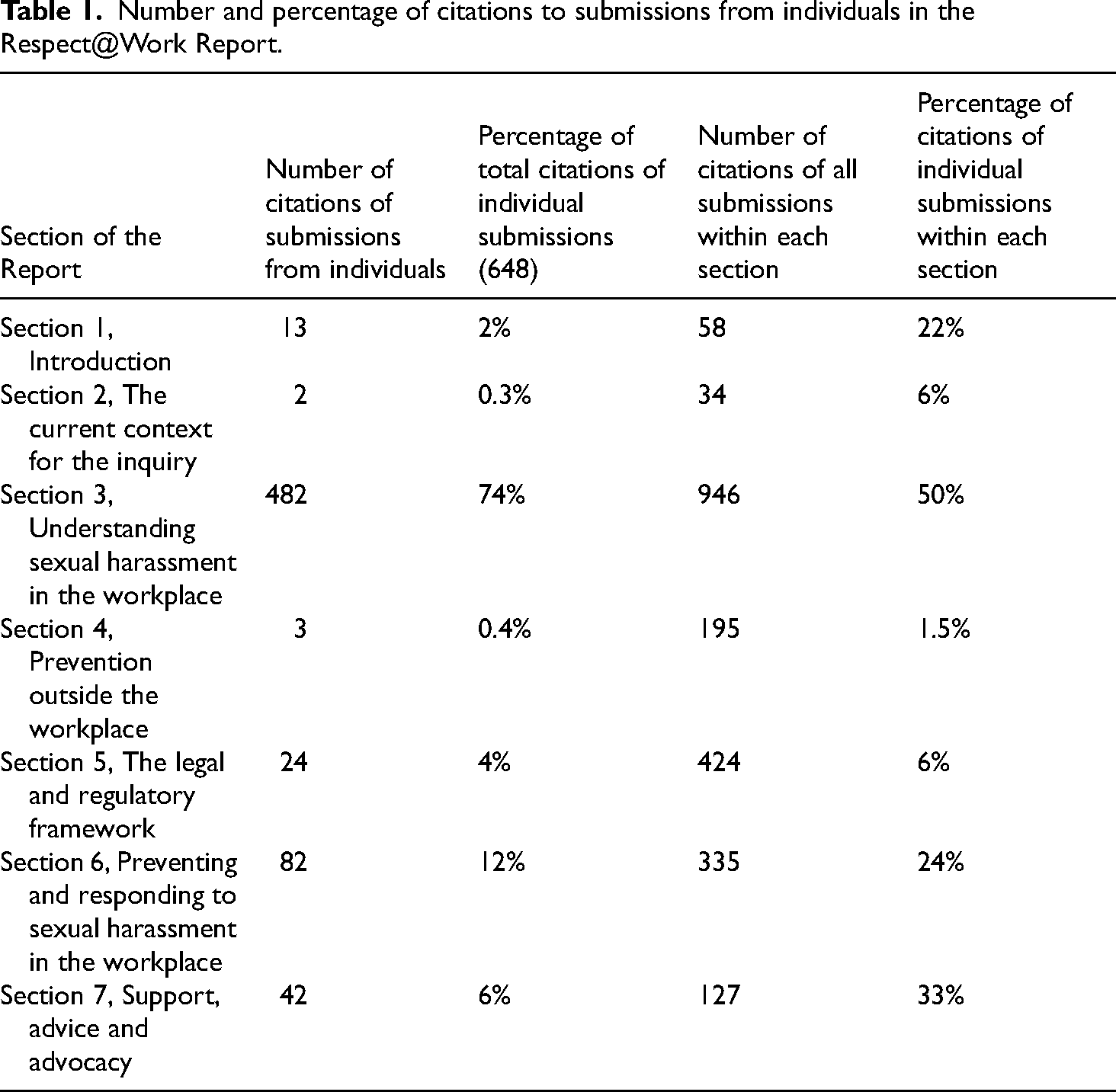
Table 1 reveals that the section of the Report with the highest number of citations to submissions from individuals is Section 3, Understanding sexual harassment in the workplace, with 482 total citations, representing 74% of all citations of submissions from individuals within the Report and 50% of the total number of citations of submissions in that section. The sections with the next highest number of citations to submissions from individuals are Section 6, Preventing and responding to sexual harassment in the workplace, and Section 7, Support, advice and advocacy.
The very high concentration of citations to submissions from individuals, both numerically and as a percentage, in Section 3 reveals a high level of interest by the Commission in what submissions from individuals reveal about the nature and extent of sexual harassment in the workplace. Within Section 3, the Commission cited 175 different submissions from individuals, or 58% of the total number of 303 submissions from individuals, revealing that the Commission placed a high value on the lived experience within individual submissions in this Section. If, as Tranter argues, a citation to a source is an indication that the writer has read and been influenced by the source, and wishes to publicly acknowledge that it has attended to the source to add to the persuasiveness and authority of the text (2015: 331–32), then in Section 3 the Commission's citation practices reveal that it listened to and was influenced by the voices of individual victim-survivors, in making its findings and recommendations regarding the nature and extent of workplace sexual harassment.
Conversely, within the Report there are very low levels of citations to submissions from individuals in Section 4, Prevention outside the workplace and Section 5, The legal and regulatory framework. In Section 5, which contained the central law reform recommendations, the Commission has only 24 citations from individuals, representing 4% of the total number of citations to submissions from individuals in the Report, and only 6% of citations to submissions in that section. If citation practices signify that a source has been read and has been influential, that there is value in publicly acknowledging that the source has been attended to, and/or that they add to the persuasiveness and authority of the text, the comparative absence of citations to submissions from individuals in these sections indicates that the Commission did not value the voices of individuals in its discussion of the legal and regulatory framework. The Commission either did not read and attend to submissions from individuals in these sections, did not see value in publicly acknowledging that it had read and been influenced by them, and/or did not hold the view that citing submissions from individuals would add to the persuasiveness and authority of these sections.
How has the Commission Responded to Narratives of Law and Justice Produced in the Survivor Submissions?
As the Commission's citation practices indicate that it has attended to only a very few submissions from individuals in its discussion of the legal and regulatory framework in Section 5, it follows that it similarly has not attended to recommendations for law reform made in the publicly available survivor submissions. Although the Commission is attentive to the broad narrative of legal failure that resounds in survivor submissions, albeit by citing alternative submissions such as those from legal professionals, academics and industry and advocacy groups, it has not attended to narrower, more specific narratives of law and justice failure emerging from lived experience in survivor submissions. Survivor submissions reveal a clear narrative of the failure of systems of reporting, complaint-handling and conciliation, both within and beyond the workplace. Yet in the Respect@Work Report, the Commission made no law reform or policy recommendations to address this concern; as Thornton argues, ‘the basic complaint-handling framework has remained the same, with a general preference for keeping details of complaints out of the public eye’ (2023: 373). Rather, the Commission recommended that employers, unions and industry groups work towards education, training, measuring and monitoring, as well as external reporting of sexual harassment prevalence, prevention and response. Further, where survivors call for consequences for perpetrators of sexual harassment, the Commission made no recommendations at all with respect to perpetrators. Instead, by framing workplace sexual harassment as ‘a broader cultural and systemic issue’, the Commission formed the view that ‘better research and data to understand behaviours, characteristics and trends in relation to harassers are critical to assist employers to identify risks in their workplace and inform the development of targeted prevention initiatives and improved responses’ (2020: 218).
The Commission's focus on supporting employers with respect to reporting and complaint-handling, and as the primary mode of response to perpetrators, is mirrored in its signature law reform recommendation: the introduction of a positive duty on employers to take reasonable and proportionate measures to prevent workplace sexual harassment among other forms of sex-based discrimination (Recommendation 17). Yet there is a clear narrative in survivor submissions of distrust of employers to adequately and effectively address workplace sexual harassment in terms of either prevention or response. Rather, survivors call for the establishment of an external, independent body that could perform a range of functions, including receiving and investigating complaints, providing support for complainants, conducting workplace inspections and publish workplace data. Some of these functions are performed by the Commission, and the Commission sought additional powers or recommended other agencies receive powers in relation to these functions. Yet it remains that the Commission made no recommendations in the Respect@Work Report to provide new or additional support and advocacy for victim-survivors. Instead, the Commission's recommendations are limited to seeking funding for existing support and information services.
The Politics and Practices of Voice and Listening in Sexual Harassment Law Reform
The methodologies I have developed and applied to trace voice and listening within the National Inquiry and the Respect@Work Report enable analysis of the politics and practices of listening in this law reform process. This is revealing in terms of both the hierarchies of attention and listening that operated within the process and the approach taken by the Commission in listening to the voices of victim-survivors.
The Commission's citation practices in the Respect@Work Report expose hierarchies of attention at work in the law reform process. The influence of established hierarchies of attention in determining whose voices are heard and how they are heard, their connection to intersectionality and their entrenchment within institutions, is well-documented (Dreher and de Souza, 2018; Thill, 2009; Thill, 2015; Waller et al., 2019). In the Respect@Work Report, it is apparent that hierarchies of attention operating within the Commission's approach to listening valued the voices of victim-survivors for what they could tell the Commission about the lived experience of workplace sexual harassment, and that those same hierarchies of attention operated to devalue the voices of victim-survivors in terms of the changes needed to the legal and regulatory model. Section 5, focusing on the legal and regulatory model, had the second-highest number of citations of submissions at 424 out of a total of 2119 citations. Yet only 5% of these citations were to submissions from individuals. Instead, the Commission privileged the voices of legal professionals, legal academics, advocacy groups and others recognised as experts in law and justice over and above submissions from individuals. The Commission's limited attention to submissions from individuals in the context of legal and regulatory reform means that the Commission did not attend to key narratives of failure of the present system, including with respect to the processes by which stories are told – reporting, complaint-handling and conciliation – as well as consequences for perpetrators. Critically, the Commission has not attended to the call for increased support, advocacy and representation for victim-survivors of workplace sexual harassment.
The Commission's citation practices in the Respect@Work Report reveal that it looks to victim-survivor voices to tell them about the problem of workplace sexual harassment, but devalues their voices in the formulation of solutions to the problem, privileging instead the voices of recognised experts within its hierarchy of attention. As Thill argues, a shift in focus from voice to listening ‘challenges the way established hierarchies of attention privilege certain voices while undervaluing others’ (2015: 16). Listening to victim-survivors of violence against women within institutional law reform processes requires openness, attentiveness, receptivity and responsiveness (Ailwood et al., 2023). Openness and receptivity require a listener within a law reform setting to be open to a diverse range of voices, to be willing to have their own perspectives and beliefs challenged, and to embrace the possible uncertainty, discomfort and demand for change that might result. Attentiveness requires a listener to recognise and account for the privileged position they occupy within discourse, and in relation to the subject matter of the inquiry, and to identify, dismantle and flatten any hierarchies of attention that might operate within a law reform process. Responsiveness, critically, requires the listener not only to recognise the speaker as an expert in their own life experience but also to respond by engaging with transformative change.
In the National Inquiry and the Respect@Work Report, the Commission's listening practices, in terms of openness, attentiveness, receptivity and responsiveness to survivor submissions, is variable. The Commission holds itself out as placing a value on the voices and stories of individuals, and particularly victim-survivors within the National Inquiry, and constructs itself as an empathic listener that should be tasked with a greater role in terms of therapeutic listening. Yet on each element of openness, receptivity, attentiveness and responsiveness to victim-survivor voices, the Commission's listening is limited to what they reveal about workplace sexual harassment. This reductive approach to victim-survivor voices limits the Commission's capacity to engage in responsive listening in ways that also limit its engagement with transformative change to address workplace sexual harassment.
The centrepiece of the Commission's law reform agenda – a new positive duty on employers to take reasonable and proportionate measures to eliminate sexual harassment from the workplace, together with complementary investigation and enforcement powers – is not a new strategy emerging from the Respect@Work Report; rather, it is something that the Commission had been requesting for several years, including in Senate Inquiries in 2008 and 2012. 7 Beyond the Commission's recommendation for the establishment of a Workplace Sexual Harassment Council, which would increase its regulatory presence and power, and changes to workplace relations and workplace health and safety legislation, the Commission put forward few new ideas in terms of the legal regulation of workplace sexual harassment. Further, as Thornton argues, the Commission recommended nothing to displace the privatisation of workplace sexual harassment (2023), a feature of the legal and regulatory model that, arguably, has operated to conceal its systemic nature since the inception of the Sex Discrimination Act 1984 (Cth) and confound the achievement of the legislation's stated goals.
Survivor submissions indicate that individuals engaging with the National Inquiry viewed their submission as more than a monologic, factual retelling of their lived experience of workplace sexual harassment. By treating submissions from victim-survivors primarily as empirical data that can inform its understanding of workplace sexual harassment, and devaluing them within established hierarchies of attention that frame its law reform process, the Commission arguably has not fully recognised the affective legal subjectivity constructed in victim-survivor submissions and their hope that the Commission will be able to help through transformative change. While the Commission holds itself out as an empathic listener, hierarchies of attention operating throughout the process have narrowed its recommendations for structural change to the legal and regulatory environment concerning workplace sexual harassment. The Commission's finding that workplace sexual harassment is a systemic issue is significant, but it has not been matched by measures to support individual victim-survivors who experience sexual harassment or with regard to consequences for perpetrators; this absence reinforces the conceptualisation of sexual harassment as an individual matter within the existing legal framework. The Commission's limited openness, receptivity and attentiveness to victim-survivor voices has resulted in a lack of ambition with respect to structural change in the legal regulation of workplace sexual harassment and generated a responsiveness that is muted, at best, to victim-survivors’ hope that the Commission will help through transformative change.
Conclusion
Victim-survivors routinely contribute their voices to institutional law reform and policy development processes seeking to address gender-based violence, yet there has been limited research into how their voices are heard, listened and responded to within these processes. Drawing on victim-survivor submissions to the Australian Human Rights Commission National Inquiry into Sexual Harassment in Australian Workplaces and the Respect@Work Report (2020), this article has advanced methodologies including thematic coding, citation analysis and discourse analysis to identify and analyse the dynamic relationship between voice and listening, and the politics and practices of institutional listening within the Commission. Analysing the politics and practices of institutional listening reveals hierarchies of attention at work within this law reform process, that recognised victim-survivors as experts only in their experience of being sexually harassed in the workplace, and devalued their voices in terms of legal and regulatory change. This analysis highlights both the importance of institutional transparency in how law reform processes are conducted, in publishing data and in citation practices, and the critical need for institutions to listen to victim-survivors of gender-based violence with openness, attentiveness, receptivity and responsiveness. It is only by implementing a victim-survivor-centred approach to listening that institutions can effectively engage with and respond to the affective legal subject and address gender-based violence through transformative change.
Footnotes
Declaration of Conflicting Interests
The author declared no potential conflicts of interest with respect to the research, authorship, and/or publication of this article.
Funding
The author received no financial support for the research, authorship, and/or publication of this article.
