




Abstract
In the wake of the #metoo movement, Harris and Giuffre use the restaurant industry as an example to illustrate how viewing sexual harassment as an issue of industry and organizational culture–rather than just the behavior of a few bad actors–can inform our understanding of sexual harassment in the workplace.
The messages came in tweets, texts, and emails: “Have you heard about John Besh?” In late October 2017, a New Orleans Time-Picayune article accused the famous chef and television personality of rampant sexual harassment and abuse against dozens of women employed by his eponymous restaurant group. Besh was soon joined by other powerful chefs accused of harassment—Mario Batali, Johnny Iuzzini, Charlie Hallowell, and Mike Isabella. In each of these cases, food writers and news reporters asked what should be done to men accused of harassment. Should we boycott their restaurants? However, wouldn’t that also hurt the victims of harassment through decreased wages and possible job loss if the restaurant failed? What about restaurant reviewers and organizations that hand out awards to chefs? Should we care if the chef or owner is an abuser if the food is good? Beneath it all: How can we prevent sexual harassment in the first place?
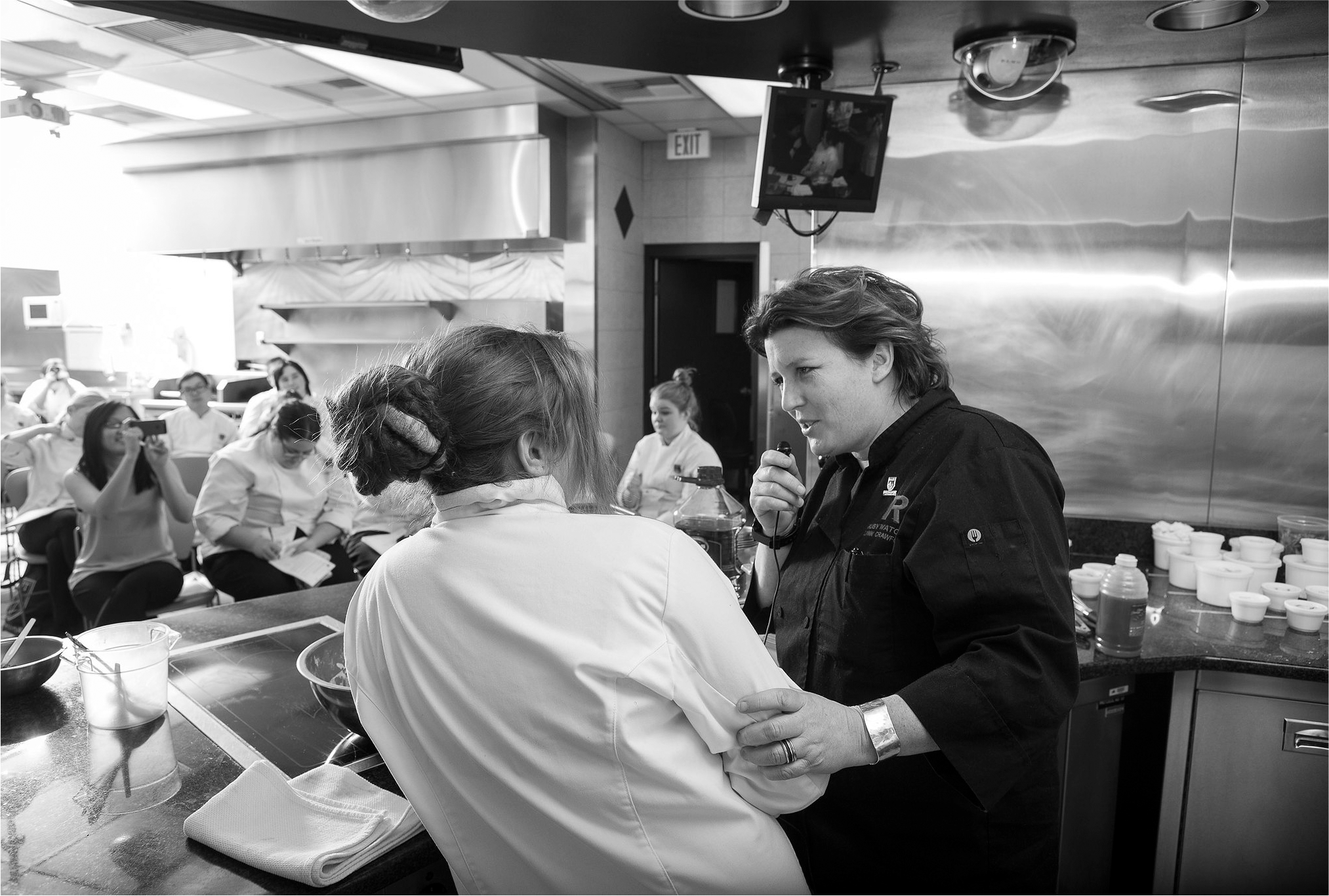
Northern Alberta Institute of Technology’s (NAIT) Chef in Residence Lynn Crawford leads a demonstration with female students.
Flickr cc, NAIT TCI Photo Dept.
Anyone who has worked in a restaurant is probably not surprised to hear that it is an industry where sexual harassment is common. However, in the wake of the Harvey Weinstein conviction, these multiple scandals have left many asking: “Is the restaurant industry finally having its #metoo moment?”
Restaurants make intriguing sociological spaces of inquiry. As Goffman would appreciate, they are literally divided into “front” and “back-of-house,” providing diners with a lovely “front stage” experience while ignoring rampant harassment and abuse occurring “back stage.” We have spent years interviewing women chefs and analyzing food media to better understand why women trail so far behind men in the culinary industry. Only 20 percent of head or executive chefs are women and even fewer own restaurants or win major culinary awards. In our conversations with women chefs, the role of male-dominated workplace cultures and harassment came up as a barrier to women’s success—and women chefs are far from alone.
According to a 2014 report by the Restaurant Opportunities Center (ROC), the restaurant industry represents the largest number of sexual harassment complaints to the Equal Employment Opportunity Commission. Women working in all sorts of restaurant jobs report experiencing sexual harassment, often from multiple sources—owners/managers, coworkers, and customers. While research has been conducted on the harassment and mistreatment of front-of-house staff like waitresses and hostesses, who make up the majority of women restaurant workers, there has been little focus on how women in the back- of-house experience harassment. We do know the prevalence of harassment suggests it is less about a few individual bad actors than a pervasive set of conditions that normalize sexual harassment in these workplaces.
We suggest a closer look at the industry and how its history, workplace organization, and definitions of success combine to create work environments where harassment can thrive. We draw from our research into the history of professional kitchens, interviews with women chefs, informal conversations with culinary insiders, and content analysis of food media, including articles on the most recent accusations of harassment. We wish to note that, although our focus is more on “high end” restaurants, these sorts of behaviors occur at every type of establishment, from corner diners, to fast food restaurants, to large corporate chains, and may be even more prevalent because of the lack of media attention.
A Brief History of Chefs and the Rise of the Genius Asshole
Despite foodwork’s association with femininity, restaurants, particularly fine dining establishments, have been historically male- dominated. Early French restaurants, which became the model for much of the Western culinary world, operated on a strict hierarchy with the chef being the unquestioned leader of the kitchen “brigade” (a term from the French military) who frequently insulted and yelled at his staff in order to keep them in line.
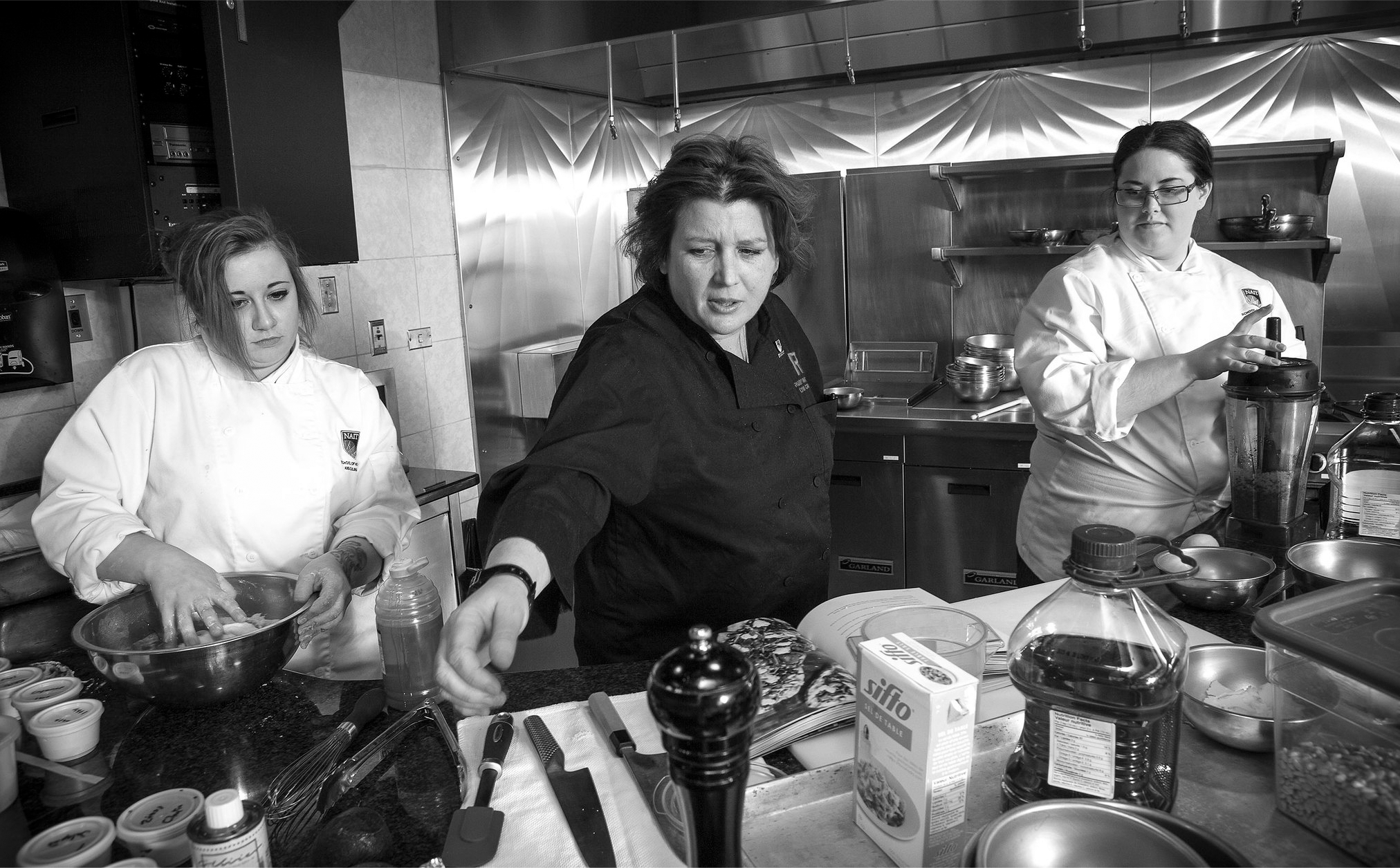
Northern Alberta Institute of Technology’s (NAIT) Chef in Residence Lynn Crawford works with female students.
Flickr cc, NAIT TCI Photo Dept.
Women were excluded from this early restaurant culture, in part, to help raise the status of the occupation. Whenever chefs would highlight their rare skills and hard work as a reason they should earn more professional status, they ran into the same question: Why should we celebrate the work of male chefs when women cook in the home every day? Scholars point out that, whenever men engage in work that is coded as feminine, this work will become devalued because of its association with women. The ubiquity and lack of respect shown women’s food- work meant that men chefs had to set themselves apart in order for their work to be seen as valuable, as well as to downplay the creativity and worthiness of women’s cooking.
With the rise of nouvelle cuisine in the 1960s, chefs began to garner more attention. Suddenly, male chefs were on the covers of magazines in France and the United States. A few decades later, in the 1980s, celebrity chefs like Wolfgang Puck embraced the media and used its positive coverage to help build culinary empires of restaurants, cookbooks, and product lines. These opportunities for chefs only increased as new media outlets, including the Food Network, helped make stars out of chefs like Emeril Lagasse and Mario Batali.
Around the same time that the Food Network began bringing wholesome, family friendly cooking to millions, there was increased cultural attention to the bad boy chef who flaunted his vices and cooking skills simultaneously. British chef, Marco Pierre White, garnered numerous professional accolades and a reputation for his angry, expletive-filled approach to management and a hard-partying lifestyle. When Anthony Bourdain published Kitchen Confidential in 2000, the book and Bourdain’s persona, which he displayed on two different food travel television series, helped cement the rock-star/bad boy chef as the new archetype. In his book, he detailed how chefs and other restaurant workers worked until late, partied through the rest of the night with copious amounts of alcohol and drugs, and engaged in lots of sexual banter, and even sex, with their coworkers.
This media coverage helped cement the idea that restaurants were unique environments filled with a ragtag band of misfits under the direction of a temperamental artist. The problem with these depictions is that they reinforced the stereotype that creatives were a breed apart and should not be held to the same standards of behavior as those in more corporate environments. In fact, these geniuses (who were always male) were supposed to be mercurial, and this represented a passion for their craft. Unfortunately, much like the art world and other fields where creative genius is highly prized with little oversight (Hollywood and academia could serve as pertinent examples), this mercurial nature sometimes resulted in abusive behavior. It created what Jen Agg, a successful Canadian restaurateur who’s long been a critic of the Boy’s Club of most professional kitchens, refers to as the “Genius Asshole” trope. This trope asserts that the genius of certain men chefs allowed them to be horrible to staff, diners, and the media without repercussions. Women, Agg recalls, cannot rely on this persona because such temperament would get them branded a “bitch” who is unfit for leadership, despite how talented the woman might be.
We see examples of this genius asshole trope in coverage of sexual harassment in the restaurant industry. One of John Besh’s former employees alleged that their sexual relationship was not consensual because of his role as her boss and his clout in the restaurant industry. When she described her concerns to managers, they encouraged her to continue her relationship with Besh and keep him “happy” so that he would continue to cook “happy” food. Protecting his genius was more important than her comfort level. A piece on celebrity chef Mario Batali, whose actions included groping a woman at a restaurant who appeared too intoxicated to respond, included several references to his numerous restaurants, many awards, and philanthropic endeavors. This coverage placed the harasser at the center of the narrative and used his many professional accolades as rationale for why he deserved redemption. The focus remained on the harm to the industry from the loss of his talent, rather than the trauma experienced by victims of harassment and assault and the number of women who leave the industry as a result of it.
Going to War Every Night
At the 2018 Philly Chef Conference, food critic and journalist Brett Anderson, from the New Orleans Times Picayune, recalled his months’ long investigation into charges of harassment and mistreatment against chef-restaurateur John Besh. For several months, Anderson wasn’t sure if he even had a story. He had come across lots of examples of lewd behavior that he personally felt disgusted by, but he wondered if this would be enough to illustrate to his readers just how toxic these environments were for women. It was not until he gotseveral women to go on the record with their full names and firsthand accounts of their experiences that Anderson believed he finally had a story he could publish.
Anderson’s reticence is understandable. When describing unwanted sexualized jokes and touching by coworkers and bosses, many women do not feel the actions are worth reporting. Part of this relates to the intense working conditions restaurant workers face. From hot, cramped kitchens in the back-of-the-house to the demanding, never-ending lines of customers in the front-of-the-house, each realm of the restaurant has its own struggles. There are long hours (including nights, weekends, and holidays), relatively low pay, and nonexistent benefits at many workplaces. These conditions have led many to argue that restaurants developed their own distinct culture to meet the demands they face at work. Unfortunately, some of the characteristics of this culture also enable sexual harassment and assault to thrive.
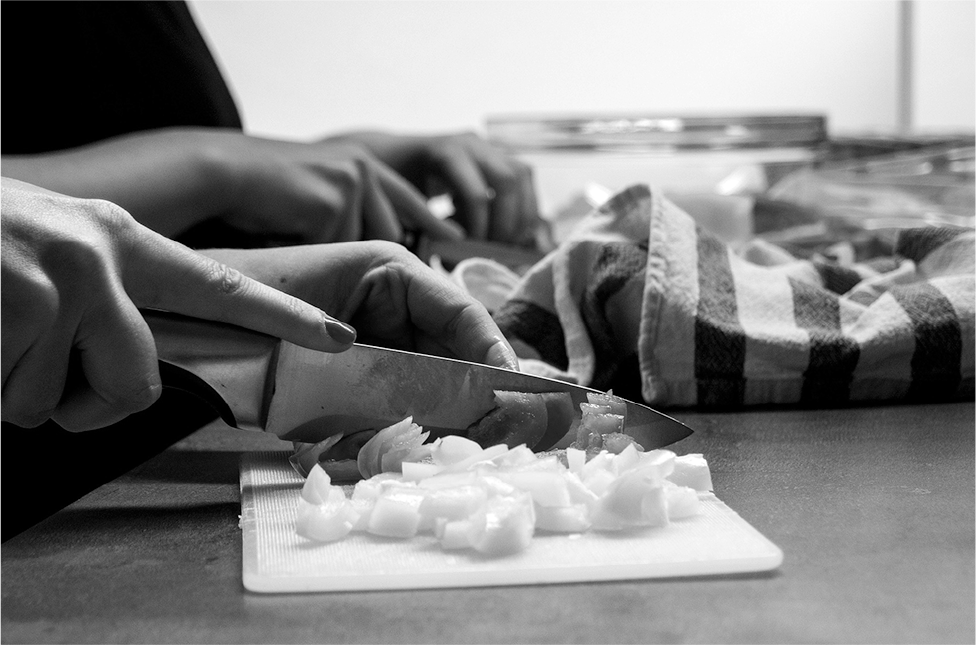
Chefs cutting onions and bell peppers.
Pixabay, Marvorel
In Kitchens: The Culture of Restaurant Work, Gary Alan Fine describes the herculean task the staff of a popular restaurant faces every night: how to coalesce as an effective team in order to serve hundreds of hungry diners. Some of our participants described this as “going to war every night.” As he described frequent sexualized joking and teasing between coworkers, Fine explained this hazing-type ritual was a way of creating bonds and coming together as a team. For women, adapting to this sexualized atmosphere was a strategy to make sure they could fit in as workers and part of the social atmosphere of the restaurant. One of our participants, Rose, a former pastry chef at some very well-known restaurants, described how she had to prove that she could take it at the beginning of her career. The “it” was both the physical demands of the job and the sexualized joking that many of her male colleagues directed her way. Eventually, through making her own jokes and executing all the tasks her bosses threw at her, Rose gained acceptance at work. She explained that she then had these “brothers” who would fight for her and challenge anyone who questioned her work ethic or that she belonged in a kitchen.
Many restaurant workers describe the “rush” that accompanies a busy dinner service. The physical and mental demands of workers sometimes led to abuse of drugs and alcohol. This behavior didn’t always end with the closing of the restaurant at the end of the night. It’s common for workers to go out together after work in order to wind down from the “high” of completing a busy night. Drinking and the use of other substances was seen as a dangerous part of forming that camaraderie; after work socializing helped to blur lines between work and off- work hours and made it more likely for sexual harassment and assault to occur.
In sexualized workplaces, it can be hard to delineate what’s harassment and what’s just part of the job.
In sexualized workplaces, it can be hard to delineate what’s harassment and what’s just part of the job. This can be especially problematic for women bartenders or wait staff who, because of a reliance on tipping for most of their income, may feel pressured to be “friendly” to customers and put up with unwanted attention. Because so much of sexual harassment begins as subtle joking or teasing or comments on one’s appearance— sometimes, as in the case of a woman working for chef Charlie Hallowell, at the same time they were discussing her future in the company—it can be hard to point to one particular instance of when teasing ends and harassment begins.
This “almost-harassment” leaves women constantly questioning their judgment. Were they making too big a deal out of things? Did they misread a situation? It also gives harassers power because it allows them to test out a woman’s boundaries. In fact, not complaining about earlier, more “minor” cases of harassment have been used against women who finally made formal complaints when they believed a male colleague stepped over the line. When we interviewed Chelsea, a pastry instructor, about her experiences, she spoke about how women chefs had to walk a fine line. They were expected to joke around with their coworkers and adapt to the macho atmosphere, but if they joined in any of the sexual banter to prove they could “hang with the guys,” this could later be used against them if they complained of harassment or abuse. She described, “Well, you better make sure that you’re squeaky clean. In the kitchen, if you engage in the conversation [about sexual matters] and then you get offended because someone touches you, then you’ve opened yourself up to it, too.”
Handle it Yourself
Some of us may be asking, “Where is HR (Human Resources) during these events?” but many restaurants do not have a Human Resources department or a process for reporting harassment. In his story on the John Besh allegations, Anderson discussed how the John Besh Restaurant Group did not have a formal HR department until shortly before the allegations surfaced, despite employing 1200 people. News coverage of the charges against Oakland, CA chef, Charlie Hallowell, detailed how some women didn’t bother to report being sexually harassed by the chef because, as co-owner of the restaurant, all complaints would eventually make their way to his desk.
Women may also be urged not to report issues of harassment. Part of fitting into male-dominated spaces meant women showing they could “take it” when the men engaged in sexualized language and behavior. These performances ranged from ignoring the behavior to going along with the joking and teasing. When men stepped over this boundary, the women we interviewed responded in a range of ways from immediately quitting to holding a knife to the man’s throat to show what would happen if he touched her again. None of the women discussed going to a manager or human resources department (even if one was available). It was seen as the women’s responsibility to prove they could handle the situation. Asking for help, the women explained, was a way of suggesting they could not handle things themselves.
Pixabay, Hfossmark
Chefs gather around a boiling pot.
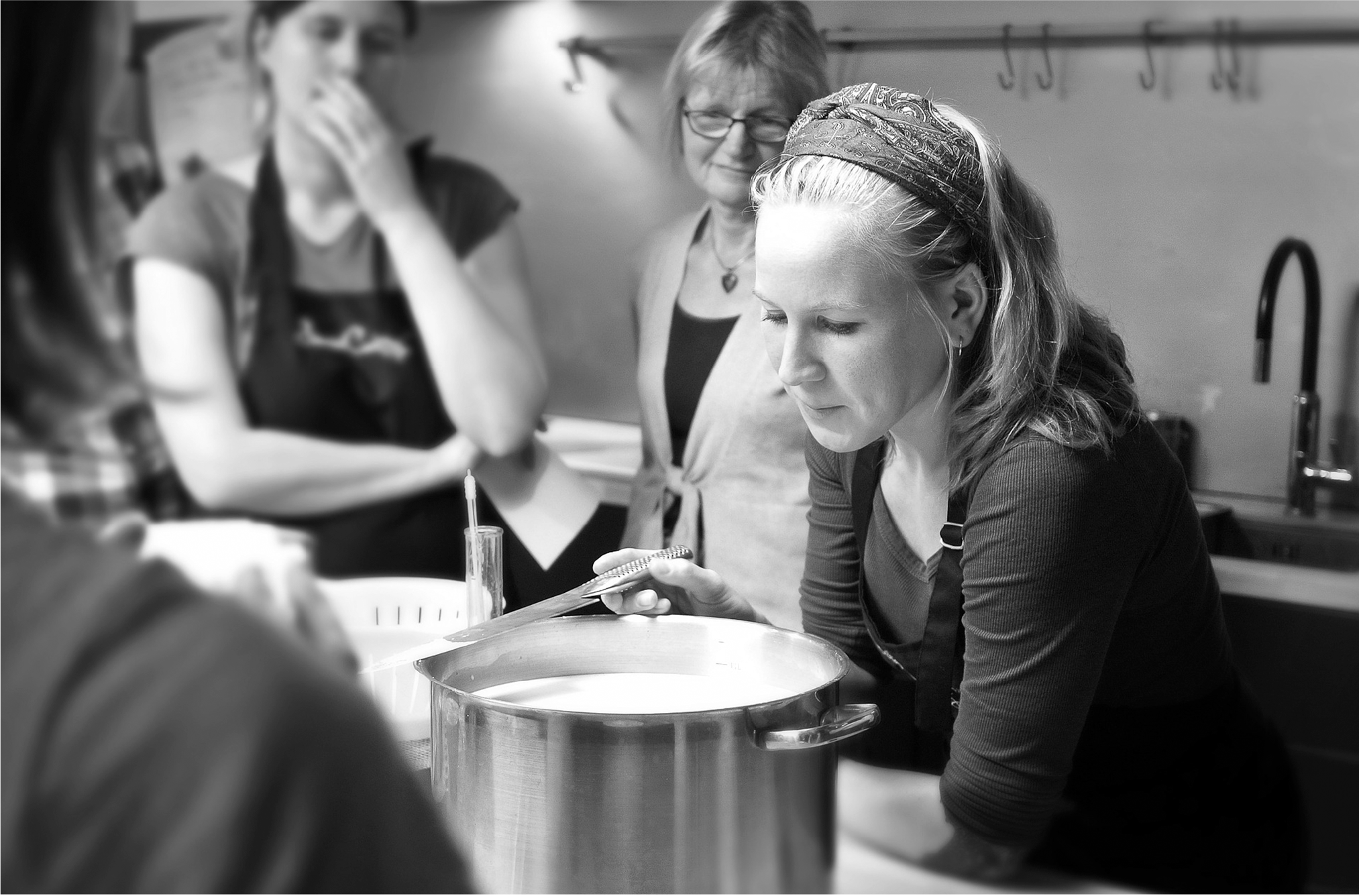
Such conditions make it difficult to prove when someone has a history of harassment and misbehavior. Women then have to rely on informal networks to learn if a workplace is safe. This can be especially difficult for less advantaged women, such as interns new to the industry or undocumented workers who make up a large portion of the lower ranks of the restaurant industry. These women may feel they have little recourse from harassment.
Eradicating Sexual Harassment in the Restaurant Industry?
Sexual harassment in restaurants is not inevitable. Just because a workplace is sexualized doesn’t mean that sexual harassment should be tolerated. Upper management, executive chefs, and restauranteurs CAN set a tone, encourage people to talk with them, act on reports, and consider the racial, sexual, and gender dynamics in their restaurant(s). This issue is less about a deviant few than the need for both individual and organizational changes.
Individual restaurant leaders can pay attention to problematic beliefs (or red flags that indicate a lack of understanding of power dynamics at work) in their approach to sexual harassment. We saw numerous examples of red flags in recent news stories about sexual harassment in restaurants. Examples include the following:
No one has ever reported sexual harassment; there must not be a problem.
My staff go out drinking with each other. Obviously, it’s okay for me to do so.
I better start some training or else I’ll be hit with a lawsuit.
The only woman who complains is the executive chef. She must be overly sensitive.
We can’t force restaurants to change. People will always touch each other and joke about sex.
I’ve got lots of women working in my restaurants. If harassment was that bad, they would leave.
She’s smiling at me, so she must like it.
Holding any of these misconceptions should encourage restaurant leaders to examine their own behaviors and the culture of their restaurant. Organizationally, we also recommend Shelley Correll’s “small wins” approach. Correll suggests workplace leaders promote a “culture of inquiry.” Instead of poorly done training that presumes that all people perceive and experience sexual harassment in the same way, get leaders to ask questions about their workers and workplaces in order to make meaningful institutional or organizational changes.
As a resource, questions could come from Abby Ferber’s “toolbox for change.” This social justice framework requires asking: How healthy is your restaurant? Where does your restaurant lie on a continuum of social justice and inclusive practice? Does it maintain the power or privilege of the dominant group? Does it restrict membership and exclude while allowing problems faced by the subordinate group to continue? These questions can be used from anyone with authority in the culinary world from restaurant owners to members of the media to organizations that award culinary accolades.
Workplace cultures can and do change. The restaurant industry appears to be in a me too movement, but additional changes are necessary in order to eradicate sexual harassment. Apologies are not enough. Offering sexual harassment training “for liability reasons” is not enough. Creating a culture of inquiry is a start. Having a Human Resources department with procedures for reporting is a start. Hiring more women in leadership positions is a start. Moving from thinking about “bad boy” harassers and “sensitive women” to thinking about sexual harassment culture is a start.
Footnotes
Note:
The authors wrote this piece prior to the mass shut downs of restaurants due to COVID-19. They offer support for all who work in the restaurant industry.