




Abstract
Reporting suggests that declining salaries cause high multiple job holding (MJH) among full-time public school teachers in the United States. Studies investigating this relationship assume an individual teacher, neglecting the effects of family characteristics on work behavior. This article examines K–12 public school teachers’ employment patterns for March and July from 2011 to 2019 to test the associations of state-level teacher salaries and familial roles with MJH. In March and July, a teacher’s familial role correlates with MJH in a pattern consistent with persistent work-family divisions: Male teachers, single or married with children, are the most likely to hold another job, and married female teachers with children are the least. These differences increase during the summer break. State-level salaries correlate with MJH only in July. Single male teachers exhibit greater sensitivity to salary changes. This article demonstrates how family characteristics, occupational schedules, and salaries interact and influence MJH.
The disinvestment in public kindergarten through 12th-grade (K–12) education in the United States continues to drive passionate political conversation in the American public sphere (Coley and Schachle 2023; Hertel-Fernandez, Naidu, and Reich 2020; Van Dam 2019). One noted consequence of inadequate educational funding is inadequate teacher pay. As popular commentary reports, in the face of stagnant or dropping salaries, full-time teachers feel compelled to secure additional employment to supplement their teacher income to support themselves and their families (Strauss 2016; Turner 2018; Ulrich and Lowe 2018). Research has linked low pay levels, the potential cause of multiple job holding (MJH), and a greater number of working hours, the consequence of MJH, with teacher attrition (Ingersoll 2001; Ryan et al. 2017). MJH among teachers thus appears as a symptom of the larger funding failure in the American public school system and a necessary but possibly detrimental strategy educators adopt to ensure financial security.
This individual-centered story fails to fully account for teachers’ economic needs, resources, and responsibilities. Teachers do not all hold the same roles or share the same responsibilities at home, nor do they have the same familial income demands. Previous research has shown how general employment patterns and familial roles—defined by gender, marital status, and parental status—interact (Gerstel and Clawson 2018; Gonalons-Pons and Gangl 2021; Percheski 2018). Yet there is little research on MJH that appreciates the interactive nature of these familial roles. Given the female-dominated nature of the education profession in the United States and the financial stress caused by inadequate state salaries (Rogers 2001), teachers’ familial responsibilities likely inform their time use (Cha 2010), including whether they hold multiple jobs. Furthermore, the work schedule of teachers differs considerably across the year. Most schools in the United States have a long summer break where work time decreases substantially and children—both their students and school-age dependent children—are out of school. Familial responsibilities may shift for many teachers when dependent children are at home. Therefore, questions on teacher MJH should incorporate family characteristics and seasonal differences in schedules alongside issues of wages.
This article brings insights from research on the family-work nexus and MJH to assess the proposed association between public school teacher salaries and the employment patterns of teachers. The following question motivates the analysis: How do state-level average salaries and teachers’ familial roles interact to predict MJH? I investigate this question by estimating logistic regression models that predict the odds of employed, college-educated, full-time, K–12 public school teachers in the United States holding more than one job with state-level average salary and familial role as key predictors. I estimate models of MJH for two different months, March, when school is in session, and July, when most schools are on summer break, to capture schedule variations across the year. I use data from the Current Population Survey (CPS) from 2011 to 2019 merged with publicly available state-level data on teacher salaries from the National Education Association (NEA).
This article is the first to include salary and familial roles in examining multiple job holding among U.S. K–12 teachers and to do so at two different points in the year. Consequently, this article contributes to the gender and family analysis in MJH while answering popular questions related to occupational schedules and governmental funding factors. This investigation yielded several key findings. During the school year, when teachers work full-time at their primary job, their familial role (defined by sex, 1 marital status, and presence of children) predicts MJH among teachers, and the state-level average salary does not correlate. During the summer months, when work time at the primary job is lower, familial role and state-level average salary predict MJH, with an interaction between family role and state-level average salaries. Additionally, I find larger differences in MJH by familial role during July compared to March. These findings demonstrate gendered differences in work decisions during times of less formal work. These patterns have implications for teacher career trajectories.
Public Disinvestment in K–12 Education and U.S. Teacher Salaries
Many U.S. states, cities, and localities significantly cut education funding during the Great Recession (Leachman, Masterson, and Figueroa 2017). Many budgets have failed to grow or have declined even further since, and further budget reforms have exacerbated funding divides across states and districts (Lafortune, Rothstein, and Schanzenbach 2018).
Teacher salaries are the largest component of K–12 public education budgets (National Center for Education Statistics [NCES] 2024). Teacher salary data from the NEA for 2011 to 2019 shows that although teacher salaries in nominal dollars have increased nationally, many state governments have enacted significant nominal pay decreases. Accounting for inflation, teacher compensation across the United States from 2010 to 2019 has decreased (NCES 2016). With lower compensation and increasing cost of living, popular reporting passionately describes the financial stress put on teachers (Hough 2019).
Teacher salaries are weak compared to similar jobs. A 2020 report from the Economy Policy Institute using data from the Current Population Survey indicates that teachers earn lower wages than workers in other fields with similar levels of experience and education, with considerable differences by gender (Allegretto and Mishel 2020). This wage penalty is a significant reversal from the mid-twentieth century when, on average, women teachers received a wage premium. Men teachers suffer a 30 percent wage penalty compared to same-gender workers in other fields. In contrast, women teachers experience a 13.2 percent penalty (Allegretto and Mishel 2020). 2 At the same time, data point to increasing nonwage benefits (insurance plans, retirement plans, etc.) for teachers. Nonetheless, when combined with the wage penalty, this increase in nonwage benefits establishes an average compensation penalty of approximately 10 percent compared to workers of similar education and experience (Allegretto and Mishel 2020).
Families and Work Choice
To estimate the impact of salary levels on individual teachers’ MJH, we must incorporate the nonschool conditions in which teachers live and appreciate how these conditions interact with their paid work in the education sphere.
Gendered dynamics in families influences the work choices of individuals, including whether one enters the formal labor market or takes on responsibilities in the household (Gerstel and Clawson 2018; Shelton and John 1996). Although research indicates reductions in gendered differences in work time in the United States, there are persistent differences across genders in paid employment and household work (Perry-Jenkins and Gerstel 2020). Namely, women in different-sex couples are more likely to take on “feminine” characterized tasks (e.g., caregiving) while men pursue paid work opportunities (Perry-Jenkins and Gerstel 2020).
The organization of work in the United States often assumes an ideal worker that encourages these intrahousehold norms (Davies and Frink 2014). Scholars suggest that full-time work in the United States relies on several assumptions: that those who work are men, dedicate significant time across a lifetime, and have a wife to care for personal needs (Acker 1990, 2006). Landivar (2015) argues that these occupational, rather than household, characteristics explain differences in formal work time between men and women. So, although women have entered the workforce, occupations often maintain traditional expectations, and work and family conflicts prevail (Jacobs and Gerson 2001).
The persistence of gendered dynamics and the need to balance work and family in the United States play key factors in the teacher MJH story, alongside declining wages. These factors become especially salient when we consider that most U.S. teachers are women and hold unique occupational work schedules with a long period of less work time (i.e., summer break). An analysis of teacher MJH thus provides an interesting case both empirically for the education policy field and theoretically for the interaction of gender, family, and state policy on employment.
Multiple Job Holding among Teachers in the United States
Researchers have analyzed MJH behavior among the general population, and these studies provide insight into the teacher MJH case. On average, as workers achieve greater levels of education, their likelihood of MJH increases (Hipple 2010). Still, most multiple job holders have less than a college degree (Hipple 2010). More often, the second job requires less education and is lower paying than their primary job (Panos, Pouliakas, and Zangelidis 2014), which fits the often repeated story in reporting on teachers (Ulrich and Lowe 2018). Empirical evidence also points to higher MJH participation among women than men (Beckhausen 2019; Betts 2004; Campion, Caza, and Moss 2020).
Few studies explicitly compare MJH behavior across familial role types (Campion et al. 2020), or the interaction between gender, marital status, and the presence of children. For instance, Averett (2001), using CPS data from 1991, finds mothers participate in MJH considerably less than other women and men; meanwhile, men with older children are less likely to work than men with younger children. Focusing on unmarried individuals and using Panel Study of Income Dynamics data from 1987, David Allen (1998) does not observe a statistically significant effect of the presence of children on MJH. More recent analysis from Australia provides evidence of persistent gendered work norms through interactions of the gender of the parent and the presence of children in predicting MJH (Preston and Wright 2020).
Most studies indicate a comparatively high MJH among teachers compared to other professions. For instance, a Census Bureau analysis identifies a 2 to 3 times higher likelihood of MJH for those working in the education field compared to the general working population from 2010 to 2019 (Beckhausen 2019). Yet estimates of the number of teachers who hold more than one job also vary depending on data sources and type of additional employment (Betts 2004; Maninger et al. 2011; Startz 2018; Walker 2019; Will 2018; Winters 2010). Some research places that percentage for teachers during the school year at around 40 percent (Walker 2019). Others, focusing solely on non-school-related jobs, provide lower estimates such as 16% (Schaeffer 2019). Studies using CPS data identify the percentage of teachers who hold multiple jobs at around 8 percent during individual months (Winters 2010). Past research also indicates that MJH rates do not differ considerably across the school year and summertime months (Schaeffer 2019).
Teacher MJH studies discern several unique employment patterns compared to the general working population. For example, Betts (2004) finds that male teachers are more likely to hold multiple jobs than female teachers. Also, as teachers age, their MJH likelihood decreases greatly (Schaeffer 2019). This may be because of higher salaries for experienced teachers, which mainly result from structured pay schedules used by many school districts.
Several studies attempt to quantify the effects of salary levels on teacher MJH. Using data from 1985 to 1995, Ballou (1995) finds that MJH among teachers was highly insensitive to wages across the year, suggesting that MJH might primarily result from temporary cash flow issues or individual motivations. More recently, Winters (2010) detects no connection between weekly teacher wage, family income, and teacher MJH. On the other hand, using qualitative data, Maninger et al. (2011) found that teachers in Texas reported that they would leave their additional jobs if they were paid more for their primary teaching jobs.
Social scientists conclude that MJH affects the careers of teachers. For example, teachers spend less time in their primary job when they take on another job (Maninger et al. 2011; Winters 2010). Stressors related to MJH affect teacher expectations, performance, and attrition. Salary positively correlates and work time negatively correlates with teaching career expectations (Han, Borgonovi, and Guerriero 2018). Furthermore, total hours worked and the associated lack of leisure time negatively affect teacher job experiences (Bartlett 2004; Matsushita and Yamamura 2022).These stressors—low salary and high work time—may negatively impact educational outcomes among students (Scheopner 2010). These work factors positively correlate with attrition among teachers, especially among new teachers (Kelly and Northrop 2015; Redding and Henry 2019). With higher MJH rates among staff, schools likely suffer as educational institutions because they cannot retain experienced teachers (Ronfeldt, Loeb, and Wyckoff 2013) and subsequently become defined by increased work time and stress (Bidwell 2001).
Hypotheses
Given past research and popular reporting, several hypotheses motivated the analysis presented in this article.
A mix of local and state government money funds U.S. public schools, with additional federal dollars. Just as total education funding varies across states, education funding allocations to teacher salaries also vary. This variation in teacher salaries may lead to differences in the likelihood of a teacher holding another job.
Hypothesis 1: Teachers in states with lower average teacher salaries will be more likely to hold another job than those in states with higher average teacher salaries.
Teachers suffer a wage penalty compared with similarly educated workers, with considerable differentiation in this penalty by gender. Because they suffer from a greater wage penalty, self-identified male teachers presumably know they could find higher wages outside the education field. Male teachers may secure higher income by taking on an additional job, increasing their total income. Both relative deprivation and the prospect of higher income might influence MJH.
Hypothesis 2: Male teachers will be more likely to hold another job compared to female teachers.
Gendered dynamics may play a significant role in the teacher MJH story and affect the behavior of coupled teachers in different-sex marriages. Given past research on the gendered division of labor in different-sex marriages, married male teachers are hypothesized to prioritize breadwinning and thus may seek additional employment and income, whereas married female teachers are hypothesized to prioritize household responsibilities and not take on additional employment. The presence of children likely deepens this divergence in behavior. Having children increases the financial costs of maintaining a household. At the same time, children increase caregiving responsibilities in a family. If the responsibilities of earning more income or taking care of children vary by gender, then the familial role of the teacher is likely associated with MJH.
Hypothesis 3a: Married male teachers will be more likely to hold another job than single male teachers.
Hypothesis 3b: Married male teachers will be more likely to hold another job than married female teachers.
Hypothesis 3c: Married male teachers with children will be more likely to hold another job than married female teachers with children.
Most schools in the United States have a summer break in which formal instruction stops for 4 to 10 weeks, depending on the district or school (Gold 2002). During summer break, teachers often work fewer hours as teachers, leaving time to divide between additional training, leisure, or employment in another job. Simultaneously, during summer break, teachers’ children are likely out of school, increasing childcare responsibilities in the family. When considering Hypothesis 3, the summer schedule will likely affect teachers differently by familial role.
Hypothesis 4: Teachers in the summer will likely exhibit greater divergence in their MJH likelihood by their familial role compared to in-school months.
Data and Sample
The current analyses used data from the CPS. The CPS is a monthly survey conducted by the U.S. Bureau of Labor Statistics and the Census Bureau. Each month, investigators survey a representative sample of 60,000 households and ask about their economic activities the week previous. Investigators repeat these surveys with households across a 16-month schedule. I accessed CPS data through IPUMS (Flood et al. 2022).
I used data for March (N = 7,560) and July (N = 6,484) for 2011 and 2019 in the analysis. I chose March because it is a month situated squarely in the latter half of most U.S. school year schedules. July is the most common month covered by the summer break period in the United States (Desilver 2019). In the CPS data, I found that teachers sampled in June and August reported more work time as teachers than teachers sampled in July. By focusing solely on data from July, the estimates more fully captured a potential summer break effect.
The samples analyzed included individuals in the CPS who identified their primary occupation as an “elementary and middle school teacher” or a “secondary school teacher” and who resided in the 50 U.S. states and the District of Columbia (DC). The CPS defines a primary job as the job to which individuals dedicate the most time and earn the largest portion of their income. Even if teachers had time off from their primary job the week before sampling, they would still identify teaching as their primary occupation because they usually work full-time as teachers.
I limited the teacher samples to only include teachers who were employed in local or state public schools. The CPS asked respondents whether they were employed in the private or public sector or self-employed. I removed all federal employees, those who worked in the private sector (i.e., private school), or were self-employed (i.e., homeschool teachers). 3
I further limited samples to those who were employed, reported that they usually worked at least 35 hours a week, and held at least a bachelor’s degree.
Given the rotating monthly survey schedule of the CPS, approximately 50 percent of individuals interviewed in March or July of one year appeared in the survey in the subsequent year. I only include individuals in the first year that they are observed.
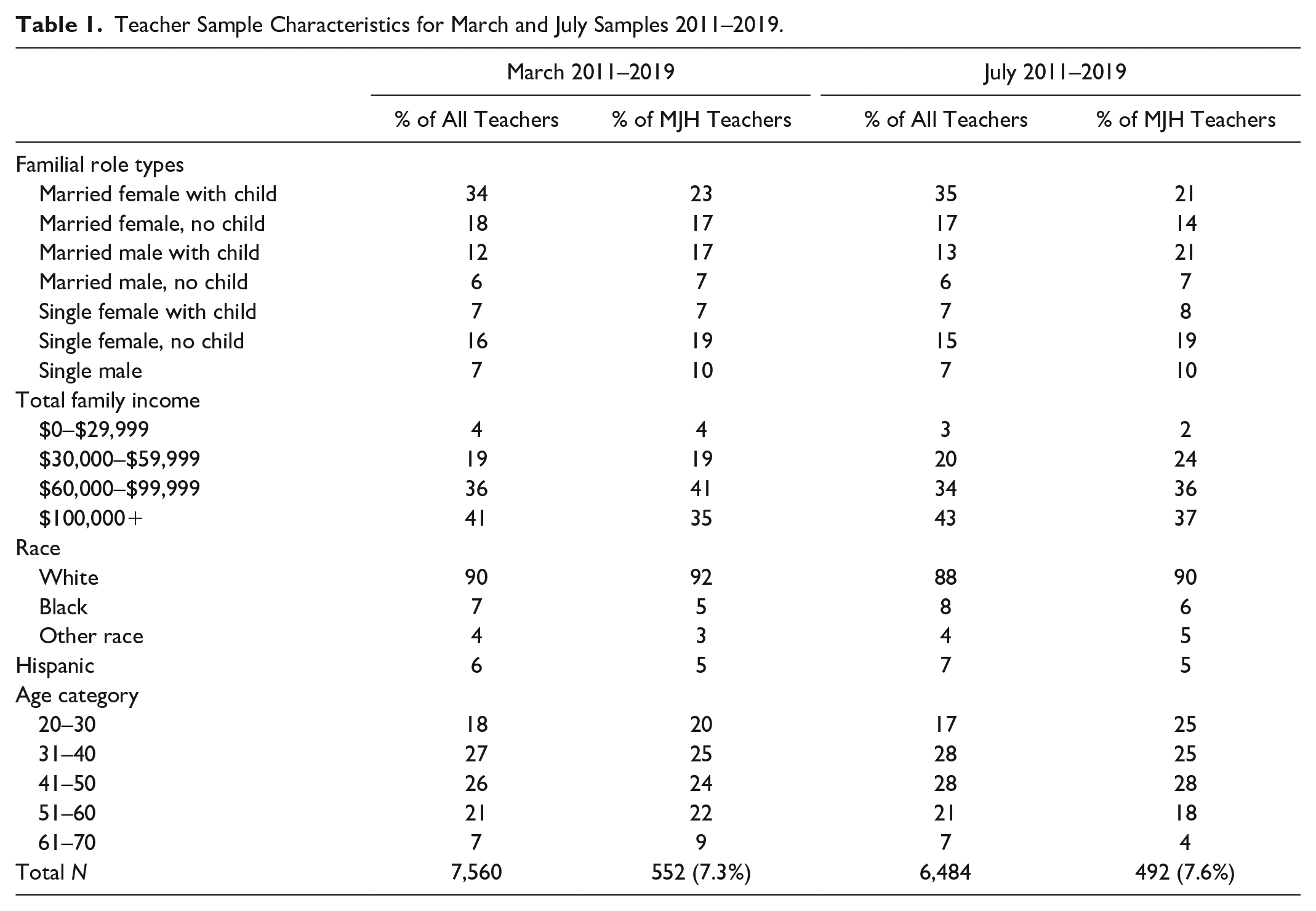
The final July teacher sample is smaller than the March sample for two reasons (see Table 4 in Supplemental Materials). First, there is an increased unemployment rate among college-educated public school teachers in the summer months, from approximately 1.2 percent in March to 7.3 percent in July. CPS data revealed that most teachers lost a job or were on a layoff. These laid-off teachers likely account for a considerable portion of the difference between the month samples. However, this analysis focused only on the behavior of employed teachers who decided to take on additional work when they have consistent work already. So, unemployed teachers were left out of the analysis. Second, despite changes to employment status, teacher reporting rates dropped in the summer months. It was difficult to determine whether including missing individuals would have increased or decreased the MJH rate in July. For instance, a non-MJH teacher may be away from home and not working and not respond, or an MJH teacher may work at a summer camp away from their primary residence. Although the samples may differ according to these specified and some unspecified work dynamics, as shown in Table 1, the samples do not differ by any meaningful demographic variable used in the analysis.
Teacher Sample Characteristics for March and July Samples 2011–2019.
Variables
MJH status
I derived the MJH variable from a CPS question that asked respondents to indicate if they worked more than one job the week before the interview that month. The CPS defines an additional job as a job that an individual performs in addition to their primary job, meaning that they generally dedicate less time and earn less money in their additional jobs. I considered an individual who held another job besides their primary job to be a multiple job holder.
In the IPUMS CPS data, it is not possible to identify the nature of the additional job. This is an important limitation given that teachers often take second jobs associated with teaching, such as summer school teachers or sports coaches (Wilhelm and Lewis 2018). The National Bureau of Economic Research monthly outgoing rotation files of the CPS include data on the nature of other jobs held by public school teachers but cannot be sufficiently linked to the CPS IPUMS set. Most teachers take on additional jobs in the private or self-employed sectors, with shares employed by local or state governments (see Table 3 in Supplemental Analysis).
State-level average annual teacher salary
I treated the state-level average annual teacher salary as a continuous variable. The NEA provided reports of the estimated state-level average teacher salaries for each year in the sample. 4 I adjusted these average salaries by the regional price parity (RPP) for the given year and state. The RPP is a measure of price levels across states created by the U.S. Bureau for Economic Analysis, and it is expressed as a percentage of the overall national price level (U.S. Bureau of Economic Analysis 2022). I further altered the salary variable using the Consumer Price Index for Urban Consumers as reported by the U.S. Census Bureau and the U.S. Bureau of Labor Statistics, with 2019 as the base (U.S. Bureau of Labor Statistics 2019). I divided the salary variable by 1,000 to allow for easier comprehension of the effect of average salaries on MJH probability. I then linked these average salaries to a teacher based on the year and the state of residence. 5
Familial role types
I defined the familial role type categorical variable by the combination of self-identified sex (limited to male or female in CPS), marital status, and the presence of children in the household. 6 Marital status was simplified to either single or married. I categorized separated, divorced, or widowed teachers and those who never married as single. I categorized teachers with cohabiting, unmarried partners of any sex as single (see Percheski 2018). Familial roles were differentiated by the presence of no children or any children in the household; the presence of a teacher’s child under the age of 18 in the household defined these categories. Single male teachers with no children and single male teachers with children were combined into one category due to the limited number of observations for these groups.
Married couples in this article only include different-sex couples (i.e., a male and female partnership). The teacher sample included 134 same-sex married teachers from 2011 to 2019, including those in male-male or female-female partnerships. Given this small number of observations and the diversity of experiences in them, the inclusion of same-sex married categories would not yield meaningful findings. I dropped all instances of same-sex couples from the analyses. Future research should address the question of work-family decisions among teachers in same-sex married couples.
The possible familial roles were as follows: married male with children; married female with children; married female, no children; married male, no children; single female with children; single female, no children; single male (regardless of parental status).
Other variables
I included other demographic and individual-level characteristics of teachers in the models to account for possible important variations: self-identified race, coded as White, Black, and other races; a binary indicator for Hispanic self-identification; age as categories in 10-year bins (20–30, 31–40, 41–50, 51–60, and 61–70); and a binary indicator for a graduate degree to indicate if the teacher held any educational attainment above a bachelor’s degree.
Excluded variables
I did not include estimates of individual-level income in the analysis for several reasons. Total personal income was available for teachers in the samples but was not broken down by source in the CPS (i.e., teaching vs. additional jobs held). 7 In additional analyses (presented in Table 5 in Supplemental Materials), a continuous variable for family income—total family income minus the teacher’s total wages (teacher wages plus wages from other jobs)—was included to capture financial resources available to teachers through their families. I chose to exclude the family income variable from the main analysis because family income was collected in the Annual Social and Economic Supplement, which only occurs in March. The results of these supplemental analyses supported the main results with similar directions and magnitudes of effects for all key variables.
Methods
To examine how the odds of teacher MJH varied by state-level average salaries and familial roles, I estimated logistic regression models predicting MJH using Stata. Results of these regressions are presented as odds of a teacher holding another job compared to a reference category of married, female teachers with children, the most common family type in the sample. Standard errors were clustered by state to account for further state-level differences in the educational environment and living standards. All models included controls for state and year fixed effects to account for persistent differences across states and national trends and yearly state-level unemployment rates. The results presented include regressions with the average state-level teacher salary and familial roles as the main predictors and with the interactions between them.
Findings
Descriptive Statistics
When adjusted for cost of living and inflation, state-level average teacher salaries in the NEA data have declined or stayed stagnant across the decade. Only 13 out of the 50 states and DC showed slight to modest increases in real wages, whereas all other states showed varying decreases in state-level average salaries.
Although we might expect that the summer months would exhibit the highest percentage of teacher MJH, past research from the Pew Research Center and the NCES reported that teachers hold higher rates of MJH in nonsummer months in the same year period as the current analysis (NCES 2021; Schaeffer 2019). The current analysis finds similar results. Among teachers in CPS for 2011 to 2019, the MJH percentage by month across the calendar year varied somewhat but stayed within the range of 7 percent and 8 percent with no considerable spikes. For 2019, approximately 12.26 percent of teachers worked another job that year, although monthly rates were around 8 percent, indicating some movement in and out of the MJH group within the year.
The MJH rate among teachers in the final data set was 7.3 percent in March and 7.6 percent in July, 2011 to 2019. Alhough different from other estimates of teacher MJH, such as those from the NCES (2021), these percentages were consistent with past monthly estimates derived from the CPS (Winters 2010). These percentages also compare to an approximate 5.5 percent rate of MJH in March and a 5.1 percent rate in July for all employed, college-educated, full-time employees in the CPS, indicating a statistically significantly higher rate of MJH for teachers compared to a comparable working population.
Table 1 displays the characteristics of the total teacher sample and MJH teacher sample for March and July, 2011 to 2019. The total teacher sample for both March and July showed similarities in composition by all demographic factors. Further tests reveal that the two samples did not exhibit statistically significant differences by state of residence or state-average teacher salaries. Nonetheless, the samples may differ systematically in some unknown way. Overall, the samples were largely female-dominated, most teachers were married, and approximately half of all teachers had children present. The MJH teachers included more male teachers, especially married male teachers with children. Compared to the March MJH teacher sample, the July MJH teacher sample contained more male teachers.
Figure 1 displays the percentage of MJH teachers by familial role type subsamples for each month (March and July). Each bar in Figure 1 represents the percentage of teachers who held more than one job among those of a particular familial role type in the given month. For instance, 4.9 percent of married female teachers with children held another job in March 2011 and 2019. There were clear differences in MJH by familial role type across the year, with married female teachers with children having the lowest MJH rate and single male teachers (11 percent in March) and married male teachers with children (12.5 percent in July) the highest . Between March and July, there were only small differences in the MJH rate. Only three family types had rate differences greater than 1 percentage point across the months: married male teachers with children had a March rate of 10.1 percent and a July rate of 12.5 percent, single female teachers with children had a March rate of 7.5 percent and a July rate of 9 percent, and married female teachers with no children has a March rate of 7.4 percent and a July rate of 6.2 percent.

Percentage of teachers who are multiple job holders broken down by familial role type subsamples for March and July, 2011 to 2019.
Additional checks were conducted to compare the actual hours worked by teachers at their primary job and other jobs across the year compared to other college-educated, employed, full-time workers. Figure 2 displays this analysis. As expected, the average actual hours worked for teachers decline during the summer, and other job work time increases. Among similar workers, work time at both primary and other jobs stays consistent throughout the year.

Reported actual hours worked at a primary job and other jobs (if held) last week for all college-educated, employed, full-time workers and public school teachers for all months, 2011 to 2019.
Multivariate Results
Models 1, 2, and 3 in Table 2 present the regression results in odds ratios (OR) for the March 2011 and 2019 samples. In Model 2, which used March data, a teacher’s familial role is a statistically significant correlate with teacher MJH. Compared to the reference group of married female teachers with children, all other familial role types had statistically significant higher odds of holding another job except married female teachers with no children. Single male teachers held the highest relative odds (OR = 2.08; p < .01). Married male teachers with children (OR = 1.85; p < .01) and single female teachers with children (OR = 1.86; p < .01) held similar relative odds compared to the comparison group.
Results from Logistic Regression Models Predicting Multiple Job Holding among Employed, College-Educated, Full-Time, U.S. K–12 Public School Teachers for March and July, 2011 to 2019.

Note: All results are in odds ratios. Standard errors are reported in parentheses. Standard errors in all models were clustered by state and year. All models included variables identifying the teacher’s self-identified race, age category, graduate school completion, monthly state unemployment rates, and controls for state and year fixed effects. Data are from the Current Population Survey and the National Education Association.
p < .1. **p < .05. ***p < .01.
Figure 3 plots the predicted probabilities of MJH by familial role type with 95 percent confidence intervals for March (left) and July (right). The difference in likelihood between married female teachers with children and married male teachers with children for March was clear in the graphical interpretation.

Association between familial role types and predicted probabilities of multiple job holding (MJH), March and July, 2011 to 2019 (with 95 percent confidence intervals).
State-level average teacher salary was not associated with the odds of holding another job in any model for the March sample. Figure 4 plots the predicted probabilities of MJH by state-level average teacher salary. There was no visible decrease in MJH as the state-level average teacher salary increased in the graphical interpretation (Figure 4).
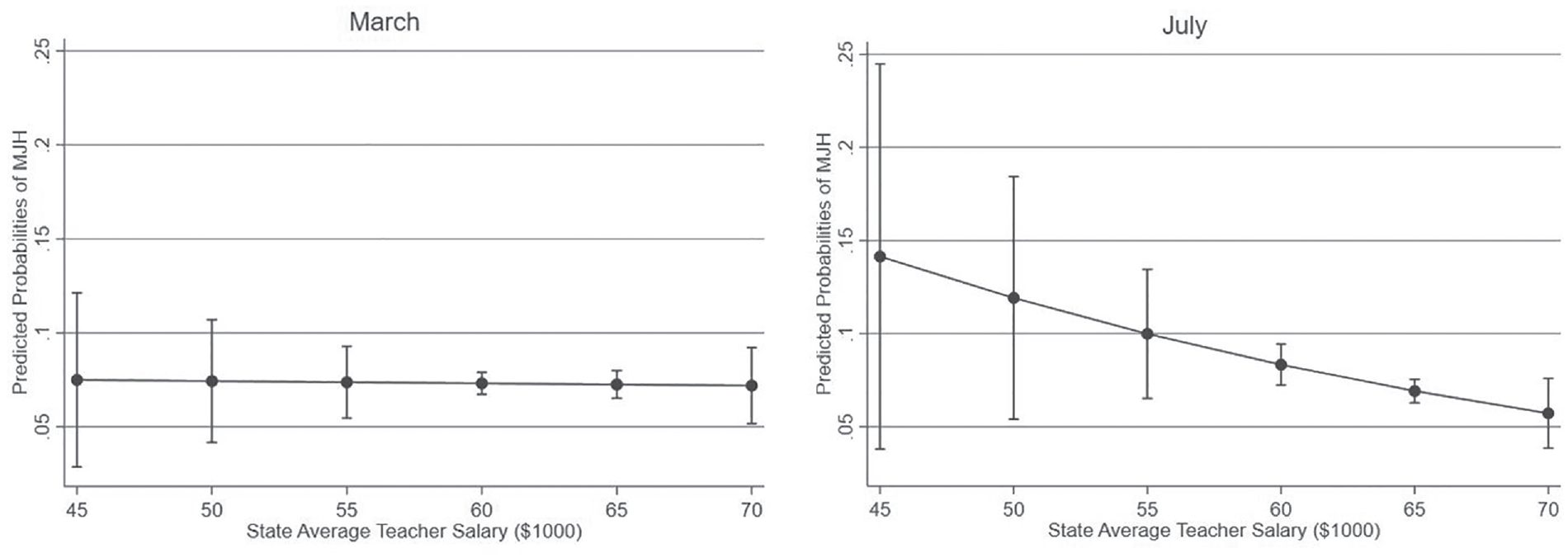
Association between state-level average teacher salary and predicted probabilities of teacher multiple job holding (MJH), March and July, 2011 to 2019 (with 95 percent confidence intervals).
The interaction between familial role type and state-level average teacher salary yielded ambiguous results. Although the regression results indicate that the single male category had a statistically significant interaction, I used a graphical approach, supplemented by an analysis of average marginal effects, to assess interaction effects (Mize 2019). Figure 5 displays the average marginal effects on predicted probabilities by key familial role types as state-level average teacher salaries increased. The analysis revealed no statistically significant interaction between familial role and state-level average teacher salary for March models. 8
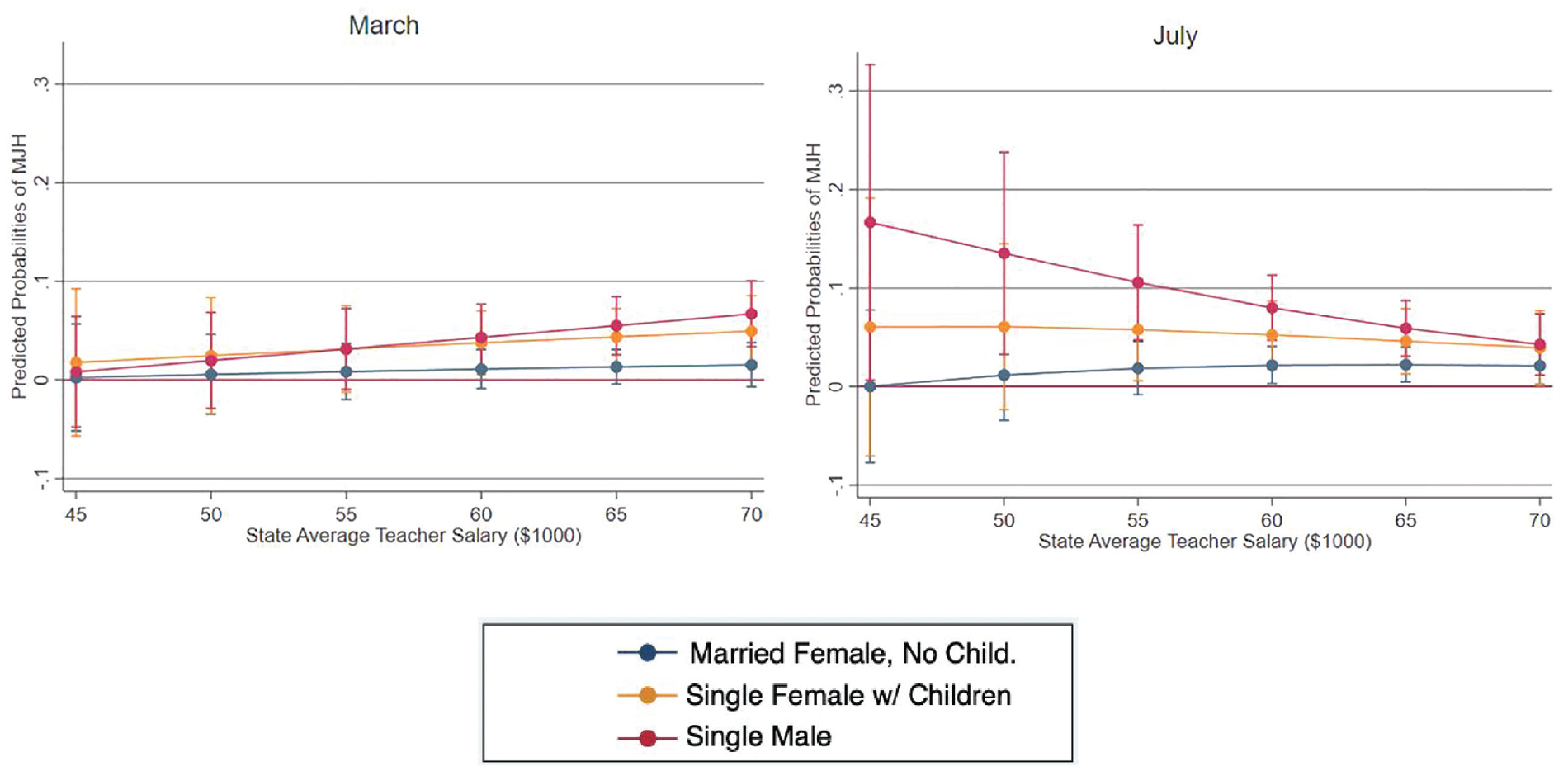
Average marginal effects on predicted probabilities of teacher multiple job holding (MJH) of state-level average teacher salary by familial role type for March and July, 2011 to 2019.
Models 4, 5, and 6 in Table 2 present the regression results in odds ratios for the July 2011 and 2019 samples. Compared to married female teachers with children, teachers in all other familial role types had statistically significant higher odds of holding multiple jobs in July (Model 5 in Table 2 and graphically on the right in Figure 3). Married male teachers with children had 3.17 (p < .01) times higher odds of working another job in the summer compared to married female teachers with children in Model 5. Furthermore, further tests revealed a statistically significant difference in odds between married male teachers with children and single female teachers without children (p < .01) and with children (p < .05).
For July, a higher state-level average teacher salary was associated with lower odds of holding another job in all models. For every $1,000 increase in state average teacher wage, the likelihood that a teacher held another job was multiplied by 0.95 (p < .1) in Model 5, and this result was translated graphically in Figure 4.
For the interaction between familial role type and state average teacher salary in July, the regression produced statistically significant interaction for single female teachers with and without children. Graphs of predicted probabilities and the average marginal effects for this interaction are shown in Figure 5. Evidence suggests that teacher MJH outcomes for single male teachers were sensitive to changes in the state-level average teacher salary for July, 2011 to 2019. 9
Evaluation of Hypotheses
Hypothesis 1 considered the negative effect of average state salary on teacher MJH. The analysis of the March sample did not support Hypothesis 1, but the analysis for July did.
Hypothesis 2 explored the broad connection between gender and teacher MJH. Male teacher categories mostly have higher odds of MJH compared to female categories. Further tests revealed statistically significant differences between married male teachers with children and all female categories in July. For March, tests revealed only statistically significant differences in odds between married male teachers with children and married female teachers with and without children. In sum, there was mixed support for Hypothesis 2.
Hypotheses 3a, 3b, and 3c continued the analysis of gender by suggesting there were familial role dynamics at play. In both months, compared to single male teachers, married male teachers without children were not more likely to hold more than one job. This finding casts doubt on Hypothesis 3a. Hypothesis 3b suggested that married male teachers, with or without children, were more likely to practice MJH than married female teachers. Married male teachers with children exhibited the highest relative odds of MJH compared to married female teachers with and without children. Still, differences between married male teachers and married female teachers were only significantly statistically different for July. So, only tentative support was given to Hypothesis 3b. Lastly, Hypothesis 3c suggested there were distinct differences in MJH between married male teachers with children and married female teachers with children. The findings supported Hypothesis 3c because these two groups had the largest difference in odds of MJH for both months.
Hypothesis 4 proposed that the scheduling differences between March, in the traditional school year, and July, during the traditional summer break, would drive the differences in results. Odds ratios for MJH by familial role types appeared more dramatic in July than in March. State-level average teacher salary became a significant result in the July sample. These two findings supported the contention that a unique summer effect was occurring, very likely relating to the increased free time of teachers with a simultaneous increase of familial responsibilities because of at-home children.
Discussion and Conclusion
This article assesses the popular contention that teachers’ poor pay causes high MJH among teachers in the United States. The analysis examines this supposed effect of salaries in the context of teachers’ familial needs, resources, and responsibilities using data from the CPS for March and July, 2011 to 2019, and the NEA. By undertaking this investigation, this article provides a renewed look at the influence of gender and family on MJH and reveals how these influences interact with state funding policies and occupational scheduling.
The findings suggest a particular story about MJH among teachers. During March, when most schools are in session and most teachers work full-time, a teacher’s familial role is the strongest predictor of teacher MJH, and the state-level average teacher salary plays a lesser role. Work conditions change during the summer. Most teachers work less in their primary job, but familial commitments increase because school-age children are at home. With this increased time away from work, a teacher’s familial role remains a strong predictor, and the state-level average teacher salary negatively associates with the teacher MJH.
Across both months, male teachers are more likely to hold a second job compared to female teachers. Married male teachers with children and single male teachers had significantly higher odds of holding more than one job than all female teacher groups for both months except for single female teachers with children in March. This divergence between male and female teachers is larger during the summer months. These findings reveal that gender, marital status, and the presence of children are critical factors in determining the likelihood of MJH among teachers.
The MJH outcomes of single male teachers with and without children are more sensitive to state-level average teacher salary changes in the summer. Potential explanations for the single male teacher category results are complicated due to the grouping of male teachers with and without children in this category and the resulting small size of the group. Those with children may feel the need to balance earning a higher income with caregiving, like single mothers (Percheski 2018), so they may be more likely to work more than one job at low teacher salary levels. Single men without children may also feel compelled to earn more during the summer because they have more recreation time to trade for labor hours.
This analysis has limitations, but these limitations elucidate several paths for future research. First, better data could allow for renewed research on the dynamics of work-family influence on employment patterns in same-sex marital couples.
Second, data did not permit analysis of employment desires or beliefs, which may motivate employment behavior. For instance, in families headed by different-sex couples, aspects of the male-breadwinner model of families persist and play a key role in the negotiations between spouses of formal labor work time and housework time (Warren 2007). Individuals may translate these beliefs into greater labor market participation by men. For instance, those who hold more traditional male-breadwinner norms are more liable to align their outcomes in the prescribed manner when conditions allow (Kan 2008). This attitudinal information would allow for a more precise and potentially causal analysis of gendered differences in teacher MJH. Time-use data on a representative sample of teachers could aid in defining the intensity of gendered participation.
Relatedly, the analysis did not include comprehensive controls for selection patterns into the teaching profession. For instance, varying wage conditions across states may lead individuals who are more or less likely to hold another job to enter the teaching profession. Future analysis could assess whether the teaching profession attracts those who are more likely to practice MJH or if differences occur across states.
Moreover, the picture painted in this article did not consider specific motivations driving further formal work or increased housework. For example, researchers can view childcare as a constraint to securing further employment. However, caring for one’s children is also a source of meaning and joy for parents. The summer break offers teachers additional time to spend with their children without negative impacts on their careers. By decreasing MJH, increased teacher salaries would allow individuals to enjoy greater leisure time, especially for single mothers, while also allowing for sharing familial responsibilities, especially for married individuals. This greater recreational or leisure time could lead to more positive teacher job experiences, thereby decreasing attrition (Bartlett 2004; Matsushita and Yamamura 2022).
Lastly, this analysis only considers state-level differences in teacher salaries. More local data could link MJH to specific school- and district-level conditions. Funding differences across and within districts result from racial and class stratification and concentration (Condron and Roscigno 2003). Differences in MJH across districts might likely match these funding disparities, exacerbating preexisting inequalities (Viano et al. 2021). Within schools, focused data could also allow researchers to view the spread of MJH across social networks, potentially providing a more precise view of MJH adoption and its effects on educational outcomes (Bidwell 2001).
Despite these limitations, the analysis provided in this article allows for a unique perspective on employment outcomes and their connection with familial roles, occupational policies, and government funding policies. Teachers in the United States are college-educated, work full-time, and experience prolonged periods of little to no work at their primary jobs. Nonetheless, they experience financial distress through comparatively weak and deteriorating publicly funded salaries. Simultaneously, each teacher occupies a specific position in their household, and their responsibilities shift as their work schedules change. Research on MJH work decisions must unite these familial roles, organizational policy, and larger funding factors to properly understand the teacher MJH phenomenon—for the sake of recruitment and retainment of teachers—and a whole host of other MJH cases, from nurses and professors to foresters and fishers.
Supplemental Material
sj-docx-1-srd-10.1177_23780231241286374 – Supplemental material for Public Funding, Private Work Outcomes: Multiple Job Holding among U.S. K–12 Public School Teachers
Supplemental material, sj-docx-1-srd-10.1177_23780231241286374 for Public Funding, Private Work Outcomes: Multiple Job Holding among U.S. K–12 Public School Teachers by Ryan Fajardo in Socius
Footnotes
Supplemental Material
Supplemental material for this article is available online.
1
The CPS asked respondents to identify their sex either as male or female. There are considerable issues in translating sex into an analysis of gender, and CPS categories limit the desirable nuance needed for this translation ( ). Regardless, I use the word “sex” when refering to the data used in analysis and “gender” when discussing the analysis of this data.
2
This gendered difference likely originates from the greater gender wage equity in the U.S. educational field compared to the wider labor market.
3
In additional analysis, I reestimated my models for all teachers, including those who worked in the private sector; my main findings are robust to the inclusion of teachers who worked in the private sectors.
4
5
To confirm the possible effect of state-level average annual teacher salary on MJH, I produced a parallel set of regressions using teacher salary data from the NCES (presented in ). Unfortunately, NCES data were only available for 2012 and 2019. The results of this supplemental analysis were similar to the results of the main analysis. For instance, the effect of state average teacher salaries in the models using NCES data was similar in magnitude and direction as in the main analysis and statistically significant in the model with the interaction.
6
In presenting data analysis, I use “male” and “female”; I use the words “men” and “women” when referring to language used in other research.
7
Weekly income for teachers was available in Annual Social and Economic Supplement data. Most teachers in the July sample did not have reliable weekly income data.
8
Only one demographic control was a statistically significant predictor of MJH for March. Identifying as a race category other than White or Black was associated with significantly lower odds of holding another job.
9
Several demographic controls were statistically significant predictors of MJH for July. When compared to the reference category of ages 20 to 30, older age categories exhibited lower odds of holding another job. The magnitude of these differences increased with older age categories, suggesting that as teachers gain experience and earn more money, the likelihood they hold another job decreases. Also, graduate education was statistically and positively associated with MJH among teachers in July.
Author Biography
References
Supplementary Material
Please find the following supplemental material available below.
For Open Access articles published under a Creative Commons License, all supplemental material carries the same license as the article it is associated with.
For non-Open Access articles published, all supplemental material carries a non-exclusive license, and permission requests for re-use of supplemental material or any part of supplemental material shall be sent directly to the copyright owner as specified in the copyright notice associated with the article.
