




Abstract
To examine the effect of the public funded teacher education (PFTE) program in China, this study examined student teachers’ academic performance and other educational aspects. Using convenient sampling method, data were collected through a self-report survey. A total of 211 public funded student teachers (PFSTs) and 305 ordinary student teachers (OSTs) were obtained. The results of t-tests and structural equation modeling analysis revealed that: (a) OSTs invest more spare time in learning and perform better in compulsory course, (b) PFSTs are more active in teaching skill competition involvement and have higher levels of professional identity (i.e., intrinsic value identity and volitional behavior identity), and willingness to engage in teaching profession, (c) perceived faculty support positively predicts both student teachers’ willingness to engage in teaching profession through the mediating effects of professional identity, (d) compared to OSTs, perceived faculty support has a higher impact on PFSTs’ professional identity. Implications for the PFTE program were discussed.
Keywords
Introduction
The uneven school quality resulting from the uneven distribution of education funds and high-quality teaching staff is a common issue both in China and internationally (Ni et al., 2022). Since high-quality teachers are likely to choose high-performing schools with better working conditions and more opportunities for personal achievement, low-performing schools always faced a shortage of capable teacher staffs (Straková & Simonová, 2024).
To tackle the issue of teacher unequal distribution, In 2007 the Chinese Ministry of Education (MoE) piloted the Free Teacher Education program in six top normal universities (MoE, 2007). This program aims to attract talented students to join teaching career by providing financial benefits and job guarantees. Students enrolled in this program are exempt from tuition and accommodation fees and receive living allowances during their studies, but they are obliged to work in urban schools for more than 10 years after graduation (MoE, 2007). In 2018, the Chinese government updated and improved the policies about Free Teacher Education program, and renamed it as “Public Funded Teacher Education (PFTE) Program” (MoE, 2018), which is characterized by shortening the service life after graduation from 10 to 6 years.
The PFTE program has attracted a great number of students to engaged in. For instance, during the Chinese 13th Five-Year (from 2016 to 2020), a total of more than 37.000 public funded student teachers (PFSTs) enrolled in Chinese top six normal universities hosting the program. This program has contributed to alleviating the uneven distribution of teachers and the shortage of teachers in schools in “resource-strapped” areas to a certain extent.
However, some recent studies reported that there are several noteworthy issues in the PFSTs’ cultivation. For instance, X. L. Zhang et al. (2023) analyzed the differences in academic performance between PFSTs and nonteaching students during the 4 years of university. They found that PFSTs’ academic performance in professional courses in the second and third years are slightly lower than that of nonteaching students. Most PFSTs were motivated by external factors (i.e., 68.1% of PFSTs were primarily motivated by job guarantees and 27.1% of PFSTs were primarily motivated by financial support) to engage in the PFTE program, while only a few ones were motivated by internal factors, such as teaching commitment (F. Zhang & Chen, 2020). Although scholars have conducted extensive research on the problems faced by universities, such as dropout rates (Lizarte Simón & Gijón Puerta, 2022; Peng et al., 2022), little attention has been paid to the PFSTs. Additionally, the willingness of PFSTs to engage in teaching profession is also needs to be enhanced as a recent study reported that only 60% of PFSTs express a clear desire to be a teacher (Jiang et al., 2019). Thus, the effectiveness of the PFTE program remains unclear, needing further examination. However, the existing studies only explored the effect of the PFTE program from limited single perspectives, lacking a comprehensive discussion, especially the differences between PFSTs and ordinary student teachers (OSTs).
To bridge this research gap, this study strives to examine the differences in academic performance and other educational aspects (e.g., learning duration outside of class, involvement in teaching skill competitions, part-time jobs, perceived faculty support, professional identity, willingness to engage in teaching profession) between PFSTs and OSTs. Since PFSTs’ willingness to engage in teaching—which is closely linked with students’ career choice and retention—needs urgent improvement, we would also explore how faculty support provided by universities impacts student teachers’ willingness to engage in teaching, and whether there are differences between PFSTs and OSTs in these relationships. Thus, this study strives to address the following two research questions:
Our study will be the first attempt to provide some concrete evidence in understanding the effectiveness of PFTE program in a developing country context. The rest of this paper is organized as follows. Brief introduction of the Teacher Education Program in China and literature review were presented in Section 2. Method introduction including instruments design, sampling and data collection were presented in Section 3. Empirical results and discussion were presented in Section 4 and 5, respectively. In Section 6, we made a conclusion, discussed the implications and limitations.
Background and Literature Review
Teacher Education Program in China
In China, the teacher education program is charged with the responsibility of cultivating high-quality teachers for elementary and secondary schools nationwide. In recent years, to strength the quality of teacher education, the Chinese government has invested vast resources in teacher education and introduced a series of practical measures. For instance, the Chinese government allocated 2.8 billion RMB to support 38 high-quality teacher education institutions to strengthen practical teaching capabilities and subject construction during the 13th Five-Year (China Teacher Paper, 2020).
In China, there are 696 universities and colleges hosting teacher education program, among which six are designated for the PFTE program. A total of 2.6158 million student teachers are studying, including two types: PFSTs and OSTs (Guangming Daily, 2021). PFSTs are those who have been admitted to the PFTE program. They enjoy a attractive package of financial benefits during their studies, and have to be teachers in primary or secondary schools in the provinces where their residence are registered for not less than 6 years according to the contract signed before enrollment. Furthermore, PFSTs who work in urban schools have to teach in rural schools for at least 1 year. PFSTs failed to fulfill contract should bear the consequences of returning all government financial support and paying a certain amount of money as penalty, and would be blacklisted in Credit Record Archives created by the educational authorities. OSTs are candidates for future teachers, whose majors are teaching and are expected to work in schools or other educational institutions in the future. Unlike PFSTs, OSTs have to pay all their own study expenses and are free to choose careers after graduation. Although PFSTs and OSTs differs in the sources of education funding and employment choices, they receive the same training process and resources (e.g., teachers, courses, and opportunities to participate in teaching activities) in universities. In this regard, their differences in academic performance and other educational aspects may largely stem from whether they have joined the PFTE program. Comparing the performance differences between PFSTs and OSTs may provide crucial evidence for understanding the effectiveness of the PFTE program.
Student Teachers’ Academic Performance and Other Educational Aspects
This study will examine the status quo of the following seven aspects of student teachers: academic performance, learning duration outside of class, involvement in teaching skill competitions, part-time jobs, perceived faculty support, professional identity, willingness to engage in teaching profession. Additionally, we will also examine the interrelationships between perceived faculty support, professional identity, and willingness to engage in teaching profession.
Perceived Faculty Support
Perceived faculty support refers to the degree to which student teachers’ perception of the adequacy of the support provided by teacher educators during their teacher education (Schepens et al., 2009), which includes psychological support and functional support (Rots et al., 2007). Specifically, psychological support describes the support aimed at promoting students’ sense of ability and self-worth, such as respect and encouragement; whereas functional support concerns the professional support aimed at promoting students’ achievement of academic success goals, such as emphasizing important concepts and providing useful feedback (Rots et al., 2007).
Previous studies have found that students’ perception of faculty support can improves their retention in higher education (Shelton, 2003; Timoštšuk & Ugaste, 2010). Since teacher educators serve as role models for student teachers both psychologically support and functionally (Rots et al., 2007), trust and support coming from teacher educators are crucial to students’ teacher education experience (Mäkinen et al., 2018) as well as their entrance into the teaching profession after graduation (Stokking et al., 2003). In the situation where teacher educators are of low teaching capacity, indifferent to students, and seldom communicate with students, student teachers may distort the professional image of teachers and decrease professional identity and willingness to engage in teaching profession (Lucksnat et al., 2022).
Professional Identity
Professional identity refers to individuals’ professional self-concept constructed by their attributes, beliefs, values, motivations, and experiences (Ibarra, 1999). It is crucial to individuals’ profession performance, profession development, and well-being (Mahboob & Khan, 2016). Student teachers’ professional identity, defined as a combination of their own self-concept and other people’s view of teaching as a profession (Chen et al., 2023), involving individuals’ core beliefs about teacher profession (Mayer, 1999). Teachers’ professional identity are closely linked with their teaching strategies, professional development, enjoyment in work, and even retention (Gaziel, 1995). Similarly, student teachers with a higher level of professional identity are more likely to regard the teaching as a valuable and important profession and choose to be a teacher as their lifelong career. The teacher training programs are crucial for students to formate solid professional identity (Timoštšuk & Ugaste, 2010). Vygotskian even argued that the development of student teachers’ professional identity is the overall goals of teacher education (Huizen et al., 2005).
Scholars have reached a consensus on the viewpoint that teacher professional identity has multiple components, but their views on the specific dimensions differ.For instance, Kremer and Hofman (1985) argued that teachers’ professional identity consists of four basic dimensions: centrality (the meaningfulness and importance), valence (attractiveness and value), solidarity (willingness to share a common destiny with peers), and self-presentation (willingness to acknowledge oneself as a teacher), whereas (Beijaard et al., 2000) proposed that it is made up of subject matter expertise, didactical expertise, and pedagogical expertise. However, these studies were targeted at in-service teachers in the contexts of US and European. To explore the constructs of professional identity of student teachers in Chinese context, Zhao et al. (2011) investigated 714 student teachers in China and empirically confirmed that their professional identity is made up of three components: intrinsic value identity, external value identity, volitional behavior identity. Specifically, intrinsic value identity refers to an individual’s identification with the intrinsic value attributes of the teaching profession, which is similar to intrinsic (e.g., inherent passion for teaching) and altruistic motives (e.g., desires to support children’s development) to some extent. External value identity refers to an individual’s tendency to approach the teaching profession because of its external characteristics and reinforcement, which is similar to extrinsic motives (e.g., salary, status, and working conditions) to some extent. Volitional behavior identity refers to an individual’s tendency to carry out continuous preparation for teaching. Since our research objects are also Chinese student teachers, we adopt the view of Zhao et al. (2011) on the three-dimensional composition of professional identity.
As a relational phenomenon, professional identity is usually developed through interaction between individuals and different factors including social, cultural, and contextual factors (Schepens et al., 2009). Student teachers’ formulating of professional identity is closely related to curriculum, practicum, institution climate, and their interaction with important others, especially teachers (Bressler & Rotter, 2017; Chen et al., 2023; Gholami et al., 2021; Hanna et al., 2022). Chen et al. (2023) collected four waves of data with 1,197 Chinese preservice teachers, they found that preservice teachers’ professional identity change over time and present three patterns during their teacher education, providing the evidence that professional identity develops dynamically under the influences of external factors. A recent research reported that the professional identity of PFSTs in China is at an upper middle level (2.7 out of 5), needing further improvement (Wan & Wei, 2022). Although substantial research has concerned factors influencing student teachers’ formation of professional identity using qualitative methods (e.g., ethnographic interviews; Deng et al., 2018; Timoštšuk & Ugaste, 2010; L. Wang & Du, 2014), research provided empirical evidence is scarce.
Willingness to Engage in Teaching Profession
The issue of student teachers’ entrance in teaching profession after graduation is a worldwide issue, which have attracted a substantial concerns of researchers (e.g., Guo et al., 2022). A large number of scholars have performed to explore the factors influencing student teachers’ willingness to engage in teaching profession. They found that various factors, including teacher education related variables (e.g., school climate, types of teacher education program, faculty support, and mentoring support), individual characteristics (motivation; teaching commitment, teacher efficacy, professional orientation, preparedness for teaching, and sense of vocation), and environmental factors (labor market; availability of other jobs, and political contexts), may exert effects on graduates’ decision (Onyefulu et al., 2023; Rots & Aelterman, 2009; Rots et al., 2007).
In this study, student teachers’ willingness to engage in teaching profession refers to the degree to which they are willing to be teachers after graduation, which is a important predictor of their actual entrance and retention (Rots & Aelterman, 2009).
The Three-Way Relationship Between Perceived Faculty Support, Professional Identity and Willingness to Engage in Teaching Profession
Adequate and success faculty support provided by teacher education programs is crucial to graduates’ professional identity development and decision to entrance teaching career (Coward et al., 2015; Stokking et al., 2003). Scholars also found that professional identity is a key predictor of teachers’ burnout and job-leaving inclination, teachers with low levels of professional identity are likely to experience high levels of burnout and job-leaving intention (Kremer & Hofman, 1985). However, there is still a lack of empirical evidence on the interrelationships between faculty support, professional identity and willingness to engage in teaching profession. Furthermore, little is known about whether these relationships differ between PFSTs and OSTs. Based on the aforementioned literature, it is reasonable to assume that student teachers’ perceived faculty support may contribute to student teacher’ willingness to entrance in teaching career through the improvement and reinforcement of their professional identity. Therefore, this study formulated the following hypotheses and formed the theoretical research model (Figure 1).

The research model.
Method
Participants
Our research focuses on senior student teachers who are in their final year of the 4-year teacher education program at a bachelor level. This group has basically finished curricula learning and is in the career choice period, whose feelings are likely to provide crucial feedback for teacher education. Data collection lasted for 2 weeks (April 2–16, 2023). In China, the MoE implemented the Free Teacher Education program in six normal universities in 2007. These six universities are all top normal universities in China, directly under the jurisdiction of the MoE, and located in different provincial capitals. Using convenient sampling method, we recruited student teachers from two top normal universities among the six top normal universities hosting the PFTE program in as the research objects. These two universities located in Chengdu and Wuhan respectively, with the proportion of PFSTs of 18.20% and 28.53%, respectively. We contacted several student counselors who are responsible for managing student teachers at these universities, briefly introduced our research and asked them to forward the online questionnaire to their student teachers, inviting them to participate anonymously and anonymously. This research was approved by the ethics approval committee of the authors’ institution. Written informed consent was obtained from all students. A total of 568 responses were received. After eliminating responses with less than 90 s of response time and with the same option for all questions, 516 valid samples were remained (211 PFSTs and 305 OSTs). We selected 90 s as the threshold because in the pre-test, we found that the minimum response time for participants who could complete all questions carefully was 92 s. The demographic information of the respondents were shown in Table 1.
Demographic Information of the Participants.

Instruments Development
A self-reported questionnaire was developed for data collection. To ensure the validity, most items were adopted and adapted from existing literature with satisfactory reliability and validity. The questionnaire consisted of items developed to collect responders’ background information (i.e., gender, major, and types of student teachers) and items to measure the variables of this research.
Academic performance: Scholar’ have employed different methods to measure students’ academic performance. Some studies examined academic performance employing self-reported questionare, such as students’ perception of their overall academic performance, ability to learn, and performance in academic tasks (e.g., Chang et al., 2019; Mehrvarz et al., 2021; Yao & Wang, 2022), while others used grade point average (GPA; e.g., Lau, 2017; Upadhyaya & Acharya, 2020). In China, not all universities provide Grade Point Average (GPA) for students, but exams for compulsory courses are measured on a scale of 100, and a score below 60 is considered a failure. To measure student teachers’ academic performance in compulsory courses, two indicators were used: the average score and the failures in compulsory courses. Each indicator was measured using a question. The one question is “What is your average score of your compulsory courses?” Response options “Below 60,”“61–70,”“71–80,”“81–90,” and “Above 90” were assigned values of 1 to 5 respectively. The other is “How many failures in compulsory courses did you make in university?” Response options “Never,”“1–2 times,” and “3 times or more” were assigned values of 1, 2, and 3 points respectively.
Involvement in teaching skill competitions: One question was used to measure the number of times that student teachers participated in teaching skill competitions during teacher education. That is, “How many times did you participate in teaching skill competition in university?” Three response options “Never,”“1–2 times,” and “3 times or more” were assigned values of 1, 2, and 3 points respectively.
Learning duration outside of class per week: We applied a single-item measure to examine the average amount of time that student teachers spending on their studies outside of class averagely (“How much time do you spend on studying outside of class per week averagely?”). Four response options “Less than 3 hr,”“4–6 hr,”“7–10 hr,” and “more than 10 hr” were assigned values of 1, 2, 3, and 4 points respectively.
Part time jobs: One question was used to measure the number of part time jobs student teachers did in their teacher education process (“How many part-time jobs did you do in university?”). Three response options “Never,”“1–2,” and “3 or more” were assigned values of 1, 2, and 3 points respectively.
Perceived faculty support: In line with the study of (Rots et al., 2007), we developed items to measure student teachers’ perception of faculty support based on Dutch translation of the Perceived Faculty Support Scale (Shelton, 2003). Participants were required to determine on a 5-point Likert scale to which extent they agreed with each of the eight statements, which were translated into Chinese using cross-checking and back-translation. Specifically, psychological support was measured with four items, with a Cronbach’s alpha value of .971. Example items are “Our teachers demonstrate confidence in students” and “Our teachers usually listen to students.” Functional support was also measured with four items, with a Cronbach’s alpha value of .969. Example items are “Our teachers provide helpful feedback on student assignments” and “Our teachers always vary teaching methods to meet student needs.”
Professional identity: Instruments used to examine student teachers’ professional identity were adopted from Zhao et al. (2011), which was a scale specifically developed for Chinese student teachers and had been tested to have good reliability and validity. Specifically, intrinsic value identity was measured with four items, with a Cronbach’s alpha value of .907. Example items are “I really enjoy teaching” and “I think teaching is a very valuable profession.” Three items were used to examine external value identity, with a Cronbach’s alpha value of .887. An example item is “I think teaching is a highly respected profession.” Volitional behavior identity was also examined with three items. One example item is “I often actively participate in lectures and other learning opportunities related to teaching.” All items were answered on a 5-point Likert scale, ranging from 1 (completely disagree) to 5 (completely agree).
Willingness to engage in teaching profession: Items used to examine student teachers’ current willingness to engage in teaching profession was adopted from (Rots & Aelterman, 2009). There are two items in total: “I want to be a teacher” and “I hope to become a teacher.” Responses were scored on a 5-point Likert scale ranging from 1 (completely disagree) to 5 (completely agree). The Cronbach’s alpha value is .956.
After the completion of the questionnaire design, we performed a preliminary test with 20 PFSTs and 20 OSTs. Language expression was adjusted to eliminate possible ambiguity and misunderstanding based on feedbacks.
Data Analysis
Data analysis were performed using SPSS 25.0 and AMOS 24.0, which included three steps. Firstly, descriptive statistics and correlational analyses were performed to calculate the mean value of the variables and examine bivariate associations among them. Secondly, t- tests was applied to evaluate the differences between PFSTs and OSTs’ academic performance and other educational aspects. Thirdly, confirmatory factor analysis (CFA), structural equation model (SEM), and multiple group comparisons were performed to examine the interrelationship between perceived faculty support, professional identity, and willingness to engage in teaching profession, and whether there are group differences between PFSTs and OSTs.
Results
Descriptive Statistics and Correlation Analysis
The mean values of student teachers’ average score in compulsory courses, times of failures in compulsory courses, involvement in teaching skill competitions, learning duration outside of class per week, and part-time jobs are 3.33, 1.35, 1.34, 2.38, and 1.93, respectively (Table 2). The mean values of perceived psychological support, functional support, willingness to engage in teaching profession are 4.14, 4.07, and 3.93. Thus, on the whole, student teachers’ academic performance, perception of faculty support, and willingness to engage in teaching profession are at upper-middle levels. In terms of the three dimensions of professional identity, the intrinsic value identity (3.80) is the highest, followed by external value identity (3.69), and volitional behavior identity (3.46). We applied criteria (i.e., small: r ≤ .30; medium: r = .30–.50; large: r ≥ .50) proposed by Cohen (1988) to interpret the correlations. The correlations between perceived faculty support, professional identity, and willingness to engage in teaching profession are medium or large.
Results of Descriptive Statistics and Correlation Analysis.

Independent-Sample t-Tests
To address the research question 1, t-tests were performed to examine the differences between PFSTs and OSTs’ academic performance and other educational aspects.
Compared to PFSTs, OSTs had significantly higher values on average score (M = 3.384, SD = 0.679 versus M = 3.242, SD = 0.732, t = −2.260, p = .024) and learning duration outside of class (M = 2.564, SD = 1.056 versus M = 2.114, SD = 0.919, t = −5.017, p = .000), but significantly lower value on failures (M = 1.275, SD = 0.541 versus M = 1.450, SD = 0.655, t = 3.308, p = .001), suggesting that OSTs have better academic performance in compulsory courses and spend more spare time on studying than PFSTs. However, PFSTs had significant greater values on involvement in teaching skill competitions (M = 1.550, SD = 0.698 versus M = 1.203, SD = 0.449, t = 6.858, p = .000), intrinsic value identity (M de3.937, SD D90.747 versus M er3.707, SD D70.802, t 273.291, p .2.001), volitional behavior identity (M de3.584, SD D50.753 versus M er3.370, SD D30.839, t 932.974, p .9.003), and willingness to engage in teaching profession (M = 4.206, SD = 0.733 versus M = 3.741, SD = 0.821, t = 6.607, p = .000) than OSTs. There is no significant difference in part-time jobs, psychological support, functional support, and external value identity between PFSTs and OSTs. Detailed t-tests results were shown in Table 3.
Results of t-Tests.

Note. M = mean value; SD = standard deviation.
p < .001, **p < .01, *p < .05.
Structural Equation Modeling Analysis
The Measurement Model
CFA was conducted to test the measurement model. We calculated the values of the following key indicators: factor loading, Cronbach’s alpha coefficient, convergent validity, discriminant validity, and the goodness-of-fit indices of model. Details of results were shown in Table 4.
Results of Construct Validity and Reliability Analysis.

The calculation results indicated that the standardized factor loadings of the 20 items are all above 0.5 (ranging from 0.688 to 0.976), which is a common used criterion (Schumacker & Lomax, 2004). Additionally, Cronbach’s alpha coefficients of the variables are all higher than .8 (ranging from .887 to .971). Therefore, the item and construct reliability are satisfactory.
We calculated the composite reliability (CR) and average variance extracted (AVE) to evaluate the convergence validity. The results revealed that, for each variable, the CR coefficient is bigger than 0.7 (ranging from 0.892 to 0.971) and AVE coefficient is higher than 0.5 (ranging from 0.727 to 0.916), meeting the criteria recommended by Fornell and Larcker (1981). Thus, the convergence validity is acceptable. Additionally, for each variable, the square root value of AVE is bigger than the correlation coefficients between that variable and other ones, suggesting an acceptable discriminant validity (Chin, 1998).
The result of model fit evaluation shown that values of the key indices are all acceptable (Hu & Bentler, 1999), with chi-square /degree of freedom (χ2/df) = 3.070, Tucker-Lewis index (TLI) = 0.968, comparative fit index (CFI) = 0.974, root mean square residual (RMR) = 0.027, root mean square error of approximation (RMSEA) = 0.063.
The Structural Model
In this study, the sample size meets the minimum requirements for SEM recommended by Hair et al. (2014). SEM was performed with the method of maximum likelihood to test the research model, parcel-level indicators were used. The result of model fit evaluation is also acceptable (χ2/df = 3.562, TLI = 0.960, CFI = 0.966, RMR = 0.040, RMSEA = 0.071). The results (Table 5) of hypothesis testing shown that perceived faculty support has no significant effect on willingness to engage in teaching profession (β = −0.014, p = .743), rejecting H1. Perceived faculty support had a significant and positive association with professional identity (β = .538, p = .000), which in turn positively predicts willingness to engage in teaching profession (β = .773, p = .000), supporting H2 and H3. The verified research structural model was shown in Figure 2.
The Results Hypotheses Test.

Note. PFS = perceived faculty support; PI = professional identity; WETP = willingness to engage in teaching profession; B = the non-standardized coefficient; ß = the standardized coefficient; SE = standard error.
p < .001, **p < .01, *p < .05.

The research model with its standardized coefficients.
We calculated the direct, indirect, and total effects among the variables of faculty support, professional identity, and willingness to engage in teaching profession. Results (Table 6) showed that faculty support has an indirect effect weighting of 0.416 on student teachers’willingness to engage in teaching profession mediated by professional identity.
Direct, Indirect, and Total Effects Among the Variables.
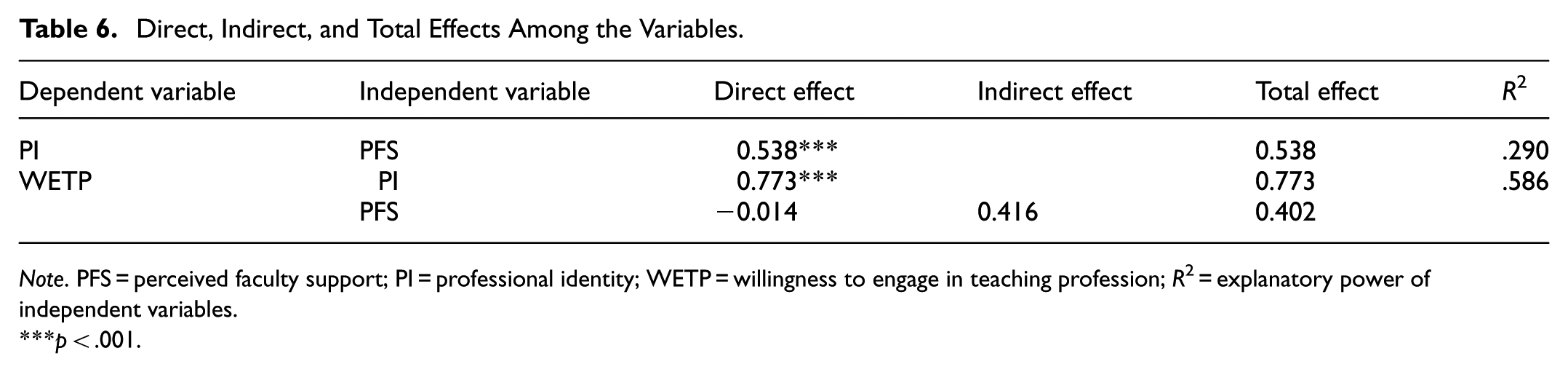
Note. PFS = perceived faculty support; PI = professional identity; WETP = willingness to engage in teaching profession; R2 = explanatory power of independent variables.
p < .001.
Multiple Group Comparisons Based on the Type of Student Teachers
Multiple group comparisons were applied to examine whether there are significant group differences in the interrelationship between faculty support, professional identity, and willingness to engage in teaching profession. The whole sample was divided into PFSTs group and OSTs group. The significances of the chi-square value difference (Δχ2) of the three paths in the research model were examined. Details of group comparisons were shown in Table 7.
Results of Multiple Group Comparisons Based on Types of Student Teachers.

Note. The bold rows indicate the path has significant differences between PFSTs and OSTs. PFS = perceived faculty support; PI = professional identity; WETP = willingness to engage in teaching profession; Diff.abs = absolute difference.
Results indicated that there is a significant group difference in the relationship between perceived faculty support and professional identity. Specifically, the path coefficient of PFSTs is higher than that of OSTs. In other words, compared to OSTs, perceived faculty support has a significant higher impact on PFSTs’ professional identity.
Discussion
The first noteworthy results is that student teachers enrolled in the PFTE program yielded no advantages in academic performance compared to those who didn’t. Conversely, OSTs performs significantly better in academic performance than PFSTs, with higher average scores and fewer failures in compulsory courses. This result may be partly attributed to the fact that OSTs spend more time studying after class. The possible explanation is that the PFSTs were promised with guaranteed jobs after graduation, whereas OSTs would have flexible employment choices accompanying with severe employment stress. Consequently, to win in the fierce job competition in future, OSTs have to invest more effort and time in learning and accumulate better academic performance.
Secondly, the results revealed that the PFSTs participate in teaching skill competitions more frequently and have higher levels of intrinsic value identity, volitional behavior identity, and willingness to engage in teaching profession. Involvement in teaching skill competitions are believed one of the most effective ways to improve preservice teachers’ teaching-related capacities (e.g., expression capacity, adaptability, teaching reflection capacity; Jin et al., 2022; Yue & Pan, 2015). In China, almost all normal universities hold various teaching skills competitions regularly to promote teacher trainees’ learning and practicing. The reasons that PFSTs are required to teaching in their home provinces after graduation may contribute to their participantion in teaching skill competitions. Consequently, this involvement may leads to higher levels of intrinsic value identity and volitional behavior identity of PFSTs, because involvement in some forms of teaching-related activities usually contribute to student teachers’ teaching professional identity arises (Jin et al., 2022; G. Wang et al., 2021). In terms of willingness to engage in teaching profession, our result is in line with Liu and Li (2022), which also confirmed PFSTs have higher levels of willingness to engage in teaching profession. The findings indicated that the PFTE program has a positive effect on promoting student teachers’ decision to participate in teaching career and increasing the supply of elementary and secondary school teachers.
Furthermore, the results also indicated that teacher trainees’ perceived faculty has no direct effect on willingness to engage in teaching profession, but indirectly impacts it through the mediating effects of professional identity. This finding is to some extent consistent with (Rots et al., 2007), which found faculty support has no significant effect on graduates’ of teacher education entrance into teaching profession. However, this study further clarified the impact mechanism of perceived faculty support by introducing the mediating factor, providing empirical evidence to support scholars’ arguments that teacher educators’ support is crucial to student teachers’ training experience (Mäkinen et al., 2018) and their entrance into the teaching profession (Stokking et al., 2003). The influence of teacher educators on student teachers is multidimensional. Teacher educator’s successful teaching contribute to construct students’ teaching identity (Mayer, 1999), while their trust and encouragement tend to help student teachers gain a higher sense of self-worth and enhance professional growth (Izadinia, 2015), which in turn affect their willingness to engage in teaching profession.
Implications
The findings provide some suggestions for the teacher education program. Firstly, the results indicated that the learning focus of PFSTs and OSTs differs. OSTs invest more spare time in learning and perform better in compulsory course, while PFSTs are more active in competition involvement to develop teaching skills. It is necessary for teacher educators to guide student teachers to balance knowledge learning and skill development, as both are key qualities needed by teachers. Secondly, the findings confirm the importance of both forms of faculty support in enhancing willingness to engage in teaching profession. It is crucial for education programs to provide adequate and sufficient support. Finally, the findings highlight a crucial mediating variable in altering faculty support for teaching willingness to engage in teaching profession, that is, the profession identity. However, the mean values of the three dimensions of professional identity are below 4 (ranging from 3.46 to 3.80, with a scale of 5). It is important to enhance professional identity in a positive manner. On the one hand, universities and colleges can organize a variety of teaching-related activities, including multimedia courseware making, teaching plan development, teaching equipment design, teaching skill competitions, to stimulate student teachers’ teaching enthusiasm and promote professional identity. On the other hand, teachers educators should communicate with student teachers frequently and pay more attention to their emotional demands because the emotion aspects are also crucial to identity formation (Deng et al., 2018; Timoštšuk & Ugaste, 2010).
Conclusions
Using a sample of 211 PFSTs and 305 OSTs at two normal universities in China, this study examined the differences in academic performance (e.g., the average score and the failures in compulsory courses), involvement in teaching skill competitions, learning duration outside of class, part time jobs, perceived faculty support, professional identity, and willingness to engage in teaching profession between PFSTs and OSTs. Furthermore, we also examined the interrelationship between perceived faculty support, professional identity, and willingness to engage in teaching profession, and the group differences between these relationships. The results revealed that OSTs invest more spare time in learning and perform better in compulsory course, while PFSTs are more active in teaching skill competition involvement and have higher levels of professional identity and willingness to engage in teaching profession. Additionally, perceived faculty support and professional identity are crucial to enhance student teachers’ willingness to engage in teaching profession. It offers a contribution to understanding the effect of the PFTE program in the context of developing country, and provides important insights for understanding how student teachers’ perception of faculty support impacts their willingness to entrance teaching career. Due to some constraints, this study also has some shortcomings. Firstly, data collection was performed using self-reported measurement, which may exert some subjective bias. To gain deeper insight into the effects of the PFTE program, qualitative approaches should be employed in conjunction with statistical data. Interviews with PFSTs and OSTs about how do they arrange their study schedules and the ways in which their willingness to engage in teaching profession was impacted by faculty support and professional identity could be especially helpful in understanding the differences between these two groups. Secondly, we only examined student teachers’ from several limited educational aspects. There may be some other potential differences (e.g., teaching motivations and perceived professional competence; Tang et al., 2020). Further work could explore the differences between the two groups in other educational aspects. Lastly, our respondents were recruited from two normal universities. Although these universities are highly representative of the six Chinese normal universities hosting the PFTE program, the geographical location and campus cultural atmosphere of different normal universities may impact students’ teachers’ willingness to engage in teaching profession. Future research can test the results of this study with more teacher students from different regions and cultures.
Footnotes
Acknowledgements
The authors would like to thank all the student teachers who participated in the study.

Ethical Considerations
All procedures followed were in accordance with the ethical standards of the responsible committee of human experimentation (institutional and national) and with the Helsinki Declaration of 1975, as revised in 2000. The research project was approved by the academic committee of the author’s institution and complied with ethical standards.
Consent to Participate
Written informed consent was obtained from all the participants for being included in the study.
Funding
The authors disclosed receipt of the following financial support for the research, authorship, and/or publication of this article: This study was supported by the Teaching Reform Research Project of Hunan Province (Grant No. 202502001274) and Hunan Provincial Department of Education Project (Grant No. 24B0689).
Declaration of Conflicting Interests
The authors declared no potential conflicts of interest with respect to the research, authorship, and/or publication of this article.
Data Availability Statement
The datasets generated during and/or analyzed during the current study are available from the corresponding author upon reasonable request.*