




Abstract
Research on populist attitudes and populist leaders’ narratives has largely overlooked what happens to populist attitudes after a populist is elected, especially among the populist’s supporters. Existing literature points to two possible directions of change. On one hand, if populist attitudes stem from a perceived lack of representation, then we would expect people’s populist attitudes to decrease once their preferred candidate is in power. On the other hand, scholars have observed that populist politicians in power continue to deploy populist rhetoric, suggesting that their supporters’ populist attitudes should stay constant or even increase. In this project, the author focuses on Donald Trump and his supporters to explore this mechanism. Drawing on a national survey conducted around the 2016 and 2020 elections, the author shows that Trump’s supporters saw a significant decrease in populist attitudes after he came into power compared with both other American voters and other Republicans. The author also demonstrates that this decrease in populist attitudes is associated with changes in the level of “feeling represented.” On the basis of these findings, the author argues that populist attitudes are driven by feelings of lack of representation over other mechanisms.
Keywords
In recent years, many populist politicians have come into political power in Europe and the Americas (Bonikowski 2016; Noury and Roland 2020). Their electoral victories are often preceded and accompanied by increasing populist attitudes among their electorate, with groups feeling abandoned by those in power and that political elites no longer represent their interests (Stapleton and Dawkins 2022). As a result, populist leaders who promise to change the status quo and claim to truly represent ordinary people can rise in popularity. Although scholars agree that populism can and has been be an effective mobilization strategy to appeal to mass constituencies and gain power (Jansen 2011; Madrid 2008; Roberts and Levitsky 2011), little is known about what happens to the waves of populist attitudes among the discontent voters after those populist politicians are voted into office. Would populist sentiment decrease once their preferred populist leader, whom they believe to represent their interest, is in power? Or does populist rhetoric’s effect burn even brighter once a candidate is mainstream?
Existing research points to two potential directions for changes in populist attitudes following a populist’s victory. One influential tradition in populism studies taps into the relationship between populism and democracy, suggesting that populism as an ideology is focused on representing the will of the people (Kaltwasser 2012). Therefore, populist attitudes rise as a result of a perceived crisis of representation, where certain groups in society feel that their interests are no longer represented by morally corrupt elites. This line of research suggests that if the “crisis of representation” is upended by electing a populist, then populist attitudes among the previously dissatisfied masses should decrease in intensity. On the other hand, theorists who see populism as a political strategy posit that populists will inevitably continue to stoke the fire of populism to maintain their power. Populism in power is recognizable as a permanent electoral campaign (Mazzoleni 2008). Through this lens, antiestablishment rhetoric is essential for newly elected populist leaders, who want to avoid being seen as the new establishment and ensure that they are always the voice of their people. This line of theory suggests that populist attitudes would stay constant or even increase in intensity after a populist leader is elected.
To adjudicate between those two theoretical predictions, in this study I investigate how populist attitudes change after a populist is elected. Examining this relationship between populists in power and the subsequent change in populist attitudes is crucial for understanding if and how populist politicians can stay in power. Populism is known to be an effective political strategy that can mobilize a discontented electorate, but if populist attitudes decline when that electorate gets their desired representation, how do populist parties and movements maintain their momentum? In this study I explore a key mechanism of how populists stay in power (or not) and in doing so build a clearer picture of the drivers behind the populist rhetoric that continues spreading across the political landscape.
In this project, I focus on Donald Trump and his supporters around his electoral victory in 2016. Specifically, I look at whether Trump voters’ populist attitudes changed significantly after Trump’s electoral victory compared with those of other general election voters and other primary election Republican voters. In addition to determining whether there was a change, I explore whether any change is proportional to Trump voters’ feelings that they are represented in politics. If there is indeed a relationship between perceived representation and populist attitudes, then we would expect not only a change after Trump’s election but also that the extent of the change would be proportional to the strength of this perception. Last, I examine what kinds of elite groups—Hollywood elites, academics, business leaders, and others—are linked to any change in populist attitudes. The reason for this step is to assess the scope of populist attitude change; if the change in populist attitudes is truly a result of gaining political representation, we would expect attitudes toward elites beyond the explicitly political sphere to remain relatively unchanged. All of this analysis also serves to establish that American populist attitudes do not follow the thermostatic public opinion model (Wlezien 1995), which holds that survey responses are signals to political elites to adjust their positions in a particular direction, typically away from the dominant view of the party in power. To accomplish all of this, I rely on a national survey set that contains populist attitude measures, with both cross-sectional and longitudinal responses from 2016 to 2020. I find that after Trump was elected, his supporters’ populist attitudes decreased in magnitude, suggesting that having a populist in office—or in other words, having a political representative they agree with—does address voters’ dissatisfaction with the system to some extent. Furthermore, Trump supporters’ antielite sentiment toward other kinds of elites remained mostly constant or even increased in intensity, suggesting that the alleviating effect of Trump’s election did not have a wide impact toward social and cultural elites.
Populism and Its Challenges
Populism’s exact definition is often contested among scholars. This ambiguous word has been used to describe political movements, parties, ideologies, and leaders across various contexts. Following Akkerman, Mudde, and Zaslove (2014), I use a minimal definition that includes only populism’s necessary and sufficient conditions: populism is a thin-centered ideology that considers society to be ultimately separated into two homogeneous and antagonistic groups, “the pure people” versus the “corrupt elite,” and which argues that politics should be an expression of the volonté générale (general will) of the people. (Mudde 2007)
This minimal definition contains two central ideas: a virtuous people who are the rightful owner of the sovereignty and the morally corrupt and detached elites who are running the country for their own special interests, therefore posing as false representatives of the ordinary people.
Although much progress has been made in populism research, the lion’s share has focused on the macro-level, including questions of defining populism, populist movement mobilization, and populist parties’ influence on government and public policy. Less research has been conducted on populist politics at the micro-level, such as measuring populist attitudes among voters (Akkerman et al. 2014; Gidron and Bonikowski 2013). Studying these populist attitudes remains challenging because of a lack of existing datasets that offer sufficiently nuanced questions that meaningfully capture individual-level populist sentiments (Gidron and Bonikowski 2013). In the past decade, many surveys that offer populist attitude measures have appeared, such as Comparative Study of Electoral Systems, the United Nations Development Programme Survey in Chile, and the Hellenic Voter Study in Greece. However, longitudinal data that speak to populist attitudes over time are still a rare find.
Out of the small number of studies of populist attitudes, scholars have relied mostly on self-administered surveys that are designed to measure populist attitudes. Akkerman et al. (2014) measured populist attitudes from a Dutch sample by distinguishing them from pluralist attitudes and elitist attitudes, and Hawkins, Riding, and Mudde (2012) used similar metrics to measure populist attitudes during the 2008 American election. Taking a different approach, Oliver and Rahn (2016) measured populism during the 2016 American presidential election with antiexpertise, antielite, and pronationalist items. On the other hand, researchers such as Levi, Sendroiu, and Hagan (2020) measured populist attitudes in 2016 by extracting relevant items from comprehensive national surveys. Echoing these studies, most extant research measures populist attitudes at only one point in time. Instead, in this study I track the change of populist attitudes at two points in time, providing a temporal story of populism in America and how populist attitudes change in the wake of an electoral success.
Moreover, little research has analyzed how populist attitudes change as a function of external events at the individual level. Frequently, those who study populist attitudes focus on how to measure populism as an attitude (Akkerman et al. 2014; Hawkins et al. 2012; Wettstein et al. 2020) or how populist attitudes are associated with other social phenomena (Levi et al. 2020; Oliver and Rahn 2016), rather than explicitly investigating the causes behind populist attitudes. One exception is Fatke (2019), who found that some personality traits are associated with populist beliefs, although this relationship varies cross-nationally. Overall, this leaves a gap around how changes in structural factors, including electoral outcomes, affect citizens’ populist attitudes. I address that gap by looking at how a populist president’s electoral victory affects his supporters’ populist attitudes.
Resonance between Populist Attitudes and Rhetoric
So how would populist attitudes change after a populist is elected? Literature on populist rhetoric suggests one direction. Theorists who see populism as a political strategy posit that populists will inevitably continue to deploy this rhetoric. Despite the changing position of populist leaders, populism is notoriously chameleonic (Taggart 2000), reacting quickly to new opportunity structures and new enemies of the people. This suggests that attacking political elites is not necessarily the only way for populism to endure; the people whom populists claim to represent are constructed through a particular mode of “othering,” and new enemies can be created to evoke a sense of danger (Wojczewski 2020). While previously attacking the political establishment, a populist leader in power could use populist rhetoric against others who are not “one of us”: often minorities and the political opposition. Some examples of populist leaders’ successfully holding onto power shed light on this mechanism. Examining various trajectories of populist leaders in power, Urbinati (2019) concluded that elected populist leaders “try to remain in a permanent electoral campaign in order to reaffirm their identification with the people and assure the audience they are waging a titanic battle against the entrenched establishment in order to preserve their purity.” The implication is that populists continue dividing society and criticizing dissenters even after they are elected, creating strong feelings of anger among supporters. In addition to othering minorities and dissenters, populists also have an incentive to launch attacks on institutions of horizontal accountability (Levitsky and Loxton 2013), creating more scapegoats for the populist wrath. It is important to note that populists do not need to keep up with the same frequency of rhetoric use as before an election. In fact, there is evidence suggesting that in the United States, incumbent politicians make less use of populist discourse. Bonikowski and Gidron (2016) argued that populists’ discursive strategy varies with their relative strategy in the political field. And Bonikowski, Luo, and Stuhler (2022) provided empirical patterns for this claim. Nevertheless, what is more central to this theoretical prediction is the continuation of populist discourse, the salience of populist frames with the populist’s mainstream position, as well as the concrete populist policies proposed with the candidate’s newfound power. Populist attitudes should not be a simple mechanical reaction to the prevalence of populist rhetoric. Instead, what has been demonstrated in U.S. radical right politics is the resonance between latent attitudes and discursive frames (Bonikowski 2017). And such resonance “is not only a function of the congruence between a frame and the beliefs of its audience, but also of shifting context” (Bonikowski 2017). Populist attitudes have taken hold in the United States, and it can be potentially emboldened by its leader becoming the president, who continues his populist campaign, albeit less frequently, to garner support for his populist policies. In the case of Trump, there is also evidence that populist rhetoric was crucial in his platform after he was elected. Şahin et al. (2021) found that Trump disseminated populist discourse on social media to garner support for his policy making and to bypass formal institutions. These theories suggest that populist attitudes should not decrease in intensity after a populist is elected.
Populist Attitudes and Representation
In the eyes of populist masses and populist leaders, living in a democratic nation does not guarantee representation. Populism instead champions “the people’s voice” as authentic forms of communication between “the people” and “the leader” as genuine, democratic communication (Kitzberger 2009). According to Weyland (2001), populism is “best defined as a political strategy through which a personalistic leader seeks or exercises government power based on direct, unmediated, uninstitutionalized support from large numbers of mostly unorganized followers.” Canovan (2002) point out the tensions inherent in the institutional design of democracy: democracy is about popular participation, but at the same time it requires a complex decision-making system that is often opaque, leading populist actors to experience deep dissatisfaction with representative institutions. Consequently, populists seek to change the status quo with “a claim to legitimacy that rests on the democratic ideology of popular sovereignty and majority rule,” that is, a return to a “true” representation led by “the people” and not by professional political elites (Canovan 2002). But who are “the people”? This category is a product of populist politics drawing boundaries between “us” and “them” (Filc 2009), simultaneously excluding and including specific groups of people.
Hence, through this lens on populism, a crisis of representation arises when citizens perceive their political establishment as detached, out of touch, and not “one of us.” Moffitt and Tormey (2014) argued that this crisis of representative democracy is evident in low voter turnout, party membership, trust in politicians, and interest in politics in most advanced democracies. One mechanism behind this crisis is that “those who are elected to represent them come to appear less as representatives and more as ‘politicians’; less like one of ‘us,’ and more as one of ‘them,’ part of the governing apparatus” (Moffitt and Tormey 2014). Instead of democracy’s professional bureaucrats and representative institutions, the type of representation that populist actors seek is a charismatic leader whom they see as one of their own.
The charismatic leader’s important role in populist movements’ pursuit of true representation highlights a crucial question: does the electoral victory of such a populist leader diminish the populist sentiment among previously disaffected citizens? The aim of this study is to answer this question. In addition, it is important to distinguish if the change in populist attitudes, if any, is a result of political representation, or simply a reflection of the thermostatic change in public opinion. The thermostatic public opinion model, first formulated by Wlezien (1995), regards change in public opinion as thermostatic shifts that are relative to prevailing political contexts and elite action. When respondents say that they are concerned in a survey, they are essentially saying that politicians in charge are not concerned enough. One example of thermostatic public opinion would be that when Democrats are in power, the public reports that we are too lax on immigration and that taxes are too high, an inference requiring only a basic understanding of ideological differences about partisan politics. On the other hand, populist attitudinal shift as a result of changing political representation should not simply respond to partisan signals. Rather, it should correspond closely to the populist candidate themselves, and how much the public perceives this candidate to represent their true interest. In this study, I measure the perception of representation in two ways: vote choices and approval attitudes. Although these are not perfect measures of the perception of representation, it is reasonable to assume that citizens who vote for and/or highly approve of a populist candidate are very likely to view this person as their true representative.
Research Hypotheses
In this study, I explore if there is truly a decrease in populist attitudes among the populist’s supporters once they are in power, and if such a decrease is simply a result of partisan preference. To strengthen the test of this mechanism, I also look at whether the decrease in populist attitudes is proportional to the feeling of representation itself. To further test the limits of any decrease in populism, I examine whether attitudes toward other elite groups change as well.
Together, the two theoretical predictions about the relationship between electing a populist leader and populist attitudes generate the following hypotheses.
Hypothesis 1a: After a populist candidate gains power, respondents who voted for the candidate will not exhibit a greater decrease in populism compared with respondents who did not vote for the populist candidate (populist rhetoric resonance hypothesis).
Hypothesis 1b: After a populist candidate gains power, respondents who voted for the candidate will exhibit a greater decrease in populism compared with respondents who did not vote for the populist candidate (political representation hypothesis).
It is important to distinguish populist preference from partisan preference. In this study’s case, partisan preference refers to voters’ preferring their own party’s candidates, while populist preference refers to populist voters’ preferring a populist candidate of their choice. Although similar in that voters are more likely to report improved sentiment if their own partisan or favorite populist candidate is elected, populist voters should in theory react more strongly to their preferred populist leader getting elected, compared with another candidate who shares the same partisan identity but is not seen as the true representative of “the people.” For instance, Trump supporters would react more strongly to Trump’s being elected as opposed to Jeb Bush. Observational data from the general election can confound those two effects, as only one candidate from each party runs in the U.S. presidential election. However, data from the primary elections can help address this issue, allowing comparison between primary support for a populist candidate versus other candidates from the same party. As such, the following hypothesis distinguishes the “populist effect” from the “partisan effect”:
Hypothesis 2: After a populist candidate gains power, respondents who supported the candidate early on will exhibit a greater decrease in populism compared with copartisans who switched from mainstream candidates to the populist candidate (early supporter hypothesis).
If representation drives the change in populist attitudes, then the opposite pattern should also be observed: supporters of a failed populist candidate should not exhibit a decrease in populist attitudes the same way with a successful populist. In my case, this situation applies to Bernie Sanders’s 2016 campaign. Although Sanders’s platform differs wildly from Trump’s, Sanders is also a populist candidate (Staufer 2021), one who ultimately failed to secure electoral victory. Examining Sanders’s campaign and voters’ reactions will test the following hypothesis:
Hypothesis 3: After a populist candidate fails to gain power, respondents who voted for the candidate will not exhibit a decrease in populism (failed populist hypothesis).
Additionally, the feeling of representation is not uniformly distributed among all Trump supporters. I argue that people who approve of Trump more strongly will also feel more represented by him. The reason is that if respondents do not approve of Trump as the president despite voting for him in the first place, they are more likely to have reservations or to vote strategically, as opposed to respondents who approve highly of Trump as the president. Therefore, I propose the following:
Hypothesis 4: After a populist candidate gains power, respondents who voted for the candidate in the election and highly approve of the candidate once in office will exhibit a greater decrease in populism compared with populist candidate voters who voted for the candidate in the election but exhibit lower levels of approval for the candidate once in office (approval hypothesis).
Finally, it is important to recognize that the hypothesized populist mechanism of political representation should only affect parts of the broader populist movement. People might become less likely to believe that society is run by corrupt elites in general once their preferred populist leader is in charge, but certain domain-specific antielite attitudes should be less influenced by a populist politician coming into power, such as resentment toward Hollywood elites and academics. This resentment may in fact be stoked by the newly elected populist leader. Therefore, I hypothesize as follows:
Hypothesis 5: After a populist candidate gains power, respondents who voted for the candidate will not see a significant decline in their antielite sentiment toward domain-specific elite groups (antielite hypothesis).
Establishing support for these hypotheses should paint a clearer picture of what happens to a populist wave after a populist gets in office.
Donald Trump the Populist
In this study, I focus on Donald Trump’s 2016 election and his supporters. Donald Trump is a prominent populist leader in recent American politics who secured an electoral victory. Research shows that Trump’s 2016 campaign is truly a populist story, as shown by his campaign rhetoric, public opinion, and partisan conflict (Oliver and Rahn 2016). Trump is also a clear example of a populist who made a big promise to deliver “true” representation. This is evident in the way his electoral victory is interpreted as “taking the country back,” as if the people had not been represented before the populist leader was elected (Urbinati 2019). Additionally, Trump campaigned heavily on the promise to “drain the swamp,” which specifically targets the political establishment in Washington, D.C. This raises the question: how do Trump supporters perceive political elites once he is in Washington? All of these features of the Trump 2016 campaign and the populist movement surrounding it make it an appropriate case study for my hypotheses.
Data and Methods
I rely on novel survey data from a YouGov online survey on American nationalism fielded by Bonikowski, Feinstein, and Bock (2021). The survey was conducted in two waves, one right before the 2016 presidential election and the other right before the 2020 presidential election. In both waves, a set of key questions relevant to this analysis were asked in identical ways. The 2016 survey (n = 900) and the 2020 survey (n = 1,000) were matched to a sampling frame on gender, age, race, and education on the basis of the full 2018 American Community Survey. In addition to the two cross-sectional waves, a portion of the 2016 respondents (n = 441) were recontacted and provided the answers to the 2020 survey, providing a longitudinal component in this dataset.
These data presents certain advantages. First, unlike many previous populism studies that construct a populist attitude measure from survey questions not designed for tapping into populism (Levi et al. 2020), these surveys contain questions that are specifically designed for measuring populism on the basis of the previous literature (Oliver and Rahn 2016). Second, because of the dataset’s panel component, I can track individuals across time and get more reliable measures on their change of populist attitudes.
Dependent Variables
Following Oliver and Rahn (2016), the key outcome, populist attitude, is measured by how much respondents agree or disagree with general statements regarding antielitism and people centrism, including “It doesn’t really matter who you vote for because the rich control both political parties”; “The system is stacked against people like me”; “The American people should have more control over politics”; and “The interests of elites are in conflict with the interests of the people.” All the answers to these questions range from “strongly disagree” to “strongly agree” on a five-point, Likert-type scale. Respondents who did not provide an answer to any of those questions were excluded. Four populism questions from Oliver and Rahn (2016) also tap into the mistrust of scientific elites. In this study, I choose to not engage with those questions, because people’s responses to those questions are heavily influenced by the coronavirus disease 2019 pandemic in the 2020 wave, which is analytically distinct from populism.
The answer to each populism question is given a score on the basis of level of agreement with the populist statement, with higher scores for greater levels of agreement. The overall populist score is the standardized sum of the score for each question. Cronbach’s α coefficients for this populism score are 0.75 and 0.70 for the 2016 and 2020 waves, respectively, suggesting that those items are relatively cohesive as a concept. Given the fact that populism as a concept is a thin-centered ideology, I argue that this level of coherence is sufficient for the purpose of the study. The descriptive statistics for the populism scale can be found in Table 1.
Descriptive Statistics: Mean Populism Score across Groups.

Note: Values in parentheses are standard deviations.
It is true that populism as a phenomenon goes beyond what those questions tap into. To be precise, those four questions measure the political dimension of populism, for which the core is about how average people feel disenfranchised by the political elites in the country. This data choice is due to the limitation in data availability, as populist attitudes have been under-measured in traditional surveys. To make up for this, I also analyze data on domain-specific antielite sentiment, which taps into wider dimensions of populism.
In addition to measuring populist attitudes as the dependent variable, I also measure domain-specific antielite attitudes. This is to examine whether changes in populist attitudes—attitudes toward general concepts such as the people and the rich—are also seen in attitudes toward specific elite groups (Hollywood elites, intellectuals, etc.). In this dataset, a series of questions were asked regarding specific elite groups. Respondents were asked if they think a specific elite group “help or harm society,” and the answer options include “help,” “harm,” and “neither help nor harm.” I code the answer “harm society” as having negative attitudes toward that specific elite group. The descriptive statistics for antielite scores can be found in Table 2.
Descriptive Statistics for Domain-Specific Antielite Sentiment.

Independent Variables
The key independent variables are proxies for respondents’ perceptions of political representation. First and foremost, whether someone voted for Trump in 2016 is an important factor of their feeling of being represented or not, and this is measured using the question “(which) candidate R would vote for in the 2016 presidential election” in the 2016 wave and the question “Who did you vote for in the 2016 presidential election” in the 2020 wave. Although inconsistent recall in surveys can lead to measurement error, cross-national survey validations have proved that in the case of vote choice recall, the overall effects are limited (Dassonneville and Hooghe 2017). In the study’s dataset, of the 148 panel respondents who voted for Trump in the 2016 survey wave, 144 (97 percent) correctly recalled their vote choice in the 2020 survey wave. This suggests that the recall inconsistency bias in this study is minimal. Additionally, I compare people who voted for Trump with Republicans who voted for other candidates in the primaries, as determined by the question “(which) candidate R voted for in the 2016 Republican primary election.” To measure the different extent of feelings of representation, I use respondents’ approval of Trump in 2020, measured by “Do you dis/approve of President Trump,” with answers ranging from “strongly disapprove” to “strongly approve” on a four-point, Likert-type scale. I recode the variable so that “strongly approve” has the highest numerical score.
Control Variables
Following Hawkins et al. (2012), who identified individual-level factors that influence populist attitudes significantly, I identify a set of relevant covariates that are applicable to my current dataset. This includes the respondents’ race (Black, white [contrast category], Asian, Hispanic, Native American, mixed, and other), age (calculated from birth year), gender (1 = female), family income (a categorical variable, ranging from <$10,000 to ≥$500,000), and education level (a categorical variable, ranging from no high school to postgraduate). The descriptive table of control variables can be found in the Appendix.
Methods
To see if Trump voters experience a change in their populist attitudes after his election and presidency, I use a pooled ordinary least squares (OLS) approach that takes account of two cross-sectional samples. According to Wooldridge (2001), a pooled OLS model can be summarized as follows:

In my case, the pooled OLS model will include the populism score as the dependent variable and whether one voted for Trump in 2016 (binary) as the independent variable. Following Hawkins et al. (2012), who extensively studied the individual-level factors that contribute to populist attitudinal tendencies, I include the respondent’s race, education level, gender, age and income as control variables in my model:
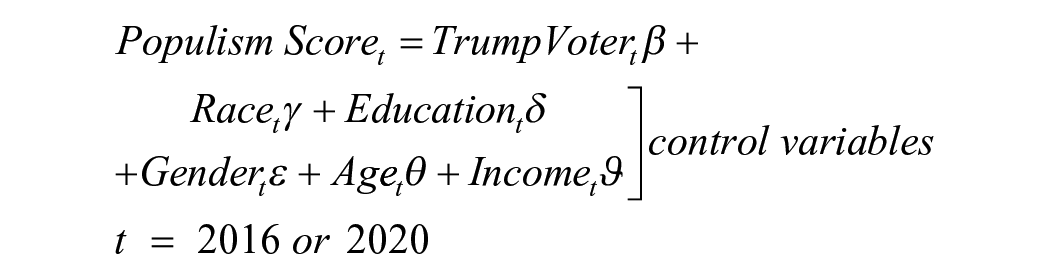
Both whether someone was a Trump voter (Trump voter/binary) and in which wave their populist attitude was measured (t) are important variables in this question. By estimating their effects on a respondent’s populist attitude level, I can approximate the change of Trump supporters’ populist attitudes compared with those of all other respondents.
By using a pooled model, I leverage more statistical power from the larger sample size of the cross-sectional sample, compared with the panel sample from this dataset. However, many variables central to my subsequent analysis are not collected in both survey waves, including respondents’ 2016 primary vote choice and approval of the president. In those cases, I leverage the panel sample, tracking the same individuals over time to analyze their change across two waves. Therefore, as a second step to distinguish the representation effect of a populist candidate versus just a partisan candidate, I apply change-score models on the panel data component to compare primary Trump voters with Republican voters who voted for other candidates. The change score refers to the change or difference of the outcome value over time:

Or, in other words, it means:

In my model, the change score will be the dependent variable, and whether someone voted for Trump or not in 2016 presidential primaries is the independent variable. Similar to the aforementioned pooled model, control variables include race, education level, gender, age and income:

Change scores are central to the analysis of panel data, with the goal of most analyses being to model how changes in the outcome variable are related to levels or changes in independent variables over time (Lewis-Beck, Bryman, and Liao 2004). With data from two points in time, I am able to leverage change score in my model to measure how populist attitudes’ change vary among different voter groups. Finally, to examine the relationship between approval measures and respondents’ change in populism, I also use a change score analysis model to explore the effect of various approval measures on change in populist attitudes. A change-score model is also run on antielite sentiments to test out the relationship between representation and specific elite groups.
Results
Modeling Change in Populism
Figure 1 shows the prediction of a pooled OLS regression comparing Trump voters and everyone else in the sample, controlling for key covariates that influence individual populist attitudes (Hawkins et al. 2012). More detailed results from the full regression model can be found in Appendix Table 2, including the coefficients used to generate the plot. The results show that, non–Trump voters have become more populist compared with their level in 2016, by about half a point on the populism scale. Second, those who voted for Trump in 2016 are on average slightly less populist in 2020 compared with their level in 2016, by about a fourth of point on the populism scale. 1 This lends support to hypothesis 1b (political representation hypothesis), that populist candidate voters see a larger decrease in populism compared with others once a populist candidate is elected. In this case, Trump supporters saw a small decrease in their populist attitudes, while others actually saw an increase, which suggests that the former decrease goes against the overall national trend. I have also conducted sensitivity analysis, repeating the same model four times while dropping one question out of the populism scale each time, and the results show that this effect is not driven by any single question. The details can be found in Appendix Table 8.
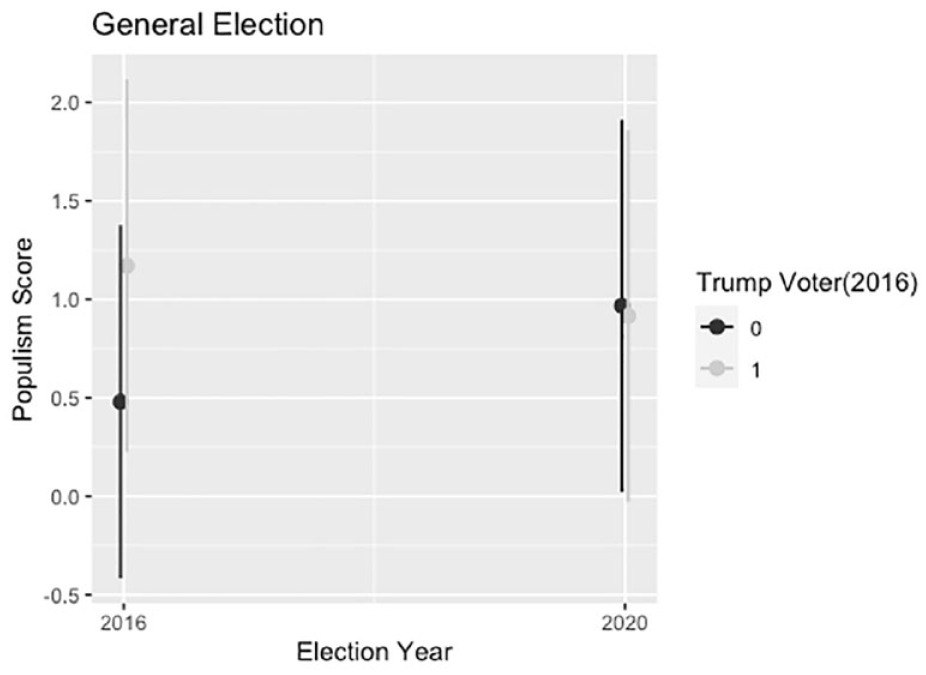
Populism attitudes score for Trump voters versus everyone else.
Isolating Populism from Partisanship
Results illustrated in Figure 2 distinguish the partisan effect from the populist effect. To understand if the decrease in populism among Trump supporters is a result of Trump’s holding office rather than a result of simply having a Republican in office, I conducted a change score analysis on a panel sample (n = 143) to compare Republicans who voted for Trump in the primaries with those who did not. The results show that people who voted for Trump had a much larger decrease in populism compared with people who voted for other Republican candidates, by 1.50 standard deviations. This supports hypothesis 2 (early supporter hypothesis), suggesting that having a preferred populist candidate in office has an effect on people’s populism distinct from pure partisan attitudes.
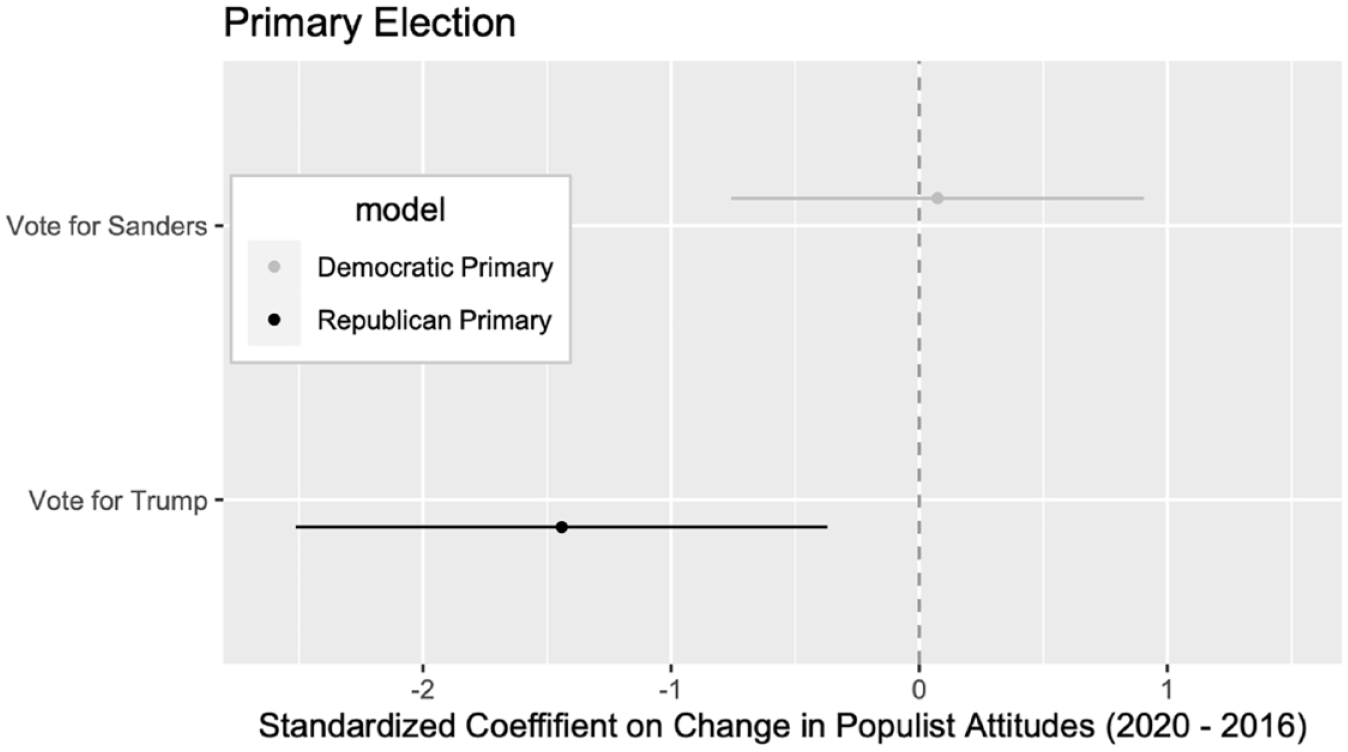
Coefficients of primary vote choice on the change in populism attitudes score (2020 − 2016), compared against their own partisan voters.
To test hypothesis 3 regarding failed populist candidates, I also compared respondents who voted for Bernie Sanders in the 2016 primaries versus other Democratic voters. The results show that although Sanders is also a populist candidate (Staufer 2021), his supporters did not show a significant change in their populist attitudes compared with their partisan voters after Sanders did not secure an electoral victory, which supports hypothesis 3. Those two findings suggest that both supporting a populist candidate—not just any partisan candidate—and this candidate’s succession into power are integral to the decrease in populist attitudes observed in Figure 2.
Similarly, I conducted sensitivity analysis, repeating the same model four times while dropping one question out of the populism scale each time, and the results show that this effect is not driven by any single question. The details can be found in Appendix Table 8.
Approval as an Indicator of Representation
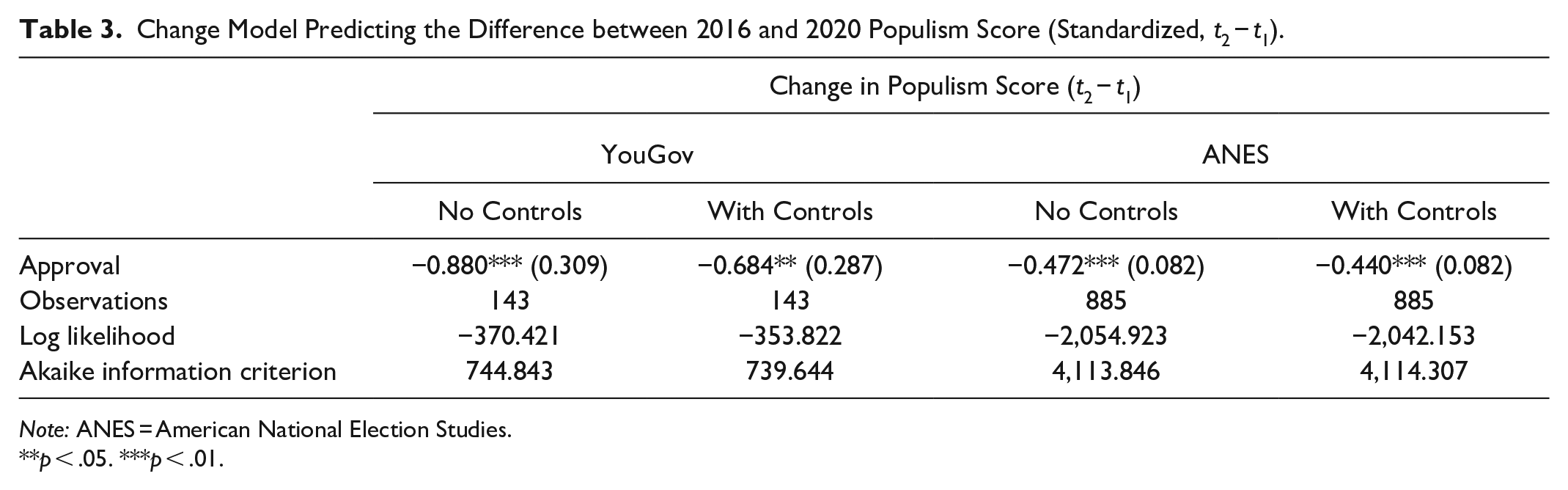
If the feeling of lack of representation is behind populist attitudes, we should also expect hypothesis 4 to hold; the stronger the feeling of representation, operationalized as approval of the incumbent president, the steeper their populist attitudes’ decline should be. Approval of the incumbent president, which in this dataset is measured at the end of Trump’s four-year term, helps capture whether respondents are satisfied with his presidency. A 2016 Trump voter who is more satisfied with his presidency is more likely to regard his administration as “true” representation compared with one who is less satisfied. In other words, I expect that the association between feelings of representation, as approximated by approval numbers, and populist attitudes should not only hold up when the former is measured as a categorical variable; the relationship should also be supported when this feeling is measured as a continuous variable. I ran a change-score model to test this hypothesis, with change in populism over time as the dependent variable and level of approval as the independent variable. The result of the model, displayed in Table 3, shows support for this hypothesis: those who approve more highly of Trump have a greater decrease in populist attitudes.
Change Model Predicting the Difference between 2016 and 2020 Populism Score (Standardized, t2 − t1).
Note: ANES = American National Election Studies.
p < .05. ***p < .01.
As this model is run on a small set of panel data, I further validate this conclusion by replicating the model on a larger dataset. Using American National Election Studies 2016 and 2020 time-series studies and their panel sample component, I find similar results (shown in Table 3; full regression results can be found in Appendix Table 1). Although the coefficients’ absolute values differ between the YouGov and American National Election Studies data models, the numerical value itself is not directly comparable, because the populism measures’ scale differs between the two datasets. Nevertheless, the fact that the significant relationship still holds when the same analysis is repeated on a larger dataset lends additional support for hypothesis 4 (approval hypothesis).
Domain-Specific Antielite Sentiment
To further test the relationship between Trump assuming office and populist attitudes, it is also helpful to look at more specific components of populism. Antielite sentiment is one dimension of populism but relatively analytically distinct (Akkerman et al. 2014; Aslanidis 2016; Gidron and Bonikowski 2013). My argument predicts that populist supporters will become less populist after gaining desired political representation. To be more specific about the mechanism, securing political representation should not affect their attitudes toward elites other than the populist leader, as their resentment toward other elites (e.g., scientists, Hollywood liberals) is not directly related to electoral representation. Although populist attitudes are measured through general items such as “the interests of elites are stacked against mine,” domain-specific antielite sentiment measures can get at the difference between attitudes toward groups associated with the populist leaders and those that are not.
To see how Trump’s election and administration have changed antielite attitudes among his supporters, I ran a change-score model comparing Trump-voting Republicans to non-Trump-voting Republicans. From Figure 3 we can see that there is no significant difference between Trump supporters and others in a variety of domain-specific antielite attitudes, including attitudes toward civil servants, bank CEOs, journalists, academics, and Hollywood elites. This confirms that a populist in power does not affect supporters’ resentment toward elite groups who are not associated with the populist leader. It also disconfirms the hypothesis that a populist leader will successfully exacerbate grievances against elites to keep the base mobilized. Notably, Trump supporters’ attitudes toward business leaders decreased significantly, compared with non–Trump supporters. This is probably because Trump has constantly branded himself as a successful businessman. Populist movements revolve around a charismatic leader, in this case Donald Trump, so supporters could develop more positive attitudes toward a particular elite group associated with Trump, supporting hypothesis 5 (antielite hypothesis).
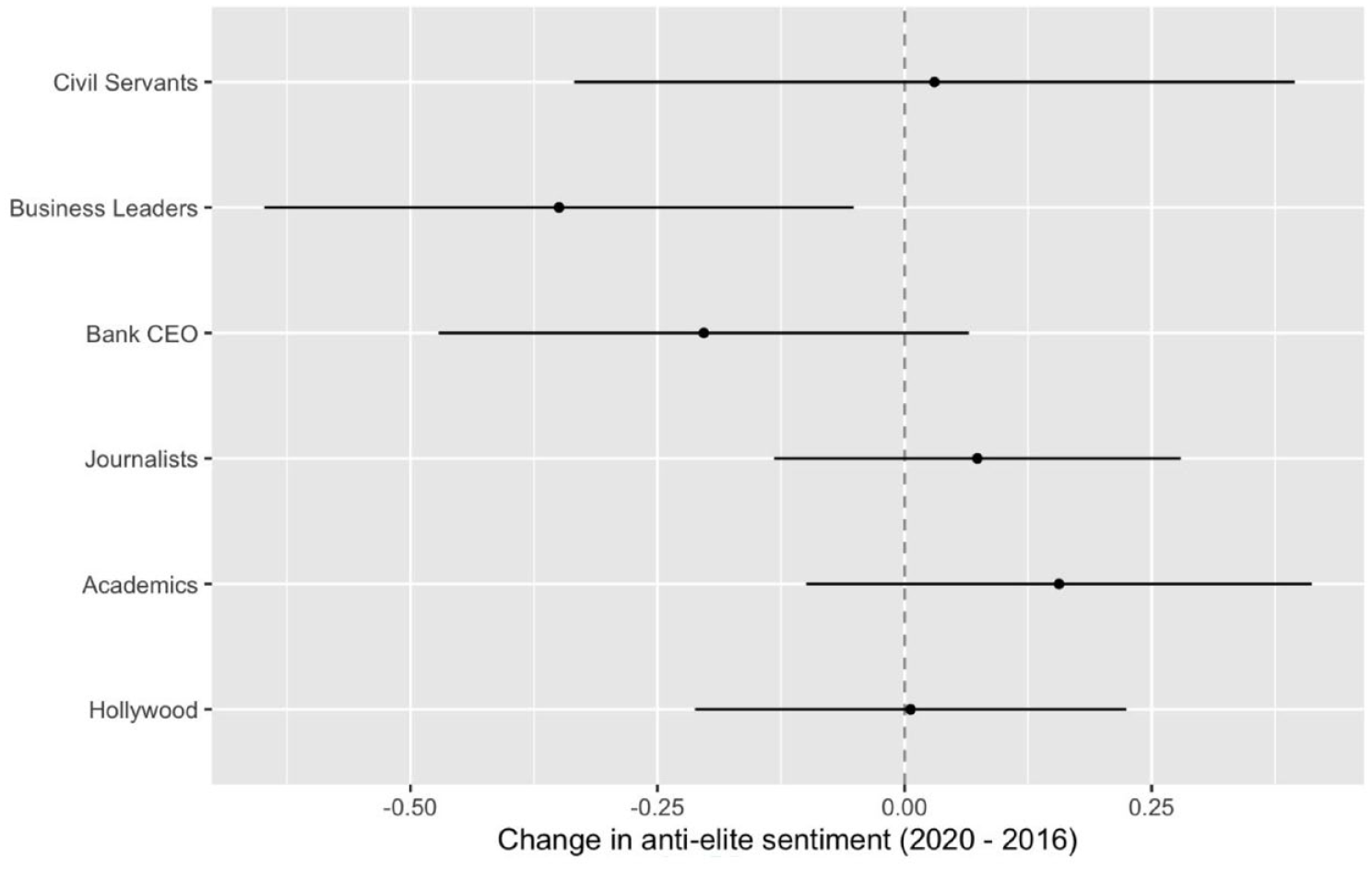
Change in domain-specific antielite sentiment for primary election Trump voters compared with other Republicans.
All in all, this finding suggests that the decrease in populist attitudes after Trump’s election is limited in scope: his supporters did not become less populist regarding cultural elites or the government rank and file. At the same time, Trump’s efforts to demonize journalists, mainstream media, and the “deep state” do not appear to have increased his followers’ substantial disaffection with those groups. It also further supports the hypothesis that the decrease in overall populist attitudes from 2016 to 2020 is due at least partially to changing political representation and not simply a result of time passing, as Trump supporters’ attitudes toward elite groups that are not associated with electoral representation or Trump remained relatively constant.
International Populists in Power
Although this study is focused on Donald Trump and the American populism case, I also argue that the implications of this study go beyond the American border. This study lends support to the finding that supporters of the ruling populist party do not demonstrate high levels of discontent of the status quo in the case of Türkiye (Aytaç, Çarkoğlu, and Elçi 2021). It also helps illustrate the cases in Western Europe, where populist parties that mobilize solely on the basis of political elitism and corruption see less success compared with those who mobilize on the basis of anti-immigration platforms (Ivarsflaten 2008). Supporters of elected populists experience decreased level of political populism because their preferred party is the elite now, but anti-immigration sentiment is not likely to dissipate because of change in political representation, therefore continuing to fuel populist support.
In turn, the studies of other populist leaders make up for the limitations of this study. If populist attitudes decrease in intensity after a populist is elected, then how do we understand the many cases of populist leaders being in power for decades? The work on contemporary Türkiye gives helpful insight. Balta, Kaltwasser, and Yagci (2022) found that although supporters of the ruling populist party (AKP) are less likely than everyone else to hold populist sentiments, they make it up by endorsing conspiracy theories that villainize foreign powers. This helps explain how the party can stay in power for so long: instead of fueling antagonism toward political elites, the populist party mobilizes hatred toward conspiratorial global forces. Additionally, Aytaç et al. (2021) provided evidence that instead of relying on sentiments of discontent, populists in power emphasize on popular sovereignty and work tirelessly to erode institutions of horizontal accountability. In other words, instead of relying on the wrath of the crowd, which has been appeased somewhat after getting their guy, the populist leaders can also make populist policies and decisions to weaken checks and balances in order to stay in power, as we have also seen in the almost successful attempt of Trump’s election denial and call for storming the Capitol.
Discussion and Conclusion
With a novel survey dataset, I was able to measure populist attitudes among the American electorate after an influential election. First of all, compared with other studies that also measure populist attitudes, this study uses a module specifically designed to measure populist attitudes on the basis of previous research. Second, I was able to measure populist attitudes across time and analyze how a populist in power—Trump serving as the 45th U.S. president—affects populist attitudes among his supporters. This allowed me to answer my central substantive question: do disaffected populist voters become less populist once they have “got their guy” in office? And relatedly, do populist attitudes stem from feeling a lack of representation, implying a change in presidency would lead previously populist voters to decrease their populist sentiment? Or are voters constantly susceptible to populist rhetoric despite changing political landscapes and we should expect no major changes in populist attitudes after a populist comes to power?
My results show that populist attitudes did decrease in intensity among Trump supporters after Trump was elected to office in 2016. This decrease is first and foremost highly salient compared with all other voters in the sample and still significant even compared with other non-Trump-voting Republicans. This further supports the idea that this decrease is not simply because of partisan preference, that is, voters’ being less disaffected because their preferred party is in control of the presidential office. Rather, there is something distinct about Trump the populist gaining power, which made the decrease in populist attitudes even steeper compared with other Republicans. To further examine the relationship between representation and populist attitudes, I tested and found that the decrease in populist attitudes is proportional to the positive feeling of representation: the more someone approved of Trump—more likely to view him as truly representative—the steeper the decline in populism they experience after his presidency. This finding further supports the association between perceived representation and populist attitudes. Finally, I note that this decrease in populist attitudes does not cover every single aspect of the populist movement. To demonstrate this, I analyzed and found that domain-specific antielite sentiment did not significantly change after Trump’s presidency. A notable exception was “business leaders,” an elite group arguably associated with Trump himself. This finding suggests that the decrease in populism is limited in scope, as the populist supporters are still similarly antagonistic toward cultural and intellectual elites, as well as government rank and file. Additionally, this in turn suggests that changing political representation is a driver behind the observed decrease in populism.
This study faces some limitations. Because of the lack of data following the 2020 presidential election, it is difficult to ascertain exactly what happened to Trump supporters’ populist attitudes after he lost the election, meaning that it was not possible to explore the flip side: how the loss of representation affects populist attitudes. The fact that the data were collected for two waves and were four years apart also poses a challenge for a clean causal analysis. I conduct four separate analyses to provide evidence for my proposed mechanism, but readers should be careful when drawing absolute causal conclusions from this study.
Given the results presented herein and the fact that they are based solely on two points in time, one might question if the observed change is just thermostatic. As discussed in earlier sections, the thermostatic public opinion model posits that public attitudes shift on the basis of prevailing political contexts. In this case, it would mean that populist attitude is just a variant of partisan sentiment: Democratic voters become less populist when Democrats hold office, and Republican voters become less populist when Republicans hold office. In a similar logic, some might expect that it is “natural” that Republicans will become less populist when a Republican is in office simply because the voters like their partisan candidate. I counter those viewpoints by pointing out two observations: the populist attitude changes for primary election voters and the change in antielite attitudes.
First of all, as we can see from the bottom panel in Figure 1, the change for the respondents who reported voting for Trump in the primary is significantly different from those who voted for other Republicans. If the thermostatic claim were correct, then we would expect that Republican voters would all express decreased populist attitudes to a similar degree. Instead, we see that early Trump supporters distinctly vary from the rest of the Republican base, with primary Trump voters having almost 1.5-point (out of a maximum of 8 points) more of a drop in the populist attitude index. This significant difference cannot be explained by the thermostatic partisan mechanism alone. Instead, something about Trump the populist candidate ticked the scale even further for voters who stood with him from the beginning of the 2016 election.
Additionally, the domain-specific antielitism data show that the thermostatic thesis does not fully explain what is seen here. In Figure 2 we see that many attitudes toward specific elite groups remain unchanged, or at least the change is statistically insignificant. Antielitism is an integral part of populism (Bonikowski 2016; Castanho Silva, Vegetti, and Littvay 2017; Oliver and Rahn 2016). If the thermostatic factor is the only thing at play here, then we should see that antielite sentiment decreases across the board. If the story of populist attitudes is only “Republicans prefer Republicans,” then it is quite counterintuitive that Trump voters did not resent civil servants significantly less, especially knowing that after the 2016 election, Republicans controlled the White House, the House of Representatives, and the Senate.
Last, there is no reason to assume that populist attitudes will “naturally” be thermostatic. To the best of the author’s knowledge, there is no existing literature that shows populist attitudes reflect a thermostatic trend that is similar to presidential approval rating. In fact, the items used to measure populist attitudes mostly pertain to only abstract groups or concepts such as “the elites”, “the people,” “the rich,” or “the system.” The questions do not indicate any candidate or partisan support at all. Therefore, there is no reason to assume that populist attitudes should be thermostatic like the presidential rating.
These lines of evidence support my argument that reactions to a populist rising to power are fueled by a mechanism distinct from just thermostatic or partisan attitudinal shifts. The fact that this study finds that the majority of Republicans have decreased in their populist attitudes, that early Trump supporters have even steeper declines, and that Democrats become more populist after Trump’s ascension into power are all contributions to a previously scant literature regarding populist attitudes and other thermostatic political attitudes.
Beyond assessing the thermostatic claim, this study contributes to the literature in several ways. First, this study adjudicates between two directions pointed to by current literature regarding what could happen to people’s populist attitudes after a populist is in power. This study finds that, at least in the context of contemporary U.S. politics, it is more likely that populist attitudes will decrease in intensity if previously populist voters have their preferred populist candidate in office. This finding suggests that, at least in the context of contemporary U.S. politics, voters’ populist attitudes are influenced by a change in political representation—and perhaps to a greater extent than opposing mechanisms, such as the constant populist rhetoric employed by the leaders and others.
This study also contributes to the literature on populism by offering another case study of populist politics at the micro-level, which is often overlooked and overshadowed by macro-level populist politics such as populist rhetoric, populist parties, and their influence on government and policy. I argue that the micro-level of populist politics can be just as important as the macro-level, seeing that the micro-level populism (populist attitudes) can evolve independent of macro-level populism (populist rhetoric).
Finally, it is also important to note that although those hypotheses are supported, I am in no way suggesting that electing a populist could provide any “solution” to a divided society by appeasing the disaffected populist crowd. It should be obvious to us through incidents such as the Capitol riot of January 6, 2021, that the deep-seated anger and antagonism inside many populist Americans does not just magically disappear after they “get their guy.” Even during Trump’s presidency, the fact that his supporters’ populist attitudes decreased is not necessarily beneficial for democratic societies. Scholars have cautioned that populist movements are not a cure to ailing democracies, as populist actors themselves like to believe. Past research (Kaltwasser 2012; Levitsky and Loxton 2013) suggests that because populists are usually outsiders who have no appreciation for the institutions of representative democracy, and they believe that they have received a mandate from the people to fight the political establishment, they often stand in opposition to the legislature, bureaucracy, and the courts and therefore have a strong incentive to weaken these representative institutions. Overall, this study tackles only a small piece of a big puzzle, and more scholarship is needed to study populist attitudes in relation to other consequential pieces, whether populist rhetoric, democratic institutions, or populists’ electoral failures.
Supplemental Material
sj-docx-1-srd-10.1177_23780231241234638 – Supplemental material for We Got Our Guy!: Populist Attitudes after Populists Gain Power
Supplemental material, sj-docx-1-srd-10.1177_23780231241234638 for We Got Our Guy!: Populist Attitudes after Populists Gain Power by Yuchen Luo in Socius
Footnotes
Acknowledgements
I am grateful for valuable feedback from Carly Knight, Paul DiMaggio, Bart Bonikowski, Siwei Cheng, Claire Sieffert, and audience members at the New York University Reading and Writing Seminar and the Political Sociology Roundtable at the American Sociological Association annual meeting.
Author’s Note
The author alone contributed to the conceptualization, design, and execution of the study, as well as to the cleaning and analysis of the data. The author is permitted to use the nationalism dataset collected by Bart Bonikowski and Yuval Feinstein.

Data Availability Statement
Supplemental Material
Supplemental material for this article is available online.
Notes
Author Biography
References
Supplementary Material
Please find the following supplemental material available below.
For Open Access articles published under a Creative Commons License, all supplemental material carries the same license as the article it is associated with.
For non-Open Access articles published, all supplemental material carries a non-exclusive license, and permission requests for re-use of supplemental material or any part of supplemental material shall be sent directly to the copyright owner as specified in the copyright notice associated with the article.
