




Abstract
Children have been assumed to share their father’s subjective social status (SSS) because fathers tend to occupy the highest socioeconomic status in a family. The progress of women in education and their increased contribution to the family economy cast doubt on this assumption, but limited data availability has hindered research on children’s SSS. Utilizing the 2005–2021 Korea Labor and Income Panel Study, this study examines whether children’s SSS is influenced by family settings that deviate from traditional gender norms. The results show that children tend to share the same SSS with their parents, but their SSS varies depending on the family settings. Children of educationally homogamous parents express higher SSS than children of educationally hypergamous or hypogamous parents net of family socioeconomic backgrounds. Also, children of the sole male breadwinner tend to have higher SSS than children of co-breadwinners. These results imply that on top of gender discrimination in labor markets, women whose social status is higher than that of their partners face an additional challenge in the family: Their children’s SSS is lower than that of the traditional male breadwinner families.
As more women pursue higher education and establish careers, there has been a noticeable shift in household demographics (Van Bavel, Schwartz, and Esteve 2018). A rising number of children are born to college-educated mothers who are actively engaged in the workforce. This shift in family dynamics, with mothers achieving educational and labor market parity with fathers, has prompted extensive discussions to understand its implications for their children, particularly concerning their well-being (Kalmijn and Monden 2012; Rauscher 2020). One important research topic is the impact of both parents’ social status on children’s subjective social status (SSS), which refers to an individual’s perception of their social standing within the socioeconomic hierarchy (Jackman and Jackman 1973). Existing literature suggests that as early as first grade, children possess the ability to self-locate within a larger hierarchical system (Vandebroeck 2021), and their SSS serves as a determinant of their well-being, such as self-rated health and behavioral problems (Amir et al. 2019; Goodman et al. 2015; Roy, Isaia, and Li-Grining 2019). Despite this, little research has examined how family settings that deviate from the traditional gender norms affect children’s SSS. This study aims to fill this gap.
The family, as a primary agent of socialization, plays a crucial role in shaping children’s perceptions of their own social standing (Lareau 2011). Traditionally, the family has been viewed as a unit of social stratification, with all members assumed to occupy the same position in the social hierarchy (Sørensen 1994). Children are assumed to share the SSS of their parents’, borrowing status from the male head of the household (Wright 1989). The economic status of the household head, predominantly a man, has been regarded as the best indicator of the social class of all family members (Goldthorpe 1983). These studies have demonstrated a correlation between children’s SSS and their parents’ SSS, with parental social status measured by either the highest parental occupational status or household income (e.g., Goodman et al. 2015; Rahal et al. 2020). However, the limitations of this approach become apparent as our society progresses toward greater gender egalitarianism, where parents often share similar or equitable social statuses. Failure to account for the social status of both parents neglects potential variations in the impact that assortative mating may have on shaping children’s perceptions of their social position. In this article, we examine how parental equality in education and in contributing to family income affects children’s SSS.
Studying children’s SSS in this changing landscape is vital for several reasons. First, it provides insight into how societal shifts in gender roles and family dynamics are perceived and internalized by the next generation. Second, because children’s SSS is linked to their well-being (Amir et al. 2019; Goodman et al. 2001, 2015; Roy et al. 2019), understanding its determinants can inform policymakers about strategies and interventions to improve child outcomes. Third, examining how parental equality affects children’s SSS can shed light on potential unintended consequences of progress toward gender egalitarianism, particularly in societies transitioning from traditional family models. Fourth, if the deviation from the traditional male breadwinner family model is associated with lower SSS for their children, it means that working mothers face additional barriers to family life on top of the difficulties they face at work and in their relationship with their spouses.
Despite the importance of this research question, empirical studies on whether and how both parental education and labor market participation influence children’s SSS are rare, if not nonexistent. One of the main reasons for the scarcity is the lack of appropriate data sets. To study this issue, it is necessary to have data on the objective social status of both parents, their SSS, and the SSS of their children. Most of the data sets used in studies of children’s SSS, such as the British Election Surveys, the General Social Survey, and the Comparative Class Analysis Project, interview only one member of a household and do not provide all these required variables (Plutzer and Zipp 2001:428). The Korea Labor and Income Panel Study (KLIPS) is one of the few, if not the only, data set with all the necessary information. Moreover, as we discuss in detail later, South Korea (referred to hereafter as “Korea”), where the traditional male breadwinner model is still dominant and mothers of school-age children tend to drop out of the labor force (Brinton and Oh 2019), provides an excellent context for investigating the differential impact of mothers’ educational attainment and labor market participation on children’s SSS.
In the current study, we first examine whether children share SSS with their parents and then move to the main research question of whether their SSS vary depending on the pattern of educational assortative mating of their parents and the mother’s role in the family economy. Our study sheds new light on the literature by investigating how women’s socioeconomic status (SES) and the complexity of status association in marriage affect children’s understanding of social location and by discussing how the disparity in gender convergence between rapidly changing educational assortative mating and slowly converging labor market performance between genders affects children’s SSS. In addition, by studying Korea, a country that is industrialized yet maintains traditional family values, we broaden the sociological understanding of shared SSS among family members beyond the context of Western societies.
Theoretical Background
Prior Studies on Women’s Role in Family Stratification
Scholars have long argued that the family is a central unit of the reproduction of social classes (Sørensen 1994). Within the family, there is often cooperation in the allocation and management of economic resources, such as income, savings, and property (Delphy and Leonard 1980). These shared economic experiences and practices contribute to a shared understanding of social status among family members. The class position of the male head has been assumed to represent the social status of all family members. In the 1970s and 1980s, this assumption and the lack of research on women’s experiences of social stratification, despite the growing proportion of women occupying their own class positions in labor markets, was criticized as “intellectual sexism” (Acker 1973). A heated debate ensued on how to perceive the class position of a family when both spouses are employed and thus have their own individual class positions (for a review, see Sørensen 1994). Now, there seems to be a general consensus that men’s SSS can be influenced almost entirely by their own objective class position, such as occupation and income, with their partner’s position having little relevance (Baxter 1994; Davis and Robinson 1998; Hayes and Jones 1992), and that women’s SSS is influenced by their own position in addition to that of their partner, although the extent of this influence varies by occupation and education (Baxter 1994; Beeghley and Cochran 1988; Plutzer and Zipp 2001).
In this debate, most studies have not investigated whether couples share their SSS. Instead, the SSS of men and that of women have been estimated independently. This is because a data set that surveys both couples’ SSS within the same family is rare. An exception is Plutzer and Zipp (2001). Using the British Household Panel Study, Plutzer and Zipp (2001) showed that married couples generally agree in their class identification even when they hold different positions on objective measures. The social location of children has been assumed to be roughly the same as that of their parents. Wright (1989:41) argued that those who do not work and thus do not have direct class locations occupy class locations through mediated relationships and that “this is most clearly the case for children.” This indirect class experience is mostly mediated through the class location of the head of the household.
Sociologists view the family as a pivotal agent of socialization that shapes the beliefs, values, and behaviors of its members (Lareau 2011; Sørensen 1994). Through the process of socialization, children internalize the conditions of social life, which refers to the deeply ingrained dispositions, tastes, and preferences that guide individuals’ actions and choices (Bourdieu 1984). This internalization process contributes to a shared understanding of social location among family members (Lareau 2011).
Despite this strong assumption, empirical research on the extent to which children share status identification with their parents is scarce. Obviously, the lack of appropriate data sets is one of the reasons. Another reason might be the seeming plausibility of the traditional assumption that children share the same social status with their parents. Studies of children’s SSS show that children as young as first grade can comprehend the hierarchical structure within society (Vandebroeck 2021), and their SSS is closely relevant to parents’ education and family income (Goodman et al. 2001; Howard, Swalwell, and Adler 2018; Weinger 1998). Although younger, elementary school-age children frequently overestimate their social class, their capacity to accurately identify and understand their social standing tends to improve as they transition into secondary school (Amir et al. 2019; Goodman et al. 2015). This developmental trajectory is further illuminated by Rauscher, Friedline, and Banerjee’s (2017) longitudinal study, which tracked 44 children from ages five to six over a two-year period. Their findings reveal that as children age, they develop a more nuanced understanding of money and its relationship to social status. Older children in the study were more likely to associate money with quality differences in life and to recognize its implications for social hierarchy.
As long as both children’s and parents’ SSS reflect the objective SES of the parents and both parents share the same SSS, it is reasonable to assume that children share their SSS with parents. Nevertheless, the extent to which children evaluate their social locations closely with their parents’ is unknown. Thus, before assessing how the deviation from the traditional male hegemonic family model is associated with children’s SSS, we first examine the extent to which children’s SSS is consistent with their parents’.
Changing Family Dynamics and Children’s Subjective Social Status
As society progresses toward greater gender equality, there are challenges in understanding how children develop a shared understanding of social status with their parents. Heterosexual families increasingly feature scenarios where the wife is more educated and/or earns more than the husband (Esteve et al. 2016). The occurrence of educational hypergamy in marriage, where husbands have more education than their wives, has declined, whereas hypogamy in marriage, where wives have more education than their husbands, has increased (Van Bavel et al. 2018). It is noteworthy that the increase in female education has been observed for a long time but that the reversal of educational assortative mating between hypergamy and hypogamy is new in the twenty-first century (DiPrete and Buchmann 2013; Kim and Sakamoto 2017). Earlier debates about the role of women in family stratification in the 1970s and 1980s did not reflect this reversal.
In contrast to the obvious progress toward gender equality in education, it remains unclear whether the traditional male breadwinner model has mostly diminished. Some studies suggest that the rise of educational hypogamy and the increasing number of women earning a higher proportion of family income have contributed to the decline of the male breadwinner model (Esteve et al. 2016). However, other studies show that women who marry men with lower levels of education do not necessarily earn more than their husbands (Chudnovskaya and Kashyap 2020; Qian 2017). These studies suggest that male dominance in economic responsibility persists as traditional gender norms in education and mate selection evolve differently (Chudnovskaya and Kashyap 2020). These uneven changes in gender dynamics raise the question of how shifts in SES between couples influence children’s perceptions of their social status. There are several possibilities.
We start with the traditional view. Goldthorpe (1983), who vigorously defended the traditional view that the family is a unifying unit of social stratification, argued that for female-headed households, scholars need only the occupation of the female head as an indicator of the family’s social class. In his view, regardless of the gender of the head of a household, the position of the head represents the social hierarchy of that family, and other members share that position. However, he noted that two heads with different class positions in which both the husband and the spouse work full time pose a “truly problematic situation” (Goldthorpe 1983:470). With the progress in gender equality, a growing number of households are under this challenging situation. As a solution, Goldthorpe (1983) suggested that the highest class attributes of anyone within a family can be a representative class position for all family members. In a similar vein, Erikson (1984) proposed the dominance model in which a family’s class position is based on the dominant occupation held by family members. The high-ranking occupation is presumed to influence the market situation of the family.
Thus, traditional views align with the status maximizing theory, which suggests that individuals tend to place themselves in the highest class they feel justifiable (Baxter 1994; Davis and Robinson 1998), with the determination of the highest class mostly influenced by the male “head” (Erikson and Goldthorpe 1992; Goldthorpe 1983). Assuming this also holds true for children, the highest class attributes between parents will be predictors of children’s SSS. Who has the highest class attribute between parents should not significantly influence children’s SSS. It is the attribute itself, not the person who possesses it, that matters for self-perception of SSS. In this view, deviance from the traditional male hegemonic family model has no relevance for children’s SSS. This leads to our first hypothesis, which we call the “status maximization hypothesis”:
Hypothesis 1: Children from upper socioeconomic backgrounds perceive their SSS as higher than children from lower socioeconomic backgrounds. Neither which parent is more educated nor which parent contributes more to family income will alter children’s SSS after controlling for parents’ objective SES.
Recent research demonstrating the additional benefit of having a mother with the same SES as the father leads to the second possibility: A mother’s social status functions as an additional resource for the family (Beck and Gonzalez-Sancho 2009; Corti and Scherer 2022; Rauscher 2020). Children of educational homogamy have better health and educational outcomes because educational homogamy may facilitate functional interactions within families rather than lead to disagreements and conflicts (Edwards and Roff 2016; Rauscher 2020). Dual-career couples tend to have comparable career trajectories and earning potential, thereby enhancing family financial stability and providing additional resources for family members (Kalmijn and Monden 2012). These findings suggest that children may perceive equally educated, dual breadwinning parents as an additive resource that can boost their SSS. When the highest class of parents is the same, children of two equally high SES parents will rate their SSS higher than children of one parent who have a relatively lower SES. In this view, at least to the extent that the mother’s status is not higher than the father’s, deviation from the traditional male hegemonic family model is positively associated with children’s SSS. We call this the “additive status maximization hypothesis” and test the following:
Hypothesis 2: Children of equally educated, dual breadwinner parents perceive their SSS as higher than children of educationally hypogamous or hypergamous male breadwinner parents net of parents’ objective SES.
Next, we pay attention to gendered expectations in the process of status maximization. Gender is an ongoing performance rooted in social interactions (West and Zimmerman 1987). Individuals enact and reinforce their own femininity and masculinity throughout their lives. Numerous studies illustrate the tendency of women and men to compensate for deviating from normative gender expectations in one sphere of social life by conforming to those expectations in other spheres (e.g., Blom and Hewitt 2020). That is, hegemonic gender norms persist and shape people’s behaviors and attitudes even if they do not conform to these norms in some areas. For example, Yamaguchi and Wang (2002) found that men are more resistant to using their wife’s higher status to maximize their social class when they earn less than their spouses. The impact of hegemonic gender norms on the behavior of family members is not limited to adults. Even young children, including those in kindergarten, understand and practice expected gender roles (Blaise 2005). Thus, male breadwinner models would continue to shape children’s expectations that men should be the primary breadwinner in the family. As a result, children of working mothers and hypogamous parents may perceive their SSS as lower than those who adhere to traditional gender roles even if their objective SES is the same. Our third, “gender-role deviation hypothesis” is as follows:
Hypothesis 3: Children of hypogamous parents perceive their SSS as lower than children of traditional gender role parents net of the objective family SES.
For all three hypotheses, we test the role of parental educational assortative mating and mothers’ economic contribution separately. This is because the social implications of educational homogamy differ from those of dual breadwinners. Women’s education used to be compensated in marriage markets, and thus educational homogamy was not necessarily a deviation from traditional gender-role expectations. On the contrary, the mother’s economic contribution to family well-being could be considered a deviation from traditional gender roles (Chudnovskaya and Kashyap 2020; Qian 2017; Schwartz and Han 2014).
Korea Contexts
Korea presents a compelling case to study the role of parental educational assortative mating and the mother’s economic contributions to children’s SSS. Familism, a fundamental value in Korean society, places importance on the collective objectives of the family, strong family bonds, and the practice of mutual support within the family. Chang (2010) argued that familism is deeply institutionalized in Korea such that the family is not only a unit of shared consumption but also embedded in many social domains such as education, pension system, and safety nets.
Although demographic behaviors such as marriage and childbearing have changed rapidly in Korea, traditional family expectations, attitudes, and obligations have remained unchanged (Raymo et al. 2015). The male breadwinner model is still dominant, and women tend to opt out of the labor market after marriage and childbearing (Brinton and Oh 2019). Moreover, women face substantial discrimination in labor markets (Kim and Oh 2022). Achieving gender parity in the workforce has proven to be a formidable challenge due to deeply ingrained gender norms in Korea. Consequently, the gender pay gap in Korea is the widest compared to all countries in the Organization for Economic Co-operation and Development (OECD; Kim and Oh 2022). Specifically, the median earnings of full-time-employed women are 35 percent lower than those of men, whereas the average gap across OECD countries is only 14 percent. In the 2012 Korean General Social Survey, a whopping 69 percent of respondents agreed with the statement that preschoolers suffer if a mother works (Kim et al. 2022), whereas only 29 percent of Americans agreed with the same statement in the General Social Survey. The presence of young children explains most of the decline in labor force participation among prime working-age women in Korea (Stansbury, Kirkegaard, and Dynan 2023).
At the same time, Korea, like many other advanced economies, has experienced a reversal of the gender gap in education in recent years. In 1970, women accounted for only one-fifth of students in higher education, and men accounted for the remaining four-fifths (Shin and Kim 2021). However, among 25- to 34-year-olds who graduated from high school in the twenty-first century, the proportion of college-educated women (75 percent) is higher than that of men (65 percent; Shin and Kim 2021:44). As a result, the pattern of educational assortative mating has changed, and educational similarity among college-educated couples has increased (Raymo and Park 2020).
Thus, the Korean context offers a unique opportunity to investigate how rapidly changing gender hierarchies in education and stubborn gender divisions in economic activities influence children’s perceptions of their social locations. Exploring the impact of these changes on children’s SSS contributes to our comprehension of the dynamic interaction between societal transformations and the perpetuation of social class.
Methods
Data and Target Population
We utilize KLIPS data from 2005 to 2021 (Waves 8–24). KLIPS is a longitudinal survey of labor market and income activities in Korea. KLIPS launched in 1998, sampling households from urban areas. We choose data from 2005 because that is when the KLIPS began collecting a consistent measure of SSS. KLIPS interviews all coresiding household members ages 15+. In this study, we focus on adolescents ages 15 to 18 who live with their parents. We limit our sample to self-responses, excluding proxy responses. We also limit our sample to families with positive income. Because our interest is the influence of marriage patterns and mothers’ economic contribution, we restrict our sample to intact families, excluding single-parent families. By linking children’s information to their parents, we can obtain respondents’ SSS, parents’ SSS, parents’ objective SES, and other demographic covariates.
Although KLIPS is a panel survey, we analyze our sample cross-sectionally. This is because one of our main independent variables, parental educational assortative mating, is a time-invariant variable. The total number of person-year observations is 8,805, and the number of 15- to 18-year-old respondents is 3,567. They are nested in 2,285 families. There are no multifamily households in our sample. Because our main independent variables are family-level covariates, we apply family-clustered standard errors for all multivariate analyses.
Dependent and Independent Variables
Our main dependent variable is SSS, measured by the following question: “How would you define your current social and economic status, considering income, job, education, assets, and etc.?” This variable is measured on a 6-point Likert scale, where 1 (upper-high) represents the highest position and 6 (lower-low) represents the lowest position. 1 We reverse code so that 6 represents the highest rank and 1 represents the lowest. For some models, we estimate the likelihood of agreement on SSS between parents and children (1 = agreement, 0 = disagreement).
Two main independent variables are the pattern of parental educational assortative mating and the mother’s economic activities. Educational assortative mating is measured by three categories: homogamy (mother = father), hypergamy (mother < father), and hypogamy (mother > father). Education is measured with four categories: less than high school, high school graduate, some college, and college graduate and more (BA+). As for the mother’s economic activities, we first develop a dummy variable indicating whether the mother is working (1) or a homemaker (0). Second, we compute the mother’s income share to the total family income and multiply it by 10. Thus, 1 unit change means a 10 percent point increase in the mother’s income share.
There are family-level and individual-level covariates that are controlled for in our models. Family-level covariates include parents’ highest education, parents’ occupation (professional/managers, semiprofessional and other white-collar workers, service/sales, and blue-collar workers), log annual family income (pretax, inflation-adjusted), household wealth rank, sibling size, father’s age, mother’s age, and broad residential regions. For parental education and occupation, we control for the highest levels of education and occupation between parents. Models that control for each parent’s education and occupation separately do not alter our conclusions. The family wealth variable is measured by percentile rank. Wealth components encompass cash in bank accounts; the total value of stocks, bonds, and trust portfolios; the total value of savings and guaranteed insurance policies; and any anticipated payouts from informal financing networks and personal loans. Individual-level covariates include children’s age, gender, birth year, and birth order (first, second, and third+). Survey years and year of entrance into KLIPS samples for the first time are also controlled for with dummy variables.
Analytic Strategy
We start our analysis with descriptive statistics to check the proportion of SSS sharing between children and parents and then move on to ordinary least squares regression models. Equation 1 shows our basic regression model:

where
Empirical Findings
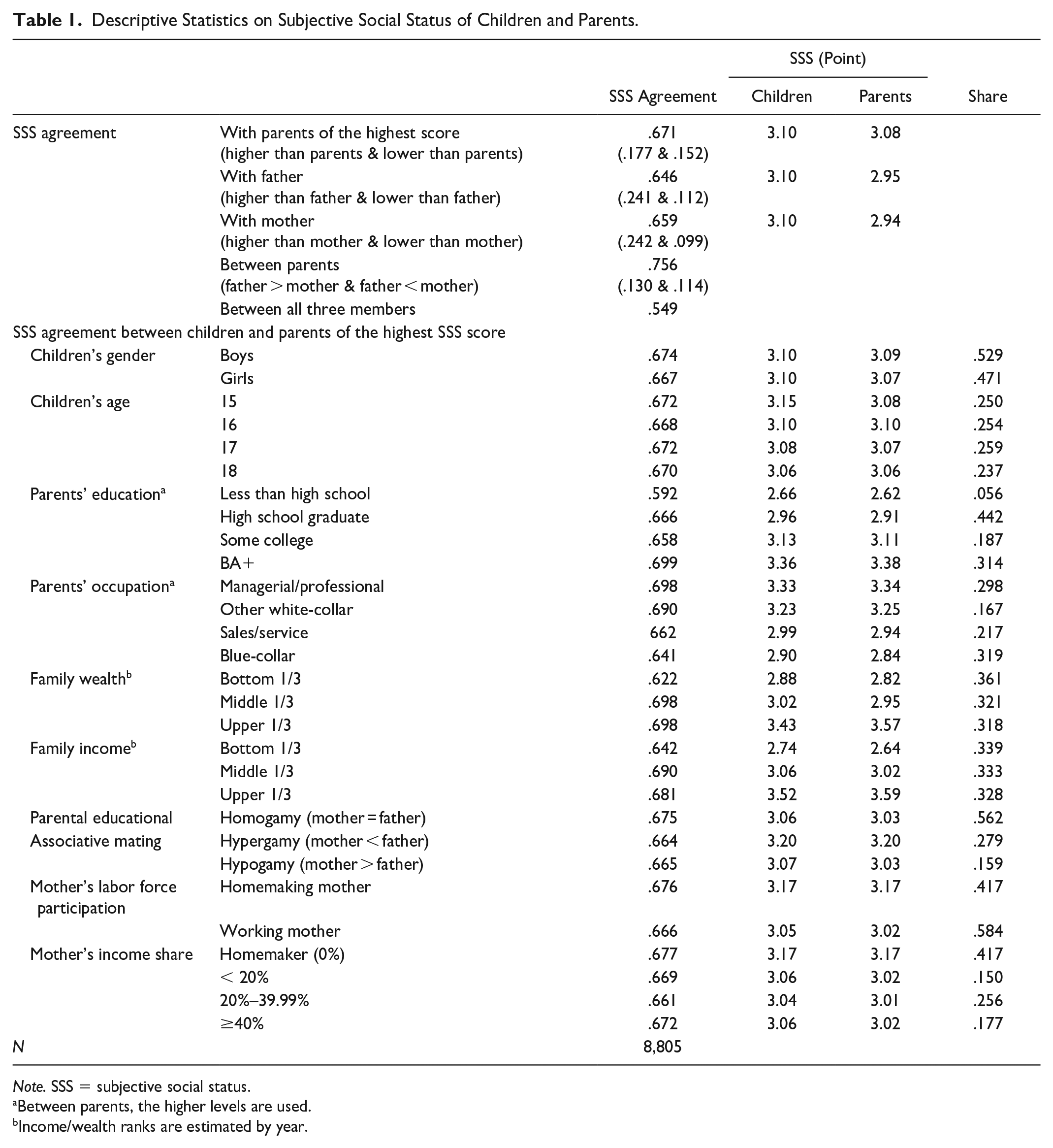
Table 1 shows descriptive statistics. Between parents, 76 percent of Korean couples agree on their SSS, which is similar to the findings reported by Plutzer and Zipp (2001) based on a British survey (74 percent agreement). More than two-thirds of child-parent pairs report the same SSS when children’s SSS is compared to a higher SSS between parents. The extent to which children agree on SSS with their fathers (65 percent) and mothers (66 percent) is similar. The proportion of both parents and children who agree on their SSS (= triad agreement) is 55 percent. Relative to their father and mother, children tend to rate their SSS slightly higher. When parents report different SSS, children are more likely to agree with the higher score regardless of the parents’ gender. Consistent with prior studies (e.g., Amir et al., 2019; Goodman et al., 2001), younger children generally assess their SSS higher than older children and thus exhibit a larger discrepancy compared to parents. As children age, the difference between children and parents becomes smaller. There is no noticeable difference by children’s gender.
Descriptive Statistics on Subjective Social Status of Children and Parents.
Note. SSS = subjective social status.
Between parents, the higher levels are used.
Income/wealth ranks are estimated by year.
As anticipated and consistent with previous literature (Mistry et al. 2015), children’s SSS is positively correlated with their parents’ education, occupation, and family income and wealth. Children from economically disadvantaged families tend to perceive themselves with slightly higher SSS than their parents. Conversely, children from economically privileged families exhibit relatively lower SSS than their parents. In other words, children’s SSS tends to regress toward the average. Regarding parental educational assortative mating, families with educational homogamy are slightly more likely to share SSS than families with hypergamy or hypogamy. There is no significant difference in SSS agreement between male sole breadwinner families and dual breadwinner families. Both groups exhibit a similar likelihood of SSS agreement. However, it is worth noting that both children and parents from male breadwinner families demonstrate higher SSS than those from more gender-egalitarian families. Children from educational hypergamous families also display slightly higher SSS than those from hypogamous families, indicating that adherence to traditional gender roles may contribute to an elevated SSS among both children and parents.
SSS Agreements between Children and Parents and between Couples
Before examining how deviation from the male hegemonic family model is associated with children’s SSS, we first check the likelihood of SSS agreement between children and parents. The high likelihood of SSS agreement has been widely assumed in previous studies but not tested empirically. Table 2 shows the linear probability model (LPM) estimates of SSS agreement between children and parents with the highest SSS (Model 1), between children and fathers (Model 2), between children and mothers (Model 3), and between fathers and mothers (Model 4).
Linear Probability Model of the Agreement of Subjective Social Status between Children and Parents.

Note. Parents’ education indicates the highest level of education for Models 1 and 4 and father and mother’s own education for Models 2 and 3. Parents’ occupation indicates the highest level between parents. Control variables include children’s age, birth cohort, sibling size, birth order, father’s age, mother’s age, residing region, survey year, and the year of the entrance into the survey for the first time. The family wealth variable is the annual percentile rank divided by 10 (so a 1-unit change is an increase of 1 decile point). The family wealth components encompass cash reserves in bank accounts; the total value of stocks, bonds, and trust portfolios; the total value of savings and guaranteed insurance policies; and any anticipated payouts from informal financing networks and personal loans.
p < .10. *p < .05. ***p < .001 (two-tailed tests).
In all three models of SSS agreement between children and parents, family wealth shows a positive association with a higher likelihood of agreement. Interestingly, the mother’s education is positively linked to SSS agreement with children, and the father’s education appears to be irrelevant. Similarly, parents’ occupational prestige is positively associated with SSS agreement but only when looking at agreement between children and mothers. These results suggest that children and parents from higher socioeconomic backgrounds are more likely to reach an agreement on SSS compared to those from lower socioeconomic backgrounds. The impact of socioeconomic backgrounds on children’s SSS agreement with parents is more pronounced for agreement with mothers than with fathers.
Parental educational assortative mating does not seem to have a substantial impact on the SSS agreement with children. Although the coefficients of hypergamy and homogamy are consistently negative across models, most of these coefficients are not statistically significant. Regarding the mother’s share of family income, it appears to have a negative association with the SSS agreement between children and parents, but the coefficient does not reach statistical significance in all three models. The evidence that family members with nontraditional gender arrangements are less likely to agree on their SSS is weak at best. Among other covariates included but not shown in Table 2, children’s gender and age show no association with the likelihood of agreement, and the number of siblings is negatively associated.
The patterns of SSS agreements between couples appear a bit different from those between children and parents. None of the socioeconomic covariates except for family wealth show statistical significance at the conventional alpha levels. Compared to those with homogamy, couples with educational hypergamy are 3.9 percentage points less likely to agree on their SSS.
When the difference (positive or negative) rather than the agreement is used as the dependent variable, children tend to overestimate their SSS compared to their parents. Older children tend to overestimate less. Children from high-income families are also less likely to overestimate their SSS. Parental educational assortative mating is related to neither overestimation nor underestimation. Slightly different ways of measuring SSS agreement (e.g., coding 2+ point difference as disagreement) yield essentially the same findings.
It is noteworthy that the R2 values of all the models in Table 2 are very low, ranging from .012 to .022. Although we do not anticipate high R2 values from LPMs, the extremely low values suggest that the high SSS agreements among family members are likely driven by a stochastic process rather than being heavily influenced by family socioeconomic background or demographic characteristics.
Overall, these results indicate that the assumption made in the previous literature that children share SSS with parents is well supported; the likelihood of SSS agreement between children and parents is similarly high regardless of the types of assortative mating and mother’s economic activities, and the deviation from male hegemonic family types does not lead to higher disagreement.
Educational Assortative Mating of Parents, Male Breadwinner Norms, and Children’s Subjective Social Status
We now turn to our primary research question: whether the patterns of parental educational assortative mating and mothers’ economic contribution are associated with children’s SSS. Table 3 shows the results. The first two models are our main outcomes. Both models confirm that children’s SSS is influenced by family socioeconomic backgrounds. As expected, children from privileged backgrounds tend to have higher levels of SSS compared to their counterparts from less privileged backgrounds. All four socioeconomic variables, parents’ education, occupation, family income, and family wealth, are associated independently with children’s SSS.
Ordinary Least Squares Estimates on the Child’s Subjective Social Status.

Note. Parents’ education and occupation indicate the highest levels between parents. Control variables include children’s age, birth cohort, sibling size, birth order, father’s age, mother’s age, residing region, survey year, and the year of the entrance into the survey for the first time. The family wealth variable is the annual percentile rank divided by 10 (so a 1-unit change is an increase of 1 decile point). The family wealth components encompass cash reserves in bank accounts; the total value of stocks, bonds, and trust portfolios; the total value of savings and guaranteed insurance policies; and any anticipated payouts from informal financing networks and personal loans. SSS = subjective social status.
p < .10. *p < .05. **p < .01. ***p < .001 (two tailed tests).
In both models, children of educationally homogamous parents tend to show significantly higher SSS than those of educationally hypergamous or hypergamous parents net of family SES background covariates. The coefficient of hypogamy is more negative than that of hypergamy, although the difference between the two coefficients is not statistically significant. This result is contradictory to the status maximization hypothesis, which expects that parental educational assortative mating does not matter after the control of the highest status of parents (Hypothesis 1), and consistent with the additive status maximization hypothesis that posits that educational homogamy provides additional resources to children (Hypothesis 2). Importantly, the results in Table 3 demonstrate that parents’ different labor market arrangement affects children’s SSS. Model 1 reveals that children of working mothers evaluate their SSS .20 points lower compared to children of homemaking mothers. A .20 lower SSS may sound like a small difference, but it is similar to the difference between children of parents with a high school diploma and those of parents with a BA+ degree or the difference between children of blue-collar parents and those of professional class parents.
We wonder whether the negative impact of working mothers is linear as the mother’s contribution to family income grows or if it is curvilinear. There are two possibilities for the curvilinear effect. One is that the net negative impact of working mothers is weak when the mother’s contribution to family income is small but accelerates as the mother’s contribution grows further (i.e., an inverted J-curve). The other possibility is that the deviation from the norm of the homemaking mother has a strong negative connotation when a mother moves from being a homemaker to being a working mother, but its impact is not increasingly stronger beyond a certain threshold as the mother’s income share grows (i.e., L-curve). To explore this question, we add the mother’s income share and its quadratic term in Model 2 and illustrate the association in Figure 1. It turns out that the main coefficient of the mother’s income share is negative and its squared term is positive, suggesting the L-curve pattern. As the mother’s share increases, the children’s SSS decreases until the mother’s income share reaches 60 percent (= .087 / (2 × .0073); a vertical dashed line in Figure 1) and then rebounds. Compared to children of homemaking mothers, the SSS of children whose mothers contribute 60 percent of the family income is .27 points lower, holding all other covariates constant. The proportion of children for whom the mother’s income share exceeds 60 percent is less than 8 percent of the total observations in our sample. Thus, the majority of cases are to the left of the inflection point. The confidence interval beyond the 60 percent threshold is increasingly widening as the number of observations becomes smaller at the right end of the mother’s income share distribution.
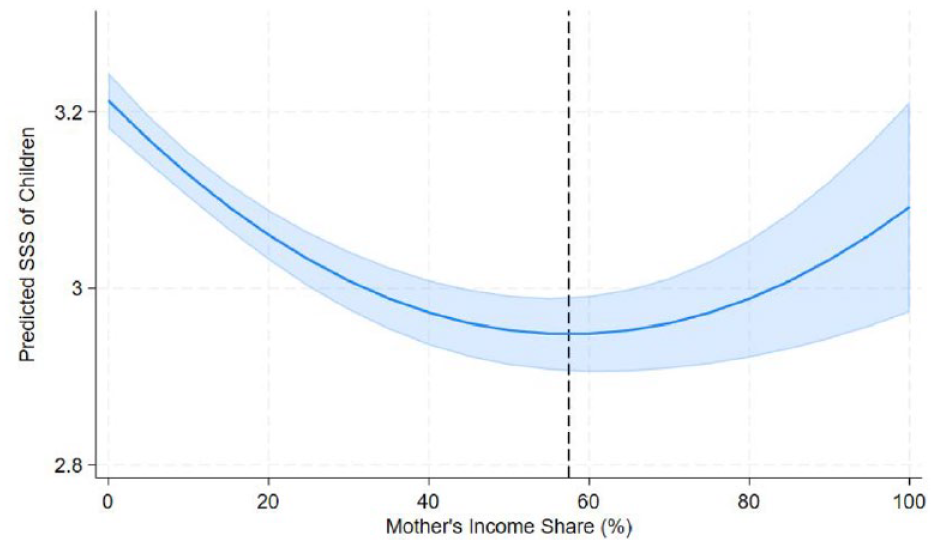
Predicted subjective social status of children by mother’s contribution to family income.
With the important caveat of the inflection point mentioned above, the average SSS of children from female sole breadwinner families remains lower than that of children with homemaking mothers. These findings demonstrate that deviating from the traditional male breadwinner model is negatively associated with children’s SSS, which supports the gender-role deviation hypothesis (Hypothesis 3) and contrasts with Hypotheses 1 and 2.
An additional question to consider is whether the negative association between working mothers and SSS is limited to children or whether it extends to all family members, including parents. Put differently, we wonder whether the negative association between a mother’s economic contribution and children’s SSS is a reflection of the negative social stigma of working mothers in Korea and thus parents themselves also rate their SSS lower when a mother works or whether working mothers have a negative impact, particularly, on children’s SSS over and above the general social stigma. 2 To investigate this, we incorporate the highest score of parents’ SSS in Model 3 and introduce an additional control of whether parents agree on SSS with each other in Model 4. As expected from the high rates of agreement on SSS between children and parents, parents’ SSS is a strong predictor of children’s SSS, and the control for parents’ own SSS attenuates a substantial portion of all coefficients in Models 1 and 2. Importantly, however, even after accounting for parents’ SSS, deviation from the traditional male breadwinner model remains negatively associated with children’s SSS. This finding suggests that nontraditional family arrangements have a negative impact on children’s SSS beyond their influence on parents’ SSS.
It is noteworthy that the inclusion of parents’ SSS in Models 3 and 4 significantly reduces the coefficient size of hypogamy more than that of hypergamy. These findings indicate that in instances of hypogamy, all family members tend to perceive their SSS as equally likely to be lower than those in homogamous families. In contrast, husbands and wives in hypergamous families tend to assess their SSS differently, and children in such families tend to perceive their SSS as similar to that of their mothers rather than their fathers. 3 Among the covariates not reported in the tables, children’s age and number of siblings are consistently negatively associated with SSS, but birth order is not. Parents’ age is not relevant for children’s SSS.
The results in Table 3 reveal that both the pattern of educational assortative mating between parents and the mother’s economic contribution are associated with children’s SSS. Net of family socioeconomic backgrounds, the economic contribution of the mother seems to reduce children’s SSS. At the same time, homogamy in education is positively associated with children’s SSS compared to hypogamy. To our surprise, there is no noticeable difference between educational hypergamy and hypogamy. In summary, these results indicate that departing from the male breadwinner model tends to lower children’s SSS, whereas deviating from educational hypergamy does not have a negative impact on children’s SSS.
Given the different impacts of deviating from the male breadwinner model and educational hypergamy on children’s SSS, we further investigate whether the association between parents’ labor market arrangements and children’s SSS varies depending on the pattern of educational assortative mating between parents. To this end, we add interaction terms between educational assortative mating and mother’s economic contribution. To present the results clearly, we compute the predicted SSS and illustrate the results in Figure 2. 4

Predicted subjective social status of children by parental educational assortative mating and their labor market participation status (a) and by parental educational assortative mating and mother’s contribution to family income (b).
Figure 2a is the outcome of Model 1, and Figure 2b is that of Model 2. Because the proportion of observations beyond the inflection point of the mother’s share is small, we plot the predicted SSS up to 60 percent. Both figures demonstrate that children of male breadwinner families report higher SSS than those of dual breadwinning parents. Children in homogamous families show higher SSS than those in hypogamous families. In Figure 2b, the differences between children of homogamous and hypogamous parents are consistent regardless of the magnitude of the mother’s contribution. For children of hypergamous parents, when the father is the sole breadwinner, their average SSS is as high as that of children of homogamy, but as the mother’s contribution increases, the SSS of children of hypergamous parents decreases and becomes lower than that of children of homogamous parents when the mother’s contribution reaches parity with that of the father. In essence, the collision of the traditional gender norm (= hypergamy) with the deviation from the traditional gender norm (= growing mother’s income share) results in the lowest SSS for children. These results are broadly consistent with Hypothesis 3.
Robustness Checks
As a robustness check, we limit our sample to the oldest age for respondents who appear multiple times and reestimate our models, reducing the total sample size to 3,567. As expected, the coefficients and standard errors differ from those we report here, but the conclusion is not altered. To examine gender differences, we estimate models by each gender, and the results reveal no noticeable differences. When we estimate the individual fixed effects models with the main independent variables lagged by one year, the directions and effect sizes of the estimated coefficients of mother’s economic activities are similar to what we report here, but none of them are statistically significant. As an additional robustness check, we estimate ordered logit models for Tables 2 and 3 and find essentially the same results.
Discussion and Conclusion
In this study, we have examined whether deviations from traditional gender norms are associated with children’s lower SSS, and our results reveal the following. First, deviations from the traditional male breadwinner model are indeed linked to lower SSS for children net of family socioeconomic background. Second, children of both educationally hypergamous and hypogamous parents report lower SSS than those of homogamous parents. Among them, hypogamy is most negatively associated with children’s SSS evaluation. Third, children of hypergamous parents tend to rate their SSS similarly to those of homogamous parents when living with a homemaking mother. However, when a mother works, the average SSS for children of hypergamous parents becomes similarly low as those of hypogamous parents.
Our results provide novel and robust evidence that underscores the importance of gender norms in understanding child well-being. Recent research highlights the negative consequences of family life, such as family dissolution, when the family deviates from the traditional male breadwinner model (Gonalons-Pons and Gangl 2021). Our results demonstrate that these consequences extend to children. Children from nontraditional family arrangements tend to perceive their SSS as lower than children from traditional family arrangements. Our results uncover that working mothers in Korea are facing a previously unknown challenge: Their children perceive their SSS lower. This finding call for a deeper exploration of the meaning of “good mothering”—cultural ideals that specify mothers as primary caregivers, utilizing child-centered, emotionally absorbing practices—in contemporary families (Hays 1996) and requires further understanding of how the ideology of good mothering influences children’s understanding of social location. Previous literature reports that good mothering is a source of stress and strain associated with negative psychological outcomes, including guilt and shame for mothers (Constantinou, Varela, and Buckby 2021; Fielding-Singh and Cooper 2022). Moreover, research demonstrates that more depressive symptoms, anxiety, and less social support are associated with lower SSS for mothers (Michelson, Riis, and Johnson 2016). Bridging the gap between societal expectations and evolving family structures is essential to creating an environment that supports both mothers and children in their diverse roles and challenges.
Figures 1 and 2 show that the relationship between the mother’s income share and children’s SSS is mostly negative. However, it rebounds as the mother’s share becomes a major source of family income. The existing literature suggests several potential mechanisms accounting for this pattern. First, societal expectations and cultural norms regarding gender roles might contribute to this phenomenon. In contexts where the male breadwinner model is predominant, a mother’s financial contribution may be perceived as a deviation from the norm, potentially affecting marital quality and stability (Gonalons-Pons and Gangl 2021). This societal pressure can impact children’s perceptions of their family’s status, leading to a temporary decline in SSS until the family adjusts and/or societal attitudes evolve. At the same time, previous studies show that more egalitarian practices in the household can lead to more egalitarian attitudes in children as they grow into adulthood (Cunningham 2001). Thus, it is possible that children in female breadwinner families (i.e., women contribute more than 60 percent) develop different attitudes toward nontraditional gender roles, leading to a rebound of children’s SSS. Second, the negative association can be associated with the time and emotional investment parents make in their children. As mothers take on more work outside the home, the reduced time available for childcare and family interaction might affect children’s sense of stability and support (Li and Guo 2023). Third, increased maternal employment and income contribution can disrupt traditional family structures, leading to role conflict and marital tension. Studies indicate that children exposed to parental conflict may experience lower self-esteem and a diminished sense of security, negatively impacting their SSS (Cummings and Schatz 2012). With the current data set, it is not feasible to explore these possibilities, but we hope future research could investigate these underlying processes and provide a more nuanced understanding of how changes in parental roles and income contributions shape children’s SSS.
From our study, it is unclear whether the negative impact of the deviation from traditional family arrangements on children’s SSS will be attenuated in the future as Korea moves to a more gender-egalitarian society. The change in the association between mothers’ income share and children’s SSS from negative to positive beyond a certain point in Figures 1 and 2 suggests that ongoing changes toward egalitarian gender roles and the normalization of working mothers could nullify the negative impact of deviating from the male breadwinner model. To explore this possibility further, comparative studies are warranted. Our case is Korea, where traditional gender roles persist in the labor market. Studies are warranted on whether other societies where dual breadwinner models are increasingly becoming the norm show a different pattern or if the deviation from traditional gender norms still affects children’s SSS negatively.
Our findings suggest that SSS may be more useful in studies of social stratification than previously thought. Recently, Oesch and Vigna (2023) demonstrated that SSS is a better measure of life chances than various objective class measures because SSS accounts for a greater proportion of the variances in income and wealth. Our results show that children’s SSS closely aligns with parents’ SSS, reflecting the objective SES of the family, which suggests that SSS can be valuable in studies of intergenerational mobility. In sociology, children’s recall of their parents’ occupation when respondents were young is commonly used to measure intergenerational mobility. However, contrary to popular belief, occupational measures are prone to nontrivial coding mismatches and errors (Belloni et al. 2016). There is a strong possibility that recalled SSS can be a better measure than recalled parents’ occupation for estimating the social location of respondents when they were young. As long as adolescent children perceive SSS similarly to their parents, adult children’s recalled SSS is a reliable measure of social status during their adolescence.
This study has several limitations. First, we cannot generalize the findings to societies outside of Korea. Other societies may have different associations. Second, how children of single parents perceive their SSS needs to be investigated in future studies. We could not address this issue because of the scarcity of single-parent families in Korea. It is also necessary to explore the formation of SSS within same-sex couples. Same-sex couples may encounter unique challenges and dynamics that can shape their shared understanding of social location. Third, historical change with advances in gender equality is another area of future research. The time span covered in the current study is too short to investigate historical changes. Despite these limitations, this study sheds new light on the family demography and stratification literature by investigating how the complexities of status association in marriage and women’s contribution to family income affect children’s understanding of their social location. We hope that this study reignites the discussion of subjective social status.
Footnotes
Funding
The author(s) disclosed receipt of the following financial support for the research, authorship, and/or publication of this article: This project is supported by the Ministry of Education of the Republic of Korea and the National Research Foundation of Korea (NRF 2020S1A3A2A03096777).
