



Abstract
The General Educational Development (GED) degree is designed to be a credential equivalent to the high school diploma. However, growing evidence indicates that GED recipients have worse outcomes than high school graduates. Such findings raise the question: is the GED socially equivalent to the high school diploma? Although educational assortative mating patterns have long been used as a barometer of the social distance across educational groups, there has not been a study that has addressed this question by examining the marital sorting patterns of GED recipients. Using log-linear models, our study shows that the odds of intermarriage between GED recipients and high school graduates resemble those between GED recipients and those without a secondary degree. Racial/ethnic minorities had greater difficulty crossing the GED/high school graduate boundary when they married. Our findings detract from the purported view that the GED degree is equivalent to a traditional high school diploma.
Introduction
The General Educational Development (GED) degree is designed to be equivalent to a traditional high school diploma (McFarland, Stark, & Cui, 2016; Snyder, de Brey, & Dillon, 2016). It is assumed that GED recipients will have skills and knowledge comparable to recipients of a high school diploma (Heckman, Humphries, & Kautz, 2014). The GED diploma is accepted by nearly all universities that require a high school diploma (American Council on Education, 2010).
Based on assumptions about equivalency, most studies have not distinguished between GED recipients and those with a high school diploma (e.g., Torpey, 2018). When disaggregated, however, past studies have yielded overwhelming evidence that GED recipients have less favorable educational, labor market, and health outcomes than do high school graduates (HSG) (e.g., Cameron & Heckman, 1993; Maralani, 2011; Milesi, 2010; Zajacova, 2012). These disparities may be even more pronounced in some subpopulations as the magnitude of the labor market and health disadvantage of GED recipients relative to HSG is not homogenous (Clark & Jaeger, 2006; Prins & Kassab, 2015; Zajacova & Everette, 2013). Zajacova and Everette (2013), for example, showed that health differentials between GED recipients and HSG were larger among NH Whites than among Hispanics and NH Blacks. Maralani (2011) found that older GED recipients are less likely than their younger peers to subsequently enroll in college. Prins and Kassab (2015) also showed that rural GED recipients were more likely than urban GED recipients to plan to pursue full-time study in a 4-year college.
People tend to marry spouses of similar social standing, such as those with similar educational attainment and occupational status (Kalmijn, 1998; Mare, 1991; Schwartz, 2013). Thus, intermarriage patterns have long been used as a barometer of the social distance across distinct groups (Kalmijn, 1998; Qian & Lichter, 2007; Schwartz, 2013). The ease with which GED recipients marry HSG can help ascertain whether a GED confers social status comparable to that of a traditional high school diploma. If barriers to intermarriage between GED recipients and HSG are significantly less formidable than those involving other educational groups, then a GED degree is a credential seen as socially equivalent to a high school diploma. Conversely, if barriers to intermarriage between GED recipients and HSG are equally, if not more, formidable than those involving other educational groups, then GED is not a credential socially equivalent to a high school diploma.
Partly due to the limited availability of large datasets with couple data that distinguish GED recipients from HSG, 1 there has yet to be a study that examines the mate selection behavior of GED recipients. Recent updates to large-scale data collections provide an opportunity to address this question. Namely, the American Community Survey (ACS) began to distinguish GED recipients from those who obtained high school diplomas beginning in 2008. We used data from the 2008 to 2019 ACS to describe the mate selection behavior of GED recipients. To do so, we used log-linear models to determine whether the barriers to intermarriage involving GED recipients and HSG were less salient than those involving spouses in other educational groups. We also examined whether the relative permeability of the GED/high school graduate boundary varied by race/ethnicity, age, and urban/rural residence. Like many studies of educational assortative mating (e.g., Mare, 1991; Schwartz & Mare, 2005), we employ log-linear models which allows us to determine whether GED recipients are a social group different from those with a high school diploma. These models are not meant to establish the causal impact of obtaining a GED degree on mate selection.
This study contributes several important insights into the educational assortative mating literature. Past studies on GED recipients have primarily focused on the educational, labor market, and health outcomes (e.g., Heckmanet al., 2014; Maralani, 2011; Zajacova, 2012). We examined the mate selection behavior of GED recipients, which is a behavior particularly sensitive to social status. By doing so, it contributes important insights to ongoing discussions about the value and merits of a GED credential (e.g., Heckman et al., 2014; Zajacova, 2012). Accurately documenting social status differentials between GED recipients and HSG may help inform high school students’ decisions to leave or remain in school. Additionally, this study assessed whether the differences in social status between GED recipients and HSG differed across major demographic groups, shedding light on the heterogeneity in mate selection behavior of male and female GED recipients who belonged to distinct racial, ethnic, and age groups and who resided in different places.
Following the convention in the literature (e.g., Heckman et al., 2014; Ou, 2008; Zajacova & Everette, 2013), we use the term “GED recipients” to refer to individuals whose terminal degree was obtained by passing the GED test; “high school graduates” (HSG) to refer to those with a terminal high school diploma; and “high school dropouts” (HSD) to refer to individuals without a secondary degree (i.e., GED/high school diploma).
Background
Assortative Mating Patterns: A Barometer of Social Equivalence
Studies of intermarriage have consistently shown that people marry a partner with similar ascribed or achieved characteristics (Kalmijn, 1998; Lichter & Qian, 2019; Schwartz, 2013). These patterns emerge due to the interplay of (a) individual preferences about the attractiveness of a potential spouse, (b) social norms about the desirability of a specific match, and (c) opportunities to interact and form intimate unions with potential partners in local marriage markets (Kalmijn, 1998; Qian & Lichter, 2007; Schwartz, 2013). Educational attainment is a particularly important dimension of marital sorting because it is heavily influenced by family background and shapes the future economic well-being of individuals and families (Mare, 1991).
Two explanations are commonly used to explain why people marry a partner with similar levels of education. The first one posits that educational homogamy is a by-product of people’s desire to find a spouse who can maximize their socioeconomic well-being in competitive marriage markets (Kalmijn, 1998; Schwartz, 2013). Married couples usually pool their economic resources; therefore, the economic well-being of the spouse has implications for one’s socioeconomic well-being. To maximize their socioeconomic resources, single men and women compete for spouses with the most socioeconomic resources. In this competitive search process, the most “marriageable” will choose each other, leaving the less marriageable to marry each other (Kalmijn, 1998; Mare, 1991). At the aggregate level, these efforts will result in high rates of educational homogamy. The second explanation focuses on people’s desire to find a culturally similar spouse. Single men and women prefer potential partners with similar tastes because they can participate in joint activities (Kalmijn, 1998; Schwartz, 2013). They also prefer potential partners who have similar values and worldviews because it serves as the basis for mutual understanding (Kalmijn, 1998; Schwartz, 2013). Social class shapes taste and norms about what constitutes as acceptable cultural behavior and practices (Stephens, Markus, & Phillips, 2014), so membership in the same social class likely increases the attractiveness of a potential partner. At the same time, cultural differences across social strata may create barriers to intermarriage. If a GED is equivalent to a high school diploma and confers the same social standing, then these processes of mate selection imply a lower barrier to intermarriage between GED recipients and traditional HSG than those to other educational pairings.
Differences Between GED Recipients and HSG
The GED is an examination-based credential. To obtain this credential, test-takers need to obtain a passing score in mathematics, writing, reading, social science, and science (Tyler, 2005). Passing these tests implies that GED recipients have knowledge and competencies in the above-mentioned domains equivalent to those with a high school diploma (Heckman, Humphries, & Mader, 2011; Tyler, 2005). Although a GED is intended to offer educational credentials equivalent to a high school diploma, there is overwhelming evidence that GED recipients differ from HSG in ways that may affect their mate selection behavior. GED recipients originate from more disadvantaged families than do HSG (Heckman et al., 2014; Ou, 2008). They also have poorer noncognitive skills, such as self-control and persistence, relative to HSG (DiPrete & Jennings, 2012; Ou, 2008). GED recipients have worse labor market and health outcomes relative to HSG (Heckman & La Fontaine, 2010; Heckman et al., 2011; Liu et al., 2013; Zajacova, 2012).
The distinct educational, occupational, health, and residential trajectories of GED recipients and traditional HSG limit structural opportunities for them to interact with one another as social equals and marry each other. The labor market and health disadvantage of GED recipients likely dampen their attractiveness as potential mates, reducing their chances to wed both HSGs and college-educated partners.
Potential Heterogeneity in the Mate Selection Behavior of GED Recipients
Rates of GED credentialing differ by race, ethnicity, age, and place of residence (Pew Report, 2010). Both the availability and the relative desirability of GED recipients as potential partners will likely vary across these dimensions. In this section, we review past findings of group differences in the GED-high school graduate gap across a variety of outcomes and discuss the implications of these findings for the mate selection of GED recipients.
Past studies offer mixed accounts about whether, and by how much, the GED-high school graduate gap varies by race/ethnicity. Some studies suggest that the GED-high school graduate gap in relative attractiveness is larger among NH Blacks and Hispanics than it is for NH Whites. This pattern may partly emerge because NH Black and Hispanic men are more likely than their White peers to obtain their GED credentials in prison (Heckman et al., 2014; see Pager, Western, & Sugie, 2009 for a review). Alternatively, other studies suggest the GED-high school graduate gap in relative attractiveness is larger among NH Whites than NH Blacks and Hispanics. For example, Zajacova and Everette (2013) found that health differentials between GED recipients and HSG were larger for NH Whites than for NH Blacks and Hispanics. They argued that this pattern emerged because the returns to earning a high school diploma were lower for NH Blacks and Hispanics than for NH Whites.
Prior work also suggests that GED recipients living in rural regions may also be more attractive potential mates than their counterparts living in urban areas. King (2002) found that HSD living in rural areas must travel greater distances to participate in adult learning programs (e.g., GED classes) and take GED tests than their peers living in metropolitan areas. Prins and Kassab (2015) showed that rural GED recipients are more likely than their urban counterparts to plan to pursue full-time study in a 4-year college. They also faced fewer financial hardships relative to their peers in urban areas (Prins & Kassab, 2015). Overall, these studies suggest that rural GED recipients may possess skills or traits unrelated to education that render them more attractive potential mates than urban GED recipients and may have an easier time marrying spouses with a high school diploma or some college education.
Finally, the relative attractiveness of GED recipients will also likely vary depending on their age at marriage. GED recipients who married at older ages may include those who received their GED credential at older ages. Those who received their GED credentials at older ages may have employment histories that mirror more closely that of HSD. As a result, they may poorer future earnings potential, rendering them less attractive mates.
Data and Methods
We used data from the 1% sample of the Integrated Public Use Microdata Series files of the 2008–2019 ACS. The ACS collected basic sociodemographic information, such as sex, age, education, and marital histories (Ruggles et al., 2021). Pooled ACS data was well-suited for our analyses for several reasons. First, it is one of the few datasets that differentiates GED recipients from HSG with a large enough sample of marriages involving GED recipients to ensure reliable estimates. Second, it includes spousal identifiers, which can be used to match husbands and wives and to determine the educational resemblance between them. Third, the ACS collected information about the year of their current marriage. This information can be used to restrict our sample to recent marriages and minimize the share of marriages involving spouses who completed more schooling after marriage.
Our sample consisted of heterosexual couples who married within 3 years of the interview date (Base N = 718,150). We focused on heterosexual couples because same-sex marriages were legalized over the study period. Homogamous marriages are generally more stable than heterogamous unions (Zhang & Van Hook, 2009). By restricting our sample to the stock of new marriages, we can minimize biases resulting due to differences in dissolution rates between educationally homogamous and heterogamous unions. ACS also did not report the respondent’s year of GED receipt or high school graduation. By restricting our sample to new marriages, we can minimize the share of marriages involving spouses who obtained their educational credentials after marriage. We excluded remarriages because (a) GED recipients divorce at higher rates than HSG and (b) assortative mating patterns vary in first and subsequent marriages (N = 296,187 excluded). We excluded marriages involving a NH Asian, multiracial, or other because there were too few marriages involving these spouses to obtain reliable estimates (N = 57,166). The GED credential cannot be attained in many countries outside the U.S.; thus, we limited our sample to U.S.-born (N = 72,859). Finally, we restricted our sample to marriages involving spouses who are 21 years and older because the rate of obtaining a GED peaks at 21 (Maralani, 2011). This restriction allows sufficient time for respondents to obtain a secondary degree (N = 55,275). Together, they yielded a sample of 236,663 marriages.
Measures
Husband’s Education
Using information about the highest degree obtained by the respondent or co-resident spouse, we distinguished those without a high school degree, GED credential, high school diploma, some postsecondary education, and bachelor’s degree or above. Wife’s education was defined analogously. For log-linear analyses that are more data-intensive, we combine “some college” with the “college graduate” categories.
Husband’s race distinguished among NH White, NH Black, and Hispanic spouses.
Husband’s age distinguished husbands between the ages of 21–29 and 30 or above.
Place of residence classified each couple as rural or urban residents.
Analytical Methods
We first described the distribution of husband’s and wife’s education, disaggregated by race/ethnicity, age at marriage, and place of residence. We also compared the educational profiles of spouses for married men and women with varying levels of education.
Once these patterns are established, we employed log-linear models for contingency tables to document how educational assortative patterns varied by husband’s race/ethnicity, place of residence, and age at marriage. To do so, we constructed contingency tables by cross-classifying husband’s education by wife’s education, husband’s race/ethnicity, couple’s place of residence, and husband’s age at marriage. We then employed log-linear models to describe how the educational resemblance between spouses differed according to the husband’s race/ethnicity, the couple’s place of residence, and husband’s age at marriage. We conducted a similar analysis and described variations in educational assortative mating patterns by wife’s race/ethnicity, couple’s place of residence, and wife’s age at marriage. Log-linear models are often referred to as the “gold standard” for analyses of educational assortative mating because they estimate the association between husbands’ and wives’ education after controlling for differences in marginal distributions of husbands’ and wives’ characteristics (Mare, 1991; Qian & Lichter, 2007; Schwartz & Mare, 2005). By controlling for group size differentials, log-linear models ensure that the intermarriage odds are not overstated for small groups (e.g., GED recipients) and understated for larger groups (e.g., HSG) (Lichter & Qian, 2019; Qian & Lichter, 2007).
Among the various log-linear models of square contingency tables, we relied on crossing models, which use parameters specific to each educational boundary to capture the odds of intermarriage between members of two educational groups (e.g., Mare, 1991; Schwartz & Mare, 2005). These models estimate the relative permeability of different educational barriers (e.g., GED/HSG vs. HSG/college). Mathematically, the baseline log-linear model (Model 1) can be expressed as follows
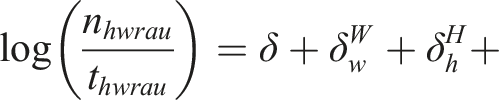

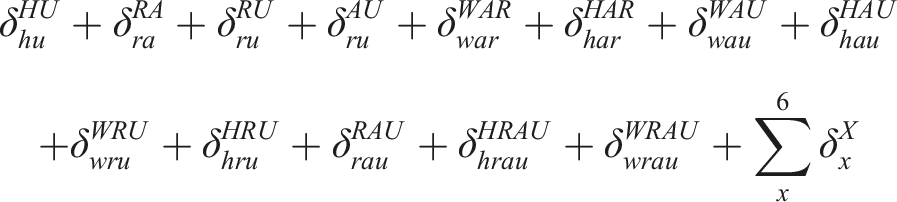
These models were very similar to those employed by Mare (1991) and Schwartz & Mare (2005), with two exceptions. Their crossing parameters captured the difficulty of crossing adjacent educational categories, whereas ours captured the difficulty of crossing specific boundaries (e.g., high school dropout/college and GED/college). We constructed crossings parameters in this way because the hierarchy of a GED credential relative to a high school diploma is a priori unclear. We also distinguished GED recipients from HSG. Log-linear models rely on contingency tables constructed by cross-classifying all variables in the model, thus including five variables is akin to the inclusion of a five-way interaction term. Table A1 in the Appendix 1 presents the educational crossing barriers. We use HSD/GED to denote the barrier between HSD and GED recipients and GED/HSG to denote the barrier between GED recipients and HSG.
Results
Sample Characteristics
Distribution of Spouse’s Education by Dimensions of Sorting.
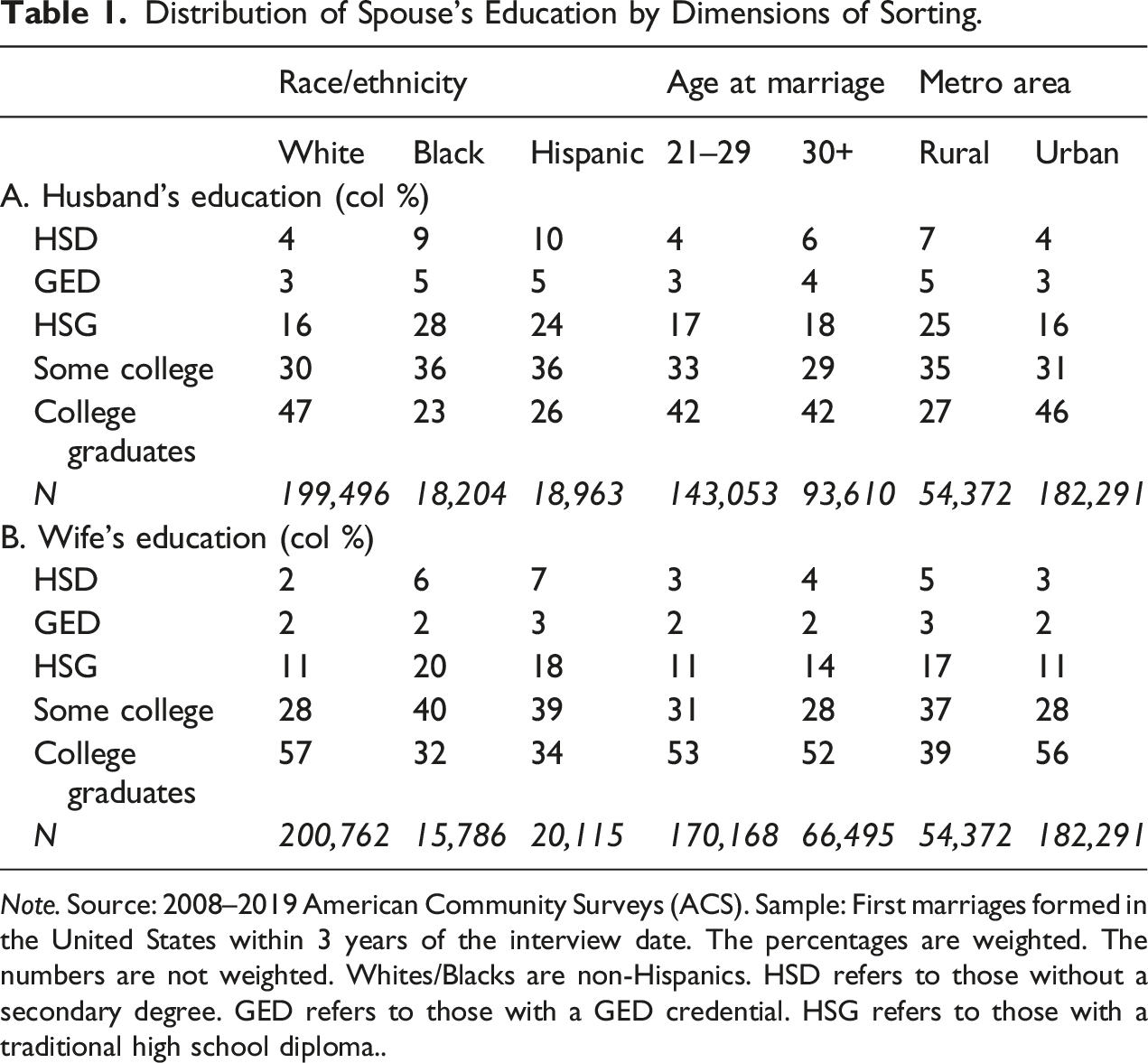
Note. Source: 2008–2019 American Community Surveys (ACS). Sample: First marriages formed in the United States within 3 years of the interview date. The percentages are weighted. The numbers are not weighted. Whites/Blacks are non-Hispanics. HSD refers to those without a secondary degree. GED refers to those with a GED credential. HSG refers to those with a traditional high school diploma..
Patterns of Marital Sorting
Percentage Distribution of Patterns of Educational Assortative Mating (Column %).
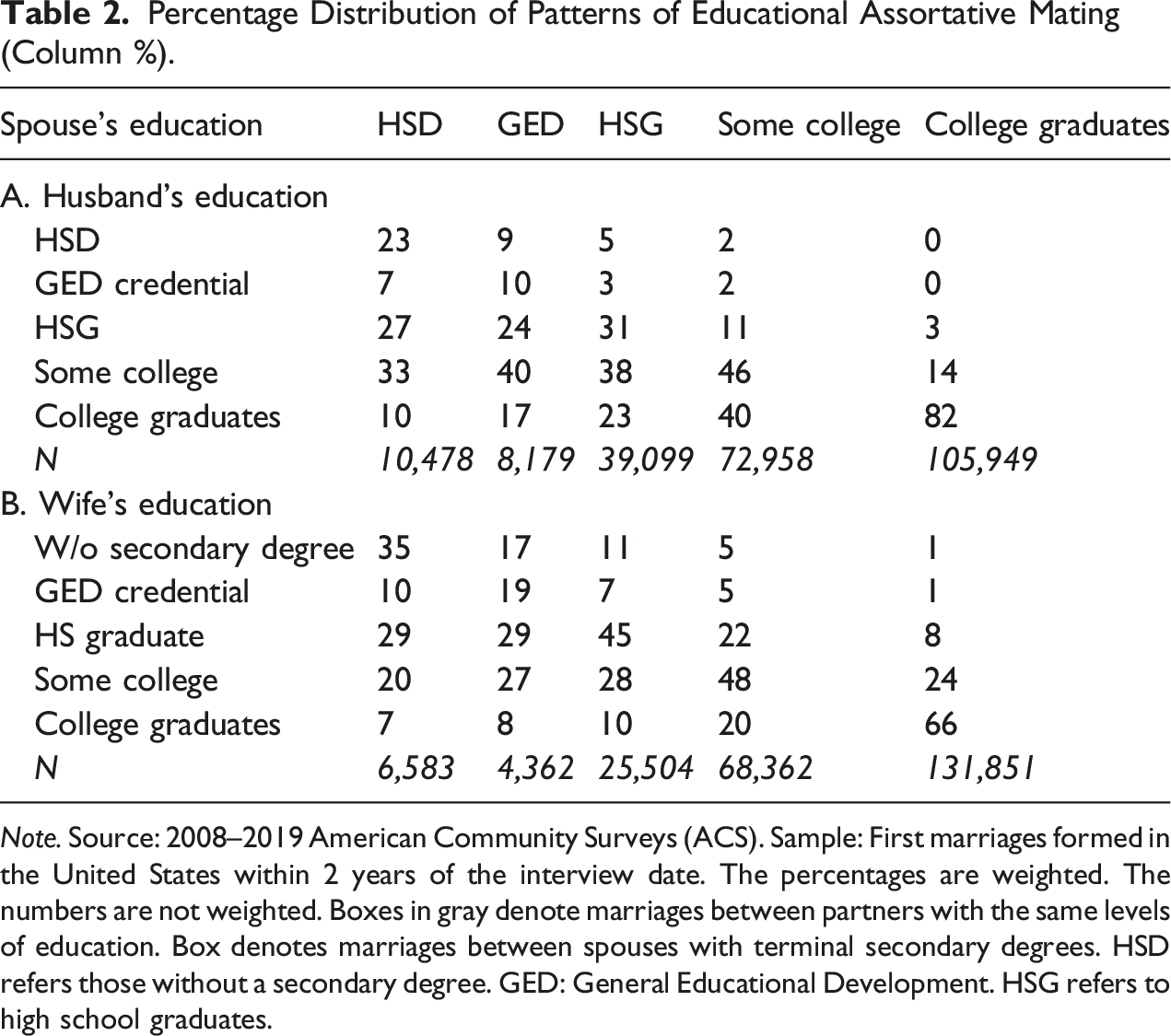
Note. Source: 2008–2019 American Community Surveys (ACS). Sample: First marriages formed in the United States within 2 years of the interview date. The percentages are weighted. The numbers are not weighted. Boxes in gray denote marriages between partners with the same levels of education. Box denotes marriages between spouses with terminal secondary degrees. HSD refers those without a secondary degree. GED: General Educational Development. HSG refers to high school graduates.
Women’s assortative mating patterns closely mirrored the corresponding patterns for men (Panel B). Three exceptions exist. First, women without a high school diploma were more likely than their male peers to marry a spouse with the same level of education. Second, female college graduates were less likely than their male peers to marry another college graduate. Third, women were more likely than their men to marry “down” educationally. These gender asymmetries likely reflect women’s recent educational advantage over men (DiPrete & Buchmann, 2013).
Group differences in assortative mating patterns reflect disparities in (a) preferences for a spouse of a certain level of education, (b) opportunities for individuals of varying levels of education to interact with one another, and (c) group size. Assessing the relative social status of GED recipients vis-à-vis HSG requires measuring (a) and (b) independent of (c). Therefore, in the section that follows, we describe results from log-linear models to assess the permeability of specific educational boundaries, net of marginal differences in group size (c).
Log-Linear Models
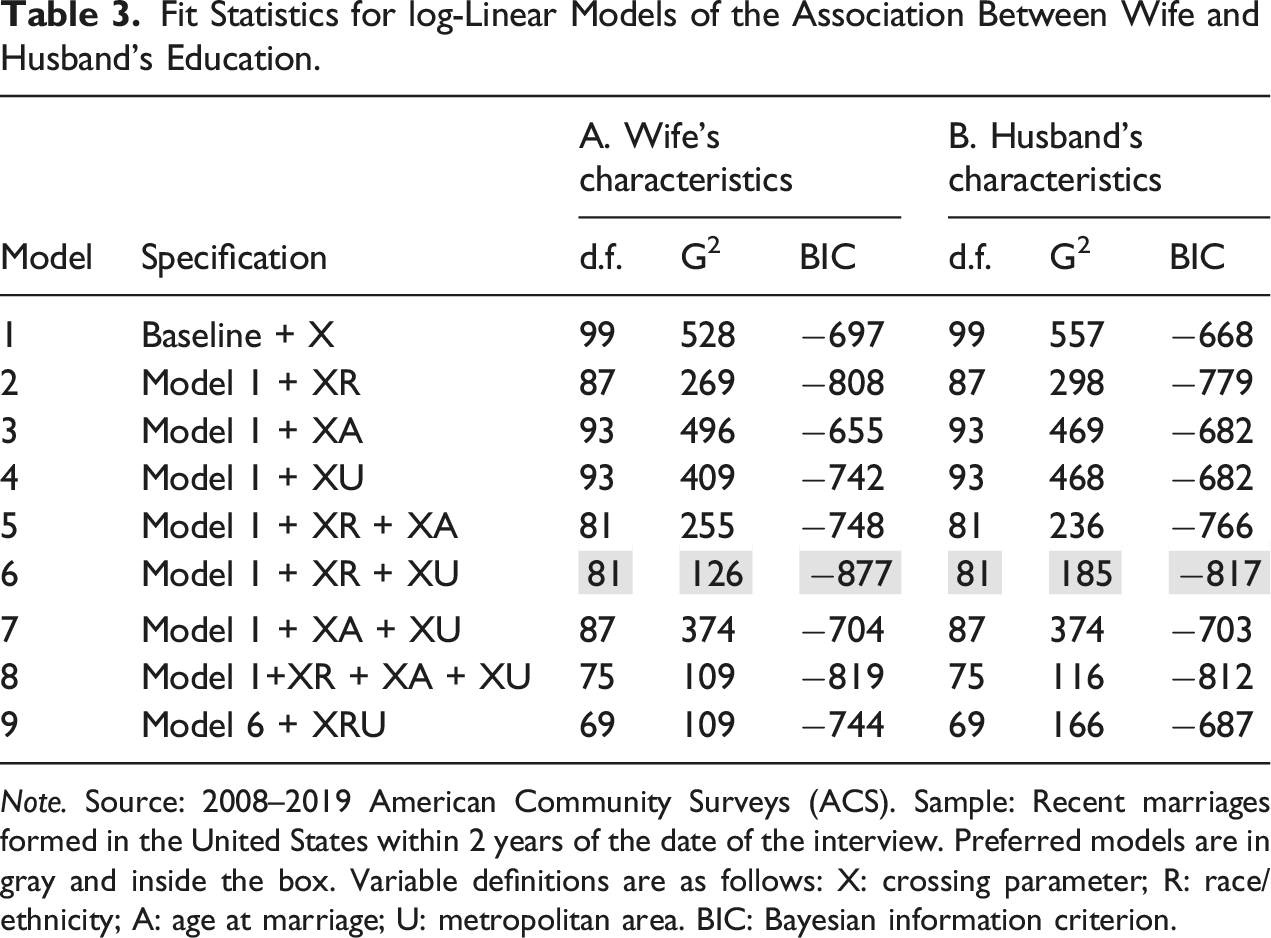
Fit Statistics for log-Linear Models of the Association Between Wife and Husband’s Education.
Note. Source: 2008–2019 American Community Surveys (ACS). Sample: Recent marriages formed in the United States within 2 years of the date of the interview. Preferred models are in gray and inside the box. Variable definitions are as follows: X: crossing parameter; R: race/ethnicity; A: age at marriage; U: metropolitan area. BIC: Bayesian information criterion.
Model 1 assumed that educational assortative mating patterns did not vary according to the husband’s characteristics and the couple’s place of residence. This model specification yielded a negative BIC, which means that this model fits the data better than the saturated models. Models 2 to 4, successively, added two-way interaction terms between the crossing parameters and a dimension of sorting (i.e., race/ethnicity, age at marriage, and place of residence). Model 2 added the interaction between the crossing parameters and the husband’s race/ethnicity (XR) to Model 1. Model 3 added the interaction between the crossing parameters and the husband’s age at marriage (XA) to Model 2. Model 4 added the interaction between the crossing parameters and the couple’s place of residence (XU) to Model 3. The addition of each two-way interaction term (i.e., XR, XA, and XU) improved model fit.
Models 5 through 8, successively, added multiple two-way interaction terms among the crossing parameters and the other covariates (i.e., race/ethnicity, age at marriage, and rural/urban status). The addition of XA to Model 2 worsened model fit (Model 5), whereas the addition of XU to Model 2 improved model fit (Model 6). Model 9 added the three-way interaction among the crossing parameters, husband’s race/ethnicity, and couple’s place of residence (XRU) to Model 6 (XR + XU). Adding XRU worsened model fit. The addition of any three-way or four-way interaction terms also worsened model fit. Thus, our best fitting model was Model 6, which is the model including two-way interactions between the crossing parameter and race/ethnicity and the crossing parameter (XR) and place of residence (XU).
The overall implication is husband’s race/ethnicity and the couple’s place of residence independently shaped educational assortative mating patterns, but these sorting dimensions did not interact with one another dimension to affect marital sorting. That is, racial/ethnic differences in educational assortative mating patterns did not vary by place of residence. Independent of race/ethnicity, age of marriage did not shape marital sorting along educational lines.
Educational Assortative Mating Patterns
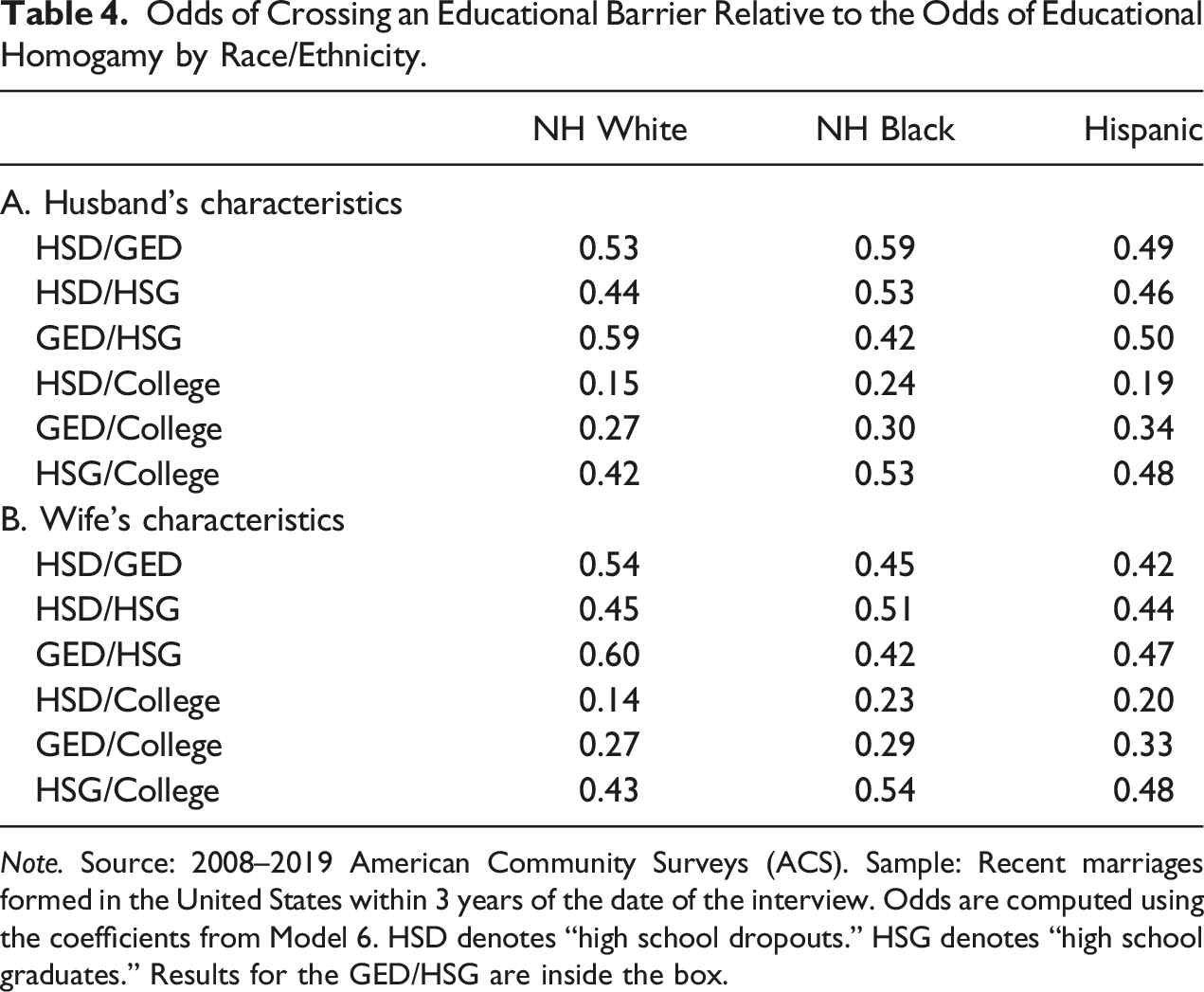
Odds of Crossing an Educational Barrier Relative to the Odds of Educational Homogamy by Race/Ethnicity.
Note. Source: 2008–2019 American Community Surveys (ACS). Sample: Recent marriages formed in the United States within 3 years of the date of the interview. Odds are computed using the coefficients from Model 6. HSD denotes “high school dropouts.” HSG denotes “high school graduates.” Results for the GED/HSG are inside the box.
The GED/College boundary is less permeable than the HSG/College boundary. For example, among NH White men, the odds of intermarriage between GED recipients and those with a college education are 36% lower than the odds of intermarriage between HSG and those with a college education:
NH Blacks and Hispanics had greater difficulty marrying across the GED/HSG boundary than NH Whites. The odds of crossing the GED/HSG boundary were roughly 30% lower for NH Black men than for NH White men:
Panel B compares the odds of crossing educational barriers by wife’s race/ethnicity. Analysis of variation in marital sorting patterns by wife’s education yielded similar results, albeit with some differences in terms of the size and significance of the coefficient.
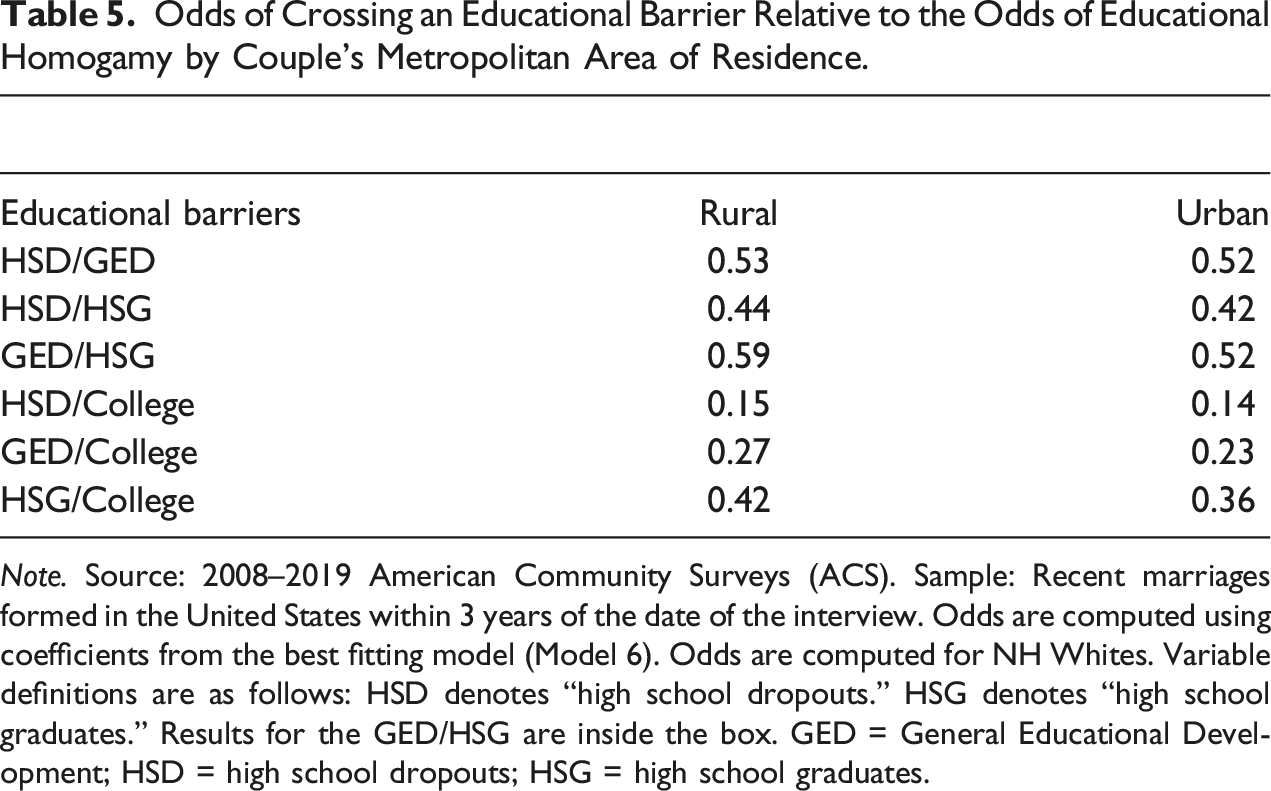
Odds of Crossing an Educational Barrier Relative to the Odds of Educational Homogamy by Couple’s Metropolitan Area of Residence.
Note. Source: 2008–2019 American Community Surveys (ACS). Sample: Recent marriages formed in the United States within 3 years of the date of the interview. Odds are computed using coefficients from the best fitting model (Model 6). Odds are computed for NH Whites. Variable definitions are as follows: HSD denotes “high school dropouts.” HSG denotes “high school graduates.” Results for the GED/HSG are inside the box. GED = General Educational Development; HSD = high school dropouts; HSG = high school graduates.
Discussion and Conclusion
The GED credential is designed to be an equivalent degree to the high school diploma. Yet, growing evidence indicates that GED recipients are more disadvantaged than HSG. Compared to HSG, GED recipients have worse labor market and health outcomes (Heckman et al., 2014; Zajacova, 2012). These findings raise the following question: is a GED credential socially equivalent to a high school diploma in other contexts, including in the marriage market? Although educational assortative mating patterns have been widely used by social scientists to assess the social distance across educational groups, surprisingly little research has attended to the marital sorting behavior of GED recipients. To address this gap in the literature, this study examined the mate selection of GED recipients. This study yielded several noteworthy findings.
Our results detract from the view that GED is an educational credential equivalent to a regular high school diploma in terms of social status. Logically, if the GED credential is a degree equivalent to a high school diploma and confers the same social status, we would expect higher rates of intermarriage between GED and HSG partners than between GED/college or HSG/college partners. Instead, we find the odds of crossing the GED/HSG boundary were not significantly different from the odds of crossing the HSD/GED boundary. The HSG/college also proved to be far more permeable than the GED/college boundary for all racial groups. These results suggest that GED recipients are less attractive mates and perceived to be of lower status than those with a traditional high school diploma. These results align well with the findings from several past studies about the outcomes of GED recipients (e.g., Heckman & LaFontaine, 2010; Ou, 2008). Nevertheless, we acknowledge the possibility that GED recipients may be less desirable mates than HSG partially because GED recipients spent a portion of their adulthood as “HSD” and another portion of their adulthood as a “person with a secondary degree.” Even if they were to receive a GED at the time of marriage, that GED recipients’ cumulative financial situation (e.g., debt and assets) or job history (e.g., job training) may be less favorable than traditional HSG, rendering them less attractive mates.
Second, NH Blacks and Hispanics had greater difficulty crossing the GED/HSG boundary than NH Whites. Furthermore, the GED/HSG boundary is more rigid than the HSD/GED boundary for NH Blacks, whereas the rigidity of the GED/HSG is not significantly different from that of the HSD/GED boundary for NH Whites and Hispanics. This pattern may emerge partially because the returns to a GED may be lower for racial minorities than for NH Whites. Specifically, due to labor market discrimination, many racial minorities with a GED credential may have been relegated to precarious service economy jobs (Kalleberg et al., 2000). The returns to education may be lower for those employed in those jobs. Supplementary analyses revealed that GED/HSG differentials in personal income are larger for racial minorities than for NH Whites. The distinctions between GED recipients and HSG may be more salient among racial/ethnic minorities. This sorting pattern may also emerge because higher shares of minority GED recipients received their credentials in prison (Heckman et al., 2014). The perceived association between GED credentials and imprisonment may reduce the value of GED credentials in these communities. Future empirical work with adequate data should identify the mechanisms contributing to racial/ethnic differences in the sorting behavior of GED recipients.
Third, consistent with work on GED recipients in rural settings, we find that rural residents are more likely to cross the GED/HSG boundary than are urban residents. This difference could have arisen due to the relatively higher social standing of GED recipients in rural communities arising from the geographic barriers to enrolling in adult learning courses and taking the GED exam in these communities. Future work should examine the barriers to educational attainment for rural residents and their implications for their mate selection behavior.
Like all empirical studies, this paper is not without limitations. First, ACS did not collect respondents’ educational histories. Consequently, we documented variations in the mate selection behavior of respondents according to their highest completed levels of education at the date of the interview. There may be a small share of GED recipients who completed their schooling in the 3 years between the year of marriage and the year of interview. Second, like most studies of intermarriage, sample size constraints prevented us from employing a two-sex model to describe educational assortative mating patterns (Fu, 2010). Thus, although we could assess whether the GED/high school graduate boundary was more permeable than the high school dropout/GED boundary, we could not compare the permeability of the boundary involving female GED recipients and male HSG with that of the boundary involving male GED recipients and female HSG. Future work relying on a larger sample should test whether female GED recipients have greater ease crossing educational barriers than their male peers. This study also offers a descriptive analysis of the assortative mating patterns of GED recipients using log-linear models. Like other studies of educational assortative mating relying on log-linear models, this study is not meant to establish causal links or to identify the mechanisms contributing to these patterns. Nonetheless, we provide an important first step by ascertaining the social distance between GED recipients and HSG through examination of the relative permeability of the GED-high school graduate boundary. Future work should determine the extent to which the barrier between GED recipients and HSG represents the effect of receiving a GED versus underlying characteristics predictive of secondary degree type. A promising area of study is ascertaining the extent to which poorer noncognitive skills shape the sorting behavior of GED recipients.
Despite these limitations, this study contributes to the body of work shedding light on the value of the GED credential. Specifically, these findings about the mate selection behavior of GED recipients further corroborate the view that a GED credential is not socially equivalent to a regular high school diploma. Such insight has important practical implications. Our findings may inform high school students’ decision to leave or remain in and graduate from high school. Educational statistics should also discontinue the practice of combining HSD and regular HSG. Our findings add to the evidence that GED recipients are a social group distinct from those with a high school diploma.
Footnotes
Acknowledgments
A previous version of this paper was presented at the 2019 annual meeting of the Research Committee 28 Social Stratification in Princeton, NJ.
Declaration of Conflicting Interests
The author(s) declared no potential conflicts of interest with respect to the research, authorship, and/or publication of this article.
Funding
The author(s) received no financial support for the research, authorship, and/or publication of this article: This work was supported by Western University’s Faculty Research Development Fund.
