




Abstract
Research shows that women engage less in online political discussions than men, but it remains unclear under what conditions this gender difference intensifies. Using a unique survey experiment with a demographically representative sample of 1,032 individuals, the authors examine how negative feedback mechanisms, a critical aspect of the online environment, affect men’s and women’s intention to participate in these discussions. The authors focus on two feedback mechanisms: dislike and deletion. The findings suggest that dislike does not discourage women from participating in online political discussions. However, women show significantly lower participation intentions when their posts risk deletion. In contrast, men’s participation intentions are not deterred by either feedback mechanism. These findings suggest that context-specific feedback mechanisms are important in understanding the gender gap in online political participation, emphasizing women’s sensitivity to online environments where their contributions might be erased.
Citizens’ everyday political talk forms the foundation of a functioning public sphere in democratic societies (Habermas 1991). Yet both in scholarly work and popular beliefs, women have been traditionally perceived as “the silent sex” in political discussions and deliberations (Karpowitz and Mendelberg 2014). Research on public political discussions reveals that men often dominate conversations in various political settings such as committee hearings, town meetings, radio call-in shows, letters to newspapers, and general public dialogues (Bryan 2010; Conover, Searing, and Crewe 2002; Davis and Owen 1998; Kathlene 1994; Perrin and Vaisey 2008). Although the rise of the Internet and social media sites promised new avenues for expression, scholars have noted a persistent gender gap in online political expression, with women being less active in online political talk than men (Bimber 2000; Bode 2017; Lilleker, Koc-Michalska, and Bimber 2021; Vochocová, Štětka, and Mazák 2016). As the online space has become an increasingly important realm of political and social life, such a gender disparity could substantially impede women’s voices in the public sphere.
Previous studies have attributed the gender gap in online political discussions to an array of factors, including socioeconomic factors (e.g., Bimber 2000), Internet skills and experiences (e.g., Hargittai and Walejko 2008), psychological factors (e.g., Bear and Collier 2016), and hostile online environments (e.g., Abendschön and García-Albacete 2021). Although these studies suggest reasons for lower participation rates among women, they rarely address why the gender difference is more pronounced in some settings than others. We contend that answering this question requires a contextual understanding of the gender dynamics in online political discussions. Sociologists recognize that individual engagement in public political conversations is contingent upon the specific context in which the conversation occurs (Eliasoph 1998; Lichterman and Eliasoph 2014). In particular, settings of political discussions can be gendered: they often bear specific norms and rules that lead to the differential participation between men and women (Karpowitz and Mendelberg 2014; Polletta and Chen 2013). Although these studies shed light on the context of public discussions, there has been limited research on how contextual or environmental factors affect the gender gap in online political discussions.
To address this limitation, in this study we focus on a critical aspect of online environments: negative feedback mechanisms (i.e., features that allow users to express disapproval of content) such as downvotes on Reddit and dislikes on YouTube. Negative feedback mechanisms are a pervasive element that shapes the permissible forms of online interactions and significantly affects individuals’ willingness to participate in online discussions (Cheng, Danescu-Niculescu-Mizil, and Leskovec 2014; Deolankar, Fong, and Sriram 2023; Scissors, Burke, and Wengrovitz 2016). However, despite its importance, little research has investigated whether and how negative feedback mechanisms may differently affect the online participation of men and women. Studies have shown that women, in general, may be more sensitive to social cues of rejection or disapproval because of societal pressures and expectations regarding conformity and agreeableness (Abendschön and García-Albacete 2021; Coffé and Bolzendahl 2017). Meanwhile, women often encounter and perceive higher levels of hostility in online environments (Kenski, Coe, and Rains 2020; Nadim and Fladmoe 2021). This heightened sensitivity and increased exposure to hostility could make negative feedback particularly useful mechanisms for understanding the gender gap in online political discussions.
Using an original vignette survey experiment with a demographically representative sample, we examine the impact of negative feedback mechanisms on men’s and women’s intention to participate in online political discussions. Analytically, we distinguish between two specific online feedback mechanisms: (1) dislike (i.e., providing “dislikes,” “downvotes,” or other one-click negative feedback to a post) and (2) deletion (deleting a post). The results show that reactions to the negative feedback mechanisms differ by gender. Yet the impact of these mechanisms is not uniform but varies depending on the specific types of negative feedback one might receive. These findings highlight the importance of contextual-level mechanisms when understanding the gender gap in online political discussions. We conclude with directions for future research.
Background
Gender Gap in Online Political Discussions
Prior research has identified the persistent gender gap in public political discussions, although many of these discussions have moved from traditional face-to-face settings to the digital sphere. Although early studies considered the online sphere as male dominated (Bimber 2000; Ono and Zavodny 2003, 2007), more recent studies suggest that women are not underrepresented in online political participation (Gil de Zúñiga et al. 2010; Lilleker et al. 2021), especially among the most active participants (Vochocová 2018). However, the gender gap in online participation varies depending on the forms of engagement. For example, Bode (2017) observed that women tend to strategically engage in online political behaviors that are less visible and less likely to offend other people, such as unfriending people for political reasons, whereas men are more likely to engage in political behaviors that are visible, such as posting political information. Similarly, Peacock and Van Duyn (2023) noted that men are more likely to comment online, whereas women are more likely to read comments but not write comments themselves. Vochocová et al. (2016) examined online political expression in the Czech Republic and showed that gender remained an important predictor of online actions that demanded efforts and exposure, such as posting politically relevant comments. Overall, most studies agree that gender disparity remains regarding expressive forms of online participation, with a few exceptions focusing on specific segments of the population, such as active social media users (Gil de Zúñiga et al. 2010; Vochocová 2018).
Why Gendered Participation in Online Political Discussions?
One dominant framework for explaining the gender gap in online political discussions is the skill gap approach. A long tradition of research in political participation has underscored how women’s disadvantaged position in society and in family relations has historically hindered women’s involvement in political discourse. Although the impact of traditional barriers such as education, income, and family obligations has diminished with the rise of the Internet (Bimber 2000; Vochocová et al. 2016), structural inequalities persist in the form of divergent Internet skills and experiences (David and Phillips 2023; Martínez-Cantos 2017). The skill gap explanation views the gender disparity in online participation stems from differential Internet skills and experiences blended with various demographic and socioeconomic factors (Correa 2010; Hargittai and Shaw 2015; Hargittai and Walejko 2008; Shaw and Hargittai 2018). Empirical findings have shown that, on average, women tend to have lower levels of Internet skills and experiences compared with men. Moreover, higher levels of Internet skills predict a much greater probability of contribution for men than for women (Hargittai and Shaw 2015). High-skilled users are also more likely to hear about and use platforms that are designed for public discussions, which further exacerbates the gender gap (Hargittai and Litt 2011; Shaw and Hargittai 2018; Wasserman and Richmond-Abbott 2005).
Another line of explanation focuses on the psychological underpinning of the gender gap in online political discussions. Studies in this area emphasize the gendered processes of socialization that shape both the sociocultural norms and the different psychological experiences of men and women when engaging in online political discussions. For instance, although men and women may not significantly differ in their actual online skills, women often tend to underestimate their technological abilities. This pattern can subsequently translate into divergent online behavior of men and women and the online activities they engage in (Hargittai and Shafer 2006). Women also tend to require a higher perceived level of competence to engage in political content, especially in highly visible activities such as sharing and commenting (Preece 2016; Lilleker et al. 2021). Moreover, women are more likely to express concerns about privacy issues when creating or sharing content online (Hoffmann, Lutz, and Meckel 2015) and prefer participating in a bounded, safer online environment (Lilleker et al. 2021). Last, some scholars argue that the often confrontational, conflict-based character of public discussion, intensified in the anonymous online sphere, is more congruent with the traditional masculine gender roles, which further discourages women from online participation (Abendschön and García-Albacete 2021; Bear and Collier 2016; Collier and Bear 2012).
Together, these findings suggest that the psychological costs of participating in online political discussions are higher for women, particularly within hostile and conflict-ridden online environments. This observation echoes with another group of research that focuses on how the social media environment may introduce new challenges and additional constraints for women to engage politically online. Compared with traditional settings of political discussions, the Internet and social media have raised concerns about the hyperhostility of public debate and the silencing effects of online uncivil behaviors. Importantly, a growing body of research has explored the gendered characters of online hostility, pointing out that women are particularly vulnerable to uncivil or hostile behaviors in online environments (Kenski et al. 2020; Nadim and Fladmoe 2021; Sobieraj 2018; Vochocová 2018). The high level of online hostility may lead women to self-censor, switch to anonymous commenting, or withdraw from online engagement (Jane 2014; Sobieraj 2020). Additionally, hostile online environments can silence women by restricting the topics they can publicly discuss and by limiting the ways they can discuss them (Sobieraj 2018). As such, the gendered nature of online toxicity, hatred, and incivility may serve as another important reason underlying the gender gap in online political discussions.
Although these lines of research laid the groundwork for understanding the gendered patterns of online participation, an important gap remains. That is, although the context specificity is important in shaping political participation in traditional offline settings (Karpowitz and Mendelberg 2014; Perrin 2005; Polletta and Chen 2013), most existing research did not set out to examine gender differences across online contexts. In other words, why is the gender gap in online political expression larger in some settings than in others? Despite little research using cross-context examination, we do see some evidence of variation in the size of the gender disparity across online settings. For example, Koc-Michalska et al. (2021) found that the gender gap in political posting was more pronounced on Twitter than on Facebook, possibly because of the heightened prevalence of “mansplaining” experienced by women on Twitter. To better understand when gender differences in online political discussions may be amplified or diminished, we need to pay more attention to the contextual-level mechanisms within the online sphere.
Negative Feedback and Online Participation
The aim of this study is to address this research gap by examining a specific aspect of online contexts: negative feedback. Giving and receiving feedback is a fundamental part of people’s experiences in online political discussions (Cheng et al. 2014). Social media platforms and online forums provide a space for people to connect with each other and discuss a variety of social and political issues. To facilitate this process, platforms and Web sites typically incorporate peer feedback mechanisms as a means of social interactions, which can be expressed via “upvotes” and “downvotes,” “likes” and “dislikes,” giving “badges” and “hearts,” making comments, banning users, and so on. Within online environments where face-to-face interactions are lacking, incoming and outgoing feedback serves as important social cues that send signals to both the person who creates the content and the observers of online discussions. This, in turn, allows people to reduce uncertainty, form impressions, develop affinity, and gauge other people’s opinions (Jin et al. 2015; Scissors et al. 2016).
Peer feedback has important implications for individuals’ online participation behaviors (Eckles, Kizilcec, and Bakshy 2016). Research in the fields of communication and social media has examined how feedback influences online content creation and participation behaviors. This research often focuses on positive feedback and identifies a consistent positive relationship between positive feedback and online content creation (Burtch et al. 2022; Eckles et al. 2016; Scissors et al. 2016). The effect of negative feedback on individuals’ participation behaviors, however, remains inconclusive. Some studies have shown that negative feedback results in a feeling of cyber-rejection and threatens users’ sense of belonging and self-esteem, which discourages individuals from online participation (Lutz and Schneider 2021). Other studies, on the other hand, have revealed that negative feedback may stimulate user participation by providing insights into preferred types of content or motivating users to post more for the purpose of reputation management (Cheng et al. 2014; Deolankar et al. 2023; Zhu, Khern-am-nuai, and Yu 2021). For example, using data from Reddit, Deolankar et al. (2023) found that receiving negative peer feedback increases a user’s subsequent posting and moderates the intensity of subsequent content, especially when the original post has extreme viewpoints.
Although studies have examined the impact of negative feedback on online participation behaviors, little research has explored its role in shaping the gender gap in online political discussions. Considering the unique challenges women face when engaging in these discussions, we contend that research on online political discussions should consider the role of negative feedback and investigate whether and, if so, how it affects men and women differently. As previously discussed, women generally require a higher perceived level of competence to participate and frequently underestimate their own abilities in online political discussions. Negative feedback, such as dislikes or derogatory comments, can reinforce these insecurities and exacerbate feelings of inadequacy, leading to women’s lower participation. In addition, given the gendered nature of online hostility, women are more likely to receive harsher feedback and become the targets of online harassment and abuse. Such negative feedback, when viewed through the lens of an already hostile online climate, can be powerful in deterring women’s participation. Together, these rationales suggest that negative feedback may serve as an important contextual factor that shapes women’s participation in online political discussions.
Another limitation in most studies of the relationship between negative feedback and online participation is that they examine how participation behaviors change after receiving such feedback. Thus, it remains unclear how the presence of negative feedback mechanisms on social media sites may affect people’s initial willingness to participate. This gap is partly due to previous studies’ reliance on behavioral data from social media platforms, which rarely capture the “null” cases (i.e., individuals who choose not to participate in the first place). This oversight, however, can be particularly problematic when understanding gender-specific reactions to negative feedback, given the different starting levels of participation between gender groups. In other words, if women are already less likely to participate in online political discussions than men, ignoring how negative feedback mechanisms affect initial participation intentions overlooks a critical aspect of how negative feedback affects different gender groups.
To address these limitations, this study examines whether and, if so, how the presence of negative feedback mechanisms influences men’s and women’s intentions to participate in online political discussions. Below, we detail the specific mechanisms of negative feedback examined in this research.
Operationalizing Negative Feedback
Negative feedback may manifest in different forms in online environments. In this paper, we focus on the mechanisms of negative feedback to one’s potential posting, rather than the actual feedback that a person received for their posting. Analytically, we distinguish between two specific mechanisms of negative feedback: dislike and deletion. By distinguishing between the two types of negative feedback, we aim to better characterize the types of negative reactions or experiences that individuals may encounter in online political discussions.
Dislike
By “dislike,” we refer to the one-click function that social media sites provide to express negative reactions, for example, through the “dislike” or “downvote” buttons. This mechanism is one of the primary ways for users to provide negative feedback on social media sites, as well as the most common metric used by previous studies to capture the size of negative feedback (Cheng et al. 2014; Deolankar et al. 2023; Lutz and Schneider 2021). Receiving “dislike” carries social implications. Research consistently suggests that dislikes signal disagreement, rejection, or lack of affinity from other members within the online community (Cheng et al. 2014; Lutz and Schneider 2021; Scissors et al. 2016).
Given the social meanings associated with “dislike,” we expect that women and men may react differently to the presence of dislike as an online feedback mechanism. Research on gender role socialization suggests that women are more likely to be socialized to avoid conflicts and put greater values on social relationships compared with men (Babcock and Laschever 2009). When it comes to communication styles, feminine habits of mind lead women to prefer consensual communications, whereas socially constructed masculinity tends to reward men for being more aggressive, more competitive, and less emotionally engaged (Coffé and Bolzendahl 2017; Eagly et al. 2020; Karpowitz and Mendelberg 2014). These gendered communication patterns are likely to shape men’s and women’s participation in online political discussions, especially when faced with disagreement or rejection from others. Relatedly, social expectations about gender may further shape how men and women react to the presence of dislike mechanisms online. For example, previous research has shown that “likability” is more important for women than for men to get good evaluations at work (Correll et al. 2020). Under such expectations, women may avoid putting themselves in situations in which they risk being “disliked.”
Existing empirical findings support the notion that men and women may react differently to dislike as a negative feedback mechanism. For example, Abendschön and García-Albacete (2021) found that “agreeableness” is a crucial personality trait shaping women’s online political participation. Specifically, women who score higher on agreeableness are less likely to participate in online political discussions, whereas being more or less agreeable makes no difference in the probability that a man discusses politics online. This finding suggests that disagreement in online political discussions may have a negative impact on shaping women’s intention to participate, but not as much for men. Research also shows that women are more likely than men to cite the fear of being criticized as a reason depressing their online participation (Bear and Collier 2016; Collier and Bear 2012). Instead, women are more willing to contribute in an encouraging environment where constructive feedback is provided (Shane-Simpson and Gillespie-Lynch 2017).
On the basis of these insights, we hypothesize that women’s intention to participate in online political discussions will decrease with the presence of dislike as a negative feedback mechanism, whereas men’s intention will not be affected significantly:
Hypothesis 1: Women are less likely to participate in online political discussions in a condition in which participants may receive dislikes for their opinions, compared with other conditions with no such negative feedback mechanism.
Deletion
Although dislike serves as a common negative feedback mechanism on social media sites, it is important to recognize that the negative reactions women receive online extend beyond mere dislikes. A substantial body of literature on online incivility and sexism has shed light on the multifaceted nature of these experiences, highlighting the systematic resistance against women’s voice and visibility online (e.g., Jane 2014; Ortiz 2024; Sobieraj 2018). Women encounter various types of gender-based attacks online, spanning from intimidating messages such as rape threats, to instances of public shaming and discrediting on the basis of sexist stereotypes to undermine women’s ideas and contributions (Sobieraj 2018, 2020). Women’s voices are also more likely to be considered non-notable even when they meet the inclusion criteria of the online community, rendering women’s contribution to online discourse more frequently erased (or nominated for erasing) compared with men (Tripodi 2023). As such, the negative reactions women receive in online discussions are also characterized by the fact that women’s voices are often undesired, belittled, and silenced.
Recognizing silencing as a significant component of women’s negative experiences online, the second mechanism of negative feedback we focus on is deletion, which refers to the potential of one’s post being removed by others. By examining this feedback mechanism, we are interested in whether and how men and women react differently when their voices are at risk of being silenced in online political discussions. Similar to dislikes, the deletion of posts may signal disagreement, rejection, or lack of affinity. However, it also serves as an explicit indicator of being undesired in online discussions (Cheng, Danescu-Niculescu-Mizil, and Leskovec 2021). Furthermore, these two mechanisms of negative feedback entail different consequences: deletion implies the exclusion of a user from online conversations, whereas dislikes still indicate some level of engagement, albeit negative.
Little research has directly examined the impact of potential deletion on men’s and women’s online participation. However, two lines of research help us develop initial expectations about how men and women react to the potential of post deletion in online political discussions. First, existing scholarship consistently suggests that women tend to perceive the online environment to be more hostile compared with men. Kenski et al. (2020) showed that women consistently perceive online statements as more uncivil than men do and display a higher sensitivity toward online incivility in general. Additionally, Nadim and Fladmoe (2021) examined gender differences in experiences with online harassment and found that men were more likely to report being targeted on the basis of “what they think” (i.e., their opinions and attitudes), whereas women were more likely to report being targeted because of “who they are” (i.e., individual or group characteristics). Given women’s heightened perception of hostility in digital contexts, we may expect that women are more likely to perceive deletion as a silencing of their voices rather than a mere expression of disagreement or rejection compared with men.
Second, a group of research focusing on the gender gap on Wikipedia indicates that women may experience higher levels of distress or discouragement when deletion is used as a feedback mechanism. As an encyclopedia that “anyone can edit” (Ford and Wajcman 2017), Wikipedia has struggled to attract and retain women contributors: the proportion of Wikipedia’s female contributors is about 13 percent as of 2023 (Wikimedia Foundation 2024). Scholars have identified the feedback mechanism on Wikipedia, especially the allowance of deleting or modifying other users’ content, as an important reason shaping the gender gap (Bear and Collier 2016; Ford and Wajcman 2017; Menking, Erickson, and Pratt 2019). For instance, Bear and Collier (2016) demonstrated that female participants on Wikipedia generally express greater discomfort with deleting other people’s work compared with men, which subsequently discourages their participation on the platform. Similarly, by inviting a group of women participants to use Wikipedia, Lir (2019) identified fear—the fear of being erased—as one of the key barriers participants face when contributing content to Wikipedia.
On the basis of these insights, we hypothesize that women’s participation intention will decrease in a setting where deletion is present as a feedback mechanism. As an explicit indicator of being undesired in online discussions, deletion may discourage people’s participation in general. However, its effect should be greater for women than men.
Hypothesis 2a: Women are less likely to participate in online political discussions in a condition in which participants’ posts may be deleted, compared with other conditions with no such mechanism.
Hypothesis 2b: The negative effects of deletion are more pronounced for women than for men.
Data and Methods
Experimental Design
To test our hypotheses, we designed a vignette describing an ongoing discussion in a hypothetical online forum (bold letters represent the points of manipulation varying across treatment conditions). 1 We use participation rules (i.e., written rules of what is allowed or not allowed when participating in discussions) to define the negative feedback mechanism presented in the forum. We used a 2 × 2 manipulation scheme in which the feedback mechanisms are varied by two dimensions: dislike and deletion. In the survey, respondents were randomly assigned to one of the four conditions. After reading the vignette, participants were asked to answer how likely (or unlikely) they would engage in the discussion.
You’re browsing websites and come across an online forum. This forum is having an open discussion about whether people should stay at home during the current pandemic. Some comments say people should stay at home to stop the spread of the virus. Other comments believe people have the freedom to go out as usual. This is an anonymous forum. All users can join a discussion or make a comment freely, with no need to register. The rules of participation are: first,
We used social distancing during the coronavirus disease 2019 (COVID-19) pandemic as the topic in our vignette. Our criteria for this choice were twofold: first, the topic should be perceived by respondents as a political matter; second, the topic should introduce minimal biases to the results. The challenge in selecting a discussion topic lies in determining what qualifies as a “political” issue. The answer to this question, however, is itself a result of social construction, often imbued with gender bias. Historically, issues pertinent to women have been relegated to the private sphere or marginalized in public discourse. So, we aimed to find a subject viewed as politically relevant by both genders.
In June 2020, when the survey was initially conducted, the United States was grappling with a surge in COVID-19 cases. With the 2020 presidential election on the horizon, discussions about social distancing and lockdown orders had been elevated by politicians, commentators, and mass media into central political discourse (Bennett 2020; Coppins 2020). It has also generated widespread online debates among U.S. citizens. Although subjects such as gun control and abortion are widely recognized as political topics, they tend to provoke gender-skewed levels of interest. However, as the COVID-19 pandemic spread widely across the country, social distancing became virtually a topic that resonated with a vast swathe of the U.S. population. As such, this topic had the potential to dampen, albeit not completely eliminate, the gender bias stemming from personal interests or knowledge about a specific subject.
Additionally, we minimized the requirements for eligibility to participate in the discussion, allowing individuals to “join freely” by removing the need for registration. This step was taken to mitigate the potential influence of one’s expertise and confidence in using online platforms on their intention to participate.
Data
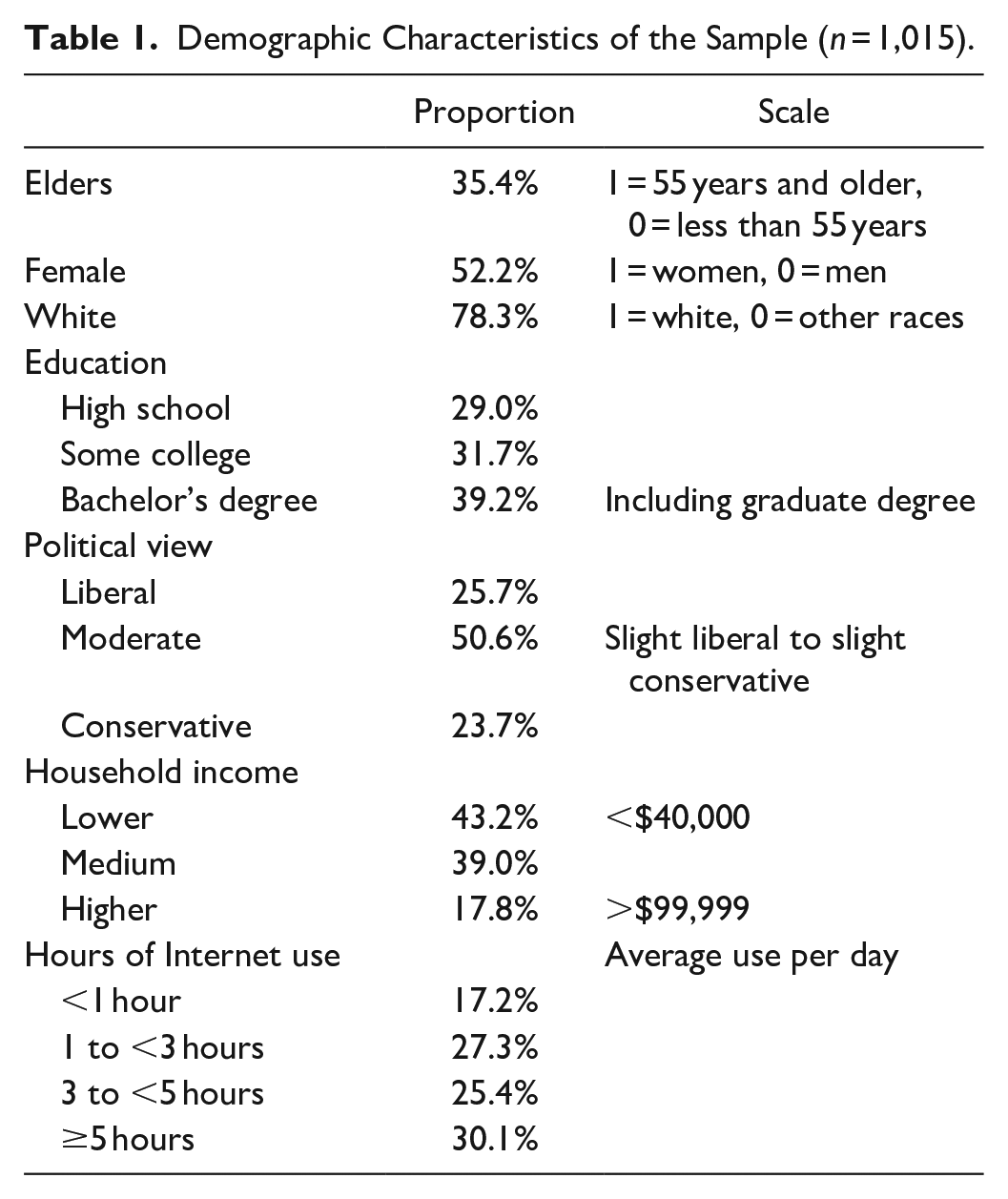
This study uses an opt-in nonprobability quota sample collected from online panels maintained by Qualtrics over two time periods (n = 1,032). 2 The first wave of data collection took place in June 2020 (n = 525) and the second wave in June 2021 (n = 507). 3 By design, respondents were randomly assigned to one of the four equally sized experimental conditions (i.e., n ≈ 250 per condition). The sample demographics are shown in Table 1. To address the sample selection bias inherent in nonprobability sampling, Qualtrics used the method of sample matching to align the distribution of key variables in the sample with the general U.S. population. To ensure the accuracy of the sample matching strategy, we compared our sample with the 2018 General Social Survey. The results show that the demographics of our sample are generally consistent with those of the target population on gender, race, income, and marital status, 4 while being slightly younger, more educated, and more extreme on political views than general Internet users. To ensure less biased and more generalizable estimates, we additionally constructed poststratification weights to adjust the differences between our sample and the target population by using the variables of education, political views, and age in the 2018 General Social Survey data. 5
Demographic Characteristics of the Sample (n = 1,015).
Measures
Outcome: Participation Intention
The outcome variable in this study is the respondents’ intention to participate in the discussion. After showing respondents the vignette, the survey asked, “In this scenario, how likely or unlikely would you be to engage in the discussion?” (responses range from 1 = “very unlikely” to 5 = “very likely”). The mean and standard deviation of participation intention in the total sample, as well as in each treatment condition, are shown in Table 2. 6
Mean Statistics of Participation Intention by Conditions and Gender.

Note: Values in parentheses are standard deviations. The significance of gender difference is marked on the coefficients for women.
p < .05, **p < .01, and ***p < .001 (two-tailed test).
Experimental Treatments: Feedback Mechanisms
The key predictors in this study are each treatment we manipulated across experimental conditions (i.e., feedback mechanisms). Specifically, we use dislike (allowed vs. not allowed) and deletion (allowed vs. not allowed) as the two manipulated points to operationalize the feedback policies representing different social meanings of participation. As a result, we generate four experimental conditions: (1) a no-treatment condition without manipulation, (2) a dislike condition with only the thumbs-down option allowed, (3) a deletion condition with only deletion of comments allowed, and (4) a dislike and deletion condition with both manipulations allowed. We created dummy variables to represent the presence or absence of each treatment condition.
Control Variables
The experimental design naturally allows us to account for unobserved variation in the sample by randomly assigning participants to each treatment condition. That said, in multivariate analysis, we control an array of demographic characters to increase the precision of estimates. The added variables include age, race, education, political views, family income, and hours of Internet use. Considering the normality assumption in regression analysis, all control variables in this study are treated as categorical variables. For example, the age variable consists of two groups, elder and younger, with the age of 55 years as its breaking point. Likewise, the education variable is divided into three groups—high school, some college, and bachelor’s degree—making the high school group a reference group in analysis. We also controlled the timing of data collection by constructing a dummy variable representing survey years to ensure the reliability of the results across time periods. The measurement of all control variables is also displayed in Table 1.
Analytic Strategies
Our analysis consists of two different tests. First, we examine mean differences between the baseline condition and each treatment condition. Specifically, we compare women’s participation intention in the no-treatment condition and each treatment condition with different negative feedback mechanisms (dislike condition, deletion condition, and dislike and deletion condition), then repeat the same sequence of analysis for men. Second, we estimate multiple regression models to verify the differential effects of negative feedback mechanisms on women’s and men’s intention to participate. In this study, the combined dislike and deletion condition serves as a proxy of the interaction between the individual dislike and deletion conditions, which represents any combined effects of multiple treatments on people’s participation intention.
Results
Tests of Mean Differences in Participation Intention
Before interpreting the main results, we briefly overview the mean participation intention of the four treatment groups in this study. Table 2 tabulates the average scores of participation intention by treatment conditions and gender. These descriptive statistics align with existing findings suggesting that women are generally less engaged in online political discussions. Overall, women’s intention to participate in the discussion is, on average, lower than that of men across all conditions, with statistically significant differences in all but the dislike condition.
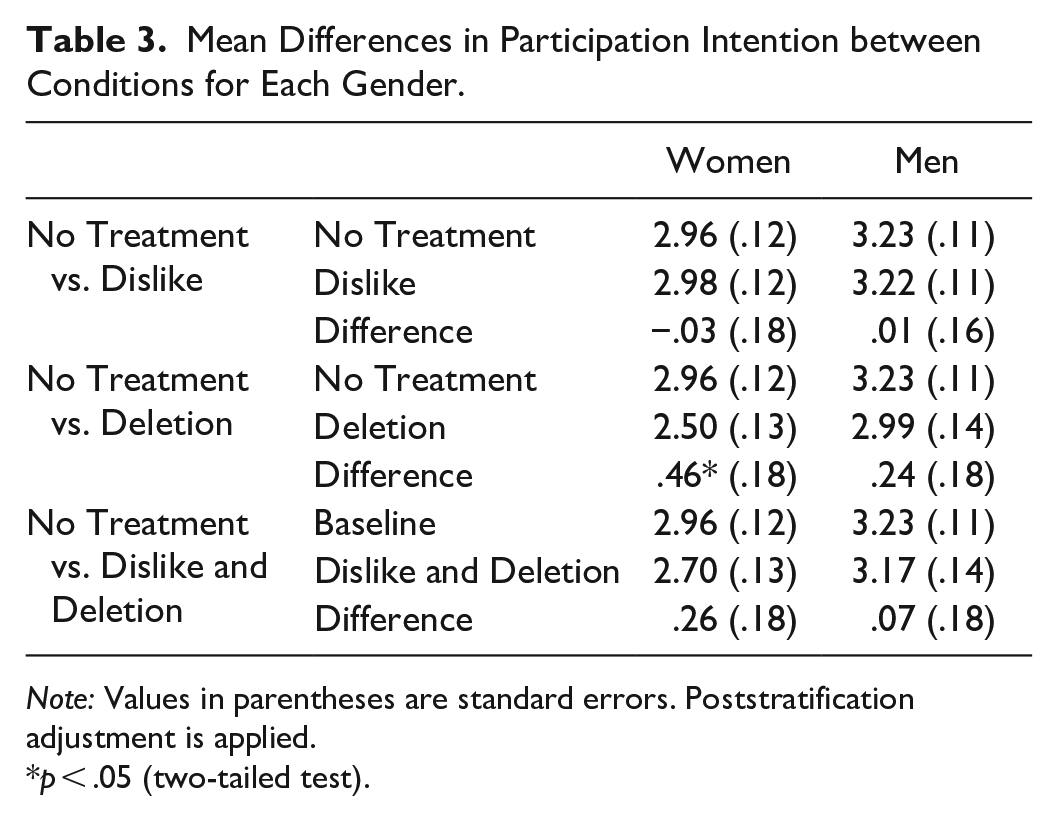
Table 3 displays the mean differences in participation intention between the no-treatment and the other three treatment conditions for both men and women. Overall, respondents show reduced means of participation intention in treatment conditions compared with the baseline no-treatment condition, although the differences are statistically not significant except for one comparison. It is worth noting that the difference between the dislike and the no-treatment conditions is the least pronounced for both genders. In fact, women’s participation intention in the dislike condition is even slightly higher than that in the no-treatment condition, though statistically not significant. Therefore, hypothesis 1, which posits that women would be less likely to participate in online political discussions in which they may face dislike for their opinions, is not supported.
Mean Differences in Participation Intention between Conditions for Each Gender.
Note: Values in parentheses are standard errors. Poststratification adjustment is applied.
p < .05 (two-tailed test).
Meanwhile, only among women, the significant mean difference in participation intention is observed between the deletion and no-treatment conditions, whereas there is no significant difference among men. Specifically, on a 5-point scale, women’s mean intention to participate in the deletion condition is .46 points lower than that in the no-treatment condition (p < .05). In comparison, although men’s mean intention to participate in the deletion condition is also lower than that in the no-treatment condition, the difference (.24) is smaller than women’s (.46) and statistically nonsignificant. 7 These results lend support to hypothesis 2a, suggesting that women are less likely to participate in online political discussions in which participants’ posts are subject to deletion. In contrast, the marginal and nonsignificant difference among men between the deletion and no-treatment conditions indicates that the potential of one’s comments being deleted does not substantially deter men’s participation as it does for women, which supports hypothesis 2b.
In the last segment of comparison intended to capture the interaction between the dislike condition and the deletion condition, the differences between the dislike and deletion condition versus the no-treatment condition show no significant results for both genders. Although we did not set any hypothesis for this comparison at the outset, we anticipated noticeable differences in participation intention, especially for women because the combined condition encompasses both elements of negative feedback mechanisms used in this study. We interpret this as evidence of why dislike and deletion represent the distinct mechanisms of negative feedback. That is, a mere combination of the two negative features might not be counted as the doubling of negative elements in the eyes of participants. Although it needs further investigation, there seem to be different social meanings attached to each condition, thus their combination might construct qualitatively different meanings about participation in online political discussions. We discuss more implications in a later section.
In sum, the tests of mean differences in participation intention show gendered responses to different mechanisms of negative feedback. To verify the differential effects by gender, we additionally conducted multivariate analyses using multiple linear regression modeling.
Multivariate Analyses for Differential Effects of Negative Feedback Mechanisms
Table 4 reports the ordinary least squares regression estimates of participation intention across different treatment conditions for each gender group. The multiple regression models enable a closer examination of how different mechanisms of negative feedback might influence people’s intentions to participate.
Ordinary Least Squares Regression Estimates of Participation Intention by Conditions for Each Gender.

Note: Values in parentheses are standard errors. Poststratification adjustment is applied.
p < .05, **p < .01, and ***p < .001 (two-tailed test).
Throughout the models, the no-treatment condition is used as the reference condition, while controlling for the demographics of respondents. As in the mean difference tests, regression estimations are performed for each gender. In Table 4, models 1 to 3 display estimates of participation intention for women, while models 4 to 6 show the results for men.
The most salient result is that in model 2, the deletion condition has the largest negative effect on participation intention for women: compared with the no-treatment condition, being in the deletion condition, on average, decreases respondents’ intention to participate by .44 (p < .01) points, while in model 1, the dislike condition shows no difference in participation intention. The results reaffirm hypothesis 2a, suggesting the discouraging effects of a condition where participants’ posts may be deleted by others on women’s intention to participate in online political discussions. Meanwhile, the negligible effect of the dislike condition for women does not align with hypothesis 1, positing women’s reluctance to participate in online political discussions in which they may confront dislikes for their opinions.
For the test of interaction between the two conditions, the results in model 3 reiterate those in the mean difference tests, showing that the dislike and deletion condition do not significantly affect women’ participation intention, although the p value of the coefficient estimate is close to the .05 significance level (p = .051). As in the mean difference test, the results do not suggest a definitive combined effect of the two treatments on women’s intention to participate. Given the smaller size of the negative effect of the dislike and deletion condition, compared with that of the sole deletion condition, this implies that there might be some contextual balancing off between the effects of the two different mechanisms of negative feedback. We discuss the implications later.
In contrast to the pronounced effect of the deletion condition for women, model 5 shows no significant effect of the same condition for men. Furthermore, the effect for men (−.22) is half the size for women (−.44). This result supports hypothesis 2b by showing that the potential of comments being deleted does not deter men’s participation as much as it does for women. Meanwhile, in model 4, the insignificant effect of the dislike condition on men’s participation intention mirrors the result in women’s model, which suggests that neither gender is markedly deterred by the potential of getting dislikes from others for what they post. These results reiterate the results of the mean difference tests, thus failing to support hypothesis 1, which posits the reluctance of women to participate in public political discussions at the risk of facing dislikes from others. After reviewing the overall effects of treatment conditions on participation intention for both genders, we find that the deletion condition appears to be the most powerful contextual cue among all treatments used in this study.
Although not the focus of this study, there are some interesting results for control variables. First, as shown in model 4, there is a strong negative effect of being older on participation intention among men under the dislike condition. Considering the general negative effects of age across the models for men, this might indicate that men’s attitudes toward online political discussions change as they become older, possibly reflecting their diminishing power in broader society. Another noticeable result is that white women show less intention to participate in online political discussions across models, compared with those in other racial groups. This might conversely indicate a strong intention to participate among minority women to make their voices heard in the public sphere. In terms of education, there seem to be contrasting effects of higher education between men and women. Across the models, women with a bachelor’s degree show less intention to participate, compared with high school graduates, whereas men with a bachelor’s degree generally show more intention to participate. On the basis of the results, we suspect that educated women are more cautious about engaging in an online public debate on political issues, compared with men.
The differing effects by gender are also observed regarding economic status measured by household income. Although significant effects are only found in the deletion condition for both genders, women with a medium household income show more intention to participate in online political discussions, compared with those with a lower household income, whereas men show the reverse relationship. We suspect that the gender gap regarding financial status might be attributed to gender roles and the division of labor within households of varying income levels. For example, women in lower income households might bear a greater burden of housework and the responsibility of providing for the family, which limits their time and energy for online political engagement, while women in medium-income households may have more resources and support. For men, the reverse trend suggests that those with medium household incomes might face more professional and societal pressure to focus on career and financial responsibilities, leaving them with less time or intention to participate in online discussions. Last, in terms of time, the insignificant effects of the survey year tell us that there is no dramatic change in participation intention between the two years during COVID-19.
Discussion and Conclusions
With much of political discourse taking place online nowadays, it is important to understand the inequalities regarding different social groups’ participation in the online public sphere. In this study, we investigate contextual-level mechanisms in producing or reducing the gender gap in online public political discussions, with a focus on one important aspect of online environments: negative feedback. Using an original survey experiment with a demographically representative sample, we examine the impact of two specific negative feedback mechanisms (dislike and deletion) on people’s intention to participate in online political discussions and how these patterns differ between men and women. We find that men and women react differently when deletion is presented as a feedback mechanism. Results from the survey experiment show that although both men’s and women’s intention to participate decreases in the condition where participants’ voices can be deleted, the negative effects of deletion are more pronounced for women than for men. Specifically, we observe a significant mean difference in women’s intention to participate between the deletion condition and the no-treatment condition, whereas for men, the difference is marginal. Meanwhile, we find that the presence of dislike as a feedback mechanism does not deter either gender from participating in online political discussions.
These findings suggest that the reactions to negative feedback mechanisms in online political discussions differ by gender. The impact of these mechanisms is not uniform; it varies depending on the specific type of negative feedback one might receive. While previous studies show that disagreement and conflicts in online political discussions can discourage women, our study reveals that women do not necessarily shy away from online political discussions because of the mere possibility of receiving dislikes or disagreement. Instead, their intention to participate declines when there is a risk that their contributions could be deleted or erased. By contrast, men’s intention to participate remains relatively unchanged regardless of the types of negative feedback involved. These patterns have implications for our understanding of online contexts in which gender gaps in online political discussions may increase or decrease. As giving and receiving negative feedback is a common aspect of online interactions, the type of negative feedback allowed within an online community could shape the gender disparity in participation: communities with a stronger erasing culture may exacerbate this gap, as women are more reluctant to engage in such environments.
Our study cannot answer why the mechanism of deletion discourages women’s intention to participate in online political discussions, whereas dislike does not have the same effect. One possible explanation is the level of negativity. Although both dislike and deletion can signal disagreement, rejection, or conflicts in opinions, deletion may be a much stronger indicator of being unwelcome in online discussions. Thus, the discouraging effect of negative feedback may only manifest when negativity is intense. Another possible explanation is that the two feedback mechanisms are interpreted qualitatively differently by respondents, especially regarding the consequences they entail. In the eyes of potential users, deletion might represent a clear exclusion from the debate by erasing a post, whereas dislikes, though negative, still indicate engagement and attention from others. If this is the case, women may be more deterred by the mechanism of deletion because it acts as a more stringent barrier to expression, silencing their voices in online discourse. On the contrary, dislikes might be seen as a normal aspect of online interactions, where disagreement is expected.
Our result from the combined condition, in which both dislike and deletion were present, provides initial insights when considering the two explanations above. If the different effects of dislike and deletion on women’s participation were solely a matter of the degree of negativity, we would expect the combined condition to deter women’s participation to an extent no less than the deletion condition alone. However, the observed decrease in the effect size in the combined condition suggests a more complex interaction between these forms of negative feedback. This finding indicates that the effects of dislike and deletion are not merely additive. Rather, the presence of dislike alongside deletion might mitigate the perceived severity of deletion alone. For example, when participants see that a dislike option is available in addition to entire erasure, they might still feel acknowledged in the discourse, albeit negatively. This partial inclusion could lessen the discouraging impact of deletion, leading to a smaller overall decrease in participation intention among women in the combined condition compared with the condition in which deletion occurs in isolation. Alternatively, this result could imply that the interplay between dislike and deletion may lead participants to interpret the feedback in a new light. For example, participants may perceive deletion as a less severe or more normal part of online interactions when paired with dislike. Overall, further research is needed to unpack how different combinations of feedback mechanisms interact to shape people’s behavior and participation in online political discussions, especially among different gender groups.
This study contributes to our understanding of gender inequalities and political participation in the digital age. To begin with, we contribute novel empirical evidence illustrating the significance of contextual factors, such as negative feedback mechanisms, in influencing the political engagement of men and women in online settings. Although sociologists have noted the importance of context specificity in shaping gendered patterns of participation in traditional face-to-face settings, there has been limited research on how contextual factors affect the gender gap in online political discussions. Often, such studies rely on qualitative interviews with female contributors or are confined to specific online communities such as Wikipedia, which limits the generalizability of their findings to the broader U.S. population (Bear and Collier 2016; Sobieraj 2018; Tripodi 2023). On the other hand, although research in social media research has emphasized the important role of negative feedback mechanisms in shaping users’ participation behaviors, few studies have explored how different gender groups may respond differently to these mechanisms. Our study bridges these gaps by examining the impacts of negative feedback mechanisms on men’s and women’s participation intention using a demographically representative sample.
Moreover, our study advances beyond previous analyses of negative feedback mechanisms, which measure negative feedback primarily using the metrics of “dislikes” or “downvotes.” We distinguish between two specific mechanisms, dislike and deletion, to better characterize the types of negative reactions men and women may encounter when engaging in online political discussions. This granular approach allows us to pinpoint which feedback mechanism significantly affects women’s intention to participate. By doing so, our findings provide valuable insights for crafting targeted interventions aimed at fostering a more inclusive online environment that equally empowers citizens, regardless of their gender. Specifically, our research indicates that the risk of deletion, rather than receiving dislikes, serves as a major barrier to women’s engagement in online discussions. Thus, for platforms, moderators, and policymakers, the key to effective intervention lies more in promoting equitable participation and creating an environment for free expression, rather than merely reducing dissents, or eliminating all mechanisms of negative feedback.
Despite its valuable insights, this study has limitations that suggest fruitful avenues for future research. First, our experiment only manipulated two types of negative feedback. We recognize that this restricted manipulation does not fully capture the diverse forms and degrees of negative feedback one might encounter in online discussions. Also, as our focus is on the presence (or absence) of negative feedback mechanisms in an online environment, people’s actual practices of negative feedback are beyond the scope of this study. For example, negative feedback may be expressed or received through comments, retweets, or personal messages, with the content ranging from expressions of differing opinions to aggressive ad hominem attacks. Although focusing on dislike and deletion, we do not intend to negate the complex nature of negative feedback on social media. By showing that simple manipulations of allowed forms of negative feedback could significantly affect women’s intention to participate in online discussions, our results underscore how women’s online political participation is highly dependent on the immediate social contexts in which these conversations occur. Future work could enhance the depth of our analysis by incorporating a more extensive array of negative feedback mechanisms to better mirror the intricate social realities that both men and women grapple with when participating in online discussions. Additionally, an exploration of potential interactions among these feedback mechanisms could elucidate how they jointly shape individuals’ participation in online political dialogues.
Second, the artificiality of the survey experiment may introduce measurement errors into our results. Participants could interpret the rules outlined in the vignettes differently. Additionally, as noted in previous studies, users do not always behave according to the norms or rules established by online communities (Goldspink 2010). Although using a hypothetical scenario of online discussion allows us to go beyond specific communities and platforms and produce generalizable conclusions, it remains uncertain to what extent our results mirror users’ actual behaviors in real-life discussions. Thus, we encourage future studies to combine experimental design with real-life behavioral data or qualitative data to further assess the validity of our findings. Alternatively, implementing simulated social media experiments could also provide insights into the impact of negative feedback mechanisms on men’s and women’s participation behavior in actual online interactions (Bail 2022).
Last, we encourage future research to explore additional contextual attributes that may influence the gender differences in online political participation. Existing studies on political participation in traditional settings have highlighted several critical factors, such as the gender composition of a community or the subjects under discussion (Karpowitz and Mendelberg 2014; Polletta and Chen 2013). Moreover, as discussed earlier, there are numerous potential reasons for gender differences in online participation, including skill levels, psychological costs, and gendered online toxicity and hostility. Future research should examine how these factors interact with contextual-level mechanisms to shape the gender gap in online political discussions. For example, it would be valuable to investigate whether the impact of negative feedback mechanisms varies among women with different levels of digital skills or self-efficacy, or how certain types of feedback mechanisms may exacerbate or mitigate online hostile or toxic behaviors. Understanding these dynamics could help us identify the conditions that will reduce the gender gap in online political discussions, offering insights for designing more effective strategies to promote equitable participation across diverse online environments.
Footnotes
Appendix: Vignettes Used in the Survey Experiment
Please read the following description about an ongoing online discussion and answer a set of questions based on it.
