




Abstract
New media are an important resource for the political participation of marginalized groups. However, there is still a lack of knowledge about the factors that influence whether this opportunity is used. Influencing factors emerge from both the Civic Voluntarism Model and previous research on migrants’ political activity. Using data collected in 2019/2020 from 486 refugees living in Bavaria, we estimate linear probability models to investigate facilitating factors for the use of new media for political participation. The analysis shows that refugees in Germany who inform themselves about politics online tend to be predominantly male, higher educated, and politically involved. Language skills and the duration of stay also appear to be important. For the expression of one’s political opinion online, gender and language skills have an impact, but informing oneself about German politics, political interest, and offline political activity in Germany are the most relevant factors. This indicates that there is a close link between on- und offline activity. However, using the internet requires particular resources, so that people with lower language skills, for example, are particularly disadvantaged.
Introduction
For a considerable period, political participation research has concentrated on citizens and their voting behavior. This is particularly evident in the German context. However, in view of the ever-increasing proportion of the population with a migration background, their political integration is becoming a focus of attention (Mays et al., 2019; Müssig, 2020; SVR-Forschungsbereich, 2020). In this article we concentrate on refugees as a sub-group of migrants. We define them as persons seeking protection, which includes all foreigners who are in Germany for humanitarian reasons as well as their family or household members. This includes persons with open, recognized and rejected protection. In 2015 and 2016, Germany registered 1.2 million refugees from Syria, Afghanistan, Iraq, and various African countries (Bundesamt für Migration und Flüchtlinge and Forschungszentrum Migration, Integration und Asyl, 2022, p. 76). Currently, Syrians are the third largest group of foreign nationals in Germany (Bundesamt für Migration und Flüchtlinge and Forschungszentrum Migration, Integration und Asyl, 2022, p. 156). These figures draw attention to this part of the population. Furthermore, refugees have the potential to influence political life and democratization both in their host countries and in their countries of origin (Bekaj & Antara, 2018). This makes the target group an especially promising subject for participation research. However, research in this field remains scarce, particularly in the German context (Bekaj & Antara, 2018; Ragab & Antara, 2018).
In Germany, refugees are limited in their political participation due to a lack of participation rights regarding electoral and other institutionalized activities (Schmidbauer & Haug, 2022; Ragab & Antara, 2018). Furthermore, their activities are constrained by, for instance, their precarious residence status and negative stereotyping (Ragab & Antara, 2018). In contrast to these obstacles, refugee protests have emerged in Germany and around the world (Bekaj & Antara, 2018). This raises the question of the factors that influence the political participation of refugees.
With political participation forms evolving in the online sphere, there are several opportunities for marginalized groups to be heard (Karadas & Zerback, 2019; Kissau, 2007). Therefore, it is of great importance to consider these new forms of engagement when assessing the situation of refugees. However, there are concerns that marginalized groups may be particularly affected by the digital divide (Elliott & Earl, 2018). While previous studies have examined the media behavior of refugees before, during and after their flight (Alencar, 2020; Gillespie et al., 2018; Leung, 2009; Witteborn, 2014), there is a need for further research into media use of refugees for political participation in Germany. It is evident that refugees are politically active online utilizing their voice to organize protests or to raise funds via the internet (Marlowe, 2019; Rae et al., 2018). But there is still a lack of knowledge about political internet use. In particular, how refugees inform themselves about politics online, who expresses their opinion online and what skills are necessary in order to do so.
We attempt to fill this research gap by analyzing internet use as well as two dimensions of the online political participation (political information and the expression of political opinions). For this we compute linear probability regression models using the data of a standardized cross-sectional survey of 486 refugees in Bavaria (a federal state of Germany) at the tur202/2020. The data was collected in the research project DePaGe (Democracy Acceptance and Participation of Refugees) at the East Bavarian Technical University of Regensburg as part of the Bavarian Research Network on the Future of Democracy (ForDemocracy).
This article is made up of five sections. In Section 2, a comprehensive review of literature is performed to identify the mechanisms of on- and offline political participation with a special focus on migrants and refugees. Section 3 introduces the methodology and data base of the analysis. Section 4 presents our results in three steps: frequency of internet use, political information online, and expressing one’s opinion online. Section 5 discusses our findings and describes the limitations of this paper, including recommendations for future research.
Theoretical Backgrounds
On- and Offline Political Participation
Political participation includes activities such as protesting, demonstrating, contacting, and voting for decision-makers. Informing oneself politically or discussing political issues, on the other hand, is not seen as political participation. Rather, these are seen as preliminary stages that can later manifest themselves in political activity (Verba et al., 1995). With the advent of digitalization, people have started to become politically active on the internet as well. Furthermore, demands for more democratic innovations have risen and many new offline and online instruments have been developed to enrich representative democracy (Gibson & Cantijoch, 2013; Oser et al., 2013; Theocharis, 2015; Theocharis et al., 2022). Online instruments include invented spaces that are developed from below and invited spaces that are offered from above, such as from the state or from municipalities (Kersting, 2013). Often, online participation tools mirror analog forms of participation such as contacting politicians, making donations, or setting up petitions. Due to the many advantages offered by the internet, such as independence of time and place and the potential to reach many people, offline and online forms of participation are often combined and used as a form of blended participation (Kersting, 2013; Vaccari & Valeriani, 2018). However, there is much debate as to whether the expression of political opinions can be political participation, especially in the online world where clicktivism or slacktivism is gaining ground (Theocharis, 2015). We follow the argument, that expressing one’s opinion online is different than offline. The internet has the potential to influence public opinion by wider dissemination of political views, which in turn may affect political decisions at least indirectly (Gibson & Cantijoch, 2013; Zerback & Fawzi, 2017). We therefore consider the expression of political opinions on the internet as political participation and information about political issues on the internet as a preliminary stage.
It can be assumed, that the same factors that influence offline forms of political participation also influence online forms of political participation (Oser et al., 2013; Sairambay, 2020). Therefore, we use the well-known Civic Voluntarism Model (CVM) as a theoretical framework. It explains political participation via individual resources as well as through political engagement and social networks (Verba et al., 1995). Further, socio-demographic factors such as gender and age are also well-known factors that influence political participation (Diehl & Blohm, 2001; Mays et al., 2019).
The introduction of new online tools has raised hopes of reaching societal groups that had previously tended not to participate. Up to now, it has often been well-educated, white and middle-aged males who have participated politically (Bryson et al., 2013; Verba et al., 1995). A debate has flared up about the impact of the new online tools. While the mobilization thesis argues that new groups, especially young people, are gained through these, the amplification thesis suspects that the same groups reached offline can also be reached online and participate even more (Jensen, 2013). As political participation is inconceivable without a minimum of utilization possibilities and related competences, equally, online media literacy must be seen as a relevant explanatory factor.
This leads to the discussion of digital divide, which describes differences in access to and the use of information and communication technologies (ICTs; Elliott & Earl, 2018; Norris, 2001). Digital divide research assumes three levels of digital inequalities. The first level divide is about material access to information and communication technology, which includes the infrastructure, but also the availability of and access to technical equipment. Factors that influence this material access are ethnic origin, education, age, gender, and income (Ragnedda & Muschert, 2015). The second level of the digital divide describes the digital skills of users of information and communication technologies. According to this, people with a high socio-economic status, who have had more resources to develop digital skills, find it easier to use these technologies (van Dijk, 2015; Zillien & Hargittai, 2009). The third level describes differences in the use of ICTs. People with a higher socio-economic status can use these technologies in a more resource-increasing way than people with a lower socio-economic status (Ragnedda & Muschert, 2015). Consequently, when considering political activism in the online sphere, the digital divide must also be taken into account alongside the familiar factors of political participation.
Internet and Media Use of Refugees
The internet plays a vital role in migrants’ integration and networking, aiding them in their daily life and in connecting with others (Kissau, 2007; Kissau & Hunger, 2009; Ritchie, 2022). Internet use, however, varies based on socio-demographic characteristics and resources, with second-generation migrants, especially younger, male, and educated individuals, showing a greater affinity (Lins, 2009; Tonassi et al., 2020). However, the focus on specific vulnerable migrant groups, such as refugees, requires further research (Horst, 2018).
Most studies that focus on refugees’ media behavior examine their relationship with the internet and digital devices before, during and after their flight (Alencar, 2020; Gillespie et al., 2018; Leung, 2009; Twigt, 2018; Wall et al., 2017; Witteborn, 2014). In these studies, the relevance of smartphones and the internet for refugees becomes clear. Within the country of arrival they are used for integration purposes, such as learning the language, finding work and housing, contacting authorities, or for approaching the host society (Alencar, 2018; Witteborn, 2014). But digital technologies are also used as “orientation devices” that enable an outlook into possible futures (Twigt, 2018, p. 2). In a German study, Emmer et al. (2016) found that 90% of the refugees interviewed use the internet almost daily. Some refugees even equate smartphones and the internet as being as important as bread and water (Gillespie et al., 2018). In her study conducted in 2016, Preißler (2017) shows that 98.6% of refugees in Germany are equipped with smartphones and the internet. In her study, it also becomes clear that the internet and smartphone are the most relevant media in a refugee’s everyday life, followed by TV and radio. When it comes to social media, refugees heavily rely on Facebook and WhatsApp, whereas email, Skype, and Twitter are used less frequently. The new waves of migrants are said to have a strong digital affinity. Diminescu (2008) even speaks of connected migrants, as migration processes have never been so digitally connected.
Media is mostly used in the native language, especially when it is used as a source of information (Richter et al., 2019). However, a digital divide is also visible amongst refugees (Kutscher & Kreß, 2015). Indeed, access and ability to use digital devices vary according to country of origin, gender and age groups (Emmer et al., 2016). While younger refugees tend to be proficient at using ICTs, older people seem to have significant difficulties (Alam & Imran, 2015). The same can be said for women who tend to lack in their digital skills, which might be explained by the low number of female media ownership in the country of origin (Preißler, 2017). Another vulnerable group are newly arrived refugees, who face the greatest risk of digital exclusion due to a lack of language skills, literacy, and financial resources. The digital divide of refugees is thus extremely shaped by income, the ability to use ICTs and access to the internet (Alam & Imran, 2015). This has serious implications for their ability to engage in online political participation.
On- and Offline Political Participation of Refugees
Most of the existing studies on political participation of refugees in Germany and around the world explore and document their political activism (Oberprantacher, 2016; Ragab & Antara, 2018). The most notable political act in Germany belongs the formation of a protest camp in Würzburg followed by a march to Berlin in 2012. This event led to a series of subsequent actions (Oberprantacher, 2016). Until now, refugees organize protests, join demonstrations, hunger-strikes or sit-ins to advocate for their rights, stop deportations or to improve their living conditions in refugee shelters (Ragab & Antara, 2018).
Migrants usually participate less actively in politics. While non-German EU citizens exhibit similar levels of political activity as German citizens, third-country nationals are less engaged (Schmidbauer and Haug 2023a). These differences persist even after controlling for the factors described in the CVM (Mays et al., 2019, p. 88; Müssig, 2020, pp. 204–205). Length of stay, language skills, knowledge about the political system, and previous political involvement are factors that are known to influence political participation among migrants (Borkowska & Luthra, 2024; Giugni & Grasso, 2020; Kassam & Becker, 2022; Ramakrishnan & Espenshade, 2001; White et al., 2008; Zapata-Barrero et al., 2013). It can be assumed that the same factors that influence migrants’ political participation also influence refugees and their political activism. However, there are still no studies that thoroughly identify the influencing factors that make refugees so particularly active.
Looking at political participation in the online sphere, most studies on refugees’ digital media use neglect their agency (Ullrich, 2017). It is therefore necessary to rely primarily on research conducted on other migrant groups. Studies on Russian-German, Kurdish and Turkish migrant groups have found that online political participation levels are generally low and that patterns differ by country of origin (Kissau, 2007; Kissau & Hunger, 2009). Kissau (2007) also found that at least for certain migrant groups, the internet can be classified as a relevant tool for political participation. In the area of online participation, e-petitions, online demonstrations, and boycotts predominate. International studies have addressed the relationship between the internet and migrants for quite some time (Elias et al., 2008; Elias & Lemish, 2009; Elkins, 1997). On the one hand, it has been shown that the internet primarily serves migrant groups for networking purposes worldwide and that this has a positive effect on organizational power since political online activities can certainly trigger offline and online participation such as mobilization for demonstrations or donations (Chekirova, 2022; Kanat, 2005). Regarding the online participation of refugees, some studies report that the internet is indeed used by refugees for political purposes (Leung, 2009, 2018; Marlowe, 2019). It is used to draw attention to specific issues, to fundraise, and to organize online and offline protests (Rae et al., 2018). Social media and platforms are also utilized to talk about political issues or to express one’s political opinion (Leung, 2009). However, the internet and social media are also often distrusted. Due to fear of espionage and racism, refugees often use pseudonyms and move anonymously on the internet or in closed groups (Dekker et al., 2018; Witteborn, 2014). How refugees use the internet to participate politically in Germany, however, still needs further research.
Hypotheses
The following analysis is conducted in three steps. First, the frequency of internet use is explored (Section 4.1): To what extent do the respondents use the internet and are there differences between different groups, similarly to a “digital divide”? According to the digital divide theory and the evidence that older people as well as women have more difficulties using ICTs, we hypothesize that gender, age, and education have an effect on the internet use of refugees.
Second, the use of the internet to access information about politics in the country of origin and in Germany as well as to express political opinions is analyzed (Section 4.2): Which of the theoretically relevant factors influence the probability of political internet use empirically? As highlated above, participation research indicates that socio-demographic and resource differences, as well as political involvement, must be considered.
We focus on two socio-demographic variables: age and gender. Overall, male refugees are presumed to be more active online than other genders. Additionally, we anticipate a strong relationship between age and the information about the country of origin, given that older respondents tend to have a stronger attachment to the politics of their country of origin. For information about the German context and the expression of political opinions, we suspect mostly middle-aged refugees to be active.
Resources are a prerequisite for political participation. In the context of migration, language skills are key, which is why we analyze them in depht. For online information, we assume that German language skills are more relevant for the German context, while the first language is more relevant when it comes to the country of origin. We assume writing and reading skills to be more relevant for accessing political information and political participation online then speaking skills. As we focus on the online-sphere, digital skills must be considered as well. Therefore, we also assume that refugees who have a higher ability to use the internet and ICTs use it more often for political purposes. From refugee research we know that the first period after arrival is characterized by administrative and integration processes, which tie up resources, especially time. Also, resources and knowledge about the political system in Germany are accumulated, making it more likely for refugees to be more politically active, especially concerning information and political expression about Germany. Therefore, we assume an increased propensity for political activities with longer duration of stay. This relationship must be considered as being limited to the first years after the arrival.
Political involvement is at the heart of political participation, as these factors can explain “why individuals might or might not want to participate” (Verba et al., 1995, p. 343). We consider political interest and political efficacy, which are central to most studies in the field. Political efficacy is typically differentiated into an internal component, which describes the feeling of being politically competent, and an external component, which focuses on the expectation that political institutions are open to influencing attempts (Balch, 1974). As we only look at whether respondents use the internet for political expression, we cannot distinguish which political issues and contexts are addressed. Therefore, we do not know which political institutions are relevant and only include political interest and internal political efficacy in the analyses, expecting both to facilitate political participation. Lastly, we consider offline political activities. As indicated by participation research, we expect those who have already been politically active, whether in Germany or abroad, to also be more politically active in the online sphere (Jensen, 2013; White et al., 2008).
The third and major step goes beyond the above-mentioned analyses and tests the theoretical considerations about the political participation of refugees on the internet in a multivariate analysis (Section 4.3): Which independent variables remain relevant for the explanation of political expression on the internet if the other tested concepts are controlled for?
Data and Methods
Data
The data basis is a standardized cross-sectional survey of refugees in Bavaria (Germany) at the turn of the year 2019/2020. The questionnaire development was theory-driven with reference to the CVM. The resulting paper questionnaire includes predominantly items from the World Values Survey (Haerpfer et al., 2022), the IAB-BAMF-SOEP survey of refugees in Germany (Schupp et al., 2018), and a survey in arrival centers for refugees in Bavaria Germany (Haug et al. 2019) with existing multilingual instruments. For (political) internet use, the items of the Arab Barometer were used. The selected questions were adapted to the survey mode and target population or translated in the seven survey languages (Amharic, Arabic, German, English, French, Farsi, and Tigrinya). The mode was primarily a written survey. Language mediators were used to explain the survey and to distribute and collect the paper questionnaires. On request, face-to-face interviews were offered (15.6% of all cases).
Due to legal reasons, a probabilistic sample from the Central Register of Foreigners was not possible for scientific projects conducted by organizations other than the Federal Office for Migration and Refugees (BAMF) until 2021 (Schmidbauer and Haug 2023b). For this reason, the research design is based on previous studies about refugees in Germany using a non-probability sampling method (Haug et al. 2019; Deger et al., 2017; Röder, 2018). The sampling used a two-stage procedure: first, cities in Bavaria were selected according to their population size (two large metropolitan areas, two small metropolitan areas, one medium-sized city and one small city). In the cities, an ad hoc survey with 377 interviews was conducted in all refugee shelters run by the district governments. Due to the outbreak of the COVID-19 pandemic the survey had to be concluded before finishing all planned inquiries. A second subsample of 109 interviews was drawn from language and integration courses. Altogether, 486 cases are available for analysis.
Sample
The respondents of the study were on average 33.6 years old at the time of the interview (SD = 10.8, MD = 31, n = 375). About three quarters were younger than 40 years (73.9%), and about one-fifth between 18 and 24 years (20.5%). The oldest respondent was 73 years old. Two-fifths (41.7%) were women, about three-fifths were men (57.8%) and two people indicated that they did not identify with either gender (0.5%). Slightly less than half of the respondents were married (48.0%) and about two-fifths (40.9%) were single. Due to the immigration history and the chosen sampling method, it was to be expected that a large part of the respondents had already been living in Germany for several years, which is also reflected in the data (M = 4.0, SD = 2.7, MD = 4, n = 411). More than one out of four respondents (27.3%) came to Germany in 2015. About two-thirds (62.7%) arrived between 2016 and 2019. A further tenth said they had moved before 2015 (9.7%). The countries of birth reflect the great plurality of origins of refugees in Germany. Of the 422 valid cases, a quarter (25.1%) stated that they were born in Syria. This was followed by Iraq (20.9%), Nigeria (11.8%), Afghanistan (7.8%), Ethiopia (5.9%), Iran (5.7%), Eritrea (5.0%), Sierra Leone (4.0%), and Somalia (3.1%). A total of 33 different countries of birth were recorded.
Measures
To test our hypotheses, we use four dependent variables taken from the Arab Barometer. The internet use is asked directly: “On average, how often do you use the internet?” Response modes were “I am online almost all day,” “Daily,” “Several times a week,” “Once a week,” “Less than once a week,” and “I do not use the internet.” Online political information and expression were asked together in a three-item-battery. For online political information we adapted the original question to distinguish between information about Germany and the country of origin. The question stem stated: “Do you use the internet …” followed by three items: (1) “to find out about political activities in your country of origin?” (2) “to find out about political activities in Germany?,” and (3) “to express your opinion about political issues?.” Response modes were “Yes,” “No,” and “I do not use the internet.” The univariate statistics for these four independent variables will be presented in their respective sections.
For our analysis we use multiple independent variables (Tables 1 and 2). For demographic information we use age, which we surveyed by year of birth, gender with three response options (male, female, and other) and duration of stay, which we surveyed by year of last immigration. As only two respondents do not identify themselves as male or female, we built a binary indicator (male vs. female and other).
Categorical Measures.

Data source: DePaGe 2019/2020.
Numerical Measures.

Data source: DePaGe 2019/2020.
The data set provides only limited information about education, which is a central factor in the digital divide. For the analysis, we use the information on whether the respondents hold a university entrance qualification (UEQ) in any country or not. As stated above, one central resource for online activities are language skills. For the measurement, we used the items of the IAB-BAMF-SOEP survey of refugees and asked the respondents how well they rate their ability to speak, read and write German and the primary language. Response modes were “Very well,” “Well,” “Averagely,” “Not very well,” and “Not at all.” As measurement for general political interest, we asked the respondents directly: “How interested would you say you are in politics? Are you ….” Response modes were “very interested,” “somewhat interested,” “not very interested,” “not at all interested.” For internal political efficacy we used the political efficacy short scale (Beierlein et al., 2014), which consists of two items: “I am good at understanding and assessing important political issues” and “I have the confidence to take active part in a discussion about political issues.” Both questions had to be answered on a seven-point partially-labeled scale from “I totally disagree” to “I totally agree.” The respective figures of Table 2 show the two items as well as the sum of both. Offline political activity is approximated by a question on whether the respondents have already taken part in demonstrations in Germany and abroad.
The lowest value for each numeric variable is coded as 0. For the regression analyses in sections 3.2 and 3.3, the variables “internet use” and “language skills” were aggregated to stabilize the imputation of missing values. These changes are described in the next section.
Statistical Analysis
In the statistical analysis of Sections 4.2 and 4.3, the probabilities of using the internet to gain information about political issues and to express one’s political opinion were modeled linearly. There are decent theoretical and statistical reasons against using the linear prediction model, as each of the three outcomes is dichotomous. However, the more suitable binary logistic regression has the downsides that estimates are not comparable within and between models, which is the not case for linear regression (Mood, 2010). Therefore, the standardized coefficients of OLS-regressions are presented. The results were validated using binary logistic models. If the regression models differ, we indicate this in the text.
To deal with the great proportion of cases with missing values in at least one of the variables of interest (nmiss = 37.2%), the models in Sections 4.2 and 4.3 were tested under MAR-assumption by multiple imputation of the data (van Buuren, 2018). MAR refers to missing at random, a concept introduced by Rubin (1976), which describes the assumption that the missing data mechanism can be described by variables that are measured. The imputation was conducted by chained equations using the R-package mice (van Buuren & Groothuis-Oudshoorn, 2011). The imputation method was predictive mean matching, which resulted in thirty completed data sets after ten iterations each.
In order to stabilize the imputation process, it is necessary to account for small cells and to add auxiliary variables (van Buuren, 2018; van Buuren & Groothuis-Oudshoorn, 2011). Respondents who do not use the internet are set to “missing” and the two lowest categories “Less than once a week” and “Weekly” are aggregated. Also, the majority of respondents used the three middle categories for German language skills and the two highest ratings for primary language skills. The other characteristics were rarely used. Therefore, we aggregated the two outer categories (“Very well”/“Well” and “Not very well”/“Not at all”). These data treatments do not alter the results but stabilize the imputation procedure. Besides the model variables, eleven auxiliary variables were used to improve the imputation result (sample type, survey mode, life satisfaction, feeling of being welcome, importance of six spheres of life and external political efficacy).
Results
Internet Use
Most of the respondents stated they use the internet frequently. Around three quarters of respondents with valid answers claimed to be online at least daily. Only one in twenty stated they do not use it at all (Table 3).
Frequency of Internet Use.

Data source: DePaGe 2019/2020.
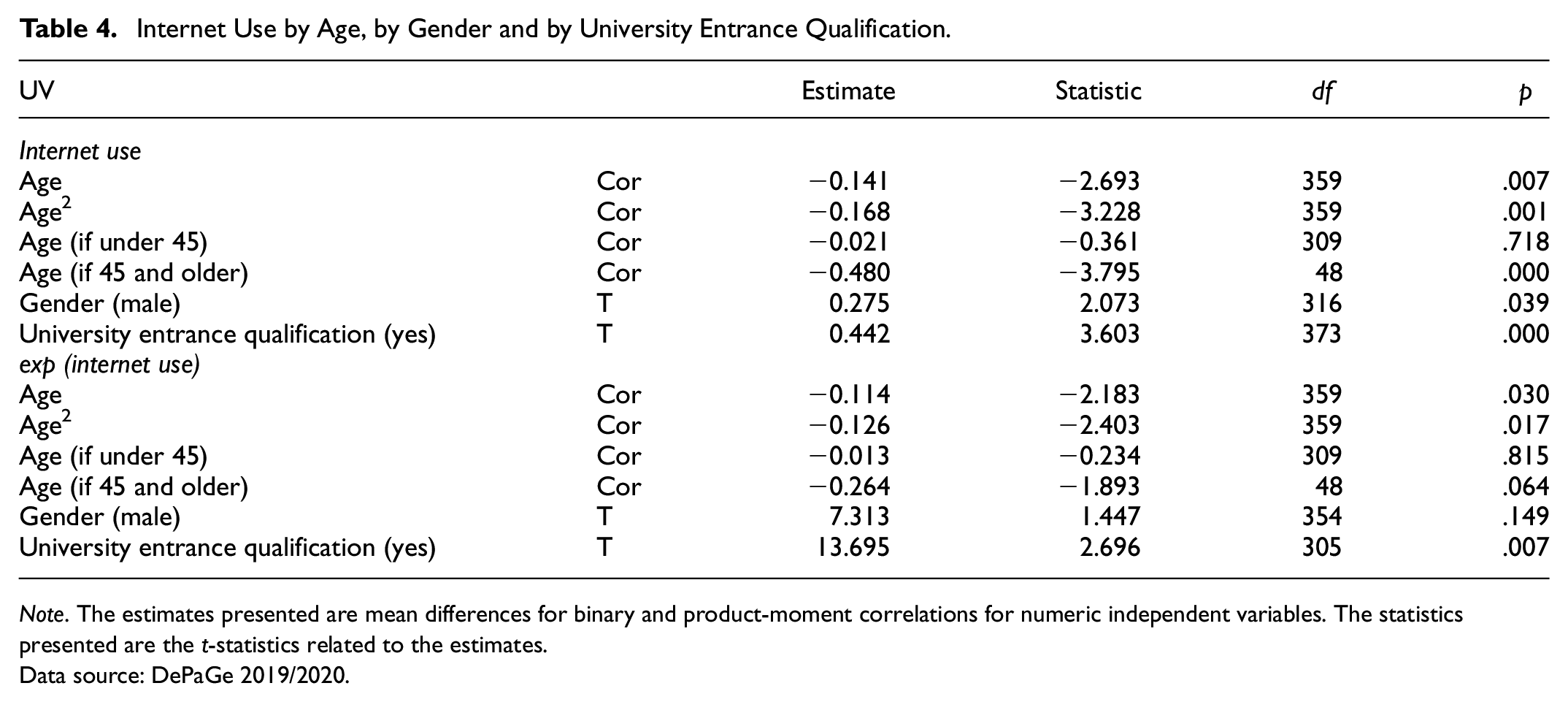
The digital divide analysis (Table 4) shows that there are significant correlations between the respondents’ internet use and all three variables concerned (age, gender, education). As the scale of the dependent variable is non-linear and the theoretical distances decrease with each step, all analyses were repeated with an exponential scale, which altered some of the results.
Internet Use by Age, by Gender and by University Entrance Qualification.
Note. The estimates presented are mean differences for binary and product-moment correlations for numeric independent variables. The statistics presented are the t-statistics related to the estimates.
Data source: DePaGe 2019/2020.
Women and people of other genders use the internet a little less (MD = 4, M = 3.59, SD = 1.4, n = 167) than those who identify themselves as men (MD = 4, M = 3.86, SD = 1.17, n = 232). This mean difference is only significant if the measured scale is used, as the selected significance level of 5% is exceeded when computing the estimate with the exponential scale. This anomaly may have occurred because of small overall differences by gender but a higher proportion of females who do not use the internet at all.
Also, there is a low but significant correlation between age and internet use. As can be seen in Figure 1, older respondents mostly drive the digital age divide. The correlation for those under 45 years is very low, whereas the estimate for those of 45 years and older is strong and significant. If the exponential scale is used, this correlation is diminished, which could be due to the small sample size by which the estimate is computed (n = 50).

Frequency of internet use by age and gender.
Respondents with university entrance qualifications stated that they use the internet more frequently (MD = 4, M = 4.02, SD = 1.04, n = 146) than respondents without these (MD = 4, M = 3.58, SD = 1.4, n = 256). This difference remains stable if the exponential scale is used. Altogether, the expected patterns of digital divide are found in the present sample of refugees.
Internet Use for Political Information and Expression
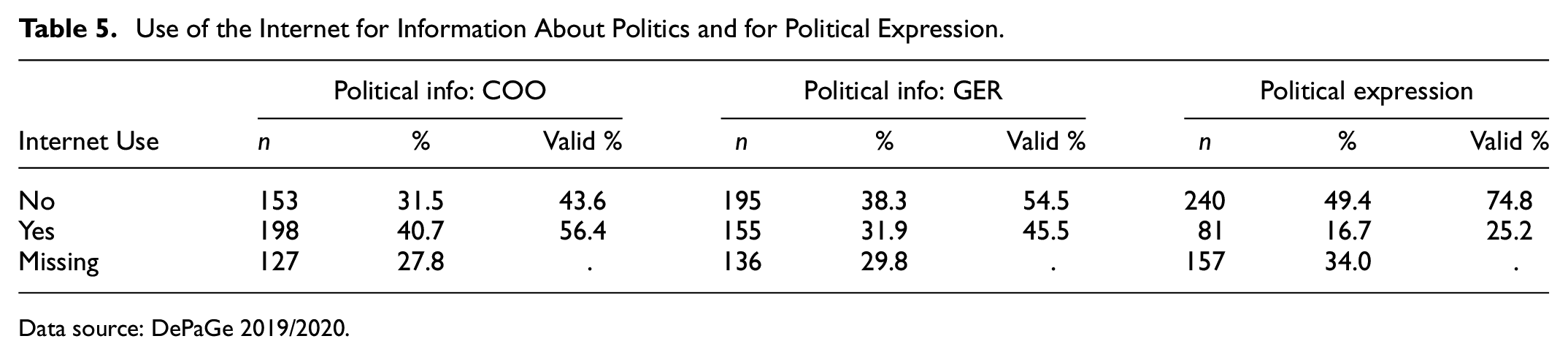
The figures in Table 5 show the distribution of internet use for political information concerning political issues in Germany (GER) and the country of origin (COO), as well as for political expression.
Use of the Internet for Information About Politics and for Political Expression.
Data source: DePaGe 2019/2020.
About one quarter of the respondents did not answer the two questions about political information (consistently) or stated that they do not use the internet at all. Half of those who gave valid answers said they inform themselves about politics in their country of origin and slightly less, but still just under a half, about politics in Germany (Table 5). If the two variables are combined, the descriptive analysis shows that about four out of ten respondents who do use the internet do not inform themselves about politics in Germany or the country of origin (n = 129, 39.4%). The same amount uses the internet for information about both contexts (n = 124, 38.4%). The remaining respondents inform themselves only about their country of origin (n = 51, 15.8%), or only about Germany (n = 19, 5.9%).
Concerning political expression, at one-third, the proportion of invalid values is slightly higher than the proportions of the two variables of political information. One quarter of the respondents who use the internet and gave valid answers stated they express their political opinions online (Table 5).
Online Information About Political Issues
To analyze the factors influencing political internet use for political information and expression, Table 6 lists the beta coefficients and standard errors of bivariate linear probability models based on the multiply imputed data. The first two column sections show the estimates for the two political information variables, and the last column section the estimates for the political expression.
Bivariate Linear Probability Models of Internet Use for Political Information and Expression.

Data source: DePaGe 2019/2020 (30 imputed data sets with 486 observations).
p < .1. *p < .05. **p < .01. ***p < .001.
As can be seen in Table 6, age is significantly positively related to online information about politics in the country of origin but not regarding politics in Germany. Visual inspection shows an increasing propensity until the age of about 55 years for both contexts, whereby this increase is small for Germany and high for the country of origin. With higher age the propensity declines again. Overall, male, and higher educated refugees state more often to inform themselves online about politics in both contexts.
After the three variables of digital divide, the resources for online activism are shown in Table 6. The results show that, for both contexts, reading and writing skills are significant predictors. For the country-of-origin, primary language skills are significant and positively related to the propensity of online information. In contrast, for political information about Germany, the German and the overall language indicators have a positive effect and are significant. Besides language, digital skills are known to be relevant resources for online activities. As there is no direct measure for them, we use the frequency of internet use as a proxy. However, the analysis shows no significant relation for the propensity of political information in any of the two contexts. As expected by our hypotheses, the duration of stay is significant and positively connected to both indicators.
Finally, as can be seen in the bottom rows of Table 6, all indicators of political engagement are positively related to each other: political interest, internal political efficacy and political activity (measured by participation in demonstrations) abroad and in Germany are positively correlated with political information.
Political Expression on the Internet
Our main interest is focused on online political participation, which we approximated by the internet use to express one’s political opinions. The estimates for the same variables as before are shown in the last column section of Table 6. From a digital divide perspective, only the gender shows a significant relation, whilst there are no age or education effects. Resources theoretically facilitate political expression on the internet, but only the overall and the German language skills – the first mainly driven by the latter – as well as reading skills are significant. The highest coefficients are found for the variables of political involvement. Interestingly, the influence of political information about Germany is more strongly connected to the propensity of internet use for political expression than about the country of origin. Also, it is noteworthy that even the smallest influence of the political involvement variables (having participated in demonstrations in a foreign country) is stronger than all of the other variables considered. For further investigation, each of the predictors of the bivariate analysis were controlled for in Section 4.3 below. As both the German and primary language could have been used for political expressions and it is unclear to which context these refer, the overall language score was used.
Multivariate Analysis of Online Activism
The multivariate analysis presented in Table 7 indicates that socio-demographic and resource-specific variables exert only small effects. The effect of gender is significant in the partial model and when resources are controlled for (1). From the political involvement variables, political interest, internal political efficacy and the offline political activity in Germany are significant. In the nested model (2) they diminish the effect of gender, but internal political efficacy is also no more significant. If the two variables of internet use to inform oneself about political issues are controlled for, the information about Germany is the strongest beta coefficient of the full model (3), but the coefficients of political interest and political activity in Germany remain significant.
Multivariate Linear Probability Models of Internet Use for Political Expression.

Note. The presented estimates are beta-coefficients of linear prediction regression models.
Data source: DePaGe 2019/2020.
p < .1. *p < .05. **p < .01. ***p < .001.
In the binary logistic regressions, we observe similar patterns. In nested model (2) internal political efficacy remains being a significant factor. As can be seen in column (2) of Table 7, the standardized coefficient of the linear prediction model is also still considerably high compared to the other non-significant factors. Also, the coefficient of offline political participation in Germany is no more significant in the full model.
The comparison of the model fits in the bottom row of Table 7 reveals that the political engagement and the online political information models exhibit the highest R2 values among the partial models. While socio-demographic and resource models only account for a negligible proportion of the total variability, they contribute to the engagement model. The model fit of the full model is the highest, indicating the necessity of controlling for all partial models.
Discussion
Our results indicate that nearly all respondents use the internet, and most of them frequently. This highlights the relevance of access to the internet for refugees who are known to predominantly use the internet for integration purposes (Alencar, 2018; Witteborn, 2014), or for networking with family and friends (Gillespie et al., 2018). Digital divide factors influence the internet use of refugees (Table 4, Figure 1). Higher educated, young to middle-aged, male refugees use the internet more often than female, older, and less educated refugees. This is in line with the literature on digital divide (Norris, 2001), which can be explained by a lack of digital skills, language skills or the lack of financial resources (Alam & Imran, 2015; Preißler, 2017).
Within the political sphere, we find similar results on the digital divide (Table 6). Male refugees who have completed a form of higher education are seen to inform themselves more about politics than female and less educated refugees. This applies to online political information about Germany as well as on the country of origin. As expected, there is a positive correlation between age and online information about the country of origin, but not about Germany. It can be assumed that older people are more attached to their country of origin, as they have lived there for a relatively long period of time. This is in contrast to younger individuals who may have been primarily socialized in Germany.
It comes as no surprise that language skills are a relevant resource for online political information (Ramakrishnan & Espenshade, 2001; Zapata-Barrero et al., 2013). Our results show a significant influence of language skills. In particular, first language skills are more relevant for refugees when informing oneself about the country of origin, while German language skills are more relevant for politics in Germany. Furthermore, our results indicate that refugees who have spent a longer period of time in Germany tend to inform themselves more about German politics online. One potential explanation for this phenomenon is that the level of interest in political issues concerning Germany increases with the duration of stay. However, the duration of stay is also relevant for informing oneself about the country of origin online. This might be due to the fact that refugees initially prioritize addressing their basic needs (such as applying for family reunification, finding suitable housing or securing employment), or alternatively, that they require a period of emotional detachment before engaging with politics in their country of origin.
When it comes to digital skills, our results show no significant relationship to political information, which can be explained if the internet is often used for non-political purposes. The respondents tend to inform themselves a little more about politics in their country of origin than about German politics on the internet. However, most of the refugees who use the internet to inform themselves about one country also do that with the other country. This underlines the fact that the same people who are already politically interested or politically active in one field, also participate or inform themselves about politics in other fields (Verba et al., 1995). Another expected result is that all indicators of political engagement, such as political interest, political efficacy, and political activity, are relevant when it comes to informing oneself about politics online.
Regarding internet use for political expression, both bivariate and multivariate analyses (Tables 6 and 7) show similar results. Again, we find gender differences, which might be due to the fact that most of the male respondents are young and are more highly educated. Within the bivariate analysis (Table 6), German language skills demonstrate their relevance for expressing one’s political opinion online. It is intuitive to conclude that the expression of opinion concerns Germany and German politics. However, as there is only low variability in the first language skills, and this result could also be due to the correlation of German language skills with education and resources for political activities.
Reading skills show to be relevant as far as absorbing political information, but writing skills are not significant, which is rather surprising. This might be explained by situations where political expression is conducted via audio or graphic inputs, where writing skills are less important. Also, all political involvement factors are relevant for expressing one’s political opinion online, which confirms the relevance of the political dimension as stated in the CVM by Verba et al. (1995). Interestingly, informing oneself about German politics has the largest predictive importance. Hence, refugees who are more informed about German politics seem to express their political opinion more often. Similarly, in the multivariate analysis (Table 7), the factors political interest, political activity in Germany and, to some degree, gender and internal political efficacy, show themselves to be relevant factors for political expression online. This confirms the assumption that refugees who are already interested in politics and have been politically active in the country of origin show more political activity in the online sphere.
The limitations of the study relate to the sample. Shortly after arrival, the population of residents in shared accommodation corresponds to the overall population of refugees. This is not the case over time as moving out of the accommodation is not randomly distributed among residents (Deger et al., 2017; Haug et al. 2019; Röder, 2018). Overall, male, and single refugees, are slightly overrepresented in shared accommodation (Haug & Schmidbauer 2022) and lower levels of social integration are to be expected among refugees in such accommodation (Siegert, 2021). Furthermore, non-probability surveys have the disadvantage that the inclusion probabilities are unknown or can only be approximately estimated. Therefore, the estimates from these samples may be biased. However, a pragmatic research strategy is to collect data fit for purpose. Refugees are a hard-to-reach population, and many relevant aspects of their lives are still unresearched. Non-probability samples can help to shed light on what is otherwise invisible (Schmidbauer & Haug 2023b; Kohler et al., 2019). Due to the high volatility of refugee flows, there has now also been a shift toward refugees related to the Russian war against Ukraine. However, the number of typical countries of origin has remained high since 2012. It is therefore still of great interest to analyze the data.
Another limitation relates to the questions of the survey as the survey only covers two political dimensions (political information and political expression online). This limits this study’s explanatory power to just two dimensions of political activism online.
Conclusion
Refugees are often perceived as passive objects of state and charitable aid. However, as we can show with our data for the regional context of Bavaria (Germany), many of them become politically active on- and offline shortly after their arrival. However, this active participation in shaping their environment is often not perceived in the social debate, faded out or devalued as inferior. The democratization potential for the countries of origin and the host countries resulting from their political participation is thus underestimated. Digital media offer the potential to cost-effectively consume political information and to become politically active. Social media also significantly promote the outreach of political statements, as they make it easier to address a broad public. However, it is still unclear within the research debate whether previously politically inactive people can be reached this way.
Our data on refugees reveals, that political interest is the most important driver of political participation, whether it occurs offline or online. Online participation can in turn be strongly predicted by offline participation. In the case of the refugees we studied, this is especially true for activity in the host country and thus more recent activity. Furthermore, information about political contexts on the internet plays an important role. It is therefore rather doubtful whether online participation can reach previously inactive people. However, it can be a powerful instrument especially for resource-poor population groups. From existing studies, we already know, that refugees use the internet for political purposes such as organizing protests, talking about political issues and expressing one’s opinion. However, this research shows that in order to express one’s political opinion several factors play an important role. For once all political involvement factors such as political interest, political efficacy and political activity are relevant for expressing one’s opinion online. However, gender, the duration of stay and language skills are relevant as well. Hence, male refugees, who have been staying in Germany for a while and who possess a decent level of German, tend to express their political opinion the most.
Our work clearly shows that the role of digital media in linking migration and political participation has great potential for following research projects. This study confirms that the internet is a relevant tool for political participation of refugees. It validates the relevance of the factors described in the CVM. These factors are as pertinent for refugees as they are for migrants and the general population. Furthermore, this study contributes to the existing body of knowledge on political communication, demonstrating that reading skills are essential for informing oneself about politics, whereas writing skills do not show to be relevant for expressing one’s opinion. One possible explanation for this phenomenon is that individuals who lack proficiency in reading and writing may utilize audio and graphic content as a means of engaging in online political activism rather than writing text messages or blogs. Further studies could elaborate on this finding and focus on the manner in which refugees express their political opinions online. Another relevant aspect for further investigation is the relationship between online and offline participation in the case of refugees. This could include examining the forms of political participation used online in comparison to those used offline, or the ways in which they are combined.
Footnotes
Acknowledgements
N/A
Declaration of Conflicting Interests
The author(s) declared no potential conflicts of interest with respect to the research, authorship, and/or publication of this article.
Funding
The author(s) disclosed receipt of the following financial support for the research, authorship, and/or publication of this article: The data collection was funded by the Bavarian Ministry of Sciences and the Arts from 2018 to 2022 as part of the project “Democracy Acceptance and Participation of Refugees (DePaGe) in the Bavarian Research Association Future of Democracy (ForDemocracy)” led by Sonja Haug at the Technical University of East Bavaria (OTH Regensburg). Open Access publication is funded by OTH Regensburg.
Ethics Statement
The research network was supported by a panel of experts who selected the funded projects and monitored their progress. The study design and project results were critically evaluated for methodological and ethical rigor. All participants provided informed consent prior to their participation in the study. Respondents had the opportunity to opt-out of data use after completion of the questionnaire.

Data Availability Statement
In order to protect the participants of the study, the survey data cannot be shared. Due to the sampling procedure, the identification of individuals by third parties cannot be prevented.