




Abstract
Increasing Internet use is changing the way individuals take part in society. However, a general mobilizing effect of the Internet on political participation has been difficult to demonstrate. This study takes a digital inequality perspective and analyzes the role of Internet expertise for the social structuration of online political participation. Analyses rely on two nationally representative surveys in Switzerland and use cluster analysis and structural equation modeling. A distinct group of political online participants emerged characterized by high education and income. Further, online political participation is predicted by political interest and Internet skills, which increasingly mediated the effects of social position. Digital information policies should therefore consider Internet skills and effective use, particularly in marginalized social groups, to avoid reinforcing traditional participatory inequalities in the digital society.
Keywords
Internet use can facilitate democratic processes from information seeking to debating political issues and voting. However, various obstacles to “digital democracy” remain (Hindman 2009; Mossberger, Tolbert, and Stansbury 2003; Schlozman, Verba, and Brady 2010). There are still sizeable percentages of the population that are excluded from the digital society due to lack of basic physical Internet access (ITU 2016). Nonusers are likely to become marginalized as key resources for societal participation are increasingly or exclusively found online.
Even under the assumption that further diffusion of the Internet will close the access divide, questions regarding the uses and consequences of the Internet for social inclusion persist (Willis and Tranter 2006; Witte and Mannon 2010). The web’s nearly unlimited information sources and spaces for political discussion brought with them high hopes for a revitalizing and mobilizing effect on democratic participation. The utopic visions were quickly accompanied by cautionary voices proposing that the “political resources available via the Internet will empower those with the resources and motivation to take advantage of them, stranding the disengaged farther behind” (Norris 2001:238). The question thus remains in how far online political participation is socially structured in a way that reflects traditional inequalities. This article tests the relationship between social position and online political participation, including the mediating effect of political interest and Internet skills.
The study uses rich primary data from a nationally representative two-wave survey that affords a high level of reliability and validity. Statistical results are based on multivariate modeling (structural equation modeling; SEM) including measurement invariance testing. The literature review identified two existing studies that used SEM to explain online political participation as the key dependent variable. This article extends a model proposed by De Marco, Robles, and Antino (2014) by including political interest, a crucial determinant of political behavior. A model by Min (2010), on the other hand, is advanced by modeling Internet skills and political interest as mediators between social position and digital participation. Finally, we address digital political engagement from the theoretical perspective of sociological digital inequality research (Hargittai and Hsieh 2013; Robinson et al. 2015): full social inclusion in the digital society increasingly requires advanced uses of the Internet such as online political participation.
Our results indicate that there is a distinct group of political online participants characterized by high education and income. Further, online political participation is strongly predicted by political interest and to a lesser degree Internet skills. Interest and skills both depend on socioeconomic variables. Age effects are stronger in 2013 than in 2011 and negative for Internet skills but positive for political interest.
Theoretical Background
Democratic Potentials of the Internet
The rapid diffusion of the Internet spurred scholarly interest regarding the effects on the political behavior of citizens: “The hope has been that the Internet would expand the public sphere, broadening both the range of ideas discussed and the number of citizens allowed to participate” (Hindman 2009:7). According to the view of optimistic technological determinism, the massive amounts of (political) information online would form the basis of participatory democracy across all segments of society (see Coleman and Blumler 2009; Dahlgren 2000).
The Internet has the potential to redistribute political power, break the monopolistic positions of traditional elites and media, and amplify the voice of the common citizen. This potential is derived from the Internet-enabled access to vast amounts of information, interactivity, and opportunities for discussion and the spreading of content and opinions without traditional gatekeeping (see Margetts 2013). The once clearly defined roles of elite senders—political actors and journalists—and the mass audience as receivers of political messages were challenged by the fundamental openness of the web. The Internet potentially enables political discourse with a wide range of ideas and communicators, a digital public sphere, that counteracts the widespread feeling of political inefficacy (Coleman and Blumler 2009). At the core of this mobilization hypothesis is the expectation that the disadvantaged and excluded attain new ways of informing and organizing themselves to participate in political processes (Norris 2001). Technological advancements and diffusion, mainly by reducing communication costs, can therefore act as a driver of democracy (Margetts 2013; Mossberger, Tolbert, and McNeal, 2008; Theocharis et al., 2016). For instance, Hirzalla, van Zoonen, and de Ridder (2010) found mobilizing effects among youth for education and gender for the specific case of vote advice applications. Many other studies have shown that online activities like political information seeking or discussion have positive effects on offline and online forms of participation (Lutz, Hoffmann, and Meckel 2014; Tolbert and McNeal 2003).
Preexisting social inequalities and differences in motivations, however, also suggest a different mechanism. The reinforcement hypothesis holds that the Internet does not generate political interest and engagement because it is primarily adopted by those already interested and engaged in politics (Boulianne 2011; Margolis and Resnick 2000; Norris 2001). Individuals of higher social status are at an advantage in putting the Internet to efficient and effective use (DiMaggio et al. 2004). Using 2008 U.S. survey data comprising more than 1,600 Internet users (see Smith et al. 2009), Schlozman et al. (2010:503) concluded that “among Internet users, there is a strong positive relationship between SES and—with the possible exception of political social networking—every measure of Internet based political engagement we reviewed.” Equalizing trends in online political engagement, such as the finding that young adults can be mobilized, stem from a parallel inequality, the digital divide, as youths are more frequent and skilled users of the Internet in general (Schlozman et al. 2010).
Internet Use and the Democratic Divide
Findings of social divides regarding media use and knowledge gains certainly predate the emergence of Internet technology. The knowledge gap hypothesis proposed that individuals of higher socioeconomic status as measured by education are better able to absorb the increasing flow of information from mass media, and therefore the difference in knowledge, for example on public affairs, between population segments tends to increase (Tichenor, Donohue, and Olien 1970). The factors that allow individuals of higher socioeconomic status to better process media information are all related to education: communication skills and literacy, prior knowledge, selective exposure, and a social environment where public affairs topics are more likely to be discussed. The sociopolitical relevance of this hypothesis lies in the transferability of information and knowledge into social power (see Duff 2011).
While Tichenor et al. (1970) focused on the transsituational socioeconomic antecedents of the knowledge gap, Ettema and Kline (1977) added motivation as a key situation-specific predictor of information acquisition. Bonfadelli (2002) applied the knowledge gap hypothesis to the Internet and detected access, usage, and skills gaps—inequalities that were associated with differences in level of education. The higher educated are more likely to have Internet access and engage in information seeking or e-commerce (Bonfadelli 2002; Büchi, Just, and Latzer 2016). Compared to legacy media, the Internet requires more active and skilled users and its technical openness imposes fewer constraints on the usage modality—which can lead to even greater knowledge gaps (Wei and Hindman 2011). Consequently, research on digital divides has moved from describing access gaps to asking how individuals use the Internet in their everyday lives and how this is connected to social inequality (see e.g., Hargittai 2008; Helsper 2012; Robinson 2009; van Dijk 2005). This digital inequality approach generally assumes that Internet activities vary in their utility. Because certain uses of the Internet are beneficial in that they can enhance users’ economic, cultural, or social capital, digital divides are related to social power and quality of life (see Bourdieu 1986; Hargittai and Hinnant 2008; van Deursen and Helsper 2015). De Marco et al. (2014:44) use the term “beneficial and advanced uses of the Internet” to characterize these capital-enhancing online activities and consider online political participation a prime example of this category. Beneficial and advanced uses of the Internet require particularly high levels of Internet skills, which have consistently been demonstrated to be unequally distributed in society (e.g., Hargittai 2010; van Deursen and van Dijk 2011).
Overall, digital inequality research finds that the establishment of Internet-based communication as a requisite resource for societal participation has added a new layer to social inequality rather than ameliorated existing forms (e.g., Hargittai 2008; van Dijk 2005). Regarding the mobilization of new participants, Anduiza, Gallego, and Cantijoch (2010) found that Internet knowledge and frequency and breadth of use are key in explaining online participation while traditional resources are only relevant to Internet access. Boulianne (2009) surveyed 38 studies on Internet use and political engagement and concluded that when political interest is controlled, the effect of Internet use tends to be insignificant. The somewhat contradictory empirical support for the mobilization hypothesis can be in part explained by the finding that “[t]he individuals . . . who most need the benefits of a new idea (the less educated, less wealthy, and the like) are generally last to adopt an innovation” (Rogers 2003:295). The reasons are failure to recognize the potential benefits from within the current social position and lower levels of knowledge and skills necessary for effective adoption compared to elites. Accordingly, Di Gennaro and Dutton (2006) found that individuals in lower social positions were marginalized because online political participation was predominantly driven by those already engaged offline.
Uses of the Internet are thus structured along socioeconomic factors. Demographic and socioeconomic variables such as age, gender, education, and income have consistently been shown to affect which Internet applications are used and in what ways (Bonfadelli 2002; Brandtzaeg, Heim, and Karahasanovic 2011; Willis and Tranter 2006; Zillien and Hargittai 2009). Recent cross-country results on these usage divides show that online information seeking is predicted by young age, high education, and years of Internet experience (Büchi et al. 2016).
In addition to such structural inequalities, motivational factors have also been found to influence beneficial and advanced uses of the Internet (e.g., Lievrouw and Farb 2003; Zillien and Hargittai 2009). Motivation, that is, interest and expected outcomes, guides users’ attention to specific media content—media use accordingly satisfies specific needs (Katz, Blumler, and Gurevitch 1973). Applied to online political participation, Min (2010) concluded that Internet users actively select uses consistent with their interests. Importantly, these interests are themselves influenced by one’s social environment and social position. In sum, both a vertical dimension of social and economic structuration as well as a horizontal dimension of within-group variance in interests and expertise need to be considered in explaining online political participation. A central proposition of this article is therefore that any explanation of participatory behavior needs to include motivation (political interest) and ability (Internet skills). For online citizens with sufficient skills and interest, the Internet offers more and easier options to stay informed and participate in political processes and thereby increase the vitality of democracy—but failure to digitally mobilize the disengaged increases the digital democratic divide, that is, the social inequalities in using the Internet for political participation (Min 2010; Norris 2001).
Explaining Online Political Participation
The minimum consensus in previous research is that mere access to the Internet does not automatically prompt users to engage in beneficial and advanced uses such as online political participation. The percentage of users who use the Internet for political purposes is generally very low, particularly for active forms of participation (see De Marco et al. 2014 for Spain; Di Gennaro and Dutton 2006 for the UK; Just et al. 2013 for Switzerland; Krueger 2002 for the US; Kruikemeier et al. 2014 for the Netherlands; Vonbun and Schönbach 2014 for Austria). In this study, we conceptualize online political participation in a relatively broad sense, encompassing active and passive engagement (see Conway 2000; Di Gennaro and Dutton 2006). Particularly in the online realm, it is adequate to consider both behavior that is aimed directly at influencing political processes as well as simply paying attention to the political environment (Krueger 2002).
Online political participation is a comparably new and varied form of engagement (Zukin et al. 2006)—looking at traditional forms such as party membership or voting may lead to the conclusion that particularly young people are increasingly disengaged. However, focusing solely on conventional definitions would miss generational changes in political practices as young citizens are likely to favor an expressive, self-actualizing style of participation often supported by online networks (Bennett, Wells, and Freelon 2011; Bennett, Wells, and Rank 2009). Since direct influence on policy and government is primarily achieved through offline modes, online participation is more effective when it translates to traditional offline participation. To this effect, there is evidence of a positive relationship between social media use and participation (e.g., Lane et al. 2017). This is, however, not a universal finding (for a meta-analysis of 36 studies, see Boulianne 2015). Hargittai and Shaw (2013) report an absence of direct effects of online political participation on voting in a large sample of young adults but describe online engagement as complementary to traditional offline engagement.
Political interest typically has the greatest effect on political engagement (Prior 2010). In addition, socioeconomic status has been shown to strongly influence online behavior even when controlling for interest and digital experience (e.g., Nam 2012; Zillien and Hargittai 2009). The key predictors of online political participation are thus social position, political interest, and Internet expertise. Min (2010) combined these elements and concluded that human interest and capacity explain political Internet use while socioeconomic factors lose their significance. The model, however, does not expound on structural inequalities in Internet skills and political interest highlighted in related research (Gallego 2014; Hargittai 2010). Mirroring the debate on knowledge gaps, some digital divide research suggests that social structure ceased to determine participation—this can result in unintentional “victim blaming” in that responsibility is transferred to individual motivation (see Duff 2011; Viswanath and Finnegan 1996; Zillien and Hargittai 2009). De Marco et al. (2014) tested a mediation model where social status effects on digital political participation were explained by Internet expertise and proficiency. However, these authors did not account for political interest as an intervening variable.
Theoretical Research Model
Figure 1 illustrates the research model we developed based on previous theoretical and empirical research presented previously. The first block, antecedents, comprises social position indicators, hours of Internet use, and years online. Social position is marked primarily by income and education. This set of variables further includes the sociodemographic attributes age and gender. Based on exploratory factor analysis, De Marco et al. (2014) aggregated diverse variables such as years of Internet use, number of places of connection, e-banking, and online shopping in a construct called Internet expertise. Here, we tried to disentangle Internet expertise to separate the effects and propose that its essential dimensions are hours of Internet use, years online, and Internet skills.
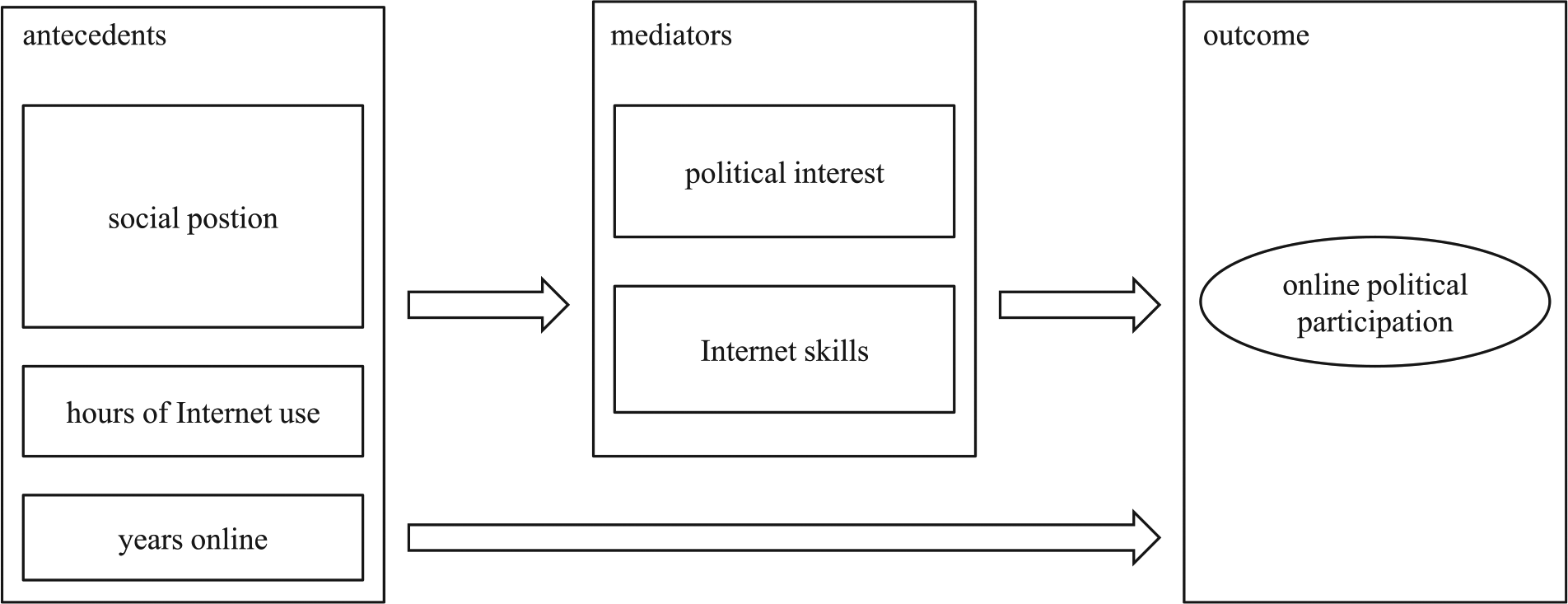
Theoretical research model.
Internet skills follow from use and online experience and are thus included in the second block (mediators). The second mediator in the model is political interest. While those in higher social positions and with higher interest and skills are presumably more active online, the positioning of Internet skills and political interest as mediators allows us to additionally analyze the social structuration of these factors.
Method
Procedure and Participants
Two surveys were conducted in Switzerland within the framework of a major, international research project that has been investigating the social, political, and economic impact of the Internet and other new technologies since 1999. An independent survey research institute conducted computer-assisted telephone interviews using demographic quota and random digit dialing, which provided nationally representative samples with regards to the demographic characteristics age, gender, and region. The 2011 survey was conducted from May 9 to June 21 and the 2013 survey from May 28 to June 29. Total sample sizes were n = 1,104 (2011) and n = 1,114 (2013). The response rate was 26 percent in 2011 and 20 percent in 2013. Exclusion of respondents that were nonusers of the Internet led to n = 841 and n = 949 relevant cases. Using data from two years means that changes in the relationships between antecedents, mediators, and outcome can be detected. The mean age of participants in 2011 was 43.12 years (SD = 16.33) and 43.54 (SD = 17.02) in 2013. For both years, 49 percent of respondents were female. The mode for monthly household income was 4,500 to 7,000 CHF across both survey years (33 percent in 2011 and 39 percent in 2013); 20 percent (2011) and 18 percent (2013) did not answer this question. One-third of participants (2011, 34 % 2013, 32 percent) had completed a degree in higher education (university, university of applied sciences), 58 percent (2011) and 57 percent (2013) had completed a vocational school or gymnasium degree, and 8 percent (2011) and 10 percent (2013) had basic education (primary or secondary school).
The typology of Internet users relied on two-step cluster analysis with log-likelihood as a distance measure and Schwarz’s Bayesian information criterion to determine the number of clusters in IBM SPSS 23. Advanced analyses of the relationships between online political participation, Internet expertise, political interest, and social position indicators used SEM. Our model involved a latent variable (online political participation) and mediated relationships and thus benefitted from the greater versatility of SEM as compared to ordinary regression. Models were tested in the software environment R with the lavaan package using a weighted least squares mean- and variance-adjusted test statistic (see Rosseel 2016). Global model fit was evaluated in accordance with widely accepted criteria in the literature (Hu and Bentler 1999; Schermelleh-Engel, Moosbrugger, and Müller 2003): Values for χ2/df ≤ 2, Comparative Fit Index (CFI) ≥ .97, and root mean square error of approximation (RMSEA) ≤ .05 indicated a good model fit. Cutoffs for an acceptable model fit were χ2/df ≤ 3, CFI ≥ .95, and RMSEA ≤ .08.
Measures
Exogenous variables (antecedents)
The first group of exogenous variables included the socioeconomic and demographic variables income, education, gender, and age. For income, respondents were asked to indicate their gross monthly household income in five categories ranging from less than 4,500 CHF to more than 12,000 CHF. Income was split into a high and a low category at 9,000 CHF for analyses. Education was measured in five categories from primary or secondary school to university degree and recoded into low, medium, and high.
The second group of exogenous variables included two of the three components of Internet expertise, that is, years online and hours of Internet use. Years online was measured by asking respondents for how many years they had been using the Internet. Hours of Internet use was calculated as total weekly use from the sum of four variables: hours of Internet use on average per week at home, the workplace, school or university, as well as other places.
Mediators
Analyses employed two mediators, Internet skills and political interest. These variables were expected to be influenced by the aforementioned set of exogenous variables and in turn predict online political participation. Respondents were asked to assess their Internet skills from 1 = poor to 5 = excellent (for similar operationalizations, see Bonfadelli 2002; General Social Survey 2004; Min 2010; Vonbun and Schönbach 2014; for a discussion and potential biases in the self-assessment of Internet skills, see Hargittai and Shafer 2006; Litt 2013). In 2011, 73 percent of participants reported good, very good, or excellent Internet skills, and 77 percent did so in 2013. The mean score for Internet skills was 3.12 (SD = .96) in 2011 and 3.22 (SD = .99) in 2013. Political interest was also measured using a single item by asking respondents how much they were interested in politics and political topics from 1 = not at all interested to 4 = very interested (see Prior 2010). The majority of Swiss Internet users was politically interested: 59 percent (2011) and 64 percent (2013) were interested or very interested. The mean score for political interest was 2.65 (SD = .98) in 2011 and 2.76 (SD = .98) in 2013.
Dependent variable (outcome): online political participation
The specific type of Internet use we sought to explain, online political participation, was measured using four variables. Respondents were asked if they had been politically engaged in the past year by seeking information on political topics, participating in political discussions, joining a protest movement or sending out a protesting letter, or creating their own political content such as flyers or blog posts. The response categories were no; yes, offline only; yes, online only; and yes, both offline and online (see Appendix, Table A1 for the distribution of responses). The last two categories were coded as one, indicating online political participation. The first two categories were coded as zero. The first activity, information seeking, is a rather passive form of participation with lower investment; accordingly, the number of respondents who engaged in this use was comparably high: 38 percent in 2011 and 35 percent in 2013. The other three forms of political participation were expectedly infrequent (between 2 percent and 7 percent). Therefore, the three dichotomized variables for online political discussion, protest, and content creation were summed, resulting in a four-point variable ranging from zero to three, indicating the intensity of active participation. For the SEM analysis, the latent variable online political participation was thus reflected by two manifest indicators in the model, passive online political participation and active online political participation. These indicators produced consistently high factor loadings between .74 and .96 (see Table 1).
Parameter Estimates for the Structural Equation Model.

Note. See Figure 3 for parameter labels.
Reference item fixed to unity.
p ≤ .05. **p ≤ .01.
Results
Two Clusters of Internet Users
As discussed previously, a relatively small percentage of Internet users engaged in online political participation. Table A1 in the Appendix shows that for every measure of participation, a majority of Internet users had not engaged in the respective activity. Of those who had participated politically, information seeking was preferably a mix of offline and online. Actively partaking in political discussion was mostly done offline only. The small number of users who engaged in protesting or content creation were spread relatively evenly across the online only, offline only, and combined mode.
Cluster analysis was performed on the aggregated data from the two surveys to build a user typology. The input variables were age, gender, education, income, political interest, Internet skills, and online political participation. Two clusters, namely, types of Internet users, emerged from the analysis with a silhouette measure of .30, indicating acceptable clustering quality in terms of cohesion and separation. The two clusters were interpreted and labeled as political online nonparticipants (cluster 1) and political online participants (cluster 2). As Figure 2 shows, the first user type was characterized by low online political participation and political interest, low education and income, low Internet skills, more women, and young age and contained 57.2 percent of cases. The second user type was distinguished by high online political participation and political interest, high education and income, high Internet skills, more men, and older age and comprised 42.8 percent of the cases.

Two distinct Internet user types. The figure shows the distribution of the input variables in two clusters of Internet users. Cluster 1 (top row): political online nonparticipants; cluster 2 (bottom row): political online participants.
Of the respondents that had not engaged in any online political participation, 95.4 percent were classified into the first cluster, and those who had participated online were all members of the second cluster (Figure 2). Accordingly, the participation variable was the most important input in determining cluster membership (normalized importance value = 1.00), followed by political interest (.28), education (.20), income (.10), and Internet skills (.07). The predictive values of age (.02) and gender (.02) were minimal.
Structural Equation Models
The aforementioned cluster analysis provided a first insight into the distribution of online political participation. Structural equation modeling was then used to further scrutinize the interrelations between social position indicators, Internet expertise, political interest, and online political participation. For this purpose, the theoretical research model developed previously was translated into a statistical model. A first structural equation model accordingly tested for all direct and indirect effects, that is, all exogenous variables (antecedents in Figure 1) predicted both mediators as well as the outcome variable (online political participation), and the mediators predicted the outcome variable. The fit measures of this model were good with χ2(22) = 38.96 (p = .014), χ2/df = 1.77, CFI = .984, and RMSEA = .033, indicating that the empirically measured relationships between the data are very well represented by the theoretical model.
Inspection of the path coefficients revealed that the effect of medium education level on Internet skills as well as the direct effects of gender, income, and hours of Internet use on online political participation did not reach statistical significance in either years. The only exogenous variables with a significant direct effect on online political participation were age and years online, ultimately supporting a mediation model. The model was thus respecified retaining only the significant paths. This final model (Figure 3) also showed a good model fit, χ2(34) = 52.92 (p = .020), χ2/df = 1.56, CFI = .982, and RMSEA = .028; the increase in χ2 was balanced by an increase in the degrees of freedom. Configural invariance between 2011 and 2013 was confirmed by the good model fit. In addition, metric invariance was confirmed (see Büchi 2016; Steenkamp and Baumgartner 1998): Constraining the factor loadings of the two indicators of online political participation to be equal in 2011 and 2013 increased χ2 only marginally and insignificantly. This indicated that the structural effects explaining online political participation were directly comparable across the two years.
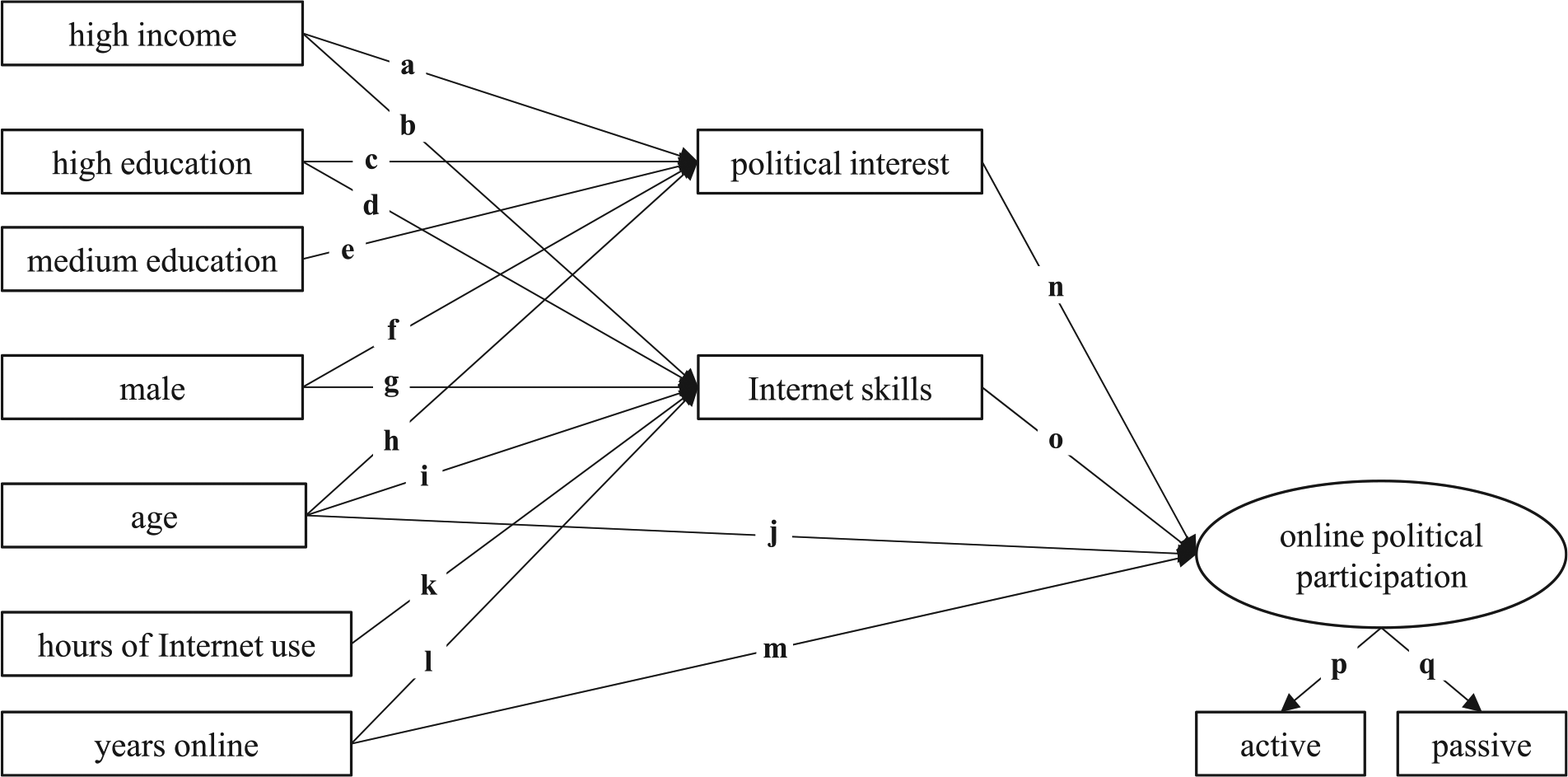
Structural equation model explaining online political participation. See Table 1 for parameter estimates.
In the following, we report the effects in the final model (Figure 3) shown in Table 1. Age positively predicted political interest; namely, older adults were more interested. Gender was a weak predictor, significant only in 2013: Men reported higher levels of political interest. In agreement with previous research, the strongest influence on political interest was education; in particular, high education positively predicted political interest. The effects of household income on political interest were rather small but positive. Turning to Internet skills, age was a strong predictor: Younger users showed higher skill levels, the effect being particularly pronounced in 2013. Similar to political interest, effects of income and gender (male) were positive but small. Internet users with high education had higher Internet skills than those with low or medium education. Years online and hours of Internet use positively predicted Internet skills.
Age had an opposite effect of comparable magnitude on the two mediators, political interest and Internet skills. Younger individuals were more skilled Internet users than older adults yet less interested in politics, resulting in a virtually nonexistent direct effect of age on online political participation (also see Schlozman et al. 2010). The evident age gap in online political participation found in bivariate analyses is thus explained by varying levels of skills and interest. The amount of variance explained (R2) by the exogenous variables was 17.1 percent (2011) and 22.8 percent (2013) for political interest and 28.8 percent (2011) and 36.1 percent (2013) for Internet skills. This means that the dependence of interest and skills on social position increased over time. The explained variance in the outcome variable online political participation was very high and stable (2011: 43.4 % 2013: 42.5 percent). In sum, the structural equation model supported the theoretical research model and was able to explain a large part of the varying levels of online political participation by taking social position indicators, Internet expertise, and political interest into account.
Discussion
Cluster analysis clearly showed the existence of a digital democratic divide. Internet users can be grouped into distinct categories of political and nonpolitical users. These types were also predicted by variables such as education, income, and skills, indicating that the social structuration of unequal participation is also found in the realm of online politics (also see Theocharis et al. 2016). From the often observed circumstance that online political participation is generally very low and that this stands in contrast to the Internet’s technological affordances, this article sought to identify the key explanatory variables and test their effects using SEM. Those who use the Internet for political purposes—by seeking information, engaging in discussions, protesting, or producing content—are those with high interest in political issues. Political interest and political participation are connected in a cycle of mutual enhancement, meaning that the more interested individuals are, the more they will engage in political activities that in turn stimulate knowledge and interest—a mechanism presumably found in virtually all domains of societal participation. Thus, the results support the reinforcement hypothesis.
The plethora of participatory opportunities enabled by the Internet cannot themselves mobilize new citizen groups. Internet use in general, and online political participation in particular, is socially structured. However, despite controlling for political interest, Internet expertise variables had influenced participation, confirming a more moderate position demonstrated in related research (Borge and Cardenal 2011; Nam 2012; Xenos and Moy 2007): The Internet does not eliminate the relevance of interest or motivation, but years online and skills independently promote online political participation. Still, because Internet skills—and even years online as a relic of first-level digital divides—are also socially structured, the mobilization of new participants is certainly an infrequent occurrence and presumably limited to very specific cases (Hirzalla et al. 2010; Schlozman et al. 2010).
This study confirms the substantive findings of Min (2010), who used U.S. data from 2004 nearly a decade later in Switzerland. The diffusion of the Internet has further progressed, yet digital democratic divides persist. The social structuration of both explanatory mediators, political interest and Internet skills, and their effects on online political participation can ultimately be traced back to educational attainment, replicating the democratic divides of the offline realm (see Gallego 2014; Schlozman et al. 2010; Theocharis et al. 2016). The total explained variance of online political participation remained stable, yet the finding that the importance of social position in predicting Internet skills and political interest increased from 2011 to 2013 is an indication of widening participatory divides. Analyses were based on representative data, and the structural equation model fit the theoretical model well, confirmed invariance across two time points, and showed very high explanatory power with regards to online political participation. These findings replicate those of similar studies in the context of a European country with very high Internet diffusion known for its direct democracy.
This study also has several important limitations. The most important one concerns the inability of the data to show the translation of online participatory divides into offline political behavior more directly aimed at influencing public policy. Despite having repeated the survey two years apart, the data were cross-sectional. Panel data on political Internet use have been rare but could substantiate causal claims. For example, it is reasonable to assume that online political participation can also increase interest. The limitations of self-evaluations in surveys, here in particular hours of Internet use and skills, also need to be considered. Furthermore, a more conclusive statement on the development of digital democratic divides over time would certainly require an extended observation period than was analyzed here. Future research may also refine the operationalizations of Internet use, skills, and online political participation and differentiate between different mechanisms (for the multidimensional structure of online participation, see Gibson and Cantijoch 2013).
Conclusion
This article analyzed online political participation within a digital inequality framework. Analyses demonstrated the persistence of digital democratic divides using two waves of a nationally representative survey of Swiss Internet users. This social structuration of Internet use for political participation is an indicator of second-level digital divides (also see Min 2010). While socioeconomic position did not directly affect participatory uses, Internet-related variables did: The level of individuals’ Internet experience and skills codetermines their online political participation. Importantly, political interest and Internet skills are strongly predicted by social position.
Based on these empirical findings, we argue that public policies aimed at social inclusion and increasing democratic participation in the digital society may need to complement the traditional promotion of political interest through education. For example, institutional reforms working toward benefitting society’s least advantaged members should ensure freedom of information, strengthening the right to privacy, and foster Internet skills development (see Duff 2011). Technical measures could include, for example, the further development of easy to use online tools in the style of voting advice applications (Hirzalla et al. 2010; Thurman and Gasser 2009).
Moving away from the reinforcement of existing social inequalities in political participation to the mobilization of historically underrepresented groups in democratic processes will be an ongoing challenge in public policy. This issue is particularly timely in Switzerland and other countries with high Internet access rates where many resources for effective democratic participation are available online. Ensuring citizens have a real opportunity to participate is at the core of any democracy. Access to and use of the Internet have become requirements for full participation in the digitally enabled state; therefore, ad hoc cursory initiatives are insufficient in addressing the right to take part (Gurstein 2015). Policies aimed at social and political inclusion consequently need to focus on effective use of the Internet and become a permanent activity of digital societies.
Footnotes
Appendix
Frequencies and Percentages of Responses for the Four Political Participation Items.

| 2011 |
2013 |
|||||||||||||||
|---|---|---|---|---|---|---|---|---|---|---|---|---|---|---|---|---|
| Information |
Discussion |
Protest |
Content |
Information |
Discussion |
Protest |
Content |
|||||||||
| Frequency | Percentage | Frequency | Percentage | Frequency | Percentage | Frequency | Percentage | Frequency | Percentage | Frequency | Percentage | Frequency | Percentage | Frequency | Percentage | |
| No | 460 | 54.0 | 684 | 80.4 | 770 | 90.5 | 805 | 94.6 | 519 | 54.7 | 784 | 82.6 | 867 | 91.3 | 908 | 95.7 |
| Offline only | 64 | 7.5 | 106 | 12.4 | 26 | 3.0 | 17 | 2.0 | 92 | 9.7 | 113 | 12.0 | 34 | 3.6 | 15 | 1.6 |
| Online only | 114 | 13.3 | 14 | 1.6 | 19 | 2.3 | 11 | 1.3 | 125 | 13.2 | 20 | 2.1 | 24 | 2.5 | 8 | .8 |
| Offline and online | 208 | 24.4 | 40 | 4.7 | 29 | 3.4 | 13 | 1.5 | 207 | 21.8 | 26 | 2.7 | 19 | 2.0 | 14 | 1.5 |
| Missing | 6 | .7 | 7 | .8 | 7 | .8 | 5 | .6 | 6 | .6 | 6 | .6 | 5 | .5 | 4 | .4 |
| Total | 851 | 100 | 851 | 100 | 851 | 100 | 851 | 100 | 949 | 100 | 949 | 100 | 949 | 100 | 949 | 100 |
Acknowledgements
The authors would like to thank Michael Latzer and Natascha Just for their support.
Funding
The author(s) disclosed receipt of the following financial support for the research, authorship, and/or publication of this article: This research received funding from the Swiss Federal Office of Communications (OFCOM) and the Dean’s Office of the Faculty of Arts and Social Sciences, University of Zurich.