




Abstract
How do social and stylistic relations in cultural fields coevolve under changing contextual conditions? Artistic communities cohere through collaborations and shared stylistic orientations among artists, but little is known about the structure and interplay of these relational processes. The authors contribute to previous studies by conducting a large-scale investigation of social and stylistic networks among Hollywood filmmakers. In particular, the authors examine how the interplay between artists’ collaborations and shared references changed throughout Hollywood’s history. Using data from the Internet Movie Database and applying relational hyperevent models, the authors analyze the coevolution of collaboration and reference networks among 15,553 Hollywood film professionals who participated in 6,800 films between 1930 and 1999. The authors complement prior sociological efforts through a longitudinal perspective on the structure of social and stylistic networks across three meaningful historical periods: before, during, and after Hollywood’s artistic transformation in the 1960s. The findings show that filmmakers are more likely to collaborate if they previously used the same references, but they are less likely to adopt the references of their previous collaborators. In addition, the results highlight that the structure of relational processes in cultural fields varies over time as the contextual conditions for tie formation change.
The social organization of cultural fields plays a crucial role in how artists produce culture (Becker 2008; Bourdieu 1993). This insight has led to various streams of research investigating creative success and canonization in filmmaking (Baumann 2001, 2007a), music (Dowd et al. 2002; Lopes 2002; Phillips 2013), or literary writing (Bourdieu 1993; Dubois 2018). Thereby, a branch of research developed that uses network analysis to study how artists’ positions in collaboration networks or specific team constellations affect individual or team success (de Vaan, Vedres, and Stark 2015; Fleming, Mingo, and Chen 2007; Li et al. 2019; Lutter 2015; Rossman, Esparza, and Bonacich 2010; Uzzi and Spiro 2005; Vedres and Cserpes 2020).
A parallel line of research highlighted that cultural fields, independent of individuals’ careers, exhibit a social organization that often faces profound changes over time (Anheier, Gerhards, and Romo 1995; Baumann 2007a; Bourdieu 1993; Crane 1995; Crossley 2009; Lena and Peterson 2008; Lopes 2002). For instance, the emergence of new painting styles (Becker 2008; White and White 1993) and the formation of musical genres (Lena 2012; Skaggs 2018) illustrate how the social fabric of cultural fields can fundamentally change.
Our study addresses the intersection of these literatures by synthesizing recent methodological advancements in network modelling (Lerner and Lomi 2023) with scholarship stressing the multifaceted and dynamic nature of relational processes in cultural fields (Basov and Kholodova 2022; Bourdieu 1993; Skaggs 2019; White and White 1993). The empirical setting of our study is Hollywood filmmaking, one of the globally most influential cultural fields. We analyze the interplay between collaboration and coreference networks among filmmakers and show how the coevolution of these two relational processes changed throughout Hollywood’s historical development from 1930 to 1999. Thereby, we contribute to a growing body of research that mobilizes novel data sources and computational tools to measure cultural phenomena (Mohr et al. 2020), and speak to sociological work concerned with the duality of culture and networks (Fuhse and Gondal 2024; McLean 2017; Mützel and Breiger 2020).
Our first main contribution is that we use network models to study the structure of artistic collaboration and shared stylistic orientations simultaneously. Although previous accounts stressed the importance of multiple relational processes among actors in cultural fields, such as friendship, recognition, and collaboration in creative projects (Becker 2008; Crane 1995; Farrell 2001), most previous network analytical studies focused on the effect of actors’ or teams’ positions in collaboration networks on their creative or economic success (de Vaan et al. 2015; Lutter 2015; Uzzi and Spiro 2005).
One reason for the focus on collaboration networks might be that it is notoriously difficult to measure other relational processes in cultural fields. Typically, researchers rely on survey methods to simultaneously map, for example, the coevolution of friendship, cultural taste, or shared world views (Edelmann and Vaisey 2014; Ellwardt, Steglich, and Wittek 2012; Lizardo 2006; Vaisey and Lizardo 2010). This approach is not feasible when studying the changing social organization of certain communities, such as Hollywood, where it is difficult to recruit respondents or where relevant members of the community do not live anymore.
We overcome these issues by mobilizing a large dataset containing collaborations and artistic references among more than 15,000 film professionals. Thus, we complement existing literature by considering how collaboration ties and shared artistic references coevolve and coalesce into stable field configurations. We argue that studying the meso-level organization of collaborations and shared stylistic orientations is crucial to understand how a hierarchy of social positions located in cultural fields emerges in the first place and subsequently affects individuals’ outcomes. Although researchers have applied network models to study multiple relational processes in scientific communities (Stark, Rambaran, and McFarland 2020), schools (Huitsing et al. 2012; Wittek, Kroneberg, and Lämmermann 2020), universities (Fujimoto, Snijders, and Valente 2017; Huitsing et al. 2014), and other organizational settings (Carnabuci, Emery, and Brinberg 2018; Lazega and Pattison 1999), only a few studies have modeled more than one relational process in artistic contexts (Basov 2020; Basov and Kholodova 2022).
Our second main contribution is that we study how the interplay between collaborations and shared stylistic orientations changes as a cultural field matures. Despite the widespread notion that the social organization of cultural fields can change profoundly over time (Becker 2008; Bourdieu 1993; Kuhn 1970; Phillips 2013), few studies applied network models to investigate temporal variation in tie formation processes (see Lewis and Kaufman 2018; Schaefer and Kreager 2020; Wittek, Bartenhagen, and Berthold 2023), especially not in the domain of cultural fields.
We address this shortcoming by considering how the structure of collaborations and shared artistic orientations changed throughout Hollywood’s historical trajectory. This extension of existing research speaks to multiple streams of literature. By taking a longitudinal perspective we complement previous investigations of selection and influence in the formation of social network ties in diverse social contexts (Dijkstra, Cillessen, and Borch 2013; McMillan, Felmlee, and Osgood 2018; Schaefer and Kreager 2020; Schaefer and Simpkins 2014; Steglich, Snijders, and Pearson 2010; Torlò and Lomi 2017). This constitutes an important first step to understand under which conditions central network positions affect individuals’ outcomes (e.g., Lutter 2015; Sorenson and Waguespack 2006). In addition, our quantitative analysis of Hollywood’s historical trajectory speaks to sociologists of film interested in the relational structures underlying Hollywood’s transformation into an art world (Allen and Lincoln 2004; Baumann 2007b; Hicks and Petrova 2006).
To test our theoretical considerations, we analyze the interplay between collaboration and coreference networks among filmmakers and show how the coevolution of these two relational processes is shaped by varying historical conditions. We examine to what extent artists with stylistic similarity, measured through their use of the same references, are more likely to collaborate, respectively, if they become stylistically similar conditional on previous collaboration, and how this link shifts over time. Using data on collaboration and cinematic references of 15,553 film professionals active between 1930 and 1999 from the Internet Movie Database (IMDb), we apply recent advances in longitudinal network modeling (Lerner and Lomi 2023) to uncover phases of continuity and change in Hollywood’s social and stylistic organization across three periods identified by scholars studying Hollywood’s history: the golden age (1930–1959), the new Hollywood (1960–1979), and the blockbuster era (1980–1999).
Overall, our findings suggest that cultural producers tend to collaborate on the basis of stylistic similarity. This tendency became more pronounced during Hollywood’s artistic transformation in the 1960s and persists in subsequent periods, pointing to an increased relevance of stylistic similarity for collaboration as artistic criteria gain importance in a cultural field. In contrast, filmmakers tend to not adopt the references from their previous collaborators. This tendency remains consistently negative across all historical periods, but decreases even further during the 1960s, which indicates that filmmakers avoid copying their collaborators stylistically. Taken together, our article illustrates that stylistic orientations shape collaboration choices among cultural producers and that this interplay is sensitive to the changing historical context for creative work.
The Social and Stylistic Organization of Cultural Fields
Cultural producers are embedded in multiple relational processes (Becker 1982; Bourdieu 1993). They engage in collaborations to create artistic work, ranging from films (Cattani, Ferriani, and Allison 2014; Lutter 2015; Rossman et al. 2010) to songs (Crossley 2009; Lena 2012; Skaggs 2019), cuisine (Gualtieri 2022), or video games (de Vaan et al. 2015). Besides collaboration, cultural producers also engage in more subtle forms of interaction, for instance, when referencing their peers’ or predecessors’ works. Artistic references can take the form of adopting dialogues or stills in filmmaking, copying geometric patterns or color palettes in visual arts (Becker 1982), or sampling in music (Lena 2004; Lena and Pachucki 2013). The main research question of this article is, To what extent are these two relational processes—collaborations and coreferences—interrelated, and how do different contextual conditions shape the link between both?
Previous research highlights the interdependence of collaboration and stylistic similarity in cultural fields but remains vague regarding its causal order (Crane 1976). On the one hand, studies suggest that artists with similar styles are more likely to collaborate. Sharing similar aesthetic preferences may lead artists to meet at the same places (Crane 1995; Feld 1981; Mehta 2017) and facilitate communication and cooperation (Skaggs 2019). However, the reversed causal direction is also plausible because collaborations can shape artists’ stylistic tastes and preferences. Collaborating for several weeks or months on a joint project may influence artists’ styles as they learn about or jointly develop new practices through interactive exchange (Farrell 2001). It may also be that both relational processes are interdependent in the sense that they continuously influence each other. In addition, historical accounts suggest that the strength of interdependence among these two relational processes may depend on a cultural field’s contextual conditions, which define the social and symbolic space in which artists are embedded. These contextual conditions include, for example, the field’s economic constitution and audience composition (Baumann 2007b), diversity among producers (Dowd 2000; Peterson and Berger 1975), employment opportunities (White and White 1993), and movements within (Bourdieu 1996; Crane 1995; Lena 2012) or between neighboring fields (Rao, Monin, and Durand 2003).
Our study will address whether collaborations leave their mark on artists’ stylistic decisions, whether shared styles lead to collaboration, and whether this interplay changes with varying contextual conditions over time. We use the Hollywood film industry as a strategic research site (Merton 1987) to study the coevolution of collaboration and coreference networks over 70 years. In the following, we build on previous studies on collaborations and stylistic affinities in cultural fields and theories on homophily in network tie formation to argue that filmmakers choose to collaborate with stylistically similar peers and that collaboration influences stylistic similarity.
Stylistic Similarity and the Use of References in Cultural Fields
A central assumption among sociologists is that cultural groups cohere through the shared deployment and development of styles, tastes, and cultural practices (Accominotti 2009; Becker 1982; Crane 1976; Wohl 2015). 1 Crane (1995) defined style as a group phenomenon that “represents a kind of collaborative endeavor on aesthetic problems, in the sense that members follow each other’s work and exchange ideas” (p. 19). She argued that the most famous artworks emerge from communities cohering on the basis of shared stylistic approaches. Godart (2018) defined style as the “durable and recognizable pattern of aesthetic choices” that reflect “a pattern of actions that can be observed and, to a certain extent, reproduced and coded” (p. 103). Styles emerge from a specific combination of artistic elements, for example, in the context of film, editing and framing techniques, lighting, or dialogue forms. 2 Shared group styles manifest through the patterned repetition of these elements across group members reflecting artists’ ability to perceive and judge the (art) world in similar ways (Eliasoph and Lichterman 2003).
We argue that one way to measure stylistic affinity is through shared artistic referencing. Seeing themselves as part of a community, cultural producers often reference their peers’ work to validate their own conceptions of artistic knowledge. For example, visual artists pick up aesthetic elements—brushstrokes, color palettes, or geometric patterns—from predecessors or colleagues and incorporate them into their works (Coman and Opazo 2020; Wohl 2015). Musicians’ artistic choices—for instance, which tonal material is used in an improvisation—build on previous performances and records and, thus, cherish or challenge established artistic conventions (Berliner 1994; Phillips 2013). Rap musicians use samples (i.e., “prerecorded sonic performances that are subsequently used in new songs”) to build aesthetic connections within their community and draw boundaries from other musical communities (Lena 2004:298). In filmmaking, references appear as adopted camera shots, editing techniques, stills, or dialogue snippets (Bioglio and Pensa 2018; Spitz and Horvát 2014). Cinematic references allow filmmakers to showcase their command over a body of aesthetic knowledge and skills. Film Noël Carroll (1982: 52) described various examples of film references: They include the outright imitation of film-historical referents; the insertion of classic clips into new films; the mention of illustrious and coyly nonillustrious films and filmmakers in dialogue; the arch play of titles on marquees, television screens, posters, and bookshelves in the background of shots; the retreading of archaic styles; and the mobilization of conventional, transparently remodeled characters, stereo-types, moods, and plots. (p. 52)
A vivid example is the final scene of Steven Spielberg’s Raiders of the Lost Ark (1981), as displayed in Figure 1. Here a wide-angle camera shot covers wooden boxes in a warehouse, recalling Orson Welles’s final scene of Citizen Kane (1941).

Example of artistic references in filmmaking: Citizen Kane (Orson Welles, 1941) and Raiders of the Lost Ark (Steven Spielberg, 1981).
Unlike scientists, filmmakers rarely reveal their references. For example, contemporary filmmaker Wes Anderson stated that “the reason why you hide your inspirational sources is because you try to steal them” (Guisset 2017). Spielberg’s intention behind referencing Citizen Kane becomes clear in an interview with the American Film Institute (2011), in which he states his appreciation of the movie and his admiration of Orson Welles as an icon of filmmaking. Spielberg was not the only filmmaker referring to content from Citizen Kane. Several of his contemporaries, including Brian De Palma, Stanley Kubrick, and Martin Scorsese, also picked up elements from this film. For example, in an interview in 1978, De Palma and Scorsese comprehensively discussed how Orson Welles’s ideas influenced their own works (The Dick Cavett Show 2019). In an interview with Ebert (1998), an important film critic, Martin Scorsese discussed cinematic references as an artistic practice he shared with his new Hollywood peers: “[We] did tons of that [referencing]. Myself and DePalma and Spielberg and Coppola; in so many of our films we did things that relate to earlier films. There are several shots in “Taxi Driver” that are inspired by “Shane.” It’s homage—the self-consciousness of saying, hey, here’s a little nudge in the ribs to Truffaut; that’s a nudge to Fellini; that’s one to George Stevens; that’s one to John Ford. You find yourself looking at old films a lot. The Hitchcock pictures I like looking at repeatedly, repeatedly, repeatedly.”
In this sense, using the same references implies a strong collective meaning. It allows artists, from musicians to filmmakers, to develop and use a set of shared conventions and simultaneously signal to one another their stylistic affinity. In the following, we discuss why the shared use of references would make artists more likely to collaborate and why artists would use the same references as their previous collaborators.
The Influence of Shared References on Collaboration
Using the same references may affect the likelihood of artists becoming collaborators for practical and symbolic reasons. One of the practical reasons is that using the same references is an indicator of having a similar stylistic vocabulary and grammar. Sharing a similar aesthetic orientation allows artists to communicate ideas more efficiently, which makes the collaborative process smoother and more productive. For example, shared stylistic conventions in jazz are crucial in facilitating jam sessions among musicians (Berliner 1994; Faulkner and Becker 2009). Sharing knowledge of a cultural repertoire, rhythms, scales, and melodies in music, respectively, stills, camera shots, and dialogues in filmmaking saves time and resources by not having to explain certain concepts or ideas. Consequently, artists can engage in more efficient and streamlined collaboration. As an illustration, De Palma described how lightning techniques developed by Orson Welles or Alfred Hitchcock serve as his own and his peers’ cinematic points of reference: “If I read a script and Marty’s [Scorsese] gonna do it or George Lucas or Spielberg’s gonna do I can see what they’re gonna shoot because you can sort of think in their grammar” (The Dick Cavett Show 2019).
Besides these practical aspects, artists may be more likely to collaborate when sharing the same references for symbolic reasons. References signal artists’ cultural tastes in specific films, and aligning in taste is conducive to forming and sustaining social ties (Dahlander and McFarland 2013; Edelmann and Vaisey 2014; Lewis and Kaufman 2018; Lizardo 2006). Previous sociological research has shown that people are more likely to form friendship ties when sharing tastes or dislikes for the same musical genres (Edelmann and Vaisey 2014), movies, music, and books (Lewis and Kaufman 2018), or when holding similar world views (Vaisey and Lizardo 2010). Such cultural homophily may also apply to artists. Realizing an aesthetic vision implies wise collaborative choices that grant sufficient individual autonomy and allow one to remain consistent with one’s previous works (Coman and Opazo 2020; Wohl 2019). In addition, a stylistic fit among collaborating artists reflects cultural producers’ shared orientation toward artistic or commercial goals, which is crucial in communication with peers, critics, and public audiences (Basov 2020; Skaggs 2019). Given these theoretical considerations, we expect that filmmakers who share the same references are more likely to collaborate.
Hypothesis 1: Filmmakers who reference the same films are more likely to collaborate.
The Influence of Past Collaboration on the Use of References
The reverse relationship—the influence of collaboration on shared references—is also plausible. Sociological research has shown that people influence each other in their cultural preferences and meaning-making through continuous exchange in small group settings (Childress and Friedkin 2012), especially when interacting with sociodemographically similar others (Rawlings and Childress 2019). Collaborations are settings of collective meaning-making in which artists spend significant time discussing creative decisions and being constantly exposed to each other’s ideas and approaches. Such constant exposure and continuous interaction may foster the development of a shared style and lead artists to learn about their collaborators’ approaches. As soon as one project ends, artists travel to new projects, and so may the lightning techniques or stills they learned about or the general cinematic taste and literacy they encountered. Previously used references may be used again in new collaborative settings in which they help solve practical problems and serve as signals of membership and belonging (Berliner 1994; Lena 2004). Following this reasoning, artists should be more likely to use references that they were exposed to in previous collaborations. Coreferences would, thus, be the outcome of collaboration rather than its necessary condition. 3
Hypothesis 2: Filmmakers tend to use the same references as their previous collaborators.
It may also be that both relational processes continuously influence each other. “As proposed by (Geertz 1973),” individuals construct and reconstruct webs of meaning both on their own and through collaborative group dynamics. In a recent study, Stark et al. (2020) found that scientists tend to choose collaborators on the basis of intellectual affinity and use similar references as their previous collaborators.
We expect that the order of these two relational processes is not fixed but changes over time throughout Hollywood’s historical development. Rather than looking at average tendencies in the coevolution of social and stylistic relations, our approach considers the historical context, and thus varying meaning structures, in which tie formation takes place (Fuhse and Gondal 2024; Gondal and McLean 2013). In the following, we describe the historical context in Hollywood between 1930 and 1999.
The Influence of Historical Conditions on the Interplay between Collaborations and Coreferences
During the 70 years of filmmaking that we consider in our analyses, 1930 to 1999, Hollywood underwent significant economic, social, and artistic changes. The three major historical periods we consider cover the so-called golden age (1930–1959), the new Hollywood (1960–1979), and the blockbuster era (1980–1999). There is high consensus among film historians that these three phases existed and reflect significant and meaningful differences in how film was made, who authored films, and aesthetic phases of film artistry (Bordwell, Staiger, and Thompson 2015; King 2012; Thompson 1999).
The golden age (1930–1959) was characterized by a commercial approach to filmmaking, driven by the dominance of the major five film studios (Paramount Pictures, 20th Century Fox, Metro-Goldwyn-Mayer, Warner Bros., RKO Pictures). The visual and narrative style of classical Hollywood cinema favored, among other aspects, continuity editing and linear narratives, and filmmakers’ professional identity and relations were characterized by long-term employment and studios’ unified ownership of production, distribution, and exhibition enterprises (Bordwell et al. 2015). Although this organizational setup facilitated assembly line–like production of films, it offered filmmakers little artistic freedom. Filmmakers were often part of large, hierarchical organizations that controlled all aspects of the filmmaking process, from production to distribution. Regarding their professional identity, they perceived themselves more as entertainers or engineers rather than artists and had little autonomy to choose their collaborators.
In contrast, the new Hollywood period (1960–1979) witnessed a profound transformation in both the production and reception of films, from a producer-centered commercial endeavor to a director-centered art form (Baumann 2007b; Elsaesser, Horwath, and King 2004). The old studio system faced a severe economic crisis driven by two major lawsuits that forced studios to dissolve their power oligopoly and loosen contractual obligations of studio personnel (Gil 2010). In addition, television emerged as a popular form of entertainment, captivating the masses, while the baby boomer generation emerged as a prominent audience that studios struggled to cater to (Baumann 2007b). At the same time, inspired by cinematic movements in France and Italy, film critics, academics, and filmmakers, constructed the idea of auteurism that facilitated the evaluation and production of film as an art form in its own right (Allen and Lincoln 2004; Baumann 2001; Hicks and Petrova 2006). The idea of auteur filmmaking implies the unified creative control of the individual filmmaker, typically through a single director or director-writer. New Hollywood filmmakers created a novel cinematic style and, with the support of other institutions, such as critical film discourse, film school departments, and film festivals, established the shift in the perception of Hollywood film from entertainment to an acknowledged art form. The collapse of the studio system offered filmmakers more freedom in choosing with whom to collaborate. This new artistic understanding of filmmaking and the weakened position of commercially oriented studios constituted a major historical shift and changed the conditions of Hollywood’s social organization.
The economic success of new Hollywood films such as The Godfather (1972) and Jaws (1975) heralded the dawn of the blockbuster era (1980–1999). This period was characterized by the increasing importance of movies’ commercial rather than artistic value, and auteurism served predominantly as a marketing tool to promote films (Baker and Faulkner 1991). Because of the elevated financial success of films, production companies ended the phase of artistic experimentation and regained more power over creative decisions. One expression of this development was the introduction of sequels and the production of several films on the basis of previous revenues, which implied casting the same stars repeatedly (Hirsch 1972). This approach, which is similar to major record labels’ aiming to establish an assembly line of commercial successes (Lena 2012; Phillips 2013), allowed studios to minimize risks while at the same time limiting filmmakers’ artistic freedom.
Previous cultural sociological research has emphasized the influence of contextual factors on artistic production. In cultural fields, long phases of continuity can be interrupted by exogenous factors, such as legal or economic crises, or endogenous factors, such as emerging movements or genres (Kaufman 2004). For example, In the case of painting, White and White (1993) argued that the oversupply of artistic talent and restricted employment opportunities facilitated the emergence of the Impressionist art movement in nineteenth-century France. As the royal academic system provided few career opportunities, Impressionist artists collectively created an alternative, gallery-centered distribution and evaluation system. In the field of gastronomy, Rao et al. (2003) showed how culinary activists challenged the dominant culinary notion and professional identity of chefs in French gastronomy. Inspired by the 1960s antiauthoritarian wave in neighboring cultural fields—literature, theater, and film—chefs forged a new culinary vision that elevated them as inventors rather than technicians and equipped them with more freedom to create rather than emulate canonical dishes.
The field’s economic conditions might also play a role. Peterson and Berger’s (1975) analysis of historical changes in the music industry examines how market concentration, in the sense that few firms dominate the industry, affects musical diversity. They propose a cyclical pattern: long periods of high concentration and low diversity are separated by short periods of low concentration and high diversity captured, for example, in lyrical themes, the number of recording firms, or racial heterogeneity among performers (Dowd 2000; Dowd and Blyler 2002). On the other hand, advocates of the open system approach argue that the impact of high concentration on diversity decreases when music production is decentralized, in contrast to the dampening effect observed when production is centralized (Lopes 1992). While these studies contributed significantly to our understanding of how contextual factors shape artistic outcomes, we focus on the dynamics among filmmakers through a network analytical lens.
Given Hollywood’s varying historical conditions, we expect the direction and strength of the link between collaboration and coreferences to change across these three historical turning points (Bearman 2015). Film historical literature indicates that a close link between stylistic orientations and collaborative decisions marked filmmaking during the new Hollywood period. In contrast, the strong commercial orientation during the golden age and blockbuster era suggests a less pronounced link during these phases. We refrain, however, from formulating a concrete hypothesis because film historical insights do not easily translate into specific measures or hypotheses about effect directions that we could include in a formal test of cultural change. Following the recent interest in abduction in computational social science research, we think of this expectation more as an explorative theoretical consideration than a hypothesis that states clearly during which periods we can expect a certain sign for effects (Brandt and Timmermans 2021; Goldberg 2015; McFarland, Lewis, and Goldberg 2016). On the basis of the film historical literature, we probe for effect heterogeneity across time and expect that the interplay between collaboration and coreference networks varies across Hollywood’s historical trajectory.
Hypothesis 3: The strength and direction of the link between collaboration and coreference networks varies among the golden age, the new Hollywood period, and the blockbuster era.
Data
We use data on collaborations among directors, writers, cinematographers, editors, and references as listed in the IMDb to measure the interplay of collaboration and coreference networks. 4 This rich data repository includes all films and their associated crew and cast over the entire history of filmmaking. IMDb is a crowd-sourced platform on which a community of film enthusiasts submits, edits, and updates information. Unless users with a proven track record submit the information, IMDb publishes new data entries only after screening them for consistency and correctness. We are not the first to draw on this exceptional source for scientific purposes. Several sociological studies have relied on the IMDb and confirmed the validity of its entries concerning the information on casts, crews, and genres (Cattani et al. 2014; Wei 2020; Sorenson and Waguespack 2006; Zuckerman et al. 2003), user ratings (Keuschnigg and Wimmer 2017), acting credits (Rossman et al. 2010), and artistic references (Bioglio and Pensa 2018; Spitz and Horvát 2014). In Appendix A, we provide a comprehensive analysis and discussion of potential biases of the data regarding artistic references.
As we are interested in permanent field participants, we only include filmmakers who participated in at least two films and were active for at least three different years. We include feature films of the following genres: action, adventure, animation, biography, comedy, crime, documentary, drama, family, fantasy, film noir, history, horror, music, musical, mystery, romance, science fiction, short, sport, thriller, war, and western. We exclude the genres of news, talk shows, game shows, reality TV, and adult movies.
Last, we include information on references from a film’s IMDb section on “connections.” There are different types of connections, ranging from active ones, such as “references,” or “spoofs,” to passive ones, such as “version of” or “remade as.” We only consider titles listed as “references” because we focus on references that filmmakers actively implemented in nonspoofing ways. Following the IMDb’s definition, a film includes a reference if it “references or pays homage to a previous title (i.e., a still, poster, or artifact; mentioned by name; scene discussed by characters; dialog quoted in a non-spoofing way).”
As IMDb users provide the information on references, it is essential to examine to what extent IMDb user preferences may drive it. A close link between user preferences and artistic references would challenge the validity of our results. For instance, if IMDb users mainly detect references for prominent films, such as Star Wars, but not for less prominent films. Also, the registered references could be shaped by a retrospective bias if users find more references in more recent films. IMDb started in the 1990s, and users might pay more attention to contemporary films and only consider popular older films. Consequently, our measure for stylistic similarity would be inconsistent over time. We address these concerns through a systematic analysis in Appendix A. Our results do not provide evidence for the concern that information on cinematic references is mainly driven by IMDb user preferences or retrospective bias.
Considering all selection criteria, our sample consists of 15,553 film professionals who participated in 6,800 films, referencing 8,358 films. Figure 2 provides an overview of our sample composition for 10-year moving windows, where the first observation window is 1930 to 1939 and the last one 1990 to 1999. This approach allows a dynamic perspective on filmmakers’ relational processes (for a similar approach, see Shwed and Bearman 2010 or de Vaan et al. 2015). In our analysis, we only include films that have at least one filmmaker and used at least one reference. Future research could devise different methods to measure stylistic similarity, such as automated image analysis, to include a broader range of film professionals. We discuss these possibilities in the concluding section of our article.

Sample size, 1930 to 1999. Each year includes 10 years; for example, 1930 includes 1930 to 1939. The left axis includes the number of filmmakers (dashed line), number of referencing films (black solid line), and number of references (dotted line). The second axis includes the number of all released films (gray solid line).
Analytical Strategy
Relational Hyperevent Models
Our analysis focuses on modeling the coevolution of filmmakers’ collaboration and coreference networks. We conceptualize both relational processes as a two-mode network. The first set of nodes consists of film projects, and the second set of people. One type of ties defines people as belonging to film projects, and a second type of ties defines films referencing other films (see Figure 3). Through this multiplex two-mode structure, we acknowledge theoretical accounts that highlight the duality between persons and the groups they are embedded in (Breiger 1974; Gondal 2018; Mützel and Breiger 2020). Our analytical strategy also answers calls to apply models tailored to study the structure of relational events in large process-produced datasets, as these are conceptually different from relationships (Light and Moody 2020:86–88).

Stylized example of a mixed two-mode relational hyperevent in our data.
The unit of analysis of our models is a produced film for which we use the information on its release year (“time”). We also consider information on the team of filmmakers—including directors, writers, cinematographers, and editors—involved in a film (up to 36 film professionals participated in a film). Moreover, we consider the list of other films referenced by a film (between 1 and 260). A produced film, thus, gives rise to a relational event (Butts 2008) that connects filmmakers with the film they produce and films with their references.
Following Breiger’s (1974) approach, a film also establishes indirect relations among its team of filmmakers by making them collaborators. Furthermore, films induce cocitation ties among team members and create reference ties from the filmmakers to the cited films. We note that our main research questions aim at the explanation of “collaboration events” among filmmakers and “citation events” from filmmakers to the cited references, respectively. As a film can connect any number of filmmakers and references, modeling the derived dyadic events—by connecting one pair of filmmakers or one filmmaker with one reference, respectively—would induce various biases. In particular, such an approach would inflate the number of observations, introduce structural artifacts, invalidly assume independence of dyadic events stemming from the same produced film, and potentially miss higher order dependencies among “hyperevents” (Lerner and Lomi 2023; Lerner et al. 2021). Therefore, we apply relational hyperevent models (RHEM), which are developed for relational events connecting varying and potentially unbounded numbers of nodes.
The underlying rationale for using RHEMs in studies of collaboration networks is that artistic collaboration is intrinsically polyadic (i.e., typically involving teams of any size). Therefore, RHEMs specify film release rates associated with hyperedges representing groups of filmmakers of any size (Lerner and Hâncean 2023). Previous sociological research has applied RHEMs to model political meetings among members of the Thatcher cabinet (Lerner et al. 2021), coattendance at social events in the canonical Davis, Gardner, and Gardner “Deep South/Southern Women Data” (Lerner and Lomi 2021), and team formation of scientific coauthors (Lerner and Hâncean 2023).
To examine if tie formation changes over time, we use a 10-year moving window approach. For example, for the year 1960, we consider ties from 1960 until 1969. Although our main interest lies in the effect of coreferences on collaboration and in the effect of collaboration on coreference, we also control for other factors that may influence the formation of collaborative and coreference ties. We describe how other network-endogenous and network-exogenous effects may influence tie formation in the following.
Measurement and Model Specification
We aimed for a close correspondence between our model specifications and previous accounts (Lerner, Hâncean, and Lomi 2023). We followed an iterative modeling strategy typical for network studies using advanced network models, such as exponential random graph models and stochastic actor oriented models (see, e.g., Wimmer and Lewis 2010). We estimated various model specifications and tried to find a parsimonious specification that captures the effects of substantial interest while also controlling for other important network mechanisms. In this process, we omitted terms that turned out insignificant or showed strong multicollinearity with other model terms. Our main focus is to model the coevolution of collaboration and reference networks. In the following, we discuss the main effects of interest and a set of control variables that may influence collaborations and references. To enhance the readability of our results Table 1 depicts all included effects visually.
Description of network effects.

Note: Black circles are filmmakers (f1, f2). White squares represent movies (m1, m2, m3, m4). Solid lines indicate that a filmmaker worked on a particular movie. Dotted lines indicate that a movie referenced another movie.
The Interplay between References and Collaborations
Our two main effects of interest capture the interplay between collaborations and references among filmmakers. In particular, we include one parameter that measures the occurrence of collaboration ties based on a shared artistic reference. Thereby, our models allow us to capture whether stylistically similar artists tend to collaborate. Analogously, the second main parameter indicates whether collaboration partners adopt each other’s references. The two effects allow us to disentangle whether filmmakers select one another on the basis of their stylistic choices and/or whether collaborators influence each other by adopting the references of their collaboration partners.
Control Variables
Repeated Collaboration and Triadic Closure
In an early study on Hollywood, Faulkner and Anderson (1987) showed that relationally close artists are more likely to collaborate. Relationally close can mean that filmmakers collaborate repeatedly. Choosing previous collaborators decreases risks and uncertainties on performance as collaboration partners can form their expectations on the basis of past experiences (Sorenson and Waguespack 2006). Other studies have emphasized the benefits of recurring ties in such diverse contexts as fashion (Uzzi 1997), science (Dahlander and McFarland 2013), biotechnology (Powell et al. 2005), and financial services (Podolny 1993, 1994). Another form of relational closeness is triadic closure. This happens when two cultural producers are indirectly connected through a third cultural producer (Ebbers and Wijnberg 2010). If filmmakers A and B and A and C collaborated, it is likely that B and C also get into contact. We expect that relational closeness in the form of repeating collaborations or triadic closure influences the likelihood of forming a collaborative tie.
Popularity by Productivity
Filmmakers who have participated in many film projects are experienced professionals, likely to be well connected in the field, and may facilitate access to follow-up projects. Therefore, they should be more attractive as collaborators than filmmakers with fewer connections. The tendency of prominent actors to attract even more ties over time is well documented for several networks, such as scientific collaboration and citation networks (Eom and Fortunato 2011; Newman 2001). We measure filmmakers’ productivity by the number of films they have participated in previously to the focal film.
Filmmaker Popularity by Resources
Filmmakers engaging in projects with big budgets are likely to be more successful in participating in new projects in the future. Working in well-equipped projects might signal higher status and elevate a filmmaker’s chances to find new projects. To measure resources, we calculated the crew size—including producers, directors, writers, cinematographers, editors, composers, costume designers, production designers, and miscellaneous production personnel—for each film a filmmaker was involved and averaged it over all prior movies of the filmmaker (for a similar approach, see Rossman et al. 2010). As an additional control for the role of resources in filmmaking, we included a parameter that measures whether the crew size of a film increases its likelihood of being referenced by another film. This parameter captures the notion that films with more resources are, on average, more visible and, therefore, attract more references.
Individual and Global Popularity of Referenced Films
We control for a referenced film’s local and global popularity. The first implies that the same filmmaker uses the same reference repeatedly, while the second implies that a film is overall disproportionally more cited by all filmmakers.
Resources of Referenced Films
Last, we control for a referenced film’s resources. Films that are well equipped with economic resources may attract more references because they might be more widely distributed so that more filmmakers are likely to see them. Again, we measure resources through crew size.
Results
The Coevolution of Collaboration and Reference Networks
Overall, we find that filmmakers are more likely to collaborate if they have used the same reference in the past. This finding is in line with our theoretical expectations (hypothesis 1) and provides evidence for the notion that stylistic similarity facilitates artistic collaboration. In contrast, we find that filmmakers are less likely to use the references of past collaborators. This finding is contrary to our expectation that collaborators influence each other in their referencing behavior (hypothesis 2). Table 2 displays the statistical effects for the complete dataset. Also, we performed further analysis that help readers to judge the explanatory power of our main effects of interest in Appendix B. In short, these additional results indicate that the selection of filmmakers on the basis of shared references and the avoidance to adopt collaborators’ references contribute substantially to the explanatory power of our model.
Relational hyperevent models for the coevolution of collaboration and reference networks.

Note: n = 686,400; number of events = 6,800.
p < .001.
Regarding the control variables, we find that contrary to previous studies (e.g., investigating friendship networks among students; Moody 2001), there is no positive significant effect for triadic closure. This might be because filmmakers tend to seek new collaborators rather than rely on recommendations by others and, thus, allow new ideas and approaches to flow. Another reason could be that that many filmmakers only participate in a small number of films during their career and drop out of the industry after a few years, decreasing the chances of forming transitive collaboration structures. Previous studies using RHEMs have also found a negative closure effect in meeting data (Lerner et al. 2021), coauthoring networks (Lerner and Hâncean 2023), and some co-offense networks (Bright et al. 2023), which suggests the existence of actors occupying stable broker positions (i.e., actors being connected to pairs of unconnected actors). These studies argued that the analytic approach to consider hyperevents as collections of dyadic events (mutually connecting all pairs of participants) may spuriously reveal positive triadic closure, simply for the reason that hyperevents with many participants create large cliques and hence many closed triangles by design.
In line with past research on scientific collaborations (Dahlander and McFarland 2013), we find that filmmakers who have collaborated in the past are also more likely to collaborate on future projects. This finding illustrates that filmmakers who stay in the industry form strong bonds through their participation in films and choose the same collaboration partners again and again.
We find that filmmakers who participated in many films in the past are less likely to participate in additional films. Again, this finding could point to the short-lived careers film professionals usually have in the film industry: as the average number of films a filmmaker produces during her career additional films become less likely over time.
Regarding the effect of resources, we find that filmmakers participating in past films with higher crew sizes are more likely to participate in additional film projects. This finding suggests that filmmakers who manage to participate in high-budget films (i.e., large crews) are more likely to stay in the industry and produce additional films. The budget of a movie (measured by crew size) has a positive effect on the probability that the film gets referenced. This result matches previous accounts that suggest that films using a lot of resources are also more likely to be recognized and consecrated among audiences and filmmakers alike (Allen and Lincoln 2004; Cattani et al. 2014).
Moreover, in-degree popularity and repeated references by the same author both show a statistically significant and positive coefficient. The in-degree popularity term points to “rich get richer” dynamics in the consecration of artworks (Cattani et al. 2014; Dubois 2018; Salganik, Dodds, and Watts 2006) and scholarly work (Eom and Fortunato 2011): each additional references increases a film’s likelihood to receive additional references. The positive repeated reference by the same author coefficient illustrates that filmmakers develop a coherent style throughout their careers and rely on the same artistic references as their careers progress. A similar tendency was recently discovered in aging scientists (Cui, Wu, and Evans 2022).
Historical Variation
We now turn to our third theoretical expectation, concerned with temporal variation in the interplay between collaborations and referencing (hypothesis 3). When disentangling by historical periods, we find substantial variation in the effect of shared references on collaboration. The estimate is negative and statistically significant during Hollywood’s golden age (1930–1959). Figure 4 shows that during this period, filmmakers tended not to collaborate with others who used similar references. Subsequently, the coefficient increased and became significantly positive in the mid-1960s, indicating that filmmakers were more likely to collaborate if they had used the same references in the past. This tendency remained relatively stable until 1999, the end of our observation period. The observed pattern matches film historical research, suggesting the elevated importance of artistic criteria for collaboration during the new Hollywood period.
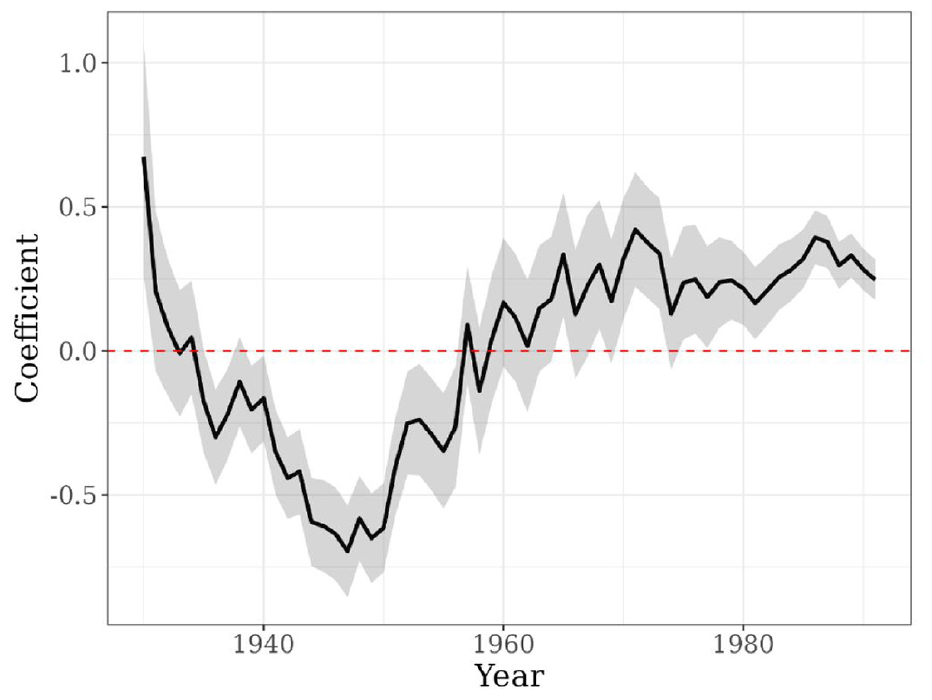
The effect of shared references on collaboration.
Regarding the effect of collaboration on the use of references, our findings consistently suggest that filmmakers tended not to adopt the references of their previous collaborators. Figure 5 shows that the coefficient ranges between −0.5 and 0 during most historical phases. However, the coefficient decreases substantively during the late 1960s. It remained at this low level, at about −1, throughout most of the 1970s until it increased again in the late 1970s. During the 1980s, it remained at a relatively stable level of about −0.1 (but at most times, points were not significantly different from 0). The observed pattern suggests that filmmakers tended to avoid their collaborators’ references even more during the new Hollywood period than in previous and successive periods. The effect could point to filmmakers striving for artistic independence and originality during the new Hollywood period. Avoiding the references of collaboration partners might have been a way to sharpen filmmakers’ artistic profile and differentiate themselves from their peers.

The effect of collaboration on coreference.
Discussion
In this study, we investigated for the first time how stylistic similarity in artistic references is related to collaboration among filmmakers in the Hollywood film industry between 1930 and 1999. Our results illustrate that filmmakers select collaboration partners on the basis of shared artistic references. Yet we also find that once filmmakers collaborate, they do not tend to become even more similar in their choices of artistic references by adopting their collaboration partners’ references. In addition, we showed that these tendencies varied over Hollywood’s historical life span and were especially pronounced during the new Hollywood era, which emphasized an artistic ideal of cultural production.
These results contribute to several streams of literature and could stimulate further work. First, the importance of stylistic choices for the social structure of artistic fields is already implicated in previous relational accounts on cultural production (Bourdieu 1993; Lena and Pachucki 2013; Mohr et al. 2020; White and White 1993). Our study furthers this notion by explicitly modeling the network structures induced by project-based creative work. Disentangling selection and influence effects on collaboration on the basis of stylistic similarity revealed that similarity in artistic choices constitutes a filter for collaboration choices: filmmakers perceive one another’s aesthetic profiles and choose collaborators that match their orientations. Further studies could investigate whether this finding also holds in other cultural fields, such as music (Lena 2004; Vedres 2017) and science (Shi, Foster, and Evans 2015; Stark et al. 2020).
Second, our findings speak to scholars concerned with modeling social networks in various empirical domains. In particular, we contribute to a strand of literature that uses advanced network modeling to disentangle multiple relational processes such as friendship, status ascription, and collaboration (Lewis and Kaufman 2018; Schaefer and Kreager 2020; Torlò and Lomi 2017). Our work illustrates the merits of conceptualizing project-based creative work as relational events that induce multiple forms of ties among actors and events. Using RHEMs (Lerner and Lomi 2023) allowed us to retain the original bipartite form of the data without artificially creating network structures by projecting all ties on the filmmaker level, which would be necessary for other types of network models. Thereby, we answer the recent call by Light and Moody (2020:86–88) that network researchers should mobilize models tailored to study the structure of relational events in online, process-produced datasets. Future work could build on our study and explore how multiplex networks induced by relational events unfold over time.
Third, the findings are of interest to scholars concerned with the case of Hollywood filmmaking. They illustrate that the selection of collaborators on the basis of stylistic similarity is present in filmmaking and varies over time. In particular, the style-based selection of collaborators became stronger during the new Hollywood period. This finding dovetails with historical accounts pointing out that an artistic orientation of the field marked the period between 1960 and 1980 (Baumann 2007b; Biskind 1999) and provides the first quantitative evidence for this notion. Also, the finding that filmmakers did not further increase their stylistic similarity by adopting the references of their collaboration partners can be interpreted in light of literature investigating Hollywood filmmaking. Previous studies show that the formation of aesthetic preferences likely occurs in the early stages of filmmakers’ careers (American Film Institute 2011; Bordwell 1997; Mehta 2017). Afterward, filmmakers have to establish their own artistic identity and try to signal originality to peers and critics. This was especially the case in the new Hollywood period, when an auteur approach to filmmaking, emphasizing a single filmmaker as the creative mind behind a film, became increasingly popular (Hicks and Petrova 2006; Pye and Myles 1979; Schatz 2016). Hence, the negative influence effect our models reveal could point to filmmakers’ striving for an original artistic identity that avoids further adopting references used by their collaboration partners. Future work is necessary to unearth the processes underlying this effect. It could consist of historical work, searching for evidence in interviews with filmmakers during the 1960s and 1970s, or surveying contemporary filmmakers.
Limitations
Its contributions notwithstanding, there are limitations of this study that point toward promising avenues for future research. One limitation is the relative sparsity of the data concerning artistic references. Many filmmakers did not use references in their careers, and our model focused on the part of the field that was engaged in referencing. Although previous evidence suggests that we capture the core of Hollywood filmmaking, as referencing was common among successful filmmakers (Baumann 2007b; Biguenet 1998; Carroll 1982), it would be interesting to study how style is affecting collaboration among nonreferencing artists. Given novel developments in the computational analysis of images and conversations in movies (e.g., Chen and Cui 2020; Haris et al. 2023; Kagan, Chesney, and Fire 2020), researchers could develop measures for stylistic choices that complement our reference-based approach, for instance, by automatically detecting the usage of certain cinematic techniques.
In addition, the IMDb dataset lacks information on individual filmmakers’ backgrounds and careers that would allow us to provide a more comprehensive picture of relational processes in filmmaking. For instance, we had no information on filmmakers’ education. Film schools and universities became increasingly important throughout Hollywood’s development and influenced filmmakers’ artistic choices (e.g., Mehta 2017). Hence, a fruitful addition to our analysis would be to add information on filmmakers’ education to the dataset and investigate how educational institutions shaped the interplay between stylistic similarity and collaboration. Moreover, we had no fine-grained information on filmmakers’ collaborations or on their mentor relations. Knowing more about the content of collaborations would have allowed us to provide a deeper analysis of how style influences collaborations. Future accounts could merge additional information to the dataset we curated or use qualitative methods to describe how style matters for filmmakers’ collaborations in greater detail.
Despite these limitations, we hope our study can inspire new research on the link between style and collaboration in artistic fields. Our analyses illustrate the merit of investigating the coevolution of multiple relational processes and highlight that collaborations are affected by artists’ stylistic choices. In addition, we found that the strength of the coupling between artistic choices and collaborations changed throughout Hollywood filmmaking’s history, indicating that field-level characteristics matter for the relational structures embedded in artistic fields.
Footnotes
Appendix A: Robustness Checks: User Preferences and Reference Inclusion in the IMDb
The IMDb is a user-generated database. Therefore, social scientists using this dataset should be aware of potential biases, for instance, induced by user behavior (e.g., Salganik 2019:17–41). In particular, it could be the case that IMDb users tend to register references mostly for films they frequently engage with or they particularly like. Furthermore, it could be the case that users register fewer artistic references in films previous to IMDb’s launch in the early 1990s. A highly selective entry of artistic references would be problematic because we aim to study how stylistic orientations affect collaborations among filmmakers rather than the salience or popularity ranking of films among IMDb users.
We conducted additional analyses to ensure that artistic references do not simply mirror IMDb user preferences. First, we analyze whether films entailing references to other films show systematic differences in the logged number of user votes in comparison to films without references. 5 We constructed a binary variable coded 0 if no references are registered for a film and 1 if at least one reference is registered. Second, we analyzed the relationship between the average rating score of a film and if the film entails references to other films. The number of user votes indicates IMDb users’ engagement with a film, while the average rating score indicates a film’s popularity. As the number of missing values is about 30 percent for both variables, we applied an imputation technique for those observations in which information was missing. We used the mice package in R and chose predictive mean matching on the basis of the variables year of release, crew size, and the first named genre. This imputation technique is particularly suitable when dealing with skewed data (https://cran.r-project.org/web/packages/miceRanger/vignettes/miceAlgorithm.html). We conduct this analysis for the complete sample consisting of 52,076 films.
In addition, we consider if the relationship between these variables changes over time. IMDb started as a Usenet project in 1990 and came to the web in 1993. Therefore, the precision of registered references might be higher for movies released after that date than for earlier films. In an extreme case, users may only have registered references for older films that became successful and did not detect references for less successful films. If users did not register references for older unsuccessful films, our measure for stylistic orientations and conclusions about temporal changes in the interplay between style and collaboration would be flawed.
A testable implication following from the scenario described above is that more references are registered for popular movies in earlier periods of the dataset. That is, although users include most references from 1993 onward, as a contemporary audience watches all films, references before 1993 are registered only for films that became successful and are still watched by a contemporary audience. Consequently, many references in older unsuccessful movies remain unreported. Hence, we would expect that the popularity differences between referencing versus nonreferencing films become smaller over time. Such a pattern would be problematic for the validity of our findings because it would suggest that the effects that we observe before the 1990s are driven by IMDb users’ selective registering of artistic references rather than the dynamics among filmmakers that took place in specific periods.
Overall, our analyses do not support the concern that references are more often detected in popular films than nonpopular films in earlier periods. Figure A1 shows the relationship between the logged number of user rating votes and the dummy-coded variable indicating if a film includes a reference. The dark gray boxes show the distributions of the logged number of rating votes over time for films with no references and the light gray boxes for those with at least one reference. The right panel of the figure shows that the distribution of rating votes remains relatively stable over time for films with no listed references. In contrast, the median number of rating votes is higher for films that include references, and this difference increases over time.
An overall difference in the number of rating votes between referencing and nonreferencing films is theoretically plausible because registering references is itself a form of engagement. If a user enters reference information for a film, the person is also more likely to rate a film. The fact that the number of rating votes increases over time for films that include references reflects our findings reported in the main text (see table 1) and resonates with film scholars’ and critics’ observation that referencing became more prevalent over time. In other words, films from the 1990s include, on average, more references than films from the 1950s, this should also be visible in IMDb users’ engagement frequency with these films. Most importantly, we do not find that the differences become substantially smaller over time (this would indicate that only references in highly visible films are registered for older periods). Instead, they become larger, indicating that as the use of references by filmmakers increases, IMDb users also engage more with films to insert references. We also assess the relationship between the popularity of films, measured by their average rating scores, and the binary variable indicating if a film includes a reference or not. It would be problematic if films that are highly popular among IMDb users also include references because this might indicate that IMDb users selectively register references for films they like, whereas they do not make these efforts for films they like less. However, the right panel in Figure A1 shows no substantive differences between the average user rating scores and the dummy-coded variable indicating whether a film includes a reference. It also reveals no clear time trend. We conclude that the inclusion of references, while correlated with IMDb users’ overall engagement frequency, i.e., the number of rating votes, is not driven by IMDb user preferences.
Appendix B: Assessing Effect Contributions
We performed additional analysis to answer the question of how much the major effects of interest in this study, i.e., collaborative tie formation through coreference and coreference tie formation through collaboration, contribute to the explanatory power of the overall model. Figure B1 tries to provide an assessment of effect strength by comparing the contributions of selection and influence in artistic references and collaborating with other network effects, that typically have high explanatory power. The results show that during most periods, our main effects of interest (collab.by.coref and ref.of.collab) contribute substantively to the overall model.
Acknowledgements
We would like to thank Jennifer C. Lena, Clemens Kroneberg, René Veenstra, and Henning Hillmann for valuable comments on this work.
Funding
The author(s) disclosed receipt of the following financial support for the research, authorship, and/or publication of this article: Katharina Burgdorf was supported by the University of Mannheim’s Graduate School of Economic and Social Sciences. Jürgen Lerner was supported by Deutsche Forschungsgemeinschaft (321869138).
