




Abstract
In this article, the author illustrates how lifestyle migration to Japan is tied to organizational norms of native speakerism and capitalist exploitation. Drawing on 32 interviews and nine months of fieldwork in Tokyo, the author describes how one of the largest foreign conversation schools in Japan (NOVA) has invested in broadcasting whiteness and English skill as traits of authentic native speakers. This process depends on who is viewed as a valuable teacher, but it also depends on migrants who pursue life in Japan through language teaching. Work at NOVA is highly exploitative. Yet because most of the workforce has ulterior motivations, they are willing to exchange substandard work for the privilege of mobility. This case highlights the overlaps between lifestyle migration and native speakerism at the organizational level and how supposedly “win-win” arrangements with labor create an enduring, material setting for the reproduction of ideology.
Do you dream of living in Japan? Do you speak English or a select few European and Asian languages? If so, you too can migrate and become the lifeblood of the multi-billion-dollar foreign conversation school industry in Japan, locally called eikaiwa. Pronounced “aye-ii-kai-wa,” eikaiwa is short for eikaiwagako or eikaiwakyoshitsu in Japanese. Eikaiwa literally means English (ei) conversational (kai) language (wa) school (gako/kyoshitsu), but colloquially it describes conversational schools writ large (Bailey 2006). Eikaiwa serve millions of clients a year and earned about 2.1 trillion yen between 2000 and 2021 (METI 2022), about $20 billion at an exchange rate of 107 to 1. Eikaiwa are also tied to a belief that direct contact with white, blonde, and blue-eyed Westerners is the ideal way to learn a language, an ideology called “native speakerism” (Holliday 2006; Kubota 2011).
Although native speakerism restricts eikaiwa work to a small portion of the global population, migrants on this pathway also face confines of being foreign and typically unable to speak Japanese in Japanese society. Although different than the racism directed at other ethnic and racial minorities living in Japan (e.g., Liu-Farrer 2020), Western migrants face notable barriers to career mobility and social integration (Hof 2021; Woo 2022). Eikaiwa jobs, in particular, have become relatively low status, often dead-end, and highly extractive since their heyday in the 1980s (Budmar 2012; Hooper and Hashimoto 2020). So, how does the privilege of mobility and the acceptance of low-status eikaiwa jobs overlap for native speakers?
Social structures are integral for migrants who pursue new lifestyles, cultural immersion, and other ways of reaching “the good life” through mobility (Benson and Osbaldiston 2016:411). In the case of Japan, because such migrants frequently rely on eikaiwa jobs to do so, I use organizational theories to understand how social structures contribute to their dual privileges and exploitation as workers. Organizations theoretically stabilize social status inequality through workplace practices (Acker 2006; Ray 2019), while workplace relations also induce the subjectivities of labor that can reduce or even eliminate resistance to exploitation (Mears 2015; Sallaz 2015). My aim is to illustrate how workplace inequality and workers’ subjectivity are inextricably combined by lifestyle migration through eikaiwa.
My case study is NOVA Language Company, Inc. Perhaps the largest eikaiwa in Japan since the 1990s, NOVA’s brand has historically revolved around offering lessons with “native speakers.” The company also went bankrupt in 2007, was purchased and reopened by a financial holdings conglomerate, and subsequently restructured its contracts and internal labor market. Drawing on 9 months of participant observation and 32 interviews with language instructors from 2019 to 2020, I describe how NOVA’s services, spatial design, and redesigned contracts have heightened the value extracted from instructors’ status as “natives.” However, because instructors depend on the job to control their mobility, they subjectively balance the exploitative aspects of work with the perks of being abroad. Taken together, I show how native speakerism—and its place between the geographic imaginaries of the Oriental East and the Occidental West—is stabilized by trade-offs of mobility and labor that occur through the eikaiwa. Doing so, I contribute to an organization-focused analysis of race, labor, and mobility to Japan that has wide applicability to other cases of work in the twenty-first century.
Organizational Theories of Race and Labor
Classical sociology argues that organizations create lasting social relationships through the rules, roles, and rewards circulated by bureaucratic structure (Weber 1922). Recent organizational studies have advanced this view by arguing that bureaucracies are not “neutral” entities but deeply entwined in the production of social status inequality and the overlapping antagonism of management and labor in the era of precarious work (Wingfield 2020). Indeed, the organizational setting creates a key link between interpersonal interactions and social macrostructures of racism, capitalism, and neoliberal relations (Ray 2019; Wingfield 2020).
A dearth of literature shows that the reproduction of status inequality is not coincidental to but a primary outcome of bureaucratic action. Acker (2006:447) described how the various practices used to achieve organizational goals such as hiring, supervision, and informal workplace interactions also typically advantage white men, who match scripts for the ideal worker in many high-status jobs. Such “inequality regimes” provide a framework to explain how intraworkplace dynamics perpetuate gender and racial inequalities by shaping networks of support and the resources tied to these workplace relations (e.g., Abulbasal et al. 2023; Roscigno 2019). At the same time, the focus on organizational inequality has paved the way for workplace scholars to theorize how rules and norms of the organization link individual and macrostructural forms of discrimination, such as racism (Wingfield and Chavez 2020).
Organizational decision making is imbued with racial meaning because organizations integrate individual-level racial “schemas” (i.e., cultural logics and norms related to race) into everyday practices and actions, resulting in the “unequal distribution of resources along racial lines” (Ray 2019:32). For instance, when different race and gender combinations are seen as the appropriate “prototype” for workplace interactions, a person’s identity triggers discrimination that may advantage or disadvantage their access to social resources (Ridgeway and Kricheli-Katz 2013). Much organizational research has focused on the disadvantages of women and people of color by prioritizing and valuing whiteness as a credential, which supports broader trends in inequality, such as racial ideology (Acker 2006; Ray 2019). In the United States, customers of retail fashion are repeatedly exposed to white or racially ambiguous models as the benchmark of bodily beauty, which results in both the exoticizing of Latinx and Asian people and the devaluing of Black bodies (Walters 2018). Thus, because organizations create enduring, material structures that produce status hierarchies internally, they also tend to stabilize broader inequality beyond the organization by creating spaces that reproduce and legitimize these differences (Arredondo and Bustamante 2022; Ray 2019).
Integrating status inequality with the rationale of profit accumulation in “neoliberal” organizations raises additional challenges (Wingfield 2020). A growing number of scholars argue that maximizing shareholder value is a central logic of corporate governance, influencing workplace norms and practices (for a review, see Fligstein and Goldstein 2022). Here, organizations receive a second spotlight because they stage the subjective experience of workers, which can facilitate the production of surplus value in a Marxist sense. Burawoy (1978:265; 1979) argued in his seminal research that “obscuring” the production of surplus value is one of the main challenges between labor and management. Rather than using coercive control, he posited that workers’ subjective experience could be used to obfuscate exploitation and, in turn, pacify resistance from labor as a whole. His explanation of workplace “games” illustrated how workers gained some sense of agency over their exertion, but such games additionally encouraged workers to align their behavior with surplus production (Burawoy 1979; see also Kojima 2015; Sallaz 2015).
Mears (2015:1120) innovated labor process theory by exploring how obfuscation occurs in the relationship between workers and management beyond where surplus value is produced. Control over workers’ “bodily” labor has become a more important facet of surplus production in the rise of service work, including strategies to elicit emotional and aesthetic forms of labor (e.g., Hochschild 1983; Kang 2003; Walters 2018; Williams and Connell 2010). Mears documented how recruiters at VIP clubs extract free bodily labor from women by maintaining relationships that encourage these women to embrace roles that produce value for clubs (in this case, as bottle “girls”). She shows that during the recruitment and management of bottle girls, recruiters create an infrastructure of relationships that “match” girls’ interests beyond “the shop floor” where most labor process studies have focused (Mears 2015:1118). Although mismatches between recruiters and women spoil these relationships, friendship and access to the high-status club scene encouraged women to “enter into, accept, and even feel good” about providing free labor (Mears 2015:1120).
Still, integrating social status inequality into studies of worker subjectivity is underdeveloped in labor process theory (Bandelj 2020). Travel may provide profound subjective rewards (Thompson 2018), but in the case of lifestyle migration to Japan, teaching is also racially coded (Bailey 2006; Hof 2018). Thus, a combined organizational framework allows us to see the overlaps of social status and labor inequality for individuals who teach to live abroad.
Teaching and Lifestyle Migration for Native Speakers in Japan
Teaching jobs offer individuals the “dream to live in Japan,” which is sought for life experience, cultural immersion, and/or adventure (Debnár 2016:88; see also Hof 2018). Migrants from Western countries often imagine Japan as part of the unfamiliar “far East” in part because of historical Orientalism from the West (Said 1978) as well as internal strategies to build a homogenous and culturally distinct nation (Liu-Farrer 2020). Thus, I refer to individuals who pursue these jobs as lifestyle migrants because they seek mobility to a place that is personally meaningful and offers “a better way of life” (Benson and Osbaldiston 2016:408). That is, as opposed to migration used to diversify household income or seek refuge, lifestyle migrants have relatively high control over their mobility and are driven primarily by personal aspirations (de Haas 2018). Such mobility is patterned by historical social structures that shape access to and the experience of migration, typically for white and/or Western individuals (Benson and Osbaldiston 2016).
One such relevant social structure is native speakerism, an ideology presuming that “native speakers” from the West speak the ideal version of English and thus are ideal teachers of the English language (Holliday 2006:385). Within English learning as a second language, white skin, blond hair, blue eyes, and other cues of a Western origin have become markers of native speaker status, whereas nonwhite instructors, such as Asian English speakers, are second-guessed for not looking “foreign enough” (Takeda 2023). The use of English as a common language for transnational communication is in major part a result of imperialism and colonialism, as English was promoted at the expense of other languages (Phillipson 2016). In turn, native speakerism has a strong influence on teaching practices today, as preferential hiring practices privilege Western teachers and assume that such individuals are qualified to teach by default, “legitimiz[ing] the authority of Western teachers over local teachers, students, and educational institutions” (Lowe and Pinner 2016:30).
The conflation of native skill and whiteness stems from historical discourse of language (Kubota 1998; Lummis 1976). As Japan began ascending to world power in the post–World War II era, the view of the Japanese people as culturally and racially pure was common in discourse of Japanese-ness, often called nihonjinron (Suzuki 2017). To distinguish Japanese identity, intellectuals reified the Western “Occident” in their attempt to both emulate the success of Western world powers while promoting an opposition to aspects of Western culture (Ning 1997). English language became depicted as both a human capital and romanticized form of culture reflective of the Occidental imaginary (Appleby 2017). Under this conception, eikaiwa emerged as a “commercialized activity built on the commodification of English, whiteness, Western culture, and native speakers constructed as superior, cool, exotic, or desirable” (Kubota 2011:486). Much of language services in Japan therefore depend on exposing clients directly to “native” language instructors, whether this is to tap into the romanticism of language instructors (often between Western men and Japanese women) or the notion of professionalization through conversation (see Bailey 2006; Kelsky 1999; Nuske 2019).
In this context, it may then seem paradoxical the privilege of native speakers has also been historically limited by scarce job opportunities and visa programs (Lummis 1976). Migration to Japan was historically restricted until the late 1980s, when domestic and global recessions and declining fertility pushed the state to open visa pathways for immigration (Liu-Farrer 2020). Just about 1.7 million immigrant workers represent less than 2 percent of Japan’s total workforce, though this number had increased 240 percent since 2008 (MHLW 2019). This era has been, of course, paralleled by the expansion of precarious working arrangements—jobs without security, with short-term prospects, and with little or no access to benefits—during the restructuring of the Japanese labor market (Osawa, Kim, and Kingston 2013; Reitan 2012; Suzuki 2015). Between 1976 and 2019, the number of part-time jobs in Japan more than doubled to 25 percent of total employment, for instance (OECD 2021). Today’s working migrants tend to be incorporated into niche labor and service jobs that domestic workers avoid, such as in the case of returning workers of the Nikkei Japanese diaspora from Brazil (Takenoshita 2013; Tian 2019).
Language teaching first emerged as a migration pathway in the 1960s and 1970s (Lummis 1976). However, “the golden age” of lucrative salaries and secure jobs ended for teachers with burst of the 1980s corporate bubble and contracting 1990 economy (Budmar 2012). Between 2000 and 2022, part-time jobs increased from about 38 percent to 74 percent of all eikaiwa employment (METI 2022). This jump in the percentage of part-time workers coincided with a near 50 percent decline in sector revenue following the 2008 global recession (Figure 1). Under these changing conditions, modern eikaiwa instructors have become seen as “the burger flippers” of pedagogy working for the “McEnglish” of institutions, which is why many instructors aim to move out of eikaiwa work, especially into universities or the mainstream labor market (Hooper 2019). In fact, in perhaps the only edited collection of articles written by eikaiwa instructors, career stagnation and marginalization in Japanese society are themes throughout, instructors’ endurance and optimism notwithstanding (Hooper and Hashimoto 2020).

Comparing the fall in revenue (top black line, left axis) and full-time employment (bottom red line, right axis) among eikaiwa.
Thus, lifestyle migrants who use teaching jobs to live in Japan have dual exposure. On one hand, they are privileged by a racial ideology of language, while on the other hand, they are exposed to restrictive, precarious job opportunities. Thus, I proceed with the basic question: How does lifestyle migration through eikaiwa support both the reproduction of native speaker ideology and the degraded quality of eikaiwa jobs? To answer this question, I offer a case study of NOVA eikaiwa.
NOVA: An Eikaiwa Case Study
NOVA boasted 1,700 instructors at nearly 300 branches in 2020 (NOVA 2020), comprising about 1 in 8 of the 10,634 instructors and 1 in 13 of the 3,995 eikaiwa registered that year (METI 2022). A stand-alone school in the 1990s, NOVA grew rapidly before the decline in consumption of eikaiwa services, going bankrupt in 2007. It was purchased by a financial holdings conglomerate that took the company’s original name (Budmar 2013). NOVA eikaiwa now represents the language services branch of NOVA Co. Ltd., a holdings corporation that also owns a basketball team, a soccer academy, a bakery, real estate, and another eikaiwa, GABA, among other things (NOVA 2023a).
Since 1995, NOVA has used the slogan ekimae ryugaku, meaning “to study abroad in front of the train station” (Bailey 2007:595). Clients “travel” at NOVA by coming into direct contact with foreign culture. The brand also promises that “All instructors are native speakers” (Figure 2). In my experience, NOVA offers Chinese, French, German, Korean, and Spanish lessons, but the focus is English. Lessons are offered for children and adults at all skill levels. All administrators and upper management in the company were Japanese, with a small portion of foreign staff members who recruit, train, and supervise new foreign language instructors (all English-speaking men in my experience). Administrators work with Japanese clients and Japanese higher-ups, who are typically out of reach of foreign instructors. Although most foreign staff members spoke little Japanese, Japanese staff also tended to speak limited English (and even less German, Korean, Chinese, etc.).

A NOVA branch as seen from street level in Tokyo. The slogan to the left of “NOVA” reads “yappari,” which can be translated as “I got it.” To the right, it reads “ekimae ryugaku.”
NOVA’s degree of restructuring may be unique, but on the basis of my experience applying to, seeing, reading about, and listening to workers from other schools, NOVA and other conversational schools generally have a similar style of casual and nonsequential lessons, advertising, and classroom design (Bailey 2006, 2007). Eikaiwa are also known as pathways to Japan for migrants without Japanese language skill.
Data and Methods
I combined participant observation with interviews and other sources to cross-verify my data, including online content. Starting in May 2019, I applied to seven different eikaiwa and was hired by NOVA in September to teach English solely on the basis of having a four-year degree and my speaking ability. Two months later, I received a 1-year, renewable visa for international services.
From November 2019 to June 2020, I worked at seven branches in the Shinjuku, Toshima, Shinagawa, and Ikebukuro areas of Tokyo. The period was seven months before and two months after the coronavirus disease 2019 (COVID-19) pandemic sparked an official state of emergency in Tokyo, and I saw high turnover at these branches. I conducted all lesson types, from standardized test preparation to casual one-to-one conversations to singing songs about fruit with toddlers.
I was a lifestyle migrant myself, taking a “gap year” before graduate school. As a white, blonde man in his early 20s, my accent and appearance granted me access, and I noted a near automatic perception of my competence as a “teacher” by clients. I also found fundamental similarities between myself and my coworkers, who were also mostly young (<30 years) four-year degree holders. They were also majority white, male, and from the United States, Oceania, or Europe. We all spoke the languages that we instructed as our first languages, and the desire to be in Japan was ubiquitous. Besides working, I also tagged along to parks, bars, and restaurants with my colleagues. It was a strong way to establish rapport and observe the total work-life of instructors.
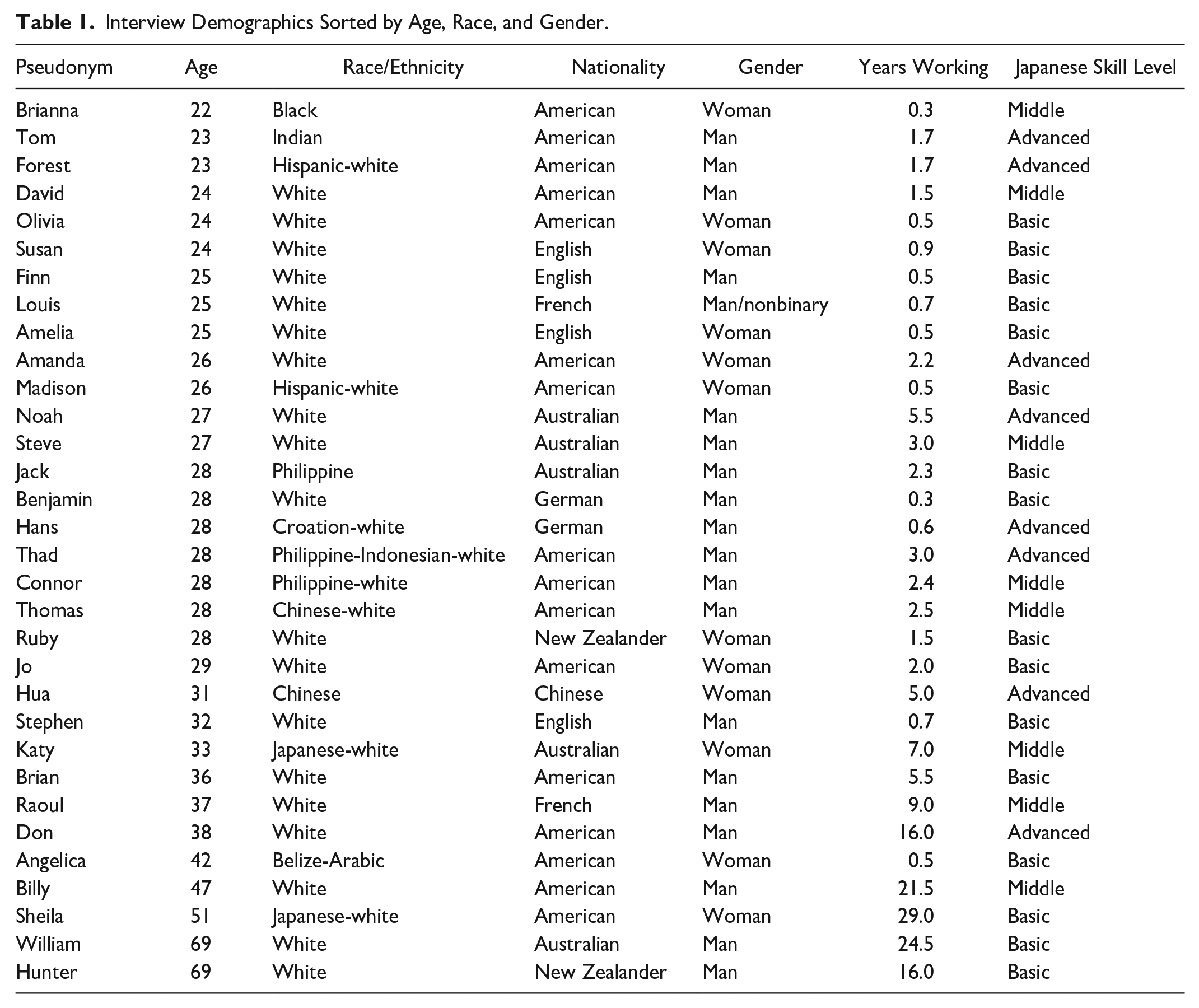
I also conducted semistructured interviews with 32 migrants working in language instruction, 28 of whom worked at NOVA. Participants described what led them to Japan, their feelings toward work, and its place in their career and life goals. As the pandemic unfolded, we also discussed the effects inside and outside work. Interviews were done over the phone or using a messenger application, while three participants answered asynchronously online. Participants ranged from just four months of employment to nearly 30 years and from 21 to 69 years of age (Table 1). I purposefully oversampled women, and I spoke to most non-English instructors who were employed at my branches. I met only 3 Black instructors and was able to interview just 1. Most of my coworkers self-defined as white or “mixed” white and came from the United States or Europe. Those who were mixed-white had either Asian or Hispanic ancestry. Notably, the company had few long-term instructors. Most were explicitly interested in temporary work, or they hoped to work somewhere else in Japan.
Interview Demographics Sorted by Age, Race, and Gender.
Rather than having a preidentified question, the research “puzzle” emerged as part of the research process (Mears 2017). The low quality of work coupled with the ubiquity of native speakerism called for an exploration of both, an analytical logic that Timmermans and Tavory (2012) called “abductive analysis.”
Findings
In the following subsections, I first report how NOVA builds its service around the bodily presence and image of certain migrants. Second, I discuss the company’s restructuring and focus on the intensification of extracting value through unpaid labor. Third, I describe why language instructors nevertheless see exploitation as a trade-off for mobility, which was an experienced shaped by status privileges and the touristic lifestyle of instructors without long-term intentions to stay in Japan.
The Value of Native Speakers
Bodily Presence
Instructors’ major value is to physically occupy branches and classrooms, as NOVA uses high-visibility windowed lobbies and classrooms to display them. As Hans (28, German) admitted, “The only qualification that I have is that I am German and that I am a native German speaker. Oh, and a bachelor’s degree. But they didn’t even specify what bachelor’s degree.” Being such a foreigner evoked “automatic” positive regard: In general, like people are pretty nice and a lot more interested in talking to you because you are automatically different in a positive way. And again, I think that’s a benefit of being a Western foreigner versus being from another country. (Jo, 29, American)
Lesson structure and branch designs capitalized on this front. Under the promise that clients could interact with real “native speakers,” instructors performed diverse forms of emotional and aesthetic labor.
Some clients were interested in grammar or test preparation, but the majority treated lessons as a hobby or pastime. Instructors often sit in windowed classrooms with one to five adult clients, playing out interactions to entertain “students.” It was largely accepted that NOVA instructors are less like educators and more like entertainers.
In fact, some managers have said we are not actually English teachers, we’re more like entertainers. . . . There was [another instructor], who really wanted to teach English and was not so friendly. But the manager said you’re not actually trying to teach it, you’re in customer service. (Ruby, 28, New Zealander)
Louis (28, French), too, knew that his role as an instructor depended on his ability to look good and amuse clients: “Let’s not even talk about the fact we have a lot of students who are not here to learn French but most to be entertained by beautiful, young French boys and girls.” That is, instructors are well aware that their interactions with clients revolves around the romanticization of language and entertainment of clients argued by past research (Kubota 2011). At lunch, one coworker confided feeling that his students were simply “collecting” aspects foreign culture, and he was simply the vessel.
Firsthand interactions are so important to these interactions that NOVA refused to move to virtual lessons until nearly one month after Tokyo declared a state of emergency in late April 2020 because of the spread of COVID-19. Even then, the return to in-person lessons was hastened to early June. Meanwhile, NOVA pulled out every stop to convince clients that in-person lessons were safe, from providing sanitizer, fans, masks, plastic dividers, and even encouraging all instructors to wear eucalyptus leaf necklaces (a method of COVID-19 prevention that remains unproven).
Many branches resemble that of Tennozu Isle, where the entire branch is situated at the ground level of a plaza with windowed classrooms to display instructors and instructor-client interactions. Tennozu Isle is a luxury plaza on the Tokyo Bay waterfront near train lines to Haneda International Airport. Here, other instructors and I jokingly referred to its children’s classroom, with an especially large picture window, as the “fishbowl” (Figure 3). Like my coworkers, I was seen here smiling, singing, and playing word games with Japanese children by hundreds of passersby, a living version of the white people and English letters that smattered the glass. In contrast, at “cram” schools, which are private services intended for key school and university entrance exams, I saw no similar way of putting Japanese teachers on display, while this practice was common among other conversational schools, including ECC, GABA, and WinBe, among others.

The “fishbowl”: a windowed classroom for children’s lessons viewed from the outside in Tennozu Isle Plaza, Tokyo.
In addition to drawing value from these interactions, NOVA lessons, branches, and brand all contribute to a socially constructed space where whiteness is assumed to be the default for “native speakers.” This setting even translates individuals who may not be classified as white in the Western context as white in Japan: “I’m extremely mixed, like a quarter Filipino, half native American, like a quarter white. . . . People often think I am white, even though I am only a quarter white. But if I had a beard, it changes” (Thad, 28, American). In fact, of eight interview participants who self-identified as mixed-white, seven felt that they “passed” as white at work. These participants had light skin tones, lighter hair, and a mono eyelid that differentiated them from a typical form of Japanese-ness. This phenomenon has been documented autoethnographically by an Iranian Irish migrant elsewhere in East Asia (Moosavi 2022). Here, the inclusion of light-skinned and racially ambiguous instructors at NOVA does not contradict whiteness as a component of native speakerism. Rather, it supports their amalgamation into the category of whiteness that predominates the idea of being a “native.”
Extracting Bodily Labor
Since the 2007 bankruptcy, NOVA has developed a pay schedule to extract copious amounts of unpaid labor from instructors’ bodily presence by keeping them visible in small, windowed lobbies. This system of exploitation was both obvious and ubiquitous.
In fact, since 2007, NOVA pulled various strategies from the “bad jobs” playbook (for a definition of a “bad job” see Kalleberg 2011). Fixed salaries were replaced with part-time wages, which were contingent on the number and type of lessons taught. A robust hierarchy of in-branch managers and in-branch training staff members was replaced by single area managers overseeing several branches, while all training was conducted virtually from Osaka. Don, an instructor of 16 years, said about career options, “NOVA is like a pizza. There is no up.” Those employed before the bankruptcy retained legacy contracts with full-time employee benefits, such as access to shakai hokken, the national health insurance plan, but new instructors selected between a part-time “employee” contract or an independent contractor option. 1 Independent contractors were paid a slightly higher base wage, but as contractors, they have no paid holidays and, instead, paid the company 500 yen per lesson in exchange for days off.
NOVA wages also became based on the number of 44-minute periods worked per month. Officially, the 44 minutes are split into a 40-minute lesson with a 4-minute evaluation and preparation time. Between lessons, there was a 10-minute interval, when instructors technically have 4 minutes of paid time to evaluate each student from their previous class and to prepare for the next lesson. The remaining 6 minutes were unpaid (Figure 4). For the typical eight-period workday, instructors might easily cross over the legal eight-hour workday (International Labour Organization 2023), though this would not be entirely uncommon for workers in Japan. My point is to focus on how this structure keeps creates unpaid labor that hinged on instructors’ constant visibility.

The technical schedule of instructors at NOVA eikaiwa. Instructors usually work eight periods a day, four days a week, and five periods on the fifth day. There is a one-period break on eight-period days and no breaks on the fifth day. Long shifts run from 1 to 9:30 p.m. or 10 a.m. to 6:30 p.m. for weekdays or weekends, respectively. Short shifts typically run from 5:30 p.m. to 9:30 p.m. or from 10 a.m. to 2 p.m.
Without fail, the 40-4-6 schedule means that instructors provide free labor. After each lesson with children, for instance, instructors do the service of demonstrating to parents in the lobby what children had learned that day. Unironically, the company’s official training video on lobby service used a demonstration that was six minutes long. The pandemic made it near impossible to avoid working through the break: There is a lot to do in between lesson periods, and you can do this or not, I think that some teachers care more but you can make more copies of things, especially recently with the online lessons. The amount of missing materials that we have to search for, and now, to set up Skype or set up [online lessons]. So, yeah, there is always crap to do. And if you work in a school that has a lot of kids, too, I have worked at a school in East Tokyo a few times, and it’s crazy. It’s a tiny, tiny school in a department store, and basically, the teachers that have to be there have to be an extra [administrative] staff. . . . They are working 100 percent during that 10-minute break. (David, 23, American)
Instructors generally respect clients and appreciate our interactions. We also depend on client evaluations for job security and promotions. In turn, recently hired instructors spend countless hours self-teaching their first few months, as NOVA offers dozens of lesson types and offers little training.
Company policy is that instructors be trained on specialty lessons before teaching them (e.g., standardized test preparation). Yet twice I taught specialty lessons to clients with no prior training. A manager simply told me to be ready, and to avoid embarrassment or letting down a familiar client, I arrived an hour early and worked between my lessons to prepare. With generally high turnover, this is normal practice, but even more seasoned instructors work through the break or spend time outside of their paid periods.
The 40-4-6 schedule also means that instructors inevitably are seen by and interact with clients during unpaid time. Few branches had private break rooms, and practically all used shared laptops stationed in the lobby and visible to clients (Figure 5). These laptops accessed specific lesson software that instructors used to evaluate students and plan lessons. Each lesson has up to five adults or eight children per class, with multiple criteria: I hate how they have no real break. We have a 40-minute lesson with 10 minutes that are not breaks, because you need to prepare your next material. So, between lessons we don’t have time to breathe. You also need to be on show. You always need to show that you are the teacher playing the role. (Louis, 25, French)

Inside a NOVA branch in Tokyo. Instructors evaluate lessons on the shared computer and rest on stools during their breaks. Clients sit in the chairs in the foreground and enter through a door out of frame. Again, the text on the window reads, “All instructors are native speakers.”
The tight time constraints, contingent pay schedule, and branch design ensure that instructors are always visible and always “on.” And as Louis attests, instructors broadly recognize the exploitative aspects of work, but as I describe below, this is an exchange they are willing to make.
Subjectivity and the Lifestyle Trade-Off
Instructors are tied to NOVA’s ability to provide a visa. Because they essentially depend on the job to move, they weigh the experiential payoffs of being in Japan to justify their labor. This trade-off is especially worthwhile for instructors who only wanted to live abroad temporarily or for those hoping to integrate into Japan’s mainstream labor market.
Gatekeeping Mobility
Eikaiwa instructors do not want to visit Japan—they want to live there. There are few opportunities outside of language teaching without the ability to speak business-level Japanese, however (Liu-Farrer and Shire 2021). Thus, despite varied personal motivations, instructors depend on teaching companies to reach and stay in Japan:
I heard you make a joke about being desperate for a visa and—
[Interjecting] Well yeah! We need a visa to stay in the country, man. We need a job. (28, American)
A handful of interviewees had actually taken Japanese study, studied abroad there, or were involved in other foreign exchange programs. They developed strong urges to live in Japan and used NOVA as a stepping stone to do so, as Amanda, a 25-year-old white American, describes: I was always fascinated with Japanese pop culture from a young age. . . . I wanted to go to Japan since I was 10 years old, and that feeling grew stronger when I hosted the Japanese exchange students as their kindness helped me through a hard time in my life. I never knew what I wanted to do for a job, I just knew that I wanted to move to Japan.
In fact, Hans, Thad, Tom, Noah, and Hua were all actively trying to master the language. For them, the job at NOVA was means of cultural and linguistic immersion, which, if they mastered, could be a way out of teaching.
Still, most of my coworkers only wanted to visit in the short term. For instance, just 1 of the 10 instructors who joined NOVA in my training cohort finished the one-year contract (including myself). Among these temporary instructors, it was common to have romantic views of Japan shaped by anime, manga, video games, and film; people often mentioned Studio Ghibli films or the movie Lost in Translation as major influences. Amelia (25, British) came to Japan after taking a cocktail course in Italy and spending three months in Berlin “just to party and have fun.” Her longing to live in Japan reflected both obsession (being a “weeb”) and exoticism (wanting to go somewhere distant): I don’t know when I guess I started being interested in [Japan]. A little 13- or 14-year-old weeb, like most of us are, watching Sailor Moon and stuff. It was never like a passion, it was just like, “That’s a cool country, far, far away that I’ll never get to see.” . . . I can’t go on holiday there, and what a waste of money for one week of experience. I might as well just stay there.
Like Amelia, many of my other colleagues linked their time in Japan to other destinations. Olivia (24, American) and Steve (28, Australian) had backpacked in Southeast Asia. Ben (28, German) had taken a working-holiday trip to Australia. NOVA would be just one stop in a lifestyle of travel that defined these individuals’ youth.
I found that some instructors came from less privileged situations: dead-end jobs or unemployment at home, feelings of misdirection, and sometimes even trauma. As Angelica (42, American) said, “My purpose is I needed healing, I needed quiet, stillness, all those things I can get in Japan.” Although driven by different motivations, Japan was still treated like an escape valve from normal life.
There was a minority at the company staying long term, sometime even to their own surprise. Hunter, an instructor for 16 years, said, “I thought I’ll join NOVA to get the sponsorship, and then disappear. [He laughs.] It’s been a long disappearing act, hasn’t it?” Most instructors with 5 or more years of experience either had Japanese partners or were forming families. Some long-timers had legacy contracts, so their situation differed from younger staff members. Still, without being able to move into other occupations, they too depended on NOVA.
Meanwhile, every single teaching company I encountered tapped into the aspirations of living in Japan. GABA (a chain owned by NOVA) succinctly captured the way eikaiwa package and orientalize Japan. GABA’s recruitment Web site describes Japan as “wonderful dichotomies of ultra new and very old,” claiming that “teaching in Japan means direct access to this unique culture and its mysteries . . . for one year or ten” (GABA 2023). NOVA’s recruiting page had twenty sub-pages describing attractions for every region with branch locations, including testimonies from past instructors (NOVA 2023b). These depictions of Japan were similar to other reductive tourism campaigns in Asia aimed at a Western audience (Shircliff 2020a, 2020b), and sitting nearby in clickable text, a banner always read, “Apply now.”
Getting in and Getting By
With visas in mind, instructors consciously exchange their labor for mobility, justifying their work through subjective rewards that exist beyond the workplace. This was not an unconscious or a subtle thought process; instructors were directly aware of the exchange taking place:
Why did you choose NOVA?
I think it was like a desperation sort of thing at the time, because I needed a visa quite badly. I didn’t know if I was going to be able to stay in Japan, which at the time is what I really, really wanted. (28, New Zealander)
Why do you work at NOVA?
Because they’re offering a visa. . . . I can see how some people would feel abused. But I take it as it is . . . for me, the goal was to live in Japan, and one of the conditions is that I have a job and an income, and this condition means working at NOVA. So, I am always checking myself. That I work for NOVA? Okay, goal. One more step to reaching a goal. (28, German)
Jamie (22, American) captured the most common sentiment when I asked if teaching was a career move: “It was what I wanted to do when I left college, but not NOVA particularly, I just wanted to go to Japan, and I knew to go to Japan I had to teach English.” The ulterior motivation was mobility.
Rather than supporting families, sending remittances, or building their careers, being in Japan was a source of ease and pleasure. People hoping to enter the mainstream labor market may have felt more pressure on a day-to-day basis (e.g., Amanda, Luke). The majority, though, had very little stress for the future and focused on perks of the present—a freedom of youth and economic security (Collins and Shubin 2015):
So, why have you stayed at NOVA?
So, basically, I was kind of bored. I have military family right, so I actually took the OAR. The Officer Aptitude Readiness test, kinda like the SAT if you’re trying to be an officer in the military. And I did really well, and I passed the PRT [the U.S. military’s Physical Readiness Training]. And I could have joined the Navy for a few years. But my test results and everything extend for few years. So, I was like “eh.” I had interest to come back Japan, if I don’t like it, I’ll go back and work in the Navy or the civilian sector. And if I do like Japan, I’ll chill here. (28, American)
Thus, although the work was exploitative in the sense of producing surplus value, I stress that this type of exploitation was not coercive. Instead, it depended on instructors’ willingness to exchange their labor for the tourism-like experience that is part of being a lifestyle migrant (Benson and Osbaldiston 2016).
Subjective rewards simply flourished around instructors’ status as lifestyle migrants, while NOVA needed only to provide the visa. Travel, to instructors, was highly regarded as a form of cultural consumption and experiential accumulation, even when the real day-to-day was more complex: A lot of people in America and people I know think it’s cool that I live here, and whether I feel like I’m actually progressing in my life is like irrelevant because people are distracted by the fact that I live in Tokyo and “Oh my God! How cool!” They say it took so much courage for me to go, but actually, it’s the opposite. I completely fucking bailed on my life and hit a panic button to get the fuck out. (Jo, 29, American)
These automatic positive appraisals were complemented by benefits of the “gaijin card,” or the foreigner card (Bailey 2007). The gaijin card essentially provides Western migrants in the Japanese setting with what Du Bois (1903:701) called the everyday wages of whiteness: the psychological advantage of low-wage white workers in the United States during the Reconstruction period. As Don, a 38-year-old white American, said, You do meet especially white men who come here, and they get the benefit of being white. And, so, they have people throwing themselves at them. . . . For me it was so enticing. It was this odd, exotic culture where I could do these things and get away with all this bullshit that I definitely would be called out for in the U.S. . . . Now, at least in my life, I have embraced a lot of it, but I do take advantage of what is different as long as it benefits me.
Mixed-white and nonwhite participants mentioned these benefits as well. Tom (23, American) explained that one of the reasons he felt comfortable in Japan was partly because he received less scrutiny there than he did in the United States as an Indian American. He called the gaijin card “this permission that you to make mistakes and not get scrutinized as much as you would if you were a Japanese person.” Still, to be clear, anti-Black and anti-Asian sentiments exist in Japan. Non-Japanese children are often bullied in schools, while Black and Chinese immigrants face overt and covert forms of racial discrimination (Liu-Farrer 2020). Although I did not hear of experiences of racism from participants, it is understood that the gaijin card has caveats of race and nationality.
The definitive theme of the migrants’ experience was nevertheless defined by the perks and advantages of an experience that is often entertaining, rewarding, and, indeed, even profound.
Tokyo is my favorite place in the entire world, and I just wanted to live there.
Wait, why?
I can’t even explain that man, it’s just walking down the street. My favorite thing is just walking down the street, just looking, just looking. The buildings are different, the feeling is different, everything is just like . . . [pause] I don’t know, I just feel good over there. I just love being in Tokyo. (22, American)
In the end, instructors’ experiences revolve around specialized feelings that could never encompass Japan in all of its complexities. Rather, their experience of novelty, awe, and romanticism was engrossing enough to justify working for a company they often disliked and recognized as unfair.
But as more seasoned instructors explain, the initial awe wears off. Some privileges remain, but as feelings faded and romanticism gave way to reality, the trade-off becomes less and less worthwhile. That is why many people in this line of work simply sojourn.
Discussion and Conclusion
In Japan, native speakerism provides jobs and a means of mobility for language instructors. Here, whiteness (or at least whiteness adjacence) provides both opportunity and limited agency (Brown 2019; Hof 2021). Moosavi (2022) concurs: “whiteness in East Asia can paradoxically be an asset in some instances and a liability in others, all on account of the intricate ways in which whiteness is both desired and resented, celebrated and doubted” (p. 119). This reality is illustrated in the way that NOVA has specialized in facilitating the short-term dream of life in Japan as a way to maximize the value it extracts from native speakers. The company creates opportunities for lifestyle migrants by physically drawing them to the classroom and facilitating the trade-off of mobility for labor.
In turn, NOVA also provides a physical setting to reproduce racial ideologies about what it means to be a “native speaker.” Aligning with a variety of research on how bureaucratic rules and procedures persistently reward white masculinity in the Western context, such as in America or Europe (e.g., Abulbasal et al. 2023; Acker 2006), NOVA privileges people who fit the imagined prototype of the native Westerner in Japan. This is because the design of its services and branches rely heavily on broadcasting the physical presence of instructors and providing romanticized interactions with foreign “natives.”
These interactions between clients and instructors thereby reinforce skewed visions of language. English is a national language around the world, but the only “native speakers” of English at NOVA, to my knowledge, came from the United States, the United Kingdom, Canada, New Zealand, or Australia (and from France, if they taught French, and so on), and indeed, the majority were white. Having me, a blonde, white man, teaching Japanese children in a windowed classroom that literally labels me as a “native speaker” is a scenario that sets off biases at the individual level, reinforcing and legitimizing ideological stereotypes about who constitutes an appropriate teacher. This observation on eikaiwa is not new in itself (see Bailey 2006; Kubota 2011). However, I expand previous research by connecting the perceived whiteness of mixed-race participants as contributing to the default whiteness that characterizes “natives” from the West. The inclusion of light-skinned and racially ambiguous language instructors at NOVA does not contradict whiteness as a component of native speakerism. Rather, by amalgamating them to whiteness, NOVA reinforces the essentialism of native speakers as white and “the belief in White-associated aesthetics as supreme,” reflecting trends in the United States in a different setting (Walters 2018:139). Moreover, by casting all foreigners as different, this process helps reify Japanese identity as distinct from the West, reflecting norms of higher education and strategies of nation building in Japan (Liu-Farrer 2020; McVeigh 2015)
NOVA not only reifies whiteness as essential to being a “native speaker,” it has also substantially increased its ability to exploit a “native speaker aesthetic.” NOVA’s labor process involves diverse forms of bodily labor: simultaneously expressive, emotional, and racially aesthetic (e.g., Kang 2003; Walters 2018). I focus on how new scheduling practices since NOVA’s 2007 bankruptcy have intensified its ability to extract value by plainly increasing unpaid labor. In this case, it rings true that multiple forms of identity coalesce in the specific labor process (Wingfield 2020). Instructors’ ability to entertain clients and provide a native speaker aesthetic contribute to their value as laborers. Meanwhile, their youth, relative economic security, and the ability to forgo career growth allow NOVA to decrease its commitment to labor, as the workforce does not rely on upward mobility, benefits, or other classic job perks.
What NOVA provides is the ability to seek “the good life.” NOVA instructors explicitly recognize the trade-off between work and access to a visa. Labor process scholars might explain this relationship in terms of relational “matches” that exist beyond the point of production (e.g., Bandelj 2020). I extend this line of thinking to argue that labors’ subjective interest is shaped by racial privileges that exist for migrants in the Japanese context. For organizations exchanging labor for lifestyles of travel, there is also a major advantage compared with other cases of the labor process, such as with VIP clubs, where the relationships between recruiters and bottle girls are both intensive and fragile (Mears 2015). Eikaiwa exert some effort to tap into the aspirations of living in Japan, but they merely build upon Orientalism (e.g., GABA 2023). With the ability to gatekeep the destination, NOVA puts little effort into curating the subjective rewards of migration from week to week, which makes this strategy powerful.
Last, I stress that NOVA is a case in which organizations become financially invested in reproducing ideological inequality to facilitate surplus production. Self-selecting, privileged native speakers are an ideal workforce. Only a small portion of these workers collaborated to resist abuse at work, mostly long-timers. The overwhelming majority had no interest—indeed, no need—to rally around them. The exploitation of such lifestyle migrants is thus unique because NOVA is in some sense “exploited” by workers as a means to move to Japan, while it gains consent to exploit workers through substandard conditions and unpaid labor. As a result of this trade-off, sustaining native speakerism—and its constituent role in the geographic imaginaries of the “far East” and the “West”—is profitable.
I encourage some cautious generalization of this case. NOVA has a unique trajectory given that it manages employees from before and after the company’s bankruptcy. The branches I observed in Tokyo are also characterized by high turnover, so there may be more varied attitudes within the company itself. That I was unable to interview many people from different racial backgrounds (e.g., Black, Asian) presents an additional limitation. Still, this case and analysis should provide impressions about native speakerism and the subjectivity of workers at other eikaiwa, as they have similar locations and a patterned style of advertising and offering of language teaching services (Bailey 2006; Nuske 2019). I suspect that native speakerism and the relative privileges of Western migrants into the East would have some similarities in other parts of Central, East, and Southeast Asia according to regional histories, policies, and labor markets.
Finally, this case study has implications for other employers who gatekeep lifestyle. Gig, technology, culture, and platform jobs all advertise the ability for self-expression, creativity, and lifestyle (e.g., Thompson 2018). In this arena, an organizational approach to such work would benefit by avoiding the compartmentalization of either status inequality or capitalist exploitation. Theorizing the overlap is key to understanding the structures and subjectivities of labor in the era of transnational and highly mobile (human) capital.
Footnotes
Acknowledgements
A handful of people supported this project. Craig Lair got me jumpstarted. Aaron Arredondo, Elizabeth A. Bennett, Christy Glass, Guadalupe Marquez-Velarde, Gabe H. Miller, J. Tom Mueller, Voon Chin Phua, Alex Theophilus and Jessica Ulrich-Schad also each provided feedback on drafts. Earlier versions of this paper were presented at the Pacific Sociological Association in 2021 and the International Labor Process Conference in 2023. Anonymous reviewers positively shaped the paper, especially those at Socius. Thank you all.
