




Abstract
The aim of this study is to understand the American public’s attitudes toward the annual coronavirus disease booster vaccination, administered beginning in the fall of 2023. The authors carried out a national survey in the spring of 2023, with 40 percent of respondents saying that they are “very likely” to receive the regular booster when it becomes available. Several underlying predictors are identified through structural equation modeling analyses. People with more vaccine takers in their social circles, greater trust in others, higher approval of President Biden’s performance, and greater perceived risk of the pandemic are more likely to receive regular boosters. The social network has the most considerable influence, with the largest coefficient size after comparing all standardized coefficients. The effect of trust is enhanced through social networks, and there is a combined effect of President Biden’s approval and risk perception. These findings contribute to the literature and have policy implications for leveraging interventions and optimizing the vaccination campaign.
Americans have experienced the impact of the coronavirus disease 2019 (COVID-19) pandemic caused by severe acute respiratory syndrome coronavirus 2 infection for more than four years. The pathogen of the coronavirus spreads primarily through close contact from person to person and targets the human respiratory system. The latest data show that more than 6.5 million individuals have been hospitalized and more than 1.1 million have died as of December 2023. A new variant, JN.1, constitutes a growing proportion of cases in the United States, which could suggest that it is either more transmissible or better at evading our immune systems (CDC 2023). To fight COVID-19, the vaccine is critical to mitigating the impacts on public health and social well-being (Baden et al. 2021; CDC 2021). Additionally, because vaccine efficacy appears to wane over time, a booster dose becomes increasingly imperative (Andrews et al. 2022; del Rio, Omer, and Malani 2022; Gupta and Topol 2021). Furthermore, in response to the genetic mutations of the coronavirus and the spread of new variants, the Centers for Disease Control and Prevention (CDC) recommends administering an annual booster starting in the fall of 2023. The booster matches the currently circulating virus strains, as with the strategy used for influenza, and could confer promising protection against symptomatic infection (Couzin-Frankel 2023; Townsend, Hassler, and Dornburg 2023).
Existing studies of Americans have extensively examined public decisions to be vaccinated against COVID-19 (Andersen et al. 2023; Daly and Robinson 2021; Iceland, Silver, and Goff 2023; Latkin et al. 2021; Wang and Liu 2022). There has been other research on public opinion related to COVID-19 boosters as well (Hao 2022; Lennon et al. 2022; Neely and Scacco 2022; Raman et al. 2022). These studies show that vaccine or booster uptake is attributed largely to sociodemographic characteristics and political orientation. Lower income and younger individuals, as well as African Americans, appear to be more hesitant. Republicans and conservatives are more skeptical about the efficacy and less likely to receive the vaccine or booster than Democrats and liberals.
Although public perspectives regarding the vaccine and booster shots have been well analyzed, the annual COVID-19 booster presents a novel setting for the evolving pandemic that is worth investigating. Regarding the uptake rate, about 70 percent of Americans are fully vaccinated (received the second dose in a two-dose series or a single-dose vaccine), one third have taken the monovalent booster, and 17 percent have received the bivalent booster. By the end of October 2023, only about 4 percent of Americans had accepted the annual booster in the five weeks since it became available (CDC 2023). The new low vaccination rate invites an in-depth examination of public perception and underlying predictors. People might perceive the annual booster differently than the original dose because of vaccine fatigue, as we are about to enter the fourth year of the pandemic and have already administered two boosters after the initial vaccine dose. Facing the unique scenario, whether the same social (e.g., income), demographic (e.g., age), and political (e.g., party affiliation) predictors sustain and shape one’s decision to receive the annual booster as they did before is in question. In addition to the commonly used factors, it is imperative to examine the influence of other less covered factors, such as networking and trust.
This study fills gaps in the literature and estimates public attitudes toward the annual booster. The outcome variable is one’s intention to receive the booster when it becomes available. Although we understand that behavioral intention is not equal to actual action and sometimes overestimates what people will do, estimating intention was our best option when we conducted the survey at a time when the booster was unavailable. A previous study of the monovalent booster estimated one’s intention (ranging from unlikely to likely) before the booster hit the pharmacy shelves (Hao 2022). The influence of social network, trust, approval of President Biden’s job performance, and risk perception is emphasized because these factors have been included in previous research about vaccine uptake (Hao and Shao 2022; Wang and Liu 2022). Building on and extending from the existing arguments, we elaborate on how these factors might affect one’s intention to receive the annual COVID-19 booster.
First, the features of a network can decide the contents of information or misinformation that people receive (Lin 2008). Having others in their social networks who received the COVID-19 vaccine might expose people to reports on the efficacy of the vaccine and promote one’s intention to receive the annual booster. In comparison, if people are surrounded by “antivaxxers” and misinformation, they might become skeptical and decline the annual booster. In other words, social network basically refers to one characteristic in this case, whether people around you have an acceptable view of the COVID-19 vaccine. Previous studies highlight that networking with other vaccinated individuals is a robust predictor of vaccine or booster uptake (Graupensperger, Abdallah, and Lee 2021; Hao and Shao 2022). On the contrary, networking with family and friends discouraging vaccination leads to lower vaccine uptake (Latkin et al. 2022).
Second, people living in a trustful environment are more likely to act for the common good with the expectation that others will likewise do the same. Trust coordinates and incentivizes people to take actions (e.g., being inoculated) to serve collective interests. The impact of trust on public response to the pandemic has been revealed in existing studies, and communities or people with higher trust are expected to respond more effectively than those with lower trust (Hao and Shao 2021; Makridis and Wu 2021). Regarding the vaccine, people with high (vs. low) social trust had higher vaccination intent, as revealed in prior studies (Dolman et al. 2023; Szilagyi et al. 2021). Trust in public health guidance is a critical driver of individual health choices (Kreps and Kriner 2022). In addition, trust and social network might have a combined effect, as together they form one’s social capital (Putnam 2000), which has been found to shape the public response to the COVID-19 pandemic (Pitas and Ehmer 2020). Particularly, people are embedded in a network of vaccine takers and also have greater trust in others and the COVID-19-related information might become even more likely to receive regular vaccine boosters. One underlying reason is that the information circulated in the inner circle of vaccine takers is expected to be scientifically correct rather than the misinformation that is more prevalent among vaccine skeptics. Thus, social network and trust interact when people are surrounded by vaccine takers and are also willing to act for others and believe in the information shared in the provaccine group.
Third, since its early development, COVID-19 has emerged as one of the most politically contentious issues in American public discourse, and the public has often turned to political elites (e.g., party leaders) for guidance rather than to public health officials (Gadarian, Goodman, and Pepinsky 2022). For example, compared with President Trump, President Biden emphasized the risk of COVID-19, recommended mitigation measures, and promoted the vaccine from the outset. The rhetoric from leaders can slant public response to the pandemic as shown in existing studies (Shao and Hao 2020, 2021). Political beliefs can shape vaccination decisions, with elite cues further enlarging the gap (Fridman et al. 2021; Neely and Hao 2023; Pink et al. 2021; Stroebe et al. 2021; Zhang et al. 2022). It may be reasonable to expect people to be more motivated to receive the vaccine or a booster if they approve of President Biden’s performance. For example, a study showed that the odds of taking the COVID-19 vaccine increase when the respondent’s trust in President Biden increases (Hao and Shao 2022). Another study showed that residents of states with more votes for Biden in the 2020 presidential election are more likely to take the monovalent booster (Hao and Shao 2023). We focus on President Biden’s approval instead of political party affiliation or political ideology because President Biden has clearly and repeatedly expressed his opinions on vaccines: it is safe, effective, and necessary. Thus, this factor might have a more direct impact on personal vaccination decisions than other measures of political orientation.
Fourth, risk perception is a predictor of one’s vaccination decision. The construal level theory articulates the link between psychological distance and conative behavior (Liberman and Trope 2008; Trope and Liberman 2010). According to this argument, people are expected to respond when they perceive the COVID-19 risk as more proximal. As a result, closer psychological distance to the risk could motivate the public to take preventive measures such as getting the annual booster. Previous studies have shown that people who perceive a high risk of the pandemic are more likely to receive the vaccine than those who downplay the risk (Hao 2023b; Wong and Yang 2022). Over time, the growing perceived risk among Americans is positively associated with the concomitant increase in vaccination rate (Hao 2023a). Moreover, the effect of risk perception could be reinforced via approval of President Biden’s job performance, as Americans favoring President Biden tend to perceive more of the pandemic’s threat (Graham et al. 2020; Shao and Hao 2021). In other words, Biden supporters are more likely to have an accurate understanding of the pandemic because of their belief in the leader’s rhetoric that portrays the threat as real and severe rather than seeding skepticism. Following this line of deliberation, people who realize the pandemic’s risk and who also happen to approve of President Biden’s performance could become even more motivated to receive the annual booster.
On the basis of the existing literature about vaccine and booster uptake, we aim to identify factors that shape one’s intention regarding the annual COVID-19 booster. For this analysis, a national survey was conducted in the spring of 2023, and the data are analyzed in two ways. First, the latent mean comparison approach is adopted to compare the characteristics of social network, trust, approval of President Biden, and risk perception between people who tend to receive the booster and those who are resistant. Second, structural equation modeling (SEM) is performed to show how these factors, directly and indirectly, shape booster intentions after controlling for sociodemographic background. The findings shed light on why some people are likely to receive regular boosters while others doubt the strategy and provide public health officials with fresh insights to promote vaccination campaigns.
Data
Survey
The data used in this study are from a nationwide survey administered by Prodege MR, an industry-leading market research provider. The Web-based survey was fielded from February 27 to March 9, 2023, about six months before the annual booster became available, with 2,500 respondents 18 years and older completing it in English. Respondents were selected using a stratified quota sampling approach to ensure that the sample was representative. Balanced quotas were determined for gender, age, race/ethnicity, and education on the basis of the demographic benchmarks of the American Community Survey. Political affiliation quotas were based on data reported by the Pew Research Center (Gramlich 2020). The participants were asked about their opinions regarding the pandemic including booster intention, as well as their social network, trust, political orientation, and sociodemographic information. The average completion time for the survey was approximately 17 minutes. The variables are described below, and the summary statistics are reported in Table 1.
Descriptive Statistics.
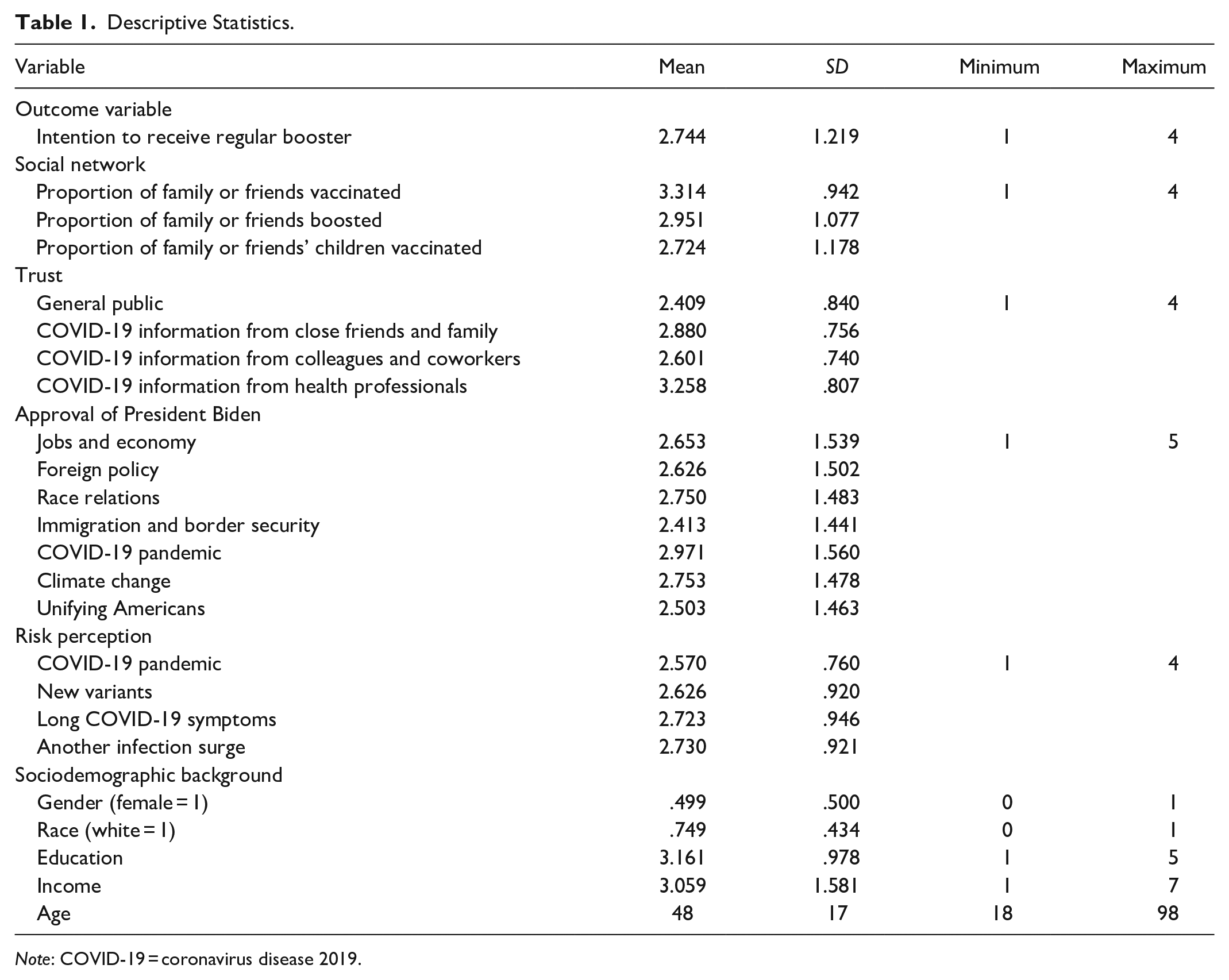
Note: COVID-19 = coronavirus disease 2019.
Measurement
The outcome variable gauges one’s intention to receive regular COVID-19 booster shots (i.e., every year) if they are recommended by public health officials. Response options are “very unlikely” (1), “somewhat unlikely” (2), “somewhat likely” (3), and “very likely” (4). As shown in Figure 1, 39 percent of respondents said they are “very likely” to receive the regular booster, and another 23 percent responded “somewhat likely.” Close to 40 percent of respondents are unlikely to receive the booster if the annual shot becomes available. We understand that behavioral intention could overestimate the action, with the actual uptake rate being lower than the estimated intention. However, this might be our best approach to gauge public attitude when the booster is unavailable.

Intention to receive the regular booster.
Social network is measured by three indicators about the proportion of one’s family members and close friends who have taken the COVID-19 vaccine, the monovalent booster, and vaccinated children. Response options include hardly any or fewer than one third (1), few or one third to half (2), some or half to two thirds (3), and most or more than two thirds (4). A higher value indicates more vaccine takers in one’s network. We acknowledge that the responses are likely subject to projection biases, as personal preferences will influence the answers. The finer scale of the question also makes it difficult to provide an accurate estimate. Nevertheless, this is the approach available to measure social network in the survey, and a previous study used the exact measurement when studying pediatric COVID-19 vaccine uptake (Hao 2023c). Four indicators are adopted to measure trust. One question asks how much people trust most others in society. The other question asks one’s trust in the accuracy of information about COVID-19 from three groups: close friends and family, colleagues and coworkers, and health professionals. Response options include “not at all” (1), “not very much” (2), “some” (3), and “a great deal” (4).
The attitude toward President Biden is gauged by how people evaluate his performance in seven areas: jobs and economy, foreign policy, race relations, immigration and border security, the COVID-19 pandemic, climate change, and unifying Americans. Responses range from “strongly disapprove” (1) to “strongly approve” (5). Risk perception is represented by concern about the pandemic’s threat, any new variants of COVID-19, long COVID-19 symptoms, and another infection surge. Response options include “not at all concerned” (1), “not very concerned” (2), “somewhat concerned” (3), and “very concerned” (4).
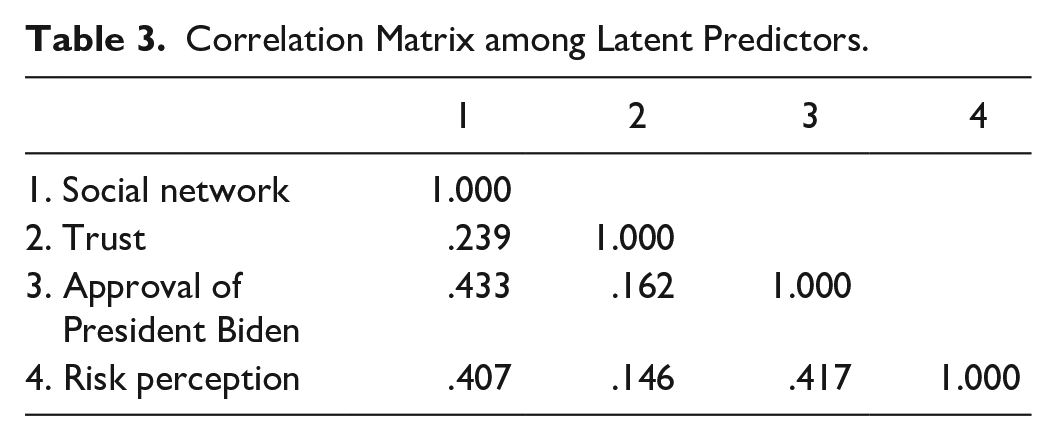
Confirmatory factor analysis is conducted separately for each of the four constructs: social network, trust, approval of President Biden, and risk perception. Results in Table 2 show that the standardized factor loadings of all individual items are statistically significant, and the loadings are reasonable in magnitude. The results suggest adequate reliability of using these variables to construct these latent measures. The correlation matrix among the four latent predictors is presented in Table 3.
Confirmatory Factor Analysis Results.
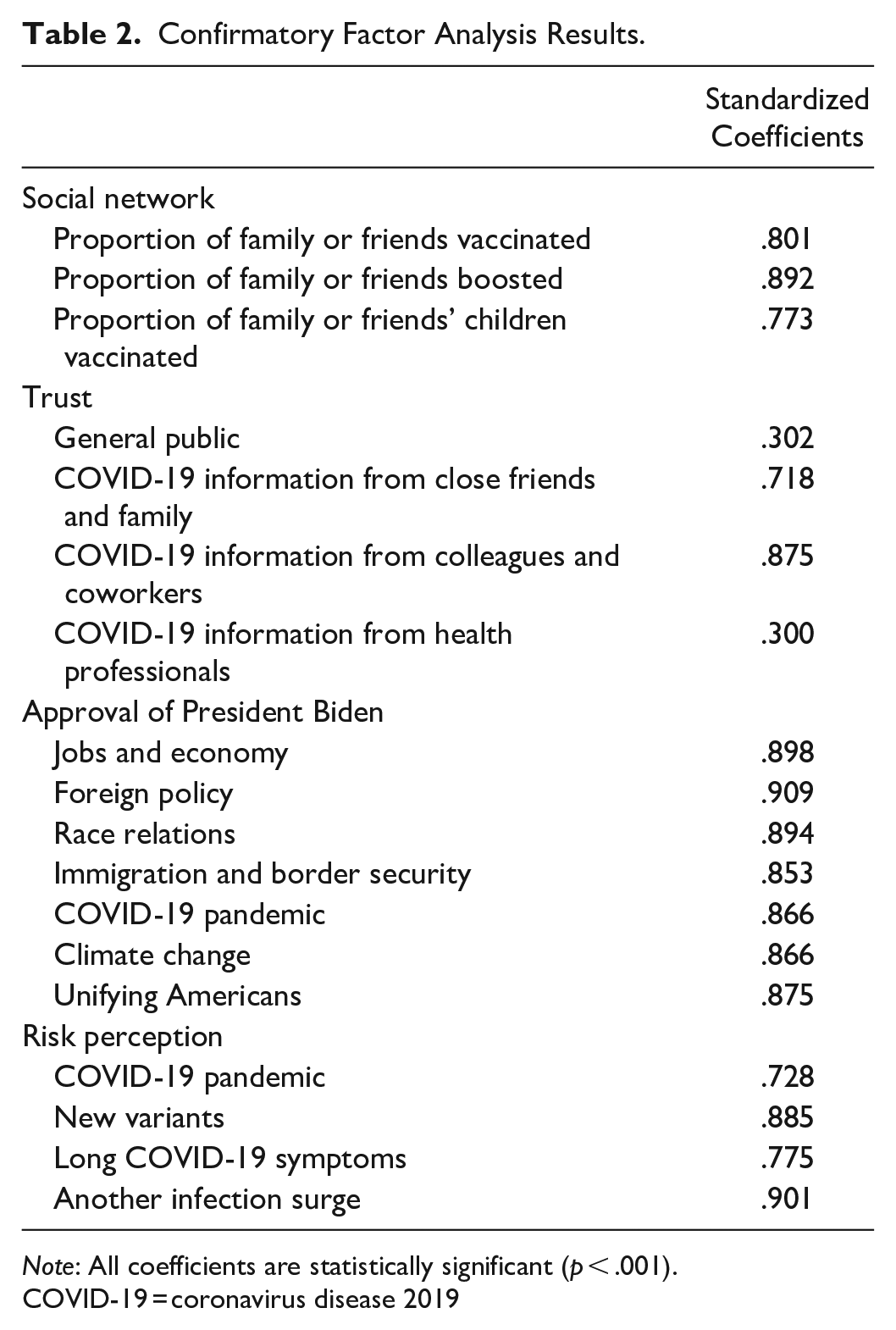
Note: All coefficients are statistically significant (p < .001). COVID-19 = coronavirus disease 2019
Correlation Matrix among Latent Predictors.
Five variables are included to measure one’s sociodemographic background: gender (female = 1), race (white = 1), education (coded in five categories: 1 = less than high school, 5 = graduate degree or higher), income (coded in seven categories: 1 = less than $25,000, 7 = $200,000 and above), and age.
Methods and Results
Latent Mean Comparison
The latent mean comparison approach is adopted to contrast the features in social network, trust, presidential job approval, and risk perception between respondents who are likely to receive the regular booster and those who are unlikely to do so. It is a commonly used approach before SEM estimation and can directly reflect differences between two groups of people without considering the influence of confounding variables. If the follow-up SEM analysis reveals the same pattern, then the finding is reinforced. Existing studies used latent mean comparison prior to SEM to compare different sociodemographic background between those who perceived the risk of the COVID-19 pandemic and those who did not (Shao and Hao 2020) as well as different social and political orientations between those who inoculated children and those who did not (Hao 2023c).
This approach is appropriate for this study because multiple indicators measure the predictors, and the indicators for each predictor have the same range (1–5 for indicators of approval of President Biden and 1–4 for indicators of other constructs). In addition, the outcome can be transformed into a binary variable (i.e., with responses including “very likely” and “somewhat likely” of receiving annual booster recoded into one group, while “very unlikely” and “somewhat unlikely” are collapsed into a reference group). Under this situation, the latent mean comparison will calculate average factor scores for each latent predictor and allow comparison between the two categories of the outcome variable.
The means of the four latent variables for the reference group are fixed at zero. Next, the means for the counterparts are estimated, and if the means are positive and significant, they are higher than the corresponding means of respondents from the reference group. If the means are negative and significant for the first group, they are lower than the mean of the reference group designated as zero. The intercepts are forced to be equal, and thereby any differences in the means of the indicators are reflected in the means of the latent variables. We use the maximum likelihood estimation that forces the analysis to use all the information available in the presence of missing values for one or more variables (Acock 2013).
As displayed in Table 4, the means of measures for these four latent variables for people likely to receive the regular booster are significantly higher than those who answered unlikely for booster intentions. The finding suggests that probooster respondents have more family and friends in their networks who have been vaccinated, received booster doses, and opted to have their children inoculated. Additionally, they have stronger trust in others, including the COVID-19 information from friends, colleagues, and health professionals. Meanwhile, this group of people is more likely to approve of President Biden’s job performance in multiple aspects and perceive the risk of the pandemic (e.g., new variants, long COVID, and another potential surge in cases) to be higher than people from the reference group.
Latent Mean Comparison Results.

p < .001.
SEM
SEM helps specify a conceptual model to investigate connections between latent-constructed variables and estimate direct and indirect effects from predictors to the outcome variable (Acock 2013; Bollen 1989). Social network, trust, presidential job approval, and risk perception are endogenous variables measured by multiple indicators. These endogenous variables and the sociographic background measures are hypothesized to affect one’s intention to receive the regular booster. The measurement of booster intention is not collapsed dichotomously in the SEM analysis but retains four categories. In addition to the direct effects, how social network moderates the impact of trust on booster intention and how the approval of President Biden moderates the impact of risk perception are assessed by creating two indirect paths. One path is from trust to the outcome variable channeled through social network, and another is from risk perception to the outcome variable via presidential job approval. The diagram is shown in Figure 2. SEM with maximum likelihood estimation is used for analyses and the standardized coefficients are presented in Table 5.

Structural equation modeling diagram.
Structural Equation Modeling Results.

Note: The coefficients are standardized. CFI = comparative fit index; RMSEA = root mean square error of approximation.
p < .10. **p < .01. ***p < .001.
The analyses produce several findings. First, social network (β = 0.437, p < .001), trust (β = 0.032, p < .10), approval of President Biden’s job performance (β = 0.314, p < .001), and risk perception (β = 0.278, p < .001) are all positively and significantly related to one’s intention to receive the regular booster. Thus, people with more vaccine takers in their social circles, who have greater trust in others and the information about COVID-19, approve of President Biden’s performance, and show concern about the pandemic’s risk are more likely to receive the booster after controlling for sociodemographic background. The results reinforced patterns identified in the latent mean comparison. The comparison of the standardized coefficients suggests that social network has the most considerable influence because the coefficient size is the largest, while trust has the least influence on booster intention.
Second, regarding the indirect effect, social network significantly moderates the impact of trust (β = 0.127, p < .001). People who trust others in general and the COVID-19 information from friends and health professionals in particular become even more likely to receive the regular booster if surrounded by vaccine takers than those immersed by vaccine skeptics. Meanwhile, the impact of risk perception on the outcome variable is moderates by approval of President Biden’s job performance (β = 0.132, p < .001). People who perceive the pandemic’s risk to be greater become more willing to take the annual booster if they also approve of President Biden’s performance.
Regarding the sociodemographic variables, males, whites, people with higher incomes, and older Americans are more likely to receive regular booster doses. The effect of education is insignificant. The model fit statistics reported at the end of the table are within acceptable ranges: the comparative fit index is greater than 0.9, and the root mean square error of approximation is less than 0.1. The model explains 48 percent of the variation in the annual booster intention.
Discussion and Conclusion
The COVID-19 pandemic has led to substantial public health costs and economic damage. The virus can continue mutating into infectious, dangerous forms that evade the immune system more easily. Meanwhile, the vaccine and booster’s efficacy appears to be compromised over time, and most Americans are relaxing their precautions against viral transmission (del Rio et al. 2022). Against that backdrop, an annual booster shot against COVID-19 is critical to reduce the magnitude of future spikes as it can combat both the original strain and contagious variants (Couzin-Frankel 2023). In this study, we aim to better understand the public’s likelihood of receiving annual booster doses when they become available and to identify factors that lead to booster intention.
The frequency distribution of the booster intention variable shows that only 40 percent of respondents said that they were very likely to receive the annual shot, whereas about 40 percent responded that they were unlikely to do so. The latent mean comparison and SEM findings reveal the effect of multiple determinants. First, people interacting more with vaccine takers will likely turn to them for vaccination advice, accommodate the group’s opinion, and ultimately might decide to receive the annual booster. Meanwhile, people with greater trust in the general public and the accuracy of COVID-19 information from friends, colleagues, and health professionals are more likely to receive the annual booster. The two factors also have a combined impact on promoting booster intention. The underlying reason might be that the feature of the network exposes people to timely information on the vaccine’s efficacy. The intention to become vaccinated is bolstered by encouragement and peer pressure from others. Meanwhile, the group’s receptive view on vaccination is reinforced by strong trust in information promoted by vaccine takers and recommended by health professionals, which together help overcome vaccine hesitancy and motivate behaviors such as vaccination that benefit the collective interests.
In addition, approval of President Biden’s job performance is another robust predictor, with people who approve of President Biden’s performance being more likely to resonate with his perspectives and policies on the pandemic and therefore to follow the vaccination recommendation. Furthermore, people who perceive a closer distance to the pandemic’s risk are more likely to take preventive measures like being inoculated. The effects of risk perception on booster intention are reinforced for people with a stronger approval of President Biden’s performance than those who disapprove of Biden. The threat people perceive from possible new variants or long COVID is shared in Biden’s sentiment of the pandemic, and approval of his performance implies the agreement of discourse that justifies the pandemic’s risk and the necessity of booster uptake. The booster intention varies by sociodemographic characteristics such as gender, race, income, and age.
Although existing studies have explored public opinion about the COVID-19 vaccine (e.g., Latkin et al. 2021; Wang and Liu 2022) and booster doses (e.g., Lennon et al. 2022; Neely and Scacco 2022; Raman et al. 2022), the topic of annual booster intentions has received less attention. The situation is different because, on one hand, we known more about the virus now than we did at the beginning of 2020. On the other hand, vaccination has become less pressing and not a priority for most people, even the aged population, and the booster rate is lower than the previous doses’ uptake rates. In other words, vaccine hesitancy remains or even increases for the annual booster (Machingaidze and Wiysonge 2021; Troiano and Nardi 2021). On September 12, 2023, the CDC released a statement saying that the annual booster is recommended for everyone six months and older and would be available by the end of that week. Thus, there is an urgent need to understand the public attitudes toward the additional shots and whether they follow the recommendation. This study contributes to the literature by analyzing a national sample of Americans and investigating determinants leading to booster intention. Results show that one’s intention to receive regular booster doses is underpinned by numerous factors, including social network, trust, approval of President Biden’s job performance, and risk perception. The findings regarding the social network effect and the interaction with trust are novel, as they are less covered in existing research about public opinion of the pandemic.
According to the present findings, some interventions might be leveraged to optimize the vaccination campaign (Dai et al. 2021; Wood and Schulman 2021). Encouraging vaccine takers to recommend vaccines to others is practical. A social network highlighting that most community members have received the immunization and disseminating trustful information that the vaccine is effective, especially among those who are hesitant, might assuage one’s concerns about the vaccine. Also, the continued presence of politicization for COVID-19 speaks to the need to ensure that medical recommendations are not seen as political or biased, which helps build vaccine confidence and nudge booster intention. It is critical to highlight a common identity that all Americans share when facing the same virus and ensure the legitimacy of science-based recommendations is successfully delivered instead of being dismissed. In addition, alerting the public to the pandemic threat, such as emerging variants, and highlighting the benefits of population-wide vaccination are also helpful in motivating booster intention. This concerted endeavor to expedite vaccination coverage is multifaceted and could have lasting effects if addressed simultaneously at the national and local levels. These strategies might specifically target female, non-white, lower income, and younger Americans, who are less likely to receive the annual booster, as found in our study.
This study has limitations, and research on this topic calls for further inquiry. First, the survey was conducted in the spring of 2023, and subsequent research should continue monitoring public opinion using the latest data. The public’s attitudes regarding the annual booster could change with more information on the booster becoming available. We acknowledge that people who intend to receive the booster might not ultimately do so. Thus, our estimation of intention to take the annual booster, which is likely to be an overestimate, can be improved with more accurate data to gauge one’s booster uptake.
Second, as mentioned in the “Data” section, social network measurement suffers from projection biases, and additional studies that incorporate alternative measures could help address the issue.
Third, although the present findings are interpreted by referring to the existing paradigms used to account for vaccine uptake, it is important to caution that the relationships can be bidirectional. The patterns identified are subject to simultaneity, wherein people who tend to receive the booster may be more likely to join social networks of vaccine takers, trust health professionals, support President Biden, and perceive the pandemic’s risk. Thus, additional studies are needed to refine the interpretation and dissect the causal relationship between predictors and outcome variables.
Finally, in addition to the factors included in the present research, scholars should consider other predictors that shape one’s intention to receive the annual booster. Those factors might reflect state-level contexts such as the health and economic impacts of the pandemic and the current political landscape.
Footnotes
Funding
The author(s) disclosed receipt of the following financial support for the research, authorship, and/or publication of this article: The survey conducted in this study was supported by the Interdisciplinary Research Grant of the University of South Florida.
