




Abstract
Risk perceptions of the COVID-19 pandemic changed economic expectations and shaped individuals’ consumption and investment choices, thereby worsening its economic and social damage. This study investigated the associations between COVID-19 risk perceptions and economic expectations using a South Korean dataset collected during the pandemic. The results of a logistic regression conducted on 1,001 participants revealed that greater pandemic risk perceptions were significantly associated with negative economic expectations at both the national and the household levels. Affective risk perception had a large and significant negative association with all four types of economic expectations, whereas cognitive risk perception had a significant negative association only with households’ economic expectations. The association was greater for the perception that the economy would “get better” than for “get worse” or “remain the same,” indicating COVID-19 may have reduced individuals’ optimistic economic expectations. COVID-19’s economic damage may last beyond the pandemic, as individuals adjust their economic expectations.
The COVID-19 pandemic has had a major short-term negative impact on public health and economic activity worldwide. The high transmission rate and severity of symptoms, combined with social distancing measures and restrictions on domestic and international travel to contain the spread of the pandemic, contributed to these impacts (Brodeur et al., 2021). As of 2023, many countries have eased COVID-related restrictions, hoping to resume pre-pandemic economic and social activities (Yeginsu & Scott, 2023). Some studies have predicted a relatively quick recovery (Andersen et al., 2022), whereas others have predicted persistent effects, especially for vulnerable groups (Barrero et al., 2021; Jung et al., 2023). To recover economic growth and well-being after the pandemic, it is important to understand the factors that lead to persistent long-term effects.
The literature shows that individuals have heightened risk perceptions when exposed to more pandemic-related information (Dryhurst et al., 2020), and adopt a more pessimistic view of economic growth after a pandemic starts (Binder, 2020). Economic expectations are important predictors of the consumption and investment decisions that determine subsequent economic growth (Eusepi & Preston, 2011; Weber et al., 2022). The negative economic effects of the pandemic will persist if individuals revise their economic expectations to be downward-biased during its spread, and the long-term effects will be greater if individuals whose perceptions (and, therefore, behaviors) are more affected by the pandemic today revise their expectations.
Therefore, finding a negative association between individuals’ risk perceptions of COVID and economic expectations suggests that areas or groups with relatively more severe short-term pandemic impacts will experience more severe long-term impacts through adjustments in individual behaviors. The severity and risk perceptions of the pandemic do not always coincide (Chen et al., 2021). For example, in the United States (US), lower foot traffic and visits to local businesses were better explained by individuals’ fear of COVID-19 than by government shutdown orders (Goolsbee & Syverson, 2021). Therefore, to better understand the potential for the long-term effects of the pandemic, it is necessary to examine individuals’ risk perceptions instead of the regional severity of the pandemic, as explored by others (Coibion et al., 2020). However, few studies have investigated how individuals’ risk perceptions of the pandemic relate to economic expectations. Therefore, this study investigated the association between individuals’ risk perceptions of COVID-19 and economic expectations using a unique survey dataset from South Korea that measured affective and cognitive risk perceptions. In particular, it focused on the “level” and “change” in economic expectations at the household and national levels over time. In short, this study considered four types of economic expectations (household level, household change, national level, and national change) associated with two risk perception types (affective and cognitive) to provide a detailed overview of how the risk perceptions of COVID-19 have shaped different dimensions of individuals’ economic expectations. This study also investigated the heterogeneity according to participants’ sex, age, and education level.
Economic Expectations, Risk Perceptions, and Economic Decisions
Individuals’ economic expectations are formed based on the available information and subjective models of the economy. Economists assume that individuals form expectations based on publicly available information such as a weighted average of past observations (Muth, 1961; Sargent, 1987; Savin, 1990). Knowledge and beliefs about the COVID-19 pandemic and its relationship to the economy can influence how individuals form expectations about the evolution of the economy.
In this study, we distinguished between affective risk perception and cognitive risk perception and assessed their associations with the four types of economic expectations introduced above. These associations were expected to be different. According to the dual-process theory of thinking, people comprehend reality using either intuitive and nonverbal ways or analytical and verbal ways (Slovic & Peters, 2006). The analytical and verbal understanding of reality corresponds to cognitive risk perception and can be described by the model of expectation formation in economics based on available information. Individuals would have a relatively good understanding of a household’s economics because the relevant information is readily available to them, including information acquired through personal experience and the experiences of those around them. This makes cognitive risk perception highly relevant for households’ economic expectations.
The intuitive and nonverbal understanding of the world, based on “affect,” corresponds to affective risk perception, and this allows the formation of expectations depending on preferences and heuristics. Affect can be a quick and efficient way to navigate complex and uncertain situations (Slovic & Peters, 2006). Most people would find national economics to be too complex and abstract to form a clear judgment based on the information available to them. Affective heuristic, or affective risk perception, is thus expected to be more relevant for economic expectations at the national level.
We also distinguished the level of economic expectations from their changes over time. Focusing only on economic expectations may confound the effects of risk perception with previously held beliefs. For example, an individual may evaluate the current economic environment as “bad” and expect the situation to continue, whereas another individual may evaluate the current economic environment as “good” but expect the future economic environment to be “neutral.” The second individual lowered their expectation relative to the current economic situation, but this cannot be captured by only comparing future expectations. We captured the association in these changes by examining them over time.
Economic expectations may shape individuals’ economic decisions in several ways. First, individuals may engage in intertemporal substitutive consumption by borrowing and saving. Individuals who forecast lower income flows may shift today’s consumption to tomorrow by saving, while those who forecast higher income flows may shift tomorrow’s consumption to today by borrowing. Accordingly, some studies have reported an increase in savings during the pandemic (Coibion et al., 2020; Cox et al., 2020; Kim et al., 2022). Second, individuals with different risk preferences may react differently to economic risks and uncertainties. For example, even if the expected value of economic growth is the same for two individuals, the individual with greater distaste for the uncertainty associated with predicting the future will “play it safe” by reducing their exposure to risky investments, such as stock market holdings or post-secondary education, or by delaying their purchase of durable goods.
The risk perception information related to COVID-19 is used to form economic expectations, which then guide individuals’ behaviors that determine economic growth. Thus, it is critical to explore the association between individuals’ risk perceptions of COVID-19 and economic expectations to understand the potential long-term consequences of the pandemic. Given the unprecedented nature of the pandemic, this study expects that individuals’ interpretations of COVID-related information will differ. Furthermore, COVID-related information may be more salient to individuals with a higher aversion to uncertainty, which differs by sex (Borghans et al., 2009) and socioeconomic status (Outreville, 2015). Therefore, this study expects the association between risk perceptions and economic expectations to depend on demographic characteristics and socioeconomic status.
Both risk perceptions and economic expectations have changed dramatically since the start of the COVID-19 pandemic. Risk perceptions have increased in response to pandemic-related information (Dryhurst et al., 2020), as observed in South Korea and China, for both health-related risks and those related to social disorders. However, these perceptions have not always been associated with the severity of the pandemic (Chen et al., 2021). The risk perceptions of COVID-19 have depended on political orientation, media consumption, age, personal experience, prosocial values, and trust (Barrios & Hochberg, 2021; Dryhurst et al., 2020; Rosi et al., 2021). Moreover, individuals have adopted a more pessimistic view in terms of their economic expectations, such as a lower inflation rate and higher unemployment rate (Coibion et al., 2020), while students have delayed their graduation and now expect lower earnings (Aucejo et al., 2020). Changes in economic expectations have shown heterogeneity across individuals based on their demographic characteristics, socioeconomic status, risks, time preferences, and institutional trust (Ambrocio & Hasan, 2022; Armantier et al., 2021; Li & Huang, 2020; Weber et al., 2022).
Meanwhile, there is little evidence on this study’s focus—how individuals’ risk perceptions of COVID-19 and economic expectations are related. In a survey conducted in the US, greater concern about the pandemic was associated with higher inflation and unemployment expectations (Binder, 2020). Those with a high risk of COVID-19 in China have the lowest short-term economic confidence (Yang & Xin, 2020). Meanwhile, during the 2015 Middle East Respiratory Syndrome outbreak in Korea, risk perceptions were found to predict intention to engage in economic and social activities (Choi et al., 2018).
Materials and Methods
Participants
A total of 1,001 participants aged 18 years and older were surveyed on March 1 and 2, 2022. The survey sample was randomly selected from a random-digit dialing sample framework that included telephone and mobile devices. Weights calculated according to age, sex, and region were assigned to each participant. Of the 6,275 eligible cases from the Gallup Korea survey panel, 1,001 responded, with a total response rate of 16.0% (see Supplemental Material for the survey details and interview guide). Weighting was performed to ensure that the sample was representative of the general population. The interviews were conducted over the telephone by trained interviewers from Gallup Korea, an affiliate of Gallup International. Demographic factors assessed in the survey included sex, age, occupation, education level, and residential area. Age was divided into five levels: 18–29, 30–49, 50–59, and >60 years. Occupation was categorized into seven types: “farming/forestry/fishery,”“self-employed,”“blue-collar worker,”“white-collar worker,”“full-time homemaker,”“student,” and “unemployed/retirement/other.” Education level was divided into five categories: “below middle school,”“middle school graduate,”“high school graduate,”“college graduate or undergraduate,” and “higher than a bachelor’s degree.” Residential areas were recorded in terms of province and grouped with reference to the political-science literature on local politics in South Korea. The five large regions, which included provinces and other areas, were the Seoul Metropolitan Area, Chung-chun, Ho-nam, Yeong-nam, and Gangwon/Jeju (N. Y. Lee, 2015).
Survey Instruments
The survey examined affective and cognitive risk perceptions. Affective risk perception was evaluated using the following item: “How worried are you about becoming infected with COVID-19?” The responses were recorded using a 4-point scale, where 4 represented “Very worried” and 1 represented “Not worried at all.” The responses were reclassified for regression modeling as 1–2 = “Not worried” and 3–4 = “Worried.” Cognitive risk perception was evaluated using the following item: “How likely do you think it is for you to be infected with COVID-19?” The cognitive risk perception item was reclassified in a manner similar to that for affective risk perception. The validity and reliability of the survey instruments were not assessed because the survey was conducted during the COVID-19 pandemic and there is no universally accepted and proven tool for risk perception.
Economic expectations were investigated by dividing them into judgments about the general economy and the participants’ livelihoods. The participants were asked to judge the economic condition of the previous year using three responses: “Improved,”“Worsened,” and “Similar.” The economic expectations for the following year were measured using three responses: “It will get better,”“It will get worse,” and “It will remain the same.” Based on the survey results, this study created new variables to evaluate the changes in judgments by comparing those about the past with those about the future. These variables were coded as follows: “It will remain the same” if the past assessment matched the future expectation, “It will get worse” if the future expectation was worse than the past assessment, and “It will get better” if the future expectation was better than the past assessment. This study interpreted the questions on the general economy to be related to the national economy.
The intensity of the COVID-19 pandemic in each region was calculated as the number of confirmed cases and deaths in the last month before the survey and the last 3 months, last 6 months, last year, and entire period since the beginning of the pandemic. The number of confirmed cases was converted to cases per 100,000 people, and the number of deaths was converted to cases per 1,000 people using the population at the end of 2021.
Analysis
The response rates for each item were calculated regarding risk perception, and univariate analyses using chi-square tests were performed to measure the differences between the risk perception statuses for each response. Table 2 reports the proportions of the missing values for each variable. Missing values were omitted from the statistical calculations, and outlier identification was not performed.
Statistical analysis was used to evaluate the impact of the risk perceptions of COVID-19 on economic expectations. As in the first analysis, age, sex, occupation, and education level were included as covariates in the models. The number of confirmed cases in the last month in each region was added as an intensity variable for COVID-19 for the sensitivity analysis. An ordinal regression analysis was used, because the outcome variables were survey items with three possible responses. Marginal effects were calculated to determine the absolute effect of risk perception, and the heterogeneity of effects were calculated according to age, sex, and education level.
The threshold for significance (alpha) was 5%; however, this study only presents the estimates and 95% confidence intervals instead of reporting the p-values. All statistical analyses were performed using R (Version 4.2.1; R Foundation for Statistical Computing, Vienna, Austria), and the average marginal effects were calculated using the R package marginaleffects.
Results
Demographic Characteristics
Table 1 presents the participants’ general characteristics. Approximately half of the participants were female (50.4%). By age, approximately half (50.7%) were under 50 years and the average age was 48.6 years (standard error 0.6). When considering risk perception, we found that individuals lacking affective risk perception had an average age of 48.8 years (standard error 0.9), while those with affective risk perception shared a similar average age of 48.8 years (standard error 0.7). By contrast, individuals lacking cognitive risk perception had an average age of 56.6 years (standard error 1.1), whereas those with cognitive risk perception had a notably lower average age of 45.3 years (standard error 0.6). White-collar workers, the self-employed, homemakers, and blue-collar workers comprised 30.3%, 18.8%, 17.9%, and 14.3% of the participants, respectively, while farming/forestry/fishery, students, the unemployed, and retired workers accounted for the rest. College graduates or higher accounted for 61.9% of the participants, while approximately 50% of participants lived in the Seoul Metropolitan Area. The participants who reported having a high affective risk perception of COVID-19 accounted for 60%, whereas 75.1% reported having a high cognitive risk perception. When asked for their judgment of the overall economic situation, 56.7% thought that it had “Worsened.” When asked about the future prospects, 42.8% participants said that “It will remain the same,” and 35.7% said that “It will get better.” When asked for their judgment of their household’s economic situation, 57.9% answered it was “Similar,” which was greater than the proportion who answered “Similar” to the question about the national economic situation (29.3%). When asked about their economic expectations for their household’s economic situation, 56.4% stated that “It will remain the same” and 30.7% believed that “It will get better.” Thus, differences in risk perceptions were found based on the participants’ characteristics. Chi-square tests were used to identify the differences both between the groups and between those with affective and cognitive risk perceptions.
Participants’ Basic Characteristics.

For some items, adding the constituent percentages may not produce a result of 100% because of rounding.
Chi-square tests were performed to evaluate the distribution of each variable depending on the risk perception. The difference in the affective risk perception item is marked as *; the difference in the cognitive risk perception item is marked as #.
Males were more likely to perceive high affective and cognitive risks, whereas females were less likely to do so. People in their 30s to 50s were less likely to perceive affective risks, but more likely to perceive cognitive risks. Blue-collar workers were less likely to perceive affective or cognitive risks. Highly educated individuals were more likely to perceive cognitive risks. However, the proportion of individuals perceiving high affective risks did not differ by education level. Those living in densely populated areas such as Seoul were more likely to perceive high cognitive risks, but not affective risks. Those who reported positive judgments (“Improved”) and expectations (“It will get better”) were less likely to perceive high affective or cognitive risks. Those with other judgments or expectations did not markedly differ in their risk perceptions.
The Relationship Between Risk Perceptions and Economic Expectations
The intensity of the COVID-19 pandemic did not affect risk perception, and no difference was found according to sex, age, and education level (see Supplemental Material). When exploring the relationship between risk perceptions and economic expectations, this study identified relatively large negative effects for all four types of economic expectations for affective risk perception, but only negative effects for the two household types for cognitive risk perception (Table 2).
The Association Between Risk Perceptions and Economic Expectations.

The coefficient of the ordinal regression was difficult to interpret; therefore, the marginal effects were calculated to show how the economic expectations for each item changed when the risk perception changed to “Not worried” and “Worried” (Figure 1). Affective risk perception increased the probability of “It will get worse” and lowered the probability of “It will get better” in terms of economic expectations at both the national and the household levels. The increase in the probability of “It will get worse” was similar across all four items, ranging from .04 and .06. The decrease in the probability of “It will get better” was between .05 and .1 and was generally larger than the corresponding increase in the probability of “It will get worse.” Modest increases of less than 0.05 were observed in the probability of “It will remain the same” across all four items.
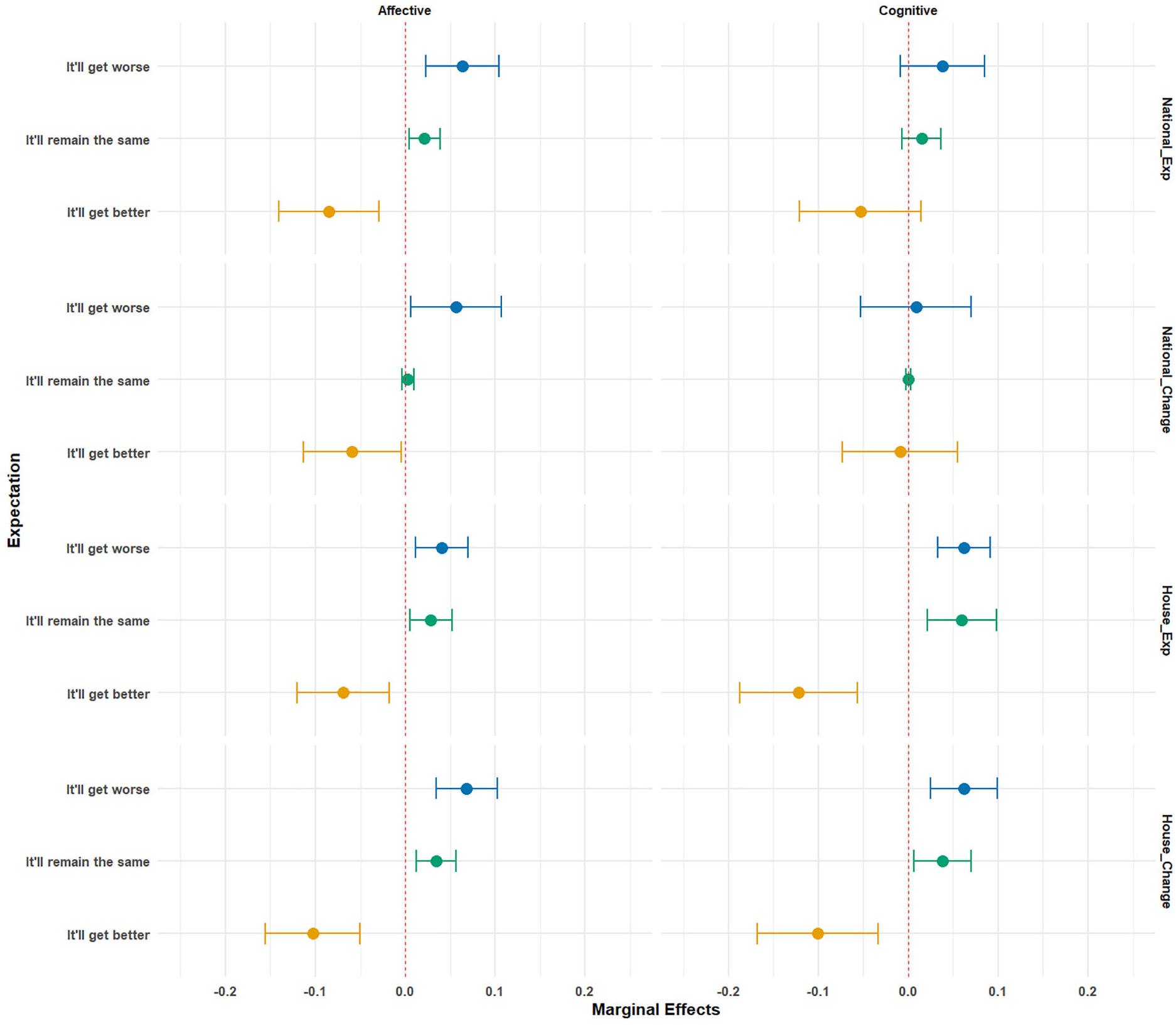
Marginal effects of risk perceptions on economic expectations. The reference group is “Not worried..”
On the contrary, cognitive risk perception significantly affected households’ economic expectations, but not national economic expectations. The probabilities of “It will get worse” and “It will remain the same” showed similar increases of around 0.05. In contrast to the small and insignificant change in the probability of “It will get better” for national economic expectations, there was a large (greater than −0.1) and significant decrease in the probability of “It will get better” for households’ economic expectations. A similar pattern was identified in the model, after excluding the intensity of the COVID-19 pandemic (Supplemental Figure S1). Finally, across the four types of economic expectations and the two types of risk perceptions, the marginal effects were similar between the levels of and changes in economic expectations.
A subgroup analysis was performed by sex, age, and education level. While no significant heterogeneity was identified by sex (Supplemental Figure S2) and age (Supplemental Figures S3a and S3b), the education level analysis showed a slightly different landscape. When people with low education levels (less than middle school) predicted households’ economic expectations, “It will remain the same” did not increase and only “It will get worse” increased (Supplemental Figures S4a and S4b).
Discussion
This study contributes to the understanding of the long-term consequences of the COVID-19 pandemic by directly relating individuals’ risk perceptions to their economic expectations. Expectation formation depends both on the perceptions of the available information and on risk preferences as well as whether the risk is understood primarily through cognition or affect. Previous studies have investigated risk perceptions and economic expectations separately, even though economic expectations do not always correspond to individuals’ risk perceptions. This study provides a more comprehensive overview of how economic and social consequences can extend beyond the end of the pandemic by jointly considering affective and cognitive risk perceptions and their associations with the levels and changes in economic expectations at both the national and the household levels.
The women in our study exhibited lower levels of both types of risk perception than men, in contrast to the typically higher anxiety levels observed in women. Specifically, there was no significant difference in affective risk perception between the sexes, but younger individuals tended to report heightened cognitive risk perception. By occupation, our findings indicated that blue-collar workers tended to experience less affective risk perception, while students and white-collar workers reported higher cognitive risk perception. This occupational trend was further validated by education level, where individuals with a college degree or higher tended to express higher cognitive risk perception, while those with a middle school diploma or less expressed lower levels. Furthermore, by region, residents of the Seoul Metropolitan Area showed lower affective risk perception and higher cognitive risk perception than those in the other regions. Lastly, individuals who anticipated a deteriorating economic outlook were more likely to perceive both affective and cognitive risks, whereas those who believed the economic situation would improve tended to report lower levels of both types of risk perception.
The findings confirmed our expectations by showing negative associations between risk perceptions and economic expectations. The associations for affective and cognitive risk perceptions were consistent with the role of affective heuristics in understanding more complicated realities. In other words, affective risk perception was significantly associated with national economic expectations, whereas cognitive risk perception was not. The associations were similar for both the levels of and changes in expectations, confirming that our findings were not confounded by individuals’ perceptions of the past economic environment.
Given the severity of the COVID-19 pandemic globally, it is surprising that the results revealed that heightened risk perceptions were, on average, associated more with lower expectations of economic improvement, and less with higher expectations of an economic slump. One possibility for this finding is that even as the pandemic reduced consumption and economic activity both in Korea and globally, the Korean government maintained public trust by keeping the pandemic under control without enforcing a strict lockdown (Park & Chung, 2021). Furthermore, South Korea’s exports of such products as computer chips, which are important exports for the national economy, increased during the pandemic (Cho, 2021; Wei et al., 2021). The association between risk perceptions and economic expectations likely reflects individuals’ understanding of these forces, of which some work in opposite directions. Nevertheless, regarding the extent to which risk perceptions reflect the local severity of COVID-19, this study’s findings propose that regions more severely affected by COVID-19 will also experience long-term consequences.
However, this study’s subgroup analysis did not reveal significant differences by sex and age, possibly because of its limited statistical power. Individuals with low education levels reported more pessimistic economic expectations, showing a positive association between risk perceptions and the expectation that the economy will worsen. This result is consistent with the finding that individuals with low socioeconomic status tend to have downward-biased economic expectations (Das et al., 2020), and further implies that the pandemic will widen the extant socioeconomic inequalities through individual behaviors guided by economic expectations.
Expectations for the national economy were significantly associated with affective risk perception but not with cognitive risk perception, whereas households’ economic expectations were significantly related to both. The results also suggested that affective and cognitive risk perceptions were formed differently. Moreover, different relative magnitudes were shown across the demographic groups. Overall, affective risk perception is likely to be more useful for studying individuals’ expectations of the national economy in the case of future outbreaks of infectious diseases.
This study had several limitations. First, the sample was only drawn from South Korea, whose unique test-and-trace system kept the public relatively well informed of the spread of COVID-19 throughout the pandemic period, except during the first half of 2022 (Omicron wave). Analysts and policymakers applying these findings to other settings should consider this inherent context. Second, this study could not account for the pre-pandemic characteristics or outcome variables because of the survey’s cross-sectional design. Similarly, it could not use longitudinal models that accounted for respondent-specific unobserved characteristics. Third, because the dataset was observational in nature, this study could not establish causal relationships between the variables. Fourth, the validity and reliability of the psychometric measures of risk perception were not fully addressed. The two measures of COVID-19 risk perception, affective and cognitive, were applied from previous studies (e.g., Y. H. Lee et al., 2023). Since psychometric measures of risk perception are not available in the literature, further investigations are required to validate the measurement of risk perception through large-scale data collection. Finally, although this study did not find large differences by subgroup, the sample size may not have allowed for sufficient statistical power to detect significant effects. Considering the sizes of the estimates, however, the results were more likely to reflect the survey period rather than insufficient power.
Given these limitations, future research should collect a larger sample and utilize a longitudinal study design. Conjoint analysis or discrete choice experiments could be used to analyze the relationships between risk perceptions and economic expectations as well as between economic expectations and economic behaviors in more detail.
Conclusion
Many analysts suggested communicating information on COVID-19 risks as a public health policy during the pandemic. However, this study’s findings call for the careful use of information communication. On the one hand, heightened risk perceptions of COVID-19 may promote preventive health behaviors, such as the use of masks and social distancing (Dryhurst et al., 2020). On the other hand, as shown here, information communication may raise risk perceptions, thereby lowering economic expectations and increasing the economic and social consequences of the pandemic. These benefits and costs are likely to apply to different segments of the population because of the heterogeneity in individuals’ responses to both. Sophisticated policy planning is thus required to promote public health without extending the negative effects of the pandemic.
Supplemental Material
sj-docx-1-sgo-10.1177_21582440241293586 – Supplemental material for Association Between COVID-19 Risk Perceptions and Economic Expectations During the Pandemic in South Korea
Supplemental material, sj-docx-1-sgo-10.1177_21582440241293586 for Association Between COVID-19 Risk Perceptions and Economic Expectations During the Pandemic in South Korea by Jun Hyung Kim, Jin-Hwan Kim, Jong Jae Lee, Deok Hyun Jang and Won Mo Jang in SAGE Open
Footnotes
Authors’ Contributions
Research conception and design: Won Mo Jang, Jun Hyung Kim, Jong Jae Lee; Investigation and formal analysis: Jin-Hwan Kim, Deok Hyun Jang, Won Mo Jang; Methodology: all authors; Drafting of the manuscript: Jun Hyung Kim, Jin-Hwan Kim; Supervision: Won Mo Jang, Jun Hyung Kim; Writing—review and editing and approval of final manuscript: all authors
Declaration of Conflicting Interests

Funding
The author(s) disclosed receipt of the following financial support for the research, authorship, and/or publication of this article: Jun Hyung Kim is supported by the National Natural Science Foundation of China (no. 72150410443).
Ethical Statement
This study was reviewed and approved by the Institutional Review Board (IRB) of the Seoul Metropolitan Government-Seoul National University Boramae Medical Center (IRB No. 20-2022-21). The need for informed consent was waived by the IRB because the data were analyzed anonymously.
Data Accessibility
The datasets generated during and/or analyzed during the current study are available from the corresponding author on reasonable request.
Supplemental Material
Supplemental material for this article is available online.
References
Supplementary Material
Please find the following supplemental material available below.
For Open Access articles published under a Creative Commons License, all supplemental material carries the same license as the article it is associated with.
For non-Open Access articles published, all supplemental material carries a non-exclusive license, and permission requests for re-use of supplemental material or any part of supplemental material shall be sent directly to the copyright owner as specified in the copyright notice associated with the article.
