




Abstract
Despite increased parity, large gaps remain between men and women in law. The author proposes that the cultural meanings and everyday interactions in which lawyers engage may create a gendered institution that reifies the gender hierarchy. Using three universal dimensions of meaning, the author investigates differences in the meanings of lawyer-related identities by gender. The results show that across all of these identities, female-modified identities carry cultural meanings that are less powerful than nonmodified identities. Using affect control theory, the author develops hypotheses about the expectations for men and women lawyers when enacting behaviors coded as either adversarial or caring. The data suggest that women are perceived as gender deviant when engaging in adversarial behaviors, while men are perceived as gender deviant when engaging in communal behaviors. These empirical hypotheses suggest ways that cultural meanings shape how lawyers experience their daily work lives and have broad implications for the gender hierarchy in high-powered workplaces.
Like other high-status fields, the legal profession in the United States is dominated by men. The American Bar Association’s (2022) most recent “Profile of the Legal Profession” notes that women still make up only roughly 38 percent of the field and fewer than 20 percent of equity partnerships. Thus, by sheer numbers alone, men dominate the field of law. However, the proportion of men lawyers tells only part of the story.
Not only do men continue to outnumber women, but gender gaps in wages and promotions remain particularly prevalent. This problem may be explained by lower performance evaluations for women lawyers (Azmat and Ferrer 2017). Women lawyers face several challenges to achieving the same levels as men in objective measures of performance. These include structural and interpersonal challenges that women lawyers face in their professional lives.
Many women lawyers face structural challenges that are driven by the nature of the profession. As many lawyers begin their work in early adulthood, women may feel that they are forced to choose between the high-pressure field of law and motherhood. These motherhood penalties are well documented across the U.S. labor market, including law (Correll, Benard, and Paik 2007). Additionally, male-dominated hierarchies persist in most law firms and corporate offices limiting women’s likelihood for promotions (Dinovitzer et al. 2009b; Hagan and Kay 1995; Hull and Nelson 2000). Although structural factors such as these may affect how women lawyers are evaluated, other processes have been identified as contributing to gender gaps.
Women lawyers often have different career aspirations than their male counterparts. These may be driven through the socialization process in law school and early-career work or come from differential returns on human capital (Azmat and Ferrer 2017). Often women face different expectations of job performance that lead to lower performance reviews for women in the workplace, a phenomenon that is seen in the legal profession (Correll 2004; Dinovitzer et al. 2009b; Wald 2010).
Interpersonal and structural challenges likely combine to result in the large gender gaps in the field. As lawyers advance further through the profession, the gaps between men and women increase (Desilver 2018; Garth et al. 2017). Controlling for human capital and structural factors, women lawyers across all areas of law make $30,000 less than their male counterparts and are significantly more likely to work part-time (Dinovitzer et al. 2009a; Garth et al. 2017).
Two performance measures play the largest role in perpetuating gender gaps in the field: billable hours and new client revenue (Azmat and Ferrer 2017). Some suggest that women may bill their hours differently accounting for some of the gaps in these measures (Reichman and Sterling 2004), whereas others propose that women undervalue their work and thus struggle to achieve in these areas (Dinovitzer et al. 2009b). Importantly, billable hours are adjusted, and new clients given out, by senior partners who may be predisposed to judge women and men lawyers differently (Flood 2013). Similarly, women face challenges in being perceived as competent by their male coworkers and superiors, possibly suppressing their performance measures and leading to differential career aspirations (Correll 2004; Rudman 1998). Women also may feel incongruity between their stereotyped gender status and career aspirations to partnerships (Heilman 2012; Rudman et al. 2012).
Although these studies have identified empirical differences in how men and women are evaluated in the field and offer theoretical clues as to the ways the women may undervalue themselves, they do not address the interactional mechanisms that underly women’s experiences in the field. The meanings attributed to women lawyers may operate such that it is undesirable to act out the lawyer role. Indeed, no work has identified the meanings of the woman lawyer role or addressed how women lawyers are perceived in these roles. However, research in the field has called for a greater focus on the social psychological factors that may act as forces in reifying the gender hierarchy (Azmat and Ferrer 2017; Dinovitzer et al. 2010).
In this work, I seek to address these gaps by using affect control theory (ACT; Heise 2007) to theoretically model the ways in which men and women lawyers are perceived when enacting behaviors in their daily practice in the United States. ACT is a social psychological theory that draws on cultural meanings of social objects to predicts affective responses and behaviors within interactions. In the following sections, I first introduce ACT and then review the literature related to the two mechanisms: (1) gendered perceptions of competency and power and (2) gender norms of behavior. Throughout this review, I note the remaining questions and the ways in which I seek to model these mechanisms using ACT. Following this, I explain how I apply ACT to this case and preview the simulations I run.
Background
Act
ACT proposes that all social concepts—identities, behaviors, settings, and emotions—have somewhat fixed affective meanings. The meanings, or fundamental sentiments, are generalized with the three universal dimensions: evaluation, potency, and activity (EPA) (Osgood, May, and Miron 1975). Evaluation is an understanding of goodness, potency of power, and activity of activeness of a social concept. These dimensions are measured using semantic differential scales. EPA ratings have been collected for thousands of concepts in several cultures and are put together into dictionaries of affective meaning.
ACT explains how individuals understand their social world through these cultural meanings. It proposes that in every interactional event, individuals seek to confirm the fundamental sentiments that are evoked through their perceptions and understandings of the situation. That is, individuals seek to understand events in ways that confirm and maintain their expectations of themselves, their interactional partners, and the situation. For example, a person who enacts a particularly potent identity, such as a lawyer, will likely attempt to behave in controlling and powerful ways to confirm their identity sentiment.
ACT’s empirically derived impression-formation equations predict how social interactions affect how an observer sees the actors, objects (recipients of actor’s behaviors), and behaviors in an event. Identities can be modified by attaching traits (e.g., pleasant), features (e.g., irritating), moods (e.g., frustrated), or status characteristics (e.g., female) using empirically derived amalgamation equations (Heise 2007). Thus, using the computer program INTERACT, researchers can simulate social interactions and predict affective responses (Heise 2013).
According to ACT, when fundamental sentiments do not match the transient impressions created by a social situation, interactants and observers experience an affective response quantified mathematically as a deflection score. Higher deflections indicate a greater discrepancy between the fundamental and transient sentiments. A social event that is further from the expected behaviors on the basis of cultural sentiments will lead to a higher deflection score. Deflection scores are operationalized as the sum of squared Euclidean distances between the expected fundamental sentiments and the situational transient impression created by an event. When a deflection score is high, an event is particularly unexpected. In these instances, interactants work to bring their situational impressions in line with their fundamental sentiments through behavioral or cognitive strategies. They may redefine identities, objects, or settings or they may behave in ways that will reduce the deflection. Computer simulations of events in INTERACT predict the response for both actors and objects in the event of a deflection (Heise 2007; Rogers 2021).
When events result in low deflection, interactants and observers feel that the event matches their cultural expectations. For example, if a lawyer—understood to be slightly good (0.88), extremely powerful (2.71), and quite active (1.54) 1 —were to charm—quite good (1.86), quite powerful (2.00), slightly active (0.68)—a client—slightly good (1.09), slightly powerful (1.25), and slightly active (0.89), the deflection is 2.58. The fundamental sentiments of the behavior are close enough to those of the actors that the interactants’ identities are validated. In particular, this behavior is in line with how a lawyer is expected to act as the actor-based deflection is 0.94.
However, if the lawyer were to chew out their client, the deflection jumps to 8.76, leading them to seek out ways to reconceptualize the situation to make it fit expectations. The behavior “chew out” is quite bad (−2.45), quite powerful (1.54), and quite active (2.16). In this situation, the actor-based deflection is 4.63 and the object-based deflection is 3.56. This indicates that although both the actor and object—in this case the lawyer and client—experience deflection, it is more culturally inappropriate for the lawyer than the client. Total deflection scores include the impressions generated by the actor, object, and behavior.
In the workplace, individuals who experience more deflection may feel that the behaviors they are engaging in are inappropriate for the identity they are enacting. That is, if a person engages in behaviors contrary to how they understand their role, they will feel the need to correct those interactions or reconceptualize themselves to bring the situation closer to their expectations. Thus, using deflection as an inverse function of likelihood (Freeland and Hoey 2018; Heise 2010; Heise and MacKinnon 1987), we can predict which individuals may be less likely to act in ways that advance their legal careers. They may also seek out other roles in which they experience less deflection, possibly explaining why women are more likely to transition to part-time work than men (Sterling, Sandefur, and Plickert 2014).
Gendered Perceptions of Competency and Power
Gender is a primary cultural frame though which we organize our social world (Fisk and Ridgeway 2018). It is through this conceptualization that we can understand differences between women and men enacting the same role. In male-dominated professions, women struggle to fit the expectations of the roles because they feel that they must enact both the role and their gender to be culturally correct (Heilman 2012). That is, gender operates as a salient status characteristic that shapes perceptions of men and women when enacting the same role.
Women are viewed as less agentic and more communally oriented than men. Agency relates to traits such as leadership, dominance, and competence, while communality relates to traits such as deference, helpfulness, and emotional expression (Heilman 2012; Wynn and Correll 2018). Similarly, research in personality traits has shown that men are culturally understood to be “productive, accomplished, and up for any type of challenge,” while women may be stereotyped as emotional or kind (Heise 2007:23). These stereotypes operate as both prescriptive norms that describe expectations of behaviors and descriptive norms that describe actual behaviors.
Through these cultural schemas, women often come to feel that there is a mismatch between their identity as a woman and their identity within a role (Eagly 2007; Moss-Racusin et al. 2010). This has been especially true of women who work in high-level organizations such as law firms (Belle et al. 2020; Heilman 2012). Women in these areas are likely to act with greater degrees of niceness rather than power, leading to a cultural understanding that they are less powerful than their male colleagues (Mullany 2008; Powell 2019). These cultural meanings shape self-assessments of competency and often result in women lowering their career aspirations (Correll 2004). Indeed, this may also lead to women seeing themselves differently in their roles and may lead to differential reward and role expectations.
Both genders see female work as less powerful and less competent than male work (Auspurg, Hinz, and Sauer 2017; Rudman et al. 2012). Similarly, regardless of profession, men are expected to take on leadership roles, while women are expected to take on caregiving roles (Rashotte and Webster 2005). These sets of expectations lead women to undervalue their performance and attach a cultural meaning to their role which defines them as nicer but less powerful (Powell 2019). Through research in universal dimensions of meaning, we can operationalize these differences in cultural meanings.
Dimensions of Power, Competency, and Evaluation
Studies using EPA have shown that potency is associated with understandings of competency in the workplace. That is, identities that are culturally understood to be more powerful are viewed as more competent (MacKinnon 2015). Potency is also directly linked to higher wages and may act as a mechanism through which masculine traits, behaviors, and identities are rewarded over feminine ones (Freeland and Harnois 2020).
Although research has shown that potency and competency are related, status and deference may operate through evaluation. When calculating occupational deference scores using EPA data, Freeland and Hoey (2018) showed that evaluation is the largest explanatory factor for differences in deference. That is, identities with high evaluations experience greater deflection in the event that they “defer” to other identities (Freeland and Hoey 2018). In this, they propose that higher evaluation operate to increase esteem and worth in occupations, a process that may result in the higher deference scores. Although evaluation may operate to increase deference across professions, it may be that in some high-status professions, such as teaching and nursing, higher evaluation is viewed as a positive status characteristic, whereas in others, such as law, higher power operates to increase occupational regard.
Although evaluation and potency have been shown to have strong effects on occupational factors such as deference (evaluation) and competency (potency), the role of activity in the workplace and workplace interactions is somewhat unclear. Activity is negatively related to occupational prestige, yet positively related to deference (Freeland and Hoey 2018). However, MacKinnon and Langford (1994) suggest that the activity dimension may relate to the expressiveness of one’s role. That is, a higher activity occupation may be one in which individuals are expected to express emotions more.
To assess how men and women lawyers are culturally understood requires investigating the three dimensions of meaning. Both potency and evaluation operate to shape the ways that men and women lawyers are perceived in the workplace, while the role of activity remains unclear. At the same time, all three dimensions affect how behaviors are perceived and the likelihood of men or women enacting those behaviors. Thus, I turn to research and theory in gender roles and behaviors to understand the processes through which my hypotheses of perceptions and behavior likelihood may be shaped.
Gender Roles and Behaviors
An overwhelming body of research has shown that women and men are differentiated through role and behavior expectations. Like understandings of competency, women are expected to act in ways that match the cultural meanings associated with their gender, more so than their role. Thus, they seek to accomplish the female gender by acting out behaviors that confirm societal expectations and play out the implicit gender hierarchy (West and Zimmerman 1987).
Through this process of doing gender, women in high-level organizations such as law firms follow prescriptive gender stereotypes that lay out the behaviors they ought to perform. These behaviors map onto their perceived lower levels of competency and higher levels of emotional expression. As women see themselves as more communal-oriented, they often end up enacting behaviors that match this cultural understanding (Heilman 2012). In doing so, though, they are less able to move up in their profession by not performing the behaviors expected of the role (Correll 2004).
The ways that individuals are affectively coded through their action reinforces these gendered behaviors. Research shows that when men act in adversarial or dominant ways, they are afforded deference and excel in high-pressure fields. On the other hand, when women engage in similar behaviors, they are more likely to experience backlash—penalties for behaving contrary to stereotypical norms (Moss-Racusin and Rudman 2010)—leading them to other behaviors to avoid this backlash and censure. But in doing so, they may be less successful in their career. Men experience a similar backlash when they are viewed as acting too soft (Correll et al. 2020). These two opposing forces lead men to either behave in adversarial ways or overcompensate for enacting communal behaviors (Willer et al. 2013) and lead women to take on the communal roles to make social situations match cultural expectations (Heilman 2012).
Law is a highly competitive and challenging profession predicated on an adversarial system (Flood 2013; Pierce 1995). Recent work has shown that women may experience different expectations of costly failures resulting in women opting not to seek out adversarial situations in which they must win to succeed (Fisk and Overton 2019). Thus, whereas men may engage in interactions in which they must be adversarial and risk losing in the competitive nature of those interactions, women face greater risks and sanctions if they lose when enacting these behaviors. Indeed, female employees in law firms, both lawyers and paralegals, are often expected to engage in behaviors that are communal and care for their coworkers such as soothing or placating them rather than the adversarial behaviors that would lead to success (Pierce 1995). This likely leads to a divide in the behaviors that male and female attorneys enact.
Taken together, the past research offers insights into the ways in which interactional mechanisms operate to reify the gender hierarchy in the field of law. Women face strong cultural expectations to engage in communal work, whereas men are expected to engage in dominant or aggressive work. Not only does this suppress career aspirations (Correll 2004), but it also creates incentives for men to act in ways that get them ahead and women to act in ways that may lead them out of the profession altogether.
Despite considerable research and theorizing on gender deviance in leadership, business, and education, key areas remain unexplored. First, past work has often focused on specific situations such as hiring and entrance to professions (see, e.g., Brewer et al. 2020). Yet it remains unclear how the mechanisms of gender inequality operate in the daily lives of lawyers. Second, little work has addressed the mechanisms that operate to constrain female behaviors in everyday events. But these behaviors have clear implications for the gender hierarchy in law. Additionally, relatively little research has focused on the ways that gender deviance affects perceptions of women in their roles. Yet this has clear implications in the workplace when women act out of alignment with gender norms to align with the norms of the profession. Although structural explanations may explain aspects of gender gaps, these do not investigate the micro-level process identified earlier that may reify gender divides at the meso- and macro-levels.
I begin to address these gaps by using ACT to investigate cultural meanings and simulate everyday interactions. First, I consider the differences between men and women lawyers in several areas of law using universal dimensions of meaning. Second, I use ACT’s computer software, INTERACT, to simulate events that are likely to occur in the daily life of lawyers. These simulations allow me to create a theoretically grounded continuous measure of the severity of gender deviance when lawyers enact adversarial or communal behaviors. Third, I use ACT’s equations to create empirical hypotheses about the predicted outcome of gender deviance for women lawyers, for example, if a woman lawyer acts in an adversarial manner, she may be reconceptualized as a “snooty lawyer”. Finally, I use these empirical hypotheses to understand how the changes that occur through gender deviance may lead to differences in how women lawyers see themselves.
Using ACT to Predict Gender Deviance and Deflection
Following in the tradition of previous ACT research (Boyle and McKinzie 2015; Heise 2013; Kroska and Cason 2019), I use the computer program INTERACT to simulate interactions between men and women lawyers and others in the legal field. Given that women lawyers remain less common in the field, it is reasonable to assume that they have a gender label attached to their role (Pierce 1995; Wald 2010). Although gender is a visible and salient trait, as a male-coded profession, the unmarked identity of “lawyer” is defaulted to male, while women lawyers are anomalous to the role and are thus enacting the identity “female lawyer” (Heise 2013).
Methods
EPA Data
To perform the simulations, I use the USA Georgia Dictionary 2015 (Robinson et al. 2016). This dictionary is relevant to the present work because it has recent and gender-specific data with which to understand the cultural meanings that women hold. Additionally, because the legal field is restricted through education and licensure, it makes sense to draw on a sample from a large research university with a relatively high proportion of future lawyers. 2
I restrict my simulations to the female-rated concepts in the dictionary. Because the population of interest in this study is women lawyers and their experiences, the cultural meanings as understood by female raters best fit this work. 3 Additionally, Kroska and Cason (2019) found that female raters were more discerning of female gender deviance in business and may be more aware of the ways in which gender operates to reify gaps in the field. Similarly, research has shown that cultural expectations held by women operate to affect their behaviors and cultural understandings of both their work and the work of their male counterparts (Moss-Racusin, Phelan, and Rudman 2010).
The EPA ratings were measured using semantic differential slider scales. Evaluation is measured along a scale from good, nice to bad, awful; potency from powerful, big to powerless, little; and activity from fast, noisy to slow, quiet. These scales range from −4.3 to 4.3, with larger values reflecting nicer, more powerful, and more active ratings.
Differences in Gendered Lawyer Identities
I first compare the differences between identities coded as female and those that are not gender coded. To do so, I contrast the non-gender-modified lawyer identities in the dictionary with identities amalgamated with “female” as a trait. This process has been used throughout ACT research to amalgamate identities and traits (Averett and Heise 1987; Heise 2007).
The dictionary includes eight identities that lawyers may enact. These include the more generalized “lawyer” and “attorney” as well as more specific roles such as “divorce lawyer” or “prosecuting attorney.” I investigate differences by gender across each of these identities in two ways. First, I measure the Euclidean distance between the unmodified identity and the female-modified identity to show that these are culturally conceptualized as different identities. I use the following equation to specify the Euclidean distance between identities:

where I is the nonmodified identity rating and F is the female-modified identity rating. Using the Euclidean distance offers an understanding of the differences in cultural meanings. That is, if there is a greater distance between identities, they are more culturally distinct in their meanings. Second, I compare differences in the potency and evaluation of the two identities. This is done by subtracting the potency and evaluation of the non-gender-modified identity from the potency and evaluation of the female-modified identity to show a gender difference in potency ratings. This offers insights into the specific differences between identities, specifically along these important dimensions that may denote competency and deference.
Sample of Lawyer-Related Identities, Behaviors, and Objects
Although the dictionary contains eight different “lawyer identities,” I restrict my analyses to just the identity “lawyer.” Although many lawyers enact more specific identities such as prosecutor or defense attorney, by focusing on the more general identity, I aim to offer a more generalized perspective on the interactions that lawyers have in their daily lives.
To create a sample of behaviors and interactants that fit the average daily life of lawyers, I draw on previous studies of the field. First, I determine the appropriate objects, or those whom lawyers interact with, in a two-pronged process. Next, I draw on typologies of behaviors from Pierce’s (1995) study of law firms to create two categories of behaviors.
Objects
I begin by using the law and business filters in INTERACT to sort the 930 identities contained in the dictionary. These filters constrain the identities to only those within the social institutions of the field, such as those in litigation, policing, legal practice, and corporate business. Given that both business and law include identities with which lawyers do not commonly interact, I chose objects with whom lawyers are most likely to interact. I do so using my own cultural knowledge as well as knowledge of the legal field drawn from research in the area (Flood 2013; Hagan and Kay 1995; Pierce 1995) and memoirs and personal histories of lawyers (e.g., Schwarzer 1998). Through this process, I include 143 objects in the sample.
Behaviors
Using Pierce’s (1995) typology of behaviors that workers in law firms engage in daily, I create a framework for behaviors that includes two categories: adversarial and communal. The legal system in the United States is predicated on an adversarial model in which lawyers must often manipulate both their own and others’ emotions to win cases. Similarly, the field “often requires behavior that is offensive not only to other people, but to oneself” (Pierce 1995:50). Not only did Pierce find the men in law firms engage in aggressive and machismo-type behavior, but she also showed that women must engage in greater displays of emotional labor and care for the emotions of their male colleague and clients.
Thus, I draw on these two areas of work—the adversarial and the caring or communal—to create two categories of behaviors. Using the law filter in INTERACT, I select five behaviors for each category. These behaviors were initially selected by drawing on cultural knowledge and past studies of the field, similar to the identities, but then further whittled down by ensuring that they occupy a similar EPA space.
Within each category, behaviors are within 2 Euclidean units of EPA space from the mean of the category. The adversarial category includes behaviors such as “confront” and “argue with” and has a mean EPA of −1.51, 1.43, and 1.30, or quite bad, slightly powerful, and slightly active. The communal category includes behaviors such as “appease” and “placate” with a mean EPA rating of 1.65, 1.17, and 0.00, or quite good, slightly powerful, and neither active nor inactive. These are shown in Table 1.
Affective Meanings of Behaviors by Category.

Source: Data are from the USA Georgia Dictionary 2015—concepts rated by women (Robinson et al. 2016).
Events
Combining the actors, objects and behaviors, the sample includes two actor profiles, 10 behavior EPA profiles, and 143 object EPA profiles. These profiles are crossed 2 × 10 × 143 to create 2,860 actor-behavior-object events. These events are then simulated using INTERACT and the resulting deflection is measured using ACT to investigate which behaviors are gender deviant for women lawyers and which are gender deviant for men lawyers.
Operationalizing Gender Deviance
Gender deviance is operationalized by comparing the actor-based deflection scores in simulations with “lawyer” as the actor and those with “female lawyer” as the actor. Thus, controlling for all other aspects of the interactions (situation, interaction partner, and behavior), I compare the deflection between different gendered actors in the same role. This simulation can be illustrated as follows: when a female lawyer (1.41, 2.01, 1.35) argues with (−1.60, 1.88, 2.59) a lawyer (0.88, 2.71, 1.54), the actor-based deflection is 4.12. By contrast, when a lawyer (0.88, 2.71, 1.54) engages in the same action, the actor-based deflection is only 2.14. By subtracting the female actor-based deflection from the male actor-based deflection, I generate a deviance score, in this case 1.98. The direction of the deviance score denotes which gendered actor is in violation of gender norms, while the size of the difference indicates the severity of the violation. This means that higher, positive scores represent greater female gender deviance, whereas lower, negative scores represent male gender deviance.
Previous ACT research in gender deviance determined that 0.5 units of gender deviance, or scores greater than or equal to 0.5 and less than or equal to −0.5, is a reasonable cutoff to determine gender deviance. Below that point, there is little difference between the deflection aroused by the male actor versus the female actor (Boyle 2023; Kroska and Cason 2019). Like other cutoff points in quantitative research, this is somewhat arbitrary. However, the original cutoff was derived as 21 percent of the mean of all possible deflections in the ACT dictionary (Kroska and Cason 2019).
Reconceptualizing Events to Lower Deflection
The ACT equations in INTERACT not only predict the deflection from each event, but also offer predictions about ways in which actors and observers might lessen that deflection. That is, cognitive strategies which bring the events closer to their cultural expectations. I investigate two strategies that observers may use to make sense of behaviors: (1) adding a modifier to their identity and (2) changing the existing modifier of their identity (Kroska and Cason 2019). In the first case, a woman lawyer who enacts a behavior that leads to a large amount of deflection might be understood as an uptight woman lawyer. Here, the modifier “uptight” helps reconceptualize her as fitting the cultural sentiments associated with the newly modified identity. Alternatively, she might be seen as just an uptight lawyer, dropping the female modifier. At issue is the ways in which women and male lawyers are reconceptualized by an observer in these situations; thus, changing the modifiers is most important rather than the possibility of modifying one’s behaviors, although future work may be able to address the behaviors that a woman lawyer may enact to bring herself back in line with the original identity.
Once the identity is modified, the new identity may be further from the original identity “lawyer.” I measure this by investigating the Euclidean distance between the modified identity and the original identity. Thus, when a woman lawyer enacts an adversarial behavior toward a colleague, the reaction may be to understand her less as a lawyer, leading to interactions that make her feel less like she belongs in that setting.
Results
Gender-Modified Identities
Table 2 shows that female-modified identities are different across all permutations of lawyer in the dictionary. Using Euclidean distance as a measure of difference between identities, I find that the smallest distance is between “defense attorney” and “female defense attorney,” with a Euclidean distance of 0.58, while the largest gap is between “lawyer” and “female lawyer,” with a Euclidean distance of 0.90. On average, the identities differ by 0.79 Euclidean units in the EPA space. These distances show that there is a cultural difference between female-modified and unmodified identities.
EPA Ratings of Lawyers and Female Lawyers.

Source: Data are from the USA Georgia Dictionary 2015—concepts rated by women (Robinson et al. 2016).
Note: EPA = evaluation, potency, and activity.
The bottom of the final column in Table 2 shows that female-modified lawyer identities are rated, on average, 0.52 units below unmodified identities in potency. However, for one identity, “divorce lawyer,” there is virtually no difference in potency between the two. It may be that because divorce lawyers deal primarily with family issues that this is a less male-coded area of law. Indeed, women are overrepresented in divorce and family law, which may explain this lack of difference (Maiman, Mather, and McEwan). On the other hand, female-modified lawyer identities are rated 0.47 units above unmodified identities in evaluation. This finding suggests that the legal field mirrors others in that women are generally viewed as communal and warm, whereas men are viewed as assertive and powerful (Heilman 2012).
Adversarial Event Simulations
Table 3 presents the results of the simulated events in which actors enacted adversarial behaviors. Of the 715 adversarial events, 57 percent are gender deviant for women lawyers. I separate the female gender-deviant events into three categories with increasing levels of gender deviance, as shown by reading vertically down the rows of Table 3. The “Event” columns show the mean EPA ratings for the behaviors and objects at that level of deviance. When a woman lawyer enacts an adversarial behavior that is at the .5 level of deviance, she is likely to behave in a way similar to an accusation, while the object of her behavior is predicted to be close to a foreman or bailsman. The specific EPA profiles can be seen in the table.
Gender-Deviant Events and Actor Redefinitions for Female Lawyers in Adversarial Events Using the INTERACT Dictionary of Concepts Rated by Women.

Source: Simulation results come from the USA Georgia Dictionary 2015 (Robinson et al. 2016), using the filters for law- and business-related concepts.
Note: The EPA profiles in the “Behavior” and “Object” columns are the average EPA values for behaviors and objects at that level of gender deviance. The concepts below the EPA profiles are the closest to that profile within these filters. Distance is measured as the Euclidean distance between EPA profiles. EPA = evaluation, potency, activity.
The next two columns show the ways in which a woman lawyer may reconceptualize herself after enacting that behavior. The first column shows the EPA profile of the additional modifier that can be added to “female lawyer” while the second column shows the new modifier that would replace “female.” Again, using the .5 level of gender deviance, we see that the additional modifier would be predicted to make women lawyers appear to be something akin to “an egotistical female lawyer.” If, instead of adding a modifier, a female lawyer attached a new modifier to her lawyer identity, she would likely be reconceptualized as something similar to a “snooty lawyer.” The specific EPA profiles for the modifiers are listed in the table.
Finally, I investigate the changes to the identity when attaching the modifier. The last four columns show the Euclidean distance between the newly modified identity and the identities “female lawyer” and “lawyer.” For example, at a deviance score of 0.5 or greater, the amalgamated identity with an additional modified is −1.61, 1.31, 1.37 (not shown in table). This identity is 3.10 Euclidean units away from the identity “female lawyer” and 2.83 Euclidean units away from the identity “lawyer” in EPA space.
Taken together, these results point to a pattern in which women lawyers are culturally expected not to engage in adversarial behaviors against others in the legal arena. These data show that women lawyers who engage in less good and more powerful behaviors toward higher evaluation objects are increasingly deviant. Thus, it is likely difficult for a woman lawyer to be able to argue with others in the field as she works her way higher in the profession.
Communal Event Simulations
Table 4 shows the results of the simulated events involving communal behaviors. In this set of events, 71 percent are gender deviant for men lawyers at a deviance score of at least −0.5. Although a greater proportion of these events are gender deviant for men lawyers, they are less severely deviant, so I separate them into two categories, those with scores of −0.5 or less and those with scores of −0.75 or less.
Gender-Deviant Events and Actor Redefinitions for Male Lawyers in Communal Events Using the INTERACT Dictionary of Concepts Rated by Women.
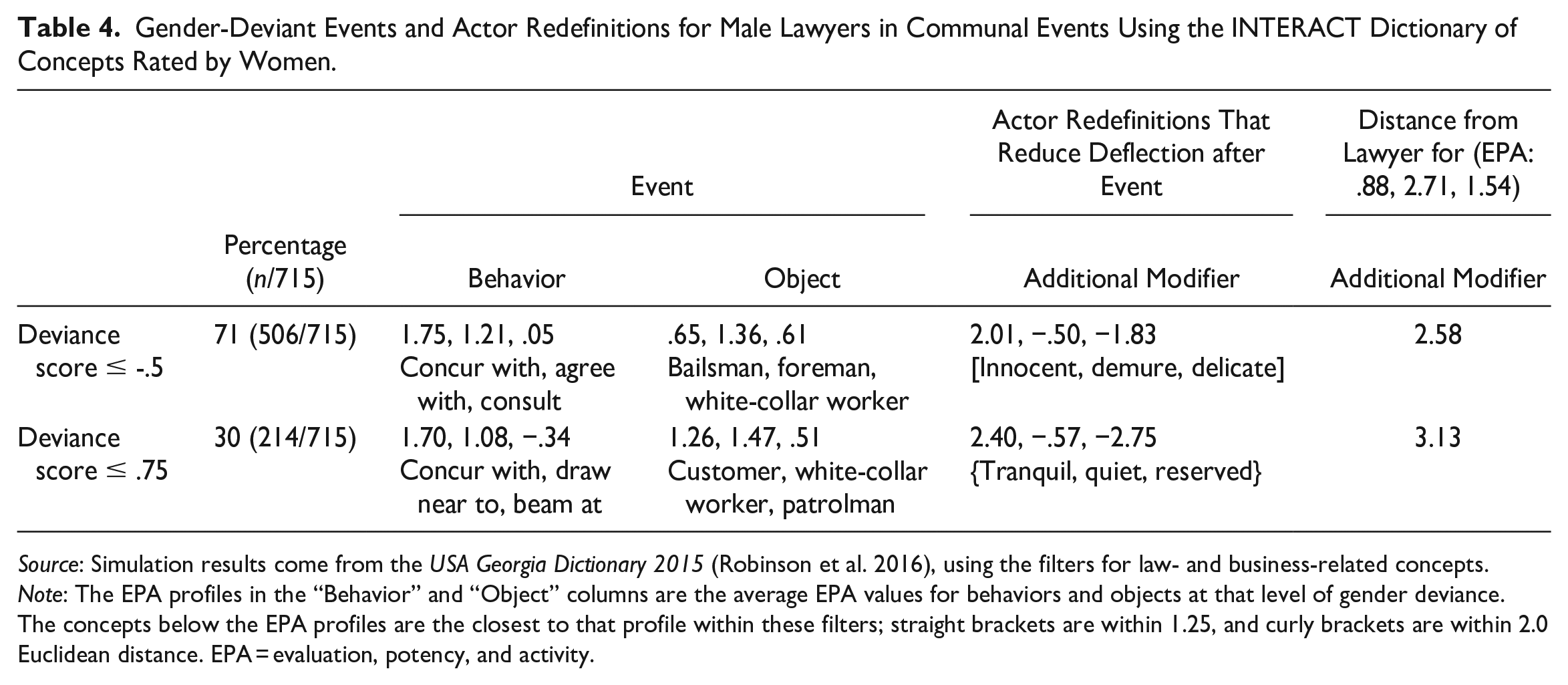
Source: Simulation results come from the USA Georgia Dictionary 2015 (Robinson et al. 2016), using the filters for law- and business-related concepts.
Note: The EPA profiles in the “Behavior” and “Object” columns are the average EPA values for behaviors and objects at that level of gender deviance. The concepts below the EPA profiles are the closest to that profile within these filters; straight brackets are within 1.25, and curly brackets are within 2.0 Euclidean distance. EPA = evaluation, potency, and activity.
Again, the columns underneath the event show the mean EPA profiles for the behaviors and objects at that level of gender deviance. Interestingly, there is overlap between the objects within gender-deviant events for men in communal behaviors and those within gender-deviant events for women in adversarial behaviors.
Because these events do not include a previously modified actor identity, I only investigate changes using an additional modifier. This is shown in the penultimate section of Table 4. As can be seen below the EPA profile, there are no modifiers in the dictionary within one Euclidean distance; thus, the modifiers below are the closest available within the dictionary.
Finally, the last column shows the Euclidean distance from the newly modified identity to the identity “lawyer.” When attaching the modifier in −0.5 deviance, the identity is 1.68, 0.90, −0.07 (not shown in the table). This is 2.58 Euclidean units away from the original identity.
Summary
ACT proposes that when interactions do not match the cultural expectations that interactants will work to correct their perceptions of the situation (Heise 2007). Thus, when a man or woman lawyer acts in ways that are gender deviant, they may be reconceptualized by adding a modifier to their identity, such as “angry female lawyer,” or by replacing the initial modifier such as changing one from a “female lawyer” to an “angry lawyer.” These changes affect the sentiments that define the identity a person is enacting. When a woman lawyer performs an adversarial behavior that is contrary to her gendered identity, she loses the perception of being somewhat good and quite powerful and becomes quite bad and somewhat powerful. In doing so, she not only reduces her power but also loses the advantage that may be gained by having higher evaluation.
Women often experience positive assessments for acting in ways that are culturally understood to be nice or warm (Auspurg et al. 2017; Correll et al. 2020). By reconceptualizing women lawyers in ways that reduce their evaluation, they take away the advantage that may be gained by their perceived increase in goodness. Indeed, the words that describe the modifiers include bitchy, annoying, and indecent, all of which likely negatively affect how one is seen in the workplace. Not only are they reconceptualized with negative modifiers, but the new identities are further away from both “female lawyer” and “lawyer” in EPA space. These predictions point to the backlash women lawyers likely experience when behaving in ways that would be non-gender-deviant for their male colleagues and how they may be viewed as unprofessional despite attempting to play out their professional role (Flood 2013; Moss-Racusin and Rudman 2010).
Men lawyers, on the other hand, are predicted to experience gender deviance when enacting communal behaviors. In these instances, to bring their identity closer to cultural expectations they may be reconceptualized as significantly higher in evaluation but much lower in potency. Given that men do not receive the same positive judgments for higher evaluation behaviors as women (Correll et al. 2020), they may instead experience a penalty for acting in less dominant and powerful ways. Indeed, the modifiers that may be attached to the lawyer identity for men lawyers are indicative not of a high-powered profession but rather of one who is providing emotional labor.
This fits the pattern described in the literature that women feel that men should not act in communal ways, leading them to take on those behaviors. At the same time, they have internalized the cultural expectations that they ought not to enact adversarial behaviors (Correll et al. 2020; Heilman 2012).
Discussion
The aim of this research was to identify interactional mechanisms underlying gender gaps in the field of law. Although research has identified gaps that exist despite controlling for human capital variables and structural factors such as motherhood and practice settings (Dinovitzer et al. 2009b; Garth et al. 2017; Sterling et al. 2014), much of this work has focused on performance measures rather than the micro-level events and meanings that lawyers experience daily (Azmat and Ferrer 2017).
By drawing on ACT, I develop empirical hypotheses through simulations that illuminate interactional processes of gender deviance and differences in dimensions of power and goodness. Potency, or power, is related to masculinity, whereas evaluation, or goodness, is related to femininity (Kroska 2000, 2001, 2009; Langford and MacKinnon 2000). Although potency is often operationalized a form of competency in the workplace (MacKinnon 2015), evaluation has also been shown to be a strong predictor of deference (Freeland and Hoey 2018). Freeland and Harnois (2020) show that there is a relationship between potency and gender divides across occupations, but do not delve into within occupation comparisons. By investigating the root interactional mechanisms of gender disparities in law, I contribute both to social psychological and gender scholarship which seeks to understand and address these issues.
Cultural Differences in Identities
I first investigated the differences between the identities of “lawyer” and “female lawyer.” Given the salience of gender as an identity and status characteristic (Fisk and Ridgeway 2018; West and Zimmerman 1987), it is reasonable to assume that women who work as lawyers are labeled as such, while men are in expected roles and have no modification. Previous research has investigated similar phenomena in the field of business but have done so attaching a “male” modifier to the identity of “executive” (Kroska and Cason 2019). In that work, the primary question of interest was the Euclidean distance from the nonmodified identity. Instead, I look at three differences between “female lawyer” and “lawyer” to understand how these identities differ.
Across all eight lawyer identities in the INTERACT dictionary, when the “female” modifier is attached, the potency of that identity decreases while the evaluation increases. Additionally, woman lawyer identities are, on average, 0.79 Euclidean units away from the nonmodified identity. Affect control scholars have often understood potency to be not only a measure of power but also a way of conceptualizing the competence of an identity within the workplace (Cuddy, Fiske, and Glick 2007; Langford and MacKinnon 2000; MacKinnon 2015; Rogers, Schröder, and Scholl 2013). Thus, if an identity is tagged with a modifier that decreases its potency, those who enact that identity may be culturally understood to be less competent and thus enact behaviors matching that meaning. However, the added evaluation may provide some benefits to women lawyers as some research has shown that evaluation operates to increase deference in occupations (Freeland and Hoey 2018).
These differences across the eight identities suggest that women lawyers are culturally understood as less powerful but nicer than their male peers. However, the one place in which this pattern does not seem to hold occurs in the field of divorce law. This is notable because not only do female divorce lawyers maintain the same amount of potency, but they also have higher evaluation than male divorce lawyers. Given the nature of the type of law practiced, it may be that family law is understood to be more feminine and that women experience less deviance when enacting the role of divorce lawyer (Liefland 1986; Maiman et al. 1992; Raggio 1999). Indeed, this may also work against women rising in the field given that divorce law is often practiced in smaller firms (Maiman et al. 1992), and salary trends show that divorce lawyers make, on average, more than $40,000 less than the average lawyer’s salary (ABA 2022; ZipRecruiter 2023).
These findings mirror recent survey results that show that women lawyers perceive their role differently from men in the field. Indeed, 82 percent of women report being mistaken for lower level employees, and 53 percent report being denied or overlooked for advancement or promotion (ABA 2022). Although these cultural meanings offer clues into the ways that women lawyers are perceived by the colleagues and others in the field, perhaps more importantly, they form the basis for the interactional mechanisms that may shape everyday experience on the job.
Interactions and Gender Deviance in Law
By separating the everyday interactions that a lawyer might have into two typologies, I am able to explore not only the gender deviance that men and women lawyers experience in their roles, but also how that may affect their career prospects. In these simulations, when a woman lawyer enacts an adversarial behavior—a behavior expected of lawyers and higher in potency—57 percent of the time, she is predicted to experience gender deviance. On the other hand, when men lawyers enact behaviors within this category, they are never predicted to be gender deviant.
Because powerful behaviors are culturally understood to be contrary to what is expected of women lawyers, if they enact adversarial behaviors, these simulations suggest they will often be reconceptualized in negative ways and been seen as less like lawyers. On the other hand, when men lawyers enact communal behaviors, they are predicted to experience gender deviance and may be experience similar issues in how they are perceived.
When understanding the ways in which men and women interact in the workplace, sociologists have often understood women as handling the more emotional sides of jobs (Correll 2003; Hochschild 1979). Thus, it is unsurprising that men may face challenges when enacting communal behaviors and women when enacting adversarial ones. In previous studies of workplace evaluations, men are given preference when they exert power and take leadership roles and are penalized for enacting more feminine caring roles (Brewer et al. 2020; Correll et al. 2020). With these expectations, it follows that men lawyers may be less apt to enact behaviors that are perceived as feminine when they are already interacting within a masculine-coded space. Thus, gender deviance may act in two ways. On one hand, women lawyers face backlash and being seen negatively when enacting adversarial behaviors, and on the other hand men who enact communal behaviors are either seen as weak or my overcompensate in future interactions to reassert their gender meanings and dominance (Willer et al. 2013).
Conclusions
The findings laid out through these empirically derived hypotheses point to an interactional pattern that acts to maintain the gender gaps in leadership and salary in the field of law. Although the proportion of women lawyers has grown, and likely will continue to grow, in recent years (ABA 2022), large gaps persist in equity partnerships, salary, and measures of competency (Azmat and Ferrer 2017; Dinovitzer et al. 2009a). By using ACT to simulate more than 2,000 interactional events that a lawyer may experience in each day, I show that cultural meanings likely act to reinforce gender status hierarchies and maintain gender gaps in the field. This helps illuminate a pattern that has been shown on the structural level with micro-level results. The patterns in these simulations suggest that women lawyers likely face daily struggles when playing out their role as lawyers. In this process, they may not be taken seriously by their colleagues and passed over for promotions, and they may perceive their own behaviors to be contrary to their role affecting their desire to remain in the profession.
Although these data simulate interactional-level events, they also reflect the broader issue that the legal field exists within masculine institutions. The simulations and the cultural meanings they reflect offer clues as to why the gender hierarchy has remained so steadfast in the field, but they are just one piece of the puzzle. As ACT scholars have noted, cultural meanings affect not only identities, but also the institutions and settings in which people interact (MacKinnon and Heise 2010). Thus, we can apply these models of gender deviance to understandings of the ways that these legal institutions shape interactions. This suggests that to effect change in the field, the meanings of the institution writ large must change as much as those of the identities that lawyers enact.
Limitations and Future Research
Although this work advances understandings of gender gaps in the field, it draws on a specific dataset that may not perfectly illuminate the cultural meanings within the field. As ACT advances, researchers may get more precise in measuring subcultural understandings of affective meanings. To do so, future research may be able to collect affective meanings from those in the field to understand the subcultural meanings. This would allow more precise simulations, which could then be tested using experiments and vignettes.
Future research may also be able to disentangle the multiple levels of identity that may operate to modify the lawyer identity. Past studies have drawn conclusions that the criminal and civil justice system and the institution of law give preference to white men and continue to reify systemic racism through their processes and interactions (Alexander 2010; Najdowski and Stevenson 2022). Future work can work to illuminate this by investigating the intersectional nature of the woman lawyer identity and start to disentangle experiences of people from a variety of backgrounds, including people of color, those from low-income backgrounds, and other minoritized groups.
Finally, this area of research offers opportunities for future researchers to test these hypotheses and combine social psychological theories toward a greater understanding of these differential gender effects. Research in expectation states theories has explored a variety of ways in which gender discrimination operates in the workplace (see, e.g., Auspurg et al. 2017; Correll 2001; Thébaud 2015) and may provide a new lens through which to conduct experiments using cultural sentiments. By looking to a combination of theoretical approaches, social psychology can begin to break down the interactional factors that play into the broader structural challenges women face in the field of law and other male-dominated professions.
Footnotes
Acknowledgements
I would like to thank Amy Kroska and the Fields-Huft lab for their valuable comments throughout the process.
