



Abstract
The Troubles in Northern Ireland ranks among the most violent periods in recent history. While social movements scholars have long sought to understand the conflict, often they do not include micro-level approaches. We use affect control theory and cultural meanings among Catholics gathered at the height of The Troubles to create prototypical group members and then simulate interactions across and between groups. Using cultural meanings gathered at a Catholic high school in Belfast in 1977, we find that Catholic (in-group) identities hold more positive meanings than Protestant identities. This remains true for identities within the paramilitary organizations and non-combatant identities. However, we find that the meanings of combatant identities are much lower in evaluation—a measure of goodness—than non-combatant identities. Our simulations suggest that interactions between groups are expected to be relatively innocuous. However, we do find that, in simulations, combatants—on both sides of the conflict—are expected to interact negatively with others. These findings and the methods we use suggest future avenues for both researchers and policymakers to better understand conflict and peacemaking.
Keywords
On July 21, 1972, explosions tore through the city of Belfast. Twenty-two bombs placed throughout the busy city center detonated in the span of just 75 minutes. Nine people were killed and roughly 130 others were seriously injured on what became known as Bloody Friday (Melaugh 2013). This is just one example of the violence in Northern Ireland during the period known as The Troubles (Keefe 2020; White 2017). From 1969 until 1998, over 3,500 people were killed and over 47,500 people were injured during the conflict (Melaugh 2013). Paramilitary organizations, including the Provisional IRA (Provos) and Official IRA on the Nationalist/Catholic side, and the Ulster Volunteer Force and Ulster Defence Association on the Loyalist/Unionist/Protestant side, 1 accounted for the vast majority of the casualties. In 1998, the Good Friday Agreement brokered peace between warring factions, and violence dropped dramatically.
Governments and organizations have used various strategies to try to fully extinguish violence, including more equitable redistributions of wealth (Krieger and Meierrieks 2019), power-sharing amongst sectarian groups (Rizkallah 2017), and either increased integration or assimilation (Bollens 2018; Nagle 2016). However, these strategies fail to adequately incorporate the role of identities and emotions as drivers of behavior. As such, we suggest drawing on affect control theory (ACT), a micro-level social psychological theory, to offer insights into the nature of the conflict in Northern Ireland as an example of how it may be applied to other conflict zones.
ACT offers a way to predict affective responses that individuals may have to various social events. Drawing on cultural meanings, ACT’s impression-formation equations predict how persons might act or feel in a given situation (Heise 2007). Researchers use dictionaries of affective meaning to simulate social events. Because cultural sentiments vary across time and place, we use a dictionary created at the height of The Troubles to explore the cultural meanings and predicted responses to social situations for those living through The Troubles.
In 1977, researchers gathered data at a high school in a Catholic area of Belfast to create a dictionary of affective meanings (Willigan and Heise 2006). This dictionary offers a novel way to understand how Catholics in Northern Ireland perceived identities and to predict how cross-cultural interactions may have been perceived. We use this dictionary to simulate interactions between and among groups to better understand the conflict in Northern Ireland. In particular, we seek to understand how cultural meanings of in-groups and out-groups affect perceptions of the conflict. More broadly, we believe our findings allow us to offer a method of understanding conflict in other areas with an ongoing legacy of group conflict, such as Palestine and Israel, Russia and Ukraine, and various Shia and Sunni conflicts throughout the world (Bollens 2018).
Background
The Troubles
The Troubles represented a complex interaction of sectarian paramilitary organizations on both the nationalist/Catholic and loyalist/unionist/Protestant sides as well as British state forces in the form of the British Army and the Royal Ulster Constabulary—the police force in Northern Ireland at the time (Collins 1998; English 2004; Keefe 2020; McGlinchey 2019; White 2017). In total, over 3,700 people were killed—both by paramilitary organizations and state forces—with more than 47,500 people, or over 3 percent of the population, injured because of the conflict (McKittrick et al. 1999). Pipe bombs, shootings, and arson were commonplace throughout major cities, with young people bearing the brunt of the conflict (Fay, Morrissey, and Smyth 1999). After several failed attempts at peace agreements, including an IRA ceasefire in the mid-1970s and attempts at a devolved government in the 1980s, the Good Friday Agreement was signed by both sides (Nagle 2018).
While there has been a great deal of research into understanding both the conflict and resolution, few studies have addressed the conflict from the perspective of identities and interactions. Rather, much of the work has explored The Troubles through a lens of economics (Browne and Asprooth-Jackson 2019), peace and conflict studies (Moeschberger et al. 2005), political science (Cunningham and Gregory 2014), and social movements.
Social movement scholars have long explored the ways that groups in Northern Ireland have perpetrated violence, pushed for civil rights, and challenged each other through politics, division, and identity (Bosi and De Fazio 2017). Research in this area has explored The Troubles primarily through a resource mobilization lens (Bosi 2008; Conroy 1995; McCarthy and Zald 1977; White and Demirel-Pegg 2017). Scholarship in this arena is uniquely situated to understand the macro-level and meso-level forces that act to drive collective behavior and action. However, as others have noted, issues of identity are crucial to understand the ways that individuals experience civil upheaval like The Troubles (Browne and Asprooth-Jackson 2019; Moss and Snow 2016; White 2010). We now turn to social psychological theories that may help to augment social movement research.
Sociological social psychology emphasizes individual and group emotions, perceptions, and behaviors. In particular, affect control theory offers a way of understanding perceptions of events through the lens of maintaining culturally held meanings about identities (Heise 2010; Robinson and Smith-Lovin 2018). We suggest that a sociological social psychological lens attuned to micro-level interactions offers a novel way to understand this conflict and may be applied to other similar conflicts.
Social Psychological Theories
Studies that have drawn on data from Northern Ireland suggest a complicated dynamic across identities (White 2010). While some studies—and indeed, most reporting on the conflict—have suggested that religious and national identities are important and salient for individuals in Northern Ireland, others suggest the opposite (Bosi and De Fazio 2017; Cassidy and Trew 1998; Nagle 2016; Smith and Cairns 1983; Trew and Benson 1996). Thus, it remains crucially important to investigate the ways in which individuals may interact when they do enact a religious or national identity—or some combination therein.
Affect control theory (ACT) is well situated to augment social movement research. As Jasper (2017) suggests, research in this area must include both the structural and individual level. We suggest that ACT can address gaps in theory and research in social movements in three ways. (1) It operationalizes variables reliably and consistently. (2) It incorporates data at the cultural level, linking together micro-level and macro-level explanations for affective response and behaviors. (3) It offers a way to empirically predict how identity meanings operate in social events. We use a framework from ACT to explore how emotions, perceptions of selves and others, and other relational dynamics predict barriers and resistance to peace in Northern Ireland at the height of The Troubles and may offer tools for understanding on-going conflicts. This work combines theoretical approaches to offer a novel method of understanding conflict drawing on historical cultural meanings.
Affect Control Theory
Affect control theory proposes that all social concepts—identities, behaviors, settings, and emotions—have somewhat fixed affective meanings. The meanings, or fundamental sentiments, are defined by three universal dimensions drawn from Osgood and colleagues’ research (Osgood, May, and Miron 1975): evaluation, potency, and activity (EPA). Evaluation is an understanding of goodness, potency of strength, and activity of activeness of a social concept. These have been measured using semantic differential scales, and research shows that EPA dimensions can adequately assess affective assessments with a moderate–high degree of reliability (Heise 2010; Osgood et al. 1975; Robinson and Smith-Lovin 2018). EPA ratings have been collected for many concepts in several cultures throughout the past several decades. These ratings are compiled and stored in what ACT researchers refer to as “dictionaries” which are stored online at affectcontroltheory.org.
The key propositions in ACT predict that individuals seek consistency in perceptions of events along these dimensions. The theory proposes that in every interactional event, individuals seek to confirm the fundamental sentiments that are evoked through their perceptions and understandings of the situation. Thus, in every situation, individuals seek to understand events such that they can confirm and maintain the preexisting, or fundamental, meanings of the actor, their interactional partners, the situation, and other social situations.
Affect control theory’s empirically derived impression-formation equations are used to predict how an observer sees the actors, objects (recipients of social behaviors), and behaviors in a social situation. These are understood as actor (A), behavior (B), object (O) events, or ABO events. In each ABO event, the observer experiences transient impressions of the actor and object. When these impressions do not match the fundamental sentiments of those identities, the observer experiences deflection (Heise 2007).
Deflection scores are operationalized as the sum of squared Euclidean distances between the expected fundamental sentiments and the situational transient impression created by an event. That is the three-dimensional distance between the EPA profiles of the fundamental sentiments of the actor, behavior, and object and the EPA profiles of the transient impressions of each. Higher scores indicate that a social event is more culturally unexpected while lower scores indicate that a social event is closer to confirming fundamental sentiments. When a deflection score is higher, interactants are expected to work to bring their situational impressions in line with their fundamental sentiments. They may redefine identities, objects, or settings or they may behave in ways which will reduce the deflection (Heise 2007; Smith-Lovin 1987).
The impression-formation equations are housed in the computer program INTERACT (Heise 2013). Using this program, researchers can run simulations of ABO events to predict affective responses. It can also be used to predict the ideal behavior between an actor and object that would minimize deflection (Heise 2013).
Current Work
In this study, we suggest a new method of understanding the social psychological processes occurring during The Troubles. We use primary data to investigate the meanings that Catholics ascribed to various identities at the time. By using this ACT dictionary, we note differences between both specific identities and groups of identities. We then generate empirical predictions of how Catholics may have perceived groups in the conflict. While we draw on the empirical predictions from ACT, we extend the theory by creating identity combinations to model the behaviors that would generate the least deflection if enacted by a prototypical group member.
Generally, Catholics and Protestants in Northern Ireland held negative feelings toward each other (Devine-Wright 2001; Leahy 2019). Social psychologists argue that these group identities—pitted against one another by policy, law, and cultural forces—have negative interactions with one another (Ferguson and McKeown 2016; Hargie et al. 2008; Livingstone and Haslam 2008). In trying to maintain positive identities of their in-group, both Protestants and Catholics may have thought more negatively of the out-group. Given the frequency of daily interactions—Belfast had a population in the 1970s of about 500,000, a size about 1/10 that of Los Angeles—there was likely a proliferation of intergroup interactions. This would create significant opportunities for conflict.
We use the EPA profiles of identity groups to explore the ways that Catholics perceived both in- and out-group members during the conflict. Through this micro-level exploration, we suggest that the ways that group members are perceived may offer insights into some of the factors that have led the conflict to persist.
Meanings offer one insight into the conflict, but to gain a better understanding of potential barriers to peace, we explore the predicted behaviors between and among groups. While ACT is a theory of identity and is generally applied at the interactional level between identities, by combining like identities, we offer a picture of how groups may behave. Given the nature of the conflict, some may suspect intragroup interactions (Catholic × Catholic or Protestant × Protestant) may be more positive than intergroup interactions (Catholic × Protestant) (Ferguson and McKeown 2016; Hargie et al. 2008; Livingstone and Haslam 2008). However, because we expect the meanings of Protestant identities to be lower in evaluation, we expect that ACT’s impression-formation equations will likely predict more negative behaviors than Catholics regardless of the object of their behavior.
Methods
ACT Dictionary Data
Following in the tradition of other ACT researchers, we use the computer program INTERACT to perform simulations of interactions (see, for example, Boyle 2023; Fields 2023; Heise 2007; Kroska and Cason 2019). We use the 1977 Northern Ireland (Belfast) dictionary (Willigan and Heise 2006). This dictionary provides a novel way of understanding the conflict through ACT. The data were collected during the height of the Troubles in a predominantly Catholic area of Belfast. Researchers measured the cultural sentiments amongst 319 teenagers at a Catholic high school. These cultural sentiments are measured using the stem “a [identity, behavior, modifier] is,” for example, “a Catholic is.” EPA ratings were created by measuring respondents’ assessments of identities and behaviors along the three affective dimensions of evaluation, potency, and activity. Each dimension is measured using a semantic differentially ranging from −4.3 to 4.32 where lower numbers represent bad, powerless, and inactive and higher number represent good, powerful, and active (Heise 2010). This dictionary consists of EPA profiles of 528 identities and 498 behaviors.
Teenagers at this time are ideal cultural informants. Because of their age, they are less likely to have been directly involved in the conflict (Gill and Horgan 2013). However, given the ubiquitous nature of the conflict, they are acutely aware of the sentiments held by Catholics. Additionally, as students in Belfast, they are part of a minority religious group in a divided city which offers a perspective unique to this dictionary.
Additionally, this dictionary includes identities that are uniquely relevant to the time and place in which the data were collected. These include identities of Catholic combatants such as Provisional IRA member or Official IRA member and Protestant combatants such as UDA (Ulster Defence Association) member or UVF (Ulster Volunteer Force) member. As we discuss below, we draw on these identities to model interactions between members of Northern Irish society during the Troubles.
Combined Identities
We begin our analysis by categorizing identities in the dictionary which share similar cultural understandings. In this process, we distinguish between those identities that are specifically republican/nationalist/Catholic and specifically loyalist/unionist/Protestant. We draw on historical and qualitative studies of Northern Ireland (Ben-Porat 2006; Cairns et al. 1995; Keefe 2020; Moeschberger et al. 2005; Moloney 2010; Santino 2001; Tonge 2002) as well as research in peace and conflict resolution (e.g., Webel and Galtung 2007) in this iterative category-making process. We use 13 identities, including three non-combatant Catholic identities (Catholic, Irishman, and Jesuit); three combatant Catholic identities (Cumann Ban member, Official IRA member, and Provisional IRA member); two non-combatant nationalist/Catholic political identities (republican and nationalist); three non-combatant Protestant identities (Anglican, Loyalist, and Protestant); and two combatant Protestant identities (UDA member and UVF member).
We draw on these identities for several reasons. First, these represent the identities in the dictionary that can be clearly categorized and would have been common to members of the Northern Irish community in both conflict and peacebuilding activities. Second, we are interested in ways the members of the Northern Irish community would be predicted to behave (within the Catholic-rated dictionary), so we use these identities rather than any representing the British government or official state forces. While we acknowledge the role of the British government and army in The Troubles, we are particularly interested in the identities and interactional processes among those within Northern Irish communities.
Using these 13 identities, we performed three combination processes. We combined identities by using the mean of each dimension of meanings—evaluation, potency, and activity. In the first, we created two identity groups: Catholic and Protestant. We used eight identities to create a “Catholic Combination” identity and five identities to create a “Protestant Combination” identity.
We next divide the identities by both religion and category. Because we seek to understand how the predicted interactions between both everyday people and combatants may act to form barriers to peace, we aim to explore the fundamental sentiments of violent actors across sectarian lines. We divided the identities into four groups: non-combatant Catholic, combatant Catholic, non-combatant Protestant, and combatant Protestant.
Behavior Predictions
We use the computer program INTERACT to draw on ACT equations in predicting the most likely behaviors to occur with interactional pairs. We create a 4 × 4 model to predict behaviors between each of four groups: non-combatant Catholic, combatant Catholic, non-combatant Protestant, and combatant Protestant. ACT has been used to predict impressions from social events (e.g., Smith-Lovin 1987). That is, by simulating an event, we can use the impression-formation equations to predict affective responses in an ABO event. We use the 1978 US equations to predict the EPA sentiments for behaviors by factoring in the fundamental sentiments of the actors and objects in the interactions. These equations can be found in the INTERACT program as well as in previous ACT work 3 (Heise 2007). We performed the predictions for each interactional pair twice, once using data from male raters and once using data from female raters.
Analysis
We begin our analyses by comparing the differences in the EPA profiles of Catholic and Protestant identities. Through this process, we identify the ways in which Catholics understood the meanings of identities that could only be enacted by Catholics as opposed to those that could only be enacted by Protestants. Next, we investigate how these differences vary when considering the combatant status regardless of religion. That is, differences in the average EPA profile for identities enacted by members of paramilitary forces and the average EPA profile for non-combatant identities. Finally, we compare differences across the four identity groups: non-combatant Catholic, combatant Catholic, non-combatant Protestant, and combatant Protestant.
Because the dictionary is dichotomized by gender, we perform our analyses twice—once using the male-rated concepts and once using the female-rated concepts. Although gender is not central to our analyses, we perform these analyses separately by gender to investigate any possible gender differences. Past research has suggested that The Troubles represented a time of increased subordination of women (Sales 1997). Thus, we present both sets of results.
Results
Differences in Identity Groups
Combination Identities by Religion.
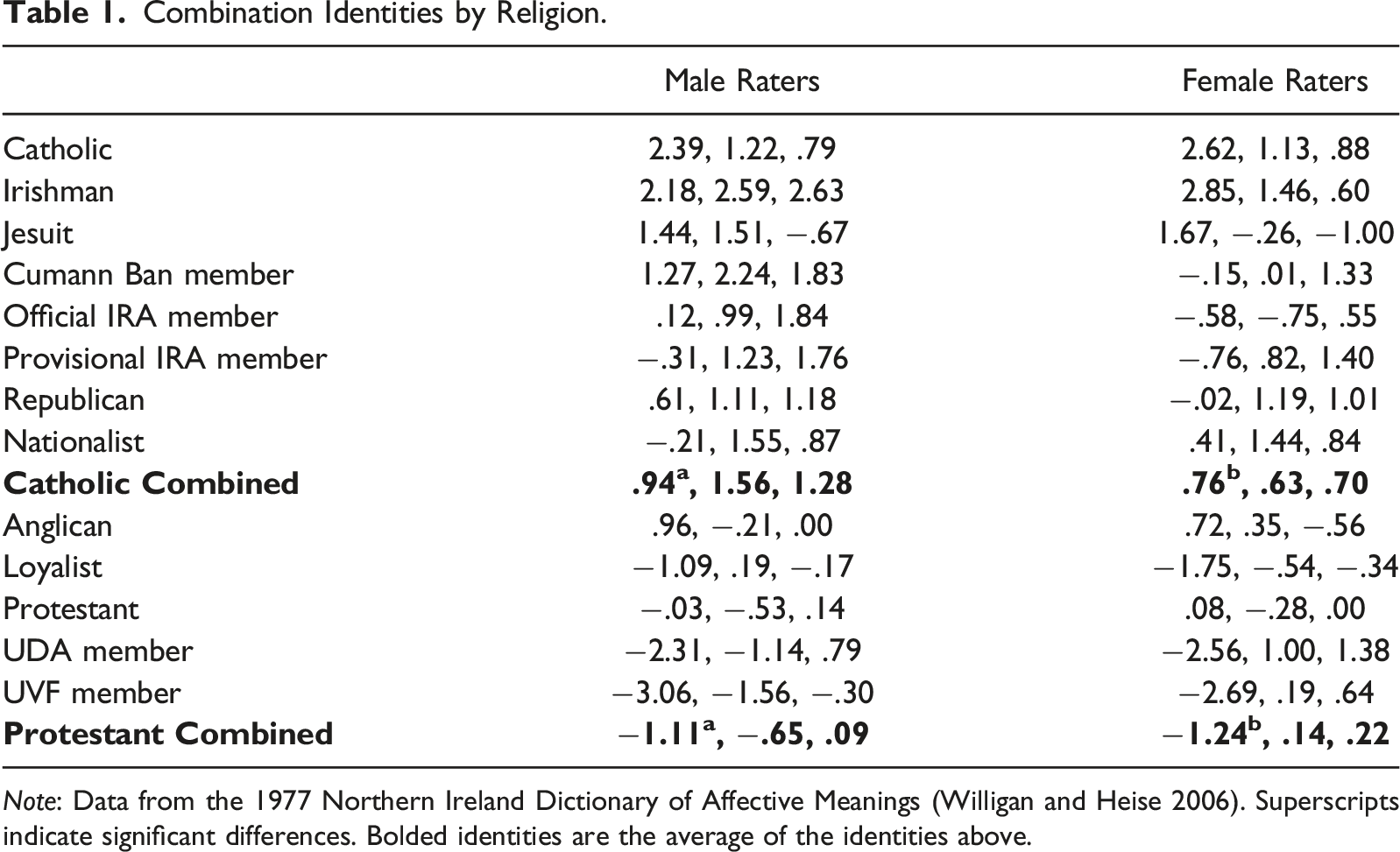
Note: Data from the 1977 Northern Ireland Dictionary of Affective Meanings (Willigan and Heise 2006). Superscripts indicate significant differences. Bolded identities are the average of the identities above.
Combination Identities by Combatant Status.
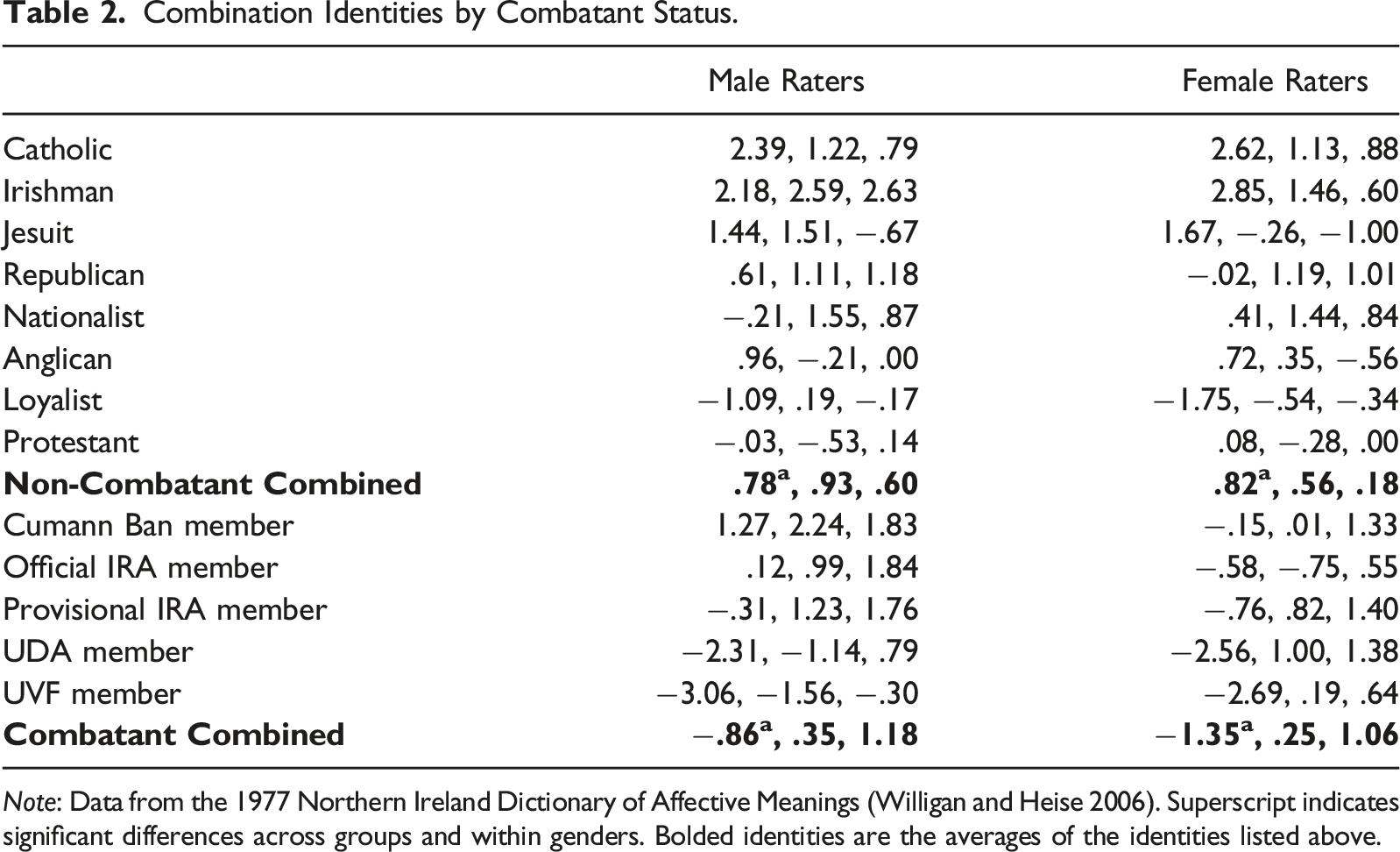
Note: Data from the 1977 Northern Ireland Dictionary of Affective Meanings (Willigan and Heise 2006). Superscript indicates significant differences across groups and within genders. Bolded identities are the averages of the identities listed above.
Combination Identities by Religion and Category.
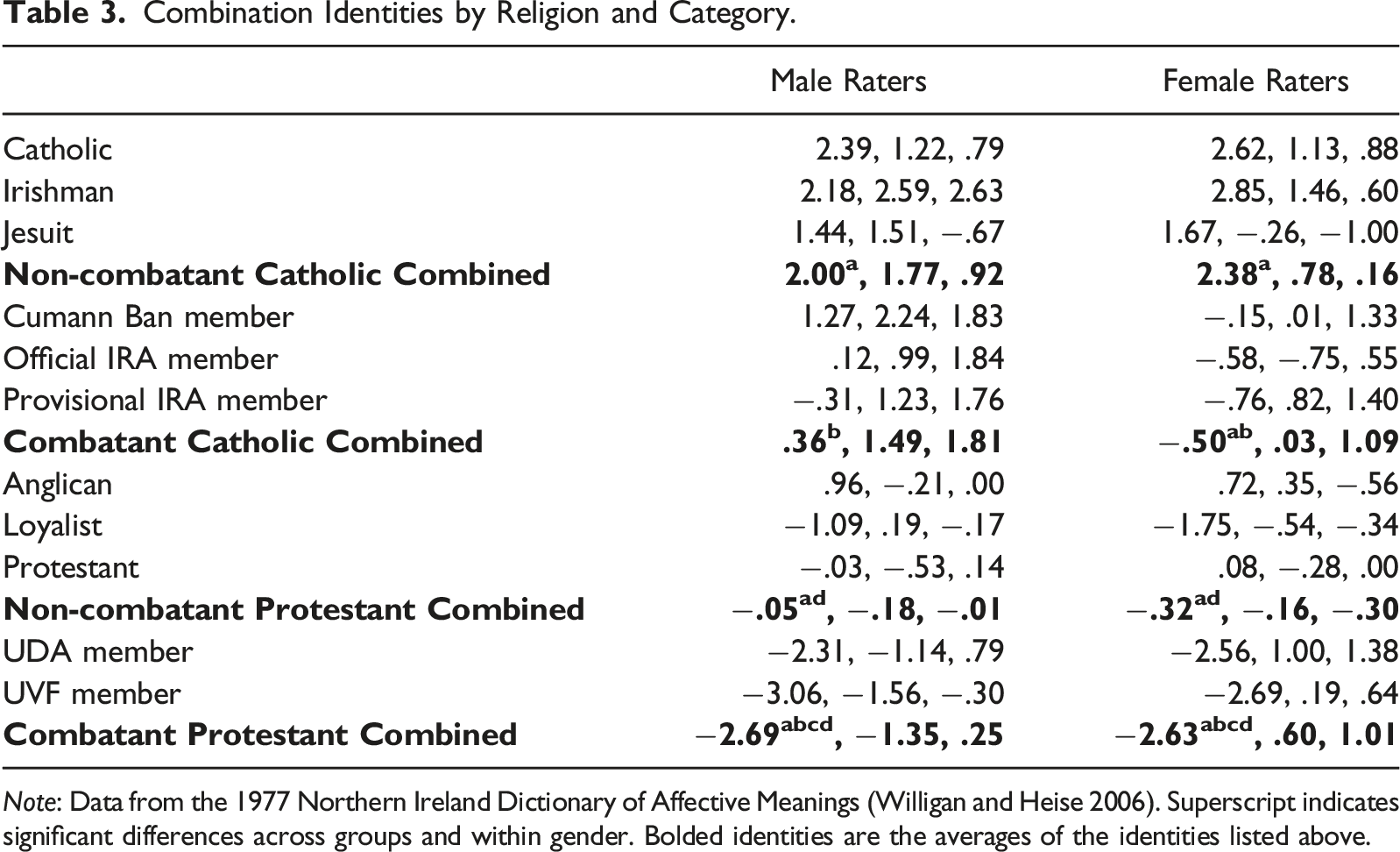
Note: Data from the 1977 Northern Ireland Dictionary of Affective Meanings (Willigan and Heise 2006). Superscript indicates significant differences across groups and within gender. Bolded identities are the averages of the identities listed above.
Behavioral Predictions
4 × 4 Event Matrix With Predicted Behaviors—Male-Rated Dictionary.
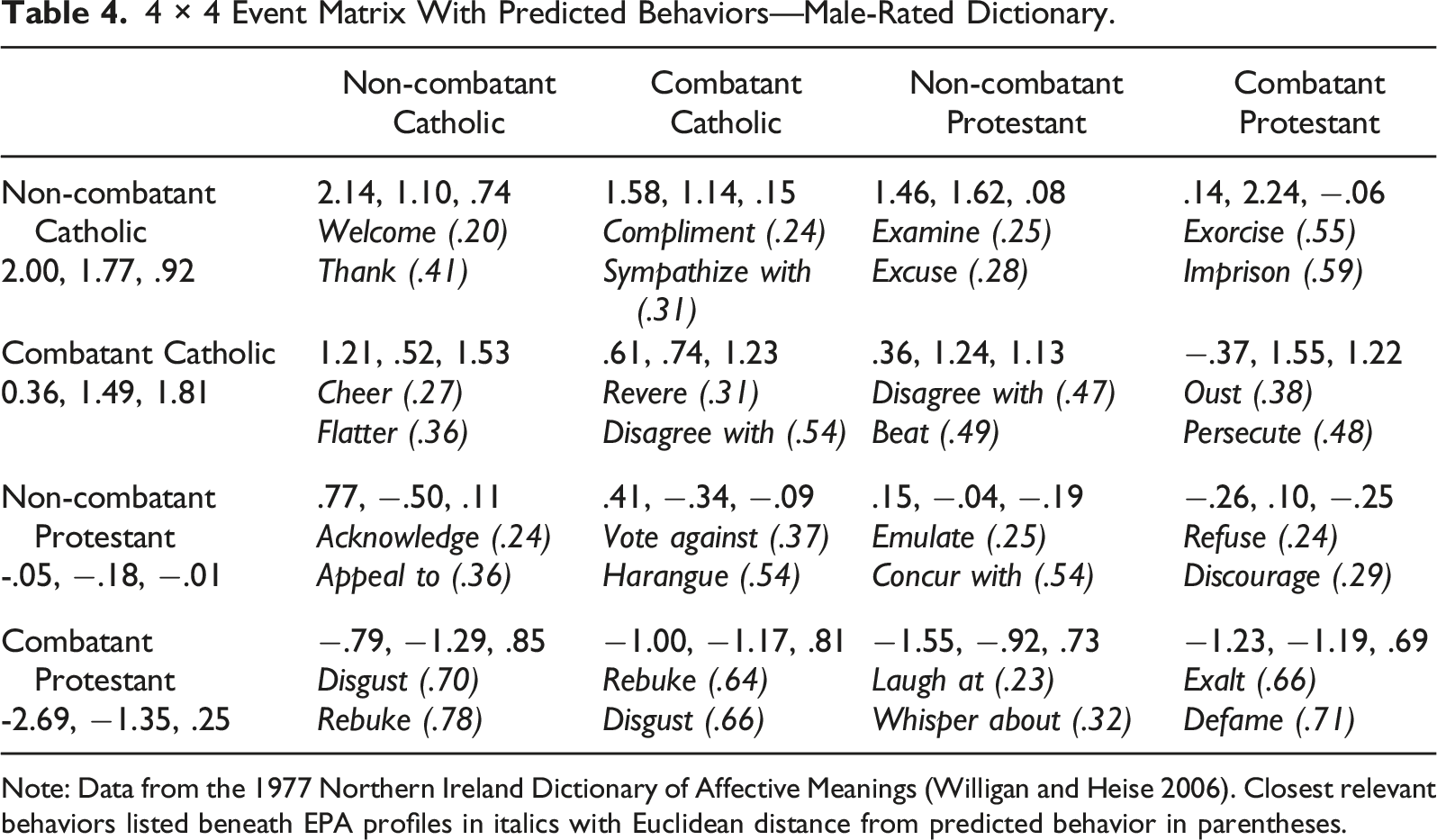
Note: Data from the 1977 Northern Ireland Dictionary of Affective Meanings (Willigan and Heise 2006). Closest relevant behaviors listed beneath EPA profiles in italics with Euclidean distance from predicted behavior in parentheses.
4 × 4 Event Matrix With Predicted Behaviors—Female-Rated Dictionary.
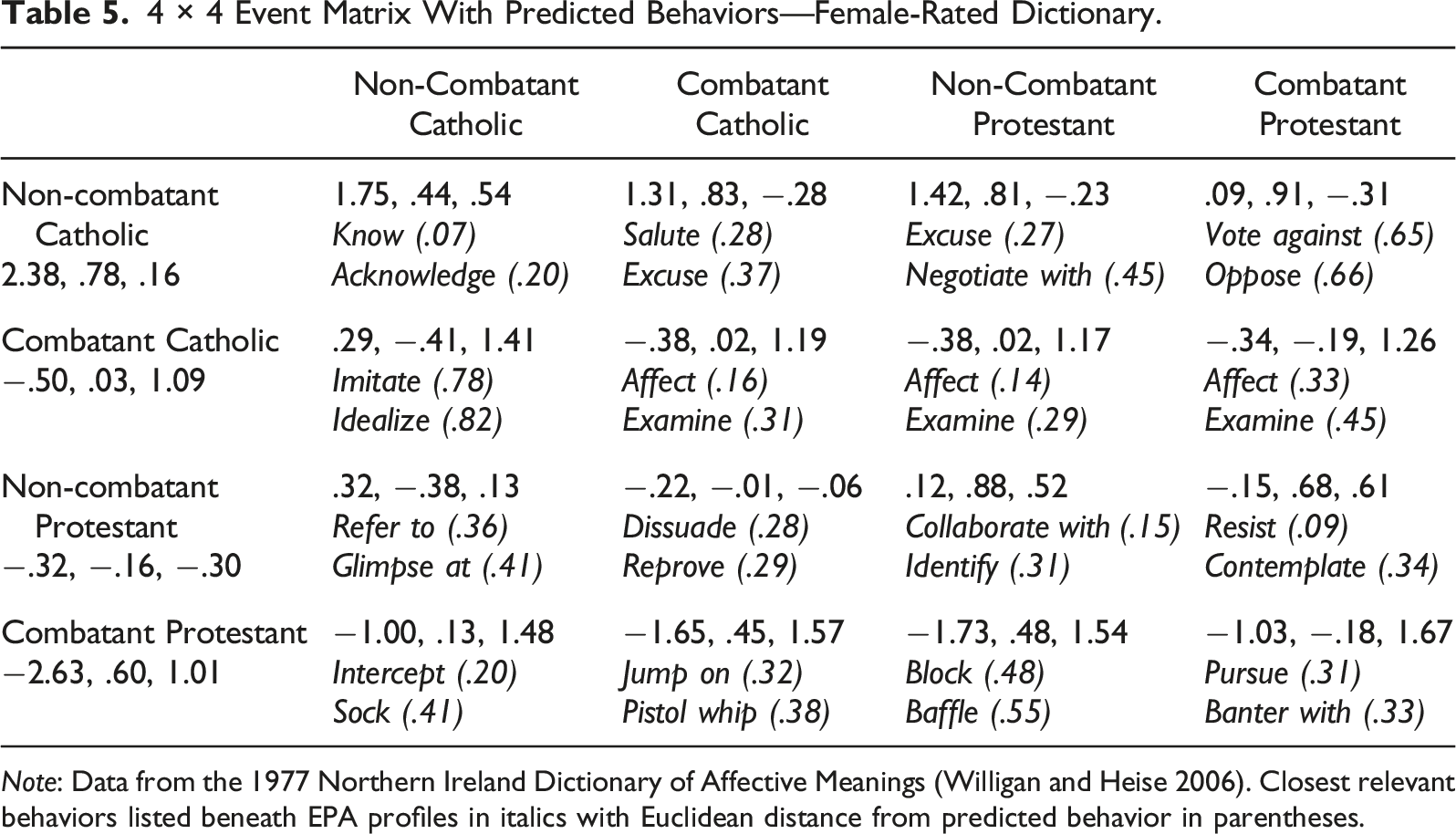
Note: Data from the 1977 Northern Ireland Dictionary of Affective Meanings (Willigan and Heise 2006). Closest relevant behaviors listed beneath EPA profiles in italics with Euclidean distance from predicted behavior in parentheses.
We use these data to investigate differences between simulated intragroup and intergroup interactions. In our study, this is represented by interactions between Catholics or between Protestants as opposed to interactions between Catholics and Protestants. While predicted behaviors between Catholics do have higher evaluation than those between Catholics and Protestants, this pattern does not necessarily hold true when looking at Protestant actors. The highest predicted evaluation of a behavior for both Protestant and combatant Protestant actors is when interacting with Catholics while the lowest is when interacting with other Protestants. There is slight variance between the male-rated dictionary and the female-rated dictionary, but the trend remains the same.
It is likely that these predictions are caused by the nature of ACT predictions. When predicting behaviors, ACT equations presuppose that actors seek to maintain not only their own fundamental sentiments but also those that they hold for the object of their behavior. Thus, when two negatively rated identities interact, the resulting behavior is necessarily negatively rated. This explains both the trend amongst positively evaluated actors—Catholics—and the lower evaluation of predicted behaviors for Protestants.
When examining the closest named behaviors in the EPA dictionary to the predicted EPA profiles in Tables 4 and 5, we see a pattern that reflects the positive nature of Catholics and negative nature of Protestants. In Catholic × Catholic events, we see positive behaviors such as “thank” or “compliment,” although these are less positive for combatants than non-combatants. Qualitatively, combatant Protestants are predicted to enact the least positive behaviors including “defame” and “pistol whip.” This pattern reflects our predictions that combatants may be the largest barrier to peace rather than those not involved in paramilitaries, offering hope for the future as the sectarian generation leaves power.
Summary
Overall, we find that the Catholic raters of the 1977 dictionary understood the fundamental sentiments of Catholic identities to be more positive than those of Protestant identities. Moreover, we find that those identities which relate directly to the conflict in the country are understood to be lower on evaluation than those that are neutral.
The simulated interactions between the four different identity groups we combined show a clear trend with more positive behaviors fitting interactions between Catholic actors and more negative behaviors predicted for interactions between Catholic and Protestants actors. By drawing on the closest behaviors to these EPA predictions, we also see a trend toward behaviors that would be contrary to peace in intergroup interactions.
Discussion
We set out to understand how affect control theory might offer a window into understanding the conflict in Northern Ireland and other persistent conflicts. In doing so, we proposed that the meanings of identities within and across groups offer insights into the ways that those living in conflict zones experience their social lives. This work offers new insights into the fields of both ACT and social movements by simulating interactions between groups and understanding the differences in how identities on the two sides were seen.
Through the identity groups that we created, we suggest a method for understanding how persons in conflict zones perceive those on both sides of the conflict. Using data from Catholic teenagers during The Troubles, we show that these raters perceived in-group members and non-combatant individuals to be higher in evaluation and potency than those on the other side of the conflict or engaging in combatant activities. It may be that some of these fundamental sentiments are driven through collective identities and the framing of social movement groups at the time—it is important to reiterate that these data were gathered at a Catholic high school in Belfast at the height of the conflict. This would fall in line with social movement scholars’ understandings of how a social movement like the republican movement in Ireland could lead to cultural understandings of different groups within the society (Polletta and Jasper 2001).
While for the most part male and female raters were aligned in how they ascribed meaning to these identities, there are differences in the ratings of Catholic combatants. This difference is driven by the ratings of Cumann Ban member—a female paramilitary organization. Female raters understood this identity to be lower in evaluation than do male raters. Indeed, it may be that the female raters understood this identity to be more combatant while the male raters understood it to be more feminine. This finding underscores the importance of gender as a salient identity and status characteristic and supports research showing the subordinate role of women in the conflict in Northern Ireland (Fisk and Ridgeway 2018; Sales 1997). This difference suggests that future research investigating these meanings may be able to parse gender differences offer greater insights into how gender affects the peacemaking process.
Our research suggests a model of investigating conflict zones through the affective meanings of those enmeshed in the conflict. In 1977 Belfast, it would have been impossible for teenagers to avoid The Troubles. The data and simulations suggest that combatants on both the Catholic and Protestant side were understood to be the primary drivers of the conflict rather than average Protestants. These simulations offer a new way of investigating the interactional drivers of conflict.
These findings suggest that we can use ACT to understand other divided societies. It may be that the general populace does not harbor animosity toward out-group members but are rather influenced by the cultural attitudes and actions of more radical sects within their communities. By using cultural meanings and impression-formation equations, we can predict affective response both across and within groups. As radical actors transition out of political spaces (such as the former IRA members retiring from their political positions in government), the possibility for more positive cultural sentiments—and thus more peaceful interactions—may emerge.
We have offered a new way of incorporating social psychology into studies of social movements and peace and reconciliation. By drawing on data of fundamental sentiments collected at the height of a conflict, we show that empirical predictions can offer insights into the identity-confirming behaviors of actors in conflict areas. Importantly, we also extend ACT by suggesting a way to understand group identities as a constellation of meanings rather than just one identity. Although this is just one small group of identities, we suggest that individuals may think of themselves as holding a group identity that is driven through multiple roles. That is, when enacting a role as a group member in a conflict area, it includes the meanings of a variety of roles. This creates a way of investigating the meanings of a more prototypical group member rather than a singular identity.
Future Directions
By collecting data in other conflict zones—such as Israel/Palestine—researchers may be able to apply similar approaches to understanding on-going conflicts. ACT offers a lens into understanding the interactional dynamics in these conflict areas and may give policymakers and peace advocates crucial insights into the perceptions of those living within these conflicted societies. Using ACT, future research may promote a micro-level method of ameliorating conflict from the level of meanings.
Footnotes
Acknowledgments
The authors would like to thank Amy Kroska and the UC Riverside Social Psychology Seminar for comments on drafts of this paper.
Declaration of conflicting interests
The author(s) declared no potential conflicts of interest with respect to the research, authorship, and/or publication of this article.
Funding
The author(s) received no financial support for the research, authorship, and/or publication of this article.
