




Abstract
Online enrollments in public universities have soared, in part because of universities’ increasing reliance on for-profit online program managers (OPMs) for everything from instructional design to student recruitment. However, scholarship has indicated that OPMs may play a role in producing predatory forms of inclusion in higher education for marginalized students. To identify mechanisms through which this might occur, the authors conduct a mixed-methods analysis of 161 contracts between OPMs and two- and four-year public universities, an original database of third-party financing structure, and university webpages. The analysis identifies several contract features—targeting, extraction, opacity, and captivity—that may help concentrate marginalized students in extractive or exploitative online programs at public universities. The authors also show that OPMs funded by private equity or venture capital are most likely to include contract features that incentivize aggressive revenue production and promote the recruitment of marginalized students in online, but not in-person, programs.
Online program managers (OPMs) are a relatively new phenomenon in higher education. OPMs provide nonprofit universities, both public and private, with a broad range of services from instructional design to marketing, student recruitment, curricular provision, operational assistance, technological platforms, and more. These companies are currently the modal mechanism for online education delivery in the public postsecondary sector, in which recent growth of online education is heavily concentrated (GAO 2022; Newton 2016). Yet research on OPMs is almost nonexistent.
The turn to OPMs reflects a larger trend of outsourcing university services to third-party, often for-profit providers (Connell 2019; Hamilton and Nielsen 2021; Wekullo 2017; Wycoff 2017). Public universities frequently enter public-private partnerships (P3s) with third-party providers for varied services, including grounds maintenance, housing, bookstore operations, food services, athletic facilities, custodial services, information technology, transportation, and parking (Hamilton and Nielsen 2021). Contracts with OPMs, however, are distinct in their centrality to the university’s primary function of education. They are particularly appealing to cash-strapped public universities seeking a way to quickly expand enrollment through increased capacity for online learning (Cheslock et al. 2021; Ortagus and Yang 2018).
These contracts highlight the growing role of corporate finance in the postsecondary sector (Eaton 2022; Mettler 2014; Newfield 2016). OPMs share similarities with third-party providers in other taxpayer-funded sectors, such as health care and public housing, in which for-profit providers may work against social equity, transparency, and affordability (Hacker 2002; Milward and Provan 2000; Morgan and Campbell 2011; Young and Chen 2020). In particular, companies funded by venture capital (VC) or private equity (PE) often center profit production over other organizational goals (Fligstein 1993; Lin and Neely 2020).
Recent research on online education also points to the importance of studying public university contracts with OPMs. Smith et al. (2023) showed that Black students and Pell Grant recipients are concentrated in online education and that studying online is associated with worse retention, completion, and student debt repayment outcomes relative to studying in-person. The magnitude of these associations is greatest at public nonprofits. Smith et al. concluded that, in the aggregate, online education is a form of “predatory inclusion” (Cottom 2020; Seamster and Charron-Chénier 2017), in which access is coupled with increased risks for marginalized students. They suggest that reliance on for-profit OPMs by public universities for online delivery may be driving the marginalized composition of the online student body and poor student outcomes.
We connect these lines of research through a multimethod analysis of 161 public university contracts with OPMs. Our focus is on understanding the potential mechanisms through which contracts with OPMs may support documented patterns of predatory inclusion in public online education. Specifically, we ask: What contract features may produce a concentration of marginalized students in online education and promote forms of student extraction or exploitation? Finally, a unique analysis of the third-party financing structure allows us to ask: Are contracts with OPMs funded by VC or PE more likely than other contracts to include potentially problematic features?
Outsourcing Online Education
Contracts with OPMs are a form of P3s, which involve outsourcing services typically provided by public institutions to for-profit providers. The turn toward P3s is not unique to higher education. The United States has long relied on private organizations for public social provision (Eaton and Weir 2015). Since their inception, Medicare and Medicaid have made payments to private providers, and after the 1980s, the federal government turned to private landlords, nonprofits, and vouchers to provide affordable housing (Erickson 2009; Morgan and Campbell 2011). State lawmakers increasingly depend on P3s to address crumbling public infrastructure (Hamilton and Nielsen 2021). On college campuses, P3s are best known as part of housing projects or other revenue-generating spaces, such as campus retail spaces, hotels, and parking garages (Carlson 2019; Hamilton and Nielsen 2021).
Following Cheslock et al. (2021), we define an OPM contract as one stipulating the “outsourcing of a suite of services that leads the external provider to participate in the management of the online program.” This definition encompasses any company involved in the development, marketing, delivery, and/or management of online programs. What is being outsourced matters. OPMs are unique among outsourcing companies in that they move core academic services, such as student recruitment, curricular development, and instruction, to third parties, rather than providing these services in-house. Learning management system providers such as Blackboard are not included in these analyses because they are not restricted to the management of online programs specifically and provide a wide array of services for in-person programs.
OPMs have played a critical role in the massive growth of online education at public universities. Since 2012, the first year that the Integrated Postsecondary Data System collected data on online enrollments, public universities have served more online students than either for-profit or nonprofit private universities (see Figure 1). Moreover, the public sector experienced greater year-by-year growth in online enrollments. By 2019, nearly 2 million students were enrolled exclusively online at public universities, significantly more than at for-profit and nonprofit private universities put together.
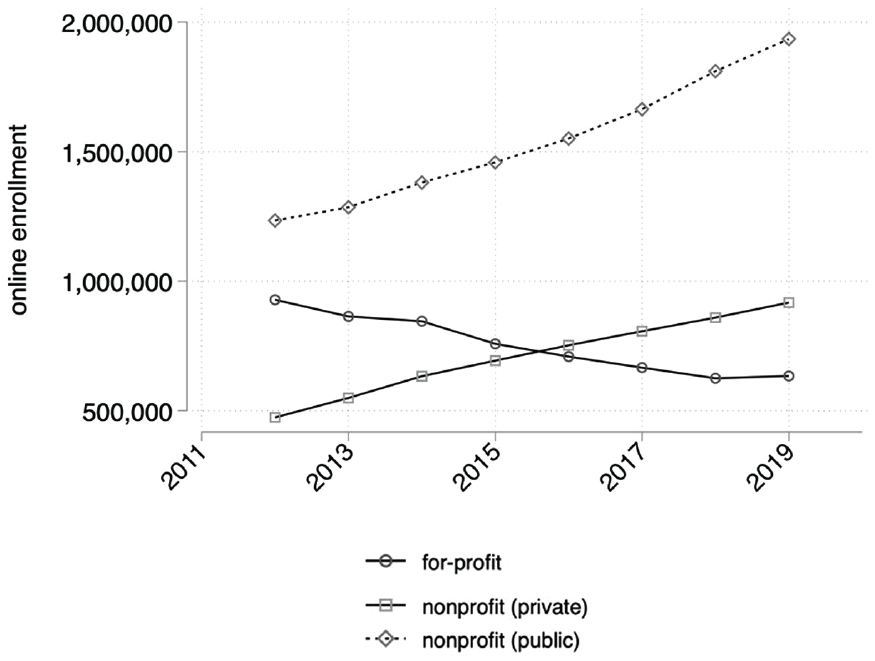
Number of Integrated Postsecondary Data System recorded undergraduate and graduate students enrolled exclusively in online education at two- and four-year institutions, 2012 to 2019.
Undergraduate enrollments make up the largest share of online enrollments. Third-party contracts for extension and continuing education programs have been central to boosting online undergraduate enrollment (Hall and Dudley 2019). At the graduate level, however, OPMs have made it relatively easy to add “self-funding” programs, particularly in teaching, health care, and technology. These degrees shift the cost of graduate education to students and their families (Pyne and Grodsky 2019).
Why have public universities partnered with OPMs? Public universities spent the 1990s and early 2000s grappling with how to incorporate new online technologies. Heavy state and federal subsidies that characterized the years between 1940 and 1980 had dwindled (Loss 2012; Stevens and Gebre-Medhin 2016). Leadership saw online education as critical to the financial future of their institutions (Allen and Seaman 2013). As Ortagus and Yang (2018) demonstrated, public universities responded to declines in state subsidies by increasing online enrollments. More students meant greater access to tuition and financial aid dollars.
Most schools, however, had little capacity to grow online infrastructure internally and looked to outsource online education to for-profit technology providers. Campus leaders were presented with the view that P3s could help solve a university’s financial and logistical challenges (e.g., see Carlson 2019). OPMs, especially those offering “bundled” services, could keep expenses low and stable for universities, while still promising revenue generation (Cheslock et al. 2021). OPMs also addressed the challenge of finding new students for online programs (Garrett, Legon, and Frederickson 2020) and tapped into the appeal of online education as revolutionary for postsecondary equity and access (Christensen and Eyring 2011; Meisenhelder 2013). The outreach aspect of online education meshed with public university missions of reaching marginalized, non-geographically mobile populations, and OPMs offered the fastest ticket into online education for most public schools.
In recent years, for-profit conversions have generated the largest OPM deals. Conversions occur when nonprofit universities purchase for-profit universities that then become OPM providers. For example, in 2018 Kaplan sold the institutional assets and operations of Kaplan University (for $1) to form Purdue Global, a nonprofit online university run by Purdue University. In 2019, Purdue Global entered a 30-year transitions and operations support agreement with Kaplan Higher Education, making it an OPM. With this deal, about 30,000 Kaplan students became students of OPM-managed Purdue Global.
Very limited scholarship examines potential benefits and risks of OPM contracts for universities. In a policy brief, Cheslock et al. (2021) provide a cogent analysis of the trade-offs universities make in these agreements: for example, schools lose the potential for higher long-term revenue when they contract out substantial aspects of an online program but effectively reduce costly initial investments. Universities may gain the convenience of a plug-and-play program but can lose control over how the program runs. Fully anticipating the costs of these partnerships upfront can be difficult, as Graham (2021) found by surveying postsecondary leaders at institutions with OPM contracts.
OPMs and Postsecondary Financialization
Research on P3s in other sectors emphasizes a core conflict: The bottom-line goal of for-profit partners is generally to produce revenue. This may contrast with the social welfare goals of public institutions (Kuang 2017; Morgan and Campbell 2011; Young and Chen 2020). P3s also tend to have low visibility to the public, limiting constituent involvement (Hacker 2002). In a review of the limited literature examining university outsourcing, Wekullo (2017) echoed these concerns. She argued that “over time, outsourcing may become expensive for both institutions and students because of the profit factors intrinsic within private enterprises” (p. 453).
University outsourcing to corporate partners has been supported by what Eaton et al. (2016) described as the “financialization” of higher education. Lin and Neely (2020) defined financialization, more broadly, as “the wide-ranging reversal of the role of finance from a secondary, supportive activity to a principal driver of the economy” (p. 178). Via PE and VC as new types of investment firms and techniques, financialization has capitalized new for-profit “intermediaries” like OPMs as partners for public universities to expand new, scalable business models.
VC and PE investments are forms of financing that allow investors to directly invest in or purchase companies. VC firms tend to be involved in smaller deals and earlier-stage companies, often in technology sectors, whereas PE firms invest in a broader range of mature companies, often in exchange for power over the direction of a company (Appelbaum and Batt 2014; Gompers and Lerner 2001). There is overlap, however, as the same firms sometimes operate leveraged buyout funds and venture funds. Although venture capitalists do not typically have controlling stakes in a company, they may sit on the boards of the companies in which they invest and influence company culture and decisions (Eaton 2022).
Research indicates that companies financed by VC or PE may be particularly prone to prioritizing profit (Eaton 2022; Eaton et al. 2016; Fligstein 1993; Fligstein and Goldstein 2015; Lin and Neely 2020). Not all for-profit providers, therefore, may introduce the same level of risk to students or universities. VC and PE may play a role in normalizing profit as a core goal, even in societal institutions such as public higher education that have not previously centered around financial markets (Eaton et al. 2016; Fligstein and Goldstein 2015; Lin and Neely 2020).
Mechanisms for Risk
Recently Smith et al. (2023) showed that Black and low-income students are disportionately represented in online programs. In addition, attending online is related to lower retention/graduation rates and less desirable student loan repayment outcomes across nonprofit and for-profit sectors; however, these patterns are particularly pronounced at public universities. The authors speculated that public university contracts with for-profit OPMs, which are often financed by PE and/or VC, may play a critical role in concentrating marginalized students in online programs with relatively poor outcomes, a form of “predatory inclusion.”
Seamster and Charron-Chénier (2017) argued that inclusion may be “predatory” if “members of a marginalized group are provided with access to a good, service, or opportunity from which they have historically been excluded but under conditions that jeopardize the benefits of access” (pp. 199–200). Charron-Chénier (2020:372) further clarified that predatory inclusion occurs when an “alternative provider” (such as an OPM) enters the market, “frames itself as expanding access to a valuable opportunity” but offers a product that “carries significant costs and risks” relative to that offered by traditional providers.
This study is not designed to determine if students at contracted schools experienced predatory inclusion. However, our analyses allow us to highlight features of OPM-university contracts that may amplify the risk for extractive forms of inclusion. We identify four key mechanisms—the targeting of marginalized students, revenue extraction, opacity in university-OPM relations, and university captivity.
As Cottom (2017, 2020) noted, digital platforms may target disadvantaged students and communities with the promise of access to historically exclusive institutions and spaces. OPMs may play an active role in recruiting marginalized student populations. Although expanding access to higher education may be viewed as a social good, it also generates profit by producing new tuition-paying consumers. Indeed, increases in online enrollments have been primarily a financial calculation for public universities seeking revenue diversification (Ortagus and Yang 2018) and financiers seeking new arenas for investment (Lin and Neely 2020). Third-party contracts may be potentially risky for students if they are aggressively pursued as candidates for universities’ online programs, but not corresponding in-person programs.
We also assess contracts for revenue extraction processes that increase the amount of profit going to for-profit providers, potentially at a cost to students. When present, these contract features incentivize for-profit providers to charge students and families as much as the market will bear. Contracts may also push universities to enroll as many students as possible, regardless of the university’s capacity to serve those students. The recruitment and revenue collection apparatus promised by OPMs can far exceed support for existing students.
When public services are outsourced, for-profit providers may avoid accountability by making financial operations less visible (Hacker 2002; Milward and Provan 2000). Thus, we consider the extent to which contracts introduce opacity in OPM-university relations, such that students enrolled at nonprofit universities may be unaware that third-party OPMs are providing their educational experiences. This is likely not coincidental: as an ed2go account activation form in circulation during the early 2000s stated, “EducationToGo courses will be delivered to your students as if your organization were actually providing the courses.” We expect that when opacity in OPM-university relations is present, OPM contracts may tilt toward exploitation as consumers can be actively misled.
Public universities seek OPM contracts to avoid upfront costs of online education and boost revenue (Cheslock et al. 2021). However, features of OPM contracts may increase university captivity. Universities may end up trapped in undesirable OPM contracts because of lost revenue, low enrollment in online programs, or, most relevant to the student experience, concerns about programming quality and student access to support. It may be difficult for university leaders focused on short-term needs to anticipate long-term problems. There are often only a few choices for certain third-party services (see Hill 2022). Companies may have considerable market power to set the terms of engagement. As Tomaskovic-Devey and Avent-Holt (2019) argued, “The less market competition in an industry, the greater the power to extract resources from both suppliers and customers” (p. 199).
In what follows, our qualitative analysis centers the terms of OPM contracts, assessing if, when, and in what ways these contracts may help concentrate marginalized students in programs that are extractive, exploitative, or not well designed to support their needs. Where possible, we conduct quantitative analyses to assess if the presence of PE or VC financing is linked to specific contract features. Our work explores the nature of third-party OPM contracts with universities and isolates types of contracts that may pose the greatest risks to students, families, and universities.
Data and Methods
This mixed-methods project relies on a database of 161 contracts between 80 unique third-party providers and 83 unique universities, which we merge with data we collected on OPM financing structure and data we collected through a content analysis of online education home pages. 1 Currently, this is the only existing database of its kind and provides a rare look at an understudied issue affecting almost every large state university and community college system in the United States.
Contracts were sampled through the systematic efforts of The Century Foundation (TCF), a nonprofit research organization. 2 In 2017, TCF issued state public records requests for a public flagship and a community college in each state. Other public schools were included by random selection. In 2019, TCF targeted the top 100 public colleges by distance education enrollment. In 2020, new requests were sent to schools from which TCF had received contracts in the past, and where the original contracts were at or near termination. Because TCF was monitoring OPM uptake related to the pandemic, they also sent requests to schools mentioned in the press as having established new online programs. The final sample thus includes contracts from most states, with two- and four-year schools of varying selectivity, and allows tracking contracts over time. We list the universities and contracts held with different providers in Table A1 in the Appendix.
Quantitative Coding
Table 1 details the quantitative variables systematically assessed of each contract. Although many of these deals involve multiple agreements over time, note that we treated all documentation related to a relationship between a university and a provider as a single entity.
Quantitative Variables Assessed in Online Program Manager (OPM) Contracts.

Basic features of contracts included the length of the contract, determined from the initial date of the first contract or amendment included in documents provided by the public records request process, to the latest end date. We also coded whether the contracted third party was a for-profit company; 93 percent of contracts are with for-profit companies. The contracts are with a wide variety of OPMs, including 2U, Academic Partnerships (AP), All Campus, ed2go, EducationDynamics, Trilogy, and many more. Four percent of contracts are with Coursera, a massive open online course (MOOC) that operates like an OPM. 3 The data also include two major for-profit to OPM conversions (the Kaplan-Purdue and Ashford/Zovio–University of Arizona deals).
Our coding for payment structure entails indicators for contracts in which third-party providers share a percentage of student tuition or fee revenue with the university. Seventy-eight contracts (48 percent) in the full database have this feature; however, we noticed a subset of contracts where third-party contract terms included a pricing scheme that did not share overall revenue; instead, they had a price structure per head or credit-hour (20 percent). A substantial number of contracts in our database (29 percent) do not engage in revenue sharing or have a price-per-head/price-per-credit-hour structure and are instead priced per service.
We also coded contracts for three services. The first is recruitment, which involved direct contact with prospective students on behalf of the university. Forty percent of contracts included recruitment services. We coded for the development of course or program materials by third-party providers (61 percent of contracts) and the provision of instructional services of some kind (e.g., a lecturer or teaching assistant) by the third-party provider. Thirty-three percent of contracts involve instructional services.
To assess the invisibility of the third-party provider’s partnership with a university, we examined the university website. Our goal was to ascertain if a potential student could reasonably encounter information about the partnership via webpage content. We examined websites only for partnerships that involved a revenue share structure, per student/credit hour pricing, or engaged third-party providers in recruitment, course development, or instructional provision. Finally, 24 percent of contracts include renewals or amendments for new or substantially expanded services beyond those in the initial contract. Thirty-five percent include autorenewal or indefinite clauses.
Qualitative Analysis
Because of the length of contracts and the frequency with which documents included security features that made them difficult to work with, we did not load them into qualitative data analysis software. Instead, we read through full documents to understand the context of language and changes within agreements over time.
The state public records request process can produce a wide array of documents. Some schools sent every draft, communication, and price sheet related to the third-party provider. In contrast, a smaller subset of contracts included redacted segments or only a price sheet. Others included unexpected items, such as unfiltered e-mails between university officials about third-party contracts and the exact copy of advertisements to be run by a third-party firm. Because of this variation, we were able to quantitatively code only the contract features above.
Authors first selected illustrative qualitative examples of the quantitative codes and compiled them into documents to be shared with team members. During weekly meetings, we discussed examples (which, in several cases, generated new ideas for quantitative coding). Our conversations eventually coalesced around contract features that may increase the likelihood of predatory inclusion in public online education, as suggested by Smith et al. (2023). These features include targeting, extraction, opacity, and captivity.
PE and VC Analysis
There are no existing data that detail PE and VC involvement in OPMs. As a result, we took several steps to produce our data on third-party financing. First, we conducted searches in the Thomson ONE and Preqin databases, which include details on PE and VC deals. We also used crunchbase.com and pitchbook.com, financial databases that provide information on companies’ investors and investments. Triangulating across four sources allowed greater coverage and confidence in our coding. Table A2 in the Appendix includes more details on third-party companies.
We determine if third-party financing structure is associated with a quantitative measure of each of the five potentially problematic features identified above. 4 We estimated linear probability models to assess if PE- or VC-funded third-party company contracts are more likely to: (1) include recruitment, (2) include a revenue-sharing structure, (3) demonstrate website invisibility, (4) expand over time, and (5) include an autorenewal or indefinite clause. We present our PE and VC analyses throughout the results.
Results
In what follows, we highlight four features that, when present in OPM agreements, may increase the risk for extractive or exploitative student experiences in online education. Table 2 provides an overview of these features, with examples found across multiple agreements. We systematically assess whether a PE or VC financing structure is associated with a key measure of each feature.
Predatory Mechanisms in OPM Partnerships with Public Universities.

Note: OPM = online program manager.
Targeting Marginalized Students
The recruitment efforts of OPMs do not mirror the demographics of in-person student programs. When populations are specified, contracts for OPM recruitment services almost uniformly focus on marginalized students. For example, the 30-year agreement between Purdue Global and PE-backed Kaplan states that the intent is to “create a new U.S. degree-granting online institution designed specifically to serve non-traditional students” and to “expand access to higher education for adult learner and other nontraditional students.” The University of Nebraska–Ranku agreement is explicit about the focal population, stating, “These students differ from on-campus students because they are mainly working adults, female, average age 34, and live within the state of Nebraska.” Other contracts use the word diverse, seemingly to signal nonwhite populations. For instance, the Louisiana State University (LSU) System–AP contract indicates “an overarching goal of expanding the reach of LSU to highly qualified students from diverse populations.”
We observed multiple examples of OPMs recruiting primarily nontraditional students. Companies often use targeted ads. For instance, the University of Massachusetts Online contract with geteducated.com, an advertising site that misleadingly touts itself as “America’s First Free Online Counseling Center,” included exact advertisement copy: Since 1971 thousands of adults living throughout the U.S. and internationally have been awarded bachelor’s degrees through the University Without Walls (UWW). UMass UWW is an academic major at the University of Massachusetts Amherst designed to help adults just like you to complete your first bachelor’s degree at a world-class public university. . . . We understand the real life challenges faced by adult students and are committed to providing you with outstanding one-on-one support and guidance from your first class through degree completion. You are not alone, we will be here to help, every step of the way. You deserve a degree completion program that respects your experience, supports you and your dreams, challenges you intellectually, and leads to a degree you can be proud of. You deserve UMass UWW.
This advertisement addresses potential concerns of nontraditional students, promising that UMass UWW is legitimate, compatible with work and family demands, and offers individualized support, while tapping into individual desires for status and mobility (Cottom 2017, 2020). Other ads appear targeted to nonwhite adult learners, as they are peppered with terms such as diversity, diverse, social justice, community, and urban populations.
As the National Center for Education Statistics (2021) states, nontraditional learners are more likely to belong to a racial-ethnic minority group, have parents with lower levels of education than traditional students, and struggle with completion. These students increase the pool of students on which universities draw, and online programs may provide access to students who would not attend otherwise. Providing access for marginalized students can be a positive social good. However, heavy recruitment in online programs often occurs separately from public universities’ more established in-person programs. Marginalized students are being targeted for admission to programs that, as we discuss later, frequently involve extraction, opacity, and university captivity. Recruitment tactics can also tip past gentle persuasion.
OPM companies frequently offer aggressive recruitment services that identify, market, and seek to actively “convert” working adults into paying students. Thus, alongside its ad campaign, the University of Massachusetts also contracted Education Dynamics for “prospecting services.” The company website promises to “Increase Enrollments. Reduce Costs. Achieve Your Goals,” with an “exclusive focus on adult and non-traditional students,” using “highly targeted mulit-channel [sic] marketing.” Channels include “DRTV [direct response TV advertising], SEO [search engine optimization], call center, paid search, display, e-mail, mobile, and social media.” Potential converts could be hit through multiple channels. The University of Texas System–AP agreement, which highlights the ability to recruit students “outside an institution’s traditional student base” is similarly expansive, including field recruiters, online marketing, social media marketing, and direct e-mail campaigns.
OPMs’ recruitment strategies may replicate or amplify existing concentrations of marginalized students in the online student population. A University of Nebraska contract provides an example, with Thruline Marketing using detailed “current student data [including name, e-mail, phone number, ZIP code, and program] for geography analysis and lookalike creation.” “Lookalike creation” leads marketing companies to target populations already disproportionately enrolled in online programs.
Contracts including bundled services frequently display an imbalance between OPM resources directed to recruitment versus services to support student success. The Southeastern Oklahoma State–AP contract offers an illustration. AP provides “enrollment specialist representatives” (ESRs) who serve as the “primary point of contact for all prospective Students for the Online Programs.” ESRs staff and equip a call center, work as a team to contact potential students, provide a toll-free number and website, inform students about programs, refer them to financial aid for processing, and of application support. ESRs, somewhat tellingly, also provide whatever support services exist for existing students. Of the nine lines of contract text devoted to student support, most of the “supports” are linked to revenue collection (e.g., reminding students of payment deadlines).
Some contracts explicitly target students who do not qualify for admission to other (often in-person) programs. The University of Texas at El Paso (UTEP)–Pearson contract notes that “UTEP agrees to provide Pearson with the following information for the purpose of promoting and marketing of the e-Learning Programs: Prospective students who applied for admission to UTEP but were not admitted.” These students, who are more likely to be nontraditional, are then routed into online programs. In this way, prospective student information is used for the production of OPM profit.
OPMs frequently build in provisions that allow them to “utilize the information of denied applicants” and approach “denied applicants with information on other educational opportunities” (Lamar University–AP). This information is of high value to OPMs, which must produce enrollments across agreements with multiple universities. In an unusual example, the University of California–Berkeley–2U contract even includes $4.2 million in financial “compensation” to Berkeley for such a provision: 2U can recruit students for lower ranked partner school Southern Methodist University, if the students are those whom Berkeley “reasonably predict[s] are not otherwise academically qualified” or appear to “have disengaged with 2U.” This approach to recruitment can become problematic if the programs to which marginalized students are channeled display potentially extractive features, an issue we turn to next.
Notably, OPMs are more likely to be involved in student recruitment when providers are PE- or VC-financed. As Table 3 suggests, contracts with PE- or VC-financed providers are 30 percentage points more likely to include recruitment as a service provided by the OPM (β = .31, p < .001). This is not surprising: the inclusion of recruitment in a contract allows OPMs to directly grow programs in ways that increase profit, which may especially motivate PE- and VC-backed OPMs. As documented above, OPMs create this growth by targeting marginalized students who are often not recruited for in-person admission.
Relationship between OPM Financing Structure and Partnership Features.

Note: Point estimates represent linear probability coefficients. Values in parentheses are standard errors. OPM = online program manager; PE = private equity; VC = venture capital.
p < 0.05. **p < 0.01. ***p < 0.001.
Revenue Extraction
We identified five different types of revenue extraction in third-party contracts that increase profit for OPMs. The most extractive of these is revenue share pricing. The revenue share payment structure allows OPMs to capture a percentage of overall tuition and fees (20 percent to 94 percent in our data), creating strong incentives to enroll more students and charge them a higher cost. By contrast, pricing per student or per credit hour ties the payment structure only to enrollment size; the OPM does not directly benefit from higher tuition. The least extractive financing structure, pricing per service, is linked to neither the amount charged nor enrollment and provides a useful counterexample.
As Cheslock et al. (2021) emphasized, under a revenue-sharing structure, both students and universities stand to lose: students may see higher prices and, overtime, net revenue for universities is much lower in a revenue-share agreement versus in-house or fee-for-service models. Table 3 indicates that contracts with PE- or VC-financed providers are a full 54 percentage points more likely to have an extractive revenue-sharing structure (β = .54, p < .001) and are less likely to have a per-head or per-service pricing structure.
Bundled (multiservice) contracts with OPMs can explicitly build in contract provisions that allow for-profit providers to play a role in setting cost. For instance, the Michigan State University (MSU)–Bisk contract states, “MSU, with the recommendation of Bisk based on market analysis, shall determine the tuition rates and other academic fees for the Offering.” Similarly, the UCLA Extension–Trilogy contract states, “The optimal price point for the PROGRAM will be determined by mutual agreement. . . . The Parties agree to raise the price point if and to the extent that market factors permit.”
In addition, aggressive enrollment growth plans work to extract greater revenue over time. For example, the Arizona State University (ASU)–Pearson contract aims for “ASU Online student growth of fifteen percent (15%) year-over-year, subject to [additional] specific enrollment goals set by the Governance Committee.” The “Governance Committee” has the authority to “forecast, target, and set new and returning enrollment goal numbers” for ASU Online, and it “consist[s] of an equal number of members representing each party.” Ocean Community College’s agreement with Pearson specifies annual growth rates between 13 percent and 25 percent, across five years. The LSU Shreveport–AP deal sets an “initial growth rate of doubling every year.” Notably, contracts do not specify parallel increases in student support to accommodate these proposed increases.
Another way that OPMs can ensure aggressive growth is to set university marketing requirements. This was common in ed2go contracts and Academic Partnership contracts but unusual among other providers. For instance, the Montgomery Community College–ed2go contract requires that the “Partner should offer at least seventy-five percent (75%) of Education to Go’s course catalog for a minimum of eight (8) months (sections) each year.” If these criteria are not met, “Education To Go may terminate this Agreement.”
Finally, contracts may specify additional fees for students. Most contracts do not include a detailed breakdown of student “fees” typically assessed through OPM contracts, making it difficult to determine how frequently this occurs. However, the Black Hawk College–ed2go contract offers details on fees. This contract postulates that “enrollees will incur an additional service charge when requesting the following services” at prices “subject to change.” The services include “Study Time Extension” ($75), “Replacement Course” ($165), “Replacement Textbook” (cost plus 15 percent), among others. Some of these fees are for services typically rendered by nonprofit colleges for free. Student fees, not just in this case, are sometimes paid directly by students to for-profit providers, allowing OPMs to produce revenue without working through university pay structures.
Opacity of OPM Involvement
We identified four examples of opacity in OPM involvement. First, we found that universities often fail to provide a transparent picture of the partnership on their webpages. Table 4 provides a summary of our analyses. We coded invisibility as a continuous variable, from category 1 (nowhere within the institution’s domain is the partnership or a specific service provided by the corporation mentioned) to category 5 (the institution explicitly mentions the partnership on the online program home page, in a way that gives a reasonably transparent picture of the extent of the partnership). Around a quarter of partnerships are coded as a 1 because they are not listed anywhere within the institution’s domain. In these cases, it is simply not feasible for potential students to locate information about the partnership.
Invisibility of Online Program Managers on the websites of Partner Institutions.

Note: 131 contracts that involved revenue share or per student pricing or used third-party providers for recruitment, course development, or instructional provision were included in these analyses.
Common examples of mentions in this category include news releases by the institution, privacy policy statements that detail how the corporation will use students’ data, and notes from meetings of administrators, board members, and/or faculty members.
Two-thirds of webpages list the partnership explicitly somewhere in the institution’s domain, in a reasonably transparent way, but the partnership is not mentioned on the online learning home page (category 3). In most of these cases, finding information about the OPM requires knowing that there is a partnership in place and searching for the for-profit provider’s name using the webpage search engine function. For instance, from Eastern Michigan University’s online education webpage, a search for “Academic Partnerships” leads to a story in the school newspaper, EMU Today (Larcom 2018). As the piece explains, the school faculty union filed a grievance asserting that the university had entered into the agreement “without appropriate input from the faculty in terms of curricular development, personnel, and instruction.”
In 9 percent of cases (categories 2 and 4), it was possible to find the provider on the online home page or the web domain but not to ascertain a transparent picture of the partnership. For instance, University of North Carolina’s (UNC) online home page names the partnership in small font at the bottom of the page, where it reads “2U, Our Program Partner,” but the home page does not illuminate how the partner is involved. 2U’s involvement is significant and includes course development, yet the home page does not clarify this, instead giving the impression that the university develops all curricula; for example, the page reads “UNC-Chapel Hill’s online programs and courses bring the advantages of a Carolina public education to engaged citizens” and “UNC-Chapel Hill’s online programs and curricula help you turn your academic and professional interests into enriching experiences at any stage of your career.”
We only found four cases, or three percent of the sample, in which the university explicitly mentioned the partnership on the online program home page in a way that was transparent and clear (category 5). For example, near the top of Truckee Community College’s online courses webpage, “EPIC Online Education Partners,” including ed2go, are introduced: “Take courses from some of the world’s best content experts through ed2go and ProTrain.” There is no ambiguity about who is providing the courses, and students are then directed to “view their [italics added] entire course catalogues.”
Website invisibility is not tied to PE or VC financing structure, as is indicated in Table 3. Here we code category 1 as “invisible,” and treat other categories as 0. Alternative specifications also show no difference in invisibility between contracts with OPMs financed by PE or VC and those not financed by PE or VC. This is not surprising, as the degree of third-party visibility in our analyses was low overall; partnerships with third-party providers, regardless of third-party financing, tend to be invisible. We suspect that this is because opacity may shield public universities and private providers from demands for transparency, access, and equity.
Outside of limited webpage visibility, contracts may allow the for-profit provider to use the university web domain. As a result, potential students cannot distinguish courses provided by the for-profit provider from those provided by the university via the web browser address. The University of Kansas–Everspring contract, for example, specifies that the “Institution shall provide and configure an appropriate Internet subdomain utilizing the Institution’s ‘.edu’ domain that may be used by Everspring to host, display and promote the Program(s) online.” The university is even contractually obligated to “provide Everspring’s applicable staff with Institution-branded e-mail addresses for use by Everspring in connection with providing the Services for the Programs(s) hereunder.”
OPM contracts can also reveal efforts to limit the brand visibility of the for-profit partner. As the LSU System–AP contract states, “Contractor will customize all marketing materials with the LSU ‘look and feel’ so that they blend into LSU’s existing brand identity.” Campuses often grant for-profit providers the ability to utilize university logos and trademarks for OPM provided courses. Thus, the ASU-Pearson contract notes, “ASU hereby grants Pearson the right and license to reproduce, display and use the name, trade names, trademarks, service marks, logos, symbols and trade dress owned or licensable by ASU.” Branding permissions blur the line between for-profit and university services.
Finally, a small number of contracts allow third-party partners to market and recruit without revealing OPM involvement. The Eastern Michigan University–AP contract (covered in the school newspaper) reveals a troubling clause: “[The] University . . . hereby grants the right to AP to use its intellectual property (including to represent the University in forming affiliate relationships and related promotions without necessarily referencing AP).” This clause suggests that AP personnel can act on behalf of Eastern Michigan University in recruitment activities without revealing employment by the for-profit provider.
University Captivity
We identified five examples of contract features that have the potential to hold universities captive to third-party providers, even when OPMs are not serving student or university interests. The most common feature of university captivity is the contract autorenewal or indefinite clause. The University of Nebraska–iDesignEdu contract, for example, autorenews for successive 7-year periods. With the Ohio University–Pearson contract, autorenewal starts another 10-year term. If a university misses the cancelation window, the agreement may roll over for an extensive period. OPM providers Pearson, ed2go, and Coursera, also frequently, but not always, include indefinite terms. As the University of Florida–Coursera contract indicates, “This Agreement will commence on the Effective Data and will continue in effect until terminated.”
Autorenewals and indefinite contracts may prolong partnerships that would otherwise end at an established date. Because these features are included in fairly standard fashion across contracts, it was possible to systematically evaluate all contracts for autorenewal and/or indefinite clauses. As is visible in Table 3, contracts financed by PE or VC were no more likely to include such clauses. Rather than being linked to OPM financing structure, different universities could have different terms with the same third-party provider, seemingly dependent on negotiations with university officials.
This was also true of other features of captivity. For instance, contracts sometimes require that universities notify intent to terminate far in advance. The Century Foundation (Dudley et al. 2021) indicates that 6 months or more notice is “very risky” and indicative of captivity. Providers appear to set variable requirements for termination. Thus, the Boise State University–AP contract specifies 9-month (specifically, 270-day) notice, while the Binghamton University contract with the same provider requires 12-month advance notice, and the LSU contract with AP requires only 30-days notice.
Contracts can layer on impediments to cancelation; thus, not only does the Boise State University–AP contract require substantial advance notice, it also autorenews for successive three-year periods and requires the school to continue paying for students actively using AP’s courses after cancelation. In addition, if the university terminates the contract early, it is prohibited from “contract[ing] with another service company for similar services” until the original termination date.
Similarly, OPM contracts may specify a “right of first refusal,” that gives third-party providers a substantial say in university relationships with other OPMs. For example, the Purdue–Deltak (acquired by Wiley) contract has an “Exclusivity/Right of First Refusal” section stating that “Purdue agrees that it shall not launch any programs that compete, in scope or target audience, with the Programs developed under this Agreement.” The Youngstown–AP contract also requires the university to “first offer the right to exclusively negotiate an Addendum for the new Programs to AP.”
The right of first refusal clause is one mechanism by which campuses may expand the scope of services with an OPM. This expansion over time is visible in our database because we traced the addendums to original contracts. Universities frequently offered new types of degrees or courses with third-party providers. To provide an illustration, the University of West Florida first contracted The Learning House to offer a 12-month bootcamp. A year later, a new contract with The Learning House included 16 new programs: 3 BA programs and 13 new MA programs in fields such as nursing, health sciences, laboratory sciences, computer sciences, educational leadership, and social work, each of which students must fund themselves.
Expansion may occur when universities are satisfied with the contracted OPM but may also simultaneously be read as a form of for-profit creep into nonprofit organizations (Irvine 2007). That is, OPM providers may creatively identify additional opportunities to expand programming with existing university partners. Contracts with PE- or VC-financed providers are 16 percentage points more likely to demonstrate expanded involvement (β = .16, p < .05; see Table 3, suggesting an active role on the part of the OPM provider. PE- and VC-backed companies are likely more aggressive in pushing their university partnerships to adopt additional programming and services.
Expansion of services significantly increases revenue. For instance, as the LSU-AP contract increased to accommodate more learners and programs, expected profit for AP (with a 50 percent revenue share) grew from an initial 2 million in 2012 to 24.8 million in 2017, a 12-fold increase in just five years. AP is financed by PE, and this financing structure may have intensified pressures to expand with existing university partners. At the same time, LSU was likely financially motivated to increase its engagement with AP, as it took in roughly the same revenue.
We code expansion as a form of university captivity because increased programming can make it increasingly difficult for universities to break with an OPM provider. Typically, each program or set of new programs is part of its own addendum, with separate timetables and termination clauses. Ending a partnership with a provider offering multiple programs via addendum could thus take decades. In addition, the further that OPMs expand into a university, the more the school may come to rely on infrastructure and profit streams from the third-party provider. Transitioning to another provider or moving services in-house may become increasingly complex. Universities may stick with an OPM even if the quality of services provided is low or diminishing over time.
Discussion
OPMs, or third-party providers who offer universities a broad range of services related to online education, have largely been ignored by sociologists. In our analyses of contractual agreements between OPMs and two-year and four-year public universities we identify features of contracts that may increase the risk for predatory forms of inclusion, whereby marginalized students are concentrated in potentially extractive or exploitative online programs at public universities (see Smith et al. 2023). In addition, we show that OPMs with PE or VC involvement are more likely to include problematic contract features.
We document the targeting of marginalized students by OPMs involved in marketing or direct recruitment, an approach that also widens the pool of tuition-paying consumers. These providers use advertisements pointed at adult learners, low-income individuals, and racially marginalized communities. They use aggressive recruitment services and explicitly target students who are denied admission to other programs. Although these tactics can increase access to higher education, they can become problematic if students are routed into potentially exploitative programs, as noted below. Additionally, the discussion of recruitment apparatus far exceeds that of student support services in bundled contracts.
We also highlight revenue extraction by third-party providers. Revenue sharing builds in pressures to raise the amount that students and families are charged for tuition, as well as enrollment. Contracts often allow third-party providers, whose primary goal is profit, to play a role in setting cost. Contracts may include aggressive growth plans and marketing requirements that push universities to expand enrollment faster than the campus can support. Third-party providers can also build in hidden charges for online students.
The opacity of OPM involvement makes it difficult for students and their families to recognize that their education is being provided by for-profit companies. Only a handful of schools provide a clear and transparent picture of the relationship with a third-party provider on the university website. Contracts can also allow third-party providers to use the university web domain, e-mail address, and branding, or even act on behalf of the university, without revealing that they are employees of a for-profit company. Invisibility protects third-party providers from oversight that may pose risks to revenue extraction (Hacker 2002).
University captivity to OPM interests may lead universities to stay in partnerships that are not supportive of students. Contracts that autorenew or are indefinite, require six or more months notification of intent to terminate, or include other impediments to cancelation may make it challenging for campuses to end partnerships. A “right of first refusal” for any related online programming can lead universities to continue working with an OPM. Third-party providers may expand their contracted programs or services with a given (and potentially motivated) university, but this can layer on complexities related to cancelation. These contract features may make it harder for universities to clearly evaluate the impact of the partnership on students, or transition to in-house online education not provisioned by an outside provider.
When combined, targeting, extraction, opacity, and captivity are suggestive of “predatory inclusion” in higher education, in which consumers gain access to “ostensibly democratizing mobility schemes on extractive terms” (Cottom 2020:443; also see Seamster and Charron-Chénier 2017). In this article we do not directly evaluate the impact of OPM provision of online education on student outcomes, but we do provide some insight into the mechanisms that might produce evidence of predatory inclusion in public online education, as documented by Smith et al. (2023).
OPMs strategically target marginalized students, who are granted access to higher education, but not via traditional in-person programs or even online programs run by a nonprofit university. These contracts may subject students to forms of revenue extraction unique to education offered by a for-profit provider. Opacity can make it difficult for students at public universities to recognize that their courses and degrees are not provided by the nonprofit university they believe they are attending. Opacity reduces questions about the quality of the degree and, to a certain extent, protects OPMs from oversight (Goldstein and Eaton 2021). Finally, university captivity may keep universities contracted with providers who do not serve student interests.
Financing Structure and Profit Production
Of the 81 unique providers in our data, 68 percent have some PE or VC financing. Companies with this financing structure help normalize the notion that profit seeking should be central to the postsecondary endeavor, even at public institutions. This logic is directly at odds with some of the founding principles of public higher education, including social equity and the provision of educational opportunity for those who seek it (Douglass 2007).
Recall that PE and VC financing allow investors to directly invest in or purchase companies that they may subsequently influence. Companies financed by PE or VC may therefore be particularly oriented toward maximizing profit for investors. There are pressures to increase “shareholder value” for outside investors and pressures to boost profitability for firms hoping to capitalize on initial investments (Appelbaum and Batt 2014; Eaton 2020; Lin and Neely 2020; Fligstein 1993).
These pressures may play a role in third-party providers’ inclusion of potentially problematic features in contracts with public university partners. Quantitative analyses indicate that contracts with PE- or VC-financed providers are more likely to stipulate a revenue-sharing payment structure that, as noted earlier, incentivizes increasing tuition cost and enrollment growth. Additionally, contracts with these providers are more likely to involve recruitment, giving the provider substantial control over enrollment and the ability to target marginalized populations. Finally, our data indicate that PE- and VC-financed companies are more likely to display expansion, whereby there is an increase in services over time.
As a recent report from the Private Equity Stakeholder Project (2022) indicates, in 2021 PE firms set a record in the number of PE deals in education. PE firms are now major players not only in postsecondary education, but also K–12 education, curricular development, and test administration, and they spend large sums on federal lobbying to ensure that laws remain favorable. With the disruptions of K–12 in-person schooling due to the COVID-19 pandemic and ongoing teacher shortages, PE-backed companies have stepped in to offer supplemental or full online instruction. It is vital that sociology attend to changes in the financing structure of education at all levels. The effectiveness of social institutions designed for the public good may be negatively affected by logics that center revenue production (Hacker 2002; Lin and Neely 2020; Morgan and Campbell 2011; Young and Chen 2020).
Policy Implications
Nonprofit advocacy organizations and the U.S. government have been urging scholars, universities, policymakers, and the public to pay greater attention to university partnerships with OPMs (GAO 2022; Hall and Dudley 2019; Marcus 2021). Recently, the U.S. Department of Education (2023) issued new guidance on third-party servicers, including OPMs. Our findings have direct policy implications for action by public universities, accreditors, and the federal government.
First, we provide evidence of contract stipulations that university officials should avoid in forming new partnerships with third-party providers like OPMs. OPMs seem to bank on the fact that many schools will accept the proposed terms. However, there may be room to negotiate. Universities may also improve their bargaining power by working as a collective unit.
Some universities are even bypassing external providers entirely. The North Carolina State College system, for example, will use $97 million to build its own nonprofit online program management operation. The goal is to “avoid the expense of the profit-driven OPM model for building online education programs,” while also leveraging in-house knowledge of how to provide a high-quality college education (Newton 2021). This approach may be costly in the shortterm, but in the longterm it will likely save the system substantial amounts of money.
Accreditors also have a role to play in regulating for-profit companies in nonprofit spaces. Agencies typically review OPM contracts that meet the federal designation of a “substantive change” for a university (e.g., 25 percent of a program is outsourced to an unaccredited entity). However, review often entails little attention to financial and governance arrangements specified in the contract or the track record of the OPM contractor. Only one agency, the Northwest Commission on Colleges and Universities (NWCCU), has a policy that requires an additional closer review of third-party contracts with OPMs—a result of the closure of NWCCU-accredited Concordia University, triggered partly by a financially problematic relationship with an OPM (Dudley et al. 2021).
One of the most central, and easily remedied, policy changes would be ending the “bundling loophole” that allows OPMs to be involved in and profit from recruitment, which is otherwise a direct violation of the Higher Education Act ban on incentive compensation. This provision prohibits postsecondary institutions that receive federal student aid from compensating student recruiters with some form of incentive payment based on success in securing student enrollment. The Department of Education could swiftly rescind the OPM incentive compensation loophole without action in Congress (Shireman 2019). Universities receiving federal loans should also be required to publicly disclose who runs their online programs, in a way that is visible to the typical prospective student.
The movement of for-profit third-party providers into public institutions is part of an ongoing shift of postsecondary services typically managed by state and university actors to private entities (Connell 2019; Hamilton and Nielsen 2021; Wekullo 2017). This shift is happening at a rapid clip in online spaces, which are less visible to faculty and administrators involved in the in-person operations of the university. Further research is needed to better understand the impact of these changes.
Footnotes
Appendix
Third-Party Providers and PE/VC Financing.
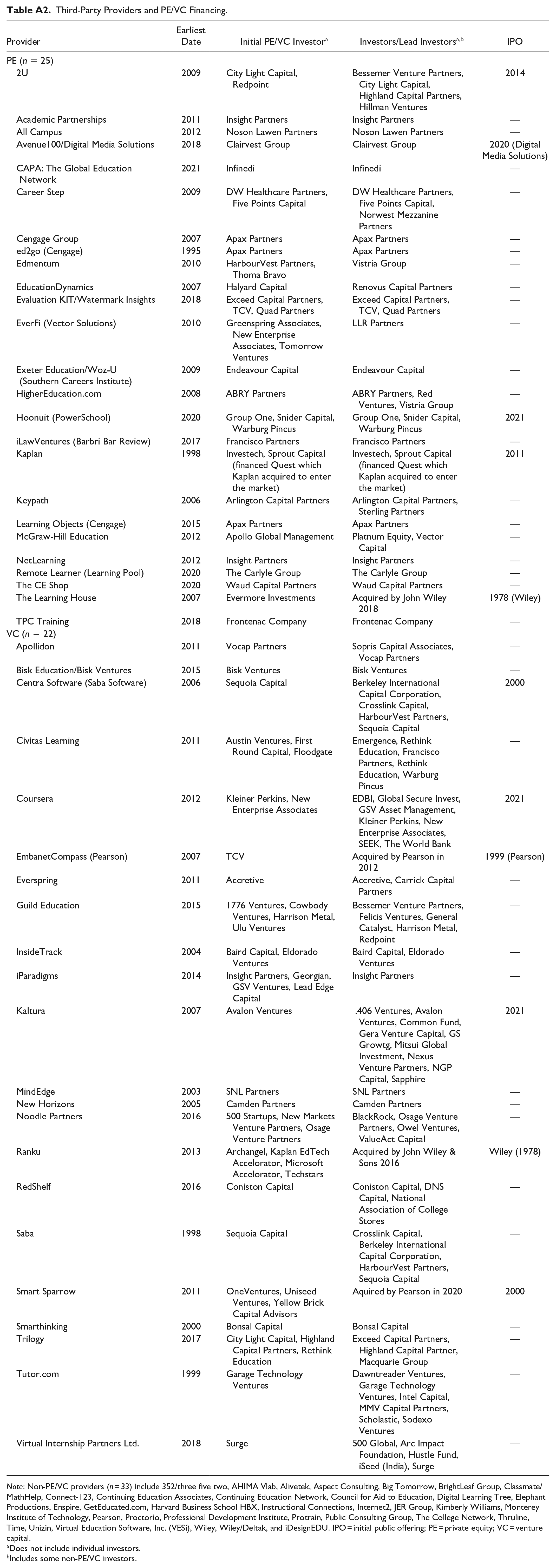
| Provider | Earliest Date | Initial PE/VC Investor a | Investors/Lead Investorsa,b | IPO |
|---|---|---|---|---|
| PE (n = 25) | ||||
| 2U | 2009 | City Light Capital, Redpoint | Bessemer Venture Partners, City Light Capital, Highland Capital Partners, Hillman Ventures | 2014 |
| Academic Partnerships | 2011 | Insight Partners | Insight Partners | — |
| All Campus | 2012 | Noson Lawen Partners | Noson Lawen Partners | — |
| Avenue100/Digital Media Solutions | 2018 | Clairvest Group | Clairvest Group | 2020 (Digital Media Solutions) |
| CAPA: The Global Education Network | 2021 | Infinedi | Infinedi | — |
| Career Step | 2009 | DW Healthcare Partners, Five Points Capital | DW Healthcare Partners, Five Points Capital, Norwest Mezzanine Partners | — |
| Cengage Group | 2007 | Apax Partners | Apax Partners | — |
| ed2go (Cengage) | 1995 | Apax Partners | Apax Partners | — |
| Edmentum | 2010 | HarbourVest Partners, Thoma Bravo | Vistria Group | — |
| EducationDynamics | 2007 | Halyard Capital | Renovus Capital Partners | — |
| Evaluation KIT/Watermark Insights | 2018 | Exceed Capital Partners, TCV, Quad Partners | Exceed Capital Partners, TCV, Quad Partners | — |
| EverFi (Vector Solutions) | 2010 | Greenspring Associates, New Enterprise Associates, Tomorrow Ventures | LLR Partners | — |
| Exeter Education/Woz-U (Southern Careers Institute) | 2009 | Endeavour Capital | Endeavour Capital | — |
| HigherEducation.com | 2008 | ABRY Partners | ABRY Partners, Red Ventures, Vistria Group | — |
| Hoonuit (PowerSchool) | 2020 | Group One, Snider Capital, Warburg Pincus | Group One, Snider Capital, Warburg Pincus | 2021 |
| iLawVentures (Barbri Bar Review) | 2017 | Francisco Partners | Francisco Partners | — |
| Kaplan | 1998 | Investech, Sprout Capital (financed Quest which Kaplan acquired to enter the market) | Investech, Sprout Capital (financed Quest which Kaplan acquired to enter the market) | 2011 |
| Keypath | 2006 | Arlington Capital Partners | Arlington Capital Partners, Sterling Partners | — |
| Learning Objects (Cengage) | 2015 | Apax Partners | Apax Partners | — |
| McGraw-Hill Education | 2012 | Apollo Global Management | Platnum Equity, Vector Capital | — |
| NetLearning | 2012 | Insight Partners | Insight Partners | — |
| Remote Learner (Learning Pool) | 2020 | The Carlyle Group | The Carlyle Group | — |
| The CE Shop | 2020 | Waud Capital Partners | Waud Capital Partners | — |
| The Learning House | 2007 | Evermore Investments | Acquired by John Wiley 2018 | 1978 (Wiley) |
| TPC Training | 2018 | Frontenac Company | Frontenac Company | — |
| VC (n = 22) | ||||
| Apollidon | 2011 | Vocap Partners | Sopris Capital Associates, Vocap Partners | — |
| Bisk Education/Bisk Ventures | 2015 | Bisk Ventures | Bisk Ventures | — |
| Centra Software (Saba Software) | 2006 | Sequoia Capital | Berkeley International Capital Corporation, Crosslink Capital, HarbourVest Partners, Sequoia Capital | 2000 |
| Civitas Learning | 2011 | Austin Ventures, First Round Capital, Floodgate | Emergence, Rethink Education, Francisco Partners, Rethink Education, Warburg Pincus | — |
| Coursera | 2012 | Kleiner Perkins, New Enterprise Associates | EDBI, Global Secure Invest, GSV Asset Management, Kleiner Perkins, New Enterprise Associates, SEEK, The World Bank | 2021 |
| EmbanetCompass (Pearson) | 2007 | TCV | Acquired by Pearson in 2012 | 1999 (Pearson) |
| Everspring | 2011 | Accretive | Accretive, Carrick Capital Partners | — |
| Guild Education | 2015 | 1776 Ventures, Cowbody Ventures, Harrison Metal, Ulu Ventures | Bessemer Venture Partners, Felicis Ventures, General Catalyst, Harrison Metal, Redpoint | — |
| InsideTrack | 2004 | Baird Capital, Eldorado Ventures | Baird Capital, Eldorado Ventures | — |
| iParadigms | 2014 | Insight Partners, Georgian, GSV Ventures, Lead Edge Capital | Insight Partners | — |
| Kaltura | 2007 | Avalon Ventures | .406 Ventures, Avalon Ventures, Common Fund, Gera Venture Capital, GS Growtg, Mitsui Global Investment, Nexus Venture Partners, NGP Capital, Sapphire | 2021 |
| MindEdge | 2003 | SNL Partners | SNL Partners | — |
| New Horizons | 2005 | Camden Partners | Camden Partners | — |
| Noodle Partners | 2016 | 500 Startups, New Markets Venture Partners, Osage Venture Partners | BlackRock, Osage Venture Partners, Owel Ventures, ValueAct Capital | — |
| Ranku | 2013 | Archangel, Kaplan EdTech Accelorator, Microsoft Accelorator, Techstars | Acquired by John Wiley & Sons 2016 | Wiley (1978) |
| RedShelf | 2016 | Coniston Capital | Coniston Capital, DNS Capital, National Association of College Stores | — |
| Saba | 1998 | Sequoia Capital | Crosslink Capital, Berkeley International Capital Corporation, HarbourVest Partners, Sequoia Capital | — |
| Smart Sparrow | 2011 | OneVentures, Uniseed Ventures, Yellow Brick Capital Advisors | Aquired by Pearson in 2020 | 2000 |
| Smarthinking | 2000 | Bonsal Capital | Bonsal Capital | — |
| Trilogy | 2017 | City Light Capital, Highland Capital Partners, Rethink Education | Exceed Capital Partners, Highland Capital Partner, Macquarie Group | — |
| Tutor.com | 1999 | Garage Technology Ventures | Dawntreader Ventures, Garage Technology Ventures, Intel Capital, MMV Capital Partners, Scholastic, Sodexo Ventures | — |
| Virtual Internship Partners Ltd. | 2018 | Surge | 500 Global, Arc Impact Foundation, Hustle Fund, iSeed (India), Surge | — |
Note: Non-PE/VC providers (n = 33) include 352/three five two, AHIMA Vlab, Alivetek, Aspect Consulting, Big Tomorrow, BrightLeaf Group, Classmate/MathHelp, Connect-123, Continuing Education Associates, Continuing Education Network, Council for Aid to Education, Digital Learning Tree, Elephant Productions, Enspire, GetEducated.com, Harvard Business School HBX, Instructional Connections, Internet2, JER Group, Kimberly Williams, Monterey Institute of Technology, Pearson, Proctorio, Professional Development Institute, Protrain, Public Consulting Group, The College Network, Thruline, Time, Unizin, Virtual Education Software, Inc. (VESi), Wiley, Wiley/Deltak, and iDesignEDU. IPO = initial public offering; PE = private equity; VC = venture capital.
Does not include individual investors.
Includes some non-PE/VC investors.
Acknowledgements
We thank Adam Goldstein, Stephanie Hall, Alisha Jones, Robert Shireman, Amber Villalobos, and Frederick Wherry for their comments on this article.
Funding
The author(s) disclosed receipt of the following financial support for the research, authorship, and/or publication of this article: This research was supported by an Arnold Ventures grant. Opinions reflect those of the authors and do not necessarily reflect those of the granting agency.
