




Abstract
In France, women and men often do not engage in the same occupations, with “feminine” occupations being on average paid less than “masculine” ones. It has been shown that this gender-based occupational segregation is not explained by a difference in professional ambition between female and male students at high school age. In contrast, studies have shown that in France, as well as in many other countries, students’ occupational aspirations are highly gendered. In this visualization, the authors replicate these findings about high school students’ professional ambition and aspirations with new data and indicators, introducing a distinction between their dream jobs and their expected jobs. This research confirms that the persistence of the gender-based occupational segregation has more to do with students’ gender stereotypes than with a difference in ambition between girls and boys.
In France, gender-based occupational segregation is quite marked, although it has been decreasing since the late 1990s (Minni 2015). Women are still largely overrepresented in some occupations, such as nursing and midwifery, and in the minority in others, such as engineering. As “feminine” occupations are on average paid less than “masculine” ones, this segregation contributes to the wage inequality between genders (Georges-Kot 2020).
It has been shown that in France, gender-based occupational segregation is not explained by a difference in professional ambition between female and male students at high school age, as they are equally ambitious (Dupont et al. 2012). In contrast, studies have shown that in France, as well as in many other countries, students’ occupational aspirations are highly gendered (e.g., Stoet and Geary 2022). In this visualization, we replicate these findings about high school students’ professional ambition and aspirations with new data and indicators, introducing a distinction between their dream jobs and their expected jobs.
Visualization
We asked 2,114 students in the first year (10th grade) and final year (12th grade) of high school about their dream jobs (“What job would you dream of doing later?”) and their expected jobs (“What job do you think you’ll really do later? The same job as the one you dream of doing? Another one?”). The schools of these students were selected to be nationally representative in terms of gender, academic level, and proportion of students from disadvantaged backgrounds. The responses of 2,017 students (1,090 10th graders [596 girls] and 927 12th graders [512 girls]) were available for analysis.
We defined a dream job or an expected job as ambitious if it belongs to the professional category “management or higher intellectual profession” (the category that requires the highest level of education and corresponds to the best salaries but with significant variations across professions). We conducted multiple binomial logistic regression analyses to examine whether gender influences students’ professional ambition, controlling for their grade level (10th or 12th grade) and for having at least one parent in that higher professional category, as a proxy for high-status background. Figure 1a shows that gender has no significant effect on the ambition of the dream or expected job, while family social status has a weak significant effect: students from high social backgrounds are slightly more ambitious than others.
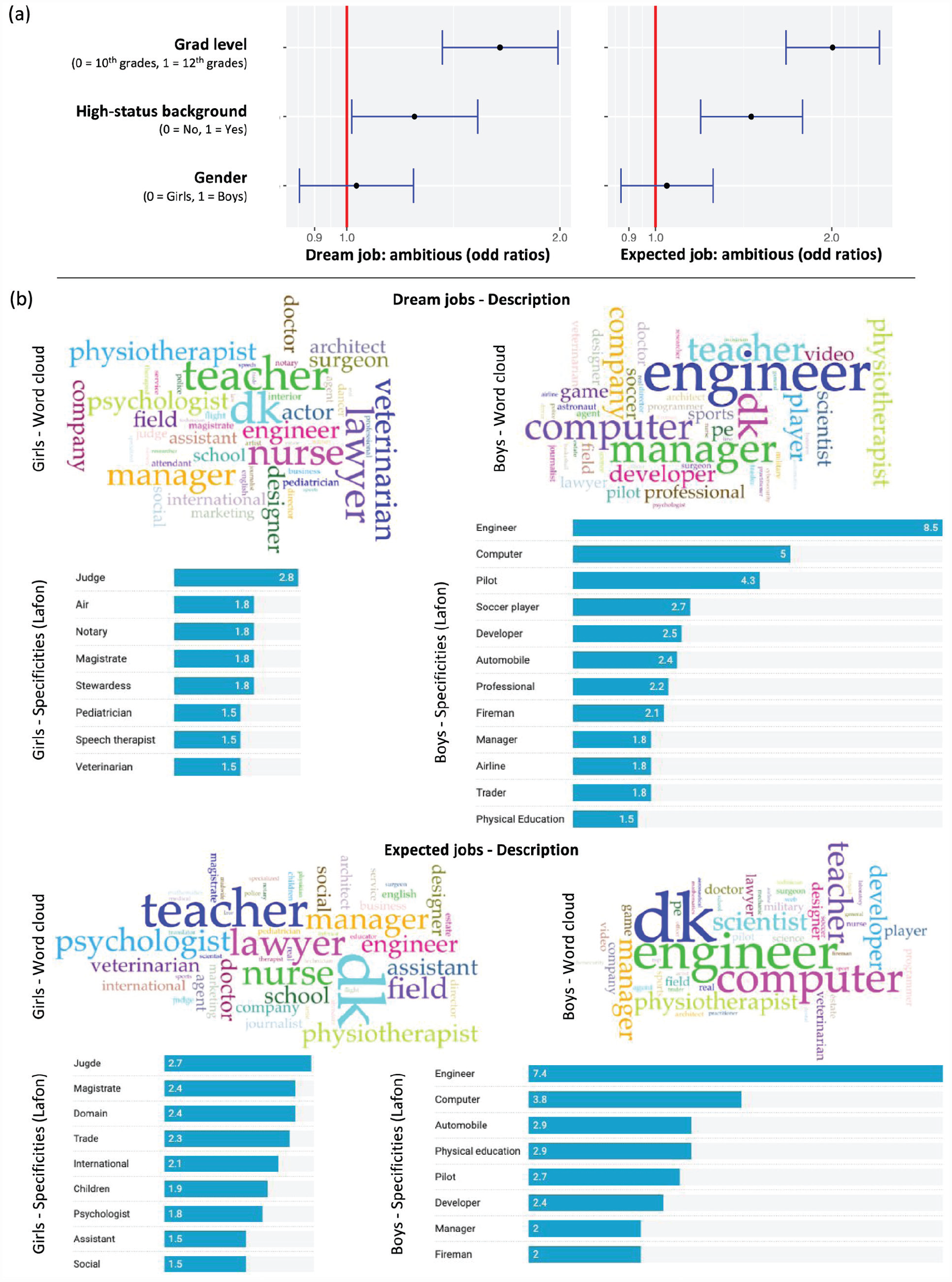
Impact of gender on high school students’ (a) professional ambition and (b) nature of dream jobs and expected jobs. (a) Multiple binomial logistic regressions explaining the choice of ambitious dream or expected jobs (i.e., jobs belonging to the “management or higher intellectual profession” category; 0 = no, 1 = yes) as a function of students’ gender (0 = girls, 1 = boys), grade level (0 = 10th grade, 1 = 12th grade), and social status background (having at least one parent whose job category is “management or higher intellectual profession” as a proxy for high-status background; 0 = no, 1 = yes). Note that the x-axis scale (odds ratio) differs between dream and expected jobs plots. (b) The words used by students to describe their dream and expected jobs: in the word clouds, the size of a word is proportional to the frequency of its occurrence; Lafon’s (1980) analyses of specificity indicate the words that are significantly (conventional threshold ≥1.5) more used by one gender compared with the other. In conclusion, students’ gender has no significant impact on their professional ambition (a), but girls and boys differ greatly in the nature of the jobs they dream of doing or expect to do (b).
In contrast, girls and boys differ in the nature of the jobs they dream of doing or expect to do. As shown in Figure 1b, the terms used by girls to describe their dream or expected jobs correspond more to people-oriented occupations, whereas those used by boys correspond more to things-oriented occupations related to the fields of science, technology, engineering, and mathematics. This result is in line with the existing literature, which consistently reveals across countries such a gender discrepancy in occupational aspirations (e.g., Stoet and Geary 2022). The persistence of gender-based occupational segregation in France therefore seems to have more to do with students’ gender stereotypes than with a difference in professional ambition between girls and boys.
Supplemental Material
sj-pdf-1-srd-10.1177_23780231231181898 – Supplemental material for Effect of Gender on French High School Students’ Dream Jobs and Professional Ambition
Supplemental material, sj-pdf-1-srd-10.1177_23780231231181898 for Effect of Gender on French High School Students’ Dream Jobs and Professional Ambition by Laurent Cordonier, Florian Cafiero, Nicolas Walzer and Gérald Bronner in Socius
Footnotes
Acknowledgements
We are thankful to the Scientific Council of the French Ministry of National Education for its cooperation on this project, especially to Stanislas Dehaene, Pascal Huguet, Christine Morin-Messabel, and Isabelle Regner for their precious help. Errors remain our own.
Funding
The author(s) disclosed receipt of the following financial support for the research, authorship, and/or publication of this article: The Geometry of Public Issues project of Agence Nationale de la Recherche (ANR-19-CE38-0006) supported Florian Cafiero’s research.

Supplemental Material
Supplemental material for this article is available online.
Author Biographies
References
Supplementary Material
Please find the following supplemental material available below.
For Open Access articles published under a Creative Commons License, all supplemental material carries the same license as the article it is associated with.
For non-Open Access articles published, all supplemental material carries a non-exclusive license, and permission requests for re-use of supplemental material or any part of supplemental material shall be sent directly to the copyright owner as specified in the copyright notice associated with the article.
