



Abstract
Social science research has long recognized the relevance of socioeconomic background for mobility and inequality. In this article we interrogate how and why working-class and first-generation backgrounds are especially meaningful and take as our case in point the professoriate and the discipline of sociology, – i.e., a field that intellectually prioritizes attention to group inequality and that arguably offers a conservative empirical test compared to other academic fields. Our analyses, which draw on unique survey items and open-ended qualitative materials from nearly 1,000 academic sociologists, reveal significant background divergences in academic job attainment, tied partly to educational background. Moreover, and especially unique and important, findings demonstrate significant consequences across several dimensions of inequality including compensation and economic precarity, professional visibility, and isolation at departmental, college or university, and professional levels. We conclude by highlighting how our discussion and results contribute in important ways to broader sociological concerns surrounding mobility, group disadvantage, and social closure.
Sociologists have long been interested in how background shapes mobility prospects and overall life chances. Whether grounded in status attainment traditions (e.g., Blau and Duncan 1967; Hauser and Featherman 1977) or intergenerational transmission approaches (e.g., Erikson and Goldthorpe 1992; Wright 2005), research consistently shows divergences in institutional opportunities for those of advantaged and disadvantaged origins. Contemporary stratification research, including specific literatures on poverty (e.g., Fox, Torche, and Waldfogel 2016), income and wealth inequality (e.g., Keister and Moller 2000; Oliver and Shapiro 2009), health (e.g., Brady et al. 2020; Willson and Shuey 2019) and education (e.g., Lareau 2003; Mare and Maralani 2006) point to such effects despite sometimes measuring socioeconomic background in distinct ways. Traditional stratification research, for instance, used indices such as socioeconomic status (SES) or occupational prestige (Blau and Duncan 1967), whereas analyses over the past two decades have tended to rely more consistently on measures of occupational class position (e.g., Erikson and Goldthorpe 1992, 2002; Smallenbroek, Hertel, and Barone 2022) and/or first-generation status (e.g., Benson and Lee 2020; Manzoni and Streib 2019; Wilbur and Roscigno 2016).
The connection between social origins, mobility and inequality is (or should be) central to social science analyses, and for good reason: it brings to the sociological forefront foundational questions about meritocracy versus social closure and opportunity versus inequality reproduction (Fischer et al. 1996; Hout 2012; Martin 2012; Tilly 1999). To what extent are group-level divergences in educational pathways and career attainment observable and, every bit as important, what are the inequality implications, if any? We address such questions in this article by analyzing the trajectories and inequality experiences of approximately 1,000 faculty members in the field of sociology specifically. Our analyses are grounded in long-standing theoretical frameworks pertaining to mobility, which we extend to a high-status occupational context (i.e., the professoriate) where some degree of social closure is likely (Bol and Weeden 2015; Tomaskovic-Devey and Avent-Holt 2019) and to a field-specific domain (i.e., sociology) that is itself cognizant of processes undergirding inequality. Moreover, and unique to our data and analyses, we interrogate the consequences across several important dimensions of inequality (i.e., tangible resources, status and visibility in the field, and sense of isolation).
Academia affords an exemplary case of a high-status professional context within which specific credential attainment is required and where, correspondingly, there are several sequential points of potential exclusion. Recent analyses of high-status and high-return job attainment (Friedman and Laurison 2019; Rivera 2015) concur on this very point as does prior attention to academic hierarchies. Specifically, educational divergences by background and undergraduate and especially graduate credentials, where exclusive programs produce the majority of faculty members (Burris 2004; Hagstrom 1971; Kulis 1988; Morgan et al. 2022), are clearly important as is uneven attrition from graduate school and the faculty ranks (Wapman et al. 2022). With regard to sociology in particular, more critical and reflexive consideration of inequality may make the field more meritocratic compared to disciplines where stratification is less intellectually central. One should not assume, however, that disciplinary attention to inequality somehow translates into immunity to its reproduction (Haney 2016; Lee 2017; Lee and Maynard 2017; Muzzatti and Samarco 2005; Posselt 2016; Weeden, Thébaud, and Gelbgiser 2017). On this point, in fact, recent aggregate analyses suggest that sociology seems to follow other disciplines with outsized representation of higher socioeconomic background individuals and groups (Morgan et al. 2022).
Our analyses build on recent research on faculty representation and status hierarchies as well as earlier and more in-depth discipline-specific treatments. This includes work such as that of Grimes and Morris (1997) who, decades ago, provided rich qualitative accounts of barriers and interactional inequalities among working-class sociologists, and Burris’s (2004) critique of hierarchy particular to field-specific graduate training and academic placement. Although prior attention to faculty socioeconomic diversity has tended to focus on particular junctures in the stratification process, such as graduate education (e.g., Smith, Mao, and Deshpande 2016) and/or a limited range of linkages (e.g., graduate institution and tenure-track employment (Clauset, Arbesman, and Larremore 2015)), we draw on mobility and inequality frameworks to offer more structurally oriented analyses that extend across multiple junctures. We also expand upon prior research by bringing attention to multidimensional inequality consequences, including but not limited to experiential and socioemotional outcomes.
The discussion that follows, the questions we address, and the rich quantitative and qualitative data we employ contribute to the literature in two primary ways. First, our data allow for relatively rigorous comparative analyses of educational pathways and divergences in academic job attainment for those of working-class and first-generation – i.e., backgrounds especially core to recent lines of inequality scholarship 1 – while also remaining cognizant throughout of racial/ethnic and gender representation. In line with cross-field analyses (Morgan et al. 2022; Standlee 2018; Wapman et al. 2022), findings highlight how disadvantaged origins undercut the likelihood of attending private undergraduate institutions, high-status graduate programs, and eventual employment in higher prestige academic departments. Second, and especially unique and pertinent, we examine the ancillary implications for job returns and economic precarity, professional status and visibility, and sense of isolation, each of which is shaped by background and educational and job attainment. Doing so provides one of the most holistic examinations to date of connections between background, professional outcomes and inequalities within academia. We highlight our most central findings in these regards and conclude by discussing the relevance of our focus and results for stratification, education, work and mobility literatures.
Mobility and the Academic Pipeline
The sociological literature has been rich in noting how intergenerational mobility either occurs or is blocked by institutional and interinstitutional (i.e., education and economy) sorting and movement (Kerckhoff 1995). Theoretically, and within completely open systems, movement is wide, significant, and driven mostly if not entirely by merit. We know that this is seldom if ever the case in practice, however. Rather, there are numerous historical, institutional, and interinstitutional closure processes that can occur, driven at least partly by varying levels of social and cultural capital (Bourdieu and Passeron 1990) and institutional hierarchies and sorting that advantage some individuals and social groups over others (Fischer et al. 1996; Tilly 1999). This is no less true in higher education where inequitable trajectories tend to reduce diversity, exacerbate social class stigma and cultural mismatch, and create strain for underrepresented populations (Casey 2005; Jack 2016, 2019; King and McPherson 2020; Stephens et al. 2012; Warnock and Hurst 2016).
Social and cultural capital, which reflect associational and network advantages (Martin 2012; Reay 1999) and knowledge held in high regard by institutions and gatekeeping actors (Bourdieu and Passeron 1990; Lareau 2015), are directly and indirectly consequential for mobility (Flemmen et al. 2017; Harker 1984; Morgan et al. 2022; Roksa and Potter 2011). Rich and growing bodies of literature on college students, for example, point to social and cultural capital disadvantages among working class, first-generation and low-income students. Such students, research has made clear, have a more difficult time adjusting to and negotiating college life (Hinz 2016; Jack 2019; Lee 2016; Lehmann 2007; Pascarella et al. 2004; Whiteside 2021), experience less overall integration and sense of belonging (Benson and Lee 2020; Mcdossi et al. 2022; Strayhorn 2018), and attend less prestigious colleges and programs (Boliver 2011; Hurst 2019). Moreover, they drop out of college at significantly higher rates (Wilbur and Roscigno 2016) and are less likely to matriculate into graduate school (Mullen, Goyette, and Soares 2003; Walpole 2003).
Institutional hierarchies and the uneven weighting of educational credentials likewise play a part in the divergences we are describing. They do so by filtering individuals and social groups disproportionately and unevenly within institutions and across them (Kerckhoff 1995). This is perhaps most easily observed in rich bodies of work on the hierarchical character of educational institutions and associations with educational access and funding to poor and rich populations (Alon 2009), ability grouping and tracking within educational institutions (Ainsworth and Roscigno 2005; Lucas 2001; Royster 2003), and segregation and curricular disparities (Orfield et al. 1997; Owens 2020; Reardon and Owens 2014). Such inequalities, well documented during the elementary, middle and high school years, ultimately reduce the likelihood of college enrollment among working-class and first-generation students from the very outset. 2 Conversely, those of advantaged backgrounds traverse educational institutions with higher levels of cultural and social capital, are more likely to attend higher resourced private and public schools growing up, and have more access to both formal advanced curriculums and various forms of college preparation and shadow education (Buchmann, Condron, and Roscigno 2010; Calarco 2020b; Khan 2011; Lareau 2015; Martin 2009). These reflect compounding and reinforcing advantages institutionally and within mobility contests.
Although much of the literature to date centers on earlier stratification and educational mobility processes, several strands of research point to the possibility that background inequalities and status hierarchies similarly matter within more advanced levels of academia and/or within the course of academic careers. Burris’s (2004) specific attention to sociology as an academic discipline suggests that graduate training in the field reflects a relatively rigid network “caste” system, which entails significant background divergences, interdepartmental hiring, and prestige reproduction among top departments nationally. Earlier work by Grimes and Morris (1997) as well as more contemporary research (see, e.g., Crew 2020; Haney 2016; Standlee 2018) agrees and points to ways in which lower social class origins create very real informational, cultural, resource, and familial constraints into and within the professoriate.
Recent aggregate and quantitative analyses (Clauset et al. 2015; Morgan et al. 2022), which include but are not limited to the field of sociology, similarly suggest (1) job attainment advantages tied to more prestigious educational credentials and (2) especially meaningful advantages for those of higher socioeconomic backgrounds that are only magnified by gaps in attrition (Wapman et al. 2022). 3 We focus on the possibility of mobility divergences in our own analyses with particular attention to background, academic job attainment, and their ties to undergraduate and graduate credentials. Specifically, and building on the prior insights, we expect that:
Those of first-generation and working-class backgrounds will be less likely to have attended private undergraduate institutions and top-ranked graduate programs. Such divergences in the educational pipeline will have negative implications for mobility into and placement in the academic labor market and, specifically, the garnering of faculty positions in higher status departments.
Background Divergences and Implications for Inequality
Along with mobility concerns and especially unique is our attention to professional returns and a host of ancillary inequalities arguably shaped by both one’s background and potentially divergent trajectories. Some of the most important, upon which we elaborate below, have to do with job compensation and economic precarity, professional visibility, and sense of belonging versus isolation.
Background disadvantages and distinct mobility pathways will, we suspect, have relatively direct consequences for job compensation. Such a pattern should not be particularly surprising. Higher status departments pay more to recruit productive scholars from arguably higher status graduate programs and also usually compensate existing faculty at higher levels to retain those who are most productive and visible. Yet if individuals of working-class or first-generation backgrounds are less likely to enroll and/or complete their training in higher status undergraduate and graduate programs and, correspondingly, are less likely to garner higher status faculty positions (i.e., our prior expectation), inequality gaps in compensation will be structurally reproduced. On this point, we know already that female faculty and faculty of color tend to receive lower salaries on average than their male and white peers (Renzulli, Grant, and Kathuria 2006), partially due to institutional status, academic field, experience, and research productivity (Li and Koedel 2017). One should arguably expect similar disadvantages for faculty members of first-generation and working-class backgrounds.
Job compensation is interesting in and of itself although it is even more important when one considers that those from lower socioeconomic backgrounds are also more likely to experience economic precarity and debt and are less able to rely on family members when faced with economic difficulties (Crew 2020). In the first regard, the amount debt accrued during graduate school is more unequal than it is for undergraduate debt, and we know that such debt burden is disproportionately borne by poorer students and students of color (Addo, Houle, and Simon 2016; Martin and Dwyer 2021; Pyne and Grodsky 2020; Seamster and Charron-Chénier 2017). Less is known about the degree of financial support and the directionality of support flows relative to family members. Although education and family literatures (e.g., Barnett, Cooney, and Shapiro 2020; Bea and Yi 2019) often presume that resources flow mostly from parents to children, the fact that those experiencing upward mobility often experience a sense of guilt and responsibility (Covarrubias and Fryberg 2015) may very well flip the directionality of this relationship on its head. Without taking debt and financial flow relative to families into account, something our data allow, analyses of job compensation alone will likely underestimate the degree of economic inequality and precarity among faculty members. 4
Status also likely begets status when it comes to professional visibility (see Bol, de Vaan, and van de Rijt 2018). Specifically, background, educational pathways and credentials, and eventual job placement can bestow advantages and disadvantages because of resource differentials, distinct and alternative job pressures (e.g., teaching vs. research), and general perceptions surrounding one’s importance to the field given one’s institutional affiliation. Election to prominent national positions and grant getting, for instance, both of which are commonly viewed as signs of professional success and status, can be partially tied to eventual job attainment, relative levels of departmental and university/college prestige, and institutional resource supports. 5 We consider such possibilities in our analyses and likewise consider membership on journal editorial boards and grant review panels. These too reflect markers of professional visibility to some degree and are sometimes viewed as largely meritocratic “objective” metrics (i.e., metrics meaningful to professional visibility and compensation, and usually reified through program rankings) (Webster, Conrad, and Jensen 1988).
Equally consequential, although usually less visible, may be interactional and social psychological consequences. What are the implications for integration and sense of belonging in academia? Bourdieu’s (1984) initial insights are of value here, particularly his attention to the ways in which high-status actors distinguish themselves through manners that confirm that they belong in more elite spaces. Such “privilege of ease” (Martin 2012) has been well documented in ethnographic and theoretical literatures on social reproduction and mobility including, for instance, Khan’s (2011) attention to prep school students, Rivera’s (2015) analyses of hiring committees and their bias toward elite college graduates, Posselt’s (2016) work on graduate admission committees and the ways in which they advantage those who convey confidence and status, and Hurst’s (2019) recent attention to the valuation of elite students at small liberal arts colleges.
A rich memoir literature (e.g., Ryan and Sackrey 1996; Tokarczyk and Fay 1993) and a small number of academic studies (Crew 2020; Haney 2015, 2016; Lee 2017; Lee and Maynard 2017) point to the importance of integration and social-psychological well-being among faculty members who come from disadvantaged backgrounds. Unlike their background-advantaged peers, such individuals often report feelings of impostor-hood, ambivalence, and displacement despite managing to “move up” though higher education (Warnock 2016; see also Standlee 2018). Notable parallels are observed in recent literatures on marginalization along racialized and/or ethnic lines. This work highlights not just structured exclusion within academic spaces but also socioemotional and professional integration costs (e.g., Arnold, Crawford, and Khalifa 2016; Niemann, Gutiérrez y Muhs, and Gonzalez 2020; Zambrana et al. 2017).
Given their “in-between” or “limbo” status and perhaps also because of exclusions and indignities experienced along the way, we suspect that those of working-class and first-generation backgrounds will be more likely to report social-interactional difficulties and a sense of isolation within higher education contexts and in the academic field that they are now part of. Taken together with our discussion of job compensation, economic precarity, and professional visibility, the expectation would be as follows:
Those of working-class and first-generation backgrounds will report and experience less compensation and more economic precarity, particularly when income is considered alongside debt and familial monetary flows. They will also tend to experience less professional visibility compared with their more advantaged peers and higher levels of isolation across departmental, college and university, and professional conference contexts.
Data
Our data are derived from a survey conducted by the American Sociological Association’s (ASA) Task Force on First-Generation and Working-Class Sociologists. The survey, preceded by a series of informative and in-depth focus groups and fielded in 2019, was sent to a random sample of 5,597 individuals who were dues-paying members of the ASA at any point between the years of 2014 to 2017. The survey was completed by 1,996 respondents (36 percent response rate). Given our analytic attention to mobility and inequality experiences among faculty members, we restrict analyses to those who have earned PhDs and who are currently employed as teaching and/or research faculty members in colleges and universities in the United States. 6 The resulting sample size on the basis of the restrictions above is 982 faculty members in sociology, dispersed across 50 U.S. states, and across public and private, “top-ranked” 7 and nonranked sociology programs.
These data are incredibly rich relative to existing research on the professoriate and include significant variations by institution type and status, faculty rank, and years since PhD and, most important for our purposes, allow for systematic comparative analyses by background. As discussed momentarily, they also include several rich and detailed indicators of socioeconomic background; other status-specific attributes (e.g., race/ethnicity, gender) and demographic controls; indicators of the educational pipeline (i.e., undergraduate and graduate school attendance) preceding one’s current academic appointment; the status of one’s current job and sociology department; salary and debt measures; information on family resource flows; indicators pertaining to professional visibility; and measures capturing sense of isolation in one’s department, on college and university campuses, and at professional conferences. Item response rates are above 95 percent. We employ multiple imputation (Rubin 1987) for missing values on our control variables, not for outcome measures nor indicators of first-generation and working-class background.
Unlike several recent analyses of the professoriate, and along with those from high-status programs and PhD-granting institutions, our data include many faculty at community colleges, regional universities, and larger institutions without PhD programs in sociology. That the sampling entailed dues paying members of ASA nevertheless likely skews such data in a conservative direction. This is because those included were able to afford membership during at least one of the three years considered and are more likely to be in higher status and resourced departments where membership and meeting attendance are expected. Despite such caveats, these data and the variations and comparative leverage they afford allow us to speak confidently about the educational histories, work, and inequality experiences of contemporary faculty and, if anything, likely underestimate inequality in the field.
Along with rich quantitative indicators, our survey included an open-ended question especially useful given our core foci. Respondents were asked whether they believe that socioeconomic origin matters for inclusion and success in the discipline. Those who responded in the affirmative (i.e., more than 90 percent) were then asked to explain how and why. Specifically, respondents observed the following prompt: “In what ways do you think one’s career and potential success in academia might be impacted by socioeconomic background? Please describe in the box below what you see as the most fundamental ways in which background matters.” Approximately 450 respondents provided such open-ended detail. Explanations range from variations in cultural capital, to deficits in knowledge and advising, to structural inequalities and social closure tied to the hierarchical character and prestige of graduate programs, all of which point to pertinent mechanisms and inequalities in the mobility pipeline and in current job experiences. Qualitative responses were content coded by three of the authors using a process of open coding to develop key themes and then focused coding to hone in on and elaborate on analytical connections. The quotations reported alongside our quantitative results illustrate with richness underlying experiences, mechanisms, and processes of disadvantage in a way that quantitative data alone simply could not.
Measurement
The Educational/Occupational Mobility Pipeline
Relative to the educational/occupational pipeline, we first compare undergraduate and graduate program trajectories along with current department (job) status of first-generation and working-class faculty relative to their more background-advantaged peers. Undergraduate attendance was measured with the following item: “From what type of undergraduate institution did you earn your four-year baccalaureate degree?” Response categories include main campus of public university (1), private university (2), public regional branch campus (3), and private college (4) (i.e., liberal arts, religious affiliate, etc.). In our analyses, we differentiate between public (0) and private (1) undergraduate enrollment. Approximately 45 percent of the faculty sample attended private undergraduate institutions, while the remainder attended public institutions.
The relative status of one’s prior graduate program is drawn from a prompt asking respondents whether their graduate program was a top 20 private program (1), a top 20 public program (2), a middle-ranked (top 50 but not top 20) program (3), or not top 50 (4). We consolidate and analyze the public/private “top 20” options (1) compared with not top 20 (0). We also combined the first three categories above and analyze those attending the broader pool of “top 50” programs (1) versus not (0). In the first portion of our analyses, we model top 20 and top 50 graduate enrollment and job attainment separately as outcomes, and they should be interpreted as such. As later analyses regarding inequality outcomes include both top 20 and top 50 departmental status simultaneously as predictors, effects can and should be interpreted as top 20 program effects and effects of a midlevel (21–50) ranking, respectively, with nonranked programs as the referent. We discuss alternative modeling and specifications in these regards in our results. Approximately 58 percent of our faculty sample reports earning their PhDs in a top 20 program, while 86 percent overall obtained their PhDs from top 50 graduate programs.
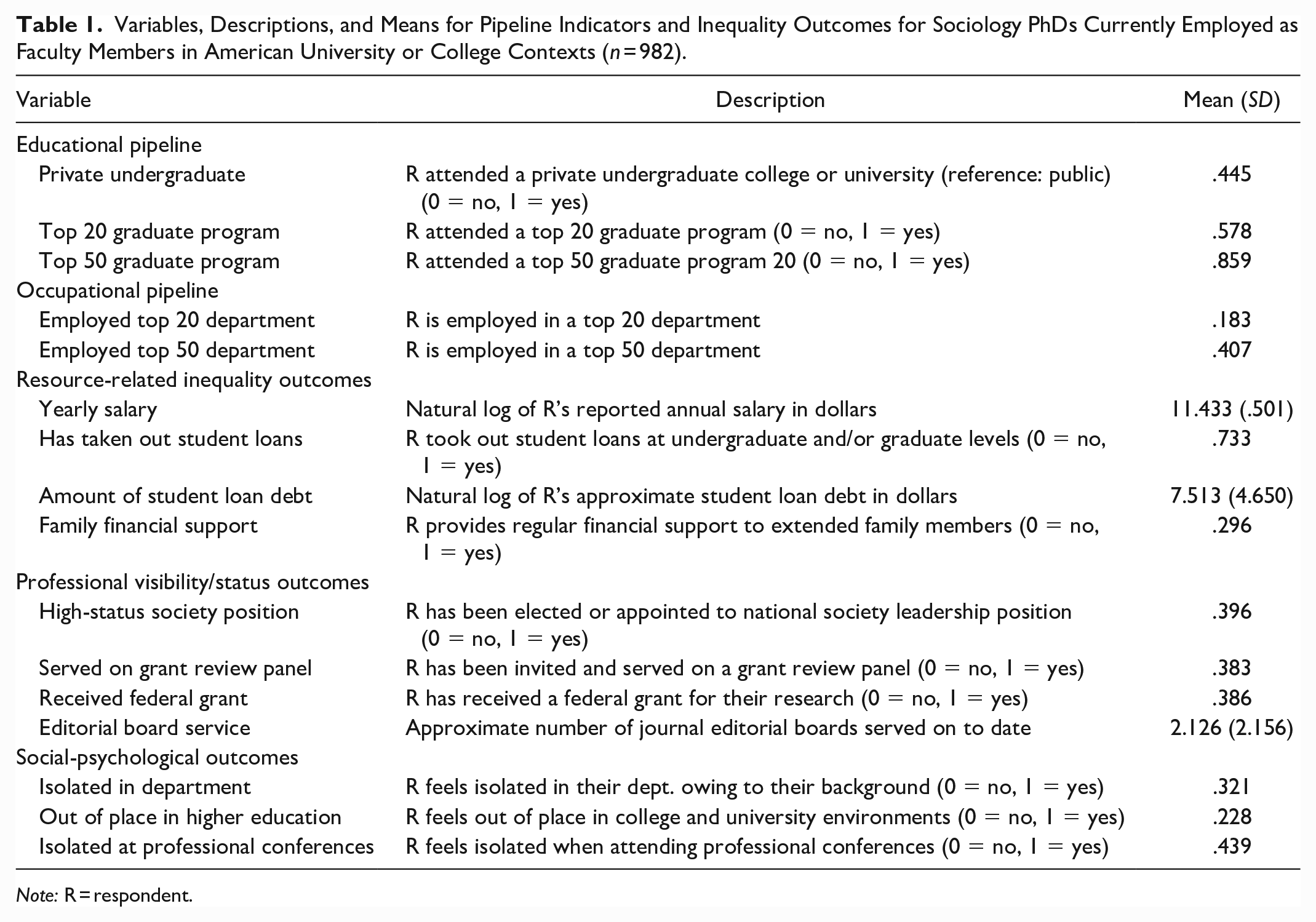
Occupational attainment, specifically current departmental status, is measured in a similar fashion as graduate enrollment on the basis of prompts regarding one’s current job. Approximately 18 percent of the sample reports currently being employed in a “top 20” ranked U.S. department, while 41 percent reports being in a “top 50” ranked department. The referent in these regards are those in unranked programs and institutions, including liberal arts colleges, regional public colleges and universities, and community colleges. Means and descriptions of these indicators as well as potential inequality outcomes, discussed next, are reported in Table 1.
Variables, Descriptions, and Means for Pipeline Indicators and Inequality Outcomes for Sociology PhDs Currently Employed as Faculty Members in American University or College Contexts (n = 982).
Note: R = respondent.
Inequality Outcomes: Resources, Visibility, and Isolation
The second portion of our analyses interrogates the implications for three distinct dimensions of inequality: resource-related, professional visibility, and sense of isolation. We capture resource-related inequalities with four measures: current salary, recoded from a seven-category scale to dollar midpoints with the natural log version used in our analyses (mean = 11.43, SD = .50); whether the respondent took out loans to finance their graduate and/or undergraduate education (1 = yes, 0 = no; mean = .73); amount of loan debt accrued by PhD completion, recoded from a six-category scale to dollar midpoints and with the natural log used in our analyses (mean = 7.51, SD = 4.65); and whether the respondent regularly provides financial support to extended family members (i.e., parents, siblings, or other relatives) (1 = yes, 0 = no; mean = .30). These unique indicators of loan debt and financial support of extended family, as suggested earlier, offer a more complete picture of financial well-being and precarity than would analyses of salary compensation alone.
Inequality, of course, is more than a matter of tangible financial resources. Within the professoriate it may also entail divergences in professional visibility and levels of integration. On the professional visibility side, we consider the extent to which there are gaps in appointment or election to high-status national academic society positions (1 = yes, 0 = no), the number of journal editorial boards a respondent has served or is serving on (mean = 2.13, SD = 2.16), whether a respondent has served on grant review panel (1 = yes, 0 = no), and whether the respondent reports having received federal grant support for their research (1 = yes, 0 = no). 8
Regarding social psychological and integrative implications, respondents were asked whether they feel isolated in their department (1 = yes, 0 = no), whether they feel out of place in college and university environments (1 = yes, 0 = no), and whether they feel isolated and out of place at professional conferences (1 = yes, 0 = no). Means for these measures are reported in Table 1. Although our resource-, visibility-, and isolation-related inequality indicators are not exhaustive, they offer some of the most comprehensive measures of inequality within the professoriate to date. Moreover, open-ended qualitative materials offer rich complementary insights regarding inequality experiences for those of first-generation and working-class backgrounds.
First-Generation and Working-Class Backgrounds
Our measurement of background draws on and is informed by a rich history of sociological research on socioeconomic origins and social class, which offers a variety of rigorous measures (Brady et al. 2018; Wright 2005). In the past, such measures tended to entail either gradational measures of parental occupational prestige (Ganzeboom, De Graaf, and Treiman 1992) or indicators of self-perceived social class background that captured either actual location in the class hierarchy and/or subjective class identification (Sosnaud, Brady, and Frenk 2013). We acknowledge the utility of such traditional measures in the social stratification literature, and indeed captured them in our survey design. We focus instead, however, on two objective indicators suggested by more contemporary inequality research: parental college degree attainment and occupational class status.
Sociologists have always used parents’ educational attainment as a fundamental indicator that, importantly, is sequentially prior to occupational, income, or other status attainments (e.g., Torche 2011). Moreover, parental degree attainment as a core background indicator is consistent with research over the past decade highlighting specific resource, informational and cultural capital disadvantages surrounding especially first-generation status (Benson and Lee 2020; Jack 2016; Mcdossi et al. 2022; Wilbur and Roscigno 2016). Consistent with the bulk of this literature, as well as measurement and policies instituted by most colleges and universities across the country, we measure first-generation from survey questions reading, “What was the highest level of education completed by your parent/primary caregiver [#1/#2] at the time you completed high school?” We specifically focus on those for whom neither parent has obtained a bachelor’s degree (1) versus those for whom at least one parent has earned a bachelor’s degree or higher (0). 9
Approximately 42 percent of our faculty sample is first generation, while the remainder are continuing generation. Although this percentage as well as that regarding working-class background, discussed next, are quite high, we remind the reader that the survey was fielded by ASA’s Task Force on First-Generation and Working-Class Sociologists. Consequently, those of first-generation and working-class backgrounds were probably much more likely to respond on the basis of the recruitment script. We draw no conclusions as to the overall representation of working-class and/or first-generation individuals within the field of sociology in general. Such representation is surely much lower than it is among survey respondents. The core aim of our analyses lies in group comparisons on outcomes surrounding job attainment and inequality experiences across several core dimensions of academic life. The significant diversity and variation afforded by these data, and overrepresentation of those from lower socioeconomic origins, allow us to do so.
Regarding occupational class status, we follow research surrounding the strength and efficacy of occupation-based nominal class schemas (Erikson, Goldthorpe, and Portocarero 1979; see also Smallenbroek et al. 2022) (i.e., schemas that draw on the specific occupations of parents to effectively differentiate working-class background vs. more advantaged class origins). Our indicator is derived from open-ended survey responses to the question “In what occupation did your primary parent/caregiver [#1/#2] work, if any, during your childhood? Please specify . . . their occupation name/title as best you can.” A research assistant coded all open-ended answers into categories consistent with the Erikson-Goldthorpe (EGP) classification scheme of social class (Erikson et al. 1979). Two members of our research team then reviewed all coding for reliability and validity and further refined the coding of cases in a manner consistent with Morgan’s (2019) update of the original EGP categories. 10 This schema and its recent update is useful for studying mobility and may capture economic resources and social network advantages above and beyond those tied more directly to parental education attainment. Working-class background is coded 1 if both parents’ EGP status is working class. The referent (0) reflects cases wherein one or both parents’ jobs are not working class. Where only one parent was present during childhood, that parent’s EGP coding was used. On the basis of this measurement strategy, 45 percent of our sample is of working-class background.
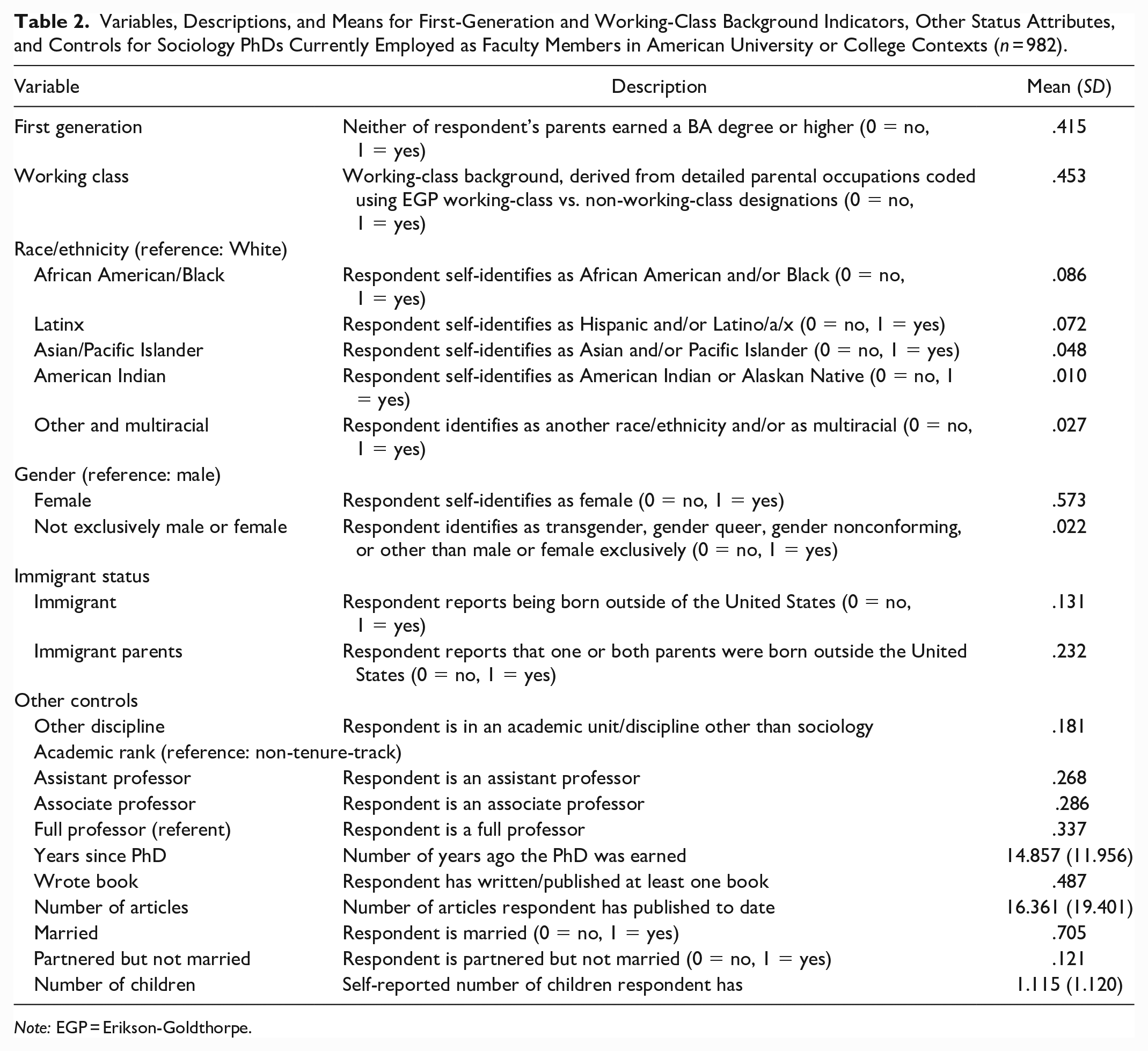
Our indicators of first-generation and working-class background importantly (1) capture most of the salient variation in SES, (2) reflect prevailing and contemporary trends and measurement in sociological research, (3) are interpretable and relevant within contemporary public debates and higher education policy, and (4) are “objective” measures that are less likely to suffer from recall bias. Notably, these two background measures overlap considerably among our faculty sample (correlation = .53), suggesting a relatively strong association between parental education and social class position. Moreover, and as reported in Table A1 in the Appendix, they also reliably overlap with traditional prestige and subjective alternatives (see also Mitnik and Cumberworth 2021). First-generation and working-class background measures, along with other important status indicators and controls, are reported in Table 2.
Variables, Descriptions, and Means for First-Generation and Working-Class Background Indicators, Other Status Attributes, and Controls for Sociology PhDs Currently Employed as Faculty Members in American University or College Contexts (n = 982).
Note: EGP = Erikson-Goldthorpe.
Race/Ethnicity, Gender, and Immigrant Status
One of the benefits of the survey device lies in its inclusion of other potentially influential status attributes such as race/ethnicity, gender, and immigrant status. Race/ethnicity is indicated by non–mutually exclusive responses to the following item: “What best reflects your race/ethnicity (please select all that apply)?” Responses included (1) White (non- Hispanic/Latino/a/x), (2) Black or African American, (3) Hispanic or Latino/a/x/ or Spanish, (4) Asian, (5) American Indian or Alaskan Native, (6) Middle Eastern or North African, (7) Native Hawaiian or Pacific Islander, and (8) other (open ended). Our analyses include indicators for white (non-Hispanic/Latino/a/x), Black or African American, Hispanic or Latino/a/x/ or Spanish, Asian/Pacific Islander, and American Indian. We also use a combined “other” category from the small numbers identifying as other, Middle Eastern/North African, and/or multiracial.
Racial/ethnic inequalities are not reducible to socioeconomic background. Moreover, distinct inequality processes and outcomes, above and beyond those analyzed in this article, are relevant to the lives and well-being of minoritized persons. Given the pertinence of minoritization to both historical and contemporary closure, exclusion, and discrimination within and across institutions, it is nevertheless essential to acknowledge inexorable links between racial/ethnic status and socioeconomic background. Such connection may be consequential for educational mobility and opportunity in the intersectional sense, to be sure (López et al. 2018). 11 It is also consequential when it comes to the demographic patterning of first-generation and working-class statuses across racial/ethnic groups. Table A2, in fact, shows this to be clearly the case. Across our sample of faculty members, African American, Latinx, and American Indian respondents are up to twice as likely as their white and Asian counterparts to be of first-generation background and are also much more likely to be of working-class background. Correspondingly, in our view, consideration of first-generation and working-class disadvantages in mobility and inequality cannot be strictly divorced from, and indeed should be considered alongside, concerns and attention to racial/ethnic inclusion and equity.
Some contemporary analyses of gender and mobility point to important advances in higher education for women (DiPrete and Buchmann 2013) as well as potential intersections of gender, first-generation status and socioeconomic background when it comes to curricular trajectories and familial obligations (Benson and Lee 2020; López et al. 2018; Wright, Roscigno, and Quadlin 2023). For these reasons we consider gender in our analyses, measured by the survey question: “What best reflects your gender (select all that apply)?” Response categories include male, female, transgender male or transgender man, transgender female or transgender woman, gender queer or gender nonconforming, different identity, and other (open ended). Approximately 57 percent of our sample identifies as female, 41 percent as male, and the remaining 2 percent report being in one of the remaining categories. We consider female and male in our analyses and, because of very small sample sizes, combine and also consider the remaining categories not falling on the traditional gender binary.
Immigrant background status may be consequential for educational incorporation, although this likely varies considerably by socioeconomic background. For this reason, we specifically account for whether the respondent and/or their parents were born within the United States. These indicators are derived from two specific questions. First, respondents were asked, “Were you born in the United States?” (1 = yes, 0 = no). They were also asked, “Were either of your parents born outside of the United States?” (1 = yes, 0 = no). Approximately 13 percent of our faculty respondents were born outside of the United States, while 23 percent had at least one parent who is/was born outside of the United States.
Other Controls
Along with key indicators of first-generation and working-class background and other status attributes, we control in some of our modeling for whether respondents are in an academic unit other than sociology, academic rank, time since earning PhD, book and article productivity, and current household composition.
Those who hold faculty teaching and/or research positions in disciplines other than sociology are coded dichotomously (1 = yes, 0 = no) and reflect 18 percent of faculty respondents. Academic rank may be important for career visibility and compensation and is measured with indicators of assistant (27 percent), associate (29 percent), and full professor (34 percent), with non-tenure-track faculty members (10 percent) serving as the referent. Controlling for years since earning PhD, which we do throughout all analyses, is important given potential variation in experiences across the academic career as well as the possibility that opportunities for educational and occupational mobility may have either constricted or expanded across time. Among our respondents, time since PhD has a mean of 14.9 years, with a standard deviation of nearly 12 years.
Household composition may be consequential for resources and/or tensions regarding geography and educational and occupational options. Respondents were asked specifically, “What is your current relationship status?” Response categories were single, married, partnered but not married, or other (open-ended). Approximately 71 percent of respondents reported being married and 12 percent partnered, compared with the remainder, nearly all of whom reported being single. Response categories regarding children (mean = 1.12, SD = 1.12) included none, one, two, three, and more than 3. About 40 percent of our faculty sample report no children, 21 percent report one child, 28 percent report two children, 7 percent report three children, and 3 percent report more than three children.
Analytic Strategy and Results
Our analyses proceed in two steps, consistent with our earlier discussion and expectations. We focus first on the educational and occupational trajectories for academic sociologists of working-class and first-generation backgrounds compared to their more background-advantaged peers. Specifically, we analyze the patterning of undergraduate and graduate program attendance and then highlight the implications for current employment in “top 20” and “top 50” academic departments. For these models, and given potential drawbacks of nonlinear probability models (see Breen, Karlson, and Holm 2018), we make use of linear regression with controls for other meaningful status attributes (e.g., racial/ethnic, gender, marital status, immigrant status) as well as years since earning one’s PhD. Appendices report full models with controls; replication using logistic regression; and disaggregated analyses of first-generation and working-class background effects with attention to potential mediation. We also draw on representative open-ended survey responses as to why, according to respondents, mobility pipeline inequalities exist and why scholars of lower socioeconomic origins are likely underrepresented. This qualitative material affords substantive insight into potential mechanisms underlying the divergences observed in our quantitative analyses.
The second portion of our analysis interrogates the implications for job compensation and economic precarity, professional status and visibility, and sense of isolation. Our data in these regards, both quantitative and qualitative, are unique in highlighting the multidimensional character of inequality. We focus first on salary compensation with all prior controls as well as department status, faculty rank, and productivity measures and provide side-by-side analyses of student loan debt and financial support of extended family members. Our analyses of professional status/visibility focus on election or appointment to leadership positions in U.S. sociology’s major national professional society; membership on journal editorial boards; membership on grant panel boards; and receipt of a federal grant(s) for one’s research. Our analytic attention to isolation centers on key professional domains: departmental, college or university, and professional conferences. Our analyses of these potential inequality outcomes highlight the relative effects of first-generation and working-class backgrounds and the extent to which mobility into or away from higher status departments and controls (e.g., rank, book and article productivity) may be playing a role. Throughout these analyses, we also draw on representative qualitative material highlighting the ways in which such inequalities are meaningful in the everyday experiences of faculty members.
Educational Trajectories, Inequalities, and the Academic Pipeline
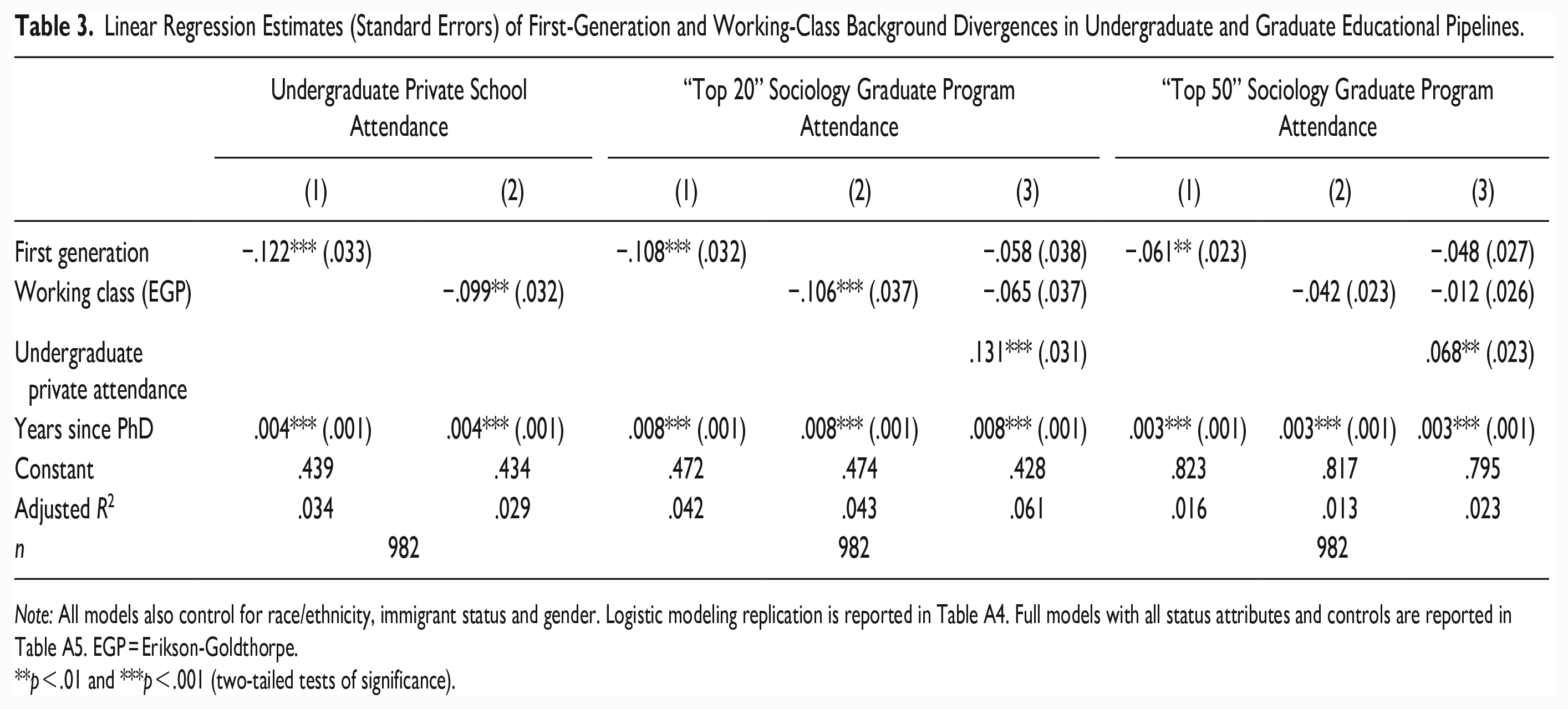
Table 3 reports educational background prior to obtaining an academic job. Specifically, we analyze the relationship between first-generation and working-class backgrounds, undergraduate institution attendance, and eventual enrollment in a “top 20” or “top 50” sociology graduate program. For graduate program attendance, we include an additional equation wherein first-generation and working-class background statuses are included simultaneously and, consistent with our interest in sequence, undergraduate (private) attendance is added as a predictor.
Linear Regression Estimates (Standard Errors) of First-Generation and Working-Class Background Divergences in Undergraduate and Graduate Educational Pipelines.
Note: All models also control for race/ethnicity, immigrant status and gender. Logistic modeling replication is reported in Table A4. Full models with all status attributes and controls are reported in Table A5. EGP = Erikson-Goldthorpe.
p < .01 and ***p < .001 (two-tailed tests of significance).
First-generation and working-class background disadvantages are notable across models 1 and 2. Although first-generation effects appear to be slightly stronger, there is substantial overlap between these two dimensions of background, so much so that it is difficult to offer completely distinct interpretations of their effects. Consistent with some prior literature on the expansion of higher education during earlier decades and the widening of postsecondary opportunities, the likelihood of private undergraduate and higher status graduate program attendance is significantly higher for older generations of scholars within our data (see also Warnock 2016). First-generation and working-class disadvantages persist nevertheless even with time since PhD included.
Predicted probabilities, derived from parallel logistic analyses and log odds coefficients (Table A4), provide some estimates of the relative size of these divergences. The probability of attending a private undergraduate institution is about 31 percent for those of first-generation status versus about 44 percent for those of continuing-generation backgrounds. Although not quite as large, the gap for those of working-class versus non-working-class background respondents is about 10 percent. As model 3 in Table 3 also suggests, background is consequential for graduate program attendance at least partly through undergraduate institutional enrollment. This interpretation, which assumes mediation, is bolstered by separate modeling of first-generation and working-class background effects. Indeed, when modeled separately, each independently and moderately declines in magnitude once undergraduate attendance is considered (Table A3).
Although interesting in and of themselves, educational trajectories may also be consequential for eventual job placement. We examine this relationship in Table 4. We specifically analyze current employment in a “top 20” and “top 50” sociology program, examining first representation by background with controls, and then adding undergraduate and graduate program enrollment in model 3. Background is clearly meaningful, reducing the likelihood of “top 20” job placement for first-generation scholars and representation in “top 50” departments for scholars of either first-generation or working-class background. Alternative analyses predicting the converse (i.e., non–top 50 job positioning, for which resources, compensation, and professional visibility and status tend to be lower) show statistically significant overrepresentation of faculty members of first-generation and working-class backgrounds. As was the case with undergraduate and graduate program enrollment, disaggregation of independent first-generation and working-class background effects (Table A3) suggests some mediation through graduate program enrollment. These effects are consistent regardless of whether linear or logistic modeling (Table A6) is used. Full linear models with all controls reported are in Table A7.
Linear Regression Estimates (Standard Errors) of Current Employment Status and Representation of Faculty Members of First-Generation and Working-Class Backgrounds in Sociology, Educational Pipelines, and Control for Years Since PhD.

Note: All models also control for race/ethnicity, immigrant status, gender, family status, and whether respondent is in a disciplinary unit other than sociology. Logistic replication is reported in Table A6; full models with all controls are reported in Table A7. EGP = Erikson-Goldthorpe.
p < .05, **p < .01, and ***p < .001 (two-tailed tests of significance).
The quantitative results thus far suggest that, although there is certainly representation of faculty members from first-generation and working-class backgrounds in the field, they remain underrepresented in higher status programs in the discipline. What potential mechanisms, however, underlie the disparities reported? Consistent with prior literature and some of our empirical findings, the gap appears to be at least partially driven by systemic and hierarchical processes built into educational mobility and credentials. Limited knowledge and/or cultural capital for first-generation and working class-individuals as well as geographic, financial, and familial constraints in the face of mobility prospects, according to many qualitative responses, are also undoubtedly at play.
In the first regard, and along with the quantitative evidence, rich open-ended responses point to ways in which inequality and exclusion are essentially baked into educational trajectories and gatekeeping processes that precede entry into the professoriate. This is consistent with other recent analyses of credentialism and hierarchy in the professoriate generally (e.g., Morgan et al. 2022). Take, for instance, these representative narratives from several of our respondents: Lower SES individuals usually come from public universities, and their odds of getting into more prestigious programs take a huge hit . . . which then, eventually, has a cost in terms of the prestige of the PHD program they end up in as well as job prospects. Background is a significant driver of academic success as an undergraduate—to have both the financial resources and the cultural capital to thrive in the university environment, which then impacts competitiveness for graduate school and so forth. Career success is certainly impacted by the ability to effectively communicate, which in university-based contexts requires written and oral communication that is associated with the middle/professional classes. SES shapes the opportunities and resources of the schools one attends, the resources and cultural knowledge of family/friends/peers, one’s own cultural knowledge related to education, the ability to attend and persist in college and graduate school. Even with funding in a PhD program I doubt students from poor or working class backgrounds could afford to attend, especially in places with high costs of living. At best they would be saddled with high student loan debt, a burden they would take into their future, which could impact family formation, homeownership, etc. I also see SES as acutely racialized in the US and so SES is related to the under representation of scholars of color in sociology.
Although many respondents note such hierarchical exclusions and links to background, just as many point to structural disadvantages in confidence, socialization, and cultural capital in graduate school and into the professoriate: I did not have all the tools needed to succeed in grad school & academia. Many of us struggle with “imposter syndrome,” gas lighting and other macroaggressions both in the classroom (from peers) and within the institution. I was often made to feel invisible and that I was not working hard, writing, or presenting enough (even though I was doing everything they’d asked me to do to make progress both in grad school and my department). . . . All of this hinders any chances I might have to move to another institution if I wanted to. Receiving no support and feeling guilty for not working to help out my family. Having no cultural capital to navigate my grad school career and my first job. Not knowing to ask my mentor for help but he’s already retired and was also marginalized in the department. First gen students don’t often know the unwritten rules of interaction within academia. Also they are rarely seen or targeted as potential stars in the discipline. Their ideas and commitment to community are seen as liabilities, versus assets to contribute to the discipline.
Finally, some highlight first-generation and working-class tensions especially when contemplating educational/occupational options and potential mobility, especially in the face of unique and intense familial, financial, marital and/or geographic constraints: Graduate students and faculty who come from disadvantaged socioeconomic backgrounds . . . are more likely to be responsible for their families in ways beyond finances, and they might spend time and energy helping family members with the complex challenges they face, which takes time and energy away from their academic work. . . . They might not ask for help from colleagues and mentors due to classed patterns of socialization and not knowing how to ask for help or what kind of help to ask for . . . which might limit opportunities, curtail possible achievements, and distance them from colleagues and mentors. At the heart of it, it would be a mixture of imposter syndrome, hidden curriculum, lack of socioeconomic support to fall back on, and a smaller network. . . . It applies to even where we attend school, how we show up, and why we go into academia in the first place. The stakes are different for us.
The quantitative results thus far along with interpretations from respondents themselves do not paint a picture of a strict caste system nor do they suggest a neutral playing field when it comes to mobility into the professoriate. Rather, there is significant presence in (and probably intellectual draw into) sociology for those of first-generation and working-class backgrounds; a point supported by their overall general representation in our data. Equally clear, however, are important and persistent inequalities in representation in higher status departments–inequalities that are driven, at least in part, by variable pathways in undergraduate enrollment, the hierarchical character and credentialism tied to graduate programs, and gaps in tangible resources, information, and cultural capital. In these regards, we remind the reader that these conclusions are derived from a conservative test of the academic pipeline in at least one important regard: the sampling frame is constrained to those who were dues paying members of the largest national professional association at some point over a prior three-year period. Arguably disproportionately excluded are those who (1) are located at lower resourced institutions (e.g., community colleges, regional public universities), (2) opted out of academic sociology altogether, and/or (3) could not obtain long-term and secure academic positions. Consequently, the pipeline inequalities reported thus far are likely significantly underestimated.
Implications for Economic Precarity, Professional Visibility, and Sense of Isolation
Although educational and occupational status divergences are important in and of themselves, they may also be consequential for inequalities in resources, visibility, and sense of inclusion. It is with such associations in mind that we interrogate the implications of the patterns observed for job compensation and economic precarity, professional visibility and status, and sense of isolation in the field.
We begin with compensation and economic precarity, reported in Table 5. Regarding income specifically, there are salary disadvantages of about $6,000 and $5,000 for those of first-generation and working-class backgrounds, respectively, even after controlling for years since PhD and status indicators such as gender, marital and parental status, race/ethnicity, immigrant status, etc. Such compensation differentials are almost entirely accounted for in model 3 once current department status (i.e., “top 20” or “top 50”) along with indicators of productivity (i.e., book and article production) and academic rank are considered. Effects of departmental status are even stronger when indicators of book and article productivity are not included. Top 20 and top 50 status designations are correlated with book and article productivity at between .15 and .35, respectively, most likely because of selection effects along with greater research resources, lower teaching loads, and other factors (see also Zhang et al. 2022).
Linear Regression Estimates (Standard Errors) of Academic Salary, Precarity and Debt, and Financial Support of Extended Family with Departmental Status, Productivity and Rank, and Control for Years Since PhD.

Note: All models also control for race/ethnicity, gender, immigrant status, marital and parenthood status, and whether respondent is in a sociology program specifically. EGP = Erikson-Goldthorpe.
p < .05, **p < .01, and ***p < .001 (two-tailed tests of significance).
We suggested earlier that salary compensation alone probably underestimates the degree of resource disadvantage and precarity experienced by academics from first-generation and working-class backgrounds. It is for this reason that we likewise report student loan debt and family monetary flows. Beyond lower compensation on average, those of first-generation and working-class backgrounds are more likely to have student debt, have significantly higher levels of student debt in actual dollars, and are much more likely than their continuing-generation and higher class-origin peers to be providing regular financial assistance to extended family members.
Models 1 and 2 suggest that first- versus continuing-generation and working-class versus non-working-class class gaps in student loan debt range, on average, between $25,000 and $15,000, respectively. Furthermore, approximately one fourth of first-generation and working-class background faculty regularly provide monetary support to extended family compared with 14 percent of faculty members from continuing-generation and non-working-class backgrounds. Although student debt and family financial support are not tied directly to current job placement like salary, considering them alongside salary gaps offers unique insight into the economic precarity that many scholars of disadvantaged backgrounds face.
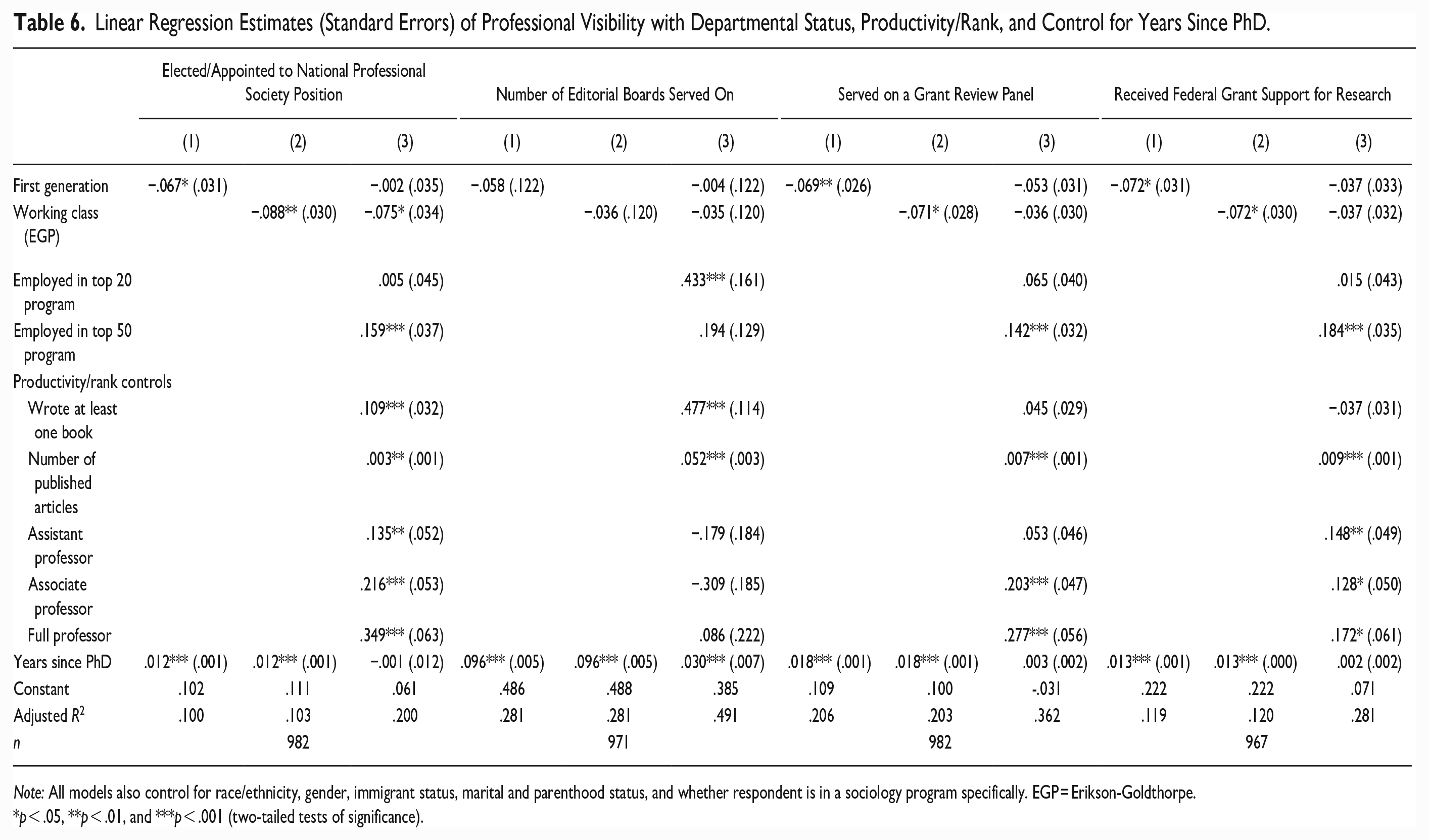
Table 6 reports results regarding professional status and visibility. Here we focus on whether the respondent has been elected or appointed to a key position in the largest national association of sociologists, the number of journal editorial boards they have served on, whether they have served on a grant review panel, and/or whether they have received a federal grant for their research. These are generally interpreted as high visibility positions and status markers within the larger discipline. Those of first-generation and working-class backgrounds are disadvantaged in three of these regards and such effects appear to be driven partially by the status of the department in which an individual is employed, a point again amplifying the relevance of educational trajectories and job attainment. The one exception to this pattern appears to be editorial board service.
Linear Regression Estimates (Standard Errors) of Professional Visibility with Departmental Status, Productivity/Rank, and Control for Years Since PhD.
Note: All models also control for race/ethnicity, gender, immigrant status, marital and parenthood status, and whether respondent is in a sociology program specifically. EGP = Erikson-Goldthorpe.
p < .05, **p < .01, and ***p < .001 (two-tailed tests of significance).
We also considered the possibility that other, more proximate, service-related administrative tasks on one’s campus or in one’s department might detract from field-level visibility. Analyses in this regard revealed little in the way of group differences with one exception: those of first-generation and working-class backgrounds report spending significantly more hours each week advising and mentoring students. Further interrogation of an open-ended survey item in supplementary analyses and a companion paper provided more detail. Specifically, those of first-generation and working-class backgrounds note a sense of responsibility toward disadvantaged students and an especially heavy emotional and care-work toll that such mentorship interactions take.
Finally, every bit as consequential as material inequalities and those surrounding visibility in the field may be the social psychological and interactional consequences of being of first-generation or working-class background in academia (Grimes and Morris 1997; Zambrana et al. 2017). Our analyses in these regards, reported in Table 7, focus on relative sense of isolation in one’s department, in college and university environments, and at professional conferences. In all three regards, those of first-generation and working-class backgrounds report a much higher sense of isolation. Such effects of background are, in fact, quite strong both statistically and substantively. For instance, the probability of first-generation and working-class academics feeling isolated or out of place ranges overall between 45 percent and 65 percent depending on the specific outcome, and these findings are robust to alternative modeling strategies (Table A8).
Linear Regression Estimates (Standard Errors) of Sense of Isolation at Department, College or University, and Professional Conference Levels with Employment Status, Rank and Productivity, and Control for Years Since PhD.
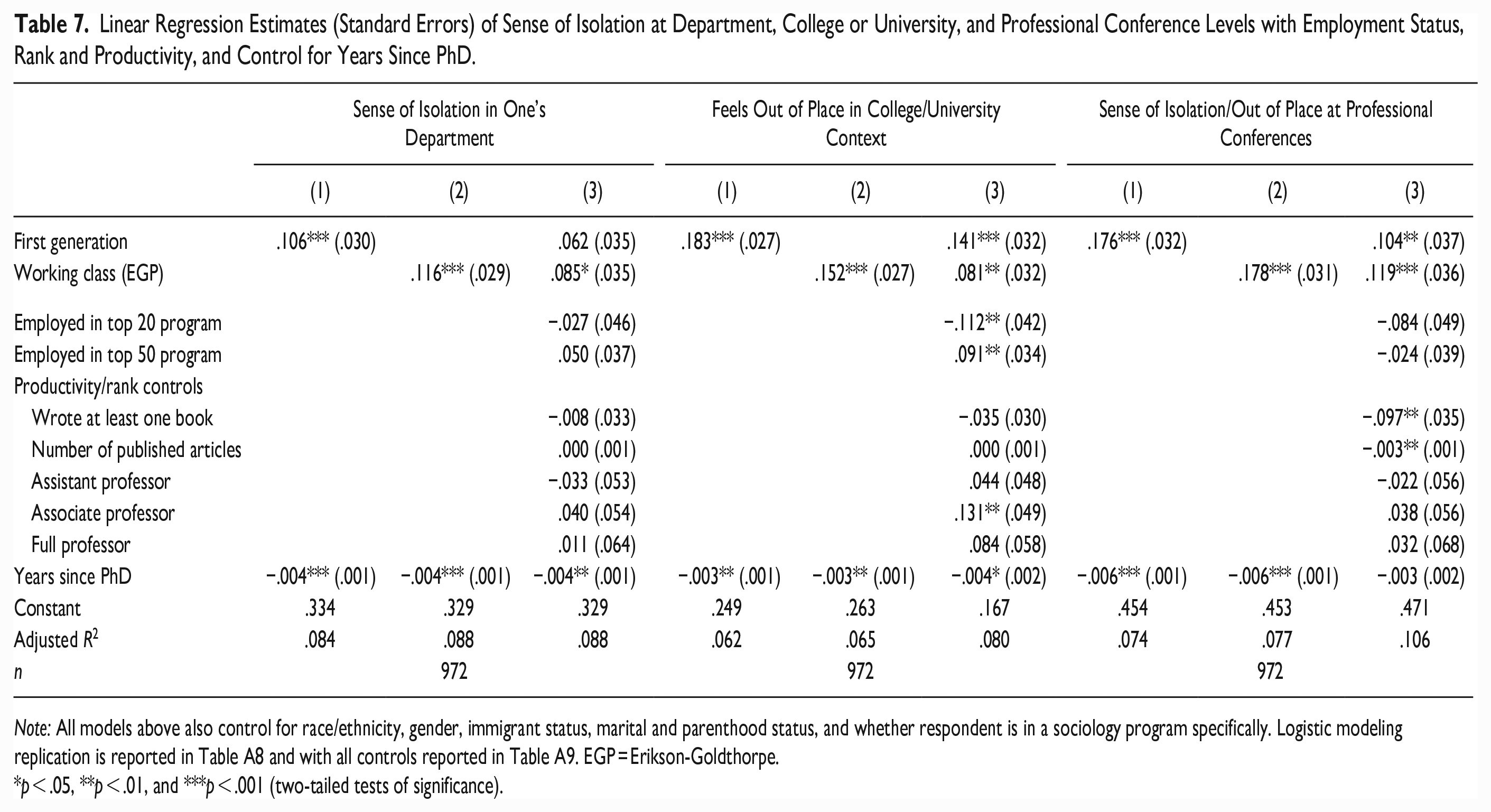
Note: All models above also control for race/ethnicity, gender, immigrant status, marital and parenthood status, and whether respondent is in a sociology program specifically. Logistic modeling replication is reported in Table A8 and with all controls reported in Table A9. EGP = Erikson-Goldthorpe.
p < .05, **p < .01, and ***p < .001 (two-tailed tests of significance).
Results regarding isolation reported in full logistic models (Table A9) highlight interesting variations by race/ethnicity and gender. Particularly noteworthy is that women and African American, Latinx, and Asian faculty members report higher average levels of isolation within their departments compared with their male and white counterparts. Such isolation, however, is not observed for these groups when it comes to more general college or university or professional conferences contexts. This suggests that efforts toward inclusion and integration for women and minority scholars should be focused at the more proximate departmental level. No statistically significant interactions were observed between background and departmental status, or between first-generation/working-class backgrounds and race/ethnicity and gender when it comes to isolation. 12 This suggests, at least preliminarily, that feelings of isolation among those of first-generation and working-class backgrounds are relatively uniform.
Such strong effects surrounding isolation are in line with broader literatures on first-generation, working class, and low-income students on college campuses (Hurst 2019; Jack 2019; Mcdossi et al. 2022) as well as firsthand treatments of the social psychological consequences of downward and upward mobility (Ryan and Sackrey 1996; Tokarczyk and Fay 1993). Unique to our analyses is the extension of the isolation foci to the threefold academic domains (departmental, campus, and professional associations) wherein integration (or lack thereof) is most likely to be experienced. Isolation, in fact, is quite consequential in the everyday lives of these faculty members: Difficulty connecting with and understanding higher status individuals. Being seen as an oddity. Having different hobbies than those you’re surrounded by and therefore having less small talk. Having less wealth and more to worry about for retirement and colleagues not understanding that. There is a culture in academia that I think sometimes excludes working class. Additionally, I find you have to be rather egotistical to be a successful academic and I tend to be more community oriented. In the context of networking, and when interacting with folks at private schools, it’s easy to feel “out of place.” The amount of privilege many in the field currently have is hard to process. Furthermore, I underestimate(d) my own contributions and worth. I think this has an impact on salary negotiations, etc. Lack of the specific support and capital needed to counter some of the strands of imposter syndrome, etc. Never feeling you’re fully worthy or belong which creates an unhealthy relationship with the work. Feeling obligated to do service and isolated at times.
For some, sense of isolation seems to only be exacerbated by service-related obligations that are often unrecognized, usually uncompensated, and emotionally taxing, such as mentoring and supporting students and colleagues who themselves feel alone or targeted because of classicism, racism, sexism, and other factors: I am constantly the person to turn to when it comes to diversity to serve on search committees, work with students, faculty, staff etc. While I love working with the diverse students of color that come through my door, at times it is emotionally and psychologically draining . . . if I don’t do the service, and be in the room advocating for diversity, who will? It’s a complete lose/lose scenario. I do A LOT of emotional labor working with first-generation, low-income, and working-class students on my campus. They often come to me upset about something that has happened with a peer or colleague and I act as de facto counselor to them. I enjoy working with these students, but this happens often and takes up a lot of my time and is a large emotional burden on me as well.
Faculty from more advantaged origins likewise report in our data being overburdened with service work. The overloads they report, however, tend to involve tasks more closely linked to professional status and visibility (e.g., serving of editorial boards or in professional society positions) and/or that tend to be financially compensated (e.g., department chair). We hope future work will interrogate more deeply divergences in service-related pressures and work. We believe that our results, pointing to the emotional toll of certain types of service work and its unique consequences for faculty members of first-generation and working-class backgrounds and also especially women and racial/ethnic minority faculty members, could be informative to such efforts (see also Misra et al. 2021).
Discussion and Conclusions
Questions regarding mobility and inequality have been foundational to sociological analyses since the field’s inception. We follow this tradition and pertinent literature in this article and focus on a relatively high-status occupational domain, the professoriate, and ask whether mobility divergences and inequalities can be observed by first-generation and working-class backgrounds specifically. The field of sociology and well-being of its faculty provide, in our view, an interesting and potentially critical and conservative test of such relations given what is arguably field-specific intellectual appeal and draw for disadvantaged populations as well explicit recognition of diversity and representation across most sociology departments and professional societies. Our use of unique survey data and analyses of almost 1,000 academic sociologists in the United States—survey data that include rich detail on background, sequential educational and job information, and indicators of inequality across multiple dimensions—helps advance in important ways the understanding of mobility divergence, constraint, and their consequences.
Although certainly represented in the field generally, the first portion of our analyses revealed underrepresentation among those of first-generation and working-class backgrounds in especially higher status departments. Consideration of sequence helped highlight how this occurs at least partly through divergences in undergraduate and graduate program enrollment and credentials. This findings parallels recent analyses of the professoriate generally (e.g., Morgan et al. 2022) and is consistent with institutional and organizational understandings of inequality and the ways it is systematically reified, on average, by structures and related internal processes that are often viewed as neutral and meritocratic (see Ray 2019; Roscigno 2011). It also resonates with classic and contemporary arguments highlighting the ways in which stratification is essentially baked into everyday organizational and institutional operations (Fischer et al. 1996; Tilly 1999; Tomaskovic-Devey and Avent-Holt 2019). Open-ended responses from survey respondents expanded on pertinent mechanisms, noting structural obstacles in educational and occupational pipelines as well as group disadvantages in cultural and social capital, familial obligations, and debt and affordability.
That faculty members of first-generation and working-class backgrounds are disadvantaged during educational mobility contests and that gaps in cultural capital, information, and/or tangible resources are partly to blame will likely come as little surprise to sociology of education scholars who have effectively demonstrated such inequalities among children, adolescents and young adults entering college (e.g., Calarco 2020a; Jack 2019; Lareau 2003). Our analyses extend such insights to later in the educational process and to job attainment (in this regard, see also Friedman and Laurison 2019; Rivera 2015). Although some research suggests that attainment of a bachelor’s degree mostly neutralizes background socioeconomic disparities in the labor market returns (see Hout 2012; Torche 2011), our results suggest that this may not necessarily be the case within high-status careers requiring graduate training and credentials. Rather, gaps in access and mobility persist.
The second part of our analyses interrogated the inequality implications of background and educational and occupational divergences. Specifically, we drew from rich survey indicators and open-ended qualitative responses and analyzed job returns and economic precarity, professional visibility, and sense of isolation at department, campus, and professional levels. Findings in these regards are clear and nearly uniform in directionality: those of first-generation and working-class backgrounds are more likely to find themselves in an economically precarious position because of lower salaries, more debt, and the extension of financial support to family; they experience less professional visibility on average, especially with regard to holding national professional positions, serving on grant review panels, and receiving federal financial support for their work; and they experience significant isolation in the context of their own departments, on college and university campuses, and when at professional conferences. Such multidimensional aspects of inequality, while hardly all encompassing, are unique to our data and analyses. We hope future scholarship will likewise consider and incorporate a diversity of inequality outcomes into data collection designs and analyses of mobility. Some of the inequalities observed are tied to background but more directly to positioning and job attainment in the field’s most highly ranked programs. Others surrounding isolation, on the other hand, persist and are observed regardless of job attainment or other status attributes.
Our findings with respect to isolation are especially stark and troubling. They point to the social psychological consequences of inequality regardless of field-specific achievements and/or rises in rank or status over time. Supplementary qualitative material from scholars of first-generation and working-class backgrounds speak to this, noting a disconnect from colleagues, difficulties relating with higher status individuals, and awkwardness and anxiety in traversing the academic world (see also Grimes and Morris 1997). Although certainly true for first-generation and low-income undergraduates (Hurst 2019; Jack 2014; Lee 2017), such social-psychological effects and social dislocation clearly persist even among those earning advanced degrees and those who experience upward mobility into higher status occupations.
Also important to our analyses, at least indirectly, is the fact that we were able to measure and analyze first-generation and working-class backgrounds discretely, and in a manner that few studies have been able to. These statuses, measured with objective indicators, overlap considerably to the point where it is challenging to offer completely unique interpretations of their effects. Indeed, they also overlap substantially with more traditional scales (e.g., occupational prestige) and subjective reports (e.g., in what class would you say your family was when you were a child?), something that speaks to their reliability as indicators of background advantage and disadvantage. We nevertheless hope that future research, including detailed methodological treatments, will take up the question of which if any is better or, alternatively, if they are capturing distinct gaps in information and cultural capital versus tangible economic resources. We suspect the latter, but also believe it important to not lose sight of their empirical and substantive overlaps and effects.
Finally, we also hope that future research will be able to systematically examine whether, when and how first-generation and working-class backgrounds intersect with other important status dynamics, particularly race/ethnicity and gender. As noted in our data discussion, there are substantial demographic overlaps especially with race/ethnicity that fundamentally tie any concern with first-generation and working-class inequalities to issues of racial/ethnic inequality and equity. Ideally, future analyses will be able to more thoroughly explore intersectional processes in these regards. Although our own data are limited by sample sizes, emerging educational and occupational research on race/ethnicity and gender, employing quantitative (López et al. 2018; Wright et al. 2023) and qualitative data (Benson and Lee 2020; Wallace 2018; Wingfield 2019), have begun to effectively interrogate intersectional patterns and processes. We hope future work will follow suit while simultaneously recognizing distinct and nonreducible racialized and gendered dynamics above and beyond any that are particular to socioeconomic background.
Our foci, data, analyses, results, and discussion represent an important contribution to literatures on inequality, mobility, education, and work–a contribution that extends sociological interest in inequality and mobility to graduate training, occupational attainment, and inequality experiences, and that uniquely brings into relief the durability of first-generation and working-class background effects even into the ranks of the professoriate. Our analytic focus on sociology as an academic field is also important. It has been long seen by the public as progressive. Furthermore, many faculty within it explicitly engage in research about inequality, and most sociology departments and professional societies at least symbolically convey a sense of openness and diversity. These facts, along with the recognition that our data likely only include more advantaged (dues-paying) professional society members, lead us to believe that our results most likely underestimate background divergences and that inequalities by socioeconomic background may be more pronounced in other academic fields. We look forward to future analyses that can assess whether this is, in fact, the case.
Some will undoubtedly interpret divergences in educational and occupational pathways, along with the various inequalities highlighted, as resulting from individual “self-selection” into and out of mobility contests and high pressure, high productivity, and high-status jobs. It is indeed easy to imagine how debt and fear of debt, ties to one’s community of origin, familial obligations, and sense of belonging or lack thereof may lead some to “opt out,” so to speak, of elite educational institutional enrollment and job acquisition. Some of our survey respondents, in fact, report such tensions and dilemmas in their own decision making, so we cannot ignore such possibilities. Such disparities, however, cannot (and should not) be theoretically or empirically reduced to mere individual self-selection. To do so is antisociological at its very core. Rather, choices are structurally rooted in socioeconomic (and other group-specific status) constraints, often reified by organizational and institutional–processes that create pipeline gaps and that result in tangible, relational and social-psychological inequalities and experiences for those on the losing end. Those from disadvantaged backgrounds are hurt as a result. So too are academic disciplines given losses in intellectual insight, diversity, and talent along the way.
Footnotes
Appendix
Logistic Regression Estimates (Standard Errors) for Final Equation of Table 7 with All Other Status Attributes and Controls Reported.

| Sense of Isolation in One’s Department | Feels Out of Place in College/University |
Isolated/Out of Place |
|
|---|---|---|---|
| First generation | .302 (.176) |
|
|
| Working class (EGP) |
|
|
|
| African American | 1.096*** (.253) | .076 (.280) | .027 (.255) |
| Latinx | .561* (.285) | .271 (.317) | .085 (.285) |
| American Indian | −.509 (.723) | .113 (.775) | −.189 (.660) |
| Asian/Pacific Islander | .958** (.350) | .431 (.422) | .551 (.347) |
| Other/multiracial | .726 (.414) | 1.078* (.481) | .515 (.648) |
| Immigrant | −.235 (.266) | −.524 (.325) | −.090 (.261) |
| Immigrant parents | .107 (.222) | −.287 (.258) | −.358 (.215) |
| Female | .388* (.158) | −.013 (.074) | .217 (.149) |
| Not exclusively male/female | .831 (.440) | .685 (.539) | .669 (.478) |
| Married | −.345 (.205) | −.318 (.225) | .133 (.199) |
| Partnered | −.271 (.274) | −.087 (.292) | .335 (.262) |
| Children | −.124 (.074) | −.072 (.082) | −.173* (.169) |
| In discipline other than sociology | −.245 (.200) | .026 (.220) | .142 (.186) |
| Years since PhD | −.030**(.011) | −.028* (.012) | .015 (.010) |
| In top 20 department | −.133 (.238) | −.746** (.278) | −.457 (.235) |
| In top 50 department | .256 (.188) | .559* (.204) | −.080 (.179) |
| Assistant professor | −.172 (.261) | .275 (.306) | −.079 (.250) |
| Associate professor | .221 (.267) | .809** (.312) | .222 (.257) |
| Full professor | .083 (.330) | .560 (.386) | .209 (.312) |
| Wrote a book | −.038 (.167) | −.223 (.186) | −.439** (.157) |
| Number of published articles | .001 (.005) | .001 (.006) | −.015** (.005) |
| Constant | −.805 | −1.682 | −.118 |
| Pseudo-R2 | .149 | .152 | .171 |
| n | 972 | 972 | 972 |
Note: EGP = Erikson-Goldthorpe.
p < .05, **p < .01, and ***p < .001 (two-tailed tests of significance).
Acknowledgements
The authors are grateful to the American Sociological Association Council and Staff for their creation of our taskforce and support of our work, for the use of these data as part of that work, and to countless U.S. and international colleagues who graciously participated in the survey and generously offered their time and insights in focus groups and open-ended interviewing in a way that enriched this project and made it possible. We also wish to thank the editors and reviewers of Socius for a fair, timely, and rigorous review process.
Funding
This research was supported, in part, by funding from the American Sociological Association.
ORCID iDs
1
As we discuss shortly in our measurement section, we focus largely on first-generation and working-class backgrounds, although also collected traditional gradational and subjective measures of class background. As we report, these correlate quite highly.
2
Those from disadvantaged backgrounds who manage to circumvent such institutional inequalities and get into and through college, on the other hand, can benefit significantly when it comes to labor market returns. This seems to be true at least for those earning a bachelor’s degree (Hout 2012;  ). Whether this is true for those with advanced degrees, including faculty members, is unclear.
3
Mobility, of course, does not occur in a social vacuum nor is it driven in purely individualistic, advantage-maximizing ways. Rather, it is socially and structurally patterned by resource disparities, familial/community obligations, and (imperfect) knowledge regarding benefits and costs. Individuals of working-class and first-generation backgrounds might, for instance, have or express greater interest in serving more diverse campuses (Covarrubias and Fryberg 2015; London 1989; Piorkowski 1983), have misgivings about working in more (alien) elite institutional settings (King and McPherson 2020; Warnock 2016), and/or consequently experience greater levels of attrition from graduate training and employment as faculty members (). Regardless, distinct mobility pathways will have implications for inequality given the hierarchical character of academic institutions and the uneven resources and status that they ultimately confer.
4
This is even more important when one considers that professional activities (e.g., memberships, conference travel, journal submissions), although sometimes reimbursed by departments or through grants, are often paid out of pocket first.
5
Although we are unaware of systematic analyses on the topic, it is difficult to imagine that faculty at regional campuses, community colleges, or lower prestige academic programs would or could be elected as easily, if at all, into prominent national professional society positions. Relative to grant getting, agencies such as the National Science Foundation are regularly taken to task for making awards to researchers and students located in the same handful of prestigious programs. In 2018, for instance, the Graduate Research Fellowship Program made a total of 2,000 awards to undergraduates applying to graduate school and graduate students in their first years. Harvard University received 43 such awards whereas the entire public university system of California received 50 awards ().
6
We excluded from consideration graduate students and postdoctoral scholars and, given alternative status and ranking systems across national boundaries, limit analyses to those who attended graduate school within the United States and who currently hold an academic position inside the United States.
7
Indicators regarding “top” programs (i.e., “top 20” and “top 50”), discussed in more detail momentarily, are admittedly imprecise to some extent, tied to history and research emphases, and are also subjective. Nevertheless, there is a consequential ranking system of departments nationally, most often linked to U.S. News & World Report. Given that higher ranked departments actively use status to recruit, there is every reason to believe that most if not all faculty members are aware of this status hierarchy and their place in it.
8
In additional analyses not reported, we also modeled whether respondents published articles in a “leading” journals (i.e., another form of professional visibility) as well as whether and to what degree respondents engage in other service-related work that might undermine professional visibility (e.g., time with and mentorship of students, writing letters of recommendation, and serving in various administrative capacities within one’s department). We discuss effects in these regards alongside outcomes of professional visibility, noted earlier, within our results discussion.
9
Parental educational background, of course, can be temporally fluid and effects of parental education might be more continuous than nominal. On this point, we confirmed in supplementary analyses that our results are robust (albeit slightly weaker) when associates degrees are included. However, given (1) recent work on educational mobility that omits associates degrees (including technical and vocational) from consideration, (2) the preponderance of literature on first-generation status and why parental BA attainment is especially consequential, and (3) the fact that our nominal indicator is consistent with how nearly all college and universities currently record first-generation status, we opt for the conventional and nominal first-generation indicator.
10
EGP categorizes occupations on the basis of the nature of the work (manual vs. nonmanual), skill and task specificity, the nature of the labor contract (salaried vs. unsalaried), and the domain of work (such as white collar vs. agricultural) (). Specific to our coding, EGP classes 5 to 8 were coded as working class, while classes 1 and 2 were coded as not working class. We then inspected open-ended responses and manually coded and sorted classes 3 and 4 into or out of the working-class designation.
11
Preliminary analyses in this regard explored both means comparisons and the possibility of interactions between first-generation/working-class status by race/ethnicity, immigrant status and gender. Because of limited sample sizes, however, such analyses did not produce reliable estimates, statistically significant group differences, and/or conditional associations. It is nevertheless impossible to close off the possibility that unique intersectional inequalities exist. We hope future work will explore such possibilities using more in-depth qualitative methods (see Benson and Lee 2020; Buenavista, Jain, and Ledesma 2023; Jack 2019) and/or quantitative data with large enough samples (see ).
12
To be clear, lack of conditional statistical associations with race/ethnicity and/or gender may be a function of sample size limitations. As such, future research would be well served interrogating potential intersections using either more detailed surveys, that might capture specific gendered and racialized processes, or in-depth interviewing and qualitative techniques that can get more effectively at nuances in process.