




Abstract
Sociological research has long been interested in inequalities generated by and within educational institutions. Although relatively rich as a literature, less analytic focus has centered on educational mobility and inequality experiences within graduate training specifically. In this article, we draw on a combination of survey and open-ended qualitative data from approximately 450 graduate students in the discipline of sociology to analyze graduate school pipeline divergences for first-generation and working-class students and the implications for inequalities in tangible resources, advising and support, and a sense of isolation. Our results point to an important connection between private undergraduate institutional enrollment and higher-status graduate program attendance—a pattern that undercuts social-class mobility in graduate training and creates notable precarities in debt, advising, and sense of belonging for first-generation and working-class graduate students. We conclude by discussing the unequal pathways revealed and their implications for merit and mobility, graduate training, and opportunity within our and other disciplines.
Research in the sociology of education is incredibly rich when it comes to the consequences of family background (i.e., socioeconomic status) for educational achievement, persistence, and mobility. Some of this work, traditionally grounded within a status attainment framework (e.g., Jackson et al. 2007), centers on elementary and high school students, but more recent work has extended examination of mobility, persistence, and attainment to the college level (e.g., Douglass and Thomson 2012; Grodsky and Rieglecrumb 2010; Ishitani 2006; Reisel 2011). These analyses highlight persistent contemporary inequalities for students of first-generation, working-class, and low-income backgrounds (e.g., Ardoin 2018; Bastedo and Jaquette 2011; Benson and Lee 2020; Boliver 2011; Hamilton 2016; Lathe 2018; Lee 2016; Lehman 2008; O’Shea 2017; Soria 2015; Warnock and Hurst 2016) and the hierarchical character of the higher-education system itself—a system that credentializes individuals at distinct status levels and thus has the capacity to reproduce inequality even among people who eventually hold similar degrees (Hurst 2019; Wakeling and Savage 2015).
Graduate education has received comparatively less empirical attention. This is unfortunate given that advanced degrees are increasingly the pipeline credential required for professional careers. Moreover, graduate programs within most fields tend to be explicitly hierarchically ranked, replete with historical reputational lags, variable admissions criteria, and distinct labor market payoffs (Cassuto 2015; Costello 2005; Hagstrom 1971). In this article, we consider graduate training and analyze whether there are observable graduate pipeline divergences among students of first-generation and working-class backgrounds and the extent to which there are consequences for resource, interactional, and social-psychological dimensions of inequality.
Our empirical focus on graduate students within sociology provides an interesting case given that the field has always held appeal for and been more successful than other fields in recruiting students of diverse backgrounds. Moreover, the field and its scholarship take inequality and mobility seriously (Bourdieu 2010; Buechler 2008; Crossley 2003; Feagin and Vera 2008; Fernandez 2003) and seem to work hard, at least symbolically, when it comes to diversity and inclusion efforts (Smith 2014). We thus suspect any inequalities observed within our own field are likely generalizable to and perhaps even more pronounced within other academic disciplines. On this point, recent aggregate analyses suggest sociology, like other disciplines, has outsized representation of individuals with higher socioeconomic backgrounds (Morgan et al. 2022).
We begin with research on family background and the ways it stratifies experiences and opportunities in higher education. This literature provides an important launch point for our analyses and informs our main expectations. Our data, which include rich background measures, controls, reports of undergraduate and current graduate school attendance, and indicators of resources/debt, mentorship, sense of inclusion, and several associated open-ended survey items, were derived from a larger data collection effort in 2019 to 2020 by the American Sociological Association’s Task Force on First-Generation and Working-Class Persons in Sociology. The task force aimed to interrogate the experiences of individuals and groups and potential inequalities within the field. We limit our sampling strategy and analytic focus in this article to current U.S. graduate students surveyed (N = 452). Our discussion and findings are especially informative to several literatures in the sociology of education (i.e., literatures on family background inequalities, mobility processes and attainment, and practices and processes in higher education) and offer practical insights that graduate programs within our and other fields might consider.
Graduate School Access, Enrollment, and Potential Pipeline Inequalities
Surprisingly few studies explicitly interrogate graduate educational pathways and inequalities by first-generation and working-class backgrounds. We do know more generally, however, that social class background plays a role in who eventually attends graduate school. Torche (2018), for instance, finds that close to 40 percent of a sample of U.S. PhD holders have parents with graduate degrees; this number is disproportionately high given that only 14.3 percent of the overall U.S. population has an advanced degree (U.S. Census Bureau 2022).
Disaggregating graduate education by type, Mullen, Goyette, and Soares (2003) similarly find a strong effect of parental education on entry into doctoral programs—this effect is largely indirect and operates through a variety of factors, including the type of undergraduate institution one attends. Specifically, the odds of entering doctoral programs seem to be higher for undergraduates from private research institutions and liberal arts colleges. This is consistent with Hurst (2019), who finds a strong effect of parental education and class position on graduate school attendance, even among students coming from small liberal arts colleges. Recent data from the National Science Foundation also show a higher representation of continuing-generation students in doctoral programs, especially in recent decades (National Center for Science and Engineering Statistics 2021).
Such findings tend to contradict an earlier assumption in the literature that social origins have a relatively weak (or nonexistent) influence at more advanced stages (Stolzenberg 1994). Of course, background effects may vary by historical and institutional context (Blome, Möller, and Böning 2019; Enders 2002; Mastekaasa 2006). Within the U.S. context, the effect of socioeconomic background was likely weaker among college-graduate cohorts in the era of mass educational expansion, between the 1950s and 1970s, and has since grown stronger.
Although limited attention centers on family socioeconomic background and graduate school student experiences, Warnock and Appel’s (2012) survey of sociology graduate students is especially informative. Their results suggest students who self-identified as working or lower class (27 percent of the sample) often feel less academically prepared, are less socially integrated, and tend to be more financially disadvantaged than their peers. Working-class graduate students, according to their findings, are also significantly more likely to accrue debt for graduate school, have significantly more debt in total dollars than their middle-class peers, and are more likely to expect their debt to affect their future career decisions.
Further attention to graduate enrollment and graduate student populations is warranted, but recent research on undergraduates (Aries 2008; Hurst 2019; Jack 2019; Lee 2016; Stuber 2011; Wilbur and Roscigno 2016) and faculty of working-class and first-generation backgrounds (Arner 2021; Haney 2015; Roscigno et al. 2023) is informative to our focus, particularly when it comes to graduate school barriers. A few analyses indeed point to patterns of disadvantage and vulnerability that persist into graduate education (e.g., Smith, Mao, and Deshpande 2016).
Inequalities in cultural capital, truncated social networks, family responsibilities, and identity consequences (e.g., sense of isolation and imposter syndrome) are common themes among first-generation and working-class students who eventually make it to graduate school (Warnock 2016). In contrast to individuals who received PhDs in the 1960s and 1970s, who may have struggled with feelings of psychological dislocation but who otherwise achieved all the hallmarks of academic success (e.g., attendance at top programs, publications, awards), accounts from more newly minted academics point to a stronger link between social origins and mobility into and through graduate school, with important long-term consequences (e.g., greater job-specific precarity, financial stress, and debt; Roscigno et al. 2023). This emerging literature points to potential pipeline inequalities and, specifically, the following expectation:
There will be observable inequalities in high-status graduate program enrollment for first-generation and working-class students, net of other status attributes and controls. Pipeline inequalities will be tied to a variety of non-mutually exclusive factors, including limited resources, disadvantages in knowledge and cultural capital, a desire or need to stay proximate to home, and lower levels of attendance at private and liberal arts undergraduate institutions.
Such a prediction is consistent with sequential understandings of mobility and arguments about credentialism and gatekeeping as mechanisms of inequality production (Posselt 2016). Given the still emerging literature on how and why undergraduates pursue graduate education in the first place (e.g., Hurst 2019; Mullen et al. 2003; Tate et al. 2015), we suspect any observed disparities will likely be tied to several factors: knowledge (or lack thereof) of graduate program status hierarchies, (in)ability to secure strong letters of recommendation, background gaps in GRE performance, differences in financial resources constraints, and a desire or need to remain geographically proximate to family members. 1 Although we cannot test each potential (and non-mutually exclusive) mechanism, our quantitative modeling of inequalities in the graduate pipeline coupled with rich qualitative materials derived from open-ended survey items is nevertheless informative in several of these regards.
Dimensions of Inequality And Experiences Within Graduate School Education
To the extent educational pathways are uneven, there is good reason to believe they will be consequential for graduate school experiences and returns, particularly given status and resource differentials across graduate programs. We know this to be the case in terms of labor market returns, wherein a handful of high-status and high-resourced graduate programs produce the majority of faculty in the discipline (Burris 2004; Hagstrom 1971).
One could, of course, make the case that disparate success in graduate school is a function of the fact that some programs are simply better than others or that the students higher-status programs admit are more talented and capable. We do not completely reject this point. Yet the more likely explanation, according to Burris (2004), lies in a department’s historical prestige, current positioning in the field-specific network, and the nonmeritocratic advantages its credentialing confers on members. This includes advantages in job placement but also a host of potentially important ancillary inequalities tied to one’s graduate school experiences. Some of the most pivotal factors, in our view, surround resource access and, conversely, economic precarity and accumulated graduate school debt, the overall quality of advising and departmental socialization support, and a sense of isolation within one’s academic field, campus, or department. We briefly address each.
Background disadvantages and distinct mobility pathways will most likely have implications for the resources graduate students receive or the degree to which they experience economic precarity and debt. The fact that higher-status graduate programs have more resources to recruit graduate students, particularly students perceived as more capable or deserving, should come as no surprise. This is also important, however, given that heightened program prominence likely translates into competitive internal and external resource advantages. If so, and if students of working-class or first-generation backgrounds are less likely to enroll or complete their training in higher-status programs, inequalities in resources will tend to be structurally reproduced. Are there tangible resource gaps for students of first-generation and working-class backgrounds? And if so, to what degree are graduate program status divergences at least partially responsible? These are some of our central questions.
The focus on resource inequalities among graduate students, although interesting in and of itself, is even more pertinent if one considers that students with disadvantaged backgrounds are more likely to experience economic precarity from the outset (Addo, Houle, and Simon 2016) and have fewer family resources to draw on when facing economic difficulties. The amount of debt accrued during graduate school is more unequal than it is for undergraduate debt, and we know that such debt burden is disproportionately borne by poorer students and students of color (Martin and Dwyer 2021; Pyne and Grodsky 2020).
The education and family literatures (e.g., Barnett, Cooney, and Shapiro 2020; Bea and Yi 2019) typically assume resources largely flow from parents to children, yet the fact that individuals of first-generation and working-class origins are more likely to come from less economically secure families (Goldrick-Rab and Sorensen 2010) and often experience guilt surrounding their mobility (Hurst 2010) and geographic distance from family (Covarrubias and Fryberg 2015) may invert this relationship and intensify financial vulnerability. 2 Without taking into account debt and family financial flows—something our original data allow for—analyses of graduate well-being and resource-related gaps will most likely underestimate levels of economic precarity.
Problematic mentoring or advising and limited departmental support for professional socialization may also be an issue in graduate training for first-generation and working-class students. This is certainly the case at the undergraduate level, owing, in part, to limitations in cultural knowledge of appropriate or inappropriate behaviors and interactions with peers and professors; potential social and cultural gaps between faculty and students, which can lead to “impostor syndrome” or a reluctance to reveal to faculty one’s own socioeconomic background; and a limited understanding or desire among faculty to learn or even know about a student’s background, life experiences, or current challenges (Hurst 2019; Jack 2019). Social and cultural distance with advisors and mentors might be even more pronounced in more “elite” graduate programs. We test for such possibilities by exploring conditional relationships between student background and graduate program status.
Finally, and every bit as consequential, may be interactional and social-psychological consequences of background inequalities and divergences in mobility. What are the implications for integration and, specifically, one’s sense of belonging among graduate school peers within one’s department and on one’s campus? Bourdieu’s (1987) attention to how high-status actors distinguish themselves in ways that confirm they belong in elite spaces is of value here. Such “privilege of ease” (Martin 2012) is well documented in ethnographic and theoretical literatures on social reproduction and mobility, including Khan’s (2011) study of prep school students, Rivera’s (2015) analyses of elite hiring committees and their bias toward “at ease” elite college graduates, and Posselt’s (2016) work on graduate admission committees and how candidates convey status and belonging. This is in sharp contrast to the feelings of impostorhood, ambivalence, and displacement often described by working-class and first-generation students and academics (Warnock 2016).
Taken as a whole, prior research points to the possibility of several dimensions of inequality that working-class or first-generation students likely encounter in the course of graduate training. Some of these have to do with tangible resource disadvantages and experiences surrounding economic precarity and debt. Others have to do with interactional inequalities and social distance gaps in advising and professional socialization. Finally, there may be important social-psychological consequences regarding isolation departmentally or, more broadly, within the profession or in higher education. Our data allow us to interrogate these possibilities and, specifically, the following expectation:
Graduate students of working-class or first-generation backgrounds will tend to report and experience fewer graduate program resources and more economic precarity/debt compared to their higher socioeconomic status peers. They will also tend to report poorer advising/support and a greater overall sense of isolation. 3 Some of these disadvantages may be tied to divergences in the graduate program pipeline and graduate program status.
Data
Our data are derived from a survey conducted in 2019 to 2020 by the ASA Task Force on First-Generation and Working-Class Persons in Sociology. The survey, preceded by a series of informative and in-depth focus groups in 2018, was sent to a random sample of 5,597 individuals who were dues-paying members of the American Sociological Association at any point between 2014 and 2017. The fact that the sampling entailed dues-paying members who are therefore more likely to be enrolled in higher-resourced, higher-status graduate programs likely skews the data in a conservative direction that will underestimate levels of inequality in the discipline.
Despite any such caveats regarding representation, these data are incredibly rich relative to existing literatures on graduate school experiences. They include several indicators of socioeconomic background, other status-specific and demographic controls, indicators of undergraduate and graduate school attendance, economic resources and debt measures, information on family resource flows, and indicators of advising, mentorship, and sense of belonging in the field and on college/university campuses. The survey was completed by 1,987 respondents (36 percent response rate).
Given our analytic attention to mobility, inequalities, and experiences within graduate school specifically, we restrict the analyses to respondents currently enrolled in a graduate sociology program in the United States. This allows us to speak confidently about current experiences and helps avoid potential problems surrounding retrospective bias. We assume most respondents are in PhD rather than terminal master’s degree programs, given their membership in the American Sociological Association, and that our results thus speak most directly to doctoral training. Representation of first-generation and working-class individuals may be somewhat higher within terminal master’s compared to PhD programs, given this group’s tendency to follow practical majors and degrees (with clear links to the job market; Wright, Roscigno, and Quadlin 2023). However, there is little reason to believe first-generation and working-class students’ inequality experiences, particularly surrounding debt, mentorship, or sense of isolation, should differ between master’s and PhD programs. The fact that our analyses center on an academic field that explicitly recognizes and studies inequality and that the sampling frame likely includes individuals who are better professionally integrated and more financially advantaged only bolsters the likelihood that our analyses represent a conservative test of inequality experiences of first-generation and working-class graduate students.
The sample is composed of 452 graduate students in sociology dispersed across 39 U.S. states and across public, private, “top-ranked,” 4 and nonranked sociology programs. Item response rates across most indicators in our analyses are above 95 percent. We nevertheless use multiple imputation to replace missing values on control and independent variables, except first-generation and working-class backgrounds (for which we have complete data). Multiple imputation replaces missing values across sample waves with predictions based on associations observed in the sample when generating imputed data sets. Results across the imputed data samples are pooled across waves. This helps account for variation within and between imputed data sets to arrive at unbiased standard errors of the coefficient estimates (Rubin 1987).
Along with rich quantitative indicators, our survey prodded respondents in several open-ended ways that are especially useful given our core foci. For instance, respondents were asked whether socioeconomic origins matter for inclusion and success in the discipline. Following affirmative responses, respondents were then asked to explain how and why. Respondents were also asked to estimate how much student debt they will likely accrue by the end of graduate school and whether they receive financial support from family members. Such information elaborates on issues of economic precarity. Finally, respondents were asked what departments might do to better support first-generation and working-class students. Responses ranged from tangible resource supports to greater fairness in admissions to better socialization and advising, all of which point to pertinent contemporary inequalities in graduate programming.
The response rate to open-ended items was between 78 percent and 81 percent, depending on the question. Qualitative materials derived from open-ended responses were content-coded and then cross-checked by two teams of three researchers each to identify dominant patterns and mechanisms discussed by respondents. These qualitative materials offer substantive depth and insight that quantitative analyses alone could not. Indeed, these qualitative data afford substantive insight into potential mechanisms underlying the divergences observed in our quantitative analyses.
Measurement
The Educational Pipeline
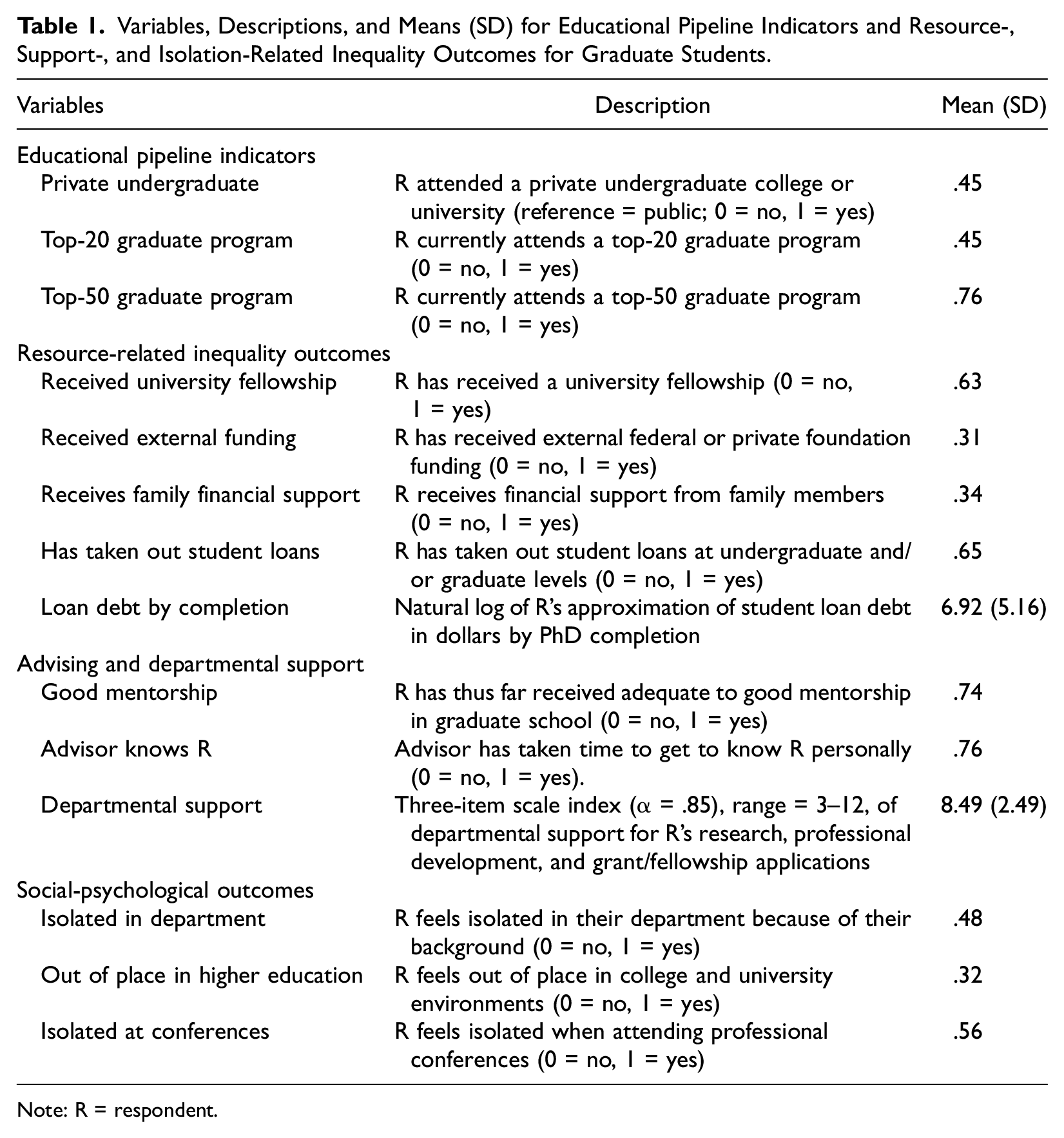
Our analyses focus on several pertinent educational pipeline and inequality-specific outcomes, beginning with a comparison of prior undergraduate enrollment and current graduate program status. Undergraduate attendance was measured by the following: “From what type of undergraduate institution did you earn your four-year baccalaureate degree?” Response categories include (1) main campus of public university, (2) private university, (3) public regional branch campus, and (4) private college (e.g., liberal arts, religious affiliate). We differentiate dichotomously in our analyses between public (=0) and private (=1) undergraduate enrollment. Approximately 45 percent of our graduate student sample attended a private undergraduate institution; the remainder attended a public institution. This indicator likely captures certain resource and integration advantages, but we recognize it more than likely misses more specific gradations in institutional status and prestige. Consequently, our analyses probably reflect a conservative test of undergraduate enrollment and its consequences for eventual graduate program admissions and attendance.
Graduate program status is drawn from a prompt asking respondents whether their graduate program is (1) top-20 private, (2) top-20 public, (3) middle ranked (top 50 but not top 20), or (4) not top 50. We consolidate and analyze the public/private top-20 options (=1) compared to not top 20 (=0); we also analyze those attending, more broadly, top-50 programs (=1) versus not (=0). Approximately 45 percent of our graduate student sample is currently enrolled in a top-20 program, and 76 percent is enrolled in a top-50 graduate program. Means and descriptions of these pipeline indicators and potential inequality outcomes are reported in Table 1.
Variables, Descriptions, and Means (SD) for Educational Pipeline Indicators and Resource-, Support-, and Isolation-Related Inequality Outcomes for Graduate Students.
Note: R = respondent.
Three Dimensions of Inequality
The second portion of our analyses turns to the implications of any pipeline divergences for three distinct dimensions of inequality: resource-related, interactional, and social-psychological. We capture resource-related inequalities with five measures: whether the respondent has received a university fellowship (1 = yes, 0 = no), whether they have received external foundation funding (1 = yes, 0 = no), whether they receive financial support from family while in graduate school (1 = yes, 0 = no), whether they have taken out loans to finance their graduate or undergraduate education (1 = yes, 0 = no), and the anticipated amount of loan debt by the time of PhD completion. The first four of these are measured dichotomously; the fifth, anticipated debt, is measured in dollars with the natural log function used in our analyses.
Inequality is not just a matter of material resources but is also interactional and social-psychological in its consequences. We thus also interrogate interactional outcomes pertaining to advising, departmental socialization support, and social-psychological aspects of isolation. On the mentorship and departmental support side, we consider the extent to which there are observable inequalities in the receipt of good mentorship (1 = yes, 0 = no), whether respondents feel their advisor has gotten to know them (1 = yes, 0 = no), and whether respondents report their department supports their professional socialization (scale range = 3–12). Regarding social-psychological implications, respondents were asked whether they feel isolated in their department (1 = yes, 0 = no), whether they feel out of place in college/university environments (1 = yes, 0 = no), and whether they feel out of place at professional conferences (1 = yes, 0 = no).
The three discrete dimensions of inequality analyzed, although hardly exhaustive, offer some of the most comprehensive tests of first-generation and working-class inequalities in graduate education to date. Related open-ended qualitative materials further offer rich and complementary insights on the relevance of such inequalities for the day-to-day experiences of first-generation and working-class students.
First-Generation and Working-Class Backgrounds
Central to our focus is the extent to which inequalities relative to first-generation and working-class backgrounds are observable. Our measurement strategy draws on a long history of sociological research on socioeconomic origins and social class—research that offers a variety of rigorous measures (Brady et al. 2018; Wright 2005), including earlier gradational measures of occupational prestige or status (e.g., Ganzeboom, De Graaf, and Treiman 1992) or indicators of self-perceived social class as something that captures either actual location or subjective class identification (e.g., Sosnaud, Brady, and Frenk 2013). We acknowledge the utility of such measures and indeed captured them in our survey design. Our analyses, however, draw on two objective indicators of background centering on parental college-degree attainment and occupational class status.
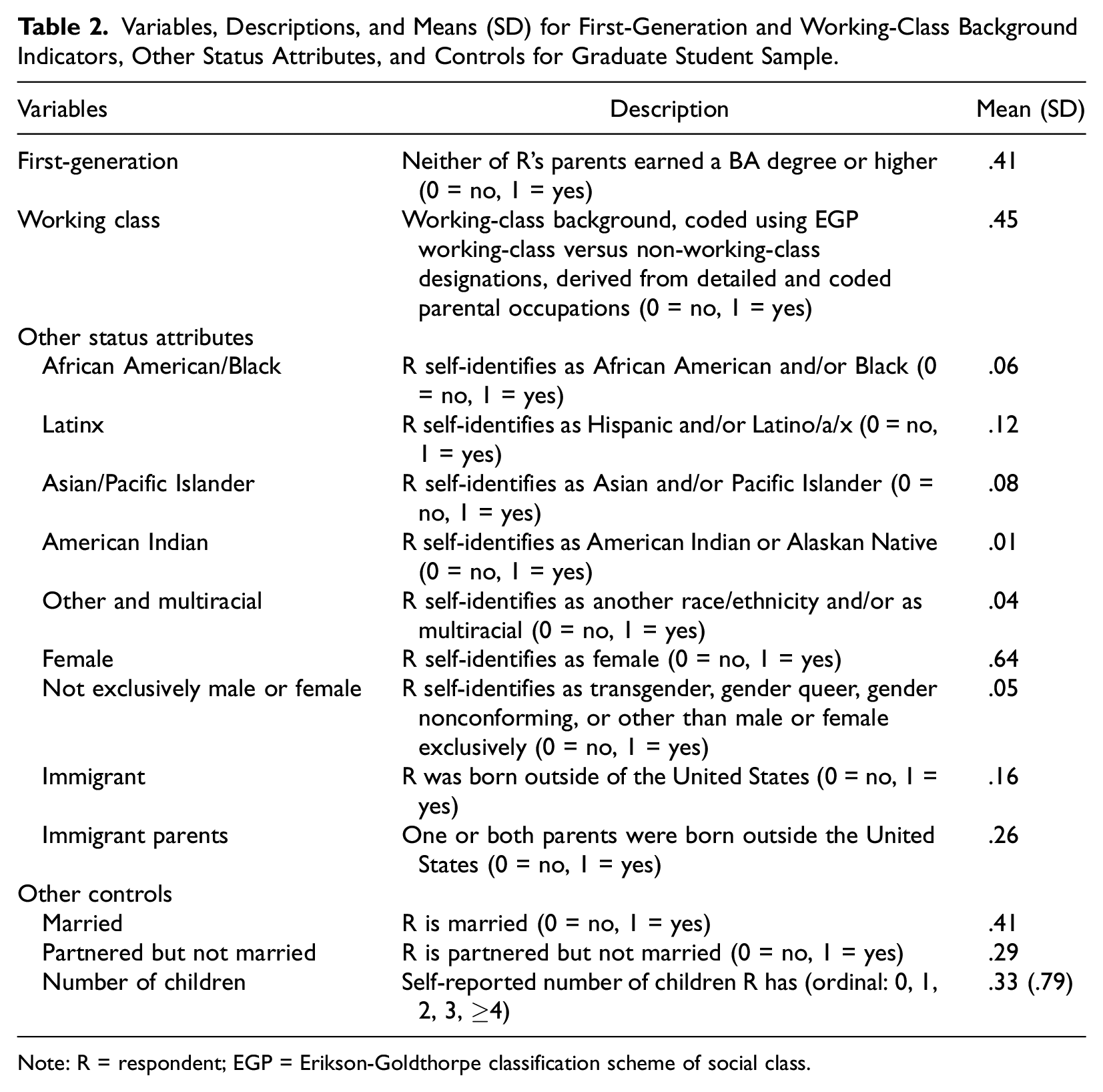
Sociologists have always viewed parents’ educational attainment as a fundamental indicator of class (e.g., Torche 2011). Moreover, parental degree attainment is consistent with recent research highlighting specific resource, informational, and cultural capital disadvantages of first-generation students (Benson and Lee 2020; Jack 2019; Mcdossi et al. 2022; Wilbur and Roscigno 2016). Consistent with the bulk of this literature and measurement and policies instituted by colleges and universities across the country, we focus on first-generation background, derived from the following survey question: “What was the highest level of education completed by your parent/primary caregiver [#1/#2] at the time you completed high school?” We focus on respondents for whom neither parent had obtained a bachelor’s degree (=1) versus those for whom at least one parent had (=0). 5 Approximately 41 percent of our sample of graduate students is first-generation; the remainder are continuing generation.
Although the percentage of first-generation (and working-class background) students may seem high, we remind readers the survey was fielded by the Task Force on Sociologists from First-Generation and Working-Class Backgrounds. Consequently, first-generation and working-class respondents may have had a somewhat higher likelihood of completion based on the recruitment script. At the same time, the demographic breakdown of our sample and first-generation and working-class representation largely mirror findings of a more general and recent membership survey conducted by the ASA. In any case, we draw no conclusions as to the actual representation of such individuals within the field. Instead, we focus on statistical comparisons between groups in our data and relative to the educational pipeline and certain inequalities—comparisons that levels of group representation in these data allow for.
Regarding occupational class status, we follow research surrounding the strength and efficacy of occupation-based nominal class schemas (e.g., Erikson, Goldthorpe, and Portocarero 1979) that draws on parents’ occupations to effectively distinguish working-class background. Our indicator is derived from open-ended survey responses to the question, “In what occupation did your primary parent/caregiver [#1/#2] work, if any, during your childhood? Please specify . . . their occupation name/title as best you can.” A research assistant coded all answers into categories consistent with the Erikson-Goldthorpe (EGP) classification scheme of social class (see Erikson et al. 1979). Two members of our research team then reviewed all materials for reliable and valid coding and further refined the coding of cases in a manner consistent with Morgan’s (2017) update of the original EGP categories. 6 This schema and its recent update is particularly useful for studying mobility given that it captures economic resources and social network contacts beyond advantages linked more directly to parental education attainment (Brady et al. 2018). Working-class background is coded 1 if both parents’ EGP status is working-class. The referent (=0) reflects cases in which one or both parents are not working-class. If only one parent was present during childhood, we used that parent’s EGP coding. Based on this measurement strategy, 45 percent of our sample is of working-class background.
Our indicators of first-generation and working-class backgrounds (1) capture most of the salient variation in socioeconomic status, (2) reflect prevailing and contemporary trends and measurement in sociological research, (3) are interpretable and relevant within contemporary public debates and higher-education policy, and (4) are “objective” measures less likely to suffer from recall bias. Our two indicators significantly overlap with one another in our sample of graduate students (correlation = .49), suggesting a relatively strong association between parental education and social class position. Moreover, and as reported in Appendix Table A1, our indicators also reliably overlap with traditional prestige and subjective identity alternatives—alternatives our survey device also captured (see also Mitnik and Cumberworth 2021). Table 2 reports our first-generation and working-class background measures and other important status indicators and controls.
Variables, Descriptions, and Means (SD) for First-Generation and Working-Class Background Indicators, Other Status Attributes, and Controls for Graduate Student Sample.
Note: R = respondent; EGP = Erikson-Goldthorpe classification scheme of social class.
Race/Ethnicity, Gender, and Immigrant Status
One benefit of the survey lies in its collection of other potentially influential status attributes, such as race/ethnicity, gender, and immigrant status. Race/ethnicity of respondents is indicated by non-mutually exclusive responses to the following: “What best reflects your race/ethnicity (please select all that apply)?” Responses included (1) White (non- Hispanic/Latino/a/x), (2) Black or African American, (3) Hispanic or Latino/a/x/ or Spanish, (4) Asian, (5) American Indian or Alaskan Native, (6) Middle Eastern or North African, (7) Native Hawaiian or Pacific Islander, and (8) other (open-ended). Our analyses include indicators for White (non-Hispanic/Latino/a/x), Black or African American, Hispanic or Latino/a/x/ or Spanish, Asian/Pacific Islander, and American Indian. We also created a combined “other” category from the small number identifying as other, Middle Eastern/North African, or multiracial.
We recognize that race/ethnic inequalities are not reducible to socioeconomic background and that distinct stratification processes are relevant to minoritized persons. However, given the pertinence of minoritization to historical and contemporary institutional closure, exclusion, and discrimination, it is important to acknowledge inexorable links between racial/ethnic status and socioeconomic background. Such connections may be consequential in the intersectional sense, to be sure. 7 Such links are also consequential in the demographic patterning of first-generation and working-class statuses across racial/ethnic groups, as shown in Figure 1. Across our sample, African American, Latino/a/x, American Indian, and other/multiracial graduate students are about twice as likely as their White counterparts to be first-generation and about one and a half times more likely to be working-class. Asian graduate students fall somewhere in between. Given such patterning, consideration of first-generation and working-class disadvantages in educational mobility and inequality in graduate training cannot be strictly divorced from, and indeed should be considered alongside, racial/ethnic inclusion and equity.
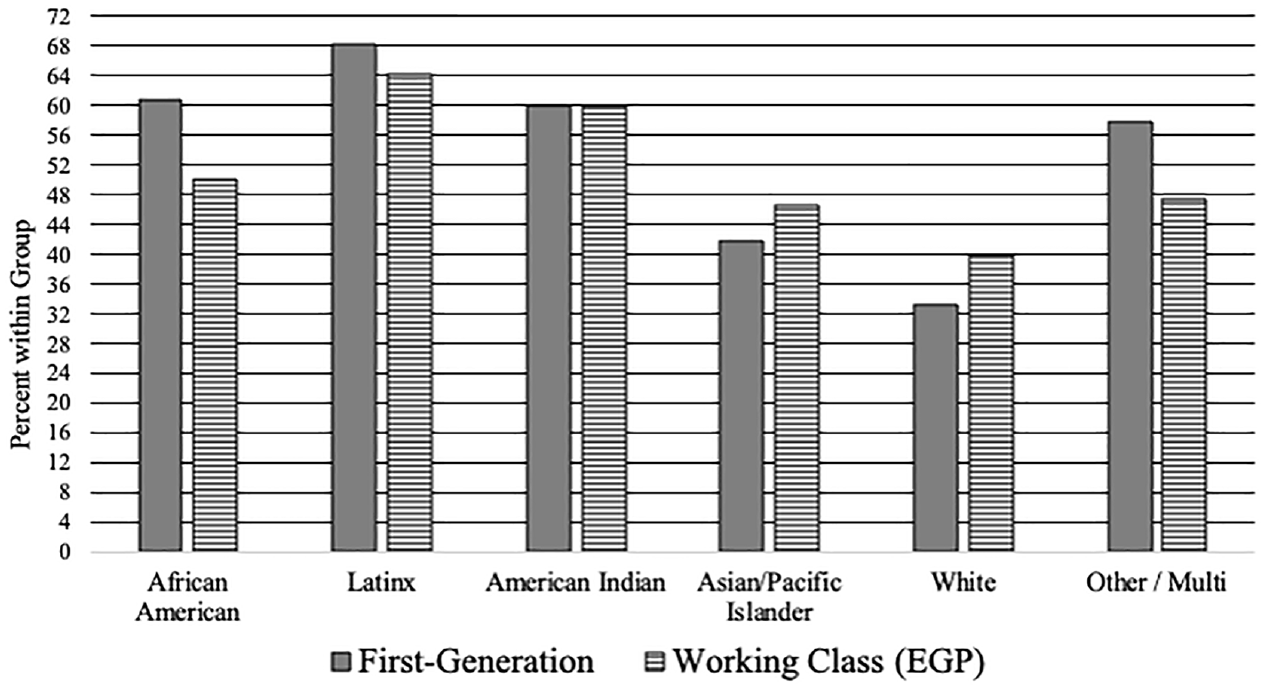
Percentage first-generation and working-class (Erikson-Goldthorpe classification scheme of social class) graduate students by racial/ethnic group.
Some contemporary analyses of gender and institutional inclusion and mobility point to important advances in higher education for women (DiPrete and Buchmann 2013), and recent analyses of working-class and first-generation students point to potential intersections of gender and socioeconomic background in curricular trajectories and familial obligations (Wright et al. 2023). We thus also consider gender in our analyses, measured by the survey question: “What best reflects your gender (select all that apply)?” Response categories include male, female, transgender male/transgender man, transgender female/transgender woman, gender queer/gender nonconforming, different identity, and other (open-ended). Approximately 64 percent of our sample identifies as female, 31 percent as male, and the remaining 5 percent fall into one of the remaining categories. Owing to sample sizes, our analyses consider female and male and a combined control for respondents who do not fall on the traditional gender binary.
Immigrant background status may be consequential relative to inclusion and incorporation into higher education, although this probably varies considerably by socioeconomic background. For this reason, we account for whether the respondent or their parents were born within the United States. These indicators are derived from two questions: “Were you born in the United States?” (1 = yes, 0 = no) and “Were either of your parents born outside of the United States?” (1 = yes, 0 = no). Approximately 16 percent of our graduate student respondents were born outside the United States, and 26 percent had at least one parent who was an immigrant to the United States.
Other Controls
Along with key background and status indicators, our models control for current household composition. Household composition may be consequential given potential resource implications or tensions regarding geography if one is married or in a coupled/domestic relationship. Respondents were asked, “What is your current relationship status?” Response categories were single, married, partnered but not married, or other (open-ended). Approximately 41 percent of respondents reported being married, and 29 percent were partnered; the remaining 30 percent nearly all reported being currently single.
Our modeling also accounts for whether the respondent has children. All respondents were asked, “How many children do you have if any?” Response categories were none, one, two, three, and four or more. The majority (82 percent) of graduate student respondents reported no children, 10 percent reported one child, 5 percent reported two children, 3 percent reported three children, and 1 percent reported four or more.
Analytic Strategy and Results
Our analyses proceed in two steps. We first focus on background inequalities and the pipeline into graduate programs. We use logistic regression modeling of high-status (i.e., top 20 and top 50) sociology graduate program attendance among this sample of current graduate students and assess whether undergraduate institutional status matters. These models control for other meaningful status attributes and controls. For ease of interpretability and summary purposes, we plot and report predicted probabilities capturing the most central patterns and divergences in graduate program enrollment and mobility in these regards. Parallel findings (available in our Appendices) are observed when we replicate these models using linear regression techniques.
The second portion of our analyses analyzes implications for graduate school resources and economic precarity, advising and support, and relative levels of isolation and sense of belonging. We focus first on availability and receipt of internal fellowships and external funding, and we also consider family financial support, acquisition of loans, and likely accumulated debt by the end of graduate school. We include undergraduate and graduate program status in the second equation to help delineate whether any first-generation or working-class gaps are partially a consequence of the relative status of the graduate program one attends. We also consider advising and department support experiences and sense of isolation at departmental, college/university, and disciplinary levels. Supplementary analyses of isolation, examining potential conditional associations between first-generation/working-class background and graduate program status, are noted within our main discussion and reported in our Appendices.
Throughout, we also draw on representative open-ended survey responses from first-generation and working-class graduate students. These materials highlight how background shapes educational mobility and the pipeline process and how issues of debt, mentorship, and isolation matter. As noted previously, these materials were content-coded through an iterative process by our research team to ensure the quotes presented are representative of the open-ended responses. 8 Together with our quantitative results, the quotes afford rich and substantive insight into potential mechanisms of disadvantage leading into and during graduate school.
Background, Undergraduate Enrollment, and the Graduate School Pipeline
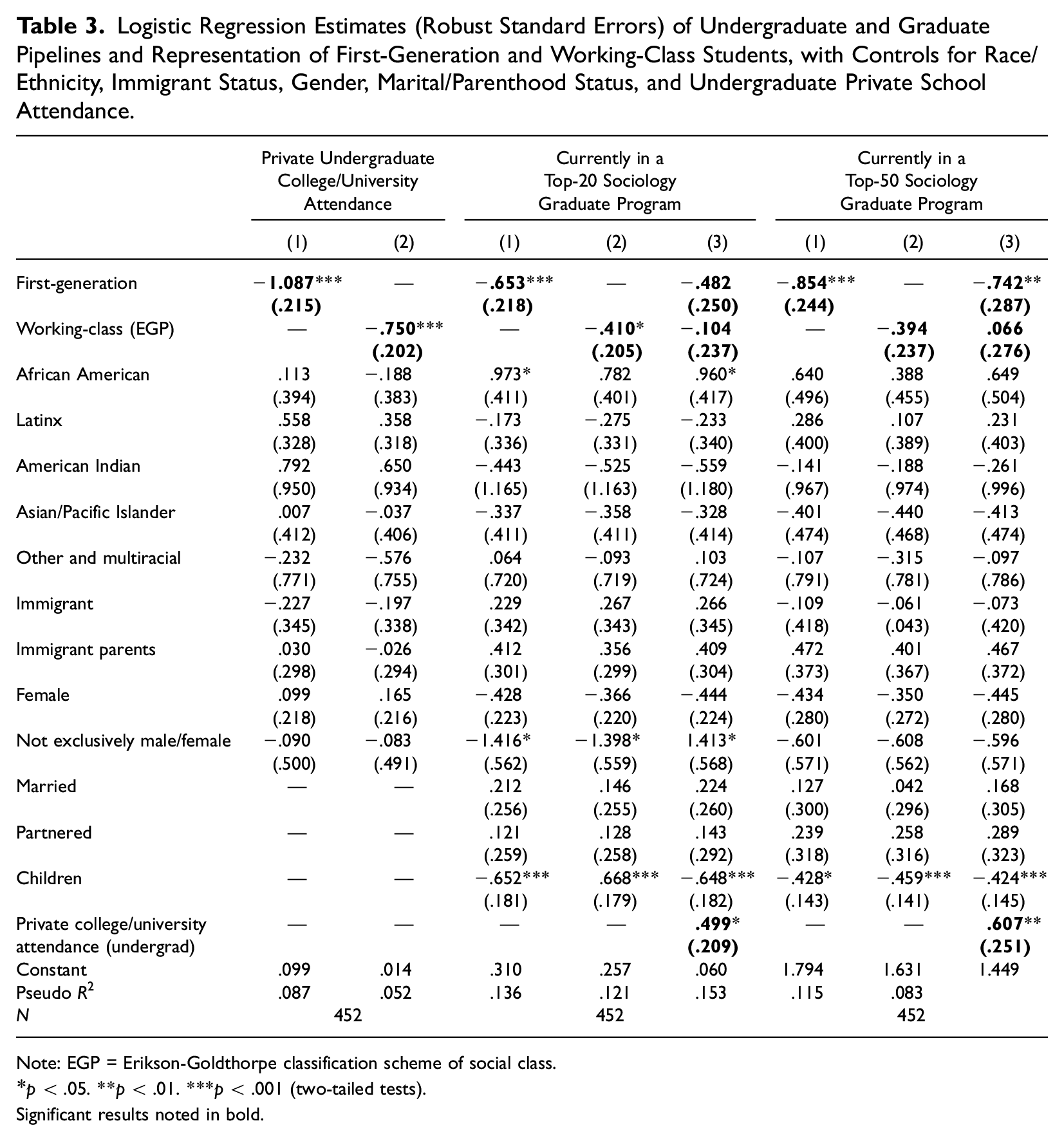
We begin with Table 3, which highlights relationships between first-generation and working-class background and (1) undergraduate attendance at a private postsecondary institution and (2) eventual enrollment in a top-20 or top-50 sociology graduate program. For graduate program attendance, we include an additional model in which first-generation and working-class background statuses are included simultaneously and, consistent with the sequential nature of the processes we are interested in, undergraduate private school attendance is added as a predictor.
Logistic Regression Estimates (Robust Standard Errors) of Undergraduate and Graduate Pipelines and Representation of First-Generation and Working-Class Students, with Controls for Race/Ethnicity, Immigrant Status, Gender, Marital/Parenthood Status, and Undergraduate Private School Attendance.
Note: EGP = Erikson-Goldthorpe classification scheme of social class.
p < .05. **p < .01. ***p < .001 (two-tailed tests).
Significant results noted in bold.
Across Models 1 and 2, for each of the three outcomes, we see disadvantages for first-generation and working-class students. 9 That is, they are much less likely to have been enrolled in a private undergraduate institution and are less likely to be currently enrolled in either a top-20 or top-50 sociology graduate program compared to their background-advantaged peers. First-generation effects appear somewhat stronger overall than those pertaining to working-class background, although we are cautious to not overinterpret this given the relatively significant overlap between these statuses already noted—overlap that makes it difficult to dissect or offer completely distinct interpretations.
Figures 2 and 3 display predicted probabilities surrounding private undergraduate and high-status graduate program attendance. These figures and the probabilities reported, which also include 95% confidence intervals (black line with rounded tips), are derived from the first and second equations of Table 3. First-generation and working-class gaps are relatively obvious for undergraduate enrollment, with the probability of attending such an institution approximately 31 percent, on average, for first-generation college students versus about a 56 percent likelihood for continuing-generation students. Although not quite as large, the gap for working-class versus higher-status socioeconomic students is similarly notable at about 18 percent.
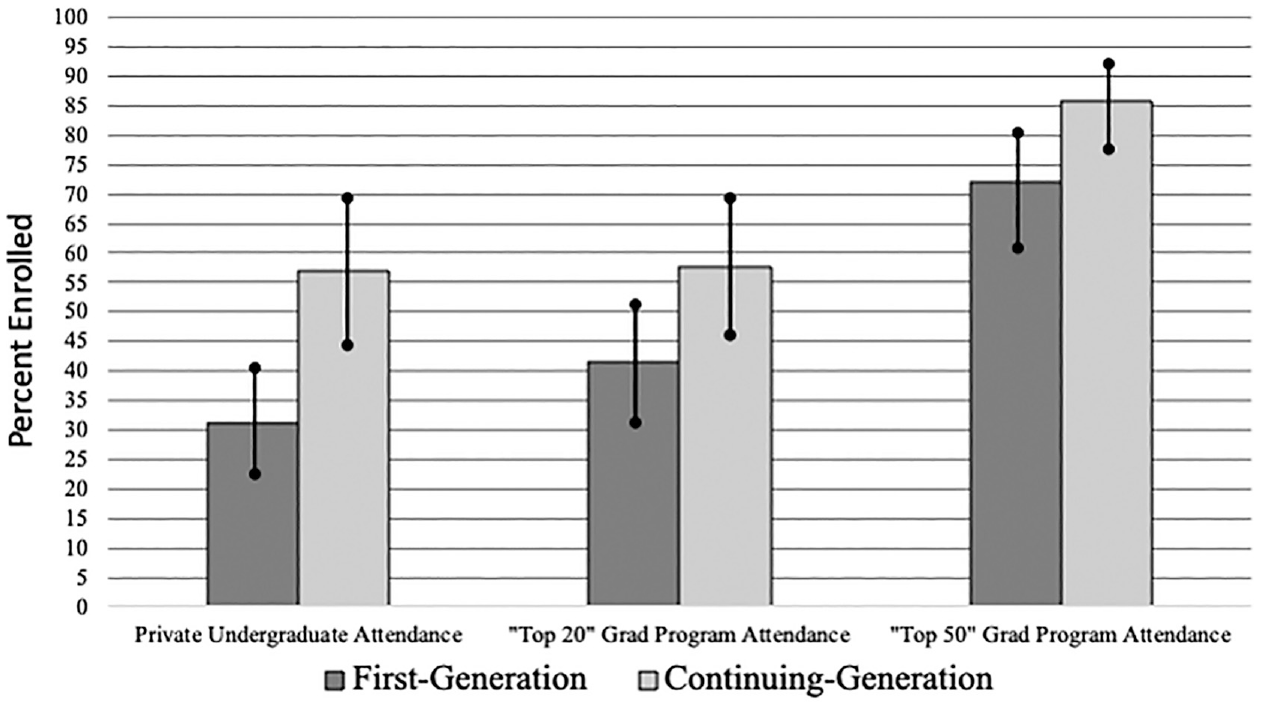
Predicted probabilities (95% confidence intervals) of first- versus continuing-generation gaps in private undergraduate attendance and top-20 and top-50 graduate program attendance.
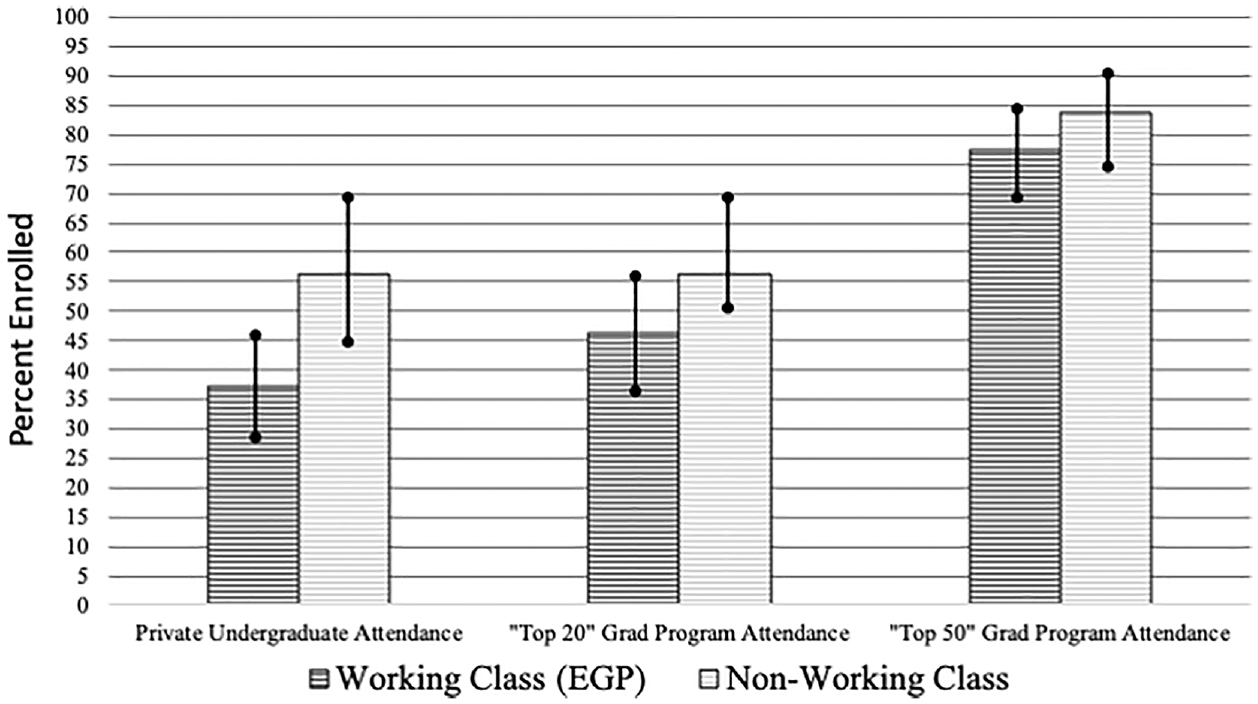
Predicted probabilities (95% confidence intervals) of working-class (Erikson-Goldthorpe classification scheme of social class) and non-working-class gaps in private undergraduate attendance and top-20 and top-50 graduate program attendance.
Gaps in undergraduate private school enrollment are potentially important if graduate admissions committees view such schools as more prestigious or more highly valued in the course of graduate program application screening or if private undergraduate enrollment is tied to other experiential advantages (e.g., research with faculty, study abroad, more detailed recommendation letters). Our modeling provides some evidence in this regard. First, results show especially strong and negative first-generation effects when it comes to top-20 and top-50 program attendance. First-generation graduate school attenders in sociology are about 41 percent likely, on average, to land in a top-20 program, compared to approximately 57 percent for continuing-generation students. We see a similar gap when we consider the broader range of higher-status graduate programs (i.e., top 50).
Second, Model 3 shows a strong, positive effect of private undergraduate enrollment. This effect and some small to moderate declines in first-generation and working-class coefficient magnitudes suggest first-generation and working-class disadvantages in higher-status graduate program enrollment are at least partially created through undergraduate experiences and credentials. These results are robust to distinct modeling strategies. Specifically, following recent suggestions in the literature that point to potential drawbacks to using nonlinear probability models such as logistic multistep modeling or group comparison (see Breen, Karlson, and Holm 2018), we reestimated our results using generalized linear models with robust standard errors. These findings, reported in Appendix Table A2, suggest parallel first-generation and working-class disadvantages and some mediation through undergraduate institutional pathways.
Inequality in the undergraduate to graduate school pipeline is complex and likely entails a combination of structural and institutional inequalities preceding graduate student enrollment; cultural skills, knowledge, and orientations that deflect first-generation and working-class students away from higher-status graduate programs; and decision-making that although occurring at the individual level, is fundamentally socially and structurally patterned in ways that place working-class and first-generation students at a relative disadvantage. Survey respondents recognized this complexity regarding the causal mechanisms underlying divergent educational pathways: I think the under-valuation of lower-ranked schools is a big factor in limiting the success of first-generation students. I started my PhD at a “not in the top-50” university, because I did not have the training or background to be competitive at a more elite school (nor was I even aware that it would be important to try and get into one). I feel that since my family lacked the educational cultural capital as I applied for college (i.e., my mother thought that community college is the same as Harvard), I feel like I am forever disadvantaged in regards to education. A mediocre [college] led to a mediocre PhD. I did not know that middle- and top-ranked PhD programs will provide tuition and stipend support . . . until an undergraduate advisor told me. Absent that conversation, I may have applied to a program that was not only less well-ranked but also perhaps one that would have required me to go into debt to complete my graduate degree.
Such qualitative insights, especially when coupled with the quantitative results reported thus far, point to neither a pure caste system nor a fluid and entirely meritocratic process. Rather, the reality lies somewhere between. Sociology as a field has a substantive draw for first-generation and working-class students—a draw reflected in respectable first-generation and working-class representation within contemporary sociology graduate programs, perhaps more so than in other academic fields. Inequalities remain in the pipeline, however, particularly within high-status graduate programs. This is problematic in the representational sense but also for a host of other tangible and less tangible inequalities and experiences within graduate training.
Dimensions of Inequality in the Course of Graduate Training
Inequities in educational pipelines, including those pertaining to graduate school, are sociologically interesting in and of themselves given prestige hierarchies in graduate programs and likely consequences for eventual academic labor market placement. Yet they are also important given their likely implications for experiences within graduate school itself. Here we consider resource inequalities, experiences with advising and professional socialization support, and sense of integration versus isolation.
We begin with analyses of resource opportunities, family financial support, and debt (see Table 4). First-generation graduate students are less likely to receive university fellowships, which are typically seen as higher prestige forms of graduate funding (p < .05). This disadvantage, which reflects about a 13 percent probability gap, appears to be explained by divergences in placement in top-20 or top-50 graduate programs—that is, programs that tend to be located at universities that are higher resourced in graduate funding and university fellowships. We find no clear advantage or disadvantage relative to external fellowship or funding opportunities unless one attends a top-20 graduate program (p < .05).
Logistic and Linear Regression Estimates (Robust Standard Errors) of Graduate Student Fellowships, External Funding, Family Financial Support, Student Loan Acquisition, and Anticipated Loan Debt Relative to Enrollment in Top-20 and Top-50 Sociology Graduate Programs.
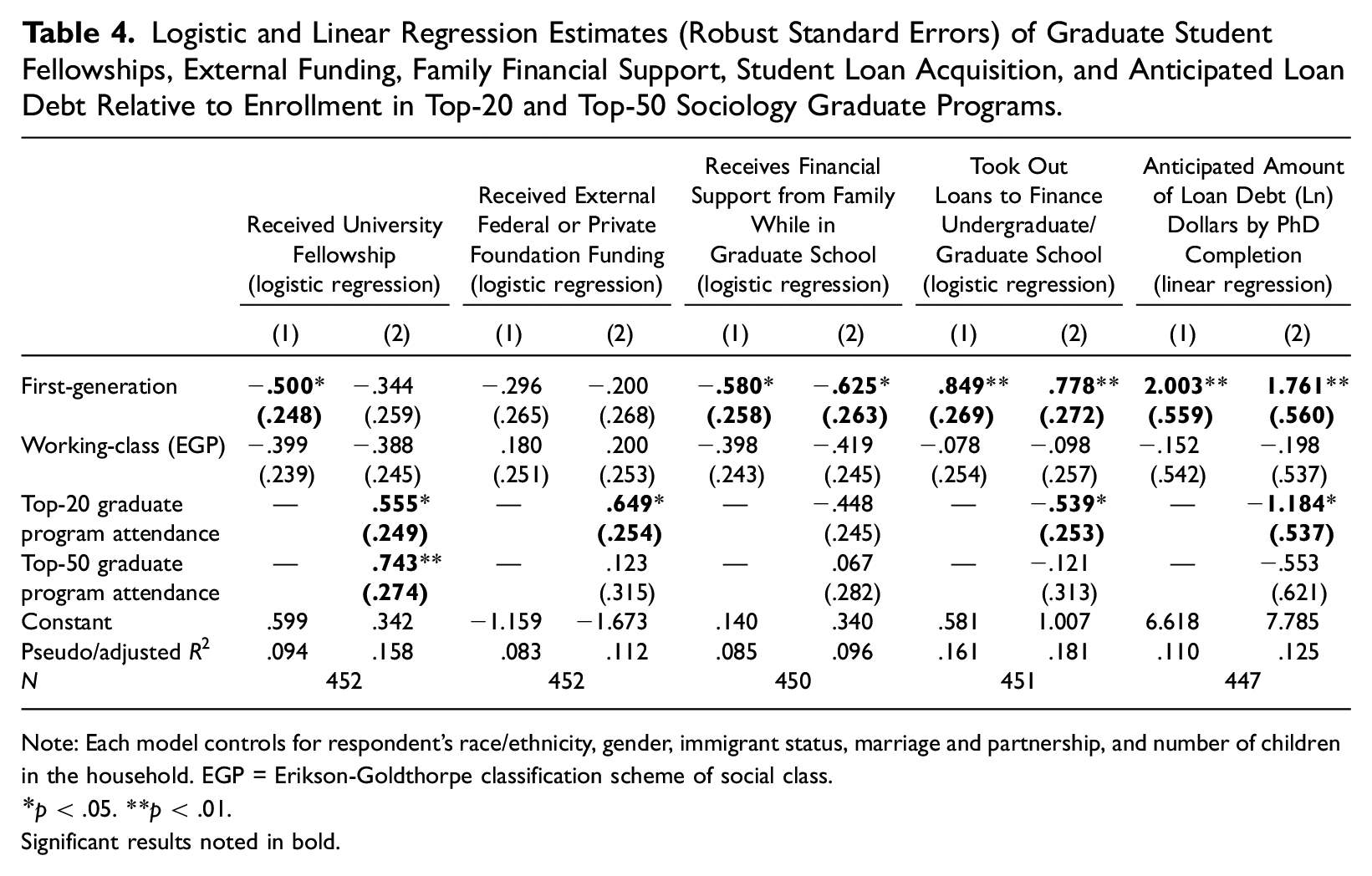
Note: Each model controls for respondent’s race/ethnicity, gender, immigrant status, marriage and partnership, and number of children in the household. EGP = Erikson-Goldthorpe classification scheme of social class.
p < .05. **p < .01.
Significant results noted in bold.
Although gaps in graduate funding do not appear to be particularly large, it is important to recognize they are compounded in important ways by financial insecurity and resource flows as well as accumulations of student debt. First-generation graduate students are much less likely to receive financial support from their families (probability of 39.2 for first-generation vs. 53.5 for continuing-generation), are more likely to have student loans (80.7 percent probability for first-generation vs. 64.1 percent for continuing-generation), and are more likely to have accumulated debt in the course of their undergraduate and graduate school enrollment (gap of approximately $6,000). We find similar although weaker effects for working-class background when first-generation status is not included in these models.
10
Such debt and limited familial support creates disparate levels of economic precarity and stress during graduate training, as noted by many of our survey respondents: Most fellowships or support plans are not a living wage. If you do not have a partner or family with a middle-class income or higher to help you, you’re at a significant disadvantage. You may have to take out more loans, work additional jobs, etc. Being the most “successful” member of my family, I am the source of income and the person to go to when someone in the family has problems. Having parents that don’t understand the US creates an extra layer of difficulty as I am the primary caretaker of my parents. I consistently have to provide for my family because of my low socioeconomic background. This makes it difficult to focus on my studies. I also have to provide emotional support during times of financial stress, particularly eviction and this limits how much I can focus on my studies. Funding that exists usually works through reimbursements, which requires having funds up front. Children from working-class backgrounds often have to materially support family members.
There are also less tangible yet still consequential interactional and social-psychological implications of these inequalities. We analyze several of these in Tables 5 and 6. First-generation disadvantages in good mentorship, having an advisor who knows the respondent personally, and departmental socialization support are clear and statistically and substantively significant. We also see statistically significant effects and inequalities for working-class students when first-generation status is not included in the model. First-generation effects, however, as indicated in Table 5, are somewhat stronger overall and largely capture the overlap with working-class background.
Logistic and Linear Regression Estimates (Robust Standard Errors) of Quality of Graduate School Advising and Departmental Professional Development Support, with Controls and Relative to Enrollment in Top-20 and Top-50 Sociology Graduate Programs.
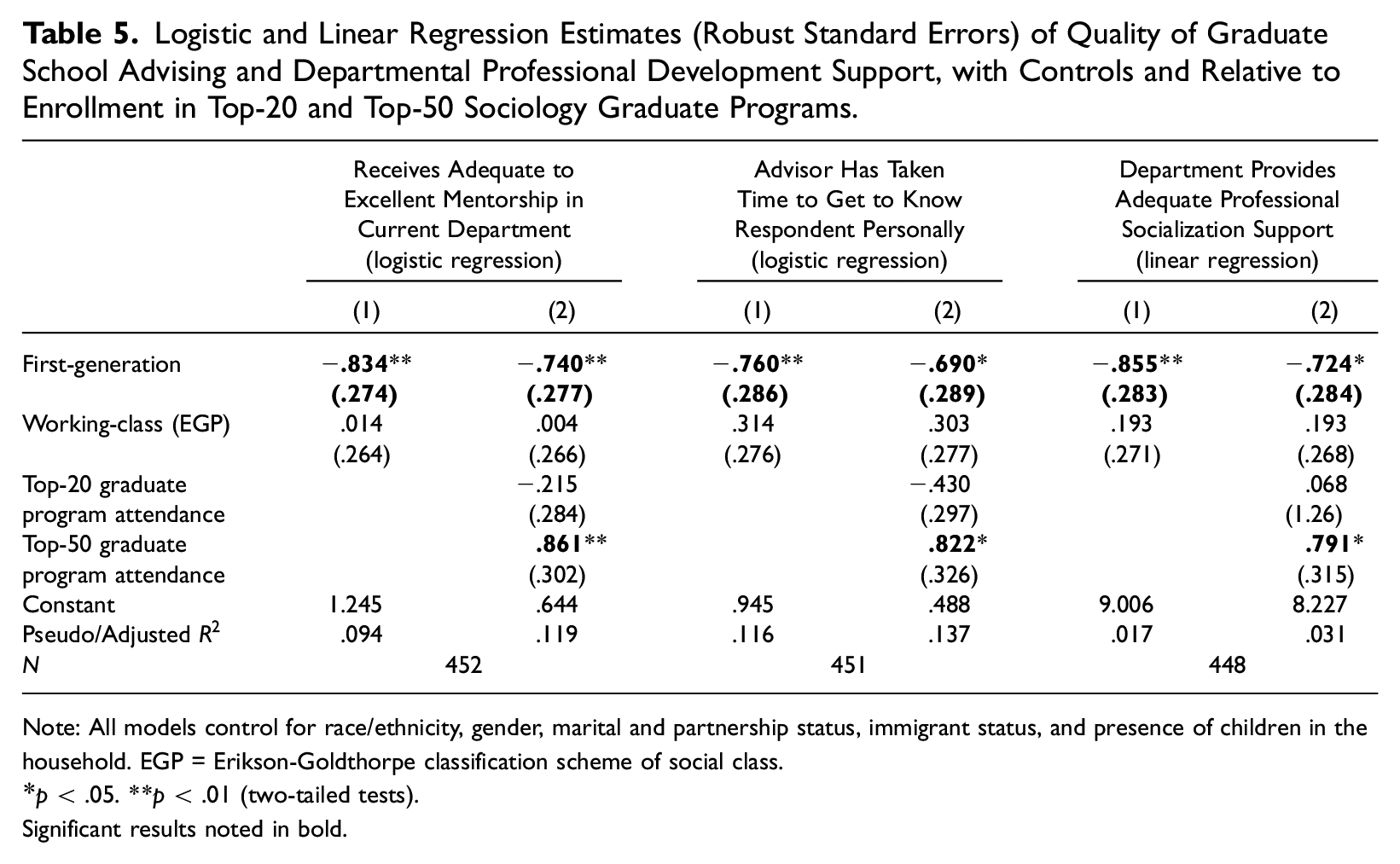
Note: All models control for race/ethnicity, gender, marital and partnership status, immigrant status, and presence of children in the household. EGP = Erikson-Goldthorpe classification scheme of social class.
p < .05. **p < .01 (two-tailed tests).
Significant results noted in bold.
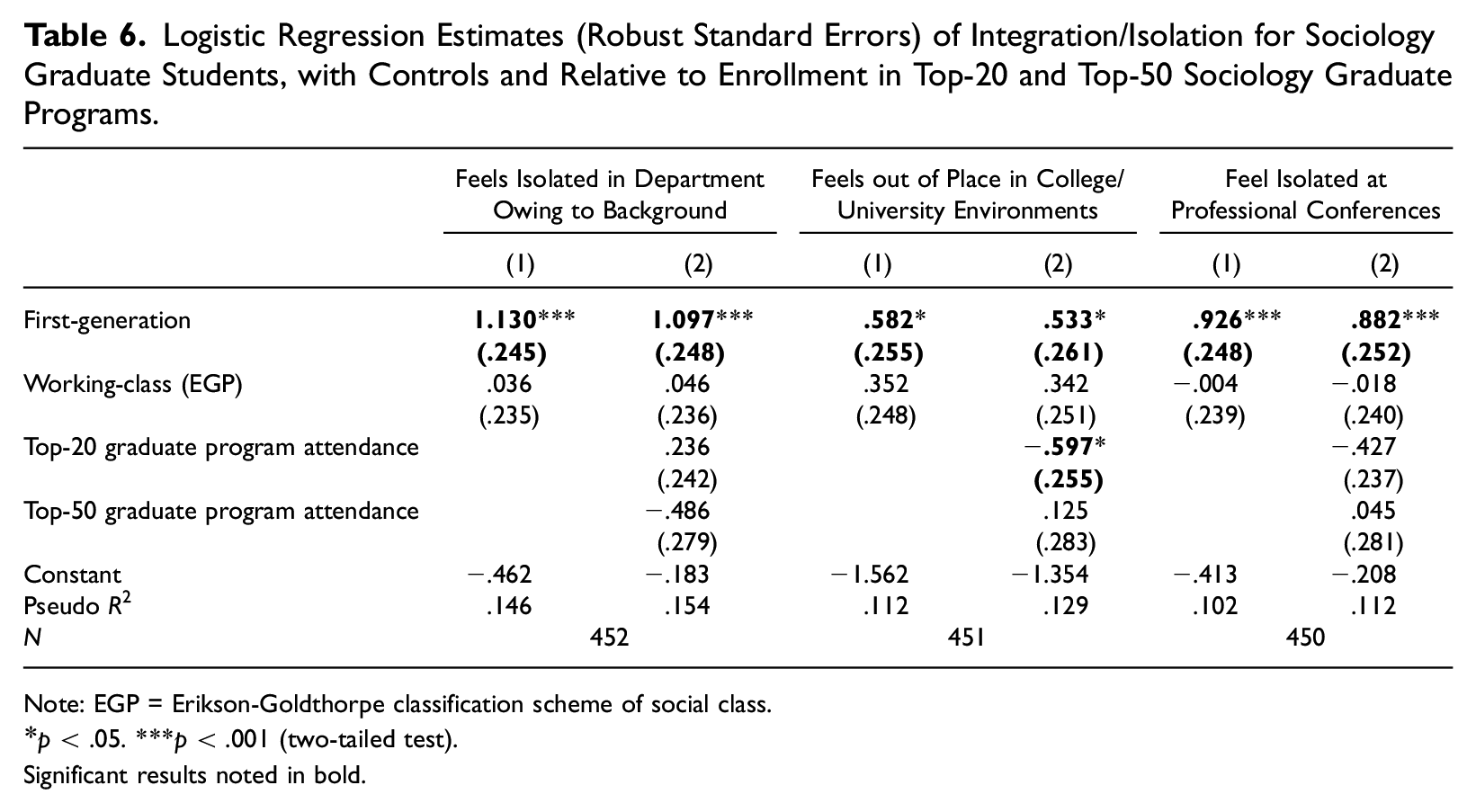
Logistic Regression Estimates (Robust Standard Errors) of Integration/Isolation for Sociology Graduate Students, with Controls and Relative to Enrollment in Top-20 and Top-50 Sociology Graduate Programs.
Note: EGP = Erikson-Goldthorpe classification scheme of social class.
p < .05. ***p < .001 (two-tailed test).
Significant results noted in bold.
Although good mentorship and closeness to an advisor appear to be more commonplace in top-50 graduate programs, where first-generation and working-class graduate students are less represented overall, little mediation seems to be occurring. The overall pattern instead points to some problematic aspects of advising and departmental support in graduate training for first-generation and working-class students regardless of departmental status. Many of our respondents concurred, noting how poor mentorship, greater social distance with prospective advisors, and limitations in overall socialization support made graduate school more difficult: From the very beginning, I did not know things that other grad students already knew, and it did not occur to any professors to teach these things. (They assumed everyone already knew.) Navigating academia has been an incredibly frustrating experience that is compounded by the lack of mentorship from faculty and advanced graduate students. When coming into graduate school, I truly had no idea what was expected of me because I did not receive strong mentorship as an undergraduate. I learned most of what I know now from piecing together expectations on my own. We can’t access a lot of resources because we don’t know they exist for us, and we don’t receive the mentorship that traditional and middle-class students are afforded. It seems the answers to this issue has been to create more work for students who are already disadvantaged by the system, we don’t need more things to do that add stress and use precious time. My independence and reliance on myself made it difficult to know what I was missing because I was used to struggling.
Finally, our data collection allows us to contribute to emerging literatures on social disconnect in the academy in a statistically comparative and rigorous way. These analyses, reported in Table 6, focus on whether one feels isolated in one’s department, on college and university campuses, and within the context of professional conferences.
First-generation graduate students report significantly higher levels of isolation in their departments (predicted probability of 66.1 percent for first-generation graduate students vs. 38.7 percent for continuing-generation students), feeling out of place in college and university environments (predicted probability of 27.3 percent vs. 17.3 percent), and feeling out of place at professional conferences (predicted probability of 62.6 percent vs. 39.8 percent). We see similar statistically significant effects for working-class students when first-generation status is removed from the model—a pattern that, again, points to the noteworthy overlap between these dimensions. As indicated by detailed and rich qualitative responses, the experience of isolation is profoundly consequential: In a way your parents are from a different world and raised you to fit in in a different world than the world of educated people. There is a sense of not really belonging and of being an outsider. I barely understood how to navigate undergrad. Being in grad school feels completely foreign and overwhelming. It often feels like I don’t “fit in” in academia, but I also don’t “fit in” with my family or friends outside of academia. I also lack confidence when speaking to professors or presenting at conferences. Impostor syndrome was a huge hurdle, particularly in my first year. Family can’t afford to visit you like richer members of your cohort so you become even more isolated. . . . Lack of understanding by departments and professors of the generational traumas experienced by those from low socioeconomic backgrounds. Complete lack of recognition. . . . Grad school is for the elite. You weed most of the rest of us out.
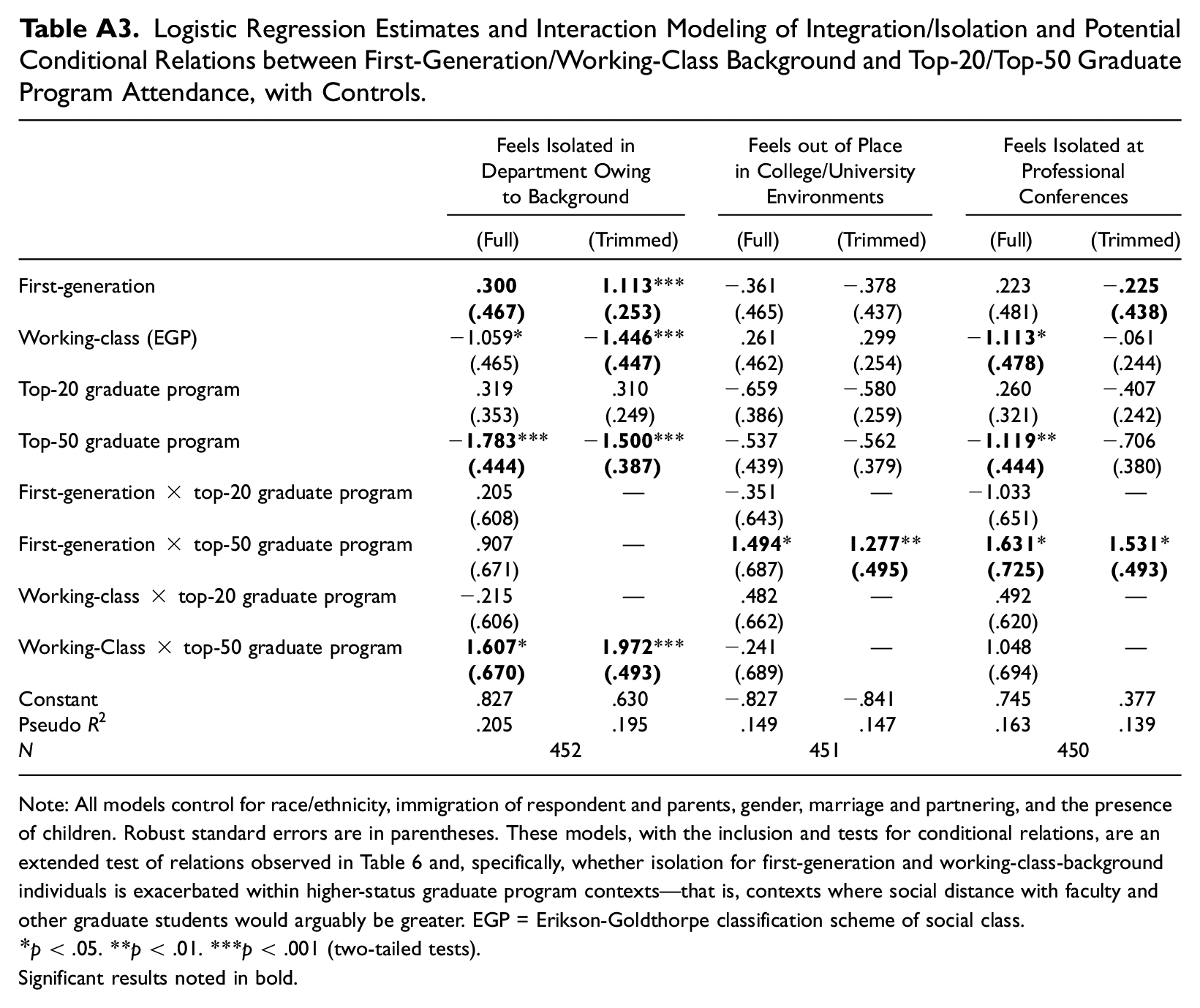
Although our focus on isolation is mainly concerned with baseline effects of background, supplementary analyses also considered the possibility these patterns of isolation might (1) dissipate over time or (2) be exacerbated in higher-status graduate contexts where social distance may be even greater. In the first regard, our data unfortunately do not include a measure pertaining to one’s year in graduate school. The more general survey population, however, did include faculty and asked identical questions regarding isolation. Overall levels of isolation are reduced somewhat for first-generation and working-class-background faculty—a reduction that may be due to social-psychological adjustment or bias in terms of who actually moves into the faculty ranks—but gaps across all three isolation measures likewise exist among faculty (see Appendix Figure A1) and are robust to modeling that includes indicators for faculty rank and years since PhD (see Roscigno et al. 2023). Such findings suggest durability in sense of isolation across time and into the professoriate.
Appendix Table A3 provides some evidence regarding context effects. Specifically, being in a top-50 program generally appears to reduce one’s sense of isolation, although such beneficial effects do not seem to accrue to working-class students (for departmental isolation; p < .001). Moreover, first-generation students’ unease within campus contexts (p < .01) and at professional conferences (p < .05) appears exacerbated for students in top-50 departments. Such findings point to an intersection of background and graduate program context—an intersection that warrants greater analytic interrogation.
Discussion and Conclusions
Questions regarding educational access, mobility, and inequality have been foundational foci within the sociology of education literature for decades. Little attention, however, has focused on graduate student training and experiences. In an effort to partially fill this gap, we drew on unique survey data and offer analyses of pipeline processes and implications for inequality and precarity among graduate students.
Our results, derived from relatively rigorous modeling and supplemented with rich open-ended qualitative materials, point to an overall lower likelihood of high-status graduate program enrollment for students of first-generation and working-class backgrounds—a pattern partially created through undergraduate gaps in private institutional enrollment. We remind readers this is most likely a conservative estimate of undergraduate enrollment effects, given the inability of our undergraduate enrollment measure to capture specific levels of institutional status beyond the private/public distinction.
Divergences in educational mobility, our analyses further show, have consequences for resources in the course of graduate training, disadvantages in advising and mentorship, and gaps in professional socialization support. Although prior literature on socioeconomic background generally suggests such divergences in educational training and supports occur, few, if any, analyses of which we are aware have analyzed central processes and inequalities as they occur in graduate training specifically.
Graduate training is an important aspect of social reproduction/social mobility. Our findings in these regards are consistent with more general institutional and organizational understandings of inequality, which point to ways inequality can be and often is systematically reified by existing structures, even when those structures and internal processes are mostly viewed as neutral and meritocratic (see e.g., Ray 2019; Roscigno 2011). Our results likewise resonate with classic and contemporary arguments regarding how inequality is baked into organizational and institutional structures and relations (Fischer et al. 1996; Tilly 1999; Tomaskovic-Devey and Avent-Holt 2019). The fact that such inequalities exist in our own discipline of sociology—a discipline that is arguably more supportive of socioeconomic diversity than other disciplines—should be a matter of concern. Indeed, social reproduction within the hierarchical landscape of education, including graduate education, is important and deeply consequential for those on both the winning and losing ends (Borgen and Mastekaasa 2018; Hurst 2019).
That first-generation and working-class graduate students are disadvantaged during educational mobility contests and that gaps in cultural capital, mentorship, or tangible resources are partly responsible will come as little surprise to sociology of education scholars, given prior research showing disadvantages among children, adolescents, and young adults entering college (e.g., Calarco 2020; Lareau 2015). Our study extends these foci to doctoral training and suggests some of the same mechanisms are at work. Moreover, and unlike research suggesting attainment of a bachelor’s degree largely neutralizes background inequalities when it comes to labor market returns (e.g., Hout 2012; Torche 2011), our findings suggest this may not be the case when it comes to graduate training. We assume, given respondents’ affiliation with the largest professional academic society in sociology (i.e., ASA), that our findings are most directly reflective of doctoral student experiences, although we suspect similar patterns would be observed among terminal master’s degree students.
Given the observed patterning of and inequalities associated with advising, sense of isolation, and economic precarity, it is plausible that first-generation and working-class students may select out of attending higher-status departments given a sense of discomfort and dissimilarity, as some of our quotes suggest. Whether operating through discrimination or unconscious bias of admissions committees (Posselt 2016), structured choices to opt out (Beasley 2011), or some other set of factors related to social class practices or distinctions, any academic field (including sociology) will be weaker as a consequence of not attending to this problem. Talent and insight are and will be lost.
We hope future research will interrogate more systematically whether, when, and how first-generation and working-class backgrounds intersect with other important status dynamics, particularly those surrounding race/ethnicity and gender. As we noted, there are clearly substantial demographic overlaps such that first-generation and working-class inequalities cannot be strictly dissected from concerns regarding racial/ethnic inequality and equity. Although our analyses are limited by sample sizes, emerging educational research on race/ethnicity and gender using quantitative (e.g., Garcia, López and Vélez 2018; Wright et al. 2023) and qualitative (e.g., Benson and Lee 2020; Wingfield 2019) data has more effectively interrogated intersectional processes. We hope future work will follow suit.
We see our discipline as comparatively open to diverse students. It also covers subject matter that appeals to individuals on the margins and is at least symbolically committed to diversity, equity, and inclusion. These facts along with sample selection (i.e., dues-paying members of sociology’s largest national association) mean the inequalities highlighted in our analyses are likely an underestimate of first-generation and working-class inequalities in graduate training generally and compared to other academic fields—that is, fields where diversity and inclusion are not part of the discipline’s legacy or research agenda. We thus look forward to future work in our and other academic fields on these topics using large-scale quantitative and in-depth qualitative analyses. We believe such work, with specific attention to stratification in graduate-level training and experiences, will widen conversation within and across academic fields. It should also prompt departments toward greater diversity and accountability and, as a result, make them intellectually stronger.
Footnotes
Appendix
Logistic Regression Estimates and Interaction Modeling of Integration/Isolation and Potential Conditional Relations between First-Generation/Working-Class Background and Top-20/Top-50 Graduate Program Attendance, with Controls.
| Feels Isolated in Department Owing to Background | Feels out of Place in College/University Environments | Feels Isolated at Professional Conferences | ||||
|---|---|---|---|---|---|---|
| (Full) | (Trimmed) | (Full) | (Trimmed) | (Full) | (Trimmed) | |
| First-generation |
|
|
−.361 (.465) |
−.378 (.437) |
.223 (.481) |
|
| Working-class (EGP) | −1.059* (.465) |
|
.261 (.462) |
.299 (.254) |
|
−.061 (.244) |
| Top-20 graduate program | .319 (.353) |
.310 (.249) |
−.659 (.386) |
−.580 (.259) |
.260 (.321) |
−.407 (.242) |
| Top-50 graduate program |
|
|
−.537 (.439) |
−.562 (.379) |
|
−.706 (.380) |
| First-generation × top-20 graduate program | .205 (.608) |
— | −.351 (.643) |
— | −1.033 (.651) |
— |
| First-generation × top-50 graduate program | .907 (.671) |
— | (.687) |
|
|
|
| Working-class × top-20 graduate program | −.215 (.606) |
— | .482 (.662) |
— | .492 (.620) |
— |
| Working-Class × top-50 graduate program |
|
|
−.241 (.689) |
— | 1.048 (.694) |
— |
| Constant | .827 | .630 | −.827 | −.841 | .745 | .377 |
| Pseudo R 2 | .205 | .195 | .149 | .147 | .163 | .139 |
| N | 452 | 451 | 450 | |||
Note: All models control for race/ethnicity, immigration of respondent and parents, gender, marriage and partnering, and the presence of children. Robust standard errors are in parentheses. These models, with the inclusion and tests for conditional relations, are an extended test of relations observed in Table 6 and, specifically, whether isolation for first-generation and working-class-background individuals is exacerbated within higher-status graduate program contexts—that is, contexts where social distance with faculty and other graduate students would arguably be greater. EGP = Erikson-Goldthorpe classification scheme of social class.
p < .05. **p < .01. ***p < .001 (two-tailed tests).
Significant results noted in bold.
Acknowledgements
The authors are grateful to the American Sociological Association Council and Staff for their creation of our task force and support of our work, for the use of these data as part of that work, and to countless colleagues in the field who graciously participated in the survey and generously offered their time and insights in focus groups and open-ended interviewing in a way that enriched this project and made it possible. We also wish to thank the editors and reviewers of Sociology of Education for a fair and rigorous review process.
Research Ethics
All research on human subjects has been approved by the relevant institutional review board. All human subjects gave their informed consent prior to their participation in the research, and adequate steps were taken to protect participants’ confidentiality.
