



Abstract
Shutdowns of in-person school and childcare in spring 2020 in response to the coronavirus disease 2019 (COVID-19) pandemic were associated with substantial reductions in mothers’ labor force participation (LFP). By fall 2020, in-person school and daycare were more widely available, but mothers’ LFP remained as low as it was in spring. Coincidently, by fall 2020, daily COVID deaths had also began to peak. Using unique panel survey data from partnered U.S. mothers (n = 263), the authors use structural equation modeling to analyze how mothers’ concerns over COVID shaped their LFP in fall 2020. Findings show that mothers’ COVID concerns were associated with reduced LFP via children’s time at home, perceived stress, and remote work. Concerned mothers were more likely to keep children home, but this resulted in less paid work likely vis-à-vis work-family conflicts. The findings illuminate one reason mothers’ LFP failed to rebound in fall 2020 despite increased access to in-person school and daycare.
Although the closing of businesses, daycare centers, and schools in the spring of 2020 in response to the coronavirus disease 2019 (COVID-19) pandemic shook the entire U.S. labor force, few groups were as negatively affected as mothers; their rate of employment dropped to levels not seen since the mid-1980s (Bureau of Labor Statistics 2020; Cohany and Sok 2007; Petts, Carlson, and Pepin 2021). Over two years later, U.S. mothers’ labor force participation (LFP) rates and time in paid labor remain well below prepandemic levels (Bureau of Labor Statistics 2021a; Montes, Smith, and Leigh 2021).
The lack of recovery in U.S. mothers’ paid work has consequences for women’s well-being and for the future of gender equality in the United States. It also necessitates an understanding of the factors driving the decline in mothers’ paid work during the pandemic. Several studies have examined mothers’ retreat from paid labor early in the pandemic (Calarco et al. 2020; Collins et al. 2021a; Landivar et al. 2020; Petts et al. 2021), showing that mothers’ low employment in spring 2020 was driven largely by business lockdowns and a lack of in-person school and daycare (Yavorsky, Qian, and Sargent 2021). But far less is known about why mothers’ employment remained roughly the same in the fall of 2020 as it was in the spring (Lofton, Petrosky-Nadeau, and Seitelman 2021), although most businesses, schools, and daycare centers had reopened by fall (Brenan 2020; Collins et al. 2021b; Procare Solutions 2021).
We posit that mothers’ concern over COVID was a particularly salient factor in shaping their LFP in the second half of 2020. Knowledge about the contagiousness of the novel coronavirus continually increased throughout the first year of the pandemic. By fall of 2020, daily COVID-related deaths spiked to their highest levels yet (Worldometer n.d.). Although concern over COVID permeated all segments of the labor force, it is especially likely to have delayed or curtailed mothers’ return to work. Because mothers in the United States assume primary responsibility for monitoring and maintaining family health (U.S. Department of Labor n.d.), their concerns over COVID are likely particularly relevant to decisions about whether children would return to school and daycare. The school and daycare status of children, in turn, should strongly affect whether and to what extent mothers returned to work by fall 2020, given that mothers are the parents largely responsible for caring for children when they are home (Landivar, Ruppanner, and Scarborough 2021). Mothers’ concerns about COVID may have also influenced their general stress levels, which may have negatively affected their LFP (Link, Lennon, and Dohrenwend 1993; Pavalko and Smith 1999; Ross and Mirowsky 1995; Stauder 2019). Last, among employed mothers, COVID concerns may have implications for the decision to work from home versus in person, which may have then had consequences for employed mothers’ paid work hours (Heggeness and Suri 2021; Stauder 2019).
Using novel panel data on 263 married and cohabiting U.S. mothers who were employed before the pandemic, we use structural equation modeling to estimate the effect of mothers’ concerns over COVID on their LFP (i.e., employment and paid work hours) in the fall of 2020. We examine three primary pathways through which mothers’ COVID concerns may have shaped their paid work: the frequency of children’s attendance in daycare or in-person school, mothers’ perceived stress, and mothers’ frequency of remote work.
Background
Changes in Mothers’ LFP during the COVID-19 Pandemic
The large decline in LFP in the early months of the pandemic was especially pronounced among mothers (Aaronson and Alba 2021; Bureau of Labor Statistics 2020). The LFP rate of mothers and fathers with preschool-age children (younger than 6 years) fell by approximately 3 percentage points from January to April 2020 (Bureau of Labor Statistics 2020). Mothers’ LFP rate went from 67.2 percent to 64.0 percent. For fathers, LFP fell from 94.6 percent to 91.4 percent. Although parents of young children had the same percentage-point decrease in LFP, the proportionate decrease was larger for mothers (5 percent decline vs. 3.5 percent decline for fathers). The decline was even greater for parents of school-age children (6–17 years), especially among mothers, whose LFP rate fell by 4 points from 77.7 percent to 73.5 percent (a 5.5 percent decrease). In contrast, the LFP rate of fathers of children ages 6 to 17 years declined by only 1.7 points from 92.2 percent to 90.5 percent (a 1.3 percent decrease). When one includes leave-taking, the number of mothers out of the labor force in spring 2020 is staggering. Among mothers with coresident school-age children, the percentage actively working in a paid job declined by 21.1 percentage points from March 2020 to April 2020, compared with 14.7 percentage points for fathers (Heggeness et al. 2021). Even when mothers remained in the labor force, their time in paid work decreased, on average. From February 2020 to April 2020, the average number of hours worked fell by more than 1.5 hours among working mothers with minor children. In contrast, working fathers experienced little change in their paid work hours (Collins et al. 2021a; Landivar et al. 2020).
Although mothers’ LFP rates and work hours rebounded somewhat in the summer of 2020, this recovery was short lived; by fall 2020, mothers’ employment rates and time in paid work again sank to early pandemic levels. The LFP rates of mothers ages 25 to 54 years was only slightly higher in fall 2020 than in April 2020. Compared with February 2020, mothers’ LFP rate was 5 percent lower in April 2020 and 4.8 percent lower in October 2020 (Lofton et al. 2021). As such, it is important to understand the persistence of lower LFP for mothers in fall 2020 despite rebounds in employment more generally.
Business Lockdowns, Access to In-Person School and Care, and Mothers’ LFP
Several factors contributed to a reduction in mothers’ paid work early in the pandemic. Larger declines in LFP for women in spring 2020 were attributable, in no small part, to seasonal variation in employment (Kim et al. 2022) as well as lockdown measures’ greater impacts on female-dominated industries (Kim et al. 2022; Qian and Fuller 2020; Yavorsky et al. 2021). A large proportion of the gap was due, as well, to mothers’ disproportionate parenting responsibilities and the corresponding loss of nonparental childcare and in-person school. According to one study of mothers’ employment in April 2020, partnered mothers who were responsible for educating their children during school lockdowns were 6.5 times more likely to be out of the labor force than mothers without such responsibilities. Partnered mothers of preschool-age children who were in full-time daycare (≥40 hours) prior to the pandemic were 7.5 times more likely to be out of the labor force than mothers who had children in care less than 10 hours per week (Petts et al. 2021).
By fall of 2020, there were signs of an economic rebound. Between the end of the second and third quarters of 2020, real gross domestic product increased by approximately 9 percent (Barnes, Bauer, and Edelberg 2021). This growth, no doubt, was due to federal financial stimulus policy and the increase in consumer spending. Nevertheless, the labor market also showed signs of rebounding. In each month of September, October, and November 2020, there were 200,000 more new business applications than in the same months of 2019 and 2018 (Barnes et al. 2021). Many workers also transitioned back to in-person work (Brenan 2020; Bureau of Labor Statistics 2021b). Yet economic improvements were uneven. Estimates show that an excess of 200,000 businesses closed in 2020 compared with normal years (Crane et al. 2021). These losses were concentrated largely among small firms and in sectors of the economy in which women are disproportionately represented, including leisure, hospitality, and other services (Crane et al. 2021).
Access to in-person school and childcare also rebounded in fall 2020. But, similar to business reopenings, these shifts were uneven. U.S. states were left to determine their own school reopening policies in fall 2020, according to local case rates and mask mandate politics. When a new school year began in September 2020, 15 states kept children in virtual classrooms, 27 offered primarily in-person school, and the remainder offered an in-person/online hybrid format (Landivar et al. 2022). Even within states, there was substantial variability in school modality by district. Large cities were more likely to offer remote instruction, while rural districts were largely in-person (Landivar et al. 2022). Although most schools in the majority of states were largely in-person, every school district offered a remote option (Landivar et al. 2022). In late 2020, 72 percent of parents surveyed said that they had some choice in how their child attended school, and two thirds who had an in-school option chose it (Henderson, Peterson, and West 2021).
Similarly, in-person childcare availability varied nationally. One analysis suggests that although 60 percent of all childcare centers were closed early in the pandemic, 73 percent of these had reopened by November 2020 (Procare Solutions 2021). Like in-person school, even though childcare options were available in fall 2020, many parents continued to keep children at home; roughly 84 percent of all U.S. daycare centers were open in fall, but attendance was only 52 percent of prepandemic levels (Procare Solutions 2021).
The uneven return to normalcy in both business and access to in-person school and daycare may help explain why mothers’ LFP remained depressed in fall 2020. Nevertheless, the reopening of businesses and care supports should have resulted in some improvement in mothers’ LFP. That mothers’ LFP was nearly as low in fall 2020 as it was in spring 2020 suggests that other forces shaped their employment outcomes. Indeed, decisions about work (leaving one’s job, working remotely or in-person) and care in fall 2020 may have become less about access and more about parents’ assessments of the risks associated with in-person activities and the resources they had to manage those risks. As such, mothers’ concerns about COVID transmission and its consequences for whether children returned to in-person school and childcare may explain persisting lower rates of mothers’ LFP in fall 2020.
Shifting Pandemic Conditions and Mothers’ LFP: Concerns over COVID
New concerns about the pandemic arose in fall 2020. As more workplaces, schools, and daycare centers opened, there were worries that indoor interaction may lead to COVID outbreaks, particularly as the weather turned colder in much of the United States. Fear about the virus coincided with a dramatic rise in cases, with case counts and deaths in fall 2020 far exceeding those in the spring (Worldometer n.d.). At the same time, health inequalities and the politicization of the pandemic in the United States resulted in significant variation in Americans’ levels of concern about COVID, with many people preferring more restrictions and others asking that all restrictions be removed (Shepherd, MacKendrick, and Mora 2020). Fears about COVID also affected individual decision making and behaviors: those with greater fears were more restrictive in their behaviors, whereas those with fewer fears were more willing to return to normal activities (Coifman et al. 2021; van Holm et al. 2020).
In fall 2020, a substantial portion of U.S. adults remained highly concerned about contracting COVID. A Pew Research Center study of employed adults in October 2020 showed that more than half were very or somewhat concerned about being exposed to coronavirus at work, and only two in five were very satisfied with protective measures taken by their workplaces. Such concerns were also gendered: compared with men, women were more likely to be concerned about virus exposure (Parker, Horowitz, and Minkin 2020). Mothers were also particularly likely to be worried about their children contacting COVID at school. A survey conducted in August 2020 found that more than 8 in 10 mothers reported being “very worried” or “somewhat worried” that the teachers and staff members at their child’s school would get sick from coronavirus and that children at the school would be unable or unwilling to adhere to physical distancing guidelines. Approximately 3 in 4 mothers worried that their children or someone in their family would fall ill if their children returned to in-person school (Lopes, Muñana, and Hamel 2020).
Given these concerns, mothers may have been especially likely to adjust their LFP because of worries about COVID. Concerned mothers may have been more likely to remain out of the labor force, quit their jobs, or reduce their work hours to reduce the likelihood of spreading or exposing themselves and family to the virus, whereas mothers who were less concerned were likely more willing to return to paid work or work longer hours. Thus, we test the following hypothesis:
Hypothesis 1: Concern about COVID is negatively associated with mothers’ LFP.
Mediators: In-Person School and Care, Perceived Stress, and Frequency of Remote Work
The effect of mothers’ concerns about COVID on their LFP likely operates through several mechanisms. We hypothesize that whether and to what extent children attended in-person school or care in fall 2020 was shaped by mothers’ concerns about COVID. Because childcare is normatively and practically the responsibility of mothers in the United States (Hays 1996), care supports are important in enabling mothers to maintain greater participation in the paid labor force (Collins et al. 2021b; Landivar et al. 2021; Ruppanner, Moller, and Sayer 2019). Evidence from early in the pandemic illustrated the importance of access to in-person daycare and school for mothers’ employment (e.g., Petts et al. 2021). Although some school districts remained fully remote (Landivar et al. 2022) and some daycare centers closed (Procare Solutions 2021), many (but not all) parents could choose between sending their children to in-person daycare or school or keeping them at home in fall 2020. Given the choice, mothers who were particularly worried about exposure to COVID may have been more likely to select a virtual schooling option for school-age children and keep preschool-age children out of daycare. Having children home, however, is really an option only to the extent that families could reasonably do so. Indeed, other factors may have limited mothers’ choices such as financial constraints that required mothers to work away from home (Henderson et al. 2021; Landivar et al. 2022). Nonetheless, if concerns over COVID transmission led families to keep children home in the fall of 2020, then this is likely to have depressed mothers’ LFP by increasing care and educational demands. Thus, we test the following hypothesis:
Hypothesis 2: Frequency of in-person school and care partially mediates the association between concern about COVID and mothers’ LFP in fall 2020. Increased concern about COVID is associated with less frequent attendance at in-person school and daycare, which in turn predicts lower LFP for mothers.
Stress may be a second mechanism through which concern about COVID is associated with mothers’ employment. According to the stress process model (Pearlin et al. 1981), stressors are events or conditions of challenge and threat that call into question the operating integrity of an organism. Whether a condition is experienced as a stressor depends on how it is appraised (Lazarus and Folkman 1984). Conditions that are undesirable (e.g., conditions stemming from fear about the pandemic) are most likely to be appraised as stressors (Wheaton 1999). In the absence of the ability to cope with a stressor (Lazarus and Folkman 1984), a stress response results which can, in turn, produce distress and undermine physical and mental health (Pearlin 1999; Thoits 2010).
Mothers’ concern over COVID is likely to result in stress because their ability to actively cope with their concerns (e.g., by improving safety protocols at work and school, ensuring others’ adherence to safety protocols, developing vaccines and treatments) is highly constrained and often beyond their control. Although mothers have some influence over their own and their children’s behavior (e.g., having children in remote learning when that option is available), they do not have direct control over others’ behavior, their access to remote work, or public health regulations. Families also experienced differential risks for COVID exposure during the pandemic, with racially minoritized (specifically, Black, Latino and Native American) individuals and low-wage earners particularly likely to be exposed to and infected with COVID (Wolfe, Harknett, and Schneider 2021). Among other reasons, some drivers of differential exposure and infection included substantial variation in families’ access to adequate health care, protective measures in communities and schools, underlying medical conditions, and abilities to work remotely (Laster Pirtle 2020).
Of course, exercising available options to minimize COVID exposure may also create additional stress. For example, keeping children home and working from home could increase stress by increasing work-family conflict (Allen, Cho, and Meier 2014; Schieman et al. 2021). Indeed, mothers experienced elevated levels of stress at the pandemic’s onset. A July 2020 survey showed that 35 percent of mothers with children who normally attend school reported that COVID-related worry and stress had a “major” negative impact on their mental health. Mothers were also more likely than fathers to say they had experienced difficulty sleeping, poor appetite or overeating, and frequent headaches and stomachaches. Mothers’ stress continued well into the fall of 2020; survey data collected late that year found that slightly more than half of employed mothers reported that stress related to COVID had negatively affected their mental health (Ranji et al. 2021).
The deleterious effects of stress on mothers’ well-being are likely to result in lowered LFP. Although a good deal of research indicates that women’s health and well-being are shaped by paid work (Frech and Damaske 2012), poor physical and mental health is associated with selection out of employment, especially among women (Link et al. 1993; Pavalko and Smith 1999; Ross and Mirowsky 1995; Stauder 2019). Such associations may be particularly pronounced during the pandemic given that mothers are primarily responsible for their family’s health (U.S. Department of Labor n.d.). Thus, we hypothesize as follows:
Hypothesis 3: Perceived stress partially mediates the association between concern about COVID and mothers’ LFP, such that increased concern about COVID is associated with greater stress and consequently lower LFP for mothers.
Frequency of remote work may be a third mechanism through which concerns about COVID are associated with mothers’ LFP, specifically in regard to employed mothers’ paid work hours. Mothers’ retreat from paid work in the fall occurred as many workers returned to the office. By fall 2020, half as many men and women were working remotely as they were in spring 2020 (Brenan 2020; Brynjolfsson et al. 2020; Bureau of Labor Statistics 2021b). It is unclear, however, whether remote work promoted or hindered mothers’ time in paid work.
Remote work may have positive effects on mothers’ abilities to maintain their paid work hours. Notably, working from home can also increase mothers’ available time by eliminating commuting and enabling mothers to adapt to changing childcare needs as they arise, something that may be particularly beneficial during a pandemic characterized by continually shifting conditions. On the other hand, remote work may increase work-family conflict by blurring boundaries between work and family (Glavin and Schieman 2012). A fall 2020 poll indicated that half of parents reported that it was difficult to work without interruption during the pandemic (Parker et al. 2020). Mothers face particular challenges in maintaining a division between work and family. Because mothers are disproportionately responsible for domestic labor, working from home can exacerbate gender gaps in housework and childcare by providing mothers with even more time to engage in these tasks (at the extent of time spent in paid work), particularly if they are the only parent working from home (Alon et al. 2021; Chung et al. 2021). To the extent that remote work promotes a traditional gendered division of labor, it may actually result in a reduction of mothers’ paid work time.
Mothers’ concerns about COVID may have led them to work remotely in fall 2020 and to keep children home from nonparental care and school settings. Indeed, a large proportion of remote working mothers with children (65 percent) stated that they worked from home because of childcare responsibilities. In addition, concerned mothers may have been more likely to choose remote work; indeed, nearly 80 percent of those working from home by choice did so because of concerns over being exposed to the coronavirus (Parker et al. 2020). If remote work is negatively associated with mothers’ paid work hours, then concern over COVID may lead to reductions in mother’s paid work hours by encouraging mothers to work from home. Conversely, if remote work is positively associated with mothers’ paid work hours, then concern over COVID could have led to more time in paid work. Thus, we present competing hypotheses:
Hypothesis 4a: Frequency of remote work partially mediates the association between concern about COVID and employed mothers’ paid work hours. Concern about COVID is positively associated with frequency of remote work, which in turn is positively associated with mothers’ paid work hours.
Hypothesis 4b: Frequency of remote work partially mediates the association between concern about COVID and employed mothers’ paid work hours. Concern about COVID is positively associated with frequency of remote work, which in turn is negatively associated with mothers’ paid work hours.
Methods
Data
Data for this study come from the U.S. Study of Parents’ Divisions of Labor during COVID-19 (SPDLC), an online longitudinal survey of married and cohabiting U.S. parents living with biological children (Carlson and Petts 2022). Data for the SPDLC were collected using Prolific (www.prolific.co), which hosts an opt-in panel of more than 125,000 survey respondents. Prolific was designed to facilitate scientific research, and evidence suggests that sample diversity and data quality are higher in Prolific samples than other opt-in panels (Peer et al. 2017). Eligible panelists (i.e., married and cohabiting U.S. parents living with biological children) were notified by Prolific of the available survey. In all, 5,821 Prolific panelists met the eligibility criteria. Surveys in the Prolific system are completed on a first-come, first-served basis. Panelists, who choose which surveys to take, are compensated financially. Surveys were administered in April 2020 and November 2020. In April, respondents also reported on their family, care, and work conditions before the pandemic (i.e., March 2020). Participants were paid $3.10 to complete the 20-minute survey ($9.30/hour). To encourage continued participation in the study, panelists were paid $3.30 ($9.90/hour) to complete a follow-up survey in November.
The first survey administered in spring 2020 (mid-April) obtained a sample of 1,207 respondents. After data quality checks, the final sample size for the first wave was 1,157 respondents. All respondents were recontacted in fall 2020 (November) to participate in a follow-up survey. A total of 828 original respondents participated in the second wave (a 72 percent response rate). Attrition analyses suggest that there are no statistical differences in the sociodemographic profile of parents in each wave of the study across a wide range of characteristics.
To increase sample diversity, the SPDLC oversampled men, politically conservative, Black, and non-college-educated respondents. Although samples obtained from Prolific are not nationally representative, evidence suggests that the profile of the original sample is similar to nationally representative data across a variety of sociodemographic characteristics (Carlson and Petts 2022). College educated and nonreligious parents are nevertheless overrepresented in the sample.
Analytic Sample
In this study, analyses are limited to female primary respondents who participated in the survey in both April (wave 1) and November (wave 2) (n = 499) 2020, had minor children younger than 18 years, provided valid information on their children’s enrollment in school or daycare at wave 2 (n = 454), and were employed before the pandemic (n = 286). We exclude respondents who reported having school-age children who were not enrolled in school in November 2020 (either homeschooled or not participating in any form of schooling) because of limitations assessing access to in-person school (n = 14). Similarly, we exclude those whose access to daycare could not be determined (n = 9). Analyses of mothers’ employment status in November 2020 are conducted on the full analytic sample (n = 263). Analyses of paid work hours are conducted only among mothers employed in November 2020 (n = 214).
Measures
All variables in this study are assessed in November 2020. For our endogenous variables (i.e., measures of employment and mediators), models also include measures from the previous wave (i.e., April 2020 for all variables except frequency of in-person school or childcare, which is assessed in March 2020). Background covariates are all measured at baseline (i.e., March 2020) with the exception of partners’ paid work hours which comes from November 2020.
We assess mothers’ LFP with two variables. Employed is a dummy variable indicating whether mothers were currently engaged in paid labor (1 = yes). Paid work hours is a continuous variable indicating how many hours mothers spent at paid work per week on average.
We consider one primary predictor of mothers’ LFP. Concern over COVID is a single-item Likert question in which respondents stated their level of agreement (1 = “strongly disagree” to 5 = “strongly agree”) with the statement “I worry that someone I know will contract the coronavirus.” Although this question assesses respondents’ general sense of concern about COVID, it does not refer specifically to concern for oneself, one’s partner, or one’s children. Despite this limitation, varying levels of general concern about COVID likely shaped mothers’ choices during this time.
Three mediating variables are included in the models. Frequency of in-person school or care is a three-point, single-item measure for which 0 = no in-person school or care, 1 = part-time in-person school or care, and 2 = full-time in-person school or care. Children are labeled as part-time in-person if they were participating in a hybrid school program or attending daycare 1 to 30 hours per week. Children were labeled as full-time in-person if they attended in-person school exclusively or attended daycare 31 or more hours per week. Frequency of remote work is measured on a six-point scale: 1 = never, 2 = less than once a month, 3 = one to three times a month, 4 = once a week, 5 = more than once a week, and 6 = works from home exclusively. Mother’s perceived stress is assessed using Cohen’s perceived stress scale (Cohen, Kamarck, and Mermelstein 1983), which consists of 10 Likert-style questions assessing the frequency of respondents’ feelings related to stress. Each question ranges from 0 (“never”) to 4 (“very often”) (responses are summed; range = 0–40).
Models include several control variables: whether the mother is in a same-sex partnership (1 = yes), whether the mother is married to her partner (1 = yes), mother’s age in years, mother’s race/ethnicity, mother’s level of education, couples’ prepandemic household income, partner’s paid work hours in November (range = 0–70), number of children in the home, and mothers’ political beliefs, which were assessed using the question “Generally speaking how do you view your own political beliefs?” Responses ranged from 1 (“very conservative”) to 7 (“very liberal”), with a value of 4 indicating “moderate.” We collapsed this measure into three categories: conservative (0–3 on the scale), moderate (reference; value of 4), and liberal (5–7 on the scale). Last, in assessing associations between concern about COVID and frequency of in-person school or childcare and mother’s frequency of remote work, we include controls for children’s access to in-person school or daycare and mother’s access to remote work. Access to in-person school or daycare is a dummy variable (1 = yes) indicating whether parents have an option to send their children to school or daycare in-person. Parents with preschool-age focal children were asked whether they had children currently in nonparental care. If they answered no, they were asked why this was the case. Options included (1) “childcare closed,” (2) “concern over child’s health/safety,” (3) “cannot find childcare we like,” (4) “cannot afford childcare,” and (5) “parents currently prefer to care for child ourselves.” Parents who stated reasons 2 and 5 were coded as having access to in-person care. Those who chose options 1, 3, and 4 were coded as not having access to care. Parents of school-age children were first asked their children’s school modality: in-person full-time, in-person part-time and virtual part-time, or virtual full-time. They were then asked whether this option was the only one available to their children. Those whose children were in school in-person either full-time or part-time and those with children in virtual learning full-time but who noted that they had other options were coded as having access to in-person school. Mother’s access to remote work assesses whether the mother has the ability to work from home (1 = yes). This question was asked only of employed individuals and is therefore included only as a control in models assessing employed mothers’ paid work hours.
Analytic Approach
To assess the predictors of mothers’ LFP in fall 2020, we conducted a path analysis using structural equation modeling in Amos 28. The path analysis allows us to assess both the direct effects of exogenous predictors on mothers’ labor force outcomes as well as the indirect effects of exogenous variables that operate through the endogenous mediators. Diagrams of our path models are displayed in Figures 1 and 2. Figure 1 shows a model predicting mothers’ employment in fall 2020, and Figure 2 shows a model predicting employed mothers’ paid work hours.

Path model of mothers’ employment status, November 2020.
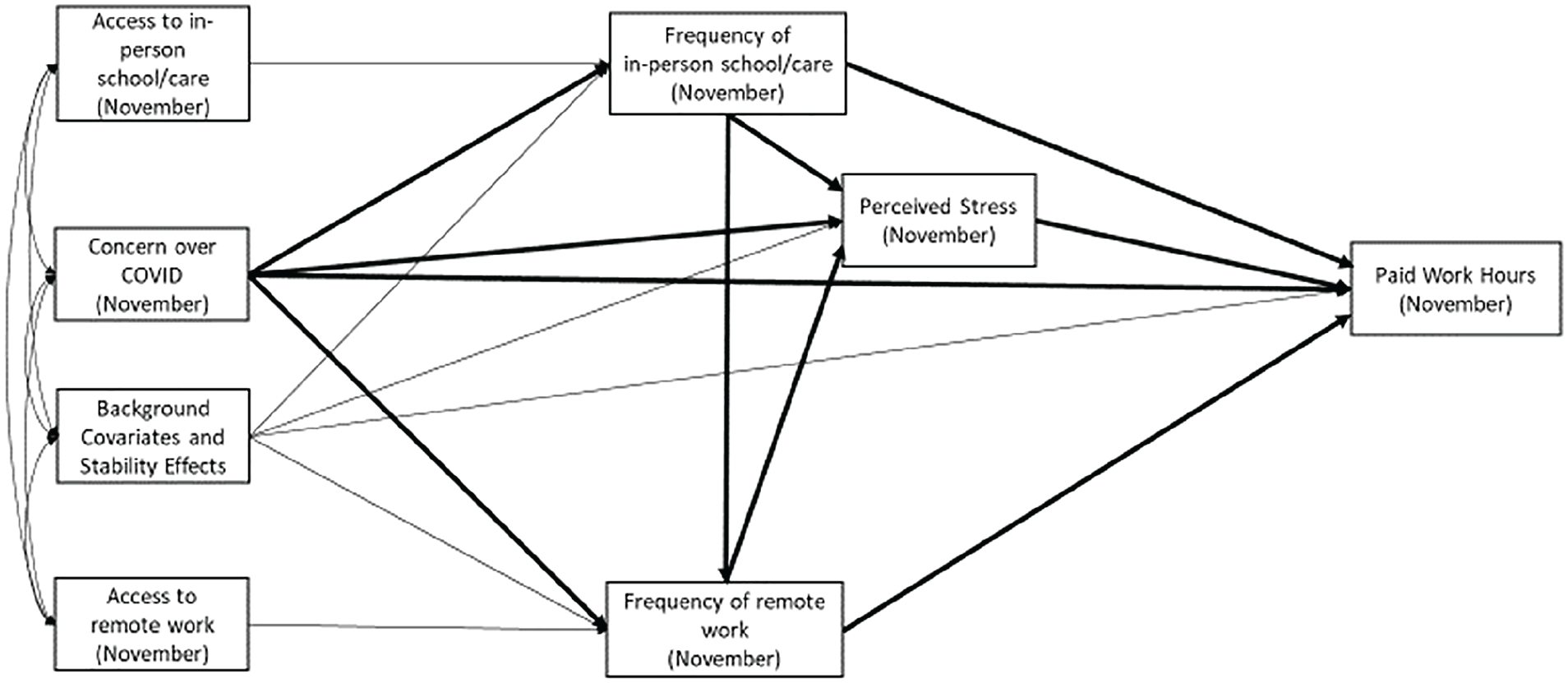
Path model of paid work hours among employed mothers, November 2020.
Direct paths are drawn from our primary exogenous variable—concern over COVID, measured in November 2020—to the variables measuring mothers’ LFP in November 2020. Indirect pathways are also specified to the endogenous mediators, also measured in November 2020: frequency of in-person school or daycare, frequency of remote work (only in models predicting work hours), and mothers’ stress. The models include exogenous control variables, which are all correlated with one another and with mothers’ concern over COVID. We also include lagged measures of the endogenous variables, which operate as stability paths controlling for path dependency, lagged effects of concern over COVID on the endogenous variable, and possible reverse causality of the endogenous variables with concern over COVID (Finkel 1995; Keele and Kelly 2006). Because of the near universal loss of in-person school and daycare in April 2020, we include a lagged measure of frequency of in-person school or care for March 2020.
We estimate associations between concern over COVID, in-person school or care, perceived stress, remote work, and mothers’ employment outcomes in November 2020 rather than longitudinally (e.g., from April 2020 to November 2020) because forced lockdowns and quarantines affecting maternal employment and remote work in April 2020 as well as changes in public understandings about COVID virulence make conditions in April 2020 likely poor predictors of behaviors in November.
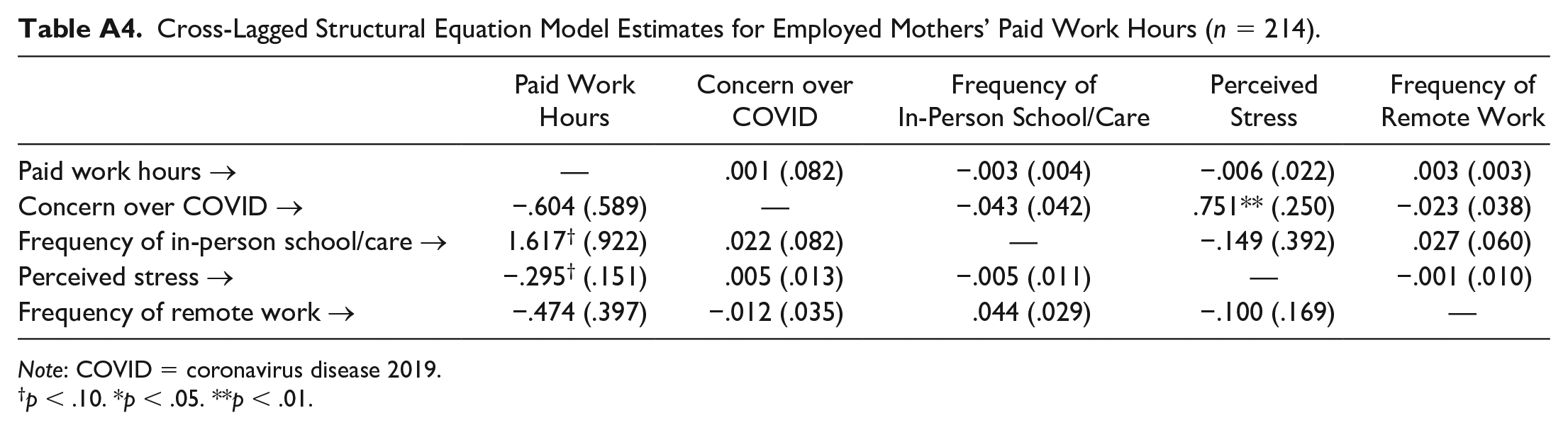
Although our model is informed by theory and past research, we recognize that estimating paths cross-sectionally in November limits our ability to assess causal directionality. We conducted supplemental cross-lagged models (see Appendix Figures A1 and A2 and Tables A3 and A4) to examine the possibility of reciprocal or reverse causality among concerns over COVID, in-person school or care, stress, remote work, and mothers’ employment outcomes. The results indicate only two statistically significant effects (p < .05): (1) a negative effect of concern over COVID in April on perceived stress in November and (2) a positive effect of frequency of in-person school or care in March on mothers’ employment in November. These associations are in line with our expectations, but the general lack of statistically significant associations is likely the result of the long lag between observations and shifting conditions over the course of 2020.
Stability paths for the endogenous variables control for any possible reverse causality due to lagged effects (e.g., effect of employment or paid work hours in April on concern over COVID in November) but leave open the possibility that any contemporaneous associations observed in November may still be the result of reverse or reciprocal causation. In two cases, a reciprocal association may result in amplified effects (i.e., effect size would appear larger than it really is): the association of concern over COVID with perceived stress and the association of frequency of in-person school or care with mothers’ LFP. Fortunately, the cross-lagged models indicate that these associations are likely unidirectional. In most instances, however, reciprocal effects are likely to be countervailing (e.g., the effect of A on B is negative, but the effect of B on A is positive); this suggests that, at worst, our analysis may underestimate effects. This could be the case for associations of COVID concerns with in-person school or care, remote work, and mothers’ LFP. It is also possibly the case for the associations of endogenous measures of perceived stress with in-person school or care, remote work, and mothers’ LFP. We specify paths from frequency of in-person school or daycare and frequency of remote work to mothers’ stress as supported by research on the loss of care supports during the pandemic (American Psychological Association 2021; Calarco et al. 2020) and on workplace supports and work-family conflict (Shockley and Allen 2007). Model fit was not improved (see Appendix Figures A3–A6) when alternative models were tested (e.g., path from stress to frequency of in-person school/care/remote work or nonrecursive, reciprocal paths between stress and frequency of in-person school/care/remote work). There was no evidence of change in the significance of the associations depending on how directionality was modeled. Moreover, how these relationships were modeled had little bearing on estimates of the relationship between these variables and mothers’ LFP or the relationship with concern over COVID.
Research suggests that mothers of school-age children experienced the greatest losses in LFP during the pandemic (Bureau of Labor Statistics 2020; Collins et al. 2021a). We conducted supplemental analyses (see Appendix Figures A7–A10) with separate models for mothers of preschool-age children (<6 years; n = 132) and school-age children (6–17 years; n = 131). Multigroup analyses indicated no significant change in model fit between an unconstrained model allowing path coefficients to vary across groups to one in which paths coefficients were constrained to be equal across groups (χ2 = 55.352, df = 49, p = .247). This suggests, on the whole, that the path model estimates do not vary between mothers of preschool- and school-age children. Although some analyses suggest that mothers of children ages 6 to 12 years may have been especially vulnerable to job loss and work reduction during the pandemic, small samples prohibit us from further disaggregating by child age.
Although sample sizes in this study are sufficient to identify statistically significant effects, we ran supplemental models using data from the SPDLC full wave 2 cross-section (which includes both new and follow-up respondents) to examine whether our results were sensitive to sample size. Because information on work and school or care in April 2020 was not available for new respondents at wave 2, we could not control for values of these variables at previous waves. In all, we conducted analyses predicting employment status for 971 mothers, and analyses of paid work hours for 610 mothers. Path coefficients from these cross-sectional analyses were nearly identical to the results we present the next section. Model fit, however, was substantially poorer, primarily because of the absence of stability coefficients for the endogenous variables.
Results
Descriptive Statistics
Table 1 provides descriptive statistics for all variables in our models. Among mothers employed prior to the pandemic, only 77 percent remained employed during the pandemic’s first month in April 2020. By November 2020, the percentage employed had increased, but only slightly, to 81 percent. Mothers’ average hours of paid work decreased as well. Employed mothers worked an average of 31 hours per week in April and 34 hours per week in November, compared with 36 hours per week prior to the pandemic.
Descriptive Statistics.
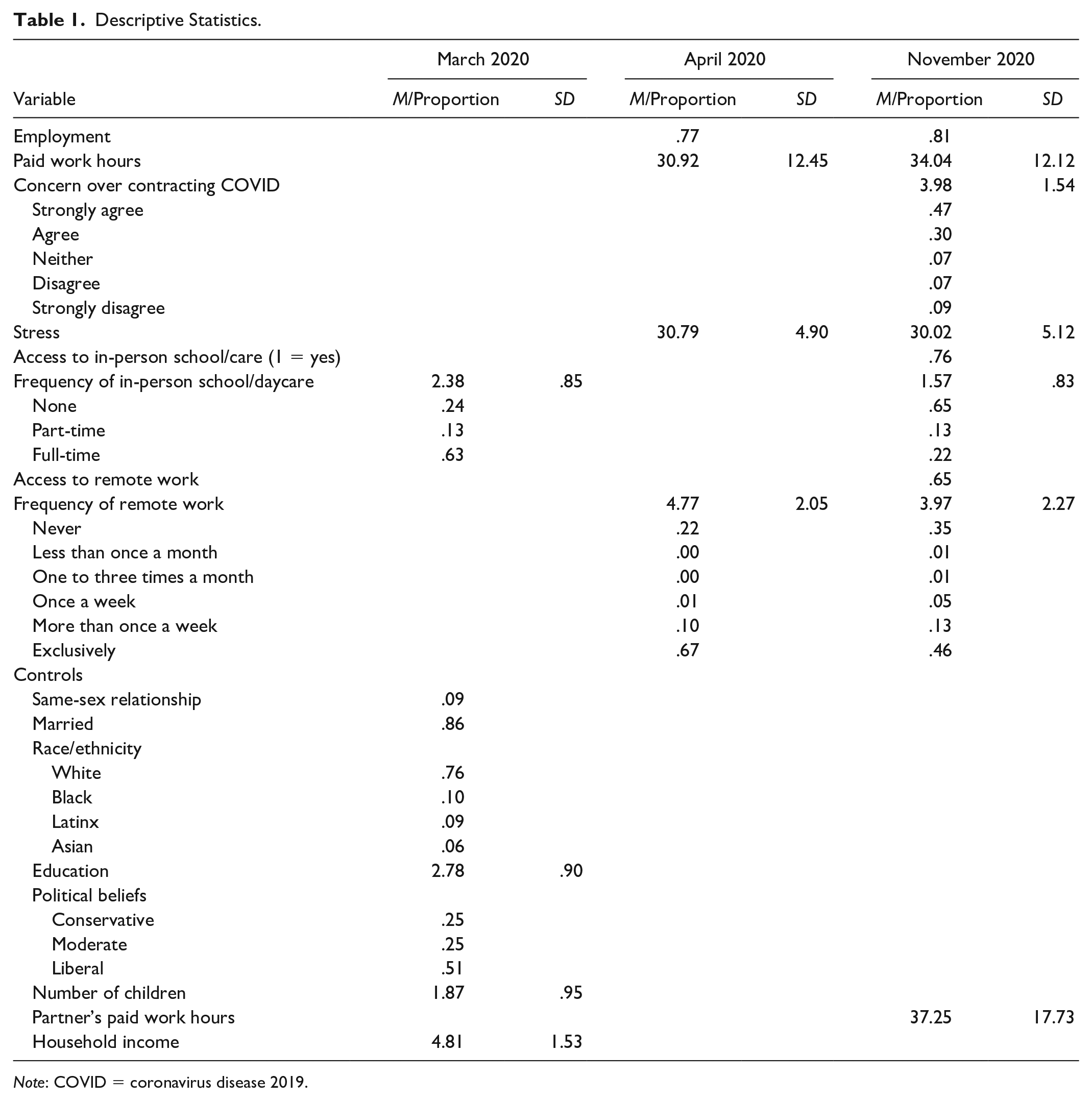
Note: COVID = coronavirus disease 2019.
In November 2020, mothers’ concerns about COVID were widespread, with 77 percent of mothers agreeing that they worried about someone they knew getting COVID, including 47 percent strongly agreeing. Consistent with mothers’ concern about COVID, mothers’ perceived stress was elevated and the proportion of children attending in-person school or care was far lower than the proportion who had access. On average, mothers had a perceived stress score of 30.02 (out of 40) in November, down less than 1 point compared with April. Seventy-six percent of mothers reported that their children had access to in-person school or daycare in November, yet only 35 percent of all mothers (45 percent of those with access to in-person school or care) reported that their children spent any time in in-person school or care.
Unsurprisingly, given the high proportion of children at home, use of remote work remained high in November 2020, though it was somewhat lower than in April. Sixty-five percent of employed mothers worked from home in November compared with 78 percent in April. Working from home was also more intermittent by fall; 46 percent of employed mothers worked from home exclusively in November, down from 67 percent in April.
Mothers’ Employment Status in Fall 2020
Figure 3 shows results from analyses of mothers’ employment status in November (see the Appendix Tables A1 and A2 for full results, including stability coefficients and controls). Statistically significant paths (p < .05) are bolded with coefficients and p values listed. Paths that do not reach statistical significance are presented as dashed lines. Fit indices indicate that the model fits the data exceptionally well. The χ2 test results (χ2 = 13.82, df = 8, p =.09) lead us to fail to reject the null hypothesis of a perfectly fitting model. The normed fit index (NFI) of .986 and incremental fit index (IFI) of .994 as well as the root mean square error of approximation (RMSEA) of .03 also indicate exceptional fit. NFI and IFI values greater than .95 and RMSEA values less than .05 indicate excellent fitting models (Hu and Bentler 1999).
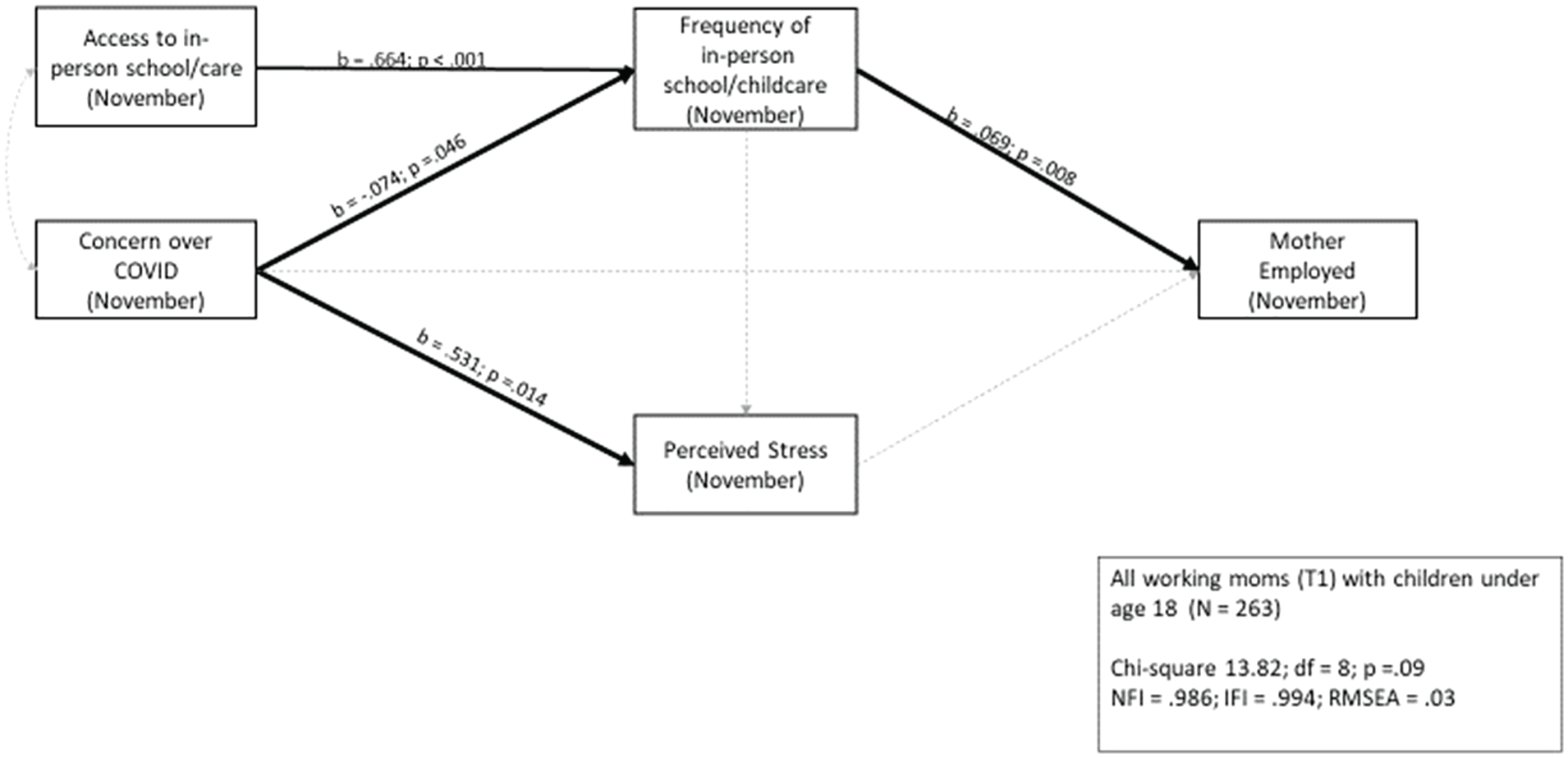
Path model of mothers’ employment status, November 2020.
Results indicate that mothers’ concern over COVID was negatively related to mothers’ employment in fall 2020. However, in contrast to our first hypothesis, the association between mothers’ concerns over COVID and employment is indirect. Consistent with hypothesis 2, the association operates through children’s frequency of attendance at in-person school or care. Results show that an increase in concern over COVID was negatively associated with children’s frequency of in-person attendance in school or care. In turn, frequency of in-person attendance in school or care was positively associated with the likelihood that mothers would be employed in the fall of 2020.
We expected that concerns over COVID may also affect mothers’ employment through perceived stress (hypothesis 3). Although concern over COVID was associated with more stress among mothers, stress itself did not predict whether mothers were employed in fall 2020. Moreover, results show no significant association between frequency of in-person school or care and mothers’ perceived stress. As such, we do not find support for hypothesis 3. Keeping children home as a response to worry over COVID did not ameliorate or exacerbate mothers’ stress levels.
Mothers’ Paid Work Hours in Fall 2020
Turning to paid work hours among employed mothers in fall 2020 in Figure 4, the results again indicate exceptional model fit. From the χ2 test (χ2 = 20.64, df = 18, p = .30), we fail to reject the null hypothesis of a perfectly fitting model. The NFI is .986, the IFI is .998, and the RMSEA is .026. All measures indicate excellent model fit. Overall, the results show that concern over COVID is negatively associated with employed mothers’ time in paid labor. Again, in contrast to hypothesis 1, the associations are largely indirect. Specifically, we find additional support for hypotheses 2 and 3, as mothers’ concerns about COVID are negatively associated with LFP because of frequency of in-person school or care and mothers’ perceived stress. Perceived stress among mothers was negatively associated with paid work hours, while frequency of in-person school was positively associated with time in paid work.
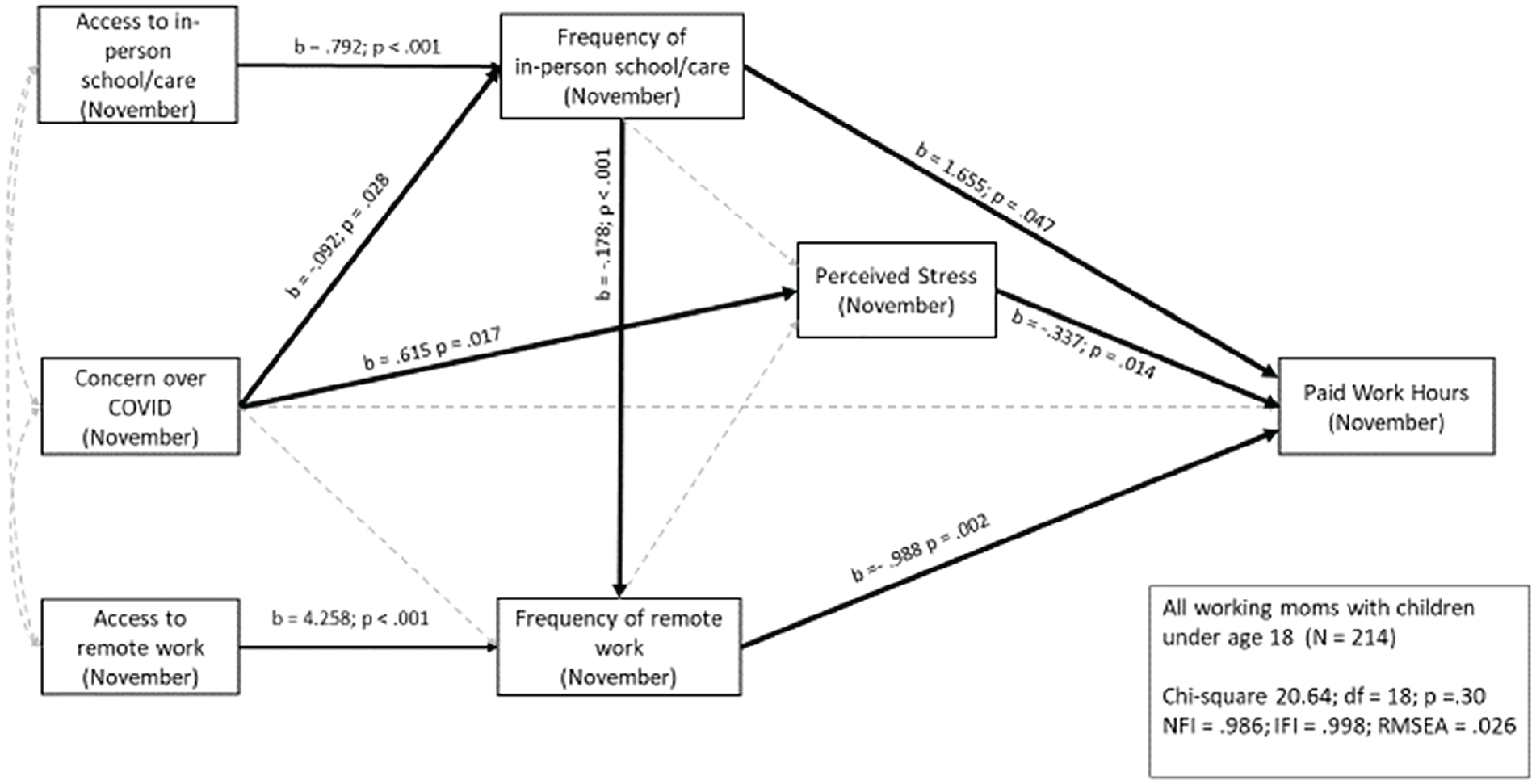
Path model of paid work hours among employed mothers, November 2020.
Mothers’ concerns about someone they know contracting COVID led them to reduce their time in paid labor in part because worrying about COVID made them more likely to keep their children home from school or daycare and increased their perceived stress. Although mothers’ concerns over COVID were directly and positively associated with their stress levels, the findings provide little evidence that mothers could ameliorate the stress emanating from COVID concerns by keeping children home and engaging in remote work. Indeed, frequency of in-person school or care and frequency of remote work were not significantly related to employed mothers’ perceived stress.
In contrast to hypothesis 4, we do not find evidence that the association between mothers’ concerns over COVID and their LFP is mediated by frequency of remote work, as we do not find a direct association between concern over COVID and mothers’ frequency of remote work. Nonetheless, concern over COVID is linked to mothers’ frequency of remote work, and subsequently mothers’ paid work hours, through its association with frequency of in-person school or care. Greater frequency of remote work among mothers is associated with fewer paid work hours in the fall of 2020. Moreover, mothers worked remotely more frequently when children were home. As such, concern over COVID did result in more remote work among mothers, but this was largely in response to keeping children out of in-person school and childcare.
In all, frequency of in-person attendance at school or daycare stemming from COVID concerns had both direct and indirect negative associations with mothers’ paid work hours. Having children home directly resulted in less paid work, likely through time conflicts related to childcare or virtual schooling demands. It also had indirect negative effects on paid work possibly by blurring boundaries between work and care. Although job flexibility is often cast as a solution to work-family conflict, remote work, though necessary to keep employment in response to having children home, did not seem to resolve tensions between working from home and having children at home during the work day (at least in regard to paid work hours).
Discussion
Two years after the onset of the COVID-19 pandemic, mothers’ LFP rates and time in paid labor remain far below prepandemic levels (Bureau of Labor Statistics 2021a; Montes et al. 2021). Although several studies have illuminated the causes of mothers’ reductions in paid labor early in the pandemic (Calarco et al. 2020; Collins et al. 2021a; Petts et al. 2021), we know far less about the reasons for mothers continued retreat from paid labor throughout the pandemic. Why, for instance, was mothers’ employment roughly the same in the fall of 2020 as it was in spring 2020 (Lofton et al. 2021)? In this study, we leveraged two waves of unique panel survey data from partnered U.S. mothers collected in April and November 2020 to help answer that question.
We found that mothers faced difficult decisions about work and childcare in fall 2020 as they weighed increased access to in-person school and daycare for their children with concerns about COVID. Greater concern about COVID led mothers to be less likely to be employed and work fewer paid hours in fall 2020, by reducing the likelihood that they had their children attend in-person school or care. Mothers’ frequency of remote work was also negatively associated with their paid work hours. Finally, mothers’ concerns about COVID were associated with increased stress, which in turn predicted fewer hours of paid work.
Building on research linking in-person schooling and mothers’ employment both during the pandemic (Collins et al. 2021b; Petts et al. 2021) and more generally (Landivar et al. 2021; Ruppanner et al. 2019), results from this study provide further evidence that mothers’ LFP is higher when children attend school or daycare more frequently. But we go beyond this to show that mothers’ worries about COVID likely shaped their willingness to let their children attend in-person school or daycare. Given that parents widely had the option to use in-person or virtual schooling (as well as options about daycare) in fall 2020 (Henderson et al. 2021; Landivar et al. 2022), their pandemic-related concerns likely shaped their decisions about which options to use.
Mothers in the United States are expected to live child-centered lives (Hays 1996) and are primarily responsible for family health decisions (U.S. Department of Labor n.d.). As such, mothers who were worried about COVID may have prioritized their children’s health above all else, even at the sacrifice of their own employment. This helps us understand why mothers’ LFP remained lower in fall 2020 despite increased access to in-person school and daycare; mothers who were concerned about COVID were more likely to keep their children at home, which in turn reduced their LFP. Of course, not every mother had the same options. A large number of families were mandated to send their kids to online school or did not have in-person care options in fall 2020. Mothers in these families likely did not “choose” to reduce their LFP so much as they were resigned to it. Indeed, whether families had access to in-person school or childcare, the decision to leave one’s job or reduce one’s hours was, in the vast majority of cases, likely something only mothers had to grapple with.
Not only did concern about COVID reduce mothers’ LFP by leading them to keep their children home, it also led to higher levels of stress which resulted in less time in paid work. COVID concerns were likely stressful for mothers because there was little they could do to cope with the larger structural problems that affected transmission risks, such as school and workplace mitigation policies and community members’ adherence to public health guidelines. Although practicing social distancing within one’s family by learning and working remotely was likely to a greater extent under mothers’ control, our results show that these potential coping strategies did little to buffer mothers’ stress because they may have led to greater work-family conflict.
Although working from home likely reduced COVID risks, our results suggest that it was largely ineffective at helping mothers manage competing care, schooling, and work obligations. Children’s presence at home directly resulted in less paid work for mothers, most likely because of time conflicts around childcare or virtual schooling demands. This aligns with prior work highlighting the negative impact of blurred boundaries between work and care for mothers. In contrast to popular discourses that frame workplace flexibility as a panacea to work-family conflict, our results align with research highlighting that remote work can contribute to a blurring of boundaries between work and family (Glavin and Schieman 2012; Noonan and Glass 2012) that particularly harms mothers. Mothers’ disproportionate responsibility for domestic labor means that working from home can exacerbate gender gaps in housework and childcare by providing mothers with even more time to engage in these tasks, particularly if they are the only ones working from home (Alon et al. 2021; Chung et al. 2021). To the extent that remote work promotes a traditional gendered division of labor, it may actually suppress mothers’ time in paid labor.
Accordingly, this study advances our understanding of the gendered impacts of remote work as well as our grasp of gender inequalities in employment during the COVID-19 pandemic by illuminating how concern over COVID was a particularly salient factor in keeping mothers’ LFP low in the second half of 2020. This concern represents a key and, to date, less discussed mechanism. Given that mothers in the United States assume disproportionate responsibility for monitoring and maintaining family health, their concerns over COVID are particularly relevant for decisions about children’s in-person school and daycare and therefore, mothers’ return to employment.
Although our study focused on the period of spring to fall 2020, future research should interrogate how ongoing concerns about COVID throughout the pandemic—for instance, with the onset of the delta and omicron waves in 2021 and 2022—have continued to shape mothers’ LFP. Evidence from early in the pandemic certainly illustrated the importance of access to in-person daycare and school for mothers’ employment (e.g., Petts et al. 2021), but less research has examined the role of choice with regard to this access. That is, why do parents choose to keep their children at home, even when in-person options are available? Our findings suggest that to the degree that ongoing concerns over COVID transmission lead families to keep children home, then it is conceivable that such concerns will continue to depress mothers’ LFP over time through sustained care and educational demands. As the pandemic evolves, the depths of mothers’ concerns, and their attachment to the labor force, will likely vary with COVID risk exposure. The introduction of vaccines likely reduced worry, but access to vaccines varied and may not have been enough to eliminate concern when case counts spiked during the omicron wave (e.g., in winter 2021–2022). Moreover, the U.S. federal government has announced plans to discontinue vaccine subsidies, leaving the uninsured especially vulnerable. The U.S. government’s sole reliance on vaccines to protect against COVID and the elimination of alternative public health measures (e.g., the end of mask mandates) will likely exacerbate inequalities in mothers’ employment. Mothers in families with the greatest health risks (e.g., uninsured, immune-compromised family members) are likely to see their employment suffer the most moving forward.
This study has notable limitations. First, the data used are not nationally representative, although they are weighted to be representative of U.S. parents in terms of gender, race/ethnicity, and age, and characteristics of the sample are similar to nationally representative estimates across many characteristics (including employment). However, because less educated and more religious parents are underrepresented in this sample, future research should examine the central motivating questions of this paper using nationally representative data. In addition, associations between the main focal variables in this study are all assessed in the same survey wave. Although the inclusion of stability paths for endogenous variables in the model and results from supplementary analyses minimize concerns about reverse causality, the model may underestimate associations among variables. Future studies should use longitudinal data with appropriate lags between observations to further consider the long-term consequences of how contextual factors throughout the pandemic may continue to influence mothers’ LFP. Moreover, though we include relevant controls in our models, we cannot rule out the possibility that the associations presented are due to spuriousness and omitted variable bias. Although fixed effects regression with panel data may help assuage these concerns, the exclusion of cases with invariant values on variables in fixed effects models and the modest sample size of mothers in this study prohibits the use of such a model. Finally, concern over COVID is measured broadly with a single item. Although mothers’ concerns that someone they know will contract COVID appear to matter for their LFP, such general concerns may be less predictive of mothers’ LFP than mothers’ specific concerns that they, their partners, or their children may contract COVID.
Despite these limitations, this study advances our understanding of why mothers’ LFP remains below prepandemic levels by examining how their concerns about contracting COVID may be associated with LFP through various mechanisms. We find that mothers’ concerns about COVID reduced the likelihood that their children attended in-person school or daycare and increased their stress, both of which, in turn, were associated with lower LFP among mothers. We also find that remote work was associated with working fewer hours and that this arrangement was more common among mothers who kept children out of in-person school and childcare because of concern about contracting COVID. Overall, these results suggest that persisting concerns and fears over COVID may have shaped mothers’ decisions about care, schooling, and work, with especially concerned mothers making choices to minimize exposure to COVID, perhaps at the expense of their own paid LFP.
Footnotes
Appendix
Cross-Lagged Structural Equation Model Estimates for Employed Mothers’ Paid Work Hours (n = 214).
| Paid Work Hours | Concern over COVID | Frequency of In-Person School/Care | Perceived Stress | Frequency of Remote Work | |
|---|---|---|---|---|---|
| Paid work hours → | — | .001 (.082) | −.003 (.004) | −.006 (.022) | .003 (.003) |
| Concern over COVID → | −.604 (.589) | — | −.043 (.042) | .751** (.250) | −.023 (.038) |
| Frequency of in-person school/care → | 1.617 † (.922) | .022 (.082) | — | −.149 (.392) | .027 (.060) |
| Perceived stress → | −.295 † (.151) | .005 (.013) | −.005 (.011) | — | −.001 (.010) |
| Frequency of remote work → | −.474 (.397) | −.012 (.035) | .044 (.029) | −.100 (.169) | — |
Note: COVID = coronavirus disease 2019.
p < .10. *p < .05. **p < .01.
Funding
The author(s) disclosed receipt of the following financial support for the research, authorship, and/or publication of this article: American Sociological Association Fund for the Advancement of the Discipline (2020) and the National Science Foundation (Grant Nos. 2148610 and 2148501).
Author Biographies
 ) and on Twitter (@pettsric).