




Abstract
This article assesses the impact of household composition and intermarriage on foreign-born women's labor force participation in Japan, Sweden, and the United States. Whereas previous literature on immigrant integration and intermarriage has treated social integration and labor force participation as tightly interlinked phenomena, we use new and previously unavailable data on Japan and the literature on institutional gender inequality to show that, in some cases, social integration through intermarriage might actually result in lower labor force participation for foreign-born women. We argue that the degree of institutional support for immigrants and families directly affects foreign-born women's labor force participation in the anticipated direction for each country. We argue that these cross-national differences are largely an outcome of differences in the degree of institutional support for working women and families within the host society and help clarify instances where social integration might have negative implications for labor force participation. These findings highlight the importance of accounting for both gender and social context when assessing the role intermarriage plays in receiving country immigrant integration.
Introduction
Foreign-born women's labor force participation has become a key focus in contemporary studies on international migration due in large part to the unique and intersectional forms of gender and national-origin discrimination to which foreign-born women are subject in receiving-society labor markets (Pedraza 1991; Duleep and Sanders 1993; Schoeni 1998; Dustmann and Schmidt 2001; Fortin 2005; Kesler 2006; Kogan 2006; Donato et al. 2011; Khoudja and Fleischmann 2015; Tammaru et al. 2015). Much of the aforementioned literature provides strong evidence that the receiving society's institutional context plays a large role in shaping the degree of inequality faced by foreign-born women in the labor market. A parallel, yet distinct, line of research on immigrant integration suggests that greater attachments to the native-born mainstream improve socioeconomic outcomes for foreign-born individuals (Portes and Rumbaut 2001; Bevelander 2005). One notable finding supporting the claim that greater native-born attachment improves immigrant outcomes is that cross-nativity 1 marriage boosts foreign-born spouses’ labor market outcomes (Bean and Stevens 2003; Steven et al. 2015; Tammaru et al. 2015; Basu 2017).
An important limitation of most recent research on foreign-born women's labor force participation is that outcomes are usually assessed within a single country (e.g., Basu 2015, 2017). Without cross-national analysis, however, it is difficult to deduce which aspects of foreign-born women's labor force participation are more country-specific and which are more universal. While some cross-national studies have used nationally representative data to analyze foreign-born women's labor force participation within Europe and North America (e.g., Kesler 2006 and Kogan 2006), very few have assessed these issues across a number of distinct regions with disparate institutional contexts for foreign-born women in the labor force. The lack of receiving country diversity is particularly troubling given that demographic structures, norms regarding family roles and work, and institutional and social support for gender equality can differ drastically from one receiving country to another (Geist 2005). Research frames capturing variation in institutional settings allow for a greater understanding of the role of context in shaping labor market outcomes, especially when norms about work and family directly influence the presence of married women or women with children in the labor force (DiPrete and McManus 2000; Ono 2003; Alba and Foner 2015).
This article presents findings from an analysis of the labor force participation of women, in Japan, Sweden, and the United States using census or registry data from 2010. In doing so, it makes both within- and between-group comparisons of gender parity within domestic labor markets for both native and foreign-born women. The countries analyzed here were selected to represent three distinct receiving societies for foreign-born female workers (Sweden with relatively strong, Japan with relatively weak, and the United States with intermediate degrees of protection for working women, families, and foreign-born individuals; Steinmo 2010). Census microdata for immigrants in Japan have only recently become available for analysis, so this article represents one of the few analyses with robust findings on foreign-born women's labor-force participation in Asia's second-largest economy. Japan is also a highly relevant country for assessing the utility of cross-nativity marriage because married women in Japan face significant social pressure to drop out of the labor force entirely and become full-time homemakers (Ono 2003; Yu 2009). Those who remain in the labor force often find few institutional resources to support continued employment outside the home, especially if they have children (Yu 2009). Thus, Japan represents one of the more extreme cases of gender inequality in high-income countries, and its inclusion here allows us to consider whether the effect of cross-nativity marriage on immigrant women's labor force participation depends on the macro-level context of gender inequality in a given society.
In keeping with previous studies (Read and Cohen 2007; Khoudja and Fleischmann 2015), we analyze the effect young children and married to a native-born spouse have on foreign-born women's labor force participation. We argue that the degree of institutional support for immigrants and working families directly affects women's labor force participation in the anticipated direction for each country. These findings add to the existing immigrant integration literature by illuminating two different forms of integration spurred by cross-nativity marriage: one providing greater access to domestic labor markets typically enjoyed by native-born workers and one resulting in less representation of foreign-born women as they gain greater exposure to social forces that cause married native-born women to drop out of the labor market altogether. Which type of integration to which cross-natively married foreign-born women are subject is largely attributable to the institutional and social support given to or denied working women within the host society.
To develop these ideas, we start by connecting the research traditions about the factors that influence the nature and degree to which foreign-born women are incorporated in receiving-society labor markets. We then show how intermarriage has been theorized to affect both the social and labor market incorporation of foreign-born workers while also demonstrating the substantive gap in the immigrant intermarriage literature concerning whether deeper incorporation into the native-born mainstream always results in positive labor market effects for foreign-born marriage partners. From there, we consider the different contexts of reception for Japan, Sweden, and the United States, as well as the sorts of migrants represented within the foreign-born population in each country. We discuss the thinking behind each of our hypotheses before describing the data and analysis procedures and moving to our results, which are followed by a discussion of our major findings and the implications for the field and future research agendas.
The Literature on Labor Force Participation and Foreign-Born Women
Factors Affecting Foreign-Born Women's Labor Force Participation
Quantitative analyses of foreign-born women's labor force participation in economically advanced countries have increased substantially over recent decades (Pedraza 1991; Duleep and Sanders 1993; Dustmann and Schmidt 2001; Andersson and Scott 2005; Lee, Zhou, and Kim 2014). Increased protections and options for women in the labor force within receiving societies and elevated educational attainment and career ambitions of women from a variety of sending societies have also expanded over the same time period (Goldin 2006), despite labor force participation rates generally remaining below that of men in most societies outside the Nordic region (Antecol 2000). Although many early studies on women's labor force participation theorized married women's economic activity as conditional on their husbands’ earning potential (Mincer and Polacheck 1974), women's increased participation within the labor force and the steadily increasing numbers of solo migrating women have greatly reduced this assumption (Adsera and Chiswick 2007; Geist and McManus 2012). Furthermore, as the number of solo-migrating women employed across a broad spectrum of jobs has increased, so has the number of studies specifically analyzing female migrants’ labor market outcomes (Kesler 2006; Furtado and Theodoropoulos 2010; Khoudja and Fleischmann 2015; Kesler 2018).
There is widespread agreement among social demographers and labor economists on the core individual-level characteristics that directly influence foreign-born women's labor force participation in economically advanced countries (Pedraza 1991; Adsera and Chiswick 2007). These characteristics include age, educational attainment, marital status, and the number and age of co-residing children. Holding all else constant, women in their prime-earning years, women with higher educational attainments, single women, and women without children under the age of six are generally associated with increased labor force participation in most high-income countries (Jaumotte 2004). The overall impact of a number of other characteristics, such as years since migration, marriage to a member of the host society or non-co-ethnic, religious affiliation, race, or sending-society geographic region, is less uniform across a variety of receiving countries (Donato, Piya, and Jacobs 2014).
Recent cross-national studies point towards several complementary and contradictory trends with respect to foreign-born women's labor force outcomes in economically advanced countries. Among complementary findings, two trends stand out. First, foreign-born women are less likely to participate in the labor force than native-born women in many post-industrial societies (Park and Myers 2010; Donato, Piya, and Jacobs 2014; Park, Nawyn, and Benetsky 2015), and this finding holds true across most age cohorts and household types. Second, foreign-born women in the labor force are more heavily concentrated in low-skilled occupations, compared with native-born women with similar demographic profiles (Schoeni 1998; Duvander 2001; Read and Cohen 2007).
Contradictory findings across economically advanced countries on foreign-born women's labor force participation deal with the existence (and degree) of ethnic/racial advantage or disadvantage (Koopmans 2016), whether more gender egalitarian institutional contexts result in better outcomes for female migrants (Kesler 2018), the effect of marriage (whether to a co-ethnic or a member of the host society) on female migrants’ labor force outcomes (Pichler 2011), and the degree to which children impact foreign-born female labor force participation (Gorodzeisky and Semyonov 2017). While contextual differences are likely behind these contradictions in the literature on foreign-born women's labor force participation, the use of incomparable data and small sample sizes also play a role. Most national surveys that directly address labor force participation often have too few immigrant female workers to compare to native-born female workers, and the collection of migration-relevant data is not standardized across different national projects. Census or registry data are often best suited to capture the most representative population of legally-residing immigrants within a country and often include many variables relevant to studying migrant labor market incorporation. However, difficulties in obtaining data over the same time periods, geographic regions, or labor force regime types have constrained analyses using such sources, particularly for countries where access to census microdata is very restricted (as is the case of Japan) and especially when data on spouses or partners, who often greatly influence women's labor force participation, are incomplete or altogether absent.
How Intermarriage Affects Immigrant Integration and Labor Force Participation
While earlier interpretations of intermarriage saw it as an indicator of assimilation (Park and Burgess 1921; Gordon 1964), newer theories of intermarriage conceptualize it as a pathway toward assimilation (Bean and Stevens 2003; Stevens, Ishizawa, and Escandell 2012; Tammaru et al. 2015). Bean and Stevens (2003) were the first within the immigrant integration canon to seriously consider how cross-nativity marriage may serve as a pathway towards immigrant integration, using US census data to show that cross-nativity marriages help hasten foreign-born spouses’ economic, social, and political incorporation. Stevens, Ishizawa, and Escandell (2012) built on the findings of Bean and Stevens (2003) and provided further evidence that socioeconomic factors affect the likelihood of cross-nativity marriages and serve as both an indicator of and a pathway toward integration within the first generation and between generations as well. More recent research has shown that the integration of immigrants in cross-nativity marriages varies along with several individual characteristics, such as linguistic and cultural fluency, educational or occupational credentials, gender, and religion (Alba and Foner 2015; Dribe and Nystedt 2015; Furtado and Song 2015; Lichter, Qian, and Tumin 2015; Rodríguez-García et al. 2015; Elwert 2018, 2020).
Relatively few analyses have focused on the impact that cross-nativity marriage has on foreign-born women's labor force participation, but those that do show general support for intermarriage's positive effect on foreign-born women's earnings and labor force participation (Furtado and Trejo 2013). Economist Delia Furtado and her colleagues, for example, have provided the most data on this subject in a US context and have shown that foreign-born women married to native-born men experience a reduced wage penalty generally associated with immigrants and higher levels of employment than either unmarried foreign-born women or foreign-born women married to co-ethnics (Furtado and Theodoropoulos 2010; Furtado 2012; Furtado and Song 2015). These findings have been corroborated by other studies (Rodríguez-García et al. 2015; Basu 2015, 2017), although intermarriage's effect may be confounded by other characteristics such as language ability, skin tone or race/ethnicity, and educational background (Basu 2015, 2017). Studies using Swedish data similarly report a labor force participation advantage for foreign-born women married to native-born men (Dribe and Nystedt 2015; Elwert 2018, 2020). Although marriage homophily in Sweden appears to be as prevalent as in the United States, some researchers suggest that heterophilous couples, or partners who differ in socioeconomic class, race/ethnicity, and/or educational attainment, may exhibit patterns of status exchange: using a high-status dimension of their identity to compensate for a less desirable dimension (Behtoui 2010; Çelikaksoy, Nekby, and Rashid 2010; Irastorza and Bevelander 2014; Elwert 2018, 2020). There are relatively few studies on labor force participation among foreign-born women in Japan. Korekawa (2017) used descriptive statistics from the 2010 Japanese census to argue that approximately half of foreign-born Chinese and Filipino women married to Japanese men were in the labor force—rates lower than that of native-born married Japanese women. In addition, Takenoshita (2017) used small-scale survey data in various regions of Japan to show that foreign-born men married to Japanese women received an employment advantage that did not materialize for foreign-born women married to Japanese men. Thus, intermarriage and economic integration in Japan reflect a greater gender gap in labor market participation than in either Sweden or the United States. How, though, does each country's institutional composition attract different types of migrants and set them on different trajectories through their respective labor markets?
Institutional Differences and the Context of Reception
It is important to understand the role that national institutional regimes and the overall composition of migrant groups play in influencing labor market outcomes, given that all three countries have distinct welfare regimes and tend to draw very different groups of migrants. A number of sociologists focusing on immigrant incorporation have been primarily concerned with what has been termed the context of reception (Portes and Rumbaut 2001; Reitz 2002; Van Tubergen, Maas, and Flap 2004). Despite slight differences in formation, these researchers all note four factors shaping how immigrants are incorporated: (1) human capital factors present within migrants themselves; (2) the receiving society's institutional, political, and cultural context (especially with respect to the sending society of the immigrants in question and how it is interpreted within the receiving society); (3) the structure and degree of openness or closedness of labor markets within the receiving society; and (4) the presence or absence and composition of co-ethnic communities within the receiving society (Van Tubergen, Maas, and Flap 2004). Gender is also noted as being of crucial importance for how individual migrants experience life within receiving societies, especially within the labor force (Donato et al. 2011).
Of all three countries, the United States tends to attract the most diverse array of migrants with respect to geographic origin and socioeconomic status (Steinmo 2010) This diversity is due in large part to the relatively high levels of immigration since the Immigration and Nationality Act of 1965 eliminated national origin quotas that gave preferential treatment to migrants from Western and Northern Europe (Park and Myers 2010). In aggregate, the United States has maintained three prominent migration flows since the 1965 immigration law revisions: one with individuals who enter as high-skilled professionals (the majority now arriving from South and East Asia); another with individuals who enter as low- or semi-skilled laborers (many now arriving from Latin America); and a relatively smaller group of individuals from a variety of countries and regions who arrive as refugees/asylum-seekers (Hollifield, Martin, and Orrenius 2014). The United States has led all other high-GDP countries in terms of the overall number of immigrants from all three categories since the last half of the 20th century (Hollifield, Martin, and Orrenius 2014). However, increased anti-immigrant and anti-Muslim-sentiment in recent years have resulted in decreased financial and social support for immigration at the national level and increased calls for immigration restrictions or outright bans from various politicians and citizen groups (Hooghe and Dassonneville 2018). Furthermore, the United States has the ignominious distinction of being one of the least gender-egalitarian countries among high-income post-industrial societies (Pereira 2018). Although the United States has passed various legislation since 1970 designed to prohibit discrimination against women in the workplace, there are still sizable gender employment and wage gaps in many sectors of the labor market, and the number of women in positions of power and influence within the labor market continues to lag well behind men (Fortin 2005).
Although the United States leads all higher-income countries in the overall number of immigrant arrivals year over year, Sweden surpasses the United States in immigrant admissions as a percentage of the total country population (Castles, De Haas, and Miller 2013). Since the end of the 20th century, Sweden has admitted two categories of migrants: one group—mostly from Southwest Asia, the horn of Africa, and North Africa—who primarily enter as refugees and asylum-seekers or their reunified family members and another group from European Union (EU) states who enter primarily through the freedom of movement/settlement provision of the EU charter (Nekby 2010). Roughly two-thirds of the total population of legally admitted migrants in Sweden are refugees and asylum-seekers, a relatively large proportion when compared with similar high-GDP countries (Sainsbury 2006). Sweden's international reputation for providing relatively generous welfare provisions to foreign-born residents has resulted in Sweden becoming a preferred destination for potential refugees and migrants (Eger 2009; Nekby 2010). However, Sweden began limiting the number of new refugee and asylum-seeking entrants in 2016, a potential sign that government and citizen support for immigrant resettlement and immigration has begun to wane (Rydgren and Van der Meiden 2016). Despite Sweden's reputation as welcoming and providing support for resource-constrained migrants, migration restrictions borne of anti-immigrant and racist sentiment have increased throughout Sweden and the rest of the EU over the past two decades in response to increased flows from Southwest Asia and Sub-Saharan Africa (Eger 2009; Nekby 2010; Rydgren and Van der Meiden 2016). Despite these shifts, it is still one of the best countries with respect to legislation and policies designed to ensure gender equality (Masselot 2007). In particular, Sweden mandates gender parity within hiring (Masselot 2007; Ray, Gornick, and Schmitt 2010), provides state funding for leave related to family care, mandates provisions for retaining jobs upon return from leave (Ray, Gornick, and Schmitt 2010), and provides generous state-funded child care to support working parents (Ray, Gornick, and Schmitt 2010). These policies have resulted in some of the highest labor force participation rates of women across all age cohorts of any country in the world (Besamusca et al. 2015).
In contrast to both the United States and Sweden, Japan tends to admit very few migrants of any category (Peng 2016). Immigrants that do manage to gain legal admission for long-term residence in Japan fall into three categories: skilled professionals who generally arrive from East Asia and India; women mostly from Southeast Asia and the Philippines who enter on entertainment visas and work in bars, hostess clubs, and a variety of other adult industries; and ethnically Japanese return migrants who largely hail from Brazil and Peru (Liu-Farrer 2020). A fourth group of individuals arrive on temporary tourist visas with the full intention of overstaying their permitted residency period to work as unskilled or semi-skilled laborers, but these individuals are difficult to track and usually do not show up in official government statistics (Ivory 2017). Although Japan maintains some institutional support for legally residing foreign residents, the number and monetary value of these provisions fall well below those offered in the United States, Sweden, and several other high-GDP countries (Peng 2016). A majority of Japanese citizens and politicians continue to push for restricting immigration, despite ongoing labor shortages, low birth rates, and an ageing population (Green and Kadoya 2015; Peng 2016). Although Japanese immigration laws were revised in 1981, 1989, 2006, and again in 2012, none of these revisions have significantly improved the social conditions for immigrants residing in Japan (Peng 2016; Takenaka, Nakamuro, and Ishida 2016; Holbrow 2020). Japan is also well-known for having deep-seated problems with gender inequality and provides few legal mechanisms to ensure gender equality within hiring or promotion or to provide remedies for violations of laws already in place (Estevez-Abe 2005; Boling 2006). Gender discrimination is often rife in several sectors of the Japanese labor market, and married Japanese women face substantial pressure to exit the labor market entirely if they have children (Osanami Törngren and Holbrow 2017). While Japan offers some state funding for childcare, it is often not enough to keep up with demand, especially in urban areas (Wada 2006). Thus, all three national contexts represent very different labor market climates for foreign-born women.
Hypotheses
As mentioned earlier, there is some disagreement among scholars about whether (and, if so, to what degree) a number of individual, group, and national-level characteristics influence foreign-born female labor force participation. What follows are a series of hypothetical propositions informed by much of the previous literature on the two household factors theorized to most substantially influence women's labor force participation: marriage and children.
1. Marriage (1a) Married foreign-born women will have lower labor force participation rates than single foreign-born women. (1b) Foreign-born women married to native-born men will have higher labor force participation rates than women married to co-ethnics in the United States and Sweden. (1c) Foreign-born women married to native-born men will have lower labor force participation rates than women married to co-ethnics in Japan. 2. Children
(2a) The presence of children of age six or younger will decrease women's participation in the labor force
(2b) Foreign-born women with children of age six or younger will be more likely to be in the labor force compared to native-born women with children under the age of six. (2c) The depressing effect of children of age six or younger on foreign-born women's labor force participation will be strongest in Japan. (2d) The depressing effect of children of age six or younger on foreign-born women's labor force participation will be the weakest in Sweden.
Marriage generally has a depressing effect on foreign-born women's labor force participation, as has been identified in a number of national contexts (Donato, Piya, and Jacobs 2014). One reason that marriage tends to decrease foreign-born female labor force participation is because married foreign-born women are much more likely to enter on a foreign-born spouse's visa that often prohibits legal employment (Balgamwalla 2014). Thus, a general hypothesis for marriage's effect on foreign-born women's labor force participation rate is:
However, there is reason to suspect that country-level social factors play a moderating role in what type of marriage partner positively or negatively affects foreign-born women's labor force participation (Stevens, Ishizawa, and Escandell 2012). Greater levels of gender egalitarianism in the United States and Sweden, relative to most sending societies, suggest that foreign-born women who marry native-born men in these countries would have elevated levels of labor force participation, compared to foreign-born women who marry co-ethnics. Conversely, the strong negative association in Japan between marriage and women's participation in labor force suggests that foreign-born women who marry Japanese men should have lower labor force participation rates than those who marry co-ethnics, despite having greater unrestricted access to the labor market by virtue of being married to a native-born spouse. The above information leads us to propose the following hypotheses:
The presence of young children, especially those who have not begun formal education, generally inhibits all women from fully participating in the labor force when compared to similarly situated women without children (Hayghe 1997; Fernández 2013). Thus:
Despite the depressing effect of younger children on women's labor force participation, previous studies have shown that foreign-born women with children are more likely to be in the labor force than similarly situated native-born women (Bevelander 2005; Geist and McManus 2012). Stated differently, although the presence of young children decreases foreign-born women's labor-force participation, they are still present in the labor force more often than similarly situated native-born women. We, therefore, hypothesize that:
As for country-specific moderating factors, Sweden has well-established state-funded childcare services available to all legal residents, regardless of nativity (Bergqvist and Njberg 2013). Japan, on the other hand, has relatively few institutional supports for childcare, and those that do exist cannot accommodate all who wish to utilize them (Peng 2002). Childcare arrangements in the United States vary widely by state and municipality and generally fall somewhere between what is present in Sweden and Japan (Cohen 1996). These differences lead us to formulate our last two propositions about the effects of young children on foreign-born women's labor force participation:
Data and Methods
We test the above-mentioned hypotheses by analyzing census data for Japan and the United States and with register data from Sweden. We analyze the labor market participation and employment outcomes of foreign-born females residing in each country during the 2010 censuses (for the United States and Japan) or residing in the country during 2010 according to the population register (for Sweden). 2 We also focus on individuals between 25 and 59 years of age, as this range represents the greatest likelihood of being in the labor market.
Swedish data consist of administrative records from several government agencies and entities such as employment agencies, the Board of Health and Welfare, the National Agency for Higher Vocational Education, the Swedish Council for Higher Education the Swedish Tax Agency, employers, and the Swedish Social Insurance Agency. All these records are made available to us through a remote encrypted connection to Statistics Sweden's own servers. Given the Swedish population's smaller size relative to the other two countries, we are able to use all cases within our age range in the register to perform our calculations, leading to a sample size of 2,007,887 persons.
Japanese data are from the 2010 Japanese Census, provided by the Japanese Bureau of Statistics within the Ministry of Internal Affairs and Communication. A total of 34,323,948 cases in the Japanese census fit our age range. To estimate the model smoothly, we randomly selected 2 percent of the Japanese population and all foreign-born residents from the original data of the Japanese Census, resulting in a total of 992,940 cases. When running the model, we added population weights to correct for the fact that foreign-born residents were oversampled in this way. We use the same sampling weights when displaying descriptive statistics.
Data for the United States are from the 2010 US census and the American Community Survey, obtained through the Public Use Microdata Sample (IPUMS-USA, Steven et al. 2015). The US data consist of a 5 percent random sample of the entire US population and contain records for 707,941 persons.
Dependent variable
The variable employment status classifies subjects into “employed,” “unemployed,” and “inactive.” In the US sample, employed subjects were those who had paid employment in the week before the census enumeration or who worked more than 15 hours in unpaid farm or family business work in that reference week. The employed category in Sweden includes all who had any paid employment or business earnings in the previous year according to the information submitted by the employers to the Swedish government. In Japan, subjects are considered employed if they worked in the reference week of 24 to 30 September, including all paid employment and work at family businesses. The unemployed category in the United States and in Japan includes those who did not work in the reference week but were looking for work. The unemployed category in Sweden includes those who did not have any work-related or business-related earnings and were receiving unemployment benefits or unemployment-related occupational training benefits. 3 Subjects are considered inactive in all three countries if they were old enough to be included in the labor force but were neither employed nor unemployed. The top seven rows of Table 1 show the distributions of this variable for each country. Employment rates were highest in Sweden (72.92 percent), followed by those in the United States (70.04 percent) and Japan (63.06 percent). A similar gradient is seen for unemployment: 14.91 percent for Sweden, 6.2 percent for the United States, and 4.35 percent for Japan. This order is reversed for labor market inactivity, with Japan having the highest figures (32.59 percent), followed by the United States (23.76 percent) and Sweden (12.17 percent).
Descriptive Statistics for Sweden, the United States, and Japan (All Women, 2010).
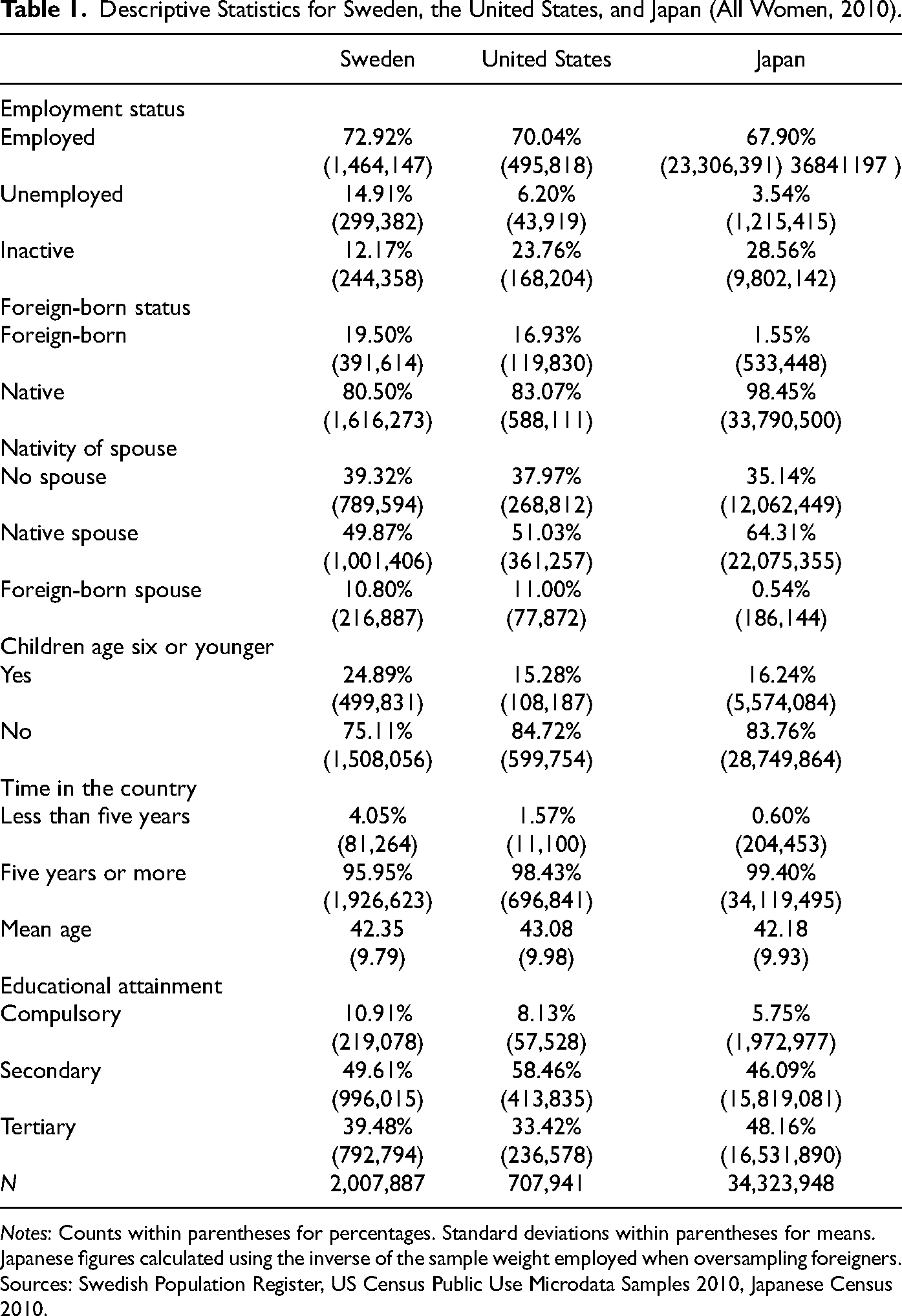
Notes: Counts within parentheses for percentages. Standard deviations within parentheses for means. Japanese figures calculated using the inverse of the sample weight employed when oversampling foreigners.
Sources: Swedish Population Register, US Census Public Use Microdata Samples 2010, Japanese Census 2010.
Independent Variables
Our key predictors are family composition, foreign-born status (native or foreign-born), and their interactions. Country of birth was re-coded into a binary classification of foreign-born status from the originally incompatible multi-category variables from each dataset: “Native” refers to subjects who were born in the country, while “Foreign” refers to those born outside the country. Two variables were used to measure family composition. First, respondents were assigned a binary marital status variable (married or unmarried), and, if married, the spouse's foreign-born status (native or foreign-born) was also indicated. The second family composition variable recorded the presence of any children aged six or less in the household. Distributions of the foreign-born status and family composition variables in our samples can be found in Table 1. Within our dataset, Sweden had the highest share of foreign-born, at 19.50 percent, followed by the United States at 16.93 percent, and Japan at 1.55 percent. In all three countries, single women were the minority: 39.32 percent in Sweden, 37.97 percent in the United States and 35.15 percent in Japan. Those who had a spouse were mostly married to a native in all three countries. A total of 1,218,293 women (60,67 percent) in the Swedish dataset had a spouse, 1,001,406 (82.20 percent) of whom had a Swedish spouse. The percentages of married women with a native spouse were 78.38 percent (361,257 of 439,129) in the United States and 99.41 percent (36735762 of 36,952,974) in Japan. Young children in the home were more common in Sweden (24.89 percent) than in Japan (16.22 percent) or the United States (15.28 percent).
Control Variables
Education was re-coded into three categories (less than secondary, secondary, and some post-secondary) to maintain comparability between samples. Compulsory education represents pre-secondary education (junior high school in the United States, högstadiet in Sweden, Chūgakkō in Japan). The bottom rows in Table 1 show that women in the Japanese sample were overall more educated than their counterparts in Sweden and the United States. For example, women in Japan were more likely to have tertiary education (48.16 percent) than those in Sweden (39.48 percent) and in the United States (33.42 percent). Age was measured in years and included in the models as a first- and second-order polynomial. Table 1 shows that the average age and its standard deviation were very close in all samples, ranging from 40 to 43 years old. Last, the share of individuals (both migrants and non-migrants) who had been residing in the country for longer than five years was larger in Japan (99.40 percent) than in Sweden (95.95 percent) and the United States (98.43 percent). A caveat of using this variable across the three countries is that it is only reported for foreign-born individuals in the US census, meaning that it is not fully comparable to the other two countries. We conducted analysis with and without this variable, and the results for our variables of interest (family composition, origin country, and their interaction) do not change substantially between the two specifications. For various reasons, other control variables usually adopted in the literature (Lichter, Qian, and Tumin 2015) cannot be used in our analysis. Migration cohort is perfectly correlated with time since migration and would complicate our model estimation. Type of residence permit, language proficiency, religion, previous employment history, race, ethnicity, and detailed origin country, while all potentially meaningful, are not consistently available across the three datasets.
Statistical Model
We fit multinomial logistic regression models with employment status as the outcome variable. This model includes two interaction effects: one between the country of origin and the presence of children aged six or younger and one between the country of origin and marital status. We use average marginal effects (AMEs) in our model, which are calculated based on predictions obtained using the model equation. AMEs show how much, on average, a given covariate affects the probability of each category in the outcome variable. Moreover, AMEs, unlike logistic regression coefficients such as log-odds ratios and odds ratios, are not sensitive to differences in unexplained heterogeneity stemming from using the same equation on different samples (Allison, 1990), allowing us to compare coefficients across the three countries (see Mood 2010). Calculating AMEs involves predicting the probabilities of each outcome using counterfactual samples for each value of the independent variable. For example, to obtain the AME of having a child of age six or younger, one must first calculate the predicted probabilities as if no one in the sample had a child, repeating the process as if everyone had a child, and subtracting the two probabilities for each individual in the dataset. The AME is the average of the individual differences in these predicted probabilities. AMEs can also be calculated for specific values of other covariates, which is useful when interpreting models which include interaction effects. If a model includes an interaction or a non-linear term, marginal effects averaged over the entire sample will show the average effect of that variable disregarding the interaction in the model. Averaging the marginal effects separately for each category of one of the variables involved in the interaction allows us to display how the effects differ between groups. We evaluate the AMEs of the family composition variables at different values of the nativity variable (i.e., native and foreign-born) to express the interaction effects contained in the models. When calculating AMEs, we use the observed values of the covariates not included in the interaction.
Results
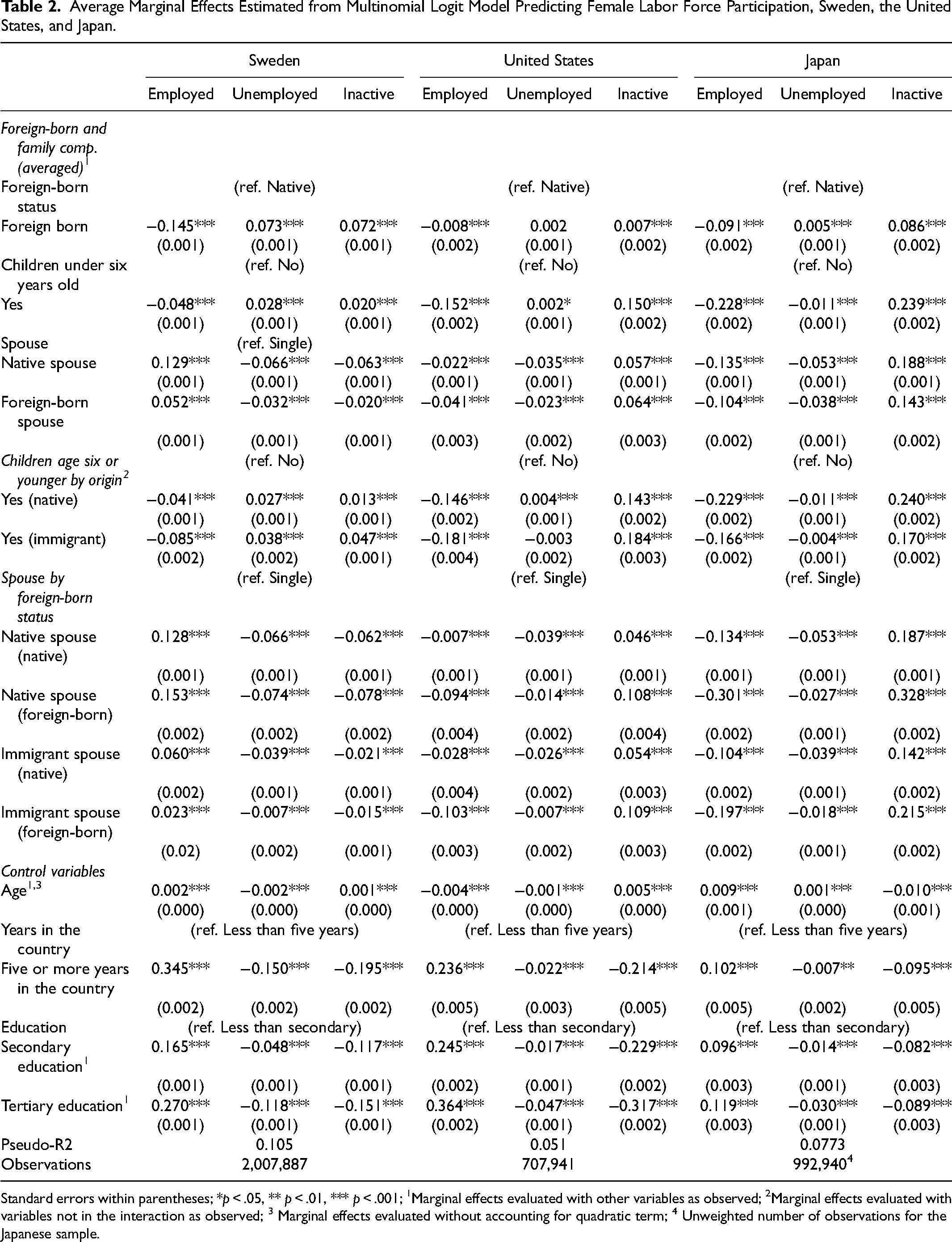
Table 2 shows the AME for the three country-specific models in our analysis. We, first, discuss the marginal effects calculated without taking the interaction into account (i.e., averaged over the entire sample and treating all other covariates as observed). We, then, turn to marginal effects calculated for the two different values of foreign-born status (i.e., first treating the entire sample as native and then as foreign-born) to explore the ways in which household composition differently affects immigrants’ and natives’ labor force participation.
Average Marginal Effects Estimated from Multinomial Logit Model Predicting Female Labor Force Participation, Sweden, the United States, and Japan.
Standard errors within parentheses; *p < .05, ** p < .01, *** p < .001; 1Marginal effects evaluated with other variables as observed; 2Marginal effects evaluated with variables not in the interaction as observed; 3 Marginal effects evaluated without accounting for quadratic term; 4 Unweighted number of observations for the Japanese sample.
The Overall Effect of Family Composition
Family composition measures show that the presence of children reduced employment and increased inactivity, depending on the country examined. Small children in the household have a much stronger negative effect on employment in Japan (−22.8 percent) and the United States (−15.2 percent) than in Sweden (−4.8 percent). Likewise, small children in the household increased the probability of women's inactivity in Japan by 23.9 percent and in the United States by 15.0 percent, while the same effect was only 2 percent in the Swedish sample. The effects of having small children on unemployment were small, although statistically significant for all three countries, ranging from −1.1 percent (in Japan) to +2.8 percent (in Sweden).
In a similar vein, the effect of having a spouse varied by country. In Sweden, both native-born and foreign-born spouses had a positive effect on employment (12.9 and 5.2 percent, respectively), negative effects on unemployment (−6.6 and 3.2 percent), and negative effects on inactivity (−6.3 and 2 percent, respectively). Note that the Swedish effects were smaller when the spouse was also foreign born but were still associated with greater employment. In contrast, having a spouse in the United States and Japan increased the probability of inactivity and reduced the probabilities of employment and unemployment. For example, women married to both native- and to foreign-born spouses were more likely to be inactive in Japan (18.8 and 14.3 percent, respectively) and in the United States (5.7 and 6.4 percent). In addition, being married to either a native- or foreign-born spouse reduced the probability of employment for women in Japan (−13.5 and −10.4 percent, respectively) and in the United States (−2.2 and −4.1 percent). Last, as in Sweden, women were less likely to be unemployed if they were married in Japan (−5.3 percent for native- and −3.8 percent for foreign-born spouses) and in the United States (−3.5 and −2.3 percent, respectively).
In sum, the marginal effects averaged over both immigrants and natives show that the presence of children led to lower employment and increased inactivity in all countries, but with stronger effects in Japan, weaker effects in the United States, and even weaker effects in Sweden. Moreover, having a spouse of any nativity in Sweden was associated with reduced unemployment and inactivity and increased employment. However, having a spouse in Japan and the United States was associated with lower levels of employment and unemployment and greater levels of inactivity (i.e., falling out of the labor market altogether). The magnitude of these effects was stronger in Japan and weaker in the United States. However, averaging the marginal effects over the entire sample conceals the interaction effect included in the model, and the possibility that native-born and foreign-born women were affected differently by family composition must also be considered.
Differential Effects of Family Composition by Foreign-Born Status
Figure 1 depicts the effects of having a small child on the employment status of women in each country, using AMEs calculated separately for foreign-born and native-born, with each employment status shown in a separate row and each country in a separate column. Cross-national differences are clearly evident. Starting on the top row, we see that in all three countries, women were less likely to be employed when young children were present at home. Japan stands out in that the effect was stronger for native-born women (−22.9 percent, compared to −16.6 percent), in contrast to the other two countries, where the effect was weaker for native-born women (−14.6 percent, compared to −18.1 percent in the United States, and −4.1 percent, compared to −8.5 percent in Sweden). Regarding unemployment (middle row of Figure 1), the effects of young children in the home were very close to zero in Japan and the United States for both native-born and foreign-born women but were substantial in Sweden. Swedish native-born women experienced an increase of 2.7 percent in the probability of unemployment when they had young children in the household, and foreign-born women experienced an increase of 3.8 percent in the same probability. The bottom row of Figure 1 shows that having a child in the household constantly increased inactivity by native-born and foreign-born women in all three countries, but that effect was larger for foreign-born women than for native-born women in Sweden (4.7 vs 1.3 percent) and the United States (18.4 vs 14.3 percent), in Japan, the effect was stronger for native-born women and weaker for foreign-born women (24 vs 17 percent). There were cross-country differences in the effects’ overall magnitude, with larger effects appearing in the Japanese and US data and smaller effects appearing in the Swedish data.
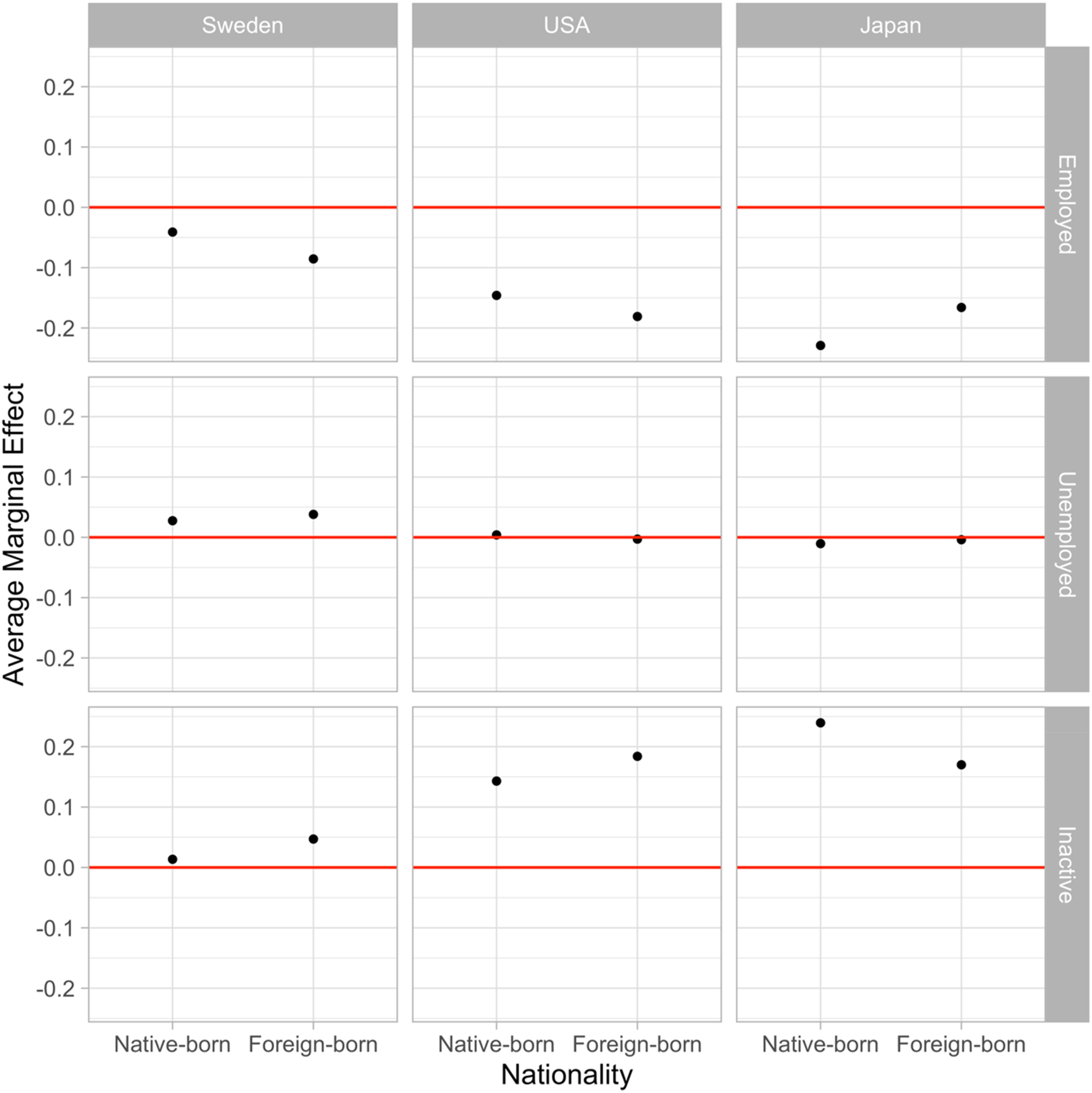
Average marginal effect of having a child children age six or younger at home on the labor force participation of women in Sweden, the United States, and Japan.
We now move on to the results showing how the effects of spousal nativity differ by foreign-born status. Figure 2 shows the estimated marginal effects of spouse foreign-born status for natives (in orange) and foreign-born (in purple). The difference in the effect of having a spouse is remarkable across the three countries. The top row of Figure 2 shows that the effect was negative in Japan and the United States but positive in Sweden when it came to being employed. In Japan, the negative effect of having a spouse on employment was stronger for foreign-born women than for native-born women and stronger if the spouse was native born (−30.1 percent for foreign-born women and −13.4 percent for native-born women) than if the spouse was foreign-born (−19.7 percent for foreign-born women and −10.4 percent for native-born women). In the United States, the effect was negligible for native-born women with native-born spouses (−0.7 percent), slightly stronger for native-born women with foreign-born spouses (−2.8 percent), even stronger for immigrants with native-born spouses (−9.4 percent), and the strongest for foreign-born women with foreign-born spouses (negative 10.3 percent). It should be noted that the overall effects were mostly smaller in the US sample. In contrast to both Japan and the United States, the effect of having a spouse was mostly positive in Sweden, with native-born spouses having stronger positive effects than foreign-born ones (12.8 percent for native-born women and 15.3 percent for foreign-born women). The effect of having a spouse on the probability of being unemployed (middle row of Figure 2) was negative in all three countries, with native-born spouses leading to larger reductions in that probability. Lastly, the bottom row of Figure 2 shows that having a spouse increased the probability of inactivity in Japan and the United States, but not in Sweden. In Sweden the effects were mostly negative and ranged from −1.5 percent for foreign born women with foreign-born spouses to −7.8 percent for native-born women with foreign-born spouses. In Japan, having a native spouse was associated with larger increase in inactivity than having an foreign-born spouse for both native-born (18.7 vs 14.2 percent) and foreign-born women (32.8 vs 21.5 percent). In the United States, the effects were roughly the same and slightly larger if the spouse was foreign-born. In both Japan and the United States, these effects were stronger for foreign-born than for native-born women.
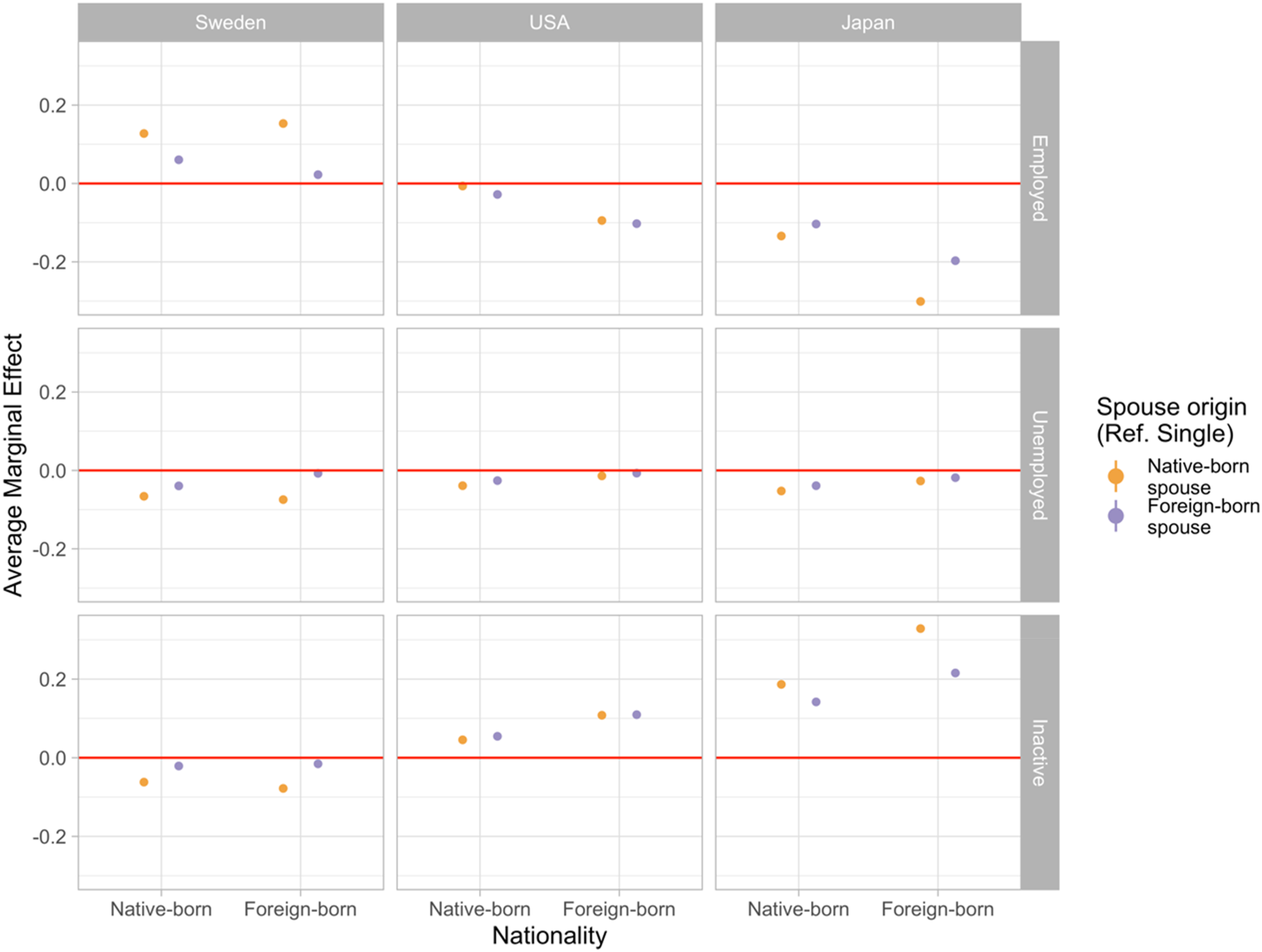
Average marginal effect of spouse origin on the labor force participation of women in Sweden, the United States, and Japan.
The magnitude of the Japanese effects shows substantial differences between native-and foreign born women when it comes to how marriage to a native-born Japanese spouse affects labor market activity. In fact, these women often exited the labor market altogether, rather than simply becoming unemployed, as shown by the large negative AMEs on employment and large positive AMEs on inactivity. Greater inactivity in the labor market among foreign-born women married to Japanese men would appear to result from the expectation that married women in Japanese society become full-time homemakers and caregivers. Scholarship on cross-national marriage in Japan suggests that gender inequality in that country may be reproduced through international marriages (Piper 2003; Korekawa 2017). This negative effect on employment of marriage to a native-born spouse creates a stark contrast between Sweden and Japan because in Sweden, foreign-born women married to native-born men were more likely to be employed than unmarried foreign-born women. This difference between the two countries might be due to Swedish husbands providing greater assistance to their foreign-born spouses to navigate the host-society labor market (Dribe and Lundh 2008; Behtoui 2010).
Discussion and Conclusions
Our results provide mixed support for our prior hypotheses about the impact of marriage and children on foreign-born women's labor force participation in Japan, Sweden, and the United States. With respect to our marriage hypotheses (1a–1c), married foreign-born women were much less likely to be in the labor force than unmarried foreign-born women in the United States and Japan, but the reverse was true in Sweden (mixed support for 1a). Foreign-born women with a native-born spouse were more likely to be in the labor force in Sweden and the United States and less likely in Japan, which was the anticipated direction of the spousal nativity effect (positive support for both 1b and 1c). Once married, women in Japan are at an elevated risk to drop out of the labor force, independently of whether they have children (Boling 2006).
As for our hypotheses about children (2a–2d), the presence of children under the age of six was generally associated with decreased labor force participation for all women in our samples (support for 2a), and the depressing effect of young children on foreign-born women's labor force participation was weaker in Sweden and stronger in Japan and the United States. We suspect that Sweden stands out because the relatively strong social safety net for families with children in Sweden affords an opportunity for foreign-born women with young children to combine work and childcare without having to leave the labor market (Andersson and Scott 2005). Hypothesis 2b, which predicted a stronger labor force attachment by foreign women with young children at home is also not fully supported by our results, as only Japan has stronger negative effects for native-born women than for foreign born women. Last, hypotheses 2c and 2d, which predicted that the negative effect of young children on labor force participation would be strongest in Japan (2c) and weakest in Sweden (2d) are supported. In Japan, along with, marriage, the presence of children is a determining factor of labor force participation (Yu 2009).
These results begin to make sense once the institutional environment for working women, foreign-born individuals, and families with children are considered. Sweden's expansive welfare state provides substantial resources to support women in the workforce, working families in general, and legally residing non-citizens (Bergqvist and Njberg 2013). The United States provides legal support for equal treatment of the three aforementioned categories, but provides far fewer state resources than Sweden (Steinmo 2010). Japan provides some state resources for native-born individuals, but few for foreign-born individuals (Peng 2016). Furthermore, there are strong social norms in Japan that pressure women with children to drop out of the workforce (Yu 2009). The Japanese data in particular show that previous studies focused on North America and Europe (such as Bean and Stevens 2003; Dribe and Lundh 2008; and Lichter, Qian, and Tumin 2015) have missed a crucial and important facet of immigrant incorporation through intermarriage: in some contexts, particularly those with a dominant ethnoculture that prioritizes and promotes female domesticity and provides few institutional supports for working women, fitting in means dropping out of the labor force entirely for foreign-born women in cross-nativity unions. This social pressure on married women to drop out of the labor market often means that single and foreign-born women married to co-ethnics in such societies are far more likely to be active in the labor force than women married to native-born residents, which has implications both within households and in the society at large.
There are some unavoidable limitations to our empirical analysis, given the nature of the datasets used. First, public-use microdata samples of census data, such as the one used for our US analysis, are samples nevertheless and may not necessarily be representative, although the large sample sizes allow for rather accurate statistical inference. Second, full population census files, such as the one used for the Japanese analysis, can be large and may force the researcher to work on a sample despite having access to the entire population if not enough computing resources are available. Proper weighting procedures as the ones for our Japanese somewhat mitigate this issue. Third, register data, while avoiding the issues of sampling, may overestimate inactivity, due to lags in de-registration by people leaving the country (Monti et al. 2020). This de-registration issue, known as overcoverage, can be dealt with through several approaches, all of which involve checking the registers for other information beyond residential registration that may indicate that the person is still in the country (Monti et al. 2020). In this article, a triangulation between the different sources of income besides work income (e.g., unemployment and social benefits), household type and composition, and migration events was used in a way that approaches what is called “cross-sectional register tracing” in the over-registration literature (Monti et al. 2020). In that process, individuals with no activity (missing data) on those variables that would otherwise be registered if they were in the country, were not included in the sample. Furthermore, some variables (such as race/ethnicity and linguistic fluency) could not be analyzed because they were not present in all three countries. Likewise, sometimes harmonizing a variable across the three countries led to a coarser measure being used in the analysis. Nevertheless, such harmonization procedures allowed us to include data on immigrants in Japan in a cross-country comparison, something that would not be possible otherwise. Key factors in the literature on immigrant labor force participation, such as education, age, time in the country, and family composition were nevertheless accounted for in our models.
However, our findings help to advace the literature in two very important ways. First, inclusion of the Japanese data clearly shows that the gendered context of reception for foreign-born workers is highly consequential on their labor market outcomes. This has been undertheorized in the literature due to the focus on a narrow collection of Western countries and should be corrected. A much more expansive study that takes into account specific policies of countries from across several regions would be necessary to provide more conclusive evidence on the link between individual outcomes for foreign-born women in the labor force and the institutional environment of the host country. Second, we demonstrate that the assumption that increased integration leads to better labor market outcomes is faulty. In some cases, such as with foreign-born women who marry native-born Japanese men, to “fit in” with a societies norms can result in negative labor market outcomes. Further research that identifies the host country contexts that might result in opposing social and economic integration are keys in moving our collective understanding forward. It is our hope that this article represents the first step in such a direction.
Footnotes
Acknowledgements
The authors would like to thank the Japanese Statistical Bureau for access to Japanese census microdata and Statistics Sweden for access to Swedish population registry data. The authors would also like to thank Patricia McManus, Hilary Holbrow, three anonymous reviewers, and the editorial team at IMR for their insightful comments that drastically improved this manuscript.
Declaration of Conflicting Interests
The author(s) declared no potential conflicts of interest with respect to the research, authorship, and/or publication of this article.
Funding
One of the authors, Hirohisa Takenoshita, received funding from the Japan Society for Promotion of Science (Grant ID: 15K03822, 18H00931).
