




Abstract
Multinational companies (MNCs) are an important part of the economy and thus for the labor market. However, their impact on various dimensions of inequality remains unclear. The author analyzes whether MNCs influence gender wage inequalities in their host countries. MNCs might transfer their home countries’ cultures by taking their beliefs, practices, and resulting gender inequalities with them into subsidiaries abroad. Company fixed-effects regressions using unique German linked company employee data show that lower gender inequalities in MNCs’ home countries are associated with a lower gender wage gap in Germany. This association is especially strong for MNCs with expatriate managers from the same home country and accounts for 10 percent of the unexplained gender wage gap. These results strongly support the transfer-of-culture hypothesis and shed light on expatriate managers as an underlying mechanism for this transfer of culture.
Despite great advances toward gender equality worldwide, gender inequalities remain in most countries, notably the gender wage gap (OECD 2019). As gender inequalities remain even within organizations, researchers have called to “bring the firm back in” (Baron and Bielby 1980) to investigate how corporate structures shape inequalities within companies (Tomaskovic-Devey and Avent-Holt 2019). In a globalized economy, multinational companies (MNCs) are essential actors, accounting for approximately 25 percent of global production, with their foreign subsidiaries generating more than 10 percent of global production (UNCTAD 2011). Despite their importance for the global economy, research regarding MNCs and gender wage inequalities is surprisingly scarce. Most of the previous scholarship on MNCs and the gender wage gap focuses on comparing locally owned versus foreign-owned companies (e.g., Earle, Telegdy, and Antal 2018; Magda and Salach 2021; Vahter and Masso 2019).
Because gender inequalities vary greatly among countries (OECD 2019; World Economic Forum 2014), scholars have recently started investigating whether MNCs can transfer their gender inequalities from their home countries to the host country (Kodama, Javorcik, and Abe 2018). Greaney and Tanaka (2021) found a lower gender wage gap for foreign-owned companies in comparison with domestic-owned companies in Japan. As Japan exhibits high gender gaps, the authors assumed that foreign-owned companies stemmed from backgrounds with, on average, lower gender inequalities. Thus, this lower gender wage gap can indicate a transfer of culture. A recent discussion paper on Sweden also indicates that MNCs can transfer their cultures and resulting gender wage inequalities to Sweden (Halvarsson, Lark, and Gustavsson Tingvall 2022).
Although the literature reveals evidence for a transfer of culture, the underlying mechanisms remain unclear. I shed light on these mechanisms by proposing expatriate managers (i.e., managers from the same home country as the MNC) as an underlying mechanism driving this transfer of culture. Expatriate managers might transfer culture to subsidiaries abroad because these managers represent the headquarters abroad, implement company-wide practices, and take their beliefs, such as gender norms, with them (Heidenreich 2012; Kodama et al. 2018). Consequently, these attributes might lead to progressive or discriminatory behavior of the subsidiary abroad.
The present research contributes to the literature in at least three ways. First, most previous studies compared domestic versus foreign companies without distinguishing among different home countries and did not focus on the transfer-of-culture hypothesis. I contribute to the literature by providing evidence on the association between gender inequalities in MNCs’ home countries and the gender wage gap in the host country. Thus, I can test the transfer-of-culture hypothesis directly. To consider different dimensions of gender inequalities, I also take into account multiple indices for gender inequalities in MNCs’ home countries. Second, I extend this identification strategy by considering the expatriate managers as an underlying mechanism for transferring culture (Kodama et al. 2018) in my analysis. Third, I contribute to the growing field of analyzing MNCs and gender wage inequalities by providing the first evidence for Germany.
I use the unique Orbis-ADIAB (Antoni et al. 2018) data set, the first large-scale data set to link financial statements from companies in Germany (Bureau van Dijk 2022) to German administrative data. The scope of these data allows me to focus on the subsidiaries of foreign-owned MNCs and compare them with one another. My results show that lower gender inequalities in MNCs’ home countries are associated with lower gender wage inequalities in these companies’ subsidiaries in Germany. This association is especially strong if an MNC has expatriate managers from the same home country. These results therefore strongly support the transfer-of-culture hypothesis and are the first evidence for expatriate managers as an underlying mechanism for the transfer of culture. Although some companies are transferring wage inequalities to Germany, many companies also lower the gender wage gap. Thus, for example, policy makers can learn how to narrow gender wage inequalities by investigating the corporate culture in MNCs from countries with low gender inequalities.
Theoretical Framework
Foreign-owned MNCs might shape the working conditions in their subsidiaries by a transfer of culture. Such companies might exploit their comparative advantages by taking company-wide rules, standards, and procedures with them (Heidenreich 2012; Bloom and Van Reenen 2010; Kodama et al. 2018), thereby preventing redundancies. The culture in an MNC’s home country likely influences such company-wide practices (Kodama et al. 2018) because the core activities of most MNCs are concentrated in their home countries (Heidenreich 2012; Thompson and Bo Kospersen 2012).
Some evidence in related fields supports this transfer-of-culture hypothesis. For instance, foreign-owned companies in Japan, a country with high gender inequalities, have, on average, more organizational practices promoting gender equality than domestic firms (Kodama et al. 2018). As most foreign-owned companies in Japan are from home countries with lower gender inequalities than Japan, Kodama et al. (2018) interpreted this result to be evidence for a transfer of culture. Similarly, a subsidiary of a Swedish company in the Czech Republic had a more women-friendly culture than local companies (Křížková et al. 2009). Furthermore, foreign-owned companies in China, Japan, and Korea employ more female employees and have a higher female share of managers than domestically owned firms (Choi and Greaney 2022; Kodama et al. 2018; Tang and Zhang 2021). Thus, my first hypothesis is that the gender inequality in a foreign-owned company’s home country transmits gender wage inequalities to its host country (hypothesis 1).
The relationship between MNCs and their foreign subsidiaries can be very heterogeneous. Whereas some MNCs allow their subsidiaries to act autonomously (Hedlund 1986), other MNCs control their subsidiaries strongly. This vertical control allows MNCs to implement company-wide practices in their subsidiaries (Heidenreich 2012). For example, Kodama et al. (2018) found that foreign-owned companies are especially female friendly when their foreign owners have a high degree of control. Thus, to control subsidiaries and maintain company-wide practices, MNCs can send managers from headquarters to foreign subsidiaries (Heidenreich 2012). These expatriate managers represent the headquarters of MNCs abroad (Heidenreich 2012) and play a key role in transferring culture from MNCs to foreign subsidiaries (Kodama et al. 2018). For example, German and Austrian MNCs had at least one expatriate manager from their MNC headquarters in more than 40 percent of their Eastern European affiliates (Marin, Schymik, and Tarasov 2014). Furthermore, expatriate managers might take their beliefs (e.g., gender norms) with them (Kodama et al. 2018). Therefore, I expect the link between gender inequality in the host country and home country to be stronger if the foreign-owned company has expatriate managers from the MNC’s home country (moderator, hypothesis 2).
Data
The data source for my empirical analysis is the Orbis-ADIAB data set (Antoni et al. 2018). This cross-sectional data set combines data from companies with financial statements in Germany with administrative information about the German workforce (Schild 2016). The resulting data set contains three levels. First, the company level consists of all companies with financial statements in Germany before January 3, 2014, in Bureau van Dijk’s ORBIS data set (Bureau van Dijk 2022). Second, the establishment level is built from the data in the administrative establishment history panel (see Schmucker et al. 2018). An establishment is the local unit of a company, and a company can have multiple establishments in Germany. Third, my data set contains the individual-level data from every employee liable to social security in companies’ linked establishments on June 30, 2014. The Orbis-ADIAB is the first large-scale German data set combining information about a company, such as ownership, with administrative register data (Antoni et al. 2018:5). 1
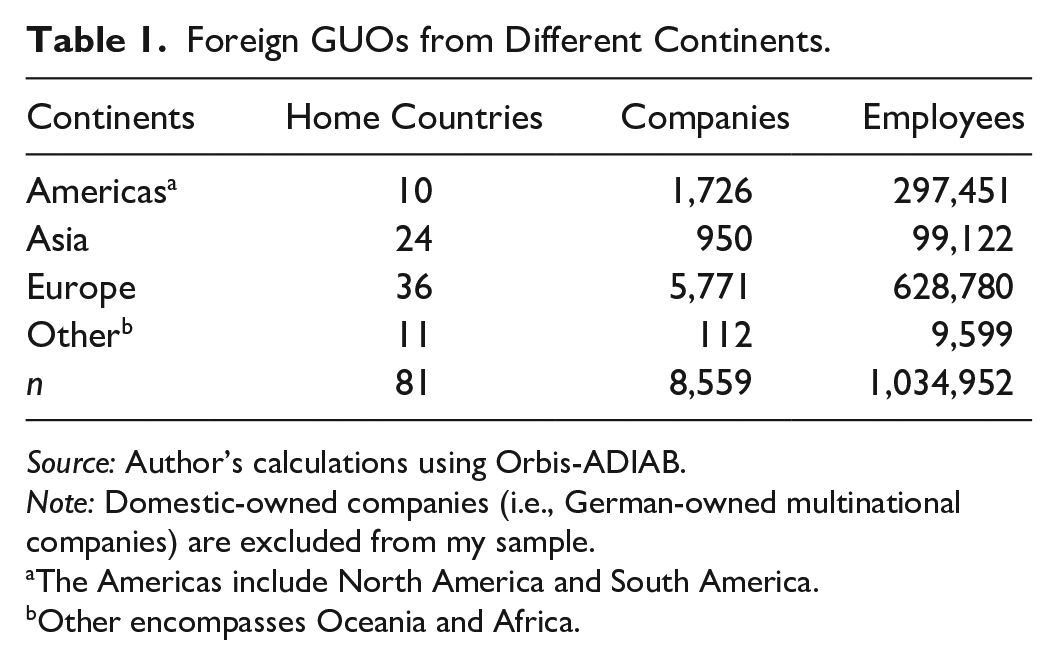
I use information about a company’s global ultimate owner (GUO) to identify its home country. A GUO is the formal majority owner of a company (Bureau van Dijk 2016). Although most previous studies have compared foreign-owned companies with domestically owned ones, this information enables researchers to analyze differences between the home countries of MNC subsidiaries. Furthermore, the large scale of the Orbis-ADIAB data set uniquely contains GUOs from 81 different countries, where more than 96 percent of foreign GUOs in Germany have their headquarters, according to Orbis. These countries span four continents and range from countries with low gender inequality, such as Iceland, to countries with high gender inequality, such as Iran. Approximately 65 percent of the foreign GUOs in the sample are from Europe, 20 percent from America, and 11 percent from Asia (Table 1).
Foreign GUOs from Different Continents.
Source: Author’s calculations using Orbis-ADIAB.
Note: Domestic-owned companies (i.e., German-owned multinational companies) are excluded from my sample.
The Americas include North America and South America.
Other encompasses Oceania and Africa.
Specifically, I exclude domestically owned companies and focus on foreign-owned MNCs that employ at least one male and one female full-time employee aged 20 to 60 years liable to social security on June 30, 2014. Because administrative data do not contain detailed information on working hours, my analysis includes all full-time employees who worked at least 35 hours per week. In total, my cross-sectional data set comprises 1,034,952 employees working at 8,559 foreign-owned companies from 81 different home countries.
Measurements
Dependent Variable
The dependent variable in this study is employees’ daily gross incomes in euros drawn from their social security contributions. The wage information is right censored at the upper earnings limit for statutory pension insurance. I impute wages separately by gender and location in East Germany or West Germany using individual-level control variables and establishment fixed effects (Card, Heining, and Kline 2013; Dauth and Eppelsheimer 2020). The imputed wages are censored at 10 times the 99th percentile to eliminate randomly generated outliers. I use the natural logarithm of imputed wages as the outcome variable in my analysis.
Independent Variables
Gender Inequalities in Foreign-Owned Companies’ Home Countries
I use the Global Gender Gap Report (GGGR) (World Economic Forum 2014) from 2014 for my main analysis. This index comprises four broad dimensions—political empowerment, health and survival, economic participation and opportunity, and educational attainment—which are divided into a total of 14 subdimensions. Figure 1 shows that this index has multiple high-density points and ranges from high gender inequality, such as Iran at 0.552, to low gender inequality, such as Iceland at 0.859 (Appendix Table A1, Appendix Table A2).

Density of GGGR at the Company Level
I chose the GGGR as an indicator for my main analysis because measures with multiple dimensions can more accurately represent gendered culture in a country than the gender wage gap, which measures only wage inequalities. For example, Hungary and Belgium have comparable median full-time gender wage gaps (OECD 2019). When taking a look at indices including other aspects of gender equality, such as political participation or education, however, Hungary (ranked 93 in the GGGR) is much more gender inequal than Belgium (ranked 10 in the GGGR) (Appendix Table A2; World Economic Forum 2014). Thus, considering multiple dimensions is essential to observe a country’s culture regarding gender. As the transfer-of-culture theory is about transferring gendered culture (Kodama et al. 2018), indices with multiple dimensions are more suitable measurements to test my hypotheses than gender wage inequalities.
Additionally, I use two alternative measures as robustness checks (Appendix Table A1). First, I use the Gender Development Index (GDI) (UNDP 2014), which is published by the United Nations. The GDI compares how well women perform in relation to men in three dimensions: health, education, and economic resources. Second, I use the gender wage gap (OECD 2019) to directly take gender wage inequalities into account. The gender wage gap produced by the OECD (2019) measures the difference between the median full-time wages of men and women and is available for 36 of the countries in my sample. Because for the gender wage gap a higher value means higher gender inequalities, whereas higher values of GGGR and GDI indicates lower inequalities, I multiply the gender wage gap by −1 to ensure that higher values mean higher gender equality for all indices.
Although all these indices measure gender inequalities, they do not correlate perfectly with one another. The correlations between the GGGR and the GDI, as well as the gender wage gap, are of low to medium strength, at 0.317 and 0.432, respectively. These bivariate correlations underline that these indices measure different dimensions of gender inequalities. Measurements are standardized to a standard deviation of 1 and a mean of 0 to facilitate comparing coefficient sizes among models with different indices.
A concern with these indices might be that they include gender wage inequalities as a dimension. As I exclude German-owned companies, the coefficient of this interaction shows whether differences in gender inequalities between MNCs’ home countries are associated with an MNC’s gender wage gap in Germany. Furthermore, by excluding German-owned companies, I focus on variation in gender inequalities between home countries. Thus, centering gender inequality around German inequalities is not necessary.
Expatriate Managers in the Foreign Subsidiary
To measure whether a company has expatriate managers from an MNC’s home country, I use the composition of administrative staff members and managers according to Blossfeld (1987). An advantage of this classification in comparison with other occupational classifications is the hierarchical structure of administrative staff (Christoph, Matthes, and Ebner 2020). Blossfeld identified three administrative levels, which are ordered from the highest to the lowest hierarchical level: managers, skilled administrative staff members, and unskilled administrative staff members. Unskilled occupations usually do not require a vocational degree, while skilled occupations require one. I assume that the highest administrative staff members in a company manage the company (i.e., managers, skilled administrative staff members in companies without managers, and unskilled administrative staff members in companies without managers and skilled administrative staff members). If at least one employee at the highest administrative level is an expatriate from its GUO’s home country, this company has expatriate managers. Their nationality defines the home country of managers.
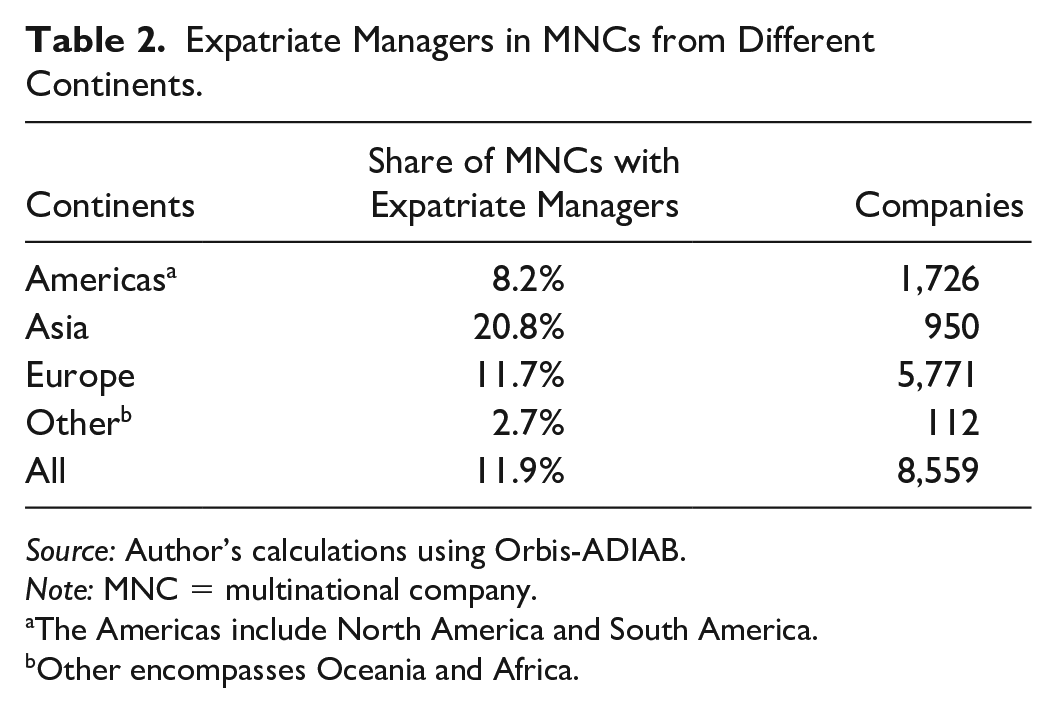
In my sample, managers are the hierarchically highest administrative staff members in 77.5 percent of the companies, skilled administrative staff members in 19.7 percent, and unskilled administrative staff members in 0.9 percent. According to Blossfeld (1987), 1.9 percent of my sample’s companies do not have administrative staff members 2 (Appendix Table A3). Approximately 12 percent of the companies have at least one expatriate from their GUOs’ home countries at their companies’ highest administrative levels. Expatriates therefore manage approximately 10 percent of the subsidiaries of MNCs from Europe and America and 21 percent of Asian MNCs’ subsidiaries (Table 2).
Expatriate Managers in MNCs from Different Continents.
Source: Author’s calculations using Orbis-ADIAB.
Note: MNC = multinational company.
The Americas include North America and South America.
Other encompasses Oceania and Africa.
Control Variables
I control for variables following the literature for investigating gender wage inequalities. At the establishment level, I take the logarithm of the establishment size, shares of high-qualified staff, members women, and part-time and fixed-term contracts into account. Additionally, I consider the industry sector and whether an establishment is located in East Germany. At the individual level, I control for age, age squared, labor market experience, tenure, education, 3 and occupation (Blossfeld 1987). Furthermore, I consider migration status and whether a migrant has the same nationality as a GUO’s home country. Appendix Table A4 lists these descriptive statistics.
Analytical Strategy
The aim of my empirical analysis is twofold. First, I measure whether gender inequality in a GUO’s home country is associated with a subsidiary firm’s gender wage gap in Germany (hypothesis 1). Second, I divide my sample into companies with and without administrative staff members from their GUOs’ home countries because I expect that expatriate managers are a driving force in the transfer of culture. Thus, the connection between the home country’s gender inequalities and the gender wage gap in the company is stronger in companies with expatriate managers compared with companies without expatriate managers (hypothesis 2). Specifically, I use the following fully interacted linear regression with company fixed effects to estimate the association between gender inequalities and the gender wage gap:

where ln(wi) is the imputed log daily gross wage of individual i, fi is a female dummy, GI h is the standardized gender inequalities in a GUO’s home country h, and fi × GI h is the interaction of the female dummy and the standardized gender inequalities index. This interaction effect aims to measure the association between gender inequality in a GUO’s home country and the gender wage gap. As I exclude domestically owned companies (i.e., German-owned companies), the coefficient of this index shows whether differences in gender inequalities between MNCs’ home countries are associated with the gender wage gap in Germany.
The model also includes control variables xieh at the home country level h, the establishment level e, and the individual level i, as well as their interaction with the female dummy. I demean the variables before I interact them with the female dummy so that I can interpret the female coefficient as the gender wage gap at the sample’s mean (Imbens and Wooldridge 2009). Finally, I control for company fixed effects, µc, to consider unobserved differences between organizations (Rabe-Hesketh and Skrondal 2012). The standard errors are clustered at the company level.
Results
Table 3 reports my results. First, column 1 shows the estimated raw gender wage gap. In this sample, women earn, on average, 20.2 percent (exp[–0.226] – 1) less than men, which is approximately 2 percentage points higher than the raw German gender wage gap for 2014 (OECD 2019). I can explain this difference by the data restrictions because the German gender wage gap is higher in the private sector than in the public sector (Eurostat 2019). After including firm fixed effects and taking control variables into account, this gap narrows to 13.8 percent (exp[–0.150] – 1) in column 2. Fully interacting with the model (column 3) barely affects the gender wage gap.
Association between Gender Inequality in the Global Ultimate Owner’s Home Country and the Gender Wage Gap.

Source: Author’s calculations using Orbis-ADIAB.
Note: The dependent variable is the log daily wage. Column 1 shows an ordinary least squares estimation, and columns 2 and 3 report the results of the company fixed-effects regression. The model in column 3 is additionally fully interacted with the female dummy. The controls include age and its square; 5 dummies each for labor market experience and tenure; 3 education dummies; 12 dummies for occupation (Blossfeld 1987); shares of women, qualified, fixed-term contract, and part-time employees in the company’s workforce; the log establishment size; a dummy for East Germany; and 16 dummies for the industry sectors. The standard errors are clustered at the company level. GGGR = Global Gender Gap Report.
p < .01 and ***p < .001 (two-tailed tests).
Column 2 suggests that the GGGR in a GUO’s home country correlates positively with women’s wages (Table 3). In the fully interacted model in column 3, the coefficient decreases but remains statistically significant. A 1 standard deviation decrease in gender inequalities in the home country is thus associated with a 4.3 percent decrease in the remaining gender wage gap ([exp(0.018) – 1]/[exp(–0.149) – 1] = −0.131). In a company with a Swiss GUO, for example, women earn, ceteris paribus, on average, 1.8 percent (exp[0.006 × 3.02] – 1) 4 more than men in comparison with women in a company with a Japanese GUO. In summary, gender inequalities in GUOs’ home countries are associated with gender inequalities in foreign-owned MNCs in Germany. These results support the transfer-of-culture hypothesis (hypothesis 1).
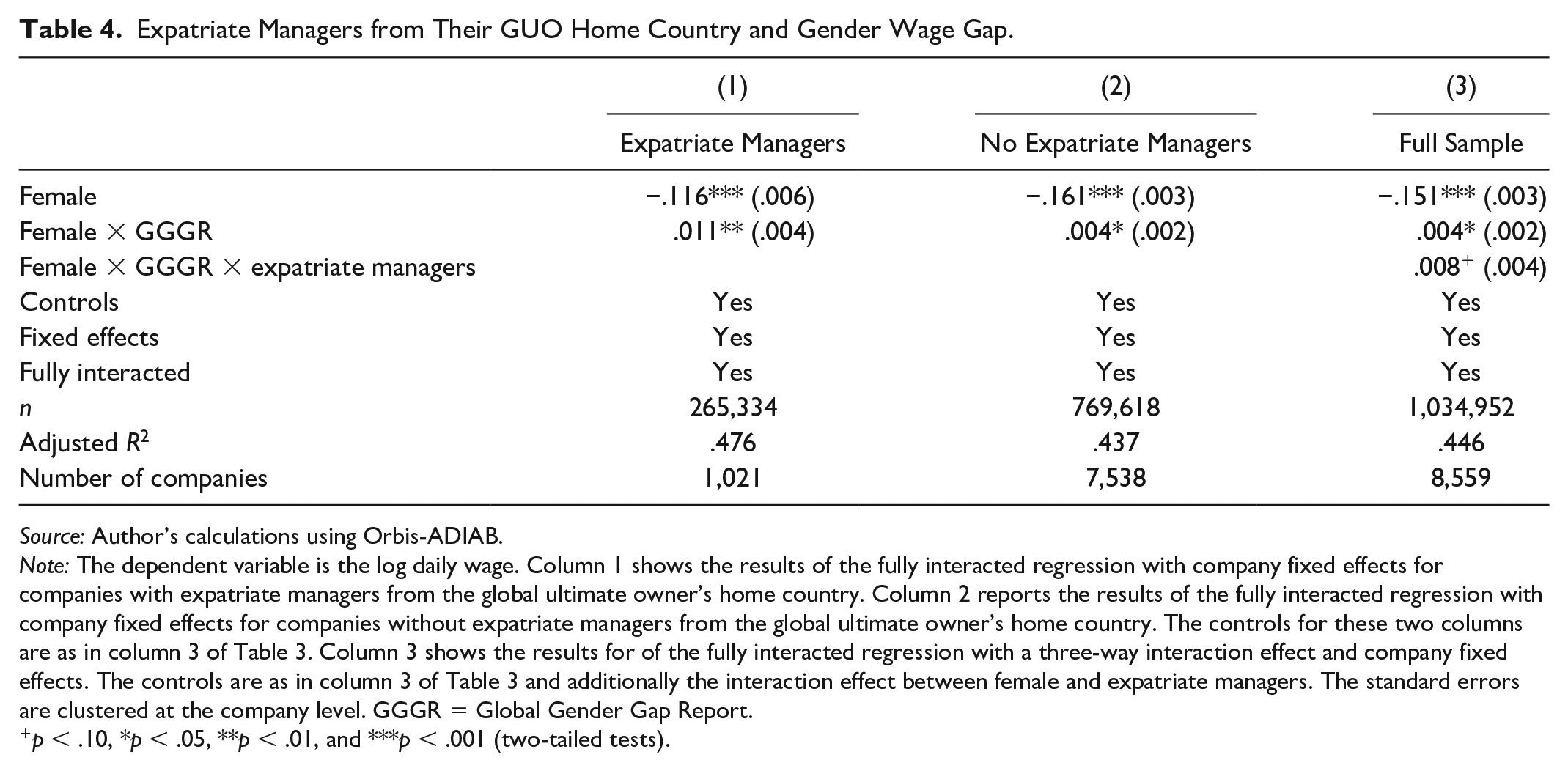
As expatriate managers from a GUO’s home country are theoretically a driving force in the transfer of culture, I divide my sample into companies with and without expatriate managers from their GUO’s home country. A total of 12 percent of these foreign-owned companies have at least one expatriate manager (Table 2). Table 4 shows that the association between gender inequalities in a GUO’s home country and the gender wage gap in Germany is approximately 3 times higher for companies with expatriate managers (0.011) (Table 4, column 1) than for companies without expatriate managers (0.004) (Table 4, column 2). As the gender wage gap is also lower in these companies, 1 standard deviation of gender inequalities accounts for approximately 10.3 percent of the remaining gender wage gap. This difference between companies with and without expatriate managers is statistically significant when estimating a three-way interaction effect among female, GGGR, and expatriate managers at each company in the full sample (Table 4, column 3). Thus, expatriate managers drive this coefficient, providing evidence supporting hypothesis 2. These results are robust to focusing solely on expatriate managers rather than expatriates at the highest administrative level and alternative measurements for managers (Appendix Table A5).
Expatriate Managers from Their GUO Home Country and Gender Wage Gap.
Source: Author’s calculations using Orbis-ADIAB.
Note: The dependent variable is the log daily wage. Column 1 shows the results of the fully interacted regression with company fixed effects for companies with expatriate managers from the global ultimate owner’s home country. Column 2 reports the results of the fully interacted regression with company fixed effects for companies without expatriate managers from the global ultimate owner’s home country. The controls for these two columns are as in column 3 of Table 3. Column 3 shows the results for of the fully interacted regression with a three-way interaction effect and company fixed effects. The controls are as in column 3 of Table 3 and additionally the interaction effect between female and expatriate managers. The standard errors are clustered at the company level. GGGR = Global Gender Gap Report.
p < .10, *p < .05, **p < .01, and ***p < .001 (two-tailed tests).
Sensitivity to Expatriate Managers’ Wages
When investigating the influence of expatriate managers on the transfer of culture, my results might be affected by expatriate managers themselves. If, for example, a company from a country with lower gender inequalities hires more female expatriate managers, the decrease in gender wage inequalities in that company might be driven by the gender composition of managers. To ensure that expatriate managers’ wages do not mechanically drive my results, I estimate models both without managers (Appendix Table A6, column 1), without migrants (Appendix Table A6, column 2), and without either managers or migrants (Appendix Table A6, column 3). My results are robust to these restrictions, supporting a transfer of culture leading to changes in a company’s gendered culture.
Different Measures for Gender Inequalities
As my results might depend on the dimensions and focus of the GGGR, I use two alternative measurements to test the robustness of my results. Each index is published by a different organization and based on different data, ensuring that my results do not depend on a single measurement by a single organization. The low- to medium-strength correlations between GGGR and GDI, as well as the gender wage gap, underline how different indices measure different aspects of gender inequalities.
For the GDI (UNDP 2014), the regressions provide similar patterns, and the standardized coefficients are similarly strong (columns 1–3 of Appendix Table A7). These results indicate that the association between the GDI and gender wage inequalities is also twice as strong in companies with expatriate managers (column 2) compared with companies without such managers (column 3). However, the three-way interaction effect among expatriate managers, GDI, and female gender is not statistically significant. Additionally, the size of the standardized coefficient female × GDI (columns 1–3 of Appendix Table A7) is similar to the standardized coefficient for female × GGGR (column 3 of Table 3 and columns 1 and 2 of Table 4).
The patterns for gender wage inequalities (OECD 2019) are also very similar (columns 4–6 of Appendix Table A7), although this sample is restricted to 36 Organisation for Economic Co-operation and Development countries. Notably, the three-way interaction effect is not statistically significant. The standardized coefficient female × gender wage gap is smaller than the standardized coefficients for GGGR (column 3 of Table 3 and columns 1 and 2 of Table 4) and GDI (columns 1–3 of Appendix Table A7). This difference could indicate that more dimensions than the gender wage gap are important for measuring the transfer of culture. In summary, the regressions with alternative indices all show the same patterns, thus supporting the robustness of my main results.
Conclusions
In this study I investigate whether gender inequalities in an MNC’s home country influence gender wage inequalities in its host country. Whereas previous scholarship has mostly compared subsidiaries of foreign-owned MNCs versus domestically owned companies, I focus on the transfer-of-culture theory (Kodama et al. 2018) to explain the differences in gender wage inequalities among MNCs from different home countries. Furthermore, this is the first study identifying expatriate managers as an underlying mechanism driving this transfer of culture.
I demonstrate that gender wage inequalities in Germany are lower in subsidiaries of MNCs from countries with lower gender inequalities. This result is evidence for the transfer-of-culture hypothesis. Furthermore, I show that expatriate managers are a driving force in this transfer of culture because these managers represent their headquarters abroad and implement company-wide practices. These results are robust to using three different measurements of gender inequalities published by different organizations: the GGGR (World Economic Forum), the GDI (Human Development Report, United Nations), and the gender wage gap (Organisation for Economic Co-operation and Development).
I find that 1 standard deviation of gender inequalities in an MNC’s home country is associated with narrowing the gender wage gap by 10.3 percent in MNCs with expatriate managers. This effect size indicates that gender inequalities in an MNC’s home country are as important for explaining the gender wage inequalities as occupational segregation, which explains 9.4 percent 5 of the gender wage gap for companies with expatriate managers. Thus, the contribution of gender inequalities in an MNC’s home country to the gender wage gap is substantial and is as essential for investigating gender inequalities as occupational segregation. In contrast to occupational segregation, however, gender inequalities in an MNC’s home country have received little attention in scholarship.
My findings indicate that MNCs might increase or decrease the gender wage gap in their host countries, depending on gender inequalities in the MNCs’ home countries. This results in a policy implication. As many MNCs transfer their lower gender inequality to Germany, policy makers could investigate in more detail how these companies narrow gender wage inequalities, for example, by focusing on their corporate culture.
Although my results are unambiguous, my data have some limitations. First, German administrative data are restricted to employees liable to social security. However, top managers, such as CEOs, are usually not liable to social security. Thus, identifying expatriate managers in my data set might underestimate the actual number of companies with expatriate managers. Second, I approximate corporate culture and gender inequalities at the country level. Although the country level is a fitting general approximation of inequalities, large differences exist between companies in the same country. Therefore, my coefficients are probably lower bound estimations because measurement error leads to attenuation bias (i.e., underestimating coefficients). Thus, I assume that my results represent the lower bound of the influence of the transfer of culture on gender inequalities.
Further research could test the transfer-of-culture hypothesis more directly in three ways. First, information about the actual attitudes of expatriate managers regarding gender inequalities might allow researchers to investigate further how expatriate managers drive the transfer of culture. Second, the transfer of culture might depend on an MNC’s mode of entry. Although expatriate managers can structure human resources and corporate culture in newly founded companies, expatriate managers are limited to changing existing structures in mergers and acquisitions (Greaney and Tanaka 2021). Thus, although a transfer of culture is plausible for different modes of entry (Greaney and Tanaka 2021; Kodama et al. 2018), expatriate managers’ influence might be stronger in newly founded companies. Third, corporate culture (i.e., practices promoting gender equality, such as work-life balance practices) (Kodama et al. 2018) could be directly tested as a mediator.
Supplemental Material
sj-docx-1-srd-10.1177_23780231221136487 – Supplemental material for Can You Take Your Corporate culture With You? Multinational Companies and the Gender Wage Gap in Germany
Supplemental material, sj-docx-1-srd-10.1177_23780231221136487 for Can You Take Your Corporate culture With You? Multinational Companies and the Gender Wage Gap in Germany by Florian Zimmermann in Socius
Footnotes
Acknowledgements
I thank Martin Abraham, Matthias Collischon, Dana Müller, Michael Oberfichtner, Sonja Scheuring, Hans-Jörg Schmerer, and Ipek Yükselen for their helpful comments. I also want to thank participants of the Joint Interdisciplinary Graduate Conference at Tilburg University 2021 and The German Labor Market in a Globalized World: Trade, Technology, and Demographics at ZEW Mannheim 2022 for their comments. Furthermore, I thank American Journal Experts for proofreading.

Supplemental Material
Supplemental material for this article is available online.
2
I treat companies without administrative staff members as lacking administrative staff members from the GUO’s home country. Excluding these companies does not affect my results.
4
The difference in the standardized GGGR between Switzerland and Japan is 0.79 – (–2.23) = 3.02.
5
Author Biography
References
Supplementary Material
Please find the following supplemental material available below.
For Open Access articles published under a Creative Commons License, all supplemental material carries the same license as the article it is associated with.
For non-Open Access articles published, all supplemental material carries a non-exclusive license, and permission requests for re-use of supplemental material or any part of supplemental material shall be sent directly to the copyright owner as specified in the copyright notice associated with the article.
