




Abstract
Women still earn less than men and continue to perform the bulk of domestic activities. Several studies documented a negative individual wage–housework relation, suggesting that gender discrepancies in housework may explain the gender wage gap. Less attention has been paid to the role of the partner’s unpaid work and to the extent that intra-household inequalities relate to inequalities outside the house. The present study attempts to fill this gap in the literature. We exploit EU-SILC 2010 data for Germany and Italy and PSID 2009 data for the US. Results suggest the importance of accounting for a partner’s housework when evaluating the determinants of individual wages and the gender wage gap. Women seem not to profit from their partners’ housework; instead, women’s non-market work increases their partners’ earnings while decreasing their own earnings. This suggests the importance of reducing women’s involvement in domestic work in order to close gender wage equalities.
Introduction
Gender roles within families and societies have changed during recent decades. Women’s employment has increased (Boeri et al., 2005; Goldin, 1990), and their household labour hours have decreased (Artis and Pavalko, 2003). Changes in men’s roles have been less significant, though men’s housework has increased somewhat (Kan et al., 2011) and men now spend more hours with children (Coltrane, 2009). Nevertheless, women continue to perform the bulk of housework, which significantly affects their employment and economic situation (OECD, 2014). The persistence of a noteworthy gender wage gap to the disadvantage of women has been well documented in all societies (Blau and Kahn, 2017). 1 As previous research documented a negative relation between wages and housework (Baxter, 1992; Bonke et al., 2005; Bryan and Sevilla-Sanz, 2011; Carlson and Lynch, 2017; Cooke and Hook, 2018; Coverman, 1983; Hersch, 2009; Hersch and Stratton, 1997, 2002; Keith and Malone, 2005; McAllister, 1990; McLennan, 2000), the unequal intra-household division of domestic labour might be a driver of the gender pay gap. The OECD (2014) suggested that the unequal division of unpaid work between women and men is the missing link in the analysis of gender gaps in labour market outcomes. Hence, this article contributes to the greater debate on gender inequalities both in and outside the house, as well as to the interrelation of these inequalities. The literature speaks of a ‘stalled revolution’ (England, 2010; Esping-Andersen, 2009), referring to the lack of change in men’s behaviours, which underlines the importance of investigating both men’s and women’s situations in different spheres in order to better understand gender inequality and its potential negative effects.
Aforementioned studies on the wage–housework relation have not considered the role of partners. As for cross-partner effects, Jacobsen and Rayack (1996) and Stroh and Brett (1996) showed that men usually profit from having a non-working wife in terms of wages or earnings progressions, while Brines (1993) investigated the relation between a husband’s housework and his wife’s paid and unpaid labour. To the best of our knowledge, no evidence exists on the relation between husbands’ housework and their wives’ wages. A number of works have measured the contribution of housework to the gender wage gap by applying a wage-gap decomposition analysis, which revealed that adding individual housework time (however, neglecting partners’ housework) to the wage equation increases the explained part of the gender wage gap (Bryan and Sevilla-Sanz, 2011; Hersch, 2009; Hersch and Stratton, 1997, 2002; Keith and Malone, 2005).
Our contribution is threefold. First, beyond investigating the effects of individual housework, we also consider the effects of the partner’s contribution to household chores on individual wages. Second, we investigate the extent to which the intra-household division of domestic work explains the gender wage gap. We run a wage-gap decomposition analysis that extends the existing literature by accounting for the explanatory power of both partners’ unpaid work. Third, we ask whether greater gender equality within the household fosters greater gender equality in the labour market. Specifically, we investigate wage differences between partners (the within-couple wage gap), the relevance of both partners’ domestic hours, and the effects of the intra-household division of household labour.
Our empirical analysis exploits the ad hoc module of the European Union Statistics on Income and Living Conditions (EU-SILC) 2010 for Germany and Italy and the Panel Study of Income Dynamics (PSID) 2009 for the US, which provide information on housework hours for both partners. Selected countries differ in their societal systems with respect to both institutional and normative aspects, such as the degree of economic openness, the extent of labour market regulation, the levels and forms of female work participation, wage-setting regulations, in addition to traditionalism and gender relations. The international comparison allows us to explore the relevance of macro-contextual elements for different facets of gender inequalities.
Background and expectations
Wages and housework
According to Becker’s (1985) economic model, the negative effect of housework on wages is due to the limited amount of energy available to individuals. Increased effort in the house correlates with reduced effort in market work, which leads to lower productivity and therefore lower wages. This idea of ‘fatigue’ also includes the ‘emotional burdens associated with coping with a double day’ (Baxter, 1992: 230) and a reduction of the time that can be spent on additional job-related activities, such as training. Family responsibilities also negatively impact on wages by placing constraints on continuous employment and career or by leading individuals to opt for less demanding, more flexible jobs that usually pay lower wages (thereby via job-related compensating differentials). In principle, this theoretical perspective is ‘gender neutral’ and predicts neither the gendering of household responsibilities nor the diverse effects of these responsibilities for men and women. In stark contrast to this perspective, gender-constructivist approaches point to the symbolic enactment of male and female roles as a mechanism for the continuous reconstruction of gender inequalities (West and Zimmermann, 1987). Gender inequalities inside and outside the house are just different aspects of the same overall pattern.
Empirical research demonstrated that the negative effect of housework on wages is generally greater for women and depends on the kind of household tasks. Women spend more hours than men in home production and are usually involved in tiring, routine tasks immediately before or after market work (such as getting children ready for school or picking children up from school) which largely interfere with productivity (Baxter, 1992; Bonke et al., 2005; Dotti Sani and Scherer, 2018; Hersch and Stratton, 2002; Noonan, 2001). In addition, high involvement in domestic activities might act as a signal of low work commitment and productivity to employers and thus may lead to lower wages (Boye, 2019).
As all individuals have a limited amount of energy, a negative relation between wages and housework is to be expected (Hypothesis 1a). However, in line with existing knowledge on persistent gender inequalities, the negative wage–housework relation should be greater for women than for men (Hypothesis 1b).
Wages and partners’ housework
Previous studies have focused on the individual wage–housework relation and disregarded the importance of partners’ housework involvement. Partners do influence each other’s employment, and this influence depends on the context they live in (Blossfeld and Drobnič, 2001). In line with the idea of ‘the wife as a resource’ advanced by Stroh and Brett (1996), Jacobsen and Rayack (1996) revealed how men’s earnings benefit from having a non-working wife and that men’s earnings decrease as their wives increase their own market participation. More recently, Langner (2018) showed that men also can support their partners’ career. It seems reasonable to assume that this mutual influence is also relevant to the consequences of the division of roles within the house.
Several mechanisms might lie behind partners’ reciprocal influence. In line with Becker’s (1985) model of effort allocation, individuals’ contributions in the house would reduce the effort that their partners would need to exert at home and increase the time and effort that the partners could invest in market work (Bonke et al., 2005). Support in the house might also enable these partners to take advantage of better job opportunities or to opt for more demanding jobs that would have positive effects on their careers and their earnings progression. In this case, the effect on partners would be expected to be mediated mainly through a reduction in the amount of housework they perform.
Alternatively, the intra-household division of labour might be an indicator of gender-(un)equal contexts and more-or-less traditional gender-role models. This gender-(in)equality in the house also translates in the market sphere. In fact, men with less traditional gender attitudes are more involved in home production and are more supportive of their partners’ careers, whereas women with more traditional views consider even an unequal division of housework to be fair because it corresponds with the normative standards they follow (Lavee and Katz, 2002). This perspective highlights the importance of positive support as opposed to a reduction of effort. Explanations based on the importance of gender roles would lead us to expect diversified and direct effects of partners’ domestic support for men and women. Having a collaborative partner should be particularly important for women given their greater involvement in housework and their higher wage-growth potential (Welch, 2000). In addition, the relationship between wages and hours (both marketable and domestic) is more elastic for women than for men (Blau and Kahn, 2007), which suggests that women are more likely to adjust their domestic and market work. Based on these considerations, we expect individuals’ earnings to depend positively on their partners’ housework (Hypothesis 2a). However, we would expect women to profit more from their partners’ greater involvement in housework (Hypothesis 2b). Furthermore, given the unequal intra-household distribution of housework, accounting for housework of both partners should explain a substantive part of the gender wage gap (Hypothesis 2c). Focusing on within-couple inequalities, according to the literature on gender equality, we expect that a more equal intra-household division of housework comes with a lower within-couple earnings gap (Hypothesis 3).
Housework and wages
While our focus lies on the effect of housework on wages and wage inequality, housework hours may also depend on wages, and the individual earnings of the two partners might affect the intra-household division of labour (Schneider and Hastings, 2017; Treas and De Ruitjier, 2008). Higher incomes might allow housework to be outsourced and thereby free individuals from unpleasant, time-consuming tasks (Craig et al., 2016). Considering how partners share domestic work, the time-availability perspective (Hiller, 1984) predicts that the partner who spends more hours in market activities does less domestic work. The relative-resources/power-perspective predicts that the individual who earns higher wages is more likely to demand greater participation from his or her partner in housework and to reduce his or her unpaid work (Brines, 1993). Most empirical studies found a negative association between market and non-market hours (Carlson and Lynch, 2017). Geist (2005) reported that the relatively higher income of husbands leads their wives to perform more housework. Gupta (2007) argued that absolute income is more decisive in reducing housework than are a partner’s relative resources. Anxo and Carlin (2004) showed that as women’s income increases, their male partners tend to perform a greater share of housework. Research also demonstrated that equality in pay within a couple correlates with greater equality in domestic tasks (Shelton and John, 1996). However, Bertrand et al. (2015) report that the gender gap in non-market activities is greater when a wife out-earns her husband, which supports the idea of housework as ‘doing gender’ in order to thus re-establish traditional gender roles and power relations. Like other researchers, in our empirical analyses, we pay attention to rule out the possibility that our results may have been affected by reversed causality.
The role of context
The outlined mechanisms linking individuals’ and partners’ housework to wages should apply to all countries, though to a different extent due to the institutional and cultural contexts. Indeed, both the division of domestic labour and the gender wage gap depend on the institutional and the cultural-normative contexts, such as traditionality in gender norms, employment regimes, market regulations, industrial relations and wage-setting systems (Barbieri et al., 2019; Kornrich and Eger, 2016; Schafer and Gottschall, 2015). Previous research has heavily focused on the US (Coverman, 1983; Hersch, 2009; Hersch and Stratton, 1997, 2002; Keith and Malone, 2005; McLennan, 2000) and a few other countries (Baxter, 1992, Australia; Bonke et al., 2005, Denmark; Bryan and Sevilla-Sanz, 2011, UK; Hirsch and Konietzko, 2013, Germany; McAllister, 1990, Australia; Phipps et al., 2001, Canada). In this work, we focus on Germany, Italy and the US. These countries have different societal systems with respect to traditionality, gender relations, wage-setting institutions and labour market regulations, which translate to differences in levels and forms of female employment (online supplementary Appendix A).
The US belongs to the liberal regime type, in which women are generally employed and work long hours. This system can be partly explained by the high degree of marketization of household production compared with Europe (Freeman et al., 2005), which is also visible in the much smaller gender differences in housework. Owing to the high level of economic liberalization and market flexibility, income inequality is high, and the gender wage gap rather pronounced. Germany belongs to the conservative welfare/employment regime type and is a typical example of a ‘1.5 household carer model’, characterized by moderate female labour market participation, especially on a part-time basis. Only very recently has Germany begun moving from a traditional to a slightly more gender-egalitarian society. Italy represents the most traditional and gender-unequal society among the three and is characterized by an ‘exit- or full-time model’ (Anxo et al., 2007). The low availability of part-time jobs and family policies constitutes a barrier to women’s participation in paid employment and encourages a traditional gender division of labour. Italy is the country with the highest ratio between female and male domestic hours and the lowest gender pay gap. 2
The three countries also differ with respect to their wage-setting systems and coverage of collective agreements, which might affect the wage-hours elasticity. In Germany and Italy, wage bargaining takes place mainly at the sectoral or industry level, the collective bargaining coverage rate is quite high (about 60% and 80%, respectively) and wage dispersion is relatively low. Differently, in the US, wages are negotiated mainly at the company level, which reduces coverage (12.6%) while increasing wage dispersion. Dahl et al. (2013) noted that if companies with local bargaining reward observed skills (such as education) more generously, they might also reward unobserved skills better. This may suggest that unobservable individual characteristics are more relevant for wage-setting in the US than in Europe, where most workers are covered by collective agreements. Based on these considerations, we expect housework to have a greater negative effect on wages in the US than in Germany and Italy (Hypothesis 4a). Furthermore, given that women in the two European countries devote more time to domestic production and that the gender gap in housework is larger than in the US, we expect housework to explain a greater share of the gap in Germany and Italy (Hypothesis 4b).
Data and analytical strategy
Data and sample
The empirical analysis exploits 2009 PSID data for the US and EU-SILC data from the 2010 ad hoc module on the intra-household sharing of resources for Germany and Italy. The EU-SILC ad hoc module is one of the few datasets that provide information on the time spent on household activities by both members of a couple and contains a large set of individual and job-related variables. Unfortunately, it is not possible to link these data with the panel dimension of EU-SILC and a sufficiently high number of observations is available only for Germany and Italy. 3
We restricted the sample to heterosexual, married/cohabiting, and employed individuals between the ages of 25 and 59, but also included non-working women to control for female selection into employment. We focused on employees 4 and excluded those who spent less than five or more than 60 weekly hours on market activities and more than 70 weekly hours on housework (Hersch and Stratton, 2002). In the EU-SILC data, housework is defined as the time spent on household work, childcare and care for other dependants in a typical week. In the PSID data, housework refers to the time spent cooking, cleaning and doing other work around the house in an average week. We acknowledge that the definition of housework is somewhat different in the two surveys and that the PSID did not specifically request information on childcare. However, some of the work performed as a result of having children is included in the reported time spent on housework (Hersch, 2006), whereas the time spent with children on homework or providing medical assistance is not likely to have been included. Hence, we check the robustness of our results considering a subsample of individuals without resident children.
Our variable of interest is the individual gross hourly wage. EU-SILC provides information on employees’ annual gross income before taxes and social contributions, the number of hours usually worked per week and the number of months spent in paid employment. Income and months worked refer to the calendar year preceding the interview (i.e. 2009). The number of working hours refers to the time of the interview (i.e. 2010). The gross hourly wage is computed as the ratio of gross monthly earnings (annual income divided by the number of months worked) and the number of hours usually worked per month (weekly hours times the average number of weeks per month: 4.3). 5 We only consider workers who did not change jobs or work hours (i.e. full-time or part-time) between 2009 and 2010 in order to ensure coherence among the two reference periods regarding income and working hours. 6 For the US, the PSID provides information on 2008 annual wages or salaries, the number of weeks employed and the number of hours worked per week. 7
Analytical strategy
The main interest of this study lies in the role of the individual’s and – in particular – of his or her partner’s housework in explaining individuals’ wages earned and the gender wage gap. The (log-hourly) wage equations hence controlled for individuals’ and their partners’ housework (daily hours), allowing for potential non-linear effects. Other controls included individual and household attributes (citizenship for European countries, race and ethnicity for the US, region of residence, urbanization, use of paid and unpaid childcare), human capital variables (education and labour market experience) and job-related characteristics (type of occupation, sector of economic activity, union membership and seniority for the US). In women’s log-wage regression, we accounted for bias stemming from selection into employment. 8 We controlled for a large set of variables – especially real labour market experience and measures of job segregation – that have been recognized to explain most of the gender wage gap (Blau and Kahn, 2017). This should partly compensate for the lack of information like work attitudes and career ambitions.
Housework may be endogenous in the wage equation as individuals with greater labour market productivity might specialize more in market activity and reduce their housework participation. Empirical tests showed that individual housework is exogenous for both men and women in Italy and for men in the US, but not for German men and women and for American women. When endogenous, we instrumented individual housework by household non-labour income, partners’ characteristics (age, education, employment status and income), the number and age of resident children, and the size, type and ownership status of the house (Hersch and Stratton, 1997, 2002). To check the robustness of our instrumental variable (IV) estimates, we also ran an IV estimation using heteroskedasticity-based instruments (Lewbel, 2012), which supplement external instruments to improve the efficiency of the IV estimator. Partners’ housework proved exogenous in all countries.
In a second step, we conducted a Neuman-Oaxaca (2004) wage-gap decomposition analysis (detailed in online supplementary Appendix B). By exploiting log-hourly wage estimates, the difference between the predicted mean log-hourly wage of men and women (the gender wage gap) was decomposed into three parts: (i) the explained part (i.e. the share of the gap due to different observable characteristics of male and female employees); (ii) the unexplained part (i.e. the share of the wage gap related to unobserved factors and employers’ discrimination), which consists of a men’s wage premium and a women’s wage penalty (estimates over a pooled sample of male and female employees are used as non-discriminatory wage structure); and (iii) the selection part (i.e. the share of the gap related to female selection into employment).
Finally, we examined the within-couple pay gap. We regressed the difference between a male and female partner’s log-hourly wages on daily domestic hours of both partners. Women’s age, the age difference between partners, the interaction between partners’ education, occupation, union membership (for the US), partners’ labour market experience and seniority (for the US), region, urbanization, and use of paid and unpaid childcare (for DE and IT) served as control variables.
Results
In line with the macro evidence from online supplementary Appendix A, the gender wage gap is lowest in Italy (11%) and substantively higher in the US (30%) and Germany (32%) (online supplementary Appendix C: Table C1 and Table 2). At the same time, Italy has the highest gender gap in housework hours, with a mean difference between men’s and women’s average domestic work of over two daily hours as compared with one hour and 40 minutes in Germany and less than one hour in the US. Similar gender gaps in housework time can also be observed within couples.
Wages and housework
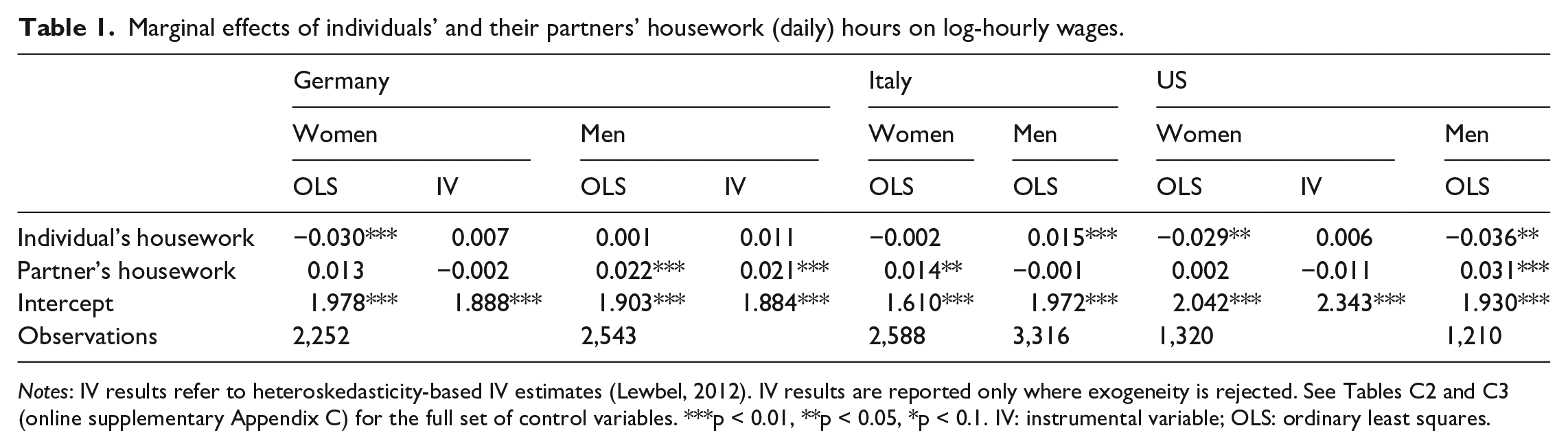
Table 1 shows the marginal effects of individuals’ and their partners’ housework on male and female log-hourly wages. We provide ordinary least squares (OLS) and IV estimates. Although OLS estimates are potentially flawed due to endogeneity issues, they provide a good starting point (complete results are shown in Tables C2 and C3 in supplementary online Appendix C). 9
Marginal effects of individuals’ and their partners’ housework (daily) hours on log-hourly wages.
Notes: IV results refer to heteroskedasticity-based IV estimates (Lewbel, 2012). IV results are reported only where exogeneity is rejected. See Tables C2 and C3 (online supplementary Appendix C) for the full set of control variables. ***p < 0.01, **p < 0.05, *p < 0.1. IV: instrumental variable; OLS: ordinary least squares.
At a first glance, results seem to confirm a negative wage–housework relation (Hypothesis 1a) for women. OLS estimates reveal that an additional housework hour is associated with a 3% reduction in female hourly wages in Germany and a 2.9% reduction in the US, but these effects become insignificant under IV estimates. Similar evidence is found by McLennan (2000). In Italy, the wage–housework relation is not significant for women. For men, the negative association can only be confirmed for the US, where it is stronger than for women (a one-hour increase in housework is associated with a 3.6% hourly wage reduction, which corresponds to a decrease of roughly US$2000 in the annual labour earnings of a male worker with an average hourly wage who works 40 hours per week). On the other hand, in Italy (and – albeit non-significantly – in Germany), the effect of an additional hour of male housework is positive and corresponds to a 1.5% higher hourly wage. Similar results are found by Bonke et al. (2005) for Danish men. This finding may be due to unobserved heterogeneity that was not fully captured by our education measure. Descriptive statistics suggest that more than in Germany and the US, in Italy, highly educated men spend more hours in non-market work than do low-educated men. 10 Given that more educated individuals tend to support more egalitarian gender-role attitudes, we suspect that education predicts not only higher wages but also egalitarian attitudes and a greater involvement of men in unpaid work, especially in Italy. 11 Overall, we find no support for the idea that housework would hamper wages more strongly for women (Hypothesis 1b) than for men. Results seem to suggest that the greater amount of housework women typically provide does not necessarily correlate with greater wage penalties.
Empirical findings generally provide support for Hypothesis 2a, according to which individuals’ earnings should increase with their partners’ greater responsibility for domestic work. In Germany, a one-hour increase in a women’s housework is associated with 2.1% higher hourly wages for her male partner. The result is comparable in magnitude under both OLS and IV estimates. In the US, the effect is even larger, amounting to 3.1% higher hourly wages, which corresponds to an increase of roughly US$1700 in male annual labour income. In Germany and in the US, men seem to take advantage from their partners’ unpaid work to a greater extent than women. Italy is the only country where women’s wages are positively associated with their husbands’ housework; however, the effect is quite small: a one-hour increase in husbands’ housework is associated with a 1.4% increase in women’s hourly wages. Overall, we find no support for Hypothesis 2b. Results are robust, regardless of whether we control for the presence of children, occupational position, working time (this suggests that women do not stay at work for more hours as their male partners contribute more to home production, which could indirectly also lead to wage gains). The very small impact of male partners’ housework on women’s wages may stem from the limited participation of men in household chores. The extra time available to women in the case of their partners’ greater participation in domestic activities is likely not enough to yield any sizable effect.
Finally, regarding cross-country differences, the marginal effect of housework on wages is larger in the US than in the European countries, which is in line with Hypothesis 4a and can be related to cross-country differences in the wage-setting system.
Gender wage gap and housework
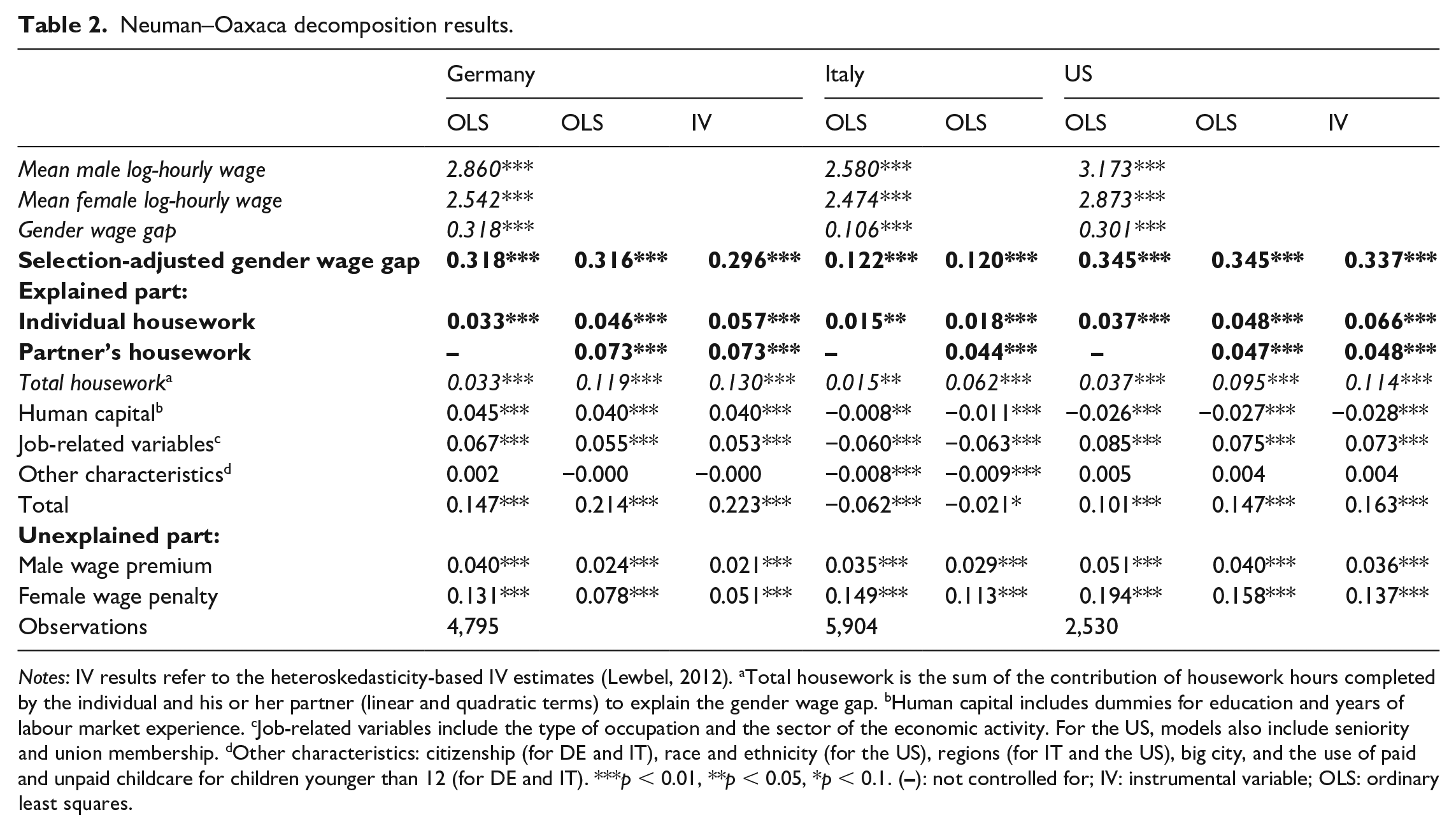
The decomposition analysis of the gender wage gap (Table 2) confirms the importance of housework in explaining the gap. Importantly, controlling for a partner’s domestic work substantially increases the explained part of the gender pay gap in all three countries. For instance, in Germany (OLS results), the explanatory power of housework amounts to 0.033 (out of 0.318) when only individual housework is controlled for in the wage equation (first column), which increases to 0.119 (out of 0.316) when the individual’s partner’s unpaid work also is controlled for (second column), accounting for 38% of the adjusted gender wage gap. In the US, the explained part related to housework corresponds to 28% of the adjusted gender wage gap, that is 0.095 out of 0.345 (OLS model). The explanatory power is even higher under IV estimates, where it amounts to 34% in the US and 44% in Germany. This share is equal to 50% in Italy. Most importantly for our purpose, the explained part of the gender pay gap increases by more than three times when a partner’s unpaid work is controlled for. The explanatory power of the time that partners spend performing housework is therefore at least as important as the time individuals spend themselves in domestic work, which provides support for Hypothesis 2c. Moreover, these findings corroborate Hypothesis 4b, according to which housework time explains a greater share of the gender wage gap in EU countries for which the gender gap in housework hours is greater.
Neuman–Oaxaca decomposition results.
Notes: IV results refer to the heteroskedasticity-based IV estimates (Lewbel, 2012). aTotal housework is the sum of the contribution of housework hours completed by the individual and his or her partner (linear and quadratic terms) to explain the gender wage gap. bHuman capital includes dummies for education and years of labour market experience. cJob-related variables include the type of occupation and the sector of the economic activity. For the US, models also include seniority and union membership. dOther characteristics: citizenship (for DE and IT), race and ethnicity (for the US), regions (for IT and the US), big city, and the use of paid and unpaid childcare for children younger than 12 (for DE and IT). ***p < 0.01, **p < 0.05, *p < 0.1. (
To contextualize the results, it is worth pointing out the relevance of housework compared with human capital and job-related variables. In Germany and the US, the explanatory power of housework time is even greater than that of job-related characteristics, which proxy job segregation by accounting for the type of occupation and the sector of economic activity. In Italy, housework time is the only factor that explains why men (on average) earn higher wages than women. Indeed, if we consider only human capital and job-related indicators, in the absence of discrimination, women should earn even more than men as women (on average) are more educated and more represented in well-rewarded occupations and industries than men.
In sum, our results suggest that a more equal share of domestic tasks among men and women should contribute to more equal earnings, thereby reducing gender wage inequalities. Furthermore, focusing only on an individual’s own housework time is too reductive to enable an understanding of the gender wage gap. In fact, when controlling for partners’ housework, the male wage premium and the female wage penalty decrease, but the reduction in the female wage penalty is generally greater. Both partners’ housework therefore needs to be considered when evaluating the determinants of the gender wage gap.
Within-couple wage gap
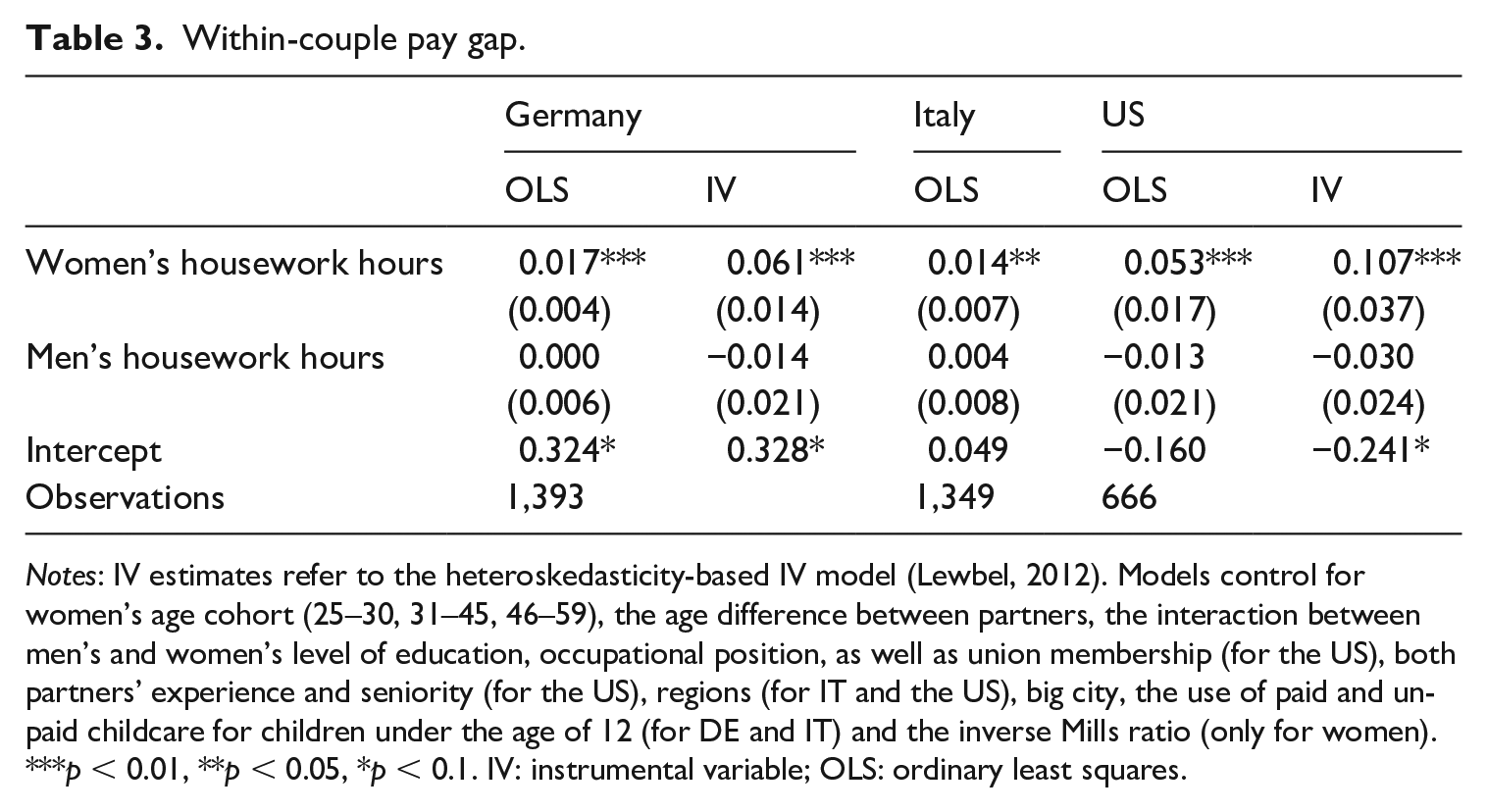
Table 3 shows the marginal effects of the housework hours of individuals and their partners on the within-couple wage gap, measured as the difference between the partners’ log-hourly wages. There is a noteworthy within-couple pay gap in the favour of men in all countries. It amounts to 18% in Italy, 30% in Germany, and 24% in the US. Results suggest that the within-couple wage gap increases with women’s housework, whereas husbands’ housework has no significant effects. Based on previous findings at the population level, results for the within-couple analysis can be attributed both to the negative effect of women’s housework on their own wages and – most importantly – to the positive effect of wives’ non-market time on men’s wages. Overall, our findings demonstrate that more equality in the private sphere correlates with more equality in the public sphere, but increased gender equality asymmetrically bears on the behaviour of women. Indeed, only a reduction in women’s contribution to household chores – which results in a more equal division of household labour – is associated with a lower gap in spouses’ hourly wages (Hypothesis 3).
Within-couple pay gap.
Notes: IV estimates refer to the heteroskedasticity-based IV model (Lewbel, 2012). Models control for women’s age cohort (25–30, 31–45, 46–59), the age difference between partners, the interaction between men’s and women’s level of education, occupational position, as well as union membership (for the US), both partners’ experience and seniority (for the US), regions (for IT and the US), big city, the use of paid and unpaid childcare for children under the age of 12 (for DE and IT) and the inverse Mills ratio (only for women). ***p < 0.01, **p < 0.05, *p < 0.1. IV: instrumental variable; OLS: ordinary least squares.
In line with previous estimates, the magnitude of effects related to housework is smallest in Italy and largest in the US. Each additional hour of women’s housework comes with a 1.4% increase in the within-couple pay gap in Italy, which corresponds to an increase in the male–female wage ratio from 1.176 to 1.192 for a couple in which both partners have average wages (€15.40 and €13.10 per hour, respectively). Indeed, we can also interpret the within-couple pay gap in terms of the male–female wage ratio given that the difference between their log-hourly wages corresponds to the logarithm of the wage ratio. Each additional hour of a women’s housework is associated with a 6% increase in the male–female wage ratio in Germany and an 11% increase in the US under IV estimates (a 1.7% and 5% increase, respectively, under OLS estimates). In substantive terms, this means that a woman should invest about 13 fewer hours per day in domestic chores in order to eliminate the within-couple pay gap in Italy (which is obviously unrealistic but illustrates the size of the effect), about five fewer hours per day in Germany under IV estimates (17 under OLS estimates), and two fewer hours per day in the US under IV estimates (five under OLS estimates).
Overall, in order to favour women’s economic situation and gender equality in general, reducing women’s domestic burden appears to be crucial. In line with this argument, results for Germany reveal that the use of formal childcare services for children younger than 12 is associated with a reduction of the within-couple pay gap (see full results in Table C4 in online supplementary Appendix C).
Conclusions
This article showed that in different contexts (the US, Germany and Italy), both individuals’ and (to an even greater extent) their partners’ housework explains a considerable part of the gender wage gap. Women’s housework, in particular, helps men earn more, whereas women seem not to take much advantage in terms of wages from their partners’ domestic work. This finding is true for the overall wage gap as well as for the within-couple gap. Overall, the results support a picture of ‘the wife as a resource’. The picture is similar across the three countries, which represent different contexts in terms of institutional settings, gender norms, female labour participation and labour market dynamics. Some interesting differences do exist, however, which we attribute mainly to more flexible wage-setting mechanisms in the US, where wages appear to be more elastic to unpaid work than in the two European countries. Nevertheless, the overall contribution of housework in explaining the wage gap is stronger in Europe, which obviously has to do with the initial size of the gap in wages as well as in domestic hours. Overall, the evidence appears to suggest that fostering a husband’s involvement in domestic chores is not a viable method of closing the gender wage gap at the population level or within a couple. The absence of the relevant effects of the male partner’s contribution, however, could be due to the overly low amount of time that men dedicate to domestic activities. However, when controlling for threshold effects based on these data, we found hardly any support for the idea that the situation would change with higher levels of men’s involvement (additional analysis not reported).
We derived expectations about the role of partners’ housework on wages from two theoretical perspectives: on the one hand, the gender-neutral economic model, which points to limited resources, and the idea that gender inequalities are socially (re-)produced on the other hand. Both perspectives led to partially different expectations. Overall, the economic model is not fully consistent with the empirical findings as we found important gender differences regarding the effect of housework. Further, the effect of a partner’s contributions is clearly not mediated through an individual’s own household work (additional analysis not shown). Instead, we found evidence for the importance of gender equality within the house to create equality also outside the house. This result is particularly evident when it comes to within-couple wage differences. However, and perhaps unsurprisingly, greater gender equality is reached through women becoming more similar to men – by doing less household work – rather than by men doing more. In all three countries, the so-called ‘dual-earner–dual-carer model’ (Gornick and Meyers, 2008) is far from being the norm, which suggests that we are in the midst of an ‘incomplete revolution’, as cited initially, and which some believe has severe consequences for family choices (Esping-Andersen and Billari, 2015). For now, empirical evidence suggests that women’s greater contribution to unpaid domestic work widens the gender wage gap. Therefore, a further reduction of traditional roles that view women as being mainly responsible for running the household would reduce income inequalities between the sexes (OECD, 2014). Reduced gender inequality might be reached through care services as well as by outsourcing household tasks to the market. The introduction of tax subsidies, tax deductions and vouchers for these services – as implemented by many governments (Estevez-Abe and Hobson, 2015; Windebank, 2009) – might provide an appropriate incentive to reduce women’s unpaid domestic work. However, while this increased ‘marketization of the domestic sphere’ will increase women’s employment and lower economic gender inequality, it will most likely come at the cost of increased overall earnings inequalities (Freeman et al., 2005).
This work is not free of limits. The literature on the gender wage gap has traditionally focused on hourly wages, as do we. This standard, however, does not examine one of the potentially relevant mechanisms for increasing earnings, namely variation in paid-work hours. An important limitation to the present study is the lack of available information on different household tasks. Performing ‘female tasks’ is more likely to have adverse effects on wages due to the daily and inflexible nature of the tasks (Hersch and Stratton, 2002; Noonan, 2001). Further, data availability for a Nordic country, where gender equality both in society and within the household is clearly more pronounced than in Central and Southern Europe and in the US, would have enriched our study. Finally, we lack longitudinal data, which give some advantage to causal modelling, notwithstanding our analyses control for endogeneity. Unfortunately, information on individuals’ and partners’ housework is only available from a single-year ad hoc module of EU-SILC.
Supplemental Material
Appendix_(to_supplement_the_article) – Supplemental material for Gender Wage Gap and the Involvement of Partners in Household Work
Supplemental material, Appendix_(to_supplement_the_article) for Gender Wage Gap and the Involvement of Partners in Household Work by Eleonora Matteazzi and Stefani Scherer in Work, Employment and Society
Footnotes
Acknowledgements
The authors would like to thank the three anonymous reviewers and the editor, Eleonore Kofman, for their constructive and very valuable comments, which helped to improve this manuscript significantly. We are also thankful for timely feedback in a difficult period. Thanks go also to Paolo Barbieri for his critical reading of various versions.
Funding
The authors acknowledge funding for the open access publication from the Department of Sociology and Social Research, Trento University, under the Departments of excellence initiative of the Ministry of the University.
Supplementary material
The supplementary material is available online with the article.
Notes
References
Supplementary Material
Please find the following supplemental material available below.
For Open Access articles published under a Creative Commons License, all supplemental material carries the same license as the article it is associated with.
For non-Open Access articles published, all supplemental material carries a non-exclusive license, and permission requests for re-use of supplemental material or any part of supplemental material shall be sent directly to the copyright owner as specified in the copyright notice associated with the article.
