




Abstract
Social scientists have documented that perceived underpayment is a chronic stressor that has clear links to job dissatisfaction. However, few have evaluated which job qualities function as alternative compensating rewards that weaken this relationship. Using the job demands–resources model as a guide, the authors investigate the moderating effects of prominent job qualities: support, control, challenge, and advancement opportunities. Analysis of a national sample of Canadian workers confirms that perceived underpayment is associated with job dissatisfaction. The authors elaborate on this relationship by documenting that job qualities located at the organizational and interpersonal levels—advancement opportunities, supervisor support, and schedule flexibility—function as protective buffers, but job qualities located at the individual task level (job autonomy and job challenge) do not. These observations have theoretical and practical implications by specifying the particular job qualities that buffer the effects of perceived underpayment. The authors integrate insights from organizational support theory to interpret the underlying mechanisms.
When we think about aspects of our jobs that matter most for our well-being, few things are as essential as the compensation we receive for the work we do. Although people desire to be paid fairly for their efforts and contributions, about half of American and Canadian workers feel underpaid (ISSP Research Group 2012; Narisada 2019). This experience of underreward fosters feelings of distress, which individuals are motivated to relieve (Adams 1965). In this study, we focus on perceived underpayment’s relationship to job dissatisfaction—a fundamental appraisal of overall job quality that predicts a range of individual and organizational outcomes, including poor health, reduced job performance, and increased turnover (Faragher, Cass, and Cooper 2005; Spector 1997; Tett and Meyer 1993). Prior population-based research has documented the positive association between perceived underpayment and job dissatisfaction (Clay-Warner, Reynolds, and Roman 2005; Narisada and Schieman 2016; Sauer and Valet 2013). We advance beyond this focal association by asking the following: Which job qualities function as alternative compensating rewards that weaken the association between perceptions of unjust pay and job dissatisfaction?
Our focus on job qualities as alternative compensating rewards is inspired by calls for investigations of situational factors as moderators (Hegtvedt 2006; Nowakowski and Conlon 2005). Given the prevalence of perceived underreward and its consequences for employee well-being, it is important to document the conditions under which its effects are attenuated. Although prior research has examined job qualities that moderate reactions to perceived underreward, few studies have examined a diverse set of job qualities simultaneously to determine which job qualities are most important for moderating the effects of perceived underreward. To address this gap, we draw on the buffering hypothesis of an occupational stress model known as the job demands–resources (JD-R) model to assess how a set of prominent job qualities—support, control, challenge, and advancement opportunities—moderate the relationship between perceived underreward and job dissatisfaction. From a practical perspective, the identification of the job qualities that function as alternative compensating rewards can provide insights about organizational efforts to maintain worker morale and reduce turnover.
A Fundamental Association: Unjust Pay and Dissatisfaction
Equity and distributive justice theories provide a foundation for understanding how individuals perceive and react to injustice. Equity theory focuses on the ratio between outcomes and inputs across (typically two) actors (Adams 1965). Equity exists when the outcome/input ratios are equal between actors. By contrast, inequity exists when the ratios are unequal. The theory predicts that when the ratio for an actor is lower, the evaluation of underreward shapes negative emotions, and the actor will be motivated to restore equity through behavioral or cognitive changes (Adams 1965). Expanding upon equity theory, the status value theory of distributive justice recognizes that individuals not only engage in local comparisons with specific individuals but also engage in referential comparisons with broader groups of individuals (Berger, Cohen, and Zelditch 1972). For example, a worker may compare his or her pay not only to that of a coworker but also to the “market rate,” or what other people in similar jobs earn. Unlike equity theory, the status value theory does not make explicit predictions about emotional reactions, but research shows that referential comparisons can also shape perceptions of injustice and provoke negative emotions (Clay-Warner et al. 2016; Hegtvedt 1990). Furthermore, from a role perspective perceived underpayment reflects a sense of injustice in a key social role: work. Given the salience of the work role for people’s identities, and given that one’s pay is typically determined by organizational policy or those in positions of authority, perceived underpayment may be conceptualized as a chronic stressor that may not be easily resolved (Pearlin 1983; Wheaton 1999). Similarly, scholars in organizational justice and occupational stress research have conceptualized perceived underreward as a work stressor that impinges on employee health and well-being (Greenberg 2004; Robbins, Ford, and Tetrick 2012).
Homans (1961) made an explicit connection between underreward and satisfaction when he noted that levels of satisfaction vary when people “fall short of getting what they deserve, for . . . distributive justice is a principal ingredient of satisfaction” (p. 265). Consistent with this observation, studies have demonstrated that individuals who perceive underreward tend to report more dissatisfaction with both the reward and the work role. Laboratory-based experimental studies indicate that compared with fairly rewarded subjects, underrewarded subjects report lower outcome satisfaction (van den Bos et al. 1997). Likewise, survey research using population-based samples show that perceived underreward is associated with more job dissatisfaction (Clay-Warner et al. 2005; Narisada and Schieman 2016; Sauer and Valet 2013), and other unfavorable outcomes such as job quits (D’Ambrosio, Clark, and Barazzetta 2018). On the basis of these perspectives and findings, we expect to replicate what other scholars have demonstrated: workers who feel underpaid should tend to report higher levels of job dissatisfaction compared with workers who feel that they are paid appropriately.
Which Job Qualities Compensate for Unjust Pay?
Although the fundamental link between perceived underreward and dissatisfaction is well established, our main contribution seeks to explicate the job qualities that moderate that association. We frame our hypotheses within an alternative compensating rewards perspective. To formulate this approach, we draw inspiration from the buffering hypothesis in stress research, which stipulates that resources “buffer” or weaken the detrimental effects of stressors on well-being. Empirically, stress buffering exists when the slope of the relationship between a stressor and an outcome is lower among those who possess a higher level of a resource (Wheaton 1985). The buffering hypothesis is a key part of the JD-R model. A central proposition of the JD-R model is that job qualities characterized as “resources” buffer the consequences of work-related stressors (Bakker and Demerouti 2017). These job resources refer to those physical, psychological, social, or organisational aspects of the job that are either/or: (1) functional in achieving work goals; (2) reduce job demands and the associated physiological and psychological costs; (3) stimulate personal growth, learning, and development. (Demerouti and Bakker 2011:2)
We apply the different components of this definition to test the efficacy of prominent job resources as potential buffers that function as alternative compensating rewards: support, control, challenge, and advancement opportunities. Collectively, these resources represent a diverse set of job qualities located at different levels of the organization: the organization at large (advancement opportunities), interpersonal and social relations (coworker and supervisor support), the organization of work (schedule flexibility), and the task level (control over tasks and job challenge) (see Bakker and Demerouti 2007).
Social Support in the Workplace
We begin with a focus on social support because of its long history in theoretical and empirical analyses of moderating effects in occupational stress models. Broadly defined, social support involves “the degree to which individuals have access to social resources, in the form of relationships, upon which they can rely” (Johnson and Sarason 1979:155). In their review of studies that test the core proposition of the JD-R model, Bakker and Demerouti (2007) emphasize its centrality: “Social support is probably the most well known situational variable that has been proposed as a potential buffer against job strain (e.g. Haines et al. 1991; Johnson and Hall, 1988)” (p. 314). In our analyses, we apply this concept of a “buffering effect” to predict that social support, as an alternative compensating reward, might function as a protective job-related resource that weakens the link between perceived underpayment and job dissatisfaction.
Although unjust pay might make workers feel devalued, social support at work represents a potential compensating reward that provides workers with alternative sources of dignity, respect, and esteem (Cohen and Wills 1985; Hodson 2001; House 1981). According to organizational support theory, these processes intersect with the broader concept of perceived organizational support (POS), that is, workers’ “beliefs concerning the extent to which the organization values their contributions and cares about their well-being” (Eisenberger et al. 1986:501). Feeling underpaid might undermine the sense of being appreciated, which should diminish POS and elevate job dissatisfaction (Kurtessis et al. 2017). However, factors that enhance POS might help counterbalance the discontent associated with unjust pay.
We focus on two forms of social support that likely enhance POS: coworker support and supervisor support. There is a dearth of research about the moderating role of both forms of social support in the relationship between perceived underpayment and job dissatisfaction. Although some research suggests that coworker support moderates the link between perceived underreward and health (Ford 2014; Rousseau et al. 2009), few studies (if any) have tested the moderating effect of supervisor support in the link between underreward and dissatisfaction. Between these two forms of support, we suspect that supervisor support might function as a particularly potent alternative compensating reward because supervisors often act as “agents of the organization” and therefore hold more legitimate positions to convey ways that employees are recognized, valued, and rewarded in the organization (Rhoades and Eisenberger 2002:700). In this way, high levels of supervisor support likely foster the perception of more favorable levels of POS. On the basis of these ideas, the social support variant of the alternative compensating rewards hypothesis predicts that both coworker support and supervisor support should weaken the link between perceived underpayment and job dissatisfaction, but supervisor support might ultimately matter more as a protective buffer in that association.
Job Control
Like social support, job control also has a long theoretical and empirical tradition in occupational stress models. In his formulation of the job demand–control (JD-C) model, Karasek (1979) observed that job control entails “the working individual’s potential control over his [sic] tasks and his [sic] conduct during the working day” (pp. 289–90). Our motivation for selecting job control as another potential moderator evolves from the JD-C model’s emphasis on decision latitude, which has two components: skill discretion and decision authority (Karasek and Theorell 1990). Skill discretion involves “the level of skill and creativity required on the job and the flexibility permitted the worker in deciding what skills to employ,” while decision authority entails the “organizationally mediated possibilities for workers to make decisions about their work” (Karasek et al. 1998:323).
On the basis of the conceptual parameters of the JD-C model, we examine the moderating role of job autonomy, which refers to control over how one conducts work-related tasks. Having the freedom to decide how work gets done may be perceived as a benefit that compensates for the job dissatisfaction that perceived underreward brings. We also examine another dimension of control, schedule flexibility, which refers to one’s control over the timing of work. In harried contemporary times, schedule flexibility has become a particularly crucial resource (Jacobs and Gerson 2004; Kelly and Moen 2020). Studies of organizational interventions document improved outcomes among workers who are given greater latitude over scheduling of work hours (Kelly, Moen, and Tranby 2011). Organizations that provide workers with the schedule flexibility to manage competing work and family or personal demands signal that they care more holistically about worker well-being. In this way, schedule flexibility reflects a practical workplace reward that might weaken the effects of perceived underpayment on job dissatisfaction. Prior research has also documented the moderating effect of job autonomy in the relationship between distributive injustice and job satisfaction in several industries in New Zealand (Haar and Spell 2009), while another study documented that schedule control attenuated the relationship between effort-reward imbalance and sickness absence among Finnish public sector workers (but that study did not assess job dissatisfaction) (Ala-Mursula et al. 2005). On the basis of these ideas and related empirical discoveries, the job control variant of the alternative compensating rewards hypothesis predicts that job autonomy and schedule flexibility should weaken the link between perceived underpayment and job dissatisfaction.
Job Challenge
As we articulated earlier, the JD-C model’s emphasis on decision latitude includes the level of skill and creativity required on the job (Karasek et al. 1998). In these elements, we see a parallel to the concept of job challenge, which represents the extent that workers are required to use their skills and abilities, engage in creative activities, and manage a variety of tasks (Schieman 2013). On the basis of the JD-R model’s definition of job resources, these activities can stimulate growth, learning, and development. When individuals have the capacity to learn new things and develop their own skills and abilities on the job, these facets may provide enrichment and recognition that enhances one’s sense of value and worth in ways that counterbalance the devaluation associated unjust pay. On the basis of this idea, we propose the job challenge variant of the alternative compensating rewards hypothesis: job challenge should weaken the link between perceived underpayment and job dissatisfaction.
Advancement Opportunities
Another feature of a supportive organization involves advancement opportunities, that is, the “possibilities for future development and career within the current organization” (Bakker, van Veldhoven, and Xanthopoulou 2010:6). Although support from coworkers or supervisors reflects the relational or interpersonal elements of work, potential pathways for advancement might signal that the organization cares about employees’ growth and development and that the organization rewards the contributions of its employees by providing chances for promotion and upward mobility. Advancement opportunities may therefore foster a more optimistic view that “better days lie ahead,” conveying that underpayment might be a temporary situation that could be resolved in the near term with a promotion. Alongside social support, job control, and job challenge, the prospects for advancement represent a future-oriented potential conduit for rewards, recognition, and status in the work role. One prior study documented the moderating potential of this job resource. Bakker et al. (2010) found that although workload and emotional demands undermine organizational commitment, these relationships are significantly weaker among employees who perceive greater advancement opportunities in their organization. On the basis of these ideas, we propose the advancement opportunities variant of the alternative compensating rewards hypothesis, which predicts that workers’ sense of optimism about future promotion within the organization should weaken the link between perceived underpayment and job dissatisfaction. By recognizing that future promotion is a tangible possibility, the sense of unjust pay—and any sense of devaluation associated with it—might be experienced as a more temporary condition.
Data
To test our hypotheses, we analyze data from a national survey of Canadian workers: the Canadian Work, Stress, and Health Study (CANWSH). The CANWSH is a biennial longitudinal study that began in 2011. We analyze data from the fourth wave of the CANWSH (fielded in 2017) because the items to measure perceived underpayment were only added in the wave 4 questionnaire. Initially, to be eligible for the CANWSH study, participants had to be (1) residing in Canada, (2) at least 18 years of age, (3) currently in paid jobs or operating income-producing businesses, (4) employed in the civilian labor force, and (5) living in noninstitutional residences. Following previous research on the consequences of distributive justice (e.g., Schunck, Sauer, and Valet 2015; Narisada and Schieman 2016), we exclude individuals who are self-employed, as they are likely to have more latitude in setting their pay compared with those who work for employers. We also exclude respondents who do not have supervisors and those who usually or always work alone, as we are interested in the moderating effects of supervisor and coworker support. Of the 1,911 eligible respondents who meet this criteria, 1,853 workers remained in the analytical sample. A retention rate of 97 percent suggests little bias due to listwise deletion.
Measures
Focal Independent Variable: Perceived Underpayment
To measure perceived underpayment, we use three survey items. The first item is adopted from the Social Inequality module of the International Social Survey Programme: “Is your pay just? We are not asking about how much you would like to earn—but what you feel is just given your skills and effort.” The responses are coded as follows: –2 = “much more than is just,” –1 = “somewhat more than is just,” 0 = “about just for me,” 1 = “somewhat less than is just,” and 2 = “much less than is just.” The second item is adopted from the U.S. General Social Survey: “How fair is what you earn on your job in comparison to others doing the same type of work you do?” The responses are coded as follows: –2 = “much more than you deserve,” –1 = “somewhat more than you deserve,” 0 = “about as much as you deserve,” 1 = “somewhat less than you deserve,” and 2 = “much less than you deserve.” The third item is adopted from the U.S. Work, Stress, and Health Survey: “When you think about the pay you get for your work, do you feel you are . . . .” The responses are coded as follows: –2 = “overpaid a lot,” –1 = “overpaid a little,” 0 = “paid about right,” 1 = “underpaid a little,” and 2 = “underpaid a lot.” We averaged the items to create the index such that higher scores indicate higher levels of perceived underpayment (α = .85). Factor analyses clearly demonstrate that all three items load highly on one underlying construct (item1 = .90, item2 = .90, item3 = .83). Figure 1 displays the distribution of the scores on this index. 1

Distribution of distributive justice index (n = 1,853).
Focal Dependent Variable: Job Dissatisfaction
We measure job dissatisfaction with three items. The first is “All in all, how satisfied are you with your job?” The responses are coded as follows: 1 = “very satisfied,” 2 = “somewhat satisfied,” 3 = “not too satisfied,” and 4 = “not at all satisfied.” The second is “Knowing what you know now, if you had to decide all over again whether to enter the same line of work you are in now, what would you decide?” The responses are coded as follows: 1 = “take same job again without hesitation,” 2 = “have second thoughts,” and 3 = “definitely not take job.” The third is “If a good friend of yours told you that he or she was interested in working in a job like yours, what would you tell your friend?” The responses are coded as follows: 1 = “strongly recommend it,” 2 = “have doubts about recommending it,” and 3 = “advise (him/her) against it.” Given the different response categories across items, we standardized each item and then averaged them to create the job dissatisfaction index (α = .75). These items are adopted from the National Study of the Changing Workforce and have appeared in other recently published research (Koltai and Schieman 2015).
Job Qualities as Focal Moderators
We used a set of items to measure the different job-related resources as potential moderators: supervisor support, coworker support, job autonomy, schedule flexibility, job challenge, and advancement opportunities. The items for each of these measures have been adopted from the National Study of the Changing Workforce developed by the Families and Work Institute.
Supervisor Support
We use four items to measure supervisor support: “My supervisor is supportive when I have a work problem,” “My supervisor keeps me informed of the things I need to know to do my job well,” “My supervisor has expectations of my job performance that are realistic,” and “I feel comfortable bringing up personal or family issues with my supervisor.” The response choices are as follows: 1 = “strongly disagree,” 2 = “somewhat disagree,” 3 = “somewhat agree,” and 4 = “strongly agree.” We averaged the items to create the supervisor support index (α = .74).
Coworker Support
Three items assess coworker support: “I really feel a part of the group that I work with,” “I have the support from coworkers that I need to do a good job,” and “I have support from coworkers that helps me to manage my work and personal or family life.” The response choices are as follows: 1 = “strongly disagree,” 2 = “somewhat disagree,” 3 = “somewhat agree,” and 4 = “strongly agree.” We averaged the items to create the coworker support index (α = .75).
Job Autonomy
We use three items to assess job autonomy: “I have the freedom to decide what I do on my job,” “It is basically my own responsibility to decide how my job gets done,” and “I have a lot of say about what happens on my job.” Response choices are coded as follows: 1 = “strongly disagree,” 2 = “somewhat disagree,” 3 = “somewhat agree,” and 4 = “strongly agree.” We averaged the items to create the job autonomy index (α = .77).
Schedule Flexibility
We use the following item to measure schedule flexibility: “I have the schedule flexibility at work to manage my personal or family responsibilities.” The response choices are as follows: 1 = “strongly disagree,” 2 = “somewhat disagree,” 3 = “somewhat agree,” and 4 = “strongly agree.” We dichotomized the measure so that those who report “strongly disagree” or “somewhat disagree” are coded as having low schedule flexibility (0), and those who report “somewhat agree” or “strongly agree” are coded as having high schedule flexibility (1).
Job Challenge
Four items measure job challenge: “My job requires that I keep learning new things,” “My job requires that I be creative,” “My job lets me use my skills and abilities,” and “I get to do a lot of different things on my job.” Response choices are as follows: 1 = “strongly disagree,” 2 = “somewhat disagree,” 3 = “somewhat agree,” and 4 = “strongly agree.” These items are derived from the Quality of Employment Study that Karasek et al. (1998) used in their formulations of the JD-C model. We averaged the items to create the job challenge index (α = .76).
Advancement Opportunities
One item assesses employees’ perception of advancement opportunities: “In the next two years, how likely are you to be promoted?” Response choices are as follows: 1 = “not at all likely,” 2 = “somewhat likely,” and 3 = “very likely.” “Not at all likely” is the reference category. In the analyses, we refer to “not at all likely” as low advancement opportunities, “somewhat likely” as moderate opportunity, and “very likely” as high opportunity. 2
Control Measures
We control for sociodemographic attributes, socioeconomic status, and work characteristics that might confound the focal associations being investigated here. First, the sociodemographic controls are gender (0 = men, 1 = women), race (0 = white, 1 = nonwhite), marital status (0 = nonmarried, 1 = married), age (years), and number of children younger than age 18 living at home. Education is coded as follows: 1 = less than high school, 2 = high school, 3 = vocational degree or some college, 4 = bachelor’s degree, and 5 = graduate degree. Income is the total 2016 pretax personal income; we use the natural logarithm of income in the analyses. We control for weekly work hours (0 = less than 40, 1 = 40–49, 2 = 50 or more, 3 = hours vary) and job sector (0 = private, 1 = government, 2 = nonprofit).
Plan of Analyses
We use spline regression models to test our hypotheses. Spline regression is appropriate because it allows us to assess how the relationship between an independent variable and a dependent variable varies across discrete segments of the independent variable (Marsh and Cormier 2002). Spline regression therefore allows us to separate scores on perceived unjust pay into two segments—those who feel underpaid and those who feel overpaid—and then assess their distinct associations with job dissatisfaction. More important, this segmentation approach permits a more precise assessment of the focal research question of our study: whether job resources moderate the relationship between perceived underpayment and job dissatisfaction. 3 In our analyses, we specify the knot (i.e., the inflection point) to be at the value associated with “perceived fair pay” and use the individual-slope coding scheme to obtain estimates of the unjust pay slope for each segment (Mitchell 2012).
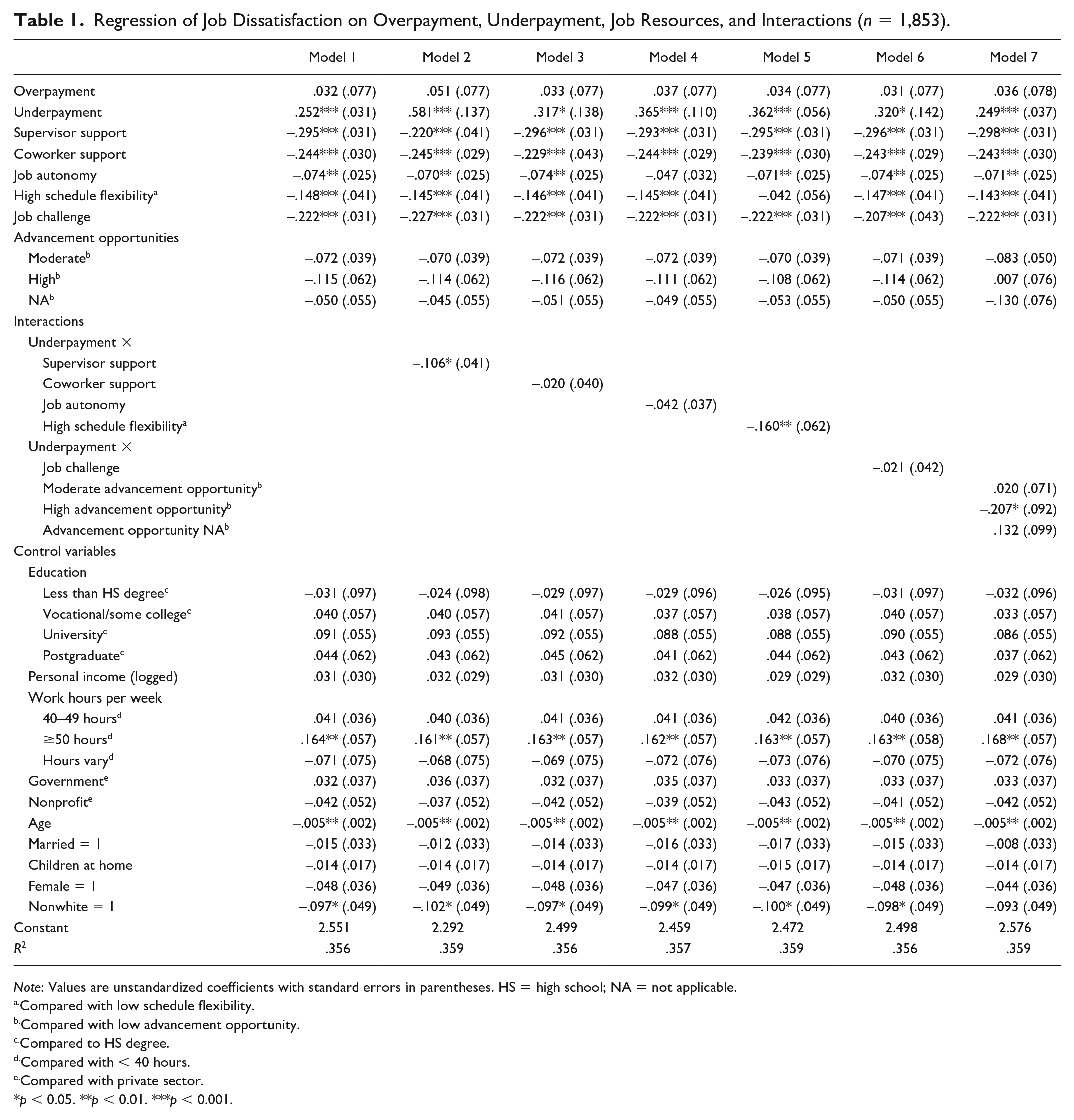
We begin our analysis with model 1 in Table 1, which tests the association between levels of perceived underpayment and job dissatisfaction. Subsequent models then test each variant of the alternative compensating rewards hypothesis by adding the following interaction terms: underpayment × supervisor support (model 2), underpayment × coworker support (model 3), underpayment × job autonomy (model 4), underpayment × schedule flexibility (model 5), underpayment × job challenge (model 6), and underpayment × advancement opportunities (model 7). Table A1 in the Appendix reports the descriptive statistics for all study variables.
Regression of Job Dissatisfaction on Overpayment, Underpayment, Job Resources, and Interactions (n = 1,853).
Note: Values are unstandardized coefficients with standard errors in parentheses. HS = high school; NA = not applicable.
Compared with low schedule flexibility.
Compared with low advancement opportunity.
Compared to HS degree.
Compared with < 40 hours.
Compared with private sector.
p < 0.05. **p < 0.01. ***p < 0.001.
Results
Consistent with prior research, model 1 in Table 1 shows that perceived underpayment is associated with higher levels of job dissatisfaction. By contrast, we observe no association between overpayment and job dissatisfaction. Model 1 also demonstrates that each of these job resources—supervisor support, coworker support, job autonomy, schedule flexibility, and job challenge—is associated with lower job dissatisfaction. By contrast, although advancement opportunities are associated with less job dissatisfaction, the link is not statistically significant (at least in this initial multivariate additive model). It is also noteworthy that the association between perceived underpayment and dissatisfaction holds net of this full range of other job qualities.
Having established that perceived underpayment is associated with more job dissatisfaction, our analyses shift to focus on testing interaction terms, that is, each variant of the alternative compensating rewards hypothesis. First, in model 2 we observe a significant negative coefficient for the interaction between underpayment and supervisor support (b = –.106, p < .05). This demonstrates that supervisor support functions as a protective job resource. Figure 2A illustrates this interaction effect: perceived underpayment is associated with more job dissatisfaction, but higher levels of supervisor support attenuate the strength of this relationship. However, in model 3 the interaction term between perceived underpayment and coworker support is not statistically significant, indicating that coworker support does not function as a protective resource. Thus, the results from models 2 and 3 suggest that these two different forms of social support in the workplace do not uniformly function as moderators; rather, only supervisor support provides a buffering effect in the association between perceived underpayment and job dissatisfaction.
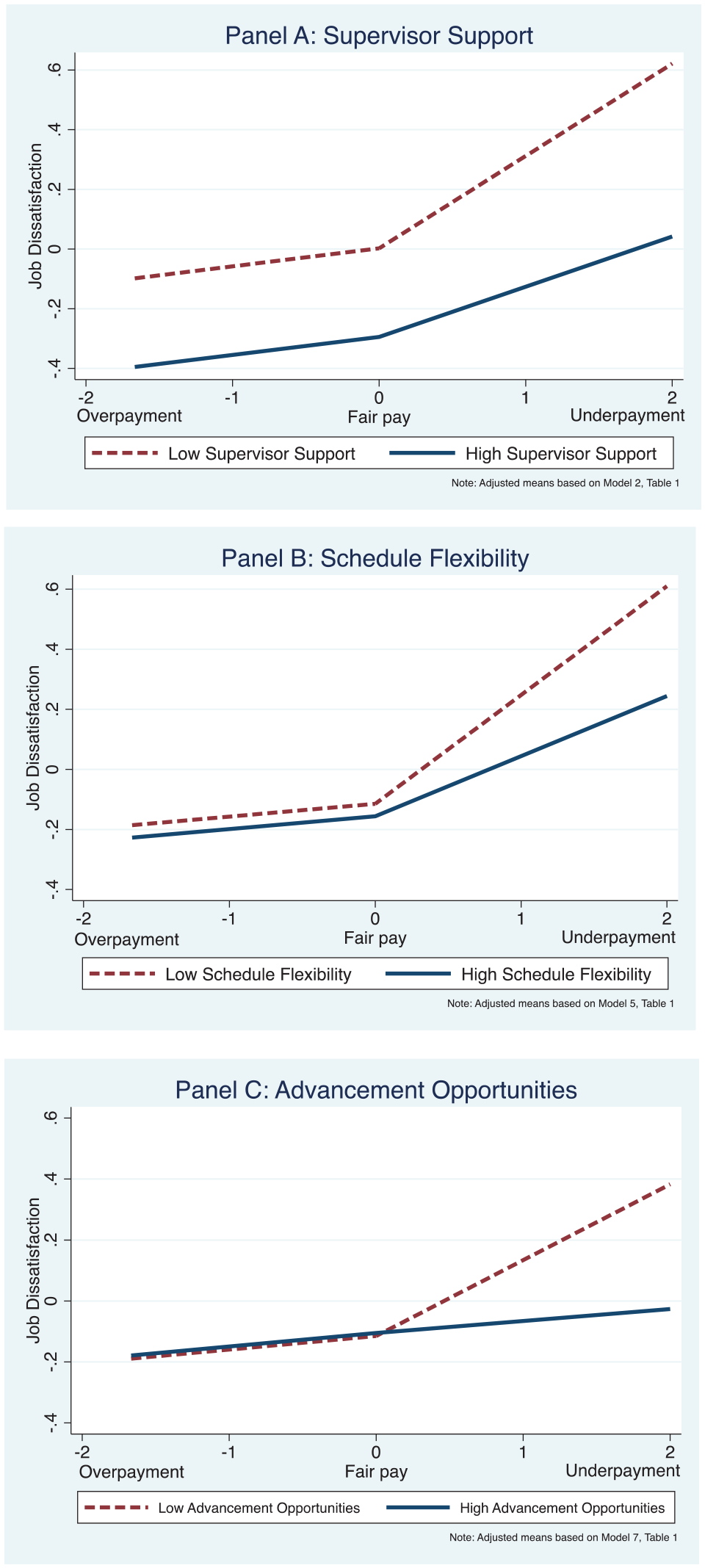
Buffering effects of supervisor support, schedule flexibility, and advancement opportunities.
Moving across Table 1, we find no significant interaction terms between underreward and job autonomy (model 4) and between underreward and job challenge (model 5). In other words, job autonomy and job challenge do not buffer the association between underpayment and job dissatisfaction. However, in model 6 we observe a statistically significant negative coefficient for the interaction between underreward and schedule flexibility (b = –.160, p < .01). This indicates that schedule flexibility functions as a protective resource. Figure 2B illustrates this pattern for schedule flexibility by showing the predicted means of job dissatisfaction, contrasting individuals who report low versus high schedule flexibility. Average levels of job dissatisfaction increase across levels of underpayment, but greater schedule flexibility attenuates that relationship. Collectively, our findings indicate that job autonomy, schedule flexibility, and job challenge do not uniformly function as buffers; rather, only individuals with high schedule flexibility appear to be protected against the dissatisfaction associated with underreward.
Finally, in model 7 we find a significant negative coefficient for the interaction between underreward and high advancement opportunities (b = –.207, p < .05). This indicates that high advancement opportunities function as a protective resource by moderating the association between perceived underpayment and job dissatisfaction. Figure 2C shows the moderating effect of advancement opportunities, illustrating that underpayment is associated with more job dissatisfaction among those who report low advancement opportunities; however, this relationship is weaker among employees who perceive advancement opportunities in their organization. Taken together, the results displayed across models 2 through 7 provide mixed support for the alternative compensating rewards hypothesis. In concrete terms, take any two individuals who feel similarly underpaid, and the individual with a more supportive supervisor, a more flexible schedule, or high advancement opportunities is less likely to report being dissatisfied with his or her job. However, we cannot say the same for coworker support, job autonomy, and job challenge as protective job resources.
Discussion
Equity theory proposes that perceived underreward shapes negative emotions, which individuals are motivated to relieve. Influenced by this work, sociologists and occupational stress researchers have conceptualized perceived underreward as a potent stressor that shapes employee well-being. Consistent with prior research, our analysis of a 2017 national sample of Canadian workers revealed that underpayment is associated with elevated levels of job dissatisfaction. With this relationship as a starting point, our study then answered calls to identify the situational factors that function as moderators (Hegtvedt 2006; Nowakowski and Conlon 2005). Given the prevalence and the negative consequences of perceived underreward, it is important to document the conditions that attenuate its effects. To identify those situational factors, we drew inspiration from the buffering hypothesis of the JD-R model. We assessed a broad set of job resources under the purview of the JD-R model—support, control, challenge, and advancement opportunities—to assess which resources weaken the effect of perceived underreward on job dissatisfaction. By simultaneously examining a diverse set of job qualities, we sought to identify the particular job qualities that matter for perceived underpayment. Our findings indicate that not all job resources provide equivalent buffering effects. Specifically, we observed that supervisor support, schedule flexibility, and advancement opportunities provided buffering effects, but coworker support, job autonomy and job challenge did not. Collectively, these patterns provide mixed evidence for the alternative compensating rewards hypothesis.
What are the potential reasons for the differential buffering of these job qualities? Our findings suggest a key insight: job resources that are located at more organizational or interpersonal levels—that is, those that characterize operation of the organization at large (advancement opportunities), interpersonal and social relations (supervisor support), and the organization of the timing of work (schedule flexibility)—are more effective as buffers than those job qualities located at the individual task level (autonomy and challenge). Furthermore, the content of job qualities that do buffer—caring supervisors, having the flexibility to accommodate work and family needs, and opportunities for advancement—underscores a unifying theme related to a supportive workplace. We identify a potential explanation in organizational support theory for these observed buffering patterns (Eisenberger et al. 1986; Kurtessis et al. 2017; Rhoades and Eisenberger 2002). Organizational support theory emphasizes the ways that these kinds of job resources promote the development of POS. Underreward represents a threat to feeling valued and appreciated at work, and these dynamics should diminish POS and elevate job dissatisfaction (Kurtessis et al. 2017). However, supervisor support, schedule flexibility, and advancement opportunities might enhance POS in ways that provide alternative compensating rewards that help minimize the job dissatisfaction associated with underreward.
We observed that having a supportive supervisor functioned as a buffer, but the buffering potency of supportive relationships only goes so far; specifically, having coworker support did not weaken the link between perceived underpayment and job dissatisfaction. Several factors might help explain the different buffering effects of supervisor support and coworker support. One possible reason is that supervisors hold positions of authority and are more clearly situated as representative agents of the organization. Such a position might transform supervisors’ supportive actions into salient sources of the mechanisms by which employees experience recognition, value, and appreciation within the organization. This explanation aligns with organizational support theory that highlights the role of supervisor support in shaping POS (Rhoades and Eisenberger 2002) and empirical evidence that supervisor support is more strongly associated with POS than coworker support (Kurtessis et al. 2017). Collectively, underpayment might diminish POS, but supervisors’ supportive exchanges with their subordinates may counter those effects by enhancing POS, thereby attenuating the observed association between underpayment and job dissatisfaction.
Schedule flexibility is another compelling resource. Although schedule flexibility is a dimension of job control, it also has clear practical aspects for employees in terms of instrumental support. Individuals who have been granted more schedule flexibility to facilitate the management of their work role with the needs embedded in other important social roles, especially family, may perceive that their employer is supportive of the overall quality of their life outside of work. Schedule flexibility is a job resource that might be functional for achieving work goals, but more importantly, it also might help workers feel that they can more effectively balance the competing expectations, obligations, and goals between work and personal or family-related roles (Kelly and Moen 2020). In this way, schedule flexibility represents a job resource that extends beyond helping individuals achieve work goals. Indeed, research documents that flexible and family supportive work practices are positively associated with POS (Kurtessis et al. 2017). Employees may therefore view schedule flexibility as a concrete signal that the organization respects them as persons and does not solely view them as workers; this orientation may boost workers’ sense of worth and esteem and, in the context of our hypotheses, provides an alternative compensating reward.
At this juncture, it is important to acknowledge that some research has documented the downsides of schedule flexibility. In contrast to the conventional view that schedule flexibility represents a resource, some research shows that schedule flexibility might contribute to more work-family role blurring and conflict (Blair-Loy 2009; Schieman and Young 2010). Moreover, recent research on the moderating effects of schedule control documents that the effect of job pressure on role blurring is stronger for those with more schedule control (Badawy and Schieman 2021). Situating our findings in this more critical frame, we suspect that whether schedule flexibility functions as a benefit or a detriment depends, in part, on the stressor in question. For stressors associated with workload and intensity, schedule flexibility may have downsides by channeling demands into nonwork roles (Badawy and Schieman 2021). In the context of perceived underreward, however, we find that schedule flexibility does function as a resource. This may be because although underreward diminishes perceptions of organizational support, schedule flexibility may increase it by elevating a sense of worth and esteem, and being respected.
Alongside supervisor support and schedule flexibility, advancement opportunities can also be conceptualized as a form of organizational support. Pathways for upward mobility may convey a sense of optimism about the future and may provide a signal that the organization cares about employees’ growth and development in the work role. Advancement opportunities may alter the time horizon of underpayment, signaling that the state of feeling underpaid is temporary and may be resolved in the near feature. In this way, the sense that “better days lie ahead” may help workers effectively redefine underpayment in a more benign or limited way that, ultimately, helps them maintain a sense of satisfaction with their work role.
Finally, we observed that two resources located at the individual task level, job autonomy and job challenge, did not function as protective buffers. Job autonomy entails the freedom to decide how one’s work is done, while job challenge represents the extent that workers are required to use their skills and abilities, engage in creative activities, and manage a variety of tasks. Both resources are beneficial in the sense that they are associated with lower job dissatisfaction, but they do not attenuate the effects of perceived underreward. Job autonomy may imply a degree of responsibility that, combined with underreward, may not reduce job dissatisfaction. Similarly, workers who feel underrewarded in a work role that requires constant learning, creative activities, and the performance of a variety of tasks might feel dissonance in the receipt of underpayment. These dynamics may explain why job autonomy and job challenge did not function as protective buffers.
Collectively, our findings suggest that job resources that are located at more organizational or interpersonal levels are important in attenuating the effects of perceived underpayment on job dissatisfaction, but resources located at the individual task level are not. Furthermore, the perceptions of organizational support might be an important underlying mechanism by which supervisor support, schedule flexibility, and advancement opportunities buffer the relationship between underpayment and job dissatisfaction. For workers who perceive underpayment, organizational and interpersonal resources that promote a sense of dignity and care by the organization may be the most effective in providing protective effects. We encourage future research to assess perceptions of organizational support and examine its role in explaining the buffering patterns we studied.
Although this study framed perceived underreward as a stressor, our findings also dialogue with equity theory. In Adams’s (1965) formulation, inequity is defined in terms of a comparison of outcome/input ratios between two actors. Outcomes are not limited to pay but also include “rewards intrinsic to the job, satisfying supervision, seniority benefits, fringe benefits, job status and status symbols, and a variety of formally and informally sanctioned perquisites” (Adams 1965:278). From this perspective, the job resources we examined may be conceived as outcomes. Thus, although one’s pay may be low, other job resources function as compensatory outcomes. Our findings suggest that not all outcomes are equivalent in offsetting concerns about pay, and that particular outcomes are important. Specifically, outcomes located at the organizational or interpersonal levels—supervisor support, schedule flexibility, and advancement opportunities—are more important than those located at the task level.
We conclude by proposing a few practical implications of our findings. To the extent that perceived underpayment represents a stressor, our observations suggest that the provision of supervisor support, schedule flexibility, and advancement opportunities can help workers maintain a sense of satisfaction with their jobs. However, these findings should not be interpreted as encouraging employers to focus solely on providing these resources while ignoring the actual problem of perceived underpayment. In their discussion of the practical implications of interaction effects between job demands and job resources, Bakker and Demerouti (2007) stated, “if job resources indeed buffer the effect of job demands on strain the advice to organizations would be to enhance job resources without having to alter the level of job demands (Van Vegchel, 2005)” (p. 322). This perspective applies to situations in which some types of stressors, such as intensive workload, are inevitable aspects of some jobs; however, it is less applicable in the case of perceived underpayment. A supportive climate might be protective, but some forms of perceived underreward might reflect structural issues that deserve to be addressed. Moreover, the importance of reducing the sense of underpayment itself is further highlighted by the lack of moderating effects observed for job autonomy, job challenge, and coworker support; this implies that the effects of underpayment are impervious to some resources. To address job dissatisfaction, organizations should make efforts to change the conditions that contribute to perceived underpayment in the first place and provide those who feel underrewarded with resources to help offset the sense of unfairness. In the present study, these resources are reflected in supervisor support, schedule flexibility, and advancement opportunities.
Before closing, we would like to acknowledge study limitations. First, some readers might wonder about the effects of overpayment and why we opted to focus on underpayment. Conceptually and empirically, we recognize that perceptions about pay are bidirectional with opposing sides of the spectrum that include both underpayment and overpayment. This bidirectional nature can present analytical challenges. Because our main focus was on the effect of underpayment, we used spline regression to partition underpayment and overpayment segments, which in turn facilitated the examination of the relationship between underpayment and job dissatisfaction, in addition to the interaction effects associated with job resources. In this approach, we also observed that overpayment was not associated with job dissatisfaction; however, data sparseness limited our capacity to examine this relationship with precision. As we display in Figure 1, no participant reported the most severe level of overpayment (a score of −2). The highest level reported was −1.7 (by only two participants), and the second highest level reported was −1.3 (by only six participants). Adams (1965) theorized that some degree of overpayment might be “acceptably rationalized as ‘good fortune’ without attendant discomfort” (p. 282). Applying that idea here, we may have observed no link between overpayment and dissatisfaction because the most severe levels of overpayment are underrepresented, and these are the individuals with the most potential for elevated job dissatisfaction. The lack of a link between overpayment and job dissatisfaction should therefore be viewed with caution. More generally, the fact that so few reported overpayment implies that a larger sample is required to effectively investigate consequences of overpayment (and contingencies) in population-based analyses.
As for our main focus—perceived underpayment—equity theory and prior research situate it as a cause of negative employee outcomes such as job dissatisfaction; these perspectives guided our hypotheses and analyses (e.g., Adams 1965; Clay-Warner et al. 2005; Sauer and Valet 2013). We recognize, however, that the cross-sectional nature of our data prevents us from making causal claims. Although cross-sectional data are a limitation, we believe that this does not undermine our theoretical case about the resources that function as moderators. Even if some of the causal direction flows the other way (i.e., job dissatisfaction could lead to perceptions of underpayment), the fact that the strength of the association differs across levels of job resources is theoretically consistent with the buffering hypothesis: underpayment is related less strongly to job dissatisfaction among workers with greater supervisor support, schedule flexibility, and advancement opportunities. Nevertheless, future research should replicate our results with longitudinal data that document estimates of underlying causal effects.
Another future direction is to consider the role of contextual effects on perceptions of underpayment and job dissatisfaction. For example, one could imagine a situation in which macro-level economic factors, such as recessions or community-level unemployment, filter down to influence individuals’ perceptions of underpayment and its consequences over time. Two questions are open to future research: (1) Do perceptions of underpayment hurt more in recessionary periods where opportunities for role exit may be constrained? and (2) How does community-level unemployment affect the ways that individuals experience underpayment and the kinds of job resources that are brought to help cope with distributive injustice? The answers to these kinds of questions can enhance conceptual and theoretical models about the experience of underpayment, its implications for well-being, and the personal and social contexts that modify those patterns.
Footnotes
Appendix
Descriptive Statistics (n = 1,853).

| Mean/Proportion | SD | Minimum | Maximum | |
|---|---|---|---|---|
| Job dissatisfaction | .00 | .82 | –.89 | 3.28 |
| Distributive justice | .55 | .69 | –1.67 | 2.00 |
| Supervisor support | 3.21 | .67 | 1.00 | 4.00 |
| Coworker support | 3.30 | .66 | 1.00 | 4.00 |
| Job autonomy | 2.78 | .77 | 1.00 | 4.00 |
| Job challenge | 3.24 | .65 | 1.00 | 4.00 |
| Schedule flexibility | .74 | |||
| Advancement opportunities | ||||
| Low | .62 | |||
| Moderate | .20 | |||
| High | .07 | |||
| Not applicable | .11 | |||
| Education | ||||
| Less than HS degree | .04 | |||
| HS degree | .12 | |||
| Vocational/some college | .24 | |||
| University | .40 | |||
| Postgraduate | .20 | |||
| Personal income | $71,840.86 | $50,880.93 | $2,400.00 | $820,000.00 |
| Work hours per week | ||||
| <40 hours | .44 | |||
| 40–49 hours | .41 | |||
| ≥50 hours | .12 | |||
| Hours vary | .03 | |||
| Sector | ||||
| Private | .49 | |||
| Government | .42 | |||
| Nonprofit | .09 | |||
| Female = 1 | .64 | |||
| Nonwhite = 1 | .10 | |||
| Age | 49.10 | 10.21 | 23.00 | 80.00 |
| Married = 1 | .56 | |||
| Children at home | .74 | 1.04 | .00 | 5.00 |
Note: In our spline regression analysis, we divide the distributive justice index into underpayment and overpayment segments. HS = high school.
Funding
The author(s) disclosed receipt of the following financial support for the research, authorship, and/or publication of this article: A grant award from the Canadian Institutes of Health Research supports this study (funding reference MOP-102730, Scott Schieman, principal investigator).

1
As a side note, very few people feel overpaid. Despite its relatively lower prevalence, we include the overrewarded in our analyses, with the important caveat that data sparseness presents analytical challenges. We include the overrewarded in our analyses to assess their levels of job dissatisfaction relative to workers who feel appropriately rewarded. The core hypothesis in our study centers on the alternative compensating rewards idea, which explicitly focuses on job resources as moderators in link between underpayment and job dissatisfaction.
2
We retain those individuals who reported “not applicable” (n = 200) and compare them with the reference category. As we describe in the “Results” section, however, in no instance was the “not applicable” group significantly different from the reference group in our analysis.
3
We have not specified hypotheses about the overpaid in our theoretical setup. Our reasoning is that most of the theoretical ideas in this area focus on why feeling underrewarded represents a unique role stressor—something that, in turn, might be offset by other workplace rewards or resources (e.g., support or flexibility). We do not see a parallel theoretical case for these same job resources as moderators of any link between overpayment and dissatisfaction. Nonetheless, we have decided to retain those who report feeling overpaid so that readers can observe how this group is indeed distinct from those who report feeling underpaid. The results we report for the moderating effects of job resources in the link between perceived underpayment and dissatisfaction hold whether we exclude or include the overpaid.