




Abstract
The United States is one of the few countries that does not guarantee paid family leave (PFL) to workers. Proposals for PFL legislation are often met with opposition from employer organizations, which fear disruptions to business, especially among small employers. But there are limited data on employers’ views. The authors surveyed firms with 10 to 99 employees in New York and New Jersey on their attitudes toward PFL programs before and during the coronavirus disease 2019 (COVID-19) pandemic. There was high support for state PFL programs in 2019 that rose substantially over the course of the pandemic: by the fall of 2020, almost 70 percent of firms were supportive. Increases in support were larger among firms that had employees using PFL, suggesting that experience with PFL led to employers becoming more supportive. Thus, concerns about negative impacts on small employers should not impede efforts to expand PFL at the state or federal level.
The United States stands out from peer countries in not mandating rights to paid family leave (PFL) when employees need to be absent from work to care for new children or seriously ill family members, although the federal Family and Medical Leave Act (FMLA) does provide 12 weeks of unpaid leave to some workers employed at firms with 50 or more employees. In the absence of a federal program, 10 states have enacted their own PFL programs, beginning with California, whose law took effect in 2004 (National Partnership for Women and Families 2020).
The coronavirus disease 2019 (COVID-19) pandemic has amplified the need workers have for paid and job-protected leave to care for family members (in addition to paid sick leave for their own illness). During the pandemic, PFL was introduced temporarily at the federal level through the Families First Coronavirus Response Act (FFCRA), and state PFL programs were amended to cover COVID-19-related absences. A new federal PFL program has been proposed as part of the Build Back Better bill (Build Back Better bill legislation: https://www.congress.gov/bill/117th-congress/house-bill/5376).
Polling data indicate that 84 percent of American voters strongly support PFL (National Partnership for Women and Families 2018). However, employer organizations have often opposed these policies, fearing possible disruptions and costs to business, particularly for smaller employers (NFIB 2016). Surveys of individual employers, although rare, provide little evidence justifying these concerns. In their foundational work “Leaves That Pay,” Appelbaum and Milkman (2011) found that California’s PFL program had positive or neutral effects on employee productivity, morale, and costs. A more recent investigation suggests that New York’s program improved small employers’ ease in handling long employee absences (Bartel et al. 2021). However, very little is known about the attitudes of employers, especially small employers, with respect to PFL. While Appelbaum and Milkman (2011) found that firms reported little negative impact following the adoption of California’s paid leave policy, they did not report on the level of support for the policy held by the firms more generally. Other researchers have reported positive employer attitudes in a small sample of firms from Rhode Island (Bartel et al. 2016).
The COVID-19 pandemic has amplified the need for paid leave (Boyens 2020), increasing attention to paid leave policies nationally. It is possible that this heightened awareness changed attitudes toward PFL among employers. However, although small employers are critical stakeholders, little is known about how small employers view PFL policies and whether their attitudes toward such policies changed during the pandemic. Thus, we estimate a model to determine whether employer attitudes changed from fall 2019 to fall 2020.
If employers did become more supportive of PFL during the pandemic, it is important to determine to what extent that change is constant or varies by the size of their workforce. Our sample includes very small firms with 10 to 49 employees as well as somewhat larger firms with 50 to 99 employees. We estimate separate models for these two subgroups of firm size to see whether attitudes and the change in attitudes are similar or different across them.
Finally, if employers did become more supportive of PFL during the pandemic, it is important to know whether this increase in support extends to firms that had employees use paid leave or whether this support is confined to firms that did not have experience with PFL use. Thus, we analyze whether the change in attitudes of employers toward paid leave policies differs by whether the firm had any employees who took paid leave either through the new federal program established under the FFRCA or through state PFL policies.
This article provides new evidence on how small employers with 10 to 99 employees in New York and New Jersey view their states’ PFL programs, with special attention to changes in attitudes during the COVID-19 pandemic. 1 Both the New York and New Jersey state PFL programs apply to firms regardless of the number of employees, unlike FMLA, which is available only to employees working for firms with 50 or more employees. Smaller firms are rarely included in employer surveys, and understanding their views is particularly important, as their attitudes toward PFL are thought to be less favorable than those of their larger counterparts (NFIB 2016). We surveyed firms in the fall of 2019 and fall of 2020, just before and during the pandemic. Employer attitudes about PFL may be especially revealing, as they summarize employers’ overall impressions of the program rather than focusing only on specific aspects (such as employee performance on dimensions related to attendance or commitment to the job).
Data and Methods
The analysis in this article uses data from a survey that was originally designed to assess the impact of New York’s 2018 Paid Family Leave Act. Drawing from business listings from Survey Sample, Inc., we recruited a representative sample of firms with 10 to 99 employees in New York and New Jersey in 2016. In 2017, 2018, and 2019 we recontacted as many firms as possible and also recruited new firms to maintain the sample’s size and representativeness. In 2020 we again recontacted as many firms as possible but did not recruit any new firms. The sample was drawn and contacted by the Office of Survey Research at Michigan State University. Our analysis focuses on whether employers stated that their attitudes toward their states’ PFL programs were very or somewhat supportive (denoted as “supportive” below), neutral, or somewhat or very opposed (denoted as “opposed”). In the fall of 2020, we also asked employers whether they had any employees who used federal PFL through FFCRA and whether they had any employees who used their states’ PFL programs during the past 12 months. The survey was conducted by the Office of Survey Research and approved by the relevant university institutional review board. Data and code used in the study are accessible at https://github.com/MSlopen/NYEmployerStudy_Socius2021.
The original survey sample was representative of firms in three size categories (10–19, 20–49, and 50–99 employees, respectively) and in 16 sectors on the basis of the North American Industry Classification System categories. Initial contact was made by mail, with follow-up via mail, phone, and e-mail. In each firm, the owner or manager completed the survey. The initial response rate (in 2016) was 46 percent. The survey included a question about respondents’ attitudes toward their states’ PFL policies on a five-point, Likert-type scale (5 = very supportive, 4 = somewhat supportive, 3 = neutral, 2 = somewhat opposed, and 1 = very opposed), as well as questions about employee composition and performance. We collapsed the responses about attitudes into three categories: supportive (including very and somewhat supportive), neutral, and opposed (including very and somewhat opposed).
To understand employers’ experiences during the COVID-19 pandemic, in fall 2020, we attempted to recontact all 4,711 firms that had participated in prior waves. A total of 1,151 firms responded, for a response rate of 24.4 percent. Among these 1,151 firms, 264 had closed in the intervening period, and 887 were operational at the time of response. Of the 887 firms that were operational, 539 responded to the employer attitude and leave use questions in both 2019 and 2020 and were included in the analytic sample for this article. We have compared our analytic sample (n = 539) with our initial representative sample from 2016 (n = 2,400) and our 2019 sample (n = 2,428). Our analytic sample does not significantly differ from the initial representative sample with respect to distribution by industrial sector, except for other services and transportation and warehousing, while no significant differences by sector are observed when comparing our analytic sample with the 2019 representative sample. However, firms with 50 to 99 employees are underrepresented in the analytic sample, while firms with 10 to 49 employees are overrepresented, relative to their proportions in the initial representative sample and in the 2019 sample. See Table A1 in the Appendix, which shows the results of these comparisons.
Our first research question is whether employer attitudes changed from fall 2019 to fall 2020. We address this using ordinary least squares regression models with firm fixed effects. Inference was conducted using heteroskedasticity-robust standard errors. The regression model takes the following form:

where Attitudeit is an indicator set to 1 if firm i is supportive of (or opposed to) its state’s PFL policy in year t, 2020
t
is an indicator set to 1 in 2020 and 0 in 2019, γ
i
is the firm fixed effect that controls for all time-invariant characteristics of the firm, and
Our second research question is whether attitudes and changes in attitudes differed by firm size. This analysis is important because attitudes may vary by firm size and given the underrepresentation of firms with 50 to 99 employees in our analytic sample. Thus, we also estimated model 1 separately in subsamples stratified by two firm size categories to compare changes among firms with 10 to 49 employees and those among firms with 50 to 99 employees. The key coefficient of interest is β1, which measures the change in firms’ attitudes toward PFL during fall 2020 relative to the year before. Figure 1 provides the distribution of firms’ attitudes toward their states’ PFL programs by year. Figure 2 provides the regression coefficients and 95 percent confidence intervals from the adjusted models.

Within-firm changes in support for and opposition to state paid family leave between 2019 and 2020 in New York and New Jersey (n = 539 firms).

Within-firm changes in support for and opposition to state paid family leave between 2019 and 2020 in New York and New Jersey (n = 539 firms).
Our third research question is whether the firms’ reported use of state PFL policies and the federal FFCRA policy was associated with changes in firms’ attitudes toward PFL. Understanding whether having an employee use the policy is associated with increased support or opposition provides a robustness check as to whether changes in attitudes are seen in firms that actually had experience with PFL. We could not include firm fixed effects in these analyses, because the variables about PFL and FFCRA use are available for each firm only once. We therefore estimated ordinary least squares regression models that included controls for the firm’s level of support in 2019 (i.e., before the pandemic), state fixed effects, industrial sector fixed effects, and the same firm composition control variables as in regression model 1, measured in 2019. This model takes the form

where Attitude
i
2020 is an indicator set to 1 if firm i is supportive of (or opposed to) its state’s PFL policy in 2020 and 0 otherwise, FFCRA
i
is an indicator set to 1 if a firm had at least one employee who used the federal paid leave policy and 0 otherwise, StatePol
i
is an indicator set to 1 if a firm had at least one employee who used the state PFL policy and 0 otherwise, NY
i
is an indicator for firms located in New York (0 for firms located in New Jersey), Attitude
i
2019 is an indicator set to 1 if firm i is supportive (or opposed to) its state’s PFL policy in 2019 and 0 otherwise, Sector
i
is a set of 16 indicators for industrial sectors of the firm, and
We also estimated model 2 using subsamples stratified by two firm size categories to compare associations among firms with 10 to 49 employees and those with 50 to 99 employees. Figure 3 provides the coefficients and 95 percent confidence intervals for the association between the reported use of each policy (β1 and β2) and support for PFL in 2020 for all firms, firms with 10 to 49 employees, and firms with 50 to 99 employees.
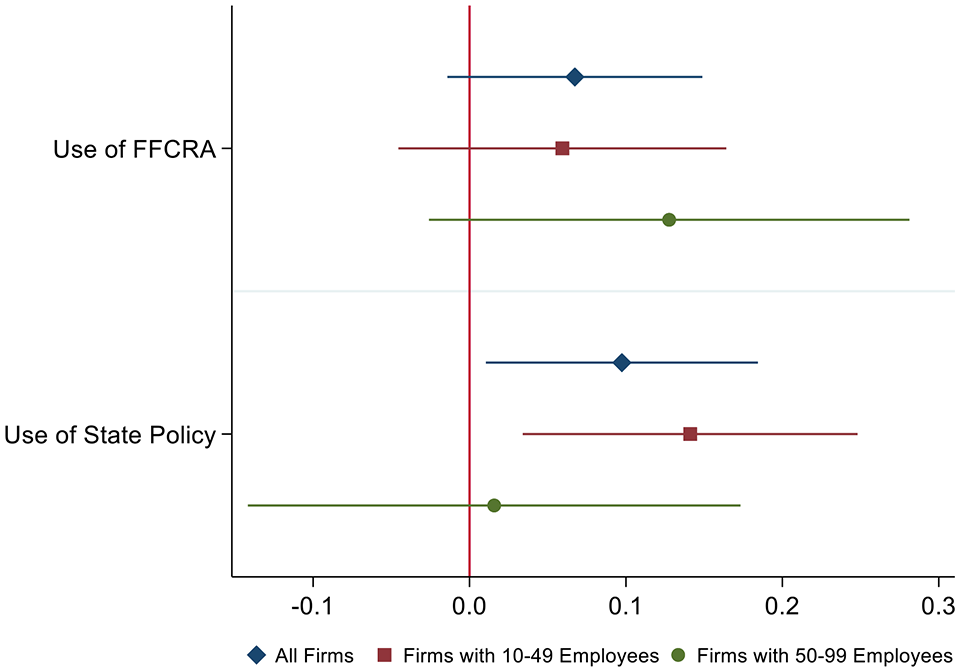
Association between the use of leave policies and change in support for state paid family leave (n = 539 firms).
Results
Employer Support Increased during the COVID-19 Pandemic
Among employers interviewed in both fall 2019 and fall 2020, the share reporting that they were very or somewhat supportive of PFL rose by 9.1 percentage points, from 61.6 percent to 70.7 percent (Figure 1). The corresponding share of firms that were somewhat or very opposed to PFL declined by 9.6 points, from 20.0 percent to 10.4 percent. Considering firms by size, in 2019, firms with 50 to 99 employees had more favorable views of PFL than firms with 10 to 49 employees: 68.3 percent of the former were supportive, compared with 58.7 percent of the latter.
After adjusting for firm fixed effects as well as firm time-varying covariates (such as percentage of employees who worked part-time or were female), the increase in support was 9.6 percentage points (p < .01), and the adjusted reduction in opposition was 8.8 percent (p < .01) (Figure 2, Table A2). A significant 14.6 percentage point (p = .02) increase in support and a 13.5 percentage point (p = .01) reduction in opposition to PFL were observed among firms with 50 to 99 employees.
However, it would be a mistake to conclude that smaller employers with 10 to 49 employees are opposed to PFL. On the contrary, in 2019, they were 2.5 times more likely to support than to oppose PFL (58.7 percent vs. 20.9 percent), and support increased by an unadjusted 10.6 percentage points (Figure 1) and a regression-adjusted 7.5 percentage points (p = .04) from 2019 to 2020, with analogous 10.0 and 8.2 (p < .01) percentage point decreases in the percentage of small firms opposing PFL (Figure 2, Table A2).
Use of PFL during COVID-19 Was Associated with Greater Support
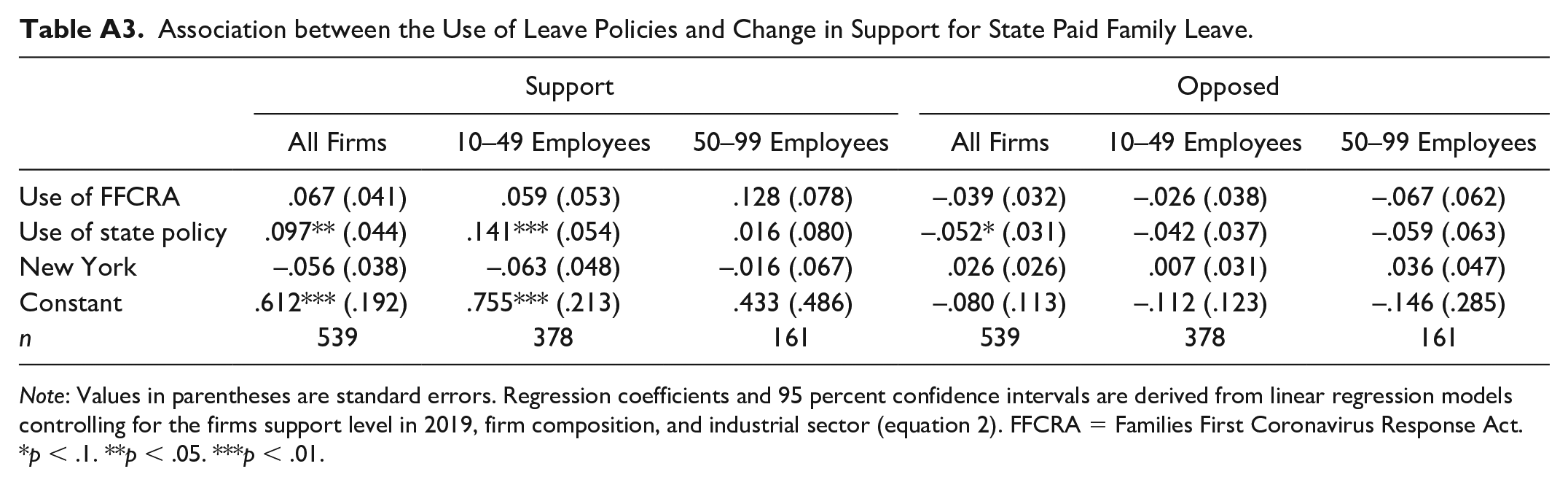
Among employers interviewed in both 2019 and 2020, 21.9 percent reported in 2020 that they had employees who used state PFL during the past year, and 28.6 percent reported that they had employees who used the federal FFCRA. 2 As shown in Figure 3, reported employee use of state PFL was associated with a rise in employer support for the program by a regression-adjusted 9.7 percentage points (p = .03), a 16 percent increase from the 2019 baseline support level of 61.6 percent. Use of FFCRA was not significantly associated with changes in support for state PFL. Use of either type of leave reduced the percentage of firms opposing the state PFL policy by smaller amounts, with the FFCRA-predicted effect again not being statistically significant.
We also estimated models by firm size. Support for state PFL laws rose by a regression-adjusted 14.1 percentage points (p = .01) among employers with 10 to 49 employees and with employees who had used state PFL, an increase of 24 percent from the pre-COVID-19 baseline of 58.7 percent. Conversely, although use of state programs was not associated with changes in favorability ratings among employers with 50 to 99 employees, worker use of FFCRA leave was associated with a 12.8 percentage point increase (p = .10), corresponding to 19 percent growth from the baseline support level of 68.3 percent. Use of either program decreased the likelihood that employers in both firm size groups opposed state PFL programs, but these reductions were smaller in magnitude and not statistically significant. Coefficients are shown in Table A3.
Discussion
The COVID-19 pandemic has highlighted the potential role of programs providing paid and job-protected leave for employees who need to be absent from work for their own illness or to care for family members. Thus, both paid sick leave and PFL are receiving heightened attention on the public policy agenda. Recent analyses have documented the use of paid sick leave during COVID-19 (Andersen et al. 2020; Pichler, Wen, and Ziebarth 2020), but we know less about PFL and the pandemic (Boyens 2020).
Drawing on data collected immediately prior to and during the COVID-19 pandemic, we provide new evidence on employer attitudes toward state PFL programs. Attitudes provide useful information because they summarize employers’ overall experiences with the programs, which may be imperfectly or incompletely revealed by responses to questions focused on specific aspects of the programs or hard-to-measure factors such as productivity.
Our analysis focuses on firms with 10 to 99 employees, as opponents of PFL often argue that small employers are most adversely affected by PFL. Drawing on a survey conducted in fall 2019 and fall 2020 in New York and New Jersey, we find that employer support for PFL, which was already high in 2019, increased significantly during COVID-19. Moreover, reported employee use of the state PFL program during the prior year was associated with greater employer support for PFL, holding constant the level of support before COVID-19. This suggests that as employers gain familiarity with the programs, their support tends to increase and opposition decreases.
Our findings that small employers largely support PFL policies and that such support increased during the pandemic make an important contribution to the literature. However, there are a number of limitations that should be noted and addressed in future research. The sample of firms included in this analysis is relatively small, and although our analytic sample maintains representation of the industrial mix within each state, smaller firms with 10 to 49 employees are overrepresented, perhaps because managers of firms with 50 to 99 employees were more likely to be working remotely and thus more difficult to reach. The overrepresentation of firms with 10 to 49 employees, which are somewhat less supportive of PFL and experience somewhat less of an increase in that support from 2019 to 2020, means that our estimates for the overall sample understate both the level of and the increase in support among firms with 10 to 99 employees. We have addressed this issue by providing separate results by firm size, but future studies should endeavor to include larger and more representative samples. In addition, there are limits to the types of firm-level characteristics that were available to include in this analysis. Finally, as data are self-reported by firms’ owners or managers, there could be reporting errors by respondents.
Despite these limitations, our results have implications for the current policy debate. First, contrary to some commonly cited rhetoric, small employers in states with PFL programs are actually quite supportive of PFL, suggesting that concerns about negative impacts on such firms should not be an impediment to enacting PFL programs. Second, support among these firms increased during COVID-19, while opposition decreased, indicating that the post-COVID-19 period could be an opportune moment for considering further related legislation, such as the federal Build Back Better bill. In addition, this finding of increased support highlights the role of PFL as a form of social insurance, which becomes particularly desirable during periods of social or economic distress. Third, employers with workers who used PFL during the pandemic became more supportive of the programs, suggesting that their experiences were positive.
Footnotes
Appendix
Association between the Use of Leave Policies and Change in Support for State Paid Family Leave.
| Support |
Opposed |
|||||
|---|---|---|---|---|---|---|
| All Firms | 10–49 Employees | 50–99 Employees | All Firms | 10–49 Employees | 50–99 Employees | |
| Use of FFCRA | .067 (.041) | .059 (.053) | .128 (.078) | –.039 (.032) | –.026 (.038) | –.067 (.062) |
| Use of state policy | .097** (.044) | .141*** (.054) | .016 (.080) | –.052* (.031) | –.042 (.037) | –.059 (.063) |
| New York | –.056 (.038) | –.063 (.048) | –.016 (.067) | .026 (.026) | .007 (.031) | .036 (.047) |
| Constant | .612*** (.192) | .755*** (.213) | .433 (.486) | –.080 (.113) | –.112 (.123) | –.146 (.285) |
| n | 539 | 378 | 161 | 539 | 378 | 161 |
Note: Values in parentheses are standard errors. Regression coefficients and 95 percent confidence intervals are derived from linear regression models controlling for the firms support level in 2019, firm composition, and industrial sector (equation 2). FFCRA = Families First Coronavirus Response Act.
p < .1. **p < .05. ***p < .01.
Author Contributions
All authors contributed equally to the writing of the manuscript. A.P.B., M.R.-S., C.J.R., and J.W. designed the initial survey and study. M.S. conducted data analysis.
Funding
The authors disclosed receipt of the following financial support for the research, authorship, and/or publication of this article: We gratefully acknowledge funding from Pivotal Ventures, the Russell Sage Foundation, and the Washington Center for Equitable Growth. We are also grateful for support from the Columbia Population Research Center, which is funded by the Eunice Kennedy Shriver National Institute of Child Health and Human Development (P2CHD058486).

1
New Jersey’s policy offered a weekly benefit rate of 66 percent of a worker’s average weekly wage (AWW) to a maximum benefit of $650 in 2019 for up to 6 weeks and was expanded in 2020 to offer a weekly benefit rate of 85 percent of a worker’s AWW, up to a maximum of 70 percent of the statewide AWW for 12 weeks. New York is in the process of phasing in its PFL policy: in 2019 and 2020, workers were entitled to 10 weeks at 55 percent of their salaries, up to 55 percent of the state AWW, increasing to 60 percent of salary up to 60 percent of the state AWW in 2020. New York’s policy provides job protection, while New Jersey’s policy does not (although eligible workers can receive job protection through the FMLA).
2
More than half (56.8 percent) of employers reported they did not have any workers use FFCRA, and 14.7 percent did not provide information on FFCRA use. Similarly, 56.8 percent of firms reported no use of state leave programs, and 21.7 percent did not respond to the state PFL use questions.