




Abstract
This study examines the differences in business continuity of Japanese and American small organizations during the Covid-19 pandemic since early 2020 in terms of organizational adaptation empowered by loans, grants, and aid and created through processes of visioning, and relationship building. The 28 Japanese and 21 American small organizations collected through snowball sampling were asked about their level of preparedness, the types of aid earned, the vision that an organization developed, and how they used their organization to advance community life. We used semi-structured interviews in the participants’ native languages for 40 min to 1.5 h. Coding results identified 36 codes, nine subcategories, and three broad categories common among small organizations in Japan and the United States. A comparison of the coding results showed three results that we focus on in our comparative analysis. First, loans, grants, and aid provided by the government were effectively used as a business continuity resource in both countries. Second, visioning, a process of setting goals and understanding purpose, was observed in Japan and the United States. Lastly, Japanese organizations emphasized maintaining relationships with business partners, even providing monetary support to them. Conversely, in the United States, new relationships were observed but organizations did not provide as much mutual support. Thus, the study clarified two different types of resilience among small organizations: trust-based resilience seen frequently in Japan, which seeks to maintain relationships with employees and business partners rather than investing in the organization, and the change-based resilience in the United States, which aims to change the organization and build new relationships.
Introduction
Small organizations have transformed their operations to navigate a cacophony of new institutional, cultural, and social norms that have been thrust upon them by the Covid-19 pandemic (Ogai, Uyama and Seki 2020; Seki, Kawai and Nakamichi 2020). The global scope of a pandemic has meant that small organizations around the world have needed to adapt. In adapting to their new context, small organizations have made culturally informed decisions about what to do. Previous cross-cultural research between the United States and Japan has allowed American researchers to study Japanese disasters (Tierney and Goltz 1997) and Japanese researchers to study American disasters (Hayashi 2007). However, there has never been an opportunity to compare the two countries navigating the same hazard simultaneously.
In this paper, we seek to understand how small organizations, including businesses and non-profits, have adapted their ways of working to navigate the Covid-19 pandemic in the United States of America and Japan. Small organizations can be understood as vulnerable to disasters because they have fewer human and financial resources to prepare for disasters, but they can also be understood as resilient in the sense that they are able to make rapid decisions in response to rapid changes. In addition, there is a lack of international understanding of how small organizations can respond to a pandemic. Through interviews with the owners, managers, and employees of 28 Japanese organizations and 21 American organizations, we present a comparative analysis that begins to understand the differences in how each country responded to Covid-19. This paper defines small businesses as those which are smaller, less competitive, and less economically performing than larger organizations, while being nimbler, more capable of innovation, and less complicated (Botha and Von Solms 2004).
This paper is organized to introduce salient points of cross-cultural comparison between Japan and the United States. First, we review prior research on three perspectives that small businesses can perform in organizational adaptation: loans, grants, and aid from financial programs in each country, visioning and relationship building. Next, it presents our methodology and describes how we conducted 28 interviews in Japan and 21 in America. In the results section, we quote our participants directly to articulate the nuance between the actions taken by Japanese and American small organizations to express the different cultural norms that influence how each navigated the pandemic.
Research context: resource of organizational adaptation
The Covid-19 pandemic caused the economies of advanced countries like Japan and the United States to contract by 10.1% (Cabinet Office 2021) and 9.1% (Makridis and Hartley 2020), respectively, throughout 2020. In 2020, the Payroll Protection Program (PPP) was the most utilized subsidy with a total of 2.2 million loans distributed, or equating to $525 billion US. Conversely, in Japan, the Subsidy Program for Sustaining Businesses, distributed approximately 4.23 million loans, worth approximately ¥5.5 trillion. Though the efficacy of preparedness and business continuity planning at small organizations is debatable (Dahlhamer and Tierney 1998), small organizations were at a significant disadvantage for rarely engaging in activities traditionally understood as having fostered pandemic preparedness (Watkins et al. 2008). Perhaps it is because they are undercapitalized (Flynn 2007), or they lack a risk analysis that would have fostered preparedness actions (Brooks 2003). Regardless, as a result, few dedicated the requisite human or economic resources to advanced preparedness (Imai et al. 2021). On the front lines of the economy, small organizations bore the brunt of the economic devastation caused by Covid-19.
At the same time, while they lacked plans or resources that could have helped their organization prepare for disaster (Watkins et al. 2008), small organizations engaged in a process of transformation and innovation that have allowed them to reorganize their processes while experiencing crisis (e.g. Linnenluecke and McKnight 2017). In fact, they engaged in a parallel process to meet new community needs by building new relationships. Rather than close shop, small organizations have engaged pushed through the pandemic, reordering their ways of working to manage the disease and create new value (Ogai, Uyama and Seki 2020; Seki, Kawai and Nakamichi 2020), allowing them to continue executing their vision.
Loans, grants, and aid
External financing can be leveraged by a small organization to access new opportunities that might otherwise be unavailable (SCORE 2019). However, Webb, Tierney and Dahlhamer (2000) and Dahlhamer and Tierney (1998) revealed that increased debt loads at traditionally high interest rates may contribute to the downfall of an organization after a disaster. While debt can be used to offset diminished cash flow for ongoing measures (Runyan 2006), it is debatable whether it is necessarily positive for the business.
At a policy level, both Japan and the United States spent enormous sums on programs to sustain small organizations through the Covid-19 pandemic. Specifically, in Japan, Jizokuka Kyufu-kin, or the New Coronavirus Infection Special Loan program, served a similar function as America's Paycheck Protection Program and Economic Injury Disaster Loan (EIDL) program, with some key differences. First, the Japanese government rolled out two programs to support small organizations through the pandemic: the Subsidy Program for Sustaining Businesses, Jizokuka Kyufu-kin (Small and Medium Enterprise Agency 2020), and the New Coronavirus Infection Special Loan (Japan Finance Corporation 2020). The subsidy program was administered by the Small and Medium Enterprise Agency to organizations that experienced a 50% drop in sales from the previous year. It provided small and medium organizations with cash infusions of 2,000,000 yen, about $18,000 USD, and sole proprietorships with grants of 1,000,000 yen, about $9,000 USD. Applications were accepted from 1 May 2020 through 15 February 2021. As well, the Japan Finance Corporation, a government-owned bank, was empowered to issue a New Coronavirus Infection Special Loan, which offered up to 80,000,000 yen, about $720,000 USD, at a rate of 0% during the first 3 years to organizations who experienced a sales decline of 5% or more, relative to their income over the last 4 years.
The United States’ federal government also rolled out two programs to support small organizations: the PPP and the EIDL program. Taken together, these two expand on, and offer a markedly different approach to supporting organizations through disaster than is traditionally available. Where the Small Business Administration (SBA) will often provide loans of up to $2,000,000 USD at rates of up to 8% over 30 years for disasters resulting from other hazards (SCORE 2019), PPP and EIDL were more generous. Through the PPP, organizations received an average of $106,542 USD at a 1% interest rate over 2–5 years. Importantly, this loan was forgiven if 60% of the principal was spent on staffing costs (Small Business Administration 2020). Through the EIDL program, organizations could borrow up to $2,000,000 USD at 2.75 or 3.75 percent over 30 years, with payments deferred for the first 2 years (Small Business Administration 2022).
Granja et al. (2020) note that there were apparent problems with the first round of PPP loans that stemmed from banks being given an essential role in the administration process. Aid programming worked well for those with existing, sophisticated relationships with their bank, who were more likely to obtain PPP loans (Duchin et al. 2022). However, if an organization lacked a relationship with their bank, they likely faced increased difficulty securing a loan and often borrowed smaller amounts. Strikingly, minority and female-owned businesses received loans 50% lower than their white male counterparts (Atkins, Cook and Seamans 2022). Adding additional difficulty is that the size and industry of the organization were not considered in the first round of lending (Barrios et al. 2020). Disparities between businesses were most vividly exemplified by the small restaurants who had to compete with Ruth's Chris Steak House (Scott 2020). The application process was made more accessible, and small organizations were given an exclusive window during which they had priority access to the funds (Omeokwe 2021). Due in part to these government expenditures, the number of bankruptcies in both countries in 2020 stabilized at a nearly 30-year low (Epiq Bankruptcy 2023; Small and Medium Enterprise Agency 2021).
Visioning
How did the small business take advantage of the financial benefits afforded by each country's pandemic assistance program? The most successful used it to find new ways of meeting their organization's purpose, their vision. The new surplus generated by pandemic aid may have been used as a new source of investment in the organization. In addition, the prolonged pandemic raised issues, including employee retention, financing, and increased uncertainty about the future (Imai et al. 2021; Ogai, Uyama and Seki 2020). Small organizations were willing to devote excess funds to creating and executing their vision to continue operating against an uncertain future.
With aid money that allowed small organizations to remain open – owners, managers, and employees could reimagine what their organization meant, what it did, and the purpose it served both in the immediate term, and medium term. Vision planning is a requirement for thinking ahead (Smith and Birkland 2012), setting boundaries, and creating a plan that meets defined goals (Johnson and Hayashi 2012). In large organizations, vision planning is often the responsibility of a specific department (Rose 2009). On the other hand, at the level of the small organization examined here, it can be more participatory, involving more owners, managers, and staff (Millett 2006).
Importantly, vision planning is not a pandemic-specific, or disaster-specific task. Small business set priorities to overcome a business crisis and balance competing goals, just as they set other priorities such as growth and product development in times of no disaster (Nordqvist and Melin 2010). Visioning as part of disaster response is valuable to an organization, and considered a best practice across the disaster cycle (Berke et al. 2014; Berke and Godschalk 2009). It provides insight into what processes and policies are working and can achieve existing strategic goals that are applied regularly (Jahantigh, Malmir and Avilaq 2018). It also shows employees that their concerns are being heard and considered (Harvey and Haines 2005). Its importance should not be overshadowed by its accessibility. Especially when backed by the serious yen and dollars offered by state aid, they visioning processes allowed organizations to meet the demands of the pandemic.
Relationship building
Lastly, when engaging with the community in new ways, the surplus generated by the pandemic and financial programs could have been used to create a positive impact on the families (Marshall et al. 2015) and local communities (Dahlhamer and Tierney 1998; Marshall and Schrank 2014) where small organizations do business. Frequent layoffs and changes in suppliers can substantially impact supply chains among their region in the long run, even if they are required to maintain the organization through the short term. To compensate for the structural impact of business type, excess funds may be poured into seeking resilient supply chains or maintaining relationships with suppliers and employees.
Supply chain disruptions in disasters are the most significant risk (Lockamy 2014; Zhang, Lindell and Prater 2009). In addition to direct losses from asset damage, indirect losses from functional supply chains must be reduced. Organizations have reported similar or better outcomes by restructuring and redefining their supply chains (Dietch and Corey 2011). Small organizations and others may begin to redefine their relationships with existing suppliers and establish new connections in the recovery process.
Small organizations live at the center of their communities (Putnam 2001). Through Covid-19, they operate at the nexus of suppliers, employees, community members, and community life. In implementing a visioning agenda, small organizations should engage in actions that allow them to support and engage with their peers (Sheth 2020). They leveraged their specific and unique capacities to collectively collaborate with others and overcome obstacles (Crick and Crick 2020). Indeed, community recovery depended on organizational recovery (Marshall and Schrank 2014).
It is possible that small organizations engaged in a specific type of disaster-induced social capital, which, while being temporary and fragile, was characterized by social participation, trust and reciprocity, and a shared social identity (Uekusa, Matthewman and Lorenz 2022). Comparing Japan and the United States, it has been found that trust among suppliers is higher and more complex in Japan, and trust tends to be used as a substitute for contract documents (Sako and Helper 1998). Indeed, in Japan, a contract is usually avoided or shortened, with a long contract indicating a lack of trust between parties (Sako 1992). Conversely, the United States privileges legal documentation, seeing it as a way to ensure that all parties will meet the expectations presented. While it has been suggested that changes in organizational structure contribute to resilience (Quarantelli 1997), the nuances of adaptation through relationship building to account for country-specific differences are not yet fully understood.
Research objectives and research question
We seek to present a descriptive account of the actions taken by small businesses in Japan and the United States during the pandemic. A central question that we will try to capture in this paper is how the hazard and the unprecedented system of financial assistance experienced simultaneously in two different countries made a difference in business continuity, especially for small businesses with fewer resources than larger ones. Considering above, the three research questions (RQs) to be examined are as follows:
RQ1 (Loan, grants, and aid): Did financial programs support the small organizations they were intended for? RQ2 (Visioning): Did financial programs allow organizations to adapt and realign their ways of working with the vision they had for their organization? RQ3 (Relationship building): Did financial programs allow organizations to build relationships with community partners?
Methodology
We sought to understand how small organizations transformed their operations and processes during the pandemic to navigate various institutional, cultural, and social environments to which their organizations were exposed (Ogai, Uyama and Seki 2020; Seki, Kawai and Nakamichi 2020). Moreover, we wanted to articulate the significant differences in experience between Japanese and American organizations.
We used a snowball sample (Patton 2015) to rapidly recruit participants across various small organizations in Japan and the United States. Our goal was breadth, and we included organizations operating for-profit and not-for-profit. We did not discriminate against the type of work done, meaning that our sample comprises service-focused entities, manufacturers, and faith-based groups. While this does not create a homogenous sample, it does allow us to understand the variety of experiences leveraging state funds to adapt an organization to the demands of Covid-19.
In Japan, we began recruiting participants by asking acquaintances of the first and third authors and then asking those participants to introduce new participants. In the United States, our sample was drawn from the Disaster Research Center's Community Impacts and Adaptation to Crisis Project, which recruited participants for interviews using a snowball sampling method. Although a snowball sample can be problematic for some RQs, it was appropriate here because it allowed our research team to access participants quickly, and with minimal friction during the early phase of the pandemic (Whittemore, Chase and Mandle 2001). The goal here was to understand the processes of continuity, introspection, and adaptations that supported small organizations to survive the Covid-19 pandemic. However, these findings may not be extrapolated to the level of a population.
Twenty-eight Japanese participants were recruited and interviewed between July and September 2021. In addition, 21 American participants were met between March and September using an online meeting application (Zoom). Noted in Table 1 are the pseudonymous names of participants, including some detail on the type of organization they operate. Interviews lasted from 40 min to 1.5 h. Questions were directed to understand the level of preparedness, the kinds of aid earned, the vision that an organization developed, and how they used that vision to advance community life. The questions were initially written in English and translated to Japanese, with some edits to accommodate the local context (see Supplemental material, Table S1 for the interview question). Theoretical “saturation” (Whittemore, Chase and Mandle 2001) is when additional interviews no longer yielded new insights, but only reinforced existing understanding (e.g. Glaser and Strauss 2017). In the US, saturation was achieved after 18 interviews; in Japan, saturation was achieved after 19 interviews, and additional interviews were conducted to confirm it. This study also examines government funding programs and restrictions on the issue of articulating business continuity for small businesses. Though not readily generalizable, our findings yield valuable insights into the challenges inherent in government-led interventions aimed at supporting small organizations, informed by an interpretive and critical theoretical framework (Yanow and Schwartz-Shea 2014).
Interviewee list.
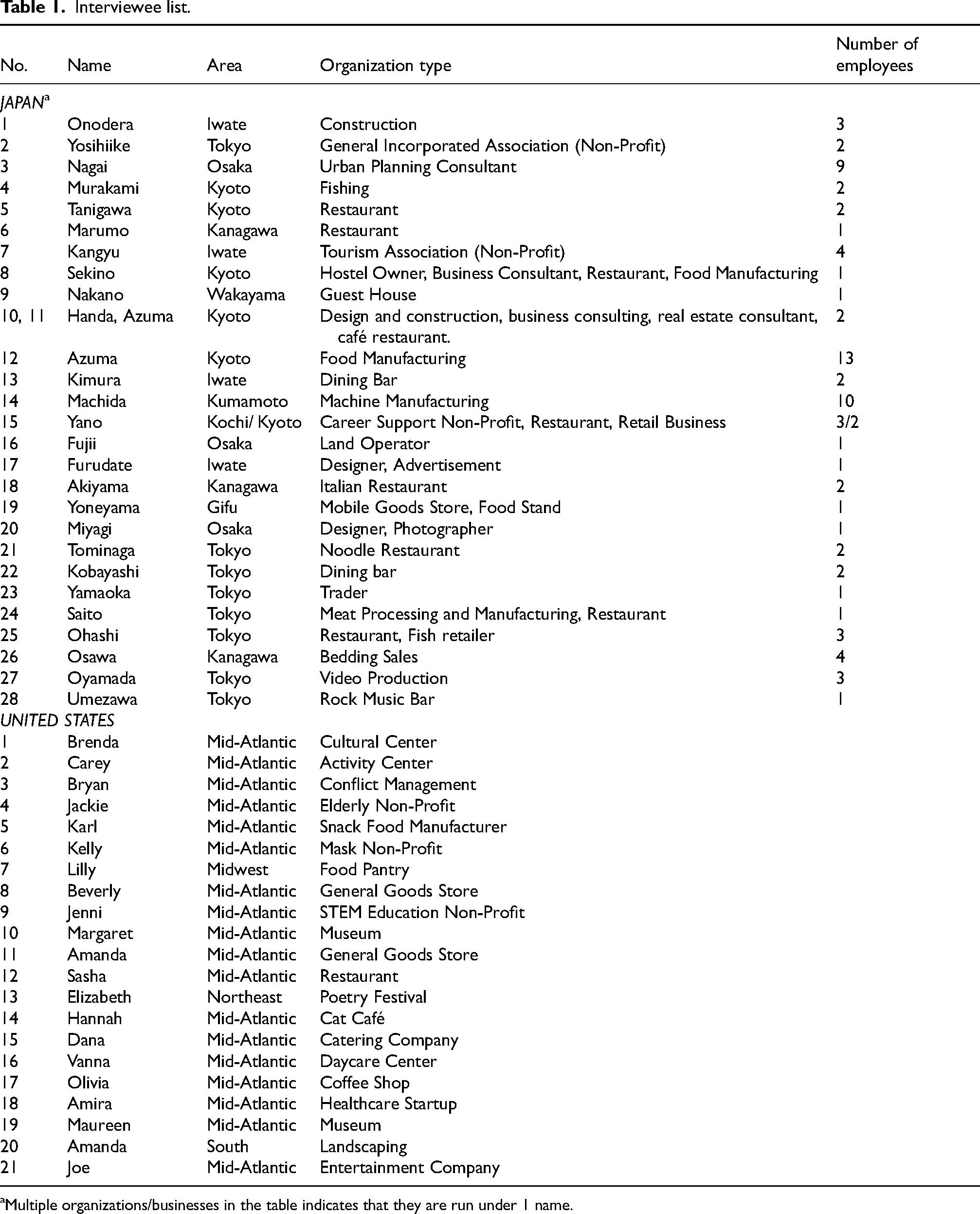
Multiple organizations/businesses in the table indicates that they are run under 1 name.
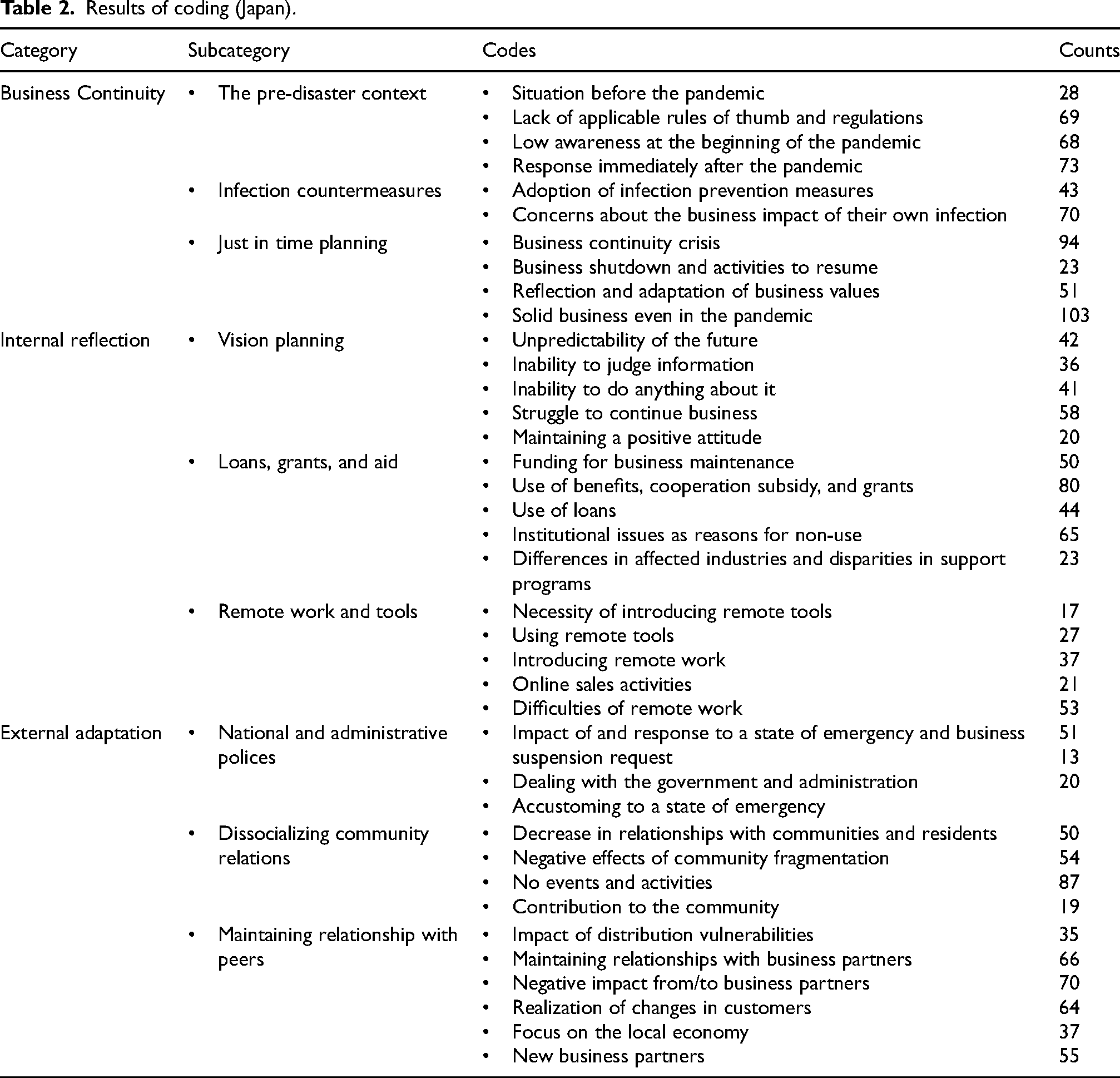
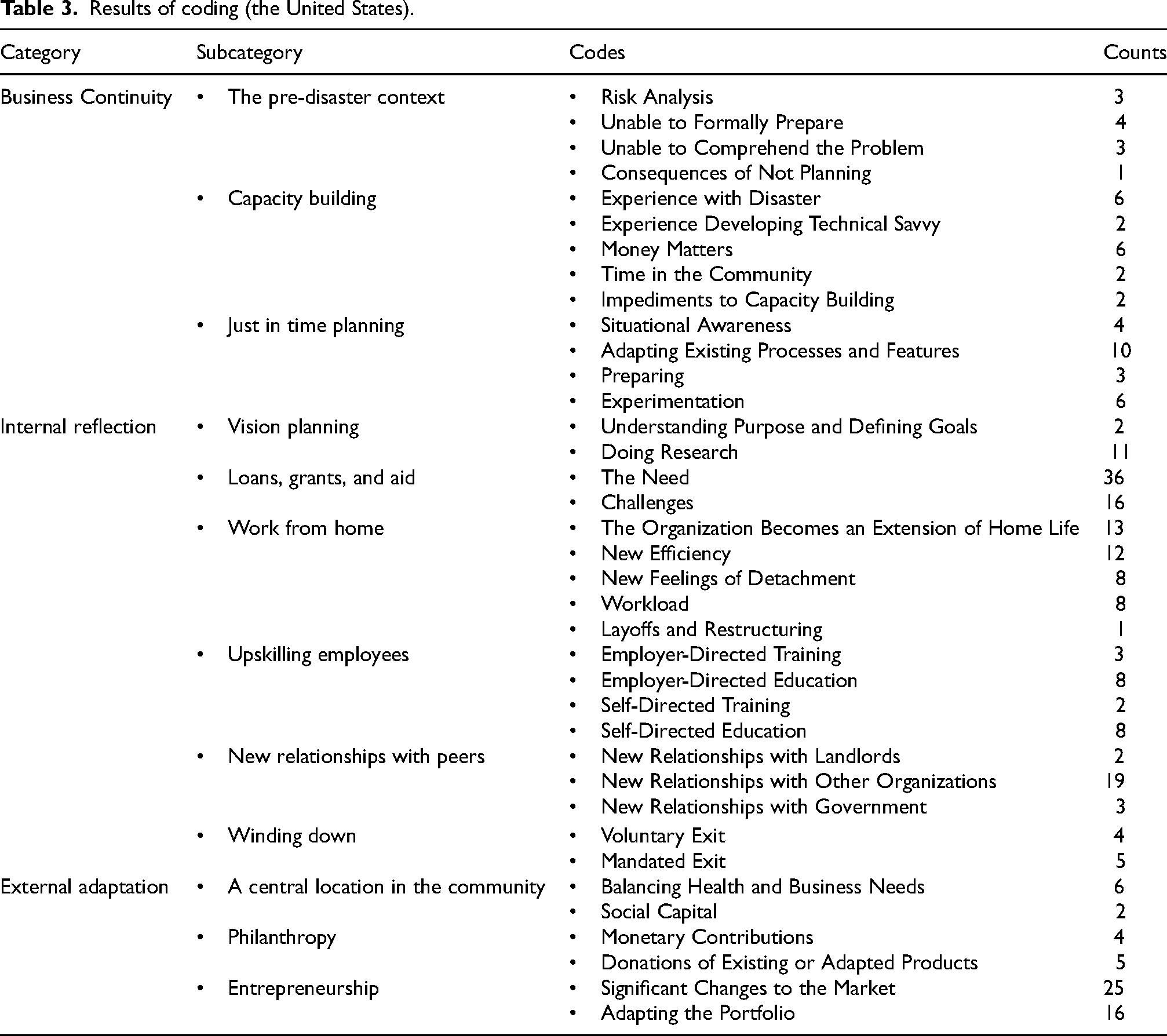
The first category of analysis, “business continuity,” explored how organizations kept their doors open. The second, referring to how to the organization's internal structure changed, we labeled as “internal reflection.” We called the ways that our participant organizations adapted their products and services, “external adaptation.” Second-round coding then allowed us to understand broad themes, including adaptation, funding, and administrative policies in Japan. In the United States, these included vision planning, aid, and the community. The third round of coding was then completed, allowing further granularity. Here, we understood which topics our participants felt to be most essential and discovered ways to tell the story of Covid-19 adaptation. We used our interview codes below (Tables 2 and 3) and compared the similarities and differences between the codes and storylines from the perspective of Organizational adaptation, Loans, Grants, and Aid, Visioning, and Relationship Building. Additional details on the relationship between these categories in both Japan and the United States can be found in other papers (Cox 2022; Daimon and Matsubara 2023). This paper mainly focuses on the differences between the two countries.
Results of coding (Japan).
Results of coding (the United States).
Results
Loans, grants, and aid
Jackie, who runs a non-profit organization in the United States that supports older adults to age with dignity, explained that her bank balance fell below $7,000 in late 2020, nearly putting the organization out of operation. However, it is not an overstatement to say that aid ensured the survival of thousands of small organizations, allowing them to continue providing their essential services. “It was the most nerve-wracking year from a finance perspective because our checking account went down to slightly above $7,000. So, it was nerve-wracking. And it was even more nerve-wracking that we hired a professional grant writer who knew where to go, where to ask people intros. And I saw that money going out the door, and my heart was breaking. And then the week after Christmas, the skies opened, and we received several grants. And that really saved us.”
Equally, Akiyama, an Italian restaurant owner in Japan, decided to continue hiring employees while their business was in the red, and reported that he avoided shutdown nick of time with the benefits of Jizokuka Kyufu-Kin. “In the last three months, more than a million yen [≈9,000 USD] have been spent in the business. Normally business owners have a mortgage, children, a family, and employees’ salaries to pay, so money flies [out] at an incredible speed. That's the reason why I needed them [the benefits] to come in. It was the end of July or August, maybe summer that it came in. I was the very close to the end at that time. Literally zero deposits. At that point, I know it was really late, but I had already decided not to fire any of my employees. So it came in, just in the nick of time before the operating money reached zero.”
Though it was necessary, earning aid was a challenging endeavor. In the United States, Duchin et al. (2022) note that the most impactful variable increasing the probability of success in receiving aid in the United States was a pre-existing relationship with a bank. These relationships meant that organizations owned by women or owned by people belonging to a racial minority received up to 50% less aid than their white male counterparts. While our methodology emphasizing comparative analysis between Japan and the United States does not allow us to explore the minority experience in-depth, we can glimpse it through some of the challenges our American participants noted in their experience accessing aid. For example, Amira, a black woman who owns a healthcare startup, explained that she relied on her network to secure funding, employing the skills of someone else who was more capable of earning aid. “Initially, I didn’t even know about them [aid programs]. Until I had a family friend who's a CPA (Certified Public Accountant) reached out to me like me, are you applying for this the EIDL loan or the SBA loan? And I said, no, I’m not, because I, I didn’t know how to apply for it. I was like, I heard about it, I didn’t know much about it. He's like, well, I can do it for you. So he did it for me. And then we ended up getting the loan from the government.”
As Bryan, who owns a conflict management consultancy, put it, the programs were designed with great intentions but were difficult to engage with. He eventually hired a professional accountant to secure access to aid, having blamed a lack of a loan in 2020 because large organizations with teams dedicated to completing the applications had taken all of the funds. “You know, it started with great ideas and great intentions, but you heard the how the big companies hoovered up all the money, because they knew they had the people to pay to do it, you know, I got lucky that my accountant was even able to follow through, but they beat me to the first round, I ended up getting the same thing because she was too slow.”
Equally, Carey who owned an activity center where she was the only full-time employee and was supported by temporary workers. For her, the utility of the paycheck protection program was minimal because her staffing costs were low. She was apprehensive about the possibility of litigation if she had completed the application incorrectly that she decided against even applying for a loan. “The Paycheck Protection Program loans were a great concept that absolutely did not work for a business like mine. It completely missed the mark for us. It was designed, I believe, for businesses where you have employees that are, you know, running your payroll, and doing all these other functions.”
As for Japanese Employment Adjustment Subsidies, which were created with a similar purpose to PPP loans, most interviewees believe that they are more for medium-sized enterprises than for small-sized enterprises. Kobayashi, who ran a yakitori restaurant and was about to apply for the subsidy program for new challenges, could not take advantage of the program due to systemic problems. “I’d like to label it [foods] properly and vacuum it up, like I’d like to spread it out for take-out. I needed to change the kitchen, so that I wanted to have a booth for that. Rather than those kinds of details, I couldn’t move forward on the web site [of the subsidy] because it was required me to fill with items such as whether or not there would be outside directors.”
When Bryan eventually did earn an EIDL in 2021, it was essential to fueling his pivot toward a new vision and ways of working. Thanks to what he described as a generous $180,000 loan, he was able to hire a team and execute a pivot that would have otherwise been impossible. Moreover, he could use his newfound cash to stimulate his local economy, hiring specialists and helping to jump-start the recovery which would continue to accelerate through 2021. “They gave me like $180,000, which I was like, was like she was shocked. But it has been a game-changer because that amount of money. It's not enough to, you know, to retire and live off of, but it is enough for me to invest in my business. For example, the marketing lady, she's $40,000, then the virtual assistant is $1,000 a month. Plus I bought a couple of monthly things like email, like I got Google workspace so that I can have a higher grade of email and more storage and things like that. All those things that things that cost that I wouldn’t have done if I didn’t have a big chunk of change available to take a chance. And in this case, it came to me and I was like, well, this is nice. It's providing the opportunity for me to grow more.”
Visioning
Though Japanese small organizations felt the need to move forward, the national government's declaration of a state of emergency made it challenging to imagine the future business environment. Although there were fewer mandatory regulations and no financial punishments in Japan until the amendments of Infectious Disease Law in January 2021 (Kawamoto 2021), Japanese customers tend to complain if a business is out of compliance (Matsubara and Daimon 2022). Many businesses were found it difficult to cope with restrictions on behavior that were suddenly announced by the government, and modified frequently, based on number of infected people increased. Kobayashi from the yakitori restaurant complained about the urgent request issued amidst the procurement arrangements. “Yeah, it's a situation like this. Well, I think that the government is also taking steps to the right and left. I would like them to think a little more about what it means to be a private company. The situation I just mentioned. If they suddenly declare a state of emergency tomorrow, there is nothing we can do about it.”
Sudden requests from the Japanese government for residents to refrain from activities caused sudden drops in demand, which negatively and continuously impacted the business partners’ desire to take new initiatives. Participants seemed to have a difficult time understanding where their organization could go. Handa, who runs a design firm in a rural area and has been involved in community development through consulting for immigrants and entrepreneurs, describes the situation of her business partners as follows. “ Our willingness to persevere and cooperate to ensure the safety of lives has been shattered many times over. Not just at my company, but at all of the businesses around me. I had a sense of crisis that if things continued as they were, our work would have to change.”
In contrast to the Japanese case, Bryan, an American, used his aid to stimulate the economy, keep his business afloat, and reorganize it to meet new priorities. He engaged in vision planning (Millett 2006), allowing him to express new goals and realign his processes. We argue that this was a task of fundamental importance to small organizations in the United States who had to navigate the pandemic. For example, like Bryan, Olivia, who owns a café in America, could access a significant amount of money through the PPP and EIDL program. Because she had separately been reflecting on sustainable development, she used her aid to align her business more closely with those values. She committed to offering a more premium experience to her customers, where the drinks tell a story and are crafted in a sustainable way. However, she notes some difficulties with this direction. Parts of her vision are less scalable. For example, she does not want to open another location. “Sustainable development, which I’ve come to think is kind of an oxymoron, and resiliency, resiliency either in a community of business, food systems was particularly what interests me because I’m sort of in this funny headspace of selling a product [coffee] that cannot be grown in continental United States and is inherently not sustainable. So what can I do in every other fashion to make it more sustainable to offset the fact that coffee is grown in these equatorial countries. So that's sort of the backstory of like my approach to opening a business and what I believe will kind of set up a long, a long term sustainable and resilient business. Yeah, so I never want to open another retail shop. I think that the uniqueness of this building, the culture we’ve created here and the actual, like, geophysical location are so special, that if we start opening multiple cafes, that appeal of feeling like you know, you can only get that masala mocha, when you come here in the winter, that will go away.”
Novelty was often a critical component of vision planning. For example, Emily, who owns a landscaping company, mentioned that the pandemic had forced her to imagine new ways of working because the old ways of doing business had become unworkable. Where she had previously offered a one-stop shopping experience for customers wherein she would plan, project-manage, and execute their job, the experience of having a large staff of landscaping professionals was too cumbersome and expensive. The terrible experience of laying off her team because her PPP money ran out led her to do things differently. She re-envisioned what she wanted her company to be. Now, it is a smaller operation focused on planning large projects and education about water sustainability. Since her passion has always been water sustainability, this transformation has allowed her greater opportunity to do work that she found valuable and exciting. “Whereas before, we were kind of like, taking work, you know, because we had these crews, and we wanted to keep them busy. The pandemic really made us think about what kind of company we wanted to be and how we wanted to grow back. […] The new vision is to be in consulting and management. Whereas before, we were a little bit of consulting, we were a little bit of management, but we also do a lot of repair work. You know, we started out as a repair company. But we realized there was an education opportunity. So we went from just being a call me when your sprinklers broken company, to really educating people on water and where it comes from, and hence, why it's important to use it efficiently.”
As they began to reopen and could see trends, Japanese organizations too began to vision. When restarting her home renovation business, the rising price of imported lumber encouraged Handa to look to her own local resources. Product scarcity forced her to confront the fact that she could not affordably continue to rennovate old houses, which was at the heart of her and her colleagues’ business. The decrease in demand and the extra time it created provided an opportunity to reflect on the issue of cost and profit in their own business. She described they were able to increase their profit margins in the face of a 50% sales decrease and as a result did not lose significant revenue. “As I said at the beginning, sales are going to drop by half. So how are we going to survive? Even though there are loans and benefits, it is impossible to tell how long Coronavirus [pandemic] will last or how long it will last, so we have to rethink the way we work. Yeah. I’ve been doing things that I tended to give extra for free, but now I’ve got to do things that are business, like making extra as paid and doing them as work.”
Saito, who previously ran both a butcher shop and a restaurant that served his products alongside a bar in the same physical space, said the pandemic forced him to refocus on the butchery and pay less attention to the restaurant. “We haven’t stopped any business except for the restaurant. To be honest, when I experienced a state of emergency in May [2020], unlike most restaurants, I focused on the [meat] sales business, instead of the restaurant. I decided to completely shift my focus and put all my energy into the butcher shop.”
Saito's vision was to ensure that customers would continue to enjoy high-quality ham and sausage. Previously, this included serving them those high-quality products in the restaurant, but because of the Covid-19 pandemic, he shifted his operating a retail sales model to emphasize the more resilient parts of his work. This way, his customers could still enjoy his products, but was able to eliminate the risks associated with running a restaurant.
Relationship building
American participants noted, perhaps too late, that the relationships which had supplied their organization pre-pandemic were no longer in place. For example, as supply shortages continued to dominate the news in 2021, Dana, a caterer, told us that he could not get many of the boutique items that he had previously used, as they were becoming more difficult to find because his suppliers had closed because of the pandemic “Some of our suppliers are just out of business. And you don’t realize it because you haven’t had to use them in a little while. But certain projects come in, and you’re reaching out and saying, hey, I need this, or I need that. And you’re like, what's this trouble with their phone number? And then you go to the website, you’re like, what's going on with the website? And then it clicks. You’re like, oh, my God, they didn’t survive Covid.”
An effect of losing suppliers is that it forced American organizations to move to larger organizations to get what they need. For example, Maureen, who owns a museum, discussed a pivot to shopping on Amazon because nobody else could fulfill her orders at affordable rates. While she did not like this development because it meant that the tight-knit community she had previously accessed was gone, only Amazon could keep up with her demand. “We tend to use small non-profits or small businesses. But, I’m trying to shy away from getting massive orders from my usual places. And that's because their shipping is a little bit too extreme. And their shipping only goes up now because of the weird crap that was going on with the United States Postal Service. So, I’ve been finding things in bulk in other places like Amazon, because I have a Prime account. Amazon is one of those places. And I hate using Amazon because it's such a big corporation. But they make things so convenient that I can just came out but like I ordered something over the weekend from Amazon for the gift shop, because we had run out of rocks.”
Japanese organizations might be surprised by the distance between American participants and their suppliers. Saito explained that that a meat supplier had recently approached him to apologize, because the supplier was closing, and their business relationship would be ending, which saddened them. Saito's supplier even went so far as to introduce new vendors who might be able to offer the same supplies. “[The supplier's] guy said, ‘I can’t do this anymore, the debt is just getting bigger and bigger and there's nothing I can do about it. I’m going to close up store now, so use these butchers.’ So he introduced me to three new stores.
The supply chain in Japan appeared as an issue of maintaining relationships with business partners rather than the vulnerability of distribution or the aspect of dynamic change. Almost all organizations said that they had not changed their suppliers. Several even felt that they should maintain their relationships with their suppliers because of the pandemic. For example, Akiyama, who runs an Italian restaurant, said that while he complied with requests from the government to shorten business hours, he still purchased excessive amounts of food from wholesalers, with a waste rate of more than 50%. “I had been working with the suppliers for over 20 years, so I wanted to them survive. I was asked to order as much as I could because my restaurant was still open. So I decided to keep ordering as much as I could, and the result is the 50% disposal rate.”
Kobayashi, who ran a yakitori restaurant, called the connection with his suppliers who overcame SARS, MERS, the Great Recession, and the Great East Japan Earthquake together “kizuna” (bonds) and bought a new refrigerator to freeze the large stock of products he felt compelled to purchase. “In that sense, if we can’t purchase good products from our suppliers, we can’t make it as business at all. The relationship with our suppliers determines everything about our restaurant. If we can’t maintain our relationship with our suppliers, we can’t make it as business. That's why I take the relationship very seriously.”
The relationship between the small organizations and suppliers in Japan could be seen as a two-way supportive relationship rather than a one-way transactional relationship. Many efforts to maintain these trusting relationships were seen in the restaurant industry. However, they can also be seen in other industries. For example, Machida, a manufacturer who stated that his business had recovered by the end of 2021, tried hard to work with his peers in industries that were struggling. “Our clients in our community are restaurants, hotels and inns, and so forth. They are in a very severe situation. So, we are managed to order their lunch boxes for our company events, go out of our way to stay at their hotel, which is very close though. It is something about repaying for all the help they’ve given us before.”
Though they did not spend as much time connecting with their peers as their Japanese counterparts did, American participants were able to earn dividends from the significant time they had spent nurturing the relationships that they had created with their customers pre-pandemic. Participants like Sasha, who owns a restaurant, mentioned that the relationships she had developed with customers pre-pandemic were essential to her staying in business. Having invested in her customer base, those customers were more willing and able to support her. As she noted, if she operated differently or did not have the same types of connections, she would likely have closed. “The community support has been fantastic. If they weren’t comfortable coming out, they would order food, post positive reviews, or snap pictures when they got food. Our town is a good place. I think that we’re really lucky to be here. If we were somewhere else, where workers just go for lunch and take away, we would have a lot more difficulty.”
Olivia, who owns a café, went further. She expressed that the time she had spent investing in the community pre-pandemic made her store seem essential to customers, even when they could not visit. For example, during the initial 6-week total lockdown, customers would drop off envelopes of cash to ensure that employees had enough money to make it through. “It really did. I mean, people for that those six weeks that we weren’t open, and people were like banging on the door, we have this little mail slot, that's the front door, here's the original door from 1947. And it has one of those cute little mail slots. And people were putting like envelopes with $20 bills. And I’m just like, I miss you guys. Here's some tips.”
Customer relationships were observed not only in the US but also in Japan. Saito, introduced earlier, describes his experience of being supported by local residents when the state of emergency declaration made it difficult to serve food and alcohol as follows. “Our customers said, ‘Are you all right?’ and ‘is your business okay?’ Most of them came to us saying that. Well, so people are really worried about us. That's why I decided to work a little harder and not close the store.”
Discussion
During the Covid-19 pandemic, small organizations in Japan and the United States leveraged their loans, grants, and aid to embark on a process of visioning and creating new relationships that helped them to survive the pandemic. While differences were observed at the subcategory level in both Japan and the US, the same three contents were identified at the category level (Tables 2 and 3). Regarding RQ1, in both Japanese and American cases, small organizations have had more difficulty accessing loans, grants, and aid than their larger counterparts. Some of the financial assistance, such as PPP loans, could be difficult to acquire. However, they effectively empowered in two strategies that were essential to the success of small organizations: visioning and focusing on the relationships.
When looking at RQ2, visioning was empowered by the surplus funds offered by governments, allowing Japanese and American organizations to reimagine their objectives engage in innovation. However, despite the differences in degree between the two countries, visioning was used as an effective tactic to define and navigate a path during the pandemic. One possible explanation for the greater difficulty of visioning in Japan than in the United States relates to the combination of government requests and social norms. Traditionally in Japan, the norm of jishuku (Nishi 2020) enforces restrictions during disasters and conflicts. Examples have included the prohibition of extravagance during World War II or the refraining from commerce after the fall of the emperor (Ito 2021). During the pandemic, the Japanese government issued five major non-coercive voluntary requests, and these may have been seen through the lens of jishuku, restricting new initiatives.
The third RQ under examination explored relationships between small organizations and their peers (RQ3). We found that Japanese organizations were more community-oriented than their American counterparts. The data supporting this finding is stark: the number of active small organizations in the United States declined by nearly 20% in the first quarter of 2020 (Fairlie and Fossen 2022), while the number of small organizations in Japan remained stable in 2020 compared to 2019 (Small and Medium Enterprise Agency 2021).
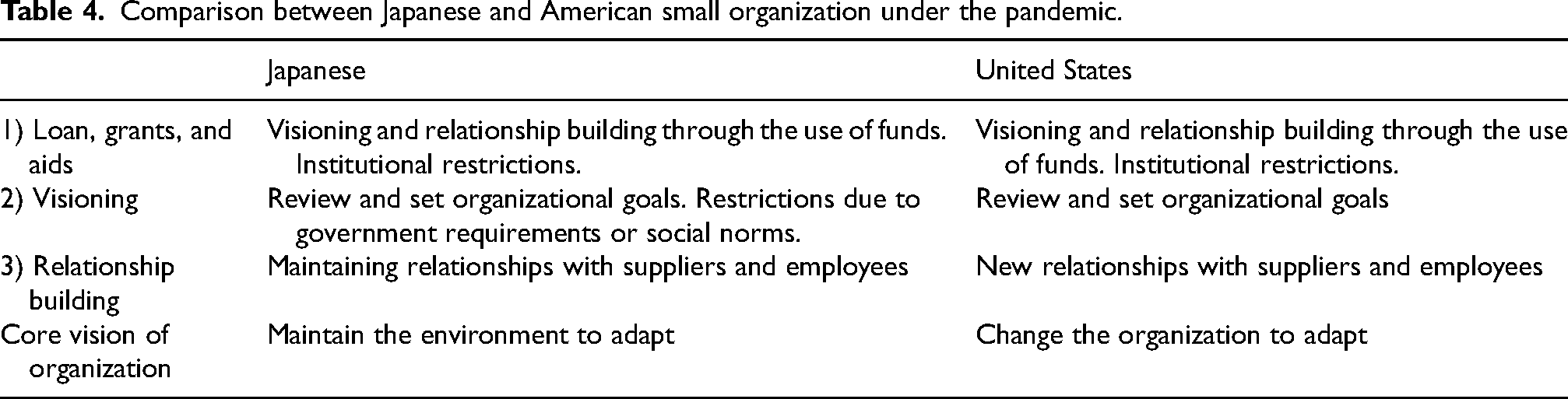
Thus, in this study, we have examined two types of the resilience of small organizations: trust-oriented resilience in Japan, which aims to maintain relationships with employees and business partners rather than investing in the industry, and change-based resilience in the United States (Table 4). In the Japanese organization, government requirements and restrictive social norms made it difficult to make significant organizational change during the pandemic. Additionally, this was due to the characteristics of Japanese organizations that are community-oriented, which are positioned in terms of trust-based business relationships and, more broadly, social capital. By comparison, the American organization were focused on change within their organizations. It has been argued that a characteristic of small organizations’ resilience, when compared to large organizations, is their ability to change their organizational structure in response to newly emerging tasks (e.g. Linnenluecke and McKnight 2017). The resilience of American small organizations in this study is also consistent with previous studies that have responded with changes in organizational structure (Quarantelli 1997). On the other hand, Japanese small organizations seem to have a different strategy. Theoretically stated, the difference between the two countries would be the form of resilience of “change quickly because of smallness” and the form of resilience of “unite because of smallness.”
Comparison between Japanese and American small organization under the pandemic.
Each approach has strengths and weaknesses. While trust-based support in the Japanese context has indeed created a resilience that has reduced the exit of organizations and layoffs of employees, the reduction of investment within organizations may reduce transformation in the long run. The contradictory tendency of Japanese organizations is characterized by their willingness to help their suppliers and their reciprocal obligation. Indeed, culturally, it would be taboo to change suppliers too often, damaging the organization's reputation. By contrast, the situation in the United States is not entirely desirable either. A significant number of small businesses—approximately 20%—failed early in the crisis (Fairlie and Fossen 2022). Those who survived were therefore forced to adapt.
Importantly, despite the enormous economic resources invested each government, Japan and the United States has shown different ways of adapting. In the future, it may be desirable to implement policies that understand and compliment the differences between the two countries, rather than taking a one-size-fits-all approach.
There are several limitations to this study that should be mentioned. First, because of the emphasis on international comparisons, sufficient consideration must be given to differences from other hazards (e.g. rapid onset, causing physical destruction, and no social distancing necessary) other than pandemics. Second, our sample is not representative. This study does not include a large sample of organizational failures or misuse/fraud of financial assistance, and main sample in the United States comes from the East Coast and is a convenience sample. This study initially focused on the experiences of those who owned and managed small organizations (owners) during the pandemic, but did not focus on the financial dimensions. A longitudinal study that explores the both the experience of the pandemic, and its financial effects could be useful. Third, the differences in funding amounts between Japan and the US have not been adequately considered. We did not explore the dollar or yen values of aid grants to the small organizations included here.
Conclusion
This study examines how small organizations in Japan and the United States could sustain their operations during the Covid-19 pandemic. Both Japanese and American organizations attempted to overcome the pandemic with visioning and access to government funding. However, the most significant difference between the two countries is found in how they socially construct business relationships. Japanese ones sought to overcome the pandemic by focusing on maintaining relationships of business partners and employees, thereby preventing bankruptcy and layoffs. In contrast, the American organizations focused on innovating their own processes, products, and services to adapt their ways of working to meet the vision that they had for their work. This study implies the differences in how small organizations in Japan and the United States responded to disasters and how similar financial subsidies can be utilized with very different tactics. The significant contribution of this study is that it has paved the way for policy and business continuity research in future disasters to take these differences in business culture into account.
Supplemental Material
sj-docx-1-med-10.1177_02807270241238725 - Supplemental material for A comparative analysis of the differences in how small organizations adapted to the covid-19 pandemic in Japan and the United States of America
Supplemental material, sj-docx-1-med-10.1177_02807270241238725 for A comparative analysis of the differences in how small organizations adapted to the covid-19 pandemic in Japan and the United States of America by Hiroaki Daimon, Zachary Cox and Yu Matsubara in International Journal of Mass Emergencies & Disasters
Footnotes
Declaration of Conflicting Interests
The author(s) declared no potential conflicts of interest with respect to the research, authorship, and/or publication of this article.
Funding
This work was supported by JSPS KAKENHI Grant Number 19J00055.

Supplemental Material
Supplemental material for this article is available online.
Author biographies
References
Supplementary Material
Please find the following supplemental material available below.
For Open Access articles published under a Creative Commons License, all supplemental material carries the same license as the article it is associated with.
For non-Open Access articles published, all supplemental material carries a non-exclusive license, and permission requests for re-use of supplemental material or any part of supplemental material shall be sent directly to the copyright owner as specified in the copyright notice associated with the article.
