




Abstract
Racial biases in law enforcement over the past three decades have been linked to the racialized policies of the war on drugs. The author examines the educational consequences of the war on drugs on the lives of youth by analyzing racial differences in the impact of a juvenile drug arrest on high school dropout. Using data from the National Longitudinal Study of Adolescent and Adult Health, the author finds that juvenile drug arrests are more consequential for Black and darker phenotype Latinx youth, who are less likely to be involved in delinquent and criminal behaviors than white youth with drug arrests. The author suggests that racial disparities in drug enforcement may be creating a racialized selection bias among drug arrestees, leading to racially disparate consequences for drug arrests, but not for other types of arrest. The results hold important implications for how drug arrests can produce and sustain racial disadvantages in educational attainment.
In the context of recent public outcry over the violent treatment of Black Americans by police officers, known as the Black Lives Matter movement, Americans continue to challenge the differential treatment of minorities by the criminal justice system. The premise of this movement, much like similar movements after the Rodney King beating of 1991 and the shooting of unarmed Oscar Grant in 2009, is relatively straightforward: the criminal justice system treats young people of color, and more specifically Black youth, more harshly both during and after an arrest (Fagan, Slaughter, and Hartstone 1987). Over the past three decades, these racial biases in law enforcement have been linked directly and indirectly to the racialized policies of the war on drugs (Alexander 2010; Provine 2007), which have given rise to controversially aggressive policing tactics (e.g., unwarranted “stop-and-frisk” searches, pretextual car stops, zero-tolerance policies in schools) focused mainly on Black and Latinx youth (Fellner 2009; Kupchik and Ellis 2008). What are the consequences of racially biased and aggressive drug enforcement on the lives of youth? In this study I examine these consequences by looking at racial differences in the impact of a juvenile drug arrest on dropping out of high school, a significant turning point for subsequent employment outcomes and likelihood of adult imprisonment (Sum, Khatiwada, and McLaughlin 2009).
Racial biases in drug enforcement mean that Black and Latinx youth consistently face a disproportionate risk for being randomly stopped and searched, without any probable cause (Rudovsky 2001). In contrast, white youth are targeted less by law enforcement and run a significantly lower risk for getting caught with drugs and subsequently arrested. One consequence of this increased and unequal surveillance is the well-documented gap in drug arrests. Between 1980 and 2010, the rates of drug arrests for Black youth were more than double the rates of drug arrests for white youth (Puzzanchera 2013), while rates for Latinx youth were not far behind those for their Black peers (Mascagni 2011; Tate, Taylor, and Sawyer 2013). Unlike violent and property arrests, racial disparities in juvenile drug arrests do not correspond to rates of actual criminal activity, as white youth are just as likely (or in some studies more likely) to use or sell drugs than Black or Latinx youth (Johnston et al. 2011; Wallace et al. 2002).
Another possible consequence of the racial disparities in drug enforcement I explore in this study is a unique selection process of drug arrestees. Prior studies have shown that Black and darker phenotype Latinx youth run a significantly higher risk for being randomly stopped and subsequently arrested for low-level drug offenses than their white and lighter phenotype counterparts (White 2015). Therefore, the “net” of arrests is cast widely for Black and darker phenotype Latinx youth, and some of these arrestees may be youth who do not otherwise engage in any serious criminal or delinquent behavior. In contrast, white youth are targeted less frequently, and they are rarely subjected to random searches; the “net” of arrests is cast more narrowly for these youth (Gaston 2019b). Therefore, white youth who are arrested for drug offenses are more likely to be those who engage in other criminal and delinquent behaviors serious enough to garner police attention. Although in this study I cannot test whether racial profiling directly causes this selection process, I do examine whether Black and Latinx drug arrestees represent a more heterogenous group with lower levels of delinquency than white drug arrestees.
Prior research has also shown that the negative impact of a juvenile arrest on high school dropout, regardless of arrest type, is more pronounced for less delinquent youth (Sweeten 2006). Following this line of reasoning, I ask, are Black and Latinx youth with drug-related charges less delinquent than their white counterparts, and if so, are the effects of an arrest more pronounced for them (Black and Latinx youth)? As I will show, the distribution of prior delinquency or criminality differs across race for drug arrests (but not other types of arrest), and this disparity leads to more detrimental consequences for Black and darker phenotype Latinx youth with drug-related charges and less impact on the likelihood of dropping out of high school for white and lighter phenotype Latinx youth with drug arrests. I suggest that although most white and lighter phenotype Latinx youth who are arrested for drugs were already on a path toward high school dropout and delinquency, many of the Black and darker phenotype Latinx youth who are arrested for drugs were not on such a path, and the arrest itself derails their chances of graduating from high school.
Background and Theoretical Framework
Arrests, Dropout, and the Vicious Cycle
Most prior studies examining racial differences in the consequences of criminal justice involvement have focused on the impact of adult incarceration on life outcomes (Pager 2003; Western and Pettit 2010). Although these studies are important in highlighting how mass incarceration leads to blocked opportunities, most adult prisoners have already experienced juvenile arrests and educational failures prior to being incarcerated as adults (Travis, Western, and Redburn 2014), making it difficult to differentiate their experiences of incarceration from other confounding factors. By focusing on first-time juvenile arrests, this study captures the sources of institutional marginalization that occur prior to adult incarceration (Wacquant 2000).
Furthermore, dropping out of high school serves as a critical early marker in the transition to adulthood, carrying long-term consequences for a host of life outcomes, including unemployment, family instability, health consequences, and recidivism (Sum et al. 2009). If Black youth are more likely to drop out after a drug arrest, this may result in cumulative disadvantages, given that dropping out carries more social costs for them (Western 2006). For example, only 39 percent of Black high school dropouts are employed at age 19, compared with 60 percent of white and Latinx dropouts (Bureau of Labor Statistics 2006). Furthermore, 59 percent of Black male high school dropouts experience imprisonment by age 34 compared with only 11 percent of white dropouts (Pettit and Western 2004). These blocked opportunities, combined with the higher potential for imprisonment, could send youth down a vicious cycle of unemployment and recidivism in adulthood.
Previous Studies: Debates and Discrepancies
In addressing the impact of the war on drugs and drug arrests, especially on Black and Latinx communities, scholars focus on the differential rates of drug arrest (Blumenson and Nilsen 2002; Bobo and Thompson 2006; Fellner 2000, 2009; Hicks 1992; Johnson and Jones 1998; Nunn 2002; Provine 2007; Tonry 1994) and consider how these rates translate into widening racial disparities. The authors of these prior studies concluded that the impact of the war on drugs on Black, and to some extent Latinx, communities has been greater because members of these communities are arrested more often. In addition to disparities in the rate of drug arrest, however, it is also important to consider possible racial differences in the effects of drug arrest. For example, even if white, Black, and Latinx youth were arrested at the same rate, the impact of the arrest on the educational attainment may be more consequential for those in racially disadvantaged groups.
Several studies over the past two decades have examined the effect of criminal justice contact on high school dropout, but these studies have several key shortcomings I address in this study. First, most of this research has not examined racial differences in the effect of an arrest. This is surprising given the well-documented racial biases in the treatment of Black and Latinx youth throughout the criminal justice process. Given the historical trend of the mistreatment of Black and Latinx youth by police officers, judges, schools, and community members both during and after an arrest (Alexander 2010; Rios 2011), it is important to examine whether the effect of a juvenile arrest on high school dropout is more detrimental for minority youth. Several scholars have also called for such research (Hjalmarsson 2008; Kirk and Sampson 2013; Tanner, Davies, and O’Grady 1999), and the few studies that answered this call conclude that the effect of a juvenile arrest does not vary across racial groups (Bernburg and Krohn 2003; De Li 1999; Sweeten 2006). According to these studies, all types of juvenile arrest similarly affect all youth. These studies, however, aggregate all arrest types and examine the average effects of juvenile arrest in general, overlooking racial differences that may exist for one particular type of arrest: drug arrests. The one exception, to date, is Mitchell’s (2016) study, which specifically examines the effects of drug arrest on social bonding and drug offending. Mitchell found that drug arrests did not reduce any measure of drug offending but had considerable negative consequences on the employment outcomes of Black respondents (but not white respondents). Questions remain, however, regarding how drug arrests affect high school completion as well as how these arrests affect the lives of Latinx youth, who are often left out of studies that analyze the consequences of the criminal justice system through a Black/white lens.
In addition to methodological gaps in the literature, in this study I also address theoretical gaps. There is a debate among scholars about how a juvenile arrest affects the educational trajectories of youth. Although most research has shown that a juvenile arrest has a direct effect and increases the likelihood of dropping out of high school (De Li 1999; Hannon 2003; Hirschfield 2009; Kirk and Sampson 2013; Sweeten 2006; Tanner et al. 1999), other scholars contend that this effect is in fact spurious, arguing that both arrest and dropout are explained by prior behavior (e.g., high delinquency and low self-control) (Smith and Paternoster 1990; Wilson and Herrnstein 1985). For example, Gottfredson and Hirschi (1990) argued that external events, such as an arrest, do not affect dropout, because these events are the product of a stable delinquent propensity established earlier in life. According to these propensity theories, youth who get arrested are already on a path of educational failure, regardless of an arrest. This study considers this perspective but moves beyond a one-size-fits-all theoretical framework for understanding the impact of an arrest on high school dropout. Instead, I examine how the impacts of an arrest differ on the basis of arrest type and race.
Why Arrest Type Matters
There are several reasons to expect racial differences in the effect of a drug arrest, which previous studies missed by using aggregate measures of arrest. First, unlike violent and property crimes, 1 the majority of drug arrests are for low-level victimless offenses such as drug possession (Puzzanchera 2010). In fact, recreational drug use is relatively common among youth, regardless of their race or class (Johnston et al. 2011). The result is that, compared with violent and property offenders, youth arrested for drug-related charges more often have limited prior delinquent and criminal behaviors and are not necessarily on a path of subsequent criminal offending (Benson et al. 1992; Resignato 2000). However, who is arrested for a drug offense is strongly influenced by race (Fellner 2009).
The decision to stop, question, and arrest someone for drugs is often left to the discretion of police officers (Beckett et al. 2005), who are more likely to make a drug arrest, net of other factors, when the suspect appears to be Black or a phenotypically darker Latinx individual (White 2015). Overpolicing in Black and Latinx neighborhoods, including discriminatory stops and arrests (Gelman, Fagan, and Kiss 2012), has led to significant racial disparities in drug arrests. White youth report higher or similar rates of drug use and sale, yet Black youth are six times and Latinx youth three times more likely to be arrested (Snyder and Mulako-Wangota 2012).
This ever present risk for (unwarranted) stops, searches, and arrests for minor offenses (i.e., drug possession) among Black and phenotypically darker Latinx youth means that even youth with minimal delinquent involvement run the risk of getting arrested (see Lundman and Kaufman 2003). In contrast, white youth are targeted less frequently, and these youth are typically arrested only if their behaviors are serious and conspicuous enough to garner police attention (Gaston 2019b). Even when caught with drugs, white youth are more likely to get a “pass” from police officers (Alpert, MacDonald, and Dunham 2005). Therefore, white juvenile drug arrestees may be more likely to already be highly involved in prior delinquent behavior and may already perform poorly in school. Therefore, I expect to find significant characteristic differences among white, Black, and Latinx youth with drug arrests. Specifically, I expect that white drug arrestees will have higher rates of delinquent behavior and lower levels of school performance than Black and Latinx drug arrestees.
A juvenile drug arrest, therefore, may be less damaging for white youth, who may already be on a pathway toward educational failure regardless of an arrest. This possibility aligns with the predictions of propensity theories, which hold that early behavior traits (such as delinquency) explain any effect a juvenile arrest has on educational attainment, because arrested youth were already on a pathway toward educational failure. Conversely, Black and dark-skinned Latinx drug arrestees are less likely to have involvement in criminal and delinquent behaviors and may not be on the same pathway as white drug arrestees. Accordingly, I expect that for white youth, any effects of a drug arrest on high school dropout are explained by delinquency and academic performance, but these factors will not explain the effects of a drug arrest among Black or darker phenotype Latinx youth.
Other theoretical frameworks may explain the relationship between an arrest and dropout for Black and Latinx youth. Some scholars challenge propensity theories and argue that a juvenile arrest imposes a direct negative impact on high school dropout. These labeling theories predict that labels or stigmas after an arrest can “type” or “cast” youth as “essentially” deviant, even if the individual is an otherwise nondeviant youth (Garfinkel 1956; Lemert 1951; Matza 1969; Paternoster and Iovanni 1989). This label of deviant can take on a “master’’ status that can affect the way youth are treated by adults and peers, leading to blocked opportunities, such as exclusion in school and in communities, and leading youth to see themselves as deviant (Lemert 1951; Matsueda 1992). This different treatment, in turn, can lead to increased delinquency, truancy, poor school performance, and disengagement from school, all of which increase the likelihood of dropping out (Finn 1989; Jimerson, Anderson, and Whipple 2002).
The negative stigma or labeling that follow an arrest may matter more for Black and Latinx youth with drug arrests for several reasons. First, prior studies find that the negative impact of labeling after an arrest on educational attainment is contingent on prior delinquency and criminal behavior (Nagin and Waldfogel 1995; Sweeten 2006). Youth with lower levels of delinquent involvement are more likely to suffer the damaging effects of a criminal stigma after an arrest, whereas youth with higher levels of delinquency are less affected by the stigma of an arrest. Other scholars argue that Black and Latinx youth have fewer means to counteract the stigmatizing effects of justice system involvement and shield them from the negative educational consequences of an arrest, compared with more advantaged white youth (Sampson and Laub 1997). For example, studies show that students’ relationships with teachers and school staff members affect their academic outcomes, including dropout, and that these forms of support are especially important for racial minorities (Cernkovich and Giordano 1992; Jordan, Lara, and McPartland 1996).
An arrest can result in adverse reactions from school officials and subsequent alienation, resulting in weakened social bonds and dropout (Hirschfield 2008). Furthermore, although juvenile arrest records are often sealed, Black and Latinx youth are more likely to be arrested on school grounds, making the arrests more visible and potentially more stigmatizing to administrators and teachers. Finally, urban schools, where Black and Latinx students are more concentrated, face more pressure and challenges to keep their campuses safe and their educational performance high (Kirk and Sampson 2011), which leads some schools to promote policies and practices that exclude criminally involved youth who may undermine a school’s appearance as a safe and effective school (Hirschfield 2008; Mayer 2005; Riehl 1999).
In contrast, other research suggests that white arrestees are more vulnerable to stigma after an arrest, because they are more advantaged and have more to lose (Hannon 2003). These scholars argue that Black and Latinx youth face more structural barriers to educational attainment, so there is less of an educational penalty after an arrest. Furthermore, as Black and Latinx youth are more likely to have frequent police encounters in their schools and neighborhoods, an arrest is normalized for them and consequently is felt to have a lesser impact. Despite this argument, there is greater evidence for more detrimental impacts among racially disadvantaged youth.
Black and Latinx youth may also experience higher levels of anxiety and trauma after an arrest because they are more likely to experience more frequent police contact and police brutality (Geller et al. 2014). The Black Lives Matter movement highlights the racial profiling of Black youth and challenges the ways they are systematically mistreated by police officers in ways that white youth are not, particularly with violence and excessive force. These negative impacts on mental health and other psychosocial outcomes can lead to dropout through lowered educational performance and expectations, as well as weakened school and community bonds (Battin-Pearson et al. 2000). On the basis of these multiple negative impacts taken together, I hypothesize that the effects of a drug arrest on high school dropout will be more damaging for Black and Latinx youth.
There may be differences in the impact of an arrest among Latinx youth, given that this racially heterogeneous group includes youth who are racialized as Black, white, and “other.” Skin tone (phenotype) affects policing and enforcement for Latinx youth, whereby darker skinned Latinx youth are stopped and arrested more often than lighter skinned members of the same group (White 2015). In his study of Oakland youth, Rios (2011) found that although Black and Latinx boys were criminalized in similar ways after an arrest, light-skinned Latinx youth were afforded second chances more often and were more likely to gain respect from teachers and police once they changed their behavior and dress style. Black youth and darker phenotype Latinx youth, however, still faced criminalization, even after they changed their behavior and dressed more formally. Therefore, in this study, I break down Latinx respondents by phenotype, and I hypothesize that the effect of a drug arrest for lighter phenotype Latinx youth may be more similar to that of white youth, while the effect for darker phenotype Latinx youth may be more akin to the effect for Black youth.
There are other possible mechanisms that may explain why Black and Latinx youth may also be more likely to drop out of high school after a drug arrest, beyond the mechanisms discussed above. Racial biases in processing and sentencing after an arrest may be one explanation, given that Black and Latinx youth are more likely to experience longer processing times, more time away from school, a higher probability of a drug conviction, and harsher sentencing (McCord, Widom, and Crowell 2001). If the negative effect of an arrest is the result of biases in conviction rather than the result of the arrest itself, then accounting for the effect of conviction should explain any racial differences in the negative impact of a drug arrest on dropout.
Scholars also argue that low-income youth suffer greater educational consequences after an arrest, because they have less access to the necessary financial and social resources to avoid the negative labeling of an arrest (Sampson and Laub 1997). Given that the majority of drug enforcement is concentrated in low-income Black and Latinx neighborhoods (Beckett et al. 2005), juvenile Black and Latinx drug arrestees may experience more negative impacts simply because they are more likely to come from low-income households or households with less of the social capital needed to buffer the effects of an arrest. By accounting for the effects of family background (parents’ education and household income), I seek to establish that racial differences in the effects of a drug arrest are not simply a result of socioeconomic differences among youth.
Some scholars contend that neighborhood and school contexts may be linked to racial differences in both arrest and dropout (Crowder and South 2003). Racial segregation means that the neighborhoods that Black, Latinx, and white youth come from, as well as the schools they attend, will be different in many ways, and these may lead to higher likelihood of dropping out and police contact (e.g., arrest). Black and Latinx youth are more likely than white youth to live in low-income neighborhoods with higher reported crime rates and attend disadvantaged schools in urban cities, which are both contexts associated with a higher risk for dropping out and police contact (Aaronson 1997; Crane 1991; Crowder and South 2003; Ensminger, Lamkin, and Jacobson 1996). Police presence is often concentrated in disadvantaged neighborhoods and urban schools, increasing the likelihood that Black and Latinx youth people will be stopped, searched, and arrested (Mitchell and Lynch 2011). Other scholars, however, contend that neighborhood and school contexts do not account entirely for racial differences in drug arrests; these researchers note that even in suburban settings, police officers engage in “out-of-place” racial profiling in drug law enforcement, as they tend to target suspects whose race is incongruent with the neighborhood racial context (Fielding-Miller, Davidson, and Raj 2016; Gaston 2019a). Accounting for neighborhood and school factors will lend more credence to the notion that racially discriminatory drug enforcement may be an operative social process at play.
In sum, there are several possible mechanisms that may be driving racial differences in the impact of a drug arrest, and these mechanisms do not exist for other types of juvenile arrest. Although I cannot test every mechanism (e.g., labeling theory, racial profiling), the findings of this study can indicate whether a drug arrest derails the high school trajectories of white, Black, and Latinx youth in different ways. The hypotheses of the study are as follows:
Hypothesis 1: There are significant characteristic differences among white, Black, and Latinx youth with drug arrests, whereby white drug arrestees have higher rates of delinquent behavior and lower levels of academic performance than Black and Latinx drug arrestees.
Hypothesis 2: The effect of a drug arrest on high school dropout is more damaging for Black and Latinx youth compared with white youth.
Hypothesis 3: For white youth, any effect of a drug arrest on high school dropout is explained by prior delinquency and academic performance, but this is not the case for Black or Latinx youth.
Hypothesis 4: The effect of a drug arrest for Latinx youth varies by phenotype, such that the effects of a drug arrest are more damaging for darker phenotype Latinx youth compared with lighter phenotype Latinx youth.
Hypothesis 5: Racial differences in the effect of a drug arrest on high school dropout are explained by racial biases in postarrest processing and conviction or class differences rather than racial biases in drug arrests and characteristic differences among youth.
Hypothesis 6: Racial differences in the effect of a drug arrest on high school dropout are explained by neighborhood and school contextual factors.
Methods
Data and Sample
This research uses data from three waves of the National Longitudinal Study of Adolescent to Adult Health (Add Health), a nationally representative study of American adolescents from a multistage stratified sample of 134 middle and high schools in 80 communities. The first in-home survey was conducted in 1994 and 1995 (wave 1, n = 20,745, 7th to 12th grade students). I use data from the initial survey as well as the third follow-up, conducted in 2001 and 2002 (
To maintain statistical power, missing values on all other independent variables were imputed into five complete data sets, with all covariates included in the imputation equations. The majority of missing cases for respondents came from parental income measures (8 percent of weighted sample) and respondents’ official transcript information (6 percent of weighted sample), provided by Add Health in their Adolescent Health and Academic Achievement Study, which contains official transcript information for only a subset of respondents. Missing data on all other variables were minimal (<2 percent of the weighted sample).
Variables
Dependent Variable: High School Dropout
The binomial outcome for this study, high school dropout (vs. high school completion), was constructed from a self-report question at wave 3. During this wave, respondents were between the ages of 18 and 24, and the question asked respondents to indicate the last year of schooling they completed. Students who reported completing less than 12 years of high school by wave 3 are coded as dropouts. Respondents who dropped out but later earned a GED are still treated as dropouts, as they more closely resemble dropouts than graduates, at least in terms of work outcomes (Murnane, Willett, and Tyler 2000). 2 Respondents who reported completing at least the 12th grade or reported earning a high school diploma by wave 3 are coded as nondropouts. The overall dropout rate of the sample (14.4 percent) coincides with the national averages between 1995 and 2000 (14 percent) (Day and Jamieson 2003), when the majority of students would have dropped out. By racial categories, Latinx youth have the highest proportion of dropouts (19.57 percent), followed by Black youth (17.15 percent), while white youth have the lowest dropout rate (13.85 percent) (see Appendix A).
Main Independent Variables
Juvenile arrest type
A categorical variable for youths’ first juvenile arrest is constructed on the basis of a series of wave 3 questions in which respondents were asked to report whether they had ever been arrested, the age at which their first arrest occurred, and what offense(s) they were charged with (respondents were allowed to choose more than one offense charge). The charges were ranked on the basis of severity, with violent arrests ranked as the most serious, followed by property arrests, drug arrests, and finally other minor offenses. Using this information in conjunction with wave 1 age and grade-level information, as well as wave 3 information on any grades repeated, I was able to calculate the grade respondents were in at the time of their first arrest. I use a grade-level cutoff (arrested while enrolled in school vs. arrested after leaving school), rather than age (arrested before age 18 vs. arrested after age 18), as the cutoff for an arrest to correspond with the dropout measure (because age of dropout is not provided). Using grade-level cutoffs means that the juvenile arrest measure includes youth who were older than 18 at the time of an arrest (12 percent of all juvenile arrestees, 9 percent of drug arrestees). All models were replicated with an age-based juvenile arrest measure (arrested before age 18) in place of the grade-level measure.
The arrest effects in these models were very similar in magnitude and precision to those reported in this article.Respondents who reported no arrest while they were enrolled in school were coded as having no arrest. Respondents who reported property, violent, or other charges as their most serious offense were coded in the other arrest category. 3 (See Appendix B for descriptive statistics of drug arrests by race.) Respondents who reported that their first juvenile arrest occurred after dropping out of high school were dropped from the sample to ensure temporal ordering (n = 127). Respondents who were arrested before wave 1 were also dropped from the sample to ensure that wave 1 measures occurred prior to an arrest (n = 22). Respondents who reported a first-time arrest that occurred while enrolled in school, and who marked that they were charged with a drug offense as their most serious charge, were coded as having a juvenile drug arrest.
A key challenge was this latter group, respondents who reported that their first arrest occurred in the same school year when they dropped out (n = 101), as it was not possible to decipher with certainty the temporal order of arrest and dropout. To address this limitation in the data, I conducted several sets of additional analyses to ensure the robustness and validity of the findings. First, I flagged these respondents (who reported that their first arrest occurred in the same school year as dropout) and compared their characteristics and outcomes with those of students whose first arrest occurred before dropout, as well as those who whose first arrest occurred after dropping out. I also made these comparisons within each racial group to ensure that such youth were not disproportionately concentrated in particular racial groups. I found that the outcomes and characteristics of the students who dropped out the same year they were arrested closely resembled those of respondents who reported being arrested before they dropped out (see Appendix H). Next, I ran models including these cases (coded as having a juvenile arrest) and excluding these cases; the substantive results did not differ, although the coefficients and standard errors were slightly stronger when these cases were included (see Appendix I). Given the results of these tests, I decided to include these cases in the analysis, coding these respondents as having a juvenile arrest. Although this group makes up a small percentage of the total arrestees (10 percent), and an even smaller proportion of drug arrestees (8 percent), these limitations should be kept in mind when interpreting the study’s results.
Race
The wave 1 in-home questionnaire asked two separate questions for race and ethnicity; one question asked respondents if they are ethnically Latino, while another question asked respondents to mark one or more races they identify with (white, Black, Native American, Asian, other). In a third question, respondents who marked more than one race were asked to mark one race they “best” identify with. Combining the three above questions creates an overall race variable, with mutually exclusive categories. Respondents were coded as Latinx if they marked “Latino” in the ethnicity question, regardless of what they marked for the race question. This makes all other race categories non-Latinx. White, Black, Native American, Asian, and “other” categories were coded directly from the race variable. If a respondent marked more than one race, their response from the “best race” question was used to assign them to a category. Because the numbers of drug arrests among Asian, Native American, and other respondents were so small, and difficult to quantitatively analyze, members of these racial groups were joined together into an aggregate “other” category and are not presented in the tables or discussed in this study.
Other Variables
Several control variables are included in the regression models. Descriptive statistics for all variables are displayed in Table 1. I include two demographic controls: age (at wave 1) and sex. Sex is measured with a dummy variable equal to 1 for female. I also include respondent’s phenotype for the Latinx analyses to assess whether drug arrest varies on the basis of perceived race for this group. This measure is based on a question Add Health provided in the interviewer questionnaire from wave 3, in which interviewers were asked to note the phenotype of the respondent on the basis of their own assessment on a skin color scale (1 = light/white, 5 = dark/black).
Percentages and Means of High School Dropout and Individual Characteristic Variables, by Arrest Type and Race.
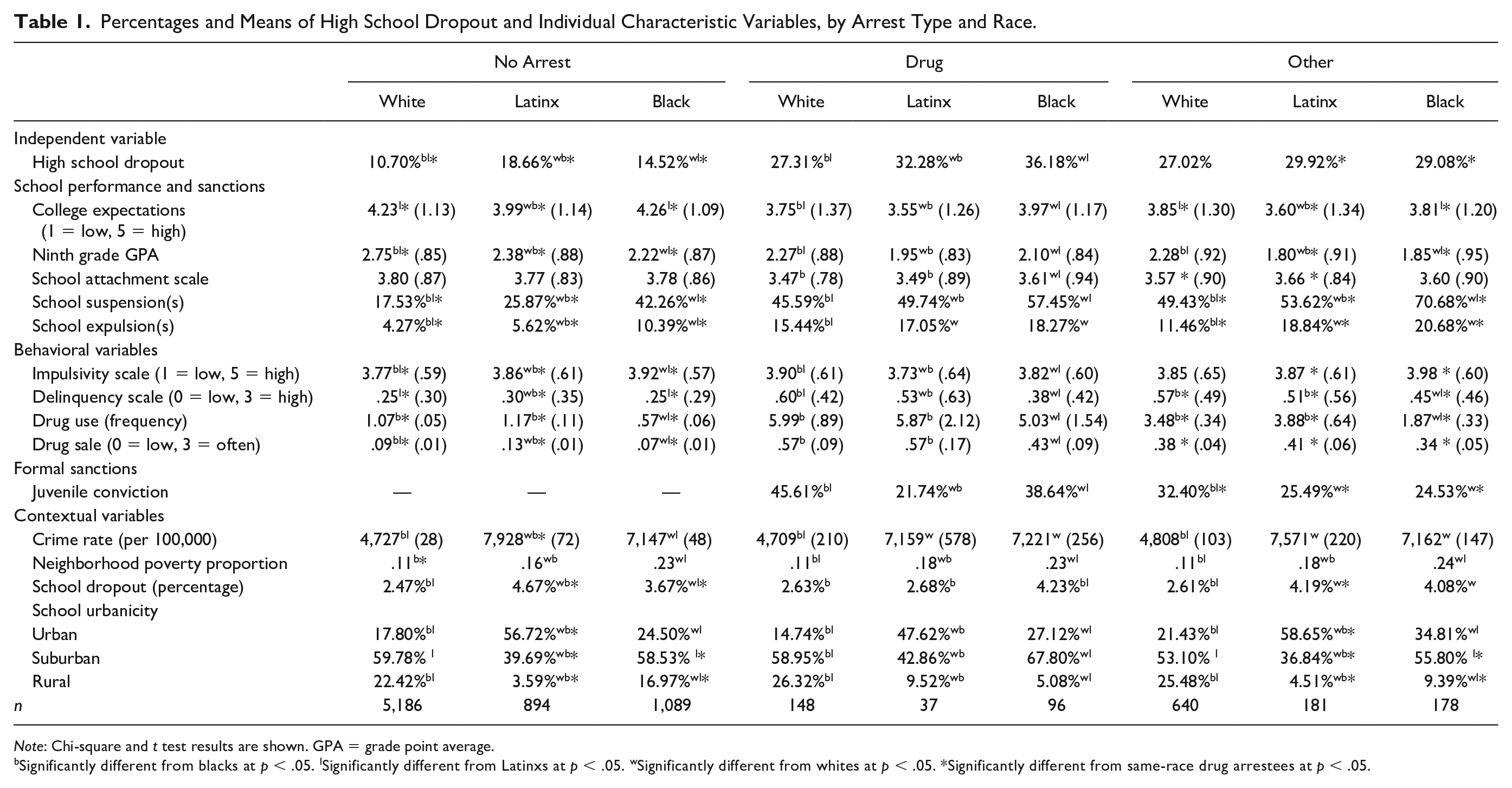
Note: Chi-square and t test results are shown. GPA = grade point average.
Significantly different from blacks at p < .05. lSignificantly different from Latinxs at p < .05. wSignificantly different from whites at p < .05. *Significantly different from same-race drug arrestees at p < .05.
Family background variables are also included as control variables, as youth from disadvantaged households have a higher propensity to drop out of high school. An ordinal measure of parental education is included because this is a key predictor of dropout (Frank 1990). This measure represents the highest level of completed schooling of the respondent’s mother and/or father. The educational attainment categories are “less than a high school diploma,” “a high school diploma or equivalent,” those who attended “some college” but did not achieve at least a bachelor’s degree, and a “bachelor’s degree or higher” category. A wave 1 assessment of family income relative to the poverty level is included. This measure is adjusted for household size. A dummy variable indicating if youth lived with both biological parents at wave 1 is also included, as youth living in a single-parent household have a higher propensity to drop out of high school (Rumberger 2001).
Several early measures of school performance and sanctions are also included in the regression models, as students with poor academics also have a higher propensity to drop out of high school (Finn 1989; Jimerson et al. 2002). First, using official transcript information, student grade point averages (GPAs) in the ninth grade (four-point scale) are included as a measure of early school performance. A variable for educational expectations is included in the model (“On a scale of 1 to 5, where 1 is low and 5 is high, how likely is it that you will go to college?”). Two dummy variables for school sanctions are also included, one dummy indicating any suspensions prior to first arrest (vs. no suspensions) and another dummy indicating any school expulsions prior to respondent’s first arrest (vs. no expulsions before first arrest). However, school sanctions may not necessarily provide accurate indicators of delinquent behavior, as Black and Latinx youth are more likely to be reprimanded and punished in school than white youth, for similar behaviors (Diamond and Lewis 2019, Lewis 2003). Regardless, these variables help shed light on the pathways that youth may be on prior to their arrest.
Four measures of delinquency and criminal proclivity (behavioral variables) are also included. In addition to family background and school performance, inclusion of prior delinquency or criminal proclivity is crucial, as labeling theories imply that an arrest affects dropout beyond the impact of prior delinquency and criminal behavior. First, the delinquency measure from Add Health is included, created from adolescents’ responses to 14 items that included subscales of delinquency (see Appendix C for delinquency scale questions). Mean scores were calculated with at least eight nonmissing responses and recomputed to the original 0-to-3 scale with, an α reliability score of .82. In addition, two count measures of self-reported drug involvement are included: first, the frequency of illicit drug use (in the 30 days prior to survey) and, second, the frequency of selling illicit drugs in the 12 months prior to the survey. I also include a measure for impulsivity (also used by Vazsonyi, Cleveland, and Wiebe 2006) created with the mean of four items from the “personality and family” section of the Add Health in-home interview, in which respondents were asked to indicate on a five-point scale (from “strongly agree” to “strongly disagree”) whether they agreed with the following four statements: (1) “When you have a problem to solve, one of the first things you do is get as many facts about the problem as possible”; (2) “When you are attempting to find a solution to a problem, you usually try to think of as many different ways to approach the problem as possible”; (3) “When making decisions, you generally use a systematic method for judging and comparing alternatives”; and (4) “After carrying out a solution to a problem, you usually try to analyze what went right and what went wrong.” The α coefficient for this four-item scale was .73.
Next, I include a dummy indicating whether respondents were convicted while they were enrolled in school. Given that Black arrestees are more likely to be convicted and institutionalized (Fellner 2009), this measure accounts for the possibility that an arrest has a greater influence on likelihood of completing high school among Black youth simply because these youth are punished more harshly.
Finally, I include several variables to account for neighborhood and school context. Add Health matched wave 1 data with participants’ 1990 census county- and tract-level data. I include a measure for the total crime rate per 100,000 populations at the county level. I also include a measure for proportion of households in a census tract with incomes below the poverty level. Add Health had also surveyed respondents’ school administrators and gathered additional information about participants’ schools. Using these data, I was able to include two measures for respondent’s school context. First, a variable measuring school dropout rates was created from the administrator question “What percentage of students in each grade dropped out last school year (1993)?” The metropolitan location of the school was also included; schools were categorized as urban, suburban, or rural.
Analysis Plan
Preliminary analyses include χ2 and t tests to examine differences in dropout as well as characteristic differences (school performance and sanctions, prior behavior, formal sanctions, and context) between youth across arrest types and racial groups (hypothesis 1). To test whether the effects of a first-time drug arrest on dropout vary for white, Latinx, and Black youth, I run a weighted logistic regression and include interaction terms for race and arrest, as well as predicted probabilities (hypothesis 2). A significant interaction for Black or Latinx youth would indicate that a drug arrest has a greater impact on the odds of dropping out for these groups compared with white youth with a drug arrest. Third, separate logistic regression models were estimated for each racial/ethnic group to determine whether the effect of a drug arrest on dropout is mediated by different variables for different racial groups. The variable blocks are included in successive steps in order to parse out which block or domain mediates the effect of drug arrest on dropout for each group.
The order in which variables are added was based on my specific questions. First, I wanted to know whether a drug arrest affects the likelihood of dropout for each group, accounting only for demographics and family background. Next, I wanted to account for propensity theory and determine the extent to which the effect of a drug arrest on dropout is explained by prior delinquency (school sanctions and behavior variables) or academic performance (hypothesis 3). In the final model, I include juvenile convictions and contextual variables (hypotheses 5 and 6). This stepwise modeling enables me to examine whether propensity theory is at play for certain racial groups, whether other mechanisms account for the relationship between arrest and dropout, and whether drug arrests still have an independent effect even after accounting for these variables. Finally, separate logistic regression analyses were conducted for Latinx youth only. These analyses include interactions for phenotype and drug arrest to examine the nuanced differential impacts that may exist for this racially and phenotypically heterogeneous group (hypothesis 4). A significant interaction indicates that a drug arrest has a greater impact for that particular group.
Results
Table 1 shows the percentages or means of the key outcome variable (high school dropout) and the individual characteristic variables, by race and arrest type, with χ2 and t test results. First, there are significant racial differences in dropout among drug arrestees, where Black youth have the highest dropout rate (36 percent), followed by Latinx youth (32 percent) and then white youth (27 percent) (p < .05). Descriptively, this finding challenges the view that a drug arrest has similar negative impacts on the high school trajectories of white, Latinx, and Black youth. Looking at other types of arrest, there are no significant racial differences across racial groups. This finding supports previous research that shows no racial differences in the impact of an arrest on high school dropout for aggregate measures of arrest. White youth also have similar dropout rates, regardless of arrest type (27 percent). Together, these statistically nonsignificant racial differences may be driving the findings of previous studies that show no racial differences in the impact of an arrest for high school dropout.
Characteristic Differences among Arrested Youth
Next, I turn to the individual background characteristics of arrested and nonarrested youth to address the first research question: whether Black and Latinx youth with drug arrests are characteristically different from white youth with drug arrests, as well as youth arrested for other crimes. In terms of school performance and sanctions, while there are significant racial differences among both drug and other arrestees, overall, there are larger racial differences among the former group. Black youth who were arrested for drug offenses have, on average, higher rates of early college expectations than white and Latinx drug arrestees. Although white drug arrestees appear to have higher ninth grade GPAs than Black and Latinx youth arrested for drugs, it is important to note how they differ from their nonarrested peers. White drug arrestees’ average GPA is .48 points lower than that of white nonarrestees; this difference is .33 points for Latinx youth and only .13 points for Black youth who had a drug arrest versus Black youth who had never been arrested. These differences highlight how Black, and to some extent Latinx, youth arrested for drugs are more similar to their nonarrested peers than white youth arrested for drugs, suggesting that these Black and Latinx youth may not be on a path toward educational failure prior to their drug arrests. Furthermore, these gaps are not as obvious for other types of arrest, suggesting a different selection process for drug arrests. Similarly, there are no racial differences in terms of school attachment for youth with other arrests; however, Black youth with drug arrests have higher levels of school attachment prior to an arrest than white and Latinx youth with a similar arrest. Black and Latinx drug arrestees also have higher rates of suspension (58 percent and 50 percent, respectively) than white youth (46 percent), as well as similar patterns for expulsion (Black youth, 18 percent; Latinx youth, 17 percent; white youth, 15 percent). This pattern is surprising given the findings on behavior variables below.
Looking next at behavioral variables, there are racial differences in impulsive behaviors among drug arrestees that are not evident among other arrest types. White drug offenders reported slightly more impulsive behaviors (3.90) than Black (3.82) and Latinx youth (3.73). There are also racial differences in the delinquency scale for drug arrestees that are not as pronounced among youth with other types of arrest. Among drug arrestees, Black youth report the lowest delinquency rate (.38), followed by Latinx youth (.53). White drug offenders have the highest delinquency among both drug arrestees (.60) and other arrestees (.57). There are similar patterns for drug use and drug sale, where Black youth arrested for drug-related crimes are significantly less likely to have used or sold drugs compared with white and Latinx drug arrestees (who reported similar rates of drug use and sale). Overall, Black (and to some extent Latinx) youth arrested for drugs have lower rates of prior delinquent behaviors than their white peers.
Given that white youth with drug arrests report higher rates of impulsivity and delinquency than Black and Latinx drug arrestees, and similar (or slightly higher) rates of drug use and drug sale than their Black and Latinx peers, it is striking that white drug arrestees have significantly lower rates of suspension and expulsion, as described above. There are similarly stark racial differences among both nonarrestees and youth arrested for other types of drugs. This latter finding supports prior research that shows Black and Latinx youth face more school sanctions than white youth, even after accounting for delinquent behavior (Browne, Losen, and Wald 2001; Eitle and Eitle 2004; Ferguson 2020; Kupchik and Ellis 2008; Skiba et al. 2002). It also supports the notion that white youth must exhibit behaviors that are more noticeably delinquent in order to be sanctioned, whether by the criminal justice system or by school officials.
In terms of differences in formal juvenile sanctions after a first arrest, surprisingly, white drug arrestees have the highest conviction rate (46 percent) compared with Latinx (21 percent) and Black (38 percent) drug arrestees. Therefore, conviction may not be driving the racial differences in dropout rates among this group.
Looking finally at contextual variables, consistent with prior research, Black and Latinx youth (regardless of a juvenile arrest) live in neighborhoods with higher crime rates and levels of poverty, and they attend schools with higher dropout rates than their white peers. Black youth who have a drug or other arrest attend schools with slightly higher dropout rates (4.23 percent and 4.08 percent, respectively) than Black youth with no arrest (3.67 percent), suggesting that perhaps institutional mechanisms (zero-tolerance policies or other institutional responses) may be driving dropout after an arrest. Looking at school urbanity, overall, the majority of white and Black youth live in suburban settings, while the majority of Latinx youth live in urban settings. A significant finding is that a higher proportion of Black drug arrestees live in suburban settings (67.80 percent) compared with Black youth with no arrest (58.53 percent) or other arrest (55.80 percent). However, this does not necessarily mean that Black and white youth live in similar suburbs. Prior studies show that Black youth are more likely to live in “inner” suburbs that are city adjacent, highly segregated, hyperpoliced, and overall contextually very different from predominantly white “outer” suburbs (Boyles 2015; Farley 1970; Logan 2014; Logan and Oakley 2017). To dig deeper, additional analysis (not shown here) shows that, on average, Black youth living in the suburbs and Black youth living in urban settings had similar percentages of Black residents in their census tracts (53 percent and 54 percent respectively), confirming some of the findings of previous studies.
To summarize, the descriptive findings reveal that although there are racial differences in both academic performance and behavior variables among all arrestees, these differences are more pronounced among drug arrestees. The findings also reveal that Black youth with drug arrests report less delinquency, drug use, and drug sales with higher college expectations and school attachments than their white and Latinx peers, lending strong support to hypothesis 1. The descriptive findings also show that Black and Latinx youth live in more disadvantaged and higher crime neighborhoods and attend schools with higher dropout rates, which could be driving some of the differences in both arrest and dropout. Next, I turn to the logistic regression and predicted probabilities to determine whether there are racial differences in the effect of an arrest on high school dropout and what mechanisms may explain these differing effects.
Racial Differences in the Impact of an Arrest
To test for racial differences in the effect of an arrest, I run regression models, which include all controls, for the likelihood of high school dropout and include interaction effects for arrest type and race. Figure 1 reports the predicted probabilities of dropping out of high school for Black, white, and Latinx youth with and without a drug arrest (there were no significant racial differences in the effect of other arrest types). These results are based on the multinomial logistic regression model reported in Appendix Table E. Looking at Figure 1 (and Appendix Table E), the only statistically significant interaction effect is for Black youth with drug arrests, who are significantly more likely to drop out than their nonarrested same-race peers (12 percent vs. 2 percent). These findings lend some support to hypothesis 2, that the effects of a drug arrest are more damaging for Black youth compared with white youth. The findings, however, are less clear for Latinx youth. Although Latinx youth with a drug arrest appear to have a higher probability of dropping out (7 percent vs. 3 percent), the interaction effect is not significant. Furthermore, I ran the same model with Latinx youth as the reference group and found that Black drug arrestees are significantly more affected by a drug arrest than Latinx youth. This finding is explored more later in a separate analysis for Latinx youth.

Interaction between drug arrest and race: probability of high school dropout.
As Black drug arrestees had the lowest levels of delinquency among all arrestees, these findings are consistent with previous research showing that an arrest is more detrimental to youth with minimal prior delinquency. These findings also contrast with previous research that indicated no racial differences in the impact of an arrest on the likelihood of dropping out of high school. As such, the findings highlight how aggregate measures of arrest obscure important racial differences that only exist for certain types of arrest.
Although these results tell us that the effects of a drug arrest are more detrimental to the educational trajectories of Black youth, they do not tell us why white or Latinx drug arrestees are not as negatively affected by a drug arrest. To address this question, I run separate models by race to examine whether certain variables explain the lack of significant effects for white and Latinx drug offenders (Table 2). I include three models for each group. The first model includes only the main effect of a juvenile arrest and basic demographic and family background variables. The second model includes academic performance and sanctions variables, as well as behavior variables; this will illuminate whether prior academic and delinquent behaviors explain the negative impact of an arrest on some youth and not others. The last model includes the remaining variables: juvenile conviction (which allows me to assess hypothesis 5, whether postarrest biases are driving the results) and the contextual variables (which allow me to assess hypothesis 6, whether neighborhood and school factors explain the effect of an arrest on dropout).
Odds Ratios from Logistic Regression of the Effects of Juvenile Arrest on High School Dropout, Separate Models by Race.

Note: GPA = grade point average; HS = high school.
p < .05. **p < .01. ***p < .001.
In model 1 for white youth, youth with a drug or other arrest are about 2.5 times more likely to drop out of high school compared with their nonarrested peers. In model 2, I introduce school and behavioral variables, and the effect of a drug arrest decreases and loses significance, while the effect of other arrest types decreases but remains significant. This means that the relationship between a drug arrest and dropout is spurious for all white offenders. This lends support to hypothesis 3: that for white youth, the effects of a drug arrest are mediated or explained by prior school performance and delinquency, suggesting that these youth were already on a path toward dropout, regardless of an arrest. In the third model, all other variables are introduced, and the impact of drug arrest remains nonsignificant, while the effect for other arrest types remains significant. The findings show that the effect of an arrest differs by arrest type for white youth, where only non-drug-related arrests have significant impacts on dropout.
For Latinx youth, the effects of both arrest types are significant in model 1, although the magnitude for drug arrests (2.908) is larger than for other arrests (2.595). Introducing prior school and delinquency behaviors variables in model 2 does decrease the magnitude of the odds ratio, but the effect of a drug arrest remains significant. The addition of conviction and the contextual variables in model 3 explains the remaining effect of a drug arrest. The findings for Latinx youth are less clear than the findings for white youth. It appears that the effect of a drug arrest is mediated to some extent by prior school performance and delinquent behaviors and also conviction and living in a high-poverty neighborhood. These findings appear to reflect the racially mixed group of youth identifying as Latinx, who may have varying experiences. I explore this issue further in the next section.
For Black youth, the effects of both arrest types on the likelihood of dropping are also significant, but the effects of a drug arrest in model 1 is significantly larger in magnitude (3.834) than the effect of a drug arrest for Latinx (2.908) and white youth (2.654). Although the effect of a drug arrest decreases slightly when school performance and behavior variables are added in model 2, the effect of a drug arrest remains significant, even when the remaining variables are introduced in model 3, lending more support to hypothesis 3. Low-income background and the contextual variables are not significant in the final model, which means that the negative effect of a drug arrest for Black youth is not driven by class differences or by neighborhood and school processes. Also, although a conviction significantly increases the likelihood of dropping out, the drug arrest variable remains strong and highly significant, which underscores the damaging impact of an arrest for Black youth, above and beyond an actual conviction.
In the full model (model 3) for each racial group, I find that other types of arrest significantly increase the likelihood of dropout. This finding supports previous research that finds negative educational consequences for aggregate measures of arrest, above and beyond individual behavior factors.
Phenotypical Differences among Latinx Youth
Given that phenotype plays a significant role in the process of criminalization and racialization, important components of racial profiling in law enforcement, I provide a brief breakdown of ascribed phenotype for the Latinx youth in the sample to help illuminate the findings in this study. The average phenotype classification of the Latinx sample (1.72) was significantly darker than white youth (1.04) but lighter than Black (3.69) (see Appendix A). This means that the effect I find in the previous section for Latinx youth may actually be a result of the mix of youth from a range of racial phenotypes in this category, who may actually be experiencing different effects. Next, I break down the phenotype of Latinx youth by arrest type and find that Latinx youth who had no arrest had the lightest phenotype, while Latinx youth with a drug arrest had the darkest phenotype (results not shown). This supports previous research that finds darker skinned Latinx youth are stopped and arrested more often than lighter skinned members of the same group (White 2015). That Latinx drug arrestees have darker phenotypes than Latinx youth arrested for other crimes speaks to the racialization of drug enforcement in particular.
To test hypothesis 4, whether the effect of an arrest varies for Latinx youth by their phenotype or racialized status, I present predicted probabilities of dropout in Figure 2. These results are based on the multinomial logistic regression model reported in Appendix Table F, with interaction effects for phenotype and arrest type. In these models, I collapse Latinx youth who were ascribed brown or black skin, because of the small cell sizes within each phenotype category. The results in Figure 2 (and Appendix Table F) show a significant interaction for Brown/Black Latinx youth who had a drug arrest, net of all controls. The results for Latinx respondents with lighter phenotypes resemble the results in Figure 1 for white respondents, where I find little consequence for drug arrest. However, for Brown/Black Latinx youth, a drug arrest increases their probability of dropping out from 5 percent to 10 percent. Although these probabilities are not as large as the effect of drug arrest for Black youth, they still indicate that darker skinned Latinx youth experience more detrimental impacts of a drug arrest than their lighter skinned peers, lending support to hypothesis 4. This finding further underscores how the impact of a drug arrest is uniquely negative for racialized and marginalized youth.

Interaction between drug arrest and Latino phenotype: probability of high school dropout.
Robustness Checks and Sensitivity Analysis
To test the robustness of the results, two sets of additional analyses were performed (in addition to those mentioned to address temporal issues with the data above). The first set of analyses examine short-term effects of arrest on high school dropout to address the possibility that prolonged lags between wave 1 behavior measures and respondent’s first arrest may compromise the efficacy of these control variables in explaining both arrest and dropout (see Appendices Ja and Jb). Although the average lags were relatively short for each racial group (between 1.73 and 2.06 years; see Appendix D), additional analyses were estimated with a limited sample that included only cases with short lags (defined as three years or less) between the wave 1 measurements and first arrest. As arrested youth are not the only ones with problematic lags, both nonarrested and arrested youth with behavioral data collected in middle school (during wave 1) were also omitted in these analyses. The results of these analyses consistently yielded similar results in terms of significance and direction as the results reported above, although the magnitude of effect was slightly smaller.
The second set of analyses used propensity score matching (PSM) instead of logistic regression models (see Appendices Ga and Gb). Respondents in each racial group who eventually had a drug arrest were matched with peers with similar background measures who were never arrested for drug-related charges using kernel matching (bandwidth = .006, kernel = Gaussian). After matching, the groups were balanced on all covariates. The findings were consistent with the interaction effects in our logistic models, where significant treatment effects (effect of drug arrest on dropout) were evident only for Black and Latinx respondents. The PSM approach, however, does not allow us to test for mediating factors for each racial group to see if certain mechanisms explain the effect of arrest on dropout. Furthermore, because PSM treats only a certain number of cases as valid matches, there is larger attrition in the treatment group (drug arrestees), which makes for a less rigorous test, given that this group is already small to begin with. Therefore, the approach of logistic regressions with interactions for race and arrest type, as well as separate logistic models by race, proved to be a more rigorous test of comparisons across groups.
Discussion and Conclusion
Two broad conclusions can be drawn from this research. First, there are significant racial differences in the background characteristics of drug arrestees that do not exist for other types of arrest. Among drug arrestees, Black youth, and to a lesser extent Latinx youth, have significantly lower rates of prior delinquency and better school performance than white youth who are arrested for drug-related charges. Although the mechanisms driving this unique selection process could not be tested in this study, there are well-documented racial biases in police enforcement, both in neighborhoods and in schools; Black youth are more likely to be arrested for behaviors that white youth are given a pass for (Alpert et al. 2005; Gaston 2019b). This may be why most Black youth who are arrested for drug-related crimes in this study appear to be youth with minimal prior delinquent and criminal behavior. In contrast, white youth who are arrested for drugs tend to be those who engage in more criminal and delinquent behaviors.
Second, the effect of a first-time drug arrest is more detrimental for the high school dropout outcomes of Black youth than white or Latinx youth. Drug arrests have weaker effects for Latinx youth, but these effects are explained to some extent by the heterogeneous racialized experiences among this group, whereby darker skinned Latinx youth are experience more damaging impacts of a drug arrest than lighter skinned Latinx youth. Surprisingly, being arrested for drugs has no bearing on the likelihood of graduating from high school for white youth, once delinquency and school performance behaviors are taken into account. These findings suggest that most white youth who are arrested for drugs were already on a path toward high school dropout and delinquency. These findings also address the theoretical debate regarding the spurious versus nonspurious effects of a juvenile arrest on high school dropout. On the basis of the findings of this study, I argue that propensity theories predictions of a spurious effect are correct, but only for white youth with drug arrests. These findings challenge long-held assumptions that juvenile arrests negatively affect all white youth; surprisingly, drug arrests do not.
What exactly explains the racial differences in the effect of a drug arrest on dropout remains a crucial question. Although the present data cannot address the specific processes involved for Black and phenotypically darker Latinx youth, prior theorists have argued that the negative impact of an arrest may be more pronounced for racially disadvantaged groups who have less protective social, human, and financial capital with which to bargain their way out of stigmatization and delinquent tracking in school (Sampson and Laub 1997). Previous research also shows that this labeling effect is more pronounced for youth who are less involved in delinquency (Sweeten 2006). Therefore, one speculation is that the population of Black and phenotypically darker Latinx youth who are arrested for drugs includes more youth who are not on the same pathway as white drug arrestees. These youth may have gone on to completed high school, but their pathways toward educational success were derailed by the negative stigma or “mark” after an arrest (Rios 2011).
Along these lines, this study also demonstrated that although white youth had higher levels of delinquency and impulsive behaviors, and engaged in drug use and sale at rates similar to those of Black and Latinx youth, white youth had significantly lower levels of school sanctions. This finding supports prior studies on racial differences in school punishment, in particular studies that highlight how Black and Latinx youth experience harsher institutional responses at school than white youth for similar behaviors (Diamond and Lewis 2019; Valenzuela 1999). The 1980s and 1990s, when students in this study were in school, were marked by a rapid increase in punitive approaches to school discipline in the United States (Kupchik 2010), alongside the expansion of punitive policing practices in Black and Latinx communities (Rios 2011). These approaches included zero-tolerance policies that require harsh punishments (such as suspension or expulsion) regardless of circumstances, as well as referrals to police and juvenile courts for offenses previously handled by school teachers, administrators, or parents (Theriot 2009), forming what is now known as the school-to-prison pipeline. Black and Latinx students are more likely to attend schools that have these punitive policies and are also more likely to face these types of school sanctions than white youth, even after accounting for delinquent behavior (Browne et al. 2001; Eitle and Eitle 2004; Ferguson 2020; Kupchik and Ellis 2008; Skiba et al. 2002). Future research should examine why a drug arrest affects Black and darker phenotype Latinx adolescents differently and how biases in school discipline, as well as police discretion in the community, may be driving these differences.
This study also builds on previous quantitative research that uses aggregate measures of juvenile arrest and fails to demonstrate any racial differences in the effect of a juvenile arrest on high school dropout groups (Bernburg and Krohn 2003; De Li 1999; Sweeten 2006). This study disaggregates by arrest types and finds racial differences in the effect of an arrest exist among drug arrestees only. These results, however, do not contradict the findings of prior research. The results in this study show no racial differences in the effect of other arrest types, even after breaking down other arrests into more specific categories (see note 3). Therefore, the racial differences in the effect of an arrest on high school dropout among drug arrestees has been obscured in previous studies by the use of aggregate measures of arrest.
The results also reveal that, surprisingly, white youth with drug arrests have higher rates of conviction than Black and Latinx drug arrestees. This contradicts the findings of previous studies that show Black and Latinx youth are more likely to be convicted after an arrest (McCord et al. 2001; Rovner 2016). However, this finding supports the notion that white youth who are arrested for drug arrests are more likely to have actually committed a drug offense than Black and Latinx youth. Furthermore, racial differences in the impact of a drug arrest are not explained by differences in conviction; this finding underscores how the arrest itself may be more traumatic for Black and darker skinned Latinx youth, who are more likely to experience police brutality, excessive force, and a consequential social stigma after an arrest (Anderson 1990; Goffman 2009; Rios 2011).
There are, of course, other types of arrest resulting from the racialized policies of the war on drugs and racial profiling generally; these additional arrest types may yield similar effects as those found in this study for drug arrests. The investigation and report on the Ferguson Police Department practices by the U.S. Department of Justice (2015), and similar reports in other cities such as Baltimore (U.S. Department of Justice 2016), highlight how police officers routinely used racial stereotypes and discriminatory practices to arrest Black residents for minuscule violations, such as “manner of walking” violations in which people were not walking on the sidewalk appropriately. The disproportionate number of arrests, shaped by a desire to increase revenue rather than public safety needs, stemmed from “unlawful bias” rather than Black residents’ committing more crimes (U.S. Department of Justice 2015). Future studies should consider if the patterns observed in this study for drug arrests could also be evident for other types of arrest that are officer initiated, require police discretion, and are shown to be driven by bias (e.g., weapon possession, disorderly conduct, trespassing, loitering).
These findings on the deleterious effects of drug arrests for Black youth suggest another way in which racial inequality is reproduced for Black Americans and speak to a larger phenomenon regarding the structures of contemporary racism. These findings support theories of Black exceptionalism (Sears et al. 1999): that in terms of opportunities and obstacles, the pathway to achieving success distinctly differs for Black Americans, who continuously remain the most disadvantaged racial group, given the nearly impermeable color line they have historically confronted. The significantly stronger effects of drug arrests for Black and darker phenotype Latinx youth suggests that Blackness continues to constitute a fundamental racial construction in American society. Therefore, it is not simply that race matters, as Sampson and Laub (1997) predicted, but more specifically that Black race matters. Future research should explore the effect of drug arrest on other educational and employment outcomes (college enrollment, college completion, unemployment, job stability in adulthood, etc.) as well as for older age cohorts to see if similar patterns persist in these areas.
This study and the data used have a number of limitations. Most notable is the lack of precise temporal ordering of events, which leaves open the possibility that for some respondents, dropout may be influencing arrest. However, the robustness checks and alternative analyses discussed above provide confidence that the findings are valid. Furthermore, Add Health is an incredibly rich data source and the only nationally representative data set that gathers specific arrest type data and requires respondents to mark arrest type (e.g., the National Longitudinal Survey of Youth 1997 leaves arrest-type questions optional, resulting in a large amount of missing data for the arrest-type variable). Another limitation is that the majority of the measures are self-report. This could be problematic if respondents do not feel comfortable disclosing previous criminal justice involvement or other sensitive information or if one racial group is less likely to report than another. A mitigating factor for this limitation is the research design of Add Health, which allowed respondents to enter their own answers into a laptop computer in privacy for sensitive materials; this increases the validity of responses.
The results of this study highlight some of the consequences of vastly different policing among Black, white, and Latinx youth. It highlights that because police treat youthful mistakes (such as drug use) differently along racial lines, most white youth who do drugs never experience the negative consequences of involvement with law enforcement, because most are not arrested. This study moves beyond previous studies that focus solely on racial biases in the rates of juvenile drug arrests and examines the effects of juvenile drug arrests. The findings suggest that estimates of the consequences of drug arrests, and more broadly the war on drugs, underestimate the impact on racial disparities. Specifically, not only are Black youth much more likely to be arrested than Latinx and white youth for drug-related charges (Fellner 2009), but a drug arrest strongly affects Black youth’s life chances.
Supplemental Material
sj-xlsx-1-srd-10.1177_23780231211027097 – Supplemental material for The Racially Disparate Effects of Drug Arrest on High School Dropout
Supplemental material, sj-xlsx-1-srd-10.1177_23780231211027097 for The Racially Disparate Effects of Drug Arrest on High School Dropout by Mariam Ashtiani in Socius
Supplemental Material
sj-xlsx-10-srd-10.1177_23780231211027097 – Supplemental material for The Racially Disparate Effects of Drug Arrest on High School Dropout
Supplemental material, sj-xlsx-10-srd-10.1177_23780231211027097 for The Racially Disparate Effects of Drug Arrest on High School Dropout by Mariam Ashtiani in Socius
Supplemental Material
sj-xlsx-11-srd-10.1177_23780231211027097 – Supplemental material for The Racially Disparate Effects of Drug Arrest on High School Dropout
Supplemental material, sj-xlsx-11-srd-10.1177_23780231211027097 for The Racially Disparate Effects of Drug Arrest on High School Dropout by Mariam Ashtiani in Socius
Supplemental Material
sj-xlsx-12-srd-10.1177_23780231211027097 – Supplemental material for The Racially Disparate Effects of Drug Arrest on High School Dropout
Supplemental material, sj-xlsx-12-srd-10.1177_23780231211027097 for The Racially Disparate Effects of Drug Arrest on High School Dropout by Mariam Ashtiani in Socius
Supplemental Material
sj-xlsx-13-srd-10.1177_23780231211027097 – Supplemental material for The Racially Disparate Effects of Drug Arrest on High School Dropout
Supplemental material, sj-xlsx-13-srd-10.1177_23780231211027097 for The Racially Disparate Effects of Drug Arrest on High School Dropout by Mariam Ashtiani in Socius
Supplemental Material
sj-xlsx-2-srd-10.1177_23780231211027097 – Supplemental material for The Racially Disparate Effects of Drug Arrest on High School Dropout
Supplemental material, sj-xlsx-2-srd-10.1177_23780231211027097 for The Racially Disparate Effects of Drug Arrest on High School Dropout by Mariam Ashtiani in Socius
Supplemental Material
sj-xlsx-3-srd-10.1177_23780231211027097 – Supplemental material for The Racially Disparate Effects of Drug Arrest on High School Dropout
Supplemental material, sj-xlsx-3-srd-10.1177_23780231211027097 for The Racially Disparate Effects of Drug Arrest on High School Dropout by Mariam Ashtiani in Socius
Supplemental Material
sj-xlsx-4-srd-10.1177_23780231211027097 – Supplemental material for The Racially Disparate Effects of Drug Arrest on High School Dropout
Supplemental material, sj-xlsx-4-srd-10.1177_23780231211027097 for The Racially Disparate Effects of Drug Arrest on High School Dropout by Mariam Ashtiani in Socius
Supplemental Material
sj-xlsx-5-srd-10.1177_23780231211027097 – Supplemental material for The Racially Disparate Effects of Drug Arrest on High School Dropout
Supplemental material, sj-xlsx-5-srd-10.1177_23780231211027097 for The Racially Disparate Effects of Drug Arrest on High School Dropout by Mariam Ashtiani in Socius
Supplemental Material
sj-xlsx-6-srd-10.1177_23780231211027097 – Supplemental material for The Racially Disparate Effects of Drug Arrest on High School Dropout
Supplemental material, sj-xlsx-6-srd-10.1177_23780231211027097 for The Racially Disparate Effects of Drug Arrest on High School Dropout by Mariam Ashtiani in Socius
Supplemental Material
sj-xlsx-7-srd-10.1177_23780231211027097 – Supplemental material for The Racially Disparate Effects of Drug Arrest on High School Dropout
Supplemental material, sj-xlsx-7-srd-10.1177_23780231211027097 for The Racially Disparate Effects of Drug Arrest on High School Dropout by Mariam Ashtiani in Socius
Supplemental Material
sj-xlsx-8-srd-10.1177_23780231211027097 – Supplemental material for The Racially Disparate Effects of Drug Arrest on High School Dropout
Supplemental material, sj-xlsx-8-srd-10.1177_23780231211027097 for The Racially Disparate Effects of Drug Arrest on High School Dropout by Mariam Ashtiani in Socius
Supplemental Material
sj-xlsx-9-srd-10.1177_23780231211027097 – Supplemental material for The Racially Disparate Effects of Drug Arrest on High School Dropout
Supplemental material, sj-xlsx-9-srd-10.1177_23780231211027097 for The Racially Disparate Effects of Drug Arrest on High School Dropout by Mariam Ashtiani in Socius
Footnotes

Supplemental Material
Supplemental material for this article is available online.
Notes
Author Biography
References
Supplementary Material
Please find the following supplemental material available below.
For Open Access articles published under a Creative Commons License, all supplemental material carries the same license as the article it is associated with.
For non-Open Access articles published, all supplemental material carries a non-exclusive license, and permission requests for re-use of supplemental material or any part of supplemental material shall be sent directly to the copyright owner as specified in the copyright notice associated with the article.
