




Abstract
Using data from a spring 2020 survey of nearly 10,000 parents of elementary school parents in one large southeastern public school district, the authors investigate predictors of elementary school student engagement during the initial period of pandemic remote learning. The authors hypothesize that household material and technological resources, school programming and instructional strategies, and family social capital contribute to student engagement in remote learning. The analyses indicate that even after controlling for rich measures of family socioeconomic resources, students with access to high-speed Internet and Internet-enabled devices have higher levels of engagement. Exposure to more diverse socioemotional and academic learning opportunities further predicts higher levels of engagement. In addition, students whose families remained socially connected to other students’ families were more likely to engage online.
In addition to causing death, illness, and economic loss, the novel severe acute respiratory syndrome coronavirus-2 is wreaking havoc on children’s educational experiences. In an effort to contain the virus, elementary and secondary schools around the world closed their doors and embarked on a months-long effort to provide remote education for homebound youth. At their peak, nationwide school closures affected an estimated 55.1 million students across 124,000 public and private schools in the country (Education Week 2020a). In most cases, these students’ schools replaced in-person instruction with a mix of synchronous and asynchronous instruction offered via Web-based instructional technologies such as Google Classroom, Schoolify, and Canvas (Gross and Opalka 2020; Hamilton et al. 2020; Harris et al. 2020).
Early indications suggest that remote instruction has been a poor substitute for in-person schooling for many students. The Los Angeles Unified School District reported that nearly 15 percent of high school students never logged on to its online learning system in the spring of 2020, and an additional 25 percent logged on only infrequently (Burke 2020). Nationwide, just 9 percent of teachers reported that “nearly all” of their students regularly completed distance learning activities, and most teachers reported that no more than half of students did so (Hamilton et al. 2020). In another study, just under half of parents agreed that their children spent less time on schoolwork and learned less during the spring 2020 shutdown than they would have in a typical session of in-person schooling (Bailey and Shaw 2020). These disruptions persist into the 2020–2021 academic year, with 17 of the 20 largest school districts in the United States, serving more than 4 million students, starting the year with remote-only instruction (Education Week 2020b).
We use data from a spring 2020 survey of nearly 10,000 elementary school parents in one large southeastern public school district to investigate predictors of elementary school student engagement. Our analyses focus on engagement as a dependent variable because engagement is typically a first step toward other favorable academic outcomes. Beyond relating positively to students’ grade point averages (Carini, Kuh, and Klein 2006) and subject-based skills (Lee 2014), engagement also correlates with high school graduation (Rumberger and Lim 2008). Although studies have documented a positive relationship between the use of technology among high school and college students and engagement behaviors such as dedication, participation, and learning interest (Rashid and Asghar 2016; Trimmel and Bachmann 2004), engagement is not immune to external disruptions. Because a better mood at home and in other nonschool environments is associated with greater engagement and less external preoccupation (Yair 2000), pandemic-induced family stressors, such as worries associated with job security, home schooling, and health, are likely to complicate traditional engagement levels. Moreover, engagement challenges are compounded in the current environment, considering that successful performance in online learning during ordinary periods already demanded greater student accountability and parental involvement compared with traditional classroom instruction (Curtis and Werth 2015). The importance of studying student engagement is augmented when we consider the cumulative nature of academic skills development: students demonstrating weaker performance skills at the start of class are less likely to be engaged during later moments (Kelly 2008).
Our analyses indicate that student technological resources, such as high-speed Internet and access to Internet-enabled devices, predict engagement even after controlling for student family income and other measures of household socioeconomic resources. Furthermore, we find that students who are exposed to diverse socioemotional and academic learning opportunities have higher levels of engagement. But even after controlling for a robust set of material, technological, and instructional resources, we find that students whose families remained socially connected to other students’ families were more likely to engage online. These findings, which resonate with prior research demonstrating the role of social capital in community recovery from disaster (Aldrich 2012; Aldrich and Meyer 2015), suggest that to effectively educate students through this crisis, educators must cultivate and maintain social ties among students’ families.
What Predicts Student Engagement with Remote Learning?
Although research suggests that remote instruction can be as effective as traditional classroom instruction (Cavanaugh 2001; Cavanaugh et al. 2004; Johnson, Aragon, and Shaik 2000; Swan et al. 1990), the wide variability in the quality and implementation of online programs raises concerns regarding the consequences of remote-only instruction for youth development (Morgan 2015; Picciano and Seaman 2007; Sorensen 2012). In addition to imposing learning challenges, physical absence from the school environment can also compromise the physical and mental well-being of children and adolescents (American Academy of Pediatrics 2020). Widely reported analyses predict dire consequences of coronavirus disease 2019 (COVID-19)–induced school disruptions for student achievement and educational inequality (Dorn et al. 2020; Kuhfeld et al. 2020).
There are good reasons to fear that students from economically and educationally disadvantaged households will suffer these negative consequences disproportionately (Calarco 2020; Dorn et al. 2020). A long line of research indicates that racial and socioeconomic inequalities in youth outcomes widen when students leave formal schooling for the summer (Alexander, Entwisle, and Olson 2001, 2007; Downey, von Hippel, and Broh 2004; Ready 2010). Furthermore, new survey data assessing how families have responded to school closure reveals that highly educated families spend more time helping their children with remote learning than less educated families (Bol 2020). Only 38 percent of lower income parents reported that their children received “a lot” of online instruction, compared with approximately half of upper income parents (Horowitz 2020), and real-time data on student completion of an online mathematics module suggests that students in relatively affluent communities remained more academically engaged during the pandemic than students in poorer communities (Opportunity Insights 2020). Our analysis adds to our knowledge of youth educational experiences during the school building closures by providing data on elementary student engagement with remote instruction and the extent to which that engagement varies with race/ethnicity and parental education.
In addition, we seek to provide policy makers, educators, and families in communities where high levels of COVID-19 transmission prohibit and/or limit face-to-face instruction with empirical evidence about how to boost student engagement in remote instruction. This work has immediate practical relevance as schools across the United States continue to limit in-person instruction. We hypothesize that the following three factors each independently predict student engagement in online instruction: (1) access to household material and technological resources, (2) school programming and instructional strategies, and (3) family social capital.
The Digital and Material Divides
Although networked technologies such as computers, tablets, and smart phones have become nearly ubiquitous in contemporary American life, racial and socioeconomic digital divides persist. Black and Hispanic adults, for instance, are less likely than white adults to own a computer or to have access to a home broadband connection (Perrin and Turner 2019), and more than 40 percent of low-income families do not have access to either of these resources (Anderson and Kumar 2019). Yet although access to the Internet characterized earlier digital gaps, recent studies identify growing inequalities related to computer use, digital competencies, and/or readiness (Attewell 2001; DiMaggio and Hargittai 2001; DiMaggio et al. 2001; Hargittai 2003; Livingstone and Helsper 2007; Puckett 2019). Moreover, because online searches for learning resources during the COVID-19-induced remote learning period have already undergone greater increases in U.S. regions that have higher incomes, fewer rural schools, and better access to the Internet (Bacher-Hicks, Goodman, and Mulhern 2020), we anticipate that the nationwide reliance on remote instruction will exacerbate existing digital inequalities.
Our focal district, like 84 percent of all U.S. public schools (Hamilton et al. 2020), made a concerted effort to bridge these digital divides, distributing 8,000 laptops to students in the weeks after discontinuing in-person instruction and partnering with local cell phone and Internet service providers to provide free Internet access. Nonetheless, some students, particularly from historically marginalized communities, likely did not have sufficient access to technology to fully participate in online learning. For these students, we hypothesize that limited access to Internet-enabled devices and high-speed Internet discourages engagement with remote instruction.
Associations between essential household needs and academic performance indicate that students will require a wide range of material resources to effectively engage with remote instruction (Hornick-Becker and Halkitis 2020; Van der Berg 2008). Studies of student academic performance prior to the COVID-19 pandemic revealed that students exposed to economic instability showed lower levels of academic achievement than students in more stable households (Cutuli, Desjardins, and Herbers 2013; Herbers et al. 2012; Miller 2011). Remote-only instruction likely magnifies the importance of a broad range of material resources, including a quiet space to do schoolwork, and/or access to caregivers who can provide guidance during remote learning sessions, challenging students’ abilities to fully engage in the learning process (Duffield 2020; Hornick-Becker and Halkitis 2020).
Hunger and food insecurity likely further impede engagement with remote instruction for students whose diets would, in a more typical school year, rely on free or reduced-price school meals (Domina 2020). In addition to hindering youth social skills development (Jyoti, Frongillo, and Jones 2005), food insecurity also interferes with children’s classroom attendance and ability to concentrate (Murphy et al. 1998). Given the profound economic disruptions the pandemic has caused for households across the United States (McNichol and Leachman 2020), particularly among the most vulnerable racial/ethnic minority and low-income communities (Karpman et al. 2020; Sanchez, Vargas, and Pedroza 2020), we therefore hypothesize that students’ engagement with remote instruction will vary with students’ family economic status, even after controlling for family racial demographics and parents’ educational attainment.
School Programming and Instructional Strategies
Even if they have the technological and physical resources they need to access instruction, students are unlikely to engage in instruction if they do not find the instruction available to them meaningful or stimulating (Fredricks, Blumenfeld, and Paris 2004). This truism, which likely holds in any instructional setting, may be doubly relevant for online engagement during a disaster. When schools closed their doors in March 2020, they sent students who were accustomed to face-to-face classroom instruction home to participate in an entirely new and unfamiliar form of schooling. Policy makers, meanwhile, repeatedly signaled to teachers, students, and families that participation in remote learning was not mandatory (Gross and Opalka 2020; Lieberman 2020).
In an attempt to boost student engagement during the course of the pandemic lockdown, educators and school leaders struggled to create relevant, interesting, and enjoyable instructional opportunities (Winthrop 2020). Although we do not observe the quality of those online instructional opportunities, we do measure the range of opportunities that schools provided during the pandemic. Because students’ instructional needs are diverse, we hypothesize that students who attended schools that provided a diverse range of instructional opportunities during the course of the pandemic lockdown engaged relatively frequently and successfully with online learning.
Furthermore, given the stress associated with moving out of the routines of face-to-face instruction, in addition to the anxieties associated with the coronavirus’s effects on family health and economic status, we suspect that many students were particularly drawn toward remote instruction that addressed their socioemotional needs. These community-oriented instructional opportunities provided rare opportunities for many children, who were otherwise isolated in their homes in observance of social distancing requirements, to interact with friends and peers. As such, we hypothesize that the provision of socioemotional learning opportunities is associated with higher levels of student engagement in remote learning during the pandemic.
Family Social Capital
Educators arguably have limited direct influence over the formation of social capital among parents and families. However, a growing body of research demonstrates that school policies and practices set the stage for families to build social ties (Murray et al. 2020; Small 2009). When, for example, educators use a broad array of communication technologies, they may increase the chances that parents have access to key information and, in the process, develop formal social capital between families and schools (Crosnoe 2004). Furthermore, when elementary schools welcome families into their hallways at the start and close of the school day; they create a context in which parents of classmates can begin to get to know one another through repeated encounters, building informal social capital (Murray et al. 2020). Such school-driven initiatives are examples of what Small and colleagues call organizational brokerage (Small 2009; Small and Gose 2020). Examining the ways childcare centers enabled the development of social ties among parents, including their connections to other organizations, Small (2009) argued that organizations play a cornerstone role in facilitating access to social capital and creating network advantages. Although some social capital formation enables middle-class parents to engage in collective network behaviors that hoard resources for their own children (Horvat, Weininger, and Lareau 2003; Murray et al. 2020), the literature provides examples of socially and economically marginalized families building collective social supports in schools (Small and Gose 2020), including in times of profound distress (Tierney 2008). Thus, despite pronounced class-based network disparities, school supports that facilitate parental involvement and information flows between parents can serve as academically beneficial social capital for students.
The transition from traditional in-person schooling to remote instruction required considerable coordination on the part of families. Prior to the COVID-19 school closures, families needed only to ensure that their students were physically in school in order to access classroom instruction. In the pandemic period, however, students needed to log in to particular Web sites, sometimes at particular times, in order to access instruction. Contemporary journalistic accounts (Cooney 2020; Harris 2020) and nationally representative survey data (American Psychological Association 2020) clearly indicate that many families felt overwhelmed by the scheduling and information gathering that this transition required.
A rich body of sociological research, including studies of community response to natural disasters and other crises (Aldrich 2012; Dynes 2005, 2006; Tierney 2008; Tierney and Oliver-Smith 2012) as well as studies of family and school life in relatively ordinary times (Astone and McLanahan 1991; Carbonaro 1998; Coleman 1988; Furstenberg and Hughes 1995; Teachman, Paasch, and Carver 1997; Yan 1999), indicates that the deployment of social capital often helps people navigate transitions of this sort.
When these resources exist between organizations and individuals, sociologists refer to them as “formal social capital.” When they exist between individuals, sociologists refer to them as “informal social capital” (Pichler and Wallace 2007). We hypothesize that both forms of social capital help facilitate student engagement in pandemic remote learning. When schools and parents develop lines of communication to facilitate the exchange of information about school practices and student needs, for example, they create and mobilize formal social capital that helps students successfully access and participate in remote instructional opportunities. Building informal social capital among parents, meanwhile, can benefit student engagement via multiple mechanisms, including creating channels for parents to pass on tips about accessing schoolwork, helping one another monitor their children’s participation in remote learning, and even providing information about health or material resources that help families navigate the crisis.
Data and Methods
This project draws upon data collected in collaboration with a large public school district located in the southeastern United States. The district’s 125 schools enroll 73,000 students and employ nearly 5,000 teachers. Approximately 40 percent of the district’s students are African American, 32 percent are white, 16 percent are Latinx, and 7 percent are Asian. The district roughly mirrors the nation in socioeconomic composition; it slightly trails the national average in third grade academic achievement and third to eighth grade achievement growth (Reardon et al. 2020).
In compliance with statewide orders, the district discontinued in-person schooling for the remainder of the 2020–2021 academic year in mid-March 2020. In the intervening weeks, the district superintendent released regular automated phone calls designed to communicate the district’s crisis education plan to all students’ families. After the schools closed, the district compiled and mailed academic workbooks to all students, provided emergency online education training to all teachers, distributed more than 8,000 laptop computers to students, and worked with local Internet providers to make free access widely available.
Our analyses use survey data collected from parents and guardians administered between May 26 and July 1, 2020, as well as supplementary survey data collected from principals and teachers. We launched these Web-based surveys on May 26, 2020. 1 The parent survey was available in both English and Spanish. The surveys took an average 9 minutes to complete, with a range of 6 to 20 minutes.
The survey asked all parents and guardians of students enrolled in the district to report on their families’ school experiences during the COVID-19 school shutdown period. Each respondent had the opportunity to report information for one school per grade level (elementary, middle, or high school). In this article we focus primarily on the elementary school responses. A total of 9,741 parents or guardians consented to participate in the study, providing data on approximately 42 percent of elementary school students.
As the unweighted descriptive statistics reported in Table 1 illustrate, nearly one quarter of survey respondents did not provide data on their race or ethnicity. Furthermore, white and relatively affluent families who did not enroll in the free and reduced-price lunch program were substantially overrepresented among respondents who did provide race information, while black and Latinx families were underrepresented among survey respondents. We recognize that a Web-based survey inquiring about online instruction may be more acutely susceptible to nonresponse bias. To minimize this potential bias, we use poststratification nonresponse survey weights in all subsequent analyses. 2 As illustrated in weighted sample data represented in Table 1, the weighted data are roughly demographically representative of the district’s enrollments. Moreover, the online, anonymous format of the survey nonetheless served as an important tool to help reduce perceived pressures among parents to deliver favorable responses about their school district.
Weighted and Unweighted Means and Standard Deviations.
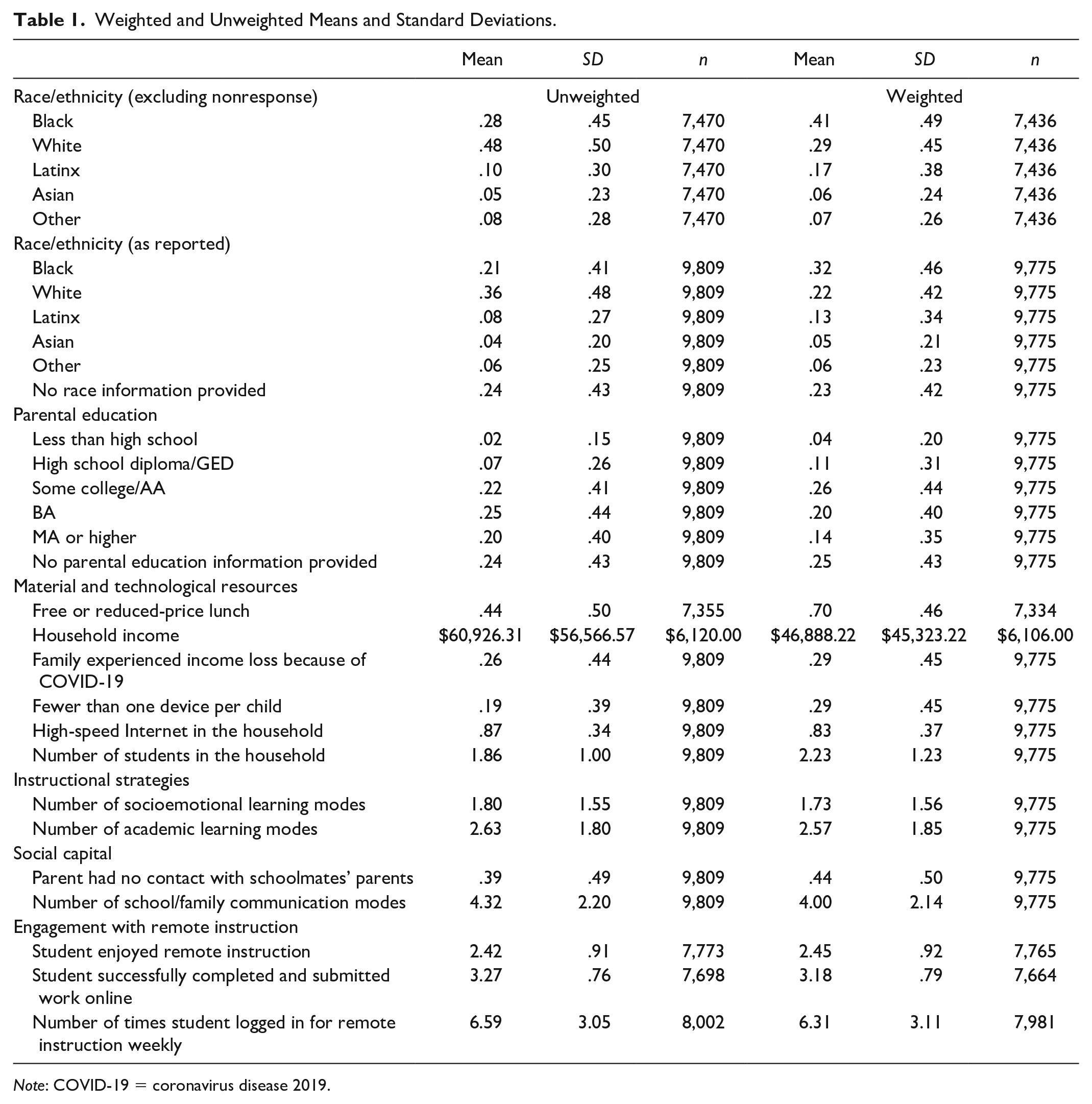
Note: COVID-19 = coronavirus disease 2019.
We use three parent survey items to measure student engagement in remote learning:
Enjoyed remote: the survey asked parents to indicate how strongly they agreed with the statement “My child(ren) are enjoying remote learning,” using a Likert-type scale ranging from 1 (“strongly disagree”) to 4 (“strongly agree”). Much like the measures of job satisfaction that are commonly used in workplace studies, this measure captures students’ affective reactions to remote instruction (Rothmann 2008).
Completed assignments: similarly, the survey asked parents to rate how often “my child(ren) at [elementary school name] are able to complete assignments and submit them online,” using a Likert-type scale rating from 1 (“never”) to 4 (“always”). This measure captures the extent to which students successfully navigated remote instructional environments and completed remote schoolwork.
Log on/week: finally, the survey asked parents, “How often do your child(ren) at [elementary school name] log onto remote learning sessions?” Survey response categories ranged from a maximum of more than 10 times a week to a minimum of 0. We see this measure as an indicator of student commitment to remote instruction.
As the histograms in Figure 1 demonstrate, parent responses on each of these three measures take relatively normal distributions.

Fraction of parents who report children’s engagement with remote learning.
Parent responses to these three items are not highly correlated (ρ = .16–.34), and we understand the items to measure three distinct aspects of students’ remote learning experiences. As such we analyze them separately here, rather than constructing a summary scale.
After exploring racial and parental education gaps in student engagement in remote instruction, we investigate the relationship between student technological resources and engagement net of parental race and educational attainment, using multilevel models of the following general form:

We then analyze the relationship between school instructional offerings and family social capital and student engagement by adding these variables to model 1, estimating multilevel regression models of the following general form:

In these models, Yhs is one of the three measures of student engagement described above; u0s represents a school-level random effect. By including this term and estimating our models in a multilevel framework, we adjust the estimation of all standard errors to account for the clustering of students in schools. In addition, this term allows us to calculate interclass correlation coefficients, which provide insights into the extent to which student outcomes cluster within schools. In general, we find relatively little clustering in outcomes at the elementary school level. Null models, estimated without controls, indicate that schools account for just 2 percent of the total variation in parent reports of student enjoyment of remote schoolwork, 8 percent of the total variation in parent reports of successful completion of school work, and 6 percent of the total variation in parent reports of the number of times student log on weekly. We define resources, instruction, and social capital, and the controls demarcated as Xhs as follows:
Resources is a vector of variables measuring household technological and material resources, including a variable flagging household that participated in the free or reduced-price lunch program (with mean substitution for families that did not respond to this item and an additional dummy flagging these households), a z-scored measure of household income (with mean substitution for families that did not respond to this item and an additional dummy flagging these households), a variable flagging households that indicated that they had experienced income loss during the pandemic, a variable flagging households in which the total number of Internet-enabled devices available to students (including laptops, tablets, and smart phones) was less than the total number of children in the household, and a variable flagging households that have access to high-speed Internet in the home. 3
Instruction is a vector of variables measuring the number of different forms of socioemotional learning families received during the remote learning period (from a list of five items that included extracurricular activities, mental health counseling or support, encouragement for a child to do something kind, opportunities for children to communicate with classmates or friends, and encouragement for children to interact with family members) and the number of different forms of academic learning families reported the school offered to children (from a list of eight different items that included tutoring or extra academic help, assignments, grading, recorded instruction or educational videos or other forms of asynchronous instruction, and virtual class sessions).
We measure social capital using a measure of the number of distinct modes of communication parents report receiving from their children’s elementary schools during the school closure period (from a list of 10 items that included automated calls from school, education apps, social media, personal e-mails, parent-teacher association list servers, letters or packages sent via U.S. mail, neighborhood list servers, virtual meetings such as Zoom meetings, individual text messages or phone calls, and school Web sites) as well as a dummy variable flagging households in which parents report having no contact of any sort with a parent of one of their children’s classmates during the school closure period.
Finally, the controls included in Xhs consist of a series of race/ethnicity dummy variables (including a variable for respondents who did not provide race/ethnicity data), a series of dummy variables measuring parents’ highest level of educational attainment, a flag marking households that completed the parent survey in Spanish, and a continuous variable measuring the number of elementary school children in the household.
Results
Racial Gaps in Engagement with Remote Learning
We first explore racial inequalities in student engagement with remote instruction during the spring of 2020, reporting coefficients from a simple model regressing our engagement outcomes on parent-reported race/ethnicity in Figure 2. 4
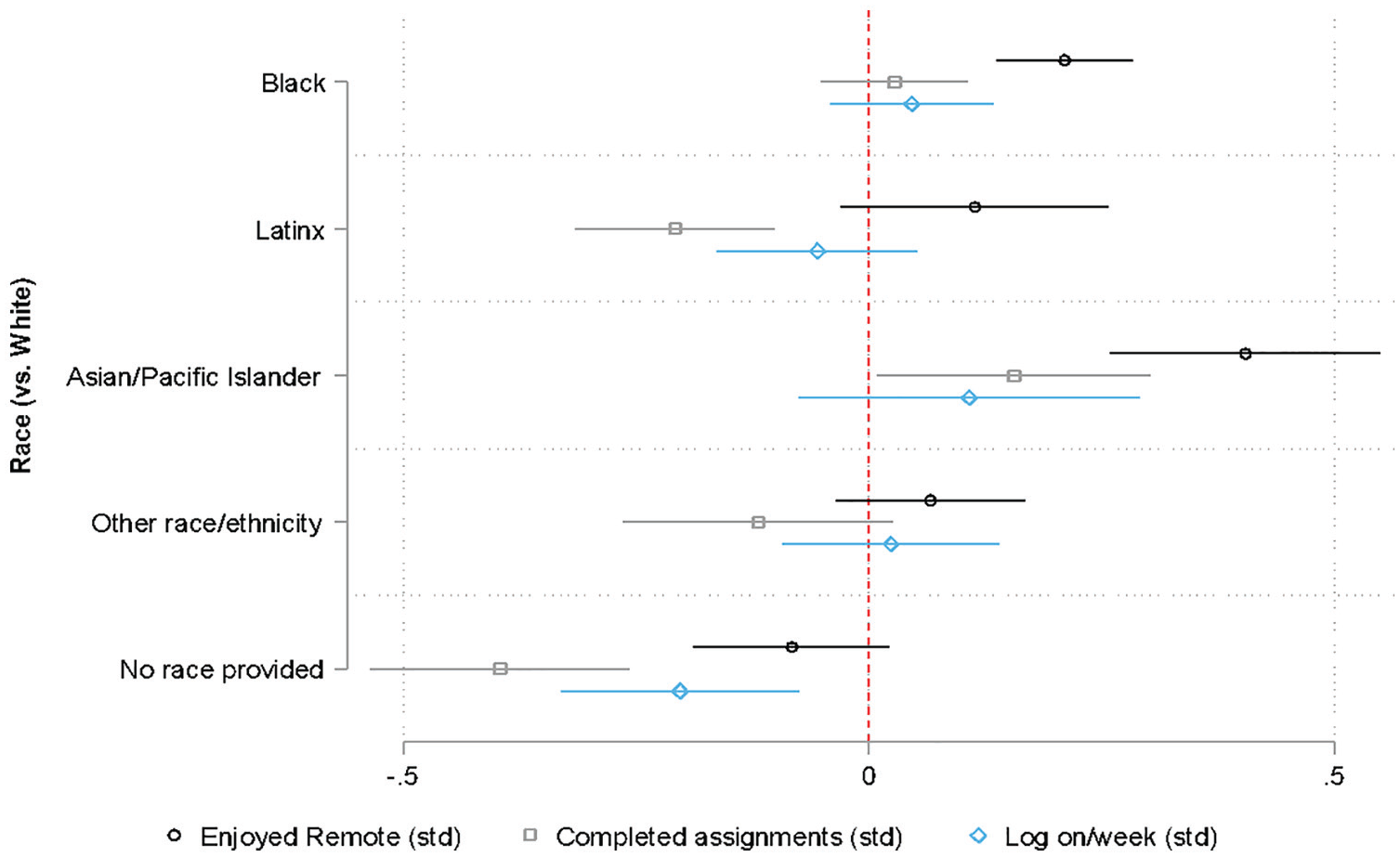
Coefficients from regression of engagement outcomes on race.
These models suggest that racial inequalities in engagement with remote instruction are relatively modest. Black and Asian parents reported significantly higher levels of enjoyment of online learning among their children compared with white parents; these differences range from .2 to .4 standard deviations. Latinx students score significantly lower than white students on our parent-reported measure of children’s success with completing and submitting work online. In contrast, Asian parents report significantly higher levels than white parents on this measure of engagement with remote instruction. Finally, we observe no significant variation among students whose parents provided racial/ethnic identification data in the number of times parents report that their children logged on for remote instruction. We note, however, that the children of parents who did not report race information had less success completing and submitting work online (p < .001) and logged on for online instruction less frequently than white children (p < .01).
Parental Education and Engagement with Remote Learning
Figure 3 provides a similar look at the relationship between parental education and student engagement with remote learning, reporting coefficients from a simple model regression engagement on parental education.

Coefficients from regression of engagement outcomes on parental education.
Although Figure 3 indicates that student enjoyment of remote instruction does not vary substantially with parental education, it suggests that students of relatively highly educated parents have more success in completing and submitting assignments online and log on to remote instruction relatively frequently. Consistent with parental involvement and social class research (Lareau 2011; Lareau and Horvat 1999), children whose parents have BA scores more than .1 standard deviations higher on average than children whose parents finished schooling with high school diplomas on this measure; children whose parents have MAs or more advanced degrees score .25 standard deviations higher than children of high school parents. A similar pattern exists on the parent-reported measure of the number of times students logged on for remote instruction.
Household and Technical Resources Predict Remote Engagement
The analyses reported in Figure 4 explore the relationship between the material and technological resources in students’ household and their engagement in remote instruction.

Coefficients from regression of engagement outcomes on parental financial indicators.
The results of these models highlight the important role access to technology plays in student engagement in remote instruction. Although the district undertook a pronounced effort to provide computers and Internet access to students, our survey results indicate that 29 percent of elementary school students in the district lived in households with fewer than one Internet-enabled device available per school-enrolled child. Furthermore, our survey indicates that nearly 17 percent of elementary school students lived in households that lacked the high-speed Internet access necessary to participate fully in Web-based video instruction. Our analyses indicate that both device availability and Internet access relate significantly to student engagement in remote instruction. Students in households with fewer than one device per child score .13 to .32 standard deviations lower on our measures of engagement in virtual learning. Students with access to high-speed Internet score .32 standard deviations higher than students who lack this resource on the measure of success in completing assignments.
It is notable that these measures of access to technological resources relate to student engagement in remote learning, even after controlling for parental educational attainment, family income, family economic insecurity (as measured by income loss during the during the COVID-19 crisis), and food insecurity (as measured by student enrollment in the school free or reduced-price lunch program.) Although we lack a direct measure of student and family comfort with technology, this finding suggests that providing students with technological resources is, in itself, an important component of addressing inequality across class lines during period. We further note that the relationship between household income and other measures of household material resources and student engagement in remote learning are relatively muted after controlling for these measures of access to technological resources. These findings again point to the importance of access to technological resources for successful engagement in remote instruction.
Instructional Strategies Predict Remote Engagement
Although educators have limited control over their students’ family backgrounds and household resources, they can make potentially important decisions about the instructional resources they provide. In the analyses depicted in Figure 5, we investigate the relationship between these relatively malleable factors and student engagement in remote learning. As it is well established that the instructional practices to which students are exposed and the social capital families deploy vary with student race and socioeconomic status, we estimate these relations net of the racial, parental education, and household resource controls we describe earlier.

Coefficients from regression of engagement outcomes on instructional strategies and social capital.
The coefficients represented in Figure 5 reveal that as the number of opportunities for socioemotional learning available to students increases, students’ engagement with remote instruction increases. Our parental report data indicate that on average elementary grade students in this district were exposed to 1.8 different types of socioemotional learning opportunities during the school closure period. These opportunities included opportunities to interact with friends (available to 57 percent of elementary school students, according to parent reports), encouragement from a teacher or another educator to do something kind (39 percent), socially distanced extracurricular activities (32 percent), and encouragement to interact with family members (32 percent) and counseling (13 percent). It is important to note that these figures likely understate the number of socioemotional learning opportunities schools provide. In analysis not shown, we see that principal reports indicate that the average students’ elementary school provided 4 of the 5 socioemotional learning opportunities; teachers report providing an average of 3.4 of these 5 socioemotional learning opportunities. The gap between educator reports of socioemotional opportunities suggest that many parents and students were unaware of opportunities schools offered during the pandemic lockdown. Supplemental analyses, available on request, consider the relation between educator reports of socioemotional learning opportunities and student engagement with remote learning. These analyses largely return null results, indicating that simply making remote learning opportunities is not sufficient to make students aware of resources and boost engagement.
Each additional socioemotional learning opportunity available to students is associated with a .1 standard deviation improvement in student enjoyment of remote learning (p < .001), net of controls. Additional socioemotional learning opportunities are also associated with smaller but still statistically significant increases in students’ ability to complete and submit online assignments (γ = .07, p < .001) and the frequency with which students log on to remote instruction (γ = .03, p < .01).
The analyses reported in Figure 5 similarly point to a positive association between the number of modes of academic instruction schools provided during the pandemic lockdown and student engagement with remote instruction. According to parent reports, elementary school students in the school district had access to 2.6 different modes of academic instruction while schools were in remote-only instruction in spring 2020. These modes included synchronous virtual classroom meetings, often held via Zoom (available to 51 percent of elementary school students according to parent reports); asynchronous learning opportunities, typically provided via the Canvas learning management system (48 percent); one-to-one online tutoring sessions (12 percent); and printed assignments to be completed offline with pen and paper (67 percent). Each additional mode of academic instruction is associated with improvements in each of the three measures of student engagement with remote instruction. Tellingly, this association is particularly pronounced in the model predicting student success in completing and submitting assignments (γ = 0.09, p < .001), suggesting that providing multiple (and in some cases redundant) forms of remote instruction helps students successfully work remotely. However, our analyses suggest that multiple modes of instruction are also associated with greater student enjoyment of remote learning (γ = 0.05, p < .001) and more frequent logging on to interact with remote instruction (γ = 0.07, p < .001).
Social Capital Predicts Remote Engagement
Consistent with prior work suggesting that social capital is a crucial resource for community resilience in the face of disaster, the sets of coefficients reported in the lower portion of Figure 5 describe robust positive associations between family social capital and student engagement with remote instruction, net of controls. In particular, we find that student engagement with remote instruction improves with each additional mode of communication that parents report receiving from school, from a list that includes recorded telephone class, educational apps, social media such as Facebook, e-mail, parent-teacher association list servers, packages shipped via the U.S. mail, neighborhood list servers, Zoom or other Web-based meeting software, telephone calls, and school or district Web sites. Although these conditional associations are relatively modest in magnitude, each is statistically significant. Net of controls, each additional mode of school is associated with a .02 increase in student enjoyment of remote instruction (p < .05), a .04 increase in student success at completing and submitting assignments (p < .001), and a .05 increase in the number of times students log on weekly (p < .001).
We further find that engagement with remote learning is significantly lower for students whose parents report having no contact with classmates’ parents during the course of the lockdown, compared with students whose parents reported contact with classmates’ parents. Although these conditional associations are relatively imprecise, they are statistically significant across all three outcomes. Net of controls, living in a family that reports no communication with classmates’ parents is associated with .07 standard deviations less student enjoyment of remote instruction (p < .05) and .09 standard deviations less success in completing and submitting work remotely (p < .01).
Although we acknowledge that this measure is blunt, we see a lack of contact with classmates’ parents during this period of profound educational change and uncertainty as an indication that a family has a relatively small store of informal social capital in their children’s school. We thus interpret this negative association as a strong indication of the role informal social capital plays in cultivating school and family resilience in the face of pandemic-induced schooling disruption. We are further struck by how many families in our data meet this definition of low informal social capital. Approximately 40 percent of all elementary school children in this sample, and 56 percent of African American children, are in families that reported no communication with classmates’ families during the spring 2020 crisis period.
Discussion
Across our society, institutions are grappling to develop strategies to cope with the ongoing COVID-19 pandemic, even as the fall 2020 semester comes to a close. School building shutdowns continue to be an important tool for slowing virus outbreaks. However, these shutdowns likely have dire consequences for youth social and academic development. If student learning declines during school closures at the same rate it slides during a typical summer, the spring 2020 COVID-19 school closure may have wiped out half of the mathematics achievement gains and nearly a third of the reading achievement gains students made during the 2019–2020 academic year (Kuhfeld et al. 2020). Furthermore, these learning losses are likely to be particularly acute for students of color as well as students from economically or educationally disadvantaged families.
In this work, we analyzed the ways in which school and family resources provided opportunities for engagement. Engagement with school is crucial for advantageous educational outcomes. During the spring of 2020, finding the ways in which schools could actively engage students was a priority during the campaign to flatten the COVID-19 curve. School-provided remote learning opportunities represent an attempt to mitigate the negative consequences of school building shutdowns for youth educational outcomes and socioemotional development. To succeed, however, remote learning opportunities must effectively engage youth. In this article, we use detailed parent reports of student educational experiences during the crisis months of spring 2020 to highlight three factors that predict student engagement with remote instruction: (1) the degree to which households had access to material and technological resources, (2) targeted school programming and instructional strategies, and (3) family social capital. Our analyses indicate that each of these factors contributes independently to student engagement.
School instruction during spring 2020 can be characterized as an unusual period of learning activity due to the pandemic-induced nationwide state of emergency. Although U.S. schools have since begun to take steps toward new instructional routines, our findings remain instructive for two important reasons. First, despite the seemingly abnormal occurrence of the coronavirus pandemic, school districts often contend with abrupt school shutdowns in the face of unanticipated crises, including natural disaster evacuations, regional disease outbreaks, and even mass shootings. It is not unlikely that student engagement in remote instruction during these periods may approximate the levels we observe in our study, particularly among school districts lacking the resources and infrastructure to effectuate smooth transitions. Second, although the educational community expects to return to a more stable instructional climate in the years to come, the pandemic will likely continue to cause disruptions at least through the 2020–2021 school year.
Our findings thus point to a range of efforts that have the potential to improve student outcomes in the months ahead, as schools across the United States implement remote-only and staggered schooling schedules. First, our results indicate the efficacy of providing technological resources to students who may not have ready access to Internet-enabled devices and high-speed Internet. Second, our results suggest that efforts to provide students with rich, holistic learning opportunities that target both their academic development and their socioemotional development will yield important benefits. Finally, our analyses indicate that educational leaders should be aware of the risks of social isolation for students and their families. By communicating regularly with families and helping forge social ties among families, educators can combat isolation and create communities that enrich student experiences with remote instruction.
Of course, maintaining two-way communications between schools and parents is easier said than done. A rich body of sociological research demonstrates the ways educator assumptions and school practices marginalize poor and minority students and parents (Calarco 2020; Carter 2005; Ochoa 2013). These school/family dynamics create social distances that even the most well-intentioned e-mails and phone calls cannot erase. Furthermore, in a system in which racial and class inequality is deeply entrenched, poor and minority students may reap fewer benefits from parent-school interactions and parental social capital than their more affluent peers enjoy (Fasang, Mangino, and Brückner 2014; Horvat et al. 2003; Lareau and Horvat 1999; Morgan and Sørenson 1999).
Although our analyses indicate that parent-school communication and social capital help boost student engagement, we do not suggest that schools or parents should be blamed for the absence of communication and social capital, particularly during this stressful time. Instead, we hope our findings inspire educators, policy makers, community organizers, and others to undertake intentional efforts to provide resources and a broad range of opportunities for engagement for the most vulnerable students and their families. As the pandemic continues, we are concerned that students will face rising rates of social and psychological isolation (Miller 2011), intensified feelings of depression and anxiety, and profound disruptions at home (YouthTruth 2020). To address these profound challenges, schools and other organizations must continue to find new ways to help physically separated youth and families to forge and maintain social ties.
Supplemental Material
sj-xlsx-1-srd-10.1177_2378023120988200 – Supplemental material for Remote or Removed: Predicting Successful Engagement with Online Learning during COVID-19
Supplemental material, sj-xlsx-1-srd-10.1177_2378023120988200 for Remote or Removed: Predicting Successful Engagement with Online Learning during COVID-19 by Thurston Domina, Linda Renzulli, Brittany Murray, Alma Nidia Garza and Lysandra Perez in Socius
Footnotes
Funding
The author(s) disclosed receipt of the following financial support for the research, authorship, and/or publication of this article: This material is based in part on work supported by the National Science Foundation under grant SES-1626891. Any opinions, findings, and conclusions or recommendations expressed in this material are those of the authors and do not necessarily reflect the views of the National Science Foundation.
Supplemental Material
Supplemental material for this article is available online.
1
Most surveys were completed by June 12, 2020, when remote instruction ended at the focal school district. However, approximately 10 percent of parent survey responses came in late June, when the school district additionally advertised the survey to families in communities with low response rates as part of a door-to-door effort to encourage families in underserved communities to complete the U.S. census.
2
These weights are constructed to correct for uneven response rates across racial/ethnic groups, socioeconomic groups (as measured by free and reduced-price lunch enrollment), and schools. In addition, our sample weights adjust responses for the number of students in each parent survey respondent’s household. These poststratification weights are calculated for each respondent as follows:
Mean[PtotalFRLs, (Frl = 1, Frl = 0)PrespFRL groups, (Frl = 1, Frl = 0), PtotalRE groups, (RE group)PrespRE groups, (RE group)] × Response rates × N(Students in HH),
where Ptotal(FRL)s is all students in school s who enrolled in free and reduced-price lunch, Presp(FRL)s is the proportion of survey respondents from school s who report enrolling in free and reduced-price lunch, PtotalRE groups is the proportion of all students enrolled at school s who identify with the respondent’s racial/ethnic group, PrespRE group is the proportion of all respondents from school s who identify with the respondent’s racial/ethnic group, response rates is the total response rate from the respondent’s school, and N(students in HH) is the number of elementary school students for which the respondent is providing data.
3
Nearly all respondents who do not have access to high-speed Internet in the home access the Internet via cell phones or hotspots.
4
Supplemental analyses, reported in Appendix Table S1, disaggregate the independent contributions of distinct forms of socioemotional learning opportunities and academic instruction with student engagement with online education during the pandemic. We used these regression to produce the figures 1– . While the results of these analyses are imprecise, they suggest that extracurricular activities, encouragement to perform acts of kindness, encouragement to interact with family members, and asynchronous learning opportunities (including online learning and low-tech opportunities such as mailed out worksheets) are all independently associated with student enjoyment of remote instruction. Encouragement to do something kind, interact with friends and family, tutoring opportunities, offline assignments, and synchronous learning opportunities are associated with high levels of success in completing and submitting remote work. Interestingly, however, these models suggest that only online tutoring and synchronous learning opportunities are significantly and independently associated with higher rates of logging on for remote instruction.
Author Biographies
References
Supplementary Material
Please find the following supplemental material available below.
For Open Access articles published under a Creative Commons License, all supplemental material carries the same license as the article it is associated with.
For non-Open Access articles published, all supplemental material carries a non-exclusive license, and permission requests for re-use of supplemental material or any part of supplemental material shall be sent directly to the copyright owner as specified in the copyright notice associated with the article.
