




Abstract
Economic disruption related to coronavirus disease 2019 (COVID-19) continued through the summer of 2020, affecting the lives of millions of Americans. In this visualization, the authors use recent data from the Current Population Survey to examine Americans’ cumulative risk for labor force detachment during the pandemic. The individuals in the analysis were interviewed eight times: in April, May, June, and July of 2019 and 2020. The authors document respondents’ employment experiences during the 2020 pandemic, using the 2019 data points as a baseline for comparison. Increasing detachment from the labor force varies by basic demographic characteristics (gender and parental status), but a more important divide in the COVID-19 economy is education, an already fundamental determinant of Americans’ life chances. The educational divide is especially pronounced among parents, with important repercussions for inequalities among children.
Using data from the Current Population Survey (Flood et al. 2020), in this analysis we examine the cumulative risk for labor force detachment from April to July 2020 among working-aged (25–64 years) adults, with a person’s trajectory from April to July 2019 as a baseline. The sample is broken down by gender, by whether a person has minor children at home, and by whether a person has at least a bachelor’s degree. We consider the specific forms of nonemployment (formal unemployment, nonparticipation in the labor force, and employment leave or furlough), as well as reduced work hours among those who remain continuously employed. Individuals sometimes experience more than one nonemployment status during the April to July period; each nonemployment status is considered separately. Additional details about decisions we made in analyzing the data, as well as some additional findings, are included in the supplementary file.
Research on employment experiences in the initial month of the coronavirus disease 2019 pandemic (Collins et al. 2020; Landivar et al. 2020) documented the importance of gender and parenthood. Our findings (Figure 1) focus on the cumulative risk for labor force detachment over several months and highlight the extreme importance of considering education, especially among parents.
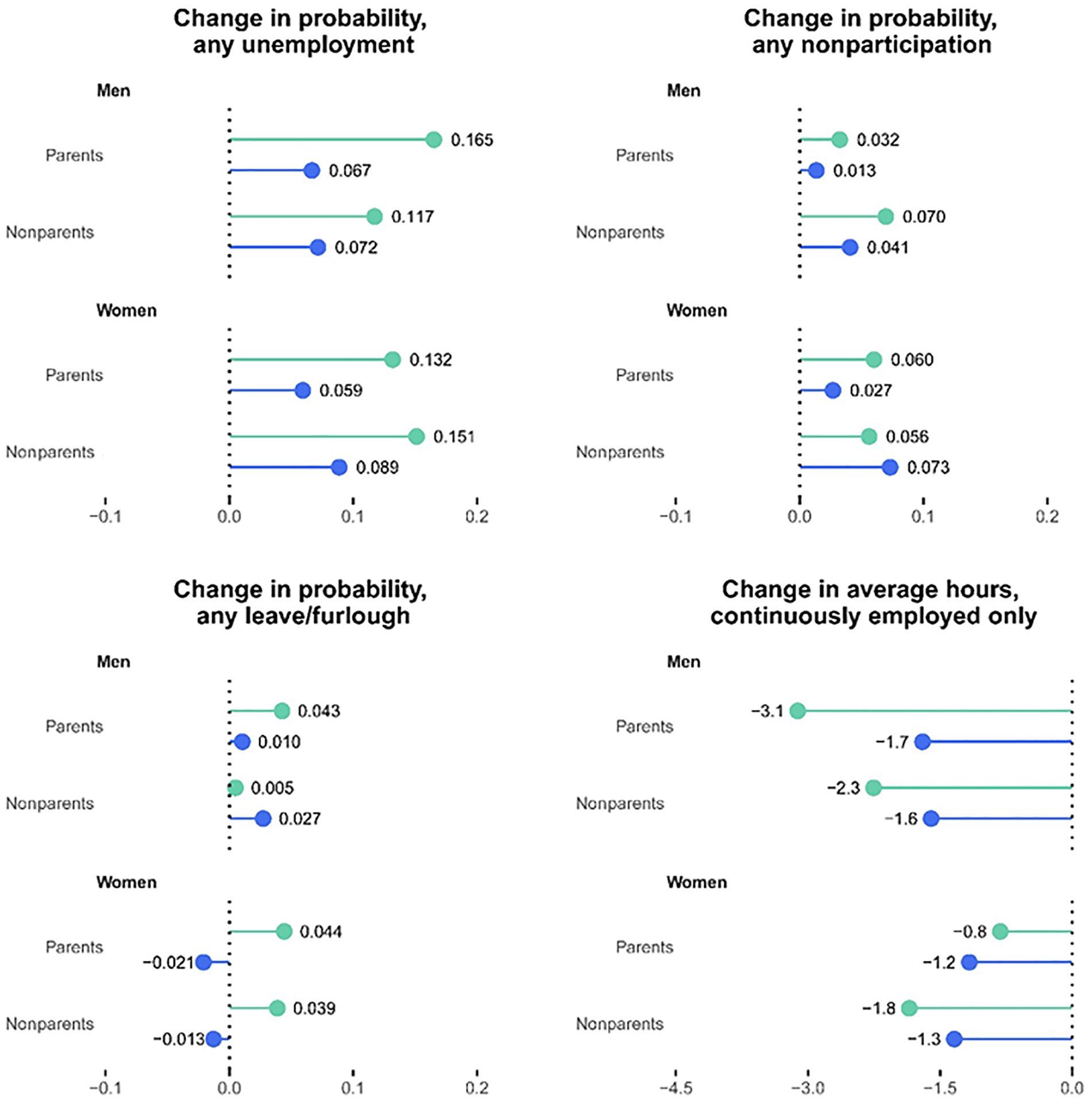
Changes in the probability of unemployment, nonparticipation, and leave or furlough, and work hours, April to July 2020 versus April to July 2019.
Findings
Formal Unemployment
The most important driver of increasing nonemployment during the pandemic has been formal unemployment. For every demographic group, having low education has increased the unemployment toll the pandemic has taken by about twice or more. Less educated fathers have experienced the sharpest increase in the cumulative risk for unemployment, almost 2.5 times larger than the increase among highly educated fathers. Similarly, among mothers, the increase in the risk for unemployment is more than twice as large among the less educated as among the highly educated.
Nonparticipation in the Labor Force
We might predict that parents would be particularly vulnerable to dropping out of the labor force during a time when childcare has been scarce and schools have been closed. However, nonparticipation can also be a hidden form of unemployment for discouraged workers, particularly in a slack economy. Parents do not appear to have experienced larger increases in nonparticipation than nonparents. Perhaps this is because growing discouragement among unemployed workers has outweighed supply-side decreases in participation. As with unemployment, the educational divide in nonparticipation is striking, especially among parents.
Employment Leave and Furlough
An individual who still has a job has the hope of returning to it in the not too distant future. However, during an economic downturn, leave or furlough may be a transition to unemployment, and even if a person does eventually return to his or her job, time away may have negative effects on work experience and earnings. The largest increases in leave and furlough are among less educated groups. Highly educated women, especially mothers, actually had somewhat lower risk for leave or furlough in 2020 than they did in 2019. One potential explanation is that they may have been less likely to take advantage of voluntary parental or other leave policies during difficult economic times.
Work Hours
The last panel, work hours, includes only those who were continuously employed across all observations in both years and whose increasing labor force detachment is therefore not represented in the other panels. Hours are averaged across a person’s April to July observations in 2019 and 2020, respectively. We see at least small declines in hours among every group. Mothers’ increasing labor force detachment during the pandemic is accounted for mostly by changes in employment status; among those mothers who remained continuously employed, hours changed less than for other groups. The largest change in hours is among less educated men, especially among less educated fathers.
Discussion
The current pandemic has exacerbated many forms of inequality. An educational divide in Americans’ life chances, already large before the pandemic (Putnam 2016), seems likely to grow even larger as economic disruption hits less educated workers far harder than others. Troublingly, this educational divide in adults’ employment experiences has widened especially among parents, contributing further to the “diverging destinies” of children that have been decades in the making (McLanahan 2004).
Supplemental Material
sj-docx-1-srd-10.1177_2378023120979804 – Supplemental material for A Growing Educational Divide in the COVID-19 Economy Is Especially Pronounced among Parents
Supplemental material, sj-docx-1-srd-10.1177_2378023120979804 for A Growing Educational Divide in the COVID-19 Economy Is Especially Pronounced among Parents by Christel Kesler and Sarah Bash in Socius
Footnotes
Acknowledgements
We gratefully acknowledge the McVeigh Data Science Initiative at Colby College, which provided funds to support our work on this project.

Supplemental Material
Supplemental material for this article is available online.
Author Biographies
References
Supplementary Material
Please find the following supplemental material available below.
For Open Access articles published under a Creative Commons License, all supplemental material carries the same license as the article it is associated with.
For non-Open Access articles published, all supplemental material carries a non-exclusive license, and permission requests for re-use of supplemental material or any part of supplemental material shall be sent directly to the copyright owner as specified in the copyright notice associated with the article.
