



Abstract
The precarious work construct combines employment instability and employment-contingent outcomes. Yet, I argue that confining the scope of the investigation to employed individuals creates a sample selection that disguises the heterogeneous nature of employment instability. The COVID-19 skyrocketing unemployment rate provides both a compelling motivation and a unique opportunity to revisit the construct of precarious work. Using pre-COVID and COVID-19 era data of the working-age population in Israel, the results demonstrate that by pushing less stable individuals out of employment, the COVID-19 recession strengthened the negative relationship between volatility and employment opportunities and accentuated sample selection. Because the selection into employment was not random, this introduces a bias into the measurement of precarious work, one that is more severe during a recession than in a full-employment market. The discussion highlights the broader significance of this lacuna and suggests a way to hone the conceptualization and operationalization of the precarious work construct.
Recent decades have witnessed gradual transformations in work arrangements and employment contracts due to economic, technological, and globalization changes. One of the most notable transformations is the proliferation of precarious work, a departure from the model of stable and secure employment with benefits. The popularity of the precarious work construct derives from its comprehensive conceptualization, which considers employment instability as well as various aspects of job quality. Since employment instability is characterized by considerable heterogeneity in labor market outcomes, including aspects of job quality in the definitions of precarious work helps distinguish employment instability that is detrimental from instability that is rewarding. Yet this comprehensiveness of the precarious work construct is also its shortcoming. Gluing together employment instability and employment-contingent outcomes confines the scope of the investigation to employed individuals. If the selection into employment is not random, it disguises the heterogeneous nature of employment instability and leads to biased estimates of the magnitude, nature, and consequences of precarious work. These two issues, truncated heterogeneity and selection bias, are exacerbated during recessions when both unemployment and employment volatility spike.
To enhance our understanding of the measurement of precarious work in different market conditions, this study follows the multifaceted advice of Clogg et al. (1990, p. 1538) to focus on “the dynamic aspects of the labor force, one that recognizes the role of economic fluctuation in the distribution of labor-market rewards”. First, it uses an inclusive sample of the working-age population to gauge the prevalence of labor-force dynamics, measured by employment volatility history (EVH), and assess its variation by market conditions (expansion and recession). Second, it examines how random selection into employment is and whether it varies by market conditions. Finally, it illustrates the possible effect of selection into employment on estimates of economic situation and demonstrates how they vary by market conditions.
The unique characteristics and sheer magnitude of the COVID-19 job market disruption, one of the severest in recent history, provide the “perfect storm” required to examine the temporal variation in the relationship between employment volatility and labor market outcomes. Most pertinently, the COVID-19 recession is unique in its work-related features. Social distancing requirements have imposed structural shifts, most notably the expansion of work from home, virtual communication, e-commerce, and the disruption, if not complete hiatus, in multiple industries. Countries worldwide have experienced record-high rates of worker displacement. In Israel, for example, the share of displaced workers in April 2020, including the unemployed and those temporarily absent from work for pandemic-related reasons, was 37 percent. In the same month, employment in the U.S. plummeted by 20.7 million—the largest decline documented since 1939, when measurement started (Ansell & Mullins, 2021). Moreover, countries worldwide have experienced unprecedented GDP slumps (OECD, 2021). 1 Thus, COVID-19 is a global phenomenon, with countries experiencing similar labor market disruptions worldwide. Additionally, unlike other recessions, the COVID-19 recession stems from an exogenous, abrupt, well-defined, and non-fiscal shock. Finally, in contrast to other disasters that cause huge physical damage and large-scale migration (Arcaya et al., 2020; Hunter et al., 2015), the COVID-19 outbreak has not led to population mobility; rather, it has forced people to stay at home, devoid of employment alternatives. Given these disruption's characteristics and their effect on worker displacement and employment instability, the COVID-19 jolt is a unique opportunity to revisit the construct of precarious work.
This empirical investigation juxtaposes pre-COVID and COVID-19 era data to compare two market conditions: near full employment and recession. It relies on a survey of the working-age population in Israel at the height of the second wave of COVID-19, with an unemployment rate of around 20 percent in the fall of 2020. Thus, the data capture work arrangements during a highly volatile and uncertain period. These peak-pandemic estimates are consolidated and juxtaposed with a parallel assessment conducted in 2016 as part of the International Social Survey Programme (ISSP) when the Israeli labor market was in (near) full employment (4.1 percent unemployment; Bank of Israel, 2022). Prior ISSP surveys (1998 and 2005, both recession periods) are utilized to gain retrospective insights regarding the nature of selection into employment during the pandemic recession compared to typical recessions. The juxtaposition of precarious work under two extreme market conditions, 2016 and 2020, as well as the long-term perspective (1998–2020), provides a useful handle for assessing swings in the scope, nature, and consequences of employment instability and for comprehending whether and how we should hone the conceptualization and operationalization of the precarious work construct so it would capture volatile careers under all market conditions.
Precarious Work
Definitions
Definitions of precarious work focus on workers’ vulnerability or deviation from the standard employment relationship (SER), defined as full-time, continuous, and long-term employment; job tenure; standardized working time; and work directed by an employer at the place of business (Kalleberg & Hewison, 2013; Vosko, 2010). These conditions occur in internal labor markets (ILMs), which Piore (1975) defines as the primary markets. A defining feature of SER, reminiscent of the Fordist and Keynesian orders, is stability and continuity.
There are numerous definitions for precarious work. Rodgers and Rodgers (1989) define it as uncertain and irregular work, in which workers lack control over their salary, working conditions, and social protection, and experience economic insecurity. Kalleberg and Vallas (2018) refer to uncertain, unstable, and insecure work in which employes bear the risks of work and receive limited social benefits and statutory protections. For Mai (2018), precarious work pertains to an uncertain job that offers poor prospects of career mobility and puts workers in an economically insecure position. Vosko's (2010) precarious employment is characterized by uncertainty, discontinuity, multiple jobs, and self-employment; limited formal protection; low control of working conditions, wages, and intensity; lack of union membership and collective bargaining coverage; and inadequate income and benefits. The European Commission defines precarious work as being in the lowest income quartile, with job tenure shorter than one year, a fixed-term or contemporary employment agency contract, low intellectual job content, high heteronomy, harassment during the last 12 months, unsocial working hours, and noxious physical job environment (Frade et al., 2004). Finally, the Employment Precariousness Scale (EPRES) is a 26-item multidimensional scale that refers to “temporariness” (contract duration), “wages” (low or insufficient; possible economic deprivation), “disempowerment” (level of negotiation of employment conditions), “vulnerability” (defenselessness to authoritarian treatment), “rights” (entitlement to workplace rights and social security benefits) and “exercise rights” (powerlessness, in practice, to exercise workplace rights) (Vives et al., 2010).
Despite the conceptual ambiguity of these definitions, the merit of the precarious work construct stems from the bridge it spans between various paradigms by mingling together aspects of job quality with employment instability, its core feature. Some of the key aspects of precarious work – low wages, inadequate benefits, lack of control over work activities, minimal flexibility, opportunities for advancement, or social protection – parallel aspects of “bad” jobs (Kalleberg, 2011). Other aspects – uncertainty, instability, insecurity – parallel facets of nonstandard and flexible employment (part-time work, temporary help agencies, contract work, short-term employment, and contingent work; Barbieri, 2009; Kalleberg, 2000; Standing, 2011), and the secondary labor market (Doeringer & Piore, 1971; Piore, 1975). 2
Yet, the inclusion of employment-contingent items in the definition of the precarious work construct is also its Achilles’ heel. This amalgam ignores the labor force dynamics of the working-age population. The exclusion of non-workers creates sample selection, which, if nonrandom, masks the heterogeneous nature of employment volatility and yields biased estimates of the magnitude and nature of precarious work.
The Heterogeneous Nature of Employment Instability
The link between employment instability and labor market outcomes is not straightforward. A history of employment volatility can lead to inferior labor market outcomes, but mobility can also be key for improving job quality and serve as a stepping stone for career development (De Cuyper et al., 2011).
On the one hand, a history of employment volatility may have a scarring effect on labor market outcomes (Barbieri et al., 2019). Human capital theory stresses the benefits of work experience and job-specific training for the creation of labor market skills that raise future productivity (Becker, 1993). Turnover, especially periods of idleness, lower the stock of accumulated work experience and lead to the deterioration of skills and human assets already acquired (Spivey, 2005). Human capital theory predicts that employers will prefer not to invest in training unstable workers who move in and out of the labor market or frequently switch jobs (Hamil-Luker, 2005). Thus, the more stable workers will be channeled into jobs requiring more training, characterized by greater responsibility and higher pay. The scarring effect of employment volatility history can also result from signaling (Spence, 1973, 2002). A history of instability and long spells of labor force idleness not only convey to employers the individual's underlying level of competence and productivity but are also taken as a sign of unobserved attributes (e.g., motivation, loyalty, persistence, and “taste” for paid work). This, as Spence (2002) noted, is a self-confirming process in which early attachment levels are used by employers to set wage rates, which in turn affect employes’ future investments. Moreover, given the theorized barrier between the secondary and the primary labor markets, and that the defining features of “good” jobs stem from the structure of ILM, a history of work volatility can also trap individuals in the secondary labor market. Finally, differences in traits and behaviors between workers with stable and unstable work histories may exist ex-ante and potentially be exacerbated ex-post by the working conditions in the two sectors (Piore, 1975).
On the other hand, employment volatility and nonstandard work arrangements are becoming more prevalent in recent decades (Farber, 2010), and in a world where SER is not the norm, precarious work history may have less bearing on labor market outcomes. Moreover, high levels of turnover can be used to improve the match between the worker and job – workers receive new information about their current market arrangement or learn about a more attractive match, leading to better jobs and higher job satisfaction (Jovanovic, 1979a, 1979b). In addition, a high level of volatility characterizes many high-skill lucrative jobs. For some workers in nonstandard employment (such as independent contractors), high turnover is not only voluntary but even desirable (Adler, 2021; Barley & Kunda, 2006; Cohany, 1998; Kalleberg, 2000; Kunda et al., 2002). This class of professionals, such as consultants, project-oriented freelance workers, and short-term contractors – proficians in Standing's (2011) typology – are well compensated but lack employment security and statutory protection. Embodying the heterogeneous outcomes of employment instability is another category in this typology, precariats or flexiworkers, which also refers to nonstandard flexible employment, characterized by instability and lack of protections. Yet, for this group of casual low-paid workers, a history of employment volatility likely has a scarring effect.
What complicates this conundrum is the variation in the type of transitions. Employment volatility can take many forms, including changing employers, occupations, mode of employment (salaried/self-employed), and transitions in and out of the labor force. The labor market outcomes of these transitions may vary accordingly. For example, job shopping after graduation is found to generate early-career wage growth for white men (Topel & Ward, 1992); others suggest it does not affect future wages (Gardecki & Neumark, 1998), and still, others show that it is negatively associated with wage levels (Light & McGarry, 1998). Solving this conundrum, Alon and Tienda (2005) demonstrate that this relationship follows a curvilinear pattern: frequent job changes during the first four post-school years reap positive wage returns for women but incur wage penalties thereafter (for a similar curvilinear pattern among men, see Yankow, 2022). Some find a long-term wage penalty for early-career temporary employment compared to the standard permanent career sequence (Fauser, 2020), while others report higher wage growth (Fuller & Stecy-Hildebrandt, 2015; Gebel, 2010; Reichenberg & Berglund, 2019), or no penalty (Padulla, 2016). Research also demonstrates the long-term penalties associated with long spells of idleness (Alon et al., 2001; Alon & Haberfeld, 2007).
Taken together, employment instability is characterized by considerable heterogeneity in labor market outcomes. This variation is explained by the type and reason for the transition, 3 career stage, initial wage level, industry, individual circumstances, structural location, local market conditions, and welfare regime (Alon & Tienda, 2005; DiPrete et al., 1997; Pavlopoulos et al., 2014). Including aspects of job quality in the definitions of precarious work helps distinguish employment instability that is detrimental from instability that is rewarding. Yet, limiting the scope to employed individuals masks the heterogeneity of volatile careers and ignores labor force dynamics.
Labor Force Dynamics and Labor Market Outcomes
There is a strong linkage between labor force behavior and labor market outcomes (Clogg et al., 1990). Research demonstrates that labor market inadequacy, measured by the labor utilization framework (LUF; Clogg, 1979; Clogg & Sullivan, 1983; Sullivan, 1978), tends to correlate with labor force instability (Alon, 1998; Clogg et al., 1990). Yet, most sociological approaches to the analysis of labor market stratification, including the literature on precarious work, ignore information about previous labor force dynamics (Clogg et al., 1990). Moreove, the precarious work paradigm limits the scope of research to employed individuals as it bundles measures for working conditions/job quality with employment instability. Yet, because employment instability includes labor force transitions and periods of idleness, focusing on currently employed individuals to measure precarious work essentially generates a sample selection problem.
Breen (1996, p. 3) clarifies the type of sample selection that applies to the construct of precarious work: “in so-called sample selection problems (Heckman, 1979), whether or not we observe
Heckman (1979, p. 154) pinpoints the problem: “Suppose … that data are missing on Y1 for certain observations. The critical question is ‘why are the data missing?’” If the data is missing at random, the only cost of having an incomplete sample is a loss in efficiency. Yet, employing a “sample selection rule that determines the availability of data,” or censoring, as does the precarious work construct, has “serious consequences” (Heckman, 1979, p. 155). If sample selection is not at random, it may yield biased conclusions about the scope and heterogeneity of precarious work and the opportunity structure faced by precarious workers. Thus, if people with volatile careers are less likely to be employed or are the first to lose their job, focusing only on those employed will yield an underestimation of the magnitude of precarity and its heterogeneity. Consequently, both external validity and internal validity are jeopardized (Berk, 1983; Gronau, 1974; Winship & Mare, 1992). Thus, whether the data is missing at random or not is a focal empirical question.
Labor force dynamics and employment instability are especially sensitive to macro-level economic conditions. Thus, economic-cycle fluctuations determine the chances of obtaining secure and stable employment, the extent of the sample selection problem, and the degree of bias in the measurement of precarious work. Sample selection is a lesser problem in a full-employment labor market, than in a recession, when employment volatility and worker displacement spike (Brand, 2015). Moreover, unstable workers are the first to feel a recession and the last to recover as they move between states of underemployment (Alon, 1998, 2004). Thus, sample selection is a much more debilitating problem for the assessment of precarious work during recessions than in a full-employment market. To understand the impact of sample selection on the measurement of precarious work, we need to assess the magnitude and randomness of selection into employment in a full-employment market and a recession.
Taken together, the precarious work construct, by definition, masks a high level of heterogeneity in labor market outcomes and creates sample selection that may yield biased empirical estimates of precarious work. Both issues are likely more acute during recessions than in periods of economic growth and full-employment market. This study assesses these issues among the entire working-age population, capturing the experiences of everyone “exposed” to recession shocks (Clogg et al., 1990). This inclusive sample facilitates the consideration of several questions:
Does the volume and demographic profile of employment volatility vary by market conditions?
2. How random is selection into employment, and does it vary by market conditions? Essentially, the question is how unique COVID-19-generated unemployment is compared to prior periods of labor market constriction. One may think that the pandemic hit the labor market at random, shutting down entire industries (for example, the hospitality industry). Yet, this is not entirely accurate because even in the affected industries, not all workers were laid off, while in unaffected industries, there were layoffs because of the contraction of overall business activity. The overarching hypothesis is that COVID-generated unemployment was not completely random. Specifically,
3. What is the possible effect of sample selection on estimates of precarious work and how do they vary by market conditions? I demonstrate the possible effect of sample selection on estimates of precarious work using the lens of economic insecurity, an essential aspect of the precarious work construct, and for which information is available for the entire population.
The magnitude of the COVID-19 record-high unemployment provides a unique opportunity to examine these questions. The juxtaposition of estimates for precarious work in high-unemployment and full-employment markets confers indispensable theoretical leverage for the conceptualization and measurement of precarious work.
Methods
Data
A cross-sectional design juxtaposes pre-COVID and COVID-19 era data to compare two market conditions: near full employment and recession. The most recent assessment of work orientations in Israel, obtained as part of the ISSP in 2016, serves as a benchmark for estimating shifts in precarious work during the pandemic (face-to-face interviews with a representative sample of the Israeli population; N = 978; ages 25–69). At the time, the unemployment rate in Israel was 4.1 percent. The COVID-19 era data (2020) are obtained from an online survey, using a probability-based representative sample of working-age individuals drawn randomly from the population registry (N = 1,247; ages 25–69; response rate: 46 percent). At the time, the unemployment rate in Israel was 18.2 percent. 4 To facilitate the comparison to 2016, 5 most of the questions for the 2020 instrument were borrowed from the 2016 instrument, and all estimates were adjusted to background characteristics. The 2016–2020 analysis omits individuals who are permanently out of the labor force (not employed in the last five years) and individuals who had missing data on all volatility history variables. The analytical sample contains 1,924 respondents. To enable inference to the entire population, the estimatesare weighted with raking weights based on iterative proportional fitting (Bishop et al., 1975).
I also append prior ISSP surveys to this data to compare the demographic attributes associated with unemployment during COVID-19 with typical recession periods (Q2). Hence, data from the ISSP work module in 1998 and 2005 were appended; both years were recession periods, with an unemployment rate of 8.9 and 9.6 percent in 1998 and 2005, respectively. 6 The analytical sample contains 5,608 respondents. Appendix Figure 1 displays the temporal trend in the unemployment rate in Israel between 1980 and 2021, including all years of the surveys utilized in this study. This historical perspective provides important insights regarding the nature of the selection into employment during COVID-19 and previous recessions.
The Setting: Israel, 2020
The broader context in Israel in 2020, especially in September-October 2020 when the data were collected, is important for situating the findings of this study in the concurrent labor market conditions. The survey was conducted nine months into the pandemic, at the height of the second COVID-19 wave in Israel (and the first substantial one, as seen in Appendix Figure 2). At the time, Israel was the country with the highest rate of new cases, with a higher per capita death rate than several developed countries (including Austria, France, South Korea, the U.K., and the U.S.; Worldometer, 2020). That period saw a countrywide lockdown, including the nearly complete closure of schools and businesses and restrictions on individual mobility to within 500 meters of homes, except for going to work and essential activities such as buying food and pharmacy goods. Like the first lockdown, it lasted several weeks, with restrictions stricter than the OECD average, severely disrupting labor market activity (Bank of Israel, 2020). Data from Google COVID-19 Community Mobility Reports (not shown) vividly demonstrate the decline in mobility trends, including retail and recreation, use of parks, and workplaces. 7
Due to these restrictions, the share of displaced workers rose sharply in September and October 2020 compared to previous months (from 11.7 in August 2020 to 20.8 in October 2020; see Appendix Figure 3). The 2020 unemployment rate was the highest in Israel's history, surpassing the records of the 1990s and the 2000s. Within 2020, the months of March-May and September-October set monthly records. Unemployment benefits were extended in Israel, as in many countriess to deal with the immense employment crisis. The number of unemployment benefits recipients soared in April, September, and October 2020 (Endeweld & Heller, 2020). 8 The goal was to compensate the unemployed for the lower level of labor demand. The ratio between supply (job seekers) and demand (vacancies) was 7.1 (seven job seekers for any single job opening) in the third quarter of 2020, compared to 3.5 on the eve of the pandemic. In all occupations, the number of job seekers exceeded the number of job vacancies.
This detailed depiction of the institutional setting clarifies the havoc social distancing wreaked on the Israeli labor market, similar to other developed countries. The COVID-19 recession may be different from a “normal” downturn of a business cycle in some ways, but it resembles a key aspect: a decline in economic activity and a high unemployment rate. This study takes advantage of this skyrocketing unemployment rate to assess the construct of precarious work and find patterns that are usually hidden in typical recessions.
Variables
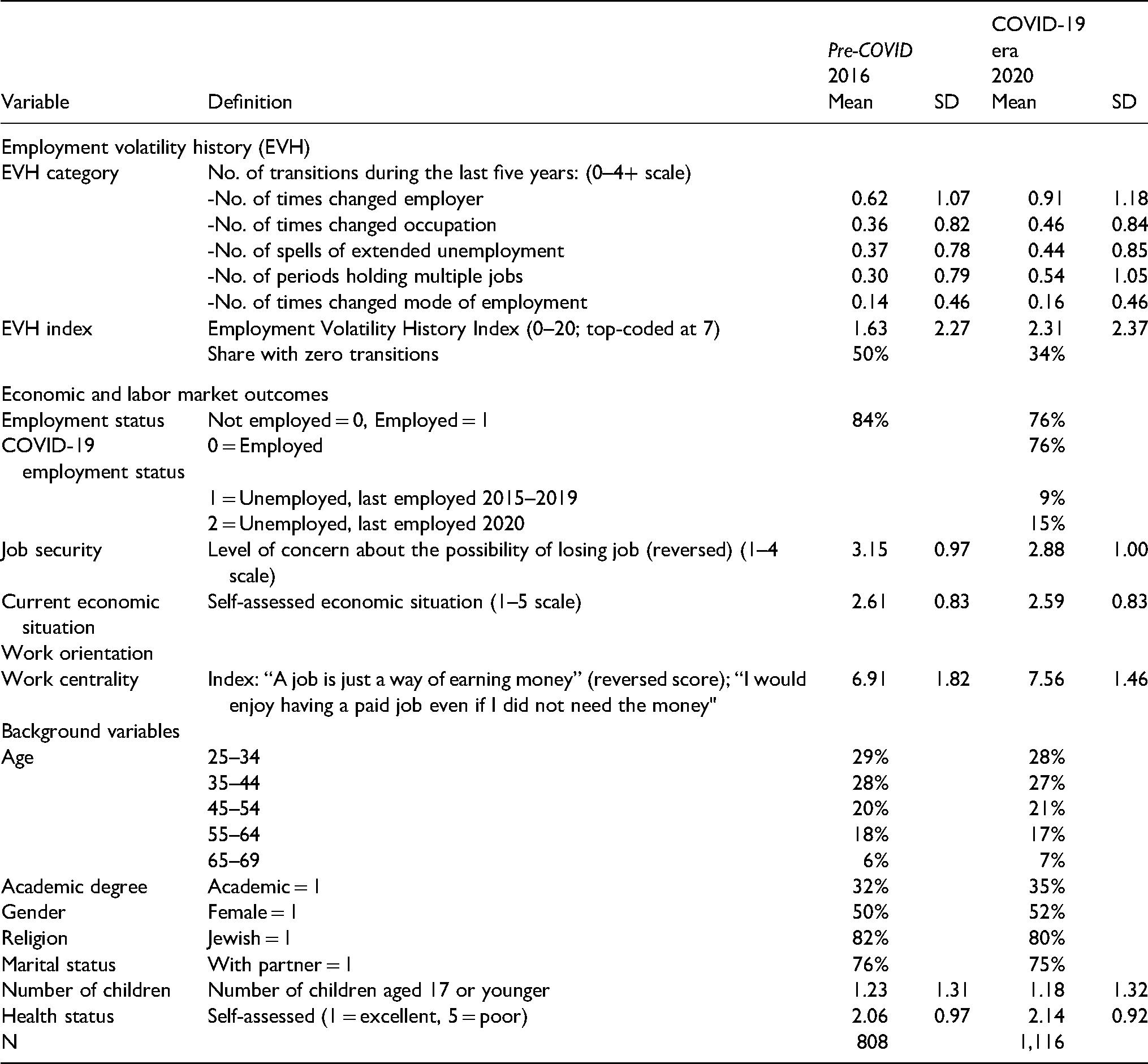
Table 1 provides detailed definitions and descriptive statistics for the working-age population (25–69) for all key variables.
Variable Definitions and Descriptive Statistics, Working-Age Population, Israel, 2016, 2020
Year: 0 = 2016 and 1 = 2020.
Employment volatility history (EVH): The number of employment transitions during the last five years is measured by category and total volume. Volume by category: A set of five variables measuring the number of transitions in each category of volatility (employer changes; occupational change; transitions between modes of employment (started own business/became self-employed); spells of extended unemployment; holding concurrent jobs). 9 Total volume is measured by an index that sums up all employment transitions during the past five years (ranges from 0–20); it is top coded at seven transitions (five and ten percent of observations had seven or more transitions in 2016 and 2020, respectively).
Economic and labor market outcomes, including current employment status, job insecurity, and perceived economic situation.
Work centrality: An index based on two statements: “A job is just a way of earning money” (reverse scored); “I would enjoy having a paid job even if I did not need the money.”
Background variables: A vector that includes indicators for age, academic degree, gender, religion, marital status, number of kids, and health status.
Analytic Strategy
This study's framework diverts from the common practice in precarious work research by starting with an inclusive sample of the working-age population to assess the link between labor force/market dynamics and labor force/market outcomes. This theoretically driven decision essentially corrects for unmeasured heterogeneity and avoids sample selection (Clogg et al., 1990). To answer Q1 (temporal shift in the prevalence EVH) I fit Equation (1), in which 
The Prevalence of Employment Volatility, Working-Age Population, 2016 and 2020, OLS Regression Estimates
Robust standard errors in parentheses.
*** p < 0.01, ** p < 0.05, * p < 0.1.
To answer Q2 (the nature of the selection into employment by market conditions), I first fit Equation (2) in which 
Employment status by employment volatility history, working-age population, 2016 and 2020.
Probability of unemployment, Working-age population, 1998–2020, by academic degree (ref: employed).
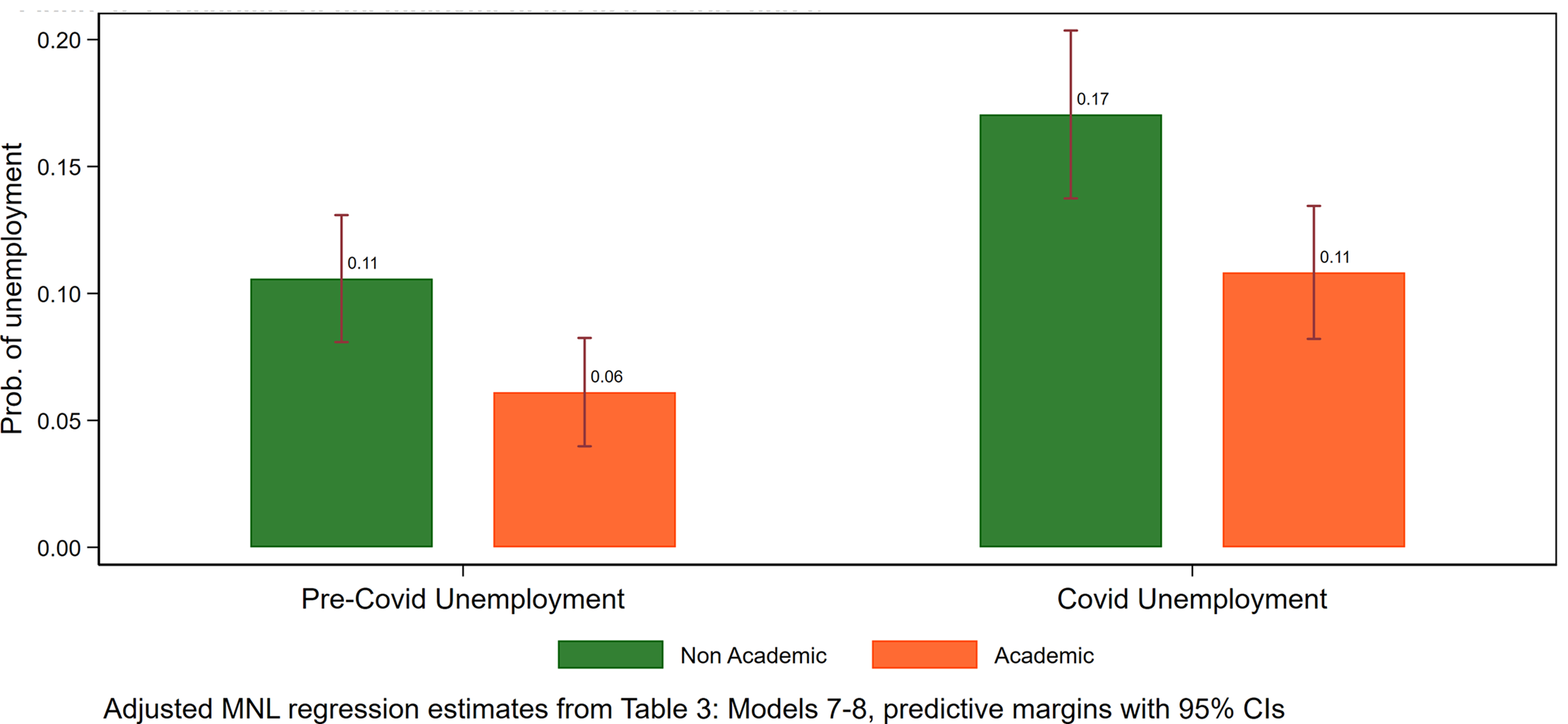
Probability of unemployment in 2020, before and during COVID-19, by academic degree (ref: employed).
The Demographic Profile of Unemployed Individuals, Working-Age Population, 1998–2020 (Ref: Employed)
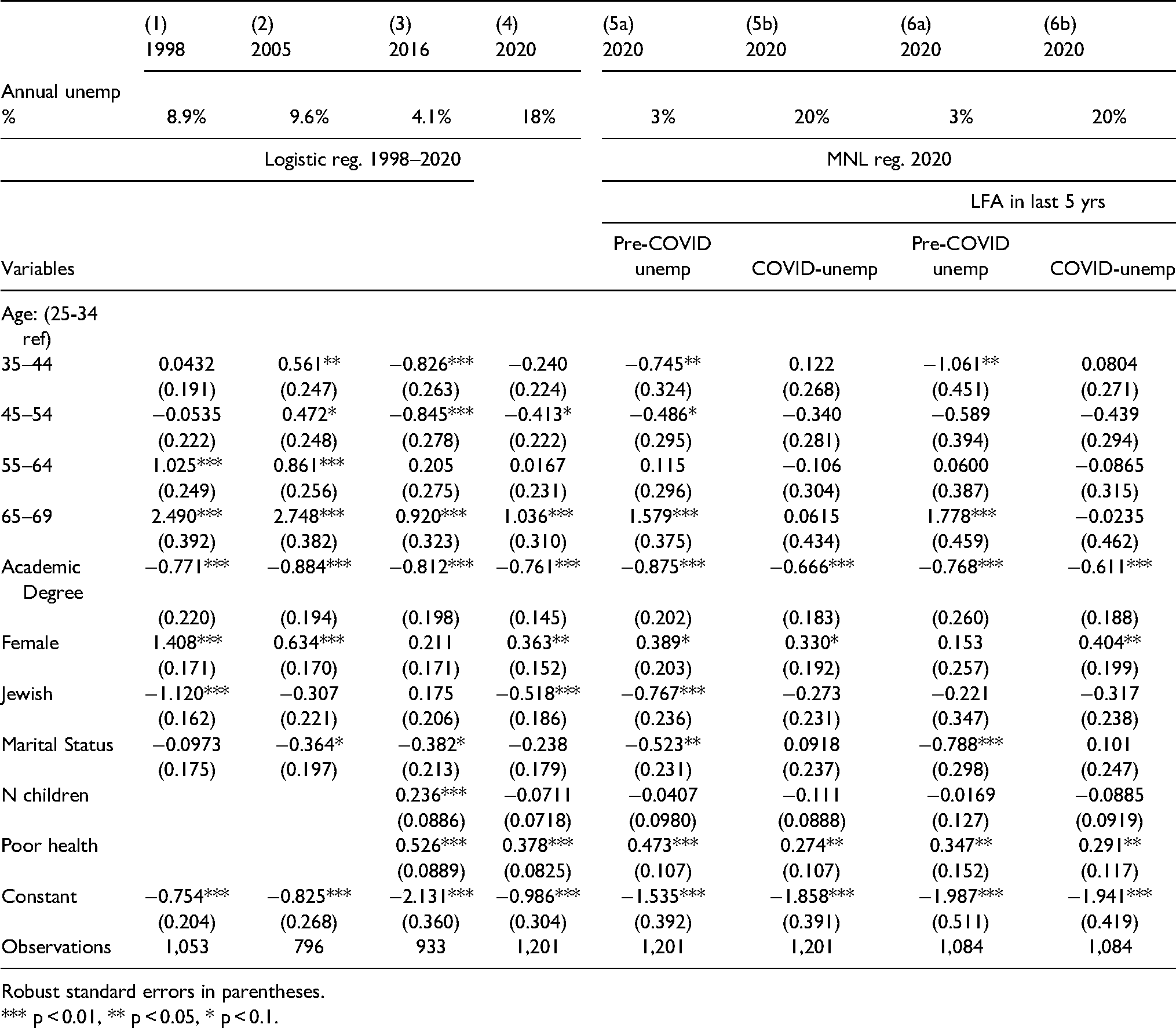
Robust standard errors in parentheses.
*** p < 0.01, ** p < 0.05, * p < 0.1.
Finally, to answer Q3 (the effect of sample selection on estimates of economic situation) I fit Equation (3) in which 
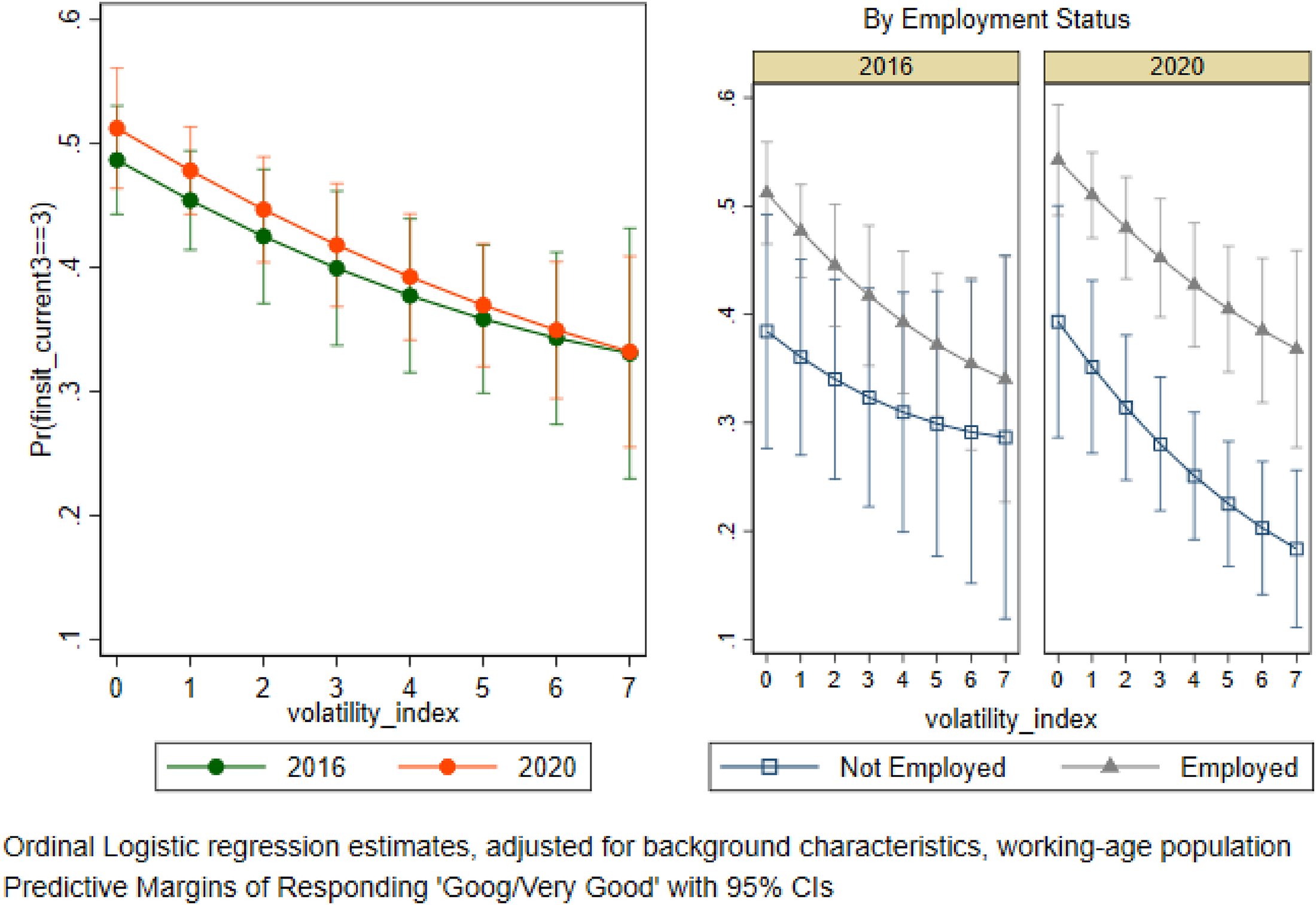
Economic situation by employment volatility history and employment status, working-age population, 2016 and 2020.
Results
Temporal Shifts in the Prevalence of Employment Volatility
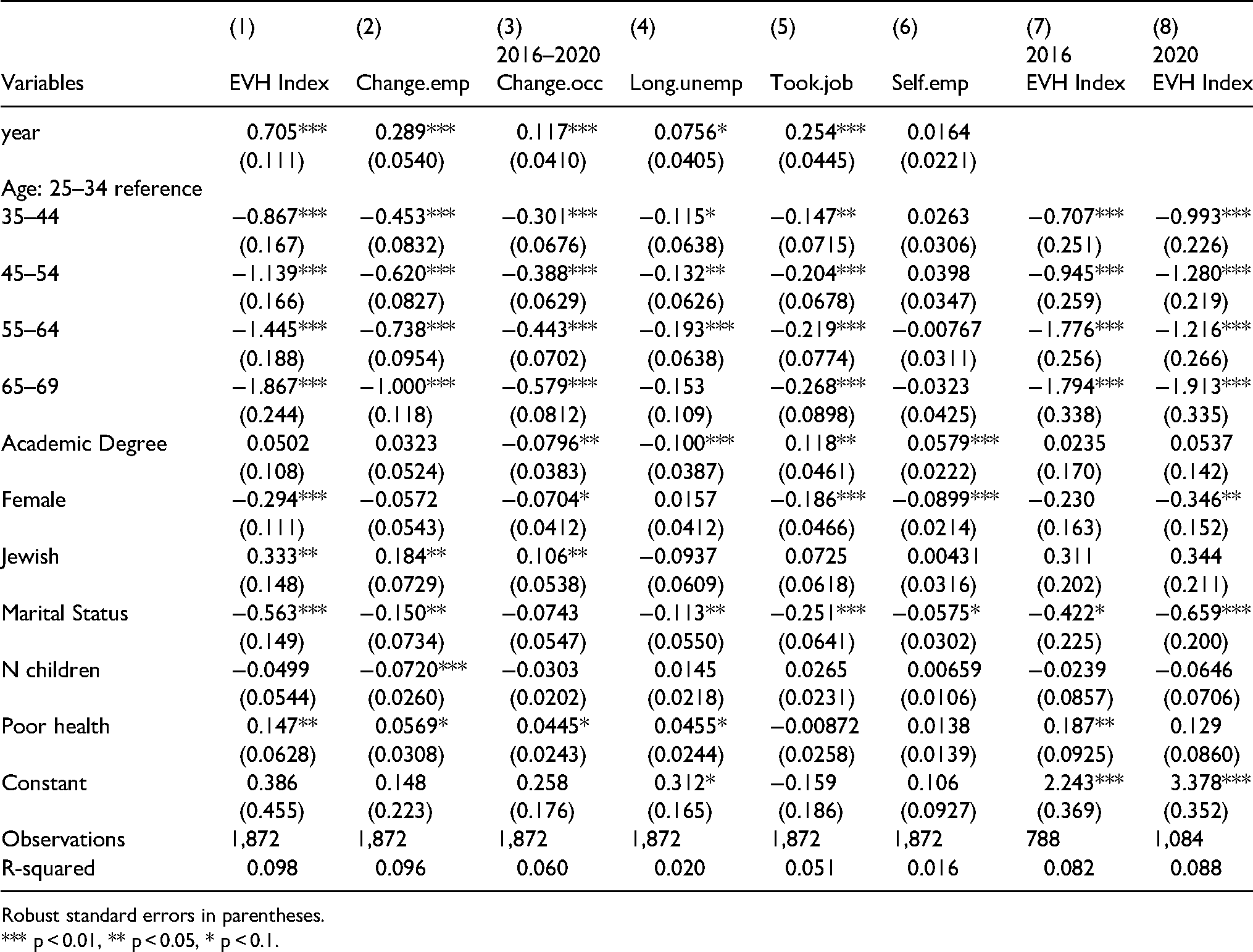
The effect of COVID-19 on employment volatility history is clear from the descriptive statistics in Table 1. On average, the number of transitions rose significantly, from 1.6 in 2016 to 2.3 in 2020, all else being equal. Moreover, the share of the working-age population reporting zero employment transitions within five years declined from 50 to 34 percent between 2016 and 2020. Table 2 reports adjusted estimates for the temporal shifts in employment volatility (Eq.1). The results of Model 1 (EVH index) reveal that the temporal surge in instability is statistically significant even after accounting for the array of background characteristics. This significant surge, consistent with H1a, captures the effect of the pandemic labor market turmoil on employment instability. Separate estimates for each volatility category (Models 2–6 in Table 2) show that the key driver for the rise in volatility was a change of employer (year slope = .289), followed by spells of holding concurrent jobs (slope = .254), occupational changes (slope = .117) and long spells of unemployment (slope = .076). The probability of becoming self-employed remained stable from 2016–2020, likely because the COVID-19 restrictions were not conducive to such a shift.
Differences in EVH by background attributes are, by and large, stable regardless of economic cycles (Models 7–8; additional specification, not shown, confirms that none of the interactions between t and X are statistically significant). This similarity between the years provides support to H1b. In both periods, males are prone to instability more than females (the gender gap is insignificant in a full-employment market), and singles more than those with partners. Moreover, the better one's health status, the lower the volume of employment volatility (the gap is insignificant during COVID-19): either poor health causes instability or employment insecurity leads to poor health (Gunn et al., 2021). Age is one of the most frequently discussed contours of inequality in recessions, employment instability, and precarious work (Grusky et al., 2019). Indeed, the results in Table 2 reveal that employment volatility declines with age under both market conditions. The younger cohorts are more likely to experience all sorts of events except self-employment. Overall, despite the sharp rise in the volume of volatility during the pandemic, the underlying demographic profile of volatile careers resembles that of 2016.
Selection into Employment and Market Conditions
Employment Status by Employment Volatility History
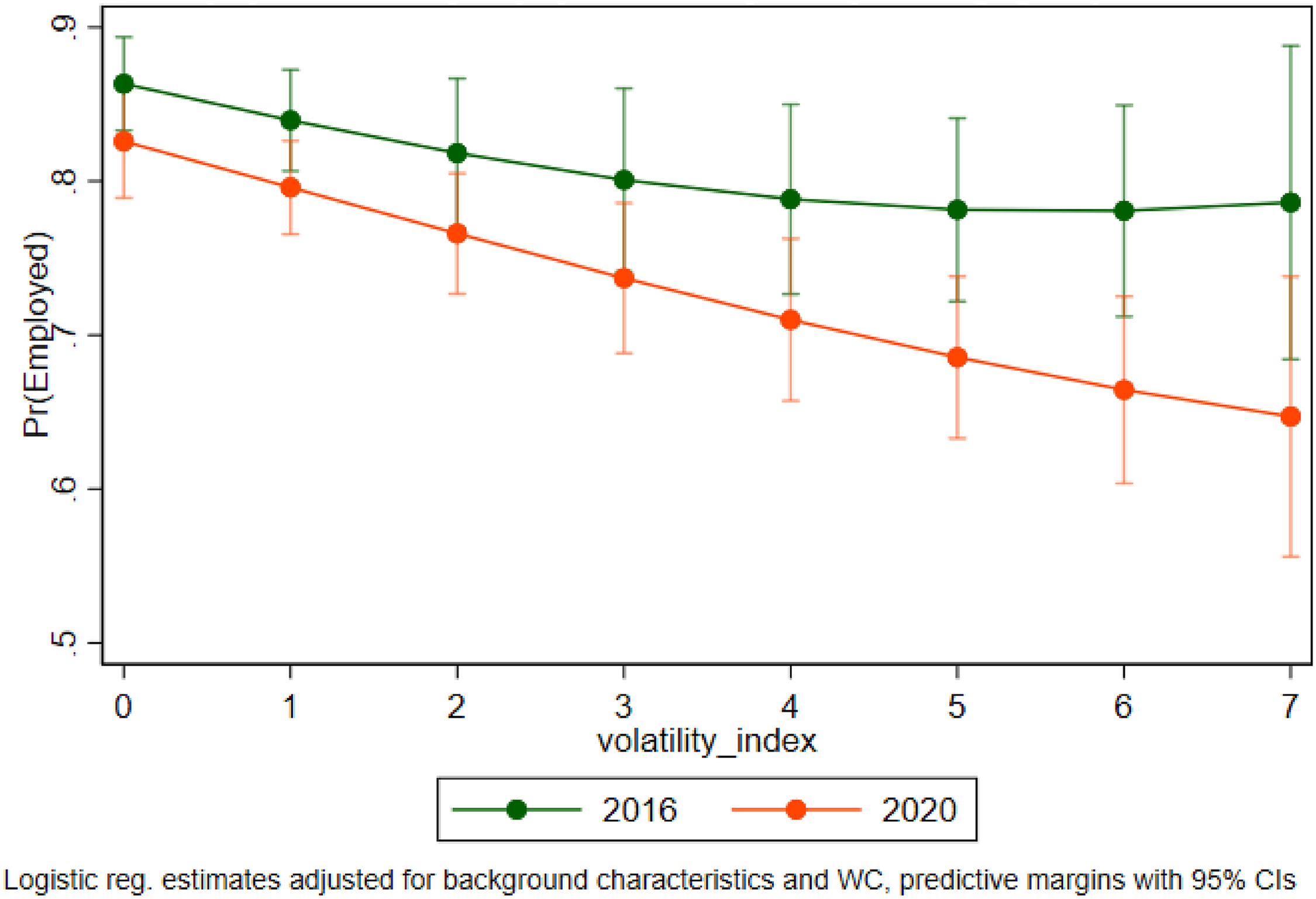
The focus on employed individuals is a potential problem with the definitions of precarious work, especially when unemployment is high. To assess how random selection into employment is and whether it varies by market conditions, I start by examining the link between EVH and employment status in full- and high-unemployment labor markets. Logistic regression of employment status was fitted to the data (Eq. 2), adjusting for background characteristics and work centrality (“taste” for paid work). The results, in Figure 1, demonstrate that in a full-employment labor market (2016), the relationship between volatility history and current employment was relatively flat as the differences in employment chances between more and less stable employment histories were not statistically significant. Yet, the jolt COVID-19 gave to the labor market changed this pattern. During the pandemic, the probability of employment was negatively related to employment volatility. In 2020, individuals with EVH containing three or more transitions were significantly less likely to have a job, than individuals in SER (zero transitions). 10 Thus, the recession effect was twofold. First, it strengthened the link between EVH and employment chances (steeper slope). Second, it accentuated the sample selection bias by pushing less stable individuals out of employment (negative slope). These findings support H2a.
Additional results (not shown) disclose a between-category variation. A history dotted with long spells of unemployment is detrimental to future employability in both periods. In a full-employment market (2016), all other categories of volatility were either inconsequential (employer and occupation changes) or conducive to future employment chances (holding concurrent jobs or moving to self-employment). This changed by 2020. For example, in 2016, a history dotted with frequent switches of employers or occupations had no bearing on the ability to secure a job; yet, in 2020, an increase in the volume of such employment changes, especially employer switches, significantly dampened employment chances. In 2020, individuals with an EVH containing two employers/occupation changes or one long unemployment spell were significantly less likely to be employed than their SER counterparts. COVID-19 bluntly exposed the Achilles heel of precarious workers: labor market insecurity.
Even those who have kept their jobs are aware of their vulnerability. Additional analysis reveals that during the uncertain market of COVID-19, the perception of job security was shaken among workers with volatile careers. Assessing the shift in workers’ worries about losing their job, the results, captured in Appendix Figure 4, demonstrate that in a full-employment market, volatile workers were not anxious about job security more than their SER counterparts. Yet, during the COVID-19 recession, workers’ worries about job loss mounted parallel to the volume of their past volatility. Thus, EVH is negatively linked to workers’ perceived job security in a recession but not in a full-employment market.
Taken together, in a full-employment market, a history of employment volatility does not have a scarring effect on employability. Almost anyone who wants to work is employed, and those in bad jobs are counted as precariats. Yet during a recession, a history of excessive employment volatility is detrimental to employment stability. Consequently, individuals with volatile careers are less likely to be employed and are thus not counted as precariats. These findings suggest that basing estimates only on employed individuals can likely lead to underestimation of precarious work during recessions, precisely when precarious workers lose ground.
Employment Status by Background Attributes
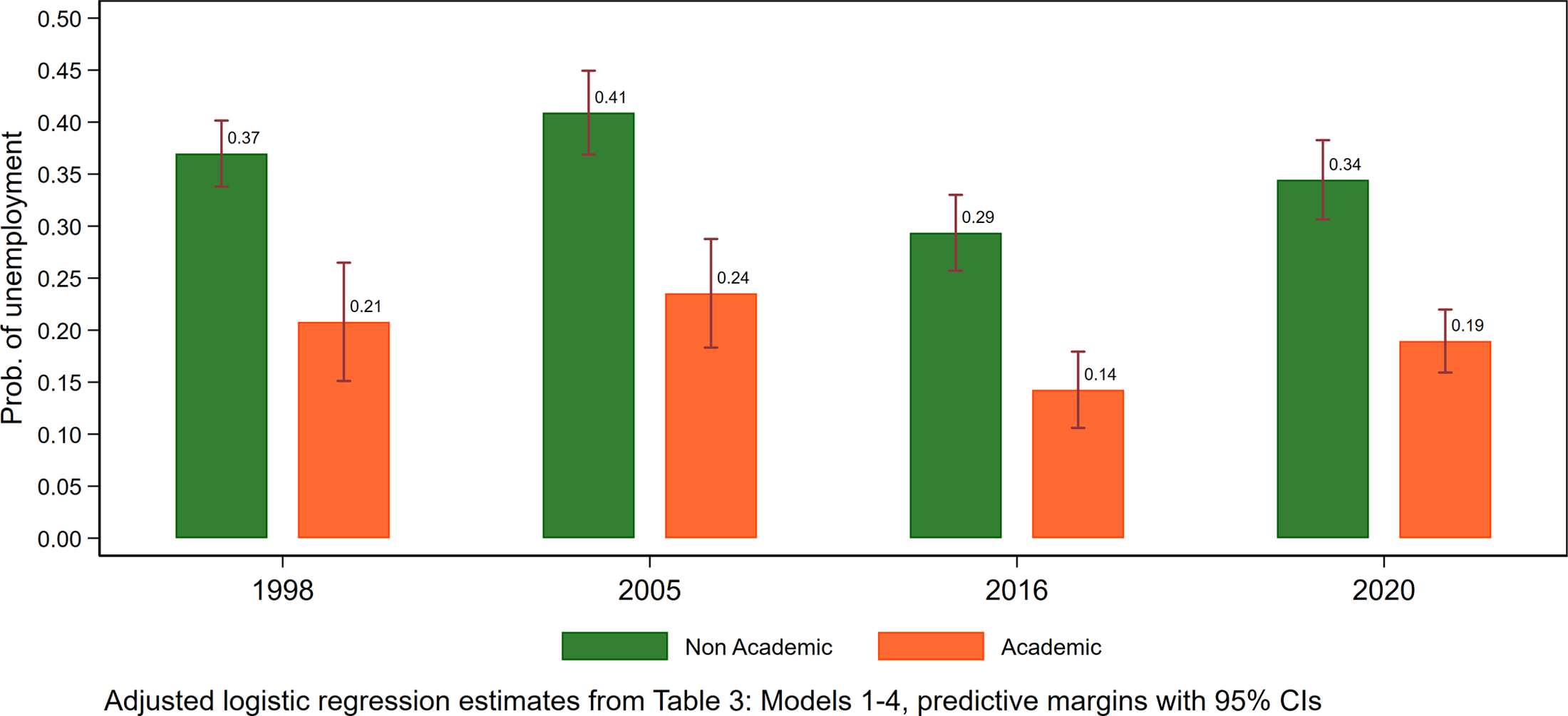
The strong negative link between EVH and the chances of employment during a recession was the first sign that selection into employment was not completely at random since individuals with volatile careers were the first to lose their jobs. To bolster this finding and determine how unique COVID-19-generated sample selection was compared to prior periods of labor market constriction, I fit a logistic regression to the working-age population in 1998, 2005, 2016, and 2020 predicting the likelihood of being not-employed (an abridged specification of Eq.2) (without EVH)) separately for each of the four survey years (1998, 2005, 2016, and 2020; the respective unemployment rates were 8.9, 9.6, 4.1, and 18.2 percent). The analysis is designed to measure whether fixed personal attributes have the same effect on the likelihood of employment during the COVID-19 recession as they have had in prior recessions. The results in Table 3 support the notion that the COVID-19 blow was not completely random, in accordance with H2b. Age and education predict employment status in all four years examined (Models 1–4); gender and religion predict employment status in all recession years (1998, 2005, and 2020; the religion gap is not statistically significant in 2005); and health status, a measure not available in previous years, predicts employment status in both 2016 and 2020 (Models 3–4). Thus, selecting only employed individuals to measure precarious work yields biased estimates for the employment conditions of individuals without a college degree and older individuals, and in recessions, the bias expands to females and non-Jews. This bolsters the claim that the bias is more severe during a recession than in a full-employment market.
To illustrate, Figure 2 presents unemployment probabilities by education in 1998, 2005, 2016, and 2020, demonstrating that in all years, academic degree holders were less likely to be unemployed than their nonacademic counterparts. To further substantiate this point, respondents in 2020 were divided into three groups: employed; not-employed, with employment ending during COVID-19; and not-employed, with employment ending prior to COVID-19. Sixty-eight percent of the total not-employed population in 2020 lost their job since the pandemic. I fit a multinomial logistic regression to unemployment status in 2020 (employed is the reference group) twice: first to the entire population to allow comparison to the estimates of previous years (Models 5a and 5b), and second, to the population with a recent history of labor force attachment (were employed in the last five years; in accordance with the rest of the empirical estimation (Models 6a and 6b for LFA)). With the latter specification, I zoom in on 2020, comparing the academic divide between employed individuals and the pre-COVID and COVID-19 unemployment groups. The unemployment probabilities in Figure 3 reveal that the academic gap existed for both comparisons: those without an academic degree are less likely to be employed in 2020 than their college-educated counterparts, either prior to or during the pandemic. Thus, paralleling the patterns that govern selection into employment in previous years, the selection was not completely at random even during COVID-19.
These findings are in line with official data establishing the unequal effect of the pandemic in Israel. Israel Ministry of Finance (2020) reports that the employment rate of those without a college degree in April 2020 decreased by about 39 percent compared to 2019, while that of college graduates decreased by only 25 percent. Also disproportionately affected by the pandemic were workers in the lowest income quintile, part-time jobs, and females. These patterns recurred during the second lockdown (parallel to the 2020 survey). 11 This is not unique to Israel. In the U.S., for example, lower-wage workers and those without a college degree have borne much more of the brunt of job losses during the pandemic than higher-wage/college-educated workers and experienced a slower recovery (Abel & Deitz, 2021, Bateman & Ross, 2021). 12
Taken together, selection into employment is never random, regardless of market conditions, and COVID-instigated selection is no different. Such nonrandom sample selection introduces a bias into the measurement of precarious work in all economic cycles. Still, this bias is more severe during recessions than in a full-employment economy, given the share of the population that is unaccounted for and their profile. Individuals at the bottom of the socioeconomic ladder were more likely to find themselves out of employment during the COVID-19 recession than their counterparts at the top, precisely because the jobs they held when the pandemic struck were low-paying, unstable, insecure, and lacking in statutory/social protections – the textbook definition of precarious work.
Selection into Employment and Estimates of Economic Situation
One way to demonstrate the effect of selection into employment on estimates of precarious work is through the lens of economic insecurity, an essential aspect of the precarious work construct. Figure 4 presents adjusted estimates for individuals’ perceived economic situation based on an ordinal logistic regression (Eq.3), fitted to the entire working-age population by volume of volatility (the predicted outcome is a good/very good economic situation). Coinciding with the literature, Figure 4 (left-side panel) reveals a strong negative relationship between individuals’ volume of employment transitions and their economic situation in both periods. Individuals with volatile careers (three or more transitions in 2020 and four or more transitions in 2016) report significantly greater financial constraints than those with no employment events.
A breakdown of this relationship by employment status (right-side panel) reveals the effect of sample selection on estimates of precarious work. During COVID-19, there was a significant disparity in the economic situation between employed and not-employed individuals at all levels of volatility. In contrast, this gap was smaller and insignificant in a full-employment market. This aligned with the rise in the poverty rate and the Gini coefficient in Israel during the pandemic, which were only partly mitigated by unemployment benefits (Endeweld et al., 2020). Thus, focusing on currently employed individuals (triangles) and ignoring the worse outcomes of not-employed individuals (squares) disguises the heterogeneous outcomes of employment instability, especially during a recession (when many working poor individuals are displaced), and underestimates the economic insecurity that accompanies precarity. In sum, estimates limited to employed individuals overrate the economic situation of precarious workers, a bias that is more severe during a recession (in support of H3). Without the COVID-specific generous government support for the unemployed, the bias would have likely been even larger.
Discussion
One of the most notable labor market transformations in recent decades has been the proliferation of precarious work, characterized by employment instability and job insecurity, a variation from the model of stable and secure employment with benefits. The value of the precarious work framework lies in combining employment instability, its core feature, with aspects of “bad” jobs into one broad construct. Yet therein also lies its drawback: ignoring non-workers. This study harnesses the force of the COVID-19 recession to generate a nuanced understanding of the conceptualization, operationalization, and validity of the precarious work construct in various market conditions.
The first question examined is whether the volume of employment volatility varies by market conditions. Supporting hypothesis H1, the results reveal a significant surge in employment volatility history during the pandemic labor market turmoil relative to 2016. Yet, the demographic profile of individuals with unstable employment trajectories did not change much. The second question delve into the issue of selection into employment, assessing whether COVID-19-generated unemployment was unique compared to prior periods of labor market constriction. The results support H2 by revealing that selection into employment during the COVID-19 turmoil was not random. During the COVID recession, and similar to typical recessions, individuals with volatile careers or at the bottom of the socioeconomic ladder have been the first to lose their jobs. Clearly, this nonrandom selection into employment introduces a bias into the measurement of precarious work in all economic cycles, but this bias is more severe during recessions than in a full-employment economy, because of the larger share of the population that is unaccounted for and their profile.
Thus, basing estimates only on employed individuals leads to underestimation of precarious work during recessions, precisely when precarious workers lose ground. This underestimation is demonstrated through the lens of economic insecurity, a central aspect of precarious work (the third question). Evidently, limiting analyses to employed individuals, as the precarious work construct mandates, yields upwardly biased estimates of the economic situation of precarious workers, a bias that is more severe during a recession than during a full-employment labor market (in support of H3).
Conclusion: From Precarious Work to Precarious Employment
Bauman (2000, p. 148) argues that present-day working life uncertainty and precariousness are of a novel kind because the disasters “which may play havoc with one's livelihood and its prospects … now strike at random … scattering their blows capriciously, so that there is no way to anticipate who is doomed and who will be saved”. Yet, COVID-19 has taught us (and this study marshaled the evidence) that as opposed to Bauman's speculation, the wrath of even an exogenous, abrupt, and non-fiscal shock is not random: its blow is predictable, directly targeting precarious workers.
Such nonrandom selection into employment disguises the heterogeneous nature of employment instability, especially during recessions. Employment instability can lead to good or bad labor market outcomes, yet the labor market heterogeneity of volatile careers is more visible in a full-employment market. In a recession, because volatile workers are the first to lose their jobs, (poor) job quality is unaccounted for in estimates of precarious work. Moreover, the fact that sample selection is not completely random introduces biased estimates of the link between employment volatility and outcomes, and more generally, an underestimation of the scope, magnitude, and nature of precarious work. In sum, these two issues – truncated heterogeneity and selection bias – are exacerbated during recessions, when both unemployment and employment volatility spike. The nuanced analysis conducted in this study reveals that the COVID-19 recession has laid bare the soft spots of volatile careers: employment instability, employment uncertainty, and economic insecurity. These aspects are the quintessential characteristics of precarious work, yet the typical definition of the construct would have overlooked them. Thus, key hardships of precarity are typically hidden from view during recessions because of selection into employment.
The findings establish the need to make the definition of the construct flexible enough to allow robust measurement in a full-employment market, but especially during labor market shocks. Honing the conceptualization and measurement of precarious work is imperative because COVID-19 may exacerbate the effect of drivers of precarious work. To monitor the spread of temporary and insecure employment during the current uncertain market, we need to incorporate information about individuals’ previous labor force dynamics, to ensure that non-workers with a recent history of employment instability are included in precarious work estimates. Non-workers are idle today, but they may be employed in unstable and low-quality jobs tomorrow (Alon, 1998; Brand, 2006, 2015). After all, moving in and out of employment is a defining feature of their precarity.
An inclusive measure of precarious employment should start with working-age individuals with volatile careers (i.e., a high employment volatility history). Among them, two groups should be included under the umbrella of precarity. First, workers who lack control over their salary, working conditions, and social protection in their current job, and who experience economic insecurity (as defined by Rodgers and Rodgers (1989), for example). Second, unemployed individuals (actively searching for employment but unable to find work or displaced due to an exogenous shock) whose last job is characterized as “bad”, according to the same features. Given the serious consequences of selection bias, I believe that even if the information on the characteristics of the last job is unavailable, it is best practice to include unemployed individuals with volatile careers (a type I error) than omitting them altogether (type II error).
In essence, this shifts the emphasis of the construct from precarious work to precarious employment, two terms that have so far been used interchangeably. Yet, this study clarifies that workers in precarious work, i.e., unstable “bad” jobs, are a subset of a larger population in precarious employment, moving between unstable “bad” jobs and out of employment. Thus, the expanded and more inclusive construct better delineates precarious employment and is more tuned to “the forces of recession and growth” (Clogg et al. (1990, p. 1572)). Given that the rise in precarious employment threatens to destabilize the political system, questions the social contract, and weakens solidarity (Arnold & Bongiovi, 2013; Bauman, 2000; Beck, 2014; Standing, 2011), we need to make sure that those precariously employed are not left out, at least by our estimates, regardless of economic cycles. The ability to design effective labor market policies, contemplate a universal basic income, and rethink the political arrangements that cherish flexibility, depends on the availability of effective estimates regarding the true scope of employment precarity.
Footnotes
Acknowledgments
This research was supported by grants from the Israel Science Foundation and Israel's Ministry of Science and Technology. The content is solely the author's responsibility and does not necessarily represent the official views of the funding agencies.
Declaration of Conflicting Interests
The author(s) declared no potential conflicts of interest with respect to the research, authorship, and/or publication of this article.
Funding
The author(s) disclosed receipt of the following financial support for the research, authorship, and/or publication of this article: This work was supported by the Israel’s Ministry of Science and Technology and Israel Science Foundation (grant number 01028172, 407/21).
