




Abstract
The authors investigate how conflict between groups shapes social status within groups. Conflict may create opportunities for individuals to gain or lose status by demonstrating group commitment. Pursuing revenge for an intergroup affront can serve as a source of status in settings characterized by a “culture of honor” or “code of the street.” Yet little is known about whether this holds in everyday settings. The authors develop a theoretical account of the relationship between vengeful behavior and social status. They test their predictions with four online survey experiments. Respondents generally perceive intergroup retaliation as more status-worthy than interpersonal retaliation, and these status rewards are similar for men and women, are specific to retaliation rather than initiating aggression, and are diminished by premeditation. Broader implications include understanding how status shapes the social organization of aggression, why trivial disputes escalate, and the link between inter- and intragroup relations.
Accordingly, aggrieved groups are often obliged to put considerable pressure on the one or two members selected for the task of vengeance. Sanctions range from cajoling to outright ostracism; in Corsica, kin of a victim might go to the length of publicly committing other family members to the pursuit of revenge—as when Santo Santini dipped his hand in the blood of his fallen son and smeared it on his youngest son’s face, shouting, “If I die, remember that you must avenge your brother!”
Much public and scholarly attention has focused on the prevalence and costs of identity-based conflict in contemporary American society. Political partisanship, national identity, and even sports fandom have been the locus of intense disputes. The ways in which such conflicts between groups shape relationships within groups have long been of interest to sociologists (Coser 1956; Erikson 1966; Sherif 1967; Simmel [1908] 1955; Sumner and Keller [1906] 1960). In particular, we know that intergroup conflict is powerfully and reciprocally constitutive of intragroup identity, cohesion, and cooperation (e.g., Benard 2012; Blake, Shepard, and Mouton 1964; Blumer 1958; Bobo 1999; Bobo and Hutchings 1996; Bornstein 2003; Brewer 2001; Minescu and Poppe 2011; see Benard and Doan 2011 for a review).
We know less about how intergroup conflict shapes another key dimension of group life: the status structure of groups, defined as patterns of respect and influence within groups (Berger, Cohen, and Zelditch 1972). Status processes play an integral role in group life because they both stratify and coordinate action within groups (Bales et al. 1951; Correll, Ridgeway, and Delamater 2003; Strodtbeck, James, and Hawkins 1957). Although a symbolic resource, status has material consequences and is valued and pursued by individuals (Anderson and Kilduff 2009).
Intergroup conflict is important for understanding status processes because it may generate opportunities for individuals to gain or lose social status through their behavior in conflict. As the opening quotation illustrates, studies of “honor cultures” and the “code of the street” suggest that individuals can earn the respect of ingroup members by responding when the ingroup is harmed or threatened, or lose honor by failing to do so (Anderson 2000; Beckerman et al. 2009; Black-Michaud 1975; Kirk and Papachristos 2011; Kubrin and Weitzer 2003; Nisbett and Cohen 1996). Yet little work has examined whether retaliation truly causes individuals to gain or lose status or whether this tendency extends beyond honor-based cultures to more widely held identities, such as those defined by nationality, political partisanship, and sports team fandom.
In addressing these questions, we examine whether individuals gain status for a particular form of participation in intergroup conflict: retaliating when confronted with an intergroup insult. We focus on retaliation for two reasons. From a theoretical perspective, retaliation is puzzling because the costs of pursuing retaliation (punishment, physiological stress, counter-retaliation) often outweigh the benefits (McCullough 2001; van Oyen Witvliet, Ludwig, and Vander Laan 2001). More broadly, many violent altercations begin as verbal disputes, and many costly intergroup conflicts are composed of chains of revenge (Gould 2003; Papachristos 2009). Understanding the status value individuals place on retaliation may help explain the volatility of much conflict.
The question of whether people view retaliation on behalf of an ingroup as status-worthy is interesting in part because the value of retaliation itself is debatable. Individuals may gain status for retaliation if it is viewed as a costly sacrifice for the group’s benefit. One possibility is that retaliation contributes, or is perceived to contribute, to creating a group-level reputation for vengefulness that deters future aggression toward the group. By engaging in potentially costly retaliation on behalf of the group, the retaliator signals his or her commitment to the group. Because group-motivated personal sacrifices tend to be viewed as status-worthy (Willer 2009), ingroup retaliators may gain social status.
Alternatively, retaliation may generate costs for the group. Unlike other forms of group-motivated sacrifice, retaliation exposes the group to the risk for counter-retaliation (Axelrod 2006; Gould 2003; Nikiforakis and Engelmann 2011). In theory, people who behave in ways that damage their ingroups should lose status in the eyes of ingroup members. This allows us to explore the limits of people’s tendency to view group-motivated sacrifices as status-worthy. Is retaliation for a group-based insult viewed as a status-worthy attempt to protect the group or a status-depreciating way of putting the group at risk?
We address this question with four survey experiments that examine how people allocate status for vengeful behavior in intergroup versus individual disputes. Respondents read a vignette in which the focal actor, with whom the respondents share ingroup membership, is subjected to an interpersonal or intergroup insult and then responds. We vary key factors such as whether the target responds with deference, verbal retaliation, or physical retaliation (study 1); the gender of the disputants (study 2); whether the insult-retaliation interaction is initiated by the ingroup or the outgroup (study 3); and whether retaliation is spontaneous or premeditated (study 4).
Individuals’ feelings about revenge are likely complex and contextually dependent. To begin to map out this complexity and to evaluate the robustness of the findings, we replicate each study using three different social identities, based on nationality, sports team fandom, and political party affiliation. These identities were chosen by pretesting for social identities that are widely held and often associated with rival outgroups (other nations, sports teams, or political parties). 1 We treat this variation in an exploratory rather than a hypothesis-testing manner. It is not our aim to develop a theory of how vengefulness varies across these specific identities but instead to ensure that our findings are not dependent on any one identity and to use differences across these identities as a building block for future theory development.
By theoretically linking intergroup competition, revenge, and social status, we build on a recent stream of empirical research that seeks to understand how social status and aggression are related (Anderson 2000; Faris 2012; Faris and Felmlee 2011; Papachristos 2009). In doing so, we draw links with classic work in sociology, in which social structure and group processes play a central role in shaping intergroup conflict (Benard and Doan 2011). Our work also speaks to an interdisciplinary literature on reputation systems and altruistic punishment as a means to generate and sustain social order (Raihani and Bshary 2015). Broadly speaking, our results have implications for understanding the social organization of aggressive behavior, including why apparently trivial disputes escalate to violence.
Background
Definitions and Scope
We define retaliation as reciprocal harm; it occurs when A harms B in response to harm that B has caused A (Aquino, Tripp and Bies 2001). We provisionally describe two scope conditions that we expect must be met for retaliation to serve as a source of status; future research can indicate whether they should be broader or narrower (Walker and Cohen 1985). First, a group must perceive itself to be in a competitive relationship with another group. Second, the relative dominance of the two groups must be relatively equal, or ambiguous. This second scope condition derives from Gould’s (2003) argument that when neither group in a competitive relationship dominates, each has an incentive to signal toughness as a means of establishing dominance over its rival. A key method for signaling toughness is to retaliate when affronted by the rival (e.g., Anderson 2000; Gould 2003; Nisbett and Cohen 1996; Papachristos 2009; Schelling 1960). In contrast, when one group clearly dominates the other, there is less incentive to signal toughness, because the relative toughness of each group is common knowledge (see Gambetta 2009 for a similar argument about prison violence).
We conceptualize maintaining a reputation for vengefulness as a public goods problem: no individual has an interest in making sacrifices for the group, but if all follow this strategy, everyone is worse off (Hardin 1968). For a group to convincingly signal vengefulness, its members must act vengefully (Gould 2003), but the cost of doing so means that most people are better off not behaving vengefully. Yet if no one behaves vengefully, then the benefit of a group-level reputation for vengefulness is lost. Similar to other public goods, a group reputation for vengefulness is nonexcludable (all group members benefit from the deterrent effect of the reputation, even if they did not behave vengefully), and also nonrival (one group member benefitting from the reputation does not reduce the capacity of other group members to benefit) (Kollock 1998). Consequently, groups must motivate members to contribute, despite temptations to free-ride or concerns that no one else will contribute (Olson 1965).
Group Contribution and Social Status
Some groups solve public goods problems through the use of rewards and punishments (Fehr and Gächter 2002; Horne 2004; Olson 1965; Ostrom, Walker, and Gardner 1992; Yamagishi 1986), including granting or withholding social status (Willer 2009). Although various theoretical and operational definitions of status exist, distinctions between these definitions are often semantic (Faris 2012). We adopt a definition of status commonly used in expectation states theory: the extent to which one is seen as worthy of respect, prestige, or deference relative to other group members (Berger et al. 1972; Correll and Ridgeway 2006; Ridgeway 1982). 2
Actors can gain social status through contribution to a group public good. According to the status theory of collective action (Willer 2009), contributions signal an individual’s group motivation, or “how much they value the group’s interests relative to their own” (p. 25). Individuals with greater perceived group motivation are expected to make more valuable contributions to the group relative to those with lower levels, increasing their status. This argument is consistent with an extensive literature that applies costly signaling theory to public goods problems (Nelissen 2008; Raihani and Bshary 2015; Spence 1973), particularly the idea that punishing antisocial behavior at personal cost is taken to signal desirable but difficult-to-observe qualities, such as intentions to cooperate or treat others fairly (Barclay 2006). Supporting this theory, individuals who make sacrifices for the group are seen as more group motivated and worthy of respect (Willer 2009), more trustworthy (Barclay 2004), and deserving higher status and leadership positions (Hardy and Van Vugt 2006; Milinski, Semmann, and Krambeck 2002).
Status Rewards for Retaliation
Our argument draws on the status theory of collective action (Willer 2009). Under the scope conditions that groups perceive competition with a similarly (or ambiguously) strong outgroup, a group’s reputation for vengefulness serves as a public good, because it is perceived to shield group members from outgroup aggression. Behaving vengefully on behalf of a group is a costly contribution to this public good, because it helps the group earn a reputation for vengefulness but carries personal risks. As a result, we expect that retaliation on behalf of the group will be viewed as more status-worthy than individually motivated retaliation:
Hypothesis 1: Retaliation for an offense directed at the ingroup will be viewed as more status-worthy than retaliation for an offense directed at an individual.
Similarly, in intergroup conflict, we expect that retaliation for a perceived offense will be viewed as more beneficial for the group’s reputation than not responding, because it signals the willingness or capacity of the group members to stand up for the ingroup. We expect group-motivated revenge to be more status-worthy than taking no action when the group is affronted:
Hypothesis 2: Retaliation for an offense directed at the ingroup will be viewed as more status-worthy than taking no action.
Empirically, we compare inaction to two types of retaliation, verbal and physical, to evaluate the effect of responding in a way that is similar in aggressiveness, or one which escalates the confrontation. By testing these hypotheses, our work makes several contributions. We identify and test the argument that group-motivated revenge is a source of status within groups. Past work has examined the status value of aggression (Anderson 2000; Faris 2012; Faris and Felmlee 2011; Felson 1978), without distinguishing retaliation from other forms of aggression. We distinguish between status rewards for retaliation versus those for initiating conflict with an outgroup. Other work examines the status value of revenge (Black-Michaud 1975; Gould 2003; Papachristos 2009), without comparing interpersonal and intergroup retaliation. We test the argument that intergroup retaliation offers greater status gains than interpersonal retaliation.
Methods
Design
We use four online survey experiments to test our hypotheses. The studies follow a common design with modifications based on the goals of the study. In each study, respondents are randomly assigned to read a vignette describing a chance encounter in which the focal character is publicly insulted and responds. In all studies, we manipulate whether this is an intergroup or an interpersonal conflict. In the intergroup conflict vignettes, we use groups identified by respondents to indicate the vignette characters’ group membership; the aggressor insults the focal character’s ingroup. The vignettes are constructed so that the respondent typically belongs to the same ingroup as the focal character. In the interpersonal conflict vignettes, the aggressor insults the focal character directly. All experimental manipulations are between subjects. All human subjects procedures were approved by the Indiana University institutional review board.
In study 1 we test our hypotheses that status rewards are greater for (1) group versus individually motivated retaliation and (2) group-motivated retaliation versus deference. In study 1 we compare deference to both verbal and physical aggression to help calibrate the degree of aggression that is (or is not) viewed as status-worthy. In study 2 we ask how gender affects our overall findings by replicating study 1, which used male vignette characters, with female vignette characters. In study 3 we examine whether study 1’s findings were specific to retaliation or if they extend to nonretaliatory aggression. This allows us to address the alternative explanation that differences between the intergroup and interpersonal conditions are due to ingroup bias (Brewer 2001). For example, it may be that all ingroup behaviors are viewed as more status-worthy than all outgroup behaviors, rather than retaliation itself being perceived as particularly status-worthy. In study 4 we examines whether premeditated revenge is treated differently than spontaneous revenge, which allows us refine the scope of our finding in the context of debates about the nature of revenge. For each study we recruited a unique pool of respondents. 3
Each study contains three conceptual replications based on national identity, sports fandom, and political party affiliation, to evaluate the robustness of the findings and map variation across key social identities (i.e., vocations and avocations [sports fandom], political affiliation, ethnicity and religion broadly conceived [national identity]; Deaux et al. 1995). 4 These identities are widely held, making them practical for use in a study of the general population. Pilot testing indicated that individuals holding these identities can easily identify rival outgroups, which was necessary to test our argument. The identities and events described in the vignettes were identified using three pretest and pilot-test studies described in Online Supplemental Appendix 1.
Study 1
Participants
Respondents were recruited using Amazon’s Mechanical Turk (MTurk) platform, a crowdsourcing marketplace where workers can complete tasks, posted by “requesters,” for pay (Crump, McDonnell, and Gureckis 2013). MTurk allows more diverse samples than traditional experimental subject pools, and results are comparable with experiments run on nationally representative panels (Weinberg, Freese, and McElhattan 2015) as well as lab experiments (Mullinix et al. 2015). Study 1 included 901 respondents who self-identify as American citizens. 5 One hundred eighty-nine respondents (21 percent) failed at least one manipulation check, and 54 respondents (6 percent) failed attention checks designed to screen out satisficing on the survey. 6 This leaves 685 respondents in the analytic sample (43 percent men, 57 percent women). 7 Consistent with past work using MTurk, our sample was more liberal, had a higher proportion of women and whites, was younger, and was more highly educated than the general population (Huff and Tingley 2015). We include the demographic breakdown for all studies in Online Appendix 2.
Procedure
After giving informed consent, respondents answered demographics questions to determine their ingroup membership. Because only American citizens are recruited into the study, all respondents have at least one relevant ingroup for our purposes (national identity). A total of 63 percent of respondents have a favorite sports team, and 68 percent affiliate with either the Democratic or Republican party. Respondents who do not have a favorite sports team and affiliate with a third party or have no political affiliation are assigned to the national identity scenario automatically (11 percent). The rest are randomly assigned to a scenario from their relevant identities (national and sports, national and politics, or all three). Given the relative breakdowns of respondents’ ingroups, the randomizer is programmed to prefer the smaller ingroup (sports, then politics, then national identity) when possible to create roughly balanced scenarios. In all, 207 respondents were assigned to the national identity scenario, 228 to the sports scenario, and 223 to the politics scenario. After being assigned to a scenario, respondents are asked to identify a relevant outgroup. Then they are randomly assigned to condition.
For clarity, given the relatively large number of experiments and conceptual replications, in the main text we present the results for each study with the three identity scenarios pooled. We briefly summarize differences across scenarios in the study-specific discussion sections. In Online Supplemental Appendices 4 and 5, we present the results separately by scenario.
Independent Variables
In study 1, we evaluate whether revenge is viewed as more status-worthy in intergroup versus individual disputes (hypothesis 1) and whether revenge is viewed as more status-worthy than deference in intergroup disputes (hypothesis 2). To test these hypotheses, we vary whether the dispute is intergroup or interpersonal and whether the focal character responds with deference, verbal retaliation, or physical retaliation. The study is thus a 2 (intergroup conflict vs. interpersonal conflict) × 3 (deference vs. verbal retaliation vs. physical retaliation) between-subjects factorial design. All vignette characters are men in study 1; in study 2, we replicate study 1 with female characters.
For the conflict manipulation, respondents in the intergroup conditions are presented with scenarios in which an outgroup aggressor insults the ingroup. Those in the interpersonal conditions are presented with scenarios in which a man wearing a cap insults a man wearing a T-shirt; no group membership is mentioned. Comparing intergroup and interpersonal conflict allows us to test whether retaliation on behalf of one’s ingroup is viewed differently than defense of oneself.
Comparing intergroup and interpersonal conflict varies two factors simultaneously: (1) whether the conflict is interpersonal or intergroup in nature and (2) whether the respondents’ specific ingroup identities are salient. This raises the question of whether a finding of greater status rewards for intergroup retaliation indicates that respondents view ingroup members retaliating on behalf of a shared ingroup as more status-worthy than interpersonal retaliation, or that they view any person retaliating on behalf of any group as more status-worthy than interpersonal retaliation.
We address this question in two ways. First, in study 3, we vary whether the ingroup or outgroup initiates or retaliates and collect status ratings of both ingroup and outgroup members. This allows a comparison of status ratings of ingroup and outgroup members who retaliate on behalf of their groups.
Second, in Online Supplemental Appendix 6, we examine whether our results are moderated by respondent identification with the ingroup. If respondents value retaliation because they view it as a defense of an ingroup they personally value, then the status value of intergroup retaliation should increase with ingroup identification. If respondents view any form of intergroup retaliation—even on behalf of groups the respondent does not identify with—as more status-worthy than interpersonal retaliation, then status rewards should be unaffected by ingroup identification. We find that the effects of intergroup versus interpersonal conflict on perceived status tend to be stronger for individuals who are highly identified with the group. Collectively, study 3 and the results in the Online Supplement suggest that there is a unique ingroup status reward for intergroup retaliation.
The response manipulation includes a deference condition in which the insulted man looks down and says nothing, a verbal retaliation condition in which the insulted man threateningly warns the aggressor to watch what he says about the retaliator or about the ingroup, and a physical retaliation condition, in which the insulted man shoves the aggressor in addition to verbally retaliating. 8 In this way, we can evaluate the effect of responding in a way that is more deferential, similar in aggressiveness, or which escalates the confrontation. All vignettes are included in Online Supplemental Appendix 3. After reading the vignette, respondents rated the retaliator on the status measures and other items collected for future use.
Dependent Measures
Our primary outcome is the perceived status of the retaliator. Respondents are asked to rate whether they think the retaliator is respected, honorable, influential, a leader, and prominent on nine-point bipolar scales (Ridgeway and Erickson 2000; Willer 2009). 9 We created a mean scale of the items for the analyses (α = .85). The hypothesis tests are based on ordinary least squares (OLS) regression models with the status measure regressed on the effects of retaliation type (indicator variables for verbal and physical retaliation, with deference as the reference category), conflict (indicator for intergroup conflict, with interpersonal conflict as the reference category), and the interaction of the independent variables. In the pooled analyses, we include indicator variables for scenario, with national identity as the reference category. Tests of directional hypotheses are one tailed.
Study 1 Results
To succinctly present hypothesis tests, Table 1 includes marginal effects—the difference in predicted means between pairs of experimental conditions—from regressions of perceived status on type of behavioral response and conflict. Full regression results are included in Online Appendix 5, Table C1. Means by condition and 95 percent confidence intervals are shown in Figure 1. These marginal effects compare the perceived status of a vignette character who retaliates on behalf of their group with that of one who retaliates for interpersonal reasons (testing hypothesis 1) as well as intergroup retaliation compared with intergroup deference (testing hypothesis 2). Positive effects indicate greater perceived status in the left column compared with the right column.
Marginal Effects from Regressions of Perceived Status on Type of Retaliation and Intergroup Conflict for Male Vignette Characters, Study 1.

p < .01, *** p < .001.
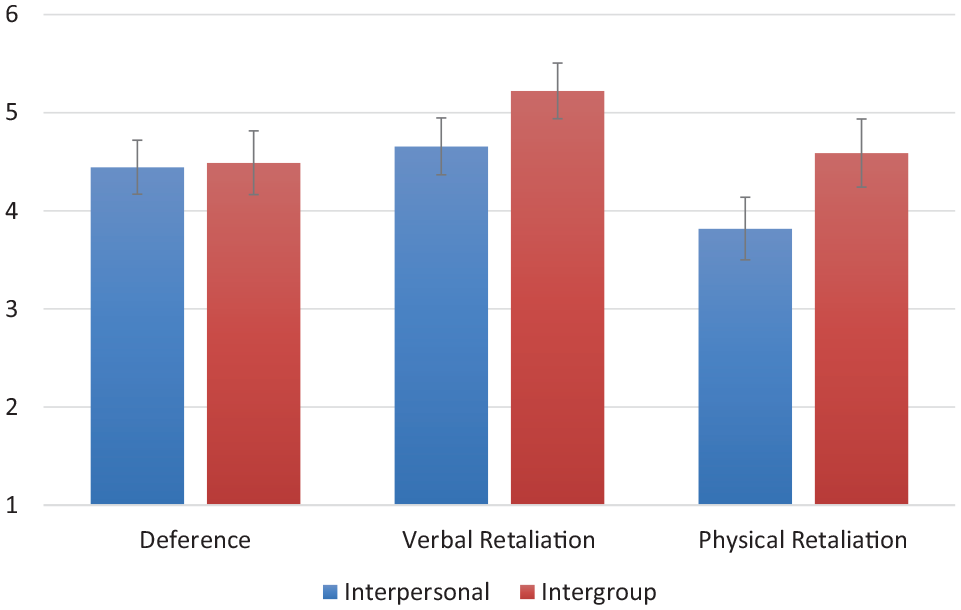
Mean status by condition, study 1 (n = 658).
We test whether intergroup retaliation is perceived as more status-worthy than interpersonal retaliation (hypothesis 1) across two types of retaliation, verbal and physical. As shown in the first row, verbal retaliation is viewed as significantly more status worthy in intergroup compared to interpersonal conflict (b = .565, p < 0.01), by a little over half a scale point on a nine-point scale. Intergroup physical retaliation is viewed as significantly more status-worthy than interpersonal physical retaliation by .771 points (row 3, b = .771, p < .001). This supports hypothesis 1.
Next, we tested whether, in the context of intergroup conflict, verbal and physical retaliation would be viewed as more status-worthy than deference (hypothesis 2). Respondents perceived verbal retaliation in the intergroup conflict condition as significantly more status worthy than deference in intergroup conflict (Table 1, row 2, b = .731, p < .001), supporting hypothesis 2. Respondents did not view physical retaliation as more status-worthy than deference (Table 1, row 4, b = .099, ns).
Study 1 Discussion
Consistent with hypothesis 1, retaliation for a verbal insult on behalf of one’s group is viewed as more status-worthy than retaliation on behalf of oneself. Disaggregating the results by scenario (details in Online Supplemental Appendix 4), we find some variation by identity. For verbal retaliation, we find a status boost for intergroup versus interpersonal retaliation in the sports and political identity scenarios, but not in the national identity scenario. For physical retaliation, we find this boost in the sports and national identity scenarios, but not in the politics scenario. We discuss possible explanations for this difference in the general discussion.
Although we consistently find that intergroup retaliation is viewed as more status-worthy than interpersonal retaliation (H1), we do not consistently find that intergroup retaliation is more status worthy than intergroup deference (H2). Although retaliation is viewed as more status-worthy than deference across the scenarios, when we disaggregate by identity (Online Supplemental Appendix 4), we find this pattern is driven by the sports scenario and is not significant in the national and political identity scenarios. We return to this pattern in the general discussion.
A limitation of study 1 is that the vignette characters are men. According to our theory, perceived group motivation, rather than the gender of the vignette character, should drive status rewards for retaliation. At the same time, the relationship between gender and aggression is complex and context-dependent (e.g., Björkqvist 1994) and it is possible that the effects shown in study 1 depend on either the gender of the respondent or the gender of the vignette characters. For example, the fact that men are more likely to display physical aggression than women (Archer 2004) might lead individuals to view physical aggression by women as counternormative and perhaps less status-worthy. Supplemental analyses find no effect of gender of respondent, nor does gender of respondent significantly moderate the effect of condition. To investigate whether the gender of the actors shapes status rewards for retaliation, in study 2 we replicate study 1 but make the vignette characters women. 10
Study 2
Participants
We recruited 1,184 respondents using MTurk. Although the exclusion rate in study 1 was not unusual for MTurk surveys (e.g., Berinsky et al. 2014), in study 2 we increased the sample size to ensure that we had adequate power. Of these, 230 respondents (19 percent) failed at least one manipulation check, and 69 respondents (6 percent) failed the attention check. This leaves 885 respondents in the analytic sample (45 percent men, 54 percent women), 299 in the national identity scenario, 287 in the sports fandom scenario, and 299 in the political affiliation scenario. 11
Study 2 Procedures and Measures
Study 2 uses the same 2 (intergroup conflict vs. interpersonal conflict) × 3 (deference, verbal retaliation, physical retaliation) factorial design as study 1. The vignettes are identical to those used in study 1, except that the disputants are both women. We use the same measures of status (α = .84) as in study 1 and discuss similarities and differences from study 1.
Study 2 Results
Table 2 includes marginal effects from OLS regressions of perceived status on the type of retaliation and on intergroup versus interpersonal conflict. Regression tables are included in the Online Appendix in Table C2. As shown in the table, study 2 largely replicates study 1, with all significant marginal effects from study 1 again significant and in the same direction in study 2. As in study 1, intergroup verbal retaliation (column 1, row 1; b = .471, p < .001) and physical retaliation (column 1, row 3; b = .529, p < .001) are viewed significantly more status-worthy than interpersonal retaliation. This supports hypothesis 1. Figure 2 illustrates these patterns.
Marginal Effects from Regressions of Perceived Status on Type of Retaliation and Intergroup Conflict for Female Vignette Characters, Study 2.

p < .001.
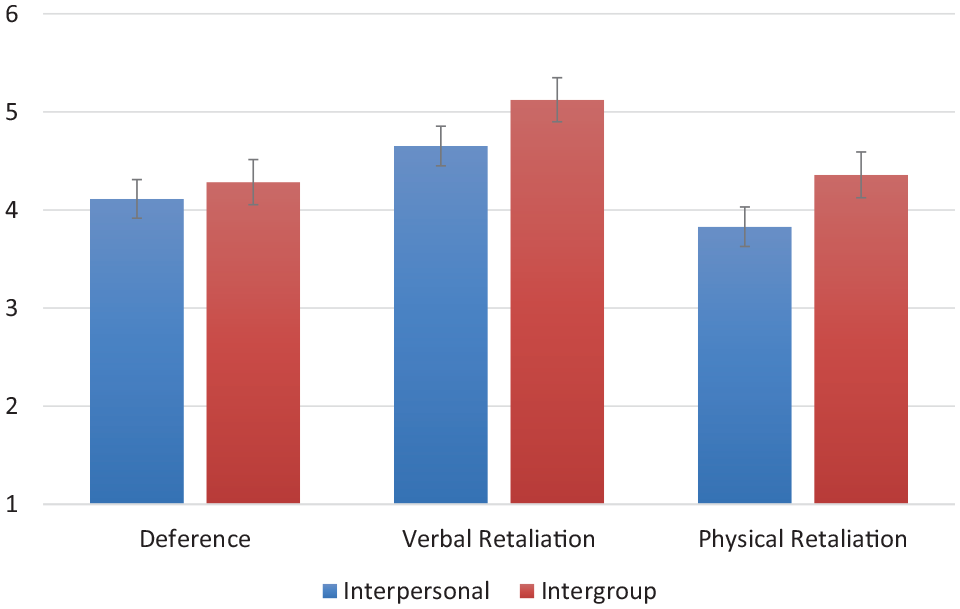
Mean status by condition, study 2 (n = 1,310).
We next evaluate hypothesis 2, which predicts that intergroup verbal and physical retaliation will be viewed as more status-worthy than intergroup deference. Similar to study 1, we find that intergroup verbal, but not physical, retaliation is viewed as more status worthy than intergroup deference (b = .839, p < .001). Unlike in study 1, this finding was not driven solely by the sports identity scenario (see Online Supplemental Appendix 4). Instead, verbal retaliation was viewed as significantly more status-worthy than deference across the national, sports, and political identity scenarios. Intergroup physical retaliation was also viewed as significantly more status worthy than deference in the national identity scenario but less status-worthy than deference in the political identity scenario.
Study 2 Discussion
For hypothesis 1, that intergroup retaliation is viewed as more status-worthy than interpersonal retaliation, study 2 largely replicates study 1, suggesting that intergroup retaliation carries similar status rewards for men and women. Furthermore, disaggregating by identity, we again find patterns similar to study 1. Intergroup verbal retaliation is viewed as significantly more status-worthy than interpersonal retaliation in the sports and political identity scenarios, while intergroup physical retaliation is viewed as more status-worthy than interpersonal retaliation in the sports and national identity scenarios. The second hypothesis, that intergroup retaliation will be viewed as higher status than intergroup deference, is better supported in study 2. Study 2 finds greater status rewards for intergroup verbal retaliation, compared with intergroup deference, across all three identity scenarios. The patterns were mixed for physical retaliation.
These differences may be more a matter of degree than kind, given that the pattern of means for male characters in study 1 was similar (means disaggregated by scenario are available in Online Supplemental Appendix 4), though with fewer statistically significant differences. That said, the differences in support of hypothesis 2 were larger in substantive magnitude in study 2, indicating that they were not simply due to greater statistical power. Such differences in degree may stem from a variety of sources. Groups may be ambivalent about retaliation due to the risk for counter-retaliation. If observers believe, correctly or not, that disputes between women are less likely to lead to counter-retaliation, they may be less ambivalent and more willing to grant status. In the case of the status gain for intergroup deference in politics, perhaps people perceive the deferential woman as “taking the high road” and thus enhancing the group’s reputation in the political sphere. Although our data do not allow us to test these possibilities, the pattern of results suggest many similarities in how observers allocate status to men and women in disputes. We return to this point in the general discussion.
Study 3
Studies 1 and 2 indicate that intergroup retaliation increases perceived social status compared with interpersonal retaliation and that this pattern is substantively similar for men and women. Although these findings are consistent with our theoretical expectations, they do not rule out the possibility that the results are due to ingroup favoritism (e.g., Brewer 2001). That is, because respondents only evaluate retaliation, we do not know if they simply evaluate any ingroup behavior as more status-worthy than the same behavior enacted by a non-ingroup member, rather than viewing intergroup retaliation specifically as more status-worthy. To evaluate this possibility, in study 3 we examine status rewards for both retaliation and initiating aggression in both interpersonal and intergroup disputes.
Although ingroup favoritism could lead both forms of intergroup aggression to be viewed as more status worthy than their interpersonal aggression counterparts, other work suggests that the status rewards for retaliation may be different than those for initiating aggression. Reputations for retaliating more effectively deter aggression than reputations for initiating aggression (Benard 2015), and peers who initiate aggression may draw the group into needless conflicts (Gould 2003; Nikiforakis and Engelmann 2011). Perhaps as a result, unnecessarily harming an outgroup can lead to status loss (Halevy et al. 2012). Because we find few gender differences (on the basis of gender of respondents as well as vignette characters), and because men are disproportionately the offenders in incidents of assault (Morgan and Oudekerk 2019), the remaining studies use male vignette characters to maintain similarity to study 1. Study 3 uses the same general structure and three identity-based scenarios as study 1. We focus on physical retaliation and compare the cases in which the retaliator is acting on his own behalf, on behalf of the ingroup, and on behalf of the outgroup. We collect ratings of both the aggression initiator and the retaliator to compare the effects of intergroup revenge with those of intergroup initiation of aggression.
Participants
Study 3 includes 722 respondents recruited through Amazon MTurk who identify as American citizens. Thirty-nine respondents (5 percent) failed at least one manipulation check, and 1 respondent failed the attention check question. This leaves 682 respondents in the analytic sample (35 percent men, 65 percent women), 234 in the national identity scenario, 222 in the sports fandom scenario, and 226 in the political affliction scenario.
Study 3 Procedure and Measures
After being assigned to a scenario and asked to identify and rate a relevant outgroup as in the previous study, respondents are randomly assigned to one of three conditions. The first condition—the interpersonal conflict condition—is the same as the interpersonal conflict/physical retaliation condition in study 1. Likewise, the second condition—the outgroup aggressor/ingroup retaliator condition—is the same as the intergroup conflict/physical retaliation condition in the prior studies. The third condition—the ingroup aggressor/outgroup retaliator condition—is a new condition that adapts the vignette of the intergroup condition but swaps the group membership of the aggressor and the retaliator so that it is the ingroup member who issues the insult. We use the same measures of status (α = .75 initiator, α = .86 retaliator) as in study 1 but ask them for both of the vignette characters. The analyses first compare the effect of condition for the retaliator, then for the aggressor.
Study 3 Results
Table 3 includes marginal effects from OLS regressions of perceived status of retaliators and initiators on indicator variables for the ingroup retaliator (outgroup aggressor) and outgroup retaliator (ingroup aggressor) conditions, compared with the interpersonal conflict condition. Full regression tables are available in Online Supplemental Appendix 5. The “ingroup retaliator” row compares the ingroup retaliator condition with the interpersonal conflict condition; positive values indicate greater status for the ingroup member. Similarly, the “outgroup retaliator” row compares the outgroup retaliator condition to the interpersonal condition. We fit separate models for perceptions of retaliators and initiators. The results are illustrated in Figure 3.
Marginal Effects from Regressions of Perceived Status of Retaliators and Initiators on Condition, Study 3.

p < .001.

Mean status of retaliator and initiator by condition, study 3 (n = 682).
Beginning with evaluations of ingroup retaliators, we find that respondents rated physical retaliation as more status-worthy in intergroup versus interpersonal conflicts (row 1, column 1; b = .624, p < .001), consistent with studies 1 and 2 (hypothesis 1). In contrast, physical retaliation by outgroup members was not viewed as more status-worthy than interpersonal conflict (row 2, column 1; b = .051, ns). There was variation by identity, with outgroup retaliation viewed as significantly more status worthy than interpersonal retaliation in the national identity scenario, less status-worthy in the sports scenario, and not statistically significantly different in the politics scenario. Pairwise comparisons of the ingroup and outgroup retaliator conditions indicate that, overall, ingroup retaliation was viewed as more status-worthy than outgroup retaliation (b = .051 – .624 = –.574, p < .001; differences due to rounding). We found no significant status boosts for initiators among ingroup members (row 1, column 2; b = –.184, ns) or outgroup members (row 2, column 2; b = .098, ns).
Study 3 Discussion
Study 3 replicates and extends key results of in studies 1 and 2. We replicate our findings of status rewards for intergroup versus interpersonal retaliation. Disaggregating by scenario shows that this difference was statistically significant in the national and political identity scenarios, but not in the sports scenario, though the direction of the effect was the same (Online Supplemental Appendix 4). We also find evidence for status rewards for physical retaliation in the political scenario, in contrast with study 1. The goal of study 3 is to assess whether individuals earn status for group-motivated retaliation specifically or whether any form of aggression on behalf of the group is viewed as more status-worthy than its interpersonal counterpart. A contribution of study 3 is the finding that these status rewards are specific to retaliation and not earned for initiating aggression with an outgroup. This provides evidence that the results of studies 1 and 2 are not the result of ingroup favoritism generally but that ingroup members perceive retaliation specifically as more status-worthy in intergroup contexts. There are no significant status rewards or penalties for initiators across the scenarios. 12
Two other patterns are worth noting. For national identity, there is an overall status boost for retaliation on behalf of one’s country, regardless of whether the country is the United States or a foreign nation. For sports fandom and political affiliation, the status boost for retaliation is stronger or specific to ingroup members. This difference may be because the national outgroup (“a foreign country”) is ambiguous, while a specific outgroup is identified in the sports and political identity scenarios. This may have led respondents to imagine the target in the ingroup aggressor scenario was not a hostile rival but an innocent victim. Alternatively, it may be that insulting a stranger’s national identity is considered more inappropriate than insulting a rival sports fan or political partisan and thus the retaliation more justified.
Additionally, we found status rewards for intergroup physical retaliation in the political scenario in study 3, while study 1 found status benefits only for verbal retaliation in this scenario. In the next section, we report similar findings in study 4. We consider this in the general discussion.
Study 4
Increasingly, scholars distinguish between spontaneous and premeditated retaliation. Social psychologists argue that premediated retaliation is more instrumental, strategic, and motivated by different personality traits than spontaneous retaliation (such as conscientiousness versus emotionality; Book et al. 2019). Similarly, behavioral economists argue that altruistic punishment may be driven by either strategic or emotional motivations (Espín et al. 2012; Frank 1988). More broadly, moral and legal systems have long distinguished between “provoked” or emotional retaliation and premeditated retaliation, generally viewing the former as more acceptable (e.g., Gould 2003; Racevskis 2002).
In study 4, we explore whether this distinction has status consequences for the retaliator by manipulating whether the behavioral response of the focal vignette character is immediate (as in studies 1–3) or premeditated. Because both spontaneous and premediated retaliation could in theory benefit the group, we view this study as a robustness check rather than a hypothesis test. That said, other factors (considered in the discussion section because of their post hoc relationship to our results) might shape the perceived status value of spontaneous versus premeditated retaliation.
Participants
Study 4 includes 740 respondents recruited through Amazon MTurk who identify as American citizens. One hundred twenty-six respondents (17 percent) failed at least one manipulation check, and an additional respondent failed the attention check question. This leaves 613 respondents in the analytic sample (52 percent men, 48 percent women), 199 of whom were randomly assigned to the national identity scenario, 210 to the sports fandom scenario, and 204 to the political affiliation scenario.
Study 4 Procedure and Measures
The initial procedures in study 4 mirror those in study 1. After being assigned to a scenario, respondents are asked to identify a relevant outgroup and their impressions of outgroup hostility. Then, they are randomly assigned to one of four conditions. Study 4 is a 2 (intergroup conflict vs. interpersonal conflict) × 2 (immediate vs. premeditated response) factorial experiment. As in study 3, the vignettes focus on physical retaliation only. The manipulation for the intergroup/interpersonal conflict factor remains the same as in study 1. In the immediate response condition, we keep the wording of the retaliation the same as in study 1. In the premeditated response conditions, we alter the response to take place four hours later and for the focal vignette character to indicate that he has been looking for the aggressor. Pretests suggest that the four-hour gap and the indication that the American tourist has been looking for the foreign tourist communicates that the act was premeditated rather than spontaneous. 13 We use the same measures of status (α = .88) as in study 1.
Study 4 Results
Table 4 includes marginal effects from OLS regressions of perceived status on the timing of the act of retaliation and on the intergroup versus interpersonal nature of the conflict. Each cell compares intergroup to interpersonal retaliation; positive values indicate that intergroup retaliation is rated more status-worthy than interpersonal retaliation. Regression results are shown in Table C3 in the Online Supplement.
Marginal Effects from Regressions of Perceived Status on Timing of Retaliation and Intergroup Conflict, Study 4.

p < .05. *** p < .001.
For spontaneous retaliation, we find that intergroup retaliation is viewed as significantly more status-worthy than interpersonal retaliation (row 1; b = .734, p < .001), consistent with hypothesis 1 and studies 1–3. This finding was consistent across all of the identity scenarios (Online Supplemental Appendix 4). Premeditated intergroup retaliation was also viewed as more status-worthy than its interpersonal equivalent, but the magnitude of the difference was about half the size (row 2; b = .347, p < .05). These patterns are illustrated in Figure 4.

Mean status by condition, study 4 (n = 613).
Study 4 Discussion
Study 4 explores the extent to which our findings depend on the timing of retaliation. Consistent with studies 1–3, we find that spontaneous acts of retaliation are viewed as more status-worthy when they are motivated by intergroup versus interpersonal conflict. However, when disaggregating by identity, we find that this difference was only statistically significant in the sports fandom scenario. Although we cannot definitively say why premeditation reduces or eliminates the status benefits of intergroup revenge, given that our vignette uses a relatively minor offense, premeditation may be seen as an overreaction. Alternatively, premeditation may be seen as an indicator of lower-status personality traits such as neuroticism (e.g., Anderson et al. 2001).
General Discussion
There has been considerable scholarly and public discussion of the apparent senselessness of much conflict. Observers puzzle over violence stemming from absurd disputes, the contentiousness of our politics, and collective violence at sporting events. We proposed that, under certain scope conditions, retaliation on behalf of a valued ingroup is viewed as more status-worthy than retaliation for interpersonal reasons (hypothesis 1). We also expected that, within the context of intergroup conflict, intergroup retaliation would be viewed as more status-worthy than intergroup deference (hypothesis 2). Using four survey vignette experiments, divided into three identity scenarios, we tested our hypotheses while examining a variety of potential moderators. We felt that examining identity-based variation was important when examining the status value of a behavior as culturally and emotionally loaded as revenge.
We generally found support for our hypothesis that intergroup retaliation will be viewed as more status-worthy than interpersonal retaliation. This pattern is similar for both male and female disputants (study 2) and is specific to retaliation rather than group-motivated aggression in general (study 3), and premeditation diminishes the status rewards of revenge (study 4).
Although there is consistent support for the hypothesis that intergroup retaliation will be viewed as more status worthy than interpersonal retaliation (hypothesis 1), we also found identity-based variation. In the national identity and sports fandom scenarios, spontaneous intergroup physical retaliation for a verbal insult is considered more status-worthy than equivalent interpersonal retaliation. For political party affiliation, studies 1 and 2 found that intergroup verbal retaliation, but not physical retaliation, was viewed as more status-worthy than its interpersonal counterpart. In studies 3 and 4, which did not examine verbal retaliation, intergroup physical retaliation was viewed as more status-worthy than interpersonal physical retaliation, similar to the sports and politics scenarios. One possible explanation may be the political context surrounding the four studies. Study 3 was conducted in November and December 2014, during a contentious midterm election, and study 4 was conducted during the 2016 U.S. presidential election. It may be that increased political tensions led respondents to be more hostile toward political outgroups during this time and thus more approving of physical retaliation toward outgroup members.
We found less consistent support for hypothesis 2, that within the context of intergroup conflict, retaliation will be viewed as more status-worthy than deference. Two studies tested this hypothesis. In study 1, we find evidence for hypothesis 2 only for verbal retaliation in the sports scenario. In study 2, we find greater status rewards for verbal and physical retaliation (similar to the direction of the effect in study 1) in the national identity scenario. In the sports fandom scenario, we find greater status rewards for verbal retaliation, but not physical retaliation, consistent with study 1. In the political affiliation scenario, we find a status increase for verbal retaliation but a status decrease for physical retaliation.
These findings contrast with the apparently strong support for revenge in honor cultures (Gould 2003) and suggest ambivalence surrounding retaliation for group insults in everyday life. Furthermore, the variation by identities points toward the importance of considering how support for revenge is shaped by group norms and culture. We speculate about three structural factors that may generate more or less vengeful group cultures.
One structural candidate for explaining interidentity variation is the risk of retaliation. As noted above, retaliation may have benefits for the group, but also costs, such as the risk for counter-retaliation (Axelrod 2006; Gould 2003; Nikiforakis and Engelmann 2011). Holding all else equal, intergroup revenge should be less status-worthy to the extent that it increases the likelihood of counter-retaliation.
A second candidate is whether mutually productive relationships with the outgroup are possible (e.g., McCullough, Kurzban, and Tabak 2013). To the extent that both groups benefit from at least somewhat cooperative relations, and revenge forecloses on this possibility, it should be seen as less desirable for the group. Political parties have at least some incentive to work together to avoid total gridlock, even while having competing interests. This may be less the case for some sports fans, for whom an adversarial relationship with competing fans could be seen as part of the fun. The finding that for sports fandom, verbal retaliation is consistently higher status than deference in intergroup contexts might speak to the extent that “trash talk” and altercations with opposing fans are institutionalized.
A third potential structural factor shaping group norms toward revenge is the extent to which third parties have the capacity and desire to sanction actors for vengeful behavior. In some ways, this point is already well established in the literature on honor cultures, particularly the idea the cultures of revenge flourish when states are too weak to regulate the use of force (e.g., Nisbett and Cohen 1996). This idea may have broader applicability. Many groups feel pressure to shape their reputations to please external audiences (Goffman 1978; Sauder and Espeland 2009). To the extent that such audiences disapprove of vengeful behavior—perhaps voters disapproving of physical retaliation in the political identity scenarios—groups may develop norms regulating such behaviors.
Through our use of four studies with three conceptual replications of each, we have attempted to provide an initial assessment of the robustness of our findings. At the same time, retaliation is a complex topic, and much work remains. For example, our work relies on a nonrandom sample. The relative affordability of the MTurk sample facilitates the multiple permutations and replications that we use but does not allow us generalize to the U.S. population as a whole.
Similarly, our work focuses on self-reports rather than behavior. Because we ask respondents to report their attitudes, rather than predict their behavior, our approach does not suffer from the attitude-behavior consistency problem (Jerolmack and Khan 2014). Additionally, asking respondents to rate the status value of an individual’s response to an insult is unlikely to raise the same social desirability concerns as questions about highly personal or controversial issues, such as drug use, racial prejudice, or sexuality. Nevertheless, one might question whether vignettes are appropriate for studying perceptions of aggression, particularly if the experience of reading a vignette differs substantively from the experience of witnessing a similar dispute. This critique may hold more weight for cases of serious violence. For example, most individuals have never witnessed a homicide and so might have difficulty anticipating their attitudes in that instance. In contrast, our vignettes depict a milder everyday confrontation. We expect that these kinds of situations are more familiar to individuals and provoke milder emotional responses, generating fewer barriers to accurate self-reports. Additionally, vignettes track closely with behavioral or observational research on aggressive behavior in a number of cases, such as in third-party intervention between male and female disputants (Rogers et al. 2019) and the deterrent effect of coercive capacity (Archer and Benson 2008; Benard, Berg, and Mize 2017).
Finally, many aspects of our vignette setting could be varied to further explore the scope of the effect, including the nature of the insult, the specific identities salient, the relationship between the disputants, the motive for retaliation, gender norms surrounding retaliation, perceived morality, and the absolute and relative status of the disputants, among others. We see our work as a first rather than a final step, and hope that it provides for a rich stream of future work on retaliation.
Broadly, our findings highlight the importance of understanding identity, intergroup relations and social status in incentivizing for retaliation. Gould (2003:12), in summarizing the tendency for trivial disputes to lead to violence, emphasized the importance of understanding “why it is everywhere the case that people can make each other angry enough to kill just by saying things” (p. 12). 14 His answer was that ostensibly trivial disputes can shape an individual’s social status in ways that incentivize them to escalate those disputes. Our finding (hypothesis 1) that intergroup retaliation holds more status value than interpersonal retaliation both supports and refines this idea, demonstrating that the status value of retaliation is shaped by intergroup relations. The status rewards for physically retaliating for a verbal insult are greater when a valued social group is insulted. To the extent that people weigh social status when deciding whether to retaliate, intergroup insults should be more likely to provoke retaliation than their interpersonal equivalent. These results were specific to retaliation, indicating that individuals are unlikely to gain status from unprovoked intergroup aggression, at least in the groups we examine here.
The mixed support for hypothesis 2, which predicts greater status for intergroup retaliation than intergroup deference, complicates theories of conflict and status. Existing work on cultures of honor or the code of the streets depicts settings in which retaliation for an insult is admirable and deference is contemptible. Our data, drawn from more common everyday groups rather than milieus in which violence is relatively common, suggest ambivalence toward retaliation in these settings. This ambivalence varies by identity, with some types of retaliation viewed as high status in some identities (e.g., verbal retaliation in the sports scenarios) but not others. Future work should explore nonretaliatory pathways to social status.
Our work builds on past research examining contribution to collective action as a source of social status (e.g., Willer 2009), as well as work in behavioral economics (e.g., Barclay 2006; Nelissen 2008). We conceptualize retaliation as a contribution to a public good, and our findings illustrate both the value and the limits of this conceptualization. Unlike unambiguously positive contributions, retaliation entails harming an outgroup and potentially provoking counter-retaliation. Furthermore, the social meaning of aggression may vary across settings (such as a political protest versus the parking lot of a football stadium). Thus, retaliation may be lauded in some groups but not others.
In sum, our work has important implications for understanding the social organization of aggressive behavior. In exploring the relationship between group membership, retaliation, and status across varied identities, we contribute an interdisciplinary body of theory and research on violence, identity, and status. In doing so, we highlight the enduring importance of social ties for understanding conflict between groups and social structure within groups.
Supplemental Material
gmr_onlineappendix_clean_20200620 – Supplemental material for When Is Retaliation Respected?: Status and Vengefulness in Intergroup and Interpersonal Contexts
Supplemental material, gmr_onlineappendix_clean_20200620 for When Is Retaliation Respected?: Status and Vengefulness in Intergroup and Interpersonal Contexts by Stephen Benard and Long Doan in Socius
Footnotes
Acknowledgements
We thank Mark Berg, Jeff Lucas, Dali Ma, our research assistants Alex Buchanan, Josh Coker, Lauryn Quick, and the Socius editors and reviewers for helpful comments and discussion. This paper also benefited from comments on presentations at Penn State, the Stanford University Social Interaction Lab, the University of Texas-Austin, Yonsei University, and the Group Process conference.
Supplemental Material
Supplemental material for this article is available online.
1
A full description of our pretests is included in Online Supplemental Appendix 1.
2
Expectation states theory has the scope conditions that the group faces a collective task (task orientation) and must approach this task as a group (collective orientation) ( ). Maintaining the reputation of the group as a public good is a task that can only be completed jointly, meeting these scope conditions.
3
Amazon Mechanical Turk workers are required to provide a Social Security number or tax identification number (). This ensures that individuals cannot have multiple worker accounts and that all study respondents are unique. Workers who have completed one study are screened out of future studies using their worker IDs.
4
5
Because these studies involve U.S. cultural beliefs, the study is restricted to MTurk workers with American Amazon accounts. Following past work, we also restrict the study to individuals who have had at least 95 percent of their past tasks approved by requesters (Peer, Vosgerau, and Acquisti 2014).
6
The manipulation check required respondents to correctly identify whether the vignette they read depicted an interpersonal or intergroup dispute. The attention check instructed respondents to choose a particular answer (e.g., “This question is included to make sure you are reading the questions carefully so that the data will be valid. For each choice below, answer 50 percent regardless of what you would’ve answered. What percentage of the following types of people, in your opinion, are nice?”).
7
There is debate regarding removal of respondents who fail attention checks from analytic samples (e.g., Berinsky, Margolis, and Sances 2014, 2016). Following , 2016), we examined the demographic distribution of respondents who failed and passed attention checks and the robustness of our results with and without their inclusion. There is no evidence that the respondents who failed our attention checks significantly differ in their demographics from the rest of the sample, nor are results substantively different with their inclusion.
8
9
Respondents were asked, “What would you think of the [ingroup member] after seeing his response to the [outgroup member]? He seems like someone who is:” not respected/respected, honorable/dishonorable (reverse coded), uninfluential/influential, a follower/a leader, prominent/not prominent (reverse coded). For the interpersonal conditions, brief descriptions of the target (e.g., “the man in the cap”) were substituted for ingroup identifiers. Individuals regularly make status judgments of individuals (Foschi 2006) or groups () they are unaffiliated with; as a result, we anticipated that they would have no difficulty making judgments across the interpersonal and intergroup conditions. Respondents’ debriefing comments suggest that they did not have difficulty evaluating the vignette characters.
10
Study 2 was conducted after study 3. We present it here for ease of reading because the design is virtually identical to that of study 1, while studies 3 and 4 introduce more changes.
11
Percentages do not add to 100 because of rounding and .46 percent of respondents identifying as “other.”
12
13
Ideally, the gap between the initial event and the act of revenge would be longer than four hours, but maintaining the original scenarios allows substantive comparisons of the results across studies. It would also be unrealistic for this chance encounter to occur again on a different day.
14
In the United States in 2010, approximately 25 percent (3,215 of 12,996) of homicides were classified as motivated by “other arguments,” which excludes disputes related to money, property, romantic triangles, gang disputes, fights under the influence of alcohol or narcotics, and homicides of unknown origin (Uniform Crime Reports, ; accessed January 30, 2019).
Author Biographies
References
Supplementary Material
Please find the following supplemental material available below.
For Open Access articles published under a Creative Commons License, all supplemental material carries the same license as the article it is associated with.
For non-Open Access articles published, all supplemental material carries a non-exclusive license, and permission requests for re-use of supplemental material or any part of supplemental material shall be sent directly to the copyright owner as specified in the copyright notice associated with the article.
