




Abstract
Recent studies have found that state-level religious and political conservatism is positively associated with various aggregate indicators of interest in pornography. Such studies have been limited, however, in that they either did not include data measuring actual consumption patterns and/or did not include data on individuals (risking the ecological fallacy). This study overcomes both limitations by incorporating state-level data with individual-level data and a measure of pornography consumption from a large nationally representative survey. Hierarchical linear regression analyses show that, in the main, state-level religious and political characteristics do not predict individual-level pornography consumption, and individual-level religiosity and political conservatism predict less recent pornography consumption. However, interactions between individual-level evangelical identity and state-level political conservatism indicate that evangelicals who live in more politically conservative states report the highest rates of pornography consumption. These findings thus provide more nuanced support for previous research linking religious and political conservatism with greater pornography consumption.
Within the past few decades scholars have sought to understand how broader community norms and cultures, generally measured at the state level, might correlate with the presence of pornography in those communities. A rather counterintuitive, yet remarkably consistent, finding in such studies is that indicators of interest in pornography tend to be higher in states characterized by greater religiosity as well as religious and political conservatism. In their early study examining how sex magazine circulation across states correlated with sexual liberalism in those states, Jaffee and Straus (1987) observed that although liberal sexual attitudes were predictably most prominent in northeastern states and lowest in southern states, the South and the Northeast were indistinguishable in terms of their sex magazine circulation. This suggested an attraction to pornographic magazines in southern states that persisted despite its climate of religious and political conservatism and the attendant sanctions against such materials in the 1980s. 1 Twenty years later, analyzing state-level correlates of credit card subscriptions to an adult entertainment Web site from 2006 to 2008, Edelman (2009) found that subscriptions were more prevalent in states characterized by conservative religious and family values. Similarly, Daines and Shumway (2011) reported that Playboy magazine sales at the state level strongly predicted divorce rates, which tend to be higher in states with more conservative Protestants and Republicans (Glass and Levchak 2014).
More recent research has taken advantage of Google Trends data, finding that Google searches for sexually explicit terms (e.g., “porn,” “lesbian porn,” “free porn,” “sex,” “sex tape”) tend to be higher in states with higher percentages of religious and political conservatives. Looking at Google searches in 2011 and 2012, MacInnis and Hodson (2015) found that states with higher percentages of Americans who self-identified as “very religious” or who affirmed that their political views were “conservative” showed comparatively higher search rates for the term “sex” on the Web and through Google Images. Decomposing religious distinctions even further, Whitehead and Perry (2018) reported that states with higher percentages of evangelical Protestants, theists, persons who believe the Bible should be interpreted literally, and frequent churchgoers showed more searches for the term “porn” (along with other terms like “lesbian porn,” “sex tape,” and “free porn” in ancillary analyses). These authors explain their findings through different theoretical frameworks like the preoccupation hypothesis (MacInnis and Hodson 2015) or moral communities theory, and the possibility that the persons doing the searches for sexually-explicit content are children in the homes of religious conservatives (Whitehead and Perry 2018).
Despite the consistency of these findings, previous research on this topic is beset by one of two issues that limit how much each study can help us understand the link between state-level religious or political climate and pornography. First, in the case of recent studies focusing on Google searches for sexually explicit terms aggregated at the state level, such studies did not have data measuring actual consumption patterns. That is to say, we are unable to discern the context in which the search term was used, which might not have been for the purpose of arousal or masturbation. Second, none of the above studies had data on individuals, and consequently, risk the ecological inference fallacy in which conclusions about individual behavior are drawn from group-level observations (Kingston and Malamuth 2011). 2
The aim of the present study is to remedy both these limitations in order to draw more reliable conclusions about the potential connection between state-level religious and political conservatism and pornography use. Specifically, we use data from a large, representative survey of American adults that contains a measure of intentional pornography consumption, and we analyze these data alongside various state-level characteristics in hierarchical linear regression models. Consequently, we are able to account for individual- and state-level religious and political characteristics (along with other controls) with actual pornography use as our outcome.
Our expectations about how individual- and state-level religious and political characteristics might predict pornography consumption when both are taken into account also uses a moral communities framework applied by Whitehead and Perry (2018; see Stark 1996 for the formulation of this perspective). The key assumption of the moral communities approach is that groups are more than the sum of individual constituents but have independent qualities, and thus, group-level measures may show different outcomes than individual-level measures. Glass and Levchak (2014), for example, pointed out the paradoxical situation that conservative Protestants as individuals have lower divorce rates than other Americans, but states with more conservative Protestants have higher divorce rates. Eliminating other ecological factors, the authors showed that the conservative Protestant subculture encourages early marriage and lower educational attainment for women, which thus contributes to higher divorce rates, even for those who are not conservative Protestants (see other applications of this approach in Lee and Bartkowski 2004; Regnerus 2003; Stroope and Baker 2018; Ulmer, Bader, and Gault 2008).
Applying this perspective to pornography use, following previous research (Grubbs et al. 2019; Hardy et al. 2013; Perry 2016), we would expect persons who are more religiously or politically conservative at the individual level to report lower pornography consumption patterns than those who are more religiously and politically liberal. However, we would also expect the broader religious and political context to moderate this trend. Whitehead and Perry (2018) proposed that communities characterized by more pervasive traditionalist values and stronger mechanisms of social control might inhibit the possibility of interpersonal sexual exploration and activity for individuals. This might drive individual men and women to consume pornography more regularly as opposed to those who live in contexts in which persons are less constrained. This also might create a paradoxical situation in which individuals who identify with religious or political conservatism do indeed on average tend to consume less pornography than others, but those cultural conservatives who happen to live in conservative states might experience more comprehensive social control that drives them toward the most surreptitious activities for sexual exploration, like pornography. That is to say, we expect a moderating effect between individual-level and state-level conservatism on pornography use. More specifically, persons who are more religiously or politically conservative personally (and thus more concerned with community reputation and sanctions; see Grubbs et al. 2019; Perry 2019) will be more likely to regularly consume pornography if they live in more conservative states where there are more pervasive norms sanctioning overt sexual “deviance.” Conversely, we expect that persons who are more religiously or politically conservative in nonconservative states would feel less constrained by societal stigma on overt sexuality and would thus be less likely to consume pornography as a substitute.
Method
Data
Individual Level
Data for individual-level characteristics are taken from the 2014 Relationships in America (RIA) Survey, a nationally representative probability sample of 15,738 adults between the ages of 18 and 60 residing in the United States. Commissioned and developed by the Austin Institute (see Litchi et al. 2014), the 2014 RIA data were collected by the research firm GfK using their nationally representative panel of adults. Members of the GfK panel are randomly recruited through address-based sampling methods, and each household is provided Internet access and hardware, if necessary. The completion rate for the main survey was 62 percent. 3 Survey weights were assigned on the basis of each case’s probability of being selected and the overall sampling design to ensure that the overall sample is representative of all American adults ages 18 to 60 (for more details about the 2014 RIA Survey, see Litchi et al. 2014; Perry 2019, 2020). These sample weights are applied in all analyses. The final n for the multivariate analyses includes 14,355 participants who provide valid information on all variables included in the analysis.
State Level
Data for state-level characteristics are taken from multiple sources, including the 2010 Religious Congregations and Membership Study, the 2014 U.S. Religious Landscape Survey conducted by Pew, and the 2008–2012 American Community Surveys. We describe the measures taken from each data set below.
Measures
Outcome Variable
The dependent variable in our analyses is an individual-level measure of participants’ pornography viewing practices. The 2014 RIA Survey asks, “When did you last intentionally look at pornography?” Possible response options range from “today” (1) to “I’ve never intentionally looked at pornography” (10). 4 Although this question technically does not inquire about viewing frequency, the operative assumption is that on average, persons who reported viewing pornography as recently as “today,” “yesterday,” or “2-4 days ago” will tend to view pornography more consistently than those who report they last viewed it “over a year ago.” Analyses comparing this measure with more traditional “frequency” questions yield results that are quite consistent, validating the use of this measure as an indicator of consumption practice (e.g., Perry 2020; Regnerus, Gordon, and Price 2016). Responses were reverse-coded so that higher numbers indicate that the participant intentionally viewed pornography more recently and thus is more likely to be a more frequent consumer of pornography.
Independent Variables
We focus on independent variables of interest at both the individual and contextual levels. At the individual level, we examine whether respondents identify as evangelical Protestants and the degree to which they consider themselves politically conservative. Respondents are coded as evangelical Protestants if they first identified as Protestant Christians and then self-identified as “evangelical,” “fundamentalist,” or “Pentecostal,” rather than other options such as “liberal,” “mainline,” or “none of these.” The political conservatism measure asks, “In terms of politics, do you consider yourself very conservative, conservative, middle-of-the-road, liberal, or very liberal?” Responses were coded such that higher scores correspond to greater political conservatism.
At the contextual level, our independent variables of interest include the evangelical Protestant adherence rate and the percentage politically conservative for each state. To account for the adherence rate of evangelicals we draw on publicly available data from the 2010 Religious Congregations and Membership Study, which provides data for 236 religious groups and the number of congregations within every state and county in the United States. Paired with population totals, adherence rates are then estimated for every religious group for each state. The evangelical Protestant adherence rate shows the number of adherents per 1,000 population. To account for the political context of each state, we use the 2014 U.S. Religious Landscape Survey, using the percentage of the population who identify as politically “conservative” or “very conservative.” Both data sets are freely available from the Association of Religion Data Archives (http://www.thearda.com).
Control Variables
Our multivariate analyses use a number of control variables at both the individual and state levels. At the individual level, we draw on data from the 2014 RIA Survey. Controls include age (in years), gender (male = 1), race (white, black, Hispanic, other race), marital status (married, widowed/divorced/separated, never married, cohabitating), presence of child(ren) in the home, education (less than high school, high school, some college, bachelor’s degree or higher), depression (never or rarely = 0 to most or all of the time = 3), employment status (employed = 1), religious service attendance (never to more than once a week), sexual identity (heterosexual = 1), and contentment with sex frequency (content, not content and prefer more, not content and prefer less).
At the state level, we use data from the American Community Survey (estimates from 2008 to 2012). We include median age, median income, percentage married, and percentage white for each state. For descriptive statistics of variables at the individual and state levels, see Table 1. 5
Descriptive Statistics.

Sources: 2014 Relationships in America Survey, 2010 Religious Congregations and Membership Study, 2008–2012 census, and 2014 Pew Religious Landscape Survey.
Statistical Analysis
To examine relationships between variables across different levels (i.e., individuals and states), we use hierarchical linear modeling (HLM) (Hofmann 1997; Raudenbush and Bryk 2002). HLM is ideal because it corrects for biased standard errors that plague standard regression techniques when probing multilevel relationships. The assumption of independence made in traditional statistical approaches is violated because of the clustering of individuals within larger groups. HLM recognizes the partial independence of individuals within the larger groups and allows us to investigate the variance at both levels while maintaining the correct level of analysis for each independent variable (Hofmann 1997). All variables are centered to their grand means.
For the level 1 equation (model 1, Table 3), we predict how recently each participant viewed pornography using a collection of individual-level predictors discussed above. The level 1 equation is the following:
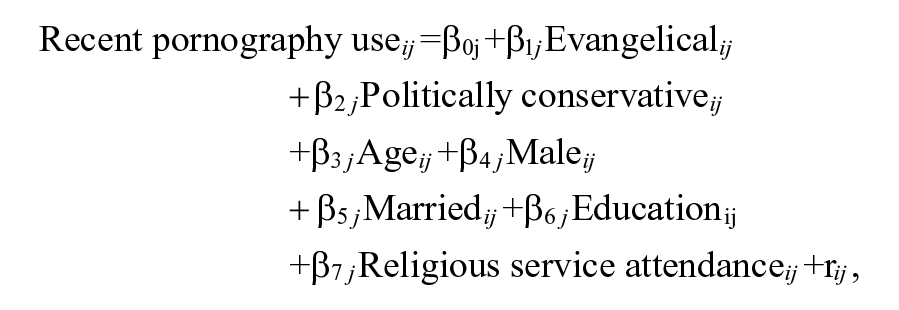
where β0j is mean recent pornography use for each state, β xj is the slope for each individual-level measure, rij is within-state variance in recent pornography use, i is individual, and j is state.
This equation will provide results similar to past research on individual pornography consumption. However, our hypotheses focus on the influence of contextual-level variables and their interaction with individual-level predictors. HLM tests for effects of state context by first examining whether each level 2 variable predicts the intercept of the level 1 model. This equation can be found in model 2 in Table 3:

where β0j is mean recent pornography use for each state, γ00 is the level 2 intercept, γ0x is the level 2 slope, U0j is the residual intercept variance, and j is state.
Beyond the individual- and state-level factors that might predict how recently a participant intentionally viewed pornography, we also investigate whether the context within which Americans find themselves will moderate our individual-level factors of interest (evangelical adherence and political conservatism) that potentially influence pornography viewing. The following are the equations for the four cross-level interactions found in Table 4:

where β xj is the level 1 slope, γx0 is the level 2 intercept, γ xx is the level 2 slope, Usj is the residual slope variance, and j is state.
Results
We first performed a one-way random-effects analysis of variance to discover how much variation in pornography consumption exists within individuals or across states: the intraclass correlation coefficient (Raudenbush and Bryk 2002; Snijders and Bosker 2012). Table 2 contains the variance components. The significant p value indicates that there are nontrivial differences in variation of the dependent variable at the state level. This means that multilevel modeling is appropriate. However, it should be noted that the amount of variation in individual-level pornography viewing due to state-level factors is quite small. Most of the variance in pornography viewing is found at the individual level, 98.65 percent (9.793/9.927).
Variance Components.

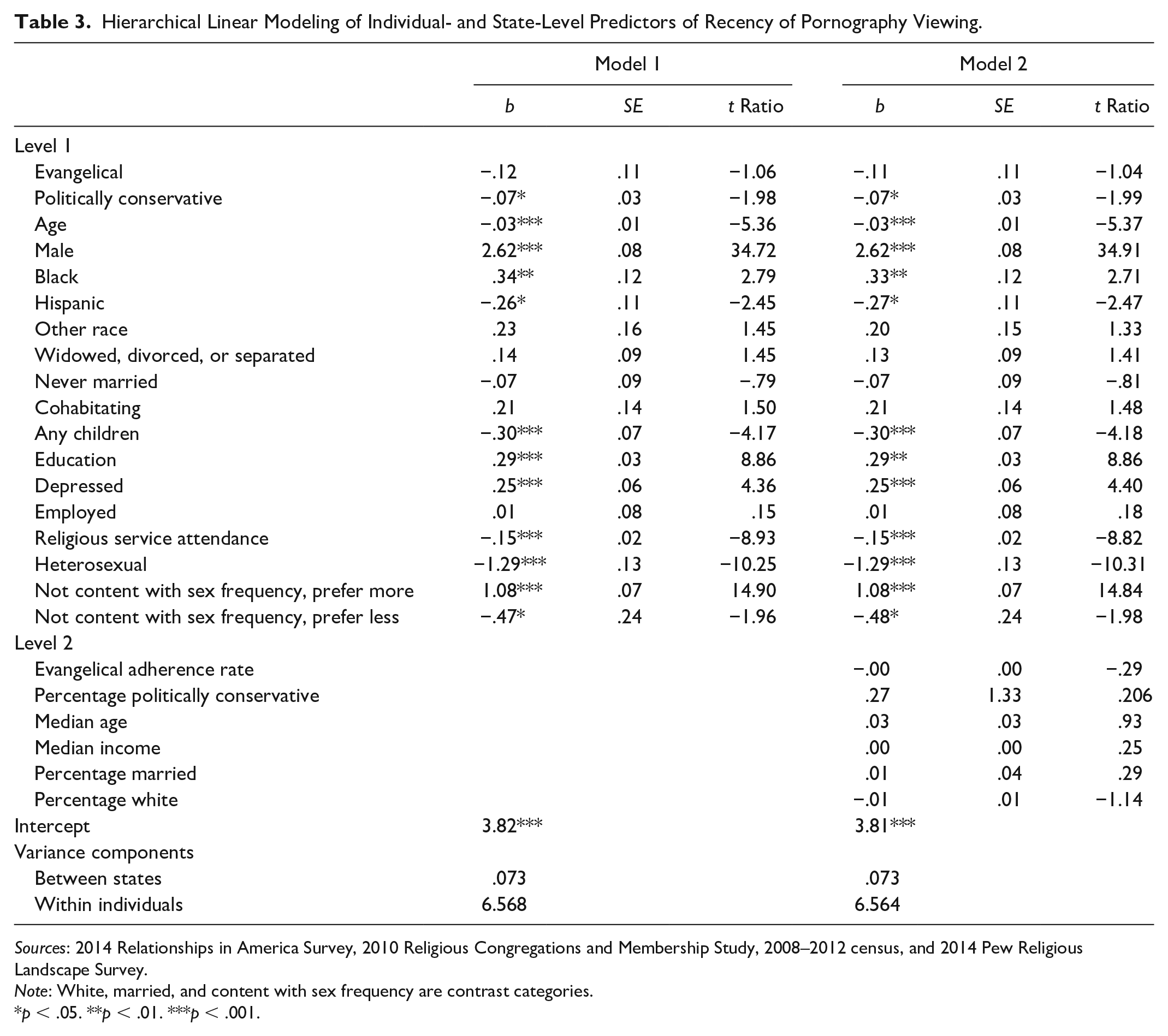
Table 3 presents the findings from the first two models. Model 1 is a typical individual-level model, predicting pornography viewing patterns using variables gathered from each respondent to the 2014 RIA Survey. The results found in this model correspond closely to much of the literature predicting pornography consumption at the individual level (Hardy et al. 2013; Perry 2016, 2019; Perry and Schleifer 2018). Being an evangelical is unassociated with more recent pornography consumption. However, political conservatism, increasing age, having children in the home, Hispanics (compared with whites), attendance at religious services, identifying as heterosexual, and wanting less sex are all significantly and negatively associated with viewing pornography recently. Men, blacks (compared with whites), those with higher education, those who feel more depressed, and those who want more sex are significantly more likely to view pornography recently. This model explains about 32 percent of the variance within individuals (1 – [6.568/9.793]).
Hierarchical Linear Modeling of Individual- and State-Level Predictors of Recency of Pornography Viewing.
Sources: 2014 Relationships in America Survey, 2010 Religious Congregations and Membership Study, 2008–2012 census, and 2014 Pew Religious Landscape Survey.
Note: White, married, and content with sex frequency are contrast categories.
p < .05. **p < .01. ***p < .001.
Model 2 includes the state-level predictors to discover if there are broad contextual influences on how recently Americans report viewing pornography. After accounting for the individual-level variables in model 1, all of the state-level predictors are not significantly associated with participants’ pornography consumption. Evangelical adherence rate, percentage politically conservative, median age, median income, percentage married, and percentage white explain about 54 percent of the variation between states.
In Table 4, we include the cross-level interactions between individual- and state-level evangelical Protestant adherence and political conservatism. Here we are testing if being an evangelical or political conservative operates differently in contexts in which there are more or fewer evangelicals or political conservatives. In each of the four models in Table 4, the individual- and state-level controls correspond closely to model 2 in Table 2. In model 1, the cross-level interaction between being and evangelical and evangelical adherence rate is nonsignificant. The same is true for the interaction between identifying as politically conservative and evangelical Protestant adherence rate (model 3) and identifying as politically conservative and percentage of the state that is politically conservative (model 4). The only significant cross-level interaction is in model 2, in which the effect of living in a politically conservative state context influences nonevangelicals differently from evangelicals (p < .01).
Cross-Level Interactions of Individual- and State-Level Predictors of Recency of Pornography Use.

Sources: 2014 Relationships in America Survey, 2010 Religious Congregations and Membership Study, 2008–2012 census, and 2014 Pew Religious Landscape Survey.
Note: White, married, and content with sex frequency are contrast categories.
p < .10. *p < .05. **p < .01. ***p < .001.
We graph this relationship in Figure 1. For nonevangelicals, the association between being in a more politically conservative state and how recently someone viewed pornography is negligible. For evangelicals, however, this relationship is much more pronounced. Those in more politically conservative states report looking at pornography more recently than evangelicals in less politically conservative states. 6
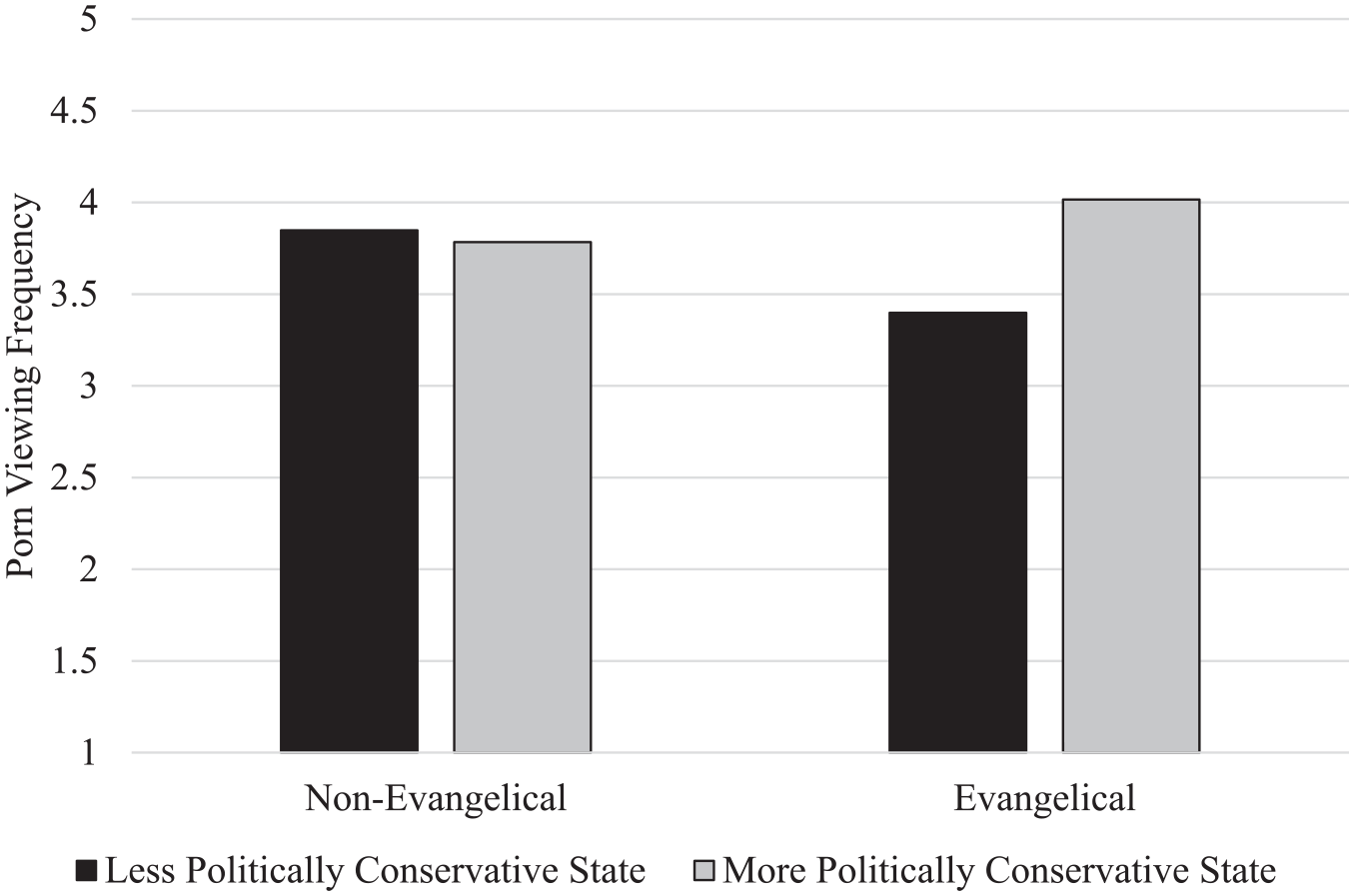
Relationship between evangelical Protestantism, recency of pornography viewing, and state-level political conservatism.
Discussion and Conclusions
Although several studies have identified a consistent association between state-level religious and political conservatism and various indicators of interest in pornography, previous research was limited in that it either lacked measures of actual pornography consumption (e.g., MacInnis and Hodson 2015; Whitehead and Perry 2018) and/or lacked data on individuals (e.g., Daines and Shumway 2011; Edelman 2009; Jaffee and Straus 1987; MacInnis and Hodson 2015; Whitehead and Perry 2018). Incorporating state-level characteristics and individual-level data from a large representative survey with a measure of pornography consumption, our hierarchical linear models have provided nuanced support for previous findings connecting contextual conservatism with pornography consumption. As expected, we found that individual-level religiosity and political conservatism predicted a lower likelihood of viewing pornography more recently. Furthermore, at the contextual level, the representation of evangelicals and of political conservatives within states were both unassociated with individual pornography consumption. However, interactions showed that persons who identified as evangelical Protestants who lived in politically conservative states reported greater recency of pornography viewing compared with nonevangelicals or evangelicals in more politically liberal states.
The moral communities perspective presupposes that groups have characteristics that can potentially influence individual-level behaviors in counterintuitive ways, including ways that appear to conflict with the individual-level characteristics of those in a community. Applied to our findings here, we propose that although evangelical Protestants might be less inclined than other Americans to view pornography at the individual level (though not to a significant degree in our analyses; see Table 3), evangelicals who live in more politically conservative states may find themselves within a cultural and social context in which overt and interpersonal sexual exploration is discouraged and thus may internalize more pressure to engage in more covert modes of sexual exploration. In contrast, nonevangelicals or evangelicals who find themselves in nonconservative contexts may feel less social or cultural constraint and do not view pornography as a primary outlet for sexual energy. Alternatively, MacInnis and Hodson (2015) propose that religious and political conservatives may ultimately fixate on and consume the very object of their cultural disdain (i.e., pornography). For evangelicals in politically conservative states, this may be the case as well, and this possibility does not discount the moral communities argument.
Our data do, however, suggest that Whitehead and Perry’s (2018) thesis regarding the children of religious conservatives searching for pornography may not be necessary. The authors argue that because Google searches for “porn” or “sex” are a rather unsophisticated method of accessing sexually explicit online material (since adults who view pornography with any regularity would likely already know their favorite Web sites), it may be the children of conservative families who are forced to search out sexual information or outlets online. Because our analyses look at evangelical adults within politically conservative contexts, it seems that adults also in religiously conservative homes or families are intentionally seeking out pornography within given contexts.
Despite the important contribution of our findings to discussions of religious and political context and pornography use, given some of our data limitations there are a number of avenues for additional research on this topic. First our data are unable to provide more fine-grained analyses of religious and political context beyond the state level. This would ultimately require a survey with an enormously large n to find adequate representation of people (level 1) in counties or cities within states (level 2). As we point out above, the amount of variance between individuals’ recency of pornography use that is explained by our state-level factors is quite small (less than 2 percent; see Table 2). This is not such severe a problem in our case because, in any hierarchical analysis, the amount of level 1 variance that is explained by level 2 differences is usually small. Hedges and Hedberg (2007), for example, show that across a number of studies focused on school (level 2) effects on educational performance (level 1), the intraclass correlations generally range between 10 percent and 25 percent (as cited in Snijders and Bosker 2012). Schools are a much more intimate context compared with states, so it is unsurprising that Hedges and Hedberg found that they exhibit a much stronger effect on individual behavior than we found with states as the level 2 context. Moreover, our statistical tests indicated that there were nontrivial differences in individual-level pornography consumption attributable to state-level variation.
Last, for our purposes, the relative size of variation attributable to state-level variation is of less importance given the number of prior studies that rely on state-level measures (e.g., Daines and Shumway 2011; Edelman 2009; Jaffee and Straus 1987; MacInnis and Hodson 2015; Whitehead and Perry 2018) and that the one-way random effects analysis of variance indicated that the variation was substantively important. Given these factors, we are confident that the present results provide a real indication of how much Americans’ pornography use is meaningfully associated with their states of residence. Even so, a large-n study with enough people in a more circumscribed area (such as counties of metropolitan statistical areas) would allow us to observe with greater confidence the potential influence of community context on individual-level pornography use. Qualitative interviews would also be helpful for discerning how social context might influence persons who are otherwise quite conservative culturally to pursue pornography use with some regularity (see, e.g., Perry 2019).
Going forward, future research should aim to connect Americans’ individual behaviors beyond pornography use to the contexts within which they find themselves. As we have shown here, even relatively broad measures of context, such as state of residence, can significantly moderate the effect of individual-level characteristics on pornography consumption, and this might also be the case for patterns of sex frequency, nonmonogamy, masturbation, and other sexual activities.
Footnotes
1
Although not necessarily showing a positive correlation between pornography consumption and state-level conservatism, in the 1980s, accessing sexually explicit magazines was still quite taboo, and thus, going out and purchasing a pornographic magazine would likely have been minimized by pervasive sanctioning. Given that likelihood, the fact that sex magazine circulation in southern states was indistinguishable from that in northeastern states is remarkable.
2
Indeed, the studies focusing on Google searches acknowledge these limitations and call for future research that takes both individual and state-level consumption patterns into account. MacInnis and Hodson (2015) explained, “Of course, it would be ideal to examine these associations at both the individual and state-level, especially given that individual- and state-level associations can vary” (pp. 145–46). And  acknowledged that “just because people are searching for porn (their key term) does not necessarily mean they are using it,” and they called for “future studies to incorporate individual measures” (p. 281).
3
Given their sampling strategy, GfK does not provide traditional response rates, which would require raw numbers of persons they invited to participate in their panels in addition to the number of panelists who were invited and completed the survey.
4
All possible response options include 1 = “I’ve never intentionally looked at pornography” (31.9 percent), 2 = “over a year ago” (22.0 percent), 3 = “over six months ago” (5.4 percent), 4 = “over one month ago” (6.5 percent), 5 = “3-4 weeks ago” (3.3 percent), 6 = “1 to 2 weeks ago” (5.4 percent), 7 = “5-6 days ago” (3.6 percent), 8 = “2-4 days ago” (8.5 percent), 9 = “yesterday” (7.4 percent), and 10 = “today” (6.0 percent).
5
The mean recency with which respondents reported viewing pornography is closest to “over one month ago” (4). Fifteen percent of respondents are evangelical Protestants. The average level of political conservatism is 3.12, or “middle-of-the-road” (3). The average evangelical Protestant adherence rate across the 50 states is 160 per 1,000 people, with a minimum of 23 (Utah) and a maximum of 420 (Alabama). The average percentage of politically conservative people in each state is 38, with a minimum of 28 percent (Oregon) and a maximum of 54 percent (Utah).
6
In ancillary analyses, we also tested for mean worship attendance rate at the state level, as found this to be correlated with Google searches for “porn” terms. There was a high degree of collinearity between this measure and the evangelical Protestant adherence rate, and ultimately, it neither predicted level 1 pornography use nor did it interact with any other individual-level factors. Thus we excluded it in order to focus more directly on religious conservatism and political conservatism and the cross-level interaction between the two.