




Abstract
Nonparental care (NPC) for children before they enter kindergarten has had two primary purposes for American families since the start of the twentieth century: supporting parental employment and providing children developmentally enriching out-of-home experiences. Today’s policy makers are increasingly expanding publicly funded opportunities for children in low-income families to experience center-based care. Yet parents’ work commitments often occur on evenings, weekends, and other times outside of the traditional school day. Understanding parental work schedules vis-à-vis NPC timing is essential to informing public expansions of accessible and affordable nonparental care options. Using a 7-day calendar from the 2012 National Survey of Early Care and Education, the authors uncover new patterns in the temporal synchronization of parental work and children’s time in various NPC settings and for households of varying incomes. Across all income groups and types of care, center-based care overlaps least with parental work hours. Children living in poverty have the lowest rates of NPC occurring during parental work time. The uncoupling of parental work status from children’s time in nonparental care suggests potential shifts in parents’ choices to expose children to care settings for the purpose of children’s development.
Expansion in early education funding and subsequent increased enrollment have potential implications for both employment prospects of parents and developmental trajectories of their children in ways that are not fully understood. Although programs are intended to improve access for children in low-income families, families’ abilities to participate in newly expanded programs may be hindered by conflicts with parental employment hours, parents’ self-care activities and support for the home, and lack of available transportation or wraparound care (Milkie, Nomaguchi, and Demy 2015; Westrupp et al. 2016). Newer state-based efforts have often prioritized programs that promote school readiness without regard to parental schedules, while childcare subsidies have matched parental work hours, sometimes at the expense of program quality (Forry, Daneri, and Howarth 2013; Ryan et al. 2011). When parents are asked, they report that changes in work schedules and wanting to support their children’s development are top reasons for initiating searches for a new care arrangement (Chaudry, Henly, and Meyers 2010; National Survey of Early Care and Education Project Team 2014). Parents of preschool-aged children are particularly likely to prioritize care environments that provide developmentally appropriate learning environments. Using a detailed, nationally representative 7-day calendar of parent work and children’s nonparental care (NPC) schedules, we investigate the synchronization between parental work and children’s time in NPC to a degree that was not previously possible. By doing so, we aim to uncover ways in which different types of NPC conflict with and complement the work schedules of parents overall and potentially differently by household income levels. We thus provide insight into the possible schedule implications of expanding NPC offerings.
To better inform how parental work conflicts with or is traded off against children’s time and participation in NPC, we ask, To what extent does parents’ time at work coincide with the time children spend in NPC? And second, how much does the correspondence between parents’ time at work and children’s time in NPC differ by household income? As such, our study describes revealed choices of work and NPC use made by parents of young children in the United States overall and by different levels of household income at an unprecedented level of detail, allowing us to question existing assumptions about how families use NPC in conjunction with parental work.
This descriptive study has four innovations that contribute to the existing empirical literature on parental work and children’s time spent in NPC. First, as described, the available data allow us to precisely align parents’ actual time at work with children’s actual time in NPC, rather than being restricted to studying children’s care by parents’ employment status more generally. We develop a measure of “all parents working” that identifies hours when all parents in a household are engaged in work-related activities, allowing us to have a comparable measure across one- and two-parent households. Second, we do so with information about each parent in a household, considering each age-eligible child within a household (not only mothers’ work hours and a focal child). Third, our nationally representative estimates of nonstandard-hours work expand the previous literature, which has often focused on nonstandard-hours work by low-wage workers. Fourth, we are able to include the full spectrum of NPC and to compare across types of care.
Parental Work and Children’s NPC
Changing parental work schedules combined with the emerging science of children’s early development inform several potential factors as to why parental work (and work-related activities) may or may not overlap with NPC. Children may participate in NPC when parents are not at work because of the availability of NPC programs or to preserve daily routines in ways that support their children’s development (Wildenger et al. 2008). Nonstandard-hours work schedules, increasing in prevalence for many types of jobs, are one example found to impinge on decisions related to the types of NPC that low-income families can rely on (Henly and Lambert 2014). Although home-based care is often provided throughout the week, fewer than 10 percent of centers (including school-based early education) are open outside of regular business hours (National Survey of Early Care and Education Project Team 2015). Parents working night shifts may find that daytime NPC supports their employment by allowing parents to sleep during the day while children are in care. Outside of the work context, parents may have other caregiving, personal health, or leisure activities for which they use NPC. Finally, the enriching nature of many NPC arrangements, whether they be high-quality preschool or high-quality nurturing time with a grandparent, may be appealing opportunities that parents view as superior to an additional hour of parent-child time, regardless of what the parent might do in the child’s absence (Duncan and Magnuson 2013; Heckman 2006; Weiland and Yoshikawa 2013).
NPC and Children’s School Readiness
High-quality early care and education are increasingly viewed as a path toward supporting favorably trajectories of children’s school readiness and development (Heckman 2011; Magnuson et al. 2004). Although parent-child interactions and conditions of the home environment can achieve these favorable trajectories, attention also has been paid to the necessary ingredients for children to thrive in NPC settings. In particular, interactions between providers and children appear to have more favorable effects on children’s developmental outcomes than other features of the care settings such as child-staff ratios (Howes et al. 2008; Mashburn et al. 2008; NICHD Early Child Care Research Network 2002; Ulferts, Wolf, and Anders 2019). Exposure to NPC from two years of age in particular can support children’s linguistic and related cognitive development and aligns with children’s developmental readiness to engage with peers and learn about social interactions including how to resolve conflicts, dialogue and evaluation social offers (Ahnert and Lamb 2018).
Socioeconomic Differences in Children’s Exposure to NPC
Both parental work and opportunities to support children’s development can contribute to socioeconomic differences in children’s exposure to NPC. Parents of all income groups work significant numbers of nonstandard hours, but the connection between parental work and childcare needs in low-income households is especially strong in two ways. A greater portion of the parental work hours in low-income households is during nonstandard times, and low-income households (especially those with just one adult) are especially likely to have every parent working during nonstandard work hours, requiring those households to use NPC during nonstandard work times. In contrast, parents in higher income households (especially those with two parents) may work equally many nonstandard work hours as parents in lower income households but rarely have nonstandard times when every parent is working (National Survey of Early Care and Education Project Team 2017).
Income disparities in the overlap of parental employment and children’s time in NPC may be found for several additional reasons. First, the incidence of nonworking parents in the household is likely to vary by household income, thus minimizing overlap of parental employment with NPC time. Second, households of different income levels have different capacities to purchase NPC for their children. Third, to the extent that center-based care in particular is available primarily during standard hours, parents working nonstandard hours may uncouple parental work choices and commitments from NPC decisions to take advantage of center-based care opportunities to promote their children’s development. This may be particularly true for families that are income-eligible for government-subsidized early education programs such as Head Start (Office of Head Start 2019).
Data, Sample, and Measures
We use household data from the National Survey of Early Care and Education (NSECE) 1 collected from January to June 2012, a period of relative stability after the great recession. The primary resources are detailed calendars of the seven days prior to the survey interview describing each resident parent’s engagement in work-related activities and each resident child’s participation in nonparental or parental care (National Survey of Early Care and Education Project Team 2013).
The NSECE household survey data are nationally representative of households in 2012 with at least one resident child under 13 years of age. Data are available from 11,629 such households. The NSECE household survey was conducted with a parent or guardian of a child or children under age 13 in households with at least one member child under age 13. The overall weighted response rate is 62.2 percent. 2 The analytic sample for this analysis includes 5,880 households with one or two parents (regardless of marital status) and at least one child aged 0 to 60 months (and presumably not yet in kindergarten). Nonmissing calendar data are available for 9,610 parents and 7,710 children under 60 months. 3 Because of the complex sampling design, including state stratification and oversampling of low-income areas, it is necessary to apply sampling weights when using the NSECE data. We report weighted estimates using child-level survey sampling weights, so that reported proportions reflect the overall population of children under age 5 in the United States in 2012. (This population numbered 20 million children in that year.) We focus on children under age 5 to be certain that our results are not confounded by kindergarten enrollments, which may interact with parental work schedules differently from childcare for younger children. Households in the analytic sample are classified by poverty status, defined as the ratio of total 2011 household income to the 2011 federal poverty threshold for their size.
To understand the interplay of parental work and children’s NPC time, we align parents’ work-related activities with children’s NPC time to understand which are happening simultaneously. Work-related activities include work, school, and training, as well as commuting to and from these pursuits. Information is not available about how parents spend time when not commuting or at work, school, or training.
NPC is broadly defined as any time spent away from a parent or guardian and could include formal arrangements such as preschool or a family childcare provider, and informal care such as lessons, play dates, and unpaid care provided by a grandmother. Time in NPC is further classified by type, of which the most common types are reported here. These four types are all regular care, defined as arrangements in which a child receives NPC at least five hours weekly. Individual providers include those that are paid and unpaid; among those who are paid, some have prior relationships to the family and some do not. Some, but not most, paid individual providers are regulated or licensed as home-based providers. Center-based care includes preschools, day care centers, Head Start, and private or public prekindergarten programs.
Taking children as the unit of analysis, we calculate for each child the proportion of his or her time in NPC that takes place when every parent in the child’s household is engaged in work-related activities. (The complement, not shown, is the proportion of time that a child is in NPC while at least one parent is not in work-related activities.) We further distinguish standard versus nonstandard hours and different types of NPC. Following established conventions in the existing literature, standard hours are defined as 8 a.m. to 6 p.m., Monday through Friday. Nonstandard hours are defined as before 8 a.m. or after 6 p.m., Monday through Friday, or anytime on Saturday and Sunday (e.g., Presser 2004).
The fact that the NSECE calendars collect multiple parents’ schedules allows us to relate children’s NPC time not just with maternal but also paternal employment. Other analyses of these data indicate that maternal employment alone does not accurately reflect needs for childcare to support parental employment (National Survey of Early Care and Education Project Team 2017). Because of the focus on residential parents, children’s time spent in the care of parents they do not live with is classified as NPC.
Results
Parental Work
Figure 1 maps parents’ work schedules over the course of a day for each of the seven days in a given week. As might be expected, work participation is highest between the hours of 9 a.m. and 5 p.m., Monday through Friday. On the other hand, the figure reveals that earlier morning (7–9 a.m.) and early evening (5–8 p.m.) work hours are quite common. Overnight hours are very limited, but more than 10 percent of parents have work hours at midday on Saturdays. Table 1 reports the incidence of parental work during standard and nonstandard hours, by ratio of household income to poverty. Although 51 percent of parents in the lowest income households had some work-related activity in the prior week, this proportion ranges from 66 percent to 77 percent among higher income households. Although rates of any work are quite different for the lowest income group, participation in standard- and nonstandard-hours work among workers is similar across income groups. Just over 75 percent of working parents from households under 200 percent of poverty work at least some nonstandard hours, somewhat more than the 70 percent of working parents from households over 200 percent of poverty. The proportion of working parents who work at least some nonstandard hours is also similar between single-parent and two-parent households (68 percent vs. 76 percent; not shown). Thus, working nonstandard hours per se and potentially also the distribution of those hours and working at all do not appear as key distinguishing factors differentiating family life for children by household income.

Percentage of parents of young children at work, by day and time of week.
Parents’ Participation in Work-Related Activities, by Standard and Nonstandard Hours and Ratio of Household Income to Poverty.

Source: National Survey of Early Care and Education Household Survey, 2012, weighted estimates.
Note: Parents of children younger than 60 months living in one- or two-parent households. Data from 2012 National Survey of Early Care and Education, pertaining to work-related activities in the week prior to survey interview, including work, school, training, and commuting between these. Income-to-poverty ratio calculated for 2011 household income. FPL = federal poverty level.
Children’s Participation in Any NPC
Figure 2 maps children’s time in NPC for each day of a seven-day week. A high proportion of children are in some type of NPC arrangement from 9 a.m. to 5 p.m. on weekdays, mirroring the high proportion of parents who are at work during the same time period.

Percentage of young children in nonparental care, by day and time of week.
Table 2 counts children with any time in NPC, at standard or nonstandard hours, and when every parent is at work. For all income groups, more children have at least some time during the week spent in NPC when at least one parent is not working than children who have some NPC time when every parent is at work. (Note that many children may have both.) However, a higher proportion of lower income children in NPC experience at least some of that care during nonstandard hours than do higher income children in NPC.
Children’s Participation in NPC, by Standard and Nonstandard Hours and Ratio of Household Income to Poverty.
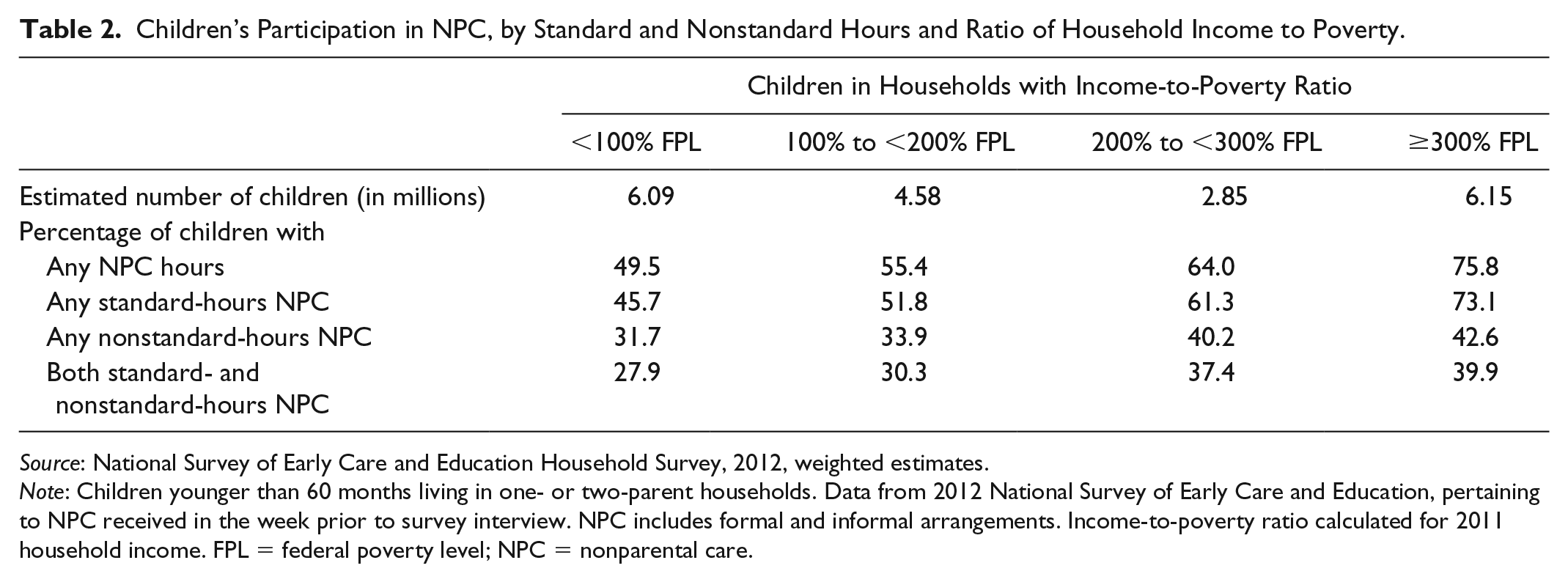
Source: National Survey of Early Care and Education Household Survey, 2012, weighted estimates.
Note: Children younger than 60 months living in one- or two-parent households. Data from 2012 National Survey of Early Care and Education, pertaining to NPC received in the week prior to survey interview. NPC includes formal and informal arrangements. Income-to-poverty ratio calculated for 2011 household income. FPL = federal poverty level; NPC = nonparental care.
Weekly Hours of Children’s Participation in NPC
Table 3 shows the number of hours spent in NPC by all children and by those who had any NPC in the reference week. Children younger than five years in any NPC spend, on average, 33 hours in NPC, with little qualitative variation in the number of hours across household income. Variation in household income comes from the proportion of children in an income group who do not experience any NPC. Children living in lower income households are less likely to have any NPC than children in higher income households. In addition, the timing of NPC hours statistically varies by household income. Approximately 85 percent of NPC hours among the highest income children (>300 percent federal poverty level [FPL]) with NPC are from 9 a.m. to 5 p.m. (standard hours) versus 65 percent among the lowest income children with NPC (≤100 percent FPL).
Children’s Weekly Hours in NPC, by Standard and Nonstandard Hours and Ratio of Household Income-to-Poverty.

Source: National Survey of Early Care and Education Household Survey, 2012, weighted estimates.
Note: Children younger than 60 months living in one- or two-parent households. Data pertaining to NPC received in the week prior to survey interview. NPC includes formal and informal arrangements. Income-to-poverty ratio calculated for 2011 household income. FPL = federal poverty level; NPC = nonparental care.
Parents’ Time at Work Coinciding with Children’s Time Spent in Any NPC
We next examine the extent of children’s time spent in NPC coinciding with parents’ work. Table 4 shows that overall, irrespective of household income, more young children are in NPC when at least one parent is not at work than when every parent is at work. 4 In the lowest income group, 2.73 million children were in NPC when at least one parent was not at work, including 2.42 million children who were there during standard hours. In the last rows of Table 4, we examine the proportion of children’s NPC time during which every parent is at work. At most, 54 percent of the time that young children spend in NPC occurs when every parent is at work, as seen among children in the highest income group during standard hours. The same children in the highest income group exhibit a low of 29 percent of nonstandard NPC hours occurring while every parent is at work.
Children Using NPC in the Prior Week and Percentage of NPC Time When Every Parent Is at Work, by Ratio of Household Income to Poverty and Standard or Nonstandard Hours.

Source: National Survey of Early Care and Education Household Survey, 2012, weighted estimates.
Note: Children younger than 60 months living in one- or two-parent households. Percentages are estimated on the basis of children with any NPC during the designated time. Data pertain to NPC received in the week prior to survey interview. NPC includes formal and informal arrangements. Income-to-poverty ratio calculated for 2011 household income. FPL = federal poverty level; NPC = nonparental care.
Parents’ Time at Work Coinciding with Children’s Time Spent in NPC, by Type of Care Arrangement
The extent to which children’s participation in NPC, irrespective of their parents’ work, might matter for children’s development depends on the type and presumed quality of the NPC arrangements (Bassok et al. 2008). Table 5 depicts, by type of care arrangement, how closely children’s care and parental work schedules coincide. Center-based care and individual unpaid care are the two types of care that are most frequently used among all children and that appear in the literature to be perceived as most valuable for children, although for different reasons, and thus may be the most likely to be uncoupled from parental work. For center-based care, one would expect preference because children can receive high-quality preschool education. For unpaid care, primarily with family or friends, one would expect the benefit to be a more nurturing environment that strengthens attachment. In contrast, the two forms of paid individual care (with or without a prior personal relationship between the provider and the child) may be most likely used for work support.
Proportion of Time Spent in NPC That Every Parent Is at Work, by Type of Care Setting and Ratio of Household Income to Poverty.

Source: National Survey of Early Care and Education Household Survey, 2012, weighted estimates.
Note: Children younger than 60 months living in one- or two-parent households. Data pertain to NPC received in the week prior to survey interview. NPC includes formal and informal arrangements. Income-to-poverty ratio calculated for 2011 household income. FPL = federal poverty level; NPC = nonparental care.
The analyses of counts of children in NPC aligned with their parents’ concurrent work and work-related activities reveal that the proportion of children ever in NPC when at least one parent is not at work is higher than the proportion of children ever in NPC when every parent works, irrespective of household income. Analyses capturing the allocation of time spent in different care settings offer a substantively varied picture across parental work status household income and parental at-work status. Table 5 presents the proportion of time spent in NPC by type and by parental work. Thirty-four percent of the time children in the lowest income households are in center-based care is while every parent is at work, a substantively lower (vs. 47 percent) percentage of time than the highest income children. This is qualitatively similar to the conclusions derived from the counts. In contrast, a majority of children’s time in the two categories of paid individual care (either with or without a prior personal relationship) occurs when every parent is at work, reaching 71 percent for children in the highest income group. Table 5 suggests that parents in the highest income group are indeed using NPC primarily to support their employment, while in other income groups, center-based care and unpaid individual care are often experienced by children uncoupled from their parents’ work time. Paid individual arrangements seem to be more associated with parental employment for all income groups.
Household Poverty or Household Composition?
The distinct patterns of parental work time and the allocation of children’s time in NPC by household poverty status do not appear across other characteristics of the household, including household composition. Children in single-parent households spend a higher proportion of their time in NPC while a parent is at work (not shown), quite in contrast to the patterns observed among the lowest income children overall. Three million children from single-parent households spend time in NPC when their parent is not at work, but only 47 percent of these children are also residing in the lowest income households (household income < 100 percent FPL). Indeed, the highest proportion of NPC time occurring when at least one parent is not at work (60 percent) is among the group of children in two-parent households (not shown).
Parental Employment or Parental Work?
Use of NPC when at least one parent is not at work may confound two things: (1) the use of any NPC when a parent is working at all during the week (and thus care arrangements may spill over to times when parents are not at work) with (2) whether the parent has any work-related activities at all. Supplemental analyses (not shown) indicate that 28 percent of the children from the lowest income households who spent time in center-based settings when their parents were not at work were children whose parents were not employed at all during the prior week. These proportions dramatically shift by household poverty status. Only 6 percent of children from higher income households (≥300 percent FPL) who spent time in center-based settings when a parent was not at work were children whose parents were not employed at all during the prior week.
Discussion
Policy makers and scholars are beginning to grapple with how employment considerations and children’s developmental objectives both affect parental NPC decisions, but this grappling is sometimes based on obsolete assumptions about the overlap of parental work time with children’s time in NPC.
Until now, the ability to accurately depict the interaction of a parent’s work day with children’s exposure to NPC has been limited by lack of comprehensive data, leaving scholars and policy makers with few facts and incomplete evidence. Previously existing data largely preclude a broader descriptive national picture of the extent and timing of intraweek work hours and how much, if any, variation exists across household income levels. No study, including the American Time Use Survey (Hamermesh, Frazis, and Stewart 2005), has matched data on parents’ and children’s schedules over an entire contemporary representative week. Whereas several studies document employment status, and/or the status of children’s participation in NPC, information about child and parental schedules can be used to enhance the information those measures portray by revealing detailed accountings of actual time spent. Furthermore, few existing studies examined questions of nonstandard hours of work and specific scheduling correspondence with children’s time spent in NPC across the income spectrum (exceptions include, e.g., Coleman-Jensen 2011; Presser and Ward 2011). None to our knowledge are able to do so from the lens of every child and every adult in the household (compared with a focal child, as in the Early Childhood Longitudinal Study, or from the perspective of one parent, as in the National Survey of Family Growth or the American Time Use Survey).
Using a detailed seven-day, nationally representative calendar, we conceptualize and generate new estimates and new findings on parents’ time in work, children’s time in NPC, and the ways in which these coincide. We introduce the concept of time when “all parents are at work,” which allows us to create comparable measures for handling the work schedules of one- and two-parent households. Our analysis of correspondence between parents’ actual work and children’s actual NPC schedules uncovers a decoupling of work from children’s participation in NPC that was not easily detectable from prior research or feasible to estimate from prior data.
We find that nearly all children younger than 60 months spending time in NPC spend some time in care when at least one parent in the household is not engaged in work-related activities. All parents are at work during greater proportions of NPC time for children of the highest income families (vs. those in lower income families), during standard (vs. nonstandard) hours, and paid individual care (vs. care that is center based or provided by an unpaid individual). There are many potential reasons for these patterns, including the likely possibility that increased availability, awareness, and financing of early education and care, through publicly funded programs and vouchers, have encouraged early care and education participation among the poorest children, even aside from the need for parental employment support.
The extent to which childcare use is motivated by employment-related parental needs, resource availability to invest in quality early education, or both, informs different early education policy strategies. Addressing misalignment of work schedules might imply employer and work-based policies to increase flexibility or the synchronizing of parents’ and children’s schedules with available hours of high-quality early education programs. Addressing financial resources alone may instead imply subsidization of NPC costs or higher earned income supplements so that parents can choose and afford to invest in high-quality early care irrespective of their employment hours. Yet another policy strategy may be to facilitate equal access to high-quality care that is invariant to standard versus nonstandard work shifts. The synchronization of parental work schedules in the context of NPC conducted in this study informs the optimal balance across these types of public policy investments (Greenberg, Lombardi, and Schumacher 2000).
Nuanced measurement of parental work with children’s NPC can deepen theoretical modeling of joint decision making among parents regarding time at work but also the intersection of that decision making with children’s time in NPC. Our findings suggest that children’s time in NPC occurs both independently from, and closely intersecting with, parental work decisions, thus complicating the levels of endogeneity or reciprocity in these relations. Future work with the same data in this study can be used to further explore the relationships and underlying mechanisms of these decisions with a broader set of family, parent, and child characteristics as well as the characteristics of the community and NPC market.
Limitations
The richness of the calendar data for all parents and all children younger than five years in a nationally representative sample of households allows unique investigation of the overlap of parental work-related hours with children’s participation in NPC. The data differ from full-time diary data, however, in that information is not available on how parents are spending their time when not in work, work-related activities, or commuting to work, especially with regard to nonwork activities that may hinder parents from caring for their children. Second, whereas information is readily available on the type of NPC setting children are participating in, no information is available about the quality of provided care, or why parents may have chosen it for their children. Third, although NSECE data include some information about nonresidential parents’ time with their children, the analysis presented here is restricted to children and parents who reside in the same household. Finally, it is not possible to make a causal inference about the observed uncoupling of parents’ and children’s schedules or to definitively assess the extent to which nonstandard hours, for example, may or may not be causally impinging on children’s exposure to certain early education and care settings.
Conclusion
Jobs following what was once considered a standard Monday-through-Friday work week are less frequent and less typical, raising concerns among family and child development scholars. Variability in parental work schedules means that a parent’s overall employment status is not enough to understand how early education schedules may complement or conflict with parents’ other obligations. Rather, identifying actual time at work and its intersection with children’s environments can provide added insight into familial experiences. Until now, it was not feasible to examine these work schedule (compared with employment status) patterns with a nationally representative sample of households with children. We find the likelihood of participating in “off-hours” work similar among lower and higher income working parents. Even so, implications for family life differ across household income, with one factor including time children spend in NPC, as we document in this study. The parental work-NPC constructs created in this study are new and can bring scholars and policy makers closer to understanding the extent of coupling or uncoupling of parental work status and children’s time in NPC. We find uncoupling in ways that point to shifts in parents’ preferences and choices to enroll their children in care settings not only to accommodate work schedules but also for the primary purpose of children’s social and cognitive development (National Survey of Early Care and Education Project Team 2014), particularly among lower income families that have experienced the relatively largest historical expansion in center-based setting options. Whether children’s time in center-based settings does or does not open opportunities for parental work is an open question.
Footnotes
Acknowledgements
We thank Ann Rivera and Ivelisse Martinez-Beck for helpful comments on earlier drafts.
Funding
The author(s) disclosed receipt of the following financial support for the research, authorship, and/or publication of this article: This work was partially funded by the Office of Planning, Research and Evaluation, Administration for Children and Families, U.S. Department of Health and Human Services, as part of the contract to conduct the 2012 NSECE.

1
The NSECE data characterize the supply of and demand for early care and education in America through four coordinated surveys of households, home-based providers, center-based providers, and instructional workers in center-based settings.
2
3
Fewer than 1 percent of the time slots for the analytic sample of children 0 to 60 months of age were missing calendar data. These are excluded from the reported analysis.
4
The proportion of time spent in NPC when a parent was not at work was highest among preschoolers (three to five years of age). In contrast, infants and toddlers (younger than three years) spent a higher proportion of time in NPC when all parents were at work. (Tabulations available from authors.)