




Abstract
In 2013 Weldon-Johns used the work-family typology classification model (WFTCM) to analyse the development of EU work-family policies. That examination showed that EU work-family legislation continued to focus on maternal care and was underpinned by the extended motherhood typology. In 2019, the Work-Life Balance for Parents and Carers Directive 2019/1158 was passed, implementing key changes to the EU framework. This article takes this as an opportunity to reflect on the current EU approach. In doing so, it revisits the WFTCM and expands the ideal types to include the shared parental roles typology and redefine the family typology. This analysis shows that while some advances have been made, gendered assumptions surrounding care remain, as does the presumption in favour of childcare. Instead of the Directive fulfilling its potential to challenge caring roles, it is likely that they will continue to be reinforced, although there are some hopes for the future.
Keywords
Introduction
In 2013 Weldon-Johns used the work-family typology classification model (WFTCM) to analyse the revised Parental Leave Directive 2010/18/EU (PLD) and the proposed changes to the Pregnant Workers Directive 92/85/EEC (PWD) (COM(2008) 600/4). 1 Using the three indicators of the family care model, the working family model and the division of gender roles, the WFTCM was used to analyse and classify the proposed and revised legislation into one of three ideal-type typologies. These were: the maternity to motherhood typology, the extended motherhood typology, or the family typology, which represented a spectrum of approaches towards addressing work-family conflict. Despite the actual and proposed changes, this analysis reinforced that the EU approach was still underpinned by a maternal focus. 2 However, in recent years there appears to have been a tentative move away from this approach. This started with the greater recognition of working fathers as working carers by the CJEU in (C-104/09) Roca Alvarez v Sesa Start Espana ETT SA 3 and (C-222/14) Maistrellis v Ypourgos Dikaiosynis, Diafaneias kai Anthropinon Dikaiomaton, 4 leading some to argue that this demonstrated a move towards recognising and valuing fatherhood. 5 Despite this apparent progress, the decision in (Case C-5/12) Betriu Montull v Instituto Nacional de la Seguridad Social (INSS) 6 served as a reminder of the limitations of the PWD and the EU work-family legislative framework in recognising the rights of working fathers as independent working carers. 7 However, more recently the Work-Life Balance for Parents and Carers Directive (hereinafter WLBD) 8 has offered the opportunity to move away from these historically maternal roots towards a more gender-neutral worker-carer approach to addressing the work-family conflict.
This article takes the enactment of the WLBD as an opportunity to re-examine the current EU approach. It also provides the chance to reflect on the WFTCM and the limitations within the original ideal-type typologies. In doing so, these are expanded to include shared parental roles, which more explicitly recognises the specific role of working fathers, or other second parents as recognised within individual Member States, as well as working mothers separately from the category of gender-neutral working carers. This enables the legislation to be analysed more effectively by recognising the inherent differences between gender-neutral parental care and responsibilities for care more generally. This also reflects the inclusion of additional rights for both working fathers and working carers in the WLBD. The article then examines the new legislation in detail through the lens of the WFTCM. This analysis will classify the WLBD and indicate whether caring roles are finally being challenged at an EU level. The article will then conclude with some thoughts on the future development of EU law in this context.
Work-family typologies
The 2013 WFTCM used three classification indicators to critically examine and classify the proposed and actual EU work-family rights into one of three ideal-type typologies, namely the maternity to motherhood typology, the extended motherhood typology and the family typology. 9 Table 1 presents these typologies as a spectrum of approaches to addressing work-family conflict. At one end of the spectrum is the maternity to motherhood typology. This is characterised by a focus on the biological aspects of childbearing and traditional gender roles, reinforced with an emphasis on pregnancy and the immediate post-birth period. Caring responsibilities are viewed as incompatible with earning, with those undertaking care being largely excluded from the paid labour market. This is evidenced by limited recognition of caring responsibilities beyond the post-natal period. This model is retained in the revised version. Next is the extended motherhood typology, which continues to be underpinned by a maternal care focus, however there is clearer recognition of caring roles. This model is characterised by equal but separate gender roles, enabling one (female) working carer to combine work and the care of young children, but fails to challenge the standard worker norm. This model is also retained in the revised version. The original model contained the family typology, which recognised shared caring roles and the care of both older children as well as other caring responsibilities. However, this approach failed to adequately analyse the distinct experiences of fathers, and other second parents, and other carers. Consequently, the revised model introduces the shared parental role typology, which represents a greater shift in the underpinning expectations of parental care by equally recognising the role of both parents as carer-earners. It is characterised by challenging traditional gender roles and enabling all parents to combine work and care, primarily by providing them with defined caring roles. The redefined family typology model focuses on relationships of care rather than the familial connection and while it includes childcare beyond the traditional dual-partnered family norm, such as grandparental care, it extends further to recognise the complex and continuing relationships of care that working persons experience throughout their lives. In doing so, it recognises that all working persons are inherently encumbered, and that the standard worker model needs to be challenged and changed to reflect this. These revisions enable the examination and classification of EU work-family rights to more fully critically consider whether there has been a greater recognition of fathers’, and other second parents’, roles, and whether additional relationships of care have been recognised.
Work-family Typologies.
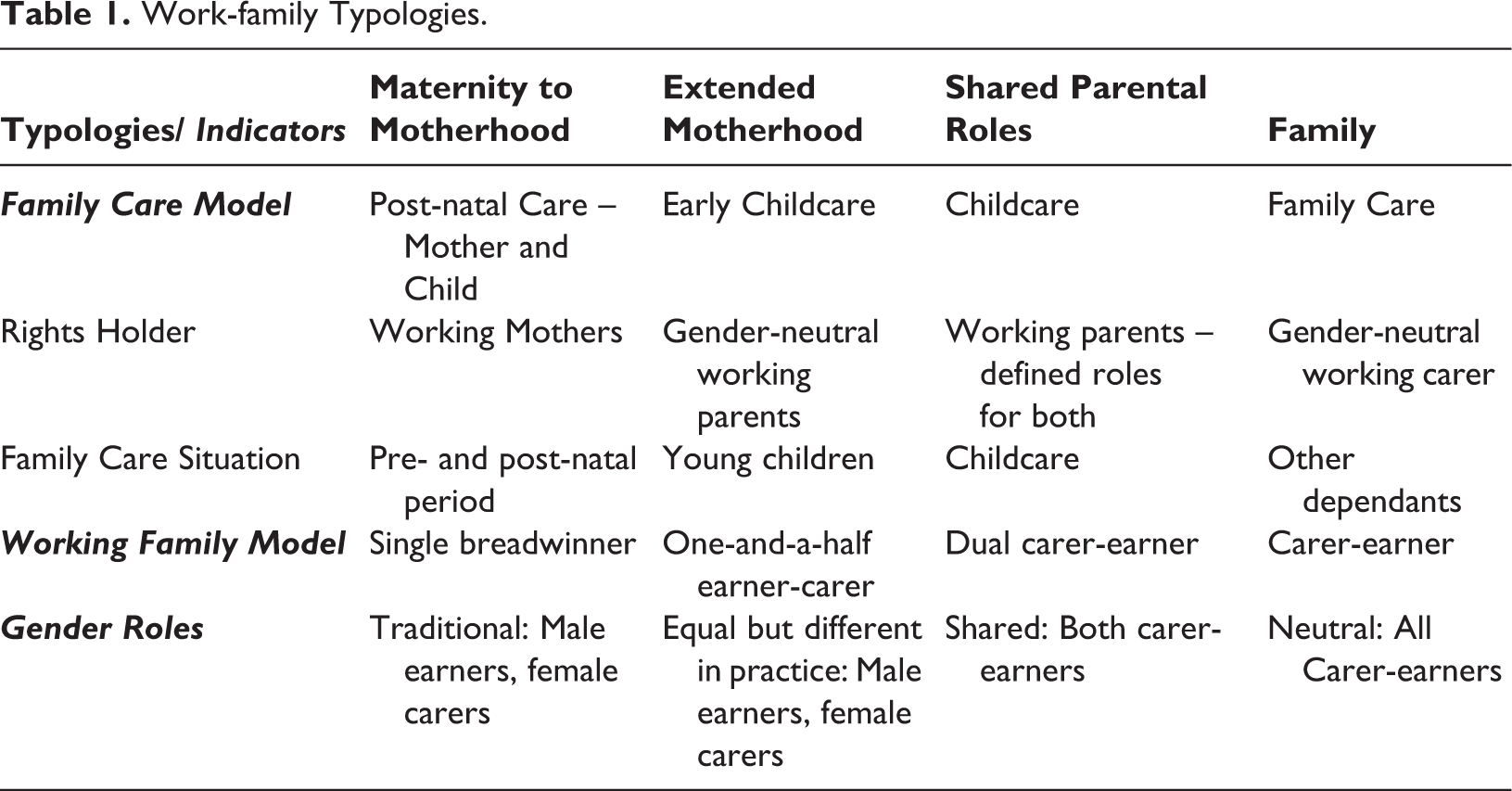
In order to classify the legislation using the WFTCM, in Table 1, the same indicators as used in the original model are applied as they remain key considerations in addressing the work-family conflict. However, the scope of these indicators is extended, reflecting the changes to the ideal-type typologies. First is the family care model, which is comprised of the identification of the rights holder and the care situations encompassed by the rights in question. Drawing from Fineman’s understanding of family care, which focuses on relationships of care rather than familial roles, 10 the model originally distinguished between post-natal care, with rights being afforded only to working mothers; early childcare, with working mothers remaining primary caregivers; and family care, which recognises both parents as carers, the care of older children and other dependants. In doing so, however, insufficient recognition was afforded to other relationships of care, the responsibility to care for another and a recognition of the interdependency of relationships of care. 11 This reinforces that in order for work-family rights to effectively meet the needs of all working carers, focus needs to be placed on all the responsibilities for care that individuals have, rather than being constrained by expectations surrounding certain familial roles. Only by doing that can the legislation acknowledge the interdependency of care and the reality that individuals rarely engage in the workplace unburdened from other responsibilities. 12 Consequently, it is necessary to recognise the universality of care and all individuals as potential carers, and recipients of care, throughout their life-course. 13 This extends from the care of young children, to care for sick or disabled dependants, eldercare and end-of-life care, and includes not only familial ties but other caring relationships. 14 This is particularly important in the context of work-family legislation, and the polarisation between the paid labour market and unpaid care that this currently reinforces. 15 In order to effectively reframe work-family rights, legislation must extend beyond the traditional maternal/female focus and move towards recognising all workers as potential working carers, or more effectively, as Busby argues, as carer-workers. 16
The revised family care model indicator reflects this by retaining the categories of working mother and gender-neutral working parents as rights holders, with post-natal and early childcare as the related care situations. The category of working parents is added, with defined roles for each to the categories of rights holders, again focusing on childcare situations, although not limited to early childcare. Finally, the gender-neutral working carers category is redefined to focus on all relationships of care, and care situations, beyond the parental-childcare norm. This final category embodies the inclusive understanding of relationships of care outlined above, by not defining nor restricting the acceptable relationships of care and care situations that are included here.
The second indictor is the working family model, which examines the balance between earning and caring responsibilities facilitated by the legislation. The categories were originally drawn from Leira’s family models, which identify three such relationships between work and caring responsibilities. 17 First, separation of work and care, with those undertaking a caring role being largely excluded from the labour market, here the single breadwinner working family model. Second, combining work and care, with a focus on one parent adopting this role while the other remains a primary breadwinner, here the one-and-a-half earner-carer working family model. Third, equal sharing of caring roles, whereby both parents equally share responsibility for work and care, here the dual carer-earner working family model. For the final category, the revision of the WFTCM presents the opportunity to reconsider the most appropriate working family model for working carers, as the dual carer-earner model is unlikely to reflect their lived experiences of combing work with care.
While the adult worker family model 18 and the ‘supported’ adult worker model 19 have been recognised within the literature, both are generally achieved through the de-familialisation, and resultant commodification, of care rather than through a redefining of the relationship between work and family life. 20 In doing so, it fails to adequately address the reconciliation of work and family responsibilities, except possibly in the sense that the single breadwinner model did, thus reinforcing traditional gender roles. 21 To more meaningfully address the position of all working carers the final model included here reflects, as Busby argues, a ‘move from an employment-centric vantage point to a care-centred approach.’ 22 This would redefine the focus of the working family model to instead prioritise care. As Herring also argues, ‘[t]he law for too long has been arranged around the vision of an able, autonomous and unattached adult’ and a ‘different vision’ is necessary, ‘one which starts with recognising that our identities, values and well-being are tied up with our relationships and the responsibilities that come with them.’ 23 Such an approach challenges the dominance of the male breadwinner working family model underpinning the models outlined above, and re-sets the focus to instead presume that all workers are encumbered and require support to balance work with other life commitments. Consequently, the final category is the carer-earner working family model, reflecting the prioritisation of care responsibilities in a more meaningful way, as opposed to focusing on how individuals meet the standard worker model. This model embraces ‘atypical’ working as the new standard worker norm, as suggested by Busby. 24 Of course, this is something that will only be truly effective by first ensuring that atypical work, and those who undertake it, are truly valued, which is arguably not the case at present. 25 Nevertheless, this model, and equally the dual carer-earner working family model in the shared parental roles classification, is not premised on the expectation of the standard full-time worker norm. It assumes that working arrangements are facilitated and supported by the legislation, enabling individuals to combine care with work, rather than being enforced on the individual because of a lack of available options.
The final indicator is the actual division of gender roles that is reinforced by the work-family rights. This indicator draws from Sainsburys’ gendered welfare state regimes and Chamberlayne’s analysis of gender roles. 26 In doing so, three divisions of roles were originally identified: First, the traditional division of gender roles, which reinforce women as primary caregivers and men as primary breadwinners; second, separate but equal gender roles, which continue to reinforce women as primary caregivers and men as primary breadwinners but provide the underpinning legislative framework to enable them to balance work and care; and third, shared gender roles, where both men and women are recognised and supported as earners and carers. This can be taken further in the context of carer-earners by including the category of neutral gender roles to reflect the arguments noted above, that all individuals have caring responsibilities that may manifest throughout their life-courses, irrespective of their gender and/or familial circumstances. 27 However, the challenge in adopting a more care-centric approach, 28 particularly in relation to gender roles, is that it is often assumed that carers are women, and so could serve to undermine the position of working carers rather than support it. 29 However, Herring argues that the appropriate application of such an approach would ensure a fair sharing of the burden of care. 30 Thus, the category of gender-neutral working carers adopted here reflects this notion that the only shared characteristic that working carers have is that they have care responsibilities and want to combine these with paid work. Legislation supporting this recognises that all individuals should be afforded legitimate choices between care and paid work. 31
The revised WFTCM will now be used to critically examine whether work-family rights in the EU have, or are beginning to, move away from a focus on maternal rights to finally recognising and challenging traditional caring roles, not just for working parents but for all working carers.
The Work-Life Balance Directive
The WLBD was first proposed in 2017 (Proposed WLBD). 32 This was followed with an agreed General Approach published on 25 June 2018 (General Approach). 33 Following some amendments, the Directive was finally adopted in 2019 and must be implemented by Member States by the 2 August 2022. 34 It was introduced under the European Pillar of Social Rights, which is aimed at enhancing citizen’s rights: by promoting equal opportunities and access to the labour market; through fair working conditions; and addressing social protection and inclusion. 35 Principles 2, 3 and 9 on gender equality, equal opportunities and work-life balance, respectively, are relevant here. This suggests a willingness to effectively address the position of working carers, recognising the gendered aspects of care. Nevertheless, as Busby notes, the Social Pillar is underpinned by economic considerations, which continue to reinforce the subordination of gender equality to economic objectives. 36 This tension between promoting gender equality and economic considerations has underpinned, and arguably undermined, existing EU work-family rights, 37 particularly the gender-neutral right to parental leave which makes no reference to a right to payment during leave. 38 However, this issue is addressed in the WLBD, again suggesting a shift towards genuinely recognising caring roles.
The legal basis of the WLBD is Art.153(1)(i) TFEU, which relates to equal treatment between men and women at work and equality regarding labour market opportunities. This approach reflects the move towards recognising both parents as working carers in the jurisprudence of the CJEU, by treating both as equally burdened by caring responsibilities. This is reflected in the underpinning aims of the Directive, which are gender equality, 39 and increasing fathers’ utilisation of rights. 40 These dual aims have been problematic in the past because a focus on achieving gender equality has often centred on the position of working mothers, to the detriment of working fathers. 41 However, the WLBD, in principle, makes a number of efforts to recognise and support working fathers, and other second parents, and carers, which could indicate a genuine change in the underpinning approach towards caring roles. Caracciolo di Torella, with reference to the Proposed WLBD, also argued that it was innovative because it was the first attempt at providing a co-ordinated approach towards addressing the work-family conflict which, she argued, could present an opportunity to reconceptualise it. 42 This suggests that the WLBD could provide the opportunity to redefine the roles of working carers.
The WLBD is, in part, a response to the withdrawal of the revised PWD, and replaces the PLD. 43 Consequently, it includes some of the more controversial proposals originally included in the proposed PWD, such as ten days’ paid paternity leave (Arts. 4 and 8) and the right to request flexible working (Art. 9). It also includes: the right to four months’ parental leave (Art. 5), two months of which are non-transferable (Art. 5(2)) and paid (Art. 8(1)); five days’ carers leave (Art. 6); force majeure leave (Art. 7); protection of employment rights and against dismissal (Arts. 10 and 12); and protection against discrimination (Art. 11).
In order to examine the changes effectively, the provisions relating to working fathers, and other second parents, will be considered separately from those relating to working carers. This is primarily because specific attention has been given to men in their capacity as working fathers within both the Recitals and the WLBD, suggesting a potentially differentiated approach towards working fathers than was the case previously. In doing so, there is an expectation that parenting roles are finally being challenged within the EU legal framework. Secondly, the position of working carers also deserves separate attention as this is the first time that their rights have been included within the EU legislative framework.
Challenging parenting roles?
The WLBD specifically recognises the limitations of the current EU legal framework from the perspective of working fathers. In particular, Recital 11 notes ‘[t]he imbalance in the design of work-life balance policies between women and men reinforces gender stereotypes and differences between work and care.’ The Recitals also recognise the barriers to fathers’ utilisation of rights, and how these can be overcome: introducing gender-specific rights, ensuring the non-transferability of rights, increased flexibility, extending the periods during which rights can be taken, and paid leave. 44 The question this poses is whether or not the WLBD indicates a genuine move away from the previous extended motherhood typology classification towards the shared parental roles typology?
Family care model
In analysing the family care model, it is first necessary to consider the categories of rights holders included within these proposals. These include the gender-specific right to paternity leave and the gender-neutral rights to parental leave, force majeure leave, and to request flexible working. The right to paternity leave in Art. 4 is a notable inclusion here. It requires Member States to provide a right to 10 working days leave that can be taken in the period around childbirth. Art.4(2) is also notable because it requires that the right to paternity leave be a day-one right to leave, with no continuity requirements permitted. This is not as extensive as the right to maternity leave in the PWD, and does not provide for mandatory periods of leave, as both Foubert and Fredman recommend. 45 Nevertheless, it marks a significant step forward in recognising fathers as carers and as independent rights holders. This is further reinforced in Art.3(1)(a) in which paternity leave is defined as ‘leave from work for fathers…on the occasion of the birth of a child for the purposes of providing care.’ The specific inclusion of caring responsibilities here reinforces that not only are fathers entitled to time off, but the reason for this is to care for the child. This attempts to move it away from the secondary status of supporting the mother to recognise that fathers have their own caring responsibilities. 46 It is also not limited to biological fathers. Art.4(3) applies ‘irrespective of the worker’s marital or family status’ under national law and Art.3(1)(a) refers to fathers ‘or equivalent second parents’. While there was some debate as to whether to make the provision more gender-neutral, 47 there were also those who strongly opposed this suggestion. 48 The inclusion of the reference to equivalent second parents thus provides at least some recognition of different familial relationships. However, Art.4(1) refers solely to ‘the birth of the worker’s child’ and while it is clear that this can include social as well as biological parents, it does not extend to the placement of an adopted child, unlike the right to paternity leave in the UK. 49 The omission of a clear reference to the placement of an adopted child appears deliberate, particularly given that the right to parental leave explicitly extends to adopted children, 50 and that its extension to adopters was proposed early in the legislative process. 51 Furthermore, by focusing on the typical dual-partnered family dynamic, the legislation could have the effect of excluding non-resident biological fathers where there is a resident equivalent second parent, such as the mother’s partner or a step-parent. Consequently, the focus remains on the traditional, primarily biologically-related, nuclear family model and does not clearly address the diversity of families with dependent children. 52
A specific role for working fathers, and other second parents, is also reflected in the revised right to parental leave. While the right remains gender-neutral, the revisions require Member States to ensure that it is an individual right, which both parents can utilise equally, with two months being non-transferable (Arts. 5(1)-(2)). The requirement that it be framed as an individual right should make it easier for non-resident parents to also utilise this. However, the reference to the transferability of leave again suggests that it is based on a dual-partnered working family norm, which may make this difficult in practice. 53 Art. 5(8) also requires Member States to consider whether the arrangements for parental leave should be adapted to meet the needs of adoptive parents, those with a disability and parents of children with disabilities or long-term illnesses. This has the potential to ensure that the right is more effective and responsive to a range of caring responsibilities, rather than offering a one-size-fits-all approach, although it remains limited to the traditional dual-partnered family norm with no recognition of other relationships of care.
The right to force majeure leave, originally contained within the PLD, is also retained in Art. 7. It similarly provides for a right to time off work for ‘urgent family reasons’ relating to illnesses or accidents. This is available to all workers with caring responsibilities and not just working parents, recognising the continuing and diverse nature of caring responsibilities throughout the life-course. As the definition of ‘urgent family reasons’ is not provided, it could enable other carers of children to take time off to respond to an emergency, so long as their immediate attendance is required. Art. 9(1) contains the right to request flexible working for working parents of children up to at least eight years of age. This is also gender-neutral, but there are elements of flexibility, such as allowing a return to original working arrangements (Art. 9(3)), which may make it more accessible to working fathers who tend to work more hours after having children than less. 54 Allowing a temporary reduction in hours with a guaranteed right to return to the original working arrangements may make it easier, and more attractive, for fathers to utilise. The right to request flexible working is also now framed as an independent right as opposed to being linked to a return from parental leave, as was the case in the PLD. 55 This again would make it more accessible to working parents, particularly fathers, who did not use parental leave in the first instance. 56 The introduction of the right to request remote working may also make it more attractive to all parents, especially women, enabling them to remain in the labour market, 57 particularly where this involves autonomy over working hours. 58
While some elements of the categories of rights holders here are still reflective of the extended motherhood typology classification, there are also indications of more defined roles for both parents within the dual-partnered family norm, suggesting a move towards the shared parental roles typology classification. However, in order to move closer to the family typology classification, greater recognition of other childcaring responsibilities beyond this norm is necessary.
Similar issues arise in relation to the family care situations included here. The right to paternity leave is limited to the period around childbirth, which is characteristic of the maternity to motherhood typology. However, this is justifiable to ensure that fathers can bond with the child and are able to care for them during these early stages of life, and, in principle, is complemented by the right to parental leave. Art. 4(1) also allows Member States to provide more flexibility here in how the leave is taken, as well as when it can be taken, including whether part of it can be taken prior to the birth. There may be some merit in allowing some leave to be used prior to birth, for instance, to enable fathers to attend the birth, or to care for other children while the mother is giving birth. However, it is important to ensure that it does not diminish the primary purpose of paternity leave, which is to care for the newborn child.
The overall extent of the right to parental leave is the same as the PLD and enables working parents to each take four months’ leave to care for the child. Like the PLD, the utilisation period is limited to when the child reaches eight years of age (Art. 5(1)). The Proposed WLBD recommended increasing this to 12 years of age, 59 with the General Approach referring only to a given age determined by the Member States and/or social partners. 60 In doing so, the General Approach left open the possibility for the leave period to be extended throughout the child’s life, 61 rather than being limited to early childcare with the resultant widening of the scope of both rights holders and care situations. 62 However, the reverse would have also been possible, too, with it being limited to the period following childbirth. Nevertheless, the enacted WLBD reflects the current position and focus on, primarily pre-school, childcare.
The focus beyond early childcare is also supported by the right to request flexible working. While this also allows for the right to be limited by the age of the child, eight years of age is the lower limit (Art. 9(1)). This enables working parents to request changes to their working patterns, hours and/or place of work at least until the child has normally started school (Art. 3(1)(f)). While this does not signal the end of childcare responsibilities, it does recognise that they extend beyond the post-birth period and are continuing. In addition, the inclusion of requests to use remote working, alongside the retention of requesting reduced hours and/or changed working patterns, offers additional opportunities to reconcile work and care responsibilities. The increased flexibility here may also make it more attractive and accessible to working fathers who may be less likely to reduce hours but otherwise work more flexibly. The ability to request to work remotely may also enable more working parents to combine work with caring responsibilities without having to reduce their labour market connection. However, the reverse is also true and can lead to a greater blurring of boundaries between work and home life, resulting in reduced work-life balance in practice. 63
The right to force majeure leave also recognises the continuing nature of caring responsibilities. It is based on responsibilities for care, rather than defined relationships, and is not limited by the age of the recipient of care (Art. 7). The care situations envisaged within the WLBD, consequently, make some steps towards recognising both the specific role of working fathers, and other second parents, and that care extends beyond the immediate post-birth/early childcare period, thus, suggesting some tentative steps towards a childcare approach in terms of the family care situations envisaged here, consistent with the shared parental roles typology. However, those elements that would have signified a stronger commitment to addressing care needs throughout the child’s life, such as removing age limits for utilising rights, would have indicated a more decisive step towards recognising shared parental roles.
Consequently, the overall family care model underpinning the WLBD is moving towards the childcare approach characteristic of the shared parental roles typology. Nevertheless, clearer recognition of the diversity of families and related childcare commitments and the continuing responsibilities of care that working parents have throughout their children’s lives is arguably necessary to fully embrace the shared parental roles typology and move towards the family typology classification.
Working family model
The second indicator is the working family model underpinning the legislation. Given the prioritisation of care, the key consideration here is the extent to which the legislation facilitates care choices while enabling working parents to remain in work. While the WLBD does appear to offer some potential here, the detail is left for Member States to determine, which undermines this possibility in practice. In the first instance, the WLBD, alongside the PWD, would enable all working parents to combine work and care responsibilities following the birth of a child. In addition, the WLBD enables both working parents to exercise parental leave for a period of four months each. While this is typically limited to early/pre-school childcare, Member States can limit the utilisation period up until the child turns eight years of age. Consequently, its extension beyond the post-birth period enables working parents to make some choices about their caring responsibilities, although this is more limited than both the Proposed WLBD and the General Approach. Nevertheless, choice is also reinforced by the requirement to ensure that parental leave can be exercised in flexible forms (Art. 5(6)), which is one of the main reasons given that would encourage fathers to take leave. 64 While there is no guidance as to what this may entail, it again has the potential to enable working parents to make choices about caring responsibilities, and arguably begins to recognise that the responses to work-family reconciliation cannot be a one-size-fits-all approach. Instead, the legislative framework needs to recognise that working parents are best placed to determine what care-work arrangement suits their needs. While the revised right to parental leave offers some potential in this regard, it is still left to Member States to determine what flexibility means, which may not embed genuine choice and flexibility in practice, and instead reinforce traditional working family models. 65
However, greater recognition of caring roles is supported in Art. 8(1), which requires Member States to ensure payments or allowances are given to those using paternity leave and during the two-month non-transferable period of parental leave. This not only reasserts the commitment to specific roles for working fathers, and other second parents, but also reinforces that caring should be non-negotiable for all working parents. 66 By limiting the financial consequences, there is a commitment to recognising and addressing one of the main barriers to taking leave, particularly for working fathers. 67 However, there are limitations to this. Firstly, Art. 8(2) only requires that paternity leave pay be at least the same as national sick pay benefits, therefore it is unlikely to be earnings-related in practice and unable to fully mitigate the loss of earnings experienced by those taking leave. However, it is important to acknowledge that this is reflective of existing EU work-family rights and was subject to much debate during the legislative process. 68 While enhanced rights would have been welcome, it remains significant that a minimum floor of rights was achieved here. Secondly, Art. 8(2) also allows for paternity pay to be subject to employment-related qualifying conditions of taking place no more than six months before the expected date of childbirth. Consequently, the right to paid paternity leave will not extend to all working fathers in practice. Regarding parental leave pay, Art. 8(3) leaves it to Member States and/or social partners to define this, with no reference to minimum levels of payment, although there is a requirement to ensure that it promotes utilisation for both parents. This was also subject to debate with higher levels of payment initially being proposed. 69 However, given the varied approach towards payment between Member States, consensus around minimum levels of payment could not be reached. 70 Given the lack of minimum rights here, this is unlikely to provide sufficient replacement earnings in practice. It is in this context that effective opportunities for flexibility in taking the leave will be most significant. Nevertheless, it is another tentative step towards recognising the importance of working parents in their capacity as working carers.
This is also supported by the extension of the right to request flexible working, particularly the possibility of requesting remote working. By allowing working parents, and carers, to have more control over their work-family arrangements, this expansion of the right could be viewed as a move away from an employment focused approach to one centred on care, as advocated by Busby and discussed above. 71 However, in order for this right to be meaningful in practice, employers will need to ensure that working parents and carers have autonomy over their working hours and the boundaries between work and care. Otherwise instead of moving towards recognising them as carer-workers, it will likely result instead in increased burdens on these workers. Furthermore, it is important to remember that this is only a right to request such changes and does not confer an automatic right to flexible working and/or home working. Consequently, the ability of working parents, or carers, to work more flexibly and/or from home is dependent on decisions made by their individual employers.
This is also supported by the protection against discrimination contained within Art. 11, which prohibits less favourable treatment on the grounds of applying for, or exercising, rights to paternity and parental leave, and the right to request flexible working. This is further supported in Art. 12(1) with protection against dismissal for the same reasons. This reinforces the protection already included in the Recast ETD, 72 which exempts paternity leave from the equal treatment provisions and provides protection against dismissal for utilising such rights. This reinforces a move towards recognising and valuing working parents in terms of their caring roles, by ensuring that their status as working carers is protected when exercising these rights or proposing to do so. However, as Caracciolo di Torella argues, it does not provide protection against discrimination based on caring responsibilities more generally. 73 This would have been a welcome inclusion here as it would have demonstrated a much stronger commitment to not only working parents but working carers, too. 74 In addition, it would have had the potential to extend to those currently excluded from the work-family rights frameworks since protection is limited to utilising these rights. This would ensure that those providing care are protected, irrespective of whether they can access specific rights.
While the underpinning legislative framework does little to change the specific rights available to working parents, and therefore facilitate a substantial renegotiation of the ways in which families navigate their caring responsibilities, there are some tentative steps forwards in this regard. In small ways, their carer status is becoming more central in the underpinning legislation. This is reflected in the strengthening of individualised rights to leave, the potential for greater flexibility, and by starting to provide for paid leave. While in practice, this may not change the one-and-a-half-earner-carer working family model, it makes some steps towards re-focusing the legislation towards the dual carer-earner working family model, and the shared parental roles typology. Nevertheless, it remains far from recognising all carers of children beyond the traditional dual-partnered family norm.
Gender roles
The final indicator is the division of gender roles reinforced by the legislation. As noted above, the proposals make some efforts to recognise clearer roles for working fathers, and other second parents. In doing so, there is, at least the potential to challenge the division of gender roles and reinforce shared responsibilities for both work and care. While the introduction of paternity leave can be viewed as a positive first step in the recognition of the role of working fathers, and other second parents, in early childcare, on its own it does little to change their secondary status in this context. 75 However, the little it does do could be viewed in positive terms. Art. 4(2) specifically ensures that this is a day-one right to leave by stating that it should not be subject to any continuity of employment qualifying conditions. This can be compared with Art. 5(4), which allows Member States to make the right to parental leave subject to continuity requirements of up to one year. Requiring that paternity leave be a day-one right is consistent with the decisions of the CJEU on childcare leave and signifies a positive step forward in reinforcing the equal treatment of parents with regards to childcare. In doing so, for the first time at the EU level, it acknowledges that working fathers, and other second parents, should have inherent rights to leave by virtue of their caring status alone. This could start to facilitate a clearer role for both parents in early childcare.
This is supported by the revisions to parental leave, which again make little, but potentially significant, changes in terms of beginning to challenge gender roles. By extending the non-transferable period to two months and reinforcing its individualised nature in Arts. 5(1)-(2), the rights of each parent as a carer-earner are reaffirmed. As the recent Eurobarometer survey shows, one of the reasons fathers do not take leave is that the mother utilises the full leave entitlement. 76 This change ensures that parents will have to share leave if they want to use it all. The requirement that the two-month period of non-transferable leave is paid also recognises and values the caring role of each parent. However, the level of payment will have an impact on the extent to which this genuinely challenges gender roles in practice. The lack of a minimum floor of rights for parental leave pay means that this cannot be guaranteed at an EU level, although the requirement for payment to ‘facilitate take-up…by both parents’ reinforces that gender equality should be a key consideration in defining this. If Member States, and/or social partners, adhere to this principle in defining pay, then due consideration should be given to the evidence that adequate income replacement is necessary to genuinely enable both parents, particularly fathers, 77 to utilise leave. However, it should be borne in mind that the availability of (paid) non-transferable leave does not necessarily result in the equal sharing of leave and caring responsibilities. While men are more likely to indicate that they have, or would have, taken leave in those countries with existing non-transferable rights, 78 they continue to take less leave than women. 79 Nevertheless, it remains a key factor in encouraging fathers to utilise leave.
The second most common response to increasing fathers’ utilisation of parental leave in the Eurobarometer survey on work-life balance was flexibility, 80 particularly having the choice between taking it in blocks and/or working part-time. Given the requirement in Art. 5(6) for Member States to allow workers the right to request flexibility in utilising leave, there is the potential here to begin to challenge typical patterns of care arrangements, and with it, traditional gender roles.
These changes indicate a move away from the previous entrenchment of separate gender roles and suggest tentative moves towards a more genuine recognition of shared gender roles. There is some potential to move towards the shared gender roles typology here, but given that much is left to the discretion of Member States, it remains to be seen whether the specific rights for working fathers, and other second parents, provide them with genuine choices regarding their work-family responsibilities.
Overall, this analysis of the underpinning work-family typology classification suggests a small potential shift away from the extended motherhood typology. This is particularly so in the context of the enhanced rights to request flexible working with the potential to allow working parents, and carers, to renegotiate the boundaries between work and caring responsibilities. However, given that this is just a right to request, and many of the other key changes are left to Member States to determine, the Directive alone is unlikely to make significant changes to the currently gendered reconciliation of work and family. For that reason, while there is some potential here to move towards the shared parental roles typology, the WLBD does not yet signify a clear shift towards this. Thus, the overall classification remains closer to the extended motherhood typology. However, the WLBD also extends rights to working carers, which together with these proposals for working parents, may more clearly support a move away from this typology.
Recognising caring roles?
The WLBD moves beyond the current legal framework’s parental focus to begin to recognise the rights of working carers. While the right to force majeure leave has always applied to working carers, 81 the right to carers’ leave in Art. 6 represents the first effort to create a specific legal right to time off work to care for another beyond emergency situations. While the underpinning objectives are to promote gender equality, 82 Recitals 27 and 34 focus on providing all working carers with increased opportunities to stay in employment. In doing so, the challenges facing working carers are at least acknowledged, if not fully met, in this Directive. The WFTCM will now be used to determine whether these provisions, allied with those relating to working parents, challenge the nature of the caring roles supported at an EU level.
Family care model
The extension of the right to request flexible working and the inclusion of carers’ leave extends the categories of rights holders beyond both gender-specific and gender-neutral parental roles, to recognising the broader category of working carers. This is an important step forward in challenging the parental focus of care and recognising rights for working carers. 83 However, this category is not without limits. While Art. 6 only requires Member States to ‘take the necessary measures to ensure that each worker has the right to carers’ leave of five working days per year’, and Art. 9 simply extends the right to request flexible working to carers, Art. 3 offers more clarity here. Art. 3(1)(d) defines carers as ‘a worker providing personal care or support to a relative, or to a person who lives in the same household as the worker.’ Art. 3(1)(c) relates specifically to carers’ leave and reinforces that it only extends to relatives or persons who live in the same home as the carer. The categories of relatives included here are defined in Art. 3(1)(e) as children, parents and spouses or civil partners, where those are recognised by national law. As there is no further guidance on the category of carers for the purposes of the flexible working provisions, it can be assumed that the same categories are included there. This reflects the traditional nuclear family by focusing on traditional bonds and presumed relationships of care, rather than focusing on responsibilities for care that may extend beyond defined familial roles. While it does extend to persons living in the same home, which could include other non-privileged relationships, it fails to fully acknowledge the diverse and complex relationships and responsibilities for care that may exist, such as care of other family members, neighbours or friends. In particular, the absence of grandchildren from these provisions, and the ones discussed in the previous section, are notable. This is reinforced by the findings of the 2016 European Quality of Life Survey, in which 29% of men and 35% of women with grandchildren reported that they regularly provided care at least once or twice a week, with many still working. 84 The inclusion of these categories of relatives was proposed in the Opinion given by the Committee on Women’s Rights and Gender Equality, 85 but not adopted. While Member States are encouraged to extend carers’ leave to grandparents and siblings in Recital 27 of the WLBD, no specific rights are conferred within the Directive itself. Their inclusion in the Recitals can potentially be viewed as a positive first step, although it remains far from supporting the rights of working grandparents in practice. Consequently, while there are some steps towards extending rights to the gender-neutral working carer, this is still based on accepted categories of care rather than recognising that all working persons are inherently burdened with caring responsibilities. 86
When it comes to family care situations, the position of working carers is much more difficult to define. This is because of the varied and unpredictable nature of these caring responsibilities, which requires a more flexible approach and one that challenges the focus on the unburdened full-time worker paradigm. 87 James and Spruce argue that to meet the caring needs of working carers the legislation must: offer some level of financial support; be accessible and cover a range of family care situations; and offer meaningful rights to flexible work. 88 These rights have the potential to meet only some of these requirements.
The family care situations include a narrow focus on emergency care in Art. 7, but also extend beyond this. This is particularly the case for the right to request flexible working. Art. 3(1)(f) enables working carers to request a change in their working patterns, including times, hours and places of work, to facilitate care responsibilities. Member States have a large degree of discretion regarding the conditions surrounding eligibility and when requests can be made (Arts. 9(1) and (3)), meaning that it is not an automatic right to make changes to working patterns and/or place of work. While it will not always be possible for a working carer to determine the extent and duration of care needs, indeed they are often much more unpredictable than childcare, 89 it may be possible in some instances and would enable working carers to respond to particular caring needs without jeopardising their longer-term connection to the labour market. Furthermore, as noted above, Arts. 9(1) and (3) provide for the possibility of limiting the changes to working arrangements, with the right to return to the original arrangements following the expiry of that agreed period or before where there is a change in circumstances justifying this, subject to employer agreement. This may be beneficial to working carers as care needs may change, for instance caring for someone during an illness or end-of-life care, with working carers subsequently being able to return to their original working pattern. The addition of remote working may be particularly beneficial here as it may better enable workers to continue to retain their labour market position while caring. However, this will only be the case if flexibility and autonomy over working hours is also present. The greatest limitation here is that this is only a right to request such a change and does not guarantee that working carers will be able to change their working arrangements. This reflects James and Spruce’s arguments for greater flexibility in flexible work, although does not go as far as creating specific rights to flexible work. 90 Furthermore, there is no specific reference to the possibility of extending a period of flexible working should circumstances change and continued care be required. Consequently, while high-quality and meaningful flexible working can help enable working carers to combine care with work, the minimum standards contained within the WLBD fall far short of this in practice.
The right to carers’ leave presents an opportunity to provide working carers with a specific right to time off work for non-emergency care reasons. However, the relatively short five-day period of unpaid leave per year contained within the WLBD arguably does not facilitate a genuine renegotiation of caring and work responsibilities. While this would, in principle, enable working carers to take short periods of time off work in order to care for dependants, this would not be much more effective than the current right to force majeure leave. 91 A longer period of carers’ leave, akin to the right to parental leave, would have been a much more meaningful way of enabling working carers to meet caring needs while still retaining links with the paid labour market. In addition, Art. 3(1)(d) restricts carers’ leave to instances where the dependant is ‘in need of significant care or support for a serious medical reason, as defined by Member States.’ These requirements may be interpreted narrowly and exclude a wide range of carers. For instance, eldercare may not necessarily fall within this definition and it would not extend to the regular care of grandchildren, thus potentially limiting the categories of care situations included here.
Despite these shortcomings, the right to carers’ leave does create a minimum floor of rights for working carers. However, the scope and conditions of access to leave are left to be determined by Member States per Art. 6. The provision relating to payment originally contained in Art. 8 of the Proposed WLBD has also been removed. Like the other rights to paid leave, this was contested during the legislative process, with agreement on paid leave being impossible to achieve. 92 While securing the right to carer’s leave despite opposition itself is laudable, the lack of paid leave is, nevertheless, disappointing because it fails to set clear minimum standards on paid carers’ leave and suggests a lack of commitment to working carers. Furthermore, the lack of financial support places this further burden on carers and reduces the choices available to them when faced with caring responsibilities. 93 This could ultimately result in withdrawal from the paid labour market, and certainly does not facilitate greater opportunities to combine care and work as noted in the Recitals. This appears at odds with the underpinning Principles of the Social Pillar relied upon here, although not the wider economic considerations, in introducing such a right. Consequently, the WLBD fails to genuinely address the needs of working carers and the persons being cared for.
Nevertheless, some positive elements are contained in the WLBD. The non-discrimination provisions include less favourable treatment on the grounds of utilising, or proposing to access, carers’ leave and the right to request flexible working (Art. 11). The same is true for the protections against dismissal (Art. 12(1)-(2)). While this does not establish specific rights to leave or extend rights to a range of dependants, it ensures that those exercising these rights are protected while doing so. However, as noted above, this does not provide carers with protection on the grounds of their carer status alone. While a significant degree of discretion is currently being left to Member States to set out the parameters of carers’ leave and the rights to request flexible working, the extension of these protective provisions to working carers is a tentative step forward in recognising and protecting family care beyond childcare.
The overall family care model underpinning the proposed legislation here does begin to recognise categories of rights holders beyond the current working parent/childcare focus. However, it does not fully embrace the gender-neutral working carer in all instances. This is reinforced by the focus on the traditional nuclear family model and the assumed caring responsibilities therein. This is also reflected in the family care situations, which only begin to recognise caring responsibilities for other dependants. Nevertheless, there are some tentative steps towards the family care model characteristic of the family typology here. This alongside the move towards the shared parental role typology identified above, suggests that there are some steps towards recognising a wider range of carers and care situations.
Working family model
The extension of the right to request flexible working to working carers has the potential to facilitate a move towards the carer-earner working family model characteristic of the family typology, by providing working carers with the opportunity to renegotiate their working arrangements to facilitate care. While Busby argued that the ‘atypical’ working model should become the new standard worker norm, 94 this requires atypical work to be valued in the first instance. However, atypical work continues to be characterised by its negative impact on women because of its precariousness, low pay and challenges entering the labour market, 95 indicating that without fully joined up thinking between policy areas, families will continue to fall back into traditional gender roles. 96 This is perhaps where the right to request remote working could be most effective, as it has the potential to empower working carers to renegotiate their work-family commitments without necessarily reducing their working hours. However, the concerns noted above regarding it being only a right to request and the need to ensure autonomy and flexibility over working hours mean that this potential may not be achieved in practice.
While, as already noted, the WLBD includes protections against dismissal and discrimination for proposing to or utilising these rights, they are only rights to request such changes and do not require employers to grant them. This, alongside the limited nature of carers’ leave, indicate that the underpinning working family model has not been significantly challenged. This is reinforced by the lack of and/or limited provisions for payments or allowances to support changes to the original working patterns.
Consequently, while atypical working arrangements are presented as a possible solution to combining work and care commitments, there are limited specific rights and few incentives to encourage a wider range of working carers to utilise them than is currently the case. This means that women are likely to remain primary caregivers and will continue to bear the burden of care, along with its labour market consequences. Therefore, the working family model underpinning the legislation remains the one-and-a-half earner-carer with respect to these wider care commitments. This, alongside the classification for working parents, indicates that while some progress is being made to recognise different family care responsibilities experienced throughout working life, difficulty remains in implementing effective legislation, particularly at an EU level, that adequately challenges the arrangements for care within working families.
Gender roles
Despite recognising the impact of caring on working women, 97 the provisions in the WLBD arguably fail to adequately challenge the gendered assumptions surrounding care. While there is some recognition of the continuing responsibilities for care, the proposals fail to adopt a more care-centric approach and instead reinforce current approaches. The limited rights to unpaid carers’ leave and to request flexible working do little to challenge the status quo regarding care and offer few incentives to men to undertake a more active role in care.
The most significant issue is the negotiable nature of the rights that are included in the WLBD. As noted above, the right to request flexible working is just that, a right to request with no safeguards to ensure that the reasons for refusing such a request are justifiable and no guarantees that requests will be approved. 98 The same is true of the limitations in terms of caring situations for carers’ leave. This not only enables Member States to limit the instances when leave is available, it also draws distinctions between ‘worthy’ care responsibilities and ones that are not considered to be sufficiently serious to warrant support. In addition, it ignores other caring responsibilities such as grandparental care, which also falls largely on women. 99 Instead of supporting working carers, this could marginalise them further, particularly carers of certain groups such as the elderly who may not fall within this definition, and grandparents who do not. This reinforces the reluctance at national levels to value eldercare responsibilities. 100
Nevertheless, it remains significant that rights for working carers are included in the WLBD. 101 It can be viewed as a tentative, but important step in placing ‘[c]aring responsibilities…on the EU agenda’ and beginning to recognise a right to care. 102 As has been seen in other areas of work-family rights, this is key to advancing them in the future. While it might be the very thin edge of the wedge now, this could be viewed as a turning point in the move towards recognising and valuing workers as carers.
Despite some efforts to begin to recognise the category of working carers in EU work-family legislation, the underpinning work-family typology classification does not reflect the family typology. Instead of adopting a more care-centric approach in practice, little more than lip-service is paid to extending meaningful rights to working carers. Those hoping to have greater opportunities to balance care responsibilities with paid work will find few here, although they will be offered protection against dismissal and discrimination when they do. Working carers, therefore, are likely to remain on the margins. Consequently, the work-family typology classification in this context is more akin to the extended motherhood typology, with women remaining primary carers in this context. This mirrors the classification of the rights for working parents and reinforces that while steps are being taken to better recognise the rights of all working carers, more needs to be done to challenge the gendered assumptions regarding care.
Towards a new work-family typology classification?
This analysis of the work-family typology underpinning the WLBD has shown that despite the tentative moves towards recognising and valuing gender-neutral responsibilities for care, there is still work to be done to achieve this in practice. Many of the proposals contained within the original versions of the WLBD would have made clearer steps towards the shared parental roles typology, possibly even the family typology in part. However, the compromises in the enacted WLBD indicate that while significant changes can be made to the landscape of work-family rights in the EU, the underpinning work-family typology is likely to remain the extended motherhood typology.
In some ways this is disappointing because the ways in which working carers (both men and women) and working fathers, and other second parents, can be encouraged to engage more in care while remaining in work are acknowledged, but not always acted upon within the provisions themselves. This reflects the challenges of harmonisation, the continuing fragmented approach towards work-family issues and the continuing subordination of gender equality to economic objectives. 103 On the other hand, while this analysis does not support a clear re-classification of the underpinning typology, it does demonstrate that there is movement towards a differentiated approach. Furthermore, the enactment of the WLBD itself marks a significant move towards the shared parental roles typology in the future. The role of the social partners may be significant here if they are entrusted with the implementation of the WLBD, as they may be more likely to facilitate the required culture change rather than Member States alone. Consequently, the future of work-family rights in the EU is much more hopeful and the move towards the shared parental roles typology, or even the family typology in future, is more of a possibility than it was before.
Footnotes
Declaration of conflicting interests
The author(s) declared no potential conflicts of interest with respect to the research, authorship, and/or publication of this article.
Funding
The author(s) received no financial support for the research, authorship, and/or publication of this article.
