




Abstract
What happens when more and more women enter high-status occupations that were previously male-dominated occupations? This article explores how the processes by which the entrance of women into high-status occupations has affected the hiring, income, and perceived competence of women. I present the results of a general population experiment conducted on a large, random sample of the U.S. population. The experiment was designed to explore the hiring, income, and perceived competence of all women when high-status occupations become predominantly female. I show that when male managers are exposed to information about high-status occupations’ becoming predominantly female, they evaluate women who work in other high-status occupations as less competent, tend to hire them less frequently, and offer them lower salaries. Female managers, however, tend to respond to such changes in the labor force by valuing women more highly.
What happens when more and more women enter high-status occupations that were previously male-dominated occupations? Women’s entry into and participation in the labor force grew dramatically throughout the twentieth century but have held steady since the 1990s, when approximately 74 percent of women ages 25 to 54 participated in the paid labor force. With the increase in their participation rate, women have moved from lower-paying female-type jobs to higher-paying male-type jobs. However, women and men frequently work in occupations that are still substantially sex segregated (Charles and Grusky 2004; Cotter, Hermsen, and Vanneman 2004; Reskin and Roos 1990). Women are also less likely than men to be in managerial and supervisory positions, and their managerial and supervisory positions tend to be associated with less authority and power compared to those of men (Reskin and McBrier 2000; Smith 2002). However, when women in a particular industry are in managerial positions, wage inequality between men and women in the industry tends to be lower compared to industries with fewer female managers represented (Cohen and Huffman 2007).
A large amount of theoretical and empirical research has focused on the effects of increased female labor force participation on the status of occupations (see, e.g., Cohen and Huffman 2003; Cotter et al. 2004; England 1992; Levanon, England, and Allison 2009). These studies have shown that occupations with a higher representation of women tend to pay less than occupations with a lower representation of women, even after controlling for education and demand for skill. However, limited attention has been devoted to analyzing the effects of increased participation of women in high-status occupations on the hiring, income, and perceived competence of all other women. In other words, although scholars have addressed the processes through which the entrance of women into high-status occupations have affected the income and status of these occupations, little research has been devoted to the processes by which the entrance of women into high-status occupations has affected the hiring, income, and perceived competence of women. In one study that thoroughly addressed the effects of the representation of women in high-status occupations on the income of other women, it was shown that the representation of women in such high-status positions was beneficial to the women in their local industries (Cohen and Huffman 2007). Nonetheless, it was impossible to draw conclusions as to the mechanisms that generated these findings.
This article presents the results of a general population experiment conducted on a large, random, probability-based sample of the U.S. population. The experiment was designed to explore the hiring, income, and perceived competence of all women when high-status occupations become predominantly female. In the experiment, the beliefs of the participants with regard to the sex composition of a high-status occupation (management consulting) were manipulated. Approximately half of the participants were informed that women constituted only 25 percent of consultants, and the other half of the participants were informed that women constituted 55 percent of the occupation. Participants were then asked to evaluate the application materials that were submitted by a female job applicant for a position in another high-status occupation (a managerial position at a high-tech company). Thus, the experiment was designed to test the effect of the “predominantly female” versus “predominantly male” manipulations on hiring decisions, salary recommendations, and competence evaluations that were made by participants in the second part of the experiment. The finding suggests that when male managers are exposed to information about a high-status occupation’s becoming predominantly female, they evaluate women who work in other high-status occupations as less competent, tend to hire them less frequently, and offer them lower salaries. Female managers however, tend to respond to such changes in the labor force by valuing women more highly. Because of the uniquely large sample and the experimental design, this study offers both the internal validity that characterizes experiments conducted in controlled settings and the external validity that characterizes studies of large random samples of the population.
The relationship between the entrance of women into high-status occupations and the hiring, income, and perceived competence of all women has not been the focal point of existing research; empirical predictions and explanations must be developed from cognate literatures concerning status, revaluation, and identity. These literatures, however, offer conflicting hypotheses. On the one hand, explanations derived from the literature about status and revaluation suggest that because people tend to attribute the status of occupations to the people who work in them, when high-status occupations become predominantly female, higher status is ascribed to the women who work in these occupations and as a result to all women (the revaluation theory). It follows, then, that when high-status occupations become predominantly female, all women are hired more, recommended higher salaries, and perceived as more competent compared to when high-status occupations are male dominated.
Different predictions seem to follow from the literature on identity and identity threat. These theories suggest that when high-status occupations become predominantly female, a threat arises for high-occupational-status men. The threat leads these men to engage in practices that protect their identity and their social and economic privileges (the identity threat theory). It follows, then, that when high-status occupations become predominantly female, women are hired less, recommended lower salaries, and perceived as less competent by high-occupational-status men compared to when high-status occupations are male dominated. The theories further suggest that because such changes in the sex distribution of high-status occupations present no threat to high-occupational-status women, they will not engage in practices that protect their identities.
In the following paragraphs, I describe the two mechanisms. I explore the conflicting empirical predictions offered by them and test them with the data. I find little evidence for the hypotheses derived from the literature about status and revaluation. Rather, there is evidence of identity threat.
Revaluation
The literature about status explains the responses to women’s entrance into high-status occupations by people’s tendency to attribute the status of occupations to the people who work in them. Research has shown that the status of occupations affects the ways in which we perceive the people who perform them. Our beliefs about the competence, performance, and agency associated with high-status occupations tend to inform our beliefs about the people who perform them. We therefore tend to classify people who work in high-status occupations as more status worthy than people who work in other occupations (Ridgeway 1997, 2011; Ridgeway and Balkwell, 1997; Strodtbeck, James, and Hawkins 1957).
This process is related to a broader tendency to classify people into categories and to ascribe value to people by the categories they belong to. A large amount of empirical and theoretical research in social psychology suggests that the status we attribute to people in social interactions is largely determined by the social categories—such as gender, race, and occupation—that the people belong to and by the cultural beliefs regarding competence and performance associated with these categories (Berger et al. 1977; Strodtbeck et al. 1957; Wagner and Berger 2002). Such cultural beliefs about categories of people also tend to evoke respect (or disrespect) and to generate unequal hierarchies of status, power, and social influence in social interactions. For example, because the cultural beliefs that are frequently associated with gender are such that men are viewed as more competent and status worthy than women, men tend to have greater social influence and power in interactions compared to women (Ridgeway 2011). This finding also is true for occupations (Strodtbeck et al. 1957). The cultural beliefs about occupations and the statuses associated with them tend to generate status hierarchies between those who work in high-status occupations and those who work in other, less highly regarded occupations.
In sum, the beliefs that we have about occupations affect the ways in which we think about the people who perform them. We tend to attribute more status and competence to people who work in high-status occupation than to people who work in other occupations. But can beliefs about occupations affect beliefs about gender, so that information about occupations will change how we think about the men and women who perform them?
In a study about gender stereotypes, social psychologists Eagly and Steffen (1984) explored the effect of occupations on traditional gender stereotypes. Participants were asked to evaluate the agency (self-assertiveness and urge to master) and communion (selflessness and concern with others) of men and women in general, of men and women in homemaker roles, and of men and women in the paid labor force. These researchers found that when portrayed as fully employed, both men and women were evaluated as being high in their agentic characteristics and low in their communal characteristics, as men were generally. When portrayed as homemakers, both men and women tended to be viewed as higher in their communal characteristics and lower in their agentic characteristics compared to women.
A related group of studies explored the relationship between male and female involvement in the labor force and gender stereotypes (Diekman and Eagly 2000). Participants were asked to evaluate the traits of both men and women in the present or in a specific past or future year. For each year, they also were asked to estimate the sex distribution in some occupations and household activities traditionally viewed as either male dominated or female dominated. All of the participants estimated that the traditionally female-dominated occupations would become less predominantly female in the future and assumed that they were more predominantly female in the past. These participants also expected that women would enter male-type occupations and become more masculine and less feminine in their attributes. Men were expected to change less than women, in their traits as well as in their tendency to enter female-type occupations. In several of these studies, the increase in the perceived sex distributions for traditionally male-dominated or female-dominated occupations and household activities was more pronounced for the female participants. In one study, female participants estimated more extreme change in the attributes of women than did male participants. Other studies have replicated these results (Diekman, Goodfriend, and Goodwin 2004) and found that women were perceived to be gaining in occupational power from the past into the future.
Unlike with the former group of studies, in this group of studies, participants did not evaluate the traits of individual men and women based on their occupations but rather the traits of all men and women when increasing numbers of women enter male-type occupations. The findings suggest that information about subgroups of women and their involvement in the labor force can change traditional beliefs about women as a group (Richards and Hewstone 2001).
In sum, this body of research suggests that beliefs about occupations and the sex distribution of the people who perform them do affect the cultural beliefs we have about gender and can change traditional gender stereotypes. I hereafter refer to this process as a process of revaluation. The revaluation theory therefore predicts that when high-status occupations become predominantly female, all women are viewed as more competent, are hired more, and are recommended higher salaries, compared to when high-status occupations are predominantly male.
Identity Threat
The identity threat theory explains the responses to women’s entrance into high-status occupations by the threat posed to the identity and interests of high-occupational-status men.
Sociologists have long identified threat-related practices of privileged social groups that are designed to further their members’ social and economic advantages. In the labor market, occupational closure, for example, occurs whenever a group is engaged in restricting the access of other groups into privileged occupations by creating social and legal barriers around them (Parkin 1974, 1979; Tomaskovic-Devey and Skaggs 1999; Weber [1922] 1978). By closing off the entry opportunities—whether along ascribed criteria such as gender or race or along individualistic criteria such as educational credentials—closure practices restrict the labor supply and therefore reduce the competition and raise the rewards of the members of the privileged group who also are viewed as more eligible and superior (Weeden 2002). A related practice is the practice of boundary heightening that tends to occur when one group is numerically dominant and the other is a small minority (“tokens”) (Kanter 1977; Yoder 1991). In many male-dominated jobs and occupations, women constitute only a numerically small minority. In these contexts, the gender boundaries are salient, and women are repeatedly reminded by men of their difference through comments, jokes, gendered language, and exclusion from informal activities. This group dynamic systematically disadvantages women in male-dominated jobs and other minority groups in similar contexts.
A large amount of empirical and theoretical research on social identity explains why a threat to men’s gender group—such as the threat that new information that jeopardizes men’s labor force advantages would pose—would affect men’s self-image and cause men to favor men and derogate women.
Social identity theory describes how people respond to their membership in social groups, for example, their gender, race, or occupation. According to the theory, group membership tends to affect one’s self-image, how one thinks about other people and how one acts toward them. Research has shown that when people are classified (or classify themselves) as members of one social group, they define their group in relation to the other groups (“us versus them”) and strive to maintain a positive view of their group. Therefore, group members tend to evaluate their group more positively than the other groups and to favor the members of their own group over members of other groups (Brewer and Brown 1998; Hogg 2001, 2003; Tajfel and Turner 1986; Turner et al. 1987). This effect is sufficiently strong such that even when the classification into groups is based on arbitrary criteria such as the relative preferences of people for Klee or Kandinsky paintings, the classification process causes people to favor the members of their own group and to rate them more highly than the members of other groups (Tajfel and Turner 1986).
This effect is even more pronounced when the status of one’s group is threatened. Because people derive their self-identities from the groups to which they belong, their self-identities are threatened when the status of one of their groups is devalued or is at risk of being devalued. In response to such a threat, people tend to derogate out-groups and to favor their own groups even more strongly (Branscombe et al. 1999; Maass, Cadinu, Guarnieri, and Grasselli 2003; Steele, Spencer, and Aronson 2002).
In the labor force and in most other areas of life, people derive their self-image from the gender groups to which they belong, among other sources. In fact, gender is a primary cultural category of difference in the United States. This means that people tend to automatically and immediately categorize people in social interactions according to their gender (Ridgeway 2011). Therefore, a threat to people’s gender groups tends to greatly affect their self-image and causes them to respond by engaging in either in-group favoritism or out-group derogation. In one study, for example, men who were exposed to a threat to the legitimacy of men’s labor force supremacy chose to sexually harass a fictitious female interaction partner (Maass et al. 2003). Specifically, these men sent her more pornographic material than did the men who were not exposed to the threat. In this study, the threat, which was intended to challenge the legitimacy of differences in labor force status between men and women, was introduced by exposing male participants to a female interaction partner who expressed either traditional or feminist attitudes toward gender roles. The woman who adopted the feminist position stated that she was planning to enter a high-status career and described her involvement in a union defending the equal employment opportunities of women.
When male-dominated, high-status occupations become predominantly female, a threat is posed to the value of the group of high-occupational-status men and to the legitimacy of its supremacy. As a result, the social identity of these high-occupational-status men is threatened. The theory further suggests that high-occupational-status men will respond to such threat by favoring men and derogating women. The identity threat perspective therefore predicts that when high-status occupations become female dominated, high-occupational-status men view high-occupational-status women as less competent, tend to hire them less, and recommend lower salaries, compared to when high-status occupations are predominantly male. 1
Naturally, changes in the sex distribution of high-status occupations present a much smaller threat, if any, to men who are not employed in high-status occupations. Similarly, the entrance of an increasing number of women into high-status occupations, to the extent that these occupations become predominantly female, is not expected to threaten the identities of women. Rather, such a trend is expected to enhance their self-esteem, especially if these women are in high-status occupations. 2
Now that the identity threat mechanism is understood, a distinction should be made between it and the mechanism of backlash. Backlash occurs when individuals are economically and socially penalized for violating the stereotypes that legitimize the social hierarchies (Rudman et al. 2012). Thus, for example, backlash may occur against individual women who violate the gender stereotypes by presenting themselves as communal rather than agentic (Phelan, Moss-Racusin, and Rudman 2008; Rudman et al. 2012). With backlash, penalties are imposed not only by those who benefit from the stereotypes and the social hierarchies that they legitimize but by everybody (Rudman et al. 2012). Hence, both men and women, for example, may engage in penalizing women who violate the gender stereotypes. It follows then that backlash is different than identity threat in two ways that are important to this study. First, whereas with identity threat it is only those who are threatened who penalize individuals who violate the stereotypes, with backlash everybody does. Second, with backlash, it is only the individuals who deviate that suffer from the economic and social penalties; with identity threat, other group members—not necessarily those who deviate—also may be penalized.
Empirical Predictions
The two theories—revaluation and identity threat—offer conflicting empirical predictions.
The revaluation theory argues that people attribute the status of occupations to the people who work in them. It predicts, therefore, that when people are informed that a high-status occupation is becoming predominantly female, they will hire women more, recommend higher salaries for them, and perceive them as more competent compared to when people are informed that a high-status occupation is male dominated. The revaluation theory predicts that women and men will not differ in their responses to such information, nor will high- and low-occupational-status men.
Different predictions follow from the theory of identity threat. This theory suggests that when a high-status occupation becomes predominantly female, a threat arises for high-occupational-status men, and they respond with derogation of high-occupational-status women. Therefore, when informed that a high-status occupation is becoming predominantly female, high-occupational-status men will be less likely to hire high-occupational-status women, evaluate them as less competent, and offer them lower salaries compared to high-occupational-status men who are informed that a high-status occupation is male dominated. The theory further predicts that women and low-occupational-status men will not be threatened by information regarding a high-status occupation’s becoming predominantly female. Thus, the employment-related decisions of women and low-occupational-status men will not be affected by such information. 3
The Experiment
I use an experimental design on a large, random, probability-based sample of the U.S. population to test these hypotheses. This approach offers the internal validity of an experiment that is conducted in a controlled setting and the external validity of a large random sample of the population.
The Sample
The sample for the experiment was a large, random, representative sample of the U.S. population. The data were collected through Time-Sharing Experiments for the Social Sciences, an National Science Foundation–funded program that contracts with Knowledge Networks to conduct Internet-based experiments using a web panel known as KnowledgePanel®. The panel is a nationally representative, probability-based web panel that is based on dual-frame sampling and combines traditional, random-digit-dialing telephone surveying techniques with an address-based technique that allows the sample to be representative of cell-phone-only households in addition to households with land lines. 4 Households that agree to participate in the panel and do not have Internet access are provided with a WebTV. From this pool of participants, panel members are randomly selected to participate in different studies conducted by Knowledge Networks. A total of 1,028 participants were asked to participate in this study. The response rate for the study was 59.2 percent.
The Procedure
In an Internet-based experiment, I began by manipulating the beliefs of the participants with regard to the sex composition of a high-status occupation, management consulting. Approximately half of the participants were informed that women constituted only 25 percent of consultants (the “predominantly male” condition), and the other half of the participants were informed that women constituted 55 percent of the occupation (the “predominantly female” condition). It was clear by the description of the occupation that it was a high-status occupation. Participants were then asked to answer a list of questions regarding the occupation and its characteristics. Subsequently, I asked the participants to examine the application materials that were submitted by a female job applicant for a managerial position at a high-tech company. The participants were then instructed to evaluate the competence of the applicant, to recommend whether she should be hired, and to propose a starting salary for her (regardless of the hiring decision of the participants with respect to this applicant).
The participants were told that they were participating in a labor force study that was designed to assess the relationships among skills, occupations, and jobs. In the first part of the study, the participants were provided with a short passage that described the history of the high-status occupation of management consulting. The passage described the level of education that was required to work in this occupation, the type of responsibilities that the occupation involved, the average weekly work hours, and the nature of the work itself (see the appendix). The sex composition of the occupation was manipulated as follows: half of the participants were informed that only 25 percent of management consultants were women, and half of the participants were informed that 55 percent of management consultants were women. Based on this description, the participants were asked to evaluate various aspects of the occupation.
In the second part of the experiment, the participants were asked to examine the application materials that were submitted by a female candidate for a marketing executive position in a high-tech company (materials were adopted from Correll, Benard, and Paik 2007). After reviewing the application materials, the participants were asked to report their impressions and to make a hiring decision. Following Correll et al. (2007), participants were specifically asked to rate the predicted capability, efficiency, skills, intelligence, independence, self-confidence, aggressiveness, organization, and motivation of the applicant (on seven-point scales). Finally, the participants were asked to recommend a salary for the applicant within the range of $135,000 to $180,000. The experiment was designed to test the effect of the “predominantly female” versus “predominantly male” manipulations on hiring decisions, salary recommendations, and competence evaluations that were made in the second part of the experiment.
The occupation of “management consulting” was chosen because it is an emerging high-status occupation with which not everybody is familiar. Thus, it was easier to manipulate participants’ perceptions of the sex composition of the occupation. Indeed, 76.32 percent of the participants indicated that they do not personally know any management consultants. The fictitious applicant’s occupation (manager in a high-tech company) was chosen because it is a related high-status occupation. Using it enabled me to test the revaluation and identity threat predictions.
Managers (people employed in the “management occupations,” according to the Standard Occupational Classification system) were oversampled, and participants’ managerial status was later used (together with their gender) to test the prediction offered by the identity threat theory, that male managers will be threatened by information regarding the feminization of the occupation of management consulting. Note that the managers also tend to have more employment-related decision-making experience compared to the other participants in the study.
To make sure that the participants associated the occupation of management consulting with management, I informed them that the two were related. Thus, participants were informed, for example, that “the industry of management consulting grew with the rise of management as a unique field of study” (see the appendix). In addition, the female job applicant in the experiment was applying for a managerial position at a high-tech company. The predictions offered by the revaluation theory did not distinguish between managers and nonmanagers.
The evaluations of the occupation of management consulting that were made by the participants indicate that they indeed perceived the occupation described to them as a high-status occupation. Thus, for example, the mean of the estimated average salary in the occupation by participants was $68,262.44 (SD = 38,780.21). Likewise, the mean of the estimated capability of management consultant was 4.423 (on a seven-point scale that ranged from not at all to extremely, SD = 1.164).
The initial sample for the study included 609 participants. Male and female managers and nonmanagers were randomly assigned to one of the two experimental conditions. The data of 79 of the participants who were self-employed were excluded from the analysis. Because the experiment demanded the attention and concentration of the participants, the data of 29 participants who spent 2 minutes or less answering all of the questions and the data of 22 participants who spent more than 10,000 minutes answering all the questions were excluded from the analysis. Of the participants in the effective sample, 239 participants were informed that the percentage of women in management consulting was 55 percent (139 men and 100 women; 153 nonmanagers and 86 managers), and 240 participants were informed that women constituted 25 percent of the profession (127 men and 113 women; 154 nonmanagers and 86 managers) (see Table A1 for the demographic characteristics of the research participants by gender and managerial position).
Results
Table 1 provides the means and proportions of the hiring recommendations, proposed salaries, and competence ratings for the applicant according to the gender of the participants and the type of the experimental condition. Participants were asked to provide separate ratings for the degree to which the applicant was capable, efficient, skilled, intelligent, independent, self-confident, aggressive, organized, and motivated. The ratings for each quality were given on a seven-point scale that ranged from not at all to extremely. I then conducted an exploratory factor analysis of the nine items used to evaluate the applicant. This analysis revealed that the nine items loaded on one factor. Using the factor weights, I created a competence composite comprising participants’ ratings of the nine items (alpha = .96, M = −0.00000000376,SD = 1). The results show that under the “predominantly female” condition, the male participants would offer the female applicant a lower salary (p < .05) and would evaluate her as less competent (p = .11) compared with the evaluations of the female participants.
Means or Proportions of Status, Standards, and Evaluation Variables, by Participant Gender and Experimental Manipulation (Standard Deviations in Parentheses).

p < .05 (test for difference in means between male and female participants).
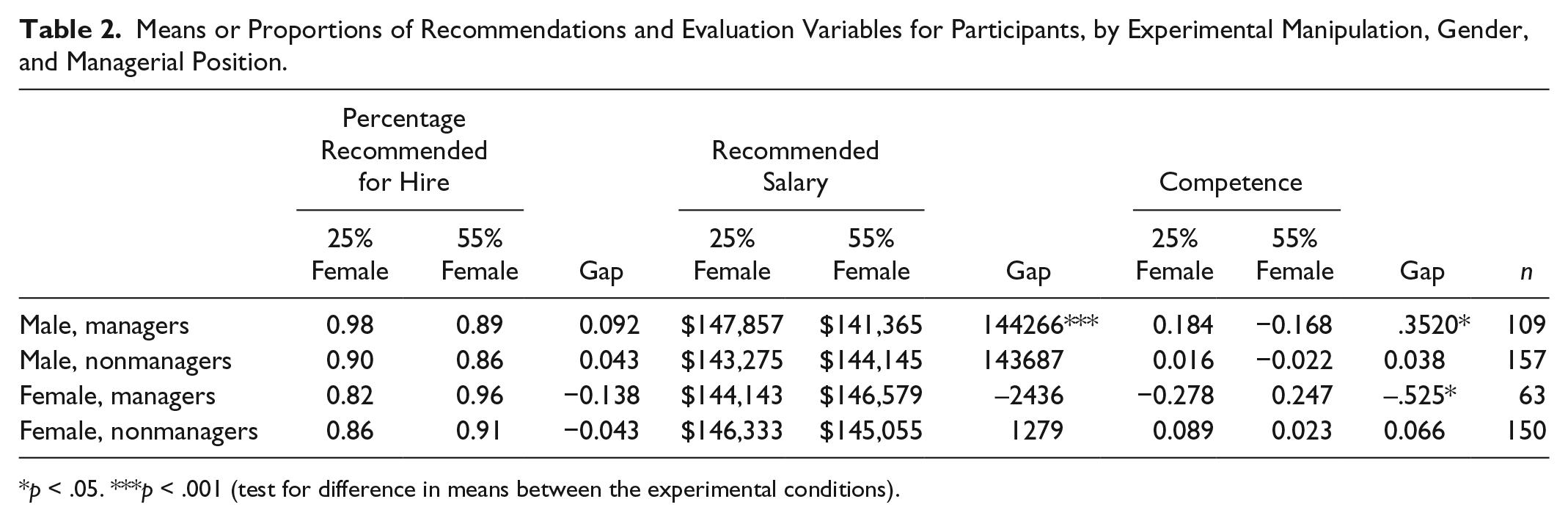
At this stage, I pooled the data for managers and nonmanagers. In Figures 1 through 3 and Table 2, I decompose the results by managerial status and gender to test the main hypotheses motivating this study.

The tendency of participants to recommend hiring the female applicant, by managerial status and experimental condition.

Salary recommendations made by participants, by managerial status and experimental condition.

Competence evaluations made by participants, by managerial status and experimental condition.
Means or Proportions of Recommendations and Evaluation Variables for Participants, by Experimental Manipulation, Gender, and Managerial Position.
p < .05. ***p < .001 (test for difference in means between the experimental conditions).
Identity Threat or Revaluation?
Table 2 presents the means and proportions of the hiring recommendations, proposed salaries, and competence ratings for the applicant according to the type of the experimental condition and participants’ managerial positions and gender. Among the male managers who were informed that management consulting was a predominantly male occupation, 98 percent recommended hiring the applicant; among the male managers who were informed that the occupation was predominantly female, only 89 percent of such participants recommended hiring (difference is statistically nonsignificant). Similarly, the male managers tended to offer the female applicant lower salaries when they were informed that the occupation of management consulting was predominantly female. The male managers offered the applicant an average of $147,857 under the “predominantly male” condition but only $141,365 under the “predominantly female” condition (p < .01). The male managers tended to evaluate the female applicant as less competent under the “predominantly female” condition. Whereas the average competence score that was given by the male managers was 0.184 under the “predominantly male” condition, the average score that was given by the male managers under the “predominantly female” condition was only −0.168 (p < .05). There were no statistically significant differences between the recommendations and evaluations made by male nonmanagers who were exposed to the “predominantly male” condition and those who were presented with the “predominantly female” condition.
Female managers were more likely to hire the female applicant when they were informed that women constituted 55 percent of the occupation of management consulting. Under the “predominantly male” condition, only 82 percent of the female managers recommended hiring the female applicant; under the “predominantly female” condition, 96 percent of the female managers recommended hiring her (difference is statistically nonsignificant). The differences in the salary recommendations that were made by the female participants by the experimental condition were statistically nonsignificant, both for female managers and for female nonmanagers. Finally, when informed that women constituted 55 percent of the occupation of management consulting, the female managers rated the competence of the applicant more highly than those who were presented with the “predominantly male” condition. The competence score that was given by the female managers to the female applicant under the “predominantly male” condition was −0.278, whereas the average score under the “predominantly female” condition was 0.247 (p < .05). There were no statistically significant differences between the recommendations and evaluations made by female nonmanagers who were exposed to the “predominantly male” condition and those who were presented with the “predominantly female” condition.
Multivariate analysis
I now turn to multivariate models to evaluate the research hypotheses by estimating the effects of the type of the experimental condition by gender and managerial position on each of the three dependent variables (when all other demographic characteristics of participants are held constant). Note that although the assignment to the experimental conditions was random and the sample for the experiment was a representative sample of the U.S. population, managers were oversampled. Thus, it is important to test for the effects of the experimental conditions when the demographic characteristics of participants are controlled for. Logistic regression models are estimated for the binary evaluation variable (recommend for hire), and linear regression models are used for the continuous dependent variables (recommended entry salary and competence evaluation). The estimated regression coefficients are presented in Table 3. For the logistic regression models, the table reports the marginal effects of the independent variables on the tendency to recommend hiring the applicant. Marginal effects can be interpreted as the change in the probability of recommending the applicant for hiring, given a one-unit change in the independent variables.
Estimated Regression Coefficients for the Effects of Managerial Position and the Experimental Manipulation on Evaluation Variables.

Marginal effects: *p < .05. **p < .01. †p < .1.
The main independent variable of interest from the identity threat perspective is the experimental condition, and the main relevant sample is the sample of male managers. From the revaluation perspective, all samples are relevant, and the main variable of interest is the experimental condition.
The results provide little evidence for the occurrence of revaluation (see the effects of the experimental condition in the fourth and sixth columns for female managers). Rather, the results strongly support the identity threat hypotheses. For all three dependent variables, the experimental condition is significant for male managers and is in the direction predicted by the identity threat theory.
In the model predicting the likelihood of being hired on male managers (first column), the effect of the “predominantly female” condition is significant and in the direction predicted by the identity threat theory, indicating that when high-status occupations become predominantly female, women’s odds of being recommended for hire by male managers are lower compared to when high-status occupations are predominantly male. In the model, a change in the experimental condition (from 25 percent women to 55 percent women in management consulting) generates a 0.092 decrease in the probability of hiring the female applicant. Women also are likely to be paid less by male managers when high-status occupations become predominantly female (second column). In the model, a change in the experimental condition results in a $6,477 decrease in the salary recommendation for the female applicant. Finally, women are more likely to be evaluated by male managers as less competent when high-status occupations become predominantly female, compared to when high-status occupations are dominated by men (third column).
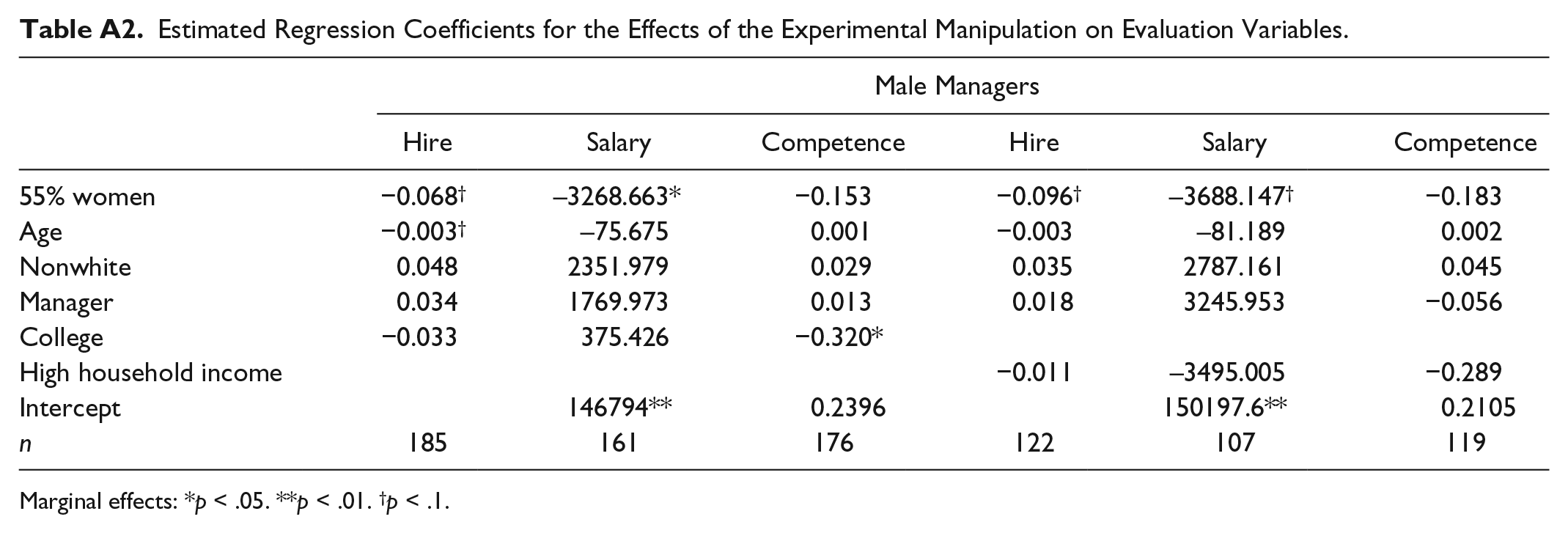
Interesting to note, a separate analysis suggests that the men who earn more than the sample mean and the college-educated men were less likely to hire the female applicant and recommend lower salaries when they were informed that the occupation of management consulting is predominantly female (see Table A2 in the appendix). The analysis indicates that when high-status occupations become predominantly female, women’s probabilities of being recommended for hire and women’s recommended salaries by these men are lower compared to when high-status occupations are predominantly male. Because men who earn more than the sample mean and college-educated men are more privileged in the labor force than other men, these results support the research hypotheses regarding identity threat. In the models predicting the competence evaluation by male mangers, the effects of the experimental condition are nonsignificant. Finally, consistent with the identity threat predictions, the effects of the experimental manipulation on the three dependent variables for men who earn less than the sample mean or without college education are statistically nonsignificant.
In summary, the results strongly support the research hypotheses offered by the identity threat theory. When the male managers were led to believe that the occupation of management consulting had become predominantly female, they recommended hiring the female applicant less frequently, offered her a lower salary, and evaluated her as less competent. Male nonmanagers were not affected by the experimental manipulation.
The responses of the female managers in the experiment contrasted with the responses of the male managers and provided little support for the occurrence of revaluation when no identity threat is posed. Under the “predominantly female” condition, female managers were more likely to evaluate the female applicant as more competent compared to the other participants in the study. The experimental manipulation had no statistically significant effect on the behavior of other groups of women in the study.
Discussion
The main contribution I make in this project is to explore the effects of women’s entrance into high-status occupations on the careers of other women. I show that when women enter one high-status occupation, women who work in other high-status occupations are negatively affected. I show that male managers respond with an identity threat to information about high-status occupations’ becoming predominantly female. These male managers do not evaluate women who are employed in other high-status occupations as more competent, as would be predicted by the theory of revaluation. Rather, they actually evaluate the women as less competent, tend to hire them less frequently, and offer them lower salaries. Naturally, other less-privileged groups of men are not threatened because the entrance of women into high-status occupations does not affect their own identities or the interests of the groups to which they belong.
The findings of this study accord with other threat-related labor market practices that have been explored by sociologists, such as occupational closure and boundary heightening. They provide additional evidence for the tendency of privileged social groups to protect and further their members’ social and economic interests and to create social and legal barriers when they are threatened.
The study provides little support for the explanations offered by the revaluation theory. When no identity threat is posed, women managers who are exposed to information regarding a high-status occupation’s becoming predominantly female behave as the theory of revaluation would predict. These women managers attribute some of the characteristics that are associated with the high-status occupations to the women who work in these positions and, as a result, evaluate all the women who work in high-status occupations as more competent.
The study is the first general population experiment to provide evidence for a causal relationship between exposure to information regarding the feminization of a high-status occupation and the ensuing labor force decisions. Similar to the results of most experiments in highly controlled settings, the findings of this study are internally valid. Furthermore, because the experiment was conducted on a large, statistically representative sample of the U.S. population, the findings are externally valid. Therefore, I can assume that the behavior of the participants in the experiment resembles the behavior of the U.S. population at large.
The study has some limitations. Most notably, because of the limited resources and sample size considerations, the study does not contain two possible additional conditions: a sex composition of 75 percent female and a sex composition of 45 percent female. These additional two conditions could have complemented the two existing experimental conditions and have shed more light on the mechanisms generating the results I report. The choice of 25 percent and 55 percent composition was guided by the wish that participants would believe the experimental manipulation. Another important limitation is that participants were asked to evaluate only the application materials submitted by a female applicant and not to compare two applicants (a female and a male applicant). Asking participants to compare two applicants might have generated a social desirability bias that I tried to avoid. Another option was to use a larger sample of participants and add two experimental conditions to the study in which participants (after being exposed to the experimental manipulation) would be asked to evaluate the application materials submitted by a male applicant. This was not done because of the limited resources and sample size considerations.
The results of this study have several implications for our understanding of labor force inequality and antidiscrimination law and policy. The results suggest that the feminization of high-status occupations is associated with an identity threat to high-occupational-status men; these men tend to evaluate women as less competent, to offer lower salaries to them, and to be less likely to hire them. Thus, a process that results from an increase in gender equality (i.e., high-status occupations are becoming predominantly female) tends to be followed by a reaction that affects all women who hold high-status labor force positions. Nonetheless, because female managers tend to respond to such changes in the labor force by valuing women more highly, when female managers are in power, women benefit from the feminization of high-status occupations. Therefore, the overall effect of the feminization of high-status occupations on the status and wages of all women depends on the relative authority and power of women.
Footnotes
Appendix
Estimated Regression Coefficients for the Effects of the Experimental Manipulation on Evaluation Variables.
| Male Managers |
||||||
|---|---|---|---|---|---|---|
| Hire | Salary | Competence | Hire | Salary | Competence | |
| 55% women | −0.068† | −3268.663* | −0.153 | −0.096† | −3688.147† | −0.183 |
| Age | −0.003† | −75.675 | 0.001 | −0.003 | −81.189 | 0.002 |
| Nonwhite | 0.048 | 2351.979 | 0.029 | 0.035 | 2787.161 | 0.045 |
| Manager | 0.034 | 1769.973 | 0.013 | 0.018 | 3245.953 | −0.056 |
| College | −0.033 | 375.426 | −0.320* | |||
| High household income | −0.011 | −3495.005 | −0.289 | |||
| Intercept | 146794** | 0.2396 | 150197.6** | 0.2105 | ||
| n | 185 | 161 | 176 | 122 | 107 | 119 |
Marginal effects: *p < .05. **p < .01. †p < .1.
1
Why weren’t identity threats and their effects observed in the social psychology studies described in the Revaluation section? Recall that in these studies the relationship between male and female involvement in the labor force and gender stereotypes were explored ( ). The participants estimated that in the future, women’s stereotypic characteristics would change in track with changes in their occupational roles.
First, the participants were asked to focus on beliefs about agency and communion and were not asked to evaluate performance or make effective labor force decisions. Second, the participants were mostly nonemployed students in a lab, and they were asked to estimate future trends; therefore, the potential threat to the participants, if any, was small. The most important reason the threats and their effects were not observed is that the participants in these studies were not asked to report their evaluations in the context of high-status, male-dominated occupations’ becoming predominantly female. When high-status occupations become predominantly female—as opposed to the mere entrance of more women into these occupations—they may pose a real threat to the men who work in these occupations. Note also that in some of the studies conducted by Diekman and Eagly, the effects were more pronounced for the female participants than for the male participants.
2
It is important to note that women and men share many of the same biases and stereotypes regarding the competence and commitment of women in the labor force (Correll, Benard, and Paik 2007; Ridgeway 1997; Ridgeway and England 2007). Research has shown that in the context of gender, women do not respond by engaging in group favoritism, as predicted by the social psychological theory of identity. Rather, women simply assume that men are better than them. This exception to the theory results from the long-term codependence of men and women and the problems that conflicting views and beliefs about value and status may cause in the relationships between men and women ().
3
Note that the predictions offered by the two theories refer to different groups of people: Whereas the predictions that follow from the theory of revaluation refer to all women and men, the predictions that follow from the theory of identity threat refer only to high-occupational-status men.