




Abstract
Much research documents that uncertainty is an important factor in the social influence process. We argue that there are two senses in which uncertainty plays a role. First, task uncertainty is a necessary but variable condition for social influence to occur. Second, uncertainty reduction is a mechanism producing social influence. We discuss how tasks can vary in the level of uncertainty they entail and how this impacts the mechanisms resulting in social influence. In this context, we predict that task uncertainty moderates social influence and that uncertainty reduction mediates it. We experimentally test our predictions in the status-to-social-influence process using standard means of studying social influence. Inconsistent with prior work, we do not find that task uncertainty is a moderator, but we do find evidence that uncertainty reduction functions as a mediator. Further, we find that the mediated effect is contingent on task uncertainty.
When making decisions, absent the ability to rationally weigh the correctness of different options in a choice set, people turn to various social cues or markers to inform their decisions (Berger et al. 1977; Lynn, Podolny, and Tao 2009; Podolny 1994). One factor that people consistently rely on in such situations is social status (Podolny 1994; Rashotte and Webster 2005; Sauder, Lynn, and Podolny 2012). Investors rely upon the social status of organizational leaders, for example, to reduce their perceived risk before contributing money to new business ventures (Podolny 2001). Indeed, social status has been shown to affect, among other things, prices in markets (Ball et al. 2001), lenders’ decisions to back loans (Harkness 2016), and the amount of charitable giving in fund-raising campaigns (Kumru and Vesterlund 2010).
At the individual level, people evaluate social status relationally by comparing relative standings. While these comparisons sometimes involve assessments using task-relevant characteristics, they often do not, and research shows that race (Lovaglia, Lucas, and Thye 1998), sex (Botelho and Abraham 2017; Ridgeway 2011), age (Kelley, Soboroff, and Lovaglia 2017), and a number of other task-irrelevant attributes (see, for example, Ridgeway, Johnson, and Diekema 1994; Webster and Driskell 1983) also inform status evaluations. Regardless of the basis for the evaluation, social status informs expectations about group members’ contributions and thus, the interaction patterns that emerge in groups. This typically results in high-status members in collectively oriented task groups speaking more, being more influential, and being evaluated more positively for their contributions (Berger et al. 1977). It also influences the effects of organizational structure, with peripheral members of the group being more likely to mirror the contributions of central, high-status actors (Eckel, Fatas, and Wilson 2010).
Underlying this research is the assumption that people rely on status to curb the uncertainties associated with decision making. If a high-status person suggests how to proceed on an uncertain task, and status is an indicator of quality, then following the suggestion makes sense. The basic process is as follows: uncertainty about how to proceed prompts people to seek out additional information; void of direct information about the quality of ideas or suggestions, they rely on the suggestions put forth by high-status actors. Here uncertainty is a necessary precursor. The person making a decision or completing a task must be uncertain about what he or she is doing before seeking out additional inputs.
That uncertainty is a necessary condition for status to shape influence processes does not, however, necessarily mean that uncertainty reduction is a significant mediator of social influence. That is, only under conditions of uncertainty would we expect individuals to use social cues (e.g., status) to inform their decisions. Yet, the mechanism by which social cues shape influence is not necessarily uncertainty reduction. While social status is used on ambiguous tasks, this does not mean it reduces perceptions of uncertainty about responses. People may still be just as uncertain and end up “following the herd” in their responses (Banerjee 1992).
This observation points to the conceptual distinction between task uncertainty and uncertainty reduction. Task uncertainty refers to the extent to which an individual is unsure about choosing between possible courses of action, and uncertainty reduction refers to the process by which social information alleviates or reduces uncertainty, making the decision process easier. Consider, as an example, choosing between one of two well-qualified job candidates. Before the committee meets, everyone gets a chance to review the applicants’ files. At that point, committee members have an initial sense of whom they prefer, but if the candidates are both qualified, they both have merits. Hence there is some task uncertainty at the outset. Then, in the committee meeting, people try to sway others to select their preferred candidate. It may be that someone makes a compelling case for a candidate, making the decision less uncertain. In this case, uncertainty reduction may explain why some initial preferences move as a result of the discussion. As this example illustrates, task uncertainty is a precondition for social influence, and tasks can have more or less task uncertainty—from two equally qualified applicants to the case where there is a clear advantage for one of them. Given this initial uncertainty, social cues may reduce uncertainty (i.e., function as a mechanism), resulting in a clearer choice as a result of social processes. This highlights another distinction between task uncertainty and uncertainty reduction. Task uncertainty is not a social process but, rather, an evaluation; uncertainty reduction derives from social information, such as the influence attempts of others.
We contend that the distinction between task uncertainty and uncertainty reduction highlights the need to more fully clarify the theoretical role of uncertainty in social influence. Next, we put forth arguments detailing the moderating and mediating role of uncertainty in social influence. We then explicitly test those arguments using established sociological procedures for studying social influence. Finally, we conclude with a general discussion of the implications of our work.
Uncertainty and Social Influence
Task Uncertainty as a Necessary and Moderating Condition
When someone is absolutely certain about the correctness of a particular position, he or she is unlikely to succumb to the will of others unless those others have some power or authority to force the individual away from what he or she knows is right (e.g., Milgram 1965). Without the ability to coerce others into a particular position, some level of uncertainty is necessary for there to be social influence (Melamed and Savage 2013; Moscovici, Lage, and Naffrechoux 1969; Pfeffer, Salancik, and Leblebici 1976; Tushman and Romanelli 1983;). This is why, regardless of the theory linking some antecedent concept to social influence, task uncertainty is a scope condition (Walker and Cohen 1985) or necessary precursor to informational social influence. 1 Thus, people will consider cues in their environment about how to proceed if and only if they feel some confusion about what to do.
At the same time, there is no set threshold of uncertainty beyond which social influence uniformly occurs. Tasks vary in their uncertainty. The outcomes of decisions are more or less uncertain. Some tasks are a little unclear, while others are completely mystifying. Research shows that as tasks or decisions become more uncertain, social influence increases (Melamed and Savage 2016; Podolny 1994; Tushman and Romanelli 1983). With little uncertainty comes little social influence. In highly uncertain environments, there is more room for social influence. Thus, we believe that task uncertainty is both a necessary condition for social influence and a moderating factor.
Uncertainty as a Mechanism of Social Influence
Separate from task uncertainty is the extent to which social cues in the environment reduce uncertainty about decisions. Uncertainty motivates people to seek out input from the environment to reduce the uncertainty surrounding an ambiguous decision. The opinions of valuable others are one “input” that people will occasionally use for this purpose (Latané 1981). At issue is when people turn to these opinions. The extant literature has established that this is particularly likely when others are either members of the same group or relatively higher status.
According to self-categorization theory (Mullin and Hogg 1999), one important environmental input when making decisions is the opinions of in-group members. Shared group membership is a precondition for influence and uncertainty reduction (Tajfel 1978; Tajfel et al. 1979, 1986). Disagreement with in-group members generates uncertainty (David and Turner 2001), and changing one’s opinion to be consonant with in-group members reduces this uncertainty (Turner 1985). Thus, self-categorization theory suggests that individuals, when uncertain about how to proceed, will use various categories of a social characteristic to identify same-group others and will seek out information from those who share their group membership to determine what course of action is best. Put differently, changing one’s mind to agree with in-group members reduces uncertainty. Uncertainty reduction is explicitly a mechanism for social influence in self-categorization theory.
The assumption that individuals will favor same-group others, however, ignores the fact that many of the social categories upon which group membership might be based are loaded with status value. Status construction theory (Ridgeway 1991) documents one process by which people with a particular category of a social characteristic gain more esteem and become viewed as more competent. This matters, because as status characteristics theory (Berger et al. 1977; Correll and Ridgeway 2006) describes, high-status others typically have greater influence. Specifically, the theory argues that in collectively oriented task groups, status differences result in a self-fulfilling prophesy whereby higher-status individuals are expected to contribute in meaningful ways to the group’s objectives, which in turn results in higher-status people’s becoming more influential over the group. Dozens of experiments (Kalkhoff and Thye 2006) confirm this positive relationship between social status and influence.
The mechanism in status characteristics theory is “expectation states,” or the anticipations of future task-relevant contributions (Berger et al. 1977). As noted, many studies have documented the association between status and influence, but none has shown that expectation states completely mediate the effect of status on influence. In part, this could be due to rudimentary measurement of expectation states (i.e., using questionnaires to assess unconscious states is not ideal, and biological indicators have not shown full mediation, either). A few studies have shown partial mediation (Driskell and Mullen 1990; Foddy and Smithson 1999), leaving open the possibility of an alternative mechanism linking status to influence. Melamed and Savage (2013, 2016; Savage, Melamed, and Vincent 2013) showed support for the argument that status reduces uncertainty in situations of social influence, implying that multiple mechanisms may be at work.
Status generalization occurs when important features of an interaction (e.g., the distribution of social influence) are in part determined by the statuses of actors regardless of the importance of those statuses for the interaction (Webster and Driskell 1978). Status characteristics are differentially evaluated (i.e., it is better to be more educated than less) and convey expectations for competency and performance (i.e., educated individuals should perform well on specific tasks and on tasks in general; Berger et al. 1977). That is, statuses are markers that indicate quality in the broader cultural environment and, as such, are often used in situations of uncertainty. Accordingly, we argue that status is related to uncertainty reduction (because status supposedly conveys competence) and that, in turn, uncertainty reduction is related to social influence (see also Melamed and Savage 2016).
Given some initial conditions, including individuals working on a collective task, meaning that it is important to consider the opinions of others and that getting a right answer is important, and that there is some uncertainty in the task, we predict the following:
Finally, it is important to consider the joint roles of task uncertainty and uncertainty reduction in the social influence process. By way of example, consider the difference between a high school graduate either completing a difficult linear algebra problem or proving the second law of thermodynamics. A basic high school education provides some algebraic insights but little by way of statistical mechanics and related fields. Accordingly, the high school graduate should be more uncertain about proving the second law of thermodynamics. If the high school graduate were working with someone with a bachelor’s degree on these tasks, the amount of possible social influence would be greater when working on thermodynamics than on an algebra problem, because there is more task uncertainty on the part of the high school graduate. Accordingly, the possible amount of mediation by way of uncertainty reduction is greater. Where there is more room for social influence, there is more room for its underlying mechanisms to shape eventual decisions. Thus, it is reasonable to conclude that a completely ambiguous task will have more task uncertainty than a less ambiguous one. Less task uncertainty, in turn, allows less room for uncertainty reduction in the social influence process. Accordingly, our final prediction is the following:
Specifically, we expect a larger mediated or indirect effect when there is a lot of task uncertainty and a smaller mediated or indirect effect when there is less task uncertainty.
Method
We test these four hypotheses with data from a laboratory experiment. The experiment used a completely randomized 2 × 2 factorial design, varying the status of the participant (high or low) relative to the ostensive partner and the certainty of the main task on which they worked (ambiguous or more certain). Because we are interested in the effects of social status on social influence, we adapted a common paradigm in sociology to fit our needs. Specifically, we relied on the standard experimental setting (SES) for testing status characteristics theory (Berger 2007; Berger et al. 1977:43–48). In general, the SES requires (1) that participants do not meet, so that standing in the status hierarchy can be manipulated; (2) that standard instructions are used ensuring that the initial conditions of the theory are met (i.e., task and collective orientation); and (3) that a standard measure of social influence is used.
In total, 86 undergraduate students from a large public university completed the experiment. Data from five (5.8 percent) participants are excluded from our analyses for failing the status manipulation check (assessed by the experimental program at the end of the session), and data from two (2.3 percent) participants are excluded from our analyses for not being collectively oriented (assessed in poststudy interviews). The results reported later are based on the remaining 79 participants. They were mostly female (55.7 percent) and were 36.7 percent Hispanic, 30.4 percent white, 16.5 percent black, and 16.4 percent “other.”
General Procedures
Participants were escorted to isolated subject rooms when they arrived at the lab. Once in the room, participants were told they would work with a partner over a computer network in a two-phase experiment and that the amount they would earn depended on their performance. In reality, participants did not interact with a partner; we simulated the behaviors of the partner in order to maximize experimental control. The remainder of the experiment was computer mediated, including all instructions. Instructions addressed three important aspects of the experiment. First, participants were told that they would earn a minimum of $6 for finishing the experiment but that they could earn more than that for each trial that they and their partner got correct in phase 2 of the experiment. Tying earnings to the task success of both the participant and the partner motivated participants to be both task and collectively oriented (see Melamed and Savage 2016; Ridgeway and Correll 2006). In actuality, all participants who completed the study were paid $15 for their participation.
Second, participants were told that the team portion of the experiment was a “critical-choice” situation in which taking others’ opinions into consideration leads to an increased likelihood of making a correct decision. This description increases participants’ collective orientation (Berger 2007). Third, the instructions described the experimental task, contrast sensitivity. This task requires that a participant select between two rectangle images filled with black-and-white squares by determining the rectangle that contains more black area. Figure 1 presents an example of one such image. Although contrast sensitivity is not a real ability, the instructions introduced it as a relatively new perceptual ability that is independent of other abilities, such as mathematical or verbal skills. After learning about the ability, the instructions informed participants that they would complete an individual contrast sensitivity task in phase 1 and then work with a partner on a team contrast sensitivity task in phase 2. Previous research finds this task to be a good test of social influence, because states of ability can be manipulated and participants can be motivated to try to seek out the correct response (Moore 1968; Webster and Rashotte 2010).

Example contrast sensitivity image.
After reading the instructions, participants began phase 1, which consisted of a practice trial and 20 trials of contrast sensitivity problems. Participants had 10 seconds to make a selection on each trial. Specifically, they were asked to choose whether an image consisted of more black or more white area. In reality, the area is equated and the ambiguity of the task facilitates manipulating status. Following phase 1, participants received manipulated feedback about how they performed as well as how their partner performed. We asked participants to record this information on a table that we provided for them. After receiving this information, participants completed phase 2 of the experiment.
Phase 2 of the experiment consisted of 25 trials of contrast sensitivity problems. In phase 2, participants had 10 seconds to state their initial opinions about which of two images contained the most white area. Then they received their ostensive partner’s initial opinion and had 10 more seconds to study the images before making their final opinion. The partner agreed with the participant on five randomly selected trials (Berger et al. 1977). Later, we analyze only the 20 trials on which the partner disagreed with the participant, or the “critical trials.”
After completing phase 2, participants completed a brief questionnaire. The questionnaire consisted mostly of manipulating check items, such as the relative status of the partner. Finally, participants were interviewed to assess their task and collective orientation using standard items. Participants were then debriefed and paid for their time.
Manipulations
The first manipulated factor was the relative status of the participant. All participants were told that they got 12 out of 20 trials correct in phase 1. High-status participants were told that they were interacting with someone who scored 7 out of 20. They were high status because they had more of the specific ability that was relevant to the group task than their partner. Low-status participants were told that they were interacting with someone who scored 17 out of 20. Again, they were relatively low status since their partner had more of the specific ability that was relevant to the group task. The second manipulated factor was the certainty of the phase 2 task. In the ambiguous conditions, the two contrast sensitivity images were equated at 50 percent white area. In the more certain condition, one of the images was 50 percent white and the other was 65 percent white. Melamed and Savage (2016) found that the difference between the two is enough to be detectible but not so obvious that participants become suspicious.
Measures
The main outcome is a binary behavioral indicator of social influence. As noted earlier, by design, the partner disagreed with the participant on 20 trials. If the participant changed his or her mind, the partner exerted influence. If, instead, the participant stayed with the initial opinion, the partner’s influence attempt was rejected.
The main independent variable is a dummy variable for whether the participant was high status relative to the partner (= 1). The moderator, task uncertainty, is another dummy variable indicating whether the participant was working on the less uncertain task (= 1). Finally, the mediator, uncertainty reduction, comes from asking participants how certain, sure, and confident they were in their final choices. These items were asked after each trial during phase 2 (Melamed and Savage 2016). To be sure, choice certainty and uncertainty reduction are not the same. Measuring uncertainty reduction would require asking participants how uncertain they were about their initial opinion, then asking them how uncertain they were about their final opinion and taking the difference between the scores. Considering that participants completed 25 trials, we did not want to ask them how certain, sure, and confident they were about both their initial and final opinions for fear of fatigue effects and for fear of tipping them off to what the study was about. Considering all trials in each condition are equally ambiguous (by design), systematic differences in perceptions of certainty about final choices derives from differences between conditions, that is, whether working with a higher- (lower-) status partner reduces (increases) uncertainty. We return to this issue in the Discussion.
Results
Table 1 presents the sample sizes and proportion of “stay” responses (i.e., rejecting influence) by condition. High-status participants (rows 1 and 2) stayed with their initial opinions more often than low-status participants (rows 3 and 4), which is consistent with much prior work and Hypothesis 1. Task certainty also seems to be associated with rejecting influence: those in the more certain conditions stayed with their initial opinions about 18 percent more often, whether high or low in status. On the one hand, this suggests that participants stay with their initial opinions more often on a more certain task. On the other, the effect of status is not reduced on the more certain task, as expected. Table 1 also presents perceptions of task certainty by condition. Higher-status participants and those in the more certain condition report higher levels of certainty, as expected.
Sample Sizes and Proportion of Stay Responses, by Condition.
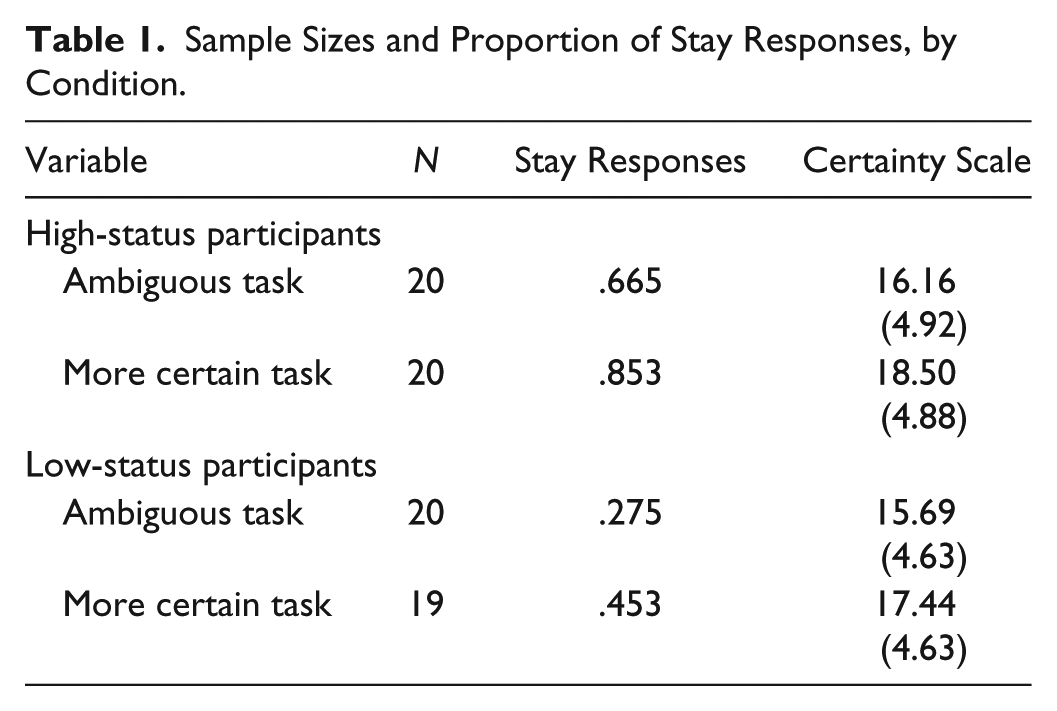
In terms of formally evaluating our hypotheses, we model the participants’ 20 binary decisions to stay or change their mind as nested in each participant. Preliminary tests of nested models suggested that nesting needs to be addressed, χ2(1) = 143.16, p < .001. Considering that Hypotheses 2 through 4 deal with moderation, mediation, and moderated mediation, we test our hypotheses in the context of generalized structural equation modeling, with decisions nested in participants (1,580 participant-decisions). This framework allows us to parsimoniously test each of our hypotheses, including the hypothesis about moderated mediation, or “conditional indirect effects” (Preacher, Rucker, and Hayes 2007). For Hypotheses 1 and 2, the structural equation model reduces to logistic regression with clustered standard errors. For the mediation hypotheses (3 and 4), which estimate simultaneous equations, we follow steps detailed in Hayes (2013) for computing indirect effects or the “index of moderated mediation” (Hayes 2015) using bootstrapped confidence intervals (CIs).
Hypothesis 1 makes the straightforward prediction that status is positively related to social influence. In line with dozens of earlier studies (Kalkhoff and Thye 2006), we find support for this prediction. As shown in Table 2, higher-status participants are more likely to stay with their initial opinions than are lower-status participants. Following prior work (Melamed and Savage 2016; Podolny 1994; Tushman and Romanelli 1983), Hypothesis 2 predicts that the effect of status should be weaker on more certain tasks. Model 2 in Table 2 shows that the main effect of being in the high-status condition and the main effect of being in the more certain condition result in increased likelihood of staying, but the interaction effect is not significant. That is, while past research has found that uncertainty moderates the effect of status on influence, we do not. We return to this issue in the Discussion.
Generalized Structural Equation Models Predicting Stay Responses.
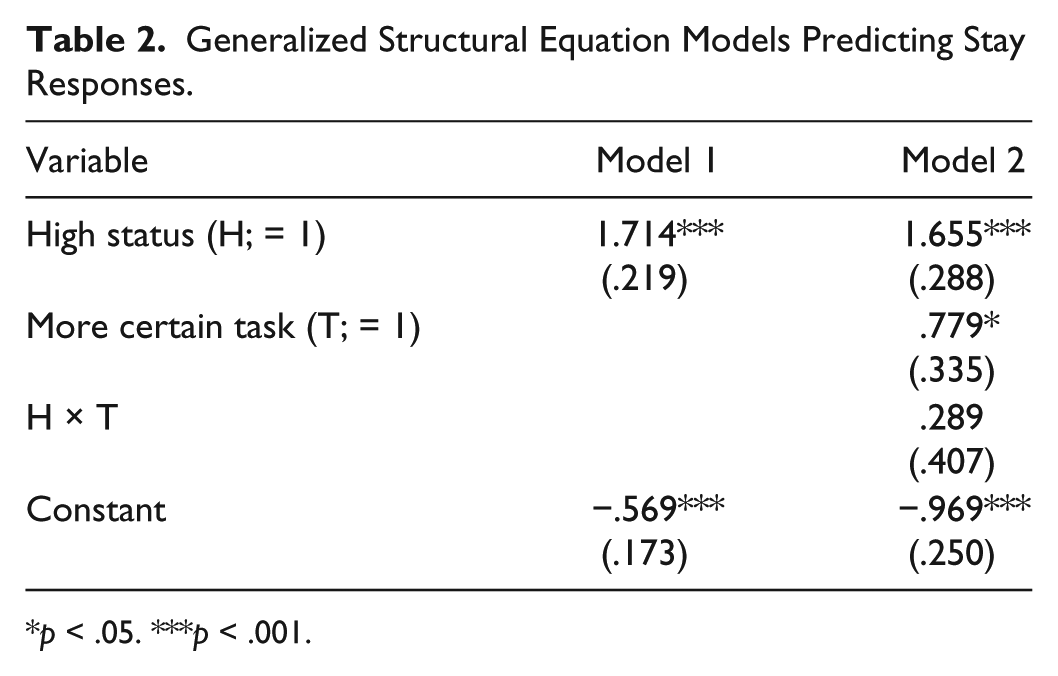
p < .05. ***p < .001.
Turning to Hypothesis 3, we predicted that the certainty scale would mediate the effect of status on influence. To test this hypothesis, we estimated a generalized structural equation model (with clustered standard errors) with one equation predicting stay responses as a function of the status manipulation and the certainty scale, and another equation predicting the certainty scale as a function of the status manipulation. Model 1 in Table 3 presents a summary of this model. The indirect effect of status on influence through the certainty scale is .095 (i.e., .785 × .121). Following Preacher and colleagues (2007), we base inference of the indirect effect on a bootstrapped sampling distribution. We took 1,000 samples and computed the indirect effect, and the 95% CI for the bootstrapped distribution was .038 to .156, indicating that a significant share of the effect of status on influence goes through the certainty scale. While short of full mediation, this result demonstrates that status indeed shapes perceptions of certainty, which results in social influence.
Generalized Structural Equation Models Predicting Stay Responses.
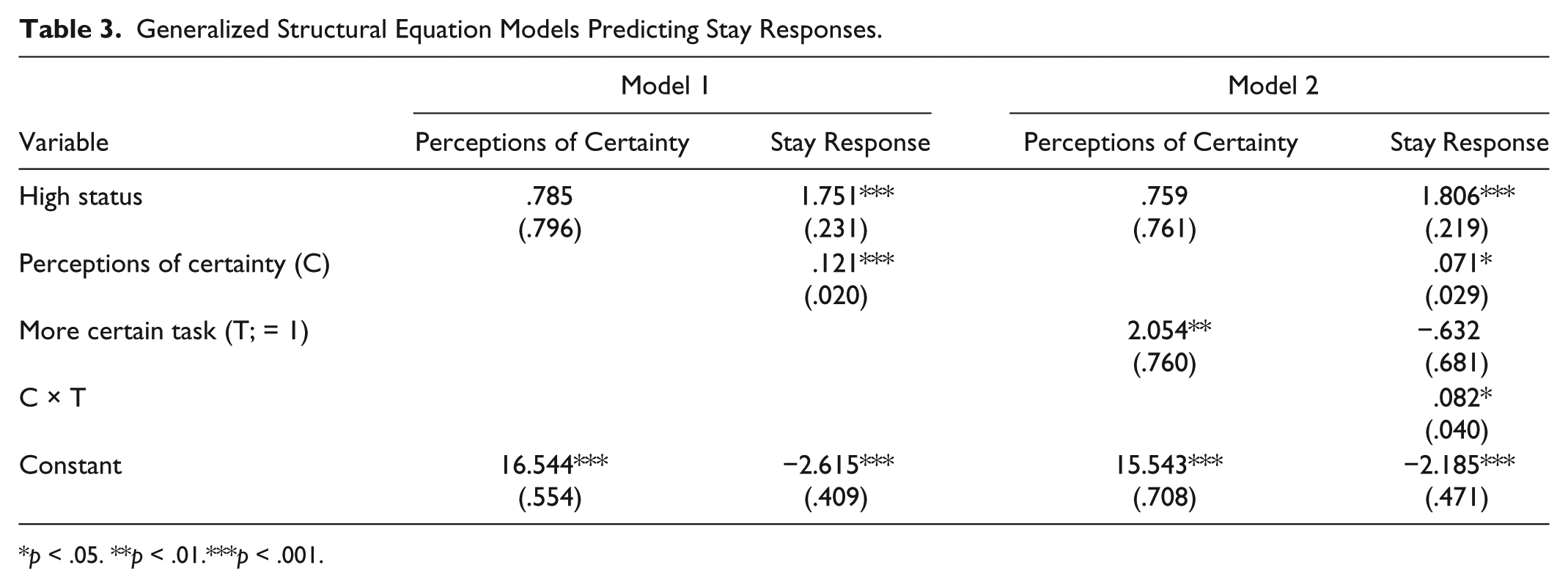
p < .05. **p < .01.***p < .001.
Finally, we predicted that the indirect effect of status on influence through the certainty scale would be weaker in the more certain condition (Hypothesis 4). To assess this hypothesis, we estimated another generalized structural equation model (with clustered standard errors) with one equation predicting stay responses as a function of the certainty scale, the status manipulation (= 1), the more certain condition (= 1), and the interaction between the status manipulation and the more certain condition. The second equation in the structural equation model predicted the certainty scale as a function of the status manipulation (= 1) and the more certain condition (= 1). Model 2 in Table 3 summarizes this model. The indirect effect of status through the certainty scale in the ambiguous (control) condition is .054 (i.e., .759 × .071), and the indirect effect of status through the certainty scale in the more certain condition is .116 (i.e., .759 × [.071 + .082]; see Hayes 2013:337–38). The difference in the two indirect effects is the inclusion of the significant interaction between perceptions of certainty and the more certain task. Specifically, bootstrapped CIs for the two indirect effects finds that the indirect effect in the ambiguous condition (.054) is different from zero (95% CI [.017, .102]) and that the indirect effect in the more certain condition (.116) is also different from zero (95% CI [.040, .198]). The presence of moderated mediation (i.e., the significant interaction between task certainty and perceptions of certainty) is consistent with Hypothesis 4, but the direction of the moderation is not as anticipated. We predicted that the indirect effect would be larger in the ambiguous condition (i.e., when there is more uncertainty to reduce) than in the more certain condition, but the results suggest that the indirect effect is larger in the more certain condition. We caution interpreting the difference in the indirect effects, however, since the 95% CIs on the indirect effects overlap. Clearly, more research is needed on this topic.
In summary, our results suggest a few key insights. First, like many studies before ours, status shapes patterns of social influence. Second, unlike prior work, we do not find that task certainty moderates the effect of status on social influence. Third, we explicitly showed that status shapes social influence through perceptions of certainty in collectively oriented dyads. And, fourth, we find that task certainty moderates the indirect effect of our certainty scale on social influence but not in the direction we anticipated. These findings are discussed at length in the next section.
Discussion
The evidence reported herein points to the importance of uncertainty in the social influence process. When working on an uncertain task, people look to their milieu for cues about how to proceed, and one factor that people rely on is status markers or characteristics (Berger et al. 1977; Lynn et al. 2009; Podolny 1994). Since status is not deterministically related to the quality of contributions or decisions (Lynn et al. 2009; Sauder, Lynn, and Podolny 2012), this could result in individuals following an incorrect lead and settling on a suboptimal outcome. Team selection, particularly with regard to the hiring task, is one situation where this can occur (Skvoretz and Bailey 2016). When employees of an organization come together to evaluate a pool of job candidates, there is frequently a great deal of uncertainty about which candidate will perform best in the years ahead. This uncertainty allows high-status members of the hiring team to have undue influence and lead the team to select their preferred candidate. Given preferences for same-race and same-sex others (Cunningham and Sagas 2005; Gorman 2005; Savage and Seebruck 2016), such candidates may not be best.
In addition to confirming the important role of status in social influence, our main contribution is to highlight the distinction between task uncertainty and uncertainty reduction. Our argument suggests that task uncertainty operates as a moderator of social influence, while uncertainty reduction operates as a mediator. Aside from delineating this distinction, our results show that uncertainty reduction indeed mediates some of the effect of status on social influence and that the mediated effect varies by the amount of task uncertainty.
The implications of these findings for organizational behavior are potentially substantial. Uncertainty is a persistent problem for organizations, as their survival requires that they effectively navigate an often ambiguous environment. Consequently, much organization research focuses on the sources and effects of uncertainty for organizations (Galbraith 1973; Lipshitz and Strauss 1997; Milliken 1987). And some of this research emphasizes the interplay of status and uncertainty (Kumru and Vesterlund 2010; Bunderson and Reagans 2011; Podolny 1994; Sauder et al. 2012). For instance, Podolny’s (1994) study of investment banking found that as market uncertainty increases, high-status organizations tend to restrict their market transactions to other high-status organizations. Although this research does not concern itself with social influence, it does demonstrate a pressing problem with the extant research on the roles of status and uncertainty for organizations, namely, the failure to distinguish whether uncertainty is a moderator or a mediator of various organizational behaviors. More problematic is that occasionally this research even conflates the two (Sauder et al. 2012). By separating task uncertainty from uncertainty reduction and documenting the moderating and mediating role of each for social influence, this research precisely describes how environmental circumstances pressure individual decision makers to rely on social cues, like status, to cope with task uncertainty.
Aside from scholarly contributions, this work has important implications for decision-making processes in many real-world situations. When people come together to solve problems—be it on committees or in meetings at work or within their community—the same basic questions lurk in the back of everyone’s mind: Who knows what they’re doing? Who can get this done? The research reported herein suggests that status characteristics, regardless of whether they actually imply competence, are used to infer competence and reduce uncertainty about courses of action.
There are some shortcomings in this work worth noting, probably the most important of which is that we measure perceptions of certainty as a proxy for the process of uncertainty reduction. The standard setting for testing status characteristics theory relies on a series of many binary trials. As such, we were concerned that asking about perceptions of certainty before and after seeing the partner’s decision would result in testing or fatigue effects. Future work might consider using fewer trials and explicitly measuring uncertainty reduction or using a different social influence task altogether. Nevertheless, there is evidence that status does reduce uncertainty in the predicted way. Savage et al. (2013), for instance, found in a laboratory study that the receipt of information about an individual’s relative status in a four-person group reduced perceptions of uncertainty about the correctness of an opinion. Given this, we can be confident, although not absolutely certain, that the process we describe here holds.
Second, both of the moderation hypotheses did not turn out as expected. Hypothesis 2, that task uncertainty moderates the effect of status on influence, was not supported. And yet several prior studies have found such an effect (Melamed and Savage 2016; Podolny 1994; Tushman and Romanelli 1983). Hypothesis 4, that task uncertainty moderates the mediation effect, was only partially supported. We did find evidence of moderated mediation, but the mediated effect seems to be stronger in the less uncertain condition. Perhaps uncertainty reduction functions as a more powerful mechanism on slightly ambiguous tasks, with other mechanisms, such as expectation states or normative beliefs about how one is supposed to behave, playing a larger role on more ambiguous tasks. That interpretation is consistent with our results.
In summary, we highlighted the different roles that uncertainty plays in the social influence process, distinguishing between task uncertainty and uncertainty reduction. We demonstrated that status shapes influence processes, that the uncertainty reduction mediates some of that relationship, and moreover, that the mediated effect is contingent on task certainty. Future research should work to improve measurement of uncertainty reduction, perhaps in a different setting, but these results largely support the contention that uncertainty plays an important yet variable role in the social influence process.
Footnotes
Funding
The author(s) disclosed receipt of the following financial support for the research, authorship, and/or publication of this article: The research reported in this article was funded in part under Award W911NF-17-1-0519 to the first-listed author from the U.S. Army Research Office/Army Research Laboratory. The views expressed are those of the authors and should not be attributed to the Army Research Office/Army Research Laboratory.

1
Deutsch and Gerard (1955) distinguished between normative and informational social influence. Normative influence occurs when a person says something they do not believe in order to appear normative. Informational influence refers to actually changing one’s mind as a result of social stimuli. We restrict our attention to informational influence.