




Abstract
Previous research using data from eBay found that women receive lower prices than men when selling the exact same products. The current project explores why this gender gap obtains and why some products have larger gender price gaps than others. To answer these questions, we exploit the variation in the gender price gap across products found in the earlier eBay data together with new survey data on the perceptions people have about seemingly male-typed and female-typed products and about people’s uncertainty about the prices of products. We show that women are penalized more for selling products that are perceived to be typically owned by men compared to products that are perceived to be typically owned by women. We further demonstrate that the effects of gender stereotypes are greater when buyers’ uncertainty increases: when buyers are uncertain about their willingness to pay for a product or about its market price, women sellers are penalized more.
Keywords
In this project, we investigate the mechanisms generating price differences between female and male sellers in product markets. We build on the findings of a previous study using eBay auction data that found that women receive lower prices than men when selling the exact same new products. The magnitude of the observed gender price gap varies across products such that for some products, gaps in the prices received by women and men are greater than for other products. Here, we exploit the variation in the gender price gap across products to understand what traits of products and sales generate greater gender price gaps. We wish to understand the role of gendered stereotypes and cultural scripts about types of products in generating the gender price gap. In doing so, we build on the literature in social psychology that emphasizes the roles of sex stereotypes and cultural scripts in generating gender inequality (Ridgeway 2011; Ridgeway and Correll 2004).
Specifically, we ask whether the gender price gap is greater for seemingly male-typed products compared to seemingly female-typed products; for example, we wonder whether the gender price gap is greater in sales of drills compared to sales of sewing machines. We also wonder whether sellers rely more on sex stereotypes and cultural scripts when uncertainty is greater. We therefore ask whether price gaps are greater in sales when buyers are uncertain about how much the product should cost.
Answers to these questions are important because while scholars have produced an impressive body of theoretical and empirical evidence about the extent and causes of gender inequality in labor markets (Blau 2016; Blau and Kahn 2000; Eagly and Carli 2007; England and Folbre 2005; Ridgeway 2011), we know surprisingly little about how gender operates in product markets. If women experience similar disadvantages in product markets as they do in labor markets, the negative effects of gender in economic life are greater than previously understood. Moreover, understanding the mechanisms that produce gender price gaps in product markets would enable us to better understand and address gender inequality in product markets but also in other arenas, like the labor market. Finally, unlike with labor markets, discrimination in product markets is not regulated by law, so whereas employment sex discrimination is prohibited, peer-to-peer sex discrimination in product markets is not.
In this article we first review the literature on the effects of gender in product markets, describing in some detail the one recent study—on which we build and further explore—that shows that women are, in fact, disadvantaged as sellers compared to men when selling the exact same new product on eBay (Kricheli-Katz and Regev 2016, hereinafter referred to as the “eBay study”). This study found that, on average, women received about 80 cents for every dollar a man received when selling an identical new product and 97 cents when selling the same used product (see Table A1 in the appendix). The magnitude of the observed gender price gap varied across products.
Utilizing the variation in the observed gender price gap across products, in the current study, we first test whether women are penalized more for selling seemingly male-typed products compared to seemingly female-typed products. We are curious whether, for example, the gender price gap for drills is greater than the gender price gap for sewing machines. We conceptualize seemingly male-typed products as products that are believed to be typically owned (and sold) by men and seemingly female-typed products as products that are believed to be typically owned (and sold) by women. We predict that when there is a perceived lack of fit between the gender of the actual owner and beliefs about who the prototypical owner should be, penalties arise. Thus, penalties are greater when products are perceived to be typically owned by men compared to by women.
In order to investigate this hypothesis, we first determine which products are perceived to be male-typed products and which are perceived to be female-typed products. People may think, for example, that the prototypical owner of a drill is a man and that the prototypical owner of a sewing machine is a woman. We ask people to report how likely the owner of the different products in our data is to be a woman or a man and test whether respondents tend to agree with each other. We then use these perceptions to test whether the gender price gaps that were observed in the previous eBay study are greater for male-typed products (those typically owned by men) compared to female-typed products (those typically owned by women).
We also hypothesize that lack of information regarding the value of products increases the gender price gap for new products. The logic behind this prediction comes from literature that shows that decision makers rely on gender stereotypes and cultural scripts more under conditions of uncertainty. Thus, disadvantages for women are greater when less information is available (Heilman and Haynes 2005; Kalev 2009; Ridgeway 2011; Rideway and Correll 2004; Sterling and Fernandez 2018; Uhlmann and Cohen 2007). In the case of product markets, when buyers are uncertain about the market price, stereotypes and cultural scripts about gender influence perceptions of the value of the product and the transaction, thereby influencing how much buyers are willing to pay for the specific product being sold by a female or a male seller.
To test the two mechanisms, we combine the price data from the eBay study that include the gender price gap for 306 products with data from two original surveys and use these combined data to explore our predictions. The two surveys document people’s perceptions about the traits of the 306 products: whether the products are seemingly male typed or female typed and the uncertainty about their market prices. Reponses of the participants in the surveys are then used in regression models to explain the gender price gaps obtained in the eBay study. By using this innovative research design that combines actual market data with survey data, we are able to explain the mechanisms generating real-world price gaps with survey evidence.
Do Women Receive Lower Prices Than Men?
To date, there has been comparatively little evidence regarding the effect of gender in product markets. There is some evidence, based on the findings of field experiments, that suggests discrimination against female buyers in product markets (Ayres and Siegelman 1995; Riach and Rich 2002). Studies have documented a related gender gap in venture capital funding and in loan granting in the United States. These studies have shown that female entrepreneurs are disadvantaged compared to their male counterparts in getting venture capital funding and loans (Thébaud 2015; Tinkler et al. 2015). Studies have further suggested that the gap is generated by biases in the behavior and evaluations of investors (Balachandra et al. 2013; Clark 2008; Gorbatai & Nelson 2015; Huang, Frideger, and Pearce 2013; Kanze et al. 2018) and by differences in the behavior of female and male entrepreneurs (Cliff 1998; Loscocco et al. 1991; Morris et al. 2006).
But how do female sellers fare? A recent study analyzing data on all the eBay auction transactions for 420 of the top-selling products from 2009 to 2012 found that female sellers are disadvantaged in product markets (Kricheli-Katz and Regev 2016). Specifically, the study found that in eBay auctions, women receive a smaller number of bids and lower final prices than do equally qualified male sellers of the exact same product (and controlling for the gender of the buyer, the sentiments in the text, the state, the date, the time, and other relevant characteristics of the auction). Women received, on average, about 80 cents for every dollar a man received when selling the exact same new product and 97 cents when selling the same used product (Kricheli-Katz and Regev 2016) (see Table A1 in the appendix). Note that the classification of products in the data is highly refined—a new blue iPod shuffle, second generation, for instance—so that comparisons between women and men are for the exact same products. Hence, results regarding new products are particularly informative as products are identical and new, so quality-related explanations for the gender price gap become irrelevant. Note also that the data set used for the analyses contains only auctions—where sellers and buyers do not negotiate with each other. Thus, differences in the negotiation skills of women and men or in sellers’ willingness to accept are irrelevant.
As a policy, eBay does not reveal the gender of its users. Nonetheless, the authors were able to show in a separate experiment that people were quite accurate in guessing the actual gender of the seller (provided to the researchers by eBay) from contextual cues in the product listing (such as the other items a person is selling).
Yet, while Kricheli-Katz and Regev (2016) were able to show that female sellers were disadvantaged, the data could not answer the question of why female disadvantage obtained. The study did find that the gender price gap was larger for some products than others. We now utilize these differences across products and merge it with novel survey data to evaluate whether women are penalized more for selling seemingly male-typed products compared to seemingly female-typed products and whether when uncertainty is greater, buyers rely more on their gender stereotypes.
Gendered Perceptions of Owners of Products
We start our investigation by exploring people’s perceptions of whether products are male typed or female typed. We asked people how likely is the owner of each product in our data to be a woman.
Why would people believe that some products are more likely to be owned by women and others to be owned by men? Studies have shown that people tend to automatically and unconsciously sex-categorize others in social interactions (Ito and Urland 2003) in order to understand “who” the other is. We tend to immediately assign a gender to every person we interact with—whether in person or virtually—and then to draw on our cultural scripts about gender to predict the other’s traits and future behavior. In fact, in the eBay study, the authors experimentally showed that people accurately sex-categorize sellers. If sellers are routinely sex-categorized, cultural scripts about whether sellers or owners of products are likely to be women or men may develop. For example, in current U.S. society, cultural scripts about products and their usage may lead people to associate drills with male owners (and users) and sewing machines with female owners (and users).
“Lack of Fit”: Penalties for Sellers Deviating from Gendered Perceptions of Prototypical Owners
If, indeed, people hold consistent and defined cultural beliefs about prototypical owners of products, we would expect such beliefs to interact with beliefs about actual sellers, affecting the prices people offer. For example, if golf clubs are believed to be typically owned by men, then when women attempt to sell such products, a perceived lack of fit between the product and the actual seller may arise. As a result, female sellers of such golf clubs may receive lower prices compared to male sellers. A perceived lack of fit may also arise when a man is selling a product that is believed to be typically owned by women, like a Disney movie, for example.
We borrow the term lack of fit from the literature in social psychology. In the case of gender, women are often not seen as suited for some jobs, especially in male-typed fields, because they are perceived to lack the traits (like aggressiveness) that the organization values. For example, Lyness and Heilman (2006) find that women are less likely to be hired and, when hired, are more likely to receive lower evaluations for positions that are prototypically held by men compared to when positions are prototypically held by women. In the context of product markets, lack of fit occurs when the perceived traits of prototypical owners are not perceived to overlap with traits of actual owners. When developing this concept in the context of market, we build on the literature that suggests that the social status of owners of products affects the perceived value of the products themselves. The value theory of power developed by Thye (2000) suggests that exchangeable objects owned by high-status actors are perceived to be more valuable when relevant to positive status characteristics. Building on this conceptualization, here we argue that the high status of male sellers affects the prices people are willing to pay for products, especially when the products are perceived to be male-typed products.
Uncertainty
One reason to expect that buyers will rely on cultural beliefs about the characteristics of owners of products in their market interactions is that market interactions tend to involve uncertainty about value and prices. Under conditions of uncertainty, people are more likely to draw on widely shared beliefs, such as stereotypes and cultural scripts (Correll 2004; Correll et al. 2017; Heilman and Haynes 2005; Kalev 2009; Podolny 2008; Reskin and McBrier 2000; Sterling and Fernandez 2018; Uhlmann and Cohen 2007). Thus for example, research has shown that female lawyers were promoted less compared to men when the job involves uncertainty (Gorman 2006).
If a similar process happens in product markets, when buyers are uncertain about prices or the quality of products, they are likely to look for “clues”—like the type of owner, the product, and the fit between them—that would help them decide how much they are willing to pay for a product. This means that when buyers are uncertain about price or quality, they may be more interested in who the owner is.
According to the prevailing cultural scripts about gender in current U.S. society, women are often perceived as less competent than men (Fiske et al. 2002; Ridgeway 2011; Ridgeway and Correll 2004). Thus, when buyers are uncertain about price or quality of new products, they evaluate products sold by women as less valuable compared with buyers who evaluate the same products but are less uncertain.
When products are used, there is potentially more uncertainty, since a buyer can be uncertain about not only the price of a product but also its condition. Thus, compared with new products, buyers of used products are more dependent on the descriptions of products that the sellers provide. Therefore, buyers of used products likely search for additional clues that would help them assess whether they can trust the seller and the description. Research has shown that women are stereotypically viewed as more trustworthy than men (Fiske et al. 2002). Indeed, the eBay study found that women were ranked by buyers as better at describing the items they are selling compared to men (Kricheli-Katz and Regev 2016). It follows, then, that with used products, the more uncertain buyers are regarding the condition of the product, and the more dependent they are on the description sellers provide, the more they would trust women compared to men and the smaller the gender price gap would be.
Since products vary by the level of uncertainty associated with their value (e.g., there is less uncertainty about the value of a $100 gift card compared with a painting), they vary in the need for buyers to search for “clues” contained in shared cultural beliefs. Thus, we predict that the more uncertain buyers are about the value of a product, the more they would rely on cultural beliefs about the specific owner when deciding how much to pay for a product. For new products, we predict that more uncertainty would increase the gender price gaps because the relevant stereotypes and cultural scripts are that women are less competent and less status worthy. For used products, we predict that more uncertainty would decrease the gender price gaps because the relevant stereotypes and cultural scripts are that women are more trustworthy and tend to handle products better.
Data and Method
Overview
We created a data set that combines data on the gender price gap of 306 of the bestselling new and used products from the eBay study described earlier (Kricheli-Katz and Regev 2016) with original data from two surveys. The first survey randomly assigns participants to evaluate new or used products and to report their perceptions of the gender of the prototypical sellers of the products as well as their perceptions of the competence and warmth associated with the prototypical sellers of these products. These perceptions are then used to predict the gender price gap of the products from the eBay study. The second survey randomly assigns participants to evaluate new or used products and to report their uncertainty regarding the prices of products. Participants’ uncertainty is then used to predict the gender price gap of the used and new products.
Gender Price Gap Data
The original eBay data included all auctions of 420 bestselling products in the years 2009 to 2012. Each product appeared in the data both as a new product and as a used product. These data revealed that on average, women received 80 cents for every dollar men received for selling the same new products and about 97 cents for selling the same used product. Importantly for the current article, the gender price gap varied by the type of product being sold. For our analysis, we use only the products—either new or used—that were uniquely identifiable by a photo, resulting in a data set of 306 bestselling products, 99 of which are new and 207 that are used.
For each product, there is a unique gender price gap. The gender price gap is the regression coefficient obtained for being a female seller in an ordinary least squares (OLS) regression model predicting the price of product when controlling for all other transaction characteristics (such as seller’s reputation, experience, number and type of pictures, time and duration of auction, etc.; for complete details, see Kricheli-Katz and Regev 2016). In other words, we use the results of 306 different regression models—a separate model for each product in the data set. Thus, our data set contains the “female” coefficients of 306 different OLS regression models. 1 Note that the variable we use in the current analysis equals zero when gaps between women and men in the original data set were statistically insignificant. For the 306 products used in this study, the average “female” coefficient is a negative 2.6%. In the analysis, we also use the final auction prices of products from the original eBay data (the variable price). We combined these two variables from the eBay data set with the data from the two surveys. In Table 1, we report the variables we use in the analysis, by the data source.
Descriptive Statistics.

Note: N = 306 products (207 used and 99 new).
Surveys and Measures
Two thousand thirteen participants from Amazon Mechanical Turk were randomly assigned to one of the two surveys and to a condition within each survey. We randomly assigned participants to the two surveys to ensure that participants participated in only one survey. Each survey had participants rate products on different dimensions, described later. These perceptions from the survey data were then aggregated across participants and used to predict the price gap between female and male sellers obtained in the eBay study. At the end of each survey, participants answered a series of demographic questions and were directed to a webpage where they entered payment information (for the demographics of participants, see Table A2 in the appendix). Finally, we conducted a third survey to further investigate the effects of gendered perceptions of used products on the gender price gap. The methodology and results of this third study are reported in the appendix.
Study 1: Lack of Fit
In study 1, we test for the “lack-of-fit” hypothesis. We explore whether gender price gaps are greater when products are male typed compared to female typed—that is, when sales are of drills compared to sewing machines. In survey 1, participants (N = 1,041) were randomly assigned to one of two conditions, which varied by whether they evaluated new or used products. They were then presented with a photo of a product that was described as either used or new, depending on condition, and were asked whether the prototypical owner-seller of the product was likely to be female on a 7-point scale ranging from much more likely to be a man to much more likely to be a woman. They were also asked to report whether the prototypical owner-seller of the product was likely to be competent, confident, intelligent, pleasant, sincere, high-status worthy, tolerant, and warm (all on scales of 1 to 7). Each participant was shown five different products, randomly drawn from the larger data set.
We aggregated the responses of participants by product and generated variables that represent the average score for each item. This resulted in a data set in which the unit of analysis is a product. We then constructed, for each product, a “likely female owner” dummy variable that reflects whether on average, participants thought the owner of the product was more likely female than male. This dummy variable equals 1 if the average response to the question of whether the prototypical owner-seller of the product was likely to be female was greater than the median. As can be seen in Table 1, the mean of the “likely female owner” variable is 0.52. We use this dummy variable because the distribution of the original 7-point-scale aggregated answers was bimodal with two distinct picks (see Figure A1 in the appendix). In order to make sure that our transformation did not bias the results, we estimated each model in which the dummy variable is used also with two dummy variables generated in correspondence to the original distributions’ peaks. Results remained the same.
Results
Participants were relatively consistent as to whether they believed the likely owner of a product was a woman or a man. The standard deviation of participants’ assessment of the likelihood that the product owner-seller was a woman was on average 1.2 on a 7-point scale. The variation in participants’ responses tended to be greater for used products compared with new products.
The results from OLS regression models predicting the gender price gap on eBay by the perceived gender of the prototypical owner of the product are presented in Table 2.
OLS Regression Models Predicting the Female–Male Gap, by Prototypical Owners’ Perceived Sex.

Note: Standard errors in parentheses. OLS = ordinary least squares.
p < .1. **p < .05. ***p < .01.
As can be seen, the gender price gap for new products is affected by whether products are male typed or female typed: when new products are perceived to be typically owned by men, the price gap between female and male sellers increases. More specifically, when new products are perceived to be typically owned by men, the gender price gap increases by 0.085 (p < .05, N = 306). In other words, when the new product is a male-typed product, women who sell the product receive an additional 8.5% of a price penalty compared to when the product is a female-typed product. Note that in all the models predicting the gender price gap, we control for the prices of the products on eBay (net of the effects of the characteristics of sellers and transactions). Thus, the effects we observe for selling products that are perceived to be typically owned by men are generated when prices of products are held constant. To the degree to which prices reflect prestige, we also hold prestige constant in our models.
Whereas with new products the gender price gap is affected by whether products are male typed or female typed, this is not the case for used products (0.085 – 0.081 is not significantly different from zero). To better understand the effects of selling products that are perceived to be typically owned by men in transactions for the sale of used products, we report the results of an additional study in Appendix (study 3).
In order to better understand the mechanisms generating the perceived “lack of fit” between prototypical and actual owners, we analyze the participants’ evaluations of the traits of prototypical owners of products. The results of this analysis are presented in Appendix (study 1A).
In sum, in study 1, we find that male-typed products are associated with greater gender price gaps compared to female-typed products: women are penalized more when selling products that are believed to be typically owned by men.
Study 2: Uncertainty
In study 2, we explore the effects of uncertainty on penalties for female sellers. We predict that buyers rely on gender stereotypes more, and thus penalize female sellers more, when they are more uncertain about the prices or values of products.
One thousand thirty-six participants were randomly assigned to one of two conditions, which varied by whether they evaluated new or used products. They were then presented with a photo of a product that was described as either used or new and were asked questions about it, as described next. Each participant was shown five different products randomly drawn from the larger data set.
Participants were asked how much they would be willing to pay for the product and then to reflect on their decision-making process. They were asked on 7-point scale ranging from not at all to very much (1) how uncertain they were about the price they would be willing to pay, (2) how interested they would be in the prices other people are willing to pay, and (3) how interested they would be in knowing who the current owner is. The three items capture different dimensions of uncertainty regarding the prices of products and the willingness to pay for them. The first item captures the participant’s own uncertainty about his or her willingness to pay for the product. The second item captures the uncertainty about the market price of the product, as reflected in the participant’s eagerness to learn how much others are willing to pay for it. For some products (like money-value gift cards), information about how much others are willing to pay is likely to be almost irrelevant when deciding how much one is willing to pay. For other products, like paintings, information about the prices others are paying is invaluable for learning what the market rate is before deciding how much one is willing to pay. The third item captures the eagerness to reduce one’s uncertainty—whether about his or her own willingness to pay or the market value—by learning who the owner is.
We aggregated the responses of participants by product and generated variables that represent the average score for each item. As reported in Table 1, participants are moderately uncertain about the price they would be willing to pay (M = 4.12), generally quite interested in knowing the price others would pay (M = 5.12), and moderately interested in who the owner is (M = 3.40). Since the market price should provide more relevant information than the owner’s identity, it is not surprising that participants are more interested in the price that others would pay.
Results
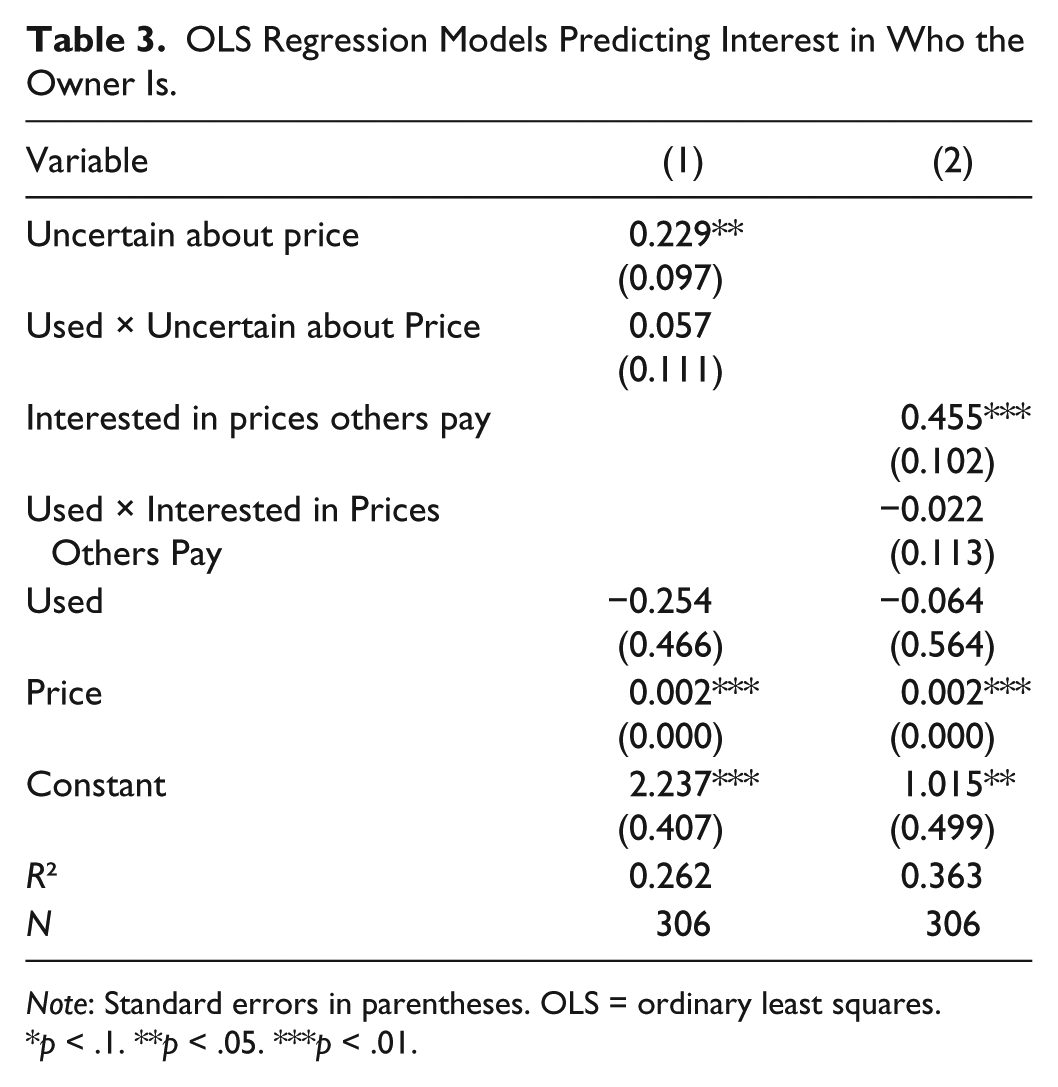
We predict that people will care more about the identity of the owners of products when they are uncertain about how much they are willing to pay for products or about their market prices. As can be seen in Table 3, in an OLS regression model predicting how interested participants were in knowing who the owner is, a one-unit increase in their uncertainty about how much they are willing to pay for the product increased their interest in who the owner is by 0.23 (p < .05, N = 306). Likewise, a one-unit increase in people’s uncertainty about the market price of the product—as reflected in their eagerness to learn how much others are willing to pay for the product—increased their interest in who the owner is by 0.46 (p < .01, N = 306).
OLS Regression Models Predicting Interest in Who the Owner Is.
Note: Standard errors in parentheses. OLS = ordinary least squares.
p < .1. **p < .05. ***p < .01.
Next we show that, as predicted, when people want to know who the owner is, the price gap between women and men increases for new products and decreases for used products. In Model 1 in Table 4, we report the results of an OLS regression model predicting the gender price gap by the interest in who the owner is. We find that a one-unit increase in the interest in who the owner is increases the gender price gap for new products by 0.05 (p < .12, N = 306). For used products, a one-unit increase in the interest in who the owner is decreases the gender price gap by 0.1 (0.6 – 0.5; p < .05, N = 306). The results for new products are consistent with our argument that when people are uncertain about the prices of products, they look for clues about the products’ value, such as the identity of the owner. They then rely on this information when deciding how much they are willing to pay. The results for used products are also consistent with the literature on gender stereotypes, which suggests that people tend to view women as more trustworthy than men (Fiske et al. 2002). It is not surprising, therefore, that the gender price gap is smaller for used products.
OLS Regression Models Predicting the Female–Male Gap, by Uncertainty.

Note: Standard errors in parentheses. OLS = ordinary least squares.
p < .12. *p < .1. **p < .05. ***p < .01.
A second dimension of uncertainty is captured by people’s eagerness to learn how much others are paying for products. In Model 2 in Table 4, we report the results of an OLS regression model predicting the gender price gap by people’s uncertainty about the market prices of products. Similar to the prior dimension of uncertainty, we see that when people are uncertain about the market prices of products—as reflected in their eagerness to learn how much others are paying for them—the price gap between female and male sellers increases for new products and decreases for used products. More precisely, a one-unit increase in the uncertainty about the market price increases the gender price gap for new products by 0.066 (p < .1, N = 306). In contrast, for used products, a one-unit increase in the uncertainty about the market price decreases the gender price gap by 0.2 (0.86 – 0.66; p < .01, N = 306). However, in models predicting the gender price gap, the effects of uncertainty about people’s own willingness to pay were statistically insignificant.
When products are used, there is potentially more uncertainty than when products are new, since buyers are uncertain also about the conditions of products. As a result, buyers of used products are more dependent on the descriptions of products that the sellers provide, compared with new products. Buyers of used products may also search for additional clues that would help them assess whether they can trust the seller and the description. Studies suggest that women are stereotypically viewed as more trustworthy than men (Fiske et al. 2002). Recall also that in the eBay study, it was shown that women were ranked by buyers as better at describing the items they are selling than men (Kricheli-Katz and Regev 2016). It is not surprising, therefore, that with used products, gender price gaps tend to be smaller compared with new products.
Summary and Discussion
In this project, we explore why female sellers receive lower prices than male sellers when selling the exact same products and why for some products gender price gaps are larger than others. We make four main contributions. First, we show that people hold gendered cultural beliefs not only about social groups but also about prototypical owners of products and perhaps even about products themselves, stereotyping a drill and a Disney movie and not just their sellers. Second, we show that these cultural beliefs result in gendered price differences of products. Third, we demonstrate that when uncertain about their willingness to pay for a product or about its market price, buyer rely more on their gendered cultural beliefs. Finally, this study makes a methodological contribution by using a series of surveys to uncover the mechanisms behind the empirical findings derived from “big data.”
We start by showing that the gender price gap is affected by whether products are male typed or female typed: when products are believed to be typically owned by men, the price gap between female and male sellers increases. Thus, for example, the price gap between women and men is larger when they sell drills, which are believed to be typically owned by men, compared to sewing machines, which are believed to be typically owned by women. However, this does not mean that women consistently receive higher prices than men do for products typically owned by women. Instead, the main effect for being a male seller is large enough to overcome the benefit of being a woman selling products typically owned by women.
Then, we present evidence that suggests that people care more about the identity of the owners of products when they are uncertain about how much they are willing to pay for products or about their market prices. We show that when people are uncertain about the market prices of products or about how much they are willing to pay for them, the price gap between female and male sellers increases for new products and decreases for used products. We argue that for new products, it is cultural beliefs about the lower competence of women that increase the gender price gap, and for used products, it is cultural beliefs about the high trustworthiness of women that decreases the gender price gap.
Our findings suggest that cultural beliefs about what women and men are and about what women and men should be play an important role in generating price differences in product markets. We show that women experience similar disadvantages in product markets as they do in labor markets and that similar mechanisms generate these disadvantages. With product markets, and especially with new products, results are particularly informative because products are identical, so quality-related explanations for the gender price gap become irrelevant. Our findings therefore support arguments that in the labor market, wage differences between women and men are the result of cultural beliefs about gender and not only of differences in merit. Furthermore, the existence of gender price gaps in markets other than the labor market implies that the negative effects of cultural beliefs about gender in economic life are greater than previously understood. Finally, building on Thye’s (2000) value theory of power in exchange relations, our findings also demonstrate how the status characteristics of owners of products (like their gender) interact with the traits of prototypical owners of these products to generate value and inequalities in mixed-motive exchange settings.
Unlike with labor markets, private transactions for the sales of products tend not to be regulated by antidiscrimination law. Nonetheless, an emerging body of literature shows that disparities in markets other than the labor market are significant in magnitude and implications. In one field experiment involving baseball card auctions on eBay, it was shown that cards held by a dark-skinned/African American hand were sold for about 20 percent less than cards held by a light-skinned/Caucasian hand (Ayres, Banaji, and Jolls 2015). In another study, it was shown that nonblack hosts on Airbnb charge approximately 12 percent more than black hosts for the equivalent rental, and rental applications from guests with distinctively African American names are 16 percent less likely to be accepted relative to identical guests with distinctively white names (Edelman and Luca 2014; Edelman, Luca, and Svirsky 2017). One study of the Uber ride-sharing company has found that in some locations, passengers with African American–sounding names were subject to longer waiting times and more frequent cancellations and that drivers took female passengers for longer, more expensive rides (Ge et al. 2016). Thus, there is accumulating evidence that discrimination is prevalent in the every growing online peer-to-peer market economy. This evidence suggests a reconsideration of the appropriateness of legal protection from discrimination in peer-to-peer markets and an evaluation of possible interventions. It follows from our study, for example, that one way to reduce discrimination in online markets is by reducing the uncertainty involved with the product, service, or person offering it. As we show, the more uncertainty involved in a transaction, the more people rely on stereotypes. If we do wish to consider the prohibition of discrimination in online product markets and the regulation of the behaviors of users, the effects on material outcomes and on the dignity and autonomy of users should be taken into account together with the harms of discrimination. In addition, the feasibility of enforcement in online peer-to-peer markets, as well as the legal responsibility of market platforms to prevent their users from discriminating, should be examined.
Footnotes
Appendix
Acknowledgements
We thank Dror Avidor, Rotem Yaron, and Tom Tzur for superb research assistance. For insightful comments, we are grateful to Catherine Albiston, Lauren Edelman, Hadas Mandel, Ariel Porat, and Cecilia Ridgeway.
Authors’ Note
Data can be accessed upon request.
Funding
The author(s) disclosed receipt of the following financial support for the research, authorship, and/or publication of this article: The project was financially supported by the Israeli Science Foundation Grant 483/15.

1
For each of the 306 products, the results of an ordinary least squares regression model predicting the effects of being a female seller on the final price were obtained (controlling for the characteristics of sellers and transactions). The 306 “female seller” coefficients are the gender price gaps we use in our analyses. We also use the intercepts from these 306 regressions as the products’ prices on eBay (net of the characteristics of sellers and transactions).