




Abstract
Within the last two decades, women’s empowerment has been the central theme of international development policy and practice. This article seeks to elucidate the challenges of integrating gender in a development project to empower women. Drawing on the wider literature on women’s empowerment, it constructs a framework to analyze the meaning of empowerment. The article then draws on the framework and empirical data gathered to illuminate the challenges of integrating gender in a pulse innovation project, implemented in Southern Ethiopia. The article elucidates gender hierarchies that limit the extent of women’s involvement in crop production processes. It demonstrates social and cultural factors that restrict women from fully participating in high value pulse markets and their involvement in production and exchange decision-making. It also illustrates how existing social networks, relations, and links disadvantage women. The article then recommends solutions to help facilitate the integration of gender in the project toward the empowerment of women.
Introduction to the Project
Pulse innovation for food and nutrition security is a project that has been implemented in Southern Ethiopia with the aim of contributing to the challenging task of bringing about food and nutrition security. The project seeks to apply a pulse-crop-centered strategy to improve food and nutrition security in the region. The strategy includes using pulse innovations as an entry point to promote systemic transformation toward food and nutritional security of rural households, through scaling up of intensive pulse-crop-based farming systems, agri-food processing and marketing, and nutrition education interventions. The project was initiated to catalyze large-scale positive change in food and nutrition security in Southern Ethiopia by scaling up pulse-crop innovations to reach 70,000 farm households. It is funded by the International Development Research Centre (IDRC), Canada, and is jointly led by the University of Saskatchewan, Canada and Hawassa University, Ethiopia. The project networks, partners, and works with a number of constituencies at international, national, and local levels including the International Crops Research for Semi-Arid Tropics (ICRISAT), Ethiopian Public Health Institute (EPHI), Farm Radio International (FRI), World Food Program (WFP), Southern Regions Regional Health Bureau, and Regional Agriculture Bureau of SNNRP, Ethiopia.
The core objectives of the project can broadly be divided into four interconnected components: agricultural, nutritional, socioeconomic processes (gender as a central component), and value chain and marketing. The agricultural dimension of the project targets increasing soil productivity, provision of new improved seed varieties, institution of improved agricultural practices, and bio-fortification. The nutritional aspect aims to assist farm households with the introduction of new, and improvement of existing, pulse-based food preparation and processing. The project seeks to ensure diet diversity and bio-availability, and also to assist rural households with value adding and marketing of their produce. The social dynamic and gender aspect of the project seeks to integrate gender and empower women. This core objective of the project focuses on making women the beneficiaries of the pulse innovation, through facilitating their full participation in production, consumption, and sales.
The focus of this article is on one of the core components, women’s empowerment, and on the challenges of integrating gender in the project. The article starts with a brief description of the research methods used, and constructs a critical framework on the concept of empowerment drawing on the wider literature. It then maps out the existing gender structures, drawing on empirical data gathered in Southern Ethiopia. It illustrates the challenges of integrating gender in the project through the analysis of the existing gender structures with a focus on the nature of household property ownership, division of labor, decision-making structures, income expenditure, and the issue of differential access to markets. It then outlines some of the major challenges that the project has faced in achieving its gender objectives and concludes with recommendations.
Research Method
The research was conducted in the summer of 2016. The data was collected from men and women members of households in the districts of Sodo, Meskan, and Halaba, three of the 15 rural districts in which the project has been implemented. The research was undertaken in the homes and farms of the participants.
Two methods of data collection—in-depth interviews and focus group discussions—were used to gather data (See Appendices A and B). Through the use of in-depth interviews, detailed data were collected from 90 research participants (see
Table of Informants.

Women’s Empowerment
The meaning of the concept of empowerment has long been a subject of controversy and debate in the social sciences, and there has been no agreement on the meaning of the term (Kabeer, 1994, p. 224). “The phrase ‘the empowerment of women’ means many things to many people” (Geleta, 2014a, p. 414; Sweetman, 2005, p. 5). One explanation given to empowerment is that it relates to improvement in the livelihoods of impoverished people and is often related to good change (Kabeer, 1994; Mayoux, 1998). Others relate empowerment with participatory processes that foster enhanced individual and community engagement that transforms and improves the socioeconomic and political lives of community members (Wallerstein, 1992). In addition, some explicate empowerment drawing on Michel Foucault’s analysis of power (see Geleta, 2014a, p. 414; McHoul & Grace, 1995). Foucault sees power as a social construction in that power is constituted through discourse, and people are constructed as subjects in discourses.
On the other hand, while Holvoet (2005) links empowerment to the process of decision-making, for Kaminski, Kaufman, Graubarth, and Robine (2000), it is a developmental process that promotes an active approach to problem solving, increased political understanding, and an increased ability to exercise control of the environment. Townsend, Gabriel, Emma, Joanna, and Mecado (1999) argue that no one “can empower another person.” The key for transforming power relations is self-empowerment. Empowerment is not something that can be given. If it is conceived as something given, paradoxically, it becomes something that can be taken away. However, if individuals achieve power themselves, no one can take it away from them. Ostensibly, they suggest that poverty and destitution can be alleviated through self-empowerment. Nevertheless, “. . . there is no consensus on the meaning of the term and it is frequently used in a way that robs it of any political meaning . . .” (Kabeer, 1994, p. 224). Rowlands describes empowerment as a complex process that is the result of control of four types of power that emerges from “above, within, with, and to” (Geleta, 2014a, p. 414; Rowlands, 1997, p. 13).
According to Rowlands (1997), “power with” is the capability to achieve with others what one could not achieve alone. It relates to a form of solidarity to bring about structural transformation at household, community, and macro-levels. “Power to” implies gaining access to a full range of human abilities and potential: It reflects self-assurance of the capability to do something. On the other hand, “power within” is a self-created will for change. It is a power from within that emerges from the realization that one is not the cause of all one’s own problems and reflects a process of realization and questioning of the broader structures that partly create one’s problems. Finally, in Rowlands’ analysis, “power over” is what we traditionally conceive when we think of power: power possessed by individuals or groups upon which other individuals and groups have no control. Those individuals and groups who are subjects of such powers perform tasks assigned by the owners of the power, often against their will. “Power over” can manifest in the form of economic, social, legal, cultural, political, and ideological control and dominance (Geleta, 2014a, p. 414; Rowlands, 1997, p. 414).
Rowlands’ framework of women’s empowerment can be used to access the degree of success of scaling up of pulse innovation project in empowering women. However, as illustrated below, similar to many other ambitious development projects, pulse innovation is located in highly gendered social settings, in which patriarchy is the dominant form of social organization. Hence, integrating gender and empowering women in a social environment in which gender inequality is deeply entrenched and pervasive is very challenging. The most important question here is how we move from a social environment that accommodates gender inequalities to the creation of a transformative social environment that fosters critical examination of gender norms, strengthens equitable gender norms, and changes inequitable structures. What we can sensibly expect from a relatively small project such as pulse innovation is a contribution toward a gradual shift.
In fact, the pulse innovation project has implemented a number of strategies to integrate gender and to empower women. First, it made an explicit plan to make women the beneficiaries of 50% of the total agricultural and nutritional interventions. Currently, about 44% of its total beneficiaries are women. Women now access new variety pulse (haricot beans and chickpea) seeds from the district agricultural bureau for both seed multiplication and grain production. Women are also provided with agricultural training regarding sowing techniques and the appropriate use of fertilizers, and are supported to get involved in the production of the new variety haricot beans and chickpeas. Women have been provided with education regarding the nutritional benefits of consuming pulses, and attended recipe demonstrations and complementary food preparation trainings to help them increase the consumption of pulses. The project has also implemented broader gender strategies including the organization and delivery of gender sensitization workshops and meetings that brought women and men farmers together to openly discuss gender issues. These aimed at improving men’s understanding and recognition of women’s roles in agriculture and in the day-to-day household chores.
With the aim of helping women to enhance their capacity to generate income from the sale of pulses, the project has also recently provided training for women and men trainers on value addition, small scale business modeling, marketing, and finance. The trainers were community leaders selected from the 15 provinces and are expected to share the knowledge they gained to women in respective areas. However, despite these interventions, as illustrated in the following section, the project is located in areas where gender inequality is deeply entrenched and pervasive. Hence, in this scenario, bringing about a gradual shift toward gender equality requires a deeper understanding of the gendered socioeconomic and cultural environments in which the project located. This will help the generation of stronger strategies that help address the gender gap. Accordingly, the next sections of this article depict the gender order and structure in the three research sites.
Structure of Property Ownership and the Division of Labor
One of the classical ways of understating gender relations and the gender order in a particular social setting is through the examination of the nature and structure of property ownership. Similar to the situation in many parts of Ethiopia, in Southern Ethiopia in general and in the three research sites in particular, in the formal law, women have equal rights with men to inherit land and own property (such as cattle). However, while these are true in theory, in practice, in all the three research sites, it was found that married women’s power to exercise their right to land and property is very limited. Despite their right to inheritance, when they get married, women often leave their land to their brothers or male relatives. Also, after they get married, in theory, women get equal rights over land inherited or owned by their husbands. Although on paper, women have equal rights to land, they have limited direct power to make decisions over the use and management of land. Husbands and male family members and relatives have culturally made decisions regarding land use. Their rights to land use and management are not respected and are commonly violated, usually by their parents and relatives and by their husbands and husbands’ relatives.
Although in theory, married women have the right to own and inherit other property such as cattle, in practice, they have limited rights over them. For example, 25 individually interviewed married women outlined that they do not make decisions on the sale of farm animals or cattle. In the three research sites, it was easy to notice that married women do not have control over property and are powerless. On the other hand, it was found that women who own and control property such as land and cattle are single (widowed, separated, and divorced). Compared with married women, single women appeared to be well informed, active, and empowered. Together with their children and their other relatives, single women make important production decisions. As will be illustrated later in this article, it was found that, more so than the married women, the majority of the beneficiaries and active participants of the pulse innovation project are single women.
In addition to the structure of property ownership, the household division of labor in Southern Ethiopia is differentiated along gender lines. More than 80% of the people in the three research sites live in rural areas, and women provide the majority of the agriculture labor. In all three areas, and in Halaba in particular where polygamy is widely practiced, they play a major role in undertaking agricultural activity. Women are busy undertaking heavy household work and also working in the fields. Women wake up early in the morning and go to bed late at night. While men can normally wake up late in the morning and go to bed early, women start the day by gathering the dung of the livestock. Then, they fetch water (in a plastic tank or a big clay pot), carrying it on their backs, which can take between 0.5 to 2 hr depending on their location. They prepare food for the family. In the absence of older siblings, women undertake child minding. Although in most areas nowadays, women use electric mills to grind barley and teff, they still use a manual stone mill to hull dry chickpeas and haricot beans. Although in all three research sites, women do not plough land, they assist men in the planting, weeding, tending, and harvesting of crops. Women are also responsible for feeding and raising cattle and minding chicken. Men primarily undertake ploughing. However, while men have some leisure time, during which they visit the local pubs, women are mostly busy with their domestic tasks.
While women represent the major contributors to the agricultural workforce in Southern Ethiopia in general, their contributions have traditionally been undervalued and misunderstood. While men’s roles in agricultural activities are clearly established, women’s role is not clearly defined and recognized. Women in all three research sites, and in Meskan and Halaba in particular, are considered lower status and receive little attention and respect, even from their immediate family members.
Despite women’s active and direct involvement in agricultural activities, men often do not assist women with the household activities. Some men, in Halaba in particular, spend their day chewing chat (a type of mind stimulant leaf that is classified as a drug), whereas women undertake most of the household activity and the minding of children as well as cattle. While almost all men in Meskan and Halaba outlined that they do not involve themselves in the domestic work, three men in Sodo noted that on occasion, they help their wives with minding children and cutting firewood, while they are busy undertaking other household activities. Nevertheless, most of the interviewed men noted that they do not get involved in domestic work and that they would rather spend the day without eating than going to the kitchen to prepare food. A few of the men noted that sometimes they think about helping their wives with the household chores. However, they are afraid that their friends and neighbors would look down on them and consider them feminine and cast doubt on their manhood. As a result of these social pressures and cultural assumptions, they refrain from intervening in the household work.
In fact, as a result of being subject to exploitative cultural relations, the majorities of the women participants of the research not only suffer from extreme resource poverty and deprivation but also are victims of time poverty. In the three research sites, women spend more than 15 hr per day on agricultural and domestic work, whereas men spend only about 8 hr on agricultural and domestic work (illustrated in Figure 1). Men spend about one third of their time on socialization, whereas women have very limited time for socialization and for rest.

Time poverty in the three research sites.
When we disaggregate the data based on considering time men and women spend on leisure and socialization in each of the research sites, it emerged that time poverty extremely affects women in Halaba, more than Sodo and Meskan. In Halaba, while women spend less than an hour on socialization and leisure, men spend about 10 hr per day (see Figure 2).

Time dedicated to leisure and socialization in the three research sites.
In the studied sites, in particular in Halaba, it is men who participate in important meetings such as kebele (local government) meetings, whereas women’s mobility is restricted, and they often spend their time being busy with domestic and agricultural activities. Compared with men, women have very little time to go out and establish networks and links with other women. Married women’s access to information is predominantly through their husbands. In the three research sites, men have greater mobility and establish networks with local community leaders, local government officers, agriculture and health extension workers, and crop retailers and buyers. While men’s mobility and their networks give them power, women’s limitation within the domestic domain is a major cause of their disempowerment and marginalization. Hence, it is evident that the nature and structure of property ownership and the division of labor disadvantage women. The empowerment of women requires the transformation of these exploitative structures and practices.
Women and Production Decision-Making
As noted above, although women provide the majority of labor in agricultural activity, in Ethiopia in general and in Southern Ethiopia in particular, agriculture is considered the men’s domain. Accordingly, while women provide the labor for agricultural activity, men dominate the management and decision-making regarding agricultural activity. About 90% of women who participated in the research in all the three research sites noted that they do not participate in decision-making over what type of crops to produce. Men have always made the decisions on what to produce, including the production of chickpeas and haricot beans. Thirty-two out of the 45 individually interviewed men noted that they alone decide what to produce, because they believe that women do not know about agriculture and do not plough land (see Table 2 below) Men argued that because they undertake the hard task of ploughing the land, they should decide what to produce. They rationalize their power over agricultural decision-making on the basis of ploughing the land.
Production Decision-Making.

Although men assert that women cannot plough land, some women interviewed in Sodo and Meskan noted that although society does not like to see them ploughing, there were many occasions on which they participated in ploughing the land. One informant in Meskan in particular related her experience with pride in the following manner: I remember I was 17. It was after the death of my father. My older brother was ploughing the land. It was raining and the soil was muddy, which made him very tired. I took over and worked on it for more than two hours. He was impressed and after that we ploughed our land together, about three hectares, for more than 5 years until I got married 5 years ago. Now, sometimes when I see men ploughing my heart goes with it. I miss it a lot.
In a similar way, another married woman in Halaba outlined that during one summer season, her husband was ill, and there was no one around to help them with ploughing. Hence, she had no choice but to plough the land. She asserts that when her husband is having trouble or ill, sometimes she and her young daughters involve themselves in ploughing their land. In fact, three of the interviewed men in Sodo outlined that even though they know that their wives can contribute to ploughing, they do not like to see them undertaking the hard physically demanding task. Four other men in Halaba outlined that they would not let their wives plough, because if they do, their friends and family will look down on them.
In the cultural values and norms of the people of the three research sites, it is culturally not acceptable for women to plough. By ploughing, they would shame their husbands, who do not normally allow them to be involved in this task. If husbands allow their wives to plough, they will be considered weak and may be insulted in their community. Ploughing for women is a taboo and is considered a transgression of cultural norms. Nevertheless, the cultural norms are used as a rationale to restrict women from fully participating in production decision-making.
These cultural norms that restrict women from fully participating in agriculture have a more pronounced negative consequence for single (divorced, separated, and widowed) women. Because, culturally, women are not allowed to plough, female-headed households with land enter into agreements for sharecropping or land rentals. These patterns are common in Meskan and Halaba. The agreement of the share depends on the productivity of the land and the input by each party. For example, if the owner provides the seed, oxen, and the land, she gets two thirds of the produce, and the sharecropper gets one third. However, poor women who have neither fertile land nor the necessary inputs often get about one third of the produce. The cultural norms that limit women’s full participation in agriculture also limit women’s ability to fully benefit from making use of their land.
Despite the fact that men predominantly undertake ploughing, women actively participate in all other agricultural activities assisting their husbands. In fact, women do predominantly produce some types of crops. In the course of analysis of the in-depth interviews, it emerged that in the three research sites, the follow-up and minding of crops is differentiated along gender lines. While some crops are considered mainly male crops, other are regarded as women’s. For example, in Halaba, while teff, wheat, and maize are considered “men’s crops,” women play major roles in the production and exchange of chat, vegetables, and beans. Women also are responsible for the production of peas, which are mainly looked after by women in small plots usually located near home. With respect to pulses, while the trading of haricot beans and other beans such as chickpeas have traditionally been the women’s domain, with the increase in price of the new variety haricot beans and chickpea in the market, males have come to dominate the haricot bean and chickpea production.
Nevertheless, the majority of women and men interviewed in the target area of the research noted that major agricultural decisions such as what to produce and how to produce, especially regarding lucrative crops, are made by men. While some men consult their wives about what to grow, it is often just lip service, and the men make the final decision. Even if the woman owns the land, it is usually the men who decide what to produce. The purchase of agricultural tools is also men’s domain.
What is more concerning is that married women in the target areas of this research do not participate in decision-making over what to do with the produce. Ten interviewed married women noted that they do not have a say in whether to consume or sell the produce. However, three individually interviewed women in Sodo noted their husbands consult them on decisions relating to produce, while another five women in Halaba outlined that their husbands advise them on what to do with the produce. Nevertheless, the majority of interviewed women noted that although their husbands sometimes talk to them about what they plan to do with the produce, the men often make the final decisions.
Agricultural Produce and Differential Access to Market
Further to examining the nature of control over decision-making regarding what to produce and what to do with produce, understanding the gender aspect of the agricultural praxis requires examining the nature of the structure of markets and the degree of women’s participation in them. In this regard, observation of some of the markets in the three research areas revealed that markets are markedly divided into two, the men’s section and the women’s section. The women’s section of the market provides relatively cheaper produce such as eggs, cheese, butter, chat, and pepper. On the other hand, the men’s section of the market provides relatively expensive produce such as farm animals and fattened cattle. With respect to purchases, while women are in charge of going to market to buy household necessities such as soap, vegetable oil, and table salt, men undertake the buying of farm animals, cattle, and farming tools.
With regard to sale of crops, when small quantities of crops such as chickpea and haricot bean (usually less than 20 kg) are to be sold, women take it to the nearest market by carrying it in baskets on their backs. However, when larger quantities are to be sold (quintals or at least 50 kg), men take it to the big markets in big sacks transported on the backs of donkeys. While women retail small quantities of crops, using a jug or a tin as a measure of unit, large quantities are sold measured by weighing scales. Men often claim that they do not know how to sell small quantities using a jug (tin) as a measuring unit. Even quantities of up to 20 kg are considered too small for men to take to market, because when men go to market, they are expected to go to local pubs and buy drinks for their friends. Accordingly, while men earn and control the higher proportion of the household income, women generate small income. In fact, in Sodo, women are not culturally allowed to take even small amounts of some lucrative crops such as teff to the market.
More than 70% of men argued that they take large quantities of crops to the markets because women do not know about weighing scales and can be easily cheated. Also, the majority of men say women cannot balance sacks on the back of donkeys and take produce to distant markets. Some of the men asserted that their wives do not know about money and cannot count. Others think women are not able to take care of money and that they waste the money. However, the majority of women noted that they do know about the weighing scale, can count money, and also can easily balance sacks on the back of donkeys and that what men said in this regard is untrue.
Women outlined that while most men get drunk when they go to market, they do not drink and hence are less likely to be cheated on the weighing scales and do not waste money. The main reason why women do not take large quantities to markets is because their husbands do not want them to control finances. Some men do not even allow their wives to take small quantities of crops to markets, and hence these women steal (hide from their husbands) when they take the small amounts to the market. Even if it is also their property, occasionally, women hide from their husbands when they take crops to markets. Meanwhile, women also noted that often social expectations and domestic workloads compel them to go only to the nearby small markets to sell small quantities of crops.
However, compared with married women, single women seem to actively participate in the selling of large quantities in distant markets as well as small quantities in the nearby market. While single women with older male children go to market with them, those who do not have grown-ups take the produce to market themselves. Meanwhile, five individually interviewed single women noted that they often find it hard to take large quantities of crops to market because some men try to extort and intimidate them so that they sell the produce for a cheaper price. Some buyers even go to the farms of single women to influence them to sell their crops to them, and they often cheat and make a larger profit. Other men buyers hold single women’s donkeys in the markets and influence them to sell, and often they feel ashamed and embarrassed, and hence unable to resist and refuse these offers. As a result of that, sometimes they do not get the market value for their produce and are ripped off. Because of these pressures, single women often go to markets on the days their male relatives go, and also sometimes seek the company of their male relatives.
Gender and Control of Income
With respect to control and use of income, the majority of income from agricultural activity, in particular from sale of pulses, in all three research sites is controlled by men. While 65% of interviewed men said they and their wives have equal control over income, 85% of women interviewed said that men make decisions on their own (see Figure 3 below). On the other hand, 5% of both men and women interviewed said that women control income. What appears to be evident is that men dominate control over income generated, and they control the majority of income from the sale of pulses in the three research sites.
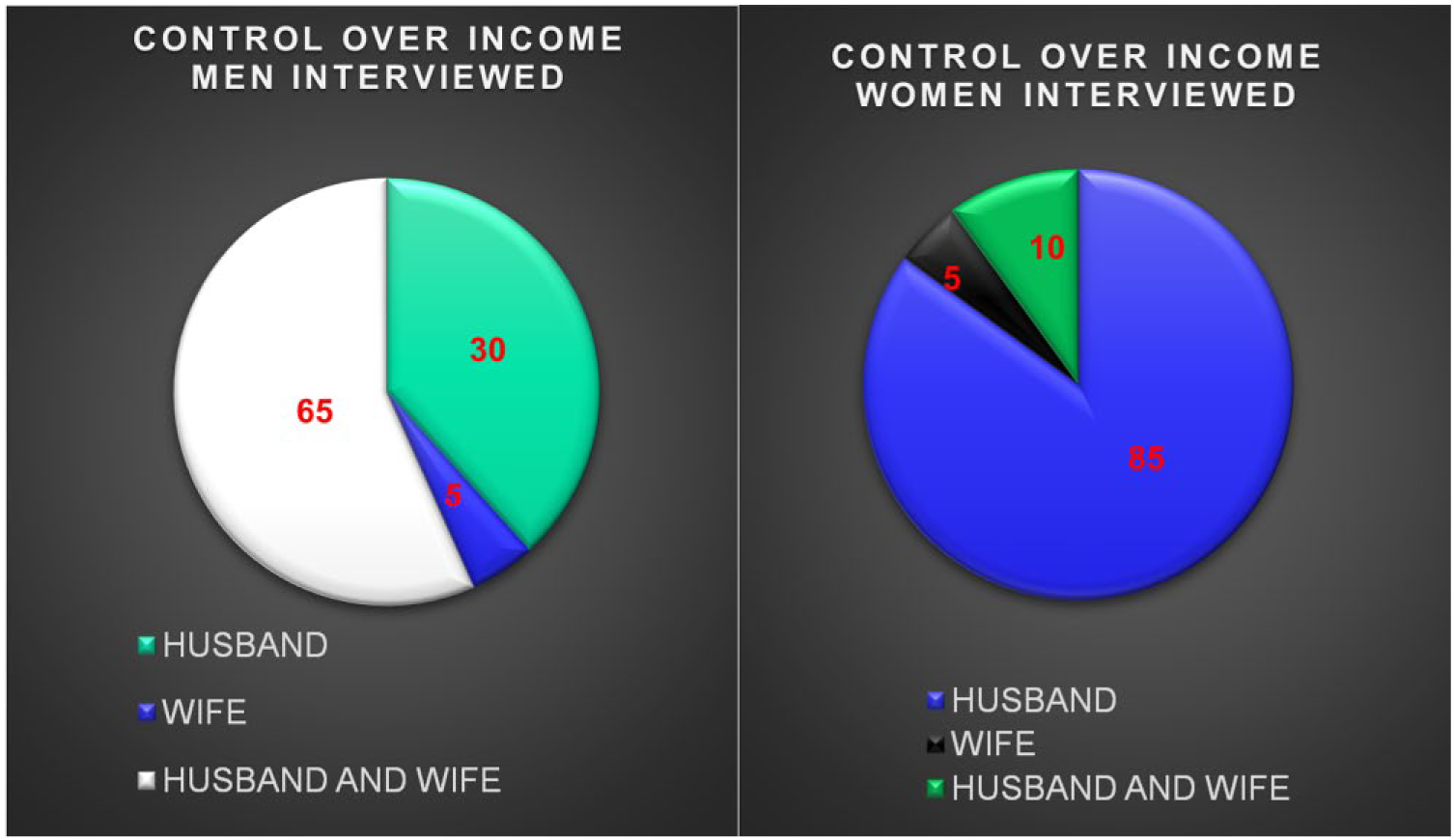
Control over income men and women interviewed.
However, more than 70% of women outlined that they control the small money they earn from the sale of crops (which they take in baskets) and also they control the income they earn from running small businesses that are located in their homes. Especially in Sodo, women are actively involved in running their own income-generating businesses, and they do not expect to receive money for household expenses from their husbands. Six of the 20 women individually interviewed in Sodo produce Areke (local alcoholic drink, often produced at home) and Enjera (local bread). They also retail chat and pepper. These business activities are small in scale, and hence, they do not allow women to earn adequate amount of income. Nevertheless, women control the income they generate from these activities and use it for household consumption. Some women, especially in Halaba, even work as daily laborers on a part-time basis in the surrounding tomato and flower plantations to earn additional income to meet household needs.
While most men use the majority of the income to buy agricultural inputs (fertilizer, seeds, pesticides, and herbicides), paying tax, and paying for labor used in harvesting crops, they nevertheless retain some money for their own personal needs. According to the interviewed women, some men use the money for alcohol and chat, and become unable to buy fertilizers and pay taxes. To cover up their bad deeds, some of them become arrogant and start fighting with their wives. One woman who was tired of her husband’s behavior in particular noted that she does not like the days her husband goes to the market because he often comes back drunk, and starts fighting and beating her by saying “what did you say to me before I went to the market . . . .” Men who are addicted to alcohol often do not bring any money home.
It appeared that the majority of income and expenditure in all three areas is under men’s control. However, this is not to say that all men are in conflict with their wives. In fact, some interviewed men and women noted that they work and make important decisions together, although these are exceptions rather than the rule. It appeared that in most cases, even if women are consulted and advised regarding income and expenditure, they have no right to oppose the interests and wishes of men. With respect to this, one interviewed woman in Halaba noted that “we talk and discuss about what to do with the income we generate. However, if my husband says I do not want your opinion, which sometimes he does, I have nothing to do but live with his decisions.” If women oppose, men become very angry, and in this case, women have to leave their house. Women say that nowadays they know that if they take their case to the local court, they would win. However, they do not want to live alone and raise their children on their own.
Social Capital and Gender
“Social capital refers to connections among individuals, social networks, and the norms of reciprocity and trustworthiness that arise from them” (Geleta, 2014b, p. 111; Putnam, 2000, p. 19). Social capital plays an important role in shaping social structures and hierarchy, and is important to examine in studying women’s empowerment. In the three research sites, men seem to have stronger networks, associations, and links (social capital). As discussed in the previous sections, women are located in the domestic domain, while men actively participate in social and communal life. In all the studied regions, and in particular in Halaba, it is men who participate in important meetings such as kebele (local government) meetings, whereas women’s mobility is restricted as they often spend their time busy with domestic and agricultural activities. Compared with men, women have very little time to go out and establish networks and links with other women. Married women’s access to information is predominantly through their husbands.
In the three research sites, men have greater mobility and establish networks with local community leaders, local government officers, agriculture and health extension workers, agricultural input, and crop retailers and buyers. While men’s mobility and their networks give them power, women’s limitation in the domestic domain is a main cause of their disempowerment and marginalization. It appears that, even more than married women who sometimes get access to information through their husbands, the majorities of single women in all the target areas of the research are marginalized and have limited access to information. In Sodo, two single women who did not get access to the services provided by the pulse innovation project noted that they were not in a position to gain access to the seed credit and agricultural and nutritional education because no one was bothered to inform them. Agricultural extension workers do not pay attention to them because they are poor, uneducated, and single.
However, this is not to say that women do not network and establish links with other women. In fact, the majority of interviewed women outlined that they have strong links and cooperate with their neighbors and exchange information about farming, the local market conditions, and about their experiences as mothers, during coffee ceremonies, which take place twice a day usually in the morning and at night time. However, when compared with men who are mobile, women are in touch with a limited number of individuals who are not necessarily aware of all that is going on beyond their neighborhood.
While women often meet and exchange information during coffee ceremonies in the neighborhood, men tend to attend and meet during local government office meetings and also meet with each other in pubs. Men’s mobility and social exposure enables them to be aware of what is going on in their community. In particular, men’s mobility and network enables them to be aware of the big market conditions and trends. Moreover, a significant number of male farmers, particularly in Sodo, have mobile phones, which they use to communicate and exchange information about market trends and patterns. Compared with men, women’s access and capacity to mobilize networks and links is restricted by cultural norms that limit their mobility to the domestic and neighborhood domain, and almost none of the women who participated in the research own mobile phones.
Furthermore, in all the research sites, but more profoundly in Sodo, men have a tradition of ploughing the land and harvesting crops, particularly teff, together with their friends and neighbors. This pattern of association and cooperation (social arrangement) is called Debo in Sodo and Meskan, whereas in Halaba, it is termed Geza. These informal social arrangements enable men to bond, associate, and work together to exchange information and share ideas about agriculture, and what is new in their surroundings. In Halaba, in particular, the system of Geza extends to sharing of resources. For example, if a man does not have an ox, he contributes his labor, and in return, he gains access to his friend’s or neighbor’s oxen.
Hence, it is easy to observe that men have a well-established and stronger network system that enables them to bond and share important information and resources. On the other hand, the gendered social environment in all three research sites restricts women from building stronger social links, networks, and associations, thereby limiting their ability to network and help each other.
Conclusion and Recommendations
As clearly illustrated in the previous sections, Pulse Innovation Project is located in an environment in which gender inequality is deeply entrenched and pervasive. The most important question here is how we can transform this gendered environment? How can we help women to play important roles in decision-making over what to produce (type of crops produced), how much to produce, what to consume/sell, and how much to consume and/or sell? As demonstrated earlier in this article, the project has used two main strategies: increasing the number of women who get access to seeds for multiplication and grain production and also providing agricultural and nutrition and value chain trainings.
While these interventions implemented by the project help as an entry point to change the gender order and to empower women, bringing about long-lasting change requires more than providing seed credit and agricultural and nutritional education. We need to think of broader strategies that help women to gain independent access to economic resources, social networks, associations, and links. One important way of assisting women to empower themselves is facilitating circumstances to enable them to be organized, to form associations and groups. In this regard, the establishment of women’s associations or women’s cooperatives for the production, consumption, processing, and selling of pulses would create opportunities for women to mobilize their resources and to work together to expand their economic capital. The establishment of cooperatives in particular would create opportunities for women to work together, share information, build social capital, and empower themselves.
More importantly, transforming the gender order requires more than helping women create and build their economic and social capital. The most challenging task is transforming culture. Focus on economic and social life through the provision of seeds and agricultural, nutrition, and value chain education does not help in transforming the deeply seated exploitative gender structure. Empowering women requires understanding and transforming exploitive cultural norms and practices. One key strategy to bring about a cultural shift is to plan and implement participatory gender analysis and gender sensitization programs. Bringing women and men together to openly discuss and reflect on gender relations would help men better understand the exploitation and marginalization of women. In fact, pulse innovation has instituted this approach as one key strategy and implemented it in some of its intervention sites. However, rather than a once-off approach, this needs to be done on a regular basis to transform the deeply entrenched and pervasive exploitative cultural norms and practices.
Moreover, the economic, social, and cultural empowerment of women requires the collaborative efforts of governmental, nongovernmental, and local and international institutions. Hence, improving the contribution of pulse innovation project to empower women demands the project’s ability to strengthen the existing and to create new networks with NGOs and other institutions working on improving the livelihoods of poor women. This requires, for example, establishing links with microfinance institutions and NGO-funded savings and credit cooperatives so that women do not just get access to pulse seed credit and agricultural training and nutrition education, but also access to finance, which enables them to purchase assets such as farm animals to build their capacity to improve their productivity.
The current structure of pulse innovation project, which focuses on the provision of seed credit and nutrition and agricultural education, can play a limited role in transforming the deeply entrenched and pervasive exploitative cultural norms and practices. In circumstances whereby the basic economic choices such as access to big markets are dictated by exploitative normative frameworks, the provision of seed credit cannot bring about a long-lasting change to the benefit of women. Despite pulse innovation’s agricultural and nutritional education propensity to help women get health benefits and become economically empowered, it does not challenge household power structures in which men dominate.
Hence, if pulse innovation and other similar projects are to transform and improve the living conditions of women, they should rethink their current practice and put in place necessary changes. They should move from just providing seed credit and agricultural and nutritional training to focusing on integration of gender at all levels, and contribute to broader and profound changes. They need to plan and execute policies that benefit the impoverished, landless, single mothers. Also, they need to assist married women to be active players in the process of agricultural decision-making and over the sale of produce. They should advocate for shared control over the utilization of income as well as shared responsibility for household work.
Footnotes
Appendix A
Appendix B
Declaration of Conflicting Interests
The author(s) declared no potential conflicts of interest with respect to the research, authorship, and/or publication of this article.
Funding
The author(s) disclosed receipt of the following financial support for the research, authorship, and/or publication of this article: This research was supported by the Global Institute for Food Security (GIFS), University of Saskatchewan, International Development Research Centre (IDRC) and the Global Affairs Canada, Government of Canada.