




Abstract
This study investigates the relationship between maternal employment and state-to-state differences in childcare cost and mean school day length. Pairing state-level measures with an individual-level sample of prime working-age mothers from the American Time Use Survey (2005–2014; n = 37,993), we assess the multilevel and time-varying effects of childcare costs and school day length on maternal full-time and part-time employment and childcare time. We find mothers’ odds of full-time employment are lower and part-time employment higher in states with expensive childcare and shorter school days. Mothers spend more time caring for children in states where childcare is more expensive and as childcare costs increase. Our results suggest that expensive childcare and short school days are important barriers to maternal employment and, for childcare costs, result in greater investments in childcare time. Politicians engaged in national debates about federal childcare policies should look to existing state childcare structures for policy guidance.
For many mothers, the care of children remains a major barrier to employment. The excessive cost of preschool care pushes mothers out of the labor market (Blau and Robins 1989; Han and Waldfogel 2001; Hofferth and Collins 2000). Mothers expect to return to work when children are school aged, but the birth of second children and short school day lengths often derail mothers’ reentries into the labor market. Persistent gaps in maternal employment are surprising given women’s gains in higher education, access to higher-level positions, and the cultural shift toward public-sphere gender egalitarianism. Yet the gender-essentialist cultural frame emphasizing mothers’ domestic duties has impeded private-sphere equality (Cotter, Hermsen, and Vanneman 2011; Goldin 2006; Pedulla and Thébaud 2015; Spitze 1988). Hence, women continue to shoulder a disproportionate domestic share and, as a consequence, are more likely to reduce employment to care for family (Sayer 2005; Stone 2008). To reduce institutional barriers to maternal employment, many countries have instituted family policies to ease parenthood transitions (i.e., parental leaves) and to provide childcare (i.e., universal childcare). Yet childcare policies, well-paid leaves of one year or less, and affordable, accessible childcare are shown to be positively associated with maternal earnings and employment (Boeckmann, Misra, and Budig 2015; Budig, Misra, and Boeckmann 2012; Misra, Budig, and Boeckmann 2011). Yet the United States stands alone as the only Western industrial nation with no paid parental leave and minimal childcare support for preschool-aged children (Gornick and Heron 2006; Gornick and Meyer 2003; Gornick et al. 1996). Rather, the U.S. federal government emphasizes market (private-sector) solutions (i.e., employer-sponsored programs or domestic outsourcing) to meet family demands with federal provisions reserved for those below established poverty thresholds (Esping-Andersen 1990).
In response to the void in federal policy, many states have legislated family policies (i.e., Massachusetts’s 2015 parental leave policy, California’s Prop 10—taxpayer funded 0–5 childcare) to support working families. States are also central to legislating school schedules, offering childcare tax subsidies, and regulating the distribution of the federally subsidized Child Care Development Fund (Amenta and Halfmann 2000; Blau 2003; Blau and Tekin 2007). As a consequence, preschool and school-aged care environments vary dramatically across the 50 states and the District of Columbia. In the absence of a federal childcare policy, state legislators are increasingly important, yet understudied, policy actors. Further, as political discussions at the national level are increasingly focused on legislating federal childcare provisions (see, e.g., Elizabeth Warren’s presidential campaign platform and President Trump’s 2019 budget for examples of federal childcare policies), policy makers should look to successes in existing states to inform their childcare platforms.
Cross-national evidence shows affordable, high-quality, and widely available childcare reduces mothers’ domestic time and increases their employment odds (Boeckmann et al. 2015; Budig, Misra, and Boeckmann 2012; Jaumotte 2003; Misra et al. 2011; Pettit and Hook 2005). School day length also structures maternal employment, with many women reducing existing employment when children are young and reentering employment once children reach school age (Bianchi 2000). Cross-national differences in school structure (i.e., Germany’s short school days, Italy’s preference for children to go home for lunch, and France’s four-day school week) structure maternal employment (Gornick and Meyers 1997). This same conceptual framework may extend to states—those with expensive childcare and short school days may limit mothers’ employment. The inclusion of school day length extends existing research and addresses the call to more holistically measure barriers to maternal employment (Han and Waldfogel 2001).
Existing research shows mothers are more likely to reduce employment when faced with expensive childcare at the national (Blau and Robins 1989; Han and Waldfogel 2001; Ribar 1992) and county levels (Hofferth and Collins 2000). Yet no study to date has investigated the role of states in structuring maternal employment. Childcare costs vary at the state level, a consequence of states’ unique economic conditions, immigration patterns, and costs of living. While a thorough investigation of childcare costs at multiple levels—the state, the county, and the Metropolitan Statistical Area (MSA)—is warranted, the requisite data are not publicly available. Thus, we use state-level differences in preschool care costs and school day lengths as broader proxies for state-level childcare generosity. The role of school day length is understudied across these literatures. This omission is conspicious given that the U.S. Constitution grounds responsibility for K–12 education in the state (Department of Education 2005), with 83 cents of every dollar coming from the state and local levels compared to only 8.3 cents from federal agencies (Department of Education 2005). This means state legislatures have important power to determine the structure and content of school education, with school days often reduced to redress state budgetary deficits (Dillon 2011). These decisions may have the unintended consequence of restricting maternal employment.
The existing literature is clear—the absence of universal subsidized childcare remains a key institutional barrier to gender equality in maternal employment and childcare nationally and globally (Cha and Weeden 2014; Gornick and Meyer 2003; Kelly, Moen, and Tranby 2011; Offer and Schneider 2011). Further, short school days may limit maternal employment. Yet no study to date has extended these models to weigh whether state-to-state variation in preschool and school-aged care resources structure mothers’ employment and childcare time. Given that greater income inequality at the state level widens class-based gaps in investment in children (Schneider, Hastings, and LaBriola 2018), state context matters in explaining how parents invest their time. It follows that childcare time investments also may be conditioned by institutionalized barriers to maternal employment—expensive childcare costs and short school days. Further, no study to our knowledge has investigated how changes in childcare costs over a 10-year span affect maternal employment and childcare patterns. To address these gaps, this study assesses two central questions: (1) Are mothers less likely to be employed and likely to spend more time in childcare in states where childcare is inexpensive and school days are long? and (2) Are increases in childcare costs over time associated with mothers’ lower odds of employment?
To test these questions, we pair individual-level data from the American Time Use Survey (ATUS) for prime working-aged mothers (2005–2014 aged 18 to 59, n = 37,993) with two strategically selected state-level measures—childcare (preschool) cost (adjusted for median married couples’ incomes) and school day length. First, we test whether some states are better at supporting working mothers than others by offering inexpensive childcare and long school days. Then, we test whether mothers living in states with more generous child and school-aged resources are more likely to work full- or part-time and also to spend less time in childcare. By utilizing data that span a decade, we also test whether changes in childcare costs structure mothers’ employment status and childcare time. This allows us to determine not only whether mothers’ employment is sensitive to childcare costs but also whether increases in childcare cost, relative to median incomes, are detrimental to maternal employment outcomes and associated with more time in childcare. Our results highlight the importance of expansive child and school-care provisions on mothers’ employment and domestic time, from which we draw concrete policy recommendations that should inform current policy debates about universal childcare.
Linking Child and School-aged Care Resources to Maternal Employment
Existing state-level research on childcare costs largely focuses on the impact of one policy—Temporary Assistance for Needy Families—on barriers to maternal employment (welfare to work) (Blau and Tekin 2007; Cancian and Meyer 2004; Cancian et al. 2002; Gallagher et al. 1998; Zedlewski and Loprest 2001). At the individual level, state-subsidized and accessible childcare is shown to be essential for the transition from welfare to work (Schumacher and Greenberg 1999; Schumacher, Greenberg, and Duffy 2001). Meyers, Heintze, and Wolf (2002) show (looking at California alone) that expanding low-income mothers’ access to state-subsidized childcare to 50 percent would increase their labor market entry by 75 percent. These studies indicate that expensive childcare is a barrier to maternal employment, but the assessment of Temporary Assistance for Needy Families, which is accessible only to low-income mothers, lacks broader generalizability.
Assessing childcare costs more generally, others document that expensive childcare increases mothers’ labor market exits and deters their employment reentries, with stronger effects among low-skilled, low-income, and single mothers (Blau and Robins 1989; Blau and Tekin 2007; Cleveland, Gunderson, and Hyatt 1996; Connelly 1992; Han and Waldfogel 2001; Hofferth and Collins 2000; Michalopoulos and Robins 2000; Ribar 1992). Mothers of preschool-aged children are most vulnerable to labor market exits (Gelbach 1999; Leibowitz, Klerman, and Waite 1992), the likelihood of which can be reduced through more generous childcare credits and subsidies (Connelly 1992; Han and Waldfogel 2001; Lefebvre and Merrigan 2008). Indeed, maternal employment increased by 12 percentage points after Washington, D.C., began offering two years of universal preschool; 10 of the 12 percentage points’ (83 percent) increase is directly attributable to childcare expansion (Malik 2018). These studies indicate childcare costs are a key barrier to maternal employment and suggest that increases in childcare costs over time will be detrimental to mothers’ odds of employment.
At the state level, Capizzano (2000) provides a descriptive overview of informal and formal childcare across 12 states, demonstrating that formal center-based care is modal but national averages mask important state variation (Capizzano 2000). States vary dramatically in their childcare costs, quality, and availability, with cash assistance and universal pre-K being central policy recommendations to improve children’s learning outcomes and mitigate gender inequality in maternal employment (New America Foundation 2018). Assessing childcare cost at the county level, Hofferth and Collins (2000) show employment exits for moderate-earning mothers are more common in counties with expensive and impacted childcare. Yet their reliance on 1989–1990 survey data from 144 of the 3,141 U.S. counties indicates a need for a more recent and comprehensive assessment. Further, our application of time use surveys allows for a direct examination of state-level childcare resources on mothers’ childcare time. We expect mothers will retreat to the home—spending more time in childcare and less in employment—in states with expensive childcare (relative to married couples’ median earnings) and short school days. Further, we expect mothers will substitute their own time in childcare to mitigate the rising costs of childcare. Our application of time use data spanning a decade allows us to determine whether mothers’ employment and childcare time are sensitive to childcare costs and increases in cost relative to income, an expansion of existing research.
We also expand upon existing research by expanding our investigation beyond preschool-aged costs alone (see Han and Waldfogel 2001 for discussion). The structural barriers to maternal employment linger into children’s school years with the inability to synchronize work and school schedules cited as a core reason mothers reduce employment (Morgan 2006; Stone 2008; Williams 2010). Short school days may limit mothers’ employment and, consequently, lead mothers to spend more time caring for children. In many states, kindergarten school days are only 3 hours per day (Education Commission of the States 2011), and the average American student spends roughly 6.7 hours in school per day and 180 days per year (National Center for Educational Statistics 2003). By contrast, the average full-time American worker spends 8.17 hours per day in employment (Bureau of Labor Statistics 2017), and without mandated (paid or unpaid) sick or holiday leave, parents are vulnerable to working 365 days per year (Travail 2012). The lack of synchronization between school and work schedules makes mothers vulnerable to labor market exits (Stone 2008). Existing research shows extending school days produces better student educational outcomes (Rivkin and Shiman 2013). Our research assesses whether longer school days have the additional benefit of being positively associated with maternal employment.
From these bodies of literature, we draw three clear hypotheses:
Hypothesis 1: Mothers will report lower odds of employment in states with short school days and those with expensive preschool care.
Hypothesis 2: Mothers in states with expensive preschool care and short school days will spend more time in childcare than those in states with inexpensive childcare and long school days.
Hypothesis 3: Increases in the cost of childcare over time (2005–2014) will be associated with lower odds of maternal employment and more time in childcare.
Data
To address these questions, we match repeated cross-sectional data during a 10-year time period (2005–2014) with state-level measures of preschool cost and school day length. At the individual level, we use 2005–2014 data from ATUS. ATUS is a nationally representative sample of Americans’ daily activities for a 24-hour period sponsored by the Bureau of Labor Statistics and collected by the U.S. Census Bureau. We restrict our sample to mothers who currently have a school-aged child in the home (17 or younger) and who are of prime working age (18 to 59). This provides an effective sample size of 29,796 respondents from all 50 states and the District of Columbia. We then match these respondents with two state-level measures: the cost of full-time childcare as a percentage of the median family income for married couples and the average length of a school day.
The childcare measures are from the Childcare Aware of America State Fact Sheets (2005–2014), which are derived from childcare referral and state and federal government agencies in each state that collects data on market rates of childcare services in the state. We utilize the states’ annual measures to provide estimates of childcare across states and changes in states over time adjusted for married couples’ median family incomes. For years when a state failed to report its childcare measures, we applied the previous year’s data. We gathered school day length data from 2007 to 2014 but found little variability in the average school day lengths across this period and thus apply data from the earliest time point of the average school day length across years (Education Commission of the States 2007, 2008, 2011, 2014).
To test for the robustness of our models, we also estimated those that control for the mediating effects of state economic conditions for two measures: (1) the unemployment rate to account for elasticity in the labor market and (2) the percentage of women in service jobs to measure demand for female employment and availability of a service market to offload housework and childcare derived from the U.S. census. We found that unemployment and service concentration did not explain our childcare effects, and thus these models are not presented. Rather, we find our childcare (preschool) costs and school day length effects are robust to the inclusion of these controls.
Methods
Because the data are time variant with years nested within states, we utilize multilevel models (Raudenbush and Bryk 2002). This modeling strategy permits an assessment of the relationship between state-level child and school-aged care resources and our outcomes of interest while accounting for the fact that individuals are nested within survey years and states. The measure of employment is analyzed through a multilevel multinomial logistic regression. We choose multinomial logistic regression, as opposed to ordinal logistic regression, because ordinal logistic regression assumes that the associations between the independent and dependent variables are parallel across categories of the dependent variable. We tested this assumption, finding that the slope parameters vary significantly across categories of the dependent variable. The measures of time spent caring for children are analyzed through multilevel linear regression. This modeling strategy also allows us to parse out longitudinal versus cross-sectional effects. Following Moller, Alderson, and Nielsen (2009) and Moller et al. (2016), all state-level child and school-aged care resource variables are measured longitudinally (deviations from state-specific means) and cross-sectionally (i.e., overall state means). All of our models are estimated using SAS.
We ran a series of unconditional models for each dependent variable to determine the best error structure. Based on this analysis, we include a random effect for states that accounts for nesting of individuals within states. We also attempted to include a random effect for time, but the model fit was inferior. Instead, we included a fixed effect for time. We use the Huber-White sandwich estimators (Huber 1967; White 1980, 1982) to relax assumptions of normality and homoscedasticity. This robust variance-covariance estimate option relaxes the assumption of independence within groups and produces asymptotically unbiased (i.e., consistent) error terms. We also include a random slope for income in the linear models. All control variables at the individual and state levels are centered on their grand means to ease interpretation of our primary variables of interest. The models also apply the individual-level weights.
Measures
Dependent Variables
We analyze two dependent variables. The first examines mothers’ current self-reported employment status. ATUS asks respondents to report their current employment status through predetermined categories. We estimate models across these categories: currently not in the labor force, working part-time, and working full-time (omitted category). We estimate multinomial logistic regression with those employed full-time as the comparison group to identify associations between state-level childcare measures and the odds of part-time work and being out of the labor market.
The second dependent variable measures mothers’ time (minutes per day) in childcare on the diary day. Childcare measures time in primary childcare activities related to the helping or caring for household children and all activities related to children’s education or health (e.g., doctor’s appointments, school conferences) but does not include childcare as a secondary, or simultaneous, activity as typically conceptualized in time use research (i.e., watching children while engaged in another primary activity including employment). Instead, the ATUS measure of secondary childcare refers to time during a primary activity when a child younger than age 13 is “in the care of” the respondent. It thus includes time when mothers are not directly engaging with or even copresent with children and thus may not be constrained by employment hours in similar ways to primary childcare activities. Because we want to clearly delineate how the cost of childcare and length of the school day affect employment and direct, primary childcare activities, we exclude secondary childcare (Hofferth, Flood, and Sobek 2016). The models were run as multilevel linear regression models, an approach consistent with previous time use research (Hook 2010).
Individual Controls
Given our focus on state-level child and school-aged care, we apply a range of individual measures as controls. Total family income is divided into five possible outcomes: less than $25,000 (reference category); $25,000–$59,999; $60,000–$99,999; $100,000–$149,999; and $150,000-plus. The lowest income quartile serves as our comparative group. We estimate those missing on income as a distinct category rather than imputing their scores through multiple item imputation because the estimation of imputed data in multilevel models does not account for its nested structure and thus fails to account for the lack of independence in our data structure (Drechsler 2015; Van Buuren 2011). We compare those with a college education or higher (value = 1) or some college (value = 1) and those with a high school diploma or less (value = 0, comparative group) as we expect more highly educated mothers to be more likely to be employed, spend less time in housework, and spend more time in childcare (Hays 1996; Sayer 2005). Marital status is an important predictor of maternal employment and unequal housework loads, and thus we compared married mothers (value = 1) to divorced and single mothers (value = 0) (Spain and Bianchi 1996; Sayer 2005). We explore age categorically, comparing those age 46 to 59 years (value = 1) to those age 18 to 45 (value = 0) as we expect the older cohort to report lower employment than the younger cohort (Goldin 2006; Percheski 2008). Race is controlled through a series of dichotomous measures including black, Hispanic, other race/multiracial and non-Hispanic white (omitted category) (Sayer and Fine 2011). We also include year dummies to account for the repeated cross-section structure of our data (2014 serves as the comparative group).
Results
Descriptive Overview of Employment, Childcare Time, and State-level Measures
Table 1 provides a descriptive overview of key independent and state-level measures. We find that states vary dramatically in their employment and childcare patterns. North Dakota, Delaware, Nebraska, and Vermont have some of the highest rates of maternal employment, with more than one in two mothers working full-time. By contrast, Idaho, Utah, California, and Washington have the lowest rates of full-time maternal employment, with only two out of five mothers employed full-time. Part-time work is concentrated in Utah, Massachusetts, Minnesota, and Wisconsin and is less common in Delaware, Wyoming, Vermont, and Arkansas. California, Arizona, West Virginia, and Idaho lead the nation with the highest concentration of mothers out of the labor force. Table 1 also shows state-level variation in childcare time. Mothers report the longest average time in caring for children in West Virginia, Connecticut, New Hampshire, and the District of Columbia, at roughly an hour and a half per day. By contrast, mothers in Mississippi, South Carolina, Arizona, and Wyoming spend the shortest average time in childcare at a little more than an hour per day.
Descriptive Overview of Mean State-level Childcare and School-aged Care Characteristics, Averaged across 2011 to 2015.
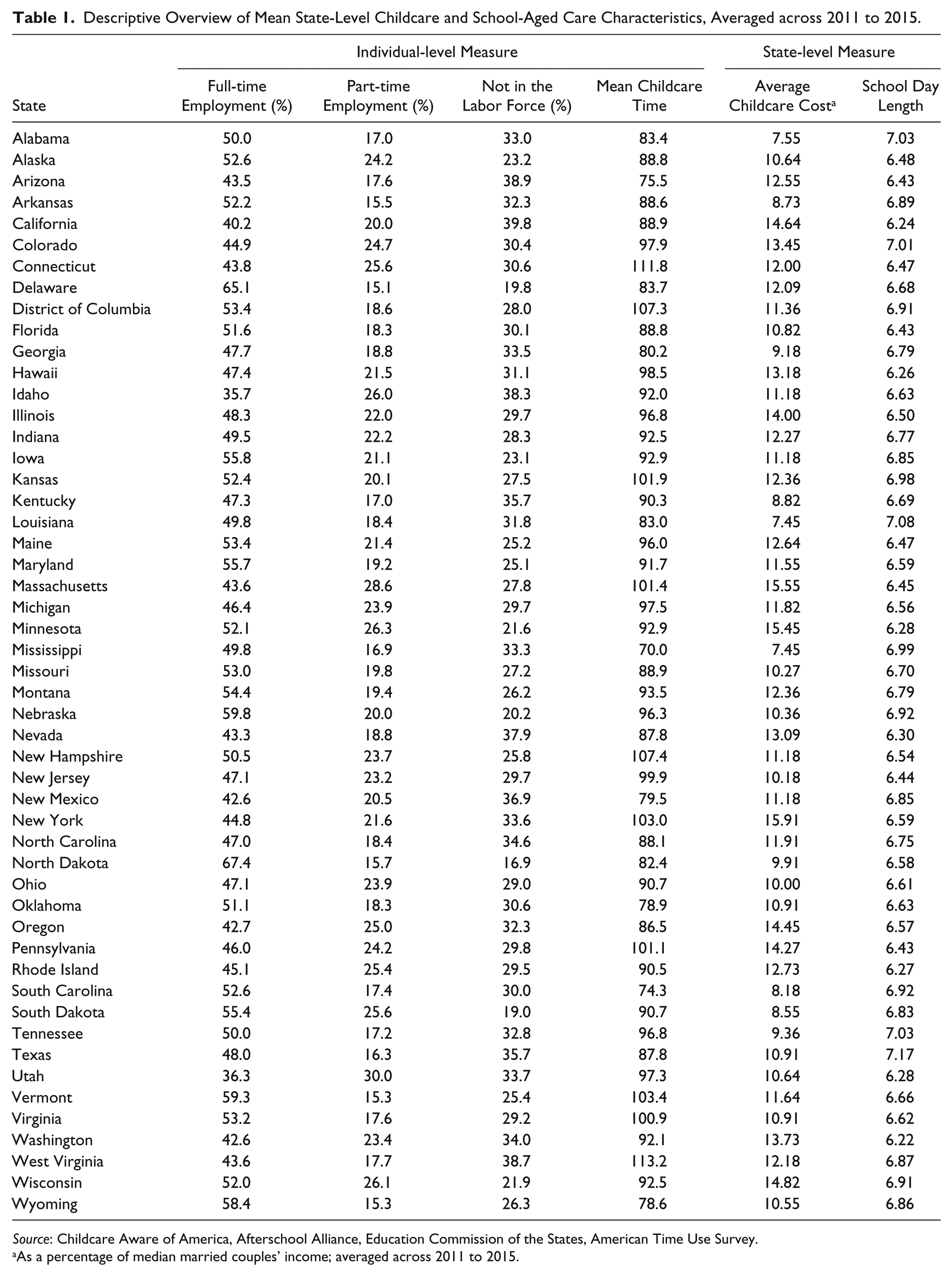
Source: Childcare Aware of America, Afterschool Alliance, Education Commission of the States, American Time Use Survey.
As a percentage of median married couples’ income; averaged across 2011 to 2015.
Turning to the state-level measures, childcare (preschool) is most expensive in many of the coastal states, such as New York, Massachusetts, and California, and absorbs roughly 15 percent of married couples’ median incomes. This is remarkable given that median income for married couples in these states is generally higher than in some of the states with lower relative childcare costs. Indeed, childcare costs are least expensive in many of the lower-income Southern states, including Mississippi, Louisiana, and Alabama, as well as many of the Plains states like Nebraska, Iowa, and South Dakota. In these states, childcare costs absorb less than 10 percent of married couples’ average incomes with childcare. In Mississippi, the least expensive state, childcare consumes only 7.5 percent of couple average income, about one half less the amount of average income consumed by childcare costs in New York, the most expensive state. School days are also longest in many of the inexpensive childcare states including Louisiana, Alabama, Mississippi, and Nebraska, suggesting inexpensive childcare states also support mothers of school-aged children with longer average school days. By contrast, school days are shortest in the expensive childcare states including California, Washington, Hawaii, and Rhode Island. Collectively, these descriptive statistics indicate that maternal employment, childcare time, childcare costs, and school day lengths vary across states.
Correlations across State-level Measures
The descriptive statistics suggest states may form distinct childcare cultures; Table 2 tests for significant correlations across these measures and their relationship to maternal employment. Consistent with the descriptive patterns, states with longer school days report less expensive childcare. These states also have a higher concentration of full-time working mothers. Mothers in states where childcare is more expensive spend more time caring for children, which is consistent with their lower odds of full-time employment. Of course, some of these relationships may be explained by individuals’ sociodemographic characteristics. The subsequent section expands these descriptive statistics by (1) testing these relationships net of individual-level controls and (2) adding estimates of changes in childcare cost over time.
Correlations between Mean State-level Employment and Childcare Time and Child and School-aged Childcare Resources.
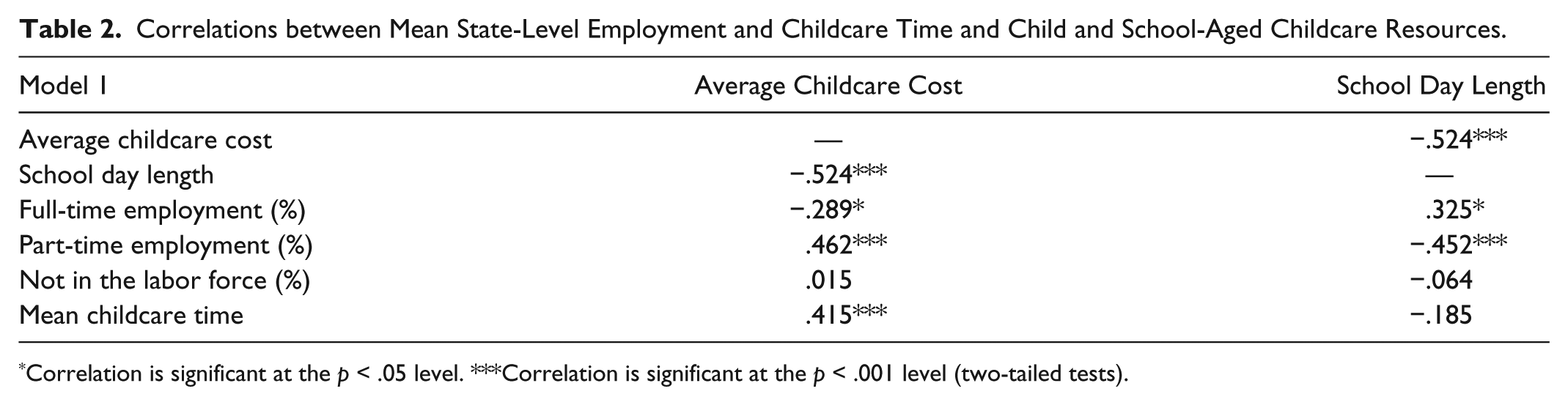
Correlation is significant at the p < .05 level. ***Correlation is significant at the p < .001 level (two-tailed tests).
Regression Results for Employment and Childcare
Table 3 provides the regression results from the multilevel regression for employment and childcare. Model 1 includes childcare costs as a cross-sectional and longitudinal measure. Consistent with expectations, mothers’ odds of working part-time are higher as childcare becomes more expensive (relative to median family incomes), an association significant only cross-sectionally. Since the comparative group is full-time employment, the results provide the inverse interpretation that mothers’ odds of full-time employment are higher as childcare costs decrease. Model 2 includes the school day length to show that mothers are less likely to work part-time and more likely to work full-time in states where school days are longer. By contrast, mothers’ odds of part-time (compared to full-time) work are more prevalent as school days shorten.
Multilevel Regression Results for Employment, by State-level Childcare and School Characteristics.

Source: American Time Use Survey (2003–2014; n = 37,993), Childcare Aware of America, Afterschool Alliance, and Education Commission of the States (n = 51).
Note: All models include the full set of individual controls including partners’ weekly wages (highest quartile omitted), married, year (2014 omitted), age, child 6 to 12 in the home (child 5 and younger omitted), education (high school omitted), and race (non-Hispanic white omitted). All models also control for the unemployment rate at the state level. Dashes indicate not estimated.
p < .05. **p < .01. ***p < .001.
Models 3 and 4 test whether expensive childcare and short school days are associated with mothers’ time in childcare. Model 4 shows time in childcare is not associated with school day length, counter to expectations. By contrast, model 3 shows mothers spend more time in caring for children in states where preschool care is more expensive. Given that mothers’ odds of full-time work decrease as childcare becomes more expensive relative to income, these results suggest mothers may trade time in employment to absorb some of the cost of expensive preschool care. In addition to the significant cross-sectional association, increases in childcare costs over time are associated with mothers’ greater investment in time caring for children. Taken together, these results suggest that mothers’ time caring for children is sensitive not only to the overall cost of childcare but also to increases in its cost over time. This lends further evidence to the notion that mothers absorb some of the expense of childcare by increasing their own time in caring for children at the expense of full-time work as costs increasingly squeeze family budgets. Further, that these associations vary significantly across U.S. states indicates that some mothers experience greater institutional barriers to employment than do others.
We tested whether these effects vary by the age of children (comparing those with preschool to school-aged children) but did not find our effects were limited to mothers of children in specific age groups. We note, however, that the division of our sample across states, time, and age of young children leaves many states with small sample sizes, weakening the power of our models. Thus, while we do not find significant effects by age of the child, we encourage researchers to take this into account in future research as we may be suffering from weak estimation power in our models.
Contextualizing the Relationship between Childcare Costs and Mothers’ Time
To better contextualize the results for childcare cost and maternal employment, Figure 1 graphically depicts these relationships by presenting the odds of full-time employment (the excluded category) for states based on the average cost of childcare, holding other variables constant. Mothers in New York, where childcare costs are the highest in the nation, are less likely to work full-time than those in Mississippi, where childcare costs are more affordable. Although these effects appear small in size, they are relatively large considering national trends in mothers’ employment. Specifically, on average, women’s full-time employment as a share of their population declined from .43 in 1999 to .39 in 2010, rebounding to .42 in 2018 (Department of Labor 2018, 2019). The predicted probabilities across states have comparable variability to that found in national statistics between 1999 and 2018, as the predicted probability of full-time employment between states ranges between .43 and .48 (Department of Labor 2018, 2019).

Predicted probability of mothers’ full-time employment, by state-level childcare costs (2005–2014 American Time Use Survey).
We further illustrate the results from the multinomial logistic regressions in Figure 2, which presents predicted probabilities based on model 2. This figure illustrates that the probability of full-time employment also varies across states. Indeed, Texas has the longest school day length at 7.17, while Washington has the shortest school day length at 6.22, and the variation-predicted probabilities range from .42 to .49, respectively. This is a considerable difference considering how little women’s full-time employment has changed over time in recent history.

Predicted probability of full-time employment, by average school day length across states (2015–2014 American Time Use Survey).
Figure 3 presents results from Table 3, model 3, by contextualizing the childcare results as an annual measure. Consistent with mothers’ employment patterns, mothers are spending more time caring for children in states where preschool childcare is more expensive. Although the effects appear small (one-minute increase in childcare time for every 1 percent increase in childcare costs), we can see that these differences, when aggregated across the year, have dramatic effects on mothers’ time use. An average mother in New York spends roughly 50 hours more per year in childcare than a comparable mother in Louisiana. Thus, small daily time use impacts can have significant consequences over time.

Predicted annual hours spent on childcare, by state-level average childcare cost (2005–2014 American Time Use Survey).
Conclusion
In this article, we tested whether childcare (preschool) cost adjusted by median family income for married couples and average school day length vary across states and whether this variation is associated with maternal employment and childcare patterns. First, we identify significant differences in childcare and school-aged care resources across states. Specifically, we find childcare costs and school day length to be significantly correlated. This means that, on average, states with inexpensive childcare have longer school days. Thus, some states provide better resources to working parents—inexpensive childcare and longer school days—across children’s life course than do others.
The links between childcare cost and school day length, on the one hand, and maternal employment, on the other, underscore that decisions made at the state level have potential to alleviate the institutional barriers to maternal employment. We draw two main conclusions, highlighting the policy implications where appropriate. First, we find mothers’ employment is sensitive to childcare cost. Individual-level studies confirm this assessment and point to reductions in childcare cost as a key motivator of maternal employment, especially for those transitioning from welfare to work (Blau and Robins 1989; Han and Waldfogel 2001; Hofferth and Collins 2000; Michalopoulos and Robins 2000; Ribar 1992). Our results show that childcare costs at the state level are also a barrier to maternal employment, with mothers reporting lower odds of full-time and higher odds of part-time employment in states with expensive childcare. Our results suggest mothers use part-time employment to redress expensive childcare costs. We find an equivalent pattern in short school day states, indicating institutional barriers to maternal employment are not isolated to the preschool years. Through these analyses we address Han and Waldfogel’s (2001) call to expand beyond childcare-alone estimates of mothers’ experiences and document the care barriers to maternal employment that linger into school age. Thus, getting children into school is not the solution to mothers’ carer-career problems in state markets where childcare is expensive.
We also find mothers spend more time caring for children in states where childcare is expensive and as childcare costs increase during our sampled time frame (2004–2015). This suggests that mothers may absorb childcare time rather than outsource it to the market, as childcare becomes more expensive. Mothers are more likely to work part-time than full-time in states with expensive childcare, indicating that childcare costs are a strong barrier to maternal employment. As childcare costs, like other living costs, continue to increase over time, we may see mothers increasingly knocked out of the labor market, providing direction for future researchers and policy makers alike. This suggests that in addition to lowering total costs, regulating the growth in childcare costs over time may be integral to facilitating maternal employment.
This study is not without limitations. The first is our reliance on cross-sectional data, which do not allow us to identify clear causal mechanisms across levels. We find strong evidence that institutional barriers to child and school-aged care are associated with limited maternal employment. Yet whether limited state-level resources block women’s reentry into the labor force at critical junctures—after the birth of a child or when children reach school age—or affect maternal employment decisions consistently across the life course are beyond the scope of these data. Also, the multilevel design limits our modeling strategy as we have a relatively small sample of U.S. states (50 and the District of Columbia). Our application of 51 level 2 units is appropriate (Bryan and Jenkins 2015) and expands upon smaller country-to-country comparisons in cross-national research (Batalova and Cohen 2002; Fuwa 2004; Heisig 2011; Hook 2006; Knudsen and Wærness 2008; Ruppanner 2010), supporting our modeling strategy. But a larger state-level sample may provide additional significant results. A further complication of our state-level design is that some of our measures vary significantly within U.S. states. For example, childcare cost and demand in metropolitan areas (New York City or San Francisco) may be more expensive and impacted than those in less urban areas, suggesting that a more detailed level 2 unit may be more appropriate (e.g., MSA-level measures). This poses some limitations to our analyses, as the effects we identify at the state level may be more pernicious when estimated at a lower unit of analysis (e.g., MSA level). Thus, our models may underestimate the impact of childcare cost and demand on maternal domestic and employment time, especially in high-cost cities. Existing studies estimating lower-level units apply the Profile of Childcare Settings data collected across 144 counties in 1990 and find expensive and impacted childcare increases maternal labor market exits (Hofferth and Collins 2000). However, these data are yet to be updated. Thus, the requisite childcare data for all 3,007 U.S. counties or 382 MSAs are not publicly available. While we acknowledge these limitations, our article is one step in the direction of understanding state-level barriers to maternal employment. This limitation points to a data void and provides directions for future research.
The implications of our results for policy and future research are clear. Low levels of institutionalized child and school-aged resources place barriers on maternal employment. Ample previous research documents these patterns for childcare cost, especially among low-income mothers and those with preschool-aged children (Blau and Robins 1989; Connelly 1992; Gelbach 1999; Han and Waldfogel 2001; Hofferth and Collins 2000; Leibowitz et al. 1992; Ribar 1992). Our study shows these relationships are robust at the state level and that the impact of limited care spans across children’s life courses. Thus, getting children into school is not the silver bullet to solve the childcare-employment dilemma. Fortunately, states are in the unique position to legislate school schedules, which may, as our study suggests, have the additional benefit of facilitating maternal employment. Longitudinal data collection estimating maternal employment prior to and after policy change could directly test for causality. Further, taking steps to lower childcare costs may increase maternal employment rates. In this regard, enacting policies more consistent with the universal provisions of European welfare states may increase mothers’ labor market attachment.
In light of these findings, questions about cost, safety, and quality remain—states with expensive childcare may provide a higher-quality product, increasing the safety of young children in care. Or mothers may look to cheaper and less-regulated alternatives in expensive-childcare-cost states. These relationships are likely exacerbated by class inequality, underscoring that regulating childcare cost and providing high-quality care to families across all income brackets is a public safety issue that requires more scrutiny and research.
Ultimately, we provide a clear argument that states are important actors for mothers’ employment and that the institutional barriers to equalizing mothers’ domestic and economic time span children’s early and school years. Our insights point to clear avenues for policy mechanisms to reduce gender inequality in maternal employment.
Footnotes
Funding
The author(s) received funding for the research, authorship, and/or publication of this article from the Australian Research Council.
