



Abstract
This paper examines the justifications for using the Child Home Care Allowance given by Finnish mothers with a one-year-old child, and the factors associated with these justifications. The study is based on a survey with parents, focussing on mothers with existing employment contract and spouse (n = 530). The main justification for home care of a one-year-old child was that the child is too young for out-of-home day care. Experiencing home care as the best interest of the child did not vary according to socioeconomic background. Normative views of motherhood as well as criticism towards the quality of day care was more likely among mothers with a lower occupational status. The practical difficulties of working life were more pronounced among mothers with irregular working hours. The financial unprofitability of employment as a reason for home care was related to the mother’s weaker subjective health, lower socioeconomic status, and higher number of children in the family.
Introduction
The emphasis of family policy in the Nordic countries is to promote equality between children as well as gender equality and the dual earner/dual carer family model (Eydal et al., 2018). Parents are provided support to care for their young children in the form of leave policies, benefits and care services.
In Finland, the well-compensated parental leave period has during the past decades covered almost the child’s first year after which parents have a possibility to choose between affordable and high-quality early childhood education and care (ECEC) services, or the Child Home Care Allowance (CHCA) 1 until the child turns three (Enroos et al., 2020; Närvi et al., 2022). The CHCA is paid to the family if the child is not in public ECEC and it can also be used to pay someone other than one of the parents for childcare. A father’s parental leave quota has existed since 2003, increasing the number of men taking some weeks of leave, but a major part of parental leave as well as the CHCA has been used by mothers. In 2022, a parental leave reform was introduced with a longer father’s quota, but the CHCA was left unchanged.
Family policy supporting long child home care period after parental leave is a controversial topic. It has raised discussion about the best interest of the child, the quality of care in ECEC, and the position of women in the labour market. The take-up of the CHCA is highly gendered; in 2018 the share of male recipients was only about eight per cent (Kela, 2021). Gender equality in reconciling paid employment and care responsibilities is thus in the centre of the discussion on prolonged child home care (Salmi and Narvi, 2017; Sipilä et al., 2012; Österbacka & Räsänen, 2022). Benefits that make it possible for parents to stay at home with their children after parental leave period are often critizised as ‘traps for women’ (Hiilamo & Kangas, 2009; Sipilä et al., 2010): they are seen to encourage long leaves of absence from the paid employment especially among mothers with a precarious position in the labour market to start with (Kosonen, 2014; Morosow & Jalovaara, 2019; Peutere, 2014). The benefit thus further weakens the possibilities of these mothers to find permanent employment and decent income.
In Finland, home care of children under the age of three is common and the Child Home Care Allowance is widely used (Salmi & Närvi, 2017; Österbacka & Räsänen, 2022). Almost 90 % of mothers of children born in 2018 used the CHCA after parental leave, half of them less than one year and the other half longer (Miettinen & Saarikallio-Torp, 2023). The socioeconomic background and labour market position of mothers is however related to the use of the CHCA, as well as to the justifications of the home care choice. Mothers with a low education level and more precarious position in the labour market use the benefit longer than others (Miettinen & Saarikallio-Torp, 2023; Närvi, 2017). For mothers with a possibility to return to their previous job, the use of CHCA is more often a possibility to spend more time with the child, or have a break from employment, whereas those without a valid work contract justify it more often with the child’s best interest (Närvi et al., 2023).
All parents in Finland, irrespective of employment situation, have a statutory right to ECEC services for their children as well as to the CHCA. There are, however, differences in local childcare policies related to, for example, the provision of vouchers for private ECEC services as an alternative to public services, or additional supplements to the CHCA with various criteria to promote child home care (Karila et al., 2022).
In practice the use of available options for childcare varies mainly according to the social position of parents. Previous studies have analysed the sociodemographic disparities of childcare choices among the whole population of mothers with young children (Eerola et al., 2022; Närvi et al., 2023; Räsänen, 2023; Sipilä et al., 2012). Compared to women who are outside the labour market before becoming parents, or those whose temporary contract ends during parental leave, mothers with a permanent contract are better able to choose when to return to employment after leave. Also, the possibility to share parenting responsibilities and leave with a partner provides more choice for mothers, whereas for single parents the solutions are more limited.
Less is known about the impact of education and occupational position on the variation in employed mothers’ childcare choices when structural obstacles related to the labour market position as well as partnership are not in place. In European comparison, working life in Finland is relatively flexible (Eurofound, 2020) which can support the reconciliation of paid employment and childcare responsibilities. However, flexibility of working time varies according to occupational status: compared to white-collar employees with regular day work, employees in blue-collar positions and those doing shift work have less autonomy over working time (Sorsa & Rotkirch, 2020; Sutela et al., 2019). Experiences of increased time pressure and work burden on the other hand are common especially among female white-collar employees (Sutela et al., 2019).
The contribution of this study is thus to analyse the justifications for child home care after parental leave among mothers with better – but still varying – capabilities to choose. We focus on mothers who are at home with their child but have a possibility to return to their previous job as they have a permanent work contract, and who live with a spouse thus sharing responsibility for family economy and care. Using the CHILDCARE-survey data collected in 2016 with parents of one-year-old children in Finland, we analyse the justifications for child home care among mothers, and the various sociodemographic aspects related to these justifications.
Theoretical Background: Aspects Related to Childcare Choices
We understand parents’ choices related to childcare as gendered practices in the context of everyday life. Through everyday life practices, public policies become lived experience (Repo, 2009; Salmi, 2004). As a context for choices, everyday life is a complex system; it is related to various ideological, normative and structural conditions. The justifications of everyday choices made by parents can show us the connections of these choices and the prevailing gendered conditions such as normative ideas of good motherhood, or gendered structures of working life.
Childcare choices have been defined as multilayered process where parents evaluate the best interest of the child and the mother, as well as definitions of the quality of care (Duncan et al., 2004). Ethical considerations are activated in the evaluations of alternative childcare solutions as parents want to ‘do the right thing’ and secure the wellbeing of the child (Repo, 2013; Stefansen & Farstad, 2010; Sulkanen et al., 2022). Thus, the questions on the quality of early childhood education and care are relevant for choosing what is best for the child. Also, parents’ evaluation of their child, and their own relationship to working life play a role.
Previous research from Finland shows that the motivations and justifications related to the home care of young children are manifold and diverse, and there are socioeconomical differences in how various choices stand out. Some parents aim for a smooth everyday life for the child and securing the parent–child attachment for child development (Repo, 2012, 2013) while others seek solutions for the challenges of stressful working life, or problems of work–family reconciliation (Repo et al., 2022). Mothers’ position on the labour market and their experiences in the workplace play a role when families negotiate childcare solutions. Finland has been described as a dual-breadwinner society where mothers’ employment is generally viewed positively (Salmi & Lammi-Taskula, 2014; Tilastokeskus, 2020). The majority of mothers and women participate in the labour market and work full-time similar to men.
Child home care seems also to be a normative ideal in Finland and mothercare is highly appreciated (Hietamäki et al., 2017; Närvi, 2017). Motherhood studies have argued that motherhood in general has become more intensive and an increasingly demanding task for contemporary mothers (Hays, 1996). Many mothers experience child home care as their task when the child is young (Hietamäki et al., 2017; Salmi et al., 2009). As many as nine out of ten Finnish mothers say they would choose it if they did not need to take the conditions of everyday life – such as breadwinning, work career, or the opinions of their social network – into account (Närvi, 2017). These results emphasise the ideological nature of child home care and motherhood, as well as their connectedness.
Along with ethical evaluations of childcare choices parents also take practical conditions into account. In families with young children, the reconciliation of paid work and family responsibilities is often based on solving various practical challenges (Närvi, 2014). Time use, coping and making a living are in the core of these challenges (Repo, 2012).
Working life also creates many conditions for the childcare choices of parents. Parents’ employment can have both positive and negative effects on family life (Kinnunen et al., 2014). In the best scenario work enriches and supports family life. Work-related demands can also lead to role conflict, where work depletes parents’ limited resources making it difficult for them to fulfil their roles as expected. Especially mothers with low education and income level seem to justify the use of the CHCA with negative experiences of working conditions (Salmi et al., 2009). Experiences of a too busy work schedule, heavy workload, difficult working hours or low salary can be related to the decision to extend child home care (Hietamäki et al., 2017). The fatigue and haste at work are often mentioned by mothers in relation to their childcare choices (Repo, 2012). Mental workload at work is also a reason to choose a longer child home care. However, these justifications are associated with the mothers’ professional position (Hietamäki et al., 2017). Sometimes mothers stay at home in order to support the career of their spouse (Närvi, 2014; Repo, 2012).
Based on previous research on childcare solutions in Finland showing many kinds of socioeconomic disparities, we expect that the justifications for child home care differ according to the employed mothers’ socioeconomic status and working life position.
Data and Methods
Our empirical analysis of the justifications of child home care is based on the CHILDCARE-survey on childcare solutions, collected among parents with a one-year-old child in ten discretionarily chosen municipalities of different size and geographical location in Finland in 2016 (Hietamäki et al., 2017). In six small municipalities all parents were invited while in four bigger cities parents living in selected neighbourhoods were included in the sample. The municipalities and neighbourhoods were chosen based on education and employment level of the population, and combination of early childhood education and care services and benefits available for parents of young children.
The invitation to the electronic survey was sent to 14,612 guardians of 7649 children, in most cases both parents of the child were included. Parents could reply in five different languages (Finnish, Swedish, English, Russian and Somali). Two reminders were sent for non-respondents, the second reminder contained a paper questionnaire (in Finnish and Somali) as an alternative to the electronic one. Altogether 2696 guardians (response rate 18,5 %) replied, covering 2081 children (27,2 %). The low response rate may mean that the respondents are not fully representative of the population of parents of young children, and on must be careful in generalising the results. However, research on survey methodology has shown that there is no substantive relationship between nonresponse bias and response rates: samples with higher response rates have similar levels of bias as those with much lower response rates (Hendra & Hill, 2019).
The number of mothers in the CHILDCARE-survey data was 1844 (response rate 24,1 %) (Hietamäki et al., 2017). The mean age of the mothers was 33 years, one in three were under 30 and only six per cent were over 40 years of age. A majority (93 %) lived with a partner in marriage or cohabitation, which is a somewhat bigger proportion than in the general population of families with children in Finland. More than half of the mothers had only one child while only four per cent had four or more children. Parents with a high education level as well as those living in cities were somewhat over-represented among the respondents.
The care arrangements of the one-year-old children varied considerably in the ten municipalities (Hietamäki et al., 2017). At the lowest, the proportion of children in public full-time ECEC was an ample one in five, at the highest the proportion was more than half. According to the parents, three out of four one-year-old children were cared for at home either full-time or part-time. The most usual place for care outside the home was a municipal daycare centre, covering about one in five children. Often the care arrangements were not long-term as one in three children were expected to experience a change in the near future. For example, the parent could be returning from leave to employment or studies and the child was going to start in ECEC, or the other parent was going to start a leave period.
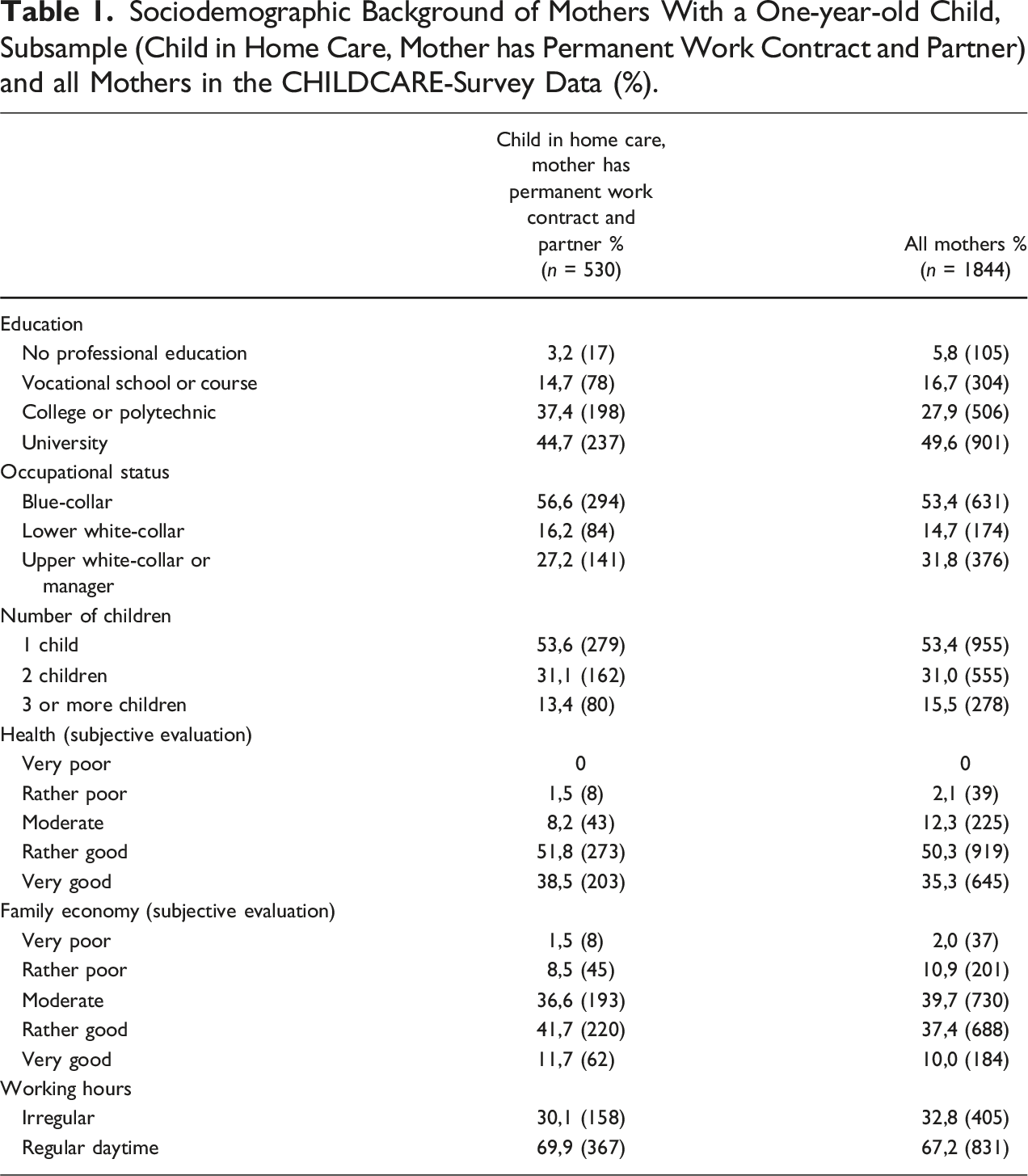
Sociodemographic Background of Mothers With a One-year-old Child, Subsample (Child in Home Care, Mother has Permanent Work Contract and Partner) and all Mothers in the CHILDCARE-Survey Data (%).
The data was analysed using the SPSS 25.0 -program. In the descriptive part, mothers’ justifications of child home care are reported using crosstabulations and means. The various justifications are then summarised based on a factor analysis. A logistic regression analysis is used to analyse the connections between the justifications of home care and socioeconomic background variables.
The question directed to those taking care of the one-year-old child at home, measuring the justifications of home care was ‘How important are the following aspects for the home care of your one-year-old child?’. There were altogether 27 different statements offered as justifications (see Hietamäki et al., 2017), and the respondent could reply about the importance for each of them. The options were ‘not at all important’, ‘somewhat important’, ‘very important’ and ‘does not apply to me’. For this analysis, we recoded the scale into three classes so that 0 = not at all important or does not apply to me; 1 = somewhat important and 2 = very important.
To reduce the large number of variables, a factor analysis was conducted. Variables with a communality value 0,3 or more in the factor analysis were chosen and sum variables based on means were computed. The values of the sum variables varied between 1 and 3. They were recoded into dichotomies to be used as dependent variables in a logistic regression analysis, with value 0 = not important (not at all important, does not apply to me; sum variable value 1) and value 1 = important (somewhat/very important, sum variable values between 1,01 – 3,00). The variable related to the quality of daycare that was not loaded in any factor was recoded in similar manner.
In the study, we analyse the connections of child home care justifications and sociodemographic background variables. These independent variables – the number of children, education, occupational status, working hours, family economy and health – were recoded into dichotomic variables. The number of children living in the family was coded 0 = one child, 1 = two or more children. For education, the value 0 = no professional education, vocational school, polytechnic and the value 1 = university. For occupational status the value 0 = blue-collar or lower white-collar employee and 1 = upper white-collar employee or manager. For working hours, the value 0 = shift work, evening, night, morning or weekend work, or other, and the value 1 = regular daytime work. The experienced family economy was coded as 0 = very bad, rather bad, moderate and the value 1 = rather good, very good. For the parents’ subjective health, the value 0 = very bad, rather bad, moderate and the value 1 = rather good, very good.
Results
Sociodemographic Background of Stay-at-Home Mothers
Previous studies have shown that mothers who use longer periods of the CHCA differ from mothers who return to work soon after parental leave (Lammi-Taskula, 2004; Närvi, 2017). Long child home care is more typical among mothers in blue-collar positions with less education, lower income level and also with more children. Many of these mothers do not have a job to return to: for example, in 2014 two thirds of mothers taking care of a two-year-old child at home did not have an employment contract (Pärnänen, 2014). Also among the respondents of the CHILDCARE-survey, child home care was most common among mothers with no professional training: four of five of them took care of the child at home while the proportion among highly educated mothers was three of five (Hietamäki et al., 2017).
In our sample of stay-at-home mothers who were married or cohabiting and had an employment contract nearly half had a university degree (Table 1). In comparison to all mothers in the survey data, they had more often a college or polytechnic degree. However, education level does not necessarily correspond to the professional status as more than half of the mothers said they were in a blue-collar position before the child was born while an ample fourth was in an upper white-collar position. Similarly to all mothers, more than half of those in the subsample had only one child. The subjective evaluation of health as well as family economy were somewhat better in the subsample than among all mothers: nine out of ten mothers experienced their health as rather or very good. More than half reported the family economy as rather or very good. Almost one third had working hours other than regular daytime, those in the subsample slightly less often than all mothers.
Justifications for Child Home Care
Next, we present the frequencies of various justifications among stay-at-home mothers for child home care (Figure 1). The justifications of home care related to the child as well as to the mother herself were among the most important for the mothers. Also justifications related to working life, normative ideals on motherhood, the spouse’s wish for child home care, and doubts about the quality of daycare were somewhat important. In comparison to a previous study among stay-at-home mothers with a two-year-old child in Finland (Närvi, 2017), the importance of these justifications was clearly higher among mothers in our study. Justifications for child home care among stay-at-home mothers of a one-year-old child (%, n = 503–511, mothers with a spouse and a work contract).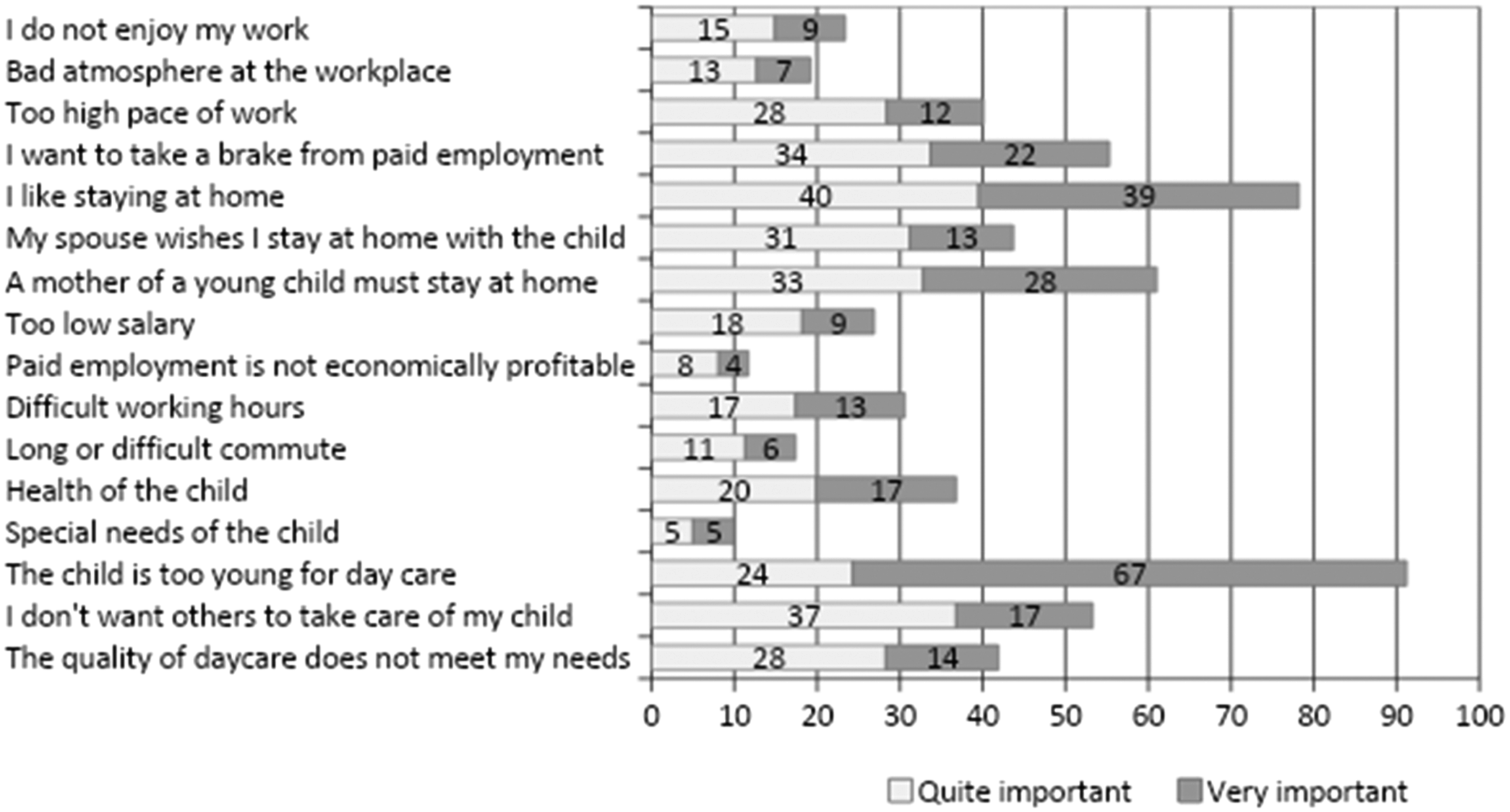
The most important justification of home care related to the child in question was their age: nine out of ten mothers said their one-year-old child was too young to start in day care outside the home. Four of five mothers also reported as an important justification that they enjoyed staying at home.
More than half of the mothers who were at home with their one-year-old child said they wanted to take a break from working life. Two of five reported the too high tempo of work and a third challenging working hours as important justifications for their childcare choice.
The normative ideal of mothers of young children staying at home was an important justification for more than half of the mothers taking care of a one-year-old child at home. Nearly half of the mothers reported the lacking quality of daycare as an important justification for taking care of the child at home. Two out of five mothers reported that the spouse’s wish for child home care as an important justification. The child’s health was reported as a justification for home care by a third of mothers.
Factor Analysis on Justifications of Child Home Care Among Stay-At-Home Mothers of Under-Two-Year-Children, With a Spouse and an Employment Contract.
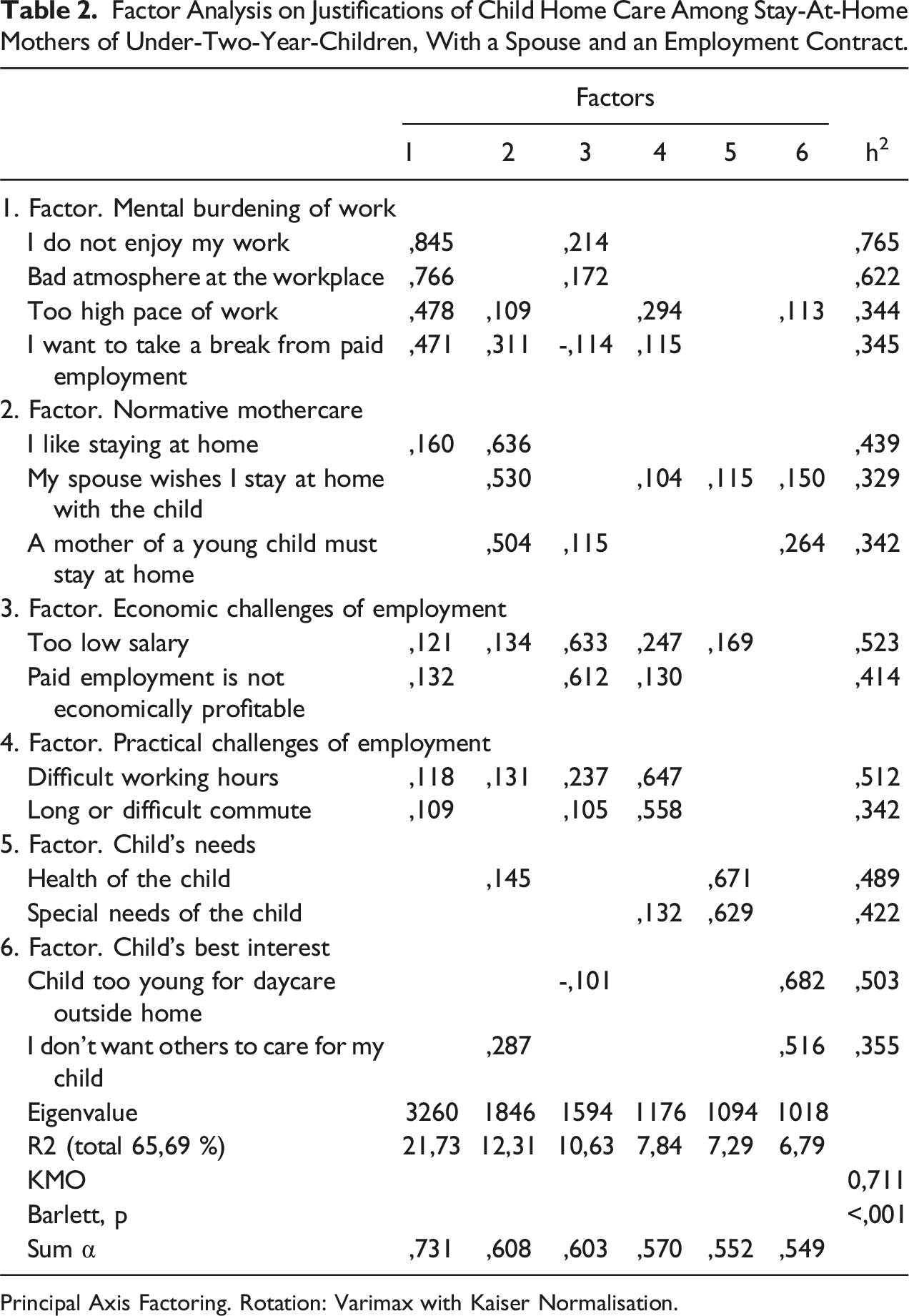
Principal Axis Factoring. Rotation: Varimax with Kaiser Normalisation.
Justifications of Child Home Care, Sum Variables (Mothers of One-Year-Old Child, With a Spouse and an Employment Contract).
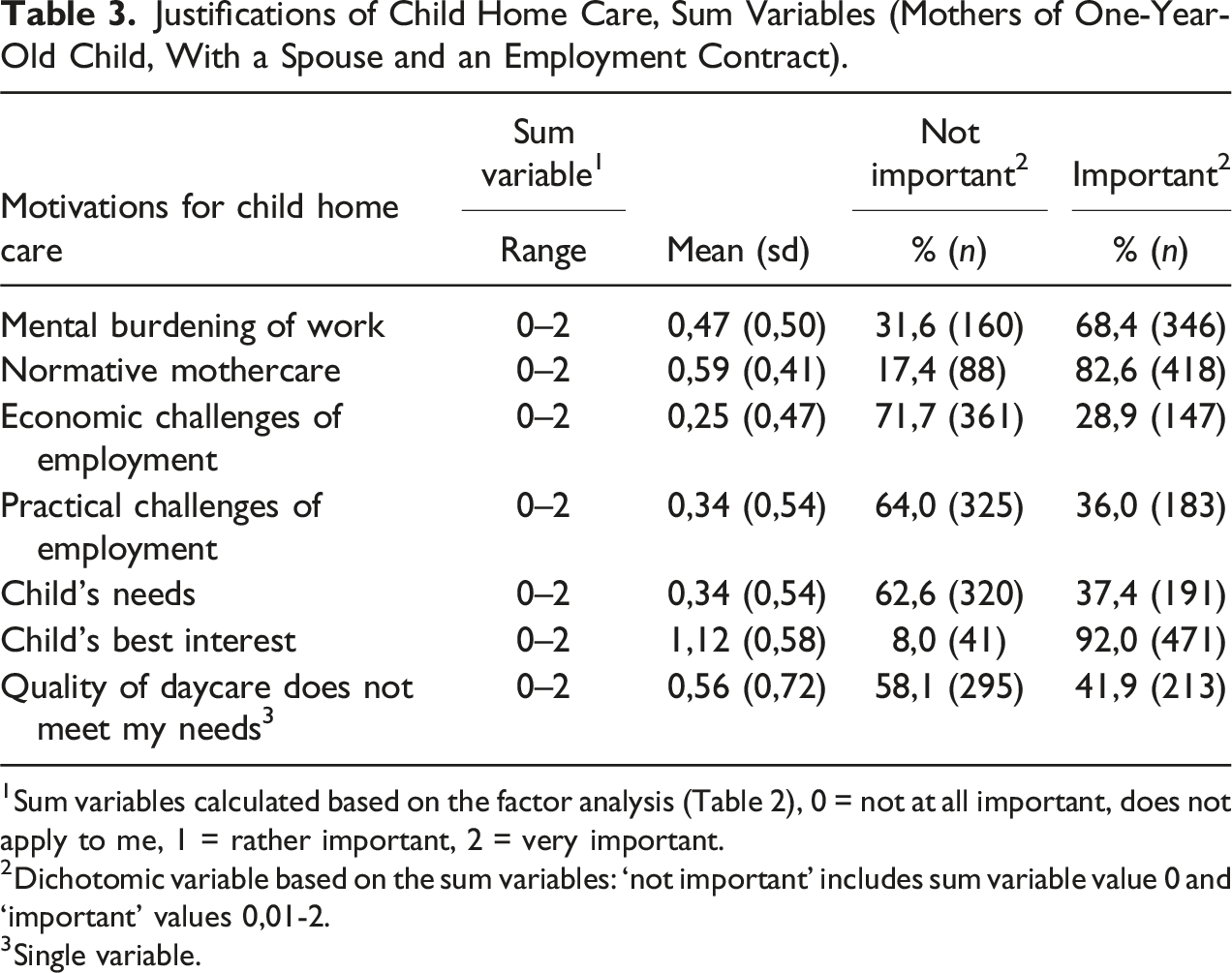
1Sum variables calculated based on the factor analysis (Table 2), 0 = not at all important, does not apply to me, 1 = rather important, 2 = very important.
2Dichotomic variable based on the sum variables: ‘not important’ includes sum variable value 0 and ‘important’ values 0,01-2.
3Single variable.
According to the frequencies, the normative motherhood ideal and the child’s best interest were important justifications for staying at home with the one-year-old child for a majority of the mothers. The mental burdening of work were important justifications for more than 60 per cent of mothers, and the economical unprofitability of paid employment for about one in three mothers. Three in five mothers reported the lack of quality of daycare and one third the health of the one-year-old child as an important justification for child home care.
Determinants of Justifications for Child Home Care Among Mothers of One-Year-Old Child (n = 478–483, Mothers With Spouse and Employment Contract).
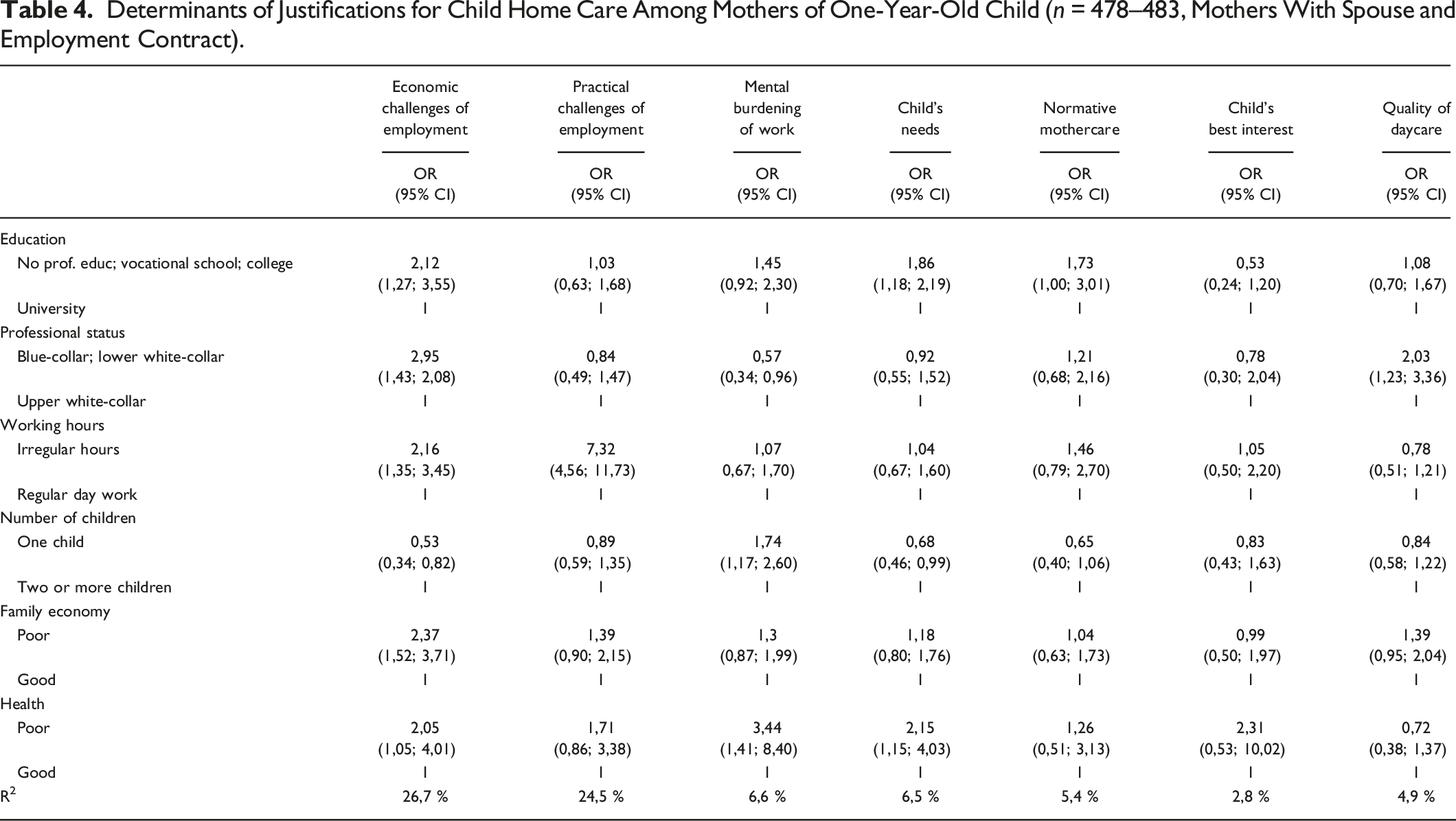
Of the six sum variables, the unprofitability of paid employment as a justification of home care of the one-year-old child was explained by the socioeconomic position, family structure, working life and the experienced health of the mother. Mothers with a lower education level, as well as those with a lower professional status, irregular working hours and problems with family economy were more likely to report the economic unprofitability of paid employment as a justification for child home care. This justification was more common also among mothers with a weaker health, and with more than two children in the family.
Mothers with shift work or other irregular working hours were more likely to report practical problems of work as important justifications for child home care.
The mental burdening of work as a justification for child home care was related to the mother’s professional status, as well as the number of children and own health. Mothers with an upper white-collar position, those with one child only, and those who experienced their health as less than good were more likely to report this justification. Mothers with lower education level, those with more than one child, and those with less than good health were more likely to report the child’s health as an important justification for home care.
The doubts related to the quality of daycare were more often reported as justifications among mothers employed in blue-collar or low white-collar positions. Mothers with a lower education level were more likely to report the normative motherhood ideal as an important justification. There was no significant variation according to any of the various background variables in reporting the child’s best interest as a justification for home care.
Discussion
Our analysis of justifications of child home care among mothers having a permanent work contract and possibility to share everyday childcare responsibilities with their partner showed socioeconomic disparities, thus confirming our expectations based on previous research on the use of the HCA.
Even among mothers with a possibility to choose between employment and longer leave, there is strong support for the normative ideal that mothers of young children should stay at home. More than half of mothers who stayed at home with their one-year-old child while having a job and a spouse, reported this ideal as being an important justification for their childcare choice. It was also quite common that this solution was supported by the spouse. As expected, there was variation according to socioeconomic position: the normative ideal was emphasised more often among those with a lower education level.
This result is in line with the observation of previous research concentrating on the populations of mothers of young children that child home care is widely understood as a mothers’ responsibility, perhaps even a natural choice. The share of fathers taking parental leave has slowly increased during the past decades (Lammi-Taskula, 2015; Saarikallio-Torp & Miettinen, 2020; Saarikallio-Torpp & Haataja, 2016), but it is still quite rare that a father takes a long leave from paid employment due to childcare, especially using the Child Home Care Allowance (Lammi-Taskula et al., 2017).
Almost half of the stay-at-home mothers in our subsample justified their solution with the doubts they had about the quality of ECEC services. Again we found socioeconomic differences. Mothers with a blue-collar or lower white-collar position were more likely to see this justification as important for their childcare choice. Also in this respect the results in our subsample – among mothers with a permanent work contract and a partner – were in line with the experiences of all mothers in the CHILDCARE-survey data (see Hietamäki et al., 2017). This is quite surprising as the public, high-quality early childhood education and care services have since the 1970’s played an important role in supporting mothers’ paid employment (Anttonen & Sipilä, 2000). Furthermore, several studies have shown that parents using these services are mainly very satisfied with the quality (Hietamäki et al., 2017; Kekkonen, 2014; Kronqvist et al., 2008; Repo, 2009).
Taking a break from working life was an important justification for more than half of mothers who took care of a one-year-old child at home while having the possibility to return to their job. Various reasons for this can be seen related to the nature of work. Two of five mothers reported that they chose child home care because of the stressful tempo of working life. For almost one third of mothers, difficult working hours were an important justification for staying at home with the child. The most likely group to report practical challenges related to paid employment as justifications for child home were mothers with non-typical working hours that included evening or night work.
The choice to stay at home with a one-year-old among mothers with a permanent work contract is thus closely connected to the mothers’ experiences of working life and can be seen as a solution for releasing the problems and burdens of reconciling paid work and family life. Previous research has also shown that children of parents doing shift work start later in daycare outside the home (Kekkonen et al., 2014). Many parents also experience their paid work as mentally burdening; this was an important justification for child home care for more than three of five mothers in our study. As expected, the socioeconomic differences were clear also in reporting this justification. Mothers in upper white-collar position were more likely to report the mental burdening of their work as a justification for staying at home with the one-year-old child. In addition, this justification was more common among those with only one child as well as with the subjective experience of less than good health.
Mothers of one-year-old children in our subsample justified child home care also with economic aspects. For some, paid employment was not economically profitable in their situation, taking into account income level, daycare fees and available social benefits. About one in three mothers reported this as an important justification for choosing child home care, with variation according to education, professional status, working hours and subjective health status. Mothers with lower education level, lower occupational status, or those experiencing challenges in family economy were more likely to report this justification as important, as well as those with working hours other than daytime work. Also mothers with less than good health, and those with more than one child found more often this justification as important for staying at home with the child.
There was one exception to the socioeconomic disparities in justifications: with little variation according to any of the background variables, almost all mothers in our subsample agreed that an important motivation to use the Child Home Care Allowance after parental leave was that a one-year-old child was too young to start in daycare outside the home. A majority of children in Finland are indeed in home care for at least some months after the parental leave period. Parents of young children think 18–24 months is a suitable age for a child to start in daycare (Miettinen & Saarikallio-Torp, 2020; Salmi et al., 2009).
The popularity of the Child Home Care Allowance points to its role as a relevant benefit to lengthen parenting leave not only for mothers who have a precarious position in the labour market, but also for those who have a valid work contract. Despite the Finnish family policy measures supporting gender equality and promoting caring fatherhood in Finland, leave take-up and home care of small children is still a highly gendered practice where mothers bear the main responsibility for unpaid care work. Mothers with a permanent work contract and a spouse who can share childcare responsibilities have more capabilities to choose between paid employment and parenting leave, but even these mothers rely largely on child home care options, especially if they have middle-level education and occupational position that do not provide a high income. Thus, public support for long child home care can be seen as an equality paradox in relation to gender equality but also regarding social inclusion and equality of children in a society that gives increasing weight to children’s right to early childhood education (Enroos et al., 2021; Strandell, 2012). Measures are needed that promote more equal sharing of unpaid childcare work among parents; support the reconciliation of paid employment and care responsibilities for all parents; as well as secure the equal possibilities of all children to participate in early education.
Since the data for this study was collected, a parental leave reform has entered into force in Finland (Närvi et al., 2023). In 2022 the number of parental leave days with an income-related benefit was increased and there is also more flexibility for parents to take leave. The aim of the reform was to increase gender equality as well as to take family diversity better into account. The reform may also influence the take-up of the Child Home Care Allowance, but that kind of information is not yet available.
Footnotes
Declaration of Conflicting Interests
The author(s) declared no potential conflicts of interest with respect to the research, authorship, and/or publication of this article.
Funding
The author(s) disclosed receipt of the following financial support for the research, authorship, and/or publication of this article: Funded by the Strategic Research Council (SRC), the Academy of Finland, decision numbers: 293049, 314317 and 345130.
