




Abstract
Family scholars examining time spent on children's care focus heavily on mothers’ allocations to a specific sphere of active caregiving activities. But children's needs for care and supervision involve connection to others; and many others beyond mothers can and do provide care, especially as children grow. Using a “linked lives” approach that centers relationality, we show how time diaries can illuminate children's time spent in “socially connected” care. Using recent (2014–2019) time diary data from the American and the United Kingdom Time Use Surveys, we examine mothers', children's, and teenagers' days to assess two forms of connected care time. First, results show that in addition to childcare time as traditionally measured by time use studies, mothers spend considerable further time providing connected care through social and community time in which children are included, religious activities with their children present, and mealtime with children. Second, looking from the child's perspective also underscores time in the larger “village” of carers within which children and youth are embedded. Fully two-thirds of 8–14-year-olds' and three-quarters of 15–17-year-olds’ waking time is not with mothers—it is spent alone or in social connection to fathers, extended family, teachers, neighbors, and friends. A “linked lives” approach shifts attention to assessing care time in diverse activities with others and to measuring mothers’ and children's time in social connections within the larger world. This analytic frame also moves away from maternal determinism to highlight the contours of children's care and social time occurring within the community at large, as well as the roles and responsibilities of those outside of the mother–child dyad across the child's early life course.
Introduction
How much care time do children receive, from whom, and how has it changed over recent decades? Much time use research attempting to answer these questions by assessing care centers on mothers’ time spent on a narrow sphere of activities termed “childcare.” Scholars focus on gender inequalities in childcare time as well as trends and class convergence in these investments (e.g. Bianchi et al., 2006; Dotti Sani and Treas, 2016; Schneider et al., 2018). The amount of time mothers spend directly caring for children—their time in physical care, and the reading to, helping and teaching of (usually younger) children—is significant and important. Yet children require and receive significant time from other adults outside the mother–child dyad, especially as they grow in their communities. The time children spend in larger social worlds of care also provides valuable learning and socialization vital for development. When mothers and their children are understood as part of the larger communities in which they live (Elder, 1999; Folbre et al., 2005), conceptualizing and measuring time spent caregiving for children can be expanded (Folbre, 2022).
We argue for moving beyond traditional measures of childcare time to also assess a more expansive notion of care time in social connection with others. We build from a “linked lives” perspective (Carr, 2018; Elder, 1999)—that is, mothers' and children's interdependence in the broader community through which children are influenced as they grow across the life course (Christopher, 2012; Dow, 2016a, 2016b). First, this entails accounting for the socially connected care mothers engage in—time in mothers’ communal and social activities that include their children. Time that children spend with these others, including extended family, neighbors and community members, may be related to healthy child development through deep and/or wide connections forged between children and those around them (Coleman, 1988; Oliveira et al., 2023). Understanding care as a mother's time with her children in the village of others can shift scholars' understanding from a dyadic approach toward a rich set of relations and activities that may be especially important as children grow beyond the very early life course (Fletcher et al., 2000).
The idea of linked lives as children grow also leads to the assessment of a second aspect: time spent in socially connected care. Moving beyond mothers and the nuclear family itself is an important way to understand the care children receive in the broadest sense (Christopher, 2012; Waldfogel, 2016), as it occurs in the larger social context. It suggests we can learn about the time that children spend with other important family and community members when mothers are not present. Children spend time with many others in educational, community, and other social settings, and do not act only as a receiver of care or learning from their individual mother (Folbre et al., 2005). The time that children are being cared for, taught, led, and supervised by others besides mothers or ouside of the nuclear family is underacknowledged. This wider perspective is an important way to measure and value the time investments of the extended family (Folbre et al., 2005) as well as educators, daycare workers, and community members (Waldfogel, 2016). Much learning and support as well as supervision (i.e. care) comes through children's time in activities with these other adults. The need for connected care was urgently highlighted by the coronavirus disease 2019 (COVID-19) pandemic lockdowns, as parents, largely mothers, reeled from losing the time their children had spent in connected care, with teachers, grandparents, neighbors and others (Milkie, 2020; Montazer et al., 2022).
In this article, we argue that using this expansive understanding of care grounded in the concept of linked lives can extend knowledge about the additional time dedicated to caregiving in a broader sense. We highlight what scholars can learn through an empirical focus using time diary data to measure this socially connected care time. We focus on two ways to extend the measurement of these worlds of care. First, we assess the time that mothers spend engaged in activities that provide communal and social time when their children are present; notably, key others who support children as they grow may also be present. Second, we examine time and care from children's perspective, across activities where others in children's care communities are present, but not mothers are not. Using recent (2014–2019) data from the American Time Use Survey (ATUS) and the United Kingdom Time Use Survey (UKTUS), we provide examples to support these concepts. Disregarding children's lives and the diversity of adults with whom the younger generation spends time and forges connections may unintentionally reify a “parental determinism,” which suggests mothers or parents are the only ones responsible for children's wellbeing (Cross et al., 2022; Faircloth, 2014). By centering care time in the larger community of others from both mothers’ and children's perspectives, the analysis makes the case for an accounting of socially connected time as care using the rich and detailed measures available in time use surveys.
Worlds of care: Ways of assessing care time and children's social connection to others
The idea of linked lives comes from a life course approach (Elder, 1999) and is vital to expanding our understanding and measurement of care. Linked lives is a term that illuminates the importance of grounding individuals in their larger networks and acknowledges the influences of others in one's own trajectories. Mothers and fathers exist in these networks; indeed, how they tie children to these networks is vital for children's social capital, as well as children's senses of mattering to the larger community (Coleman, 1988; Hunter et al., 2018; Rosenberg and McCoullough, 1981). Children, especially as they grow, forge new and important ties outside their mothers and nuclear families, including with other relatives, teachers, peers, and other adults like coaches and neighbors. In many racialized communities, these others are known as vital in acting as “the village” of others raising children (Dow, 2016a, 2016b). And as became evident in the COVID-19 pandemic, these ties are important both as networks of others providing meaning, information, and mattering and also as networks of basic care and/or supervision when outside the purview of parents (Calarco et al., 2020; Milkie, 2020).
Though children can be cared for in a diversity of ways and by a diversity of others, a primary focus of scholars who use time diary data is on a narrow sphere of activities classified as “childcare” time, which includes parents directly and actively caring for children—such as feeding and bathing, and reading to, helping, teaching, or playing with children (Altintas, 2016; Cha and Park, 2021; Dotti Sani and Treas, 2016; Kalil et al., 2012). These activities of care are typical and central when children are very young, but less so when children are older (Milkie et al., 2021; Wray et al., 2021). Parents enjoy interactive forms of direct care (Dotti Sani, 2021), although notably studies show that other types of parent–child time together like meals and in leisure are rated highly by parents as well (Milkie et al., 2021; Musick et al., 2016). Thus, although the focus on this common measure of “downward” childcare time is important, it is only one way to assess care, which can also be understood as “outward” (Doucet, 2022; Folbre, 2022).
Many scholars using time diary data have pointed to the importance of pushing beyond these narrower, more standard ways to measure childcare. For example, there are a variety of other forms of care that are supervisory or involve being “on-call” (Budig and Folbre, 2004; Craig and Mullan, 2012; Folbre et al., 2005; Folbre, 2022). Parent–child interaction and togetherness happens not only in direct childcare, but also in co-present time together (Bianchi et al., 2006; Wray et al., 2021). In addition, scholars point to the limits of measuring care time narrowly, advocating for the assessment of the broader responsibilities of care work (Doucet, 2015, 2022; Folbre et al., 2005; Folbre, 2021, 2022).
Ultimately, expansive notions of care that go beyond measures of mothers’ time in childcare activities are crucial, particularly for integrating broader networks of “linked lives” into understandings of care. Using only narrower measures of childcare activities may understate the complex reality of care for children, with consequences for scholarly understanding (Folbre and Yoon, 2007) and public discourse on inequalities, such as gender inequalities (Folbre, 2021). Taking a life course, linked lives approach allows us to learn more from recognizing the socially connected care worlds that mothers and their children are embedded within. This can be understood and measured in at least two ways, as described below.
Mothers’ time in the socially connected care of children
The idea of “linked lives” in life course research (Elder, 1999) emphasizes the vitality of assessing children as they are socially connected to others, with mothers and in ecological contexts that go beyond just their mothers. A linked lives approach emphasizes the social networks that help raise children in the larger community. Understanding social connection as a form of care was emphasized by Coleman (1988), who saw the building of social capital in and through families as a vital way in which children became successful in the larger world (Doucet, 2001; Hagan et al., 1996; Hunter et al., 2018).
Examining measures of childcare employed in research using time diaries understates this type of connection and linked lives. We suggest that looking at socially connected care activities can lend insight into this type of community-based care and the building of social capital. Socially connected care involves time where mothers introduce and embed children into larger social communities, when interacting or present with children. This type of care may be particularly important for racialized parents, who may define care in a more social way that underscores child development and value-sharing during time together outside of direct “intensive” childcare (Christopher, 2012; Dow, 2016a, 2016b; Nomaguchi et al., 2022). We point to three potential socially connected care activities in time diaries: time in mothers’ own social and community time where children are included, time in religious activities that include children, and time in meals together.
First, as highlighted by Coleman (1988) as potentially developing valuable social capital across the child's early life course, is time when mothers socialize with friends or extended family and spend time in civic engagement. Mothers often bring children along to such as conversations with neighbors and friends or include them in time in community volunteering or civic life. This provides important kinds of socialization and connection for children that help to shape their sense of mattering to others (Rosenberg and McCoullogh, 1981), their understandings of their futures by socializing into future family and work roles (Hunter et al., 2018), and their place in the larger community. Mothers, fathers, and others supervise children and build support for them through conversation with others as they strengthen ties to adults and children in the extended family and larger community (Hagan et al., 1996; Hunter et al., 2018; Jespersen et al., 2021).
A second form of socially connected care is mothers’ time in religious activities with their children. This may be small in terms of minutes of mother–child time, similar to a “developmental” activity like reading together. Despite this, it can be an important sphere of mothers’ activities in which children are also included. Religious activities may be especially important in linking children to a community of others who can support them and provide a sense of belonging and mattering beyond the family (Hunter et al., 2018; Nomaguchi et al., 2022). For example, Dow (2016a) points to how some middle-class African-American mothers integrate their care for children into their church communities by seeking out childcare through these networks.
Finally, mealtime as socially connected care may be important to understand in the bonding and conversations that support the child's future, and in linking the child with resources and other supports. Time diaries often code the time mothers eat with children not as childcare but as mothers’ personal care time. Yet, a mother eating with a child means more than her consuming calories in front of her child. Meals are often revered by scholars and by parents themselves as vital—not only for nourishment to the physical body but also for building children's sense of family and providing children with an understanding of parental and cultural values (Fiese and Schwartz, 2008; Larson et al., 2006). Meals serve as a regular, more structured locus of family interactions, where mothers, children, siblings, fathers, and sometimes extended family or friends, get together (Craig and Mullan, 2012; Kremer-Sadlik and Paugh, 2007; Offer, 2013). Even when mothers and children eating together do not have others with them, at least for school-aged and older children, it is a time when the two may reflect upon their connections to activities out in the community. Mealtimes are thus a potent potential source of helping children build bonds in family and community, as well as helping and teaching them and providing values related to their future. Despite this, mothers eating meals with children are generally not coded in time diaries as “helping” or “teaching” childcare activities. As a result, focusing only on more traditional childcare may miss additional sources of socially connected care that can build belongingness and social ties central to children's mental health (Ackert and Wikle, 2021; Alvarez et al., 2017).
Children's social connections to others beyond mothers
A life course perspective also points to centering children as they grow and are actively part of relationships with extended family, friends, and communities. Often missing from scholarly work using time diaries to measure care is the point of view of the most powerless in society—children (Folbre et al., 2005). A life course approach encourages scholars to assess and understand time at all stages of the life course. For school-aged children and youth, most of their waking time is likely spent in activities outside of mothers’ purview. Indeed, their time with others may provide mothers and fathers with valuable social integration (Nomaguchi and Milkie, 2020). Examining with whom young people spend their time allows us to know more about children's lives in their own right. Rather than focusing on “what parents do” or “what children receive from adults” the key question becomes: “what do children do?” (Cano and Gracia, 2022) and who are they with during their daily lives? Their own ties extend beyond mothers, who of course are important and central, and can be used to reflect not only the care they receive but their “linked lives” within their families and communities.
Moreover, measurement from a child or teenager's perspective focuses attention on the needs for care and supervision outside of the mother–child dyad. Putting children at the center helps us move beyond the maternal focus, which is necessarily individualistic and undercounts the needed inputs from fathers, extended families, teachers, care providers and communities to provide care and time with children for their development through adulthood. The COVID-19 pandemic became a care crisis when the others with whom children are connected for care and supervision became unavailable; these others with whom children spend their days beyond the mother–child dyad are vital to acknowledge and learn more about (Milkie, 2020). Understanding how children are raised in relation to the “village” presents a more nuanced, broader understanding of care time (Dow, 2016b). Indeed, such a singular focus on mothers’ (and sometimes fathers’) childcare time risks reifying a type of parental determinism (Faircloth, 2014) in which parents, particularly mothers, are presumed to be the only ones responsible for children's care and wellbeing.
Looking from children's perspectives sheds light on their own lived experiences and socially connected care worlds that are obscured when scholars only examine adults’ time diaries. Previous time use research has used children's diaries to understand a variety of issues. For example, considering time investments from the child's point of view helps assess the fuller networks of those who provide care, particularly from outside the household (Folbre et al., 2005; Kalil et al., 2014), and how these care networks may change over time (Cano and Gracia, 2022). Considering children's point of view can also illuminate how differently they may perceive their worlds compared to parents (Milkie et al., 2021; Wikle and Hoagland, 2020). Finally, looking at children's diaries also maps out how their daily lives unfold and how this time use changes from a life course perspective as children become adolescents (Gracia et al., 2020, 2022; Hilbrecht et al., 2008; Zuzanek et al., 2018). Time diaries, then, can yield a rich source of understanding about who children are connected to or cared for by, other than their mothers; how much time they spend in relation to various others; and in which activities they are commonly engaged with these important others.
Current study and research questions
In this study, we take a life course approach and draw on the insights of “linked lives” to explore the potential richness of time diaries and the concept of socially connected care. We follow other time use scholars who have added nuance to and developed complexity in how time diaries can be used to measure care time, especially care for children. This study focuses on how children are socially connected both with and beyond mothers in the larger world. We ask two research questions. (1) How much time do mothers spend with children beyond “childcare” activities in “socially connected” care time—defined in this study as mothers’ time in social and community activities, religious activities, and mealtimes with their children present? This adds to our understanding of how mothers actively embed children in larger networks, especially in types of time where mothers can transmit values to children. (2) From school-aged children and teenagers’ perspectives, how much time do they spend with mothers versus connected to important others in their day-to-day lives? Examining children's and youths’ diaries provides a different view of care—of the time spent in learning and development with others—that children experience beyond the mother–child dyad.
Data and methods
This paper draws on data from two sources. First, we use five recent years of annual surveys (2015–2019) 1 of the ATUS (Hofferth et al., 2020), a nationally representative sample of Americans aged 15 and older. One individual per household reports information on what they were doing over a 24-h period of time starting at 4:00 a.m. on the specified interview day. Information collected includes what the respondent was doing (the primary activity) and contextual information about their time use (including the location, time, and duration, as well as who was with them during each activity).
Second, we use the most recent data (2014–2015) from the UKTUS, 2 a nationally representative survey of British households. Unlike the ATUS, which is collected at the individual level, the UKTUS is conducted at the household level. The UKTUS collects two-time diaries (one weekday and one weekend) from each household member aged 8 years old and older. This lower age limit is critical to our understanding of care from children's daily lives. 3 Each respondent (or their proxy) reports information on what they were doing over a 24-h period of time in 10-min intervals starting at 4 am. Information collected includes what the respondent was doing (the primary activity), secondary activities, and contextual information about their time use (including the location, time, and duration, as well as who was with them during each activity).
Analytic sample
To answer the research questions, we use three separate samples from these data. Data from the 2015 to 2019 ATUS are used to examine the first question regarding mothers’ reports of time in socially connected care with children and in traditional measures of childcare time. The analytic sample includes mothers with at least one child under age 18 (N = 9332). Mothers are compared by the age of their youngest child: 0–7 years old (N = 5330), 8–14 years old (N = 3146), and 15–17 years old (N = 856). 4
The ATUS and the UKTUS are used to examine children's and teenager reports of time. As previously stated, diaries are only collected from respondents 15 or older in the ATUS, but the UKTUS collects diaries from respondents as young as 8 years old. From 2014–2015 UKTUS data, we look at respondents aged 8–14 years old, with an analytic sample of 1575 diary days (789 respondents). From the 2015–2019 ATUS, we look at respondents ages 15–17 years old (N = 1556). 5
Measures
This study operationalizes connected care using time diaries, which provide a detailed accounting of the primary activities that respondents did as well as who else was present during those activities. We consider two perspectives on this socially connected care: First, from adults' perspectives, we examine mothers’ time with children; second, from children's perspectives, we assess children's time with others across their days.
Co-presence of others
In both the ATUS and UKTUS, respondents are asked to report “with whom” they were during their activities. Respondents may report being alone or may report multiple people present at once. In the UKTUS, respondents are asked, “Were you alone or with somebody you know?” In the ATUS, respondents are asked “Who was in the room with you?” (at home) or “Who accompanied you?” (when an activity was presumed outside of the home by the interviewer). 6
The categories of “with whom” also differ between the two surveys. In the UKTUS, respondents could report the following people as present: none (alone), mother(s), father(s), child(ren) under 8 years old, other household persons (including household children 8 years or older), or other non-household persons (including non-household children 8 years or older) (Centre for Time Use Research, 2016). In the ATUS, a more detailed list of categories was collapsed into the following categories: none (alone), mother(s), father(s), sibling(s), relative(s), friend(s), and other. The “other” category includes neighbors, acquaintances, coworkers, roommates, boarders, other non-relatives, other non-household children under 18, other non-household adults 18 and older, and categories that are likely not applicable to teenagers (e.g. own child, grandchild, foster child). In both surveys, respondents may also report neither being alone nor anyone co-present, leading to “no code recorded.” 7
Mothers’ time with children
With time diaries, we assess two forms of care. Based on a linked lives approach, we examine mothers’ time in socially connected care time to include time when children are reported as present in three types of mothers’ primary activities: (1) social and community activities (e.g. socializing with friends or neighbors, hosting or attending gatherings, volunteering, attending organizational events), (2) mothers’ religious activities (e.g. attending religious services, religious education), and (3) mothers’ mealtime (e.g. meals or snacks at home or elsewhere). As a comparison, we show traditional measures of childcare time, which includes time in primary activities defined as childcare by the ATUS, where respondents are directly interacting with, helping, or caring for children under the age of 18. We distinguish between “developmental” and “routine” activities, as is common in the literature in mother–child time using time diary data. 8 “Developmental” childcare activities include reading to, playing with, and talking to children, education-related activities with and for children, and organization and planning (Cha and Park, 2021). Routine childcare activities include basic or physical care, such as feeding, bathing, putting to sleep, or emotional or medical care. In time diaries, these socially connected care time and childcare are mutually exclusive. It is important to note that in all measures of care (including traditional childcare activities), others beyond the mother-child dyad may be present.
To measure socially connected care time from children's and teenagers’ perspectives, we examine relationships across their day. Children's and teenagers’ waking time alone and with others includes any time when children are not sleeping or doing personal care (e.g. grooming, medical care) as primary activities (as the presence of others is not consistently reported in sleep or personal care). We show daily minutes of waking time alone, as well as the percentage of waking time with others out of children's total waking time on the diary day.
To provide more detail into children's lives with others, we further disaggregate this “waking time” into four different activity categories that make up a significant part of children's days: (a) meals; (b) education (e.g. school, homework, extracurriculars, and other related activities); (c) leisure (e.g. active leisure such as sports, hobbies, or playing; or passive leisure such as computer use, TV-watching, or reading); and (d) work (e.g. unpaid work in housework and shopping; care work for other children 9 or adults; or paid work). The co-presence of others likely varies significantly across these activities. Examining them separately lends insights into how socially connected care is arranged across children's lives, including how mothers’ and other people's co-presence in daily life changes across childhood and youth.
Analytic strategy
In this paper, we present a descriptive analysis on the daily minutes that mothers and children spend in different types of activities and with different people.
For the first research question on the amount of time mothers spend caring for their children through socially connected care versus traditional measures of childcare, we do the following. Using time diaries from the ATUS (2015–2019) from mothers, we show two different non-overlapping measures of their time with children in socially connected care and childcare activities. First, the participation rate is the percentage of mothers who reported at least one daily minute in this primary activity when their child was present. Second, we report the mean daily minutes in these activities for all mothers (including those mothers who reported zero minutes in the activity category). We show the differences by the age of the youngest child to demonstrate how mothers’ time with children changes across different stages of childhood. Age ranges of children (0–7 years old, 8–14 years old, and 15–17 years old) were constructed to mirror available data on children's time diaries (i.e. the UKTUS only measures time for children 8 and over, and the ATUS for youth 15 or older).
For the second research question about how much time children spend socially connected to others versus mothers in their daily lives, we do the following. Using time diaries from children, we show how 8–14-year-olds (UKTUS) and 15-to-17-year-olds (ATUS) 10 , respectively, spend time with others. We present their mean daily hours in waking time with different categories of others co-present (including children who reported zero time with these categories of others), as well as the percentage of all waking time where these persons were reported co-present. We then show how 8–14-year-olds and 15–17-year-olds, respectively, spend time with others across their own primary activities in four broad categories. In these activity categories, we only include children whose diaries indicate at least one daily minute in this activity, as the number of children's diaries indicating zero minutes is otherwise too high. Thus, these analyses show how children who participate in these activities (leisure, meals, education, and work) spend this time with others, in mean daily minutes as well as the percentage of waking time.
Results I: Mothers’ time with children in socially connected care and traditional childcare
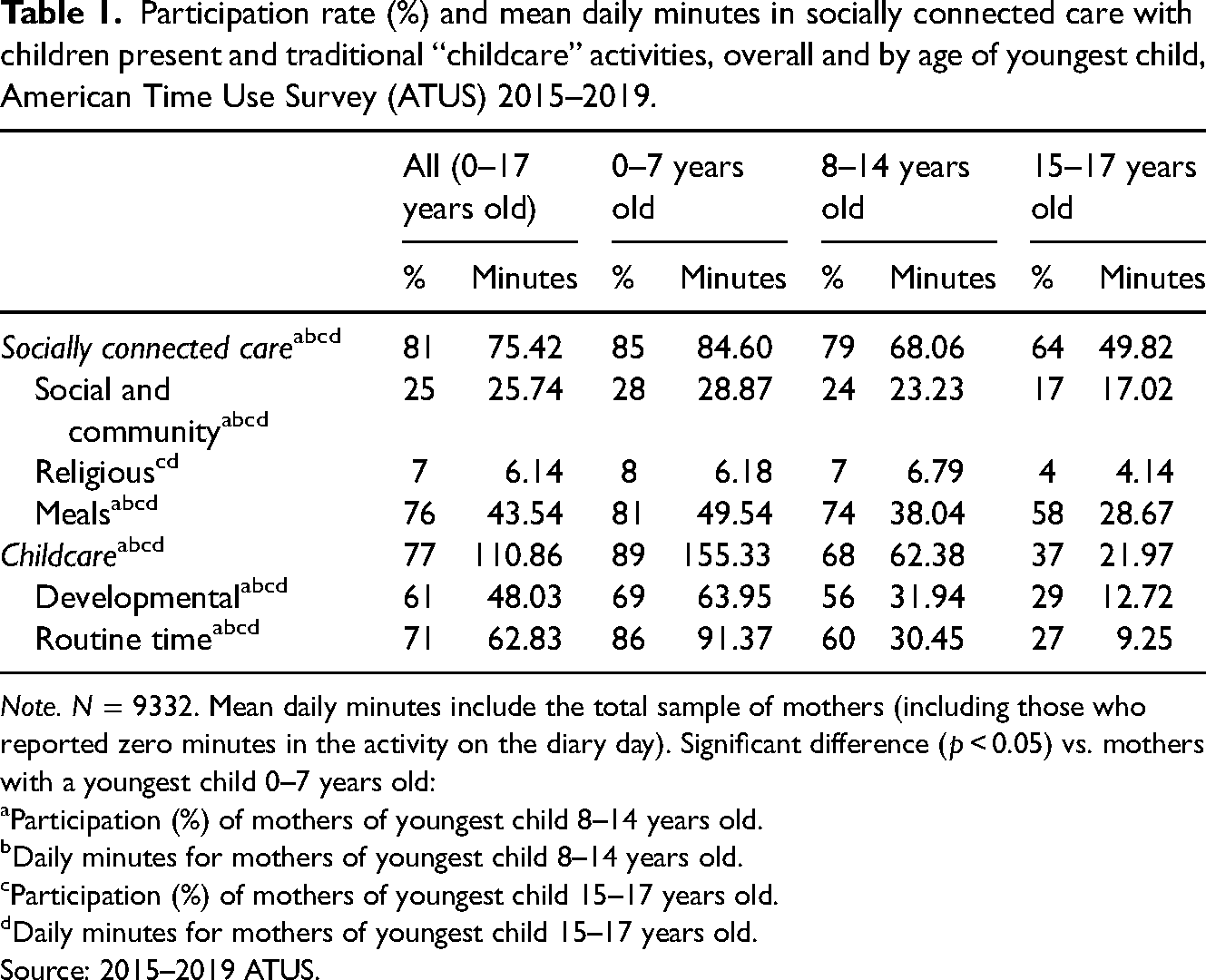
From the perspective of mothers’ time diaries, our understanding of care can be enriched by examining socially connected care. This is a vital form of care in which mothers connect children to the broader social world. This type of care as defined in this study includes three key types of activities where mothers report being present with children: social and community time, religious time, and meals. Comparing this to childcare time—the more traditional measure used in studies looking at time use data—can illuminate one form of additional time we may be missing in mothers’ care for children. Table 1 presents the percentage (%) of mothers who report doing this activity with children present on the diary day and the number of average daily minutes for all mothers (including those who did not report the activity). We provide results by the age of the youngest child to highlight how mothers’ time shifts over the life course of childhood.
Participation rate (%) and mean daily minutes in socially connected care with children present and traditional “childcare” activities, overall and by age of youngest child, American Time Use Survey (ATUS) 2015–2019.
Note. N = 9332. Mean daily minutes include the total sample of mothers (including those who reported zero minutes in the activity on the diary day). Significant difference (p < 0.05) vs. mothers with a youngest child 0–7 years old:
Participation (%) of mothers of youngest child 8–14 years old.
Daily minutes for mothers of youngest child 8–14 years old.
Participation (%) of mothers of youngest child 15–17 years old.
Daily minutes for mothers of youngest child 15–17 years old.
Source: 2015–2019 ATUS.
Table 1 shows clearly that socially connected care time makes up a significant, under-acknowledged part of mothers’ time with children. Over three-quarters of mothers—about 81%—spend at least some time in socially connected care with children on the diary day across age groups. This is especially true of mothers of the youngest children, with 85% of mothers reporting some form of this care; and stays high among mothers with older children (79%) and youth (64%). Mothers spend more than an hour in socially connected care per day with younger children and 50 min with teenagers 15–17 years old. Mothers report more time in childcare with their 0–7-year-olds than socially connected care time (155 versus 85 daily min). However, time in socially connected care and childcare are the same in middle childhood (68 and 62 daily min for 8–14-year-olds). For mothers whose youngest child is an adolescent, the pattern is very different from those with younger children: these mothers report 50 min in socially connected care with their teen present compared to only 22 min of the standard “childcare” activities. Most of mothers’ socially connected care time is spent in meals with their children—about 50 min per day on average when they have a youngest child aged 0–7 years old, 38 min per day for a youngest child 8–14 years old, and 29 min for 15–17 years old. For children aged 8–17, spending time in meals accounts for more of mother–child time than time in the often-reported “developmental” childcare activities. In sum, altogether, mothers are doing about double the amount of care for their children that scholars have attributed to them using only traditional childcare activities. Although this does not capture by any means all the time mothers are with children or supervising them in total, this broader scope does show another common form of active and social care mothers provide.
Results II: Children's worlds of care through time with others
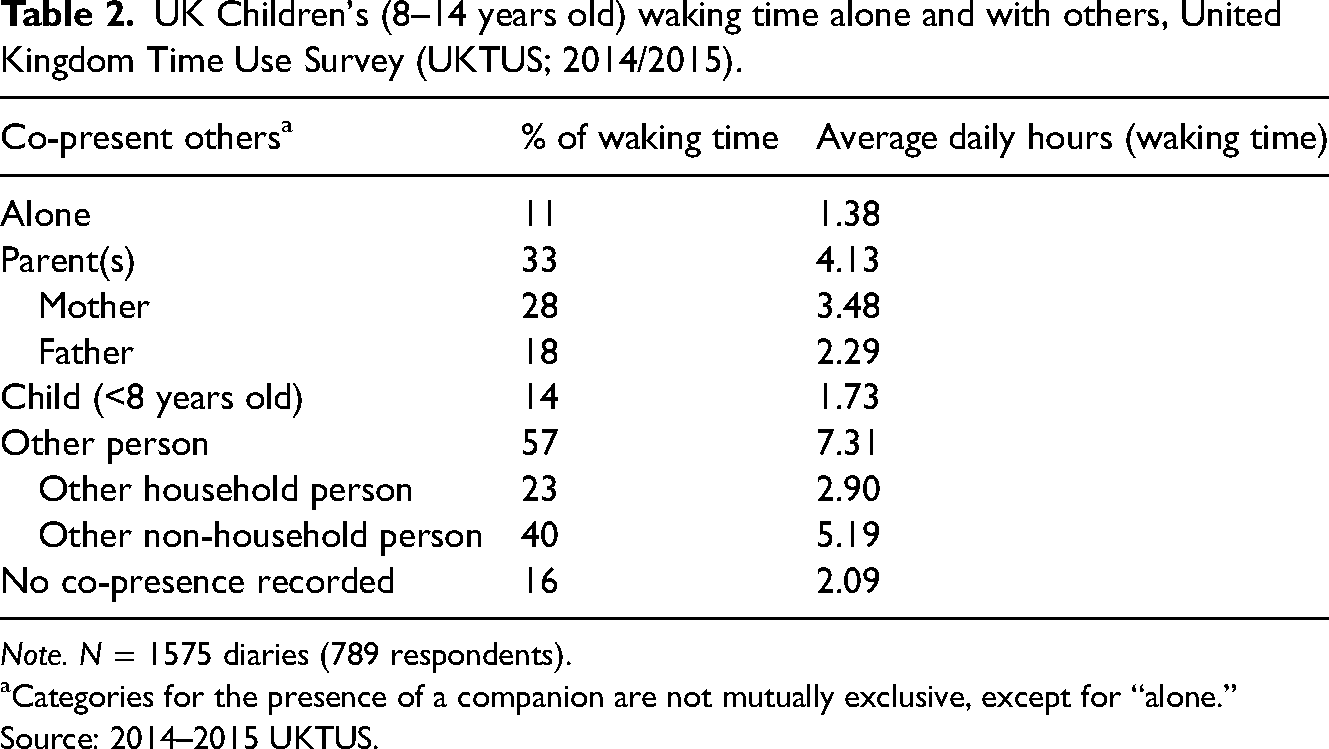
To further broaden notions of children's connected care and to decenter the mother–child dyad perspective, we turn to children's own time diaries to investigate with whom they spend their time. We also assess what types of time they spend with parents compared to important others. Table 2 shows with whom UK school-aged children (ages 8–14 years old) spend their waking time (i.e. any time not including sleep or personal care) The first column (% of waking time) shows the proportion of children's time spent co-present with others, and the second column shows the number of average daily hours (even if children's diaries indicate zero minutes co-present with others in that category). As multiple people can be reported as co-present in an activity, the percentages are not mutually exclusive and thus the totals of the column do not add up to 100% or one day of waking time.
UK Children's (8–14 years old) waking time alone and with others, United Kingdom Time Use Survey (UKTUS; 2014/2015).
Note. N = 1575 diaries (789 respondents).
Categories for the presence of a companion are not mutually exclusive, except for “alone.”
Source: 2014–2015 UKTUS.
According to Table 2, UK school-aged children spend relatively little time alone—only about 1.4 h per day, representing 11% of their waking time. The vast majority, about 89% of their waking time, is spent with mothers and important others. They spend a good part of their waking time with mothers—about 3.5 h per day, or about 28% of their waking time. Even so, this means that for more than two-thirds of school-aged children's waking time, mothers are not reported as present in children's diaries. Instead, children spend a significant amount of their waking time with other non-household persons: 5.2 h of waking time per day on average, or about 40% of their total waking time. Children's diaries thus indicate significantly more time in the waking day with others than mothers. This wide-ranging category of “other non-household persons” might include other children such as friends and classmates, or other adults such as teachers, coaches, mentors, non-household family, and so on. The UKTUS, unfortunately, does not provide more granularity in this category, but the dominance of this co-presence with “important others” unveils the importance of looking beyond just time with mothers or parents.
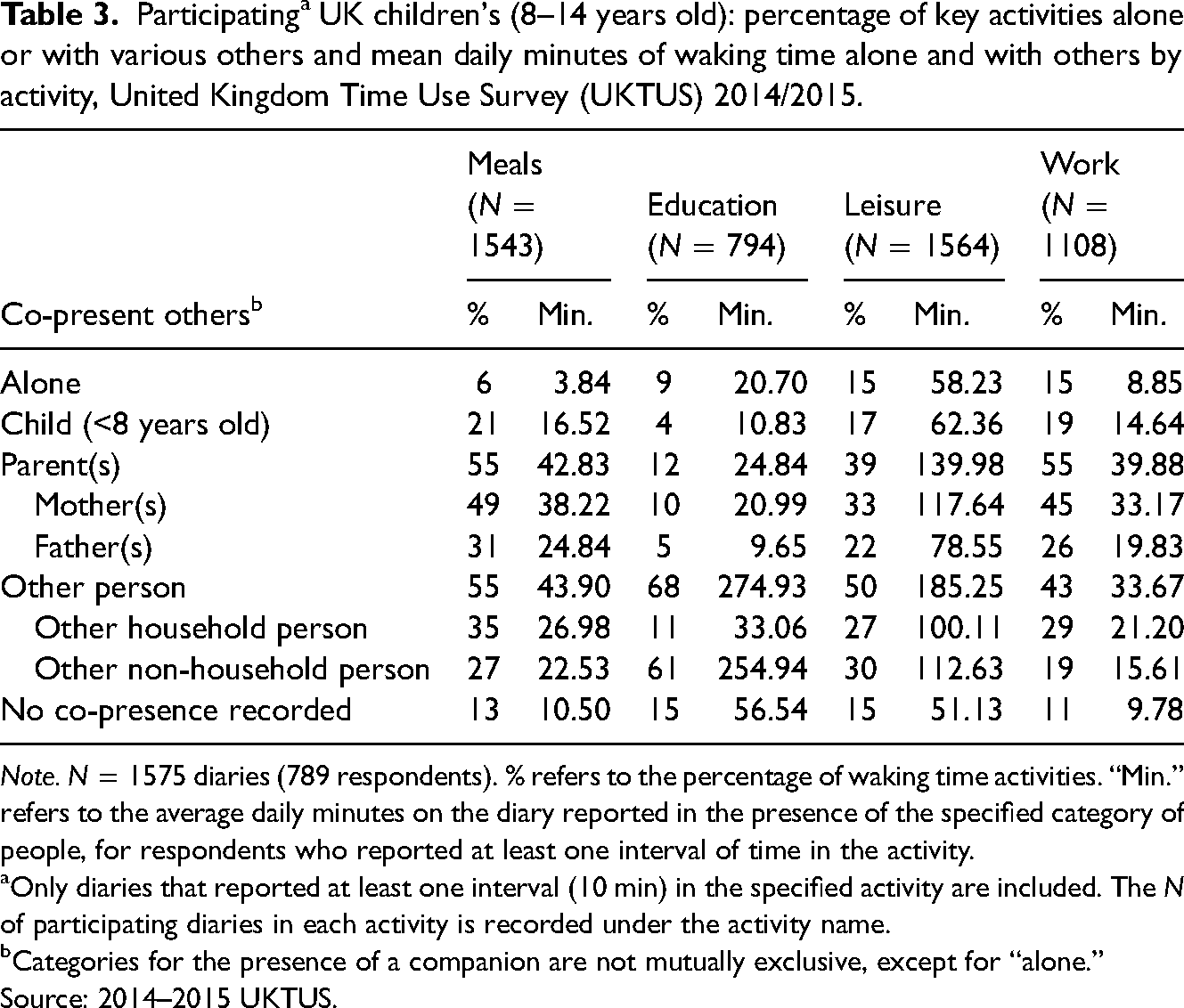
When children are spending time with important others in daily life, how are their social connections patterned? In other words, what types of activities are they doing? Table 3 shows how school-aged children spend their time (in average daily hours as well as the relative proportion of waking time) in four major types of activities: mealtime, education, leisure, and paid and unpaid (e.g. housework) work. Because a large number of child respondents report no time in specific activities, we only report the mean time for those who reported at least one time interval (10 min) engaged in that activity in their diary.
Participating a UK children's (8–14 years old): percentage of key activities alone or with various others and mean daily minutes of waking time alone and with others by activity, United Kingdom Time Use Survey (UKTUS) 2014/2015.
Note. N = 1575 diaries (789 respondents). % refers to the percentage of waking time activities. “Min.” refers to the average daily minutes on the diary reported in the presence of the specified category of people, for respondents who reported at least one interval of time in the activity.
Only diaries that reported at least one interval (10 min) in the specified activity are included. The N of participating diaries in each activity is recorded under the activity name.
Categories for the presence of a companion are not mutually exclusive, except for “alone.”
Source: 2014–2015 UKTUS.
Children are most likely to have mothers present at mealtime (49%) or during unpaid and paid work (45%), for those who report any time in these activities on the diary day. In contrast, children are most likely to be with non-household persons—such as family, friends, or larger community networks—in education activities, such as attending school or doing homework, if they participate in this on the diary day. This time that children spend attending classes at another location with teachers, peers, and others is also an important part of care/supervision that occurs in the community at large, outside of maternal and parental care. Although more detail on this issue is beyond the scope of this study, an important part of children's care as well as helping and teaching for children happens in education settings through non-parental roles—such as teachers, coaches, and peers (Oliveira et al., 2023).
Beyond educational activities, the presence of important others is clear across children's lives. For example, non-household persons are present at a not-insignificant part of children's mealtimes (27%). Children's leisure activities include non-household members almost as frequently as mothers (30% versus 33%). Children whose diary day includes leisure activities (which is the vast majority of respondents) spend an average of about 113 min or around 1.9 h of leisure time per day with other non-household persons. This could include non-household family members, friends, but also coaches, extracurricular leaders, neighbors, or mentors. Looking from children's point of view on their own activities, rather than mothers’ direct childcare, helps to understand how children receive care from and are supervised through their social connections with others beyond their mothers.
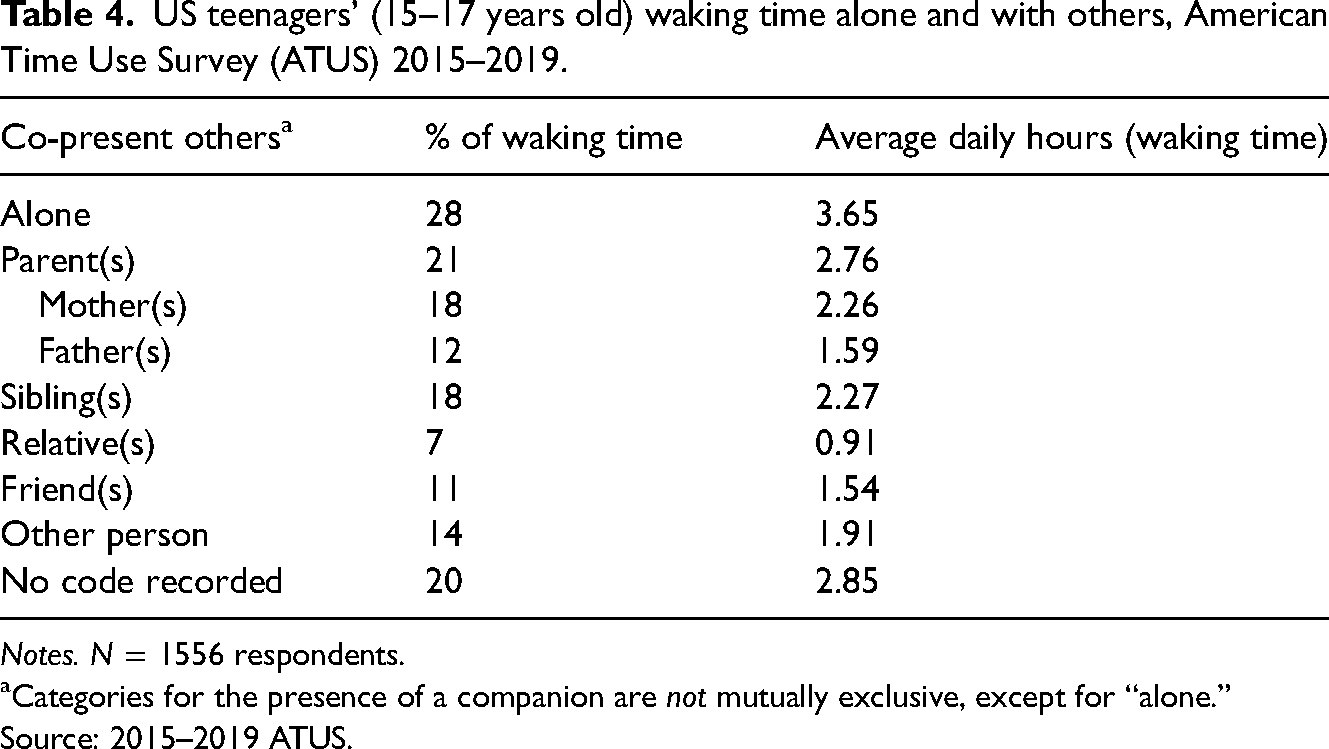
To further understand this linked lives approach to care across the life course, we also analyze teenagers’ time with others and how co-presence varies across activities. Table 4 shows with whom US 15-to-17-year-old teenagers spend their time with different types of people co-present, both in terms of average daily hours of waking time and the relative percentage of total waking time. Teenagers aged 15–17 spend more time alone and less time with their parents, compared to school-aged children ages 8–14. Only 18% of teenagers’ waking time, or about 2.3 h daily on average, is reported as co-present with mothers. Instead, teenagers spend about 28% of their waking time, about 3.7 h of waking time per day on average, alone. They also spend about 1.5 h or 11% of their day with friends co-present—and likely more time interacting via technology when not physically together. 11 Finally, US teenagers also spend almost 2 h on an average day or about 14% of their waking time with “other,” a broad category that includes teachers, school acquaintances, coaches, or so on. Note that since diaries are collected across all days of the week (including the weekend) and throughout the year (including holidays and summer months), this would be much higher on a school day.
US teenagers’ (15–17 years old) waking time alone and with others, American Time Use Survey (ATUS) 2015–2019.
Notes. N = 1556 respondents.
Categories for the presence of a companion are not mutually exclusive, except for “alone.”
Source: 2015–2019 ATUS.
Again, looking at adolescents’ time with others in specific activities lends further insights into their waking day and with whom they spend time in social connection to others, decentering the emphasis on parent–child time only. Table 5 shows how US teenagers spend their time in activities with others present, both with the percentage of time in the activity spent with the copresence of others and the average daily minutes of waking time in this activity (for those who reported at least one minute in this activity). Similar to school-aged children, teenagers are more likely to report that their mother was present in mealtime (40%) compared to any other activity. Teenagers spend much more of their waking time in their own leisure activities alone (39%) or with friends (15%) or others (15%). Finally, unfortunately, the ATUS time diaries cannot tell us much about specifically with whom teenagers spend time in educational settings. Time with teachers, mentors, friends, classmates, and others is underestimated due to the prevalence of “no code recorded” (IPUMS staff 2022, personal communication, April 26). However, it is clear that a substantial portion of teenager's time in education (about 277 min or 4.6 h per an average day) is spent away from parents in educational settings, with other important adults.
Participating a US teenagers’ (15–17 years old): percentage of key activities done alone or with various others and mean daily minutes of waking time alone and with others by activity, American Time Use Survey (ATUS) 2015–2019.
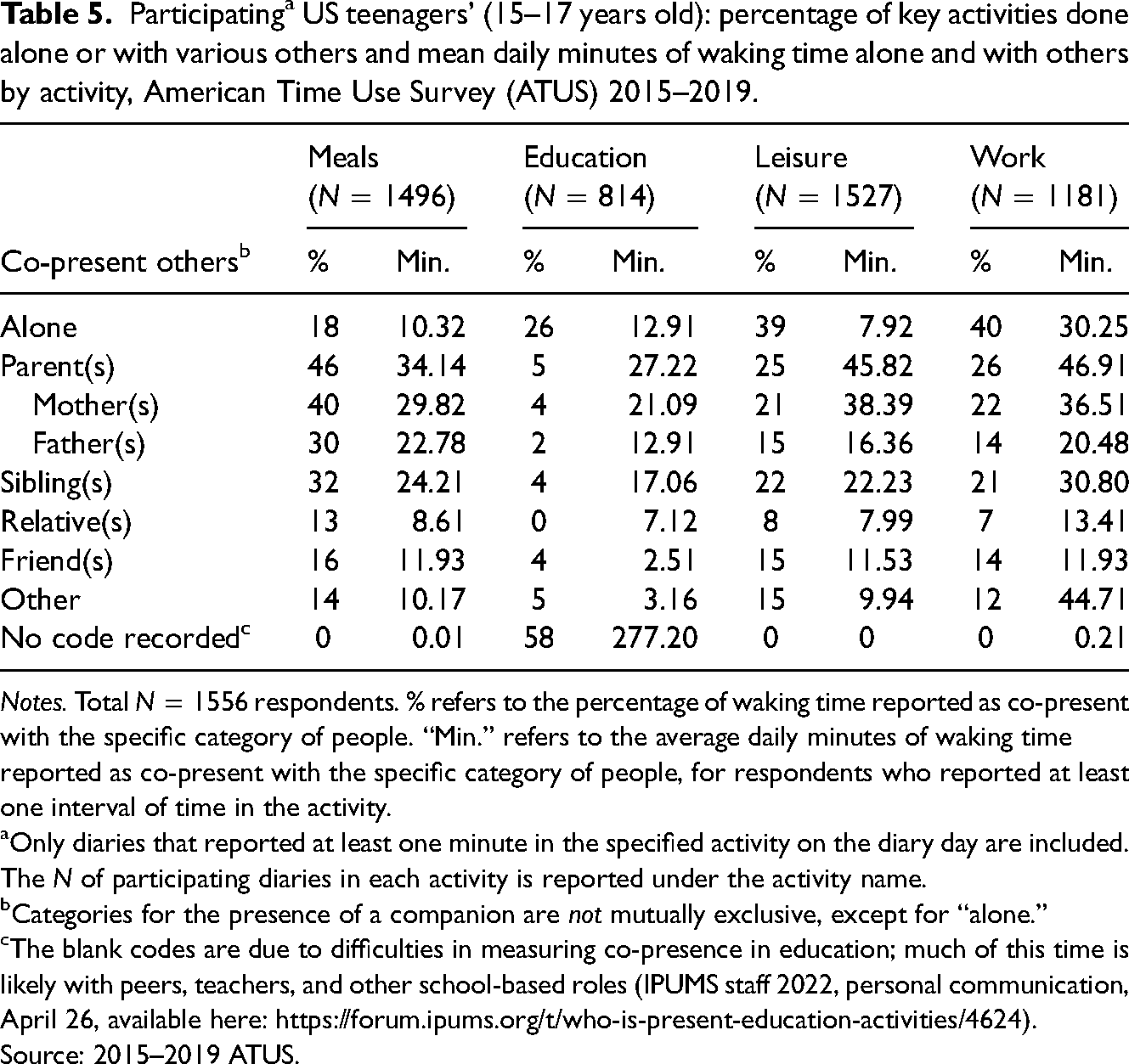
Notes. Total N = 1556 respondents. % refers to the percentage of waking time reported as co-present with the specific category of people. “Min.” refers to the average daily minutes of waking time reported as co-present with the specific category of people, for respondents who reported at least one interval of time in the activity.
Only diaries that reported at least one minute in the specified activity on the diary day are included. The N of participating diaries in each activity is reported under the activity name.
Categories for the presence of a companion are not mutually exclusive, except for “alone.”
The blank codes are due to difficulties in measuring co-presence in education; much of this time is likely with peers, teachers, and other school-based roles (IPUMS staff 2022, personal communication, April 26, available here: https://forum.ipums.org/t/who-is-present-education-activities/4624).
Source: 2015–2019 ATUS.
Discussion
An emphasis on worlds of care beyond the mother–child dyad through the idea of “linked lives,” places value in seeing the varieties of care mothers provide, as well as understanding children's lives in social connection to a variety of others, and in community space (Hunter et al., 2018). Regularly, in time use research on parental time, gender inequalities, and child development, traditional measures of individual mothers’ “childcare” as a primary activity is centered and understood as equating to all maternal time with children. Yet this is not the case by any means (Minnotte, 2023), as childcare activities represent only about one-third of mothers’ time together with children (Wray et al., 2021). This results in an incomplete scholarly understanding of 1) the time needed to care for and supervise children, 2) who spends time with and cares for children, and 3) social patterns in that caregiving time (Folbre, 2022). In another form of care, mothers regularly bring their children into social spaces both because they need to in their own daily lives and because placing children in larger communities of mattering and belonging is considered valuable and good for child development (Dow, 2016a). Tabulating “socially connected care” sheds light on a missing piece of the puzzle of how children are cared for not only by parents but also by others in communities, such as extended family or educators (Doucet, 2001). This study shows that much of mothers’ time with children present is spent in connection with other adults in the community and accompanying children out in the world. Indeed, particularly for mothers of older children, they spend as much—if not more—time in this “socially connected care” compared to traditional measures of childcare. Including this type of time enriches our understanding of how much care mothers provide, and expands theorizing about other forms of care. This conceptualization focuses on an important subsetof mothers’ time with children, centered theoretically on the idea of “linked lives.” Mothers' socially connected care importantly connects children to larger social worlds; these linkages are presumed to have quite positive effects on children and their futures (Coleman, 1988).
Mothers are not the only ones responsible for children, despite ideologies that emphasize their intensive, one-on-one care of children (Minnotte, 2023). There is another, different way to understand care as broader and connected, particularly vital for showing the shared responsibilities needed to care for, supervise, and socialize children (Doucet, 2001). Further, children have activities and ties of their own outside the mother–child dyad which is a central part of the support, guidance, and care they receive to grow (e.g. Gracia et al., 2020; Zuzanek et al., 2018). We also show in this study that the majority of children's days, once they are school-aged, are spent with others beyond mothers. Considering children's own perspectives on their daily lives illuminates care relationships in a different way than solely considering parental perspectives, as is common in time diary research (Folbre et al., 2005). Showing how children's time changes across the early life course reveals the continued expansion of care and connection with the community at large as youth move away from mothers and fathers to a larger degree (Ashbourne and Daly, 2010). When childcare is researched as a small subset of activities that mothers do mainly for the youngest children, we know less about children's lives and the reality of the network of adults that are actually needed to care for and supervise children.
The focus on childcare as traditionally measured tends to make people assume that this is the only or most important form of care. It may also suggest that those parents with more resources, for example, the most highly educated, are viewed as doing more of the “right” activities like playing with or reading to young children in cultivating children's success (Lareau, 2003; Minnotte, 2023). This “developmental” time in reading and teaching done by mothers is a tiny but important amount of care time overall. A regular focus on this small portion of care has meant a lack of knowledge about the other time that mothers spend caring for children, and about the care and supervision children receive from others. These forms of socially connected care, such as the time spent eating with, socializing with, and learning from extended family, day-care providers and teachers, coaches, neighbors, and others may be equally important as children grow. In past research using time diaries, this parent-child time is often overlooked because it is categorized as personal care or leisure time of the parent—instead of as care. This socially connected care could be especially vital to mothers and children in Black and Latino communities, where mothers may prioritize care centered in communities and broader networks (Dow, 2016a) and may also value “care” from a more social and integrated lens (Dow, 2016b; Nomaguchi et al., 2022).
This study has several limitations. First, the “socially connected care” mothers do is based on primary activity and with whom codes in time diaries. Although time diaries provide descriptive and detailed information on daily lives, the “with whom” codes are sometimes limited in terms of exploring exactly who these others are. Future research should continue to measure and examine how a variety of important others—such as extended family, neighbors, teachers, mentors, leaders, community members, and so on—may play distinct roles in mothers’ and children's care worlds. This study also does not specifically examine different combinations of co-presence—for example, mothers and fathers, or mothers and others—but provides a first look at with whom children spend their time. Future research can continue to unpack the different variations of time together with others and its impacts on children. Second, we acknowledge that the study did not examine fathers; it would of course be important for future research to analyze their socially connected care with children. Additionally, the study suggests that more time in socially connected care with mothers and in children's time beyond the mother–child dyad are useful and important for children's learning and support in larger worlds of care. Yet it is beyond the scope of this study to analyze the utility of these connections for social, emotional, and academic development of children and their sense of belonging and community. This is an area ripe for future research. Also, although unstructured time and time apart from adults in solitary or peer play can be very important for children's growth (Barker et al., 2014), the quality of this alone time matters. For example, benefits may be different if used for reading or playing rather than scrolling on social media. Additionally, connections with others may not be as high quality as those with mothers—although as children grow, these others certainly become more central in their care, supervision, and socio-emotional learning experiences. Measuring the quality of the connections and time spent across a child's time inside and outside of family life is just as important as measuring the quantity (Bowen et al., 2014; Milkie et al., 2015; Vagni, 2019; Waldfogel, 2016).
Conclusion
Using examples of data on maternal time with children beyond “childcare,” available in major time use surveys, we can broaden our understanding of the whole lives of parents and children by assessing socially connected care time. Building and maintaining social connections is one of the most important forms of caring and helps analysts rethink and measure other forms of time beyond childcare (Doucet, 2001; Coleman, 1988). Moreover, asking about time from a child's perspective similarly helps us to rethink care time, and place children in extended families and communities of which they are a part (Folbre et al., 2005; Gracia et al., 2020; Zuzanek et al., 2018). Children build social relationships with others by spending time with them. Measuring the amount of time and the types of activities in which children of different ages and social statuses are with other adults and children apart from parents advances our knowledge of their social worlds.
In all, the huge investments of time parents—and other adults in the community—spend in diverse ways with or for children beyond the narrow band of childcare activities—should be examined more carefully, given such time can be important to children's thriving. Moving to assess time in social relationships (Doucet, 2022), for example, between children and parents, and children and others, and not based on a set of activities alone, may be useful in examining care time in the future.
In all, several gains are evident through an emphasis on care beyond mothers’ direct childcare time, as articulated by many time use and care scholars (e.g. Doucet, 2015, 2022; Folbre et al., 2005; Folbre, 2022). In this analysis, we expand ideas about children's worlds of care—beyond active and direct care by mothers—and beyond mothers themselves. Mothers’ socially connected care means children may or may not be the focus of direct attention, but nonetheless, they benefit in many ways from being part of the community at large and the networks of others they are growing into. Measuring this form of care stems from intersectional and life course lenses, which center children in the larger “village” of which they are part. Once the analytic lens broadens to include a more comprehensive conceptualization of care, we gain clarity about others’ actual amounts of co-present time with children. This insight can be pursued in future research to reassess inequalities in time spent with children across social groups. It also pushes scholars to broaden out from an individualistic lens of “maternal determinism” toward an approach that acknowledges and counts the responsibilities of the broader family and educational community, as well as neighbors and communities, in raising and supporting the next generation of citizens.
Footnotes
Declaration of conflicting interests
The authors declared no potential conflicts of interest with respect to the research, authorship, and/or publication of this article.
Funding
The author(s) disclosed receipt of the following financial support for the research, authorship, and/or publication of this article: This research was supported by the first author's Social Sciences and Humanities Research Council (SSHRC) Insight Development Grant “Time Together and Apart: Clarifying the Family Time Paradox in Canada and the United States.”
