




Abstract
The role of grievances in drawing public concern and activist support is a surprisingly understudied topic in modern social movement literature. This research is the first to parse issues into core components to understand whether some grievances are more successful than others in evoking reactions that can benefit social movements. Specifically, I use concepts and measures developed by affect control theory scholars that tap into cultural perceptions of the goodness or badness of behaviors and identities to investigate how people react to different configurations of good or bad perpetrators, behaviors, and victims in mobilizing events. I find strong support, across outcomes, that evaluations of goodness and badness in grievances affect people’s willingness to care about an issue or support a campaign. This provides insights into both the types of movements more likely to be successful as well as the types of social problems less likely to draw public support.
There are hundreds of activist issues, from the very specific (e.g., “Protect the dolphins of Taiji”) to themes that have appeared across generations (e.g., “War is not the answer”). Are all issues created equal when it comes to drawing public sympathy and support? I apply concepts from affect control theory (ACT) to evaluate the potential differential appeal of movement grievances. Here, I use the term grievances to refer to the different causes and issues that people might care about, focusing on the raw material or content of those issues. These may entail personal grievances for people who are members of an aggrieved group but also may encompass people not directly affected by the injustice who still care that the grievance be remedied. If grievances do indeed differ in their power to draw sympathy and adherents, then the conclusions from this research have the real-world implications of suggesting how well particular social issues might fare in attracting public concern and activist attention.
I parse grievances into three basic building blocks to understand whether some grievances are more successful than others in evoking mobilizing, affective, and cognitive reactions that can ultimately benefit social movements. In ACT, the basic elements of an event are actor, behavior, and object, such that actor behaves toward object. From the perspective of grievances, the actor would be the source of the injustice, the behavior would be the nature of the harm, and the object would be recipient of the harm, that is, victims. I then use measures of cultural perceptions of the goodness or badness of behaviors and identities to investigate how people react to different configurations of good or bad actors, behavior, and objects in potentially mobilizing events. I find that changing the goodness and badness of each core component (actor, behavior, and object) can induce dramatically different reactions when it comes to supporting a campaign.
Using a vignette study, I find strong support, across outcomes, that people prioritize harm when evaluating grievances and that bad behavior directed toward good victims constitutes the most powerful mobilizing form of grievance. This reveals the potential for inherent inequalities in responses to activist issues, since groups viewed negatively in terms of cultural sentiments (e.g., prisoners, addicts) are disadvantaged compared to groups viewed positively (e.g., doctors, schoolchildren). I also find that the actor matters for many outcomes but that the effect of actor is weaker than the effect of behavior and its target and largely disappears in cases of bad behavior toward good victims. In general, bad actors produce higher levels of concern and emotion than do good actors.
The results also show that while concerns about the well-being of others dominate grievance evaluations, expectations about how the world should be (and deflection from those expectations) are particularly useful for understanding protest against good behavior. While less common, there are activist campaigns against acts of care, such as opposition to improving conditions for prisoners or hostility to providing humanitarian aid to undocumented immigrants. This study finds that good acts are more likely to arouse anger, perceptions of injustice and immorality, and interest in supporting a campaign if they (a) are directed toward groups culturally perceived as bad or (b) are the actions of actors culturally perceived as bad.
Ultimately, this research is not making claims about the ubiquity, scale, or relative importance of grievances compared to other factors when it comes to activism. Rather, this is about the comparative content of grievances, with the conclusion that not all grievances are created equal in their ability to attract attention and support. If, as the findings from this study suggest, civic and political sectors are less willing to take action for certain types of issues (i.e., on behalf of groups of people with negative cultural perceptions), this increases the likelihood that these types of grievances continue, resulting in more or less permanent social inequalities. Additionally, this study can inform framing strategies by detailing how the selection of good or bad identities of perpetrators and victims, as well as how acts are communicated, might elicit differential responses in the bystander public and potential adherents.
Social Movement Literature and Grievances
For the most part, recent social movement scholarship has not systematically investigated how the content of grievances affects mobilization. Earlier, mid-twentieth-century work placed primacy on the role of grievances in social movements but was flawed in its view of protestors as irrational or deviant and its limited perspective of the sources of grievances, which were seen as emerging from rapid change, social strains, and the breakdown of the sociopolitical order (Smelser 1962), with an emphasis on relative deprivation (Gurr 1970). This led to critiques that grievances are relatively pervasive and that other factors (leadership, resources) are needed to understand the strength of movements (Jenkins 1981; McCarthy and Zald 1977). Consequently, there has been less interest in studying grievances and a shift toward these other mechanisms.
While not common, there are more modern investigations into grievances, including the role of threats and strain in social movements and how sudden or shocking grievances inspire collective action. Real or perceived declines in resources, status, or power can encourage mobilization and social movement activity (McVeigh 1999; Tilly 1976). Another way that grievances can promote activism is when something is upsetting or stunning enough that it motivates people to seek out action. Such moral shocks can take the form of powerful symbols, such as dramatic animal-testing photographs (Jasper and Poulsen 1995), unexpected and alarming events (Opp 1988; Walsh 1981), or political or legal decisions (Luker 1984). The content of grievances may tap into biases in human judgment and decision making that make some causes more attractive than others, such as increased interest in preventing losses over acquiring gains (Bergstrand 2014).
Charles Tilly’s (2006) work on displays of worthiness, unity, numbers, and commitment by members of a social movement and how these displays are perceived by others is also relevant here. In describing worthiness, Tilly (2006:54) emphasizes elements like sober demeanor, neat clothing, and presence of clergy, dignitaries, and mothers with children. This speaks to the general air of respectability of protestors, but we also see several identities (mothers, clergy) rated positively on the evaluation dimension, that is, seen as “good.” Thus, positive impressions of who is aggrieved could factor into expressions of public support for movements.
Scholarship on social movement framing process also suggests ways that grievances can be more or less powerful in appealing to the public and adherents. Framing refers to signifying work or meaning construction done by various actors (e.g., adherents, adversaries, and the media) on issues and interests relevant to the movement (Snow 2009). For example, frames that provide clear diagnoses of problems and prognostics for solutions or that resonate with the everyday experiences of people may constitute more effective public appeals (Snow and Benford 1988). Social movement actors can be creative in how they portray a cause, and how perpetrators and victims are cast can shape public debate about an issue. The LGBT rights movement has been particularly effective in using positive cultural perceptions about weddings and love to highlight the injustice of not allowing same-sex couples to marry (Fetner 2016). Framing the right to marry as a right to equal love and commitment helped to usher in positive outcomes for the movement (Ghaziani, Taylor, and Stone 2016).
How grievances are interpreted and packaged through framing processes is central to courting both adherents and the general public. However, as effective as framing can be, I also argue that the content of a mobilizing event can either limit or assist in the development of these frames. If a social movement is attempting to protect prisoners, then it will be more constrained in its ability to portray this aggrieved group in positive cultural evaluation terms than a movement attempting to protect veterans, voters, or schoolchildren. This is particularly true if the movement is vulnerable to counterframing from the media and countermovements.
These studies all suggest ways that some types of issues may be more conducive to political action than others. However, to date, social movement scholars have not attempted to systematically look at and compare the relative strength of the content of issues across movements as an end in itself. Here, I employ a social psychological approach that draws on cultural meanings to find general patterns in what might make some topics particularly powerful in motivating concern and activism. Thus, while other movement scholars have noted the consequences of having negative labels attached to aggrieved groups—such as feminists being labeled “spinsters,” “old maids,” “man haters,” “cranks,” and “queers” (Rupp and Taylor 1987)—or have looked at grievances in specific cases, like the response to Three Mile Island (Walsh 1981), this research looks at the broadest level to find themes that can cut across movements, time periods, and case studies. More specifically, it examines the goodness and badness of identities and behaviors—elements that can be found in any social movement campaign.
ACT and Application to Grievances
It would be nearly impossible to predict whether any single cause will attract the attention of any single individual. But given the culture and larger structures people are embedded in, one can predict patterns in what issues are likely to draw a larger audience. ACT is an area in social psychology that measures these cultural assumptions that people hold about identities and behaviors. ACT centers on the basic idea that individuals create events to confirm sentiments that they already have about themselves and others and that when sentiments are not maintained, then individuals re-identify themselves and others, with the result that through this process, people perform the social roles that maintain society (Heise 1979, 2002; Smith-Lovin 1979). ACT draws on the work of Osgood, Suci, and Tannenbaum (1957) in developing three cross-cultural dimensions of meaning. In essence, humans react to stimuli according to three different dimensions of response: evaluation (goodness vs. badness), potency (powerfulness vs. powerlessness), and activity (liveliness vs. quietness) (Heise 2007). All three dimensions can be used to characterize how people feel about items in the abstract. For instance, when thinking of father, how good, powerful, and lively are fathers, in general? To determine these values, surveys have been conducted in which respondents assigned scores on each of these dimensions (varying from −4.3 to +4.3) to particular identities, behaviors, modifiers, and settings, leading to the development of evaluation, potency, and activity (EPA) profiles. For example, in the United States, the identity of father has an EPA profile of E = 2.71, P = 2.71, A = 1.15 (Francis and Heise 2003), such that fathers are seen as very good, very powerful, and active. This EPA profile for father taps into our “fundamental sentiments” about fathers, which are highly stable, widely shared cultural meanings. Heise (2002:18) describes these fundamental sentiments as “enduring affective meanings prevailing in society that allow individuals to orient quickly and automatically in different situations.”
While people hold abstract, fundamental sentiments about actors, behaviors, and objects, these sentiments are not always confirmed in the situations that occur in everyday life. Situational or transient impressions form in these specific events. For example, when a grandmother abuses a child, the transient impression of the grandmother no longer matches the fundamental sentiment about grandmothers—in this case, grandmother would be seen more negatively on the evaluation dimension. This mismatch, or deflection, that occurs between transient impressions experienced in specific situations and one’s more abstract, fundamental sentiments about items can motivate people to take action to restore their ideas about the world. Thus, experiencing deflection could potentially affect why people choose to engage in activism to address grievances.
To represent situational events, ACT uses the simple social event actor behaves toward object, or ABO event. I use this ABO event to represent a grievance, with the actor being the perpetrator of an injustice, the behavior being the action taken by the actor, and the object being the target or victim of the injustice. I then term this a “mobilizing event.”
Here, I assess only the evaluation component (goodness/badness) of the EPA profile. The evaluation dimension is more strongly influenced by cultural norms and is more stable over time than are the potency and activity dimensions; evaluation measurements taken up to 25 years apart have correlations of .90 or higher (Heise 2007). Additionally, I posit that the evaluation dimension will have the strongest effect on mobilization. Many social movement campaigns explicitly try to invoke a sense of “good” and “bad” in attempts to reach the general public; it is more difficult to see how being perceived as slow/fast or noisy/quiet (the activity dimension) could affect injustice or activist concerns regarding a group. I do think potency (powerfulness or powerlessness) could matter for mobilization, but I control for potency in this study to first establish the effects of the evaluation dimension, which I posit to have the strongest effects. Finally, it is important to clarify that groups that have negative evaluation profiles are not actually “bad,” nor are groups who have positive evaluation profiles actually “good.” This paper is not casting moral judgments. Instead, it investigates these profiles to understand how cultural impressions attached to identities could advantage or, in the case of negative scores, disadvantage groups and prevent them from getting public support or sympathy in times of need.
The Effects of Grievances: Mobilizing Outcomes
Good or bad identities and behaviors in grievances could ultimately influence general concern or support for an issue in a variety of arenas, from attitudinal transformation to emotional reactions to public support for a movement. By looking at initial responses to issues, this is a study of the first step of mobilization, fitting most neatly in processes like the formation of the mobilization potential—the reservoir of people who could be mobilized by a social movement (Klandermans and Oegema 1987). Turning an analytic eye to how the mobilization potential is formed is particularly useful given that social movement scholarship tends to investigate the end result of participation.
I am interested in affective and cognitive reactions both as an end goal and as a factor leading to behavioral activism. While people often think of social movements targeting policies or corporations, many social movements prize attitudinal transformation. Movements for and against LGBT rights, for example, pour significant time and resources into capturing peoples’ hearts and minds, with the result that attitudes toward gays and lesbians have experienced profound shifts in recent decades (Fetner 2016). Also, the LGBT rights movement has been actively engaged in transforming identities associated with shame into identities associated with pride (Britt and Heise 2000).
Perceptions of unjustness and immorality may feature prominently into calculations of what people are willing to care about or devote their time toward helping. There is a strong injustice component to collective action (Gamson 1992). Grievances may differ in the degree to which they can rouse emotions, and emotions, in turn, can affect peoples’ interest in participating in collective action (Goodwin, Jasper, and Polletta 2001). Anger and moral outrage are particularly relevant emotions for activism (Gamson 1992; Jasper 1997).
Finally, public reactions to an issue can have another effect: they can shape whether people interested in activism are more likely to face social rewards or social sanctions for participating in collective action (Oberschall 1973). Strong public support for an issue could increase potential adherents’ perceptions that a critical mass or threshold will be reached to achieve campaign goals, making participation more attractive (Marwell and Oliver 1993).
Theoretical Mechanisms: Well-being Concerns and Deflection
Given these potential outcomes, how do configurations of good or bad identities and behaviors in grievances ultimately translate into concern or support for an issue? I hypothesize that the characteristics of a mobilizing event operate through two mechanisms—well-being concerns and deflection—to affect affective, cognitive, and sympathetic outcomes. While ACT provides many of the concepts and mechanisms used in the theoretical development of what types of events will be seen as most powerful, ultimately the evaluation of what constitutes an injustice or not has a moral judgment component that requires additional logic pulled from literature on morality. Together, ideas from these two bodies of literature can be synthesized to make predictions about the mobilizing potential of grievances.
Mechanism I: Well-being Concerns
The first mechanism, well-being concerns, holds that people generally care about the welfare, health, and happiness of others, including nonhuman entities, such as animals or the environment, and are motivated to prevent acts of harm. The concept of well-being concerns is not derived from ACT and instead stems from work done on morality and justice as well as other fields. ACT, however, does recognize that positive or negative behavior in situations can significantly alter whether actors are seen as good or bad and terms this a morality effect (Heise 2002). Judgments of whether actions will harm or benefit others can inform people’s perceptions of whether an act is immoral or constitutes an injustice. Gilligan (1977:486), an early proponent of “care” as a factor in moral judgments, summarizes one theme as “the wish not to hurt others and the hope that in morality lies a way of solving conflicts so that no one will get hurt.” Care/harm constitutes a moral foundation that is particularly relevant for social justice movements (Haidt 2012). Stets and Carter (2006) identify caring as one of two main components to the moral identity. Thus, while definitions of morality diverge, and other elements, like fairness, also appear consistently, the concept of harm/care is widely used as a foundational element of morality.
When applied to the ABO event, well-being concerns are most clearly manifested in the behavior component. Does an action benefit or harm others? ACT surveys ask participants to rate actions as good or bad, which does not necessarily translate to harm or care. Evaluation profiles are defined more broadly as a sense of approval or disapproval following along standards such as morality, aesthetics, functionality, or hedonism (Heise 2002). But according to one of these surveys (Francis and Heise 2003), the most highly rated negative behaviors averaged across both men and women are to murder, kill, abuse, rape, knife, shoot, stab, mug, brutalize, and victimize. Conversely, the most highly rated positive behaviors are to thank, heal, care for, rescue, propose marriage to, educate, save, help, and kiss. Here we see clear themes of care and harm. All of the top negative behaviors refer to harm. The top positive behaviors show more nuance, such as expressions of love, but the idea of caring for others still dominates. Thus, it is fair to say that, alongside other considerations, evaluations of whether an action harms or cares for others are likely to inform evaluations of whether an action is perceived as good or bad.
In turn, identifying behavior as harmful has real-world implications for the types of issues taken up by volunteers and activists. Mathur et al. (2010) find support for this in that people were significantly more willing to donate money and time to groups perceived as experiencing painful situations. Thus, my first hypothesis derived from well-being concerns is that negative behavior is more powerful than positive behavior in affecting mobilizing, affective, and cognitive outcomes (see Well-being Concerns Hypothesis 1).
The nature of recipient groups may condition outrage over harm. A number of studies have found that extreme out-groups low on dimensions of warmth and competence (such as addicts and the homeless) may be perceived as less than human, including neural evidence that such groups do not cue social cognition processes that attribute a mind to the other person (Fiske 2010; Harris and Fiske 2006). The authors of such studies note that, if supported with further evidence, this could contribute to explanations of how atrocities, such as hate crimes, prisoner abuse, and genocide, occur against dehumanized groups of people. Indeed, Cuddy, Rock, and Norton (2007) found that after Hurricane Katrina, people who dehumanized others by not conferring secondary emotions, like anguish or mourning, to racial out-group victims were less likely to report intentions to volunteer for hurricane relief efforts. Thus, such dehumanization has consequences for the types of groups that people are willing to spend their time to help.
From these examples, we see a tendency for people to accept bad behavior, as long as it is directed toward perceived out-groups. The idea that people promote favoritism for social groups that they identify with (in-groups) over groups they are not members of (out-groups) has been well established (Brewer 1979). It is likely that such logic transfers over to whether people view a group negatively on the evaluation profile and indeed is likely to be even stronger than in-group or out-group bias given that in ACT surveys, such groups are actively being categorized as “bad” rather than just “other.” In an ACT survey (Francis and Heise 2003), the most highly rated negative identities by men and women were rapist, child molester, wife abuser, murderer, terrorist, serial murderer, white supremacist, and racist. Less extreme negative identities that could potentially form groups affected by social movements might include felons, smokers, atheists, prostitutes, alcoholics, or dropouts. And, similar to Harris and Fiske’s (2006) comments on dehumanization, if indeed people are ignoring harm directed at groups with negative cultural sentiments, then it is less likely that these victims will receive help when they need it, revealing an important gap in where civic activities, like volunteering and activism, are directed (see Well-being Concerns Hypothesis 2).
On the other hand, when bad behavior is directed toward “good targets,” such as grandmothers or babies, we would expect people to be more outraged and willing to help. For example, movements seeking to prevent drunk driving shared stories of children killed by drunk drivers, which made for a particularly powerful message to the general public (Weed 1990). When it comes to goodness and evaluation profiles, the top-ranked positive identities are soul mate, best friend, loved one, true love, friend, saint, grandmother, God, grandparent, and hero (Francis and Heise 2003). These are marked by subjective interpersonal relationships and are less applicable to social movement campaigns. Other positive identities more realistically found as groups could be teachers, mothers, pastors, doctors, infants, army reservists, students, or voters.
I do not develop a hypothesis regarding the actor element because, from a well-being stance, it does not matter who is committing the act—the emphasis is on whether or not that act is causing harm and whom it is harming. The next section, on deflection, will explore the role of perpetrator and its mobilizing effect.
Mechanism II: Deflection
Given the centrality of preventing harm to judgments of injustice, one might ask, are there any mobilization efforts directed against positive acts, like caring for others? And if so, what motivates these campaigns? Deflection is a second mechanism through which the evaluation dimensions of ABO elements could affect movement sympathy and participation. Deflection pertains to both positive and negative acts and thus, unlike well-being concerns, does not always assume negative acts will be more powerful. ACT predicts symmetry in expectations of evaluations of goodness and badness when it comes to behavior and actors. Good actors should engage in, and be recipients of, good acts. A proper priest should model good behavior and receive good acts in return, like charity, when he or she needs it. On the other side, there is the expectation that bad actors will commit bad acts and that bad things should happen to them for doing so. A criminal is not expected to help an old lady cross the street; he or she is expected to steal her purse. And such criminals should not be rewarded with acts of kindness but be punished for their wrongdoings.
When identities and behaviors in situations do not match cultural expectations, this can generate deflection. Deflection pertains to the idea in ACT (as well as other control theories) that people are motivated to maintain meanings in their world, and when such meanings are disconfirmed, this produces tension or stress that motivates action to restore meanings.
People can reduce deflection by taking action, by redefining the situation, or by seeking out new interactions that will restore sentiments (Robinson and Smith-Lovin 2006). Typically, ACT scholars focus on how people interacting together choose actions that confirm their identities or how observers of interactions might re-identify participants to explain the situation (Heise 2002). I extend the logic of ACT to grievances. Certainly, re-identification processes sometimes occur, and this can be detrimental to people affected by a grievance, as evidenced by a tendency for people to “blame the victim” or see victims of misfortune as less good and as deserving what happens to them (e.g., the just-world phenomenon documented by Lerner 1980). However, I propose deflection will have other effects. The stress produced by deflection should disturb people, making it harder for them to ignore or turn away from an issue. Heise (2007:62) states that the more deflection an event produces, the stranger the event seems, and that “life is stressful when it has turned persistently strange, unique or inconceivable.” Thus, the tension that results from deflection is predicted to motivate people to care more about or to take action to address types of injustices where resolving the injustice allows situations to realign with fundamental sentiments about how the world should be.
The idea that deflection could motivate activism is supported by other studies that have found deflection affects actions and decisions in a variety of ways. For example, Shuster and Campos-Castillo (2017), in an application of ACT to the Equal Rights Amendment movement, find that framing strategies that describe events in ways that generate deflection may encourage people to take political action against those outcomes. Deflection and meaning maintenance can influence how respondents frame unwanted sexual experiences (Boyle and McKinzie 2015). Hunzaker (2016), in looking at how narratives are shared, found that people tend to alter high-deflection information to increase cultural consistency and also tend to add more low-deflection information. This has pragmatic consequences for the types of stories that get told and retold. Additionally, people are more likely to share narratives that reinforce cultural biases; specifically, individuals are more likely to transmit negative stereotype-consistent content when the character experiences a negative outcome as compared to a positive outcome (Hunzaker 2014). Here, victims of misfortune are maligned, particularly if they are perceived as being a member of a low-status group, which then becomes emphasized in retellings. This then contributes to the perpetuation of negative stereotypes. Thus, other studies offer support for the idea that deflection processes can affect sympathy for groups as well as influence behavioral choices, including political action.
The mechanism of deflection suggests that good acts can influence social movement sympathy and participation if such behaviors are aimed toward negatively evaluated groups. In ACT, there are specific equations that show deflection is higher when there is a mismatch between the evaluation of the behavior (good or bad) and the evaluation of the object (good or bad) due to the divergence between impressions and fundamental sentiments (Heise 2007). While negative behavior toward good objects is predicted to produce deflection, behaving positively toward bad objects is also predicted to produce deflection. Thus, while the well-being hypotheses pertain only to acts of harm, deflection can also speak to acts of care and mobilization around good acts that benefit negatively perceived recipients (see Deflection Effects Hypothesis 1). This implies the potential for protest against aid if it is directed toward groups with negative cultural perceptions, like prisoners. For example, although there are both politicians and activists in favor of closing Guantanamo Bay, it remains in operation, revealing the political difficulties of trying to help a group labeled as terrorists.
Additionally, the actor can contribute to deflection; just as a mismatch in the goodness or badness of behavior and object can generate more deflection, so, too, can a mismatch between the goodness or badness of the actor and the behavior (Heise 2007). The actor’s behavior is an important source of deflection if such behavior is unexpected or disconfirms the actor’s identity. People sanction actors who violate norms (Robinson and Smith-Lovin 2006). Good actors who do not behave as they should, such as teachers who abuse children, are predicted to generate deflection and, subsequently, more sympathy and participation for campaigns working to address the issue. Additionally, bad actors who behave positively may also become a source of mobilization if people are suspicious of their motives. Indeed, for companies that have caused harm and are seen as low in warmth, such as BP after the Deepwater Horizon oil spill, overt attempts to repair reputational damage and reestablish warmth can backfire, leading to more punitive judgments from perceivers (Kervyn et al. 2014). These examples demonstrate that the actor and behavior evaluations can interact to produce deflection and mobilization, through either positive actors acting negatively or negative actors behaving positively (see Deflection Effects Hypothesis 2).
The effect of actor may also modify the two-way behavior–object interaction, resulting in a three-way interaction between all three components. It is possible that good actors will increase mobilization more than do bad actors. This inference may not seem intuitive, but to the extent that a potentially mobilizing event is viewed as something happening that a person does not like (whether it is good acts toward bad objects or bad acts toward good objects), knowing that a good actor is responsible for this unfavorable event could be more unexpected and more threatening to worldviews. These good actors could be sanctioned more for such norm violations (see Deflection Effects Hypothesis 3).
While deflection, like the well-being concerns hypotheses, predicts that bad acts toward good objects will result in stronger mobilizing reactions due to increased deflection, to avoid repetition with Well-being Concerns Hypothesis 2, I will focus on what deflection uniquely explains: good acts. Here, sympathy and activist support is to prevent the outcome, so refers to opposition to good acts.
Deflection Effects Hypotheses
Finally, it is important to clarify that all three EPA dimensions work together to generate deflection. In ACT, deflection is formally defined as the divergence of transient affective meaning from fundamental affective meaning on the EPA dimensions summed over all entities in an action (Heise 2007). However, the deflection-generating effects of evaluation can also be investigated separately through impression-formation equations estimated only for the evaluation dimension, ignoring potency and activity effects and some interaction terms (Heise 2007:113). The equations can explain a large part of the variance in post-events transients, specifically, R2 = .76 for actor evaluation, .81 for behavior evaluation, and .87 for object evaluation (Heise 2007:113). In the next section, I utilize both a program designed by David Heise (Interact) and evaluation impression-formation equations to more precisely measure deflection.
Method
Experimental Design
For the experiment, I use a between-subjects 2 × 2 × 2 completely randomized factorial design in which the two levels (positive and negative evaluations) of each factor—actor, behavior, and object—are crossed, resulting in eight experimental conditions. That is, I have two versions of actor (good actor and bad actor), two versions of behavior (good behavior and bad behavior), and two versions of object (good victim and bad victim). I use a vignette study to evaluate my hypotheses.
Participants
Participants were recruited from undergraduate sociology classes at a large public university in the southwestern U.S. for the opportunity to earn money. The instrument—the vignette and questionnaire—was distributed to 240 participants, with 30 participants in each condition.
The participants were 59 percent female and 41 percent male. The majority of the participants were ages 18 to 25 (88 percent). Most participants were white (68 percent) or Latino/a (24 percent), with 16 percent of participants identifying as some other race or ethnicity, such as black, American Indian or Alaska Native, or Asian or Pacific Islander (participants could select multiple races or ethnicities). In regard to political preferences, the mean for participants was 3.34 (SD = 1.44), falling between somewhat liberal and moderate on a 7-point scale ranging from 1 = very liberal to 7 = very conservative. Since the identities and behaviors used for the experimental manipulations are based on evaluation ratings collected in the United States, I included a question asking participants if they had spent the majority of their lives living in the United States. I then removed any participants who had not spent the majority of their lives in the United States as a precaution against cultural differences in evaluation ratings and recollected the data (16 cases).
Procedures and Materials
The experiment took place in undergraduate classrooms where participants were handed a vignette/questionnaire packet with compensation attached ($5). Vignettes were randomly ordered to create random assignment of participants to conditions. The vignette and questionnaire took approximately 15 minutes to complete, and the participants were not allowed to interact during this time.
Each vignette presents one mobilizing event consisting of a specified combination of the goodness and badness evaluations of actor, behavior, and object (e.g., “Teachers abuse bullies”). The event was a single sentence. While a longer vignette could have provided richer context for participants, adding modifiers to the actor, behavior, and object terms would alter the manipulation of these elements. For example, settings (Smith-Lovin 1979), nonverbal behaviors (Rashotte 2002), and emotional displays (Robinson and Smith-Lovin 1999; Tsoudis and Smith-Lovin 1998) can affect the formation of impressions. Additionally, introducing greater description of the events would have made it difficult to maintain consistency across the eight conditions, some of which involved positive behavior and others negative behavior.
After reading the vignette, participants then answered a series of questions. The first section of the questionnaire asked about their emotional reactions to the event, their evaluation of the immorality or injustice of the event, their perceptions of others’ reactions to the event, and how realistic they thought the event would be in everyday life. The second section of the questionnaire was prefaced with these instructions: “For this next section of the questionnaire, assume that there is a real-life example of [mobilizing event] and activist campaigns have emerged to OPPOSE it. You have just been approached by an activist recruiting people to take action to PREVENT [mobilizing event].” This was followed by questions asking about a participant’s personal willingness to support a campaign. The survey also asked about willingness to participate in actions for the campaign (e.g., petition, protest) as well as perceptions of others’ willingness to participate in the campaign. Participants were also asked if they thought about the behavior described in the event in abstract or specific terms and to clarify what they envisioned. The questionnaire then concluded with demographic questions. The final page welcomed participants to write in additional comments, such as reactions to the event, further explanation of answer choices, or general comments on the survey.
Manipulations
I operationalized the goodness and badness of actors, behaviors, and objects using the evaluation dimension of EPA profiles of identities and behaviors. The evaluation ratings come from a survey by Clare Francis and David R. Heise (2003), “Mean Affective Ratings of 1,500 Concepts by Indiana University Undergraduates in 2002-3,” which used 1,027 respondents who lived in the United States at age 16 and included approximately equal numbers of males and females (Heise 2004). EPA dictionaries separate out EPA profiles by gender as past research has shown that males and females can differ in their evaluations, particularly on sexuality-related identities (Heise 2004). I do not expect the mechanisms of well-being concerns or deflection to operate differently for men and women. Because gender differences are not of theoretical interest in this study, I select identities that do not have significant differences on evaluation ratings by sex in the data set (identities with known sex differences are noted in Heise 2004). I then use sex-averaged scores.
I selected the actor, behavior, and object presented in each mobilizing event based on their score on the evaluation dimension. I also endeavored to keep potency scores constant (positive), which limited my choices. In this experiment, the identity used for the good actor was teachers (E = 2.65, P = 2.09, A = 0.96 ), and the identity for the bad actor was murderers (E = −3.63, P = 1.57, A = 0.51). For behavior, the good action was care for (E = 3.18, P = 2.17, A = 0.05), and the bad action was abuse (E = −3.59, P = 0.19, A = 0.83). For object, the good object was grandparents (E = 2.85, P = 1.61, A = −0.81), and the bad object was bullies (E = −2.74, P = 1.17, A = 1.49). I use these elements in an event, actor behaves toward object, creating all possible combinations of good/bad elements. This results in eight conditions: “Teachers abuse bullies,” “Teachers care for bullies,” “Murderers abuse bullies,” “Murderers care for bullies,” “Teachers abuse grandparents,” “Teachers care for grandparents,” “Murderers abuse grandparents,” and “Murderers care for grandparents.” For actor, behavior, and object, 0 = good and 1 = bad.
These events may seem surprising as potential movement grievances. A better way to think of them is as a way to reveal patterns in responses toward components through comparisons across experimental conditions rather than as stand-alone grievances. What we learn about are the effects of the elements (actor, behavior, object) and their interactions, not about the single event per se. We can then take this knowledge (i.e., are there stronger effects when bad behavior is directed toward good objects as opposed to bad objects?) and apply that takeaway point to social movement grievances.
I also evaluated how these events generate deflection. ACT predicts what events will be seen as surprising and strange, but there is also a way to demonstrate this empirically. Interact is a program that allows users to perform various tasks using EPA dictionaries and ACT equations, such as analyzing events where selected identities engage in specified behaviors. One of the outcomes from analysis of events is the amount of deflection generated, which is displayed in a graph divided into four segments, with the first indicating normal and expected events (deflection numbers at about 0–6), the second displaying events that are unusual and unique (about 7–14), the third showing unorthodox and weird events (15–22), and the fourth delineating events that seem impossible as originally conceived (23–30+) (Heise 2013:26). In calculating deflection, Interact uses all the dimensions—evaluation, potency, and activity. This, then, provides a check on whether my manipulations of the evaluation dimension only, while attempting to hold potency constant, translated empirically into the deflection reactions I predicted based on the grievance components.
For the deflection check, I imported sex-averaged scores from the Indiana data set into Interact. The expectations hold up well. I predicted the highest deflection from good actors with bad behavior toward good objects, and indeed this event, by far, generated the most deflection (“Teachers abuse grandparents” deflection = 37.7). The maximum of the graph is 30, so the deflection was extremely high. In stark comparison, the event of good actor with good behavior toward a good object led to almost no deflection (“Teachers care for grandparents” deflection = 2.5). Care for bad objects (bullies) generated higher deflection than care for good objects (grandparents). Specifically, deflection was 13 points higher when teachers cared for bullies rather than grandparents, moving from a normal, expected event to one seen as unorthodox and weird. Similarly, deflection was 3.7 points higher when murderers cared for bullies as compared to grandparents. The full list of deflection scores, ordered from high to low, is as follows: “Teachers abuse grandparents” = 37.7; “Teachers abuse bullies” = 18.1; “Murderers care for bullies” = 16.3; “Teachers care for bullies” = 15.5; “Murderers care for grandparents” = 12.6; “Murderers abuse grandparents” = 10.6; “Murderers abuse bullies” = 8.3; “Teachers care for grandparents” = 2.5. Also, we can see that the lowest scores are events with matching evaluation conditions, such as bad actors with bad behavior toward bad objects, and good actors with good behavior toward good objects, as predicted in the theoretical section.
Additionally, I used equations developed by Heise that assess impression formation for the evaluation dimension only (Heise 2007:113). Specifically, I calculated both absolute and squared differences generated by ABO elements set to scores at the 2/–2 level, 3/–3 level, and 4/–4 level in all possible combinations of good and bad components of events. As expected, events high on symmetry (good actor that performs good act toward good object) produced the smallest amount of deflection at all levels. Conversely, the highest levels of deflection came from good actors who engage in bad acts toward good objects events. Acts of care in asymmetrical combinations also generated deflection: bad actors performing good acts toward bad objects, in particular, had high levels of deflection.
In sum, the additional analyses conducted in Interact and with the evaluation dimension impression-formation equations confirmed predictions about how the different components of potentially mobilizing events generate deflection when the focus is on just the evaluation dimension.
Dependent Measures
I measured several types of reactions: evaluations of immorality and injustice, perceptions of others’ evaluations of immorality and justice, assessments of issue importance, emotions, support and willingness to engage in activism for a campaign, and perceptions of others’ willingness to engage in activism for a campaign. In the research instrument, I did not use words mobilizing event; this is a placeholder for the manipulation, which was written out each time (e.g., “Teachers abuse bullies”). Due to space constraints and to simplify the analyses, I created indices for my outcome variables and for the affective outcomes focus on anger, a known mobilizing emotion.
Immorality was created through two questions: whether the participant believed the event was morally right or wrong (1 = very right to 7 = very wrong) and whether the event was just or unjust (1 = very just to 7 = very unjust). These were then summed and averaged to create a composite measure (Cronbach’s α = .92).
Average American immorality was evaluated in a similar manner, by summing and averaging two questions that asked the participant whether the average American would think that the event was (a) morally right or wrong (1 = very right to 7 = very wrong) or (b) just or unjust (1 = very just to 7 = very unjust) (Cronbach’s α = .95).
Importance asked the participant if, compared to other issues, he or she viewed this issue as an unimportant or an important problem (1 = very unimportant to 7 = very important).
Interest in activism was examined by creating an index of several variables. The first asked participants if, in general, they would oppose or support activist campaigns to stop the event (1 = strongly oppose to 7 = strongly support). The other variables asked how willing participants would be to take the following actions for these campaigns to stop the event: sign a petition, donate money, recruit other people to take action, attend a peaceful protest, and attend a disruptive protest, like occupying a street without permission. Each action had answer choices ranging from 1 = very unwilling to 7 = very willing. These six variables were then summed and averaged to create the activism variable (Cronbach’s α = .90).
Average American interest in activism assessed whether participants viewed others as likely to engage in various forms of activism for the campaign. These questions asked participants how willing they thought the average American would be to take the following actions to oppose the mobilizing event: sign a petition, donate money, attend a peaceful protest, recruit other people to take action for the issue, and attend a disruptive protest, like occupying a street without permission. Each action had answer choices ranging from 1 = very unwilling to 7 = very willing. These actions were then summed and averaged to create the average American activism outcome variable (Cronbach’s α = .88).
Anger was evaluated by asking participants the extent to which, if at all, they would feel anger in reaction to the mobilizing event (1 = none at all to 7 = very high levels).
Analytic Strategy
To test the hypotheses of the predicted main effects and interactions, I conducted a three-way analysis of variance of the evaluation dimensions of actor, behavior, and object on each of my dependent variables. I graphed the interactions and compared differences in means to ascertain the direction and strength of effects.
Results
Well-being Concerns Hypotheses
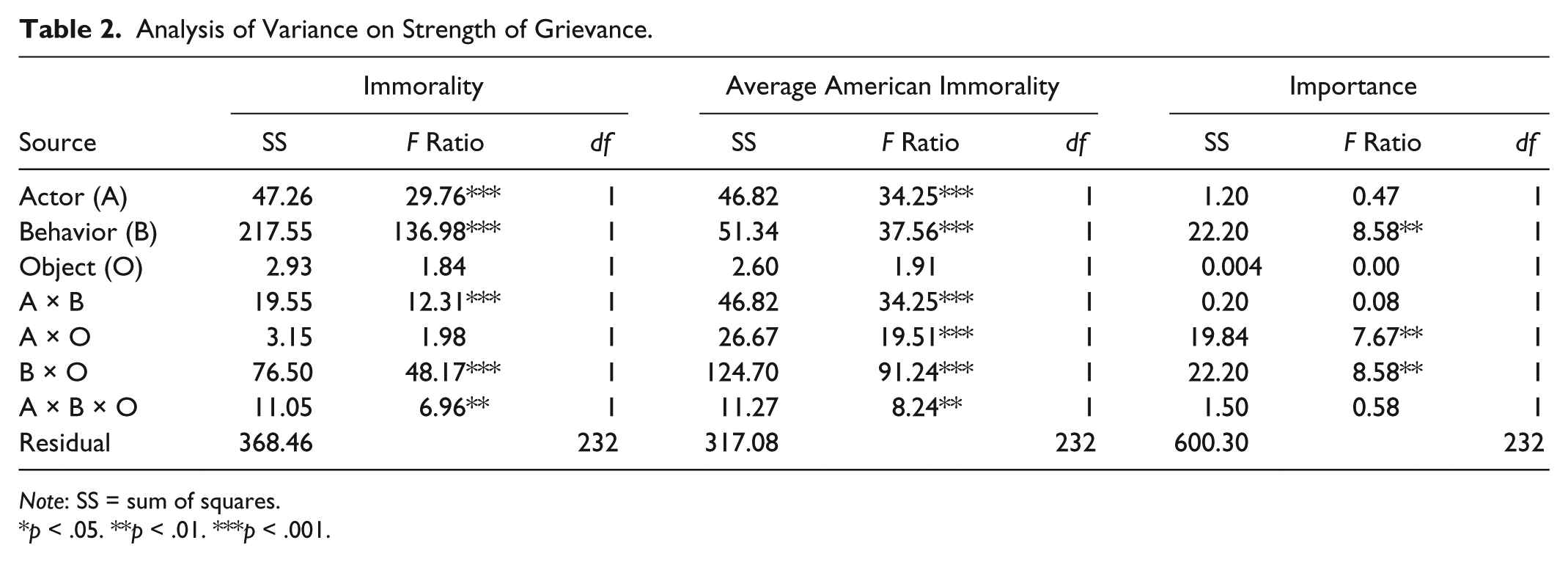
The first well-being hypothesis predicts that bad behaviors arouse more concern and support than do good behaviors. This hypothesis is strongly supported. Table 1 reports the means and standard deviations for these variables, and Tables 2 and 3 report analyses of variance for these outcomes by the experimental factors. As Tables 2 and 3 show, behavior has a significant main effect on all outcomes except perceptions of the average American’s interest in activism, and the main effects indicate that this is in the predicted direction. These results indicate a strong pattern in which bad behavior brings about greater perceptions of immorality, importance, and anger and increases willingness to engage in activism, relative to good behavior, in grievances.
Means and Standard Deviations of Outcomes by Experimental Condition.

Analysis of Variance on Strength of Grievance.
Note: SS = sum of squares.
p < .05. **p < .01. ***p < .001.
Analysis of Variance on Anger and Interest in Activism by Grievance Components.

Note: SS = sum of squares.
p < .05. **p < .01. ***p < .001.
The second well-being hypothesis predicts that the mobilizing effect of bad behavior over good behavior becomes stronger when directed at good objects rather than bad objects. This hypothesis is supported. As predicted, behavior has a stronger effect when the grievance involves a target perceived culturally as good compared to one viewed as bad. The two-way interaction for behavior–object is significant for all variables (see Tables 2 and 3). To understand the nature of the interaction, I analyzed differences in the effect of good or bad objects on outcomes for good behavior separately from bad behavior. Figure 1a graphs outcomes by object for bad behavior, and Figure 1b graphs outcomes by object for good behavior. The means for all variables except perceptions of others’ activism are significantly higher (p < .05) when the bad behavior is directed toward a good victim as compared to a bad victim. Indeed, bad behavior directed toward good objects forms a core component of grievances that bring about the highest levels of anger, perceived injustice and immorality, perceived importance, and willingness to support and engage in activism for a campaign. Participants also believed that the average American would agree with them that harmful behavior toward good victims was the most unjust and immoral of the grievance types.

(a) Outcome means for bad behavior toward object. (b) Outcome means for good behavior toward object.
Deflection Hypotheses
The deflection mechanism predicts that asymmetrical behavior and object pairings (bad behavior directed toward a good object or good behavior directed toward a bad object) will increase outcomes more than will symmetrical evaluations (good-good or bad-bad pairings). As noted earlier, the results show that people have a much stronger reaction to bad behavior directed toward good objects (angrier, more likely to support campaigns and engage in activism to oppose it) and appear to be more willing to tolerate bad behavior directed toward bad objects (not seen as immoral and unjust, either for the participant or by the perceived average American).
Interestingly, though, when one looks at good behavior, another pattern appears (see Figure 1b). For good behavior, all variables except interest in activism had significantly higher means when good behavior was directed at bad targets rather than good targets (p < .05). Importantly, this indicates that, unlike well-being concerns, deflection can speak to positive behaviors: people are more likely to oppose acts of care when they are directed toward groups culturally perceived as bad. Further, participants viewed the average American as having an even steeper increase in their perceptions of injustice and immorality when good behavior was directed at bad targets, indicating a belief that this effect is even stronger in larger American culture. This shows support for the first deflection hypothesis, predicting acts of care toward negative groups will increase affective, cognitive, and mobilizing outcomes.
The second deflection hypothesis predicts that nonsymmetrical behavior from actors (bad acts by good actors or good acts by bad actors) will bring about stronger outcomes than symmetrical actor–behavior acts. While the two-way interaction between actor and behavior did not have the universal significance of behavior–object interactions, it did matter for a number of variables: immorality, average American immorality, activism, and average American activism (see Tables 2 and 3). This appears to be driven largely by the fact that when it comes to good acts, bad actors generate greater concern than do good actors. For bad actors, both good and bad acts are alarming, and the difference between them is small or nonexistent for many outcomes. Participants, in their comments, sometimes noted their suspicion of bad actors performing good acts, while good actors did not raise these same fears. Once again, deflection can be useful for explaining what well-being concerns cannot: the conditions under which good acts can still lead to feelings of injustice.
Finally, we turn to the three-way interaction. The analyses of variance in Tables 2 and 3 show significant three-way interactions between actor, behavior, and object for outcomes except importance and interest in activism. The specific logic behind the third deflection hypothesis, that the behavior–object interaction will be stronger for good actors than for bad actors due to increased sanctioning for norm violations, was not supported, but there were interesting findings.
I conducted separate analyses of variance on the actor–behavior interaction for both good and bad objects. The results of this breakdown show a clear division. When it comes to bad objects, the actor–behavior interaction is not significant for the majority of variables (exceptions are anger and others’ immorality perceptions), and when the interactions are significant, they lack a clear pattern (see examples in Figures 2d through 2f). When it comes to good objects, however, the actor–behavior interaction is significant for all variables except importance, with outcomes showing the same pattern: when bad behavior is directed toward good objects, the effect of actor decreases or ceases to matter (see Figures 2a through 2c). This suggests that bad behavior toward good objects constitutes a powerful form of injustice that generates concern no matter who is the perpetrator.
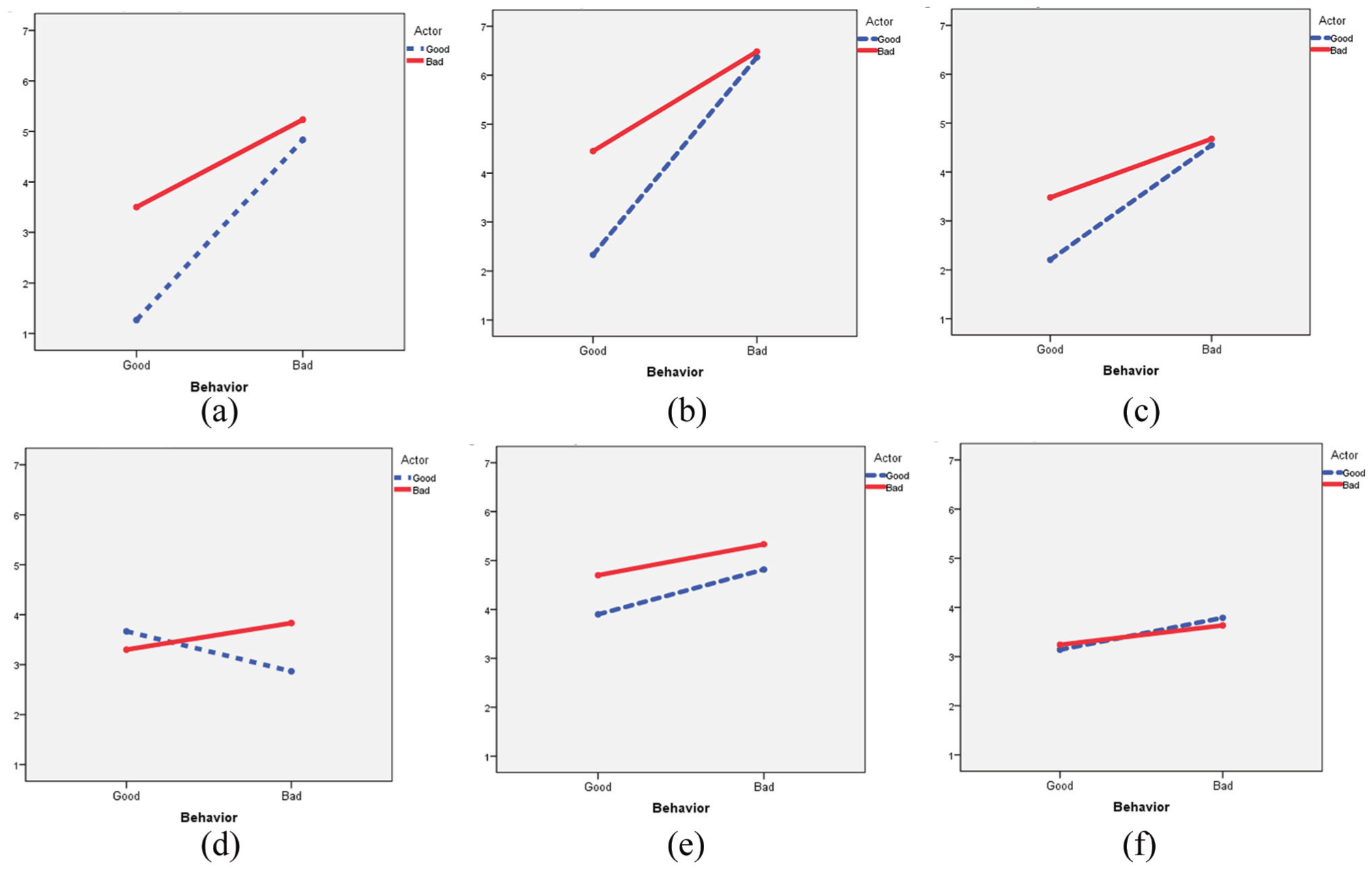
Actor–behavior interaction for good object on the outcomes of (a) anger, (b) perceptions of immorality, and (c) activism and for bad object on the outcomes of (d) anger, (e) perceptions of immorality, and (f) activism.
Discussion
The results show strong support for both of the well-being concerns hypotheses. Bad behavior (as compared to good behavior), especially when directed at good objects (as compared to bad objects), leads to stronger reactions of anger, perceptions of injustice and immorality, and issue importance and is particularly adept at attracting campaign support and a willingness to engage in activism. Bad actors are more alarming than good actors, but this effect essentially disappears in cases of bad acts toward good victims. Thus, to understand the mobilizing power of grievances, look first at the type of behavior and the nature of the aggrieved group. Deflection is likely strengthening the well-being concerns that drive mobilizing outcomes in bad behavior–good object events.
Importantly, deflection can also help to elucidate good behavior. Good acts are seen as more unjust when they benefit negatively perceived groups or stem from negatively perceived actors. While protests against acts of care are less common, they do occur. For example, conservative talk-radio host Glenn Beck faced criticism and backlash after he promised to provide teddy bears, soccer balls, food, and other supplies to unaccompanied Central American children housed in border security detention facilities in Texas. When several buses attempted to transfer children and their parents from the overcrowded Texas facilities to California, hundreds of angry protestors blocked the road, forcing the buses to turn around. Similar dynamics played out again with concerns about family separations at the border. When a Senate candidate attempted to deliver water, food, blankets, books, and toys to detained migrant children, he was denied entry and ultimately arrested and charged with criminal trespass after refusing to leave. In these cases, providing care to the undocumented immigrants was contested. Looking at protestors’ comments, many perceived the undocumented immigrants negatively, calling them criminals, diseased, gang members, and worse.
This reflects the idea that, when it comes to movement campaigns, there are likely to be framing contests warring to define the identities attached to perpetrators and victims as well as the nature of the act. We see this happening in issues surrounding police brutality and the Black Lives Matter movement. While minority racial categories do not receive direct negative ratings on the evaluation profile, race likely affects what identities get attached to groups and people. When Michael Brown, an 18-year-old black man, was fatally shot in Ferguson, Missouri, some political commentators depicted him as a “criminal” or “thug” (he was suspected of stealing cigarillos) rather than as a “high school student” or “college student” (he had just graduated from high school and died two days before starting a technical college). To what extent race factored into which identities became attached to Michael Brown is important given the large gulf between these positive or negative identities (“student” evaluation rating = 1.86; “criminal” evaluation rating = −2.67).
This study has a number of limitations. I used very short, one-sentence events to prevent accidental introduction of new factors through additional text (e.g., modifiers and settings) and to preserve consistency across varied combinations. However, one concern might be that these events were not elaborate enough to draw in an audience and make them care enough about the issue to engage in activism. However, any disinterest produced by the single-sentence format and lack of details around the event is distributed across the conditions. Also, in today’s digital age, where headlines, tweets, and Facebook posts communicate news in a short format, the idea that grievances might be communicated in less than a few sentences might actually be quite realistic.
Another concern is that these findings are specific to the chosen manipulations and do not actually reflect broader patterns. But turning to the main conclusions, would we expect that a majority of people would care more about preventing harm to groups culturally perceived as bad over those culturally perceived as good? Would they prefer preventing harm to rapists over mothers or, in a less negative case, preventing harm to smokers over schoolchildren? Similarly, what would the average person likely be more upset about—sending aid to prisoners or sending aid to nurses? Or what would they find more alarming—white supremacists making donations or doctors making donations? My experimental findings make intuitive sense. Some might argue they state the obvious, even. But if that is the case, and the nature of grievances so clearly matters for what issues arouse anger or get support, isn’t it important to incorporate this into models of civic engagement? This research takes a first step toward formally documenting a systematic understanding of the differential effects of grievances in inspiring public support and mobilization. In doing so, it recognizes the political reality that due to the identities attached to them, some groups are more privileged in appealing to the public and others face an uphill battle.
Finally, a note on the scope of this research: I focused on whether there is differential mobilizing strength of grievances depending on content and looked at how grievances compare to each other (rather than their relative importance among other established processes). My claim is not that grievances are sufficient for bringing about mobilization; decades of social movement literature have demonstrated the importance of factors like resources and political opportunity structures. Rather, I added grievances as another variable (and one not often considered) that could affect mobilization and, by extension, that it could do so through these other mechanisms. Grievances with more advantaged content (e.g., those focused on the rights of schoolteachers rather than the rights of sex offenders) could see trickle-down effects into increased resources (e.g., more of the public willing to donate) and increased political access (e.g., less risky issue for politicians to support).
Conclusion
This research is the first to parse grievances into basic core components to understand whether some grievances are more successful than others in arousing mobilizing, affective, and cognitive reactions that can advantage social movements. The application of ACT to social movement grievances also suggests an extension of ACT to collective action. In turn, concepts from ACT, specifically, evaluation ratings and deflection, contributed to the development of a broad, theoretical framework for understanding grievances.
I also expect that there are many other unexplored ways that the content of grievances differentially affects public reactions and interest in activism. ACT suggests one such route: evaluations of potency (powerfulness or powerlessness) of identities. Is our interest in aiding a cause partially contingent on how powerless or vulnerable the aggrieved group is perceived to be? Future research could investigate how differences in the perceived potency of aggrieved groups affects sympathy and support.
A contribution of this study is that it suggests ways that social movement actors can engage in more effective framing strategies. For example, a factor that promoted drunk-driving legislation was the idea of a “killer drunk” who threatens the lives of others (Gusfield 1981). While drunk is already viewed as slightly bad on evaluation profile ratings, the addition of killer puts it on par with some of the most egregious identities. This then creates an effective label—“killer drunk”—which helps to identify drunk driving as an injustice worth addressing.
In sum, this study finds support for the idea that not all grievances are created equal when it comes to public backing and activism and that, importantly, the content of grievances can be studied in systematic ways that illuminate the types of grievances expected to yield higher rates of concern and mobilization. Investigating how grievances differentially appeal to potential sympathizers and attract resources is relevant for all types of civic engagement, including volunteer work, charitable giving, and voting behaviors. Further, it has the real-world implications of identifying the types of issues and social problems less likely to attract support and action. If the civic and political sectors are less willing to take action to help particular aggrieved groups, this increases the likelihood that these types of grievances persist.
Footnotes
Acknowledgements
I would like to thank Linda Molm, Kraig Beyerlein, Brian Mayer, Erin Leahey, and Robin Stryker for their helpful comments on earlier drafts of this paper.
Funding
The author disclosed receipt of the following financial support for the research, authorship, and/or publication of this article: A grant from the National Science Foundation helped support this research (Award No. 1102555).
