



Abstract
This paper explores the application of affect control theory (ACT) to the study of morality. A concise statement of ACT sets the stage for presenting examples of applying the theory to morality. This includes exploring the moral implications or overtones of social concepts (social identities, behaviors, traits, and settings); computer simulations of impressions created by moral and immoral events; and a discussion of several studies directly applying ACT to morality. The paper concludes with a detailed discussion of what ACT can contribute to moral psychology and the sociology of morality.
The American Psychological Association Dictionary (VandenBos, 2007) defines morality as “a system of beliefs or set of values relating to right conduct, against which behavior is judged to be acceptable or unacceptable.” Consistent with this definition, the focus of moral psychology is on moral judgments, “evaluations (good vs. bad) of the actions or character of a person that are made with respect to a set of virtues held to be obligatory by a culture or subculture” (Haidt, 2001, p. 817).
This paper explores the application of affect control theory (hereafter, ACT) (Heise, 1979, 2007; MacKinnon, 1994; Robinson & Smith-Lovin, 2018) to morality. A concise statement of the theory sets the stage for presenting specific examples, including the moral implications or overtones of social concepts (identities, behaviors, traits, and settings); computer simulations of moral and immoral impressions created by events; and a discussion of several studies directly applying ACT to morality. A concluding section details how ACT can contribute to moral psychology and the sociology of morality.
These contributions include an established and efficient measurement model for evaluating the actions and identities involved in moral judgments; the ability to deal with a wide range of evaluative judgments; an expansion of the dimensionality of moral judgments beyond evaluation to potency and activity; a formal mathematical model and computer program for simulating the moral outcomes of events; the ability to add contextual fabric to moral judgment vignettes; an extended model for studying morality at the level of the global self; and, finally, illuminating the dimensionality and content of moral judgments with reference to the five dimensions of Moral Foundations Theory (MFT) (Haidt, 2012).
Affect Control Theory
Affect control theory (ACT) (Heise, 1979, 2007; MacKinnon, 1994; MacKinnon & Heise, 2010; Robinson & Smith-Lovin, 2018) proposes that people are motivated to enact behaviors that are culturally appropriate to the situational identities of self, the situational identities of others, and the institutional setting.
The data for ACT consist of cultural sentiments for social concepts measured on semantic differential scales corresponding to the EPA (evaluation, potency, and activity) structure of affective-connotative meaning. Ranging from −4.3 to +4.3, actual values generally fall between ±3, with ±2 considered a large (positive or negative) value. Cultural sentiments are estimated by aggregating individual scores on these scales.
Because semantic differential scales serve as generalized attitude scales (Osgood et al., 1957), they allow one to measure all kinds of social objects—social identities, interpersonal behaviors, social settings, social characteristics, personality traits, and emotions—on a single, common metric. Moreover, EPA scales provide a mathematically coherent metric for making predictions in the same Euclidean space as the cultural data. Predictions are made with Interact, 1 the computer program for simulating social events and their affective and cognitive outcomes.
ACT is based on three fundamental principles: (1) affective reaction, (2) affect control, and (3) reconstruction, which together “describe a cybernetic process of lower- and higher-order feedback wherein past cognitions evoke affective reaction and current affective states influence subsequent cognitions” (MacKinnon, 1994, p. 50). 1. The affective reaction principle proposes that people respond affectively to events, experiencing transient impressions or feelings for the actors, behaviors, and object-persons involved in them. Transient impressions are estimated by empirically-based impression-formation equations. The equation for predicting actor evaluation, for example, reveals that good acts generate transient impressions of morality for the actor; bad acts, impressions of immorality. This “morality effect is one of the most important factors in impression formation” (Heise, 2007, 38). Good and bad actions also affect the object-person in an event. The equation for predicting object-person evaluation reveals that the recipient of a positively evaluated action appears nicer while a negatively evaluated action devalues the object-person.
In addition to the morality effect, behavior affects actor evaluation via consistency effects. Both behavior-object consistency—doing nice things to good people or bad things to bad people—and actor-behavior consistency—doing good things if a good actor or bad things if a bad actor—contribute to the overall evaluation of an actor. In addition, across-dimension congruency affects the overall evaluation of an actor. For example, acting nicely to weak object-persons makes an actor seem good, while acting abusively to weak object-persons makes an actor seem bad. I refer back to these effects in my discussion of findings from analysis of the impressions of morality created by events. 2. While the affective reaction principle pertains to impression-formation, the affect control principle applies to impression-management. According to this principle, people are motivated to construct and interpret events to minimize the discrepancy (called deflection in ACT) between internalized cultural sentiments and the transient feelings produced by events or, equivalently, to optimize consistency between the two. 3. The reconstruction principle proposes that when people cannot minimize deflection through restorative actions, then they attempt do so by re-identifying event participants through identity labeling or attribution of explanatory traits. The attribution equations of ACT are derived from empirically-based amalgamation equations describing the combination of identities with traits and other attributions.
While ACT is a theory about identities rather than the self per se, it has been extended into a theory of self entitled ACT-Self (MacKinnon & Heise, 2010; MacKinnon, 2015). According to ACT, identities are confirmed by selecting and enacting behaviors; according to ACT-Self, the self is confirmed by selecting and enacting identities, which in turn are confirmed by enacting behaviors. In other words, the self-process is a higher-order cybernetic system controlling the lower-order cybernetic system of identity processes. Thus, when a person experiences inauthentic self-sentiments as a consequence of enacting a situational identity that is out of character or immoral, ACT-Self predicts that the person will enact a redeeming identity that will optimally restore her or his usual EPA levels of self-esteem, self-efficacy, and self-activation. I return to the affect control theory of self below in my discussion of moral identity research in the sociology of morality.
Illustrations of ACT Applied to Morality
This section presents three examples of how affect control theory can be applied to morality: (1) using EPA measures of cultural sentiments to identify the moral implications or overtones of social concepts (identities, behaviors, settings, and traits); (2) using the impression-formation equations to illustrate the effects of behavior on the moral evaluation of actors and object-persons; and (3) discussing two exemplary studies that have explicitly applied ACT to the study of morality.
Moral Implications or Overtones of Concepts
In this section I show how ACT can be used to explore the moral implications or overtones of identities, behaviors, settings, and traits outside the context of any event. These concepts by themselves evoke connotations of immoral events, which become amplified for concepts defined in action terms (e.g., a killer is one who kills; a rapist is one who rapes; an execution is an event where an individual is killed, and so on.)
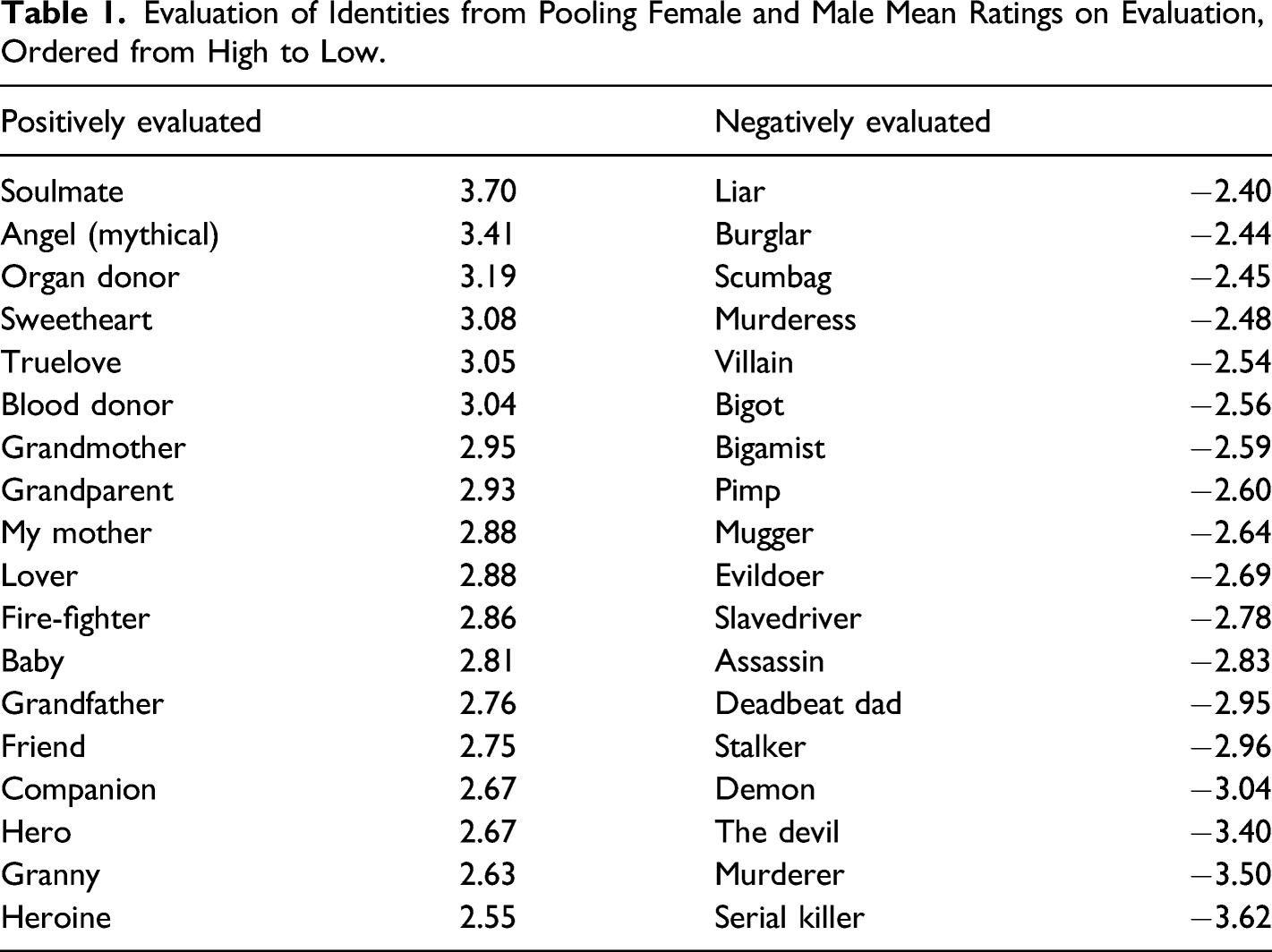
Evaluation of Identities from Pooling Female and Male Mean Ratings on Evaluation, Ordered from High to Low.
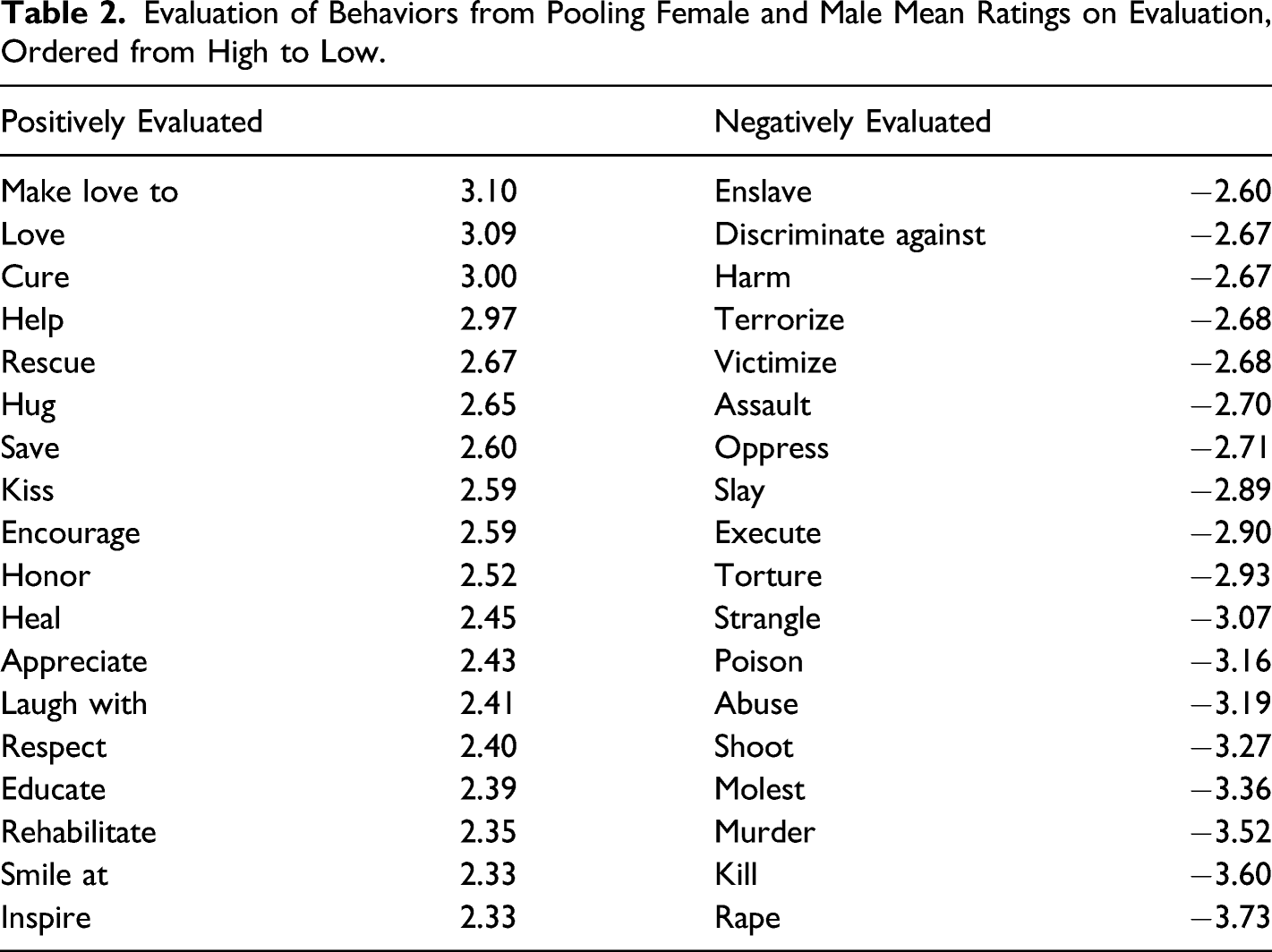
Evaluation of Behaviors from Pooling Female and Male Mean Ratings on Evaluation, Ordered from High to Low.
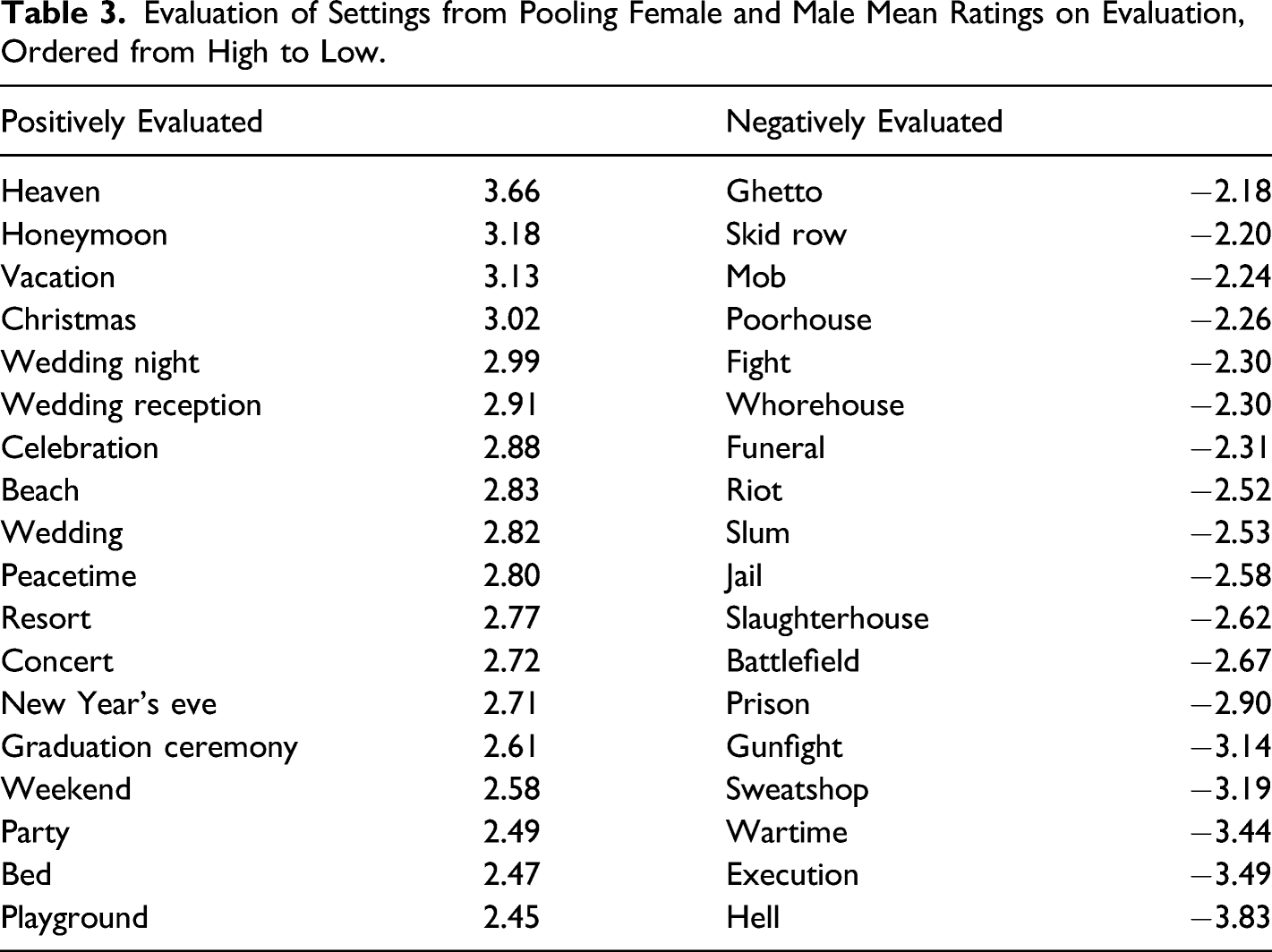
Evaluation of Settings from Pooling Female and Male Mean Ratings on Evaluation, Ordered from High to Low.
Evaluation of Traits from Pooling Female and Male Mean Ratings on Evaluation, Ordered from High to Low.
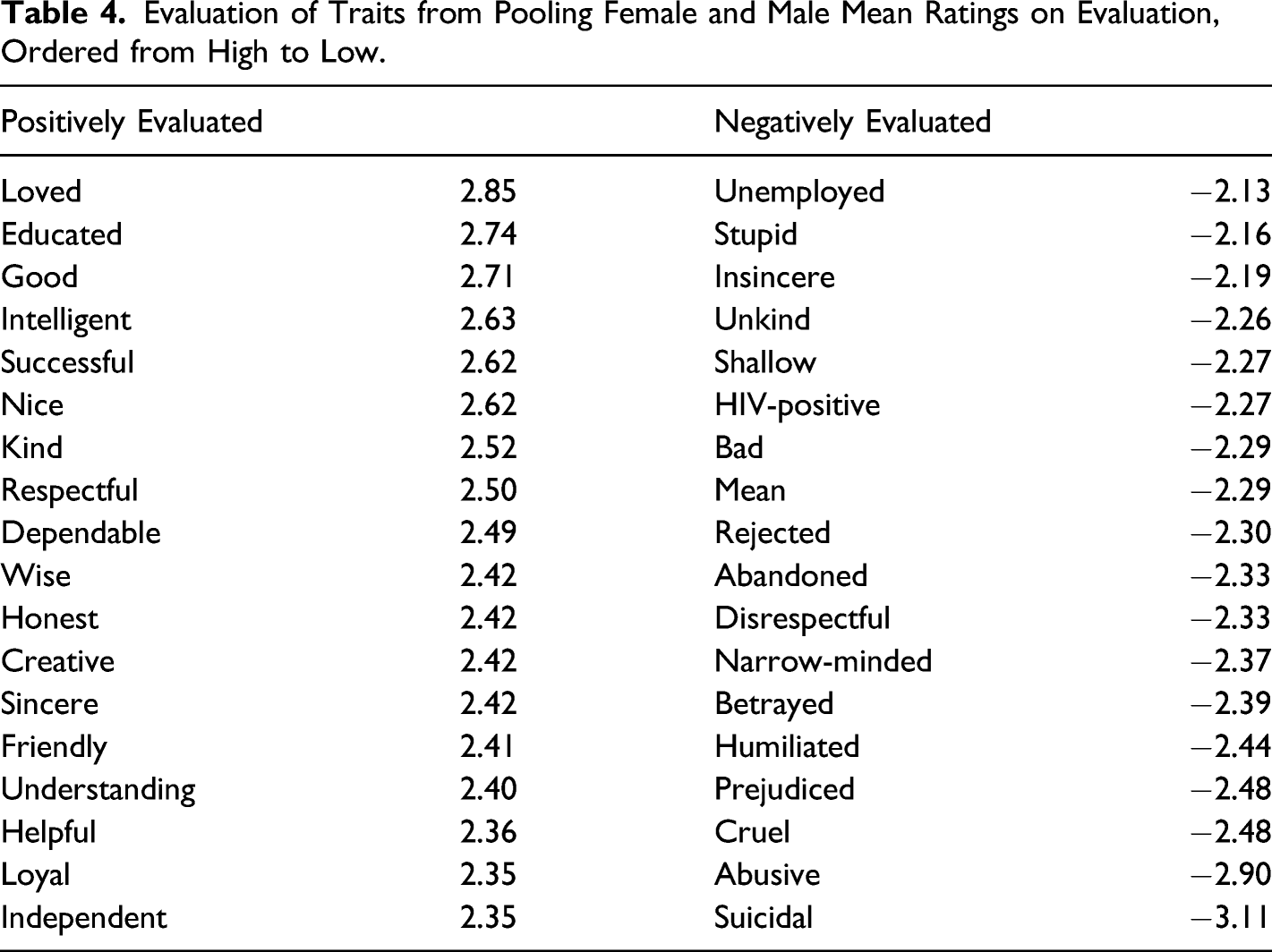
Tables 1 to 4 report lists of identities, behaviors, settings, and traits that have the most extreme negative and positive scores on evaluation, employing EPA data collected from a sample of Canadian university students (MacKinnon, 2006). To enhance clarity of presentation, male and female mean ratings have been pooled, and only the eighteen concepts highest and lowest on evaluation are reported for each type of concept.
As reported in Table 1, the list of highly evaluated social identities include those pertaining to love relationships (soulmate, sweetheart, truelove, and lover), friendship (companion and friend), parental figures (my mother, grandmother, grandfather, grandparent, and granny), altruism (blood donor and organ donor), heroism (firefighter and hero), and one religious/mythical identity (angel). Since identities have implications for actions, these are the kinds of actors we might expect to engage in moral behavior
The list of the most negatively evaluated or immoral identities pertain to killing (murderer, serial killer, assassin, and murderess); evil (the Devil, demon, villain, and evildoer), deviance and crime (mugger, stalker, pimp, bigamist, crook, and burglar), and faulty character or exploitation (scumbag, liar, bigot, jerk, slavedriver, and deadbeat dad).
As reported in Table 2, the most highly evaluated actions include those pertaining to love and affection (make love to, love, hug, and kiss); assisting and rehabilitative acts (cure, help, rescue, save, heal, aid, and rehabilitate); and a variety of empathetic or uplifting acts (respect, encourage, honor, appreciate, laugh with, smile at, and inspire). Educate also appears in the list of highly evaluated behaviors.
The list of the most negatively evaluated behaviors include rape as the most immoral action, followed by other harmful and murderous actions (kill, murder, molest, shoot, abuse, poison, strangle, torture, execute, slay, oppress, assault, victimize, terrorize, harm, discriminate against, and enslave).
Like identities, settings have implications for actions; some places and events are associated with moral actions; others, with immoral actions. Heaven is at the very top of the list of positively evaluated settings and Hell at the very bottom of negatively evaluated settings. Between these extremes, we have places or events pertaining to weddings (honeymoon, wedding reception, wedding night, and wedding) as well as those related to other celebratory events (celebration, Christmas, graduation ceremony, and New Year’s Eve). Other settings refer to leisure (vacation, beach, resort, bed, concert, weekend, party, and playground). Interestingly, but not surprising, peacetime appears among the most highly evaluated settings.
Turning to highly devaluated settings, hell is followed by places or events pertaining to war or violence (execution, wartime, gunfight, battlefield, riot, mob, slaughterhouse, and fight), incarceration (prison and jail), and poverty (sweatshop, slum, poorhouse, ghetto, and skid row). Whorehouse also appears as a highly devaluated setting, implying that culturally disapproved sexual practices take place there. However, not all negatively evaluated settings imply a potential for immoral acts, as exemplified by funeral, a setting associated with sadness but not immorality.
Like identities, actions, and settings, the traits attributed to people often have affective-connotative overtones of morality or immorality. However, as reported in Table 4, there are fewer traits that are clearly moral or immoral compared to identities, actions, and settings. While traits such as intelligent, successful, independent, wise, creative, and educated are highly evaluated, they cannot be said to be necessarily moral. Similarly, to be loved refers to a highly valued affective state for most people but it does not necessarily imply morality. Highly evaluated traits that do imply moral actions include good, nice, kind, respectful, dependable, sincere, respectful, helpful, loyal, honest, understanding, and friendly.
Like positively evaluated traits, negatively evaluated traits reported in Table 4 do not necessarily have apparent moral implications. In the present case, this is exemplified by humiliated, betrayed, unemployed, shallow, rejected, HIV-positive, abandoned, and stupid. Negatively evaluated traits that more clearly imply immoral actions include suicidal, abusive, prejudiced, cruel, disrespectful, unkind, bad, mean, insincere, and narrow-minded,
In summary, this first illustration of ACT applied to morality shows that one can discern the moral implications or overtones of identities and other social concepts by simply examining their values on evaluation. As observed above, potency can amplify or dampen the effect of evaluation on the moral overtones of concepts (and so can activity, albeit often to a lesser extent). A grandmother, for example, is unlikely to engage in immoral actions such as any of those listed in Table 2, not only because of her high evaluation (2.95), as reported in Table 1, but also because of her low potency (.21) and even lower activity (−2.26).
In addition to affective-connotative meaning, cognitive-denotative meaning also plays a role in the moral implications of concepts. As reported in Table 3, for example, a funeral is very negative on evaluation (−2.31), but it is unlikely that anyone would consider it as an immoral social setting—sad for sure but not immoral.
Impressions of the Morality of Actors and Object-Persons in Events
As discussed above, the impression-formation equations of ACT predict the transient impressions of identities and actions created by social events. As reported there, the equation for predicting the post-event evaluation of an actor includes the evaluation of the behavior (the morality effect), behavior-object and actor-behavior consistency in evaluation, and across-dimension (evaluation, potency, activity) congruency effects. Recall also that behavior evaluation affects the transient impression of the object-person, exemplified by devaluation of the recipient of a negatively evaluated act.
Transient Impressions of Actor and Object Evaluation Created by Events (Male Values are Outside Parentheses; Female Values Within.)
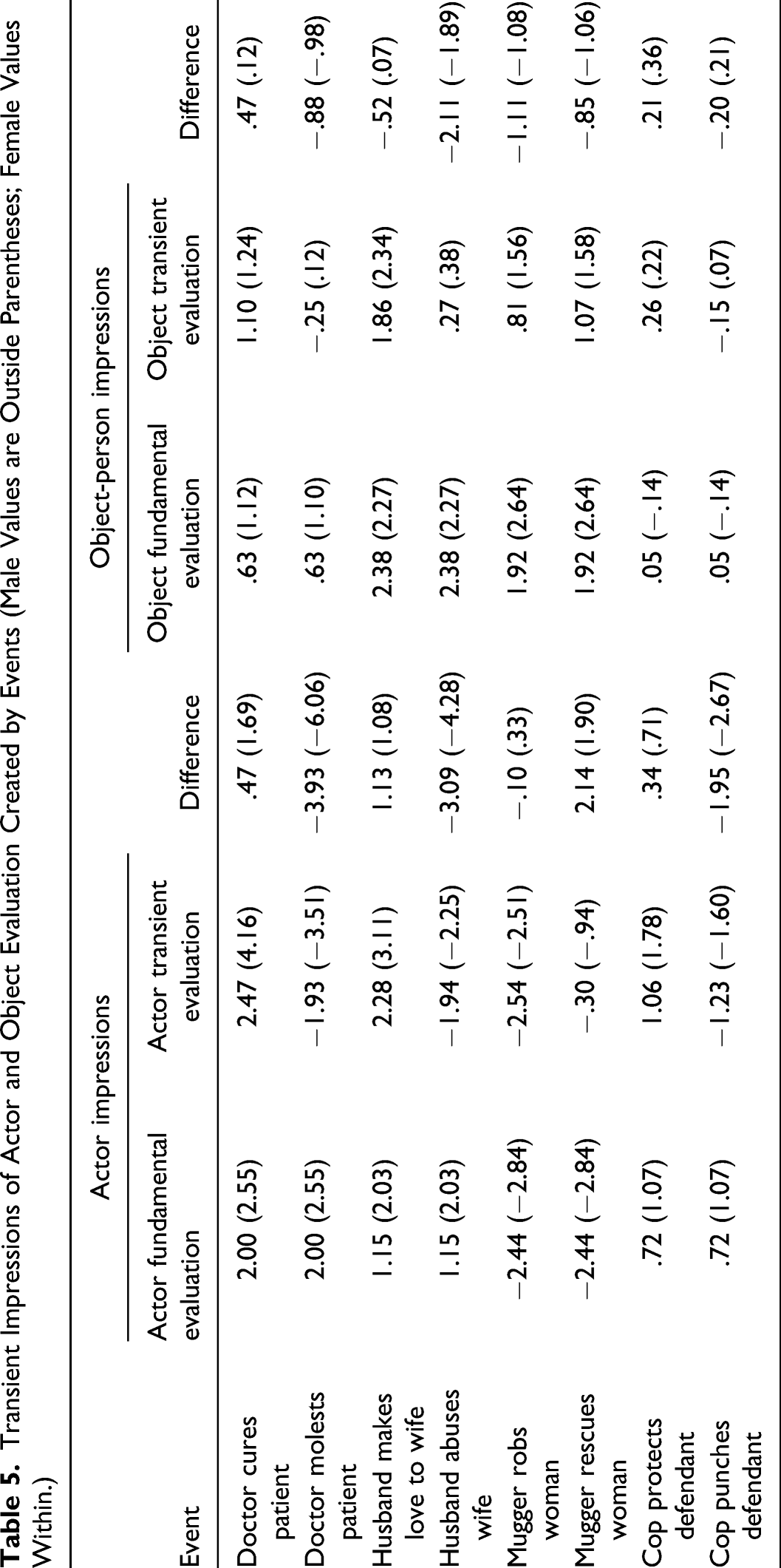
For male cultural sentiments and impression-formation equations, a doctor gains .47 in evaluation by curing a patient and declines in evaluation by a dramatic −3.93 for molesting one. These impressions are even more pronounced (1.69 and −6.06, respectively) for females. Similarly, a husband gains in evaluation by making love to his wife [1.13 (1.08)], but plummets in evaluation if he abuses her [−3.09 (−4.28)]. A cop seems a little nicer when protecting a defendant [an increase of .34 (.71)] but extremely immoral by punching a defendant [a decline of −1.95 (−2.67)]. Turning to the only negative identity in Table 5, the impression of a mugger does not change appreciably as a consequence of robbing a woman [−.10 (.33)], because this is the kind of immoral action in which a mugger engages when acting in character. However, a mugger gains dramatically in evaluation [2.14 (1.90)] by rescuing a woman, an extremely moral and out of character action for a mugger.
The last three columns of Table 5 illustrate how the same events affect the impression of morality for the object-person in an event. A patient gains a little in evaluation [.47 (.12)] when cured by a doctor, as does a defendant [.21 (.36)] when protected by a cop. While remaining a highly evaluated person, a woman declines slightly in evaluation after her husband has made love to her, but this drop in evaluation occurs for males only (−.52). However, the evaluation of a woman declines notably when rescued by a mugger [−.85 (−1.06)], even though the mugger’s evaluation has dramatically increased. Perhaps the most dramatic finding is the devaluation of the object-person, which occurs when a doctor molests a patient [−.88 (−.98)], a husband abuses a wife [−2.11 (−1.89)], or a mugger robs a woman [−1.11 (−1.08)].
As in the preceding section, this section on impression-formation has considered only evaluation, the defining dimension of morality, because of considerations of space. Additional analysis could explore the role of potency and activity in moral judgments. For example, Kroska and Schmidt (2018) found that actors higher on potency were viewed as more immoral after an immoral action than actors equal on evaluation but lower in potency. And as discussed in the preceding section on the moral overtones of concepts, cognitive-denotative meanings and deliberations also play a role in the moral judgments of events.
While EPA scales code a lot of cognitive-denotative information, they do not code all of it. There are many acts that would be considered immoral by most people in most cultures but would seem affectively appropriate in ACT analysis because they produce little deflection (e.g., a mother making love to her son). In this case, violation of a more cognitive normative rule rather than affective response is required to explain the perceived immorality of the act. In other cases, specifying the institutional context in Interact analysis with cognitive filters (lay, business, law, politics, academe, medicine, religion, family, and sexuality) helps to sift out anomalies.
Finally, it must be emphasized that simulations of moral judgments should be considered as theoretical predictions that must be tested with experimental or other kinds of research designs.
Studies Illustrating the Application of ACT to Morality
Heise (2007) has shown that evaluation ratings of concepts are remarkably similar across five countries (Canada, Germany, Ireland, Japan, and the United States), with a mean cross-cultural correlation of .81 for social identities and .88 for behaviors. “So people brought up in these …cultures largely agree about who is good and who is bad, and about which actions are moral and which are immoral” (Heise, 2007, p. 19). On the other hand, there is a fair bit of residual variance in moral sentiments unaccounted for by these correlations (34% for identities and 23% for behaviors), which is consistent with findings from moral psychology research on the variability in moral judgments across cultures (e.g., Haidt et al., 1993). This variability points to the need for employing culture-specific EPA measures of concepts and, by implication, impression-formation equations as well, in cross-cultural studies employing ACT, which is exactly what Hitlin and Harkness (2018) did in a new and creative approach to cross-cultural research in social psychology.
For the same five countries, Hitlin and Harkness (2018) applied ACT to study cross-cultural variation in moral emotions produced by the same events. Instead of employing actual EPA data from each country in Interact simulations, which would require translation of terms for identities, behaviors, and other concepts, they constructed numerical EPA profiles “to test equivalently good, active, and potent (or not) concepts across nations.” A clever procedure employed previously by Kroska and Harkness (2011), this enabled Hitlin and Harkness to simulate events that “affectively ‘feel’ the same in different cultures, regardless of what that linguistic term actually is” (2018, p. 150). Using these numerical EPA profiles and culture-specific impression-formation equations, they ran a strategically designed set of 2000 Interact simulations, coding the emotion retrievals from the analysis into four categories of moral emotions: self-sanctioning (e.g., shame, guilt, and embarrassment), other-sanctioning (e.g., disgust, anger, and contempt), compassion (emotions expressing empathy or sympathy towards others), and praise (emotions expressing gratitude and joy toward others). 4 Supporting their theoretical predictions, they found that negative self-sanctioning and other-sanctioning moral emotions are much more common in countries with high levels of inequality (United States and China) while the positive communal emotions of compassion and praise are much more likely to occur in countries with lower levels of inequality (Germany, Japan, and Canada).
A second example of applying ACT to the study of morality, Restrepo (2021) employed EPA data from ACT to operationalize and test the template-matching theory of Schein and Gray (2015), a prominent theory in moral psychology. According to this theory, we compare a perceived event to our cognitive template of a typical immoral act, and if it closely matches the template, we judge it to be a moral transgression. The theory also views an immoral act as having a dyadic structure, involving an intentional agent directing a damaging behavior towards a vulnerable recipient. Capitalizing on the equivalence of this dyadic structure to the ABO structure of events in ACT, Restrepo translated the cognitive-denotative meanings of 25 hypothetical moral situation vignettes from moral psychology into affective-connotative meanings using EPA data from ACT.
Subjects rated how immoral, harmful, and unexpected the 25 translated scenarios are on 5-point Likert scales. Analysis revealed positive relationships between the average rated immorality of each scenario and average ratings of harmfulness and unexpectedness. Consistent with Schein and Gray’s theory, behavior evaluation and behavior potency are among the best predictors of the perceived immorality of events. Analysis also revealed an effect for object potency, an objective indicator of the vulnerable object-person in Schein and Gray’s prototype of an immoral event.
Restrepo also calculated Euclidean distances in three-dimensional space between the EPA profiles for each of the 25 vignette scenarios and the EPA profile of the prototypical immoral event, “A person kills a child.” Supporting the template-matching theory of Schein and Gray (2015), the Euclidean distance of vignette from prototype predicted the time it took for subjects to categorize events as immoral or not immoral, with reaction time serving as a proxy for the cognitive demand of the categorization task. Results reveal a quadratic rather than a linear effect, with subjects quickly classifying events that are very close to or far apart from to the prototypical immoral event, with events in the middle taking longer to be classified, presumably because they are more ambiguous.
Potential Contributions of ACT to Moral Psychology and the Sociology of Morality
Restrepo’s test of Schein and Gray’s (2015) template-matching theory illustrates the relevance of ACT to moral psychology. Its relevance is also illustrated by features ACT shares of with another prominent theory in moral psychology, social intuitionism theory (hereafter, SIT) (Haidt, 2001, 2006, 2012; Haidt & Craig, 2004; Haidt et al., 1993). Both ACT and SIT are based on a dual systems model of mental processing, consisting of a fast, intuitive system below the threshold of consciousness and a slower, cognitive-rational system more available to consciousness. Additionally, both theories emphasize the fast-intuitive system—in moral judgments for SIT and in evaluative judgments more generally for ACT. And both theories view the role of the slower cognitive-rational system as operating mostly after the fact—providing post hoc justifications of moral judgments in the case of SIT and cognitive revisions of events in the case of ACT.
The relevance of ACT to the sociology of morality is exemplified by the cross-cultural study of Hitlin and Harkness (2018) discussed above, which also reflects a resurging interest in morality by sociologists in the last two decades (Hitlin and Vaisey, 2010). The application of identity theory (IT) to moral identity represents a major thrust in this direction (e.g., Stets and Carter, 2011, 2012). Based on a control systems approach similar to ACT, the basic idea is that people are motivated to confirm a “moral identity standard” containing “the meanings an individual associates with being a moral person” (Stets and Carter, 2012, p. 124). I return to Stets’ work on moral identity below.
This raises the question as to what ACT can offer moral psychology and the sociology of morality beyond these relevancies or shared features. First, ACT contains an established and efficient procedure for measuring the evaluation of actions and identities involved in moral judgments of events. Second, ACT deals with a much broader range of evaluative judgments than moral judgments, tapping into the “large gray area of marginally moral judgments” (Haidt, 2001, p. 817). Third, ACT expands the dimensionality of moral judgments beyond evaluation to include the potency and activity dimensions of affective-connotative meaning.
Fourth, ACT offers a formal mathematical model and computer program that researchers in moral psychology and the sociology of morality could use to generate hypotheses for empirical testing.
Fifth, ACT enables one to add contextual fabric to events in moral judgment vignettes or scenarios studied by moral psychologists and sociologists of morality. For example, ACT allows one to specify institutional and event settings (S) (e.g., hospital, home, and a sports event) and to simulate ABO-S events. Additional context can be added by modifying identities with traits or affective moods (e.g., an angry doctor).
Sixth, the ACT theory of self (ACT-Self) described above would enable moral psychologists and sociologists of morality to measure moral behavior at the level of self, identifying redeeming identities that would optimally restore a person’s sense of moral self-integrity. Although Stets concept of moral identity discussed above has the global self as its referent, their control systems model treats the moral identity in the same way as any other any identity. Like the original formulation of ACT, identity theory is a theory of identity processes rather than of the global self-process, a theory of identity-verification rather than self-verification (MacKinnon and Heise, 2010).
Seventh, ACT may also shed some light on the dimensionality and content of moral judgments. While the five dimensions proposed by Moral Foundations Theory (MFT) 5 (Haidt, 2012) have proved very useful (e.g., in distinguishing between political liberals and conservatives), some might consider them as numerically arbitrary. In contrast, the EPA dimensions of affective-connotative meaning employed by ACT have been long established as numerically stable, cross-cultural universals (Osgood et al., 1975). And, as observed above, EPA semantic differential scales provide a mathematically coherent metric for making predictions in the same Euclidean space as the cultural data of ACT.
In this regard, the five dimensions of MFT can be collapsed into the three-dimensional space of ACT. This can be accomplished by assigning EPA values to the key words of the MFT foundations (1. care/harm; 2. fairness/cheating; 3. loyalty/betrayal; 4. authority/subversion; and 5. sanctity/degradation); or their corresponding characteristic emotions (1. compassion; 2. anger, gratitude, and guilt; 3. group pride and rage at traitors; 4. Respect and fear; 5. disgust); or their corresponding relevant virtues (1. Caring and kindness; 2. fairness, justice, and trustworthiness; 3. loyalty, patriotism, and self-sacrifice; 4. Obedience and deference; 5. temperance, chastity, piety and cleanliness) (from Haidt, 2012, p. 104). With the translation of MFT terms into EPA values, three-dimensional graphs could be used to explore clusters of MFT terms in EPA space. Besides establishing an affective-connotative interpretation of the five dimensions of MFT, this would inform ACT simulations of events relevant to MFT.
There remains the question as to whether the EPA measurement model of ACT can distinguish between moral violations and other kinds of negatively evaluated actions such as violations of purity or hygiene. A partial answer would be that moral violations tend to have more extreme values on evaluation (see right-hand column of Table 2). In addition, immoral violations tend to be more powerful and often more lively than violations of normative conventions. From pooling male and female ratings as done for evaluation in Tables 1–4, “to kill someone,” for example, has a potency rating of (2.12) and an activity rating of (.93), while “to offend someone,” as in violation of a normative convention about purity, has much lower potency (.90) and activity (.22) ratings
Summary and Conclusion
Following a description of ACT, this paper presented examples of how the theory can be applied to the study of morality: (1) using EPA measures of cultural sentiments to study the moral implications or overtones of concepts; (2) using the impression-formation equations to show the effects of moral and immoral actions on the evaluation of actors and object-persons; and (3) discussing two exemplary studies demonstrating the application of ACT to the study of morality. A concluding section of the paper provided a detailed discussion of what ACT has to offer to the study of morality.
In conclusion, this paper is motivated in part by a concern with advancing a more unified social psychology by integrating psychological and sociological approaches. Commenting on ACT, the psychologists Clore and Pappas (2007, p. 338) observed that “there are many parallels and potential points of contact between our own and others’ work in psychology and that of Heise and his colleagues in sociology,” so that it is surprising that there has been “so little contact.” Hopefully, this paper will make a modest contribution towards reducing the isolation of the two foundational disciplines of social psychology.
Footnotes
Acknowledgments
The author wishes to thank Amy Kroska, Lynn Smith-Lovin, and two anonymous reviewers for their suggestions for revision.
Declaration of Conflicting Interests
The author(s) declared no potential conflicts of interest with respect to the research, authorship, and/or publication of this article.
Funding
The author(s) disclosed receipt of the following financial support for the research, authorship, and/or publication of this article: The data reported in this paper are derived from research funded by the Social Sciences and Humanities Research Council of Canada (Project # 410-04–3887).
