




Abstract
Despite increasingly frequent mass shootings and a growing dissatisfaction with current gun laws, American opposition to federal gun legislation remains strong. The authors show that opposition to stricter gun control is closely linked to Christian nationalism, a religious cultural framework that mandates a symbiotic relationship between Christianity and civil society. Using data from a national population-based survey, the authors show that Christian nationalism is an exceptionally strong predictor of opposition to the federal government’s enacting stricter gun laws. Of all the variables considered, only general political orientation has more predictive power than Christian nationalism. The authors propose that the gun control debate is complicated by deeply held moral and religious schemas that discussions focused solely on rational public safety calculations do not sufficiently address. For the substantial proportion of American society who are Christian nationalists, gun rights are God given and sacred. Consequently, attempts to reform existing gun laws must attend to the deeper cultural and religious identities that undergird Americans’ beliefs about gun control.
Despite declines in violent crime including homicide for the past three decades, mass shootings have climbed (Arthur 2017; Federal Bureau of Investigation 2013; Follman, Aronsen, and Pan 2018; Smith and Cooper 2013). The rise in mass shootings spiked in 2017, with 13 mass shootings in which 138 people were killed. Recent mass shootings have prompted growing dissatisfaction with current gun laws and renewed debate about gun control (Brenan 2018). Calls for stronger gun control have met strong reactions from gun rights advocates, often framed in terms of Americans’ constitutional, and perhaps even God-given, right to bear arms. Following the shooting at Stoneman Douglas High School in Parkland, Florida, on February 14, 2018, Wayne LaPierre, executive vice president of the National Rifle Association, claimed that the right to bear arms was bestowed upon Americans by God: The genius of those documents, the brilliance of America, of our country itself, is that all of our freedoms in this country are for every single citizen. And there is no greater personal, individual freedom than the right to keep and bear arms, the right to protect yourself, and the right to survive. It is not bestowed by man, but granted by God to all Americans as our American birthright [emphasis added]. (C-SPAN 2018)
LaPierre’s speech at the Conservative Political Action Conference is only the most recent invocation of a long-standing belief that the right to bear arms is God given, guaranteed by the divinely inspired founding documents of this country (Barton 2000). 1 Claiming that the U.S. Constitution was inspired by God serves to elevate the gun, and the right to own it, to a sacred status bestowed by a Christian God.
In addition to stating that the right to own firearms is God given, gun advocates have also claimed that it is the breakdown of Christian values, not easy access to firearms, that drives gun violence. The week after the Parkland school shooting, Florida’s House of Representatives passed a measure (97-10) requiring public schools to post the state motto, “In God We Trust,” in a “conspicuous place” (Solochek 2018). Kim Daniels, a Democrat who sponsored the bill, said that “the real thing that needs to be addressed are issues of the heart” and that “he [God] is the light, and our schools need light in them like never before.” Despite later action, at that time these Florida legislators refused to consider gun control legislation (36-71) (Andrews 2018). 2 Shortly thereafter, the Alabama state senate passed a bill allowing the display of the Ten Commandments on public property and in public schools. Gerald Dial, the Republican state senator who has proposed this bill for several years, remarked, “I believe that if you had the Ten Commandments posted in a prominent place in school, it has the possibility to prohibit some student from taking action to kill other students” (Brownlee 2018). Similar to Florida, the Alabama state senate had no plans to consider a gun control measure at that time.
For many Americans, the gun control debate is not merely about a secular public safety issue but is instead deeply entwined with what are perceived as the God-given rights of the American public and a purported breakdown of the moral fabric of American society. We propose, therefore, that a distinct cultural style of religiosity, Christian nationalism, may be a key determinant of American opposition to gun control.
Religion and the Sacred Gun
Recent research highlights the symbolic significance of the gun in U.S. culture. Mencken and Froese (2017), for example, showed how the gun operates as a source of identity for certain segments of American society, particularly white men who have experienced economic distress (also see Carlson 2015). They argued that the gun provides moral and emotional support, bestowing a sense of empowerment for a subgroup of Americans who “root their identity, morality, and patriotism in gun ownership” (Mencken and Froese 2017:22). Other work similarly highlights the cultural power of the gun as a symbolic object entangled with notions of what it means to be a “true” American (Baker 2005; Carlson 2015; Mencken and Froese 2017).
Religion in America has a complex relationship with gun ownership, attitudes toward gun ownership, and stances on gun control legislation that varies depending on what aspects of religion are under consideration. Yamane (2016) showed that although theologically conservative Americans are more likely to own handguns, the religiously active are less likely to do so. He also found that evangelical Protestants, compared with mainline Protestants, are more likely to own handguns (also see Stroope and Tom 2017). Further demonstrating the complex relationship between religion and guns, Mencken and Froese (2017) found a curvilinear relationship between church attendance and the degree of empowerment gun owners derive from owning guns. They also found that self-estimated religiosity is negatively related to gun empowerment and positively associated with support of various gun control measures.
The literature has consistently demonstrated the importance of religion but has not yet grappled with a distinct religious disposition potentially implicated in the belief that guns are a God-given right to Americans in a Christian country with an unraveling moral fabric. The framework used by LaPierre and those sponsoring legislation in Florida and Alabama cannot merely be attributed a specific religious tradition or religious behavior. Instead, their entrenched opposition to gun control is grounded in a particular symbolic system about the role of Christianity in the public sphere. In their study on adolescent access to in-home firearms, Stroope and Tom (2017) proposed that their findings about conservative Protestants’ being more likely to have guns in the home could be due to conservative Protestants’ greater belief that the United States is a Christian nation established on, among other things, the right to bear arms. Because of data limitations, Stroope and Tom were unable to directly test this cultural mechanism. However, their suggestion that a symbolic entanglement of Christianity and nationalism shapes some Americans’ approach to guns deserves further attention given some people’s apparent intransigence toward any form of gun control legislation to address rising mass shootings. It is possible, therefore, that for some people gun control is not a simple matter of calculated public safety but instead a symbolic battleground. For them, gun control is a direct attack on a God-given right, and mass shootings are the result not of easy access to firearms but instead of the moral decay of what should be a Christian nation.
Christian Nationalism and Gun Control
Recent research highlights the societal implications of cultural styles of religion above and beyond conventional religiosity measures. As Stewart, Edgell, and Delehanty (2018) showed, the extent to which Americans expect religion to play a role in public life is a key determinant of prejudice toward various out-groups even while individual religiosity can, under certain circumstances, promote tolerance. According to them, cultural styles of religion may be just as if not more important than conventional religiosity measures for understanding Americans’ politics. A recent study of voting patterns in the 2016 presidential election supports this assertion, showing that the extent to which voters desired a close intertwining of Christianity and the public sphere, which the authors labeled Christian nationalism, was a key predictor of voting for Donald Trump net of religiosity, political ideology and party, and a host of other sociodemographic measures (Whitehead, Perry, and Baker 2018).
This growing body of research on Christian nationalism suggests that at least some Americans’ approach to politics is grounded in concern for symbolic boundaries and the belief that Christianity should play a prominent role in the public sphere (Gorski 2017; Williams 2013). Delehanty, Edgell, and Stewart (2017) showed that religious cultural expressions such as Christian nationalism are malleable sets of symbols that operate outside institutionalized religion. It does not matter if a person is religious in the traditional sense; he or she can still favor a symbiotic relationship between Christianity and civil society regardless of membership in a congregation or attendance of services. Research on religion and politics has shown that politicians are often adept at capitalizing on this form of religious cultural expression (Calfano and Djupe 2009; Domke and Coe 2010), which seeks to inject Christianity into the public sphere through such things as (1) protecting God-given rights (illustrated in our quotation from LaPierre) and (2) promoting Christianity as a solution to social problems (as illustrated by the Alabama and Florida state legislatures).
Recent research indicates that Christian nationalism promotes conservative stances on a host of issues debated within the public discourse (Davis forthcoming; Froese and Mencken 2009; McDaniel, Nooruddin, and Shortle 2011; Whitehead and Perry 2015), cutting across religious groups in a way indicative that it may be a key component of the restructuring of American religion that culminated in the rise of the religious right and new approaches to the place of religion in civic society (Wuthnow 1988). Christian nationalism is arguably a key factor in the current political climate, including what might otherwise seem like paradoxical support for Donald Trump among conservative Christians (Braunstein 2017; Gorski 2017; Whitehead et al. 2018). Christian nationalism has been linked to a wide range of social stances, including opposition to gay rights (Whitehead and Perry 2015); opposition to economic regulations, welfare, and affirmative action (Froese and Mencken 2009); and support for more stringent punishments for criminals (Davis forthcoming). Christian nationalism is also a powerful predictor of intolerance toward various out-groups, including (nonwhite) immigrants (McDaniel et al. 2011), racial minorities (Edgell and Tranby 2010; Perry and Whitehead 2015a, 2015b), and non-Christians (Braunstein and Taylor 2017; Merino 2010; Shortle and Gaddie 2015; Stewart et al. 2018). Research without measures of Christian nationalism has long found similar patterns for the impact of evangelical affiliation, but it may be that these “evangelical effects” were driven largely by higher average levels of Christian nationalism among evangelicals. In fact, it is possible that at least on certain social issues such as gun control, evangelicals who are not Christian nationalists could be more different from Christian nationalist evangelicals than from people in other religious traditions.
Elites, including National Rifle Association officials and politicians, have used Christian nationalism to justify opposition to gun control, but what about the American public? Does Christian nationalism predict Americans’ opposition to gun control net of other factors? If so, future discussions about gun control should seek to further address the underlying cultural, moral, and identity-based foundations of Americans’ opposition to gun control legislation in order to address rising mass murder.
Data and Methods
We use the second wave of the Baylor Religion Survey (BRS), fielded in 2007, to analyze the association between Christian nationalism and gun control attitudes (n = 1,648). 3 The 2007 BRS, a national population-based survey of American adults, was selected because it contains a multidimensional measure of Christian nationalism alongside an item measuring gun control attitudes. 4 The BRS is the only national population-based survey to include a multidimensional measure of Christian nationalism, and 2007 was the most recent BRS wave to include measures of both Christian nationalism and gun attitudes. Of note, this wave was fielded in a similar cultural moment, shortly after a similar mass-casualty school shooting in April 2007 at Virginia Tech. The data are publicly available for download from the Association of Religion Data Archives. 5
Our outcome measure asks respondents, “To what extent do you agree or disagree that the federal government should enact stricter gun laws?” Response options ranged from “strongly agree” to “strongly disagree.” We first examined models estimating the ordinal outcome and then a dichotomous outcome that combined the “agree” and “strongly agree” responses compared with all other responses. Both approaches yielded the same patterns, so we elected to present easily interpretable predicted probabilities for the dichotomous outcome. Our independent variable of interest is a multidimensional measure of Christian nationalism used in a variety of recent studies. With possible response options ranging from “strongly disagree” to “strongly agree,” respondents were asked “To what extent do you agree or disagree that” (1) “the federal government should declare the United States a Christian nation?” (2) “the federal government should advocate Christian values?” (3) “the federal government should enforce a strict separation of church and state?” (reverse coded), (4) “the federal government should allow the display of religious symbols in public spaces?” (5) “the federal government should allow prayer in public schools?” and (6) “the success of the United States is part of God’s plan.” 6 Each measure loads onto a single component, with eigenvalues all above .6. The scale has a high degree of internal consistency, with a Cronbach’s α value of .87. 7 We provide descriptive statistics and correlations between the independent variables and support for stricter gun control in Table 1.
Descriptive Statistics for 2007 Baylor Religion Survey.

Note: Multiple Imputation data; n = 1,648.
Boldface correlations are significant at p < .05.
We control for a variety of sociodemographic, political, and religious measures. The sociodemographic factors are age (in years), marital status (married = 1), race (white = 1), gender (female = 1), education (high school or less, high school graduate, some college, college graduate, postgraduate), income (<$20,000, $20,001–$35,000, $35,001–$50,000, $50,001–$100,000, and >$100,000), region (East, South, Midwest, West), and size of place (rural = 1). The political and religious factors are political ideology (extremely conservative = 1 to extremely liberal = 7), political party (Republican, independent, Democrat), 8 religious tradition (evangelical, mainline, or black Protestant; Catholic; other; Jewish; no affiliation), religious service attendance (never = 0 to several times a week = 8), and views of the Bible (biblical literalist, interpret Bible [Bible is perfectly true but meaning must be interpreted], errors in Bible [Bible contains some human error], Bible is legend [Bible is ancient book of history and legends], don’t know).
We present a series of figures displaying support for stricter gun control legislation by levels of Christian nationalism. We present the bivariate relationship and then predicted probabilities on the basis of logistic regression models with ordinal and continuous measures centered. We present results from models that include just the sociodemographic factors and not the political or religious covariates and then from full models that include all covariates. We then consider whether and how the patterns vary across different affiliations and other key subgroups relevant to gun attitudes. Table A1 in the Appendix provides the full model.
Results
The bold line in Figure 1 displays percentage agreement that the federal government should enact stricter gun laws at each level of the Christian nationalism scale. The relationship between Christian nationalism and opposition to gun control is both clear and substantively meaningful. At the mean of the Christian nationalism scale (12.4), about 46 percent agree with enacting stricter gun laws. At 1 standard deviation above the mean (18.8), only about a third (36 percent) of Americans agree. At 1 standard deviation below the mean (6.0), about two thirds (70 percent) of Americans agree that the federal government should enact stricter gun laws. 9

Christian nationalism and agreement that the federal government should enact stricter gun laws (n = 1,648).
Figure 1 also displays two predicted probability lines (secondary y-axis). The dotted line presents support for gun control by Christian nationalism accounting for only sociodemographic control measures (in multivariate models that center continuous and ordinal measures at the mean). The dashed line presents predicted probabilities for the full model including all political and religion covariates. Both predicted probability lines indicate a persistently strong relationship between Christian nationalism and opposition to gun control. In fact, behind only political ideology, Christian nationalism (β = −.35) has the strongest standardized coefficient in the full model (see Table A1). We estimate, on the basis of the full model, that someone 1 standard deviation above the mean on the Christian nationalism scale has a 40 percent probability of agreement with stricter gun control, whereas someone 1 standard deviation below the mean has a 57 percent probability of agreement. Putting the differences in starker contrast, someone who scores at the bottom of the Christian nationalism scale (0) has a 65 percent probability of supporting stricter gun control, whereas someone who scores at the top of the scale (24) has only a 35 percent probability of supporting it. Christian nationalism, therefore, is clearly a deep cultural divide in the gun control debate net of both sociodemographic and ideological factors. 10
Does the strong relationship between Christian nationalism and gun attitudes cut across Christian religious groups, or is it specific to certain groups? Figure 2 presents the relationship between Christian nationalism and support for gun control across different Christian traditions and the unaffiliated. As shown in the figure, the relationship operates similarly across each of the groups presented. At any given level of Christian nationalism, the differences between different religious groups tend to be rather small, with evangelicals not differing from mainline Protestants or the unaffiliated. 11 The impact of Christian nationalism, therefore, is not specific to evangelicals (among whom it is most common) but instead operates similarly across Christian traditions. 12 In other words, were it not for Christian nationalism’s being more prevalent in evangelical subculture, evangelicals would not be more opposed to gun control than other groups; as clearly demonstrated in our data, evangelicals who are not Christian nationalists are just as likely to support gun control as liberal Protestants and even the religiously unaffiliated.

Christian nationalism and agreement that the federal government should enact stricter gun laws by religious tradition (n = 1,648).
The association between Christian nationalism and opposition to gun control operates similarly across key sociodemographic subgroups as well. We considered whether and how the patterns varied across each of the sociodemographic and ideological covariates listed in the methods section, and we present illustrative patterns by gender, size of place (rural), and political party in Figure 3. These panels show predicted probabilities for the relationship between Christian nationalism and support for stricter gun control laws across groups controlling for all other covariates. In each of the examples, and the others considered, we find similarly strong relationships between Christian nationalism and opposition to gun control across groups. 13 When we explored a number of different interactions and specifications, we found one exception to this finding of a consistent relationship that does not vary across groups: in the South, there is a curvilinear relationship between Christian nationalism and gun control attitudes not present in other regions. 14

Christian nationalism and agreement that the federal government should enact stricter gun laws by various sociodemographic groups (n = 1,648).
Having stated the general pattern of Christian nationalism operating similarly across groups, we turn to the illustrative patterns by gender, rurality, and political party. In the full model presented in Table A1 in the Appendix, women are significantly more likely to support stricter gun laws than men. And in Figure 3A, we see this reflected across all levels of Christian nationalism. Importantly, the negative association between Christian nationalism and support for gun control is similar among men and women. Figure 3B shows the similarly parallel pattern in the association between Christian nationalism and support for gun control among rural and nonrural respondents. There is a clear main effect, with rural respondents more opposed to gun control than nonrural respondents, but the relationship between Christian nationalism and views on gun control does not vary by whether people are live in rural or nonrural areas. Finally, Figure 3C displays the association by political party. Although there is a wide divide between Democrats and Republicans on views toward gun control overall, there is no interaction effect between party identification and Christian nationalism. Republicans, independents, and Democrats who embrace Christian nationalism are all similarly more likely to oppose gun control than their partisan counterparts who do not adhere to Christian nationalism.
Discussion
Religion is a well-established determinant of Americans’ attitudes toward a range of social issues, and recent research has highlighted the potential impact of Christian nationalism independent from typical measures of religiosity. In this study, we examined the relationship between Christian nationalism and support for stricter gun control. We found that Christian nationalism is a key determinant of American opposition to stricter gun control across religious and sociodemographic groups. Americans who desire that religion, specifically Christianity, be officially promoted in the public sphere are deeply opposed to federal gun control laws. American exceptionalism with regard to the intensity of religion may therefore help explain American exceptionalism in terms of mass shootings (Schnabel and Bock 2017). Setting themselves apart from comparable countries, Americans are turning to “Christian values” instead of gun control to end mass shootings.
Our findings demonstrate the importance of a particular cultural style, Christian nationalism, in understanding opposition to gun control. Gun control advocates’ appeals to “logic,” “reason,” and public safety calculations will likely not be the right approach to convince a subset of Americans—for whom guns are a God-given right tied to a cultural style tied to deeply held senses of morality, identity, and perceived threat—of the value of gun control legislation. Rather than arguments about how other countries, frequently those less religious than the United States, have addressed gun violence, gun legislation proponents may want to find culturally targeted approaches that will be more readily accepted by a subculture for whom Christianity and American nationalism are intertwined.
This descriptive study found a strong correlation between Christian nationalism and opposition to gun control. The observational nature of the data limits our ability to test why the relationship exists (or establish whether it is causal). Nevertheless, we offer a couple of possible explanations for why Christian nationalism is such a strong predictor of gun attitudes.
First, Christian nationalists may perceive guns as a sacred God-given right because they see the Constitution, along with other founding documents, as inspired by the Christian God. If a person believes that the founding documents were inspired by God, then the right to bear arms is God given. Subsequently, any attempts to revoke or even restrict this right could be interpreted as an attack on the wisdom and providence of the Christian God.
Second, Christian nationalists frequently argue that social problems can be solved only by promoting Christianity, and a particular brand of “traditional Christian values,” in the public sphere. In their estimation, school shootings and mass casualty gun violence have little to do with guns per se and more to do with how American culture has abandoned its reliance on Christianity and the Christian God. Therefore, human attempts to fix social problems without addressing the perceived underlying problem of “moral decline” are at best misguided and at worst an affront to the Christian God. These two responses are reflected in the reactions of Wayne LaPierre and the Alabama and Florida state legislatures shortly after the Parkland school shooting in early 2018.
The robust association between Christian nationalism and gun control attitudes provides further evidence for the importance of cultural styles of religion when seeking to understand Americans’ deeply held values and their attitudes toward contentious social issues. For many Americans, these cultural styles shape their sense of identity, moral certitude, and political framework for not only how the world should look, but also how to enact that vision. The degree to which Americans desire that religion be symbolically displayed and politically enforced in the public sphere provides a key insight into their attitudes and behaviors. Recent research, this study included, demonstrates that Christian nationalism is an important example of the symbolic power of distinct cultural styles of religion. Christian nationalism illustrates how a malleable set of cultural symbols over and above institutionalized religion cannot be reduced to variation in religious service attendance or even affiliation with particular religious traditions. In fact, Americans who attend religious services more frequently are more supportive of stricter gun laws even after we account for Christian nationalism (see Table A1).
Speaking to debates about differences between religious groups and “effects” of religious affiliation, we found that group differences in attitudes can be driven by different average levels of Christian nationalism. Although Christian nationalism is most common among evangelicals, it is not limited to them, and the relationship between Christian nationalism and opposition to gun control is the same across Christian traditions. When accounting for Christian nationalism, we find that evangelicals are no more likely to oppose gun control than mainline Protestants or even the religiously unaffiliated. In fact, evangelicals who oppose Christian nationalism are more different from Christian nationalist evangelicals than from those in other religious traditions. Therefore, although Christian nationalism is in some ways a white evangelical phenomenon (it is most common among them), it has permeated the broader culture and may be a defining factor in the restructuring of American religion and related “culture wars.” Accordingly, to understand the societal implications of religion, we need to move beyond measuring just the ways Americans are more or less religious and also consider whether and how religious schemas—which cut across different religious affiliations and levels of religiosity—shape political values.
Our findings shed light on why Americans seem to be speaking past one another in the gun control debate. For some Americans, a commonsense approach to gun control seems like the best solution. But for other Americans, even moderate gun control restrictions may be perceived as an attack on their beliefs and values. Those in support of gun control legislation need to recognize that for many Americans, the right to bear arms is intimately entangled with their belief in the United States as a Christian nation. The rights bestowed upon citizens in their interpretation of the Constitution are legitimated by the Christian God and not just by the weight of tradition and time (although these matter as well). The gun is sacred not only because of the sense of empowerment and control it confers on gun owners (Mencken and Froese 2017) but because it is a God-given right. For Christian nationalists, the gun control debate is not just about guns but about the Christian God’s perceived blessing of the right to bear arms. Americans on both sides of the gun control issue will need to recognize this particular justification of the right to bear arms to find a way forward.
The symbolic boundaries by which religious groups distinguish themselves vary over time (Schnabel 2017), and American history provides lessons that may help illuminate the present gun debate, especially as it relates to interpretations of the Constitution as a sacred document granting God-given rights. Civil rights leaders such as Martin Luther King Jr. were not shy in drawing upon religious, moral, and rights-based legitimation to support their views and appeal to Americans about how a Christian nation should treat all its citizens (Fea 2011). Gun control advocates might similarly be able to identify common ground with gun rights advocates if they seek to understand the cultural styles of Christian nationalists who see guns as a God-given right.
Footnotes
Appendix
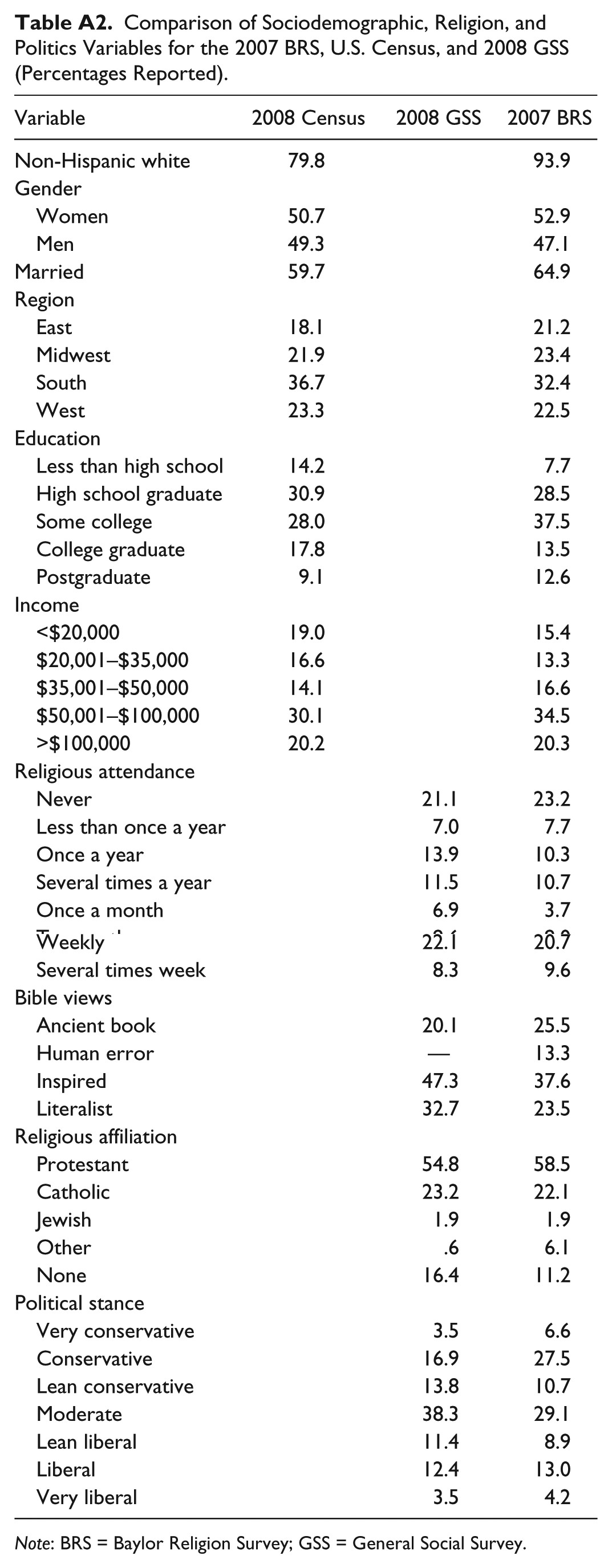
Comparison of Sociodemographic, Religion, and Politics Variables for the 2007 BRS, U.S. Census, and 2008 GSS (Percentages Reported).
| Variable | 2008 Census | 2008 GSS | 2007 BRS |
|---|---|---|---|
| Non-Hispanic white | 79.8 | 93.9 | |
| Gender | |||
| Women | 50.7 | 52.9 | |
| Men | 49.3 | 47.1 | |
| Married | 59.7 | 64.9 | |
| Region | |||
| East | 18.1 | 21.2 | |
| Midwest | 21.9 | 23.4 | |
| South | 36.7 | 32.4 | |
| West | 23.3 | 22.5 | |
| Education | |||
| Less than high school | 14.2 | 7.7 | |
| High school graduate | 30.9 | 28.5 | |
| Some college | 28.0 | 37.5 | |
| College graduate | 17.8 | 13.5 | |
| Postgraduate | 9.1 | 12.6 | |
| Income | |||
| <$20,000 | 19.0 | 15.4 | |
| $20,001–$35,000 | 16.6 | 13.3 | |
| $35,001–$50,000 | 14.1 | 16.6 | |
| $50,001–$100,000 | 30.1 | 34.5 | |
| >$100,000 | 20.2 | 20.3 | |
| Religious attendance | |||
| Never | 21.1 | 23.2 | |
| Less than once a year | 7.0 | 7.7 | |
| Once a year | 13.9 | 10.3 | |
| Several times a year | 11.5 | 10.7 | |
| Once a month | 6.9 | 3.7 | |
| Two or three times a month | 8.6 | 8.0 | |
| Weekly | 22.1 | 20.7 | |
| Several times week | 8.3 | 9.6 | |
| Bible views | |||
| Ancient book | 20.1 | 25.5 | |
| Human error | — | 13.3 | |
| Inspired | 47.3 | 37.6 | |
| Literalist | 32.7 | 23.5 | |
| Religious affiliation | |||
| Protestant | 54.8 | 58.5 | |
| Catholic | 23.2 | 22.1 | |
| Jewish | 1.9 | 1.9 | |
| Other | .6 | 6.1 | |
| None | 16.4 | 11.2 | |
| Political stance | |||
| Very conservative | 3.5 | 6.6 | |
| Conservative | 16.9 | 27.5 | |
| Lean conservative | 13.8 | 10.7 | |
| Moderate | 38.3 | 29.1 | |
| Lean liberal | 11.4 | 8.9 | |
| Liberal | 12.4 | 13.0 | |
| Very liberal | 3.5 | 4.2 |
Note: BRS = Baylor Religion Survey; GSS = General Social Survey.
Acknowledgements
We would like to thank the editors and reviewers for their constructive comments on a previous draft. All errors or omissions remain the authors’ alone.
1
References to the divine in the founding documents may have been more deist than theist, but Christian nationalists today interpret references to the divine as necessarily Christian, conveniently ignoring the influence of Enlightenment deism on the founding fathers (Barton 2000; Fea 2011). Perhaps ironically, proponents of the “Christian nation” narrative at the time of the founding fathers opposed the Constitution because it was viewed as godless (Lambert 2003,  ). Today, however, proponents of the Christian nation narrative go to great lengths to underscore the influence of the Christian God on the Constitution.
2
On March 9, Florida governor Rick Scott signed into law a bill that raises the minimum buying age to 21 years, mandates a three-day waiting period for more gun purchases, and gives police broad powers to confiscate guns from persons deemed to be a threat. It also created a program that will arm some teachers and school staff members.
3
To account for missing data on all covariates, we use multiple imputation in which the number of imputations equals five, using a regression-based approach in SAS version 9.3 with the PROC MI and PROC MIANALYZE commands. The latter command combines all the results from the five imputations to generate overall estimates, standard errors, and significance tests. Additional analyses using unimputed data yield equivalent results. There is some disagreement concerning the role of the dependent variable in multiple imputation (). Additional analyses in which multiple imputation procedures were not applied to the dependent variable, the independent variable of interest, or either yielded virtually identical results.
4
In the Appendix, compares the 2007 BRS with census estimates and the 2008 General Social Survey on various measures.
6
Although almost all prior work using these questions refers to the scale as measuring Christian nationalism, a few studies (see ) refer to the scale as measuring “sacralization ideology.” Although we do not believe the term sacralization ideology is inaccurate, it is perhaps too broad. We would argue that the BRS measures, with varying degrees of specificity, ultimately inquire about respondents’ beliefs that America is a distinctively Christian nation. The statements about the federal government’s declaring the United States to be a Christian nation, or advocating Christian values, or enforcing a strict separation of church and state are obvious. But we believe it would be a stretch to argue that the vast majority of American adults have anything else but Christianity in mind when they are asked about whether the federal government should allow the display of religious symbols in public spaces, or prayer in public schools, or whether the success of the United States is God’s plan. Affirmative answers to these questions would almost certainly indicate that the respondent envisions the United States not as a religiously diverse or generally sacralized nation, but as a Christian nation, consecrated by the Christian God, and where Christian identity, values, rituals, and symbols are privileged by the federal government.
7
This quantitative measure of Christian nationalism prompts respondents’ instantaneous feelings about the relationship between Christianity and the United States. We follow argument that these various questions, and their forced response categories, allow us to faithfully capture authentic and entrenched viewpoints and outlooks without requiring respondents to explain or defend their choices.
8
To ensure that there were no possible multicollinearity issues, we also tested models that included the political party and political ideology measures separately. The results for Christian nationalism from these ancillary analyses are statistically and substantively equivalent to those presented below.
9
10
In ancillary analyses (available on request) we considered whether general authoritarianism is a confounding mechanism for the relationship between Christian nationalism and gun control attitudes (Hetherington and Weiler 2009). We created an authoritarian index used in prior research () constructed from three questions that asked for respondents level of agreement with the statements “Obedience and respect are the most important things kids should learn,” “We must crack down on troublemakers to save our moral standards and keep law and order,” and “People should be made to show respect for America’s traditions.” Controlling for general authoritarianism does not alter the relationship between Christian nationalism and opposition to stricter gun control laws. This demonstrates that preferences for authoritarianism, which are associated with Christian nationalism, do not explain the relationship, and it is other aspects of Christian nationalism—and the desire for a close, symbiotic relationship between Christianity and civil society—that predict opposition to gun control.
11
In fact, the unaffiliated are lower, though not significantly lower, than evangelicals on support for gun control at any given level of Christian nationalism. Notably, the coefficient for unaffiliated versus evangelical on support for gun control was positive before accounting for Christian nationalism, on which the unaffiliated score quite low.
12
Consistent with the argument that the patterns are a result of Christian nationalism specifically, the patterns do operate differently among the “other faith” category. Although this group was small, there is a significant interaction effect between “other faith” and our Christian nationalism scale on gun attitudes such that the relationship was significantly weaker (i.e., nonexistent) among people of non-Christian faiths.
13
We explored interactions between each of our control measures and Christian nationalism. The lack of significant interactions suggests that the association between Christian nationalism and attitudes toward gun laws operates similarly across different segments of the American public.
14
Specifically, in the South there is a threshold beyond which more Christian nationalism does not have as strong an association with opposition to gun control. We explored the data visually and noted this anomalous pattern, and we subsequently found a significant three-way interaction effect for Christian Nationalism × Christian Nationalism × South. This curvilinear relationship for Christian nationalism in the South means that Christian nationalism is significantly linked to lower support for gun control, but only up to a certain point. In the South, where there is a culture of Christian nationalism and of opposition to gun control, both of which were higher than in the other regions, there appears to be a ceiling effect for opposition to gun control (those who score moderately high on Christian nationalism in the South demonstrate similarly high levels of opposition to gun control as those who score high on Christian nationalism in other regions). Aside from a potential ceiling effect for opposition to gun control, the curvilinearity we found in the South could be due to high levels of Christian nationalism being more countercultural, and thus more attitudinally influential, outside the South.